You're at the counter, the renewal notice is in your hand, and the clerk is waiting on a smog result that hasn't shown up yet. That's when most drivers start asking the same set of smog check questions, because the answer can decide whether you're done in one stop or headed back for another visit.
The confusion usually isn't about whether California takes emissions seriously. It's about the details, like whether your car needs a STAR station, whether a cleared check-engine light helps or hurts, and why a vehicle can fail right after a battery replacement. Those are the questions that matter, because they affect your time, your registration, and whether the car is actually ready.
Table of Contents
- Why Smog Check Questions Matter to Every Antioch Driver
- What Is STAR Certification and Why It Counts
- The Readiness Monitor Trap Most Drivers Fall Into
- Test-Only Stations vs Repair Shops
- Costs, Retests, and Preparation Tips
- Planning Your Smog Check Visit Successfully
Why Smog Check Questions Matter to Every Antioch Driver
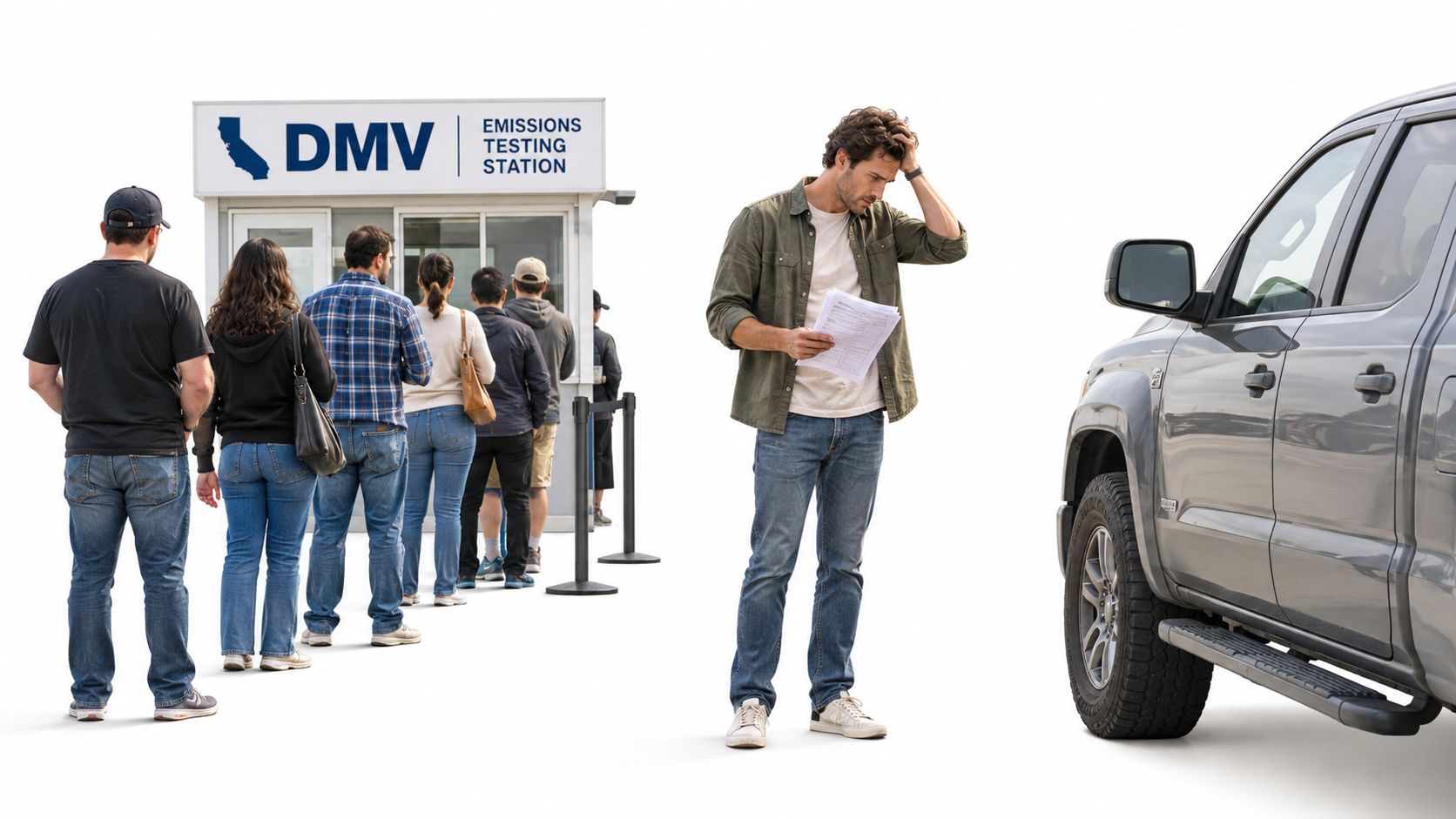
A driver walks into a DMV line thinking the hardest part is the wait. Then the renewal notice calls for a smog certification, the car hasn't been tested recently, and now the whole errand turns into a puzzle. That's why smog check questions matter, not as trivia, but as the difference between getting your paperwork done and getting sent home to sort out a failure or missing requirement.
California treats smog inspection as a recurring emissions check, not a one-time hurdle. The state's system tests whether the vehicle's emissions output and related components are working the way they should, and the outcome depends on the car's condition, model year, and test category. For drivers, that means the right answer is usually practical, not theoretical.
A test is a snapshot, not a judgment
A failed inspection doesn't always mean the vehicle is dying, and a passed inspection doesn't mean you can ignore maintenance. The test is a snapshot of how the car is behaving right now, under the state's rules. That's why someone with a good-running car can still get tripped up by readiness status, a missing monitor, or a station requirement they didn't notice on the renewal notice.
Practical rule: If the notice, the scanner, and the car's recent repairs don't all line up, slow down and check the details before you pay for another visit.
For Antioch drivers, the stress usually shows up at the worst moment, right before a sale, a registration deadline, or a repair follow-up. Getting clear answers early saves time, and it also tells you whether the problem is the vehicle itself, the station type, or just the way the inspection was triggered.
What Is STAR Certification and Why It Counts
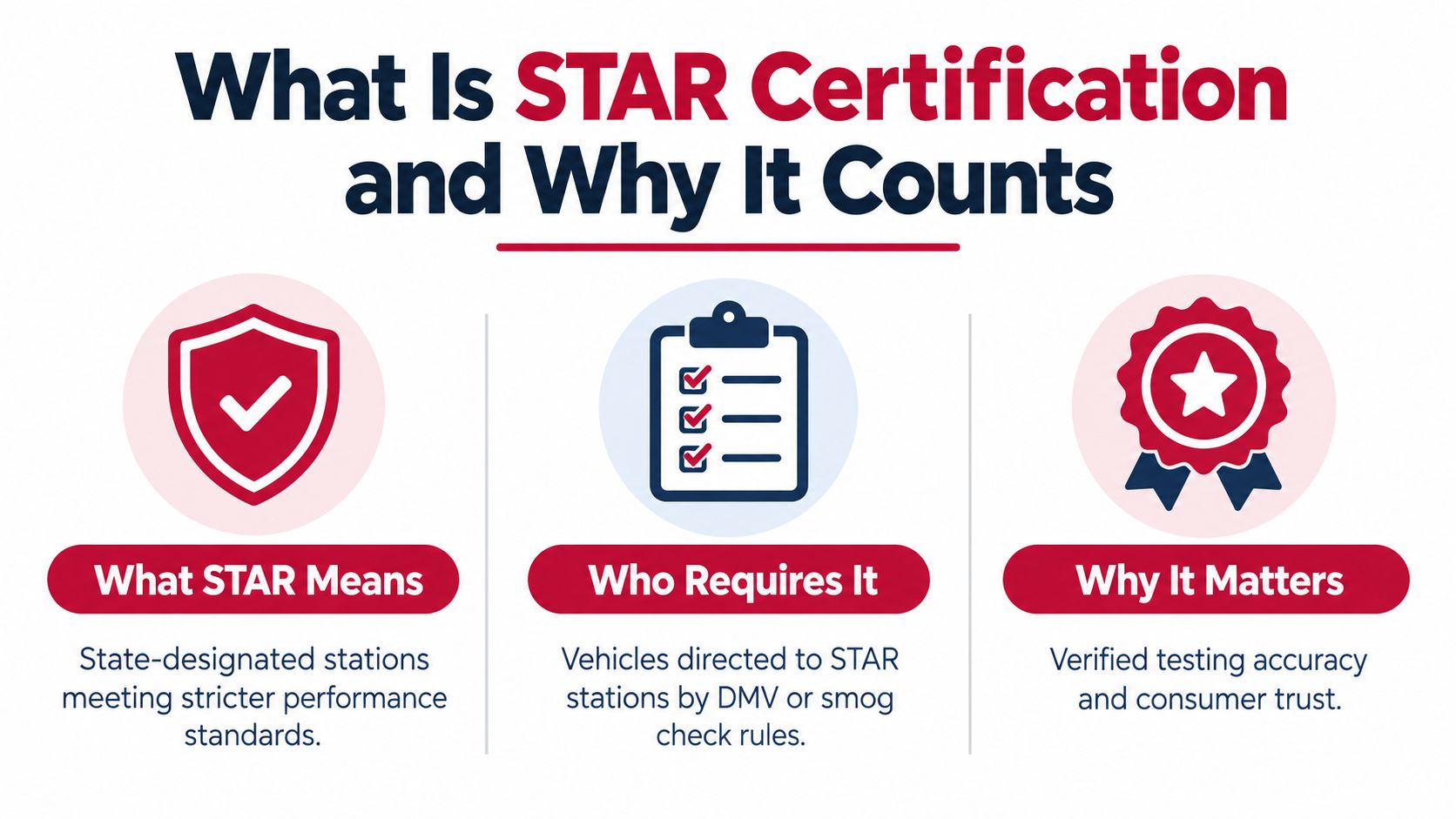
STAR certification is where a lot of drivers get stuck, because the word looks simple but the rule behind it isn't. In California, STAR stations are part of the state's inspection structure, and they matter because some vehicles are directed there by DMV or smog rules. If your renewal notice says STAR, the regular neighborhood station won't satisfy that requirement.
The volume tells the story. In calendar year 2023, 48% of licensed stations were STAR certified, yet STAR stations performed 83% of all Smog Check tests (BAR smog check performance report). That gap shows how much of the state's inspection load sits on STAR facilities, especially when vehicles are subject to directed testing or added scrutiny. If a station handles most of the testing, it's not because the badge is decorative, it's because the system routes a lot of work there.
What the designation means in practice
A STAR station is not just another logo on the wall. It signals a station operating under a stricter place in the program, which is why it comes up so often in consumer questions about renewals and pass rates. If you want a deeper breakdown of how the designation works, this guide on STAR-certified smog stations is a useful companion read.
The main point is simple. If the DMV notice says STAR, the station choice is part of the test itself, not a side issue. And if the notice doesn't say STAR, you still want a station that knows the rules well enough to process the test without confusion or delays.
A STAR requirement is about compliance, not convenience. Read the notice first, then choose the station.
For drivers trying to keep registration moving, that one word on the notice matters more than almost anything else in the smog process.
The Readiness Monitor Trap Most Drivers Fall Into
The most common mistake is also the most frustrating one. A driver clears a code, disconnects the battery, or swaps a part, then shows up expecting the car to pass because the warning light is off. The problem is that turning off the light doesn't complete the self-tests the car needs to prove the system is ready.
Modern OBD monitors watch systems such as the catalyst, oxygen sensors, evaporative emissions controls, and exhaust-gas recirculation. Those checks run only when the car sees the right temperature, speed, load, and fuel-level conditions. Until then, the monitor stays incomplete, and the inspection can fail because the computer hasn't finished confirming the repair.
Why clearing codes backfires
For California gasoline vehicles model year 2000 and newer, the Bureau of Automotive Repair generally allows the OBD test to pass only when the evaporative-system monitor is the sole incomplete monitor (BAR OBD test reference). If other monitors are still incomplete, approval can be blocked. That's why a cleared code can create a fresh problem instead of fixing the old one.
The smarter move is to check readiness before you go. If a scan tool shows incomplete monitors, drive normally until the vehicle has had the conditions it needs to run its tests. Cold starts, steady cruising, and deceleration all help, but the exact drive cycle changes by manufacturer.
- Check readiness first: Look at monitor status before you head to the station, especially after a battery swap or repair.
- Don't erase evidence twice: Repeatedly clearing codes can hide the fault and stretch out the delay.
- Ask the right question: If one monitor won't set, find out which one it is before paying for a retest.
If you want a plain-language walkthrough of this issue, the readiness monitor guide covers the same trap from a shop-floor point of view.
Useful rule: If the computer hasn't finished its checks, the car isn't ready, even if the dash looks calm.
That's the trap. The light is gone, but the car still hasn't proven anything.
Test-Only Stations vs Repair Shops
A lot of drivers assume every smog station is also trying to sell them something. That's not always true, and the difference matters. A test-only station sells inspection results, while a full-service repair shop can inspect and then offer work that may or may not be needed to get the car compliant.
| Feature | Test-Only Station | Full-Service Shop |
|---|---|---|
| Main business | Inspection | Inspection and repair |
| Repair sales | None | Yes |
| Customer focus | Pass or fail result | Test plus possible fixes |
| Conflict of interest | Lower | Higher |
| Best use | Drivers who want an unbiased test | Drivers who already need repairs |
That split is why many owners prefer a test-only facility when they just need the state result and nothing else. If the car passes, they're done. If it fails, they can decide separately where to get diagnosed and repaired instead of making that decision under pressure in the same bay.
One option in Antioch is Fire House Smog's test-only center, which fits that model. It's a straight testing environment, so the inspection decision isn't tied to an in-house repair ticket.
The practical benefit is trust. A test-only station doesn't have a repair bill waiting behind the result, so the customer gets a cleaner read on the vehicle's status. That's especially helpful when you're trying to separate a real emissions issue from a paperwork issue.
Costs, Retests, and Preparation Tips
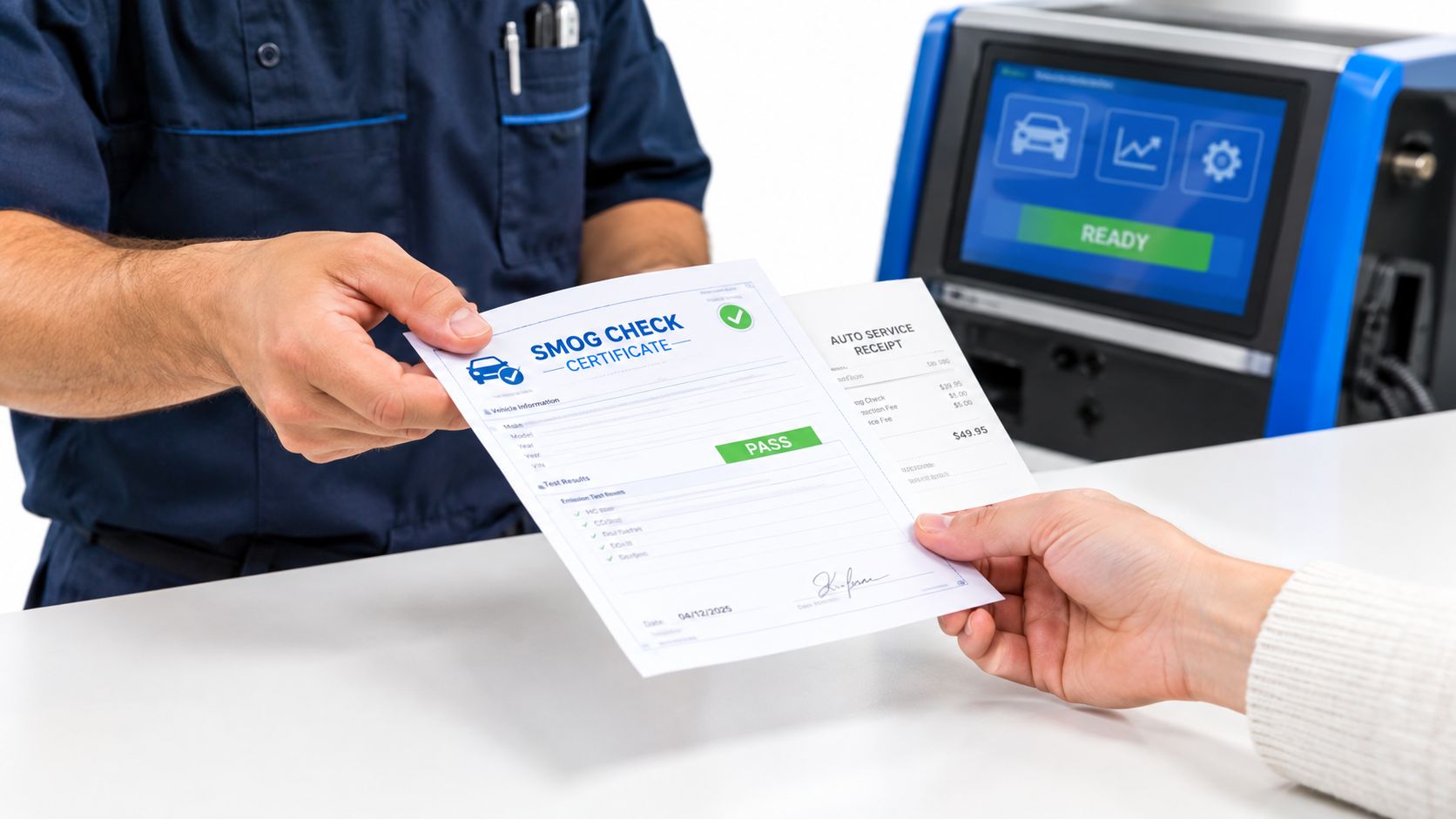
The best smog visit is the one that doesn't surprise you. If you know what to bring, what to check, and what the station offers after a failed test, you save yourself a second trip and a lot of guessing. That's why preparation matters as much as the inspection itself.
Two things make a real difference before you arrive. First, the car should already be in a state where the readiness monitors have had time to complete. Second, the station should be able to handle the inspection quickly, especially if you're trying to avoid losing a workday over a certificate.
Fire House Smog advertises two service bays, seven-day smog test availability, and free retest availability when required, per site policy and coupon terms. It also lists DMV service hours of Monday to Saturday 9:30 AM to 5:00 PM and Sunday 12:00 PM to 4:00 PM, with limited weekend services possible. Those details matter because they change the logistics, not just the convenience.
A short video walkthrough can also help if you're comparing station flow and certificate handling.
What to do before you roll in
- Confirm readiness: Scan the car if you've replaced the battery, cleared codes, or finished repairs.
- Bring the right expectations: A smog certificate is only useful if the result has been transmitted or accepted where it needs to go.
- Choose a station with capacity: Two bays can reduce the odds of sitting in line while your whole day disappears.
If your schedule is tight, a station that can inspect and also process DMV-related work on site can cut down the back-and-forth. That's not about a sales pitch, it's about finishing the job in one stop.
Planning Your Smog Check Visit Successfully
The cleanest smog visit starts before the engine ever warms up. Read the renewal notice closely, check whether the car needs a STAR station, and make sure any recent battery work or code clearing hasn't reset the readiness monitors. Those three steps solve most of the confusion people bring to the counter.
If the vehicle just had repairs, don't assume a cleared light means success. The computer still has to rerun its tests, and California's OBD rules can block a pass when the wrong monitors are incomplete. That's why a scanner check before the appointment is often smarter than hoping for the best at the lane.
A simple pre-visit checklist
- Read the DMV notice word for word: STAR required and smog required are not the same thing.
- Check OBD readiness: Make sure the car has completed the monitors it needs.
- Avoid last-minute battery disconnects: That usually sets you back instead of helping.
- Use a test-only station when you want a pure result: It keeps the inspection separate from repair pressure.
- Plan for your schedule: Extended hours help if you can't leave work in the middle of the day.
A good smog visit should answer one question clearly, can the car be certified right now. If the answer is no, you want that answer early, not after a long wait or a second line at another counter.
The smartest drivers treat smog checks like a readiness check, not a gamble.
That approach keeps registration moving and takes a lot of stress out of the process.
If you want a straight answer on your vehicle, Fire House Smog handles STAR-certified, test-only inspections and DMV-related services in Antioch. Visit Fire House Smog to check what your car needs and get the smog side of the process handled without extra back-and-forth.