The inspection itself typically takes about 30 minutes. Your total visit may take longer because check-in, paperwork, payment, vehicle positioning, and any queue happen outside the hands-on test.
You may be asking because a registration deadline is approaching, your workday is already planned around a short stop, or you don't want to arrive at a smog station and discover that “30 minutes” means something different than you expected. For a California STAR Smog Check, the most useful distinction is between inspection time and total visit time.
The technical inspection is only one stage. A test-only station may also need to verify vehicle information, position the car, complete required documentation, process the result, and manage vehicles waiting ahead of you. Understanding that sequence makes it easier to choose an appointment or walk-in time without building your entire day around an uncertain estimate.
Table of Contents
- Understanding the Star Test Timeline
- The Two Phases of Your Smog Check Visit
- Key Factors That Extend Test Duration
- What to Expect at a STAR Test-Only Station
- Comparing Standard and Extended Timelines
- Tips to Minimize Time Spent at the Station
Understanding the Star Test Timeline
Your registration deadline is close, and you have planned a quick stop before work. At a STAR test-only station, the inspection may fit into that window, but the full visit follows a longer path from arrival to certification.
At Fire House Smog, separate the inspection time from the waiting and administrative time around it. The hands-on inspection is the technical portion. A line, vehicle positioning, data entry, paperwork, certificate processing, or payment can add time before or after that work. This distinction gives you a more useful answer to “How long is STAR testing?” and helps you reserve time without treating the estimate as a guarantee.
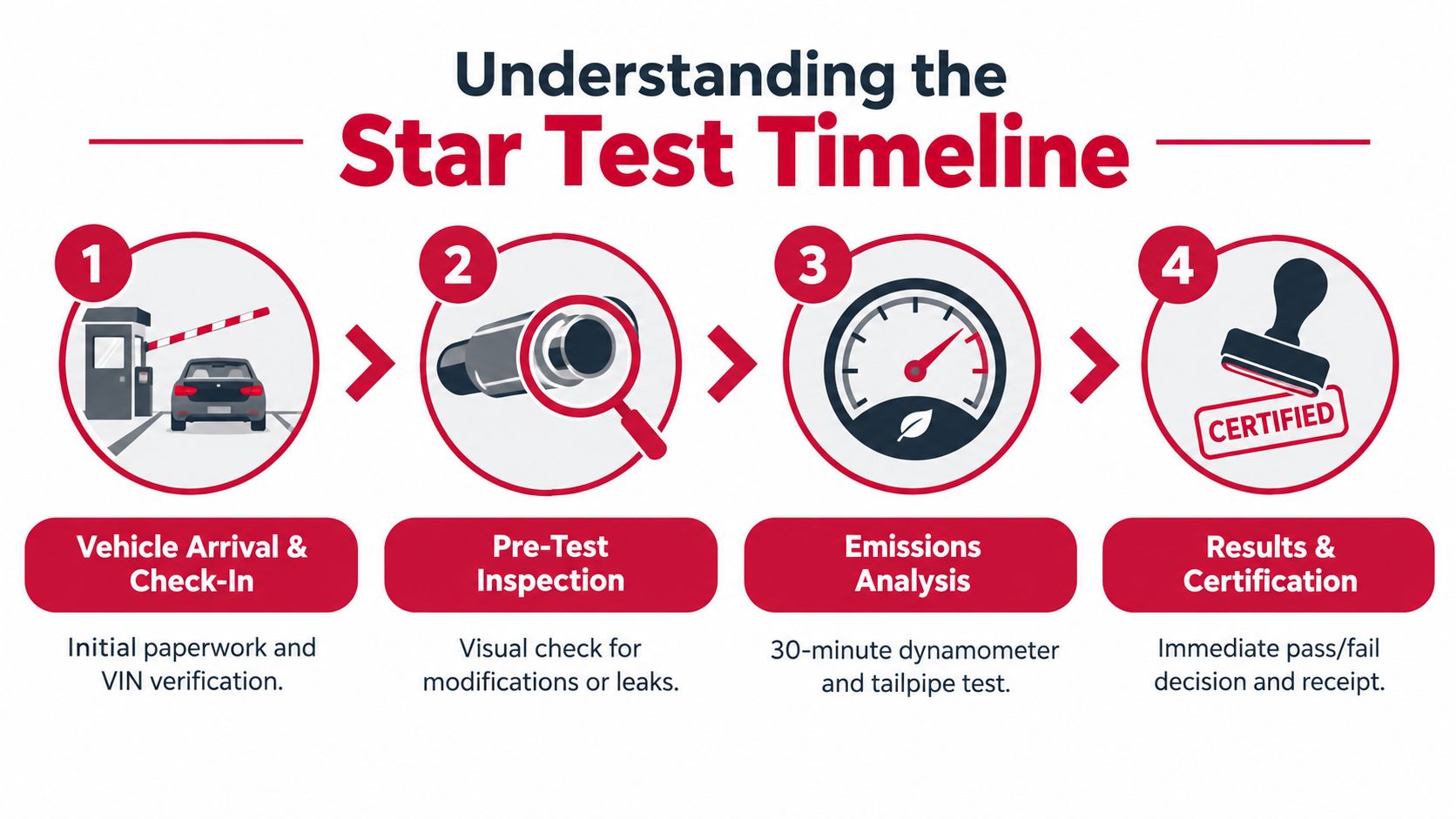
The working estimate
The timeline works like a short sequence with four parts:
- Arrival and check-in, when the station records the vehicle and customer details.
- Pre-test checks, including the visual and functional portions that apply to the vehicle.
- Emissions analysis, the main technical part of the inspection.
- Results and certification, when the outcome and receipt are processed.
The California Bureau of Automotive Repair's STAR FAQ explains that a thorough inspection can take 20 minutes or more, while its practical estimate is about 30 minutes for the inspection itself (California Bureau of Automotive Repair's STAR FAQ). Use the 20-minute figure as an indication of the hands-on work, and reserve 30 minutes as the more useful planning allowance for the inspection's required procedures.
Practical rule: Reserve about 30 minutes for the inspection, then add personal buffer for a possible line and administrative processing.
That extra margin can protect your work schedule, DMV plans, or school pickup if the station is busy. For a broader explanation of the steps surrounding the technical test, see this guide to how long a smog check takes.
The Two Phases of Your Smog Check Visit
A STAR visit becomes easier to understand when you separate it into intake and processing first, followed by the technical inspection. The phases connect, but they don't take place in the same way or require the same information from you.
Phase one, intake and processing
The first step is administrative. The station needs to identify the vehicle, record the relevant information, and prepare the order for inspection. You may need to provide registration details or answer questions about the vehicle, while the technician confirms what type of testing applies.
This stage helps prevent an incorrect test. The vehicle's age, equipment, readiness status, and inspection requirements affect the workflow, so accurate information at check-in gives the technician a clearer starting point. A queue can also form here if several customers arrive at once, even when the inspection bay itself is available.
Keep your registration information accessible and tell the technician if the battery was recently disconnected or replaced. That detail can affect whether the vehicle is ready for testing, as explained in the California BAR smog check overview.
Phase two, the technical inspection
Once intake is complete, the vehicle moves through the applicable inspection procedures. For most vehicles from 2000 and newer, the process includes an OBD inspection, which checks information from the onboard emissions system. Vehicles built before 2000 generally receive a tailpipe emissions test instead, according to the BAR smog check requirements.
The technician may also perform a visual inspection of emissions-control hardware and functional checks. These steps aren't optional extras. They help establish whether the vehicle's emissions equipment is present and operating according to the applicable requirements.
After the technical work, the result is recorded and the customer receives the relevant documentation. A passing result may allow you to continue with registration tasks, while a failing result means you'll need to address the identified problem before seeking another test.
The key planning point is simple: the inspection clock starts after intake and vehicle preparation, not necessarily when you first enter the station.
Key Factors That Extend Test Duration
The about 30-minute estimate works best for a vehicle that is ready, a station with manageable workload, and a test that proceeds without complications. Several conditions can change that experience before or during the inspection.
Vehicle age and inspection type
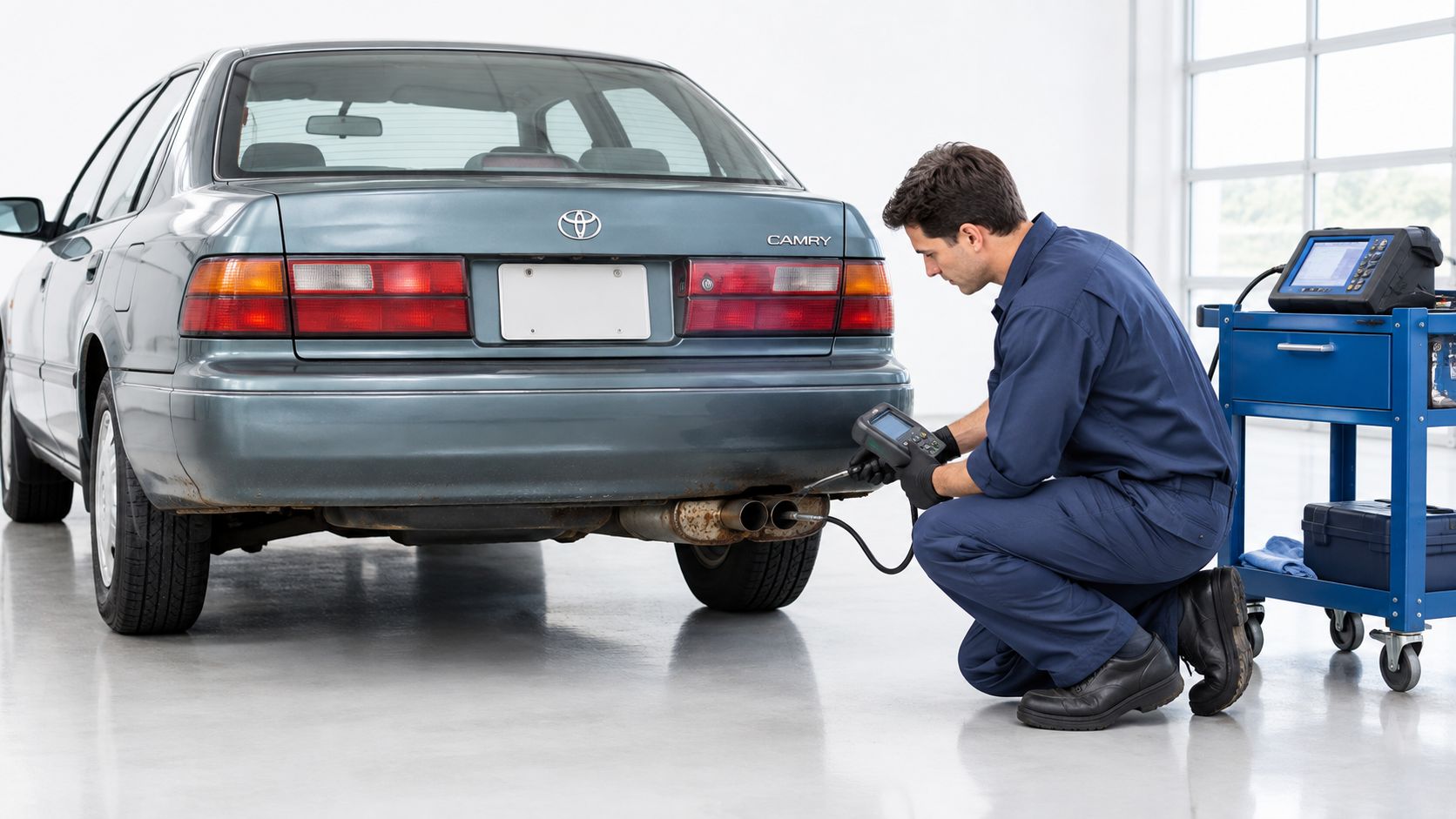
The vehicle's model year affects the technical path. Most vehicles from 2000 and newer typically receive an OBD inspection, while pre-2000 vehicles generally receive a tailpipe emissions test. The inspection can also vary by vehicle type, applicable procedures, and the technician's familiarity with that vehicle.
A STAR station meets higher performance standards and may inspect vehicles that require STAR testing, including high-polluting vehicles. STAR status doesn't create a separate fixed-duration test protocol. It identifies the station's authorization and performance category, while the actual work still depends on the vehicle and required procedures.
Readiness monitors and battery history
A recently disconnected or replaced battery can create a delay that no station can solve by moving your car ahead in line. California requires driving for roughly a week or two in some circumstances so emissions-readiness monitors can reset before the vehicle is tested. If the monitors aren't ready, the visit may end without a completed passing inspection.
The OBD readiness monitor information can help you understand why a vehicle may need preparation before arrival. The important distinction is between waiting at the station and waiting for the vehicle's computer to complete its monitoring cycle. The second may require time on the road before testing can proceed.
Warning lights and station workload
An illuminated check-engine light signals a condition that must be repaired before a passing result is possible. Testing the car sooner doesn't remove that requirement, and attempting a test without addressing the issue can turn a planned certification visit into a repair appointment.
Queue length also matters. A station may complete the technical inspection efficiently while customers still wait for a bay, intake, or final paperwork. This short video provides additional visual context for the emissions testing process.
What to Expect at a STAR Test-Only Station
You arrive expecting one task, but the visit runs on two clocks. The first is the hands-on inspection in the bay. The second covers check-in, vehicle and registration details, result entry, and certification paperwork. Separating these stages gives you a clearer estimate than treating the entire visit as one block of testing time.
A test-only station performs the inspection and records the outcome. It does not handle emissions repairs as part of that appointment. If the vehicle does not pass, you can take the result to a repair provider of your choice rather than making an on-the-spot decision about station repairs.
At Fire House Smog, the STAR test-only workflow uses two service bays. That capacity can help keep vehicles moving when one bay is occupied by a procedure or paperwork. It does not guarantee an immediate start, since the total visit still depends on the vehicle, the station's current workload, and the time needed for administrative steps.
A typical customer sequence
The process usually follows this order:
- Check in: Provide the requested vehicle and registration information.
- Confirm the test: The station identifies the STAR inspection procedures that apply.
- Move into a bay: The technician performs the applicable visual, functional, OBD, or tailpipe checks.
- Receive the result: The station records the outcome and gives you the relevant receipt or certification information.
The inspection is only one part of the timeline. The test-only format keeps the next decision clear: after the result is recorded, you know whether the vehicle passed or needs attention elsewhere. Drivers planning a focused visit can review the quick STAR smog service information beforehand. Calling ahead can also clarify arrangements for an unusually large vehicle or special equipment.
Comparing Standard and Extended Timelines
At Fire House Smog, a STAR test-only visit has two separate clocks: the time spent on the inspection and the time spent waiting, checking in, paying, or completing certificate processing. A vehicle that is ready and accepted promptly may need about 30 minutes for the inspection itself. The full visit can take longer.
| Scenario | Estimated Time |
|---|---|
| Vehicle is ready, the station has available capacity, and the inspection proceeds normally | About 30 minutes for the inspection, plus intake and processing |
| Vehicles are waiting ahead of you | Longer than the inspection estimate because the delay occurs before the vehicle enters a bay |
| Registration information, payment, or certificate processing needs extra attention | Longer than the hands-on inspection |
| The battery was recently disconnected or replaced and the monitors are not ready | Immediate testing may not be possible. Applicable readiness driving may take roughly a week or two |
| The check-engine light is illuminated | Repair is required before a passing result is possible |
| The vehicle fails and needs diagnosis or corrective work | The visit extends beyond the inspection, followed by a later retest after the issue is addressed |
This comparison separates inspection time from administrative and readiness delays. The about 30 minutes estimate describes the core STAR inspection, much like the time a technician spends examining a vehicle rather than the time a customer spends completing an entire appointment.
A queue adds time before testing begins. Paperwork or payment adds time after the inspection. A readiness problem changes the schedule more significantly because the vehicle may need additional driving before a valid test can occur. A failed test creates a separate repair and retest timeline.
A short visit is realistic when the vehicle is prepared and the station can accept it without a substantial queue. If a warning light is on or an emissions issue remains unresolved, schedule diagnosis first. Treating a STAR appointment as a troubleshooting visit can turn a focused inspection into a longer process.
Tips to Minimize Time Spent at the Station
A driver who arrives at Fire House Smog with the right documents and a prepared vehicle can keep the appointment focused on the inspection. Preparation cannot remove every queue or processing delay, but it can prevent avoidable interruptions before and after the hands-on test.
Before leaving, check the dashboard and consider the vehicle's recent history. A short drive may warm the engine, but it will not resolve an illuminated check-engine light or incomplete readiness monitors. If the battery was recently disconnected or replaced, tell the station and confirm whether the vehicle can be tested yet.
Use this checklist:
- Review the dashboard: Arrange repairs before testing if the check-engine light is illuminated.
- Confirm battery history: Mention any recent battery disconnection or replacement during intake.
- Bring documents: Keep registration information available for registration and certificate processing.
- Plan a buffer: Allow time for a queue, payment, and paperwork beyond the core inspection.
- Choose the right visit window: Extended weekday hours and weekend availability may help you fit the appointment around work.
- Ask about retesting: If the vehicle fails, confirm the station's current free-retest policy and any coupon terms before authorizing repairs.
Two service bays may help Fire House Smog keep vehicles moving, while testing seven days a week gives drivers more scheduling options. Required procedures still take their proper time, and an unready vehicle cannot be rushed through a valid test.
Visit Fire House Smog for a STAR test-only smog inspection in Antioch. Contact the station before arrival with questions about vehicle size, readiness monitors, retesting, or how much time to reserve.
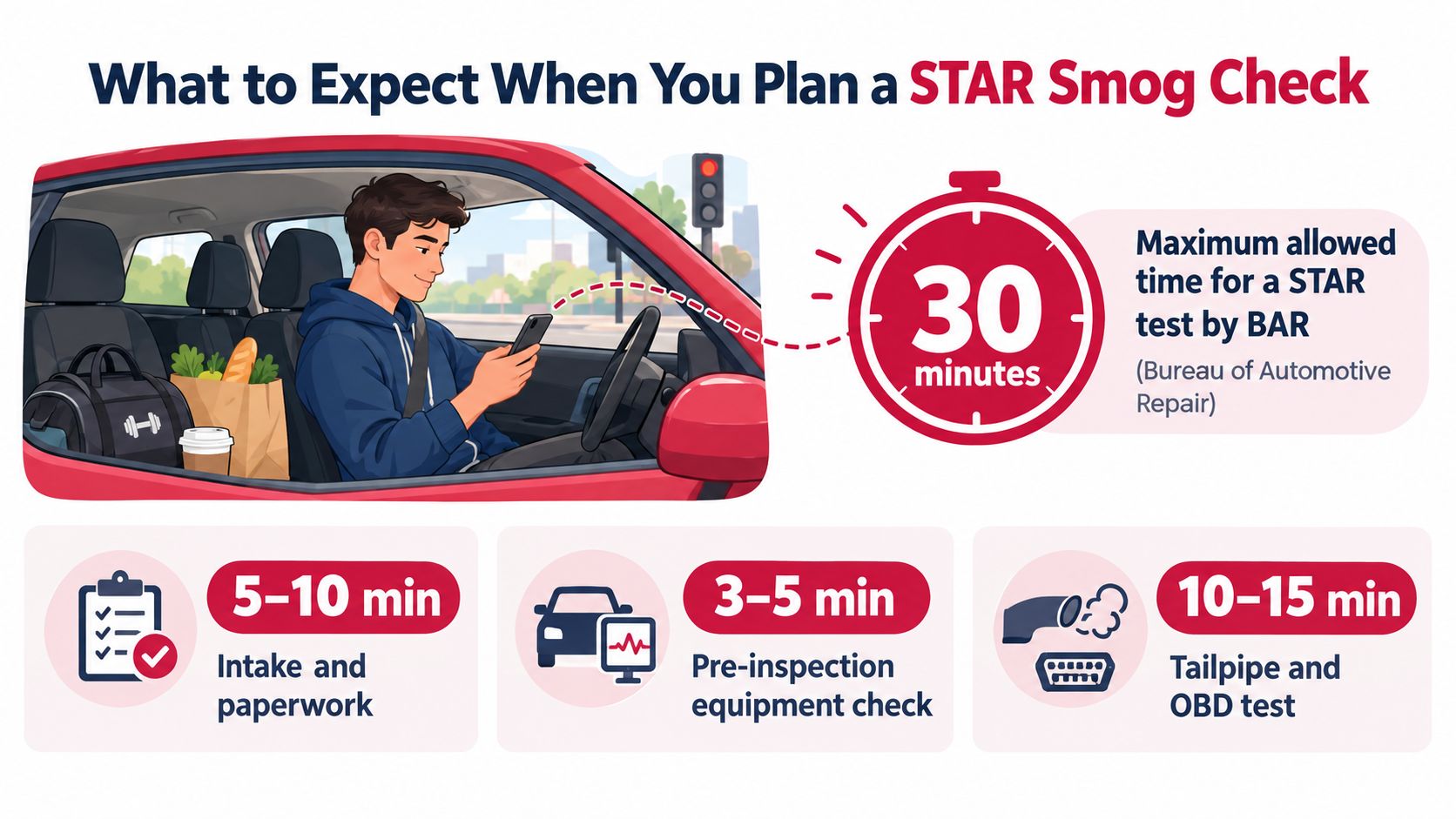
A STAR test-only smog check typically runs about 30 minutes for the inspection itself, with the full visit often stretching to 45 to 60 minutes once intake, paperwork, and any queue are included. Older vehicles can take longer because their inspections may require tailpipe testing instead of only an onboard diagnostic check.
You may be trying to fit the appointment between work, school pickup, and a DMV deadline. The mistake I see most often is budgeting only for the time the vehicle sits on the machine. At a real station, the clock also includes check-in, registration details, vehicle identification, test setup, results review, payment, and electronic certificate processing.
The California Bureau of Automotive Repair's Smog Check guidance uses about 30 minutes as the normal benchmark. Treat that as the inspection window, not a promise that you'll be back on the road exactly half an hour after arrival.
Table of Contents
- What to Expect When You Plan a STAR Smog Check
- Inside the Smog Check Workflow Step by Step
- How Vehicle Age Affects Inspection Time
- Retests Free Repairs and the Clock Reset
- Smart Ways to Cut Your Wait at the Station
- Putting It All Together Your Realistic Time Budget
What to Expect When You Plan a STAR Smog Check
A driver who's scheduling a STAR test-only inspection between errands should reserve roughly an hour of usable time. BAR's benchmark is about 30 minutes for the test, but intake, paperwork, and a waiting vehicle ahead of you can extend the visit to 45 to 60 minutes. Busy stations can take longer, particularly when a vehicle needs extra verification or a technician is finishing another test.
STAR stations follow BAR requirements and may handle vehicles directed to STAR testing or identified as gross polluters. That means the technician can't skip required visual, emissions, and diagnostic checks just because the car appears to be running well. A test-only station also can't fix the vehicle during the inspection, so a failure becomes a separate repair decision rather than an improvised repair session.
Your appointment plan
Use this simple schedule:
- Reserve a time slot instead of assuming a walk-in will move immediately.
- Allow an hour buffer for a normal first visit.
- Avoid back-to-back morning commitments, especially if the vehicle is older or has a warning light history.
- Ask about same-day retesting before the technician starts, so you know the station's policy if the car fails.
A two-bay test-only shop generally has more room to keep one vehicle moving while another is being checked. That doesn't eliminate queues, but it can reduce the bottleneck created by a single occupied bay. In my experience, early weekday appointments are usually easier to manage than a late-morning walk-in, but you should still confirm the station's actual schedule.
Practical rule: If missing the next appointment would cause a problem, don't book the smog check without leaving a full hour for the visit.
For a clear explanation of the STAR designation and why a vehicle may be directed to one of these stations, review this guide to what STAR-certified smog testing means.
Inside the Smog Check Workflow Step by Step
The inspection bay is only one part of the appointment. A clean, ready vehicle moves through the process predictably, while missing paperwork, incomplete readiness monitors, or an older emissions system can slow the technician down.
The five stages that consume time
Check-in comes first. Expect time for the driver's information, registration or renewal details, vehicle identification, payment, and the station's work order. If the counter is handling another customer, your vehicle may be waiting before it reaches the bay.
Vehicle preparation follows. The technician identifies the correct test path, connects the equipment, checks the diagnostic connection where applicable, and prepares any tailpipe equipment required for the vehicle. Setup is quick when the car is accessible and the required systems are in normal condition.
The emissions portion depends heavily on the vehicle. Newer cars commonly provide results through OBD-II data, while older vehicles may require additional tailpipe procedures. The BAR notes that pre-2000 model-year vehicles may require a tailpipe emissions test, which adds steps compared with a straightforward diagnostic scan. See the BAR inspection guidance for the official program framework.
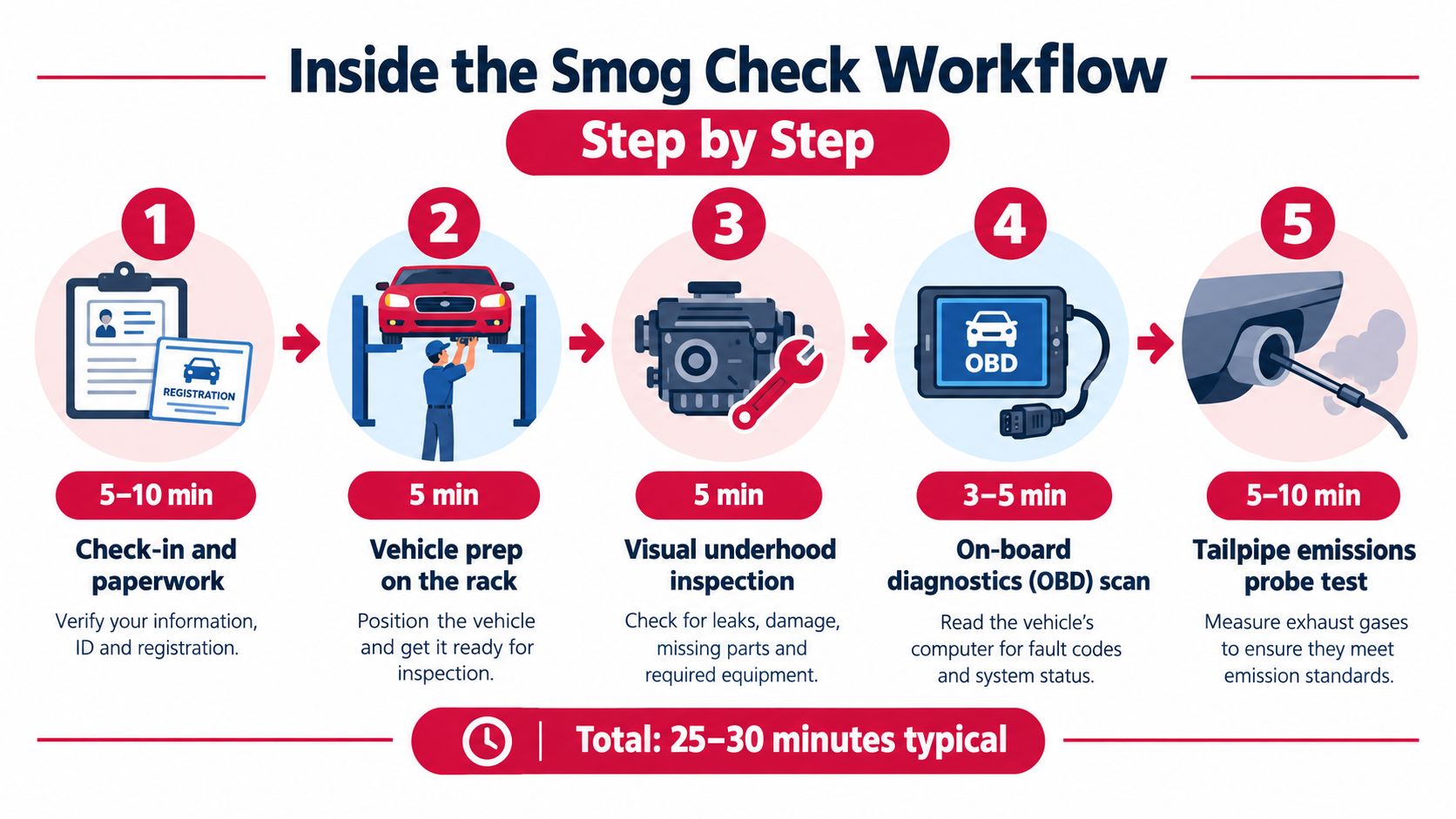
The final stage is results handling. The technician reviews the outcome, explains a pass or failure, issues the certificate when appropriate, and submits the result electronically. A slow connection, a missing document, or a customer question about the report can add time after the machine has finished.
Why the machine isn't the whole appointment
Drivers often ask why a “30-minute test” takes closer to an hour. The answer is operational. The technician must establish the vehicle's identity, choose the correct procedure, document the result, and complete the transaction.
If the car passes cleanly, the final review is usually straightforward. If it fails, the technician must explain which portion of the inspection produced the failure and provide the report needed for repair planning. That conversation is useful, but it doesn't belong in the machine-time estimate.
How Vehicle Age Affects Inspection Time
Vehicle age is the most practical predictor of inspection length. Newer vehicles usually rely more heavily on onboard diagnostics, while older vehicles may need a tailpipe measurement and additional manual checks.
The industry range is commonly 15 to 30 minutes for a standard emissions inspection, while one California-focused timing guide lists 15 minutes for 2000-and-newer vehicles, 25 minutes for 1996 to 1999 models, and 35 minutes for 1995-and-older vehicles. Those figures show the model-year gradient clearly, but they describe testing time and shouldn't be treated as a guaranteed door-to-door appointment length. Review the California smog timing guidance by vehicle age when estimating your visit.
| Vehicle Category | Model Years | Estimated Inspection Time | Test Type |
|---|---|---|---|
| Newer OBD-II vehicle | 2000 and newer | About 15 minutes | OBD-II inspection |
| Transitional OBD-II vehicle | 1996 to 1999 | About 25 minutes | OBD-II with additional emissions checks |
| Older vehicle | 1995 and older | About 35 minutes | Tailpipe-based emissions testing where required |
A ready OBD-II vehicle is usually the fastest path because the technician can retrieve diagnostic and readiness information directly from the car. The process becomes less predictable when monitors aren't ready, the malfunction indicator lamp is illuminated, or the vehicle has been recently disconnected from its battery.
Older cars deserve more planning. If your vehicle falls into that category, read this guide to smog checks for older cars before booking. Ask the station whether it handles your exact vehicle type, especially if the car is a diesel, a heavy-duty pickup, or a specialty vehicle with equipment requirements outside the ordinary passenger-car workflow.
California's 2026 BAR update also matters for collector vehicles. The update says expanded collector-vehicle exemptions are phased in beginning January 1, 2028, so some older vehicles may face different inspection requirements in the future. That change can affect whether a vehicle needs a STAR inspection at all, which in turn affects queue expectations for stations serving older-car owners.
Retests Free Repairs and the Clock Reset
The hardest time estimate is the one after a failure. A driver arrives expecting a certificate, hears that the vehicle didn't pass, and leaves with a report instead. The inspection may be over, but the registration task isn't.
The technician should provide a failure report identifying the area that needs attention. Common problem categories include catalytic-converter performance, evaporative-emissions leaks, and ignition misfires. Those problems don't have one fixed repair time. A pre-diagnostic scan at a repair shop can help separate a simple sensor or leak issue from a repair that requires deeper testing.
The retest timeline
California's program generally gives the driver a 90-day period for repairs and retesting under the applicable rules. Confirm the exact retest terms with the station, because fee policies and eligibility can depend on where the original test occurred and the station's stated conditions.
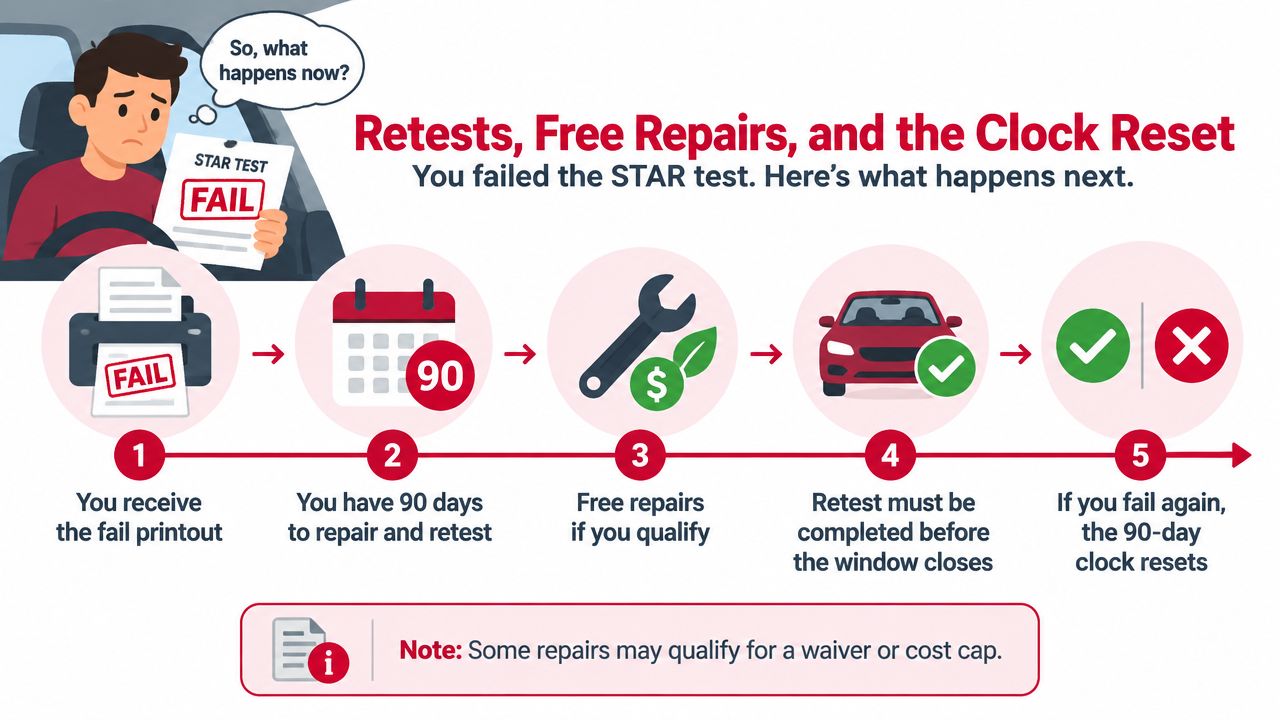
The practical sequence is simple:
- Keep the failure report: Give it to the repair technician so they can target the failed portion.
- Confirm the retest policy: Ask whether the same station offers a waived retest fee and what conditions apply.
- Repair before returning: Don't use the retest appointment as a second diagnostic session unless the station specifically offers that service.
- Return before the window closes: A different station may require its own intake process and may not honor the original station's free-retest terms.
The phrase “free retest” doesn't mean the whole second visit is cost-free. Repairs still cost money, and a state fee may apply depending on the transaction. The return trip also consumes time, often adding a substantial appointment window to the original visit.
A failed test resets your schedule, not just your repair list.
If you're comparing the total financial and time impact before booking, use this explanation of vehicle emissions test costs and ask the station for its current retest policy.
The clock-reset feeling is real. Choosing another STAR station can mean repeating check-in, waiting for a bay, and beginning the inspection workflow again. Keep the original paperwork, repair the documented issue, and return to the same station when its policy makes that the most efficient option.
Smart Ways to Cut Your Wait at the Station
The fastest appointment starts before you pull into the lot. A prepared driver removes the small delays that cause a short inspection to become a long visit.
Make the vehicle easy to process
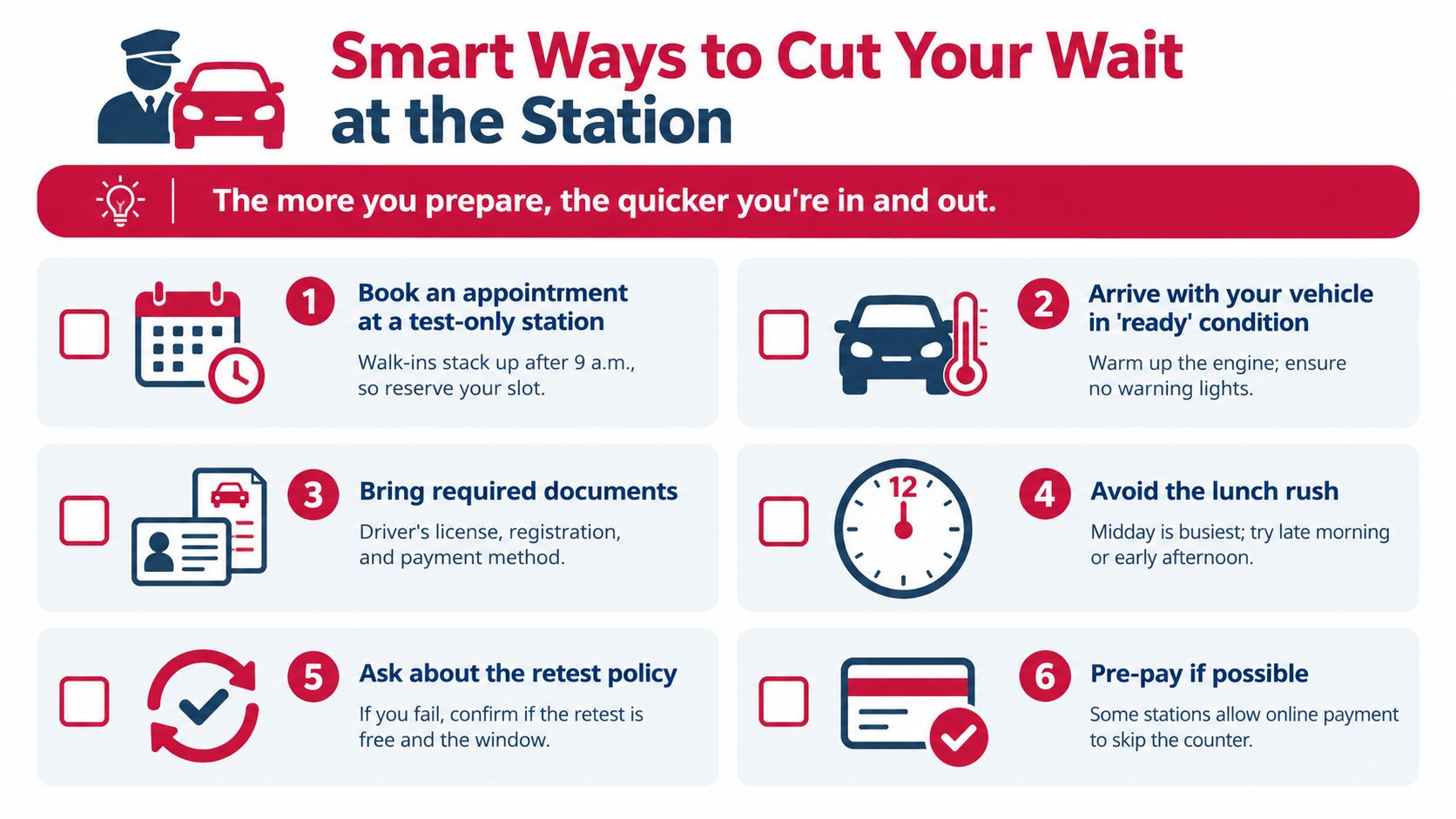
Book an appointment at a test-only station whenever the option exists. Walk-ins can stack up during the morning and midday rush, and a reservation gives the station a better chance to assign a bay without interrupting another test.
Arrive with the engine fully warm from normal driving. Don't race the engine in the parking lot. Drive normally, then arrive with the dashboard malfunction indicator lamp confirmed off. If the light is on, the station can't turn a likely failure into a pass by rushing the inspection.
Bring the documents the counter needs:
- Identification: Have your photo ID available.
- Registration details: Bring the registration or renewal notice so the technician can match the vehicle and transaction.
- Payment: Keep the payment method ready instead of searching through the car at check-in.
- Vehicle information: Tell the station about unusual equipment, a recent battery disconnect, or a vehicle classification that may require a different procedure.
Ask the right questions before entering the bay
Call ahead if you drive a diesel, heavy-duty truck, recreational vehicle, or unusually large vehicle. A passenger-car bay may not accommodate every vehicle, and finding that out after arrival is a wasted trip.
Operator advice: Ask which bay is available and whether the diagnostic equipment is already running a test. That answer tells you more about your likely wait than a generic promise that the station is “not busy.”
Don't arrive with an avoidable readiness problem. A recently cleared diagnostic system can leave monitors incomplete, and the vehicle may need normal driving before it can be tested successfully. The station can tell you what it sees, but it can't manufacture a valid readiness result at the counter.
Some stations combine testing with DMV services, while others focus only on inspections. Fire House Smog is a STAR-certified test-only station with two service bays, seven-day smog testing, and California DMV registration services at its Antioch location. Confirm current hours, vehicle eligibility, appointment availability, and retest terms before you drive over.
Putting It All Together Your Realistic Time Budget
The cleanest way to answer how long does a STAR smog check take is to separate three situations: a prepared newer vehicle, an older vehicle, and a failure that creates a second visit.
For a clean OBD-II pass, reserve 45 to 60 minutes door to door. The BAR benchmark covers about 30 minutes of inspection, but intake, a queue, results review, payment, and certificate handling determine when you leave. This is the budget I recommend for a driver with a normal passenger vehicle and a scheduled appointment.
An older vehicle deserves more room. Guidance places standard testing broadly in the 15-to-30-minute range, while the California-focused timing breakdown reaches 35 minutes for 1995-and-older vehicles. Add the counter process and possible queue, and you should avoid scheduling another appointment immediately afterward.
| Scenario | Intake | Inspection | Certificate | Total Visit |
|---|---|---|---|---|
| Prepared newer OBD-II vehicle | 5 to 10 minutes | About 15 to 30 minutes | A few minutes | Plan for 45 to 60 minutes |
| Older vehicle needing tailpipe testing | 5 to 10 minutes | About 25 to 35 minutes | A few minutes | Plan beyond the standard hour if busy |
| Failed test and later retest | New check-in at return | Repeat inspection process | Review after result | Reserve another substantial appointment window |
A failure creates a second planning problem. You need the repair appointment, parts or diagnostic time, and a return visit within the applicable 90-day retest period. A free or waived retest policy may reduce the testing charge, but it doesn't eliminate the time required to bring the vehicle back and process it again.
The collector-vehicle rules add another reason to check eligibility before scheduling. BAR's 2026 update describes expanded exemptions phased in beginning January 1, 2028, so those changes are a future consideration rather than a current blanket exemption. They may alter which older vehicles enter STAR queues later, but you should use the rule that applies to your vehicle and registration transaction today.
Book the appointment, arrive with the required documents, warm the vehicle through normal driving, and leave an hour of breathing room. That plan is more reliable than betting your day on the machine finishing quickly.
Fire House Smog provides STAR-certified test-only inspections, two service bays, and DMV registration services for eligible vehicles in Antioch. Check current hours and vehicle requirements, then visit Fire House Smog to plan your smog check with enough time for the inspection and certificate process.
Your registration notice is on the passenger seat. You've got errands to run, work later, and no interest in spending half the day bouncing between a smog station and the DMV. That's usually when people start looking for a drive through smog check and asking the same practical questions: Can I stay in the car? How long does it really take? What slows the process down? Can I finish the registration part today too?
If you're in Antioch or elsewhere in East Contra Costa County, those are the right questions. California's smog system isn't a small side task. It's a large compliance program built around repeat inspections, and the modern framework goes back to the statewide program that began in March 1984 after SB 33 passed in 1982, with biennial testing and change-of-ownership testing in participating counties, plus structured inspections and shop certification requirements, as outlined in the California Smog Check Program overview.
Table of Contents
- Introduction to the Drive Through Smog Check Experience
- How a Drive Through Smog Check Actually Works
- Drive Through Versus Traditional Smog and DMV Options
- Vehicle Size Limits and Which RVs Can Be Tested
- What to Expect When You Arrive Step by Step
- Tips to Get Through Your Smog Check Faster
Introduction to the Drive Through Smog Check Experience
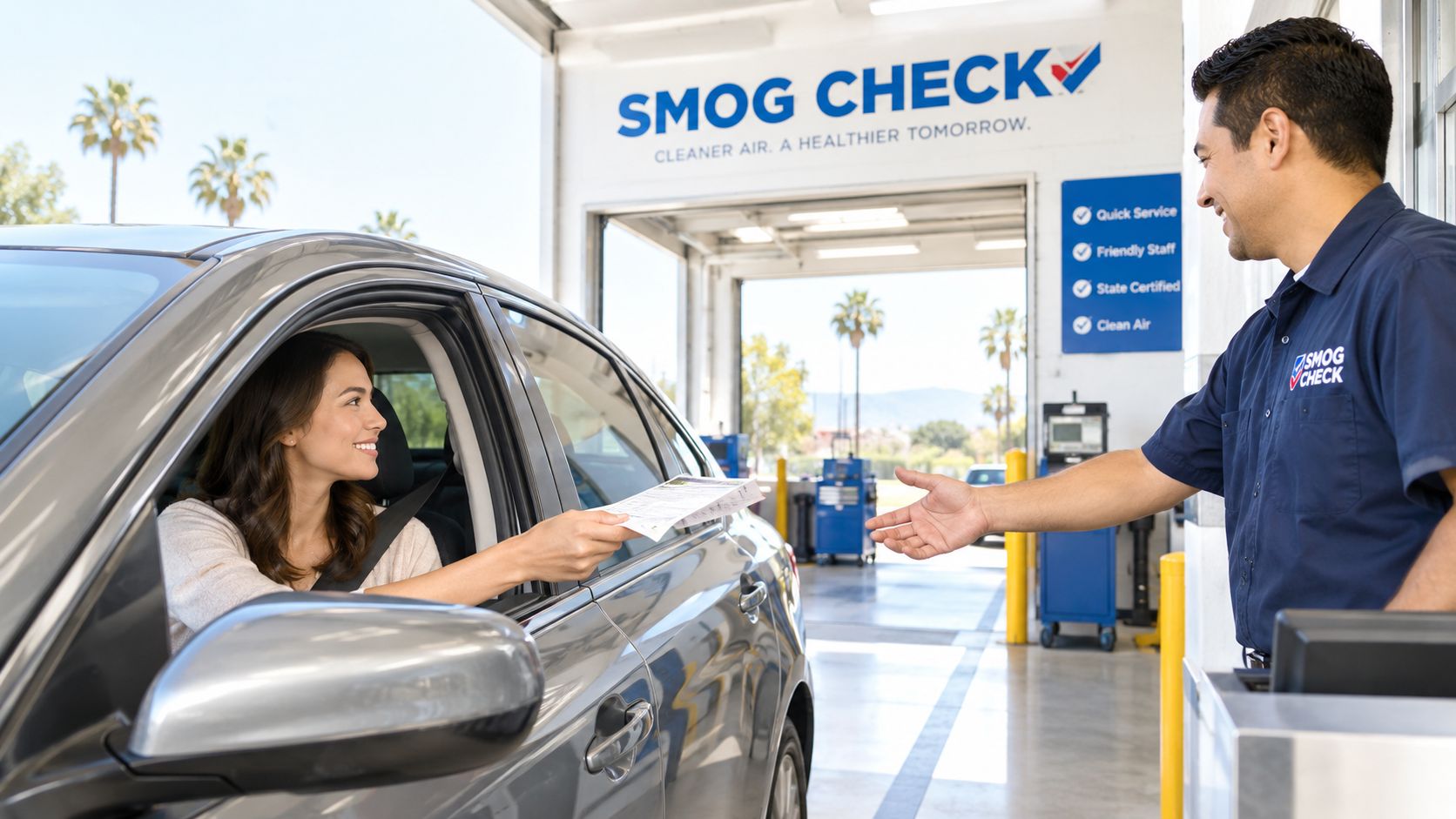
The drive-through version feels less like dropping your car off at a repair shop and more like pulling into a well-organized lane where each step has a purpose. You arrive, hand over your paperwork, a technician checks what kind of test your vehicle needs, and the station moves the car through a fixed routine. No wandering waiting room. No guessing what happens next.
Why people like the drive-through format
Most drivers don't want a lecture on emissions systems. They want a clean pass, a clear answer, and a short stop. That's why the drive-through idea works. It turns the visit into a simple sequence.
A car wash line, except instead of soap and rinse, the station is checking whether your vehicle's emissions system is ready, connected, and compliant.
Practical rule: Fast smog visits usually come from preparation, not luck. A smooth lane only helps if your car and paperwork are ready when you pull in.
Who this guide helps most
This is especially useful if you're a first-time California driver, a parent helping a student with registration, a commuter who just got a renewal notice, or a small fleet owner trying to move several vehicles through with less downtime.
You'll also see where time gets saved and where it gets lost. In many cases, the test itself isn't the problem. The delay comes from missing documents, a battery that was recently disconnected, or going to the wrong kind of station for your DMV requirement.
How a Drive Through Smog Check Actually Works
A drive-through smog station is basically a pit-stop workflow. The station isn't there to rebuild your engine or sell you parts. It's there to run a standardized inspection, record the result, and move the next vehicle in line.
California's smog system is built for scale. The Bureau of Automotive Repair reported 12,200,718 total Smog Check tests in 2025, with 1,102,337 failures and an overall failure rate of 9.04%, according to the 2025 BAR Smog Check executive summary. That same report listed 11,275,981 initial tests and 959,667 initial failures, an 8.51% initial failure rate. When that many vehicles need inspections, stations that use standardized lanes and consistent check-in steps make sense.
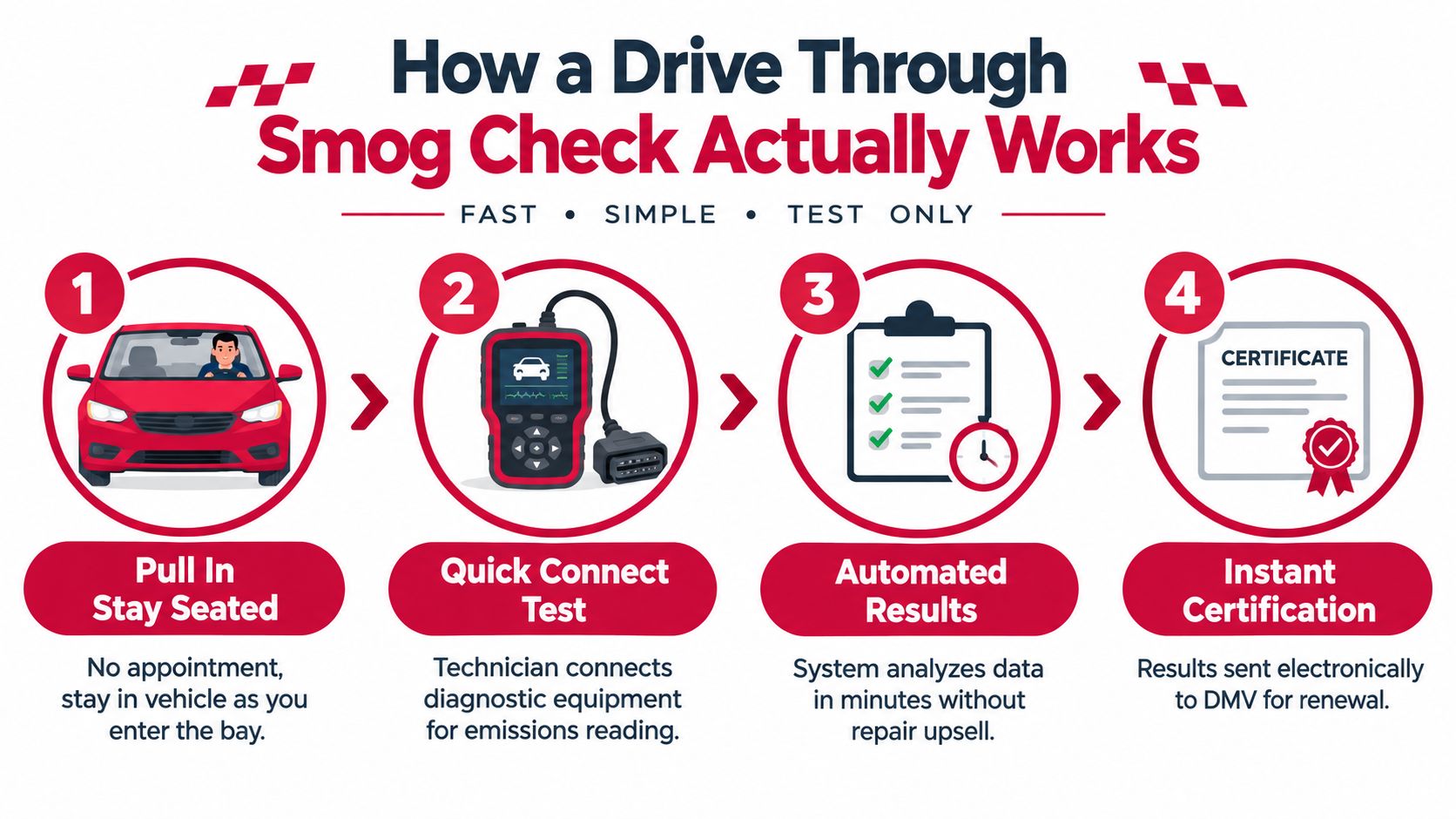
The four parts of the lane
The easiest way to understand the process is to break it into four parts.
Check-in
The technician confirms the vehicle information and what kind of inspection applies.Connection and inspection
On many newer vehicles, the technician connects to the car's onboard diagnostics system. On older vehicles, the process may involve a tailpipe test.Visual and functional review
The station also checks emissions-related components that are supposed to be present and operating.Electronic reporting
The result is transmitted so it can be used for registration.
Here's a helpful walk-through of a quick STAR smog process if you want to see how a local test-only lane is typically organized.
A short video makes the flow easier to picture once you've read the basics.
What actually gets tested
California doesn't use one test method for every vehicle. For gasoline-powered 2000 model-year and newer vehicles and diesel-powered 1998 model-year and newer vehicles, the inspection is OBD-focused. Pre-2000 vehicles use a tailpipe emissions test, and the state also notes that a smog check typically includes visual and functional inspections of the emissions control system, as described in the BAR Smog Check manual.
That matters because newer cars often move faster through the lane when they're properly prepared. The station usually isn't waiting on a long exhaust sampling routine. It's checking whether the car's own emissions monitors are ready and whether the system shows problems.
A test-only station is closer to an inspection lane than a repair garage. Its job is to measure and report, not to diagnose for profit.
Drive Through Versus Traditional Smog and DMV Options
Not every “fast” option is fast for every driver. The best path depends on two separate questions. First, where should you get the smog test? Second, where should you finish the registration work?
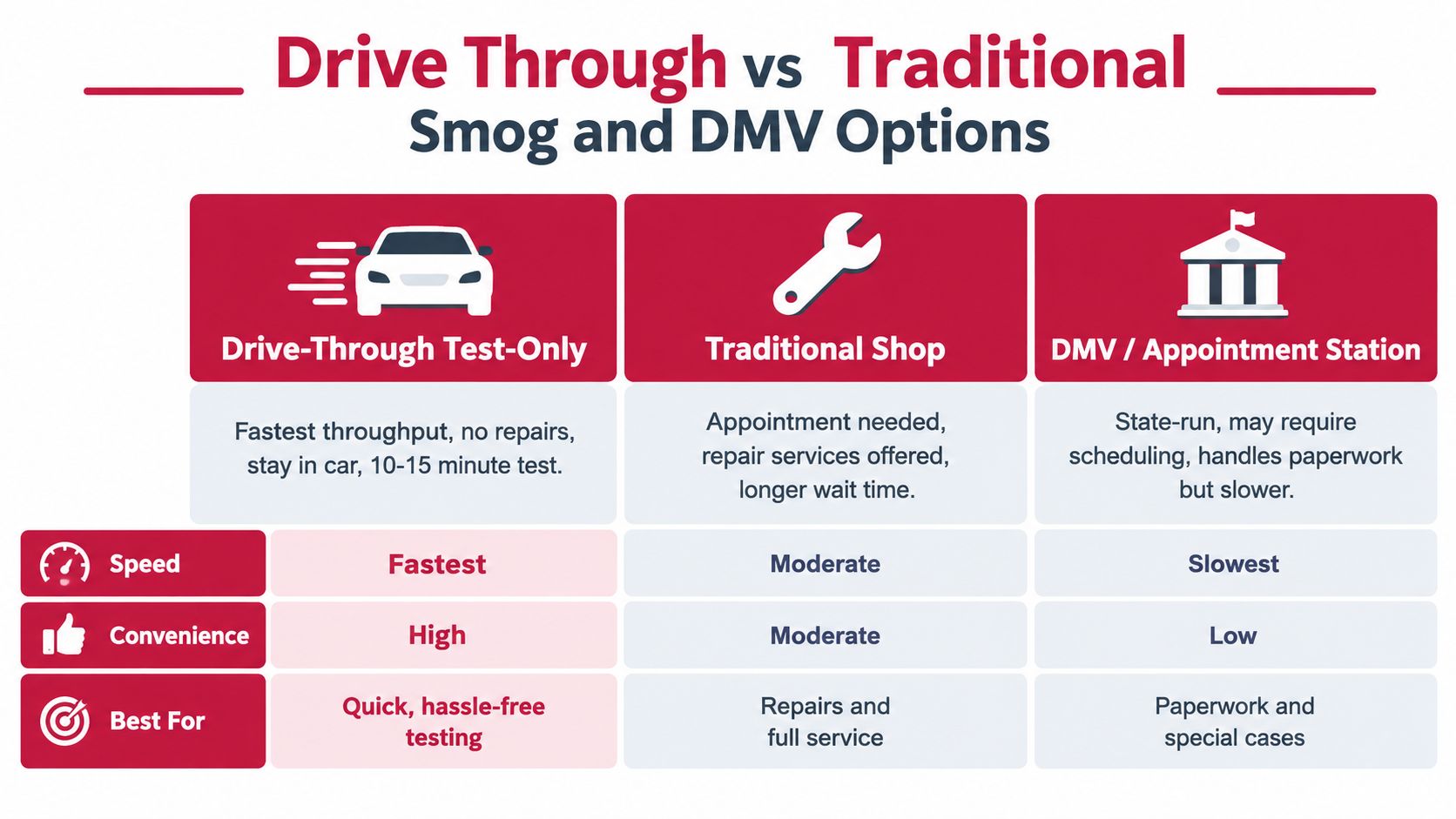
Smog lane choices
A drive-through test-only station is usually the cleanest choice when your main goal is speed and neutrality. The workflow is narrow by design. Check in, test, report results, done. Because the business doesn't perform repairs in the same lane, there's less chance the visit turns into a sales conversation.
A traditional repair shop that also performs smog inspections can still be the right choice if you already know the car needs mechanical work. But if your car is due for certification and running fine, combining inspection and repair under one roof can slow the visit.
A STAR station may also be required in some cases. That confuses first-time drivers because not every registration notice has the same instructions. If your DMV paperwork says STAR, you need the correct type of station.
Registration choices after the test
The second decision is what happens after you pass. California DMV says smog checks are required for many renewals, ownership changes, and first-time out-of-state registrations, and it also notes that DMV-authorized business partners can handle certain registration services with shorter waits and on-site processing, as explained on the California DMV smog inspection and registration page.
That's the part many drivers overlook. They think the smog certificate is the finish line. Often it's only one leg of the trip.
Choosing Your Fastest Smog and Registration Path
| Option | Best For | Wait Time | Key Limitation |
|---|---|---|---|
| Drive-through test-only station | Drivers who want a focused inspection without repair upsells | Often shorter when paperwork and vehicle are ready | Doesn't repair the vehicle if it fails |
| Traditional smog and repair shop | Vehicles that may need diagnosis or repair work right away | Can vary based on repair workload and appointments | The visit may become longer if repair discussions start |
| DMV office or DMV business partner | Drivers who need registration completed after the smog result posts | Varies by location and service model | Not every service is available everywhere |
If your goal is one stop, ask two questions before you leave home: “Can this station perform my required smog test?” and “Can I finish the DMV side today too?”
For working drivers and small fleets, that two-question check saves more time than almost anything else.
Vehicle Size Limits and Which RVs Can Be Tested
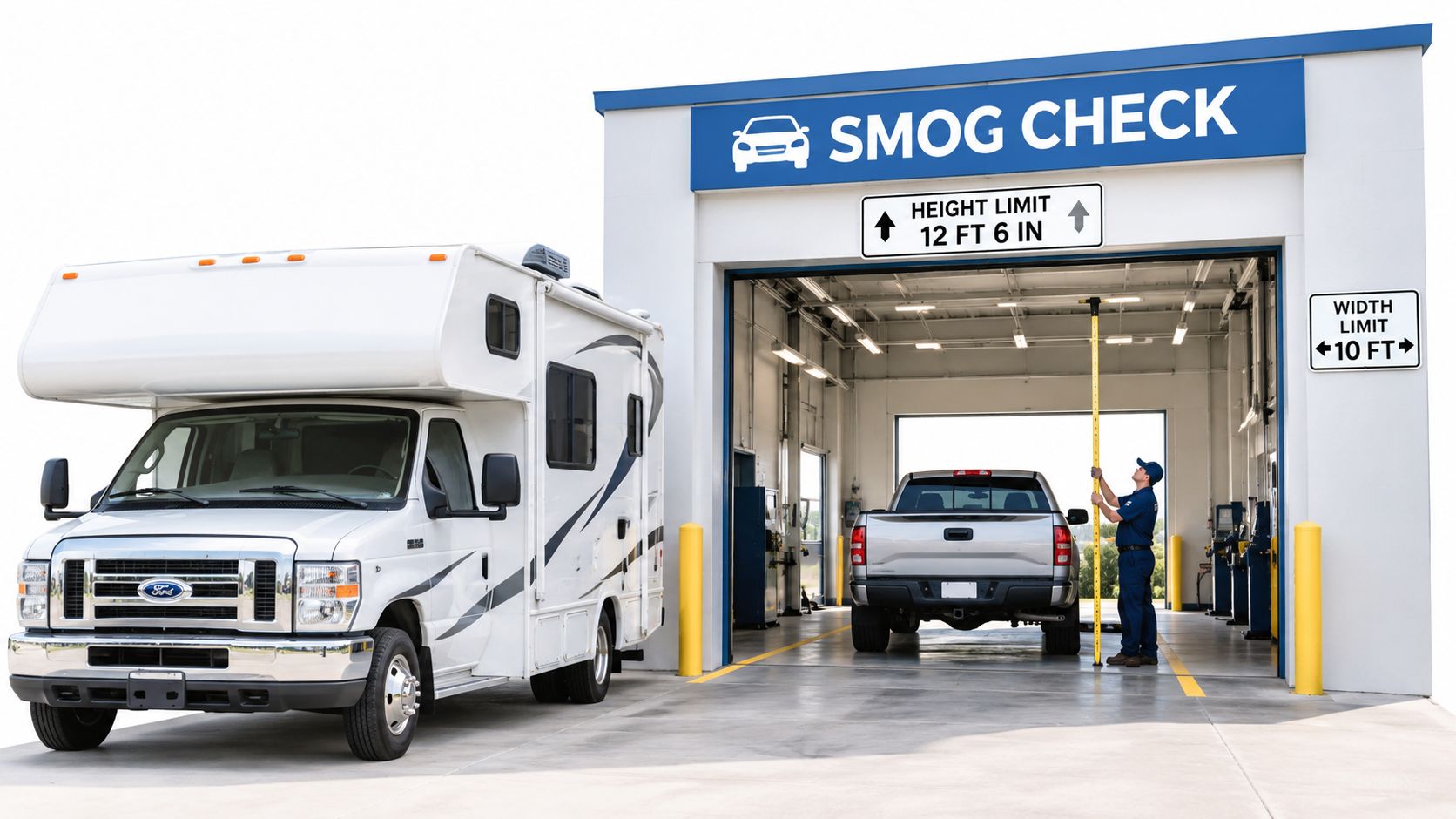
A drive-through setup is fast because the lane is standardized. The trade-off is that physical space matters. Bay height, bay length, turning room, equipment placement, and how the technician accesses the vehicle all affect what can be tested safely.
That's why a sedan usually glides through without drama, while a tall van or motorhome may need a phone call first.
Vehicles that usually fit easily
Most stations built around passenger traffic can handle:
- Standard cars such as sedans, coupes, and hatchbacks
- Common SUVs used for family driving or commuting
- Light-duty pickups that fit comfortably within normal lane space
- Work vans that aren't unusually tall or extended
These vehicles usually match the workflow the station sees all day. The technician can access the cabin, connect equipment, complete the inspection, and move the vehicle out without repositioning or special handling.
Vehicles that deserve a call ahead
Some vehicles are testable, but not every station can take them at every time.
Examples include:
- Motorhomes and RVs that may exceed bay height or turning limits
- Long-wheelbase trucks or vans that are awkward in tighter lots
- Vehicles with exterior modifications that change clearance or access
- Heavier specialty vehicles that don't suit the station layout
Fire House Smog is one local option that performs STAR-certified test-only inspections, handles cars, trucks, and some RVs, and advises customers with larger vehicles to call ahead because fit depends on size and equipment limits.
A simple phone-check script
If you drive something bigger than a normal SUV, keep the call short and specific.
Lead with the vehicle type
Say the year, make, model, and whether it's gasoline or diesel.Mention the size concern
Tell them if it's lifted, extended, unusually tall, or an RV.Ask the practical question
“Can your bay handle this vehicle, or should I go somewhere set up for larger units?”
That quick check can save you a wasted trip across town.
What to Expect When You Arrive Step by Step
When you pull in, think of the visit like a relay race. Each handoff matters. If one handoff is smooth, the next one starts right away.
Pull in and check in
Start with your registration notice or current vehicle paperwork ready to hand over. If you've had a recent smog test, bring that paperwork too. Keeping those papers in the visor or glove box saves the awkward parking-lot search.
At 2900 Lone Tree Way in Antioch, the process is built around a straightforward lane layout. Two service bays help move vehicles through without the stop-and-start feeling you get at smaller single-lane locations.
The inspection sequence
Once checked in, the technician confirms the vehicle details and begins the inspection sequence that matches your car. For many newer vehicles, that means connecting to the onboard system and reviewing emissions-related data. The technician also performs the required visual and functional checks.
If you've never done this before, the biggest surprise is usually how ordinary it looks. There's no dramatic machine sequence. It's more like a careful checklist with electronic reporting built in.
If you want a fuller timing breakdown, this guide on how long a smog check usually takes gives helpful context on what affects the pace.
Stay relaxed during check-in. Most delays happen before the test begins, not during it.
Payment, reporting, and what happens next
After the inspection, the station finalizes the result and transmits it electronically for DMV use. If the vehicle passes, that result becomes part of your registration path. If it doesn't pass, the station explains the next step and whether a free retest applies under site policy and coupon terms.
A few practical notes help first-time drivers:
If you pass
Your next move is usually the registration side, not another mechanical step.If you fail
A test-only station won't repair the car in-house. That can feel inconvenient in the moment, but it also keeps the inspection role separate from repair sales.If you need DMV help the same day
Ask before you arrive whether the registration service hours match your timing.
That last point matters more than you might expect.
Tips to Get Through Your Smog Check Faster
The quickest visits usually come from drivers who remove the common bottlenecks before they leave home. A drive-through lane can move briskly, but it can't fix an unreadable registration notice, an unset monitor, or a car that arrived straight after a battery swap.
The biggest time-savers before you leave
California's rules got stricter on readiness monitors. Effective October 1, 2025, all readiness monitors must be set for a vehicle to pass a smog check, and BAR advises drivers to wait a week or two after disconnecting or replacing a battery so the monitors can reset before inspection, according to the BAR Smog Check consumer guidance.
That means one of the most common mistakes is showing up too soon after battery work.
Your pre-visit checklist
Use this short list before heading to the station:
Bring the right paperwork
Have your registration notice, current registration, and any prior smog paperwork easy to reach.Check recent battery history
If the battery was disconnected or replaced recently, give the vehicle enough normal driving time so the monitors can reset.Warm the car up with normal driving
A vehicle that has been sitting all day can be slower to inspect than one that has already been driven.Look for simple issues
Make sure the gas cap is present and tightened, and don't ignore dashboard warning lights.Match your timing to DMV service hours
If you want a one-stop visit, confirm that registration processing is open when you plan to arrive.
If you're trying to avoid the most common causes of failure, this page on typical smog check fail reasons is a practical place to start.
Where time is really won or lost
People often assume the lane itself is the whole story. It isn't. Time is usually won in three places:
- Before arrival, when you gather paperwork.
- Before the test, when your monitors are ready.
- After the pass, when you already know where and how you'll complete registration.
The one-stop version works best when you treat the whole errand like a pit stop. Fuel ready. Paperwork ready. Driver ready.
If you want a practical one-stop option in Antioch, Fire House Smog offers STAR-certified test-only smog inspections, service for cars, trucks, and some RVs, plus DMV registration help with on-site tag printing during posted hours. If your goal is to get in, get tested, and finish the registration side with less backtracking, it's worth checking their current hours before you head over.
Gasoline vehicles with a 1975 model year or older are permanently exempt from California smog checks, while 1976 and newer vehicles generally still require testing unless they qualify for another exemption. The cutoff is based on the vehicle's model year, not how old the car feels, how rarely it's driven, or whether it carries classic-car plates.
You've found a clean older truck, checked the title, and are ready to register it. The seller calls it “pre-smog,” but the truck's paperwork says 1976. That single detail can change whether you need a Smog Check before completing a renewal or ownership transfer.
The phrase pre smog year California appears in listings, forums, and restoration discussions, but people often use it loosely. California's actual rule is more precise. A gasoline vehicle from model year 1975 or earlier falls under the permanent exemption. A newer classic vehicle may look just as old and may be maintained just as carefully, yet still follow different testing requirements.
Table of Contents
- Introduction to Pre Smog Rules in California
- How California Smog History Created the Pre Smog Era
- Which Model Years Count as Pre Smog and Exempt Today
- How to Verify Your Vehicle Smog Status Before the DMV
- What Pre Smog Status Means for Registration and Ownership Transfer
- Common Misconceptions About Pre Smog Vehicles
- Next Steps for Smog Checks and DMV Processing in Antioch
Introduction to Pre Smog Rules in California
You buy a restored pickup, check the title, and see a model year that differs from the seller's “pre-smog” description. The registration question starts with that recorded year, not with the vehicle's appearance, mileage, or time spent in storage.
Model year is a fixed label. It works like a classification printed on the title, registration, and vehicle records. California uses that label to select the applicable Smog Check rule. Vehicle age is the result of the label, not a separate test for exemption.
That difference can affect an ordinary DMV transaction. A 1974 pickup and a 1976 pickup may have matching restorations, the same engine family, and identical weekend use, yet receive different treatment. A carefully maintained 1978 coupe also does not become exempt just because owners call it a classic.
Practical rule: Read the model year on the title and registration before relying on a listing or seller's description.
The fixed cutoff is only one part of the broader system. Newer vehicles may receive temporary testing relief early in their registration life, while collector classifications, specialty plates, fuel type, and transfer circumstances follow their own rules. Those categories should not be blended together under the informal label “pre smog.”
The guide examines five decisions:
- Cutoff year: Why the rule uses a fixed model-year boundary.
- Vehicle status: How permanent exemption differs from temporary relief for newer vehicles.
- Verification: Which records to check before a DMV visit.
- Ownership: How renewal, sale, and out-of-state registration can affect the process.
- Future planning: How collector exemptions and new-vehicle standards may change.
For a specific vehicle, begin with the recorded model year and then confirm the applicable status. If the title, registration, and seller's description conflict, a direct check with the BAR or DMV is safer than relying on an online listing.
How California Smog History Created the Pre Smog Era
California's “pre-smog” language comes from a regulatory transition. Before modern tailpipe controls, residents and officials first had to recognize the problem, then measure it, and finally create enforceable standards.
From visible crisis to organized control
Los Angeles' first recognized smog episode occurred on July 26, 1943. Visibility in downtown Los Angeles fell to about three blocks, and residents reported smarting eyes, respiratory discomfort, nausea, and vomiting. People initially mistook the event for a gas attack, and similar smog episodes continued through the 1940s, according to the National Academies history of California air pollution.
That episode made air pollution publicly visible in a major American market. The issue was no longer an abstract concern for researchers. Residents could see the haze, feel its effects, and connect daily life with a growing environmental problem.
California then moved from observation toward administration. In 1947, Governor Earl Warren signed the Air Pollution Control Act, authorizing county air pollution control districts, as documented by the National Academies source above. The state had created a legal framework for organized air-pollution control within roughly four years of the major smog event.
Measurement changed the policy conversation
By the mid-1960s, California researchers were no longer limited to describing smog. They began creating precise tailpipe test systems in 1965, and California adopted the nation's first statewide vehicle-emissions standards for new cars in 1966, according to Hagerty's history of California vehicle-emissions regulation.
The results show why testing and standards became central. Average emissions of key smog-forming pollutants, including hydrocarbons and nitrogen oxides, fell from 14 grams per mile in 1965-model cars to 3 grams per mile by 1975, then to 1.5 grams per mile by 1981, according to the same Hagerty account.
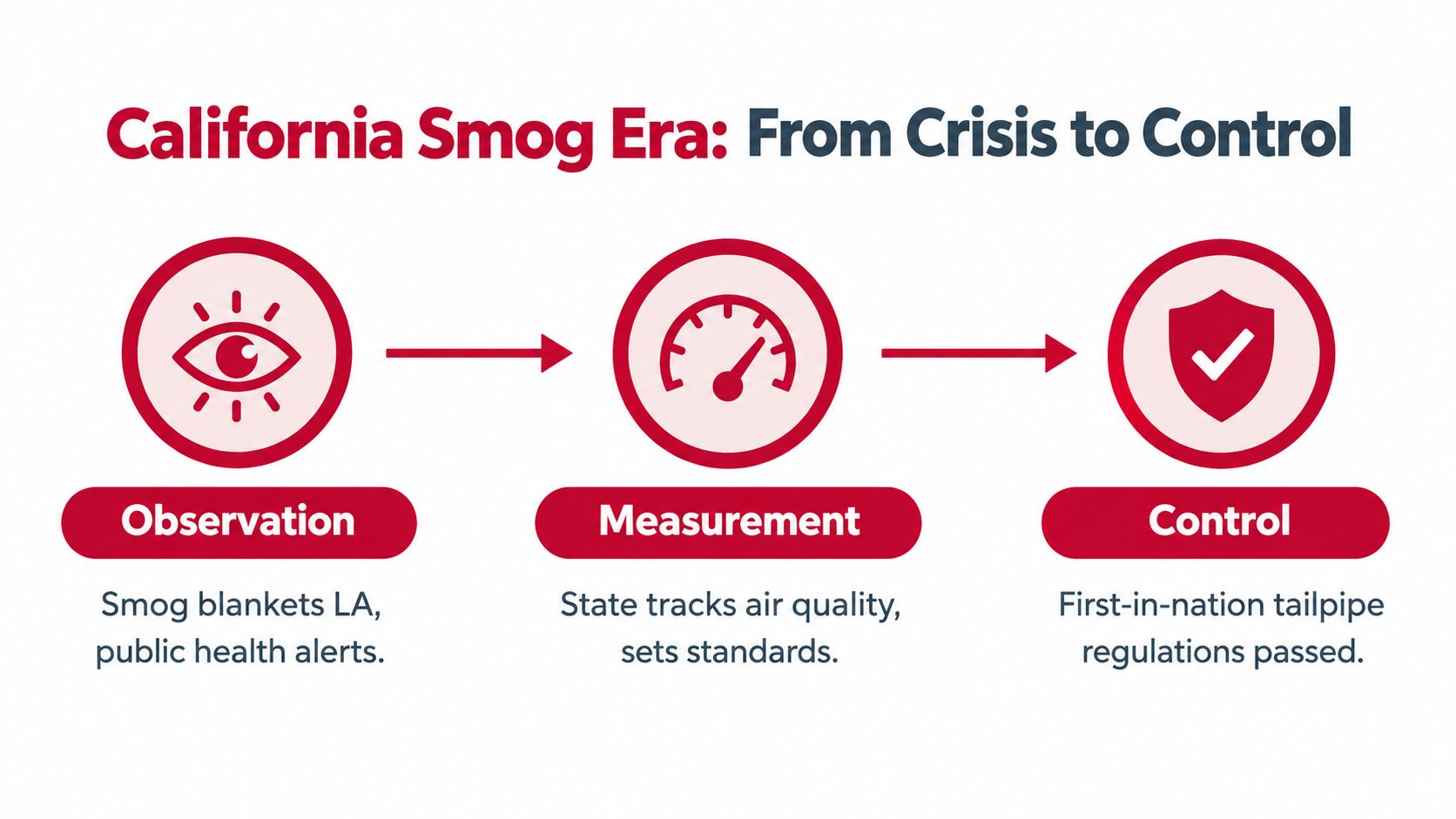
That sequence explains the logic behind a fixed cutoff. California needed a practical way to identify vehicles produced before the emissions-control era, without asking inspectors to reconstruct every vehicle's history. A model-year boundary gave registration officials and owners a clear administrative test.
The cutoff can feel arbitrary when you compare two neighboring model years. Historically, however, the dividing line represents the shift from largely uncontrolled vehicle pollution toward regulated manufacturing, testing, and emissions equipment. A newer classic may be old today, but it belongs to a later regulatory generation.
Which Model Years Count as Pre Smog and Exempt Today
A 1974 vehicle and a 1976 vehicle may look equally old at a registration counter, yet California treats them differently. The deciding factor is the recorded model year, not the vehicle's current age, restoration date, or how often it is driven.
A gasoline-powered vehicle with a 1975 model year or older is permanently exempt from California Smog Check requirements under the BAR's official Smog Check rules. “Permanently” means that routine testing does not begin later merely because the vehicle changes owners, stays registered for years, or is driven more frequently.
A gasoline vehicle from 1976 or newer does not gain that permanent exemption by becoming an old classic. A well-restored 1978 vehicle can still require a Smog Check when the relevant registration or ownership-transfer rule calls for one. Vehicle condition and exemption status are separate questions.
Use the model year first
Use this sequence:
- Read the recorded model year. Check the title, registration, or reliable vehicle records. The year of purchase or restoration does not control the classification.
- Compare it with 1975. A gasoline model year of 1975 or earlier falls within the permanent exemption category.
- For 1976 or newer, identify the transaction. Renewal and ownership transfer can create different testing requirements unless another rule applies.
- Confirm the fuel and vehicle type. The gasoline cutoff should not automatically be applied to hybrid, alternative-fuel, or other vehicle categories.
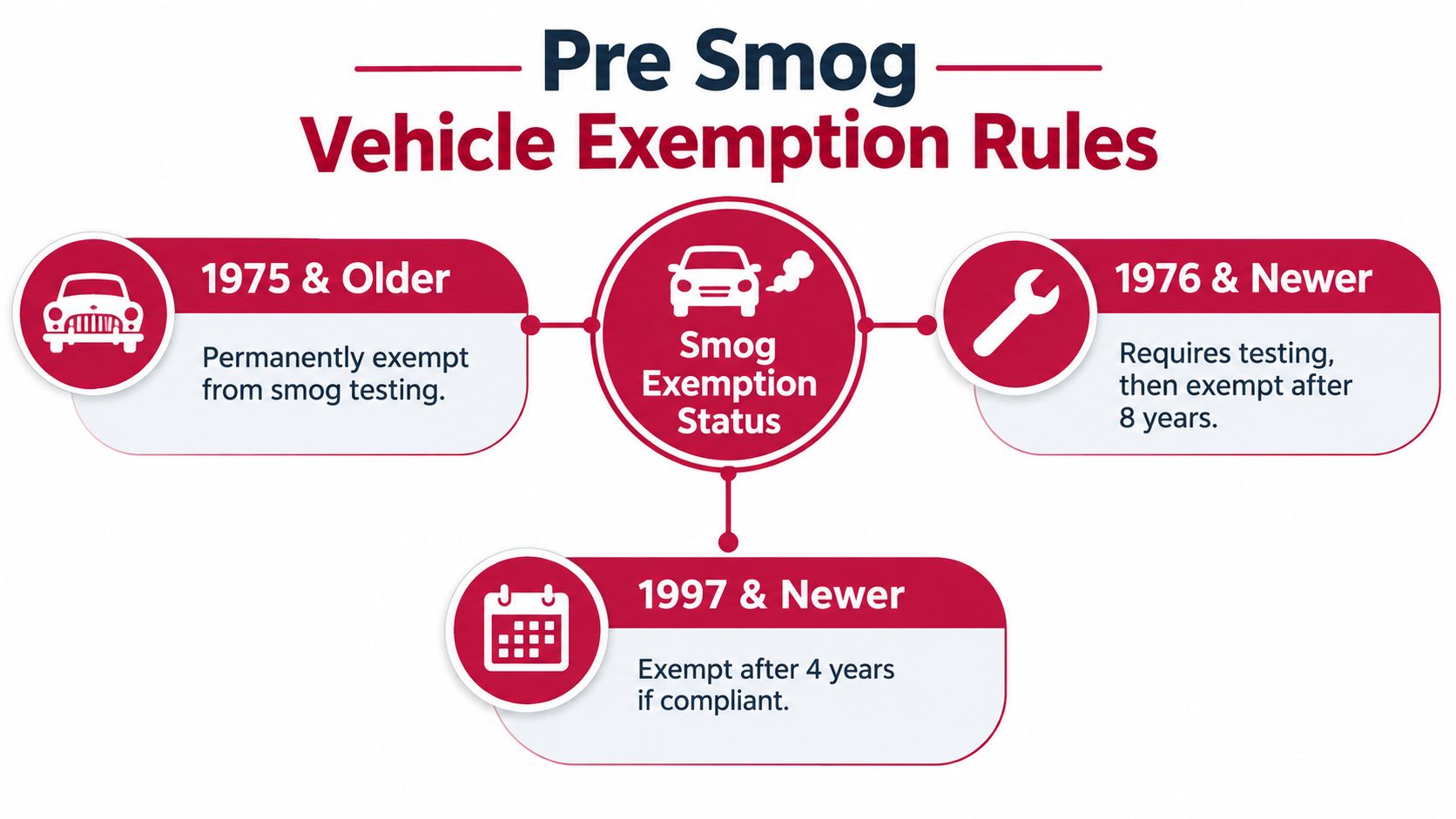
California also provides a separate renewal relief period for newer gasoline, hybrid, and alternative-fuel vehicles. Vehicles eight model years old or newer don't need a smog inspection for renewal, according to the BAR. This temporary rule changes as the vehicle moves through its model-year lifecycle, while the 1975-and-older exemption remains tied to the fixed cutoff.
For planning, the first required renewal test can be estimated by adding eight to the model year. The first change-of-ownership test can be estimated by adding four to the model year. These calculations are useful checks, but the registration notice and official records control the actual DMV process.
California's rules may also expand for certain collectors under the upcoming SB 1392 changes. That potential collector pathway is separate from the pre-smog cutoff, so an eligible collector vehicle should not be confused with a vehicle that qualifies automatically because it predates 1976.
For additional older-vehicle examples, review this guide to California smog-exempt vehicle years.
The practical question is: What model year does California have on record, what fuel does the vehicle use, and what transaction is being completed?
How to Verify Your Vehicle Smog Status Before the DMV
A buyer arrives at the DMV expecting a routine transfer, then learns that the vehicle's recorded model year or fuel type changes the smog requirement. Checking the records first can prevent that extra trip. Start with the vehicle's official identity, not the seller's description.
Begin with the paperwork
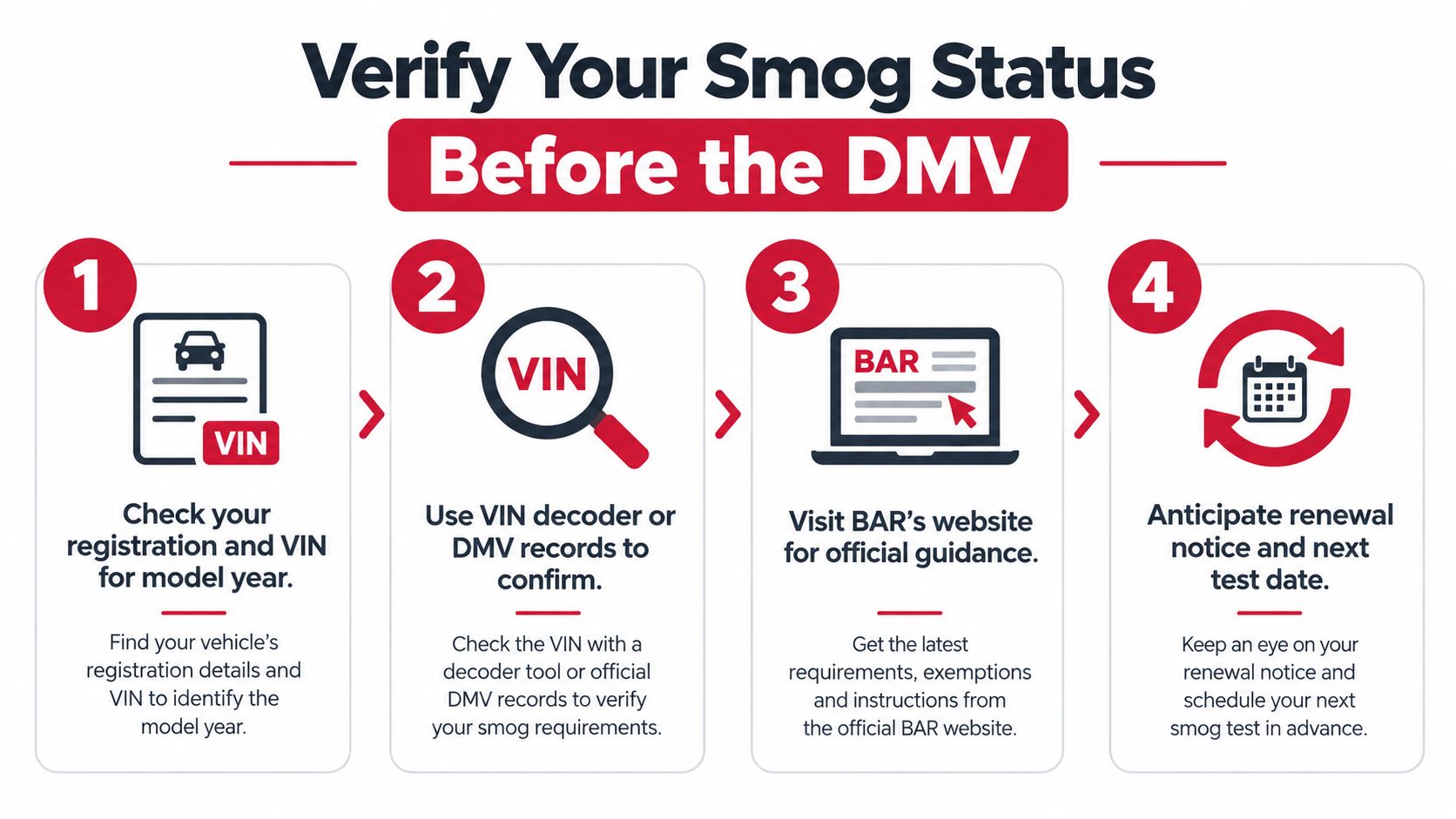
Review the California registration card, title, and vehicle identification number. Confirm that the model year matches across the documents. California's pre-smog cutoff is a fixed model-year rule, so an older-looking vehicle is not automatically exempt. A gasoline vehicle from 1975 or earlier follows a different path from a 1976 vehicle, even if both appear to be classic cars.
For an out-of-state purchase, compare the title with the VIN plate and available manufacturer information before assuming California will classify the vehicle as pre-smog. A VIN decoder can clarify basic identity details, but DMV records control when documents disagree. Engine swaps, reconstructed titles, incomplete paperwork, and unusual body conversions can make a general online answer misleading.
Match the vehicle to the transaction
Identify the transaction before deciding what to check. Renewal and ownership transfer can trigger different requirements for the same vehicle. As a planning estimate, add eight to the model year for the newer-vehicle renewal relief period, or add four to the model year for a change-of-ownership estimate. Confirm the result against the DMV notice and current BAR Smog Check guidance.
| Vehicle Model Year | Renewal Smog Required | Transfer Smog Required |
|---|---|---|
| 1975 and older gasoline vehicle | Permanently exempt | Permanently exempt |
| 1976 and newer, within the newer-vehicle relief period | Check registration notice | Check transfer requirements |
| 1976 and newer, outside that relief period | Usually required when prompted | Check transfer requirements |
The table is a planning aid, not a final decision. Vehicle type, fuel classification, transaction details, and attached records can change the result.
For a transfer, collect the title, bill of sale, identification, and out-of-state registration documents when applicable. Ask the DMV or BAR about unusual cases before scheduling a test, especially for an RV, nonstandard engine, or uncertain fuel classification. Review the requirements for an emission test certificate before arranging the transaction.
Keep supporting registration records even when the vehicle appears exempt. Clear documentation connects the recorded model year and fuel type to the vehicle being presented.
Before you leave home: Confirm the model year, fuel type, transaction type, and date shown on your DMV notice.
What Pre Smog Status Means for Registration and Ownership Transfer
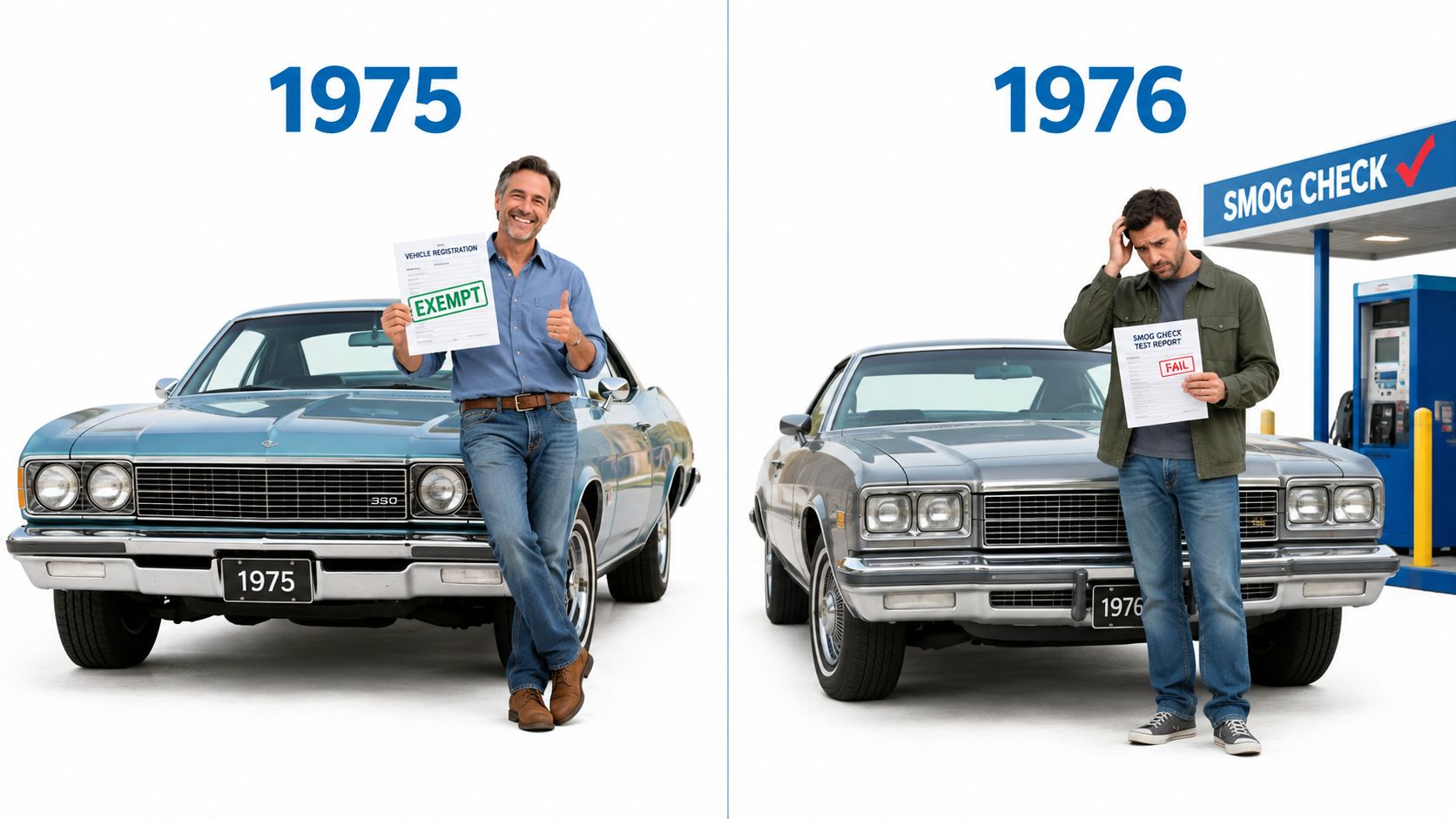
A buyer in Antioch may face two different outcomes with older cars. A gasoline vehicle from model year 1975 or earlier generally avoids the ordinary Smog Check requirement for registration renewal, while a 1976 vehicle may still require testing. The dividing line is the recorded model year, not the vehicle's age or its “classic” label.
The exempt vehicle still needs the correct registration paperwork and applicable charges. Exemption removes the routine smog step, not the DMV process itself. For broader qualifying categories, review this guide to smog exemptions in California.
Renewal and transfer are different moments
Renewal follows the registration cycle. A transfer follows the sale or ownership change. As a result, a car that did not need a recent renewal inspection may still require smog documentation during a transfer.
Before paying, the buyer should confirm who must provide certification. The seller should avoid promising exemption based only on age, mileage, a specialty plate, or a listing description. The DMV's recorded model year and fuel classification control the transaction. If those records conflict with the seller's statement, use the official record as the starting point.
Some vehicles need a different testing path. STAR requirements, modifications, unusual equipment, vehicle configuration, or RV status can affect where and how testing occurs. Contact a station or BAR before arriving if the vehicle does not resemble a standard passenger car.
The future policy discussion adds another distinction. SB 1392, known as “Jay Leno's Law,” is described as proposing a phased collector-car exemption that would begin January 1, 2028 for qualifying 1976 to 1980 vehicles, with the expansion continuing through model year 1985 by 2033, according to AutoNext's explanation of SB 1392. Those are proposed future changes, not a current blanket exemption. A 1976 vehicle should still be evaluated under the rule in effect for the transaction.
California is also tightening requirements for newer vehicles in a separate regulatory track. CARB's Advanced Clean Cars II program covers model years 2026 through 2035, while the state's emergency vehicle-emissions rules were readopted in 2025. Older collector vehicles and newer production vehicles therefore sit under different policy pressures.
For a sale or registration renewal, verify the exact model year, fuel type, and transaction requirement before scheduling a test or completing payment.
Common Misconceptions About Pre Smog Vehicles
A buyer finds a 1978 car advertised as “pre-smog” and assumes its age settles the issue. It does not. California uses a fixed model-year cutoff, not a vehicle-age test. For the permanent gasoline exemption, the cutoff is 1975 and older. A 1976 vehicle can be old enough to be collectible while still requiring a Smog Check for a particular transaction.
Classic plates do not automatically remove Smog Check requirements. Plate status may describe how the vehicle is registered, but it does not replace the official record's model year, fuel type, or transaction requirement. A seller's use of “classic” or “pre-smog” is a starting point for questions, not proof of exemption.
Low mileage does not change the cutoff. A car stored for most of the year may be driven very little, yet its model year remains the same. Proposed collector rules may include qualification conditions, so owners should not treat limited use as an exemption under current requirements.
The gasoline rule does not cover every older vehicle. The permanent cutoff described by BAR applies to gasoline-powered vehicles from model year 1975 and older. Hybrids, alternative-fuel vehicles, and specialty vehicles may follow different requirements. Confirm the vehicle's actual classification before applying the gasoline rule.
Why older advice causes trouble
Online listings often reduce a complicated DMV question to “pre-smog” or “smog exempt.” That shorthand may fit a 1974 gasoline car, but it can mislead someone shopping for a 1976, 1978, or 1980 vehicle. The result is a buyer who arrives for a renewal or ownership transfer expecting no test, then discovers that the transaction requires one.
The upcoming collector expansion makes date checking even more important. The phased SB 1392 schedule described earlier is separate from the current permanent 1975 cutoff. Newer vehicles also fall under a different emissions policy framework through CARB's Advanced Clean Cars II program, as explained in the official CARB program description.
The reliable question is not “Is this a classic?” It is “What model year and vehicle category does the official record show?”
If the advertisement conflicts with the registration or title, pause before paying. Resolving the record before purchase is easier than correcting a registration problem afterward.
Next Steps for Smog Checks and DMV Processing in Antioch
Start with the simple rule: 1975 and older gasoline vehicles are permanently exempt, while newer vehicles need a transaction-specific check. Confirm the model year on the registration or title, identify whether you're renewing or transferring ownership, and review the DMV notice before booking an appointment.
If the vehicle needs testing, choose a station that matches the vehicle and transaction. Fire House Smog is a STAR-certified test-only smog check station and licensed DMV registration-services provider in Antioch. It handles qualifying car, truck, and some RV inspections, along with registration renewals, ownership transfers, and on-site tag issuance during posted service hours.
Bring the registration card, title or transfer documents, VIN details, identification, and the DMV notice. If the vehicle is modified, unusually large, out of state, or has an engine swap, call ahead so the station can confirm whether its equipment and services fit the vehicle.
A practical appointment checklist:
- Model year: Confirm the official year, not the restoration year.
- Fuel type: Verify gasoline, hybrid, alternative fuel, or another classification.
- Transaction: Identify renewal, transfer, or initial California registration.
- Documents: Bring the registration and ownership paperwork.
- Questions: Mention modifications or unusual vehicle equipment before testing.
Fire House Smog can help Antioch-area owners verify the appropriate testing path, complete qualifying Smog Checks, and process DMV renewal or ownership-transfer services in one location. Visit Fire House Smog before your appointment to review the available services and plan your next step.
You open your California DMV renewal notice and see a requirement for a STAR smog check. Your car runs normally, the check engine light is off, and you assume any nearby smog shop can handle it. That assumption is how drivers waste a trip.
The right California smog test station depends on your vehicle, the wording on your DMV notice, and the station's certification. Modern OBD rules create another trap: a vehicle can appear to run perfectly and still fail because its readiness monitors haven't completed. The practical approach is simple, verify the station requirement first, confirm the vehicle's diagnostic status, and choose a location that can complete the inspection and any related DMV task without sending you across town.
Table of Contents
- Why Your DMV Notice Might Require a STAR Station
- Understanding STAR Certification and Test-Only Rules
- What Happens During a Smog Test Visit
- How to Choose the Right Smog Station for Your Vehicle
- How Fire House Smog Solves Common Driver Frustrations
- What to Do If Your Vehicle Fails the Smog Test
- Your Pre-Visit Checklist for a Smooth Smog Test
Why Your DMV Notice Might Require a STAR Station
A STAR requirement on your renewal notice isn't a suggestion. It tells you that the state has directed your vehicle to a station participating in California's higher-performance inspection program. A regular licensed smog shop may be able to test many vehicles, but it might not be authorized to complete the inspection your DMV record requires.
California's modern STAR program began on January 1, 2013, replacing the older Gold Shield and Test Only designations. The California Bureau of Automotive Repair's STAR program guidance says STAR stations must meet higher performance standards. The program was created under Assembly Bill 2289 to improve Smog Check quality and support the state's emissions-reduction targets.
What the STAR direction means
The key distinction is between your vehicle's directed status and the general ability of a shop to perform smog inspections. If the DMV notice says STAR, select a station that clearly identifies itself as STAR certified before you arrive. Don't rely on a sign that only says “smog check.”
You can also review what STAR-certified smog testing means before booking. The important point is that STAR certification applies to the station's eligibility and performance standards. It doesn't mean every STAR station provides the same services, accepts every vehicle, or performs repairs.
California requires a Smog Check every other year for registration renewal in the situations covered by the state program. Vehicles involved in a change of ownership may also need testing at a STAR station, depending on their directed status. For lighter vehicles, the current framework generally covers gasoline, hybrid, and alternative-fuel vehicles from model year 1976 and newer, while diesel vehicles from 1998 and newer are included. Vehicles less than four model years old can pay a smog abatement fee instead of testing for the first eight years of registration, subject to the state's rules and the notice issued for that vehicle.
Avoid the wrong-shop mistake
Before leaving home, read the renewal notice closely. Look for wording that specifies STAR, a test-only station, or another inspection direction. If the notice is unclear, ask the station to verify whether it can process the vehicle before starting the test.
Practical rule: Match the station to the DMV instruction, not merely to the vehicle's age or the closest shop.
That one check prevents the most frustrating outcome, arriving at a capable shop that still can't submit the inspection required for your registration.
Understanding STAR Certification and Test-Only Rules
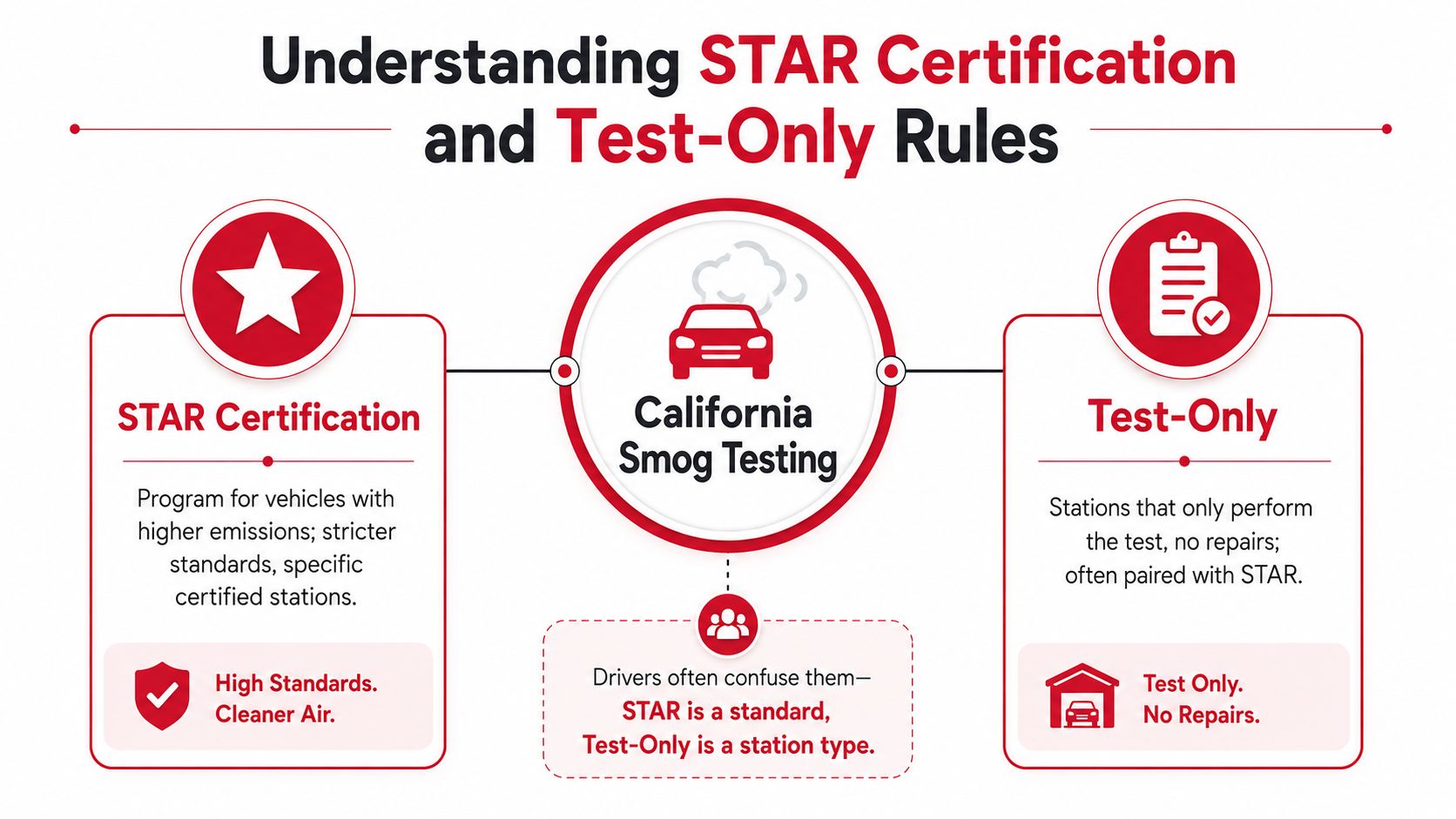
STAR certification and test-only status aren't the same thing. STAR is a state certification standard for qualifying stations. Test-only describes the station's business model and service restriction. A location can be both STAR certified and test-only, which is often the clearest choice for a driver who wants an independent inspection.
Think like an auditor
A test-only station is similar to an independent auditor. It examines the vehicle and reports the result, but it doesn't sell the emissions repair that follows. California prohibits test-only smog stations from performing emission repairs, which removes the financial incentive to fail a vehicle in order to generate repair revenue, as explained in the test-only station requirements overview.
That separation doesn't guarantee a pass. A vehicle still has to meet the applicable inspection standards. It does, however, create a cleaner relationship between the inspection and any later repair decision. If the vehicle fails, you can take the report to the repair shop you trust instead of feeling pressured to authorize work at the inspection site.
STAR certification adds another layer. A STAR station must meet higher performance standards, making it the appropriate destination when the DMV directs your vehicle there. The station still needs the right equipment, trained staff, and physical capacity for the vehicle you bring.
The readiness-monitor trap
For vehicles from 1996 and newer, the inspection centers on OBD-II compliance rather than only a tailpipe measurement. The system checks diagnostic information, fault-code behavior, and readiness monitors. Those monitors tell the inspection equipment whether the vehicle's emissions-related self-tests have completed.
A battery disconnect, computer reset, or recent emissions repair can erase monitor status. The car may start, idle, and drive normally while the computer still reports an incomplete inspection state.
As of October 1, 2025, California BAR rules require all readiness monitors to be set for a vehicle to pass a Smog Check inspection, according to the BAR explanation of the new OBD readiness-monitor regulations. That changes the preparation question. Don't ask only whether the check engine light is off. Ask whether the vehicle is fully ready for testing.
What Happens During a Smog Test Visit
A professional visit follows a predictable sequence. You provide the registration information, the technician confirms the vehicle details, and the station performs the inspection required for that model and fuel system. The technician then records the outcome through the state's approved process.
The inspection sequence
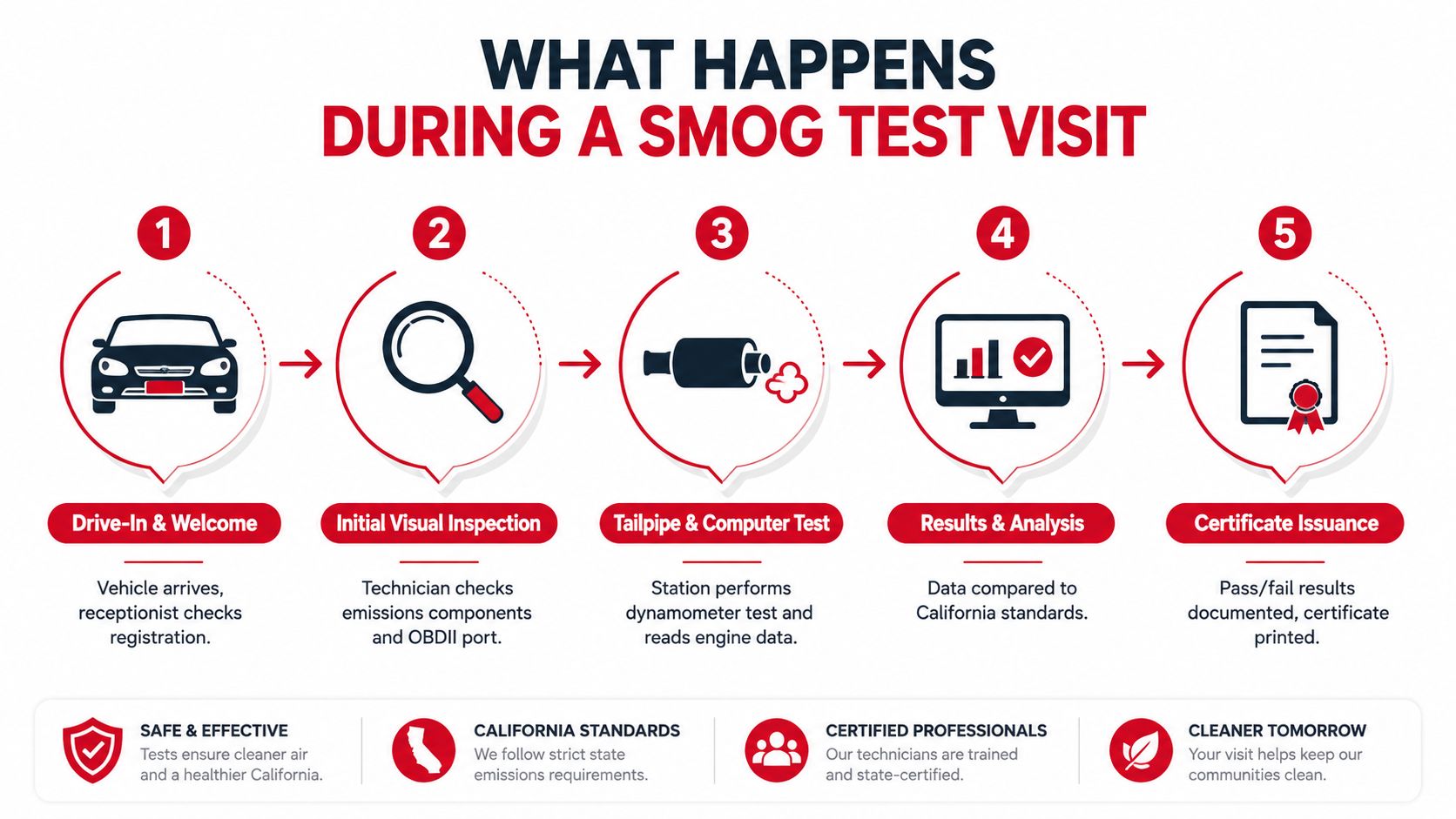
First, intake and verification. Bring your current registration renewal notice or vehicle information. The station needs accurate vehicle and registration details before it can determine the correct inspection path.
Next, the visual inspection. The technician checks relevant emissions equipment and locates the vehicle's OBD-II connection where applicable. Missing, disconnected, or visibly altered emissions components can create a problem before the computer portion is complete.
Then comes the emissions and computer evaluation. Older vehicles may use inspection methods that include tailpipe analysis. For 1996-and-newer vehicles, OBD-II data plays the central role. The equipment reviews diagnostic trouble codes and readiness status, not just how the engine sounds or feels during the drive.
Finally, the station documents the result. A passing inspection is transmitted for registration purposes, and the certificate process is completed. A failed inspection should produce information identifying the area that requires attention, so you can make a targeted repair decision rather than guessing.
You can review how long a smog check takes before scheduling, but don't treat a short appointment estimate as a promise. Vehicle condition, queue length, station layout, and diagnostic issues can change the total visit.
Why readiness causes surprise failures
A recent battery replacement is a common example. Disconnecting power can clear stored diagnostic information and leave monitors incomplete. The repair may have solved the original problem, but the vehicle still needs appropriate driving conditions before the system can verify the repair.
A station with a focused intake process and properly maintained diagnostic equipment can identify this issue quickly. A station with multiple bays can also keep vehicles moving through intake, inspection, and certificate issuance instead of making every customer wait for one bay to clear.
Don't reset codes immediately before testing. That can make the vehicle look cleaner on the dashboard while leaving the diagnostic system unready.
How to Choose the Right Smog Station for Your Vehicle
Choose the station by requirement first, convenience second. A low price or nearby location doesn't help if the facility can't perform the required STAR inspection, fit your vehicle, or handle the registration service you need.
| Station Type | Repair Services | STAR Certified | Best For |
|---|---|---|---|
| STAR test-only station | No emissions repairs | Yes | DMV-directed vehicles and drivers seeking inspection neutrality |
| STAR test-and-repair station | Testing and emissions repairs | Yes | Owners who want diagnosis and repair at the same location |
| Non-STAR shop | Depends on the business | No | Vehicles that aren't directed to STAR and fit the shop's approved service scope |
Use this decision filter
Start with the DMV notice. If it requires STAR, eliminate non-STAR locations immediately. If you want an independent result, select a STAR test-only station. If you already know the vehicle needs emissions work and prefer one provider to diagnose and repair it, a STAR test-and-repair station may be more practical.
Then check vehicle compatibility. Passenger cars, SUVs, and light-duty trucks are common, but larger trucks, RVs, and motorhomes may require specific bay dimensions or equipment. Call before driving over, especially if the vehicle is unusually long, tall, heavy, or modified.
A station that can't fit the vehicle can't solve the compliance problem, no matter how convenient its address looks.
Scheduling matters just as much. Working drivers should look for evening and weekend smog availability, while anyone combining the inspection with DMV work should confirm the separate hours for registration services. Ask whether the station offers a retest policy, whether coupons have conditions, and whether the price changes for a STAR-directed inspection.
A reliable call-ahead checklist is short:
- Confirm STAR status: Ask whether the location can process a DMV-directed STAR inspection.
- Describe the vehicle: Give the technician the model year, fuel type, vehicle class, and approximate size.
- Ask about readiness: Mention recent battery disconnection, computer resets, or emissions repairs.
- Verify DMV services: Confirm registration renewal, ownership transfer, or tag issuance if you need more than testing.
- Check timing: Ask about current wait conditions and operating hours.
How Fire House Smog Solves Common Driver Frustrations
Drivers usually want three things from a California smog test station: a valid inspection, a straightforward process, and no unnecessary repair pressure. A test-only model addresses the last concern because the station performs the inspection without selling emissions repairs. That keeps the pass or fail decision separate from the repair recommendation.
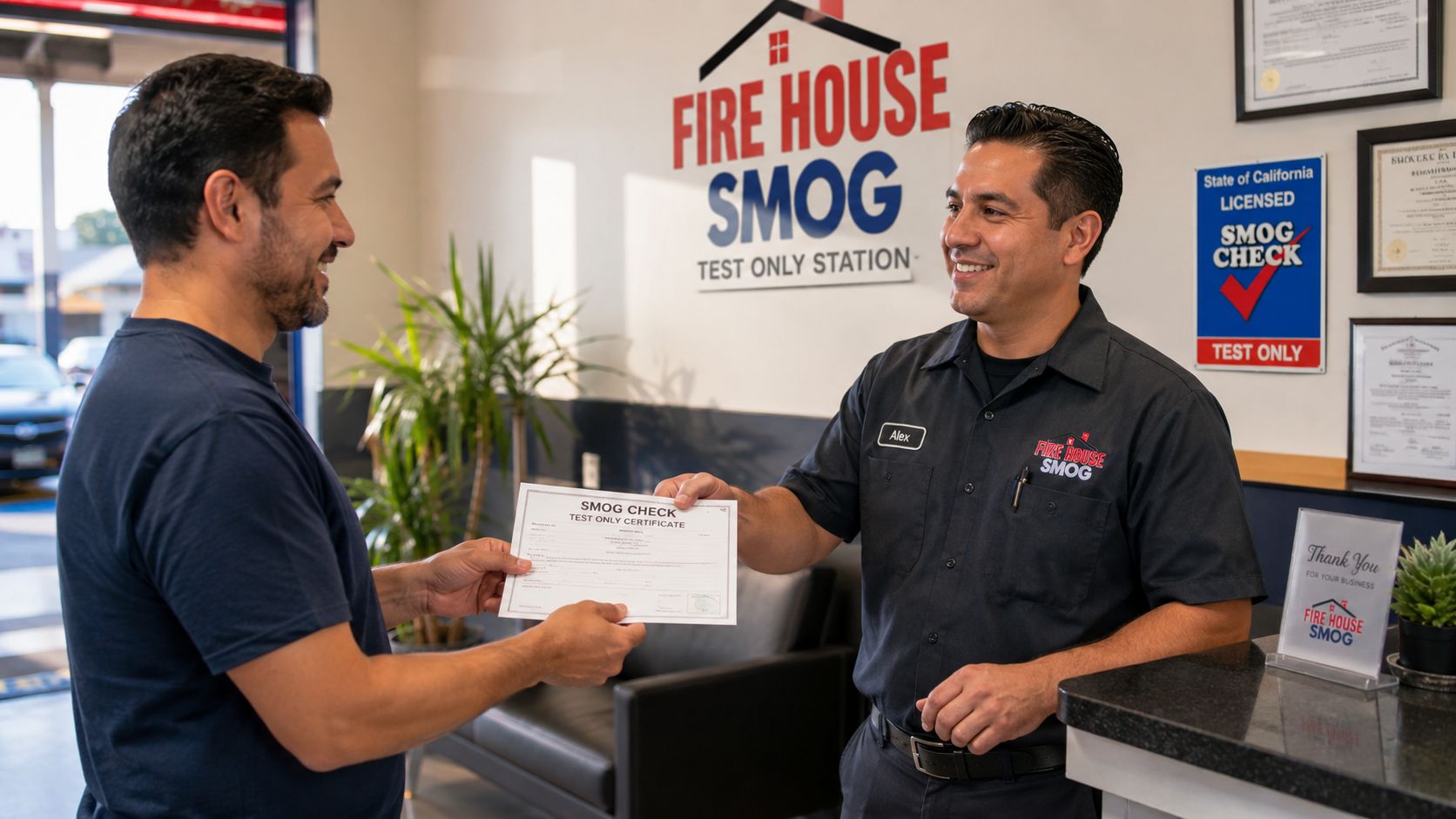
Fire House Smog is a STAR-certified test-only station at 2900 Lone Tree Way in Antioch. It handles smog inspections for cars, SUVs, and light-duty trucks, and it can accommodate some RVs and motorhomes subject to size and equipment limits. Call 925-754-1600 before bringing a larger recreational vehicle.
One visit can cover more than testing
A failed or completed smog inspection often appears alongside a registration deadline. Making a second trip to a DMV office adds friction, especially for drivers who work standard daytime hours. Fire House Smog also provides California DMV registration services, including renewal and on-site sticker printing, during its posted service hours.
Smog testing is available seven days a week, with extended evening and weekend availability. DMV services operate Monday through Saturday from 9:30 AM to 5:00 PM and Sunday from 12:00 PM to 4:00 PM, with limited services possible on weekends. Confirm the exact service you need before arriving, because smog hours and DMV hours aren't identical.
A workflow built around throughput
The location uses two service bays, which supports a more efficient flow for intake and inspections than a single-bay setup when demand is active. The station also offers a coupon policy that includes a discount on smog tests and a free retest, subject to the applicable terms.
That doesn't remove the need to prepare the vehicle. A STAR test-only station can provide a neutral inspection and process the result, but it can't make incomplete readiness monitors complete or repair a malfunctioning emissions system. The value is operational: you can obtain a clear result, understand the next step, and potentially complete your registration task in the same visit.
What to Do If Your Vehicle Fails the Smog Test
A failed smog test is a diagnosis point, not a reason to panic. First, get the result and identify whether the failure involves readiness monitors, a stored fault code, emissions equipment, or measured emissions. Don't authorize unrelated work just because the vehicle failed.
If the issue is incomplete readiness, ask whether the vehicle needs a proper drive cycle after a battery reset or repair. Driving may allow the monitors to complete, but only when the vehicle meets the conditions required by its diagnostic system. If a fault returns, the vehicle needs actual diagnosis and repair.
For a broader explanation of common causes, review California smog check fail reasons before choosing a repair strategy. Keep every emissions-related invoice and diagnostic record. Documentation matters if you later need financial assistance or a compliance extension.
Separate the available relief options
A Repair Cost Waiver isn't the same as a retest. California guidance summarized in the repair assistance and waiver information says registration may proceed after a failed test only when the owner spends at least $650 on documented emissions-related repairs and meets the applicable requirements.
An Economic Hardship Extension is narrower. It applies to low-income owners at or below 185% of the federal poverty level, requires repair-spend documentation, and can extend compliance for up to two years. Meeting one condition doesn't automatically qualify you for the other.
Retest only after the right fix
If the station or repair technician confirms that the vehicle is ready and the repair addressed the failure, schedule the retest. Fire House Smog offers a free retest under its site policy and coupon terms, so confirm the conditions before relying on it.
Do this in order: read the failure result, determine whether the issue is readiness or a malfunction, keep repair records, then retest.
A waiver won't replace a required repair record, and a retest won't fix a failed component. Treat each option as a separate tool.
Your Pre-Visit Checklist for a Smooth Smog Test
Use this checklist before driving to any California smog test station. It targets the mistakes that cause avoidable delays.
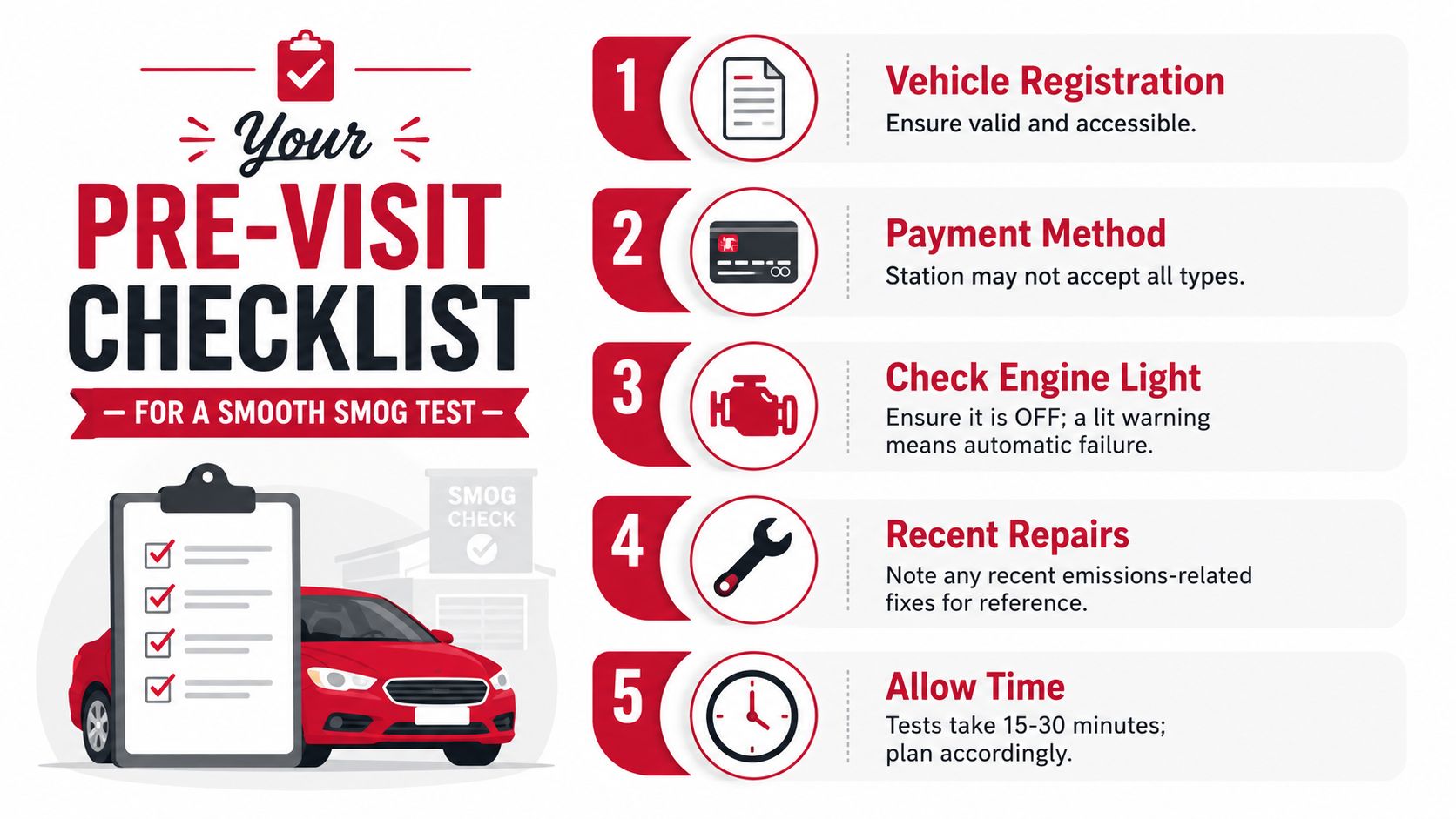
- Read the DMV notice: Confirm whether the vehicle must go to a STAR-certified station.
- Check the dashboard: The check engine light should be off. If it's illuminated, expect a diagnostic problem rather than a routine pass.
- Confirm readiness: Ask a qualified technician to check OBD-II monitor status, especially after a battery disconnect, computer reset, or recent emissions repair.
- Bring registration information: Have the renewal notice and vehicle details available for intake and DMV processing.
- Describe the vehicle accurately: Tell the station if it's a diesel, hybrid, light-duty truck, RV, or motorhome.
- Call about capacity: Larger vehicles may require advance confirmation that the bay and equipment can accommodate them.
- Ask about retests: Confirm whether a free retest applies, and check any coupon conditions.
- Plan the full visit: If you also need registration renewal or ownership-transfer services, verify those separate operating hours.
- Keep repair paperwork: Save emissions-related invoices and diagnostic documentation in case the vehicle fails or you seek assistance.
The best preparation is knowing the vehicle's readiness state, not assuming that normal driving means the inspection will pass. Bring the right notice, choose the right station, and avoid resetting the vehicle just before testing.
Fire House Smog provides STAR-certified test-only smog inspections, free retests under applicable terms, and on-site DMV registration services with sticker printing at its Antioch location. Visit Fire House Smog to confirm station requirements, check vehicle compatibility, and schedule a smog and registration visit that fits your week.
If you just got a DMV renewal notice, there's a good chance your real question isn't “where's a smog shop?” It's “do I need a STAR-certified station, or can I use any place that does inspections?” In Concord and the rest of Contra Costa County, that's the decision that saves you from wasted time, repeat visits, and the usual DMV headache.
Bayside Smog Concord CA sits in the category that matters most for drivers who need a clean, fast answer. It's a long-running Concord inspection station, and the right way to think about it is simple, it handles the compliance side of the process, not repair sales, so you're not walking into a shop that's trying to turn your test into a bigger invoice.
Table of Contents
- What Bayside Smog Offers and Who Needs Their Services
- Understanding STAR Certification and Enhanced Smog Requirements
- Step-by-Step Smog Check Process and What to Bring
- Comparing Bayside Smog to Typical Smog Stations
- Common Smog Test Failures and How to Prepare Your Vehicle
- Why Smog Compliance Matters for East Bay Air Quality
What Bayside Smog Offers and Who Needs Their Services
If your DMV notice is sitting on the counter and you just need the right station the first time, Bayside Smog is set up for the inspection side of that problem. Its posted services cover registration renewal, ownership transfer, and out-of-state processing at a fixed Concord location, 2849 Willow Pass Rd, Suite B, Concord, CA 94519. For drivers who want the paperwork handled with the test, that is the point of using a station like this (Bayside Smog).
What the station does
Bayside Smog operates as a test-only station, and that matters more than people give it credit for. A test-only station performs the smog check without steering you into repair work, so the result stays focused on DMV compliance instead of a repair quote. If your goal is to get the inspection done, get the paperwork moving, and leave without extra back-and-forth, this is the kind of setup that saves time.
Practical rule: If your main job is to satisfy DMV requirements, choose a station that stays focused on testing and registration processing, not one that mixes testing with repair recommendations.
The station's service range covers the vehicles most drivers bring in, including passenger cars, SUVs, light-duty trucks, and some RVs, with limits based on vehicle size and equipment. Unusual vehicles need a quick call before you go. That avoids showing up with something that does not fit the bay or does not match the inspection type.
Hours and throughput matter
Bayside Smog's posted schedule shows weekday service from 9:00 a.m. to 5:30 p.m. and Saturday service from 9:00 a.m. to 5:00 p.m., with Sunday closed. That gives working drivers a real window to get in without burning a full day off (Bayside Smog). The station also presents itself as a same-day option with a two-bay setup, which is exactly what helps when you want to avoid a line that drags into the morning.
If you are choosing between a basic smog shop and a station like this, use the paperwork as the deciding factor. A regular station is fine for a simple test with no extra DMV issues. Once renewal, ownership transfer, or STAR direction enters the picture, a station built around testing and processing is the safer choice.
Understanding STAR Certification and Enhanced Smog Requirements
STAR certification trips up drivers because they assume any smog shop can handle any DMV requirement. That assumption causes wasted appointments. In Contra Costa County, the rules are tighter because the county sits in an enhanced smog check area, and California uses the STAR program to steer certain vehicles to STAR stations. For a plain-language overview of the system, see What is STAR Certified Smog.
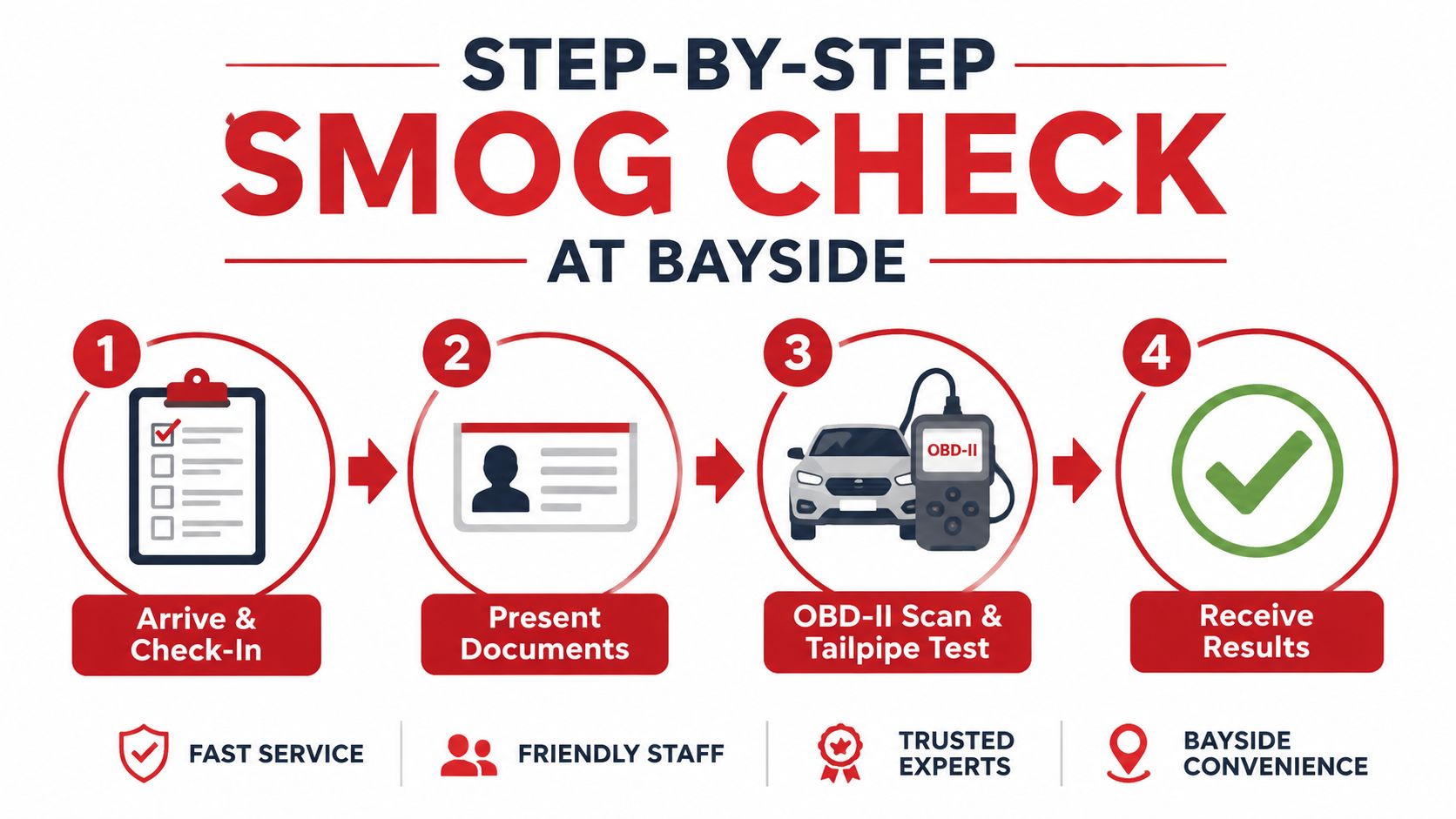
What STAR really means
A STAR-certified station is a station that operates under California's formal oversight system. It is the kind of place the state expects you to use when your vehicle's status calls for extra scrutiny. The point is simple, STAR is not a marketing label, it is a routing system for the vehicles that need closer handling.
You should use STAR when the DMV or the vehicle's compliance status requires it. If your renewal notice says STAR, use a STAR station. If it does not, confirm whether your vehicle can use a regular smog station before you book. That check saves time, and it keeps you from showing up at the wrong shop.
Which vehicles usually trigger the STAR question
The answer turns on model year, vehicle type, and the exact language on your DMV notice. Some vehicles can go to a regular smog shop. Others are directed to a STAR station, and the notice is what settles the question.
If the notice in your hand names STAR, treat that as the deciding factor. Don't try to outthink the DMV.
Contra Costa County adds another layer because enhanced-area rules can affect how the vehicle is evaluated and what the DMV expects next. Read the notice first, then match the station type to the vehicle category before you leave home. If you want a quick refresher on the term itself, the STAR overview above explains the setup without the DMV jargon.
Step-by-Step Smog Check Process and What to Bring
The cleanest smog visit starts before you arrive. Bring the paperwork that proves who you are and what the vehicle is doing in the DMV system, because missing documents slow everything down and can turn a simple visit into a second trip. At minimum, have your registration, renewal notice, and ID ready when you pull up.
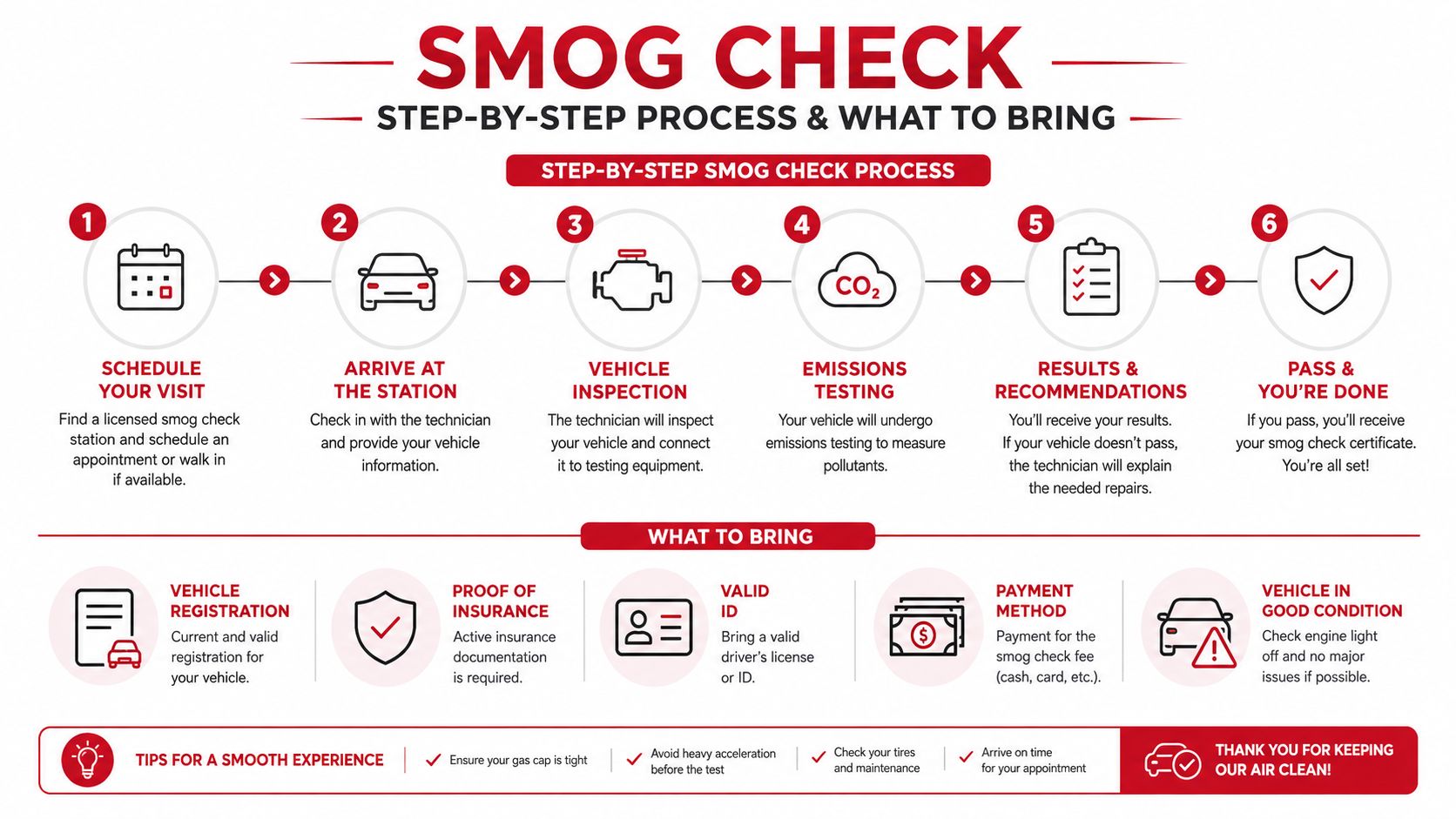
What the visit usually looks like
At a test-only station, the workflow is straightforward. You check in, hand over the documents, and the technician runs the inspection that matches your vehicle's requirements. That usually means OBD testing for many newer vehicles, plus whatever visual or functional checks apply to the car's configuration.
The point of a test-only model is speed and clarity. The station inspects the vehicle, reports the result, and leaves repair decisions to you and your mechanic if the vehicle doesn't pass. That keeps the inspection lane from turning into a sales counter.
For a quick refresher on which documents matter most, the DMV-style checklist in this guide to vehicle registration documents is the right mental model. Bring the paperwork first, then worry about the result.
What to expect if the vehicle passes or fails
If the vehicle passes, you're done with the inspection side and can move straight into the renewal or transfer process if that's what you came for. If it fails, don't argue with the lane. Get the printed result, find the actual failure reason, and fix that issue before you come back.
A two-bay setup helps here because it reduces the bottleneck that happens at smaller stations. Bayside Smog also has a drive-through style layout and on-site parking, which makes arrival and exit less awkward than the cramped strip-mall setup many drivers hate.
Best move: Don't show up assuming the station will “figure it out” for you. Know your paperwork, know your notice, and know whether you're there for testing only or for DMV processing too.
Comparing Bayside Smog to Typical Smog Stations
A lot of drivers get stuck on the wrong question. They ask whether they need "a smog shop," when the real issue is whether their car needs a regular test lane, a STAR-certified station, or help with DMV paperwork after the inspection. For that decision, the useful comparison is simple: what each station can do for your situation, and what it cannot.
The practical differences that save time
Here is the cleanest way to compare a place like Bayside Smog with a typical local station:
| Factor | Bayside Smog | Typical smog station |
|---|---|---|
| Testing model | Test-only | Test-only or repair-capable |
| Repair work | No repair upsell from the same lane | May also sell repairs |
| DMV help | Handles registration renewals and tag-related processing on site during posted hours | Often sends you elsewhere for DMV steps |
| Hours | More workable for people who cannot leave during a standard weekday block | Often limited to basic weekday availability |
| Vehicle types | Notes support for some RVs and motorhomes | Many shops stick to standard passenger vehicles |
That table is the part most drivers need to see. If your main headache is paperwork, on-site DMV processing saves a second trip. If your priority is keeping the inspection separate from repair advice, a test-only lane is the cleaner setup.
What the test-only setup means for you
A repair-capable shop can be convenient after a failure, but it also blurs the line between an inspection and a sales pitch. A test-only station keeps that line clear. You bring the vehicle in for the result, then you decide who fixes it if it fails.
That matters even more in Contra Costa County, where drivers often do not know whether they are dealing with a normal smog station requirement or a stricter STAR-related situation. If your vehicle only needs a standard inspection, a regular test lane is enough. If your registration notice or vehicle profile points you toward a STAR-certified station, choose that first and skip the guesswork.
Bayside Smog also notes support for some RVs and motorhomes, which separates it from many places that only want compact daily drivers. That makes it more useful for vehicles that do not fit the usual inspection mold, or for owners who want one stop for the test and the DMV side of the transaction.
If you compare it with a different local compliance-focused option like Fire House Smog, the main difference is location and the way each shop fits into your errand plan. The decision should still come back to the same question, does your vehicle need a regular test lane, a STAR-certified station, or a place that can handle the paperwork without sending you across town afterward.
Common Smog Test Failures and How to Prepare Your Vehicle
Most failed smog checks are not mysteries. They're predictable, and drivers ignore the warning signs until the day of the appointment. The common pattern is simple, a check engine light, a recent battery disconnect, an incomplete drive cycle, or maintenance that's been postponed too long.
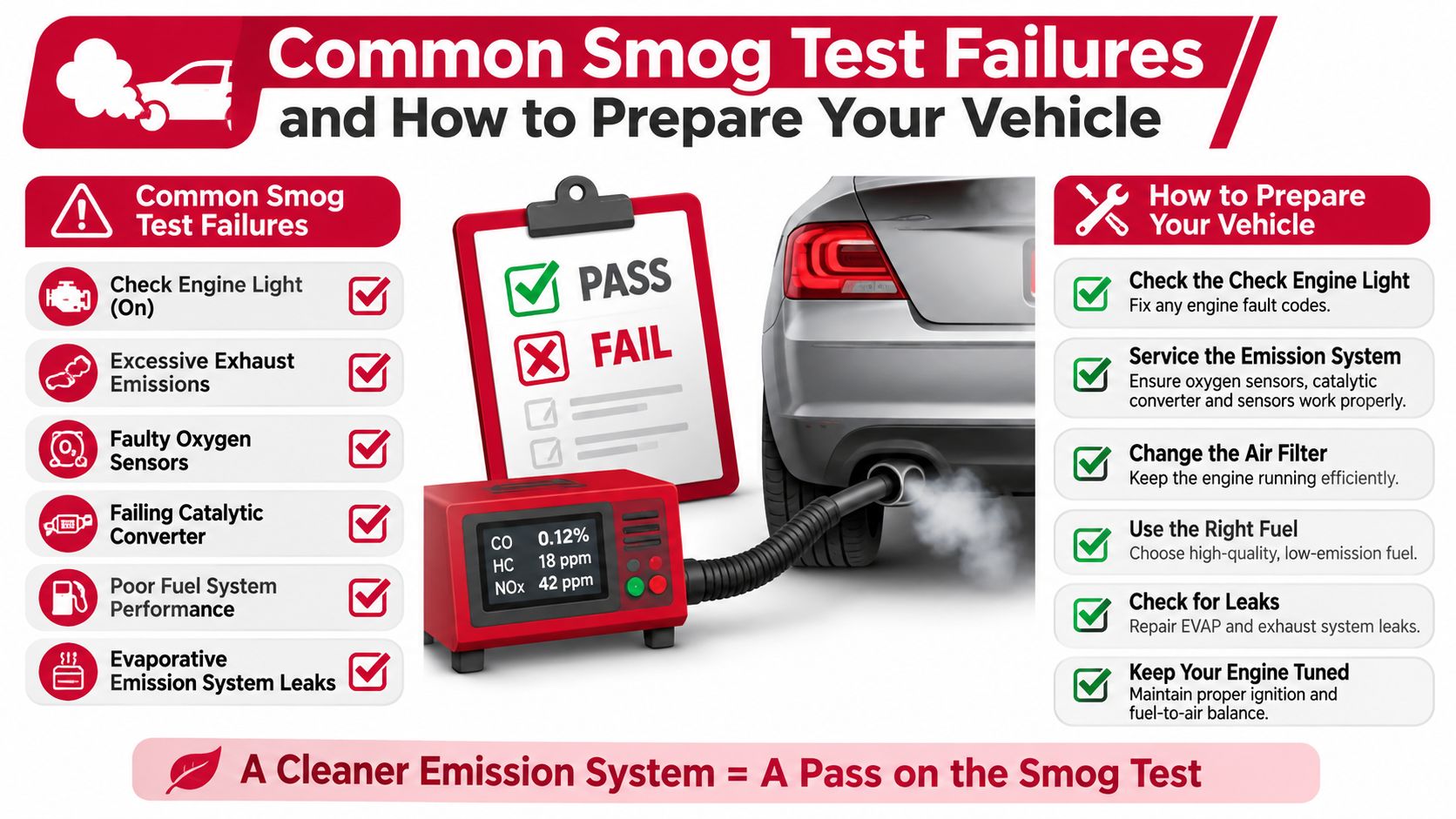
What to fix before you show up
If the check engine light is on, don't gamble on the inspection. Read the code, repair the actual issue, and only then test. If the battery was recently disconnected, the vehicle may not have completed the drive cycle needed for the onboard diagnostics to report correctly, which can trigger a failed or incomplete result.
Oil changes, air filter condition, and a secure gas cap matter too, not because they're magic, but because neglected maintenance shows up in emissions systems. A test-only station like Bayside Smog can't repair the vehicle for you, so showing up with obvious maintenance gaps just burns your time.
For a plain-English breakdown of failure causes, this guide on smog check fail reasons is the right next read before you book anything.
How to prepare without overcomplicating it
Do these things before your appointment:
- Clear warning lights first. A lit check engine lamp is a stop sign, not a suggestion.
- Finish a proper drive cycle. If the battery was disconnected or repairs were made, give the vehicle enough normal driving time to reset.
- Check the basics. Make sure the gas cap is tight, the air filter is secure, and obvious maintenance is current.
- Schedule the test after repairs, not before. Testing first just gives you a failure sheet you already could have predicted.
Direct advice: If you already know the car has a warning light, get it repaired first. Testing a broken system is the fastest way to waste a morning.
Why Smog Compliance Matters for East Bay Air Quality
A smog check looks like a DMV checkbox until you put it in the context of East Bay air quality. The Bay Area Air District was founded in 1955, adopted its first anti-smog regulation in 1957, and has tracked major changes in air quality over time (Bay Area Air District history). The same source reports that from 1990 to 2011, the Bay Area economy grew 77%, population grew 23%, miles driven rose 30%, and emissions of criteria pollutants including ozone and particulate matter fell 60% over that period. It also reported that the Bay Area's three-year annual average particulate matter concentration dropped from 12.3 micrograms per cubic meter to 7.8 micrograms per cubic meter over 15 years.
That matters in Concord and across the East Bay because vehicles are part of the region's air-management system. Clean-air progress does not remove the compliance requirement, it makes it more important that cars stay in good shape and stay legal. If you run a fleet, put on a lot of miles, or keep an older car going, treat the smog check as a routine maintenance step, not a last-minute DMV errand.
Contra Costa County sits inside that same system, so the right station choice depends on the notice you received and the vehicle you drive. Some cars need a STAR-certified station because the DMV or registration notice calls for enhanced testing. Others can go to a regular smog shop and still meet the requirement without paying for service they do not need.
Local pollution hot spots in nearby East Contra Costa communities make that maintenance decision more than a personal inconvenience. They also make it a practical health and cost decision. A vehicle that is consistently hard to pass should get looked at early, because repeated failures waste time and money. A vehicle that is due for enhanced smog testing still needs the right station first, and the clean-air goal does not change that basic rule.
If you want a clean, no-drama smog visit, use a station that stays focused on testing, paperwork, and DMV compliance. Fire House Smog handles STAR-certified test-only smog checks and DMV registration services in Antioch, so it is a straightforward option when your notice points you to that type of station. Visit Fire House Smog to check your options, confirm what your vehicle needs, and get the paperwork side handled without extra trips.
A STAR-certified smog check is California's higher-standard emissions test for certain vehicles the DMV directs to special stations, and the program has been in effect since January 2013. About 60% of active smog stations have been accepted into the STAR program, but only those stations can inspect many directed vehicles and gross polluters.
You open your registration notice, scan the page, and then stop at the line that says your car needs a STAR station. Most drivers have the same reaction. What does that even mean, and did something go wrong with your car?
Usually, this notice doesn't mean you did anything wrong. It means California wants a more closely controlled inspection for your vehicle. For a worried car owner, that can feel intimidating at first. In practice, it's a quality-control system designed to produce a more trustworthy result.
What confuses people most is that “STAR” sounds like marketing language. It isn't. It's a state certification tied to station performance, equipment standards, and inspector accuracy. And if you're looking at a STAR Test-Only station, there's another layer that matters to you as a consumer. That shop can inspect your car, but it can't sell you the repair.
That difference is a big deal. It changes the test from a sales opportunity into something much closer to an audit. If you want peace of mind that the result is based on your car's actual emissions, not on a repair estimate waiting in the background, that model makes a lot of sense.
Table of Contents
- Introduction That Confusing DMV Notice
- What Is the California STAR Program
- STAR Test-Only vs STAR Test and Repair Stations
- Why Your DMV Notice Says STAR Station Required
- Passing Your STAR Smog Test A Step-by-Step Guide
- After the Test Understanding Your Results
- Get Your STAR Certified Smog Check in Antioch
Introduction That Confusing DMV Notice
If you're searching for what is STAR certified smog, you're probably dealing with a DMV renewal notice that feels more cryptic than helpful. You just want to renew your registration, and suddenly the state is telling you where your car has to be tested.
That's a common situation. A STAR-certified smog check is a higher-standard California emissions inspection required for certain vehicles, usually because the DMV wants the test done at a station with tighter oversight and stronger performance standards.
Why this catches drivers off guard
The concept of a regular smog check is well-known. The confusing part is the added STAR label. Drivers often wonder if their car has been singled out, whether it already failed somewhere behind the scenes, or whether the test will be harsher.
In plain language, the state is trying to make sure some vehicles get checked at stations that have proven they can produce reliable results. That's the main idea.
Practical rule: If your notice says STAR station required, don't shop for any smog shop. Shop specifically for a STAR-certified station, and if you want the most neutral setup, look for STAR Test-Only.
What most people really want to know
When a customer asks me about STAR, the main questions are usually these:
- Why my car? Did the DMV flag something specific?
- Is this different from a regular smog check? Yes, the station standards are different.
- Can I still pass? Absolutely, if the vehicle is in compliance.
- Should I use a test-only station? If you want a cleaner separation between inspection and repair, many drivers prefer that route.
By the end of the process, the goal is simple. You want a result you can trust, whether your car passes or needs work.
What Is the California STAR Program
A California smog check is only helpful if the result is trustworthy. The STAR program was built around that idea.
California launched STAR in January 2013 as part of a broader update to the Smog Check system. Under the program, the Bureau of Automotive Repair certifies stations that meet tighter standards for testing equipment and inspector performance, as described in the California Senate Smog Check fact sheet/index.pdf).
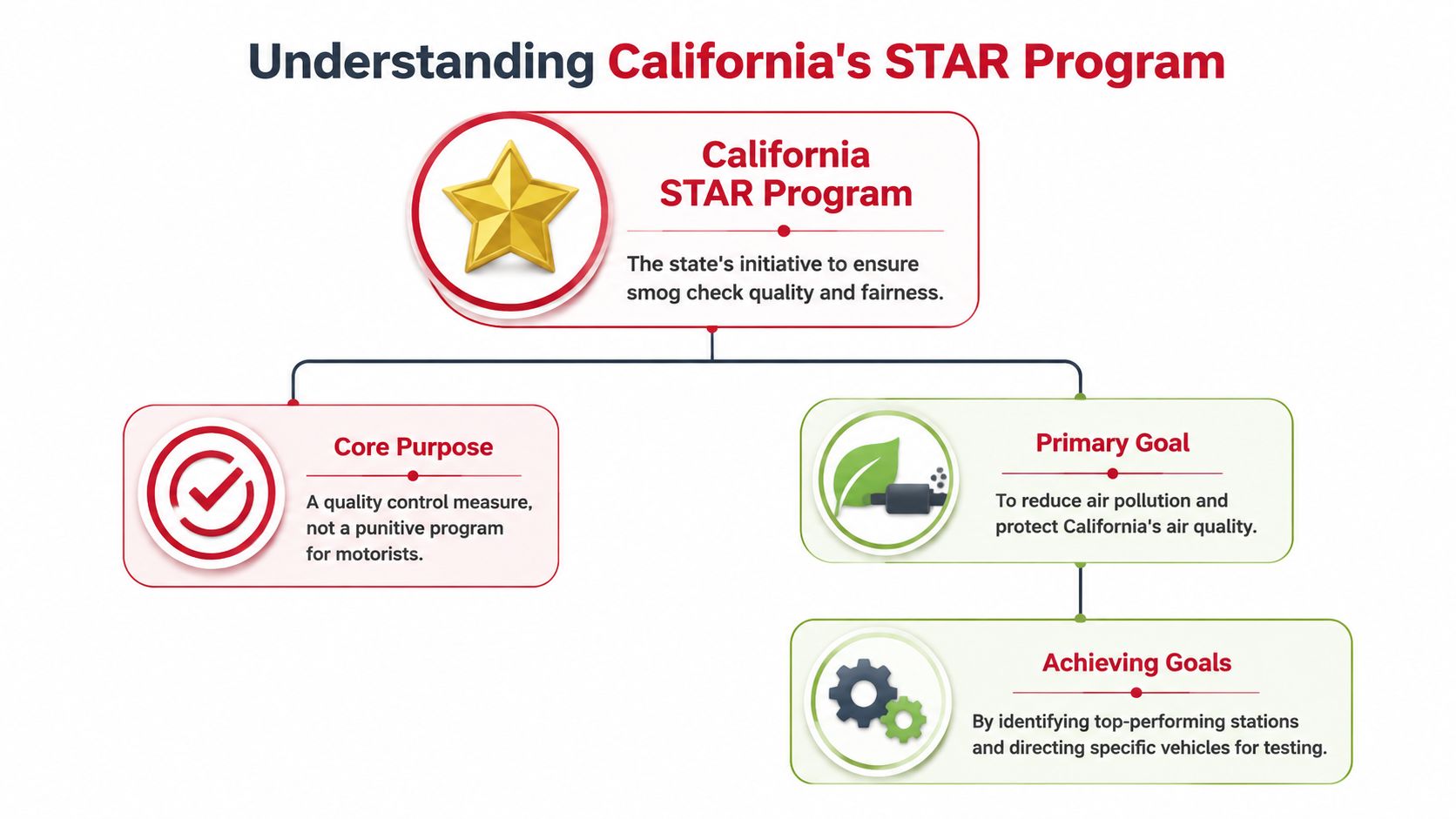
For a vehicle owner, the easiest way to understand STAR is this. It works like an extra layer of quality control. The state uses it to make sure certain vehicles are inspected at stations with stronger oversight, so the result carries more weight.
That consumer-protection angle is easy to miss. Many drivers hear "STAR" and assume it means a tougher version of the same test. In practice, it is also a way to reduce doubt about the inspection itself, especially when the state wants a cleaner, more dependable reading.
What STAR is actually designed to do
STAR helps California monitor vehicles that may need closer attention, including directed vehicles and gross polluters, according to the same fact sheet. In plain English, those are the cars the state wants checked in a more controlled setting because accuracy matters more with them.
That is why many drivers prefer the STAR Test-Only model when it is available to them. A test-only station inspects the vehicle but does not sell the emissions repair. The setup feels more like an audit than a sales appointment. For owners, that can provide real peace of mind because the station's job is to measure and report, not diagnose and fix in the same visit.
If you want more background on the rules your vehicle is being measured against, this overview of California vehicle emissions standards connects the smog check process to the state's clean-air requirements.
What STAR means in plain English
For the average owner, the STAR label means the station operates under tighter state scrutiny. A smog test is only useful if the result is dependable. A pass should mean your car met the standard. A fail should point to a real emissions problem, not a sloppy inspection or a questionable call.
Here's a simple breakdown:
| Term | Plain-English meaning |
|---|---|
| Regular smog station | Can inspect many vehicles, but not every DMV-directed one |
| STAR station | Meets higher state standards and can inspect certain directed vehicles |
| Directed vehicle | A vehicle the DMV requires to be tested at a STAR station |
| Gross polluter | A vehicle emitting far above legal limits |
The key idea is reliability. California does not just want more smog tests. It wants credible tests, especially for the vehicles most likely to create pollution problems or raise questions about the accuracy of the result.
So when someone asks, what is STAR certified smog, the best answer is broader than a definition. It is a state-run quality-control system that helps protect consumers by steering certain cars to stations held to a higher standard. And when that inspection happens at a STAR Test-Only station, many owners feel more confident that the result is unbiased.
STAR Test-Only vs STAR Test and Repair Stations
You pull into a STAR station because your DMV notice says you need one. Then you see two labels that sound almost the same: STAR Test-Only and STAR Test and Repair. That is where many owners pause, because the difference affects more than convenience. It affects how independent the inspection feels.
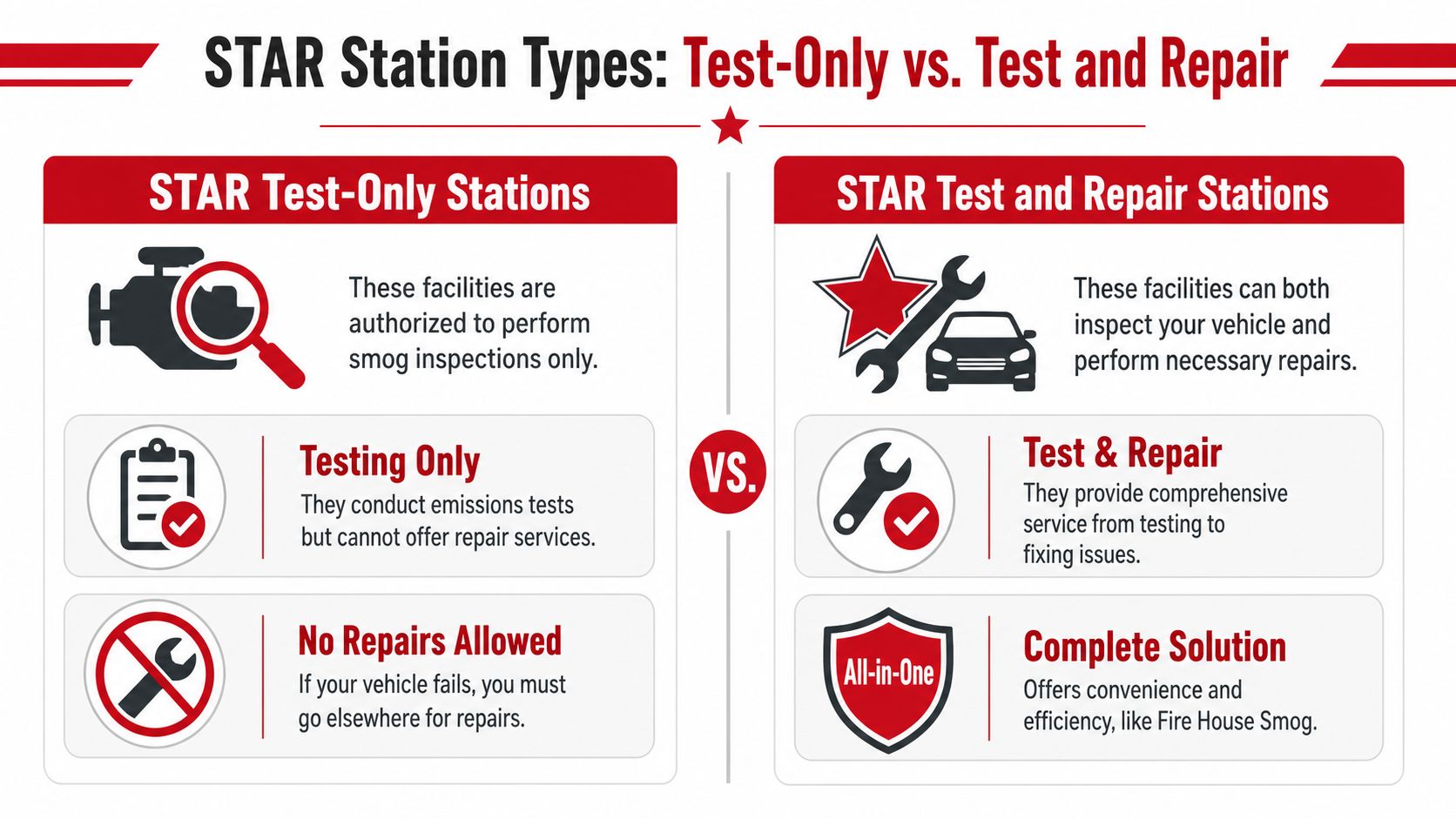
What a STAR Test-Only station does
A STAR Test-Only station inspects the vehicle and reports the result. It does not perform emissions repairs, as explained in this overview of the STAR smog check station program.
That business model matters.
If the shop cannot sell you the repair, the test works more like an audit. The technician's job is to measure what the car is doing, document it correctly, and send the result to the state. For many drivers, that removes a layer of doubt. You are not wondering whether a failed test might turn into a repair estimate five minutes later.
If you want a practical breakdown of how that setup works, this guide to STAR-certified test-only centers explains the process in plain language.
What a STAR Test and Repair station does
A STAR Test and Repair station can do both jobs. It can inspect your car, diagnose the problem if it fails, and complete the repair work.
Some owners prefer that one-stop setup. If your vehicle has an issue, you may be able to move from test to repair without visiting a second shop. That can save time.
Still, the structure is different from test-only. The same business that finds the problem can also sell the fix. Many honest shops operate this way, but some drivers are more comfortable separating those roles.
Why many owners see test-only as the cleaner model
The strongest consumer-protection benefit of the STAR system shows up here. A STAR Test-Only station gives you a result without a repair sale attached to it.
A simple comparison helps:
- Test-Only works like an independent inspection.
- Test and Repair works like an inspection plus repair option.
Both are legitimate. The question is what gives you more confidence.
If your main concern is trust, the test-only model often feels safer because the station does not profit from failing the car and then fixing it. That is why many directed vehicle owners view STAR Test-Only stations as more than a category on a sign. They see them as a safeguard built into the smog check system.
A side-by-side comparison
| Station type | Can inspect | Can repair | Main consumer question |
|---|---|---|---|
| STAR Test-Only | Yes | No | “Am I getting an independent result?” |
| STAR Test and Repair | Yes | Yes | “Do I want the test and repair in one place?” |
The same SmogTips guide notes that California uses the test-only model for many vehicles in Enhanced Smog Check Areas. That fits the larger purpose of STAR. The program is not only about identifying higher-risk vehicles. It also gives owners a way to get an audit-style emissions check that feels fair, separate, and easier to trust.
For a concerned car owner, that peace of mind is a big part of what STAR certified smog really means.
Why Your DMV Notice Says STAR Station Required
The short answer is that your vehicle has been directed to a STAR station. The DMV didn't print that by accident. It means the state wants your car inspected at a station that has shown stronger performance in identifying emissions failures.
What “directed vehicle” means in plain language
A directed vehicle is one the system routes to a STAR station instead of letting it go to any regular smog shop. That can happen because of the car's prior test history or because similar vehicles are more likely to fail.
This part is important. The state isn't necessarily saying your car is bad. It's saying your car falls into a category where the inspection should happen at a station with a stronger record for catching real emissions problems.
The hidden metric most drivers never hear about
One reason STAR certification is harder to earn is a performance standard called Similar Vehicle Failure Rate, or SVFR. To qualify for STAR certification, a station's SVFR must be at least 50% of the industry-wide failure rate for similar vehicles, according to California regulation 16 CCR 3392.2.
That sounds technical, so let's translate it.
If a certain kind of vehicle commonly has emissions problems, the BAR wants STAR stations to show they are identifying those failures at a meaningful rate. In other words, STAR stations aren't supposed to pass everything. They're supposed to catch the vehicles that should fail.
STAR stations are selected with data. The point isn't to be tougher for the sake of being tougher. The point is to be more accurate with vehicles that carry more emissions risk.
A short visual walk-through can help if you want to see how the requirement works in practice:
Why that should reassure you
Drivers often read “STAR required” as a warning. A better way to read it is this: the state wants the result to come from a station with a verified track record.
That matters whether your car passes or fails. If it passes, you can feel more confident the vehicle is fully compliant. If it fails, you have a more credible reason to investigate the problem instead of wondering whether the result was sloppy or rushed.
Passing Your STAR Smog Test A Step-by-Step Guide
You pull into a STAR station with your DMV notice on the passenger seat, and one question is usually running through your mind: what exactly are they going to do to my car?
The good news is that a STAR smog check is not a mystery inspection. It follows a set process, and at a STAR Test-Only station, that process works a lot like an audit. The station's job is to measure and verify, not to sell you a repair. For many drivers, that separation is what makes the experience feel fair.
Before you go
The easiest way to avoid surprises is to show up with the car in normal driving condition.
If your Check Engine light is on, handle that first. That light means the car has already detected a problem, and a smog inspection is likely to catch it too. Going in anyway usually wastes time and adds stress.
It also helps to arrive with the vehicle warmed up. A short drive before the test gets the engine and emissions system to normal operating temperature, which gives the car the right conditions for inspection.
A simple pre-test checklist helps:
- Drive the car first: A normal trip before the appointment helps warm the engine and emissions components.
- Look at the dashboard: Warning lights can signal a problem that needs attention before testing.
- Pay attention to how the car feels: Rough idling, hard starts, or other obvious issues are worth addressing first.
- Bring your notice or registration information: That helps the station confirm the correct inspection for your vehicle.
What happens during the test
The exact procedure depends on the vehicle's model year and system type, but the flow is usually easy to follow.
Vehicle identification
The technician confirms the VIN, license plate, and inspection requirement so the right test is performed.Visual inspection
Emissions-related parts are checked for missing, disconnected, or altered components.Electronic and system checks
For many vehicles, the technician connects to the onboard diagnostic system to see whether the car has reported emissions faults or incomplete monitors.Tailpipe or functional testing, when required
Some vehicles need additional measurement or equipment checks based on their age and configuration.
That structure matters for a reason. At a STAR Test-Only station, the technician is there to document what the vehicle is doing on that day, the same way an independent inspector checks a home before a sale. That can give you peace of mind because the result is meant to be unbiased.
Why the equipment standard matters
The inspection is only as trustworthy as the equipment being used.
STAR-certified stations use BAR-certified Emission Inspection Systems, and those systems must be calibrated regularly under California regulation 16 CCR 3392.1. That calibration rule helps keep the readings accurate, so the machine is measuring your vehicle instead of reflecting a drifting sensor or poorly maintained test equipment.
In plain terms, the machine should stay on target. That is one more reason many vehicle owners feel more comfortable with the STAR model. The station is being checked, the equipment is being checked, and your car is being checked.
How to make the day easier
A little preparation can make the visit feel routine instead of tense.
- Give yourself extra time: A rushed arrival makes the process feel harder than it is.
- Ask questions if something is unclear: A good technician should be able to explain what type of inspection your car needs and why.
- Bring recent repair records if you have them: They can help clear up questions about emissions-related work or replaced parts.
If your vehicle is running properly, a STAR test should feel straightforward. For drivers sent to a STAR Test-Only station, that is often the biggest comfort of all. You are getting a measured, audit-style answer from a station set up to inspect first and leave sales pressure out of the test.
After the Test Understanding Your Results
Once the inspection is finished, you'll get one of two outcomes. Pass or fail. The emotional reaction can be strong, but the next steps are usually simpler than people expect.
If your vehicle passes
A pass means the vehicle met the inspection requirements. In most cases, the certificate is transmitted electronically to the DMV, and you can move forward with registration.
That's the cleanest outcome, and it's why many drivers want the confidence of a well-run STAR inspection. You're not left guessing whether the result will hold up.
If your vehicle fails
A fail doesn't mean your car is finished. It means the inspection found something that needs correction before the vehicle can be certified.
The first thing to read is the Vehicle Inspection Report, often called the VIR. That report tells you where the problem showed up. Depending on the vehicle and issue, the failure may relate to emissions readings, onboard diagnostics, or emissions equipment concerns.
Use the report this way:
- Read the failure area first: Don't guess at the problem before looking at the VIR.
- Take the VIR to a licensed repair facility: The report gives the repair shop a starting point.
- Return after repairs for retesting: The car has to be checked again after the underlying issue is addressed.
Why a STAR failure is worth taking seriously
The point of the STAR system is not to trap drivers. It's to produce a more dependable inspection result. If a STAR station reports a failure, that result is generally more useful because it comes from a system built around tighter oversight.
In practical terms, a failure can save time. It tells you there's a real emissions issue to fix instead of leaving you with a vague suspicion that the car “might be okay.”
Don't treat a failed STAR test like bad luck. Treat it like a diagnostic checkpoint that found something your vehicle needs.
Some stations, including Fire House Smog, offer a free retest based on site policy and coupon terms. That can make the follow-up easier once repairs are completed.
Get Your STAR Certified Smog Check in Antioch
Your renewal notice shows up, you read “STAR station required,” and the first question is usually simple: where can I get this done without turning a test into a sales pitch?
That is why many Antioch drivers prefer a STAR Test-Only station. The setup works like an audit. The station checks whether the vehicle meets California emissions rules, but it does not have an in-house repair outcome tied to the result. For a car owner, that separation can feel a lot more reassuring. You are there for a clear answer, not a bundled diagnosis-and-repair conversation.
That consumer protection angle matters. A STAR Test-Only visit gives you a cleaner reading of where your car stands today, especially if you want confidence that the inspection result is independent.
What to look for in a local station
A good local option should make the process easier, not more confusing. If your registration deadline is close, small practical details make a real difference.
Helpful features include:
- Test-only operation: The inspection stays separate from repair recommendations
- STAR certification: Needed if your DMV notice specifically requires a STAR station
- Quick service flow: Useful if you need to fit the test into a workday
- On-site DMV support: Helpful if you want to handle registration tasks in one stop
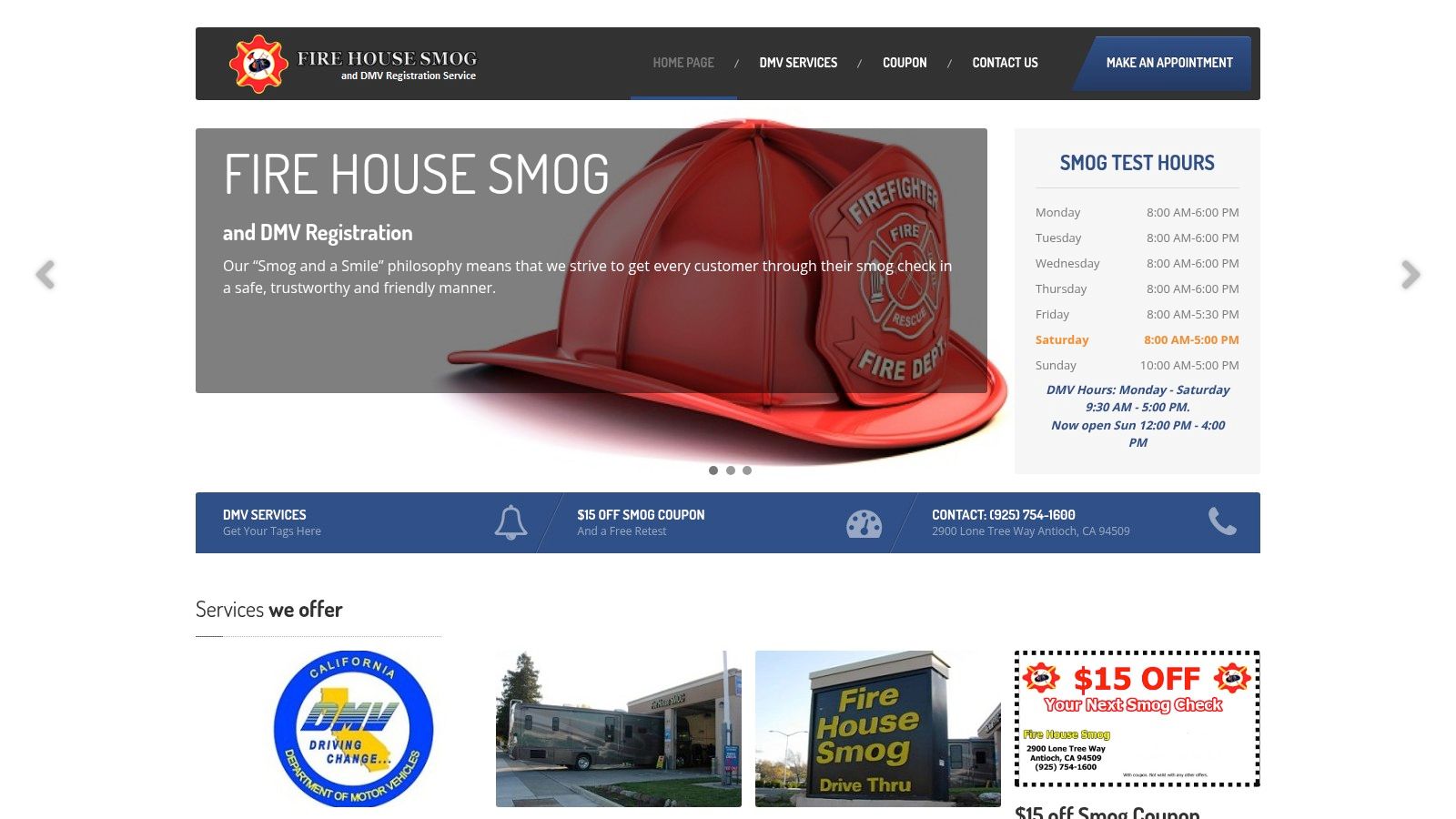
A factual local option
One local choice is STAR smog check service in Antioch, offered by Fire House Smog at 2900 Lone Tree Way, Antioch, CA 94509. The station operates as a STAR-certified test-only smog station, has two service bays, offers testing seven days a week, provides on-site DMV registration services with sticker printing, and can be reached at 925-754-1600 during posted hours.
For a driver trying to make sense of a DMV notice, that combination is practical. You can get the required inspection at a test-only station, keep the result separate from repair sales, and take care of some registration tasks in the same visit.
If you have been asking what STAR certified smog means in real life, this is the plain-English version. It is a tighter, more closely watched inspection process for certain vehicles. At a STAR Test-Only station, it also gives you something many drivers want most: confidence that the test result is unbiased.
Need a STAR-required inspection in Antioch? Fire House Smog provides STAR-certified test-only smog checks and on-site DMV registration services at 2900 Lone Tree Way, Antioch, CA 94509. You can call 925-754-1600 to confirm hours, ask whether your vehicle type can be accommodated, or check current retest and coupon details before you stop by.