
How Long Does a STAR Smog Check Take
A STAR test-only smog check typically runs about 30 minutes for the inspection itself, with the full visit often stretching to 45 to 60 minutes once intake, paperwork, and any queue are included. Older vehicles can take longer because their inspections may require tailpipe testing instead of only an onboard diagnostic check.
You may be trying to fit the appointment between work, school pickup, and a DMV deadline. The mistake I see most often is budgeting only for the time the vehicle sits on the machine. At a real station, the clock also includes check-in, registration details, vehicle identification, test setup, results review, payment, and electronic certificate processing.
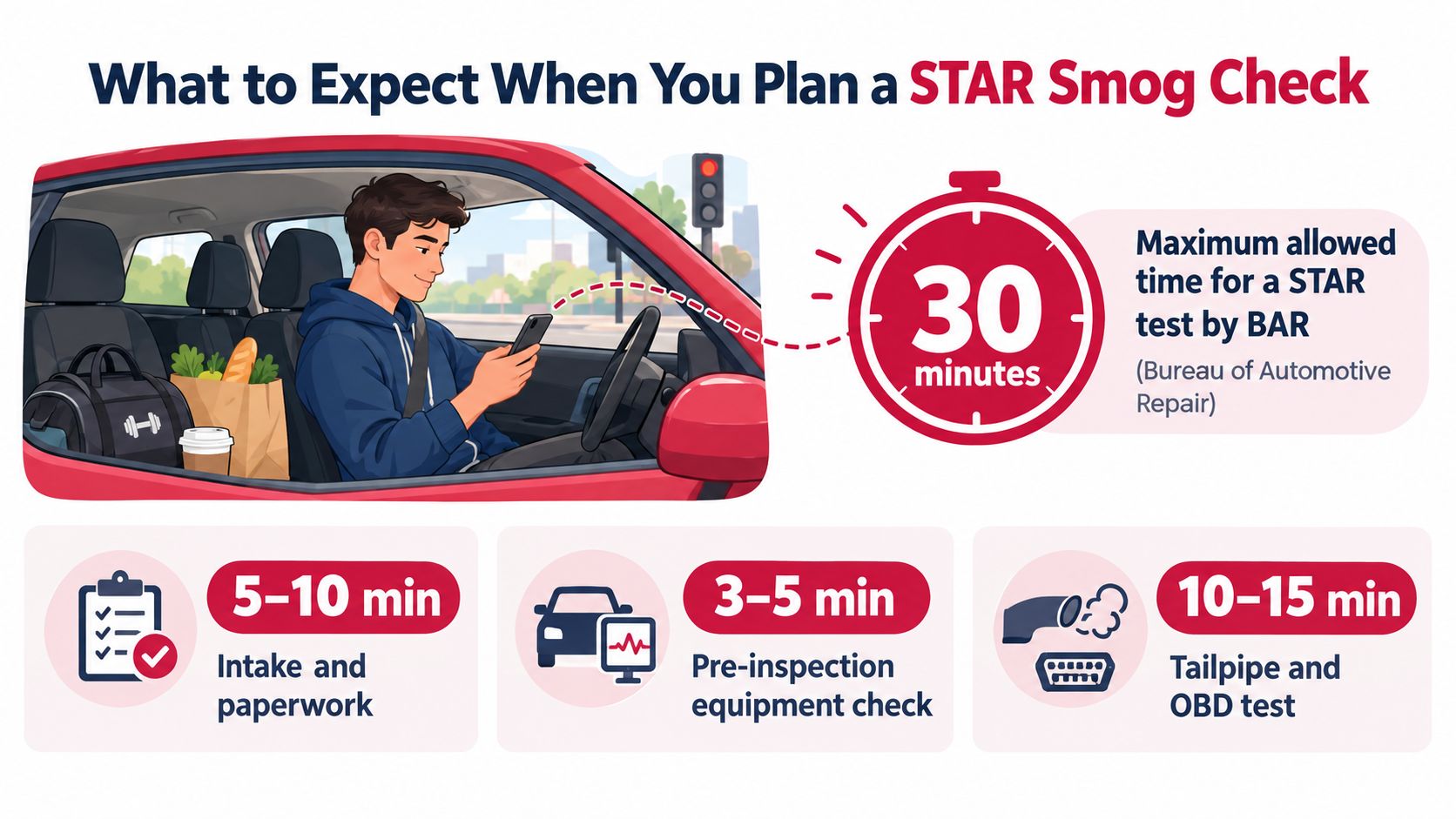
The California Bureau of Automotive Repair's Smog Check guidance uses about 30 minutes as the normal benchmark. Treat that as the inspection window, not a promise that you'll be back on the road exactly half an hour after arrival.
Table of Contents
- What to Expect When You Plan a STAR Smog Check
- Inside the Smog Check Workflow Step by Step
- How Vehicle Age Affects Inspection Time
- Retests Free Repairs and the Clock Reset
- Smart Ways to Cut Your Wait at the Station
- Putting It All Together Your Realistic Time Budget
What to Expect When You Plan a STAR Smog Check
A driver who's scheduling a STAR test-only inspection between errands should reserve roughly an hour of usable time. BAR's benchmark is about 30 minutes for the test, but intake, paperwork, and a waiting vehicle ahead of you can extend the visit to 45 to 60 minutes. Busy stations can take longer, particularly when a vehicle needs extra verification or a technician is finishing another test.
STAR stations follow BAR requirements and may handle vehicles directed to STAR testing or identified as gross polluters. That means the technician can't skip required visual, emissions, and diagnostic checks just because the car appears to be running well. A test-only station also can't fix the vehicle during the inspection, so a failure becomes a separate repair decision rather than an improvised repair session.
Your appointment plan
Use this simple schedule:
- Reserve a time slot instead of assuming a walk-in will move immediately.
- Allow an hour buffer for a normal first visit.
- Avoid back-to-back morning commitments, especially if the vehicle is older or has a warning light history.
- Ask about same-day retesting before the technician starts, so you know the station's policy if the car fails.
A two-bay test-only shop generally has more room to keep one vehicle moving while another is being checked. That doesn't eliminate queues, but it can reduce the bottleneck created by a single occupied bay. In my experience, early weekday appointments are usually easier to manage than a late-morning walk-in, but you should still confirm the station's actual schedule.
Practical rule: If missing the next appointment would cause a problem, don't book the smog check without leaving a full hour for the visit.
For a clear explanation of the STAR designation and why a vehicle may be directed to one of these stations, review this guide to what STAR-certified smog testing means.
Inside the Smog Check Workflow Step by Step
The inspection bay is only one part of the appointment. A clean, ready vehicle moves through the process predictably, while missing paperwork, incomplete readiness monitors, or an older emissions system can slow the technician down.
The five stages that consume time
Check-in comes first. Expect time for the driver's information, registration or renewal details, vehicle identification, payment, and the station's work order. If the counter is handling another customer, your vehicle may be waiting before it reaches the bay.
Vehicle preparation follows. The technician identifies the correct test path, connects the equipment, checks the diagnostic connection where applicable, and prepares any tailpipe equipment required for the vehicle. Setup is quick when the car is accessible and the required systems are in normal condition.
The emissions portion depends heavily on the vehicle. Newer cars commonly provide results through OBD-II data, while older vehicles may require additional tailpipe procedures. The BAR notes that pre-2000 model-year vehicles may require a tailpipe emissions test, which adds steps compared with a straightforward diagnostic scan. See the BAR inspection guidance for the official program framework.
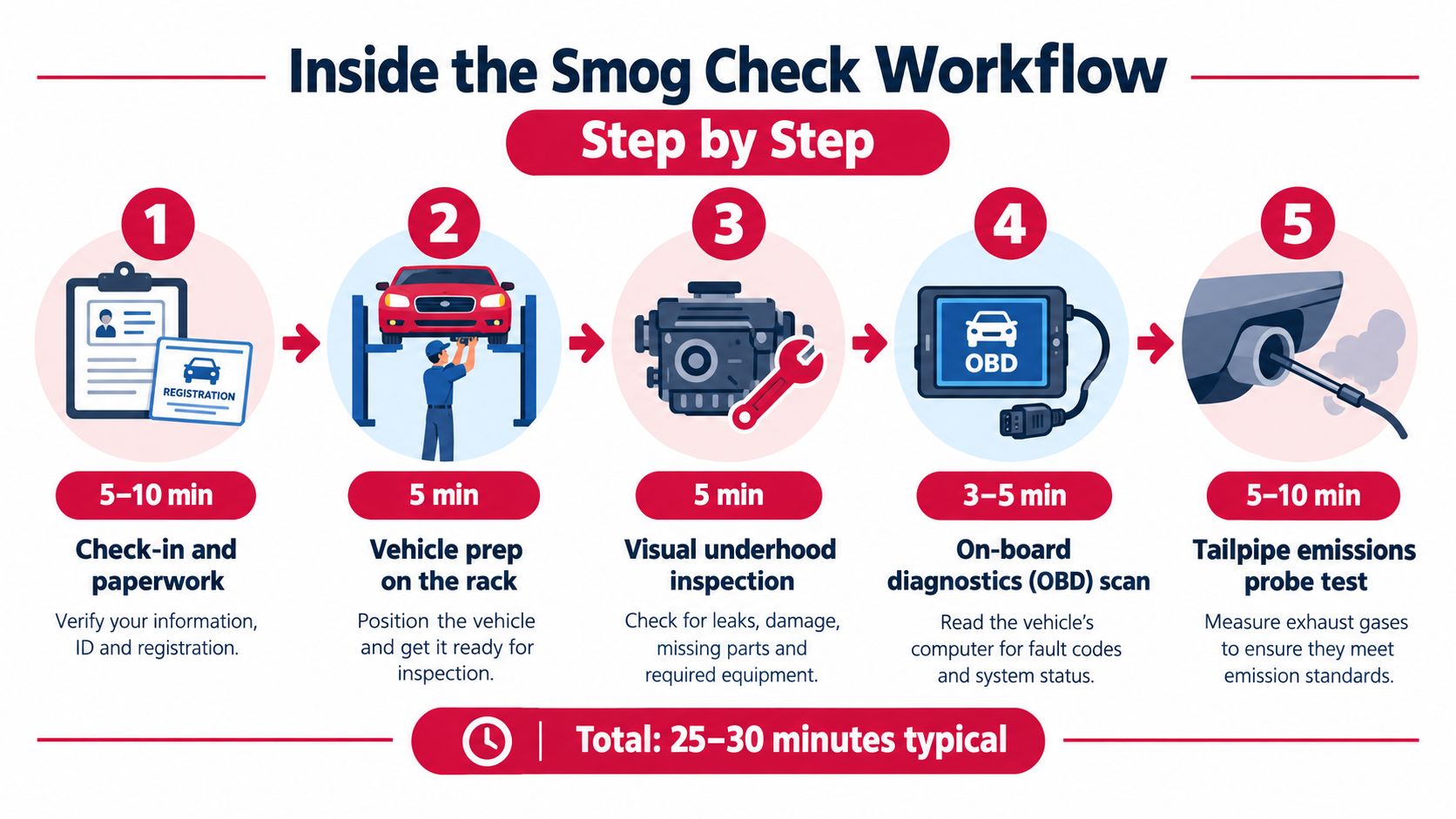
The final stage is results handling. The technician reviews the outcome, explains a pass or failure, issues the certificate when appropriate, and submits the result electronically. A slow connection, a missing document, or a customer question about the report can add time after the machine has finished.
Why the machine isn't the whole appointment
Drivers often ask why a “30-minute test” takes closer to an hour. The answer is operational. The technician must establish the vehicle's identity, choose the correct procedure, document the result, and complete the transaction.
If the car passes cleanly, the final review is usually straightforward. If it fails, the technician must explain which portion of the inspection produced the failure and provide the report needed for repair planning. That conversation is useful, but it doesn't belong in the machine-time estimate.
How Vehicle Age Affects Inspection Time
Vehicle age is the most practical predictor of inspection length. Newer vehicles usually rely more heavily on onboard diagnostics, while older vehicles may need a tailpipe measurement and additional manual checks.
The industry range is commonly 15 to 30 minutes for a standard emissions inspection, while one California-focused timing guide lists 15 minutes for 2000-and-newer vehicles, 25 minutes for 1996 to 1999 models, and 35 minutes for 1995-and-older vehicles. Those figures show the model-year gradient clearly, but they describe testing time and shouldn't be treated as a guaranteed door-to-door appointment length. Review the California smog timing guidance by vehicle age when estimating your visit.
| Vehicle Category | Model Years | Estimated Inspection Time | Test Type |
|---|---|---|---|
| Newer OBD-II vehicle | 2000 and newer | About 15 minutes | OBD-II inspection |
| Transitional OBD-II vehicle | 1996 to 1999 | About 25 minutes | OBD-II with additional emissions checks |
| Older vehicle | 1995 and older | About 35 minutes | Tailpipe-based emissions testing where required |
A ready OBD-II vehicle is usually the fastest path because the technician can retrieve diagnostic and readiness information directly from the car. The process becomes less predictable when monitors aren't ready, the malfunction indicator lamp is illuminated, or the vehicle has been recently disconnected from its battery.
Older cars deserve more planning. If your vehicle falls into that category, read this guide to smog checks for older cars before booking. Ask the station whether it handles your exact vehicle type, especially if the car is a diesel, a heavy-duty pickup, or a specialty vehicle with equipment requirements outside the ordinary passenger-car workflow.
California's 2026 BAR update also matters for collector vehicles. The update says expanded collector-vehicle exemptions are phased in beginning January 1, 2028, so some older vehicles may face different inspection requirements in the future. That change can affect whether a vehicle needs a STAR inspection at all, which in turn affects queue expectations for stations serving older-car owners.
Retests Free Repairs and the Clock Reset
The hardest time estimate is the one after a failure. A driver arrives expecting a certificate, hears that the vehicle didn't pass, and leaves with a report instead. The inspection may be over, but the registration task isn't.
The technician should provide a failure report identifying the area that needs attention. Common problem categories include catalytic-converter performance, evaporative-emissions leaks, and ignition misfires. Those problems don't have one fixed repair time. A pre-diagnostic scan at a repair shop can help separate a simple sensor or leak issue from a repair that requires deeper testing.
The retest timeline
California's program generally gives the driver a 90-day period for repairs and retesting under the applicable rules. Confirm the exact retest terms with the station, because fee policies and eligibility can depend on where the original test occurred and the station's stated conditions.
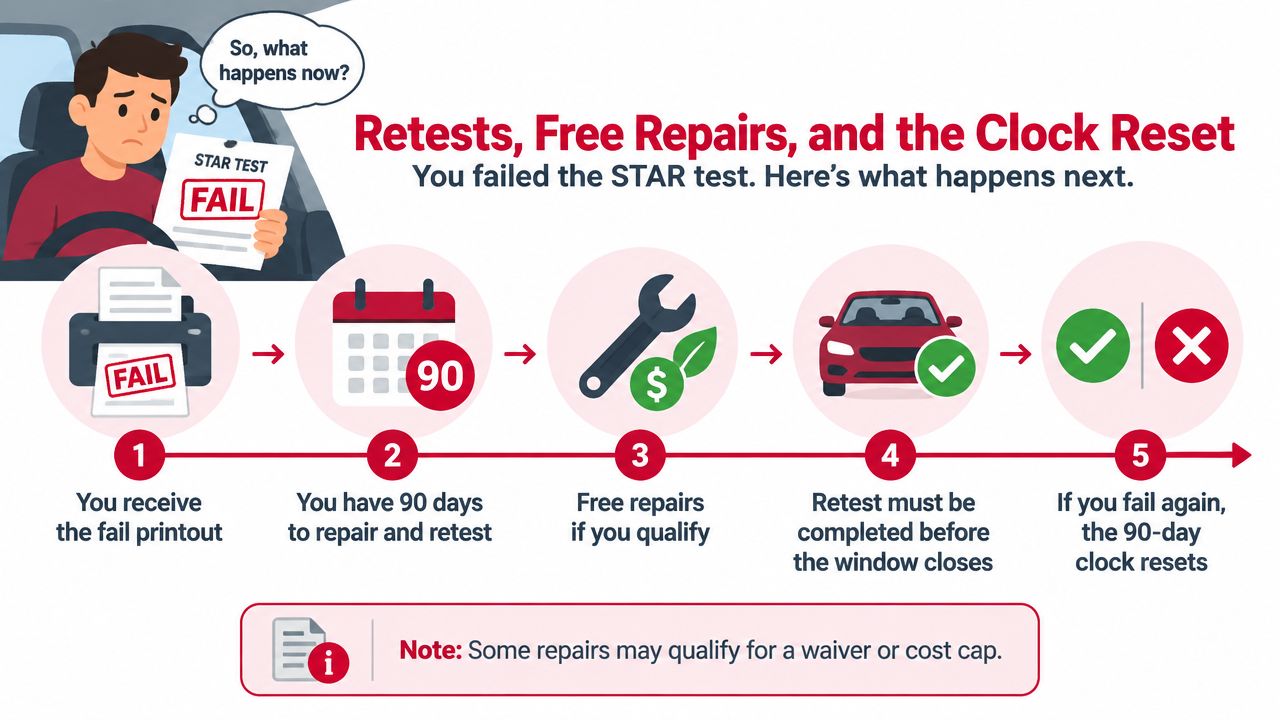
The practical sequence is simple:
- Keep the failure report: Give it to the repair technician so they can target the failed portion.
- Confirm the retest policy: Ask whether the same station offers a waived retest fee and what conditions apply.
- Repair before returning: Don't use the retest appointment as a second diagnostic session unless the station specifically offers that service.
- Return before the window closes: A different station may require its own intake process and may not honor the original station's free-retest terms.
The phrase “free retest” doesn't mean the whole second visit is cost-free. Repairs still cost money, and a state fee may apply depending on the transaction. The return trip also consumes time, often adding a substantial appointment window to the original visit.
A failed test resets your schedule, not just your repair list.
If you're comparing the total financial and time impact before booking, use this explanation of vehicle emissions test costs and ask the station for its current retest policy.
The clock-reset feeling is real. Choosing another STAR station can mean repeating check-in, waiting for a bay, and beginning the inspection workflow again. Keep the original paperwork, repair the documented issue, and return to the same station when its policy makes that the most efficient option.
Smart Ways to Cut Your Wait at the Station
The fastest appointment starts before you pull into the lot. A prepared driver removes the small delays that cause a short inspection to become a long visit.
Make the vehicle easy to process
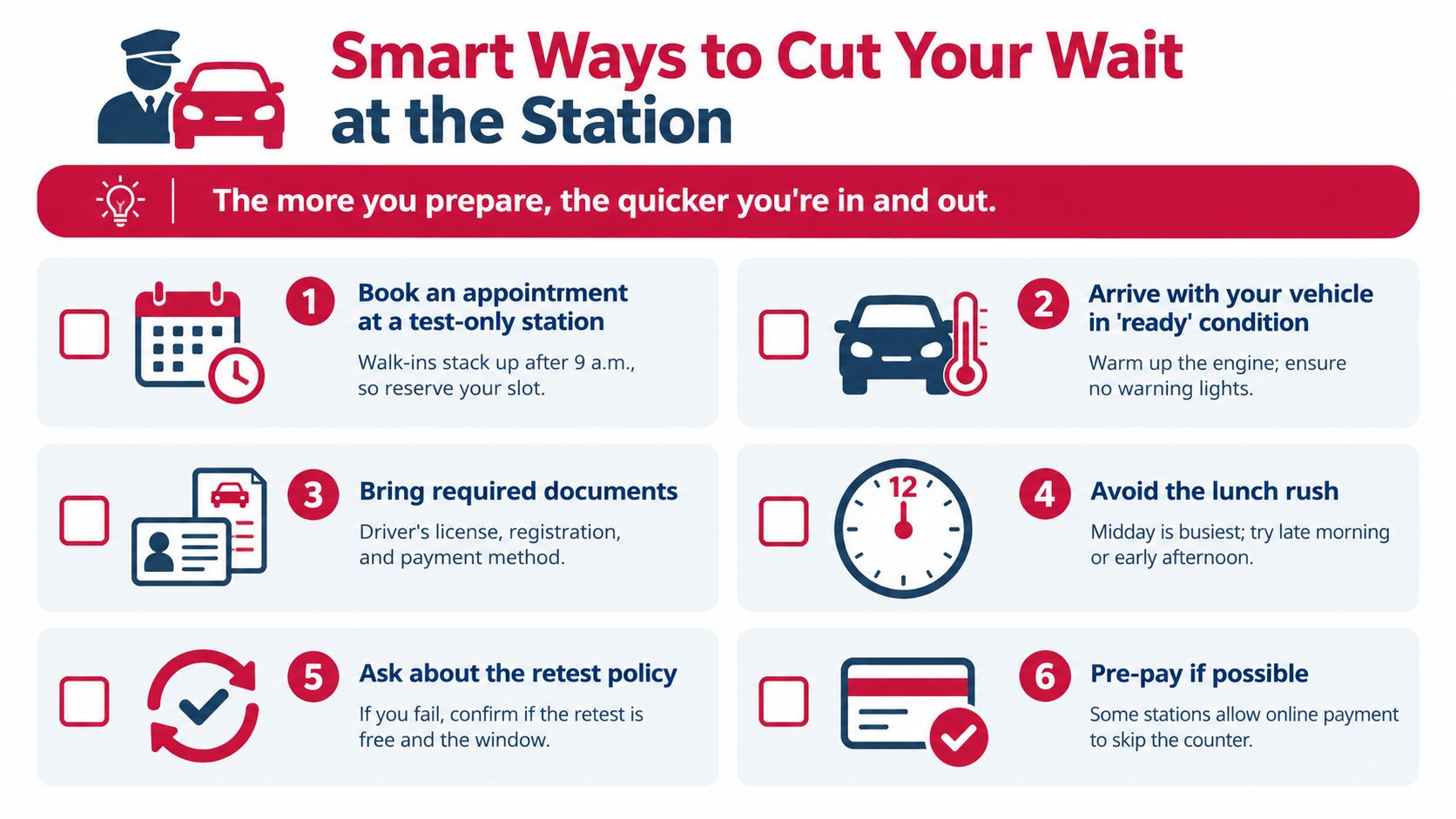
Book an appointment at a test-only station whenever the option exists. Walk-ins can stack up during the morning and midday rush, and a reservation gives the station a better chance to assign a bay without interrupting another test.
Arrive with the engine fully warm from normal driving. Don't race the engine in the parking lot. Drive normally, then arrive with the dashboard malfunction indicator lamp confirmed off. If the light is on, the station can't turn a likely failure into a pass by rushing the inspection.
Bring the documents the counter needs:
- Identification: Have your photo ID available.
- Registration details: Bring the registration or renewal notice so the technician can match the vehicle and transaction.
- Payment: Keep the payment method ready instead of searching through the car at check-in.
- Vehicle information: Tell the station about unusual equipment, a recent battery disconnect, or a vehicle classification that may require a different procedure.
Ask the right questions before entering the bay
Call ahead if you drive a diesel, heavy-duty truck, recreational vehicle, or unusually large vehicle. A passenger-car bay may not accommodate every vehicle, and finding that out after arrival is a wasted trip.
Operator advice: Ask which bay is available and whether the diagnostic equipment is already running a test. That answer tells you more about your likely wait than a generic promise that the station is “not busy.”
Don't arrive with an avoidable readiness problem. A recently cleared diagnostic system can leave monitors incomplete, and the vehicle may need normal driving before it can be tested successfully. The station can tell you what it sees, but it can't manufacture a valid readiness result at the counter.
Some stations combine testing with DMV services, while others focus only on inspections. Fire House Smog is a STAR-certified test-only station with two service bays, seven-day smog testing, and California DMV registration services at its Antioch location. Confirm current hours, vehicle eligibility, appointment availability, and retest terms before you drive over.
Putting It All Together Your Realistic Time Budget
The cleanest way to answer how long does a STAR smog check take is to separate three situations: a prepared newer vehicle, an older vehicle, and a failure that creates a second visit.
For a clean OBD-II pass, reserve 45 to 60 minutes door to door. The BAR benchmark covers about 30 minutes of inspection, but intake, a queue, results review, payment, and certificate handling determine when you leave. This is the budget I recommend for a driver with a normal passenger vehicle and a scheduled appointment.
An older vehicle deserves more room. Guidance places standard testing broadly in the 15-to-30-minute range, while the California-focused timing breakdown reaches 35 minutes for 1995-and-older vehicles. Add the counter process and possible queue, and you should avoid scheduling another appointment immediately afterward.
| Scenario | Intake | Inspection | Certificate | Total Visit |
|---|---|---|---|---|
| Prepared newer OBD-II vehicle | 5 to 10 minutes | About 15 to 30 minutes | A few minutes | Plan for 45 to 60 minutes |
| Older vehicle needing tailpipe testing | 5 to 10 minutes | About 25 to 35 minutes | A few minutes | Plan beyond the standard hour if busy |
| Failed test and later retest | New check-in at return | Repeat inspection process | Review after result | Reserve another substantial appointment window |
A failure creates a second planning problem. You need the repair appointment, parts or diagnostic time, and a return visit within the applicable 90-day retest period. A free or waived retest policy may reduce the testing charge, but it doesn't eliminate the time required to bring the vehicle back and process it again.
The collector-vehicle rules add another reason to check eligibility before scheduling. BAR's 2026 update describes expanded exemptions phased in beginning January 1, 2028, so those changes are a future consideration rather than a current blanket exemption. They may alter which older vehicles enter STAR queues later, but you should use the rule that applies to your vehicle and registration transaction today.
Book the appointment, arrive with the required documents, warm the vehicle through normal driving, and leave an hour of breathing room. That plan is more reliable than betting your day on the machine finishing quickly.
Fire House Smog provides STAR-certified test-only inspections, two service bays, and DMV registration services for eligible vehicles in Antioch. Check current hours and vehicle requirements, then visit Fire House Smog to plan your smog check with enough time for the inspection and certificate process.