You open your California DMV renewal notice and see a requirement for a STAR smog check. Your car runs normally, the check engine light is off, and you assume any nearby smog shop can handle it. That assumption is how drivers waste a trip.
The right California smog test station depends on your vehicle, the wording on your DMV notice, and the station's certification. Modern OBD rules create another trap: a vehicle can appear to run perfectly and still fail because its readiness monitors haven't completed. The practical approach is simple, verify the station requirement first, confirm the vehicle's diagnostic status, and choose a location that can complete the inspection and any related DMV task without sending you across town.
Table of Contents
- Why Your DMV Notice Might Require a STAR Station
- Understanding STAR Certification and Test-Only Rules
- What Happens During a Smog Test Visit
- How to Choose the Right Smog Station for Your Vehicle
- How Fire House Smog Solves Common Driver Frustrations
- What to Do If Your Vehicle Fails the Smog Test
- Your Pre-Visit Checklist for a Smooth Smog Test
Why Your DMV Notice Might Require a STAR Station
A STAR requirement on your renewal notice isn't a suggestion. It tells you that the state has directed your vehicle to a station participating in California's higher-performance inspection program. A regular licensed smog shop may be able to test many vehicles, but it might not be authorized to complete the inspection your DMV record requires.
California's modern STAR program began on January 1, 2013, replacing the older Gold Shield and Test Only designations. The California Bureau of Automotive Repair's STAR program guidance says STAR stations must meet higher performance standards. The program was created under Assembly Bill 2289 to improve Smog Check quality and support the state's emissions-reduction targets.
What the STAR direction means
The key distinction is between your vehicle's directed status and the general ability of a shop to perform smog inspections. If the DMV notice says STAR, select a station that clearly identifies itself as STAR certified before you arrive. Don't rely on a sign that only says “smog check.”
You can also review what STAR-certified smog testing means before booking. The important point is that STAR certification applies to the station's eligibility and performance standards. It doesn't mean every STAR station provides the same services, accepts every vehicle, or performs repairs.
California requires a Smog Check every other year for registration renewal in the situations covered by the state program. Vehicles involved in a change of ownership may also need testing at a STAR station, depending on their directed status. For lighter vehicles, the current framework generally covers gasoline, hybrid, and alternative-fuel vehicles from model year 1976 and newer, while diesel vehicles from 1998 and newer are included. Vehicles less than four model years old can pay a smog abatement fee instead of testing for the first eight years of registration, subject to the state's rules and the notice issued for that vehicle.
Avoid the wrong-shop mistake
Before leaving home, read the renewal notice closely. Look for wording that specifies STAR, a test-only station, or another inspection direction. If the notice is unclear, ask the station to verify whether it can process the vehicle before starting the test.
Practical rule: Match the station to the DMV instruction, not merely to the vehicle's age or the closest shop.
That one check prevents the most frustrating outcome, arriving at a capable shop that still can't submit the inspection required for your registration.
Understanding STAR Certification and Test-Only Rules
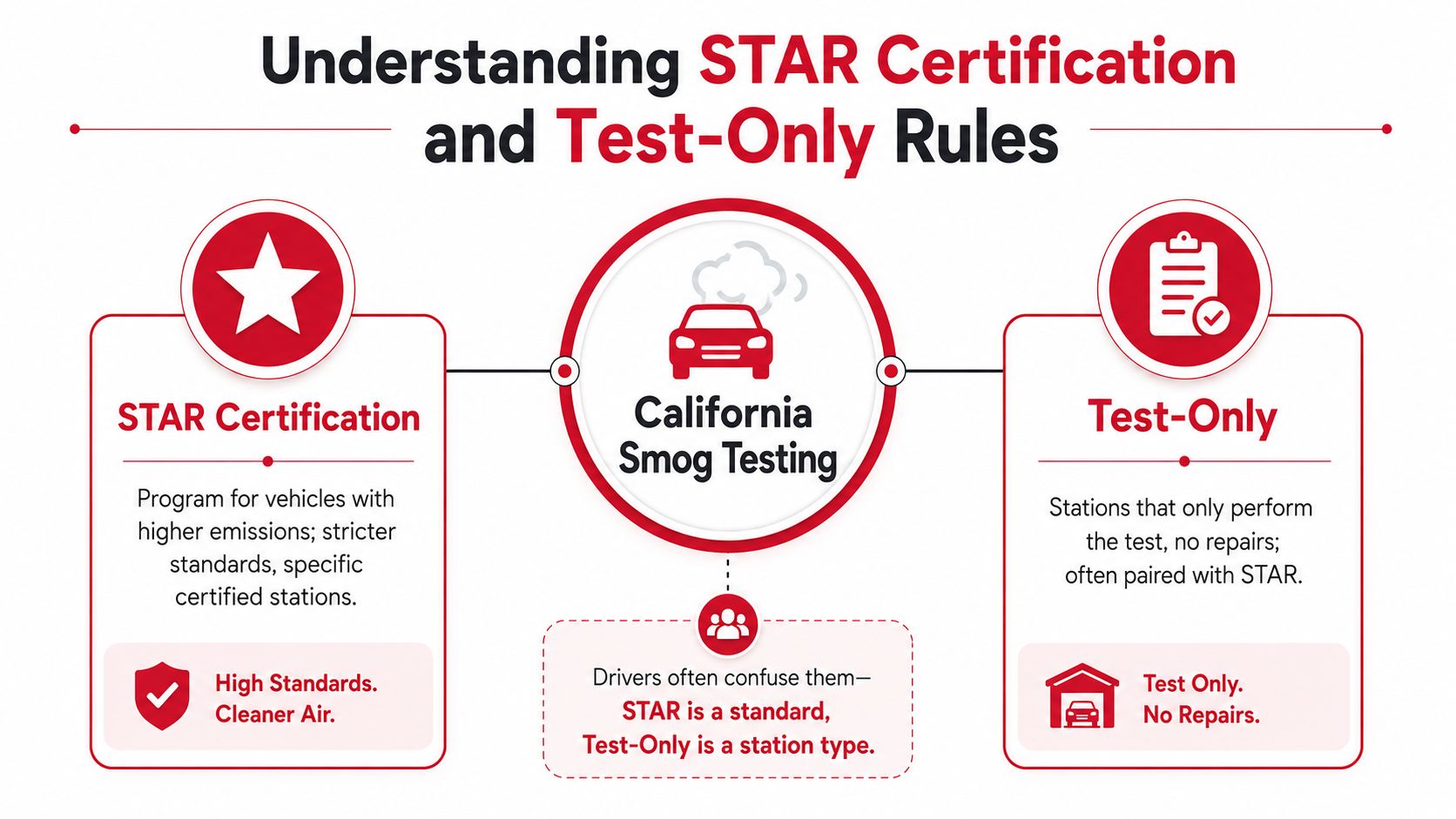
STAR certification and test-only status aren't the same thing. STAR is a state certification standard for qualifying stations. Test-only describes the station's business model and service restriction. A location can be both STAR certified and test-only, which is often the clearest choice for a driver who wants an independent inspection.
Think like an auditor
A test-only station is similar to an independent auditor. It examines the vehicle and reports the result, but it doesn't sell the emissions repair that follows. California prohibits test-only smog stations from performing emission repairs, which removes the financial incentive to fail a vehicle in order to generate repair revenue, as explained in the test-only station requirements overview.
That separation doesn't guarantee a pass. A vehicle still has to meet the applicable inspection standards. It does, however, create a cleaner relationship between the inspection and any later repair decision. If the vehicle fails, you can take the report to the repair shop you trust instead of feeling pressured to authorize work at the inspection site.
STAR certification adds another layer. A STAR station must meet higher performance standards, making it the appropriate destination when the DMV directs your vehicle there. The station still needs the right equipment, trained staff, and physical capacity for the vehicle you bring.
The readiness-monitor trap
For vehicles from 1996 and newer, the inspection centers on OBD-II compliance rather than only a tailpipe measurement. The system checks diagnostic information, fault-code behavior, and readiness monitors. Those monitors tell the inspection equipment whether the vehicle's emissions-related self-tests have completed.
A battery disconnect, computer reset, or recent emissions repair can erase monitor status. The car may start, idle, and drive normally while the computer still reports an incomplete inspection state.
As of October 1, 2025, California BAR rules require all readiness monitors to be set for a vehicle to pass a Smog Check inspection, according to the BAR explanation of the new OBD readiness-monitor regulations. That changes the preparation question. Don't ask only whether the check engine light is off. Ask whether the vehicle is fully ready for testing.
What Happens During a Smog Test Visit
A professional visit follows a predictable sequence. You provide the registration information, the technician confirms the vehicle details, and the station performs the inspection required for that model and fuel system. The technician then records the outcome through the state's approved process.
The inspection sequence
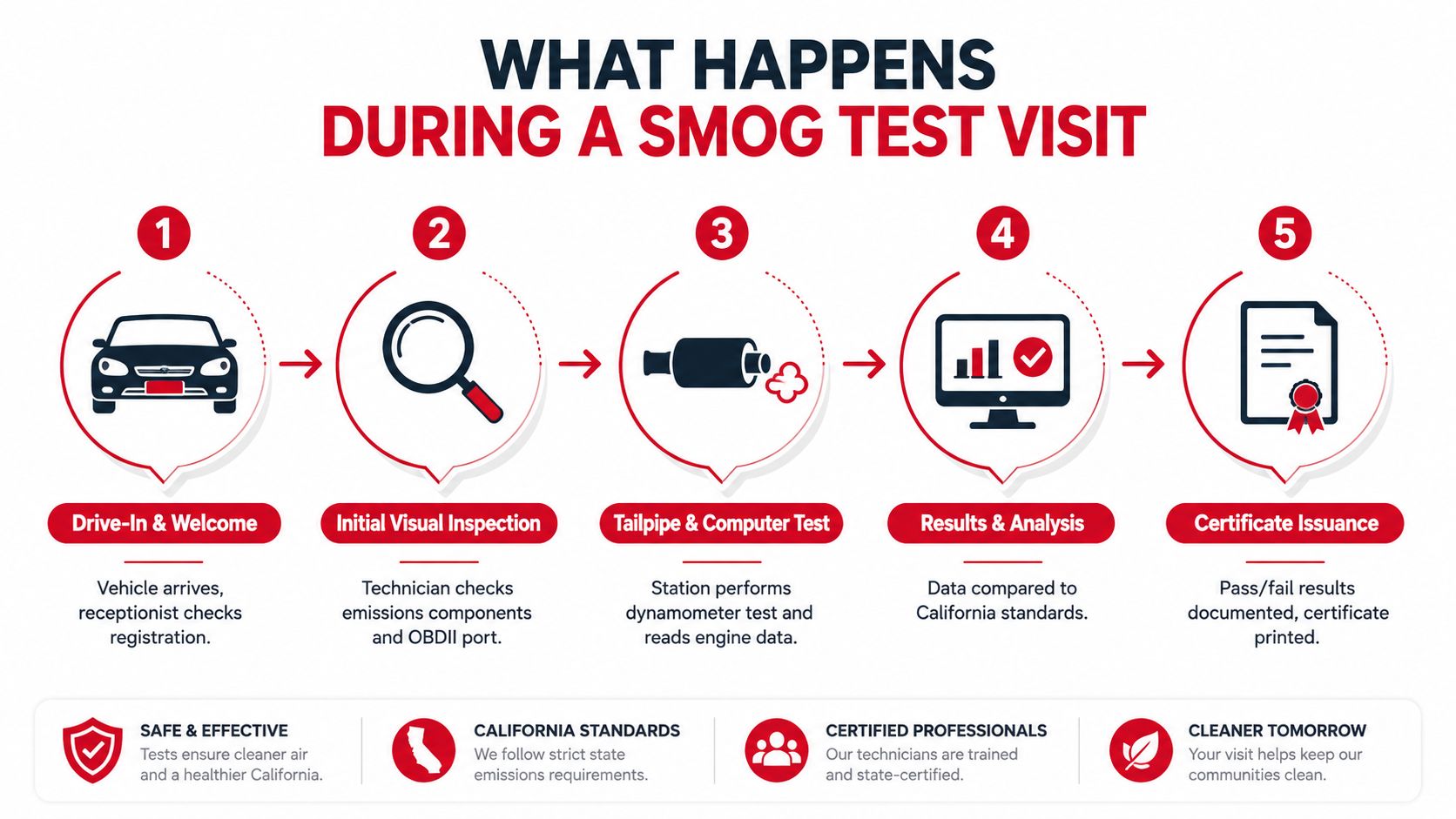
First, intake and verification. Bring your current registration renewal notice or vehicle information. The station needs accurate vehicle and registration details before it can determine the correct inspection path.
Next, the visual inspection. The technician checks relevant emissions equipment and locates the vehicle's OBD-II connection where applicable. Missing, disconnected, or visibly altered emissions components can create a problem before the computer portion is complete.
Then comes the emissions and computer evaluation. Older vehicles may use inspection methods that include tailpipe analysis. For 1996-and-newer vehicles, OBD-II data plays the central role. The equipment reviews diagnostic trouble codes and readiness status, not just how the engine sounds or feels during the drive.
Finally, the station documents the result. A passing inspection is transmitted for registration purposes, and the certificate process is completed. A failed inspection should produce information identifying the area that requires attention, so you can make a targeted repair decision rather than guessing.
You can review how long a smog check takes before scheduling, but don't treat a short appointment estimate as a promise. Vehicle condition, queue length, station layout, and diagnostic issues can change the total visit.
Why readiness causes surprise failures
A recent battery replacement is a common example. Disconnecting power can clear stored diagnostic information and leave monitors incomplete. The repair may have solved the original problem, but the vehicle still needs appropriate driving conditions before the system can verify the repair.
A station with a focused intake process and properly maintained diagnostic equipment can identify this issue quickly. A station with multiple bays can also keep vehicles moving through intake, inspection, and certificate issuance instead of making every customer wait for one bay to clear.
Don't reset codes immediately before testing. That can make the vehicle look cleaner on the dashboard while leaving the diagnostic system unready.
How to Choose the Right Smog Station for Your Vehicle
Choose the station by requirement first, convenience second. A low price or nearby location doesn't help if the facility can't perform the required STAR inspection, fit your vehicle, or handle the registration service you need.
| Station Type | Repair Services | STAR Certified | Best For |
|---|---|---|---|
| STAR test-only station | No emissions repairs | Yes | DMV-directed vehicles and drivers seeking inspection neutrality |
| STAR test-and-repair station | Testing and emissions repairs | Yes | Owners who want diagnosis and repair at the same location |
| Non-STAR shop | Depends on the business | No | Vehicles that aren't directed to STAR and fit the shop's approved service scope |
Use this decision filter
Start with the DMV notice. If it requires STAR, eliminate non-STAR locations immediately. If you want an independent result, select a STAR test-only station. If you already know the vehicle needs emissions work and prefer one provider to diagnose and repair it, a STAR test-and-repair station may be more practical.
Then check vehicle compatibility. Passenger cars, SUVs, and light-duty trucks are common, but larger trucks, RVs, and motorhomes may require specific bay dimensions or equipment. Call before driving over, especially if the vehicle is unusually long, tall, heavy, or modified.
A station that can't fit the vehicle can't solve the compliance problem, no matter how convenient its address looks.
Scheduling matters just as much. Working drivers should look for evening and weekend smog availability, while anyone combining the inspection with DMV work should confirm the separate hours for registration services. Ask whether the station offers a retest policy, whether coupons have conditions, and whether the price changes for a STAR-directed inspection.
A reliable call-ahead checklist is short:
- Confirm STAR status: Ask whether the location can process a DMV-directed STAR inspection.
- Describe the vehicle: Give the technician the model year, fuel type, vehicle class, and approximate size.
- Ask about readiness: Mention recent battery disconnection, computer resets, or emissions repairs.
- Verify DMV services: Confirm registration renewal, ownership transfer, or tag issuance if you need more than testing.
- Check timing: Ask about current wait conditions and operating hours.
How Fire House Smog Solves Common Driver Frustrations
Drivers usually want three things from a California smog test station: a valid inspection, a straightforward process, and no unnecessary repair pressure. A test-only model addresses the last concern because the station performs the inspection without selling emissions repairs. That keeps the pass or fail decision separate from the repair recommendation.
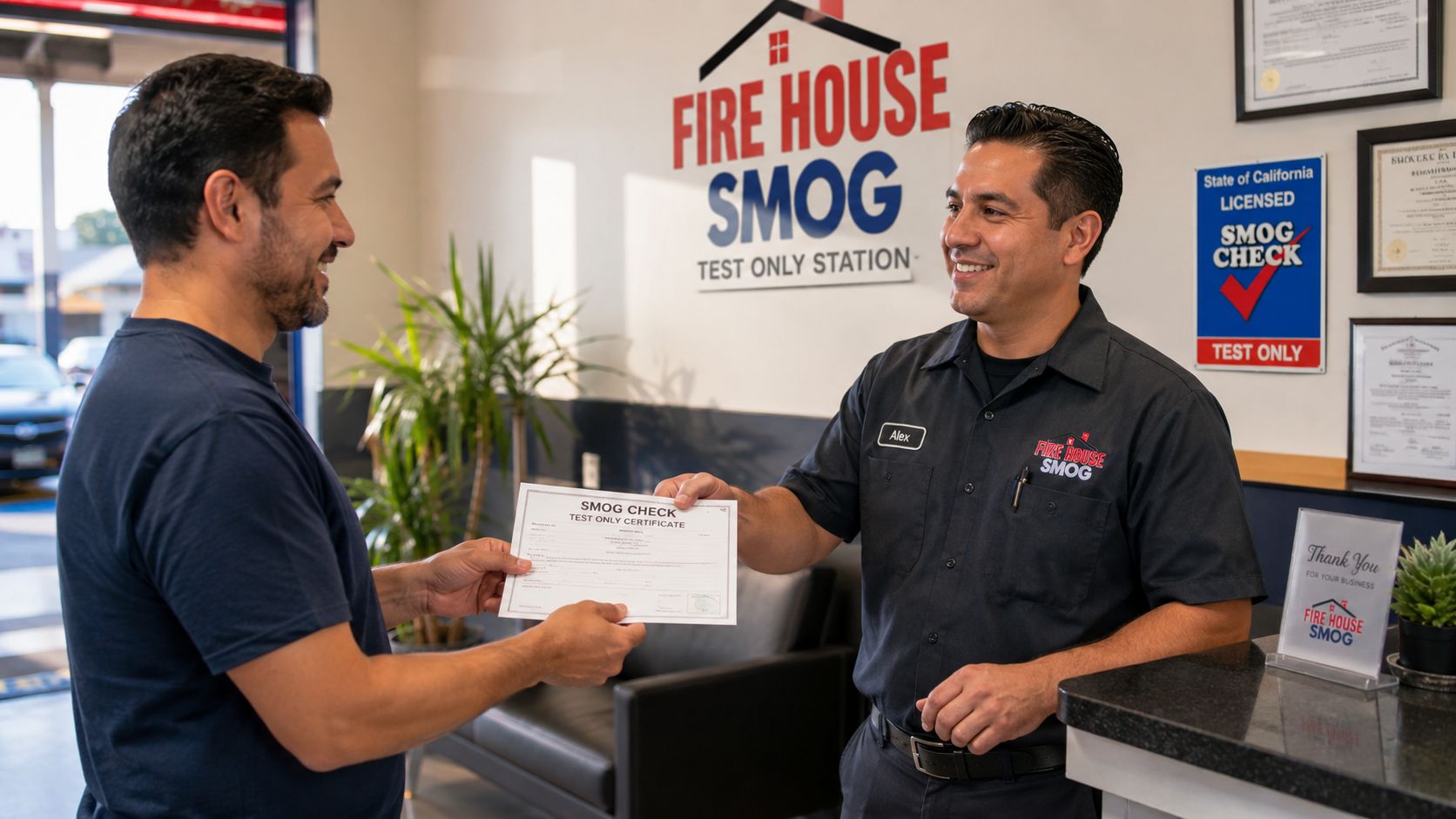
Fire House Smog is a STAR-certified test-only station at 2900 Lone Tree Way in Antioch. It handles smog inspections for cars, SUVs, and light-duty trucks, and it can accommodate some RVs and motorhomes subject to size and equipment limits. Call 925-754-1600 before bringing a larger recreational vehicle.
One visit can cover more than testing
A failed or completed smog inspection often appears alongside a registration deadline. Making a second trip to a DMV office adds friction, especially for drivers who work standard daytime hours. Fire House Smog also provides California DMV registration services, including renewal and on-site sticker printing, during its posted service hours.
Smog testing is available seven days a week, with extended evening and weekend availability. DMV services operate Monday through Saturday from 9:30 AM to 5:00 PM and Sunday from 12:00 PM to 4:00 PM, with limited services possible on weekends. Confirm the exact service you need before arriving, because smog hours and DMV hours aren't identical.
A workflow built around throughput
The location uses two service bays, which supports a more efficient flow for intake and inspections than a single-bay setup when demand is active. The station also offers a coupon policy that includes a discount on smog tests and a free retest, subject to the applicable terms.
That doesn't remove the need to prepare the vehicle. A STAR test-only station can provide a neutral inspection and process the result, but it can't make incomplete readiness monitors complete or repair a malfunctioning emissions system. The value is operational: you can obtain a clear result, understand the next step, and potentially complete your registration task in the same visit.
What to Do If Your Vehicle Fails the Smog Test
A failed smog test is a diagnosis point, not a reason to panic. First, get the result and identify whether the failure involves readiness monitors, a stored fault code, emissions equipment, or measured emissions. Don't authorize unrelated work just because the vehicle failed.
If the issue is incomplete readiness, ask whether the vehicle needs a proper drive cycle after a battery reset or repair. Driving may allow the monitors to complete, but only when the vehicle meets the conditions required by its diagnostic system. If a fault returns, the vehicle needs actual diagnosis and repair.
For a broader explanation of common causes, review California smog check fail reasons before choosing a repair strategy. Keep every emissions-related invoice and diagnostic record. Documentation matters if you later need financial assistance or a compliance extension.
Separate the available relief options
A Repair Cost Waiver isn't the same as a retest. California guidance summarized in the repair assistance and waiver information says registration may proceed after a failed test only when the owner spends at least $650 on documented emissions-related repairs and meets the applicable requirements.
An Economic Hardship Extension is narrower. It applies to low-income owners at or below 185% of the federal poverty level, requires repair-spend documentation, and can extend compliance for up to two years. Meeting one condition doesn't automatically qualify you for the other.
Retest only after the right fix
If the station or repair technician confirms that the vehicle is ready and the repair addressed the failure, schedule the retest. Fire House Smog offers a free retest under its site policy and coupon terms, so confirm the conditions before relying on it.
Do this in order: read the failure result, determine whether the issue is readiness or a malfunction, keep repair records, then retest.
A waiver won't replace a required repair record, and a retest won't fix a failed component. Treat each option as a separate tool.
Your Pre-Visit Checklist for a Smooth Smog Test
Use this checklist before driving to any California smog test station. It targets the mistakes that cause avoidable delays.
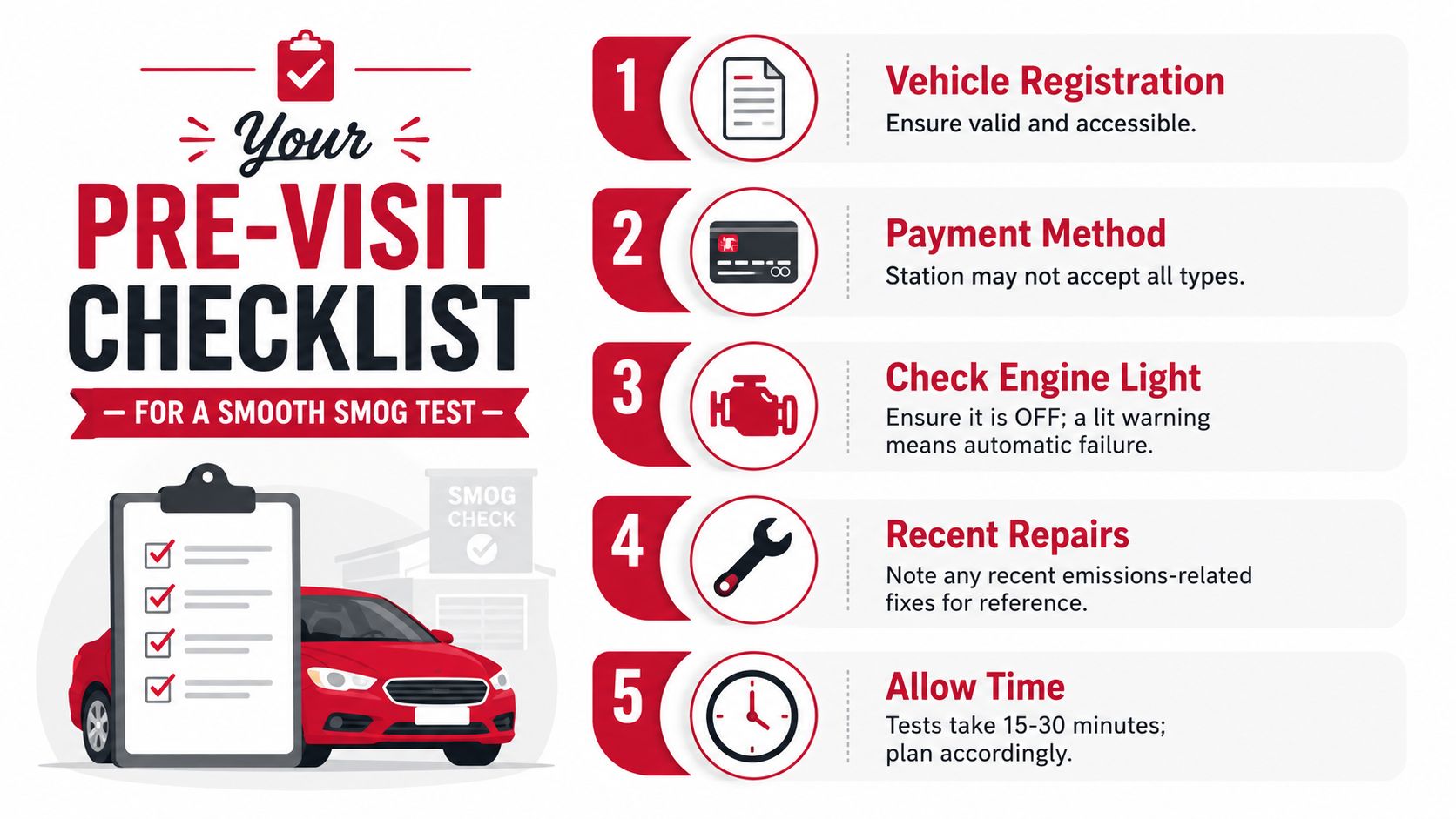
- Read the DMV notice: Confirm whether the vehicle must go to a STAR-certified station.
- Check the dashboard: The check engine light should be off. If it's illuminated, expect a diagnostic problem rather than a routine pass.
- Confirm readiness: Ask a qualified technician to check OBD-II monitor status, especially after a battery disconnect, computer reset, or recent emissions repair.
- Bring registration information: Have the renewal notice and vehicle details available for intake and DMV processing.
- Describe the vehicle accurately: Tell the station if it's a diesel, hybrid, light-duty truck, RV, or motorhome.
- Call about capacity: Larger vehicles may require advance confirmation that the bay and equipment can accommodate them.
- Ask about retests: Confirm whether a free retest applies, and check any coupon conditions.
- Plan the full visit: If you also need registration renewal or ownership-transfer services, verify those separate operating hours.
- Keep repair paperwork: Save emissions-related invoices and diagnostic documentation in case the vehicle fails or you seek assistance.
The best preparation is knowing the vehicle's readiness state, not assuming that normal driving means the inspection will pass. Bring the right notice, choose the right station, and avoid resetting the vehicle just before testing.
Fire House Smog provides STAR-certified test-only smog inspections, free retests under applicable terms, and on-site DMV registration services with sticker printing at its Antioch location. Visit Fire House Smog to confirm station requirements, check vehicle compatibility, and schedule a smog and registration visit that fits your week.