
Drive Through Smog Check What to Expect and How to Pass
Your registration notice is on the passenger seat. You've got errands to run, work later, and no interest in spending half the day bouncing between a smog station and the DMV. That's usually when people start looking for a drive through smog check and asking the same practical questions: Can I stay in the car? How long does it really take? What slows the process down? Can I finish the registration part today too?
If you're in Antioch or elsewhere in East Contra Costa County, those are the right questions. California's smog system isn't a small side task. It's a large compliance program built around repeat inspections, and the modern framework goes back to the statewide program that began in March 1984 after SB 33 passed in 1982, with biennial testing and change-of-ownership testing in participating counties, plus structured inspections and shop certification requirements, as outlined in the California Smog Check Program overview.
Table of Contents
- Introduction to the Drive Through Smog Check Experience
- How a Drive Through Smog Check Actually Works
- Drive Through Versus Traditional Smog and DMV Options
- Vehicle Size Limits and Which RVs Can Be Tested
- What to Expect When You Arrive Step by Step
- Tips to Get Through Your Smog Check Faster
Introduction to the Drive Through Smog Check Experience
The drive-through version feels less like dropping your car off at a repair shop and more like pulling into a well-organized lane where each step has a purpose. You arrive, hand over your paperwork, a technician checks what kind of test your vehicle needs, and the station moves the car through a fixed routine. No wandering waiting room. No guessing what happens next.
Why people like the drive-through format
Most drivers don't want a lecture on emissions systems. They want a clean pass, a clear answer, and a short stop. That's why the drive-through idea works. It turns the visit into a simple sequence.
A car wash line, except instead of soap and rinse, the station is checking whether your vehicle's emissions system is ready, connected, and compliant.
Practical rule: Fast smog visits usually come from preparation, not luck. A smooth lane only helps if your car and paperwork are ready when you pull in.
Who this guide helps most
This is especially useful if you're a first-time California driver, a parent helping a student with registration, a commuter who just got a renewal notice, or a small fleet owner trying to move several vehicles through with less downtime.
You'll also see where time gets saved and where it gets lost. In many cases, the test itself isn't the problem. The delay comes from missing documents, a battery that was recently disconnected, or going to the wrong kind of station for your DMV requirement.
How a Drive Through Smog Check Actually Works
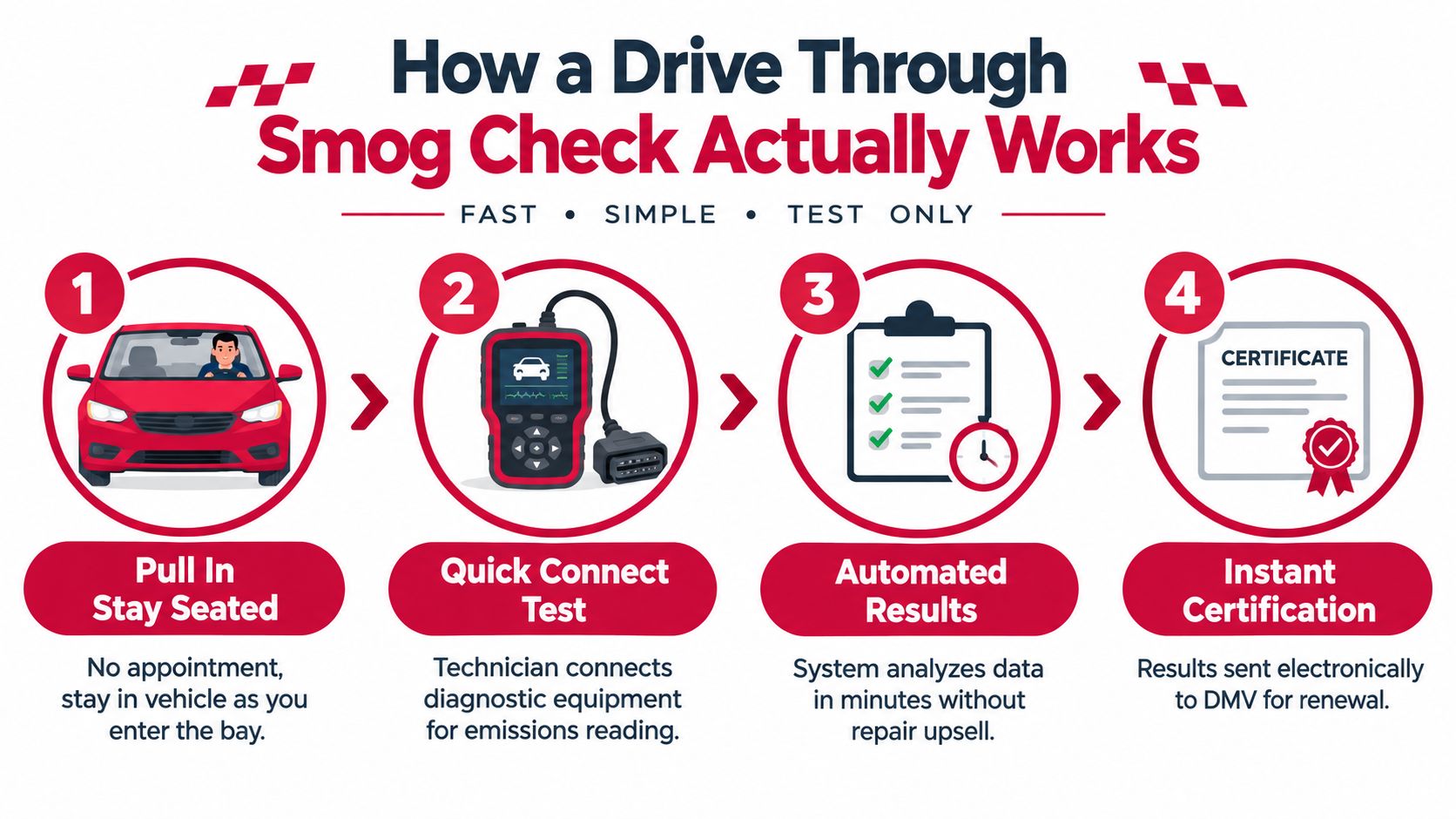
A drive-through smog station is basically a pit-stop workflow. The station isn't there to rebuild your engine or sell you parts. It's there to run a standardized inspection, record the result, and move the next vehicle in line.
California's smog system is built for scale. The Bureau of Automotive Repair reported 12,200,718 total Smog Check tests in 2025, with 1,102,337 failures and an overall failure rate of 9.04%, according to the 2025 BAR Smog Check executive summary. That same report listed 11,275,981 initial tests and 959,667 initial failures, an 8.51% initial failure rate. When that many vehicles need inspections, stations that use standardized lanes and consistent check-in steps make sense.
The four parts of the lane
The easiest way to understand the process is to break it into four parts.
Check-in
The technician confirms the vehicle information and what kind of inspection applies.Connection and inspection
On many newer vehicles, the technician connects to the car's onboard diagnostics system. On older vehicles, the process may involve a tailpipe test.Visual and functional review
The station also checks emissions-related components that are supposed to be present and operating.Electronic reporting
The result is transmitted so it can be used for registration.
Here's a helpful walk-through of a quick STAR smog process if you want to see how a local test-only lane is typically organized.
A short video makes the flow easier to picture once you've read the basics.
What actually gets tested
California doesn't use one test method for every vehicle. For gasoline-powered 2000 model-year and newer vehicles and diesel-powered 1998 model-year and newer vehicles, the inspection is OBD-focused. Pre-2000 vehicles use a tailpipe emissions test, and the state also notes that a smog check typically includes visual and functional inspections of the emissions control system, as described in the BAR Smog Check manual.
That matters because newer cars often move faster through the lane when they're properly prepared. The station usually isn't waiting on a long exhaust sampling routine. It's checking whether the car's own emissions monitors are ready and whether the system shows problems.
A test-only station is closer to an inspection lane than a repair garage. Its job is to measure and report, not to diagnose for profit.
Drive Through Versus Traditional Smog and DMV Options
Not every “fast” option is fast for every driver. The best path depends on two separate questions. First, where should you get the smog test? Second, where should you finish the registration work?
Smog lane choices
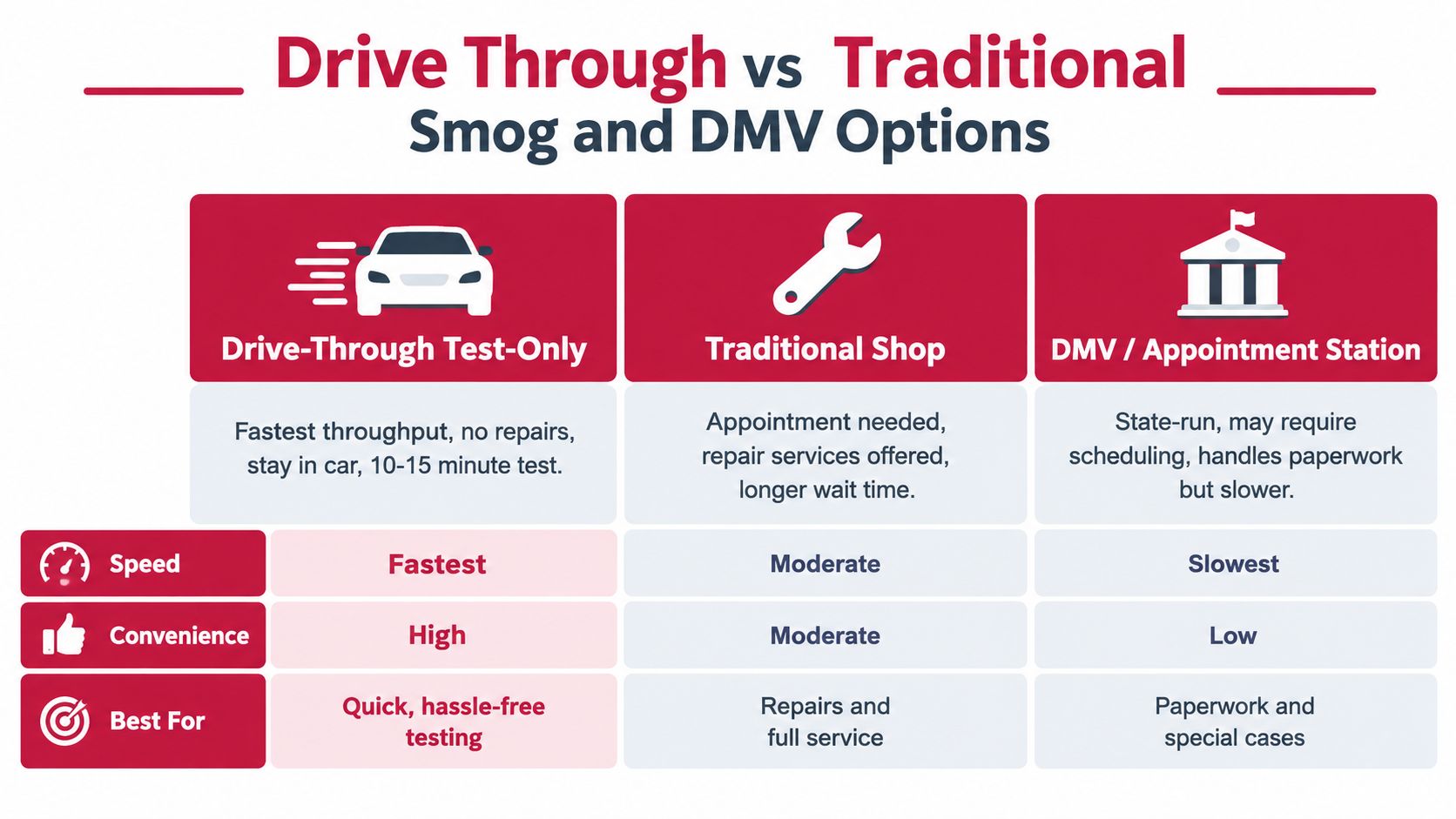
A drive-through test-only station is usually the cleanest choice when your main goal is speed and neutrality. The workflow is narrow by design. Check in, test, report results, done. Because the business doesn't perform repairs in the same lane, there's less chance the visit turns into a sales conversation.
A traditional repair shop that also performs smog inspections can still be the right choice if you already know the car needs mechanical work. But if your car is due for certification and running fine, combining inspection and repair under one roof can slow the visit.
A STAR station may also be required in some cases. That confuses first-time drivers because not every registration notice has the same instructions. If your DMV paperwork says STAR, you need the correct type of station.
Registration choices after the test
The second decision is what happens after you pass. California DMV says smog checks are required for many renewals, ownership changes, and first-time out-of-state registrations, and it also notes that DMV-authorized business partners can handle certain registration services with shorter waits and on-site processing, as explained on the California DMV smog inspection and registration page.
That's the part many drivers overlook. They think the smog certificate is the finish line. Often it's only one leg of the trip.
Choosing Your Fastest Smog and Registration Path
| Option | Best For | Wait Time | Key Limitation |
|---|---|---|---|
| Drive-through test-only station | Drivers who want a focused inspection without repair upsells | Often shorter when paperwork and vehicle are ready | Doesn't repair the vehicle if it fails |
| Traditional smog and repair shop | Vehicles that may need diagnosis or repair work right away | Can vary based on repair workload and appointments | The visit may become longer if repair discussions start |
| DMV office or DMV business partner | Drivers who need registration completed after the smog result posts | Varies by location and service model | Not every service is available everywhere |
If your goal is one stop, ask two questions before you leave home: “Can this station perform my required smog test?” and “Can I finish the DMV side today too?”
For working drivers and small fleets, that two-question check saves more time than almost anything else.
Vehicle Size Limits and Which RVs Can Be Tested
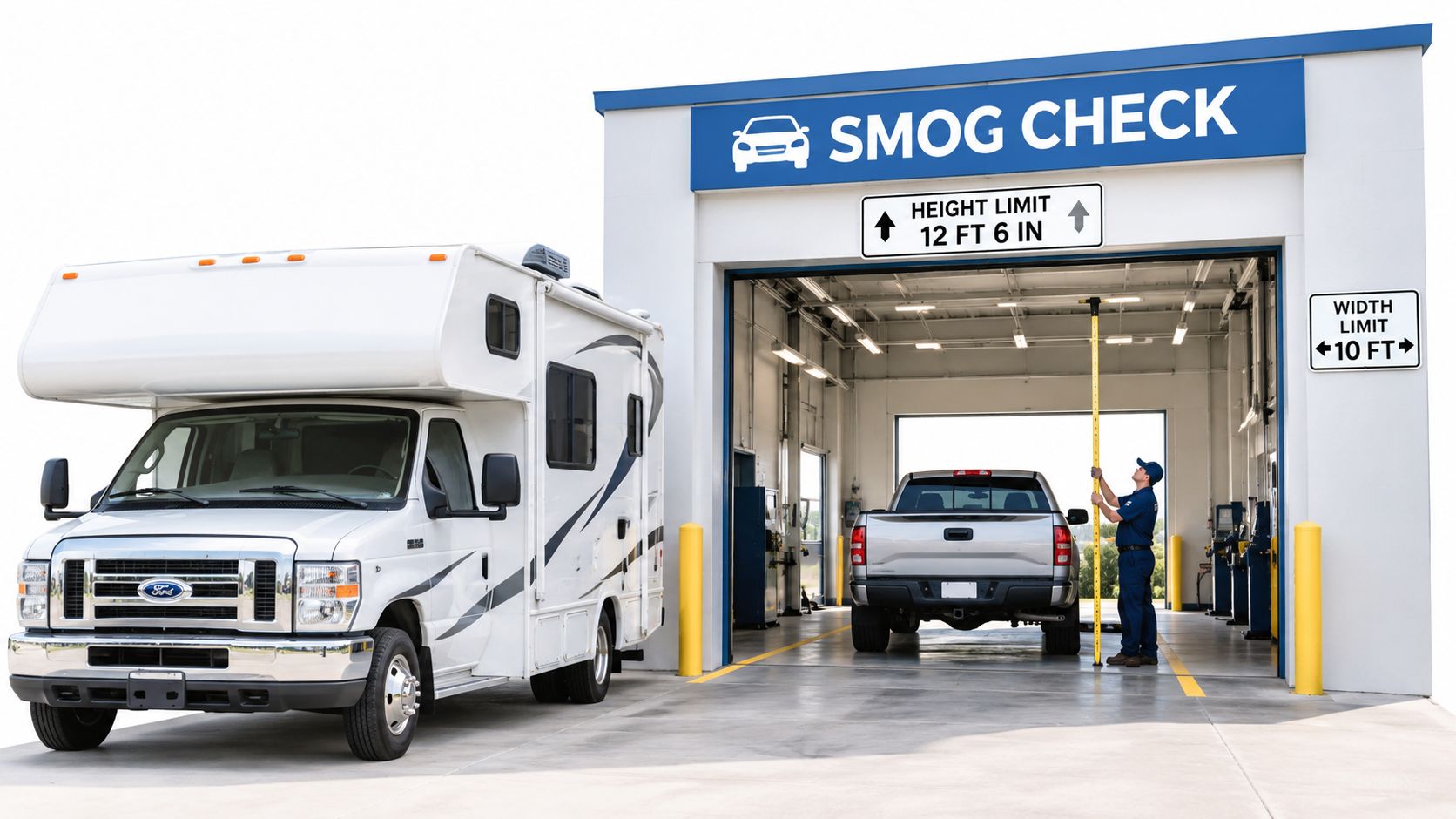
A drive-through setup is fast because the lane is standardized. The trade-off is that physical space matters. Bay height, bay length, turning room, equipment placement, and how the technician accesses the vehicle all affect what can be tested safely.
That's why a sedan usually glides through without drama, while a tall van or motorhome may need a phone call first.
Vehicles that usually fit easily
Most stations built around passenger traffic can handle:
- Standard cars such as sedans, coupes, and hatchbacks
- Common SUVs used for family driving or commuting
- Light-duty pickups that fit comfortably within normal lane space
- Work vans that aren't unusually tall or extended
These vehicles usually match the workflow the station sees all day. The technician can access the cabin, connect equipment, complete the inspection, and move the vehicle out without repositioning or special handling.
Vehicles that deserve a call ahead
Some vehicles are testable, but not every station can take them at every time.
Examples include:
- Motorhomes and RVs that may exceed bay height or turning limits
- Long-wheelbase trucks or vans that are awkward in tighter lots
- Vehicles with exterior modifications that change clearance or access
- Heavier specialty vehicles that don't suit the station layout
Fire House Smog is one local option that performs STAR-certified test-only inspections, handles cars, trucks, and some RVs, and advises customers with larger vehicles to call ahead because fit depends on size and equipment limits.
A simple phone-check script
If you drive something bigger than a normal SUV, keep the call short and specific.
Lead with the vehicle type
Say the year, make, model, and whether it's gasoline or diesel.Mention the size concern
Tell them if it's lifted, extended, unusually tall, or an RV.Ask the practical question
“Can your bay handle this vehicle, or should I go somewhere set up for larger units?”
That quick check can save you a wasted trip across town.
What to Expect When You Arrive Step by Step
When you pull in, think of the visit like a relay race. Each handoff matters. If one handoff is smooth, the next one starts right away.
Pull in and check in
Start with your registration notice or current vehicle paperwork ready to hand over. If you've had a recent smog test, bring that paperwork too. Keeping those papers in the visor or glove box saves the awkward parking-lot search.
At 2900 Lone Tree Way in Antioch, the process is built around a straightforward lane layout. Two service bays help move vehicles through without the stop-and-start feeling you get at smaller single-lane locations.
The inspection sequence
Once checked in, the technician confirms the vehicle details and begins the inspection sequence that matches your car. For many newer vehicles, that means connecting to the onboard system and reviewing emissions-related data. The technician also performs the required visual and functional checks.
If you've never done this before, the biggest surprise is usually how ordinary it looks. There's no dramatic machine sequence. It's more like a careful checklist with electronic reporting built in.
If you want a fuller timing breakdown, this guide on how long a smog check usually takes gives helpful context on what affects the pace.
Stay relaxed during check-in. Most delays happen before the test begins, not during it.
Payment, reporting, and what happens next
After the inspection, the station finalizes the result and transmits it electronically for DMV use. If the vehicle passes, that result becomes part of your registration path. If it doesn't pass, the station explains the next step and whether a free retest applies under site policy and coupon terms.
A few practical notes help first-time drivers:
If you pass
Your next move is usually the registration side, not another mechanical step.If you fail
A test-only station won't repair the car in-house. That can feel inconvenient in the moment, but it also keeps the inspection role separate from repair sales.If you need DMV help the same day
Ask before you arrive whether the registration service hours match your timing.
That last point matters more than you might expect.
Tips to Get Through Your Smog Check Faster
The quickest visits usually come from drivers who remove the common bottlenecks before they leave home. A drive-through lane can move briskly, but it can't fix an unreadable registration notice, an unset monitor, or a car that arrived straight after a battery swap.
The biggest time-savers before you leave
California's rules got stricter on readiness monitors. Effective October 1, 2025, all readiness monitors must be set for a vehicle to pass a smog check, and BAR advises drivers to wait a week or two after disconnecting or replacing a battery so the monitors can reset before inspection, according to the BAR Smog Check consumer guidance.
That means one of the most common mistakes is showing up too soon after battery work.
Your pre-visit checklist
Use this short list before heading to the station:
Bring the right paperwork
Have your registration notice, current registration, and any prior smog paperwork easy to reach.Check recent battery history
If the battery was disconnected or replaced recently, give the vehicle enough normal driving time so the monitors can reset.Warm the car up with normal driving
A vehicle that has been sitting all day can be slower to inspect than one that has already been driven.Look for simple issues
Make sure the gas cap is present and tightened, and don't ignore dashboard warning lights.Match your timing to DMV service hours
If you want a one-stop visit, confirm that registration processing is open when you plan to arrive.
If you're trying to avoid the most common causes of failure, this page on typical smog check fail reasons is a practical place to start.
Where time is really won or lost
People often assume the lane itself is the whole story. It isn't. Time is usually won in three places:
- Before arrival, when you gather paperwork.
- Before the test, when your monitors are ready.
- After the pass, when you already know where and how you'll complete registration.
The one-stop version works best when you treat the whole errand like a pit stop. Fuel ready. Paperwork ready. Driver ready.
If you want a practical one-stop option in Antioch, Fire House Smog offers STAR-certified test-only smog inspections, service for cars, trucks, and some RVs, plus DMV registration help with on-site tag printing during posted hours. If your goal is to get in, get tested, and finish the registration side with less backtracking, it's worth checking their current hours before you head over.