
What Year Cars Are Exempt from Smog in California
Gasoline-powered vehicles from model year 1975 and older are permanently exempt from California smog checks. Newer vehicles have separate age-based exemptions, eight model years for registration renewal and four model years for ownership transfers.
If you're renewing registration, buying an older car, or standing at the DMV counter with a notice that says a smog certificate is required, the model year matters more than the vehicle's mileage, purchase date, or how clean its emissions history has been. California doesn't use one universal exemption rule. It uses different rules for classic gasoline vehicles, newer vehicles during registration renewal, and newer vehicles changing ownership.
That distinction prevents two common mistakes: assuming a vehicle is exempt when it isn't, or paying for a test that the DMV doesn't require. Use the vehicle's model year, fuel type, and transaction type to identify the right category before you schedule an inspection.
Table of Contents
- California Smog Exemption Rules at a Glance
- The 1975 and Older Classic Vehicle Exemption
- New Vehicle Exemptions for Renewal and Ownership Transfer
- Special Rules for EVs Hybrids Motorcycles and Diesel Vehicles
- How to Verify Your Vehicle Exemption Status
- Common Smog Exemption Misconceptions to Avoid
- Quick Reference Checklist and Next Steps
California Smog Exemption Rules at a Glance
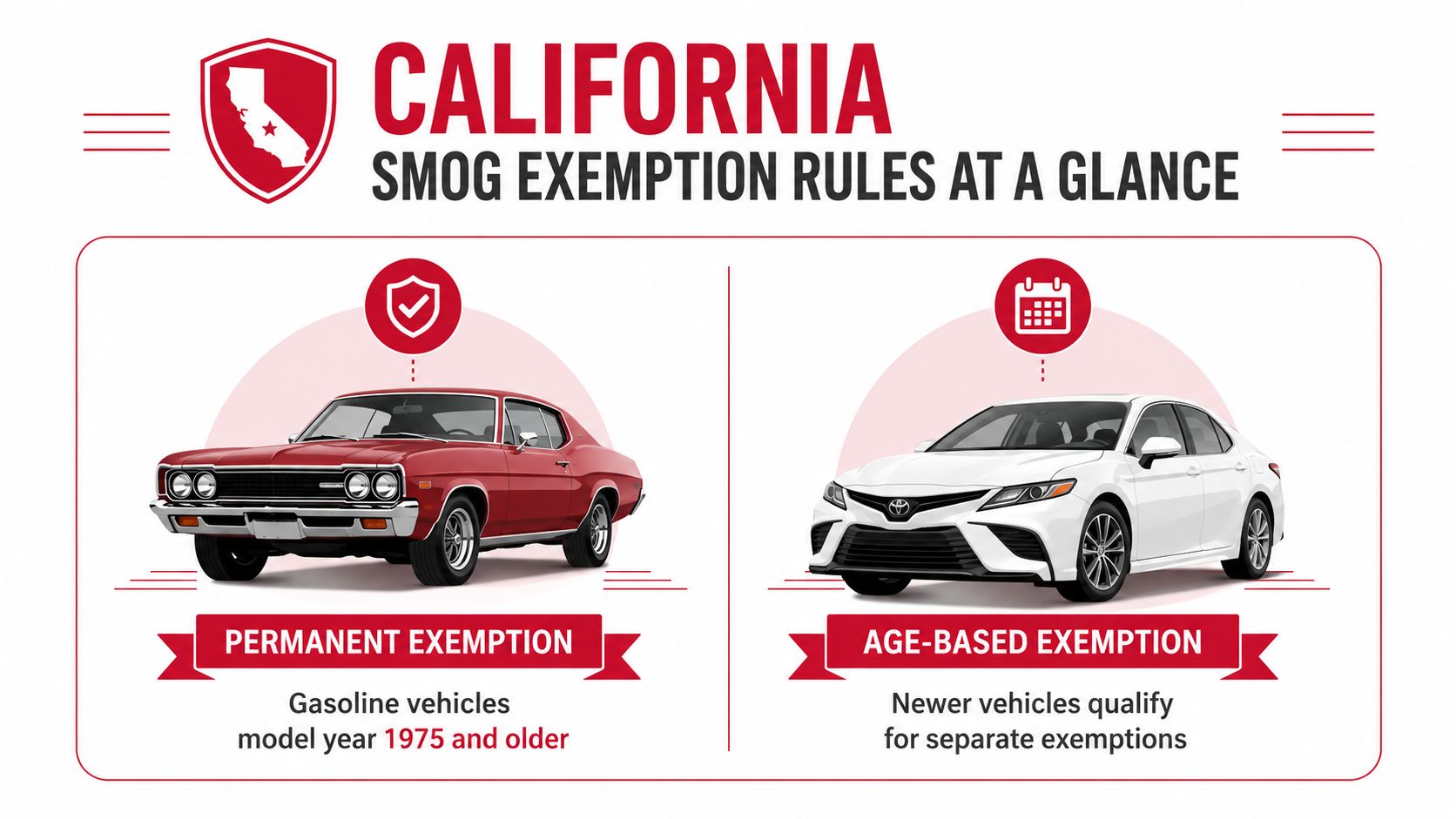
California separates smog exemptions by vehicle category and transaction. Classic gasoline vehicles, newer vehicles at registration renewal, and newer vehicles during ownership transfer each follow a different rule. The fixed classic cutoff covers gasoline-powered vehicles with a model year of 1975 or older, while the newer-vehicle exemptions use model-year age windows. California's current smog exemption guidance distinguishes these categories clearly.
Use this three-part check before scheduling an inspection:
- Classic gasoline vehicle: Model year 1975 or older remains exempt under the fixed cutoff.
- Registration renewal: Vehicles eight model years old or newer are exempt from the biennial renewal smog check.
- Ownership transfer: Vehicles four model years old or newer are exempt from a smog inspection during the transfer.
Calculate the applicable model-year window
Start with the transaction, then apply the correct age rule. Do not use the renewal window for a title transfer, or the transfer window for a registration renewal. The same vehicle can qualify under one category and require testing under another.
For a renewal, add eight to the vehicle's model year to identify the first model year that may require an inspection. For example, a vehicle's model year provides the starting point for that calculation, not its purchase year, mileage, or emissions history. The California DMV smog inspection guidance provides the official process, and the renewal notice remains the final check for that vehicle.
The 1975 and Older Classic Vehicle Exemption
If you own a gasoline car from 1975 or earlier, check the model year before booking a smog test. California's classic-vehicle exemption uses a fixed cutoff, not a rolling age rule. A 1975 vehicle qualifies under that cutoff, while a 1976 vehicle does not become exempt by getting older.
The rule applies to the vehicle's documented model year and fuel type. California does not treat every gasoline car that reaches a certain age as a classic exemption vehicle. If the title, registration record, and vehicle identification show a gasoline-powered model year of 1975 or older, the exemption generally applies.
Use the model year, not the calendar year
Check the model year shown on the title, registration record, or identification information. Do not base eligibility on the purchase year, manufacturing date, mileage, or how long the vehicle has been stored.
| Vehicle Model Year | Exemption Status | Notes |
|---|---|---|
| 1975 | Exempt | Meets California's fixed gasoline-vehicle cutoff |
| 1974 | Exempt | Also meets the classic vehicle exemption |
| 1976 | Not exempt under the classic cutoff | Older age does not change the cutoff |
The practical distinction is simple. A 1975 gasoline car may renew registration without a standard smog inspection under the classic exemption. A 1976 gasoline car should not be treated as exempt solely because it is an older vehicle. Confirm the DMV record before relying on the exemption.
Practical rule: Vehicle age alone does not create a classic exemption. The documented model year must meet California's fixed cutoff.
Keep the DMV record accurate
A smog exemption does not remove other registration duties. Maintain valid ownership, registration, and vehicle information. If the DMV record lists the wrong model year or fuel type, provide the supporting title and vehicle documents before assuming the system will recognize the exemption.
Substantial modifications also require careful recordkeeping. Keep the title and related documentation available. A modification does not automatically remove or preserve exemption status, so resolve unclear information with the DMV rather than paying for an inspection unnecessarily.
For a plain-language explanation of older gasoline-vehicle rules, review this California smog exemption guide for older cars. If the DMV system flags a qualifying vehicle for testing, correct the record issue first.
New Vehicle Exemptions for Renewal and Ownership Transfer
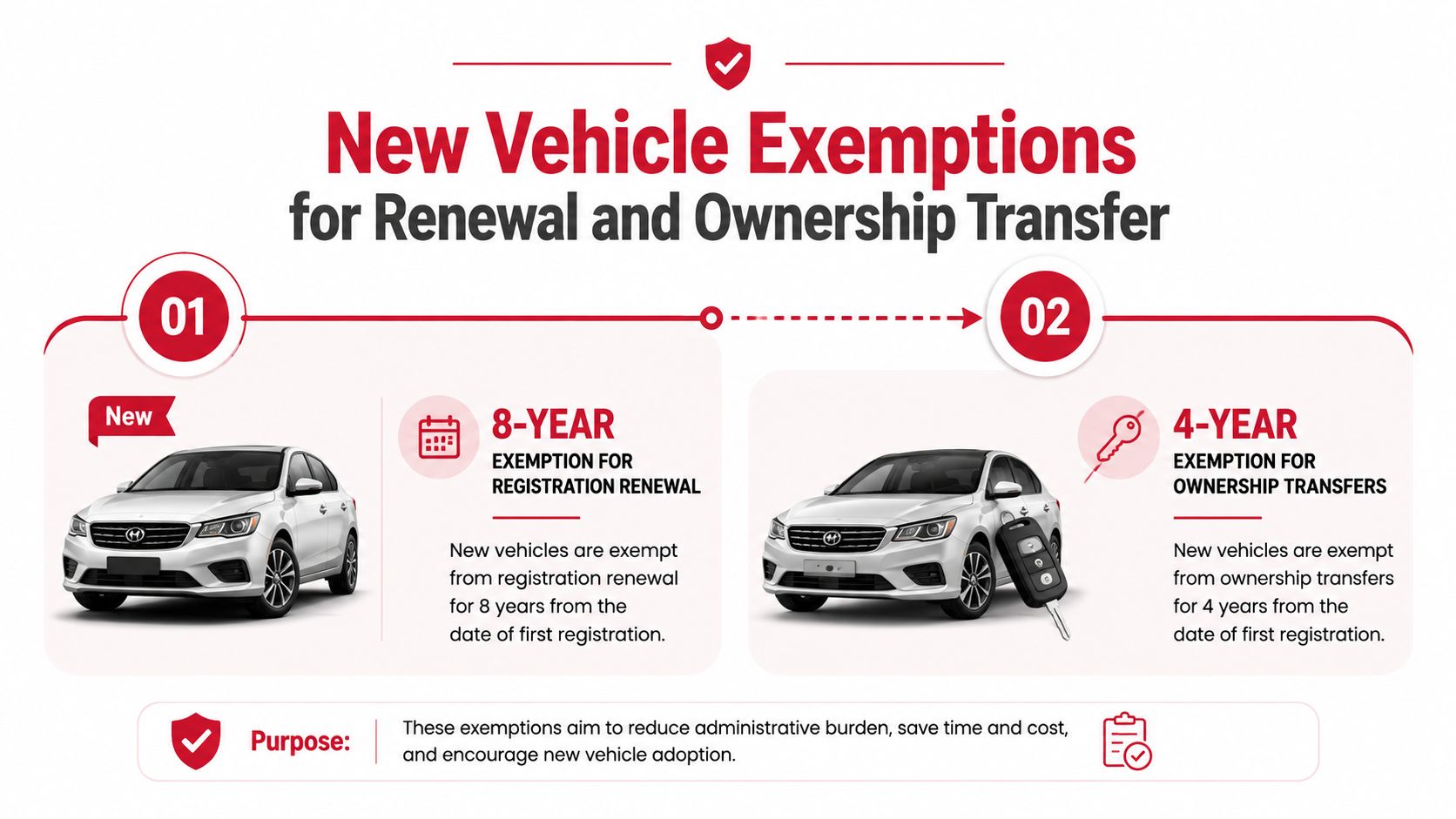
A vehicle can qualify for one exemption during registration renewal and a different exemption during an ownership transfer. California generally exempts gasoline, hybrid, and alternative-fuel vehicles that are eight model years old or newer from the biennial Smog Check at renewal. For an ownership transfer, the vehicle must generally be four model years old or newer.
Use the official model year for both calculations. The purchase date, the date you acquired the vehicle, and the date it entered your household do not change the vehicle's model-year age. Add eight to the model year to identify the first year a renewal smog check is generally required. A 2020 model-year vehicle generally first needs a renewal smog check in 2028, subject to the vehicle's registration record and transaction details.
Calculate the renewal timing
Follow these steps:
- Find the vehicle's official model year.
- Add eight to that model year.
- Treat the result as the first year a renewal smog check is generally required.
- Compare the result with the DMV renewal notice or online vehicle record.
A 2026 model-year gasoline vehicle generally would not need its first registration-renewal smog check until 2034. A 2022 model-year vehicle would generally remain exempt at renewal through 2030 under the same calculation. These examples apply only to the renewal exemption. The vehicle's actual record controls what appears on the renewal notice.
Keep renewal and transfer separate
The ownership-transfer rule uses a shorter window. A vehicle that is four model years old or newer can generally transfer without the smog inspection required for an older vehicle transaction. Confirm the transaction type and review the transfer paperwork before signing over the title.
Handle the smog question before submitting transfer documents. This California vehicle registration transfer information explains the paperwork and identifies situations that may require further DMV action.
The purchase date does not reset the model-year clock. California bases these age-based exemptions on the vehicle's model year.
Ask two separate questions: “Am I renewing registration?” Apply the eight-year rule. “Am I transferring ownership?” Apply the four-year rule. A car being “new enough” is not a complete exemption test.
Special Rules for EVs Hybrids Motorcycles and Diesel Vehicles
Your vehicle's fuel type determines which exemption category to check. California separates three questions that are often combined: the permanent classic-vehicle cutoff, the temporary new-vehicle exemption, and the alternative-fuel rules. Use the model year first, then confirm the vehicle's official record.
An electric vehicle has no gasoline engine producing tailpipe emissions, so it does not follow the ordinary gasoline inspection pattern. A hybrid still has an internal combustion engine. Its fuel efficiency does not create a permanent exemption. Hybrids generally follow the newer-vehicle age window, which ends as the vehicle reaches the applicable model-year limit.
Compare the vehicle categories
| Vehicle Type | Exemption Rule | Model Year Cutoff |
|---|---|---|
| Gasoline-powered vehicle | Permanent classic exemption | 1975 and older |
| Newer gasoline vehicle | Age-based renewal exemption | Eight model years or newer |
| Hybrid vehicle | Age-based renewal exemption applies while within the qualifying age window | Eight model years or newer |
| Alternative-fuel vehicle | Age-based renewal exemption applies while within the qualifying age window | Eight model years or newer |
| Electric vehicle | No standard tailpipe smog check | Not based on a gasoline cutoff |
| Motorcycle | Generally outside the standard smog-check requirement | Not based on the gasoline cutoff |
For unusual fuel systems or emissions equipment, review this California emissions standards guide before assuming the ordinary gasoline rule applies. The registration event still matters, because an exemption at renewal does not automatically answer every ownership-transfer question.
Diesel needs a separate check
Diesel vehicles use a different cutoff. Diesel vehicles from model year 1997 and older are exempt, while newer diesel vehicles may face different testing requirements. Vehicle weight also affects certain diesel trucks and recreational vehicles. Vehicles over 14,000 pounds GVWR can receive different smog-check treatment.
“Diesel” alone is not enough information. Confirm the model year, gross vehicle weight rating, vehicle class, and registration use. RVs require the same care, since their size, equipment, and weight can affect both inspection availability and the requirements that apply.
Motorcycles are generally outside the standard smog-check requirement, but a modified alternative-fuel vehicle or diesel truck should not be evaluated with a generic age calculator. Check the DMV record and the applicable California emissions category before booking a test. That approach separates the permanent classic exemption from the temporary new-vehicle window and the distinct alternative-fuel treatment.
How to Verify Your Vehicle Exemption Status
A vehicle can meet an exemption category and still require a smog certificate for the transaction on your DMV record. Check the official record first, then compare it with the vehicle's model year, fuel type, and registration event. Keep the license plate, VIN, renewal notice, and model-year information ready.
Use the DMV record as the starting point
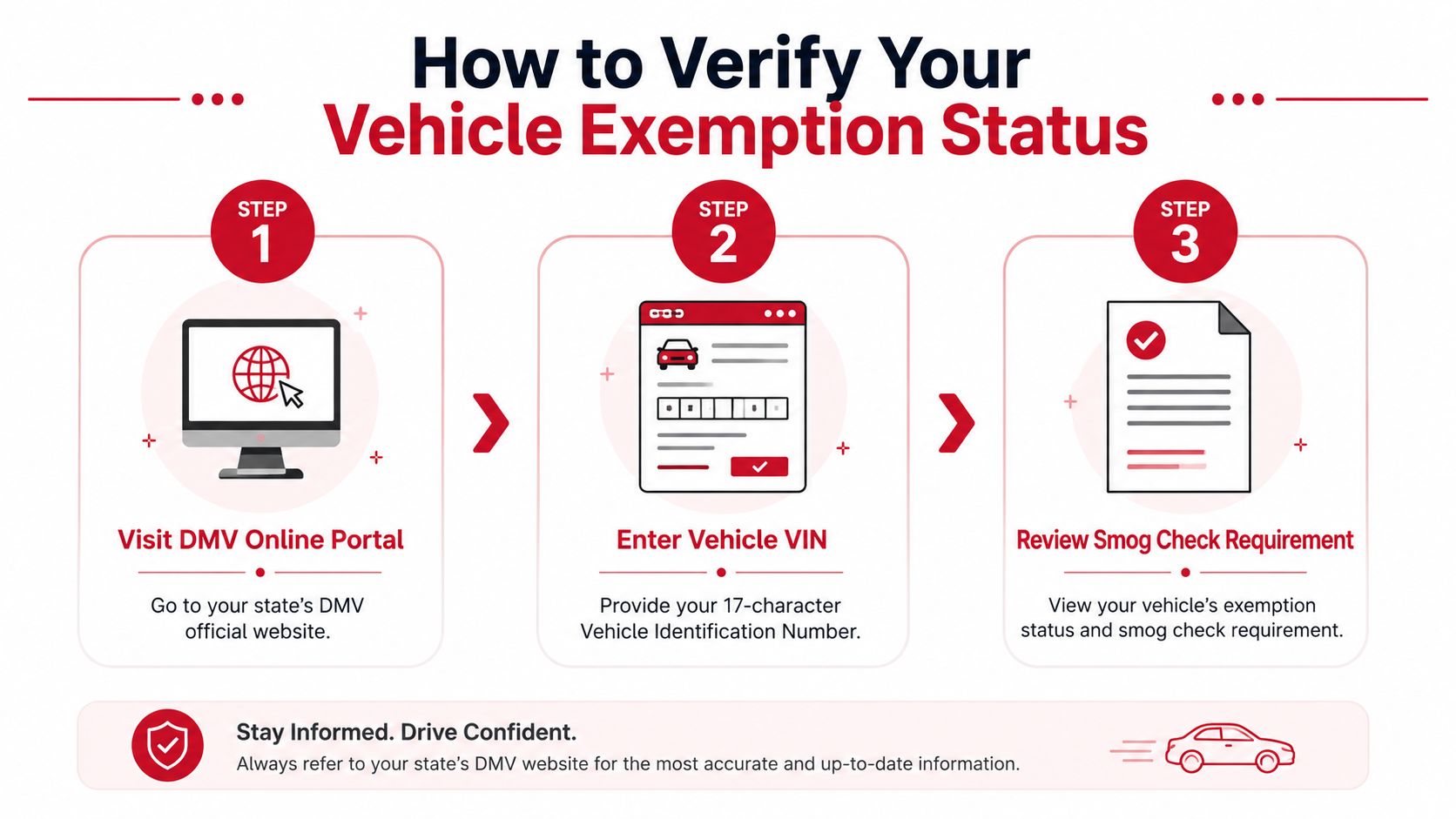
- Open the California DMV vehicle registration portal. Review the current renewal or transaction requirement through the state's online registration tools.
- Enter the requested vehicle information. The portal may ask for details such as the VIN or license plate.
- Read the smog requirement carefully. Confirm whether the current renewal or ownership transaction requires a smog certificate.
- Check the category behind the result. Compare the record with the vehicle's model year, fuel type, and the transaction you are completing.
- Save the result. Keep a digital or printed copy if the DMV record appears inconsistent with your vehicle documents.
Your renewal notice shows what the DMV expects for that specific registration event. A vehicle may fit the classic, new-vehicle, or alternative-fuel category, while the record still shows a requirement because of an incorrect model year, fuel type, ownership status, or vehicle classification.
If the DMV asks for a smog certificate, verify the record before assuming the notice is incorrect or booking an inspection.
If the DMV result conflicts with the title, registration, or vehicle specifications, contact the DMV and the Bureau of Automotive Repair's Smog Check Program. Ask which record element triggered the requirement. If the agency confirms or corrects the exemption, request written documentation and keep it with your registration records.
For a visual walkthrough of the verification process, use the following guide:
Identify the transaction before taking action. Renewal, ownership transfer, and correction of a vehicle record can produce different smog requirements, even for the same vehicle.
Common Smog Exemption Misconceptions to Avoid
The biggest myth is that California exempts a gasoline vehicle once it reaches a certain rolling age. It doesn't. The current classic gasoline exemption uses the fixed 1975 model-year cutoff, so a 1976 vehicle doesn't qualify because it has become old.
An out-of-state vehicle doesn't become exempt merely because it was previously registered elsewhere. California applies its own registration and emissions rules when the vehicle enters the state, and the owner must evaluate the vehicle using its California transaction, model year, fuel type, and classification.
Four assumptions that cause trouble
- “I barely drive it, so I don't need a test.” Low mileage and occasional use don't create a general exemption. The rule is based on the applicable vehicle and transaction categories.
- “It passed before, so it's exempt now.” A clean prior inspection doesn't remove a later testing requirement. Check the current DMV notice.
- “It's a hybrid, so it never needs smog.” Hybrids can receive the newer-vehicle age exemption, but they aren't automatically exempt forever.
- “It's old enough for classic status.” California's gasoline cutoff is tied to model year 1975 and older, not to a rolling age label.
These mistakes usually happen because owners use one rule to answer every situation. That approach fails when a renewal rule gets confused with a transfer rule, or when a gasoline rule gets applied to diesel, hybrid, electric, or motorcycle categories.
Check the official record before you pay for testing, especially when transferring an out-of-state vehicle or correcting a title. A short verification step is more useful than relying on a broad statement that the car is “old,” “clean,” or “fuel efficient.”
Quick Reference Checklist and Next Steps
先按車輛類別和交易情境核對,別把經典車、新車或替代燃料車的規則混在一起:
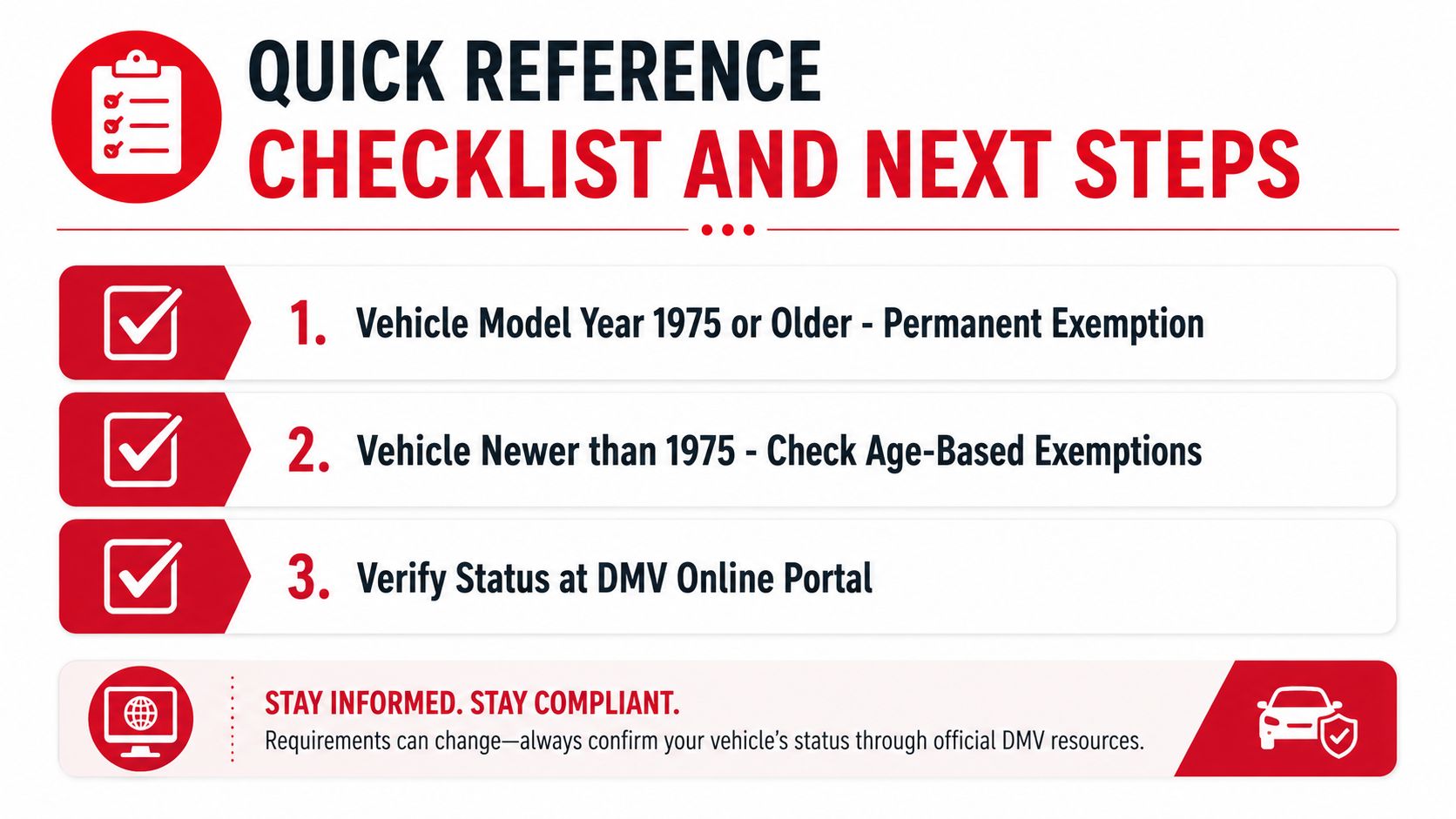
- 經典車: 汽油車若屬於 1975 年或更早的車款年份,通常符合經典車豁免條件。
- 新車續牌: 續牌時,確認車輛是否屬於 八個車款年份或更新,再依車款年份計算並核對 DMV 紀錄。
- 新車轉讓: 辦理所有權轉移時,確認車輛是否屬於 四個車款年份或更新,並查看轉讓文件。
- 替代燃料與其他類別: 電動車、混合動力車、柴油車、摩托車、重型卡車或休旅車,必須按自身類別判斷,不能直接套用汽油車規則。
- 最後確認: 檢查 California DMV 車輛紀錄和續牌通知,再預約 smog 檢查。
如果資料仍不清楚,請透過 California DMV smog inspection portal 核實,並使用 Bureau of Automotive Repair 的持牌檢查站資源。DMV 紀錄要求檢查時不要跳過,也不要在未確認要求前先付費檢查。
Fire House Smog 提供 STAR 認證僅檢查 smog 服務、California DMV 續牌及所有權轉移協助,地址是 Antioch 的 2900 Lone Tree Way。請瀏覽 Fire House Smog 查看服務。