
California emissions test results come back as a certificate with a pass or fail status, OBD-II diagnostic data, and any flagged trouble codes. The most common reason a test never reaches the tailpipe stage is incomplete readiness monitors, not a real emissions defect.
You may be standing at the counter with a Vehicle Inspection Report in your hand, trying to decide whether “failed,” “not ready,” or a code such as P0420 means an expensive repair. The wording can feel technical, but the report follows a logical path. It records what the station checked, which part of the inspection stopped the process, and whether the result can be sent to the California Department of Motor Vehicles.
California's statewide results show why these inspections matter. The 2025 Smog Check executive summary recorded 11,275,981 initial tests, with 959,667 failures, an 8.51% initial failure rate, and 12,200,718 total tests with a 9.04% overall failure rate. Emissions-related failures accounted for 83,034 cases, or a 10.20% emissions failure rate, as reported in the California Smog Check benchmark data. A result that doesn't reach the tailpipe stage is therefore worth interpreting carefully, not treating as proof that the engine has a major defect.
Table of Contents
- What Your Emissions Test Results Show
- How OBD-II Readiness Monitors Decide Your Result
- Common Trouble Codes Behind a Failed Emissions Test
- Emissions Failures Versus Visual and Functional Rejections
- Your Retest and Repair Path After a Failure
- Why a STAR Test-Only Station Matters in Antioch
- From Smog Certificate to Renewed Registration in One Stop
- Quick Checklist and Next Steps for Your Vehicle
What Your Emissions Test Results Show
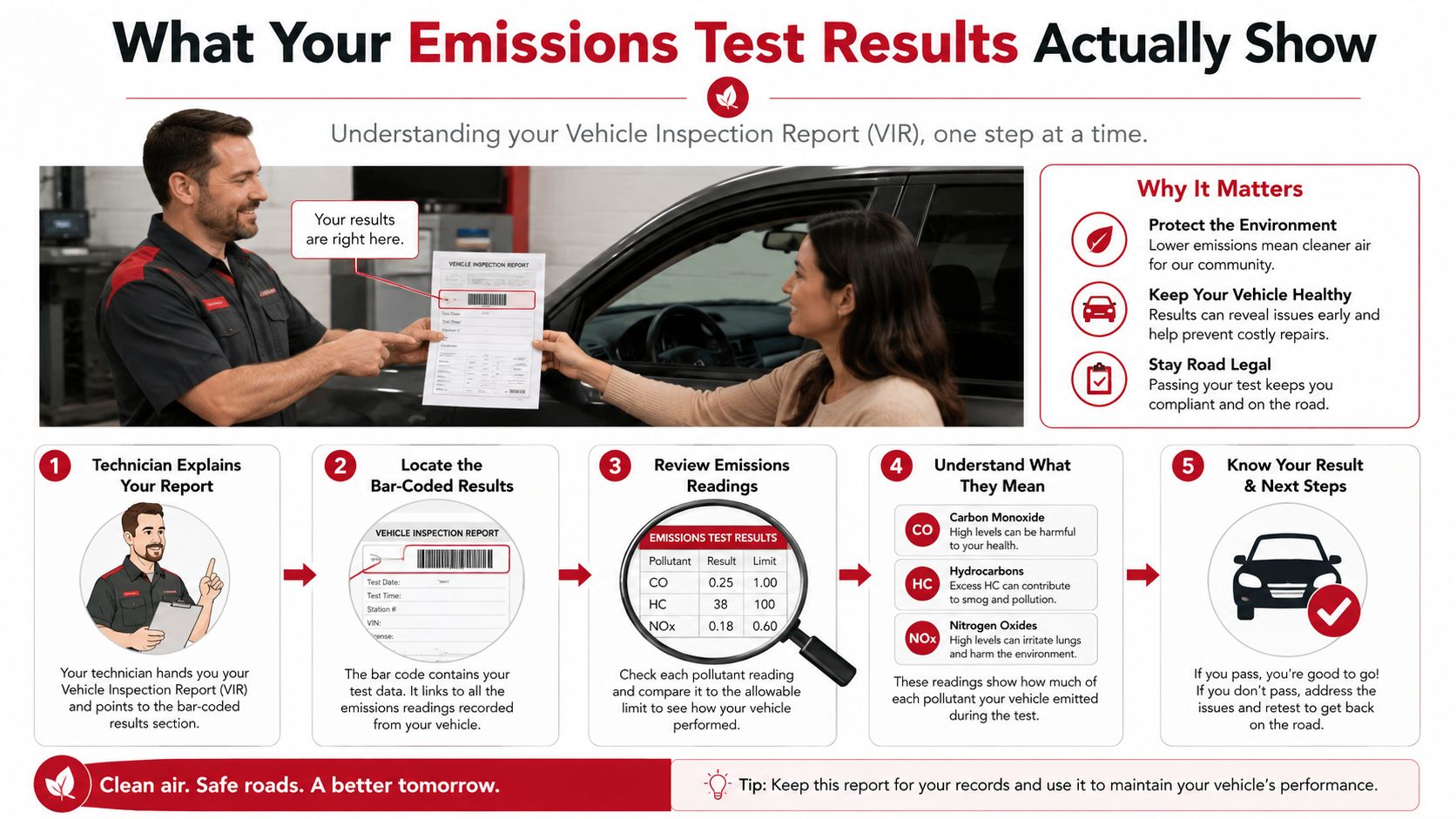
A technician usually hands you a Vehicle Inspection Report, or VIR, after the inspection. Begin with the header before reading the pass or fail box. It normally lists the test date, vehicle identification number, license information, station number, and test type. Confirming these details first can prevent a record problem caused by a mismatch, even when the vehicle itself tested correctly.
The certificate includes a barcode and serves as the inspection record connected to the DMV. It may show the overall outcome, completed inspection portions, OBD-II information, applicable tailpipe readings, and emissions-related diagnostic trouble codes. The applicable measurement rules are summarized in this guide to California emissions standards.
Read the result fields in order
Review these report sections:
- Overall outcome: The final status may be pass, fail, or refusal to test.
- Inspection portions: The VIR can identify visual and functional checks, the OBD scan, and tailpipe testing when required.
- Measured readings: Applicable tailpipe results may include hydrocarbons, or HC, carbon monoxide, or CO, oxides of nitrogen, or NOx, and carbon dioxide, or CO2. The report compares each reading with the applicable cutpoints.
- Diagnostic information: The VIR can list emissions-related trouble codes or show that the vehicle's monitors were not ready.
- Certification statement: A passing certificate provides the DMV with the electronic record needed for the applicable registration transaction.
The certificate is the legal inspection record used by the DMV to clear a registration requirement, not merely a shop receipt. A passing result is generally transmitted electronically. Keep the paper copy in case the online record is delayed or a clerk needs information from the certificate.
Practical rule: A “Not ready” result usually means the inspection was stopped before the tailpipe measurement could happen. Read it as a status of the vehicle's self-checks and inspection progress, then use the VIR to identify what was completed and what prevented certification.
How OBD-II Readiness Monitors Decide Your Result
Think of readiness monitors as a pre-flight checklist. A pilot doesn't take off until the instruments complete their self-checks. Your vehicle's OBD-II system works similarly. It runs self-tests on emissions equipment during particular driving conditions, then stores each monitor as ready or not ready.
Continuous monitors, including misfire detection, fuel-system monitoring, and component checks, operate while the vehicle runs. Non-continuous monitors need specific conditions before they can complete. These include the catalytic converter, oxygen sensor, EVAP system, EGR system, secondary air system, and A/C refrigerant system.
California inspection rules allow only limited incomplete-monitor conditions. EPA and state inspection guidance generally treats 2001-and-newer light-duty vehicles as allowed one unset monitor, while 1996–2000 vehicles are often allowed up to two, as described in the EPA inspection and maintenance policy guidance. If the vehicle exceeds its applicable limit, the test can stop before the tailpipe stage.
Why a monitor becomes not ready
A battery disconnect erases stored monitor status. Clearing a trouble code with a scan tool can do the same thing, even if the repair was appropriate. A recent EVAP-related repair or refueling event may also leave the EVAP monitor waiting for the right conditions, while ordinary short trips may not provide the speed, temperature, and steady driving needed for a complete cycle.
| Monitor | Type | What Can Set It to Not Ready |
|---|---|---|
| Misfire | Continuous | The system hasn't completed its operating checks after memory was cleared |
| Fuel system | Continuous | Recent battery loss, code clearing, or insufficient driving conditions |
| Comprehensive components | Continuous | The vehicle hasn't finished its component self-tests |
| Catalyst | Non-continuous | The required warm-up and steady driving conditions haven't occurred |
| Oxygen sensor | Non-continuous | The sensor monitor is waiting for the proper temperature and operating pattern |
| EVAP | Non-continuous | A recent code clear, refueling event, purge issue, or incomplete drive cycle |
| EGR and secondary air | Non-continuous | The system hasn't encountered the conditions needed to run its test |
| A/C refrigerant | Non-continuous | The vehicle's conditions haven't allowed the monitor to complete |
Before paying for an inspection, ask a technician or qualified shop to check monitor status with a scan tool. If the scan shows too many incomplete monitors, driving the vehicle through the manufacturer-specific cycle may solve the immediate refusal. Guidance on checking this condition is also available in the OBD readiness monitors guide.
A ready vehicle can still fail. Once the monitors are complete, the OBD scan may identify a stored trouble code or a malfunction indicator lamp condition. That code tells you which system needs diagnosis, but it doesn't automatically identify the failed part.
Common Trouble Codes Behind a Failed Emissions Test
A trouble code is a starting point, not a repair order. The VIR can tell you that the OBD system detected a problem, but it usually can't tell you whether the cause is a hose, sensor, valve, wiring fault, ignition part, or catalytic converter.
Match the code to the system
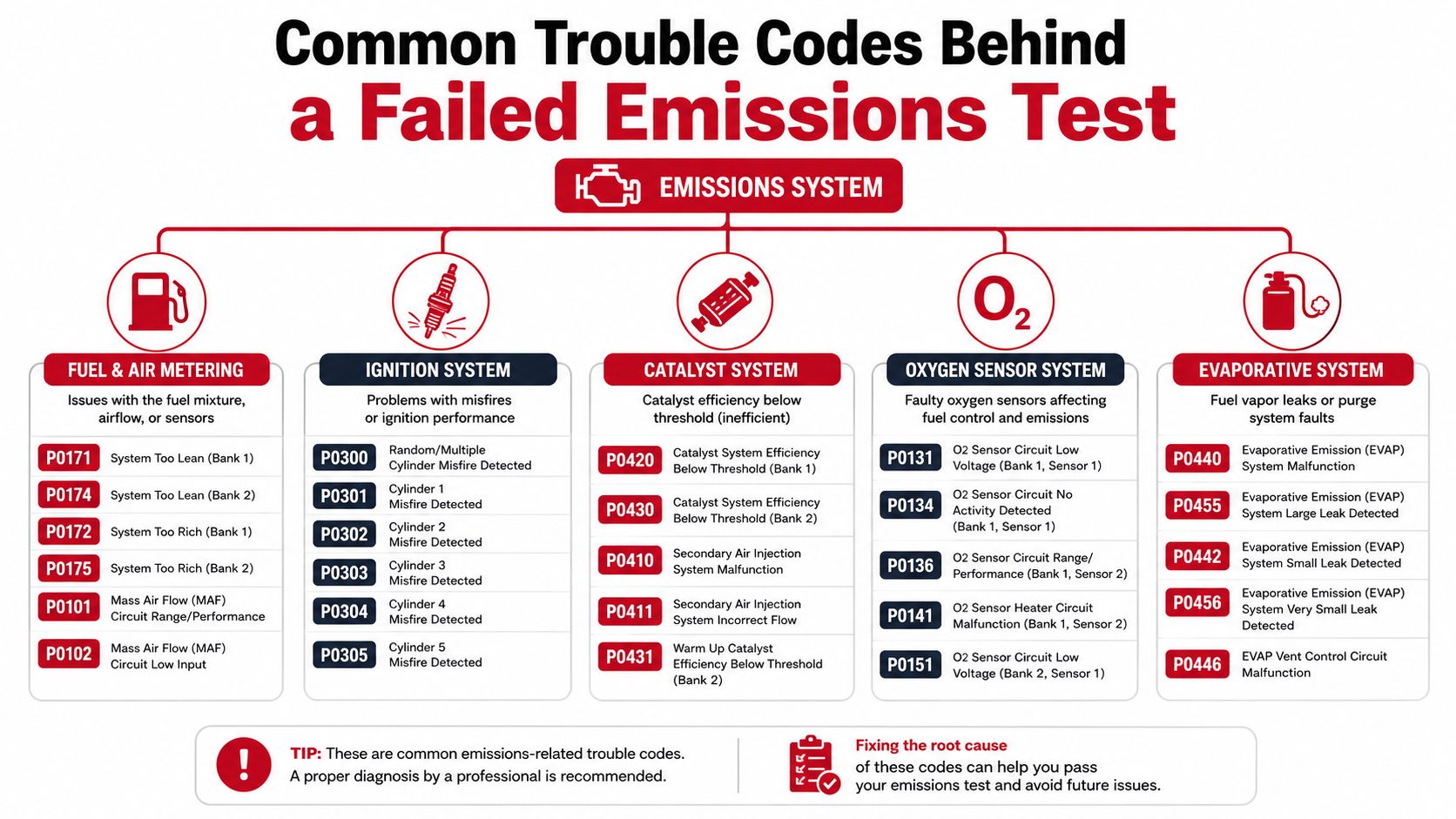
Fuel and air metering codes, such as P0171, P0172, P0174, and P0175, describe lean or rich operation. A vacuum leak, dirty airflow sensor, fuel-pressure problem, injector issue, or intake leak can produce similar code families. The repair urgency depends on the cause. A lean condition can also contribute to drivability or component damage if it remains unresolved.
Ignition and misfire codes, including P0300 through P0308, indicate random or cylinder-specific misfire detection. Worn spark plugs, ignition coils, injector faults, compression problems, or wiring can be involved. A flashing malfunction indicator lamp deserves prompt attention because continued misfire can send unburned fuel into the exhaust system.
EVAP codes, including P0440, P0442, P0455, and P0456, relate to fuel-vapor leaks or purge-system operation. A loose or damaged fuel cap can be simple, while a split hose, stuck purge valve, or tank-side leak requires more testing. A small leak code isn't the same repair as a large leak code, even though both belong to the EVAP family.
Catalyst efficiency codes, such as P0420 and P0430, mean the monitoring system believes the catalytic converter isn't cleaning the exhaust as expected. An oxygen-sensor problem, exhaust leak, fuel-control issue, or deteriorated converter may be responsible. Replacing the converter before checking those possibilities can waste money.
Oxygen-sensor codes, including P0136 and P0156, can involve the sensor, wiring, exhaust leaks, or a related fuel-control condition. EGR and secondary-air codes, such as P0401, P0411, and P0413, may point to restricted passages, failed valves, pumps, solenoids, or control wiring.
A code names a detected condition. It doesn't name the part you should buy.
EPA documentation explains that OBD systems monitor emissions components for malfunctions or deterioration that could cause emissions thresholds to be exceeded. Field research also identifies catalyst and EVAP monitors as areas where readiness can be less consistent than core monitors, which helps explain why those systems often appear in delayed or failed inspections, as discussed in this OBD emissions monitoring research.
A single code can represent a relatively simple repair or a major emissions-system diagnosis. Ask for the printed code list, the monitor status, and the inspection category before authorizing work. More practical interpretation is available in this guide to common smog check fail reasons.
Emissions Failures Versus Visual and Functional Rejections
Not every failed emissions test is an emissions-reading failure. A technician may record a problem during the visual, functional, or tampering portion before the vehicle reaches an OBD or tailpipe decision.
| Failure Type | Typical Cause | Certificate Marking | Next Step |
|---|---|---|---|
| Emissions-specific | HC, CO, or NOx above the applicable limit, or an emissions-related OBD fault | Failed emissions or OBD portion | Diagnose the system, repair the cause, and retest |
| Visual or functional | Missing converter, altered exhaust, fuel-filler issue, or illuminated malfunction indicator lamp | Failed visual or functional portion | Correct the equipment or diagnose the warning condition |
| Tampering | Removed EGR equipment, altered intake, or exhaust changes before the catalytic converter | Tampering or equipment failure | Restore compliant emissions hardware before retesting |
A tailpipe failure means the measured gases exceeded the applicable cutpoints. An OBD failure means the vehicle's diagnostic system reported a monitored emissions problem or failed to meet the readiness conditions. These are different paths, even though both may appear under the broad heading of emissions compliance.
Visual and tampering findings can bypass tailpipe measurement entirely. For example, a missing catalytic converter is visible hardware evidence, while an altered intake or removed EGR component can create a compliance problem before the analyzer measures exhaust. The station documents the result on the inspection record, while the owner needs to correct the condition and obtain a valid retest.
An illuminated malfunction indicator lamp can create confusion. The lamp is a functional warning, but it usually points toward an OBD diagnosis that may reveal an underlying emissions fault once the vehicle is scanned. A technician shouldn't treat the light itself as the complete diagnosis.
The repair paperwork and the DMV record serve different purposes. The station provides the inspection result and any available failure information. A repair facility may provide diagnostic findings or invoices, but those documents don't substitute for a passing certificate when the DMV requires a completed smog inspection.
Your Retest and Repair Path After a Failure
Antioch drivers should begin with the failure category on the VIR. California's next step depends on whether the result came from OBD-II or tailpipe readings, or from a visual, functional, or tampering finding.
For a failure limited to OBD-II or tailpipe readings, California policy generally allows a free retest within 90 days at the same station when no repairs have been performed, as described in the California retest and inspection guidance. Repair work can change the retest conditions. Clearing a trouble code may also change monitor status, so ask the station about the coupon and its exact terms before doing anything.
Choose the next action from the report
- No repair and eligible failure: Keep the failed VIR, confirm the same-station retest conditions, and return within the allowed period.
- Repair required: Take the code list and inspection findings to a certified smog repair technician. Request diagnosis before approving parts.
- Income-qualified assistance: Check California's Repair Assistance options if you meet the program requirements. The program includes a $500 cap for EVAP repairs, according to the applicable state program terms.
- Directed repair: Follow the repair direction when the inspection or state process sends you to a specific path. An owner's-choice repair means you can select a qualified repair provider.
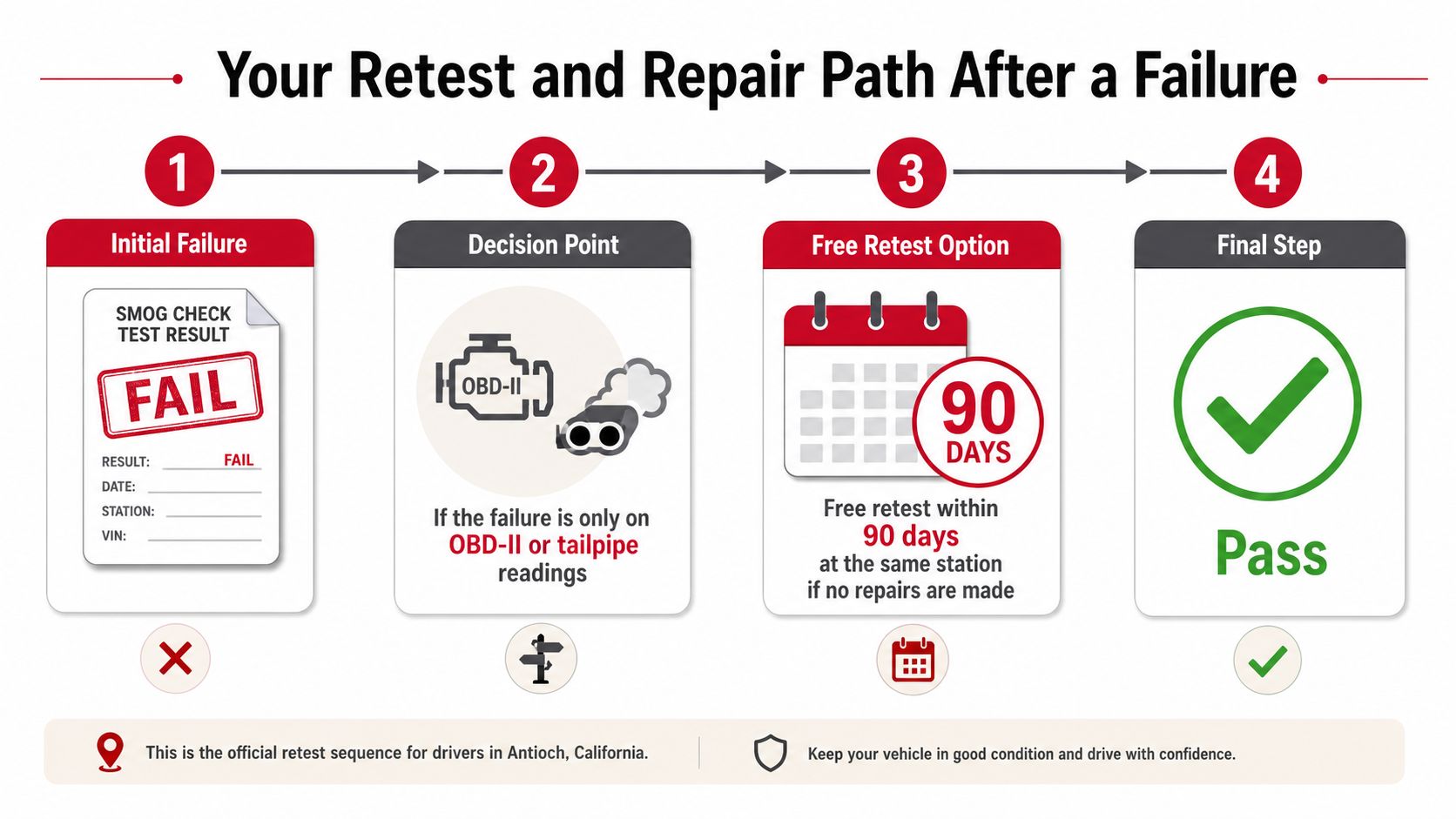
Use the VIR to choose between these paths. A no-repair retest works when the failure was limited to an eligible OBD or tailpipe reading and the vehicle has not been altered. When the report lists a persistent trouble code, visual defect, or tampering, schedule diagnosis and repair before returning for inspection. Fire House Smog offers test-only inspections, retest handling under its site policy and coupon terms, and electronic transmission of completed results to the DMV.
This short video can help you see how the retest decision fits into the broader inspection process.
Bring the original VIR to the follow-up visit.
Why a STAR Test-Only Station Matters in Antioch
A STAR test-only station keeps the inspection separate from repair sales. For a first-time customer, that separation makes the paperwork easier to read. You can focus on whether the vehicle passed, which system caused a failure, and what the report records before discussing repairs.
A test-and-repair shop may inspect the vehicle and sell the work needed afterward. Customers should request clear documentation before approving parts or labor. A test-only station does not perform in-house repairs, so its inspection decision is separate from selling the parts or labor used to correct a failure.
When STAR status affects your appointment
California directs some vehicles to STAR or test-only inspections, including vehicles identified through the state's compliance process. Antioch is part of an enhanced inspection area, so check the registration notice or DMV direction before selecting a station. A vehicle requiring STAR inspection may not be accepted at an ordinary smog location.
Testing also becomes easier to follow when the station concentrates on inspection. The technician can identify whether the result involved readiness monitors, OBD data, tailpipe readings, visual equipment, or tampering. That explanation connects the result to the certificate or failure report without folding a repair estimate into the inspection decision.
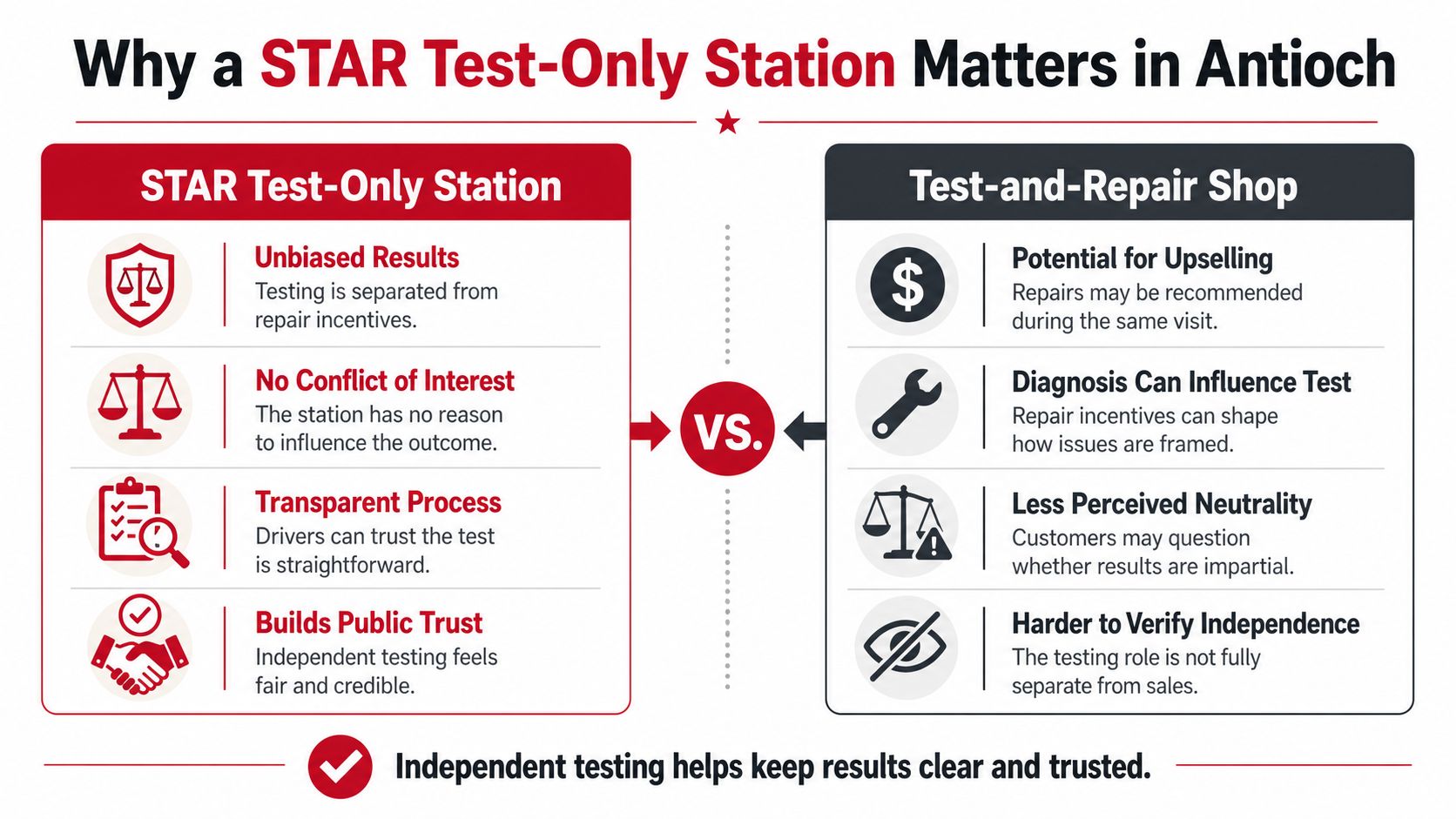
Before driving across Antioch, confirm the required station type for a directed vehicle. For an ordinary renewal, independent testing can provide a neutral result and a clear paper trail. Bring the DMV notice when available. It shows the station which inspection category applies and helps prevent an avoidable appointment mistake.
Test-only operation removes the repair-sales conflict and keeps the inspection decision focused on the vehicle's recorded condition.
From Smog Certificate to Renewed Registration in One Stop
Once the vehicle passes, the technician transmits the result electronically to the DMV. The certificate number may then connect to your renewal record, allowing the registration transaction to move forward without carrying a paper certificate between separate offices.
Start with the renewal notice and confirm that the vehicle's smog requirement has been satisfied. Then complete the registration payment through the available DMV channel. Depending on the vehicle and transaction, renewal may be available online, by mail, or through an authorized on-site DMV service provider.
A practical Antioch sequence
- Bring the renewal notice: It helps the provider locate the correct DMV transaction.
- Bring identification and payment: The provider may need identification and an accepted payment method for the renewal.
- Confirm the smog transmission: If the pass was recent, ask the station to verify that the result was submitted electronically.
- Complete the renewal: Once the DMV record accepts the inspection, pay the required registration fees.
- Collect the sticker and tag materials: An authorized provider may print available registration materials on site.
The timing matters. A certificate should be transmitted before registration expires if you want to avoid a late transaction or a record that hasn't updated in time. If the portal or renewal notice doesn't reflect the result, don't assume the inspection failed. First compare the VIN, license information, and certificate details, then ask the station or DMV service provider to reconcile the record.
A STAR certificate and a regular certificate both document a passing inspection, but the required certificate type depends on the vehicle's DMV direction and inspection category. The notice controls that choice. If the DMV specifically directed a STAR inspection, a pass from a station that doesn't satisfy that direction may not resolve the requirement.
Some drivers use separate trips for the smog check, registration payment, and sticker pickup. An Antioch provider that offers both inspection and licensed DMV registration services can combine those tasks when the vehicle and transaction qualify.
Quick Checklist and Next Steps for Your Vehicle
Use the inspection process as a decision tree rather than guessing from the dashboard light.
- Confirm the vehicle and test type. Check the registration notice, vehicle class, and any STAR direction before choosing a station.
- Protect monitor status. Avoid disconnecting the battery or clearing codes before an inspection. If memory was recently reset, allow enough mixed driving for the required monitors to run.
- Check basic conditions. Make sure the fuel cap is installed correctly and look for an illuminated malfunction indicator lamp.
- Ask for readiness results. If a monitor is incomplete, request the specific monitor name and the driving conditions needed to complete it.
- Read the VIR before authorizing repairs. Identify whether the result is a refusal-to-test, OBD failure, tailpipe failure, visual rejection, functional problem, or tampering finding.
- Request the code list. A DTC is evidence for diagnosis, not proof that the matching component needs replacement.
- Use the correct follow-up path. Return for an eligible no-repair retest, or visit a qualified smog repair technician when the report identifies a repair condition.
- Reconcile the DMV record. After a pass, confirm the electronic submission before completing registration renewal.
Digital records can also be delayed or appear inconsistent across portals. CARB's Clean Truck Check FAQ says results should appear in CTC-VIS within 0–1 days, and advises users to retest, disconnect other devices, check the vehicle-device connection, and confirm stable internet if a result doesn't appear within 5 minutes. It also explains that a vendor portal may show “Awaiting CARB's Response” while the CARB account shows no result, and that CTC-VIS displays submissions made on or after October 1, 2024, as detailed in the CARB test-results troubleshooting guidance. Those details apply to the referenced Clean Truck Check system, but they illustrate why a missing digital record needs reconciliation rather than an immediate assumption of failure.
Bring your emissions test results sheet to Fire House Smog in Antioch if you want the recorded outcome explained before choosing a next step. The station provides STAR-certified test-only inspections and licensed DMV registration services, so eligible customers can address the certificate and renewal workflow in the same visit.
Fire House Smog can review your VIR, explain readiness and trouble-code findings, perform eligible retests, and process qualifying DMV renewals with on-site tag services. Visit Fire House Smog at 2900 Lone Tree Way in Antioch with your inspection report and renewal notice so you can leave with a clear plan for the next pass.