Smog Check San Rafael: What Drivers Need to Know
You open the DMV renewal notice, and there it is, the line that makes people pause at the kitchen table in San Rafael. The car seems fine, the registration is due, and now the form is asking for a smog certification that you weren't expecting, or at least didn't expect to have to think about today. That's the point where most drivers start guessing, and that's where mistakes happen.
The good news is that the system follows a pretty clear pattern once you know where to look. A smog check San Rafael driver usually needs to answer three questions, whether the vehicle is due, whether it's exempt, and if it failed, where it's allowed to go next. The rest of this guide walks through those decisions in plain English, so you can tell the difference between a routine test, a STAR-directed visit, and a repair path that matches the notice in your hand.
Table of Contents
- What Triggers a Smog Check in San Rafael
- Who Is Exempt and Who Must Test
- Test-Only, Test-and-Repair, and STAR Stations Explained
- How to Prepare Your Car Before the Test
- Smog Check Costs and Wait Times in San Rafael
- What Happens After a Failed Smog Check
- Linking the Smog Certificate to Your DMV Renewal
- Common Questions San Rafael Drivers Ask at the Counter
What Triggers a Smog Check in San Rafael
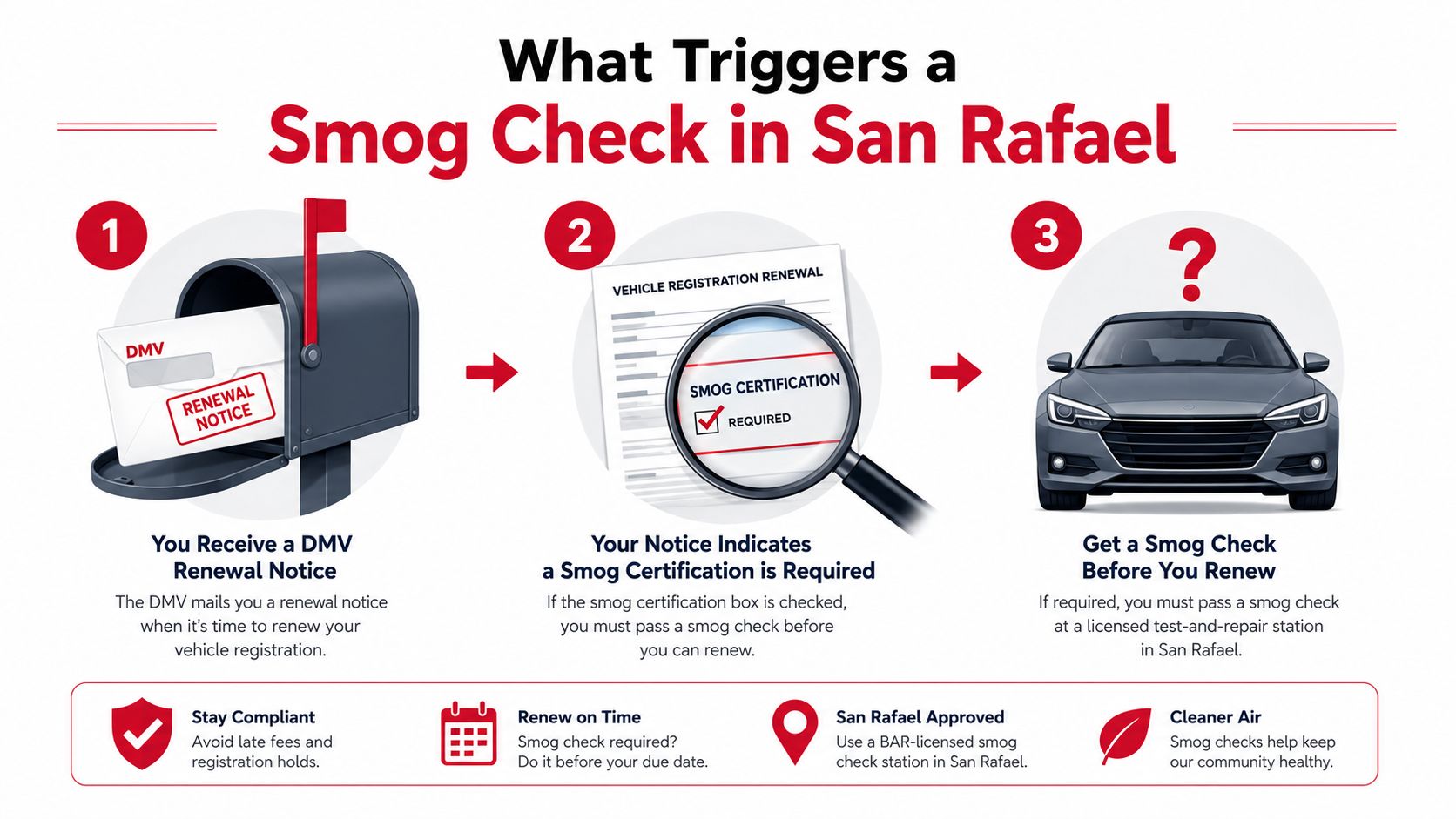
A San Rafael driver usually finds out through the DMV renewal notice. The envelope arrives, the form has a smog certification box, and the next question is whether the vehicle needs testing, whether it needs a specific station type, or whether it qualifies for an exemption. California's Smog Check framework requires inspection for registration renewal in participating counties, and the DMV also marks when a STAR station is required for that vehicle. For Marin County drivers, the notice matters because it is tied to where the vehicle is registered, not just how often it is driven around town. See the DMV's explanation of the statewide framework in the DMV smog inspection rules affecting San Rafael registration renewals.
Read the renewal notice like a checklist
The smog certification box is the first thing to check. If it is marked, the DMV expects a certificate before renewal can move ahead. The vehicle description is the next piece, because model year and fuel type tell you whether an exemption may apply. The STAR direction line is the part that causes the most confusion, because a vehicle sent to a STAR station has to be certified at the right kind of station, not just any shop that performs smog inspections.
Practical rule: If the DMV notice says a STAR station is required, treat that as the station assignment for the vehicle.
A useful way to read the notice is to separate the question of need from the question of location. If the notice asks for smog, you are already past the first question and into the second one, where station type matters. That is where drivers lose time, because a vehicle can be eligible for a certificate and still be turned away if it is tested at the wrong station type.
For a San Rafael driver holding a renewal notice at the kitchen table, the job is simple: match the notice to the vehicle. If the notice calls for a certificate, check whether the vehicle sits inside an exemption window, then look for the station type named on the form. If there is already a failure slip in hand, the path changes again, and the next step depends on whether the car needs a test-and-repair station, a test-only station, or a BAR referee review.
Who Is Exempt and Who Must Test
A lot of San Rafael drivers get stuck here because the exemption rules are not based on age in a loose, everyday sense. California DMV uses model year and fuel type to decide who is exempt, and that can feel backwards if you are only looking at the car's actual age. Gasoline-powered vehicles 1975 or older do not need a smog inspection, and diesel-powered vehicles 1997 or older do not need one either. The DMV also lists exemptions for diesel vehicles over 14,000 pounds gross vehicle weight, electric vehicles, and natural-gas-powered vehicles over 14,000 pounds.
The model-year rule is where people usually misread the notice
For gasoline vehicles, the DMV says gasoline-powered vehicles less than eight model-years old do not need a smog inspection. That is a moving window, so the cutoff changes as the model year changes. A driver who counts from the calendar can get the answer wrong, while a driver who counts backward from the current model year gets the right result.
There is also a separate rule that started January 1, 2019, where vehicles under 4 model years old may pay a smog abatement fee instead of undergoing inspections for the first 8 years of registration. That is one reason newer cars do not always follow the same testing pattern as older ones, even when the renewal notice still looks like a smog-related renewal.
A simple way to sort your vehicle
- Gasoline, 1975 or older: no smog inspection required.
- Diesel, 1997 or older: no smog inspection required.
- Diesel over 14,000 pounds GVWR: no smog inspection required.
- Electric: no smog inspection required.
- Natural gas over 14,000 pounds: no smog inspection required.
- Gasoline under eight model years old: generally exempt from testing.
If you want the state's exemption categories in one place, the smog inspection exemption rules page lays them out in DMV language.
A renewal notice that already asks for smog certification means the vehicle has been matched against the exemption rules for that cycle. If the DMV wants a certificate, the car is being treated as a vehicle that must test now, not later. That is the point where the notice matters more than a guess at whether the car feels old enough or new enough.
Test-Only, Test-and-Repair, and STAR Stations Explained
The labels on smog stations sound close, but they serve different purposes. A test-only station handles the inspection and does not sell repairs, so the test result stays separate from the repair estimate. A test-and-repair station can inspect the vehicle and fix emissions-related problems at the same shop. A STAR station meets higher Bureau of Automotive Repair performance standards and can certify some vehicles that other stations are not authorized to certify, including high-polluting vehicles and vehicles the DMV notice sends to STAR. If you want the state's definition of STAR stations and certificate fees, see the California BAR smog check overview.
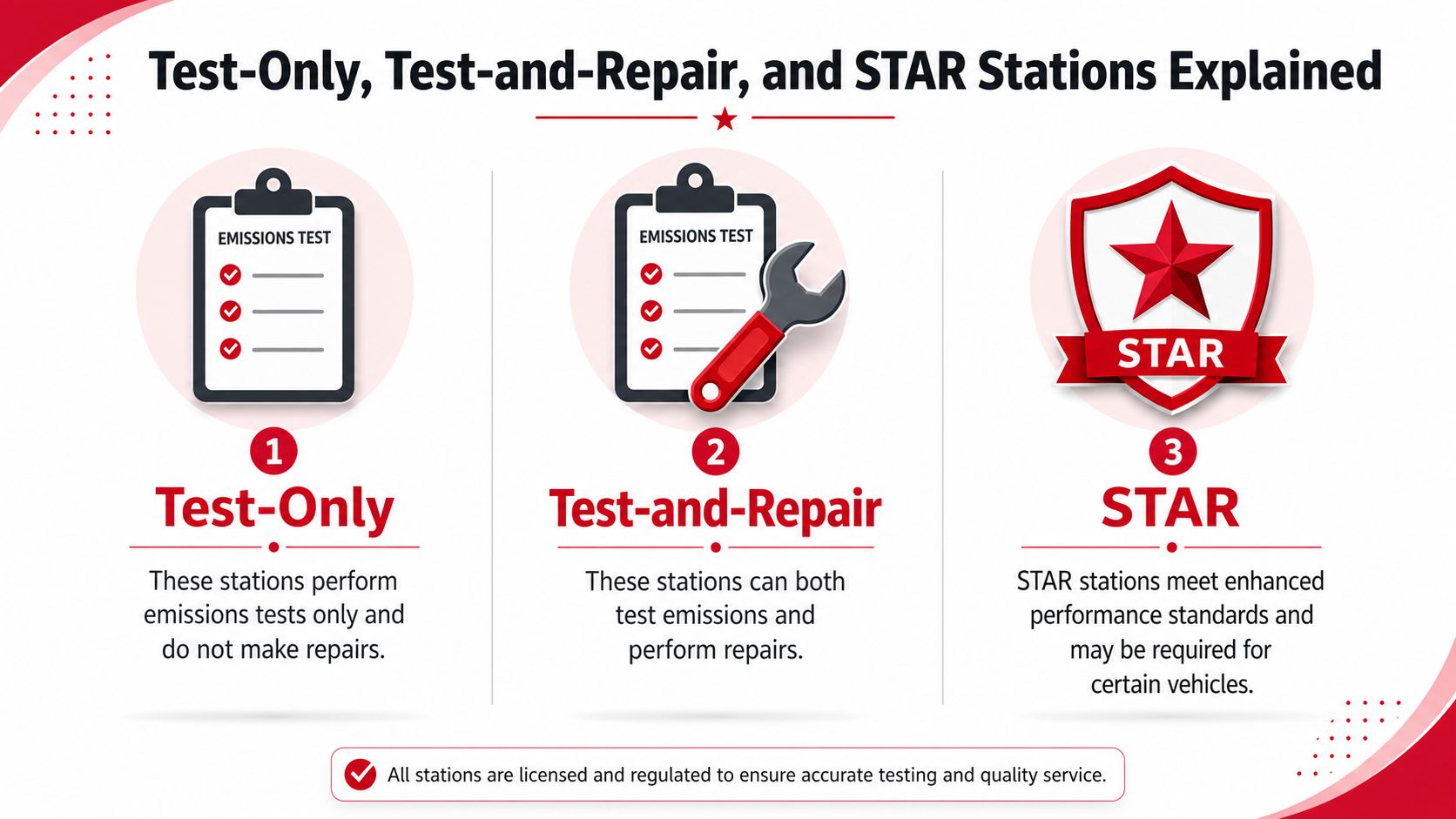
A failed smog check can make the station choice feel more complicated than it first looks. The car may need repair, but the next station still has to be allowed to certify the result. That is why the station type matters before you pull in, not after the test is already done.
Why station type matters before you arrive
If your renewal notice directs you to a STAR station, a non-STAR station cannot complete that certification for you, even if the car passes the inspection. Drivers often miss that part because they focus on the pass or fail line and overlook whether the shop was allowed to sign off on the result. The DMV renewal notice controls the lane you need to use.
A test-only station works well when you want the inspection handled without a repair pitch attached to it. A test-and-repair station makes more sense when you expect the car may fail and you want one place to diagnose and fix the issue. STAR stations matter when the vehicle is directed there, or when the emissions history puts it into a stricter category. For a plain-language explanation of that category, what STAR-certified smog means helps show why one shop can certify a vehicle while another cannot.
Picking the right lane the first time
- Need a first-pass inspection: a test-only station is usually the simplest fit if the notice does not require STAR.
- Need diagnosis and repair in one place: a test-and-repair station is the practical choice.
- Directed by DMV notice or dealing with a high-emitting vehicle: a STAR station may be required.
- Unclear after a failure: read the renewal notice before choosing the next stop.
If you are comparing station types around San Rafael, the main question is not just whether the car can pass. It is whether the station is allowed to handle the next step in the process. That keeps you from paying for the wrong visit, then having to start over somewhere else.
How to Prepare Your Car Before the Test
A clean test result often starts before you reach the station. The most useful prep is simple and mechanical, not dramatic. Drive the car long enough to get it fully warm, make sure the check-engine light isn't on, confirm the gas cap is sealed, and don't show up right after a battery change if the vehicle needs time to reset its monitors. Some stations also use testing methods that depend on the vehicle type, so a little setup helps avoid a return trip.
A five-step routine that keeps people from getting burned
- Take a warm drive first. A drive of at least 10 to 15 minutes helps bring the vehicle up to operating temperature.
- Look at the dashboard. If the check-engine light is illuminated at the time of test, the vehicle fails regardless of how it feels on the road.
- Inspect the gas cap. A loose or badly sealed cap can create trouble that feels small but still matters in inspection.
- Think about battery history. A recently replaced or dead battery can reset readiness monitors, which can delay a clean result.
- Check fuel and tire condition. Some station procedures may depend on vehicle setup, so don't arrive with obvious maintenance issues hanging over the test.
A vehicle that's “driving fine” can still fail if the onboard systems aren't ready or the warning light is on.
That's the part drivers usually underestimate. Smog testing isn't a general roadworthiness check, and it isn't a judgment about how the car feels on the commute up to San Rafael. It's a test of whether the vehicle's emissions-related systems are ready and whether they're operating within the allowed limits.
If you're trying to avoid a second visit, the morning-of checklist matters more than a last-minute top-off of the tank or a wash. Get the dashboard clear, let the engine warm up, and don't treat a warning light as something you can explain away at the counter.
Smog Check Costs and Wait Times in San Rafael
A smog check bill usually has two parts, and separating them keeps the numbers from looking mysterious. The station charges for the inspection itself, and the state certificate fee is added on top of that. California's Bureau of Automotive Repair sets the Smog Check certificate fee at $8.25, while the station sets its own labor price. That is why one San Rafael listing can show $41.75 plus the $8.25 certificate fee, which lands at about $50 on coupon pricing, while another shop may quote something different for the same basic service.
The practical lesson is simple. A lower advertised price may reflect a narrower appointment window, while a higher price may buy you longer hours, weekend availability, or faster service. San Rafael drivers often end up paying for convenience because it is easier to fit the test into a workday or a weekend errand than to wait around for a slow counter.
Wait time is a separate question from price. A quick pass-only visit can move along without much delay, while a busy hour or a vehicle that needs more involved testing can add time to the visit. If you are trying to get registration renewed before the deadline, budget for both the fee and the wait, not just the sticker price.
| Cost Component | Typical Range | Who Sets It |
|---|---|---|
| Smog Check certificate | $8.25 | California Bureau of Automotive Repair |
| Station labor charge | Varies by station | The individual station |
| Advertised local coupon pricing | About $41.75 plus the certificate fee | The station |
| Out-the-door total on a coupon listing | About $50 | Combination of station charge and certificate fee |
Before you hand over the keys, ask about the retest policy. Some stations will retest under certain terms at no extra charge, and that can keep a failed visit from turning into a second full bill at the same shop. If you are comparing places, the retest rule matters just as much as the first price quote.
For drivers who want to understand why a car fails in the first place, this smog check fail reasons guide can help make the common causes easier to sort through.
What Happens After a Failed Smog Check
A failed smog check can feel like a dead end, but the next step depends on the kind of failure and on what the DMV notice says. For a San Rafael driver, the first question is not "Who can fix it?" It is "Who can certify it after the repair?" California BAR explains that if a vehicle fails and is not a gross polluter, it can be repaired and certified at any test-and-repair station. If the vehicle was directed to a STAR station on the DMV notice, or if it exceeded gross polluter thresholds, the repaired vehicle has to be certified by a STAR-certified station or a BAR referee. The BAR's decision rules are laid out in the Smog Check manual.
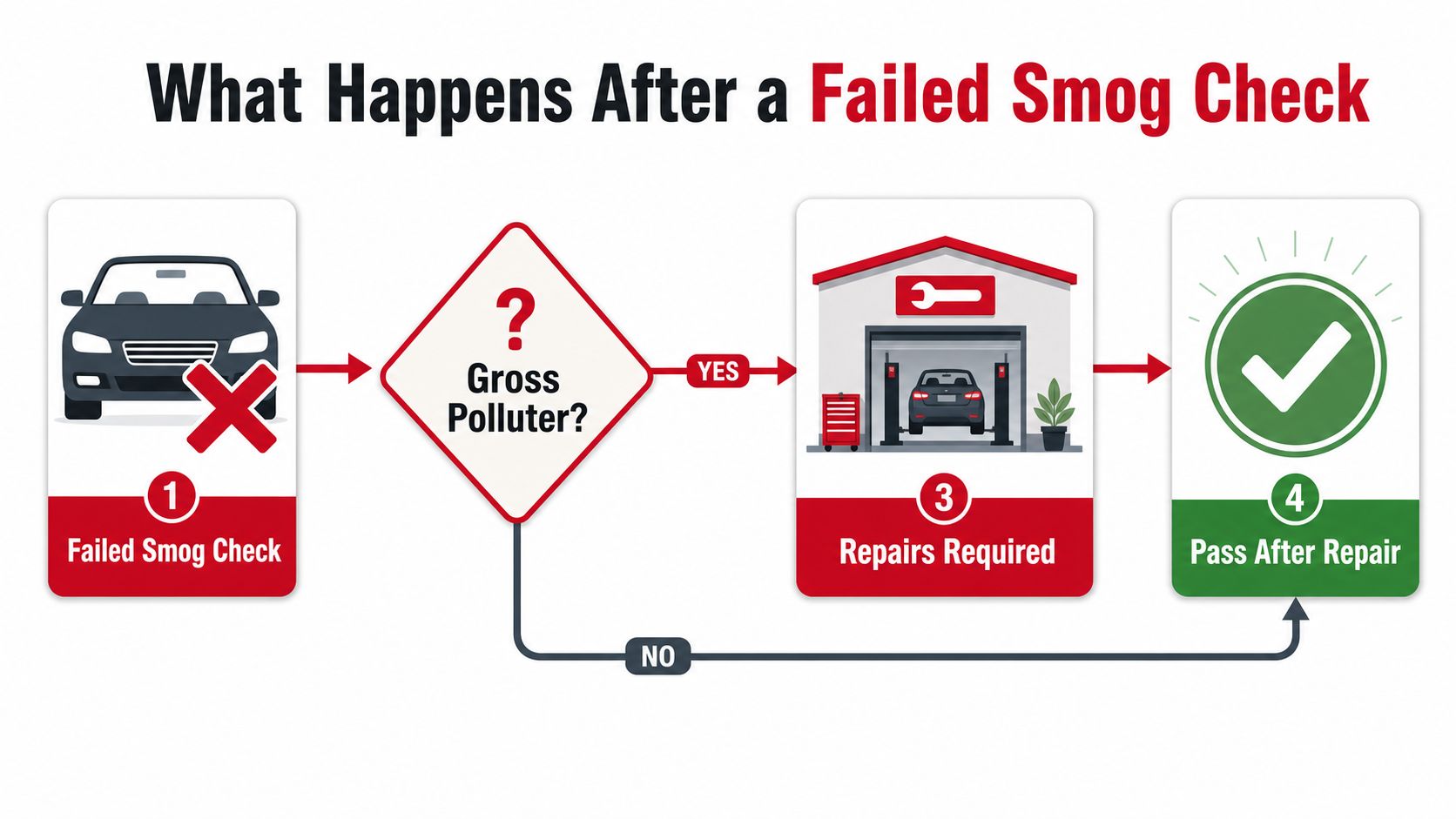
The simplest way to read the failure path is to treat it like a traffic sign. Some cars can make a normal left turn at a test-and-repair station, while others are directed into a narrower lane that only STAR or a referee can use.
The repair path depends on the failure type
If the problem can be corrected by a regular repair shop and the vehicle is not in a restricted category, a test-and-repair station is usually the easiest place to start. The station can both repair the car and complete the follow-up certification, which avoids sending you somewhere else after the fix. If the DMV notice directed the vehicle to STAR, that direction still controls the final certification even after the repair is done.
A BAR referee is a state-employed inspector who performs certification-only tests at fixed locations. Drivers usually end up there when the result is disputed, when the vehicle does not fit the normal station path, or when the repair and test paperwork need a closer review. The referee route is not the default choice, but it is the correct one when the ordinary shop flow does not match the rules.
For drivers trying to make sense of why a car failed before choosing the next shop, the smog check fail reasons guide is a useful starting point. It helps separate routine repair issues from the cases that point toward STAR or a referee.
A practical decision tree
- Failed, not a gross polluter: repair at a test-and-repair station.
- Directed to STAR on the renewal notice: repair and certify through STAR or a referee.
- Gross polluter situation: certification has to follow the stricter STAR or referee route.
- Dispute over the result: the referee path may be the cleaner option.
The key is to read the failure slip and the DMV notice together. Either one can change the next stop, and that is where a lot of San Rafael drivers get tripped up. A car that needs a repair is one path. A car that also carries a STAR direction or a gross polluter designation is a different one.
Linking the Smog Certificate to Your DMV Renewal
A passing smog test only solves part of the renewal. The station sends the result to the DMV electronically, usually within minutes, and then the registration can be finished online, by mail, or at a DMV field office. Some stations also offer DMV renewal services through a licensed business partner, so a driver can handle testing and tag printing in one visit during posted hours. The renewal steps are laid out in the California DMV registration renewal guide.
A San Rafael driver usually runs into trouble at the handoff between the certificate and the renewal notice. A smog pass tells the DMV the car cleared testing, but it does not always mean the renewal is done. If the station only performs testing, the driver still needs to complete the registration somewhere else. If the station also handles DMV renewal services, the paperwork may be finished in the same stop, as long as the vehicle and notice qualify.
The certificate type still matters. A regular pass cannot satisfy a directed renewal if the notice calls for STAR certification, just as a correct test cannot fix the wrong paperwork. The DMV checks the kind of certificate on file, not only whether a certificate exists. That is the part many drivers miss after a failure or a renewal notice arrives with special instructions.
What to have ready at the counter
- Renewal notice: shows whether smog is required and whether STAR is directed.
- Failure slip, if applicable: shows the last test result and helps the station match the next step to the paperwork.
- Current registration: helps the DMV side move faster.
- Proof of repair, if you're returning after a failure: helps connect the repair work to the failed test.
For drivers who want testing and DMV paperwork in one place, Fire House Smog is one example of a station that also provides DMV registration services alongside smog testing. For everyone else, the rule is simple. The smog certificate supports the renewal, but it does not replace the renewal itself.
Common Questions San Rafael Drivers Ask at the Counter
The same questions come up again and again, usually right after the paperwork gets confusing. People want to know whether an out-of-state vehicle can be transferred without a smog check, whether an RV can be tested, whether a directed renewal can be handled anywhere, and how a free retest works. The answers are short once you know the rules.
Quick answers drivers usually need
- Out-of-state transfer: Yes, transferred vehicles generally need a smog check, along with the other paperwork required for the transfer process. VIN verification is part of that process for many transfers, so don't assume the smog visit is the only step.
- RVs and motorhomes: It depends on length and equipment, so call ahead before driving over.
- STAR-directed renewal notice: Only a STAR station or referee can certify it, not a regular non-STAR station.
- Free retest coupons: They're usually tied to the issuing station's terms, and you should bring the original receipt and failure slip.
The best counter question is often, “Does my notice require STAR, or not?” That one detail changes the whole route.
San Rafael drivers get stuck when they treat every failure or renewal the same. They're not the same. A normal pass, a directed renewal, and a post-failure certification each follow a different path, and the station you choose has to match the paperwork you already have.
If you're standing in front of a renewal notice right now, start with the vehicle's model year, fuel type, and STAR direction line. That's the fastest way to tell whether you're booking a routine test, a repair-and-certify visit, or a referee step.
If you want a station that handles both smog testing and DMV registration services, contact Fire House Smog and ask how they handle STAR-directed notices, retests, and renewal paperwork before you head over.