
You open your DMV renewal notice, scan for the amount due, and then see the line nobody likes: smog certification required. If you own a diesel in California, that notice tends to raise more questions than answers. Gas drivers often assume your process is the same as theirs. It isn't.
Diesel owners deal with stricter rules, a smoke test many people misunderstand, and OBD checks that can trip you up even after you've already made the repair. I've seen plenty of owners walk in thinking, “The truck runs fine, so I should be good,” and then get blindsided by an incomplete monitor or smoke that hangs a little too long.
The good news is that the process is manageable when you know what the station is checking. You need to know whether your diesel is subject to testing, what causes failures, how to prep the vehicle before test day, what happens during the inspection, and what to do if you pass or fail.
Table of Contents
- Your Diesel Needs a Smog Check. Now What?
- Which Diesel Vehicles Need a Smog Test in California
- Top Reasons Diesel Vehicles Fail the Smog Test
- How to Prepare Your Diesel for a Smog Test
- The Process at a STAR Test-Only Smog Station
- After the Test Passing Failing and Next Steps
Your Diesel Needs a Smog Check. Now What?
Most diesel owners start in the same place. Registration notice in hand, keys on the counter, and a mild sense that this is going to be more annoying than it should be. That feeling is fair. Diesel testing in California has more traps than most drivers expect.
A common scenario goes like this. You've got a pickup or SUV that starts fine, pulls strong, and doesn't seem to have any obvious issue. You assume the smog test for diesel vehicles is just another quick formality. Then somebody tells you a glowing check engine light means failure. Somebody else says to just clear the code. Then a forum post says smoke is okay if it's “not too bad.” That kind of advice gets people into trouble.
What works is a simple approach.
- Read the renewal notice carefully: If DMV says a smog check is required, treat that as your starting point.
- Figure out whether your diesel falls under the California testing rule: Model year and GVWR matter.
- Check the dashboard before you go: If warning lights are on, don't gamble.
- Drive the vehicle enough after repairs: Clearing codes at the last minute usually creates a different problem.
- Go in prepared: A warm engine and a vehicle in normal running condition usually make the process smoother.
Practical rule: Don't use the smog station as your first diagnostic step if the truck is already warning you that something's wrong.
Owners who do best aren't the ones with perfect vehicles. They're the ones who show up understanding what the inspection involves.
Which Diesel Vehicles Need a Smog Test in California
You open your DMV renewal notice, see the smog requirement, and the first question is usually simple. Does my diesel need this test, or am I exempt?
For California diesel owners, the rule is pretty straightforward once you ignore the bad advice floating around online. Most diesel vehicles with a 1998 or newer model year and a GVWR of 14,000 pounds or less need a smog check every two years, as outlined in this California diesel smog requirement overview. If you drive a light-duty diesel pickup, SUV, or passenger vehicle, assume you are in the program until your door-jamb label and registration details prove otherwise.
That catches a lot of California owners off guard, especially people who just bought a newer diesel and expect the same early-year break gasoline vehicles can get. Diesel does not work that way.
The rule that matters in the real world
At a STAR test-only station, this is the first thing I want an owner to confirm before we even talk about readiness monitors, warning lights, or smoke. Model year and GVWR decide whether your diesel belongs in the biennial smog program. If your truck is covered, the DMV will keep asking for a smog certification at renewal time while it stays registered in California.
If your diesel is older or heavier, the answer can be different. That is why guessing by appearance is a mistake. A truck that looks like a light-duty pickup still needs to be judged by its actual gross vehicle weight rating, not by what the owner or seller assumed.
Quick reference table
| Vehicle Type | Smog Check Required? |
|---|---|
| Diesel, model year 1998 or newer, GVWR 14,000 lbs or less | Yes, biennially |
| Diesel, model year 1997 or older | No, exempt from this biennial requirement |
| Diesel over 14,000 lbs GVWR | No, exempt from this biennial requirement |
The fastest way to sort this out is to check the sticker on the driver's door or door frame and find the GVWR there. Then match that number with the model year on your registration. If you own a pickup and want a more specific breakdown, this guide to a truck smog check in California will help.
A few practical points save people headaches at the counter and in the test bay:
- Do not assume your diesel gets an abatement-fee shortcut. Covered diesel vehicles are generally in the testing cycle, not on a temporary pass.
- Do not test too early unless you need to. Your passing certificate has a deadline tied to DMV timing, so random early testing can create extra work.
- Check the weight rating, not the badge. A 2500, 3500, or similar trim name does not settle the question by itself.
The right move is simple. Verify the model year. Verify the GVWR. Once you know whether your diesel is in the California program, the rest of the smog process gets a lot less confusing.
Top Reasons Diesel Vehicles Fail the Smog Test
California diesel failures usually come from two places. The vehicle reports a problem through the OBD system, or it pushes out smoke that hangs too long during the test. At a STAR test-only shop, we see both every week, and neither one is a surprise once you know what the technician is checking.
The check engine light problem
If your check engine light is on, stop there and handle it before you book the test. A diesel with an active fault is telling you something is wrong, and California smog equipment is going to see it.
The mistake I want owners to avoid is clearing codes right before coming in. That move usually makes things worse. You still have the original fault, and now the readiness monitors may show incomplete, which can block a passing result.
Here is what that means in plain language:
- An active warning light puts your diesel in a bad position: The fault is part of the inspection picture from the start.
- A recently reset computer raises another problem: The vehicle may not have finished its self-checks.
- A real repair includes drive time afterward: The system has to run its tests and show ready status.
At the shop, this is one of the easiest fail patterns to spot. The owner says the truck is running fine. The computer says otherwise.
Visible smoke during the snap test
Smoke is the other big one, a criterion on which California gets more specific than many drivers expect. The issue is not whether the exhaust looked dramatic to you in the driveway. The issue is whether smoke stays visible too long during the BAR snap-acceleration procedure.
A diesel vehicle fails if a visible smoke plume observed 5 to 15 feet from the tailpipe lingers for more than 3 seconds on either of the final two BAR Snap Tests, according to the California Smog Check Manual.
That catches a lot of owners off guard. A truck can seem acceptable in daily driving and still fail in the bay because the smoke hangs after a quick throttle snap in neutral. If your diesel puffs on startup, hazes under a hard rev, or leaves a cloud that does not clear right away, take that seriously.
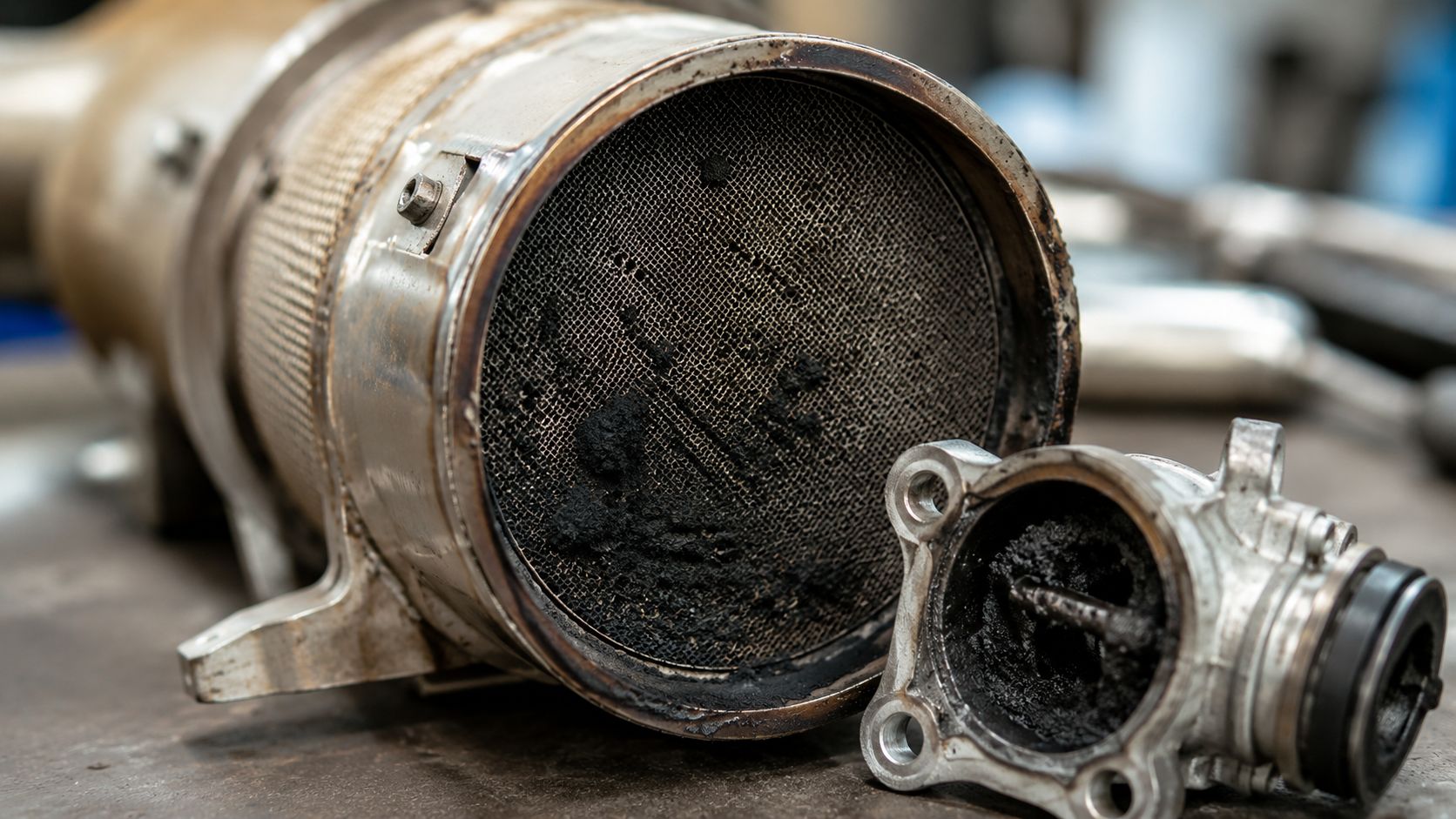
Common causes include a restricted DPF, EGR problems, injector issues, turbo problems, and poor maintenance. If you want a broader breakdown of common reasons vehicles fail a smog check, that guide helps. For diesel owners in California, the practical lesson is simple. Lingering smoke is not cosmetic. It is a direct path to failure at a STAR station.
How to Prepare Your Diesel for a Smog Test
Preparation is where you save yourself time, money, and aggravation. Don't overcomplicate it. You're trying to show up with a diesel that is warm, stable, free of warning lights, and fully ready in the OBD system.
Your pre-test checklist
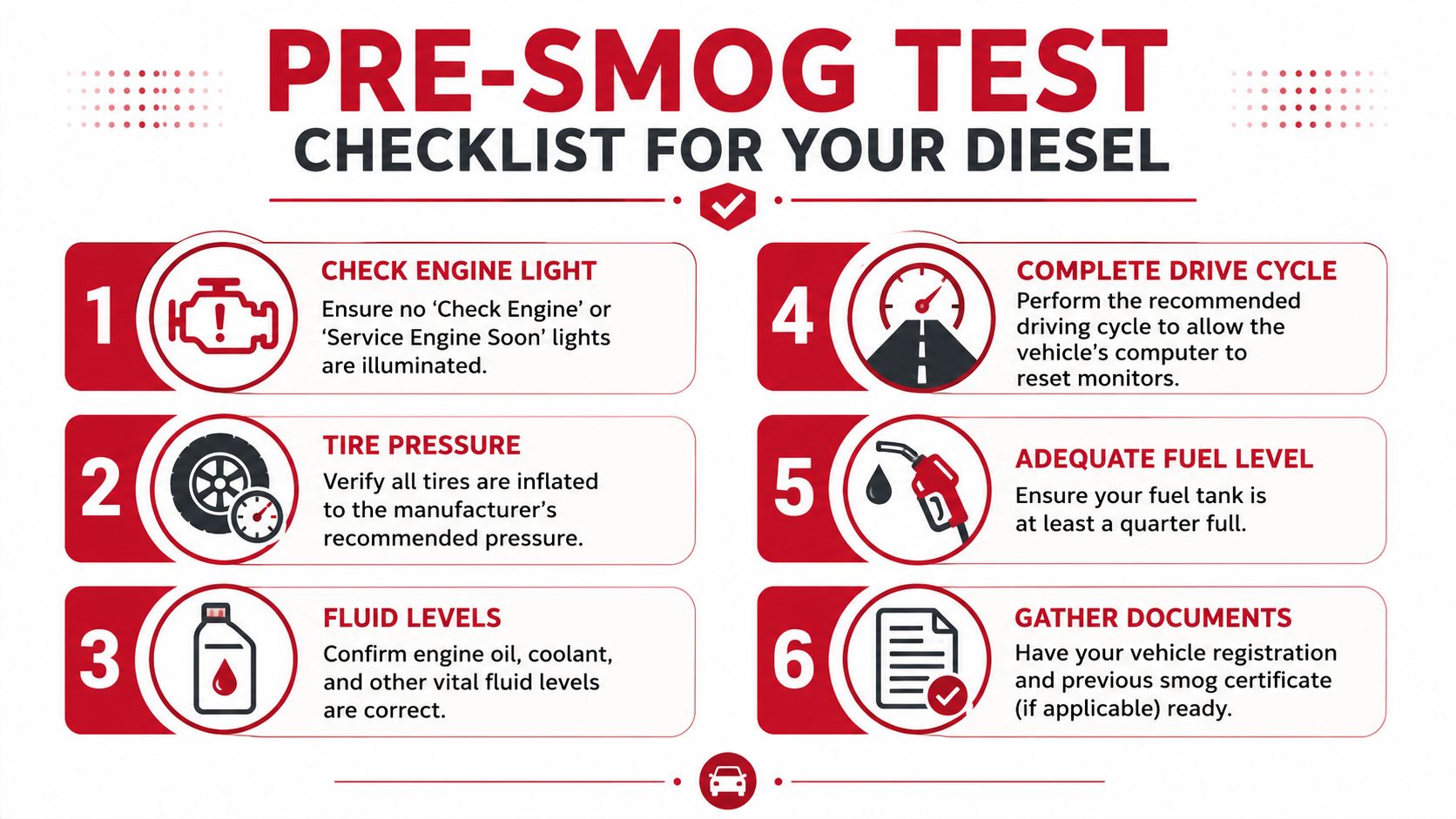
Start with the dashboard. If the Check Engine or Service Engine Soon light is on, handle that first. And if you just cleared it, don't rush straight into the test lane. BAR requires complete OBDII monitors, and a recent reset can leave the vehicle unreadable for pass purposes, as covered in this BAR monitor completion discussion for diesel testing.
Use this checklist before you go:
- Fix the actual fault: Don't erase symptoms. Repair the cause.
- Drive it after repair: The vehicle needs normal operation long enough for the system to run its checks.
- Check for obvious smoke: Have someone watch the exhaust while you briefly raise rpm in a safe area.
- Make sure fluid levels are normal: Low fluids can create drivability problems you don't need on test day.
- Bring your paperwork: Registration paperwork helps keep the visit simple.
This quick video helps visualize the preparation mindset before inspection:
What to do the day of the test
Drive the vehicle long enough to get it fully warm before you arrive. Cold diesels tend to behave worse. They can idle rougher, haze more, and generally make a bad first impression.
A few practical habits help:
- Avoid last-minute battery disconnects. That can wipe out readiness status.
- Don't show up right after major engine work unless you've driven it. Repaired isn't the same as ready.
- If you suspect smoke, postpone and diagnose it. Hope is not a strategy.
- Keep the visit routine. No weird fuel experiments or backyard fixes the morning of the test.
Shop-floor advice: The best smog appointment is the boring one. Warm engine, no lights, normal idle, no surprises.
If you handle those basics, you put yourself in the best position to pass on the first trip.
The Process at a STAR Test-Only Smog Station
A lot of stress disappears once you know what happens in the lane. The inspection isn't mysterious. It's a sequence. The technician checks the vehicle, checks the system, performs the diesel procedure, and records the result.
What the technician does
For a California diesel in the covered class, the station generally looks at three things that matter to owners most.
First is the visual side. The technician is looking for obvious issues and emissions-related concerns that make the vehicle unfit for testing or compliance.
Second is the OBDII check. The station connects to the vehicle and reads the emissions system status. Active faults, stored problems, and incomplete readiness can surface during this process.
Third is the BAR Snap Test. During that procedure, the technician places the vehicle in neutral and quickly pushes the accelerator to 2,000 to 3,000 RPM and releases it to evaluate smoke opacity and duration, according to the California smog check guide describing the BAR Snap Test.
That's the part customers usually notice because they hear the engine rev. But by the time the throttle gets snapped, a lot of the inspection picture is already forming.
Why test-only matters
A test-only station has one major advantage. The shop isn't trying to sell you a repair while it's evaluating your vehicle. That removes the repair upsell angle that makes many drivers uneasy.
That matters even more for diesel owners, because failures can involve systems that are expensive, technical, and easy to misunderstand. At a test-only station, the result is the result. You pass, or you get a report showing what needs attention.
In practical terms, a well-run STAR test-only location is helpful because it usually offers:
- Cleaner decision-making: You're getting an inspection, not a sales pitch.
- Faster throughput: Multiple bays can keep lines moving.
- Convenience if registration is due: Some locations also handle DMV-related tasks on site.
- Better fit for work schedules: Evening and weekend availability helps owners who can't disappear midday.
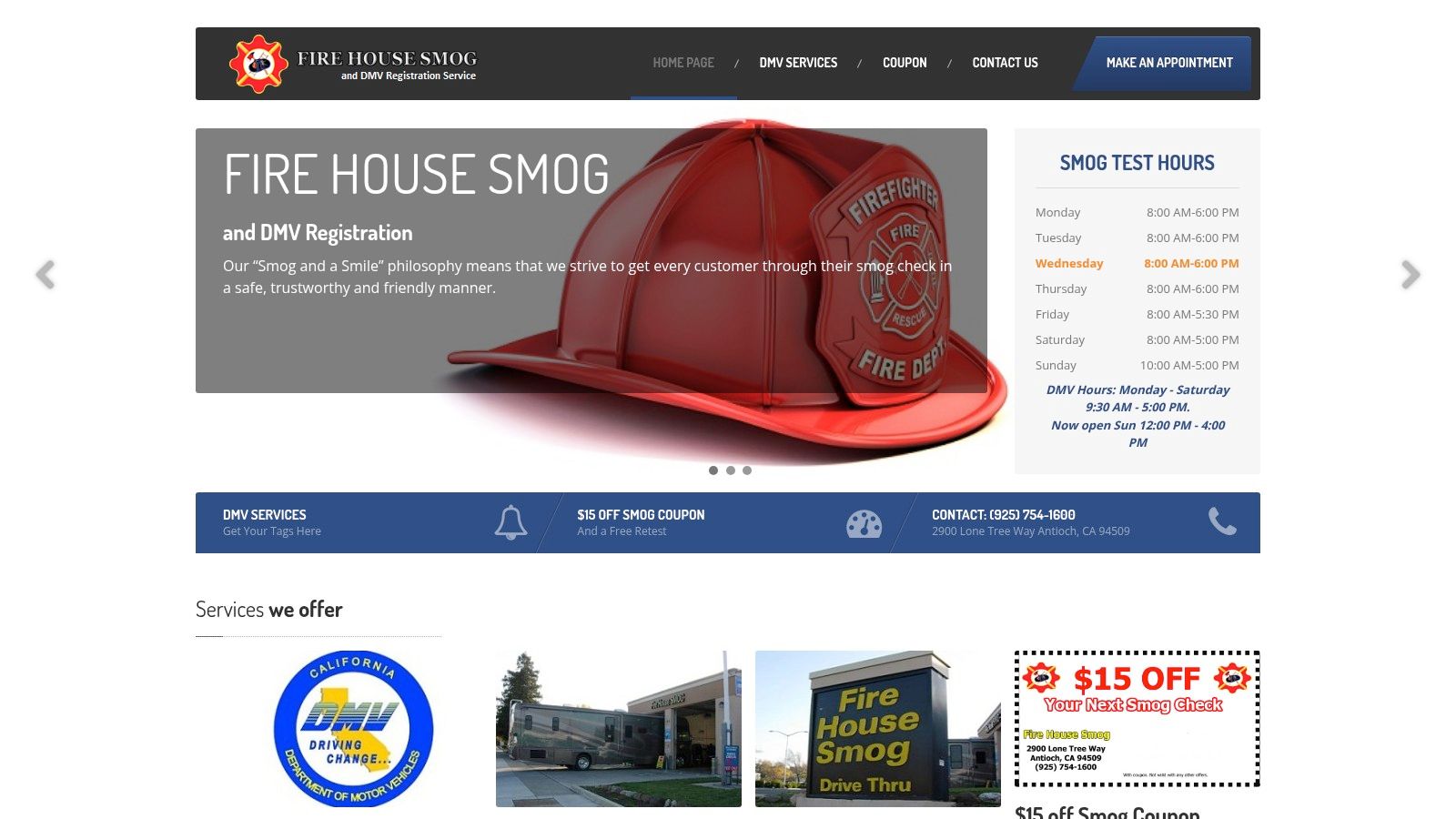
For drivers in Antioch and nearby areas, that setup is exactly why places that combine STAR testing with registration support are popular. When you can test the diesel and then handle your DMV business in one stop, the whole process feels less like a bureaucratic obstacle and more like a routine errand.
After the Test Passing Failing and Next Steps
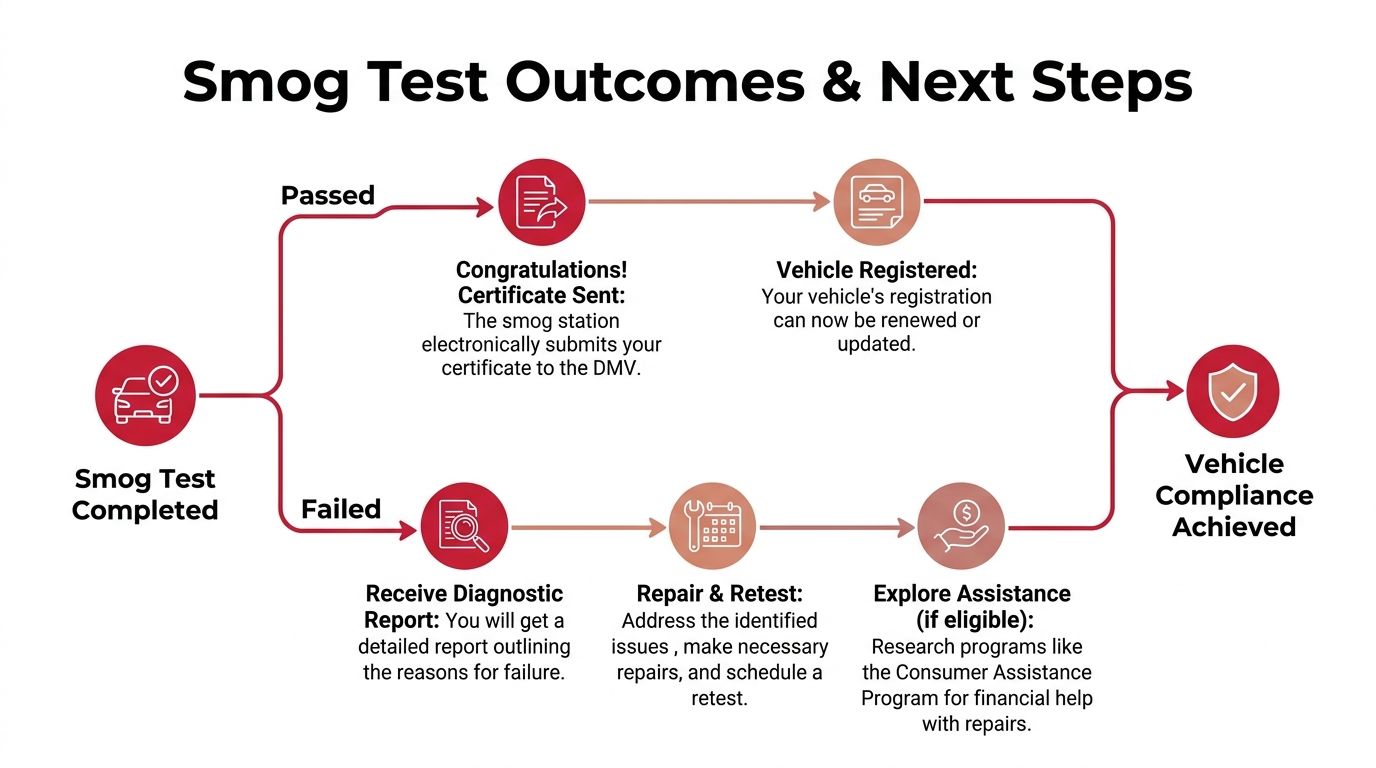
Once the inspection ends, things get simple. You're on one of two tracks. Either the diesel passed and you move on, or it failed and you need to use the report the right way.
If your diesel passes
If the vehicle passes, the station electronically sends the certificate information to DMV. That's the outcome everyone wants because it turns the smog test for diesel vehicles into a one-and-done visit.
At that point, keep your receipt and finish any remaining registration steps. If your registration renewal is the next task, a location that also offers California DMV registration renewal services can make that part faster.
Pass, save your paperwork, and don't wait around if registration is still pending.
If your diesel fails
If the vehicle fails, don't guess. Read the Vehicle Inspection Report carefully. That report tells you why the station could not certify the diesel.
Different failures call for different next moves:
- OBD-related failure: Take the report to a qualified repair shop and address the fault, then drive the vehicle enough for readiness to return.
- Smoke-related failure: Have the engine and emissions system checked before coming back. Lingering smoke rarely fixes itself.
- Visual or equipment issue: Correct the noncompliant condition exactly, not approximately.
Here's the mistake to avoid. Don't throw random parts at the vehicle because a friend had “the same issue.” Diesel failures often overlap in symptoms. A proper diagnosis saves money.
If you're testing at a station with a free retest policy, use it according to the posted terms. That can reduce the sting of a failed first attempt. The important thing is to return only after the issue is repaired and the vehicle is ready, not just quieter, cleaner-looking, or temporarily reset.
A failed inspection is frustrating, but it's still manageable. Use the report, repair the underlying problem, then retest with confidence.
If you need a straightforward place to handle your diesel smog check and registration follow-up, Fire House Smog in Antioch offers STAR-certified test-only inspections, on-site DMV services, weekend availability, and a practical process that keeps things simple for diesel owners.