Vehicle Emissions Testing Station Guide for 2026
If you're staring at a renewal notice, a blinking check-engine light, and a calendar that won't budge, you're already in the exact situation a vehicle emissions testing station is built for. The good ones don't just “run a test.” They translate a messy compliance chore into a few clear steps, then hand you the paperwork the DMV needs so you can get on with your day.
In Antioch, that matters because people aren't usually coming in for fun. They're trying to keep a registration current, sort out a warning light, or figure out whether a car that failed yesterday needs a repair, a retest, or a referee appointment. A smog shop that understands the process can feel less like a mystery desk and more like a checkpoint with a human at it.
Table of Contents
- The Monday Morning Smog Check Story
- What a Vehicle Emissions Testing Station Actually Does
- STAR Test-Only Versus Test-and-Repair Stations
- Which Vehicles Need a Smog Check and What the Bay Does
- Why Vehicles Fail Smog Checks in California
- After a Failure Retests, Referees, and Repair Assistance
- How On-Site DMV Services Streamline Registration
- Smart Questions Antioch Visitors Ask Before Their Visit
The Monday Morning Smog Check Story
Monday morning at a busy Antioch station starts the same way for plenty of drivers. Someone pulls into the lot with a renewal letter in one hand and a phone in the other, asking the question that causes half the confusion in this business, “Do I need a test, or do I need the DMV?” The answer is usually both, just not in the order drivers expect.
A technician walks the driver through the lane, checks the vehicle, and explains what happens next in plain language. If the car is newer, the inspection leans on the onboard computer. If it's older, the station may need to look at exhaust behavior too. Either way, the station is doing more than “looking busy.” It is measuring whether the car meets the state's emissions rules and turning that result into a record the registration system can use.
A good station saves time by removing guesswork, not by rushing the vehicle through the bay.
That's why a vehicle emissions testing station is part convenience stop, part regulatory checkpoint, and part DMV surrogate. It's the place where the car is checked, the result is recorded, and the driver learns whether the next stop is a renewal window, a repair shop, or a second inspection. On a Monday morning, that clarity is often the difference between a calm errand and a whole day of phone calls.
For drivers who want a local reference point, a station page like Fire House Smog's smog check station overview shows how a smog-only location fits into the broader process without turning every visit into a repair conversation. That separation is what first-time visitors often need most.
What a Vehicle Emissions Testing Station Actually Does
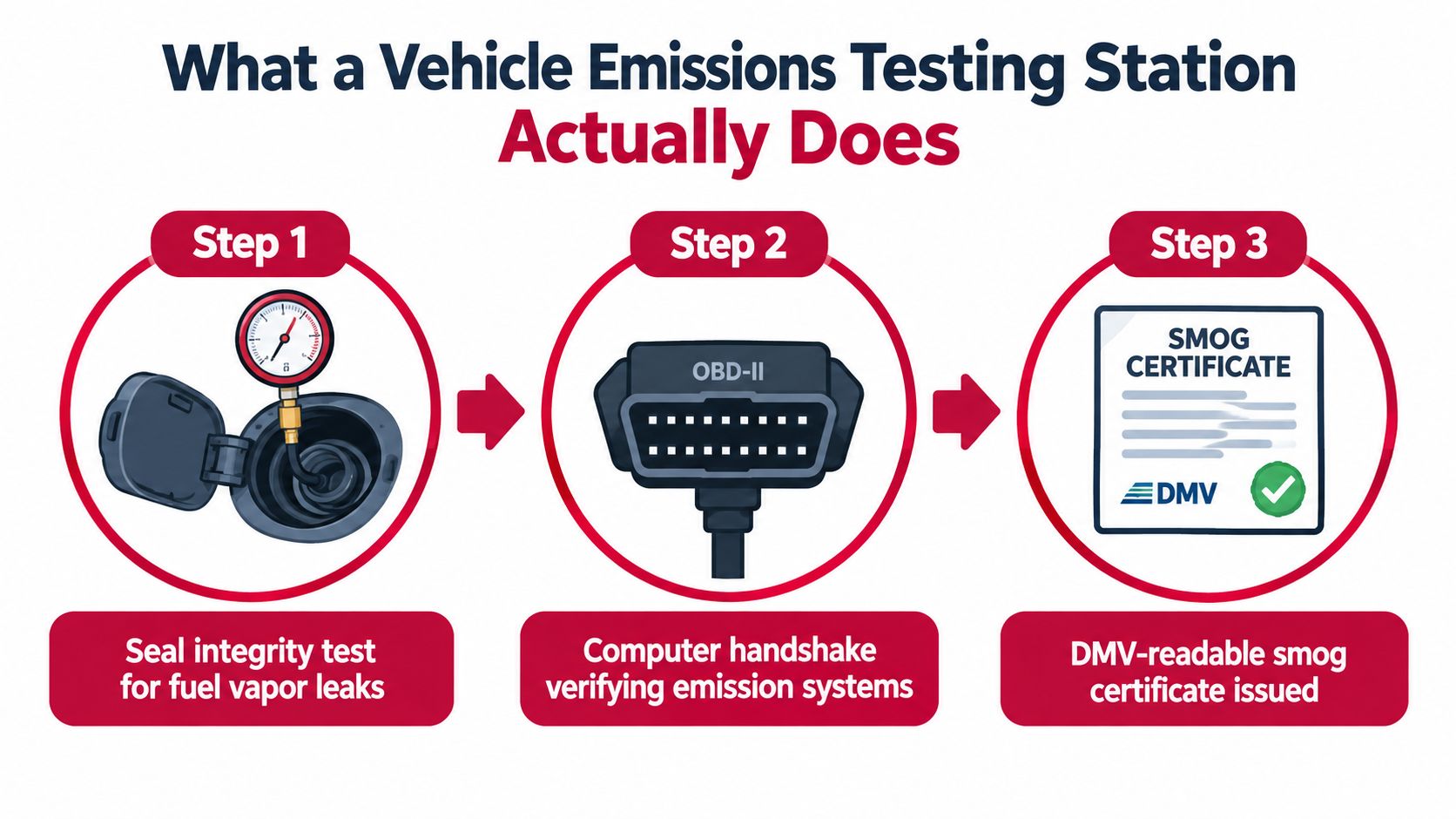
A vehicle emissions testing station works like a quick physical exam, but for the systems that control exhaust and vapor output. The technician isn't guessing whether the car is “clean enough.” They're checking specific signals, then comparing those signals with California's inspection rules. The result becomes the document the DMV can read later.
The test has a ladder, not a single step
First comes the physical setup. The station verifies the vehicle type, then chooses the right inspection path for that model year and configuration. California's smog program uses different methods for different vehicles, so the station has to match the test to the car instead of forcing every car through the same lane.
Next comes the measurement step. For newer gasoline vehicles, the inspection centers on the onboard diagnostics system, which is why many drivers hear the phrase OBD-II scan. That scan checks the malfunction-indicator lamp, readiness monitors, diagnostic trouble codes, and communication with the inspection system. For older vehicles, the station may also need to sample exhaust directly.
Finally, the station sends the outcome into the compliance chain. The driver leaves with proof of what happened, and the DMV later uses that result to decide whether registration can move forward. It's a little like a doctor's office visit where the exam room produces a referral slip, not a prescription.
In California's modern program, that station network handles huge volume. In 2023, California had roughly 11.4 million initial Smog Check tests, and STAR-certified stations delivered about 83% of all inspections despite representing only 48% of licensed stations. That's why the station is more than a storefront, it's part of the state's measurement infrastructure, not just a place to hand over keys. California Bureau of Automotive Repair performance report
If the result is what the DMV needs, the receipt matters. If the vehicle fails, the failure code matters even more.
For drivers trying to picture the workflow, a station like Fire House Smog's emissions testing requirements page is the kind of reference that helps turn the process into a checklist instead of a guessing game.
STAR Test-Only Versus Test-and-Repair Stations
California's STAR label gets talked about like a gold star on a report card, but that's not really what it is. It's a quality-control designation, and it works differently depending on whether the station only tests or also repairs. In Antioch, that distinction matters because it changes who can inspect the car, who can sell work, and how a driver should read the result.
The practical difference
A STAR test-only station inspects the vehicle but doesn't sell the fix. That sounds simple, yet it's powerful because the station has no repair revenue tied to the outcome. A STAR test-and-repair station can do the inspection and then offer the repair work in the same place. For some drivers, that convenience is perfect. For others, it feels too close to a sales pitch.
California's 2018 program data showed 4,225 of 8,213 licensed Smog Check stations were STAR-certified, which is 51%, and those STAR stations performed about 82% of the year's 11.4 million initial inspections. That means a little over half the stations handled most of the workload. The same pattern continued in a modern report, where STAR stations still carried the bulk of inspection volume. California Bureau of Automotive Repair 2018 performance report
Here's the useful way to think about it. STAR isn't a promise that your car will pass. It's a sign that the station meets higher performance standards and can be part of the directed-testing system. That makes STAR useful as a screening and compliance signal, not as a guarantee.
| Feature | STAR Test-Only | STAR Test-and-Repair |
|---|---|---|
| Main role | Inspects vehicles | Inspects and can repair |
| Repair sales | No | Yes |
| Incentive structure | Separated from repair revenue | Can include repair recommendations |
| Best for | Drivers who want an impartial result | Drivers who want inspection and repair in one stop |
| Customer experience | Clear separation between test and fix | More convenience, but more decision pressure |
STAR status helps a station qualify for certain testing roles. It doesn't promise a pass on any specific car.
That's why some Antioch drivers prefer a test-only model. They want the inspection result first, then they can decide where to repair the car if needed. If you want to compare the business model side by side, Fire House Smog's STAR-certified station page is a straightforward example of how a test-only site fits into California's system.
Which Vehicles Need a Smog Check and What the Bay Does
A driver pulls into an Antioch station with a clean-looking car and still gets questions before the hood opens. That is normal. California does not inspect every vehicle the same way, so the station first matches the car to the right inspection path. Age, engine type, and weight class all matter, because the wrong test can give the wrong answer.
The inspection path changes with the vehicle
For 1996-and-newer spark-ignition passenger vehicles and trucks under 14,001 lb GVWR, California uses an OBD-II inspection that checks the malfunction-indicator lamp, readiness monitors, diagnostic trouble codes, and communication with the inspection system. For 2000-and-newer vehicles, California inspections are primarily OBD-based. For 1996–1999 gasoline vehicles, the process generally includes both OBD and tailpipe testing. California Smog Check manual
That matters because the bay is not just a place to plug in a scanner. If tailpipe testing applies, the engine must be at normal operating temperature, then run at low idle for at least three minutes immediately before sampling. California's procedure also uses snap tests that move the engine from idle to roughly 2,000–3,000 rpm before returning to idle. The goal is to measure how the car behaves under controlled conditions, not how it behaves cold after a short drive.
A technician also has to check whether the vehicle is safe and compatible with the station's equipment. That comes up most often with vehicles that need a dynamometer step, since the car has to fit properly and stay stable on the rollers before the test starts.
What drivers usually miss
- Battery disconnects matter: Clearing codes can reset readiness monitors, which means a car may need normal driving before it is ready to retest.
- Warning lights matter: A flashing or commanded-on malfunction indicator lamp can change the result immediately.
- Directed testing matters: STAR certification can determine where certain vehicles are sent, so station choice is not always random.
- Special vehicles need a call ahead: Hybrids, alternative-fuel vehicles, older cars, and some RVs may have different inspection rules or equipment limits.
Drivers who want to check the details before they arrive can use Fire House Smog's emissions testing requirements page. Checking that page before you drive over settles the bay-fit question before it turns into a parking-lot debate.
Why Vehicles Fail Smog Checks in California
Most failed inspections come down to one of a few practical problems, and none of them feel mysterious once you see the pattern. The issue is usually not “the car is bad,” it's “the test saw something out of range.” That's a very different problem, because it tells you where to look next.
The common failure buckets
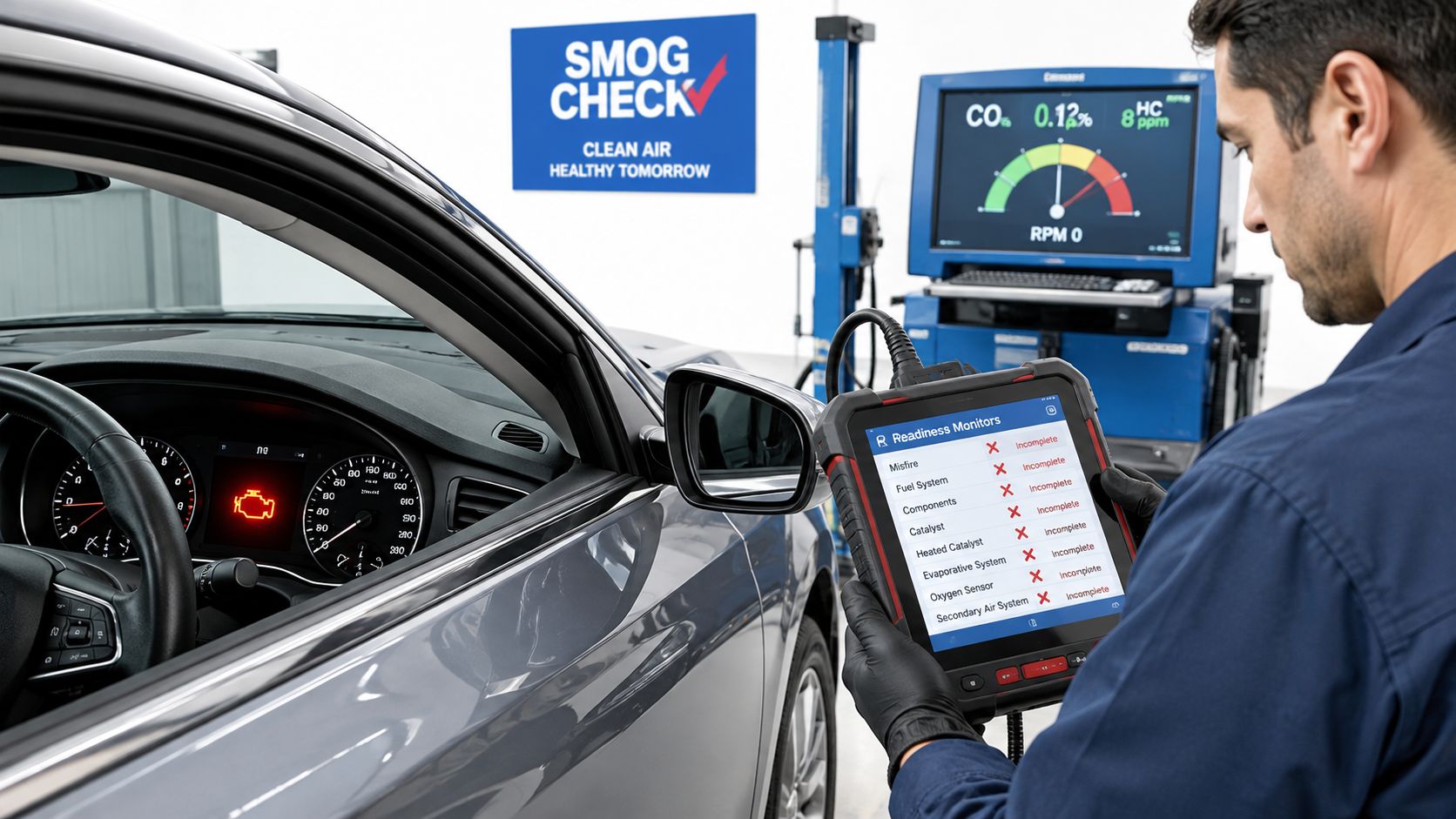
An illuminated or flashing malfunction-indicator lamp is the most obvious red flag. If the car is telling the computer something is wrong, the station has to respect that signal. An applicable diagnostic trouble code can trigger the same outcome, even if the car still drives normally on the street.
Incomplete readiness data is another common problem, especially after a battery disconnect or code clear. A driver may think the issue was “fixed” because the light went out, but the car's monitors may still need more driving before the system can confirm the repair. That's why stations shouldn't promise an instant pass after code clearing.
Tailpipe inspections have their own rules. California's BAR procedure requires the engine to be at normal operating temperature and run at low idle for at least three minutes immediately before the tailpipe inspection, with snap tests sweeping the engine from idle to roughly 2,000–3,000 rpm. BAR proposed manual for equipment and procedure
What drivers should do before the visit
- Drive the car normally first. A short trip around the block usually doesn't tell the computer enough.
- Don't clear codes right before inspection. That can reset readiness and create a fresh failure category.
- Watch the dash carefully. A warning light that flashes is not the same as one that stays off.
- Bring the exact failure report. The station can't diagnose a prior problem if the paperwork is vague.
If you've ever wondered why a car can feel fine and still fail, that's usually the answer. The test isn't judging drivability, it's judging emissions-related data. A vehicle can run smoothly and still fail if the computer says the monitors aren't ready.
After a Failure Retests, Referees, and Repair Assistance
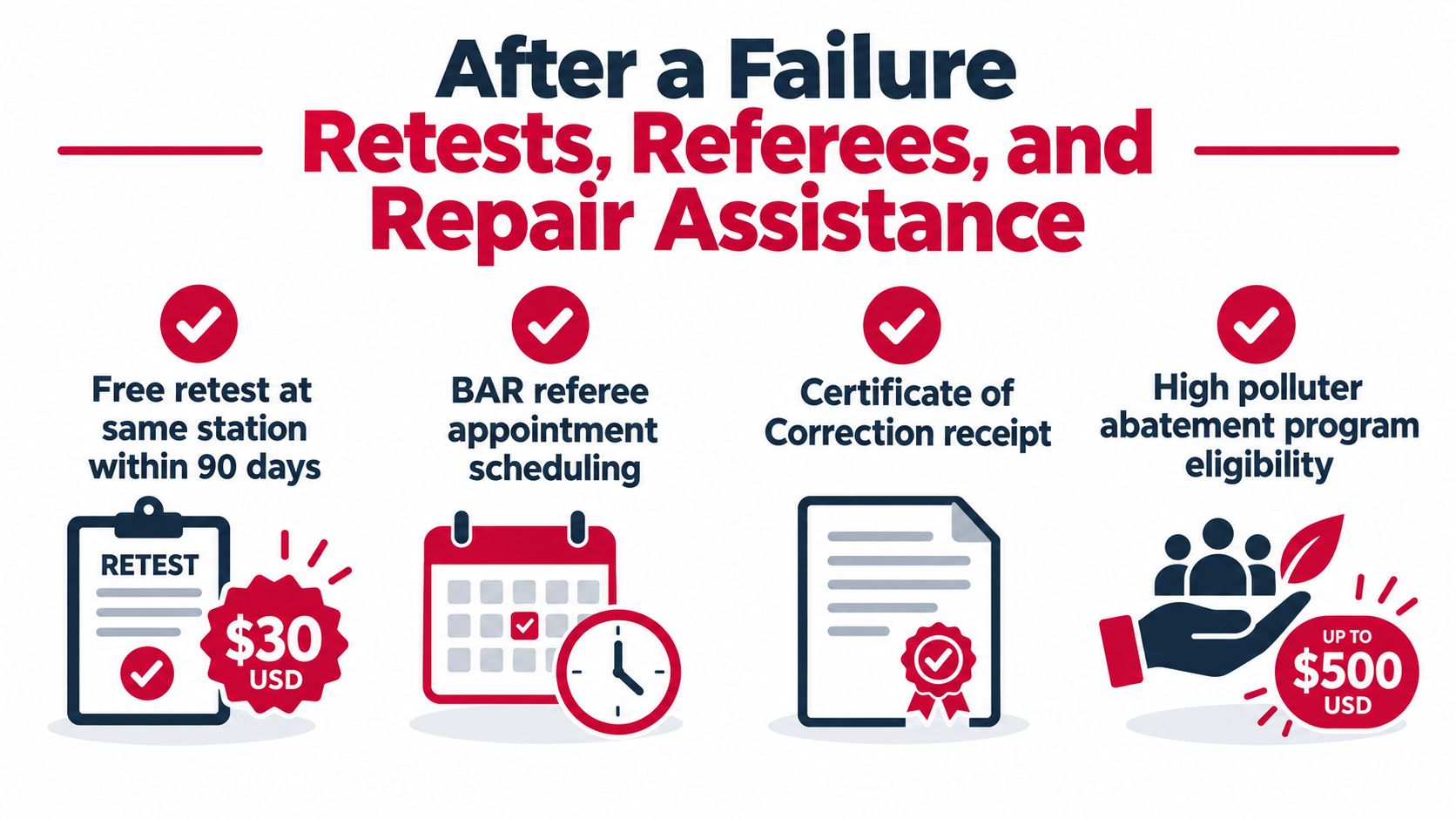
A failed smog test isn't the end of the road, but it does force a decision. Some drivers need a clean retest after the car's issue is fixed. Others need a referee because the result seems wrong, unusual, or tied to a vehicle category that needs extra review. And some drivers need help paying for the next step.
The decision tree after the fail
Start with the inspection report, not with parts shopping. That report tells you what the station found, which is more useful than guessing at the repair bill. If the same station offers a retest policy, keep the paperwork and ask how the retest works before spending money twice.
If the result doesn't make sense, the DMV directs failed-test customers to the BAR Referee Program for next steps. That's the right move when the vehicle has unusual equipment, the result looks inconsistent, or the owner needs help understanding what the station recorded. The referee process is there to resolve questions, not to sell parts.
If the repair cost is the real problem, California's Consumer Assistance Program can provide eligible consumers up to $1,450 for emissions-related repairs and up to $2,000 toward vehicle retirement. California Bureau of Automotive Repair reference guide That creates a fork in the road. For some drivers, repair is rational. For others, retirement or replacement may make more sense than sinking money into a car that's already near the end of its useful life.
Don't let a failed certificate push you into the first expensive fix you hear about.
The equity issue matters here too. Lower-income drivers are often the ones who feel the most pressure to repair immediately, even when the repair wasn't planned. That's why a clear diagnosis, a referee option, and repair assistance all belong in the same conversation. They give drivers more than one way to stay legal.
A practical approach is simple. Keep the failure report, ask whether the issue is diagnostic or mechanical, check assistance eligibility, and only then decide whether repair, retirement, or a referee visit makes sense. If the station is test-only, it can help separate the inspection from the repair pitch, which is often the first bit of clarity a frustrated driver needs.
How On-Site DMV Services Streamline Registration
A lot of drivers don't want a lecture, they want their registration handled without another trip across town. That's where on-site DMV service changes the experience. When a smog station can renew registration and print the sticker in the same building, the visit stops being two separate errands.
At 2900 Lone Tree Way in Antioch, Fire House Smog is a licensed business partner of the California DMV, offering on-site registration renewals with sticker printing, ownership transfers for California and out-of-state vehicles, and DMV service hours Monday through Saturday 9:30 AM to 5:00 PM and Sunday 12:00 PM to 4:00 PM. The value isn't just convenience, it's fewer handoffs. You finish the inspection, then handle the paperwork in the same place.
That matters in East Contra Costa County, where working drivers often need weekend availability or a service window that fits around family schedules. It also helps when the DMV task is tied to a smog result, because you don't have to carry a certificate from one counter to another and hope the timing lines up. The station becomes the place where the compliance loop closes.
For some customers, especially people transferring ownership or dealing with an out-of-state vehicle, that simplicity is the difference between “I'll do it this week” and “I'll keep putting it off.” One stop is easier to finish than two.
Smart Questions Antioch Visitors Ask Before Their Visit
STAR certification does not guarantee a pass. It means the station is being scored on quality-control metrics such as test deviations, similar-vehicle failure rate, and incorrect gear selection, while pass/fail decisions are made quarterly and follow-up pass rates are updated twice yearly. That makes STAR a trust signal, not a promise about your specific car.
A test-only station doesn't have a repair department trying to steer you into work. That's why some drivers prefer it. They want the inspection result first, then they can decide whether to repair the car somewhere else or ask for more diagnosis before spending money.
RV questions usually come down to size and equipment compatibility, not just whether the vehicle has a motor. Some recreational vehicles can be inspected if they fit the bay and the station's setup, but not every unit will. A quick call before you drive over saves everyone time.
Out-of-state title transfers are usually handled as a DMV service issue alongside the smog certificate, not as a separate mystery process. If the station offers on-site transfer help, the driver can often handle the registration workflow in the same visit instead of making a second stop. That's the kind of practical detail people remember when they're trying to get back on the road fast.
If you want a local place that keeps the inspection side and the DMV side organized without turning the visit into a sales pitch, Fire House Smog handles smog checks, registration renewals, and ownership transfers in one Antioch location. Visit Fire House Smog to check the services, hours, and what your vehicle may need before you head over.