A standard STAR smog check usually lands around $70 to $85 total for most passenger cars, because you're paying the station's inspection fee plus the $8.25 state certificate fee only after a pass. The best benchmark to keep in mind is the $68.56 statewide average inspection cost, which puts a typical out-the-door total at roughly $76.81 before any EFT or convenience fees.
You're probably standing at the counter with a renewal notice in one hand and a price quote in your head that doesn't quite make sense. One shop says one number, another says something else, and nobody explains why the legal test can cost more or less depending on where you go.
Table of Contents
- What Drivers Actually Pay for a STAR Smog Check
- How the Price Is Built
- Test Only Versus Test and Repair Stations
- How Vehicle Type Changes the Price
- Retest Policy and When You Get a Free One
- Coupons, Discounts, and How to Lower the Final Number
- What to Bring and How to Plan the Visit
- What the Price Buys You
What Drivers Actually Pay for a STAR Smog Check
Pull into a STAR station with a renewal notice, and the first number that matters is the all-in pass cost, not the sticker price on the wall. For a normal passenger car, that usually sits around $70 to $85 total, because the shop charges its inspection fee and California adds the $8.25 certificate fee only if the vehicle passes.
The number to trust is the pass total
That's the figure I'd use when you're comparing quotes in Antioch or anywhere else in California. A low posted inspection price can still end up expensive if the station layers on extras, while a higher quoted fee may already include the moving parts that matter at the register.
The benchmark behind that range is the $68.56 statewide average inspection cost reported in independent summaries based on BAR pricing data, which works out to about $76.81 out the door before any EFT or convenience fees. That's why a quote in the $70 to $85 band is normal for a standard STAR inspection, not a ripoff.
Practical rule: if the station can't tell you the pass total clearly, keep asking. A clean answer is usually a sign the shop knows its own pricing.
The important part is this. STAR pricing isn't one fixed state number for the test itself, so the station controls the inspection charge. The state only controls the certificate fee, and that fee only shows up if you pass.
How the Price Is Built
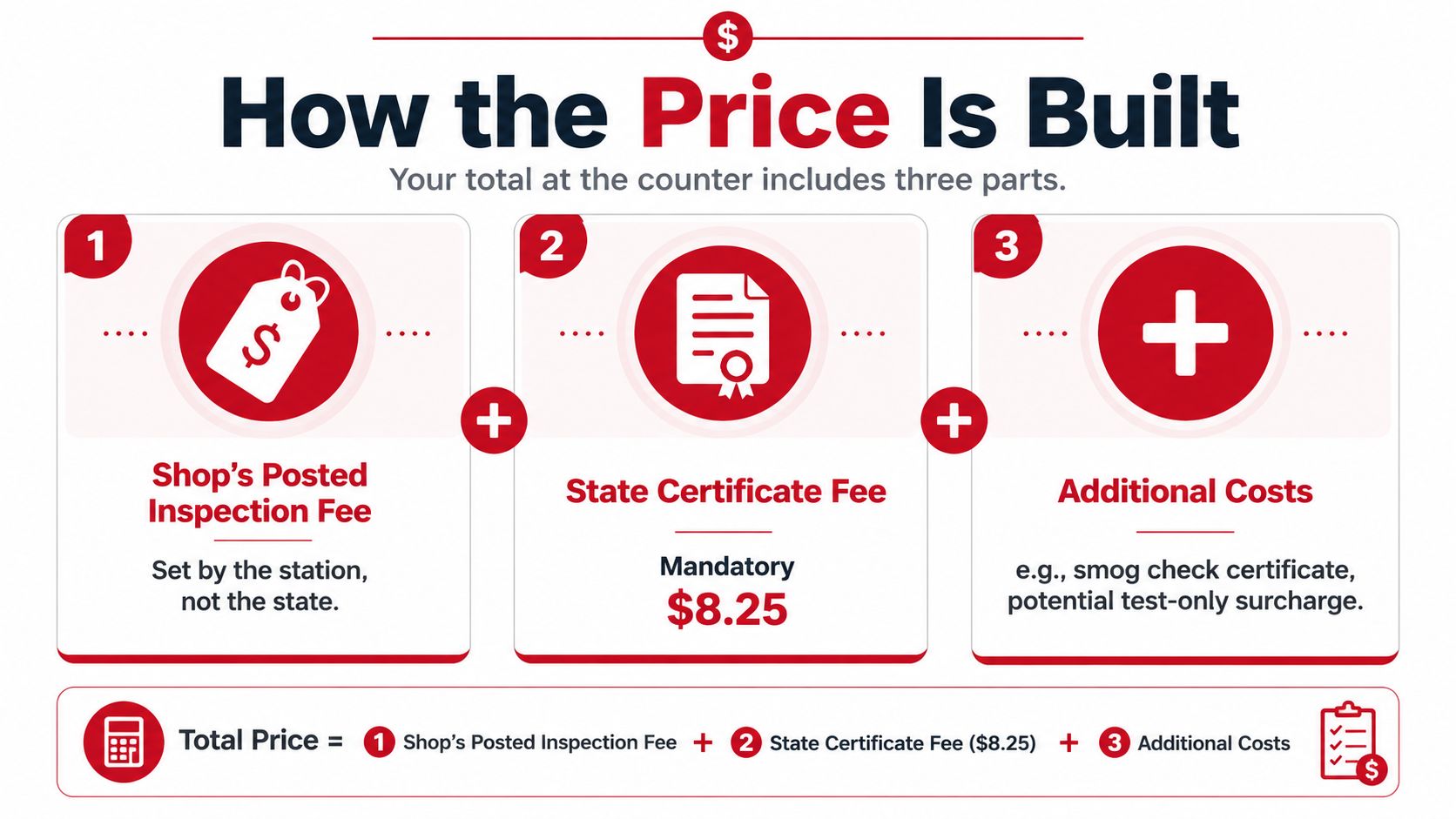
A STAR smog bill has three moving parts. Two are set by the shop, one is set by the state, and the final total depends on whether the car passes.
Start with the shop's inspection fee
The station sets its own posted inspection price. California does not fix that base smog fee statewide, so two shops in the same area can legally quote different numbers for the same kind of test. The number that matters is the pass total, because that is what you will hand over if the vehicle clears the inspection.
For Antioch-area drivers, the smart move is to compare the full pass price, not the teaser on the wall. The shop fee is the part that moves around, and that is where one station undercuts another, or hides a charge in the fine print. If you want the cleanest quote, ask for the out-the-door number before you pull in.
Add the state certificate fee only after a pass
California charges the $8.25 certificate fee only when the vehicle passes inspection. That fee is fixed, so it does not change from shop to shop. A pass adds it to the bill, and a fail does not trigger that same final total.
Watch for small electronic transmission fees
Some stations add a small fee for electronic transmission or similar processing. It is not the main cost driver, but it still changes the final number. A shop can advertise a low inspection price and then pad the receipt with a processing charge, so the quote only helps if it includes every item you will see at checkout.
The bargaining space lives in the posted inspection fee, because the certificate fee is fixed. If you want a lower final number, compare the shop price first, then ask whether any extra transmission or convenience charge is being added on top. A STAR Test Only station usually makes that easier, and if you want a straight compliance visit without repair pressure, check out this smog test only center in Antioch.
Test Only Versus Test and Repair Stations
A STAR Test Only station and a STAR Test and Repair station do the same legal job, but they do not price that job the same way. The test-only model keeps the focus on the inspection itself, and that usually means a cleaner bill. Fire House Smog operates as a test-only STAR station with no repair sales, which removes the repair revenue pressure that can shape how some shops present the final number.
Test-only shops keep the bill cleaner
A test-only station has one job, inspect the vehicle and certify the result. There is no repair desk waiting to turn a failed test into a bigger ticket, so the inspection quote tends to stay more direct and easier to read.
That matters more than people admit. A shop that sells repairs can still be honest, but the structure is built so the same place that finds the failure can also sell the fix. If you are watching your budget, that is the part to watch.
My rule as a shop owner: if you already know you need a clean compliance test, go test-only first. Do not pay for a diagnosis you did not ask for.
| STAR Station Type Comparison | Average Inspection Fee | Repair Upsell Risk | Typical Use Case |
|---|---|---|---|
| STAR Test Only | $62.36 | Lower, because the station does not sell repairs | Drivers who want a compliance test only |
| STAR Test and Repair | $71.01 | Higher, because the shop can profit from the fix | Drivers who may want diagnosis and repair in one place |
For Antioch drivers, that difference shows up in the actual out-the-door number. A test-only shop is usually the smarter choice when you need the certificate and nothing else. A test-and-repair station makes sense only if you want one place to inspect the car, tell you what failed, and handle the repair work too.
How Vehicle Type Changes the Price
Vehicle class drives pricing harder than expected. The emissions workflow gets more complex as you move into older model years, different fuel types, and larger platforms, so the price climbs with the work.
The price ladder gets steeper as the vehicle gets older or bigger
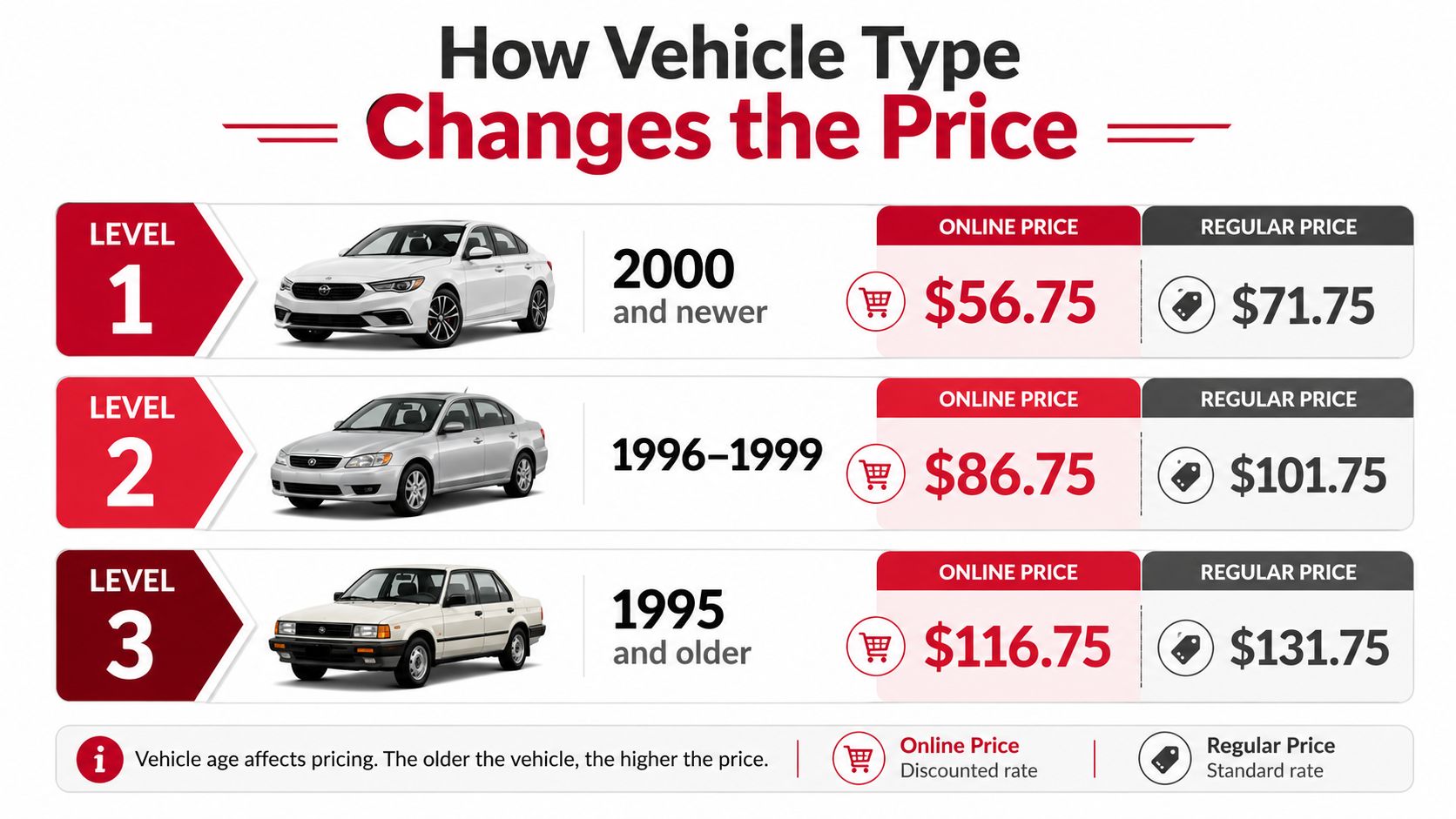
A California STAR price sheet shows a clear progression. 2000-and-newer vehicles run $56.75 online or $71.75 regular, ’96–’99 vehicles run $86.75 online or $101.75 regular, 95 and older run $106.75 online or $121.75 regular, and RV or motorhome tests run $176.75 online or $191.75 regular, all before the $8.25 certificate fee.
That spread isn't arbitrary. Legacy emissions systems take more time, larger vehicles take more handling, and RV or motorhome testing can require a different workflow entirely. That's why older diesels, fleet vehicles, and RV owners should budget well above the common passenger-car band.
A practical way to read the sheet is simple, each step into a more complex class can add roughly $15 to $70+ before fees. That's the number that matters when you're trying to estimate the out-the-door cost before you leave home.
Budget for the vehicle you own, not the one you wish you owned
If you drive a newer light-duty car, you're usually in the lower pricing band. If you own an older car, a diesel, or a motorhome, don't compare your quote to a basic sedan and complain that the station is “overcharging.” The inspection is just different.
Retest Policy and When You Get a Free One
If your car fails, don't pay twice by accident. The smart move is to ask the station exactly how its free retest works before you leave the lot.
Bring the same vehicle back with the repair proof
A free retest usually applies when you return to the same station within the station's qualifying window and bring the car back for the same issue after a qualifying repair. That means the vehicle, the failure, and the paperwork all need to line up.
The key is to separate a valid retest from a brand-new test. If you go somewhere else, wait too long, or show up without the original failure paperwork, the station may treat it as a full-price visit instead of a courtesy retest.
Ask these two things before you drive off
- What paperwork do you need? Bring the original smog report and any repair receipt the shop expects.
- What counts as the same problem? Some failures are straightforward, others trigger a new inspection path if the vehicle has changed in a meaningful way.
That's the part drivers skip, and it costs them. A good station will explain the retest terms clearly, and you should make them do it before you leave.
Coupons, Discounts, and How to Lower the Final Number
If you want the lowest legal STAR price, start with coupons and end with a test-only station. Those are the two levers that usually matter most, because they attack the inspection fee before the fixed certificate fee ever gets involved.
Coupons cut the shop fee, not the state fee
A coupon reduces the station's posted inspection price. It does not erase the $8.25 state certificate fee, so your savings show up on the inspection side of the bill, not on the certificate line.
That's why coupon math is simple. If a vehicle would otherwise fall into a higher pricing tier, a decent coupon can move the receipt back toward the standard passenger-car range. On the higher-end vehicle classes, the savings are even more noticeable because the posted test price has more room to move.
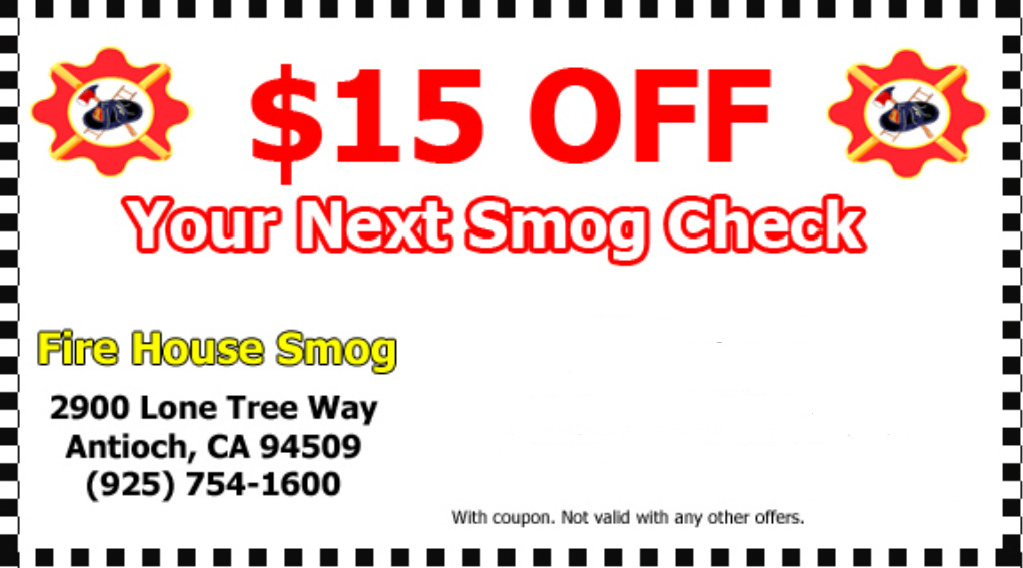
For Antioch drivers who want a simple place to check current offers, Fire House Smog coupon details are worth looking at before you book. Just keep your eyes on the final pass total, not the headline discount alone.
Pick the structure that doesn't sell you a repair
A test-only station is the cleaner play because the shop isn't trying to convert a failed inspection into a repair ticket. You're paying for the compliance test, and that's it.
- Use coupons early: Apply them to the inspection fee before you compare totals.
- Choose test-only when you can: That keeps repair pressure off the table.
- Ask about the pass total: The number you want is the amount after the certificate fee.
Don't chase the lowest advertised price if the shop hides the real total in add-ons.
That's how drivers end up paying more than they expected. A fair quote tells you the inspection cost, the certificate fee, and any small processing charge up front.
What to Bring and How to Plan the Visit
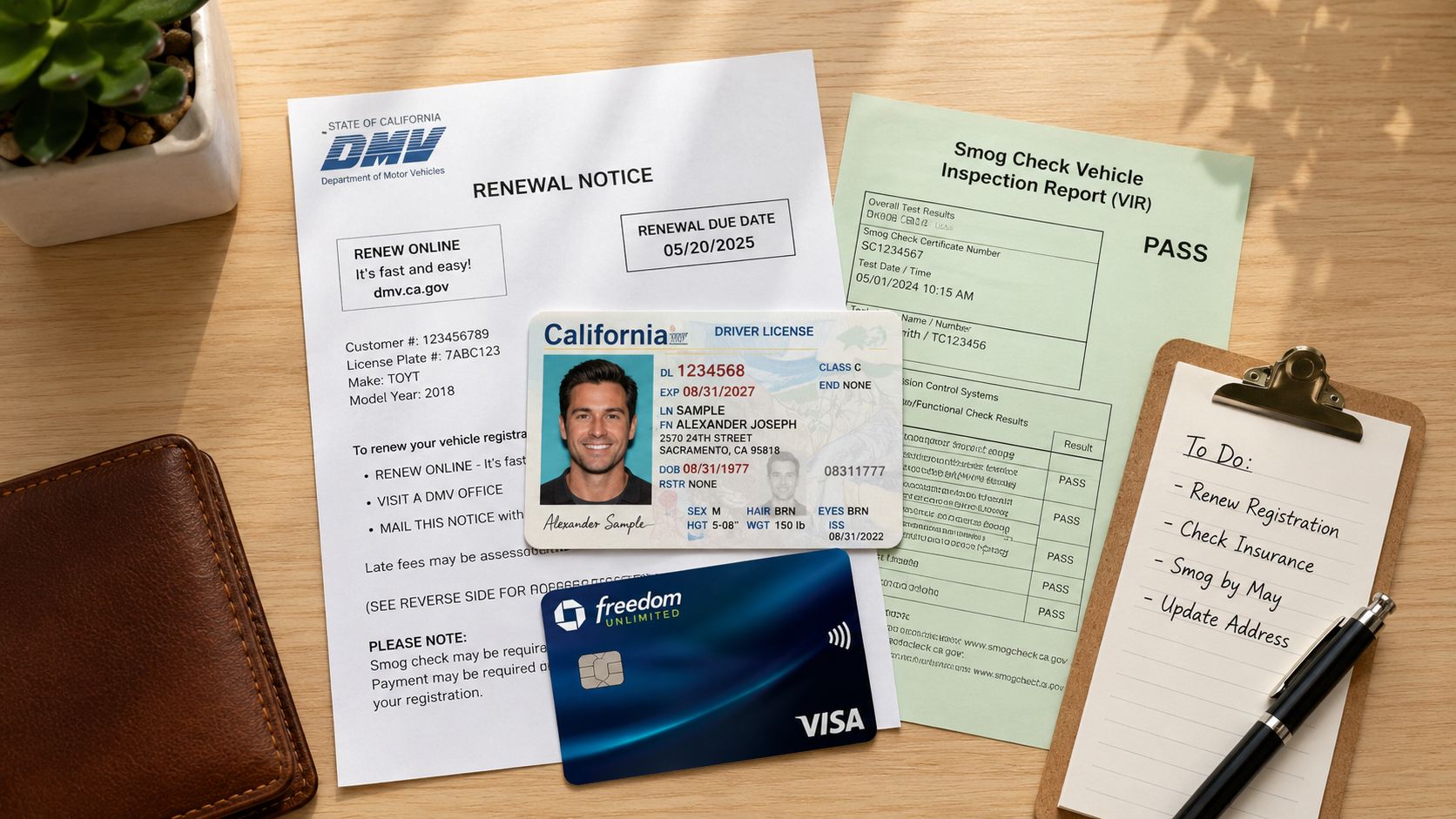
A smooth smog visit starts before you put the car in drive. Bring your renewal notice or DMV notice, your valid ID, and your payment method, and keep any prior smog report handy if you're returning for a retest.
Use the station that matches your schedule
Fire House Smog operates at 2900 Lone Tree Way, Antioch, CA 94509, and the phone number is 925-754-1600. It offers smog testing seven days a week, with DMV registration renewals Monday through Saturday 9:30 AM to 5:00 PM and Sunday 12:00 PM to 4:00 PM, plus two service bays and on-site sticker printing. The station also recommends calling ahead for RVs, which is just common sense because large vehicles need more room and more planning. Vehicle registration document requirements are worth checking before you roll in.
Don't waste a trip on missing paperwork
- Bring your renewal notice: That's the fastest way to match the visit to the right transaction.
- Carry a valid ID and payment: You want no surprises at the counter.
- Keep your previous test report: This matters if you're coming back for a retest.
The point is to show up ready, not hopeful. A prepared driver gets through faster, and a station with two bays can move cars more efficiently when the paperwork is already in order.
What the Price Buys You
The receipt pays for more than a quick emissions test. In a test-only setup with on-site DMV services, you are paying for a cleaner process, fewer repair pitches, and less time wasted bouncing between offices.
The value is in the workflow, not just the number
At a station that handles smog testing and DMV renewals in one place, the price covers convenience that matters on a workday. You get the inspection done, handle registration tasks on-site, and leave with fewer stops on your list.
That matters even more in a test-only model, because the station is not trying to turn your visit into a repair sale. You get the compliance result, the DMV handling, and the sticker process without the usual upsell pressure.
Bottom line: a fair STAR price is the one that gets you legal, gets you out, and does not drag you into a second bill.
Weekend availability and two-service-bay throughput matter too. They do not change the legal fee structure, but they do change the value of the trip, especially if you would otherwise burn half a day at a crowded DMV counter.
If you want a straightforward STAR smog check in Antioch, go where the pricing is clear and the process is built for compliance, not repairs. Fire House Smog handles STAR test-only inspections, on-site DMV registration renewals, and sticker printing at 2900 Lone Tree Way, and you can check the details or plan your visit at Fire House Smog.