Your brake pedal is a little softer than it was last month. The exhaust has picked up a rattly note on cold starts. The smog light came on, and now you're trying to decide whether to spend money on repairs, chase a smog appointment, or waste half a Saturday bouncing between shops and DMV lines.
That's the Antioch problem. Most drivers don't need more jargon, they need a clear read on what's urgent, what's annoying, and what can be handled in one clean trip. Antioch brake and muffler decisions get a lot easier when you stop treating every noise as a separate crisis and start looking at the whole visit, the symptom, the inspection, and the paperwork.
Table of Contents
- The Moment You Realize Your Car Needs Attention
- Warning Signs You Should Never Ignore
- What Brakes and Mufflers Actually Do in Your Car
- Typical Services and Realistic Cost Ranges in Antioch
- Certifications and Shop Traits That Matter
- Why a Test-Only Smog Station Changes the Equation
- Questions to Ask and How to Prep Your Car
- Putting It All Together This Week
The Moment You Realize Your Car Needs Attention
You're backing out of a driveway in Antioch, hit the first stop sign, and hear a high squeal that wasn't there yesterday. Or the car starts cold, the muffler gives off a low rumble, and the sound follows you down the block like it's attached to the bumper. That's usually the point where people start guessing, and guessing is how you end up paying twice.
The smarter move is to treat the noise as a system warning, not a single-part verdict. A brake squeal can be pads nearing the end. A rattle can be a loose heat shield, a worn hanger, or internal exhaust wear. A soft pedal, steering shake, or exhaust hiss each points in a different direction, and the difference matters because the right shop should be able to explain it before they turn a wrench.
Practical rule: If the symptom changed the way the car feels, not just the way it sounds, stop waiting for it to “go away.”
What this guide really protects you from is vague estimates, mystery add-ons, and the classic “we found three more things” surprise. Antioch drivers don't need a lecture. They need enough clarity to know whether they're asking for brake work, muffler work, a smog check, or just a straight answer from the person holding the clipboard.
Warning Signs You Should Never Ignore
What your ears are telling you
A squeal at low speed usually means the pad material is getting thin enough that the wear indicator is doing its job. Grinding is more serious, because metal is likely contacting metal, and that's the point where delay becomes damage. On the exhaust side, a hollow rumble, ticking, or sharp hiss often means the system is leaking somewhere it shouldn't.
A smell matters too. Exhaust odor in the cabin is not something to brush off, and a hot, metallic smell after braking hard is a clue that the system has been working too hard or dragging. If a sound shows up every morning and fades later, that doesn't make it harmless, it usually means the part is warming up and temporarily masking the issue.
What you feel through the car
A brake pedal that feels spongy, low, or inconsistent deserves attention fast. So does a steering wheel shake during braking, because that usually means the braking surface isn't contacting evenly. If the car pulls left or right when you stop, don't normalize it.
For exhaust issues, the main thing you feel is a change in how the car breathes or sounds under load. You may notice more cabin drone, more vibration at idle, or a weaker, less settled response. Those aren't cosmetic problems. They're clues.
What you can see without tools
Check the driveway or parking spot for fluid. Brake fluid leaks are not a “watch and wait” item. Rust streaks, hanging exhaust parts, or a visibly separated pipe connection also tell you more than a five-minute sales pitch ever will.
- Urgent now: grinding brakes, fluid leaks, exhaust smell in the cabin, strong pulling under braking.
- Book soon: squealing, light vibration, rumble on startup, small exhaust rattle.
- Document first: dashboard lights, odd smells, or changes that happen only under specific conditions.
If you can describe the symptom in plain English, the shop has less room to pad the diagnosis.
What Brakes and Mufflers Actually Do in Your Car
The brake side, part by part
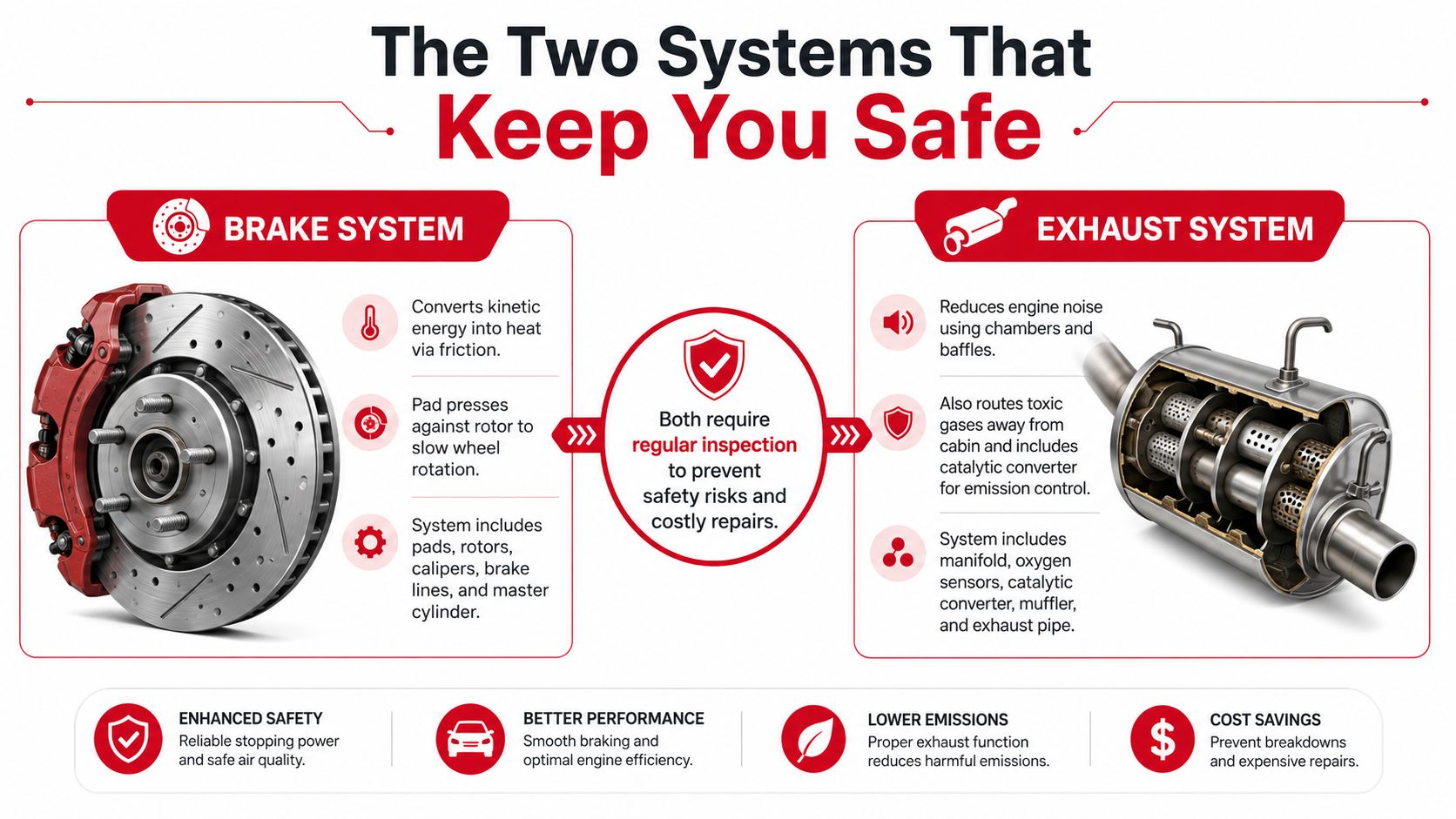
Brakes aren't one component. They're a chain. The pads are the wearing surface, the rotors are the friction disc, the calipers clamp everything together, and the lines and master cylinder move fluid to make it all work. If a shop says “you need brakes,” that could mean simple pad replacement, or it could mean the rotor surface is too far gone, a caliper is sticking, or the fluid system isn't doing its job.
That's why pricing changes so much from one quote to another. A pad swap is a very different job from a caliper-and-rotor job, and the labor, hardware, and fluid needs are not the same. If the estimate doesn't break that out, push back.
The exhaust side, part by part
The exhaust system does more than mute noise. It routes hot gases away from the cabin, helps control emissions, and uses parts like the manifold, sensors, catalytic converter, resonator, muffler, and tailpipe to balance sound and flow. A muffler is only one piece of that chain, so “muffler repair” can mean a small patch, a section replacement, or a larger exhaust job.
That's also where fitment matters. A muffler that looks close enough can still alter back-pressure and drivability if the inlet size, body length, or offset is wrong. Donaldson's engine-brake silencer specs show that flow behavior changes at different pressure conditions, which is a good reminder that exhaust design affects more than sound. Donaldson's exhaust product guide makes that point plainly.
Practical rule: If the quote doesn't specify the exact brake or exhaust part being replaced, you're not comparing the same job.
For drivers trying to cut emissions and avoid repeat visits, a basic maintenance mindset helps. Fire House Smog's emissions guide is worth reading before you assume a warning light means the same thing for every vehicle.
Why fit and material matter
OEM-style muffler catalogs list aluminized-steel, baffled oval mufflers with common inlet and outlet diameters from about 2.0 to 3.5 inches and overall lengths from roughly 22 to 31 inches. Fortluft's exhaust catalog shows how much those dimensions vary. That's not cosmetic trivia, because a poor match can make installation harder, sealing worse, and the exhaust note harsher than it needs to be.
Typical Services and Realistic Cost Ranges in Antioch
What you're usually paying for
Most Antioch brake and muffler work falls into a few buckets. Pads alone are the lightest job. Rotors add machining or replacement. Calipers raise the bill because they're a labor and parts step-up. On the exhaust side, a single muffler repair is one thing, but a larger section or catalytic converter-related job is a different conversation entirely.
The honest way to think about pricing is not, “What's the cheapest place?” It's, “What exactly is included?” Hardware kits, brake fluid, sensors, clamps, hangers, and diagnostic time can all be hidden in the fine print. The low quote often just omits the parts that make the repair hold together.
A simple comparison
| Service | Typical Range | What Moves the Price |
|---|---|---|
| Brake pad replacement | Lower to mid-range | Vehicle layout, pad quality, rust, labor access |
| Rotor resurfacing or replacement | Mid-range | Rotor condition, hub corrosion, vehicle type |
| Caliper service | Mid to higher range | Sticking hardware, fluid condition, integrated brake design |
| Single muffler replacement | Lower to mid-range | Pipe size, hanger damage, weld work, fitment |
| Full exhaust section repair | Mid to higher range | Rust, clamp failure, sensor removal, custom fabrication |
| Catalytic converter replacement | Higher range | Emissions parts, sensor work, vehicle-specific fitment |
Those are not sticker prices, they're planning buckets. The point is to keep you from walking into a shop with a fantasy number in your head and getting frustrated when reality shows up.
What pushes the job up
European and luxury vehicles usually take more labor. Rusted fasteners slow everything down. Integrated parking brake calipers and emissions-related exhaust parts can add complexity fast. If a shop explains those variables clearly, that's a good sign. If it just throws out a number and hopes you don't ask questions, keep walking.
Certifications and Shop Traits That Matter
The credentials that actually mean something
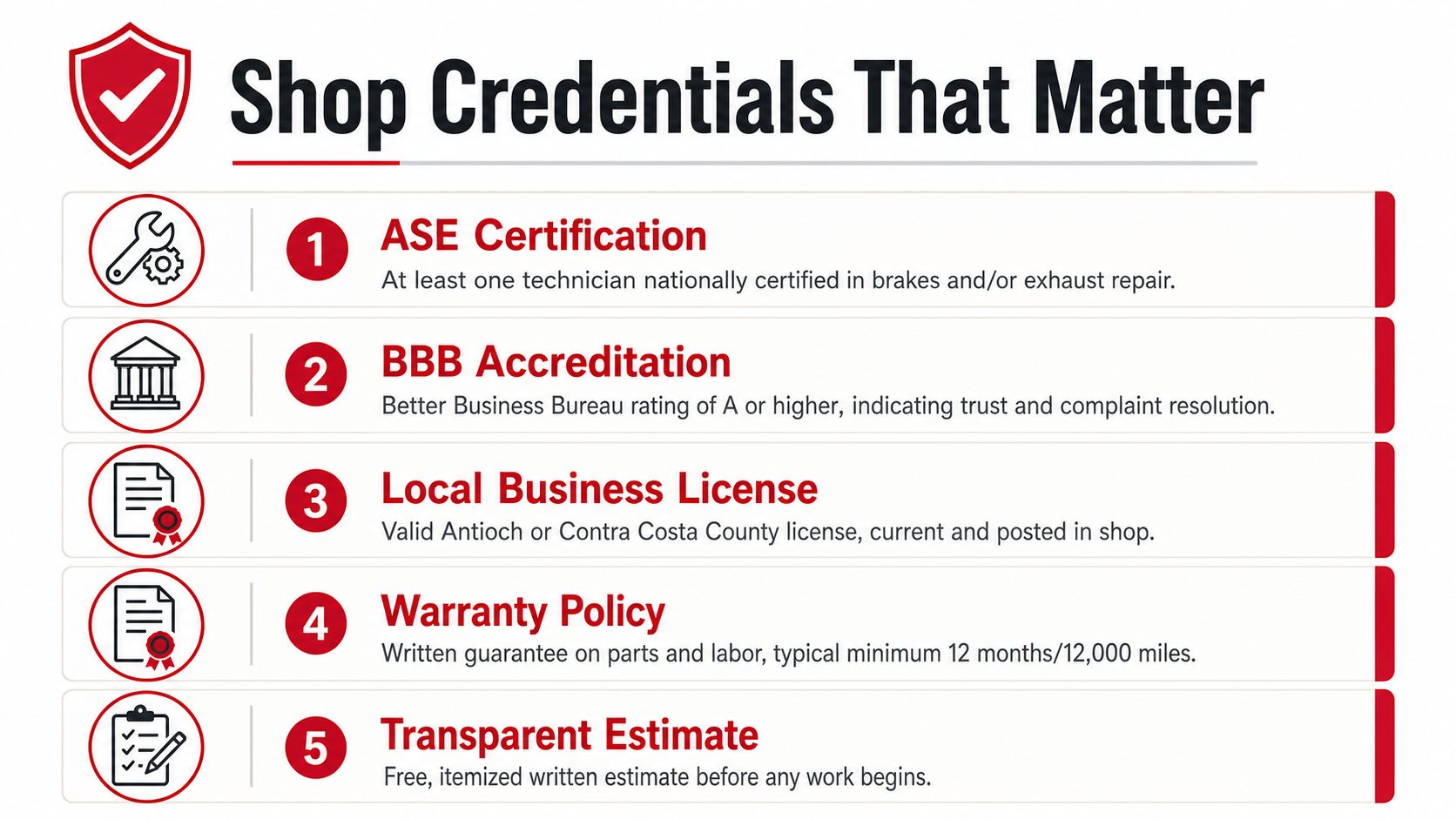
A clean lobby doesn't mean much. ASE certification does matter, because it shows the technician has passed recognized testing in a trade area. A real written estimate matters even more. So does a warranty you can read without asking three times what it covers.
For smog work, STAR certification is not a bragging-rights badge, it's a California smog-program label tied to inspection oversight. If you need that side of the process, the question isn't whether the shop has a nice waiting room, it's whether it is operating in the right lane for your vehicle and paperwork.
Fire House Smog's STAR-certified station page spells out that model clearly.
What trustworthy shops do without being asked
- Break out the estimate: parts, labor, and any sublet work should be separate.
- Show the worn parts: if they replaced it, they should be willing to show it.
- Explain the warranty: if they dodge the warranty question, that's a red flag.
- Keep the bay organized: a messy work area usually means sloppy habits elsewhere.
- Answer direct questions: if they can't explain the repair in ordinary language, they don't understand it well enough.
A good shop doesn't get defensive when you ask about parts, labor, and warranty. It gets specific.
One more thing. California DMV-related services are a different category from repair work. If a business can handle inspection and registration tasks on-site, that's useful, but it doesn't make its brake advice more credible. Judge each function on its own.
Why a Test-Only Smog Station Changes the Equation
Why the business model matters
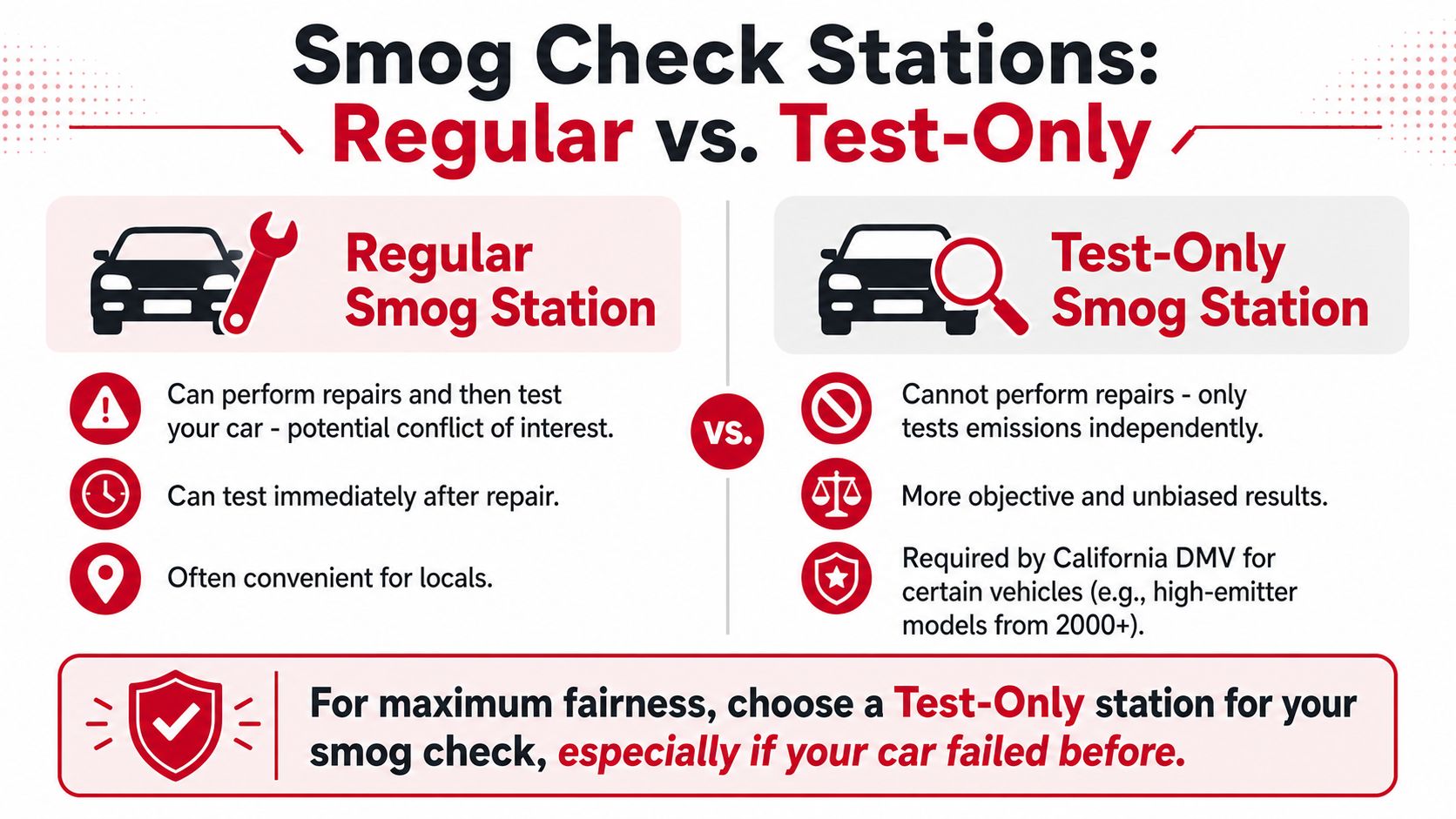
A test-only station cannot sell the repair work that follows a failed test. That changes the conversation. The person running your inspection has less reason to turn a borderline result into a sales pitch, which is exactly why a lot of drivers prefer that setup when they want a straight read.
A repair-oriented shop can still be honest, but the incentive structure is different. If the same place inspects, diagnoses, and repairs, you should ask more questions, not fewer. That doesn't make it bad. It just means you should know what game you're playing.
Where STAR stations fit
California's STAR program adds another layer of oversight for certain vehicles and testing situations. The practical value for the driver is not the label itself, it's the confidence that the test is being run in a tighter lane. For a car that's been on the edge before, that can be a smarter first stop than guessing at a repair bill and then getting tested somewhere else anyway.
The convenience angle matters too. A station that handles smog and DMV registration on-site turns two errands into one. Fire House Smog's in-and-out test-only center page reflects that workflow, including test-only service and registration support.
What to look for in the appointment itself
If a station offers a free retest, extended hours, and on-site tag issuance, that's not fluff. It's a time saver. For Antioch drivers balancing work, family, and more than one vehicle, convenience often matters more than shaving a few dollars off the first line item.
Questions to Ask and How to Prep Your Car
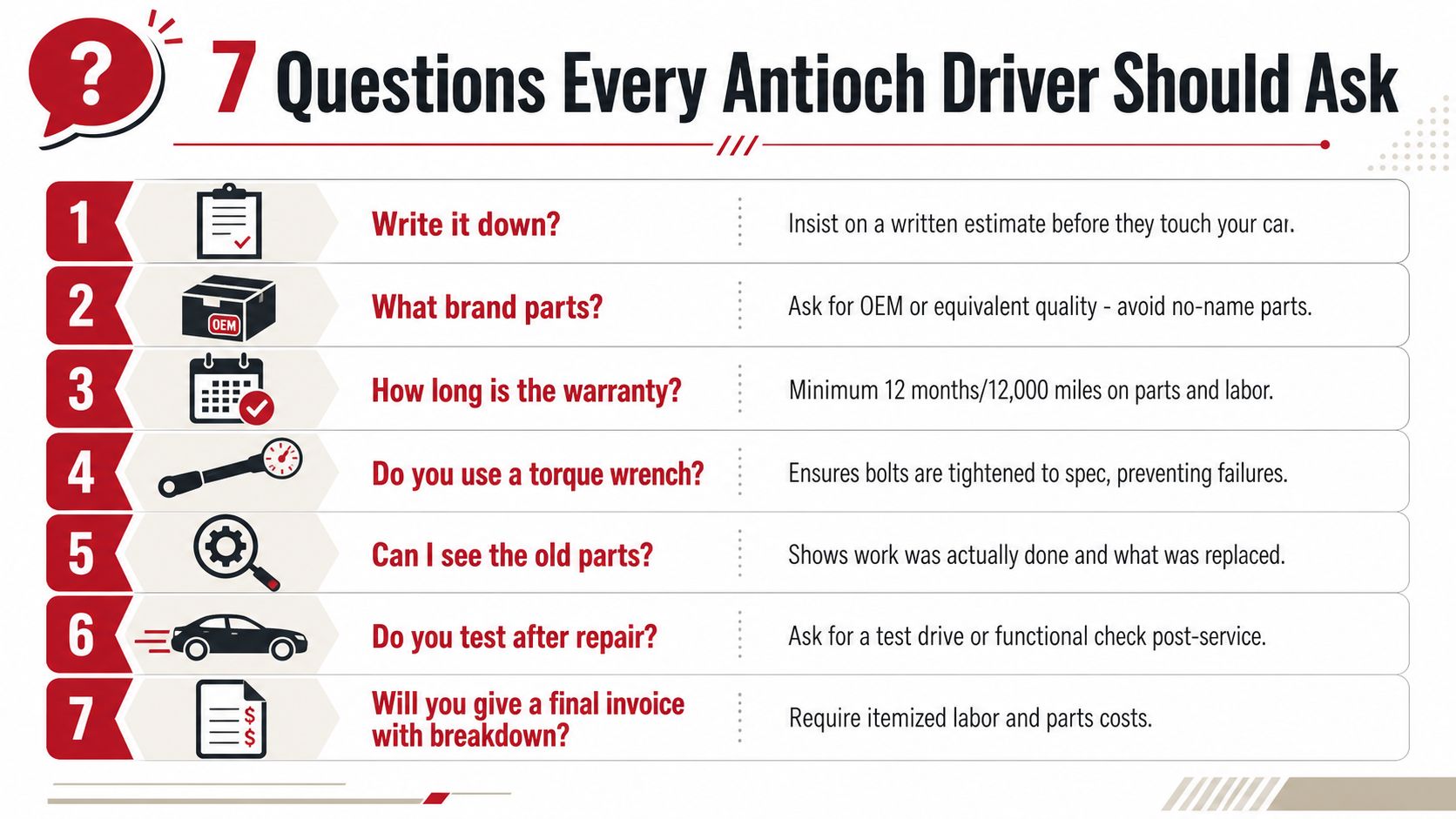
The seven questions that expose weak shops
Ask these before you agree to anything. If the answers are vague, the shop is telling you what kind of experience you're about to have.
- Write it down? Ask for a written estimate before work starts.
- What brand parts? Get the exact part quality, not “good stuff.”
- How long is the warranty? Parts and labor should be covered in writing.
- Do you use a torque wrench? On brake and wheel-related work, that matters.
- Can I see the old parts? If they can't show them, ask why not.
- Do you test after repair? A repair that isn't checked is unfinished.
- Will you give a final invoice with breakdown? You want the final paper trail, not a shrug.
These questions work at a muffler shop, a brake shop, or a smog station. They're short, direct, and hard to dodge.
Fifteen minutes of prep saves time
Clear the trunk. Note any warning lights. Snap a photo of the dash before you leave home. Make sure the gas cap seals properly. If you're bringing the car in for brake work, release the parking brake before you arrive if the shop asks for it, and park on level ground whenever you can.
For smog and registration, bring the renewal notice, payment, ID, and any paperwork that applies to an out-of-state transfer. If the vehicle has an obvious issue like a check-engine light, don't hide it. A good station would rather know up front than waste your time pretending the problem isn't there.
One honest checklist before you hand over the keys
- Paperwork ready: renewal notice, ID, payment, transfer forms if needed.
- Car ready: gas cap tight, dashboard photo saved, trunk cleared.
- Problem described: one sentence about what changed, when, and how often.
- Expectation set: ask what happens if the diagnosis changes once the car is in the bay.
If a shop can't handle that conversation, it probably can't handle the repair cleanly either.
Putting It All Together This Week
Start with the symptom, not the sale. If the problem is braking, pulling, squealing, or exhaust noise, you need a repair shop that can explain parts, labor, and warranty without dancing around the question. If the task is smog, registration renewal, or a transfer, a STAR-certified test-only station is the cleaner choice because it removes the repair-sales conflict and keeps the visit focused.
Then use the questions. Don't skip them because the counter person sounds busy. A shop that's worth your money will answer them clearly, and a station that can handle smog plus DMV work should be able to tell you exactly which documents you need before you arrive. Convenience is only valuable when it comes with transparency.
For a lot of Antioch drivers, the smart move is a one-trip workflow, smog, registration, and any follow-up paperwork handled together. That saves you from the usual shuffle, and it keeps you from paying for a repair you didn't need just to get a sticker.
If you want a test-only smog check with on-site DMV registration support in Antioch, Fire House Smog handles that workflow in one stop. Visit Fire House Smog to check the service details, bring the right paperwork, and get in and out without turning it into a second errand.