
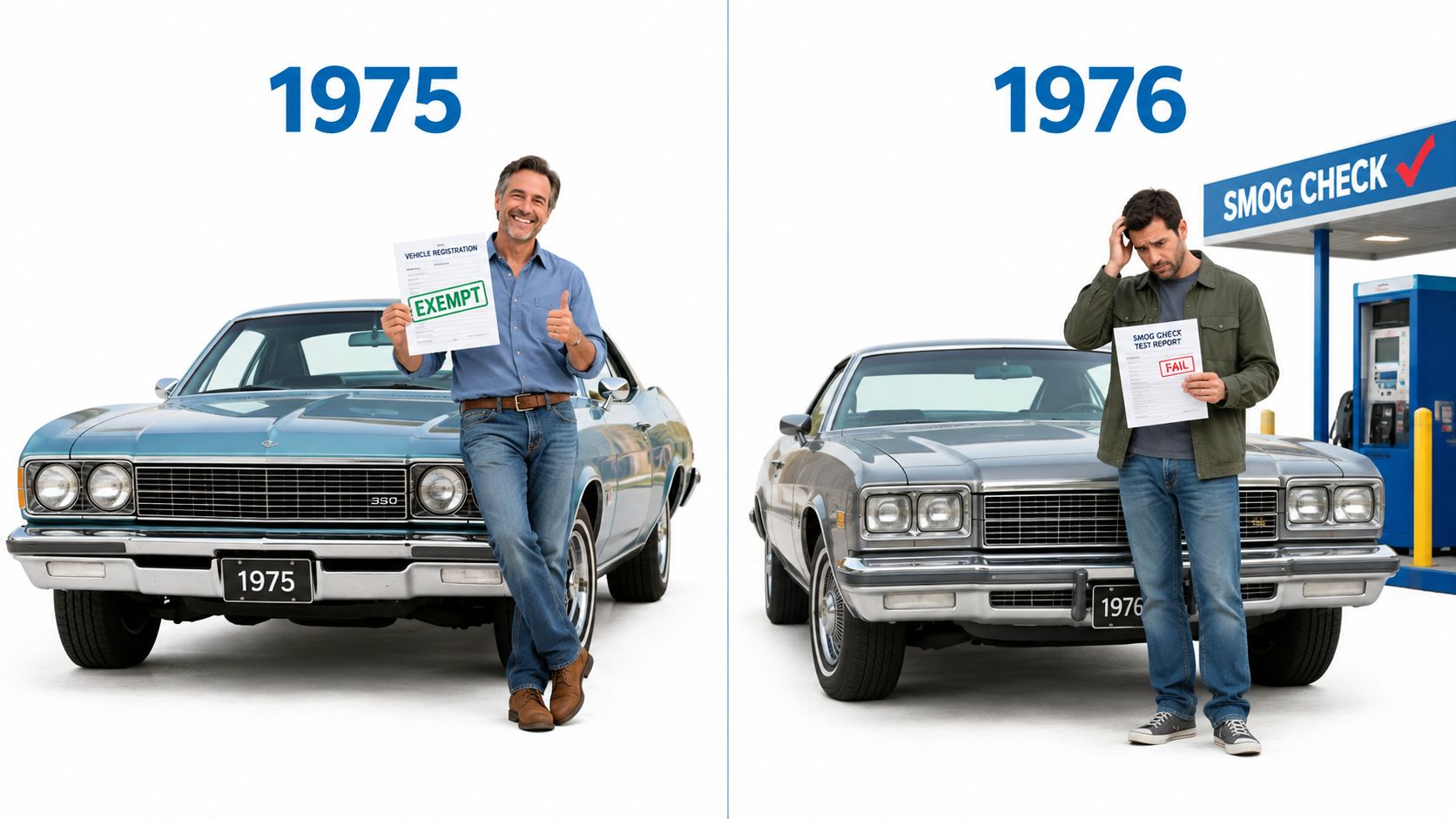
Gasoline vehicles with a 1975 model year or older are permanently exempt from California smog checks, while 1976 and newer vehicles generally still require testing unless they qualify for another exemption. The cutoff is based on the vehicle's model year, not how old the car feels, how rarely it's driven, or whether it carries classic-car plates.
You've found a clean older truck, checked the title, and are ready to register it. The seller calls it “pre-smog,” but the truck's paperwork says 1976. That single detail can change whether you need a Smog Check before completing a renewal or ownership transfer.
The phrase pre smog year California appears in listings, forums, and restoration discussions, but people often use it loosely. California's actual rule is more precise. A gasoline vehicle from model year 1975 or earlier falls under the permanent exemption. A newer classic vehicle may look just as old and may be maintained just as carefully, yet still follow different testing requirements.
Table of Contents
- Introduction to Pre Smog Rules in California
- How California Smog History Created the Pre Smog Era
- Which Model Years Count as Pre Smog and Exempt Today
- How to Verify Your Vehicle Smog Status Before the DMV
- What Pre Smog Status Means for Registration and Ownership Transfer
- Common Misconceptions About Pre Smog Vehicles
- Next Steps for Smog Checks and DMV Processing in Antioch
Introduction to Pre Smog Rules in California
You buy a restored pickup, check the title, and see a model year that differs from the seller's “pre-smog” description. The registration question starts with that recorded year, not with the vehicle's appearance, mileage, or time spent in storage.
Model year is a fixed label. It works like a classification printed on the title, registration, and vehicle records. California uses that label to select the applicable Smog Check rule. Vehicle age is the result of the label, not a separate test for exemption.
That difference can affect an ordinary DMV transaction. A 1974 pickup and a 1976 pickup may have matching restorations, the same engine family, and identical weekend use, yet receive different treatment. A carefully maintained 1978 coupe also does not become exempt just because owners call it a classic.
Practical rule: Read the model year on the title and registration before relying on a listing or seller's description.
The fixed cutoff is only one part of the broader system. Newer vehicles may receive temporary testing relief early in their registration life, while collector classifications, specialty plates, fuel type, and transfer circumstances follow their own rules. Those categories should not be blended together under the informal label “pre smog.”
The guide examines five decisions:
- Cutoff year: Why the rule uses a fixed model-year boundary.
- Vehicle status: How permanent exemption differs from temporary relief for newer vehicles.
- Verification: Which records to check before a DMV visit.
- Ownership: How renewal, sale, and out-of-state registration can affect the process.
- Future planning: How collector exemptions and new-vehicle standards may change.
For a specific vehicle, begin with the recorded model year and then confirm the applicable status. If the title, registration, and seller's description conflict, a direct check with the BAR or DMV is safer than relying on an online listing.
How California Smog History Created the Pre Smog Era
California's “pre-smog” language comes from a regulatory transition. Before modern tailpipe controls, residents and officials first had to recognize the problem, then measure it, and finally create enforceable standards.
From visible crisis to organized control
Los Angeles' first recognized smog episode occurred on July 26, 1943. Visibility in downtown Los Angeles fell to about three blocks, and residents reported smarting eyes, respiratory discomfort, nausea, and vomiting. People initially mistook the event for a gas attack, and similar smog episodes continued through the 1940s, according to the National Academies history of California air pollution.
That episode made air pollution publicly visible in a major American market. The issue was no longer an abstract concern for researchers. Residents could see the haze, feel its effects, and connect daily life with a growing environmental problem.
California then moved from observation toward administration. In 1947, Governor Earl Warren signed the Air Pollution Control Act, authorizing county air pollution control districts, as documented by the National Academies source above. The state had created a legal framework for organized air-pollution control within roughly four years of the major smog event.
Measurement changed the policy conversation
By the mid-1960s, California researchers were no longer limited to describing smog. They began creating precise tailpipe test systems in 1965, and California adopted the nation's first statewide vehicle-emissions standards for new cars in 1966, according to Hagerty's history of California vehicle-emissions regulation.
The results show why testing and standards became central. Average emissions of key smog-forming pollutants, including hydrocarbons and nitrogen oxides, fell from 14 grams per mile in 1965-model cars to 3 grams per mile by 1975, then to 1.5 grams per mile by 1981, according to the same Hagerty account.
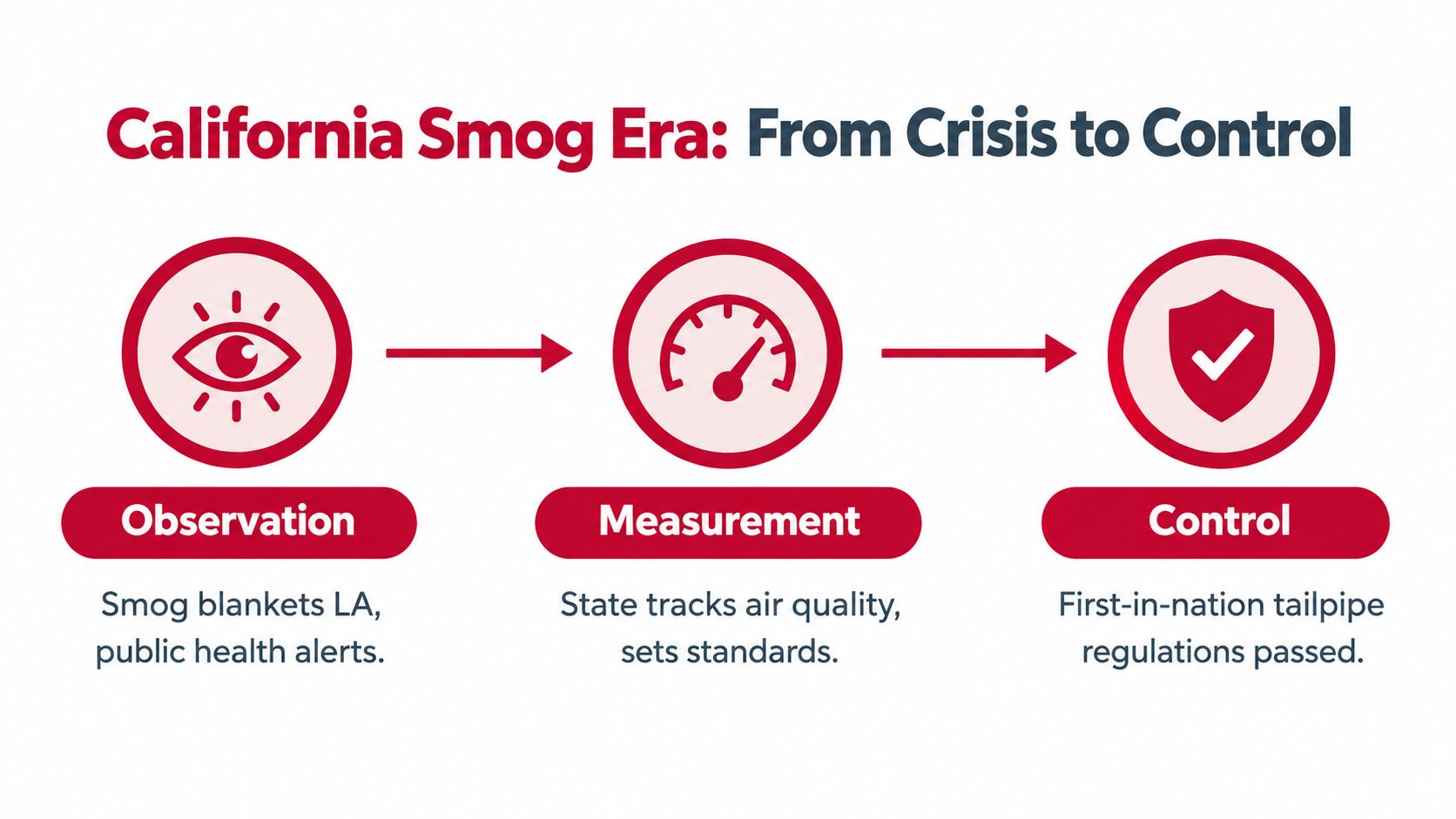
That sequence explains the logic behind a fixed cutoff. California needed a practical way to identify vehicles produced before the emissions-control era, without asking inspectors to reconstruct every vehicle's history. A model-year boundary gave registration officials and owners a clear administrative test.
The cutoff can feel arbitrary when you compare two neighboring model years. Historically, however, the dividing line represents the shift from largely uncontrolled vehicle pollution toward regulated manufacturing, testing, and emissions equipment. A newer classic may be old today, but it belongs to a later regulatory generation.
Which Model Years Count as Pre Smog and Exempt Today
A 1974 vehicle and a 1976 vehicle may look equally old at a registration counter, yet California treats them differently. The deciding factor is the recorded model year, not the vehicle's current age, restoration date, or how often it is driven.
A gasoline-powered vehicle with a 1975 model year or older is permanently exempt from California Smog Check requirements under the BAR's official Smog Check rules. “Permanently” means that routine testing does not begin later merely because the vehicle changes owners, stays registered for years, or is driven more frequently.
A gasoline vehicle from 1976 or newer does not gain that permanent exemption by becoming an old classic. A well-restored 1978 vehicle can still require a Smog Check when the relevant registration or ownership-transfer rule calls for one. Vehicle condition and exemption status are separate questions.
Use the model year first
Use this sequence:
- Read the recorded model year. Check the title, registration, or reliable vehicle records. The year of purchase or restoration does not control the classification.
- Compare it with 1975. A gasoline model year of 1975 or earlier falls within the permanent exemption category.
- For 1976 or newer, identify the transaction. Renewal and ownership transfer can create different testing requirements unless another rule applies.
- Confirm the fuel and vehicle type. The gasoline cutoff should not automatically be applied to hybrid, alternative-fuel, or other vehicle categories.
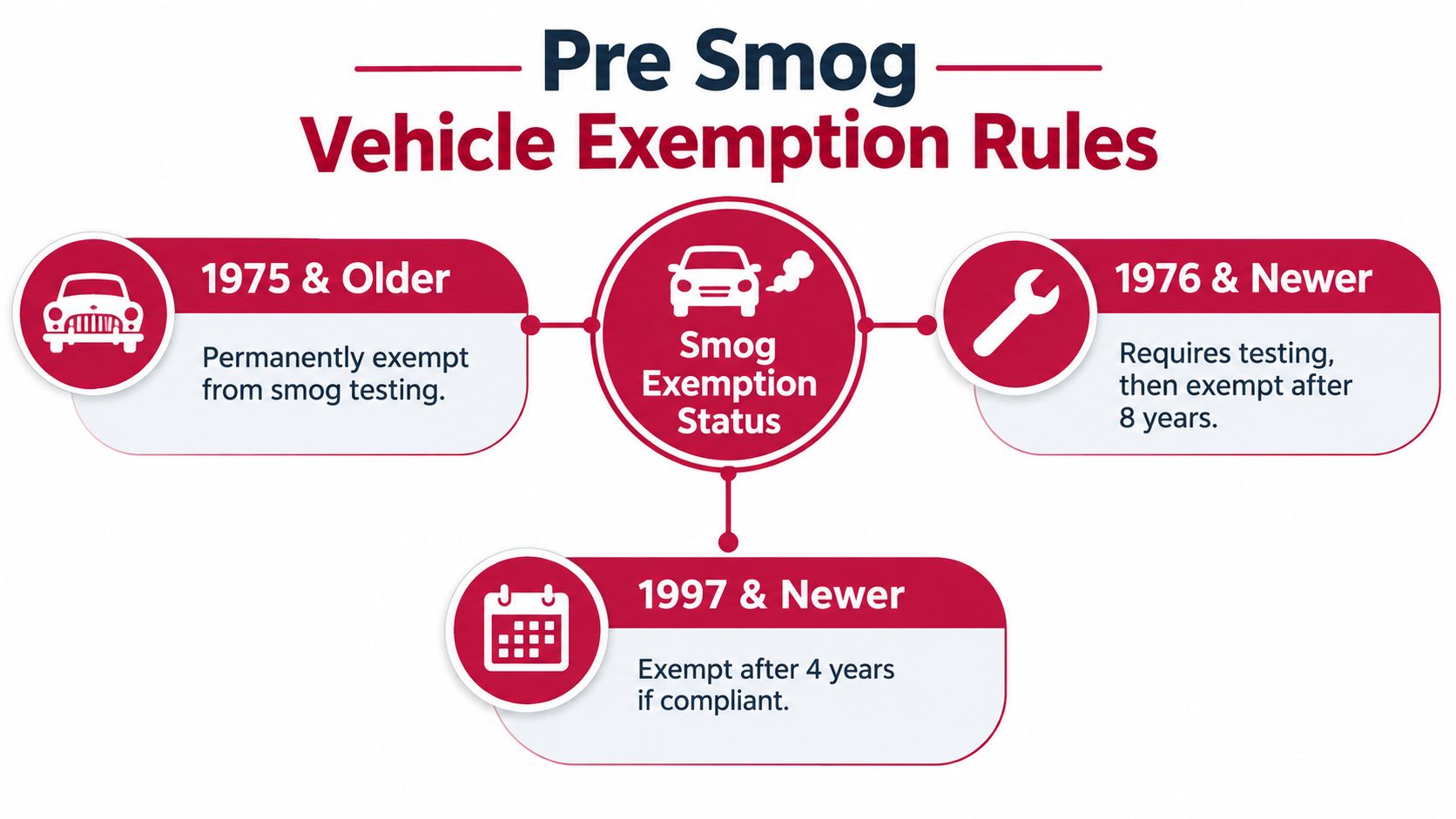
California also provides a separate renewal relief period for newer gasoline, hybrid, and alternative-fuel vehicles. Vehicles eight model years old or newer don't need a smog inspection for renewal, according to the BAR. This temporary rule changes as the vehicle moves through its model-year lifecycle, while the 1975-and-older exemption remains tied to the fixed cutoff.
For planning, the first required renewal test can be estimated by adding eight to the model year. The first change-of-ownership test can be estimated by adding four to the model year. These calculations are useful checks, but the registration notice and official records control the actual DMV process.
California's rules may also expand for certain collectors under the upcoming SB 1392 changes. That potential collector pathway is separate from the pre-smog cutoff, so an eligible collector vehicle should not be confused with a vehicle that qualifies automatically because it predates 1976.
For additional older-vehicle examples, review this guide to California smog-exempt vehicle years.
The practical question is: What model year does California have on record, what fuel does the vehicle use, and what transaction is being completed?
How to Verify Your Vehicle Smog Status Before the DMV
A buyer arrives at the DMV expecting a routine transfer, then learns that the vehicle's recorded model year or fuel type changes the smog requirement. Checking the records first can prevent that extra trip. Start with the vehicle's official identity, not the seller's description.
Begin with the paperwork
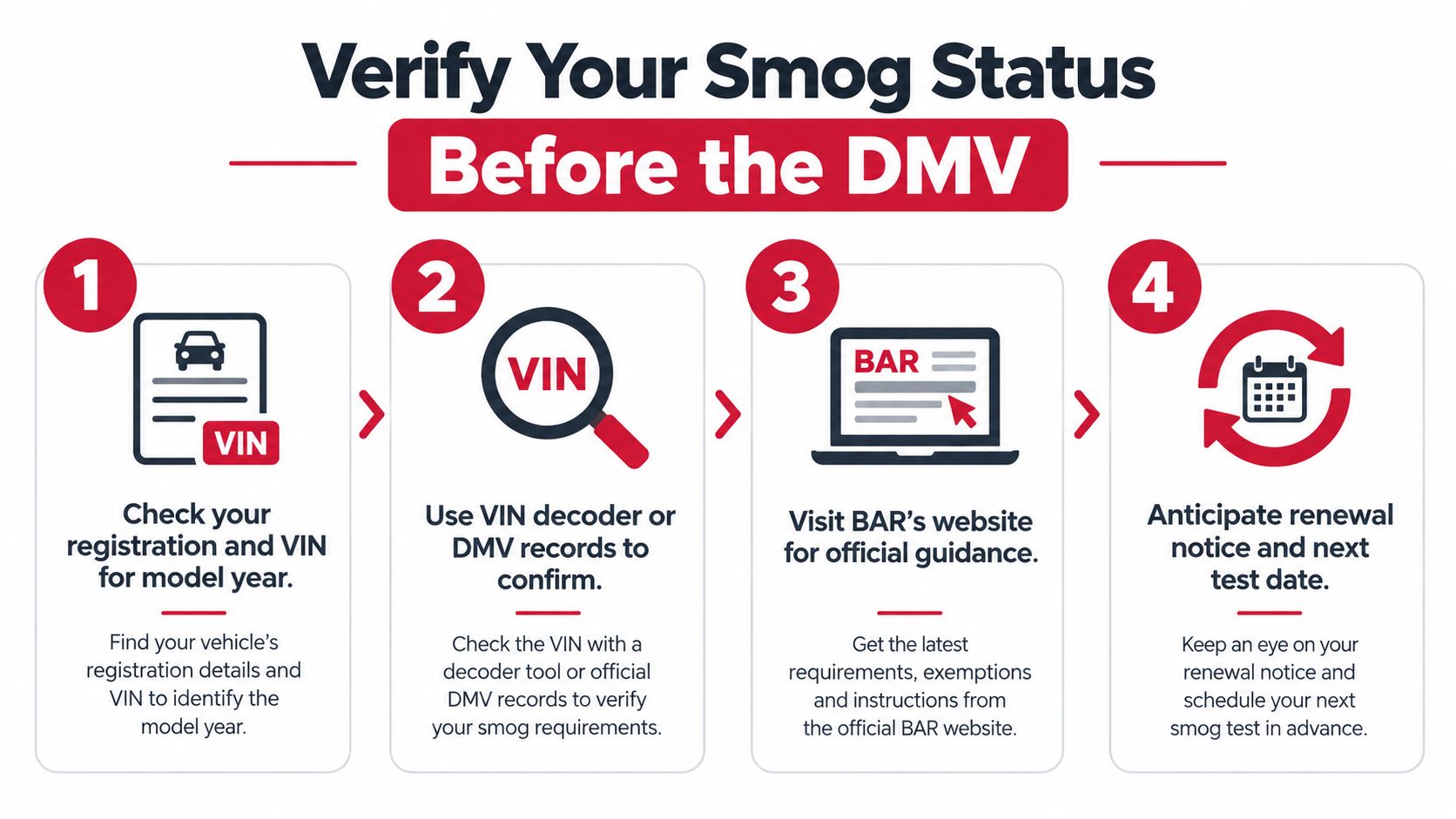
Review the California registration card, title, and vehicle identification number. Confirm that the model year matches across the documents. California's pre-smog cutoff is a fixed model-year rule, so an older-looking vehicle is not automatically exempt. A gasoline vehicle from 1975 or earlier follows a different path from a 1976 vehicle, even if both appear to be classic cars.
For an out-of-state purchase, compare the title with the VIN plate and available manufacturer information before assuming California will classify the vehicle as pre-smog. A VIN decoder can clarify basic identity details, but DMV records control when documents disagree. Engine swaps, reconstructed titles, incomplete paperwork, and unusual body conversions can make a general online answer misleading.
Match the vehicle to the transaction
Identify the transaction before deciding what to check. Renewal and ownership transfer can trigger different requirements for the same vehicle. As a planning estimate, add eight to the model year for the newer-vehicle renewal relief period, or add four to the model year for a change-of-ownership estimate. Confirm the result against the DMV notice and current BAR Smog Check guidance.
| Vehicle Model Year | Renewal Smog Required | Transfer Smog Required |
|---|---|---|
| 1975 and older gasoline vehicle | Permanently exempt | Permanently exempt |
| 1976 and newer, within the newer-vehicle relief period | Check registration notice | Check transfer requirements |
| 1976 and newer, outside that relief period | Usually required when prompted | Check transfer requirements |
The table is a planning aid, not a final decision. Vehicle type, fuel classification, transaction details, and attached records can change the result.
For a transfer, collect the title, bill of sale, identification, and out-of-state registration documents when applicable. Ask the DMV or BAR about unusual cases before scheduling a test, especially for an RV, nonstandard engine, or uncertain fuel classification. Review the requirements for an emission test certificate before arranging the transaction.
Keep supporting registration records even when the vehicle appears exempt. Clear documentation connects the recorded model year and fuel type to the vehicle being presented.
Before you leave home: Confirm the model year, fuel type, transaction type, and date shown on your DMV notice.
What Pre Smog Status Means for Registration and Ownership Transfer
A buyer in Antioch may face two different outcomes with older cars. A gasoline vehicle from model year 1975 or earlier generally avoids the ordinary Smog Check requirement for registration renewal, while a 1976 vehicle may still require testing. The dividing line is the recorded model year, not the vehicle's age or its “classic” label.
The exempt vehicle still needs the correct registration paperwork and applicable charges. Exemption removes the routine smog step, not the DMV process itself. For broader qualifying categories, review this guide to smog exemptions in California.
Renewal and transfer are different moments
Renewal follows the registration cycle. A transfer follows the sale or ownership change. As a result, a car that did not need a recent renewal inspection may still require smog documentation during a transfer.
Before paying, the buyer should confirm who must provide certification. The seller should avoid promising exemption based only on age, mileage, a specialty plate, or a listing description. The DMV's recorded model year and fuel classification control the transaction. If those records conflict with the seller's statement, use the official record as the starting point.
Some vehicles need a different testing path. STAR requirements, modifications, unusual equipment, vehicle configuration, or RV status can affect where and how testing occurs. Contact a station or BAR before arriving if the vehicle does not resemble a standard passenger car.
The future policy discussion adds another distinction. SB 1392, known as “Jay Leno's Law,” is described as proposing a phased collector-car exemption that would begin January 1, 2028 for qualifying 1976 to 1980 vehicles, with the expansion continuing through model year 1985 by 2033, according to AutoNext's explanation of SB 1392. Those are proposed future changes, not a current blanket exemption. A 1976 vehicle should still be evaluated under the rule in effect for the transaction.
California is also tightening requirements for newer vehicles in a separate regulatory track. CARB's Advanced Clean Cars II program covers model years 2026 through 2035, while the state's emergency vehicle-emissions rules were readopted in 2025. Older collector vehicles and newer production vehicles therefore sit under different policy pressures.
For a sale or registration renewal, verify the exact model year, fuel type, and transaction requirement before scheduling a test or completing payment.
Common Misconceptions About Pre Smog Vehicles
A buyer finds a 1978 car advertised as “pre-smog” and assumes its age settles the issue. It does not. California uses a fixed model-year cutoff, not a vehicle-age test. For the permanent gasoline exemption, the cutoff is 1975 and older. A 1976 vehicle can be old enough to be collectible while still requiring a Smog Check for a particular transaction.
Classic plates do not automatically remove Smog Check requirements. Plate status may describe how the vehicle is registered, but it does not replace the official record's model year, fuel type, or transaction requirement. A seller's use of “classic” or “pre-smog” is a starting point for questions, not proof of exemption.
Low mileage does not change the cutoff. A car stored for most of the year may be driven very little, yet its model year remains the same. Proposed collector rules may include qualification conditions, so owners should not treat limited use as an exemption under current requirements.
The gasoline rule does not cover every older vehicle. The permanent cutoff described by BAR applies to gasoline-powered vehicles from model year 1975 and older. Hybrids, alternative-fuel vehicles, and specialty vehicles may follow different requirements. Confirm the vehicle's actual classification before applying the gasoline rule.
Why older advice causes trouble
Online listings often reduce a complicated DMV question to “pre-smog” or “smog exempt.” That shorthand may fit a 1974 gasoline car, but it can mislead someone shopping for a 1976, 1978, or 1980 vehicle. The result is a buyer who arrives for a renewal or ownership transfer expecting no test, then discovers that the transaction requires one.
The upcoming collector expansion makes date checking even more important. The phased SB 1392 schedule described earlier is separate from the current permanent 1975 cutoff. Newer vehicles also fall under a different emissions policy framework through CARB's Advanced Clean Cars II program, as explained in the official CARB program description.
The reliable question is not “Is this a classic?” It is “What model year and vehicle category does the official record show?”
If the advertisement conflicts with the registration or title, pause before paying. Resolving the record before purchase is easier than correcting a registration problem afterward.
Next Steps for Smog Checks and DMV Processing in Antioch
Start with the simple rule: 1975 and older gasoline vehicles are permanently exempt, while newer vehicles need a transaction-specific check. Confirm the model year on the registration or title, identify whether you're renewing or transferring ownership, and review the DMV notice before booking an appointment.
If the vehicle needs testing, choose a station that matches the vehicle and transaction. Fire House Smog is a STAR-certified test-only smog check station and licensed DMV registration-services provider in Antioch. It handles qualifying car, truck, and some RV inspections, along with registration renewals, ownership transfers, and on-site tag issuance during posted service hours.
Bring the registration card, title or transfer documents, VIN details, identification, and the DMV notice. If the vehicle is modified, unusually large, out of state, or has an engine swap, call ahead so the station can confirm whether its equipment and services fit the vehicle.
A practical appointment checklist:
- Model year: Confirm the official year, not the restoration year.
- Fuel type: Verify gasoline, hybrid, alternative fuel, or another classification.
- Transaction: Identify renewal, transfer, or initial California registration.
- Documents: Bring the registration and ownership paperwork.
- Questions: Mention modifications or unusual vehicle equipment before testing.
Fire House Smog can help Antioch-area owners verify the appropriate testing path, complete qualifying Smog Checks, and process DMV renewal or ownership-transfer services in one location. Visit Fire House Smog before your appointment to review the available services and plan your next step.
You're renewing a diesel vehicle registration when a notice mentions emissions compliance, and one question immediately comes up: what does California diesel emission cover? For a passenger diesel, the answer may involve a conventional smog inspection. For a work truck, bus, motorhome, or fleet vehicle, it may involve a different program, additional reporting, or equipment requirements.
The phrase covers more than visible smoke from a tailpipe. It includes pollutants such as nitrogen oxides, particulate matter, and carbon dioxide, along with the tests, filters, monitors, engine standards, and fleet rules California uses to control them. The most important distinction today is between light-duty smog checks and the growing compliance system for heavy-duty and off-road diesel equipment.
This guide translates those rules into practical language. You'll learn what diesel engines produce, why California regulates them aggressively, which program may apply to your vehicle, how emissions are measured, and what steps can help you prepare for testing or fleet compliance.
Table of Contents
- What California Diesel Emission Means for Everyday Drivers
- How Diesel Engines Create Emissions You Can Understand
- Why California Regulates Diesel More Strictly Than Other States
- Light Duty Smog Checks Versus Heavy Duty Clean Truck Check
- How Diesel Emissions Are Measured and Reported in California
- What Diesel Owners Can Do to Stay Compliant in California
- Staying Ahead of California Diesel Emission Changes
What California Diesel Emission Means for Everyday Drivers
You are renewing a diesel vehicle's registration when the notice mentions emissions compliance. The first question is usually simple: do you need a smog inspection, or does another California program apply? The answer depends on the vehicle's weight, use, engine, equipment, and operating location, not on the word “diesel” alone.
For a light-duty diesel car, SUV, or pickup, the immediate requirement may be a California smog inspection connected with registration. A work truck, bus, motorhome, or fleet vehicle follows a different regulatory path. California's heavy-duty Truck and Bus Regulation applies to nearly all diesel-powered vehicles over 14,000 pounds gross vehicle weight rating operating in the state, with limited exceptions.
This shift matters for everyday drivers because California's diesel rules increasingly focus on heavy-duty and off-road equipment. A passenger diesel owner may mainly deal with a smog appointment, while a fleet operator may also manage inspections, reporting, equipment condition, and operating restrictions. Both groups may search for California diesel emission, but they do not face the same checklist.
Emissions are only one part of compliance
Diesel combustion produces nitrogen oxides, or NOx, which contribute to smog formation, and particulate matter, or PM, which includes tiny particles associated with diesel soot. Carbon dioxide is another combustion product with climate implications. California addresses these pollutants through engine standards, fuel requirements, aftertreatment systems, inspections, and fleet programs.
A clean-looking tailpipe does not prove that every emissions control is working. A malfunctioning sensor, failed filter, disabled emissions component, or excessive exhaust restriction can create a compliance problem without producing a dramatic cloud of black smoke. The visible exhaust is only the surface, much like checking a dashboard light tells you a system needs attention without identifying the failed part.
Practical rule: Identify your vehicle category first. An emissions notice does not mean every diesel vehicle follows the same inspection or reporting process.
What you should be able to decide
By the end of this guide, you should be able to:
- Classify the vehicle: Determine whether it is a passenger or light-duty diesel, a heavy-duty vehicle, or off-road equipment.
- Identify the program: Tell a regular smog inspection apart from the Clean Truck Check system.
- Understand the hardware: See why diesel particulate filters, backpressure monitors, and onboard diagnostics affect compliance.
- Prepare intelligently: Gather documents, inspect the vehicle, and seek qualified help before a deadline.
- Choose the right next step: Contact a testing station, fleet compliance provider, or qualified diesel technician based on the vehicle's actual use.
That process helps prevent a practical mistake: arriving for the wrong inspection or assuming that smoke-free exhaust guarantees compliance.
How Diesel Engines Create Emissions You Can Understand
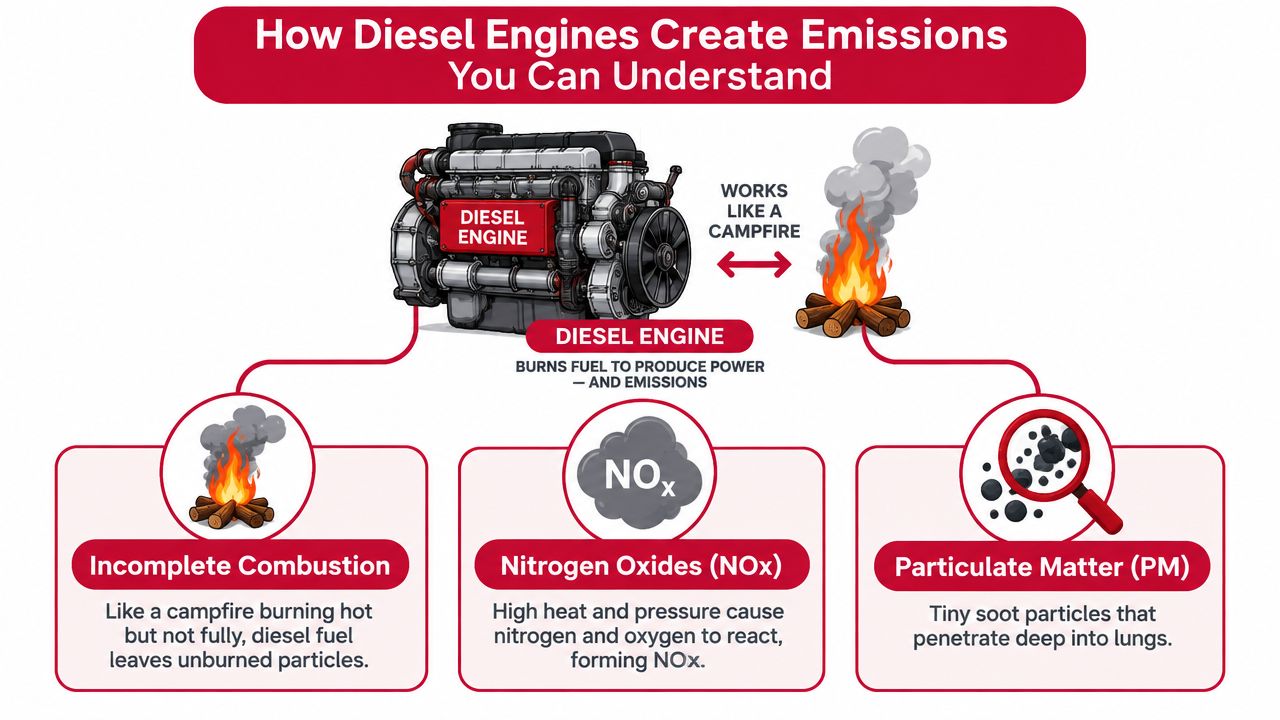
A diesel engine pulls a heavy load up a California grade. Inside the engine, fuel burns under high compression, producing power along with gases and particles that must be controlled before reaching the air. A campfire offers a useful comparison: a hot fire with enough oxygen burns more completely, while uneven fuel pockets leave smoke and residue behind.
Diesel engines are designed for efficiency and pulling power, yet their high-temperature combustion creates pollutants that California regulates closely. The exhaust system uses different components for different pollutants, so one working part cannot solve every emissions problem.
NOx forms in a hot combustion chamber
Nitrogen oxides, or NOx, develop when the intense heat and pressure inside the cylinder cause nitrogen and oxygen to react. NOx usually cannot be seen, but it contributes to the chemical reactions that produce ground-level ozone and smog.
A vehicle can therefore have clear exhaust while producing too much NOx. Depending on the engine and vehicle design, controls may include combustion calibration, exhaust gas recirculation, or selective catalytic reduction. A faulty sensor, catalyst, or related control component can raise NOx emissions without creating a visible black plume.
PM includes visible soot and hidden particles
Particulate matter, or PM, consists of tiny solid and liquid particles suspended in exhaust. Larger soot particles may look like smoke. Smaller particles are difficult to see, which explains why a clean-looking tailpipe does not prove that the emissions system is operating correctly. California focuses heavily on PM because these particles can enter the respiratory system.
A diesel particulate filter, commonly called a DPF, traps soot as exhaust passes through it. The filter must later regenerate, meaning a controlled process burns away the collected material. Repeatedly failed regeneration can restrict the filter and lead to reduced performance or warning lights.
Carbon dioxide has a different role
Carbon dioxide, or CO2, forms whenever carbon-based fuel burns. It differs from NOx and PM, and the control method differs as well. NOx and PM relate closely to local air quality and health concerns, while CO2 reflects the broader climate effect of fuel combustion.
The practical lesson is simple: diesel emission control requires several working systems. A DPF captures soot, but it does not correct every NOx problem. A NOx control system reduces that gas, but it cannot replace a functioning DPF.
Diesel emissions include invisible gases and visible or hidden particles. Compliance depends on controlling both.
Why California Regulates Diesel More Strictly Than Other States
A passenger diesel owner may notice California's rules during registration, while a truck operator may deal with engine model years, inspections, and reporting. That difference reflects how the state built its diesel program over time. The focus has shifted from checking only light-duty vehicles to controlling the heavy-duty and off-road equipment that produces large amounts of diesel pollution.
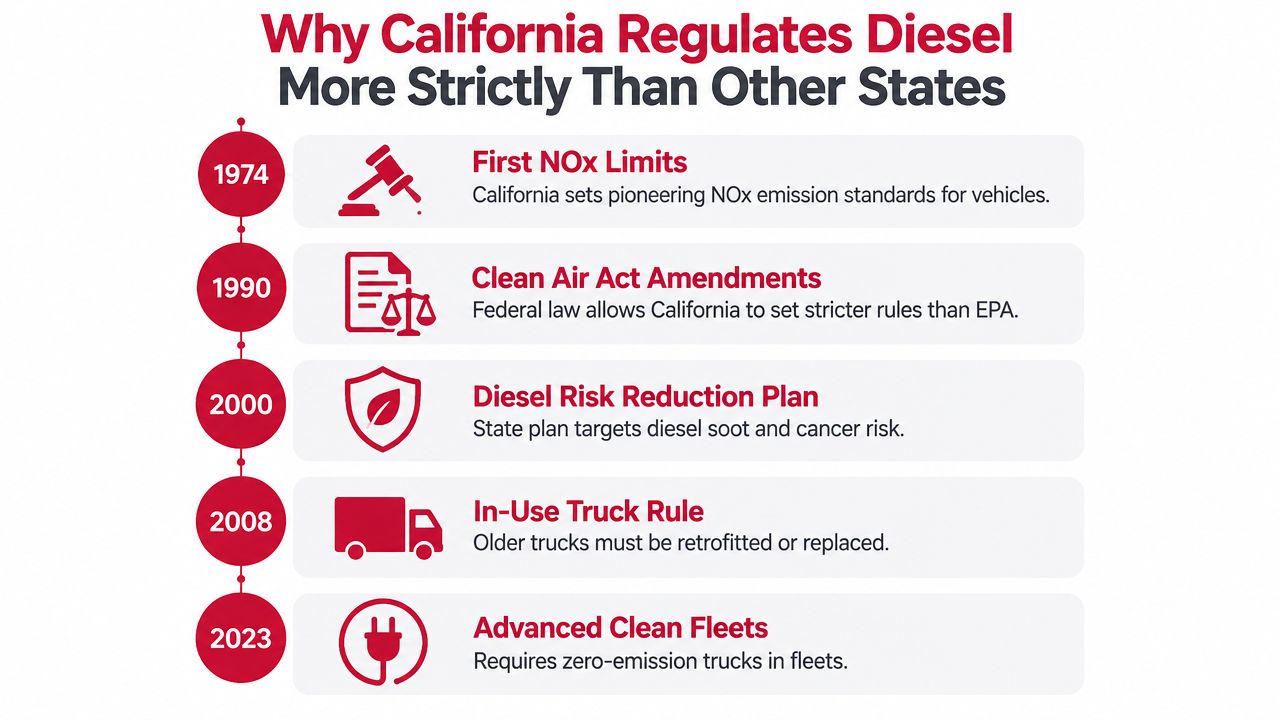
California's Air Resources Board, or CARB, began regulating diesel truck emissions in 1974 with a NOx standard for new vehicles. It tightened those standards through five steps, reaching the current level with 2010 models, according to this California Clean Diesel history.
The state adopted a Diesel Risk Reduction Plan in 2000. Its goals were to reduce diesel PM2.5 emissions by 75% by 2010 and 85% by 2020. Low-sulfur diesel fuel began in 2006 at 15 parts per million, allowing more advanced exhaust-control equipment to operate effectively.
These milestones explain why California diesel emission compliance involves more than a visual inspection. The program combines fuel requirements, new-engine standards, retrofit equipment, and rules for vehicles already working on California roads.
Why heavy-duty vehicles became the focus
CARB identified heavy-duty diesel trucks and buses as the single largest source of statewide NOx, responsible for 30% of statewide NOx emissions. In 2008, the agency estimated that about 941,000 trucks and buses operated in California, producing 859.3 tons per day of NOx and 33.1 tons per day of PM2.5.
Those figures shaped the regulatory strategy. Passenger-car inspections could not address commercial vehicles that travel long distances, carry heavy loads, idle at facilities, and remain in service for years. The same reasoning applies to diesel construction and other off-road equipment, where compliance depends on the engine, control equipment, and operating requirements.
The Truck and Bus Regulation took effect in December 2008. As of January 1, 2023, nearly all diesel-powered vehicles over 14,000 pounds GVWR operating in California must have a 2010-or-newer engine and emission system, with limited exceptions.
For a plain-English overview of standards affecting different vehicle categories, review this guide to diesel emissions standards. The practical starting point is the vehicle's weight rating and use, not the word “diesel.”
Light Duty Smog Checks Versus Heavy Duty Clean Truck Check
A diesel pickup owner may be thinking about registration and a familiar smog check. A fleet manager is usually solving a different problem: whether a heavy-duty vehicle must meet Clean Truck Check, California's inspection and maintenance program for heavy-duty vehicles.
Clean Truck Check covers nearly all diesel and alternative-fuel heavy-duty vehicles over 14,000 pounds GVWR operating on California roads, including trucks registered outside California. CARB identifies the first emissions compliance deadline as January 1, 2025. CARB also indicates that OBD-equipped vehicles are scheduled to move to quarterly testing beginning in October 2027, as described in its Clean Truck Check FAQ.
| Program | Applies To | Test Method | Frequency |
|---|---|---|---|
| Light-duty smog inspection | Qualifying passenger cars, SUVs, and light-duty trucks | California smog inspection procedures based on vehicle equipment and model | Frequency depends on registration and vehicle requirements |
| Clean Truck Check | Nearly all diesel and alternative-fuel vehicles over 14,000 pounds GVWR operating on California roads, including out-of-state trucks | Heavy-duty emissions compliance testing and reporting | Required according to the applicable CARB schedule, with quarterly OBD testing for OBD-equipped vehicles scheduled to begin in October 2027 |
Start with the weight rating, not the engine badge
A personally used diesel pickup may fall under the light-duty smog-check system. A similar-looking vehicle configured for commercial work may receive a different classification. A motorhome or recreational vehicle may also require special handling if its size or equipment exceeds a testing station's setup.
The gross vehicle weight rating provides the clearest starting point. Check the manufacturer's label, registration records, and fleet documentation instead of judging by appearance or the word “diesel.”
For a qualifying passenger diesel that needs a registration-related inspection, this guide to a smog test for diesel vehicles explains what the appointment may involve before you arrive.
Why the burden is shifting
Light-duty smog checks remain familiar to individual drivers. California's expanding compliance workload now centers more heavily on trucks, buses, motorcoaches, some motorhomes, and other heavy-duty vehicles.
That change follows how these vehicles operate. Commercial and industrial equipment can accumulate extensive road or operating time, so owners need an accurate compliance calendar, current vehicle records, and a response plan for failed tests or warning indicators. Waiting for a registration notice can leave an operator unprepared for a separate heavy-duty reporting obligation.
How Diesel Emissions Are Measured and Reported in California
A truck can pass one check and still show a problem in another. California therefore uses several measurement layers. A computer scan may find a stored fault, a smoke or opacity inspection may reveal visible exhaust, and advanced equipment can measure emissions while the vehicle operates on the road or a test cycle.
The process has three practical levels.
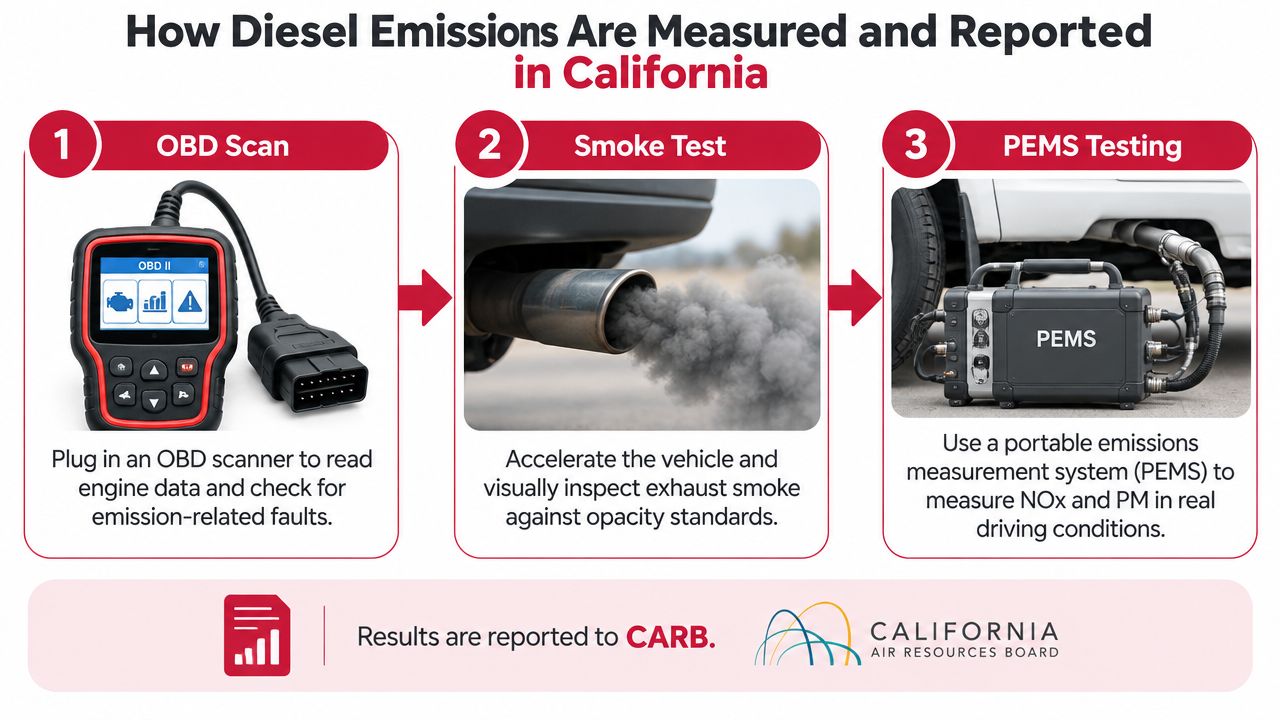
First comes the vehicle's own diagnostic data
An onboard diagnostics, or OBD, scan reads information stored by the engine and emissions systems. It can identify sensor faults, aftertreatment trouble, or operating conditions that keep the system from working as designed.
A warning lamp is useful evidence, not a complete verdict. A vehicle without an illuminated lamp may still need readiness checks. Technicians also review whether a recent repair or battery disconnection erased diagnostic information before testing.
Filters require verification and monitoring
CARB requires a verified diesel particulate filter when the device is used for regulatory credit. CARB's installation and maintenance guidance identifies DPFs as the most common technology for reducing diesel particulate matter from heavy-duty engines operating in California.
A filter system also needs a backpressure monitor. It warns the operator before exhaust restriction reaches the specified high-pressure limit. Excessive backpressure can raise engine load, reduce filtration effectiveness, and damage the engine or aftertreatment system.
Real-world testing supports emissions inventories
CARB's EMFAC2025 documentation describes revisions to heavy-duty diesel emission rates based on real-world dynamometer testing, portable emission measurement, and in-use testing data. Its micro-trip method represents actual operating patterns more closely in emissions modeling, as described in the EMFAC2025 technical documentation.
For off-road and heavy-duty equipment, compliance increasingly examines NOx and PM together, rather than soot capture alone. CARB verification materials identify Level 3 diesel technologies that can target at least an 85% particulate matter reduction, while proposed off-road standards address both NOx and PM.
Here's a plain-language visual explanation of the testing flow:
A passing result depends on the complete system: engine, calibration, filter, sensors, and aftertreatment. Changing one component without checking the full setup may leave the original compliance problem in place.
What Diesel Owners Can Do to Stay Compliant in California
A passenger diesel owner may be preparing for a registration smog inspection, while a truck operator is managing a fleet emissions obligation. Those are different lanes of the same road. Start by confirming the vehicle's classification, GVWR, registration status, engine information, operating routes, and any Clean Truck Check responsibilities.
Use the notice as your first checklist:
- Read it carefully: Determine whether it requests a smog certificate, registration action, or heavy-duty compliance response.
- Check warning indicators: Repair check-engine, aftertreatment, DPF, or emissions-system warnings before testing.
- Bring supporting records: Have registration information, vehicle identification details, and recent emissions-system repair documents available.
- Keep the equipment intact: Do not remove, bypass, or substitute emissions components unless the replacement is approved for that vehicle and application.
- Confirm the test site fits: Large trucks, motorhomes, and specialized equipment may not fit every light-duty testing bay.
If a light-duty diesel fails
A failed inspection identifies a condition to diagnose, not a shopping list of parts to replace. Ask the station to explain the failure category, then get a diagnostic opinion from a qualified technician. The practical question is, “What condition caused the failure, and how will this repair correct it?”
Confirm the retest rules before returning. Some stations offer a free retest under their site policy and coupon terms, but eligibility depends on the circumstances and the station's conditions.
If you manage heavy-duty equipment
Fleet compliance works best when every vehicle has its own record. Track the GVWR, engine model year, emissions-control equipment, inspection status, fault history, and upcoming deadlines. A shared spreadsheet or fleet platform is enough if one person owns the task and updates it after each inspection or repair.
For drivers in Antioch and East Contra Costa County, Fire House Smog is a STAR-certified test-only station at 2900 Lone Tree Way in Antioch. It performs smog inspections for qualifying cars, trucks, and some recreational vehicles, along with California DMV renewal services and on-site tag printing. Testing is available seven days a week, and the station has two bays. Call 925-754-1600 before bringing a larger vehicle or motorhome to confirm that it fits the equipment limits. This Clean Air Truck resource explains related heavy-duty considerations.
Staying Ahead of California Diesel Emission Changes
A diesel pickup owner may focus on registration, while a trucking company tracks inspections across an entire fleet. Both face California diesel rules, but the compliance path depends first on vehicle classification. The state is placing growing attention on NOx and PM, especially from heavy-duty fleets and off-road equipment.
Off-road diesel is expected to remain a major source of mobile emissions in California. That direction explains why future compliance planning reaches beyond on-road truck inspections and passenger-vehicle smog checks. CARB has discussed proposed Tier 5 off-road standards in a 2026 workshop, aimed at reducing NOx and particulate matter from new compression-ignition engines sold in California.
Use this verification checklist
- Confirm classification: Check the vehicle's GVWR and identify whether it is light-duty, heavy-duty, or off-road equipment.
- Identify the program: Determine whether the vehicle needs a registration smog inspection, Clean Truck Check activity, or another CARB requirement.
- Track deadlines: Put applicable dates on a fleet calendar rather than relying only on a renewal reminder.
- Protect the emissions system: Maintain the DPF, sensors, backpressure monitor, and related aftertreatment equipment.
- Keep records: Save inspection results, repair invoices, equipment details, and compliance communications.
- Verify changes: Review current CARB guidance before buying parts, installing software, or changing an emissions-control strategy.
A fleet calendar works like a service map. It shows which vehicle needs attention, what documentation is missing, and when the next obligation arrives. For a passenger diesel owner, the same habit can be simpler: confirm the applicable smog-check rules, keep repair records, and verify requirements before a registration renewal.
CARB's SB 1 report identifies a useful-life limitation that reduced modeled emissions reductions from adopted and planned heavy-duty regulations by a cumulative 82,276 tons of NOx and 890 tons of diesel PM from 2024 through 2045 statewide, as documented in the EMFAC2025 technical materials. The point is practical. A rule may become stricter while regulators still assess whether its expected reductions occur during real vehicle use.
Long-term compliance depends on the full emissions system, accurate records, and the program governing the vehicle. Passing one inspection helps, but readiness between inspections prevents avoidable problems.
If you need a qualifying diesel smog inspection or California DMV renewal support in Antioch, visit Fire House Smog. The STAR-certified test-only station offers emissions testing, selected recreational-vehicle inspections, and on-site registration renewal services, so call 925-754-1600 to confirm your vehicle's requirements before arriving.
You've just opened a California DMV renewal notice and noticed the smog requirement. Maybe your vehicle is a diesel pickup, SUV, van, or motorhome, and you're unsure whether the rules apply to your model, your registration status, or the miles you drive. The questions usually arrive together: What exactly counts as a diesel emission, does every diesel vehicle need the same inspection, and what happens if the vehicle is based outside California?
California's approach can feel complicated because it combines several layers. The state regulates diesel particulate matter, nitrogen oxides, engine hardware, fuel characteristics, and in-use vehicle operation. A light-duty owner generally deals with the familiar California Smog Check process, while a heavy-duty vehicle operating on California public roads may fall under the separate Clean Truck Check program.
The reason for this strict approach is practical. Diesel pollution affects more than the person behind the wheel. Emissions can travel through neighborhoods near freeways, warehouses, ports, border crossings, and other freight routes. California's newer data systems examine those patterns at community level, not only as statewide totals.
This guide starts with the basic science, then connects it to health, CARB standards, out-of-state heavy-duty vehicles, exemptions, failed tests, and the steps an Antioch-area driver can take before visiting a test-only station. You'll also see why a functioning diesel particulate filter, accurate sensors, and complete diagnostic information matter even when the exhaust looks clean.
Table of Contents
- Introduction to California Diesel Emissions and Why They Matter Now
- What California Diesel Emissions Are and How They Form
- Health and Environmental Impacts Across California Communities
- How California Regulates Diesel Through CARB Rules and Standards
- Compliance Requirements for Diesel Vehicles Driving in California
- Testing Exemptions and What Happens If Your Diesel Fails
- Practical Guidance for Staying Compliant With Confidence
Introduction to California Diesel Emissions and Why They Matter Now
A diesel owner usually encounters the rules at an inconvenient but familiar moment. The registration renewal arrives, the DMV asks for a smog certificate, or a buyer wants proof that the vehicle can be transferred. The owner searches for “California diesel emissions” and finds references to CARB, DPFs, OBD systems, and Clean Truck Check, often without a clear explanation of which requirement applies.
The first distinction is the vehicle's role. A light-duty diesel vehicle may need a regular California Smog Check for registration or transfer. A heavy-duty vehicle operating on California public roads can face a separate emissions inspection and reporting obligation, even when it's registered in another state. Those programs serve different purposes, so treating every diesel as if it follows one universal test creates confusion.
Why the state focuses on diesel
California's diesel inventory has historically included more than one million on-road and off-road vehicles, along with stationary and portable engines, according to the California Air Resources Board diesel emissions assessment. The same assessment estimated statewide diesel particulate matter emissions at about 28,000 tons per year, with approximately 27% from on-road engines and 66% from off-road engines.
Those figures explain why the state's strategy reaches beyond passenger cars. Trucks matter, but construction equipment, agricultural machinery, generators, ships, and other diesel sources also contribute to the overall burden.
You don't need to become an emissions engineer to handle your own compliance. You do need to identify the correct program, keep the emissions equipment intact, and allow enough time to address a warning light or failed inspection before a registration deadline. The sections below translate the technical terms into decisions you can use.
What California Diesel Emissions Are and How They Form
A heavy-duty diesel truck can pass your neighborhood with no visible smoke and still release pollutants. The engine compresses air, injects fuel, and uses the resulting heat to ignite it. That combustion produces power, while incomplete burning and high-temperature reactions create emissions.
Two pollutants guide much of California's diesel-control work: diesel particulate matter, or diesel PM, and nitrogen oxides, known as NOx. They form differently and behave differently after leaving the tailpipe, so they require different control strategies. The rules also apply across changing routes. An out-of-state truck operating in California may still need to meet California requirements, even though its home-state program differs.
Diesel PM is more than visible smoke
A fireplace offers a useful comparison. The soot you can see represents only part of what combustion releases. Diesel engines can emit extremely small particles even when the exhaust appears clear. More than 90% of diesel particulate matter is smaller than 1 micrometer, placing it within the PM2.5 fraction, as described in California diesel standards and control information.
Fine particles can remain airborne and travel deep into the respiratory system. A diesel particulate filter, or DPF, captures much of this soot before it exits the tailpipe. During regeneration, the system raises conditions inside the filter so accumulated material burns in a controlled process.
NOx creates a different problem
NOx forms mainly during high-temperature combustion. It can affect air quality near the vehicle and react in the atmosphere to help form ozone and secondary particulate matter. PM is commonly associated with material emitted from the exhaust, while NOx can help create additional pollution after entering the air.
Modern diesel systems may combine exhaust gas recirculation, oxidation catalysts, DPFs, and selective catalytic reduction. SCR uses diesel exhaust fluid to reduce NOx. These components operate as a chain. A damaged hose, clogged filter, faulty temperature sensor, or malfunctioning catalyst can break that chain.
Practical rule: A clean-looking tailpipe does not prove that the complete emissions system is working correctly.
The engine computer monitors sensors and operating conditions. If it detects a fault, it may store a diagnostic trouble code or turn on the malfunction indicator lamp. That electronic record can matter during an OBD inspection, even if the vehicle drives normally.
Neighborhood mapping makes this distinction practical. Statewide emissions describe the broad problem, while 1×1 km community maps can show where traffic and nearby sources overlap. For a vehicle owner, the next step is straightforward: keep emissions equipment intact, respond to warning lights, and confirm the correct inspection requirements at a STAR test-only station.
Health and Environmental Impacts Across California Communities
A truck can meet statewide requirements while still affecting neighborhoods differently along its route. People encounter diesel pollution where they live, work, walk, wait near traffic, or spend time beside freight corridors and ports. A statewide average measures overall progress, while local mapping asks the more practical question: where are residents encountering emissions?
Long-term progress has not eliminated risk
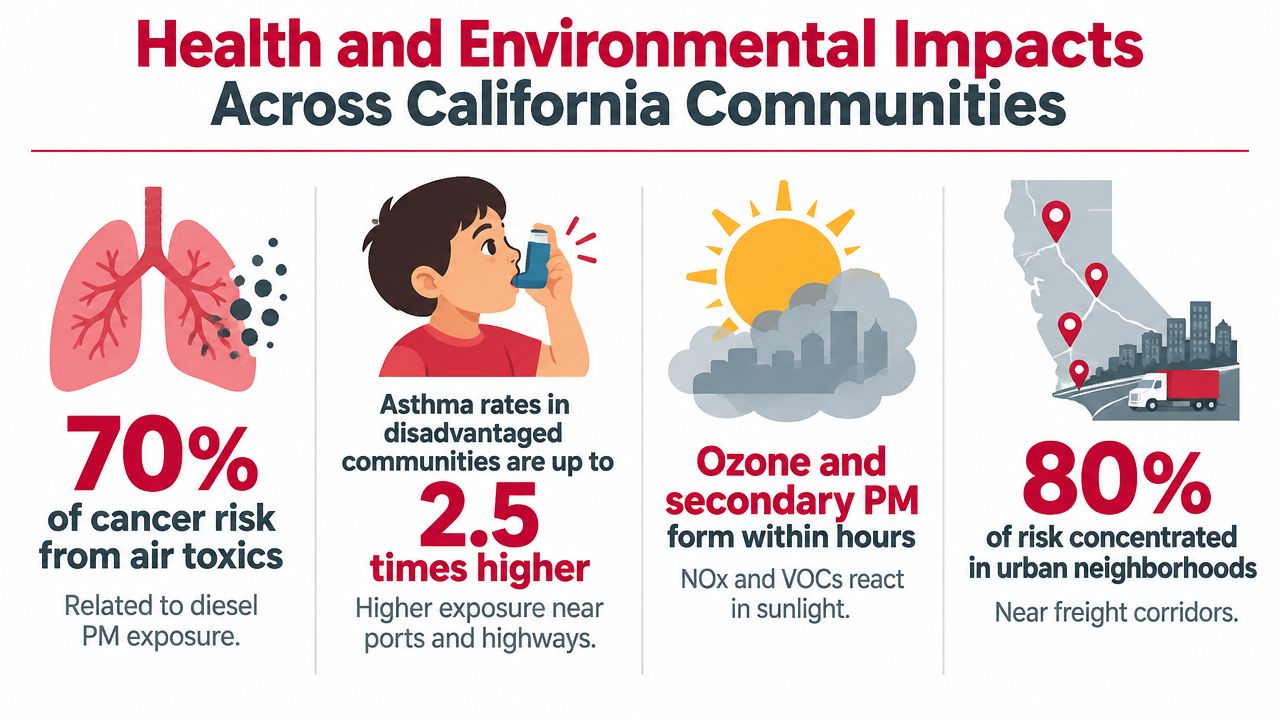
A peer-reviewed analysis found that statewide ambient diesel particulate matter concentrations fell 68% between 1990 and 2012, even as diesel vehicle miles traveled increased 81%. The analysis and CARB health summary associated the 2012 ambient concentration of 0.58 µg/m³ with an estimated 520 new cancer cases per million residents exposed, as documented in the peer-reviewed diesel PM analysis.
The lesson is that cleaner engines, improved fuels, and emission-control systems reduced pollution substantially, while residual exposure still deserves attention. Diesel PM remains toxic, and its effects are not distributed evenly across the state.
NOx creates a second pathway. After leaving a vehicle, it can help form ozone and secondary PM, so the impact extends beyond the visible exhaust plume. A route with frequent truck traffic and idling can produce a different exposure pattern from a quiet residential street, even within the same city.
Maps make local exposure easier to understand
California's community-analysis method combines emissions estimates from on-road, area, stationary, and ocean-going vessel sources. OEHHA grids the state at 1×1 kilometer resolution, then converts the information to census tracts for community analysis, as explained in the CalEnviroScreen diesel particulate matter fact sheet.
The inventory also accounts for diesel PM originating on the Mexico side of the border when evaluating San Diego and Imperial counties. Pollution does not stop at a registration system, county line, or state boundary. The same issue appears in interstate compliance: an out-of-state heavy-duty vehicle may follow rules from its home jurisdiction, yet still operate on California roads and affect communities here.
Exposure is local enough that the same vehicle can have very different community effects depending on its route, idling pattern, and proximity to homes, schools, and workplaces.
For drivers, maintenance and compliance are practical parts of reducing that exposure. At a STAR test-only station, ask which inspection applies, keep emissions equipment intact, and address warning lights before testing. One inspection cannot solve a neighborhood-wide problem, but it can help prevent an individual vehicle from adding avoidable pollution.
How California Regulates Diesel Through CARB Rules and Standards
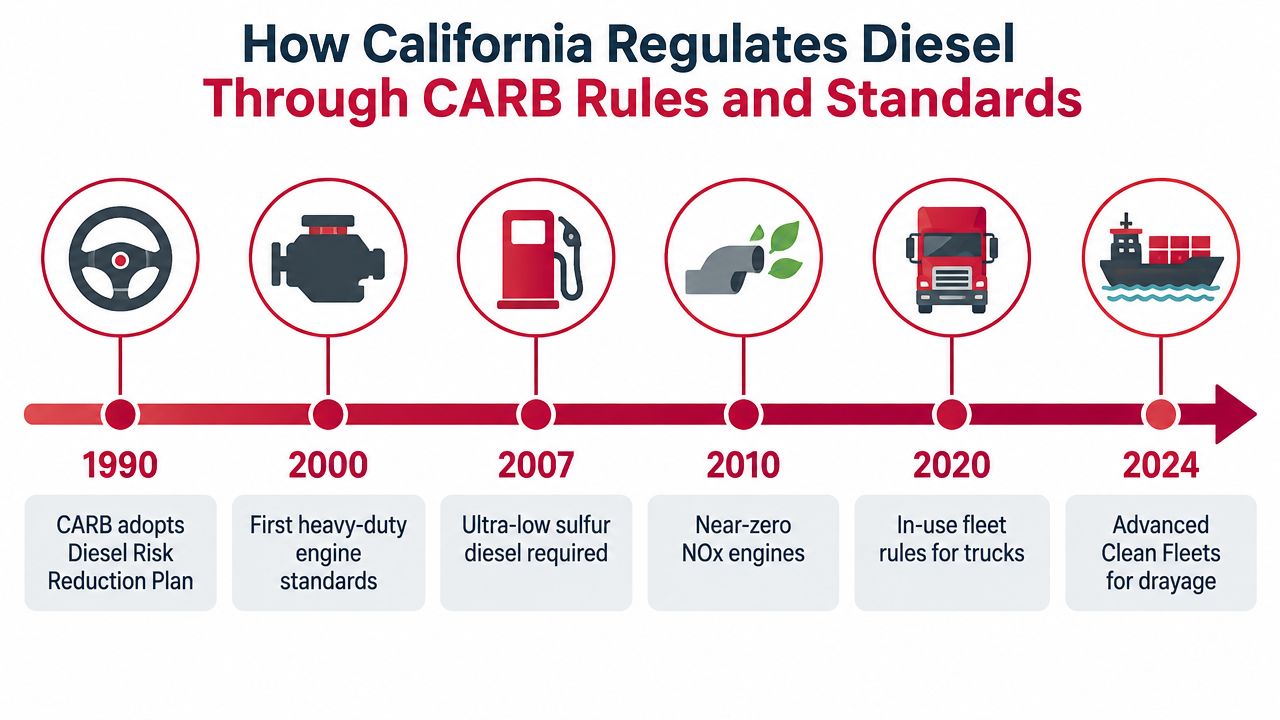
A diesel pickup can pass a visual check yet still create excess pollution during idling or low-load driving. California's system therefore works across several connected layers. One set of rules limits particulate matter, another controls NOx under different engine conditions, and fuel policies address carbon intensity. The framework examines the vehicle, its controls, how it operates, and the fuel it uses.
PM controls target the smallest particles
CARB's Diesel Risk Reduction Plan set statewide targets to reduce diesel PM emissions by 75% by 2010 and 85% by 2020. Later control programs moved heavy-duty engines toward PM levels below 0.01 g/bhp-hr, roughly matching the 2007 new-engine PM standard, as described in CARB's heavy-duty diesel risk-reduction materials.
Those limits explain why DPF condition matters. The filter works like a fine screen in the exhaust path, trapping soot before it reaches the air. If it is missing, damaged, modified, or not working correctly, emissions can rise sharply even when the engine still feels powerful. Proper maintenance supports the test result and the neighborhood-level pollution reduction the equipment was designed to provide.
NOx rules cover different operating conditions
CARB's heavy-duty omnibus rule reduced the transient diesel NOx limit from 0.20 to 0.050 g/bhp-hr, a 75% reduction, and lowered the idle NOx limit from 30 g/hr to 10 g/hr. It also established a low-load NOx standard of 0.200 g/bhp-hr for medium- and heavy-duty diesel engines, according to the CARB heavy-duty omnibus initial statement of reasons.
“Transient,” “idle,” and “low-load” describe different engine conditions. A truck may perform cleanly at steady highway speed while producing excess emissions during starting, idling, acceleration, or light-load operation. That distinction matters for vehicles traveling through California from another state, because a home-state rule may not address every condition covered by California requirements.
Fuel policy broadens the picture
California's Low Carbon Fuel Standard, or LCFS, addresses carbon intensity across the transportation fuel system. Amendments taking effect July 1, 2025 set reduction targets of 30% by 2030 and 90% by 2045, according to the official CARB LCFS rulemaking page.
A smog inspection checks vehicle operation and emissions-control readiness. Fuel policy examines the broader lifecycle of transportation fuels. Together, they cover hardware, software, operating conditions, fleet practices, and fuel pathways.
For a plain-language explanation of owner obligations, see California diesel smog laws and requirements. At a STAR test-only station, confirming the correct inspection and addressing warning lights before testing can help connect statewide rules with the condition of one vehicle.
Compliance Requirements for Diesel Vehicles Driving in California
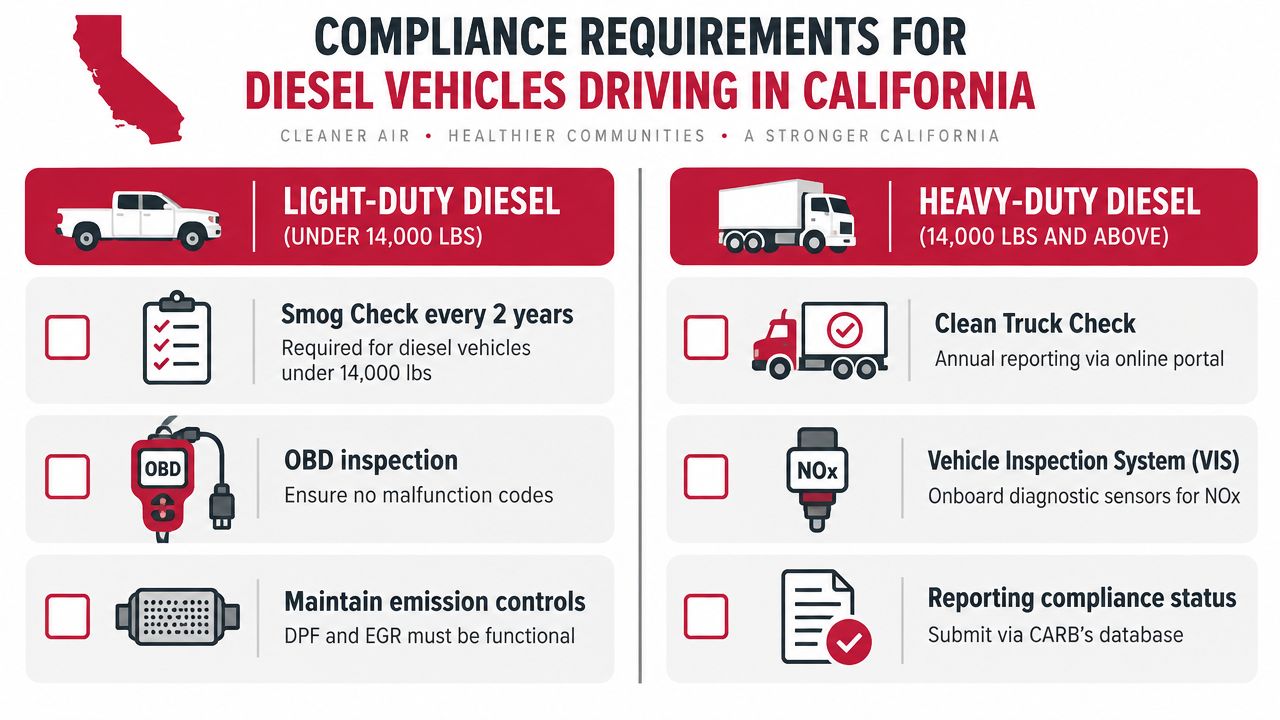
A diesel vehicle's compliance path starts with its use, weight, registration, and equipment, not its fuel type. A light-duty diesel renewing California registration generally follows the regular Smog Check process. A heavy-duty vehicle operating on California public roads may instead fall under Clean Truck Check, including some vehicles registered outside California.
Light-duty diesel vehicles
For a qualifying light-duty diesel vehicle, the inspection may include an OBD check, visual examination of emissions equipment, and an emissions test suited to the vehicle and program requirements. The model year, weight, registration circumstances, and DMV notice determine whether testing is required.
Before scheduling, gather the renewal notice, registration information, and recent repair records. If the malfunction indicator lamp is on, do not erase the codes just before testing. Clearing them can leave readiness monitors incomplete, much like resetting a checklist before all its items have been verified. The vehicle may then be unable to receive a clean result.
A STAR-certified test-only station performs inspections without selling repair work. That separation lets you obtain the test result first and choose a repair provider independently. It can also help connect statewide emissions rules with the condition of one vehicle in the neighborhood where it is driven and tested.
Heavy-duty vehicles and Clean Truck Check
CARB says nearly all diesel and alternative-fuel heavy-duty vehicles over 14,000 pounds operating on California public roads must comply with Clean Truck Check. The requirement includes out-of-state vehicles, motorcoaches, transit vehicles, school buses, and California-registered motorhomes, as stated in the Clean Truck Check FAQ and program information.
Testing began October 1, 2024, and the first compliance deadline was January 1, 2025, according to the same CARB information. Clean Truck Check includes reporting and compliance fees, so passing a regular light-duty smog inspection does not automatically satisfy a heavy-duty obligation. An interstate operator therefore needs to check California's requirements separately rather than relying only on the rules from the vehicle's home state.
| Vehicle situation | Main question |
|---|---|
| California light-duty diesel | Does the DMV require a Smog Check for this renewal or transfer? |
| Out-of-state heavy-duty truck | Does it operate on California public roads and exceed the applicable weight threshold? |
| Diesel motorhome | Is it over the applicable heavy-duty threshold and operating in California? |
| Fleet vehicle | Has the operator completed reporting and the required testing? |
CARB's program schedule calls for OBD-equipped vehicles to move to quarterly testing scheduled to begin in October 2027, as described in the agency's Clean Truck Check information. Fleet managers should track each vehicle separately. One completed inspection does not cover the entire operation.
Testing Exemptions and What Happens If Your Diesel Fails
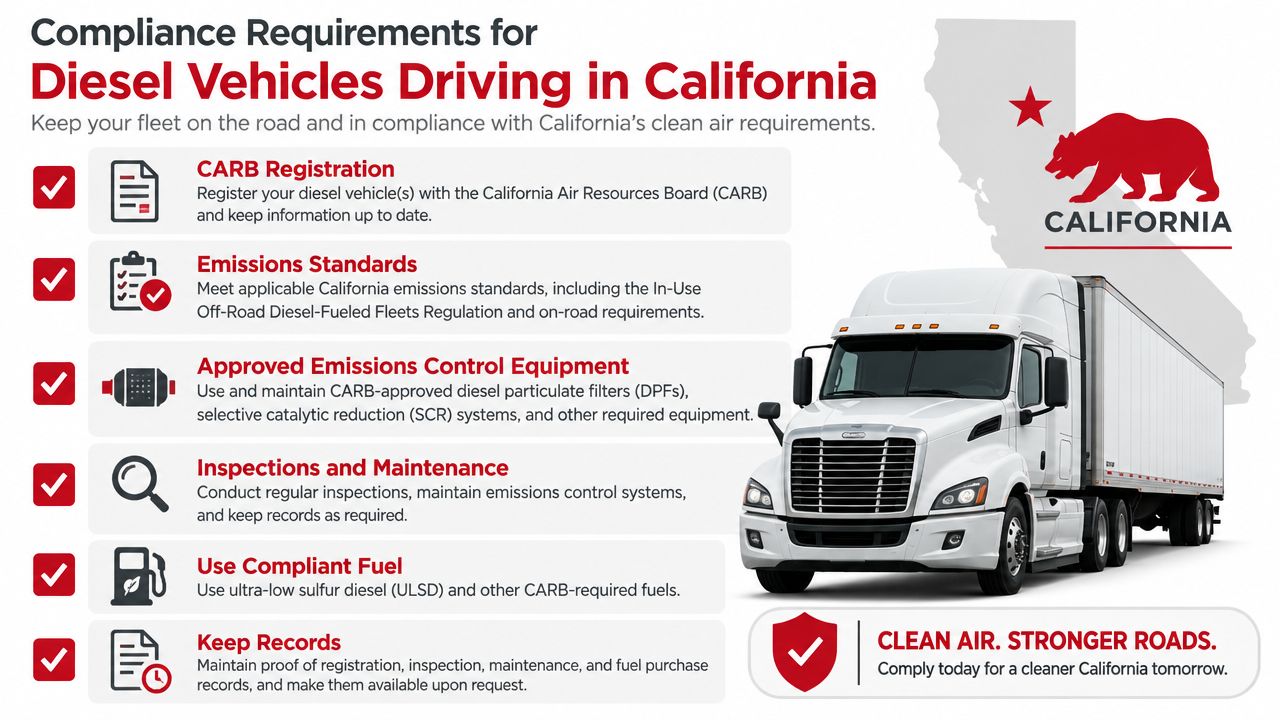
A failed result doesn't always mean the engine needs major work. It means the vehicle didn't meet one or more inspection conditions, and the result should identify the area that needs attention. The right next step depends on whether the issue is a warning lamp, incomplete monitor, visual defect, or measured emissions problem.
| Outcome or Exemption | Who It Applies To | Required Action |
|---|---|---|
| No Smog Check requested | Owners whose DMV notice or vehicle circumstances don't require a test | Confirm the exemption or non-test status with the DMV before assuming registration is complete |
| Pass | Vehicles that meet the applicable inspection requirements | Submit or retain the certificate as directed by the DMV or program |
| Fail with a warning lamp | Vehicles with an active emissions-related fault | Diagnose the stored code, repair the cause, and complete the required retest |
| Fail with incomplete monitors | Vehicles recently cleared of codes or disconnected from battery power | Drive only as appropriate for monitor completion, then follow station guidance |
| Visual inspection failure | Vehicles with missing, disconnected, or visibly altered emissions equipment | Restore compliant hardware before returning for inspection |
| Heavy-duty compliance issue | Vehicles covered by Clean Truck Check that lack required testing, reporting, or compliant results | Complete the applicable CARB process rather than relying on a light-duty certificate |
The table is a decision aid, not a substitute for the exact notice or CARB classification. Exemptions can depend on vehicle type, weight, fuel, registration, and use. Out-of-state registration alone doesn't remove a covered heavy-duty vehicle from California's operating requirements.
Common failure patterns
A DPF can deteriorate, sensors can report implausible readings, and NOx control hardware can stop working as designed. These problems may increase particulate matter or NOx without producing dramatic smoke. The engine computer may detect them before the driver notices a change in performance.
An incomplete monitor is different from a failed emissions measurement. It often means the computer hasn't completed the self-check needed for certification. If a repair shop clears codes and immediately sends the vehicle to a station, the monitors may not be ready.
Before a retest: Keep the failure report, ask which monitor or component caused the result, and make sure the repair provider confirms readiness before you return.
A test-only facility can provide an independent result, but it won't replace a qualified repair diagnosis. For diesel-specific preparation and inspection guidance, review this diesel smog test guide.
Practical Guidance for Staying Compliant With Confidence
Antioch and East Contra Costa County drivers can make the process easier by treating the smog visit as a scheduled compliance task, not a last-minute DMV emergency. Start with the notice, confirm the vehicle category, and check whether the vehicle has an active warning lamp or recent emissions-system repair.
Use this short preparation list:
- Bring the essentials: Take the DMV notice, current registration information, and any repair or diagnostic paperwork.
- Check the dashboard: Resolve an illuminated emissions warning before testing, and don't clear codes immediately beforehand.
- Protect the equipment: Don't remove, bypass, or disconnect the DPF, EGR, catalyst, SCR, or related sensors.
- Confirm the station fit: Call ahead for larger vehicles, RVs, or motorhomes because bay and equipment limits can vary.
- Plan the timing: Seven-day smog testing and extended weekday and weekend hours can help working drivers avoid a rushed visit.
- Ask about retesting: If the vehicle fails, keep the result and confirm whether a free retest applies under the station's current policy and coupon terms.
A STAR-certified test-only model can reduce concern about being pushed into repairs at the same location because the station doesn't sell repair work. Fire House Smog also provides on-site DMV renewal services with tag issuance at 2900 Lone Tree Way, with DMV service hours Monday through Saturday from 9:30 AM to 5:00 PM and Sunday from 12:00 PM to 4:00 PM. Smog testing is available seven days a week, and customers can call ahead at 925-754-1600.
For additional maintenance habits that support cleaner operation, read this guide on reducing vehicle emissions.
Fire House Smog provides STAR-certified test-only smog inspections for qualifying diesel vehicles, along with California DMV renewal and registration services at its Antioch location. Bring your vehicle to Fire House Smog, or call 925-754-1600 to confirm eligibility, available hours, and retest details before you visit.
You're staring at a California registration renewal notice, and the check engine light is glowing on your 2013 Camry. The car starts, drives normally, and doesn't seem to be making unusual noise. That doesn't matter at the smog station. In California, the check engine light, formally called the malfunction indicator lamp, is a regulatory trigger tied directly to the vehicle's emissions inspection.
The right move isn't to gamble on a quick test or erase the warning before you arrive. Diagnose the fault, repair the cause, let the vehicle complete its required self-tests, and only then book the inspection. That sequence prevents the wasted inspection fee and the second trip that follows a predictable failure.
Table of Contents
- What the Check Engine Light Means for Your California Smog Test
- How California Treats an Illuminated MIL During Inspection
- What Happens During the OBD-II Portion of the Smog Check
- Quick Pre-Test Checks You Can Do Before Booking
- Temporary Fixes Versus Professional Diagnostics
- Retest Options and Fire House Smog Policies
- Your Pre-Smog Checklist Before You Drive In
What the Check Engine Light Means for Your California Smog Test
California's Bureau of Automotive Repair treats the MIL as part of the OBD-II inspection, not as a suggestion for the driver. If the lamp is illuminated while the engine is running, the vehicle fails the applicable inspection under the California Smog Check Program. The vehicle can run smoothly, accelerate normally, and still fail because the computerized emissions system has reported a malfunction.
The lamp also has to behave correctly during the dashboard check. With the key on and the engine off, the MIL should illuminate. After the engine starts, it should turn off. That sequence confirms the warning circuit is present and responding rather than removed, disabled, or malfunctioning.
Vehicle age changes the inspection path
OBD-II applies to 1996 and newer gasoline-powered passenger vehicles and light-duty trucks, and to 1998 and newer diesel vehicles, according to BAR's OBD test reference. Newer vehicles receive an OBD-based evaluation, while older vehicles can follow different inspection procedures depending on their model year and equipment.
That means a driver shouldn't apply advice for an older car to a modern vehicle. The exact inspection path depends on the vehicle's fuel type, model year, and applicable Smog Check requirements.
Your decision path is straightforward:
- The light is on while running. Don't book the test yet. Get the fault diagnosed.
- The light was recently cleared. Don't assume the car is ready. Check the readiness monitors.
- The light is off and monitors are ready. A pre-test scan can confirm whether booking makes sense.
- The vehicle fails. Keep the Vehicle Inspection Report, complete the listed repairs, and ask the station about retest eligibility.
Practical rule: A smooth-driving car with an illuminated MIL is still a likely smog failure. The lamp's status matters before the inspector evaluates anything else.
How California Treats an Illuminated MIL During Inspection
The inspection begins with a functional question: does the MIL display the required behavior? California's OBD procedure treats the lamp status as a pass/fail item for applicable OBD-II vehicles. BAR states that a vehicle won't pass Smog Check with the check engine light on, so an inspector can't overlook the warning because the vehicle feels fine on the road.
A normal bulb check isn't a failure. With the key on and the engine off, the MIL should light with the other dashboard indicators. Once the engine starts, it should go out. A steady light while the engine is running indicates that the vehicle's system has commanded the lamp on, and that status produces a failure.
A flashing light deserves immediate attention. It commonly signals an active misfire that can damage the catalytic converter, so driving around hoping it disappears is a poor decision. Whether steady or flashing, an illuminated MIL does not become acceptable because the car passes a quick visual glance.
The cleared-code trap
Clearing trouble codes or disconnecting the battery can turn the dashboard light off temporarily, but it also resets readiness monitors. After emissions repairs, the vehicle must complete the relevant self-tests through normal driving or a manufacturer-specified drive cycle. The BAR explanation of the updated readiness rules makes the key point clear: a cleared lamp alone doesn't prove that the emissions system has verified the repair.
As of October 1, 2025, California requires all applicable readiness monitors to be set for a vehicle to pass, subject to limited fuel-type and model-year allowances described by BAR in its OBD test reference. A recently cleared code can therefore create a separate readiness failure even when the MIL is currently dark.
| MIL Status | Inspector Interpretation | Smog Outcome |
|---|---|---|
| Illuminated with engine running | The OBD system has commanded the lamp on | Fail |
| Illuminated during key-on, engine-off, then off after starting | Normal bulb-check sequence | Continue with the inspection |
| Does not illuminate during key-on, engine-off | Lamp circuit or required display behavior is not verified | Fail |
| Flashing while engine is running | Active fault condition requires prompt diagnosis | Do not test before diagnosis |
| Recently cleared and lamp off | Lamp status may look normal, but monitors may be incomplete | Possible readiness failure |
What Happens During the OBD-II Portion of the Smog Check
At an OBD-equipped station, the technician connects the inspection equipment to the vehicle's diagnostic link connector, commonly called the DLC. The equipment communicates with the vehicle's computer and retrieves the information needed for the official inspection record.
The scan evaluates more than the dashboard lamp. It can capture the vehicle identification information, MIL command status, whether the MIL has been on since the last code clear, stored diagnostic trouble codes, and readiness monitor results. These data points show whether the vehicle's emissions controls have completed their required self-checks and whether the computer has detected a reportable malfunction.
Ready and incomplete monitors
A readiness monitor marked ready has completed its applicable self-test. An incomplete or not-ready monitor hasn't finished the conditions needed for the system to evaluate that emissions component. Battery disconnection and code clearing can return monitors to an incomplete state, which is why arriving immediately after either event is risky.
Under California's current framework, the allowable monitor status depends on fuel type and model year. BAR's guidance describes limited allowances for certain vehicle groups, while the readiness rules effective October 1, 2025 require applicable monitors to be set, with exceptions handled according to the state's criteria.
You can learn more about how these self-tests work in this guide to OBD readiness monitors. The important practical point is that a scan tool reading isn't a repair. It only reports what the vehicle computer currently knows.
The technician then records the inspection results through the BAR inspection system. If the vehicle identification information raises an eVIN issue, the inspection may require an additional visual verification. A damaged, missing, or unreachable diagnostic connector can also prevent the required electronic inspection from being completed.
At the end, the station provides the BAR-OIS printout, which serves as the official record of the inspection. If the vehicle fails, keep that document. It identifies the failed items and gives the repair shop a starting point instead of leaving everyone to guess.
Quick Pre-Test Checks You Can Do Before Booking
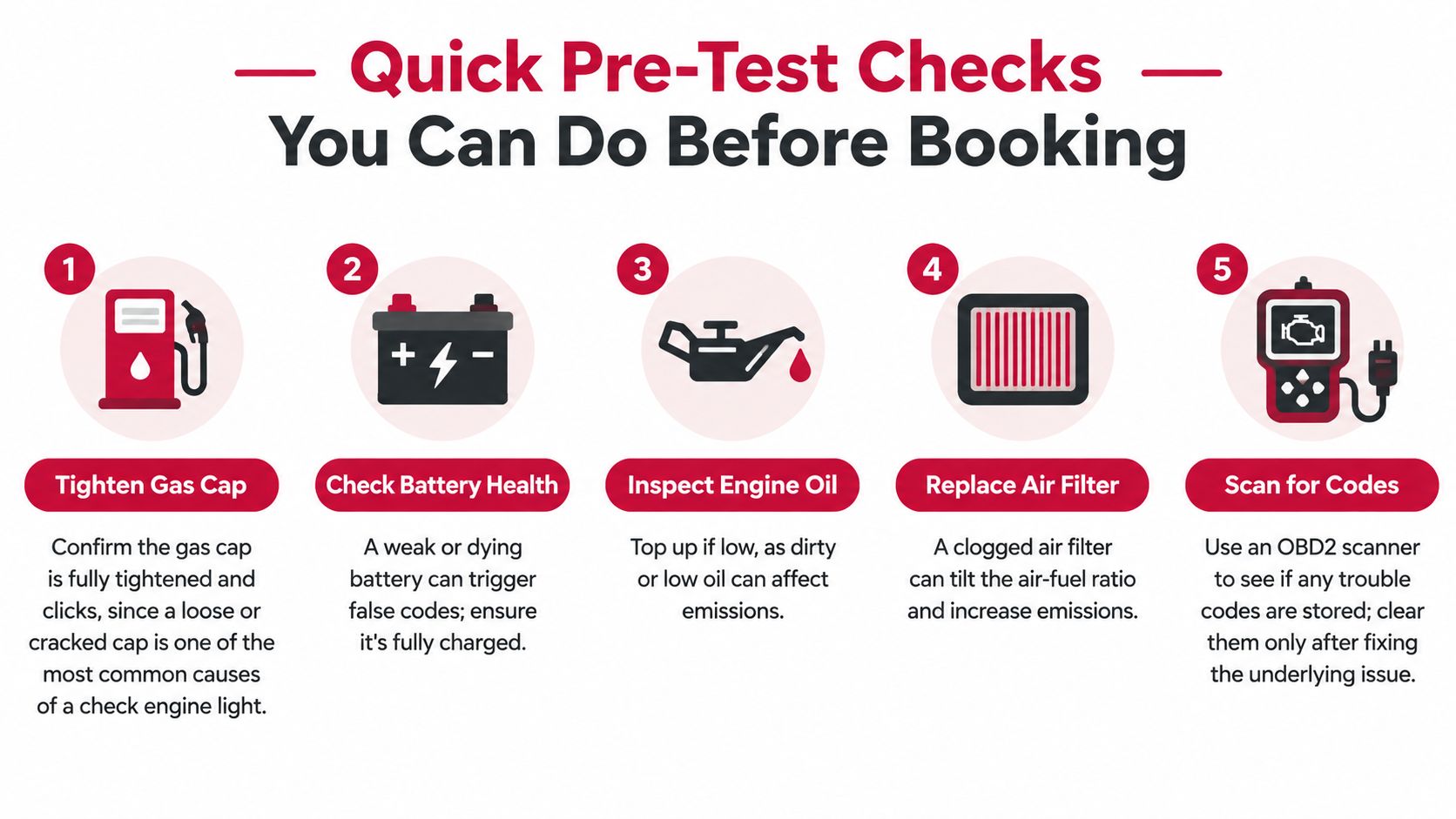
A few checks at home can keep you from paying for an inspection your vehicle was never ready to pass. Start with the gas cap. Remove it, inspect the seal for visible damage, reinstall it, and tighten it until it clicks. A loose or damaged cap can trigger an evaporative-emissions fault, and it's one of the easiest possibilities to rule out.
Then review what happened before the warning appeared. If the battery was disconnected or a code was cleared, the vehicle needs normal driving so its emissions monitors can rerun. A mixture of stop-and-go and highway driving gives the system varied operating conditions, but the manufacturer's drive-cycle instructions may be necessary for monitors that are difficult to set.
Use the dashboard and scanner together
Before starting the engine, look at the instrument cluster. Confirm that the MIL illuminates during the key-on check and then turns off after startup. A dim, intermittent, or missing lamp isn't something to ignore, because the inspection checks the lamp's commanded behavior.
If you have access to an inexpensive OBD-II scanner, read the stored codes and monitor status without erasing anything. You want the scanner to show no active MIL command and the applicable monitors in a ready state. A parts store scan can identify a code, but it usually isn't a full diagnosis.
What not to do
Don't clear the codes just before the appointment. The light may disappear, but the monitors can revert to not ready, creating a different reason for failure. If the MIL returns after you've driven normally, stop treating the problem as a cosmetic dashboard issue and arrange proper diagnostics.
Temporary Fixes Versus Professional Diagnostics
The shortcuts are familiar. Someone disconnects the battery, erases codes with a reader, installs a sensor borrowed from another vehicle, or pours in an additive advertised as an emissions fix. These actions may change what the dashboard shows, but they don't establish that the failed emissions component works.
A professional diagnostic process starts with the code and the conditions under which it appeared. A technician reviews freeze-frame information, tests the system with a capable scan tool, checks wiring and connectors, and isolates the actual cause. Depending on the fault, the repair could involve an oxygen sensor, catalytic converter, ignition component, fuel-control problem, or an EVAP leak.
Compare the choices honestly
| Approach | Typical Cost | Time | Smog Test Outcome Risk |
|---|---|---|---|
| Clear codes or disconnect the battery | Tool or battery-service cost may apply | Immediate dashboard change | High, because monitors can become not ready and the fault may return |
| Replace a part based only on a code | Varies by component and vehicle | Repair time plus monitor drive time | High if the code identifies a system rather than the failed part |
| Use an additive product | Product purchase and application time | Short-term | High, because it doesn't verify the underlying repair |
| Professional diagnosis and repair | Depends on the fault and labor required | Diagnosis, repair, then monitor completion | Lower, because the cause is tested and the vehicle can verify the repair |
Use a code reader as a screening tool, not as permission to erase the evidence. If the light returns, the vehicle runs roughly, or a monitor stays incomplete, pay for diagnosis before paying for another inspection. The common reasons for a smog failure can help you understand the report, but they can't replace vehicle-specific testing.
Fire House Smog operates as a test-only station, so it performs the inspection rather than selling in-house repairs. That separation can be useful when you want an inspection result and a clear failure report before choosing where to repair the vehicle.
Retest Options and Fire House Smog Policies
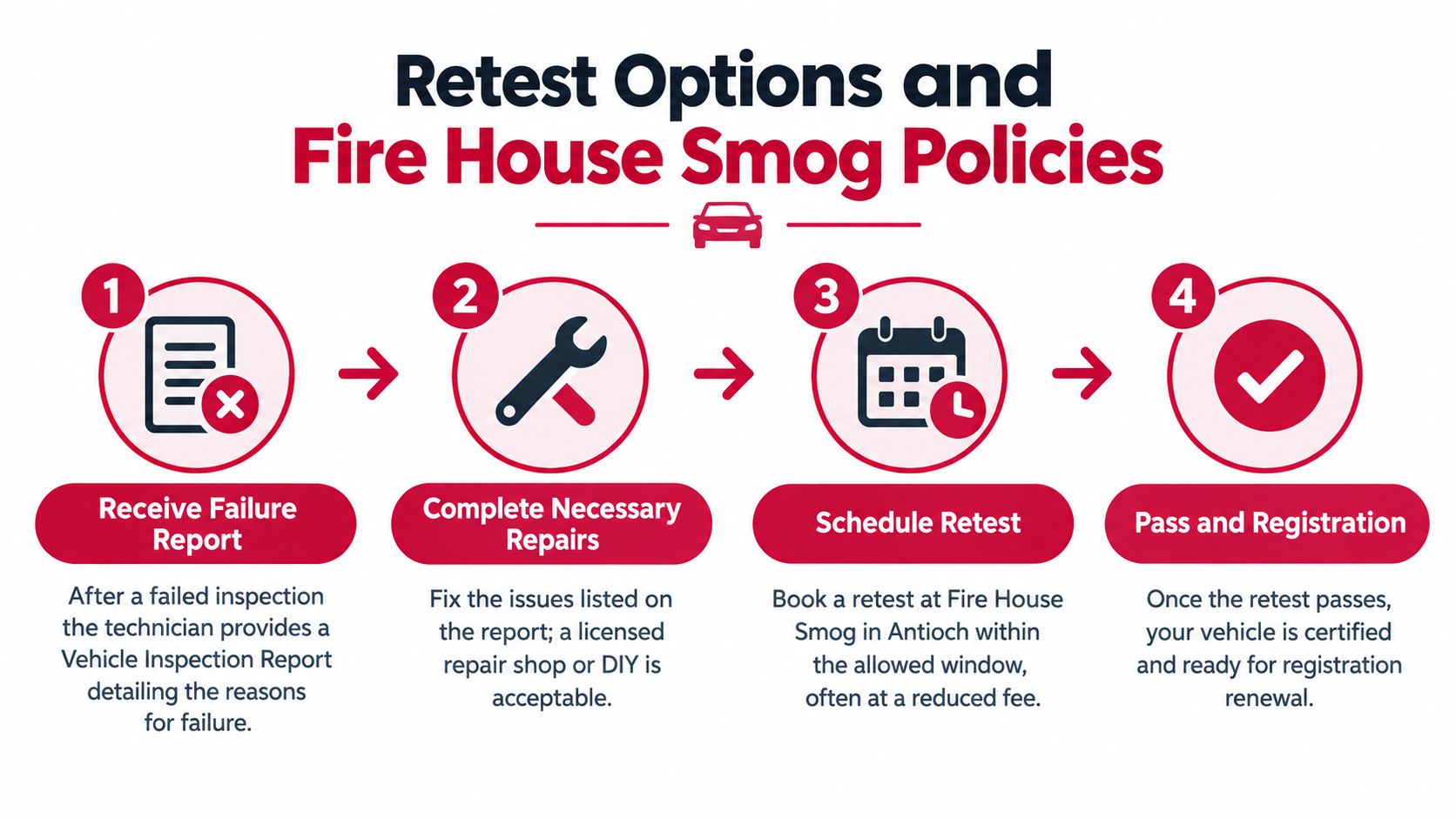
A failed inspection isn't the end of the registration process, but it is a document-driven process from that point forward. The technician provides a Vehicle Inspection Report, or VIR, showing the items that caused the failure. Read that report before authorizing repairs, because the listed failure may concern MIL status, readiness, trouble codes, or another inspection requirement.
The repair location depends on the vehicle's inspection category and the instructions on the report. Some vehicles may need a state-registered repair facility, and STAR, directed-repair, gross-polluter, or hardship situations can involve additional requirements. Don't assume any repair shop can handle every category.
Follow this order after a failure
- Keep the paperwork. Save the VIR and any printed diagnostic information.
- Repair the listed condition. Give the technician the exact failure details, not just “the car needs smog.”
- Allow verification time. After repairs, the vehicle must complete applicable self-tests and return to a ready state.
- Ask about retest eligibility. Fire House Smog's Antioch station offers a free or discounted retest within its defined policy window when the original inspection and qualifying repair work are completed at the same location, subject to site terms and coupon conditions.
- Bring documentation back. Take the prior VIR, repair invoices, identification, and any documents specified by the station.
Call before returning. The station can confirm whether your vehicle qualifies for the applicable retest policy, what repair documentation is needed, and whether a directed or STAR-related requirement changes the process. That short call is more useful than driving back with incomplete paperwork.
The retest still evaluates the vehicle under California's inspection rules. A free or reduced retest doesn't waive the MIL requirement or readiness requirements. It only reduces the cost and inconvenience when the vehicle and documentation meet the station's policy.
For a fuller explanation of the next steps, review what happens after a failed smog test. Repair first, verify the monitors, then schedule the return inspection.
Your Pre-Smog Checklist Before You Drive In
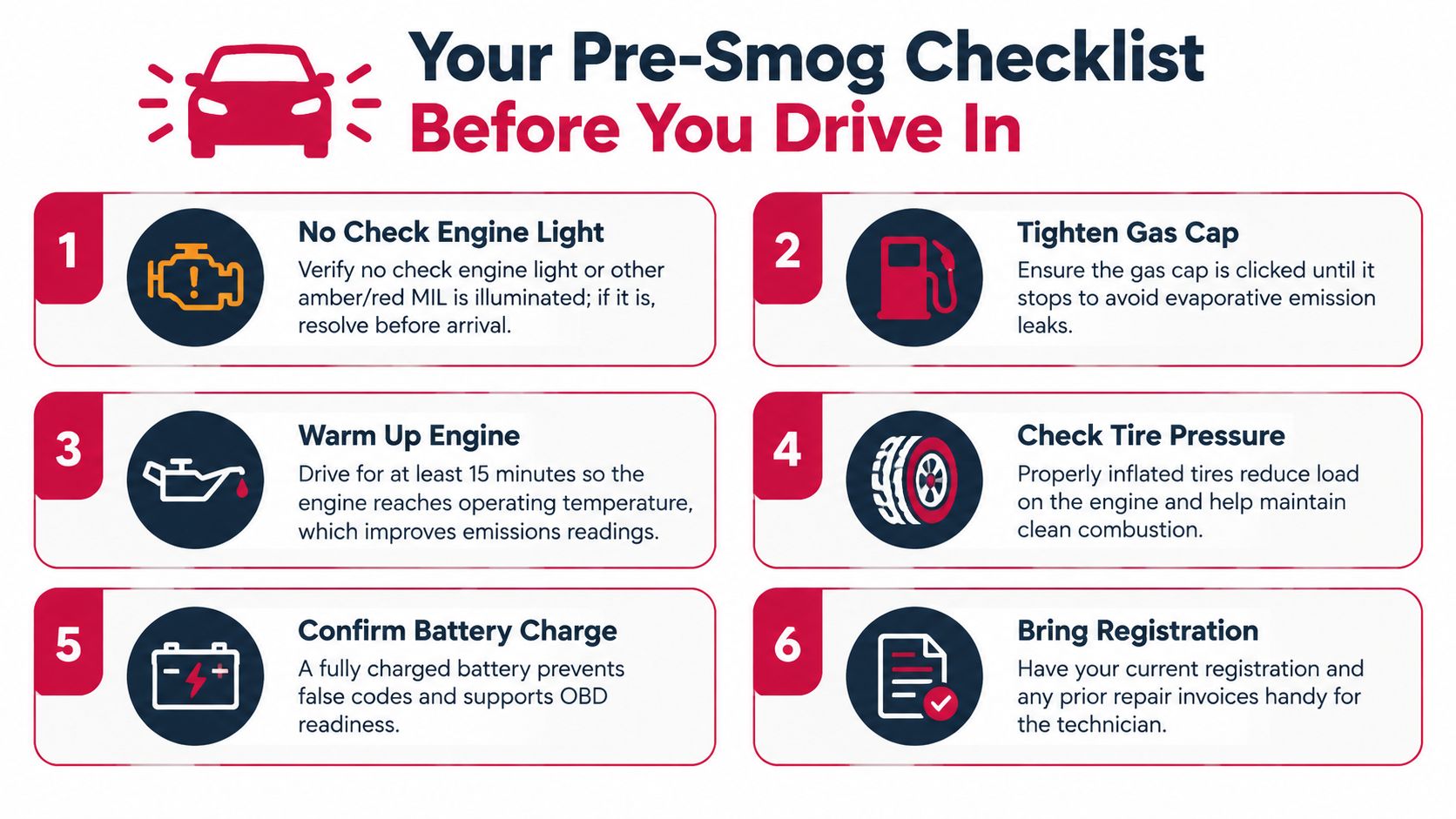
The final check should happen before you leave home, not after the technician connects the OBD equipment. Look at the dashboard with the key on and the engine off, start the vehicle, and confirm the MIL follows the normal sequence. If it stays on, stop there and arrange diagnosis.
Confirm that the battery hasn't recently been disconnected and that no one has erased codes since the last repair. A battery event can reset monitor status, so a dark dashboard light doesn't automatically mean the vehicle is ready for certification.
Run through these final decisions
- Dashboard warning light: The MIL should be off after startup. An illuminated lamp needs diagnosis before testing.
- Gas cap: Tighten it securely and inspect for obvious seal damage.
- Engine warm-up: Drive for at least 15 minutes before arrival, as specified in the preparation guidance provided for this inspection context. This helps bring the engine to operating temperature, but it doesn't replace required monitor completion.
- Fuel level: Keep the tank between one-quarter and three-quarters full when possible, unless your vehicle manufacturer or repair technician gives different instructions.
- Battery condition: Make sure the battery is charged and the vehicle starts normally.
- Documents: Bring your registration, prior VIR, repair invoices, and identification when they apply.
Fire House Smog in Antioch provides STAR-certified, test-only smog inspections and handles California DMV registration services at its Lone Tree Way location. If your vehicle has failed before or recently had emissions work, call ahead to confirm retest eligibility and required paperwork before scheduling.
The practical answer to the California smog test check engine light problem is simple: don't hide the warning, fix the cause, and verify readiness before you test. That approach gives the inspection a real chance to pass and leaves you with documentation if it doesn't.
If your check engine light is on, have the vehicle diagnosed first, then bring the repaired and monitor-ready vehicle to Fire House Smog in Antioch for a STAR-certified test-only inspection. Call ahead about retest eligibility, required documents, and the station's free or discounted retest policy before you make the trip.
You're trying to renew your California registration, sell a diesel pickup, or bring an out-of-state vehicle into the state. The DMV notice says a smog check may be required, but the rules seem inconsistent. An older diesel may be exempt from the standard inspection, while a newer, clean-running truck can fail because its onboard diagnostic monitors aren't ready.
The answer depends on more than fuel type. Model year, gross vehicle weight rating, vehicle type, and the applicable emissions program determine what you need to do. California uses one system for lighter diesel vehicles and separate programs for heavier commercial vehicles, so starting with the wrong assumption can waste a trip to the station.
Table of Contents
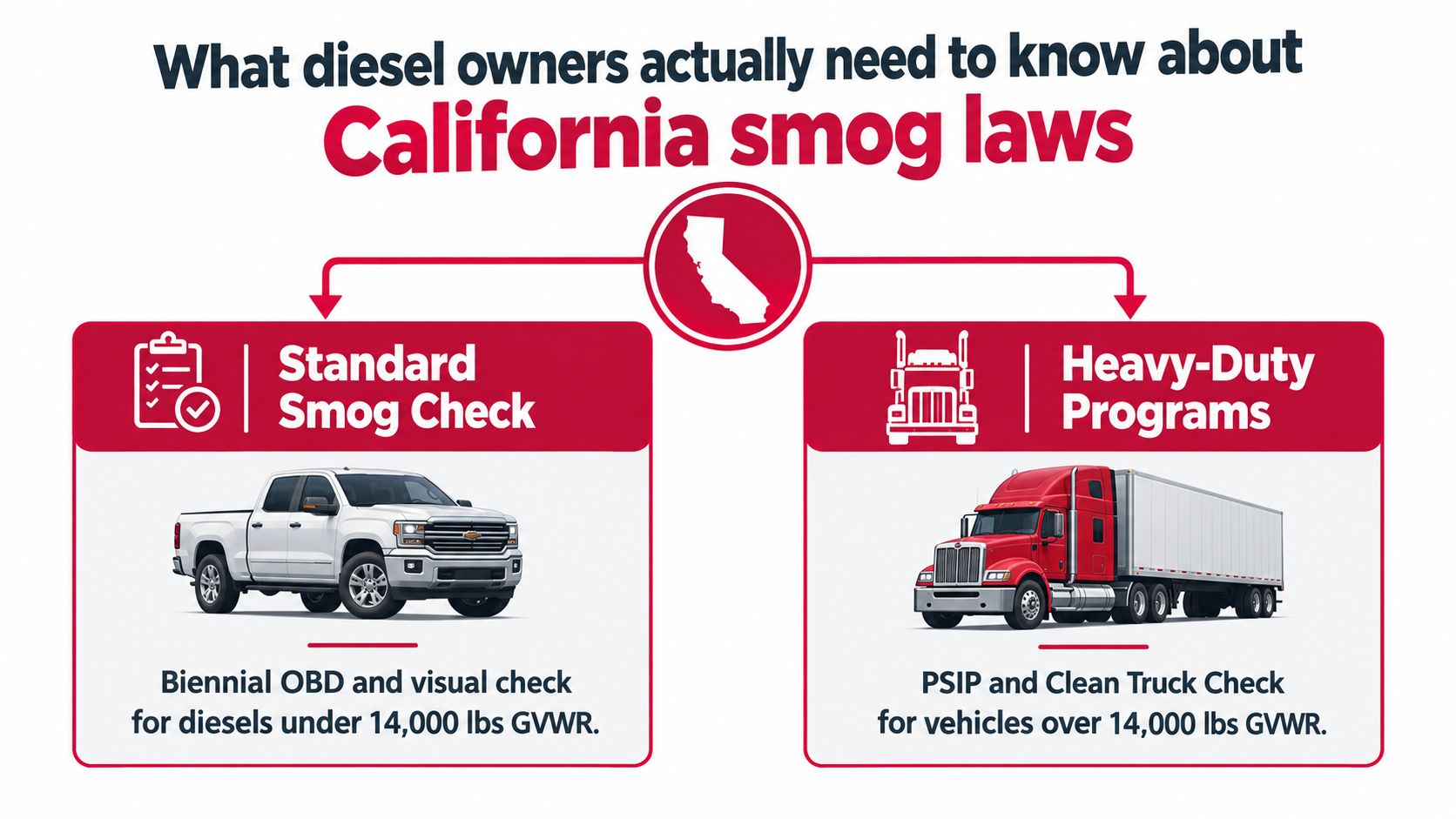
- What diesel owners actually need to know about California smog laws
- Which diesel vehicles fall under the light-duty Smog Check program
- OBD readiness rules that decide whether a newer diesel passes
- Heavy-duty diesel rules beyond the standard smog check
- Common exemptions and exclusions for diesel vehicles
- Real-world scenarios for individual owners and small fleets
- Repair, retest, and penalty steps to stay compliant
- Putting it together, your diesel smog compliance checklist
What diesel owners actually need to know about California smog laws
California diesel compliance has two main tracks. The first is the light-duty Smog Check Program, which covers many diesel cars, SUVs, vans, and pickups. These vehicles receive an emissions inspection that combines onboard diagnostics, emissions-equipment checks, and other applicable inspection procedures.
The second track covers heavier vehicles. Diesel vehicles outside the light-duty Smog Check boundary may fall under the Periodic Smoke Inspection Program, commonly called PSIP, and the Truck and Bus Regulation. The California Air Resources Board explains that heavy-duty diesel vehicles registered in California and meeting the applicable weight and age conditions became subject to annual PSIP requirements beginning October 21, 2010, while the Truck and Bus Regulation has operated since December 2008. See the CARB enforcement advisory on the Periodic Smoke Inspection Program for the separate heavy-duty framework.
Start with three questions
Before booking anything, identify:
- What model year is the vehicle? Diesel vehicles from 1998 and newer are generally within the light-duty Smog Check program when they meet the weight requirement. Diesel vehicles from 1997 and older are outside that standard inspection program.
- What is the GVWR? The light-duty boundary is 14,000 pounds GVWR or less. Check the manufacturer's door-placard rating, not the vehicle's current cargo weight.
- What type of vehicle is it? A personal diesel pickup and a commercial heavy-duty truck can face different rules even when both use diesel fuel.
California's diesel policy expanded in stages. The Bureau of Automotive Repair Smog Check guidance identifies January 1, 2010, as the point when Assembly Bill 1488 brought qualifying diesel passenger vehicles and trucks into the program. That history explains why diesel owners often encounter rules that look like a mixture of registration testing, diagnostic checks, smoke inspection, and fleet emissions regulation.
For a broader explanation of emissions equipment and standards, review diesel emissions standards. The rest of the process becomes much easier once you know which side of the 14,000-pound GVWR line your vehicle occupies.
Which diesel vehicles fall under the light-duty Smog Check program
A diesel vehicle generally belongs in California's regular Smog Check lane when it is model year 1998 or newer and has a GVWR of 14,000 pounds or less. That includes many diesel passenger cars, SUVs, vans, and pickups used privately or for lighter work. The California DMV smog inspection guidance uses the same model-year and weight boundary.
The GVWR is the manufacturer's maximum rated operating weight for the vehicle, including occupants and cargo. It isn't the truck's current scale weight. Find the rating on the driver-side door placard, then compare it with the model year listed on the title or registration record.
Use the eight-year timing rule
For a vehicle subject to biennial testing, the first inspection timing can be calculated by adding eight years to the model year, as described in the BAR reference guidance. A 2010 model-year diesel first becomes subject to a biennial Smog Check in 2018, while a 2017 model-year diesel first becomes due in 2025. After that first inspection, the vehicle generally follows the biennial cycle when the DMV requires certification.
| Model Year | GVWR | First Smog Check Due | Station Type |
|---|---|---|---|
| 1997 and older | Any light-duty rating | Exempt from the standard light-duty Smog Check | No standard light-duty test |
| 1998 and newer | 14,000 pounds or less | Add eight years to the model year, subject to DMV requirements | Licensed Smog Check station |
| 1998 and newer | Over 14,000 pounds | Not handled through the light-duty lane | Heavy-duty CARB programs |
A diesel Volkswagen TDI, Mercedes-Benz Bluetec, light-duty Duramax pickup, or Power Stroke pickup may therefore follow the same basic registration-testing path as other vehicles in the light-duty category. The badge, engine size, and body style don't decide the program by themselves. GVWR and model year do.
Don't confuse station categories
The station type matters, but owners often overcomplicate it. A light-duty diesel owner should choose a station licensed and equipped to inspect that vehicle. If the DMV notice or vehicle record directs you to a STAR station, use a STAR-certified location.
Diesel vehicles have special diagnostic requirements, especially newer models. Call before arriving if the vehicle is unusually large, modified, or an RV, because bay and equipment limits can vary. A station that handles ordinary passenger vehicles may not be able to inspect every commercial or recreational diesel.
OBD readiness rules that decide whether a newer diesel passes
A diesel can start normally, produce no visible smoke, and still fail the smog check because its OBD readiness monitors haven't completed. These monitors are self-tests run by the engine control system. They check whether emissions-related components and systems have performed their required diagnostic routines.
The technician also checks for an illuminated malfunction indicator light and stored emissions faults. Clearing a code may turn the dashboard light off temporarily, but it can reset the monitors to incomplete. That creates a common trap: the owner fixes or clears a problem immediately before the appointment, then arrives with a vehicle that hasn't completed the required drive conditions.
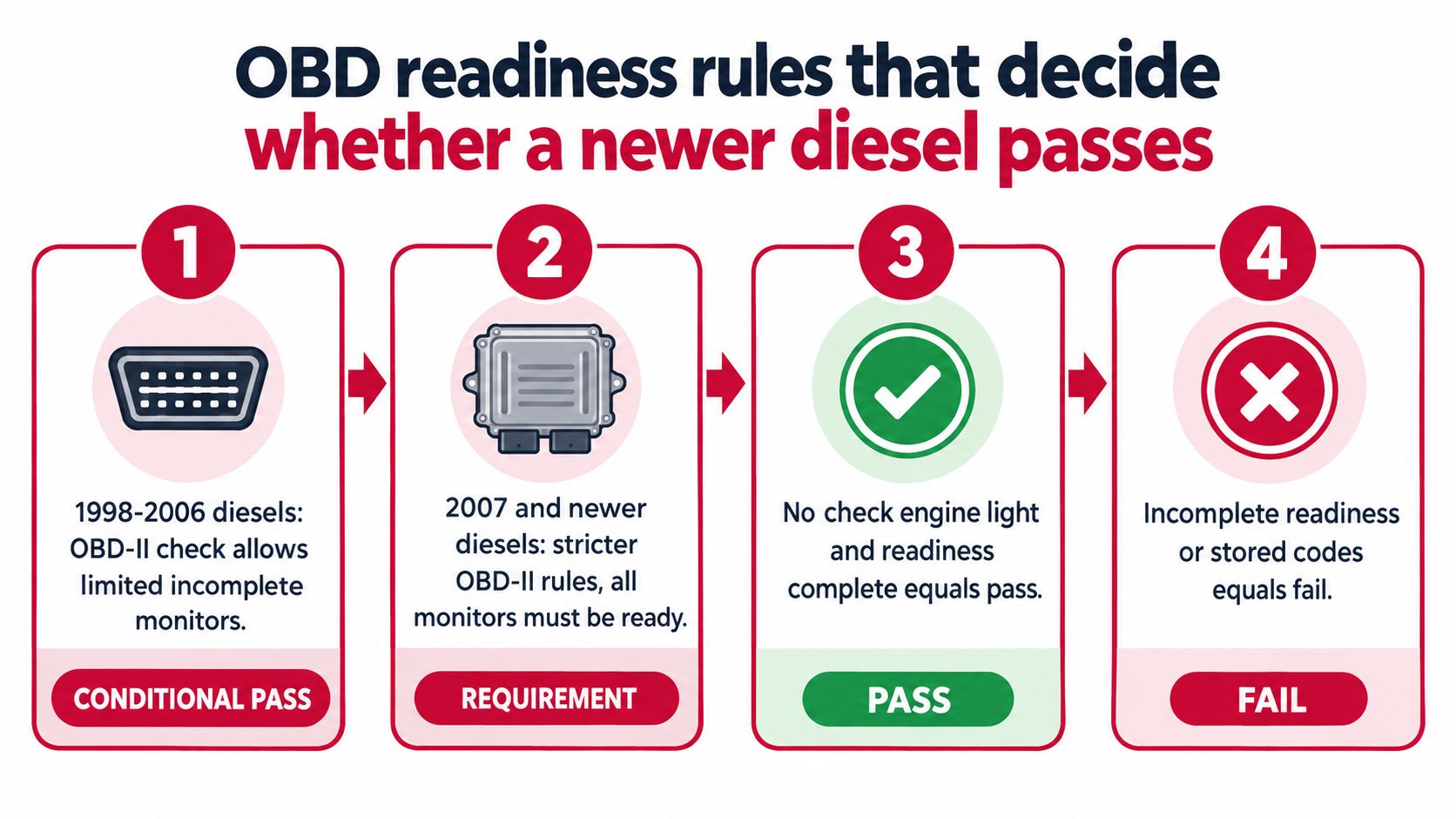
The rules differ by diesel generation
For older OBD-equipped diesels, the applicable readiness standard allows limited incomplete monitors. The exact result depends on the vehicle's model year and the monitor status reported by the diagnostic system.
For 2007 and newer light-duty diesel vehicles, California tightened the readiness requirements beginning in July 2023. The BAR announcement on the updated diesel requirements states that only the Diesel Particulate Filter monitor and the Non-Methane Hydrocarbon Catalyst monitor may remain unset. All other applicable monitors must be ready.
That change matters because the permitted exceptions are narrow. A vehicle with an incomplete monitor after a battery disconnect, ECM reset, software reflash, or code clear may not qualify for a passing result even if it drives well.
Practical rule: Don't clear codes or disconnect the battery immediately before a smog appointment. Repair the cause first, then allow the vehicle to complete the manufacturer's required drive conditions.
Prepare the diagnostic system, not just the engine
After a repair, ask the technician what drive-cycle conditions the vehicle needs. Some monitors require a cold start, steady cruising, stop-and-go operation, or specific temperature conditions. A generic freeway drive may not complete every monitor on every diesel.
You can use an OBD scan tool to see whether monitors show “ready” or “not ready,” but a readiness check isn't a guarantee of a pass. The station still has to inspect the vehicle and evaluate applicable faults and emissions equipment. For a plain-language explanation of monitor status, see OBD readiness monitors.
The video below can help visual learners understand how diagnostic readiness affects emissions testing.
Heavy-duty diesel rules beyond the standard smog check
A diesel vehicle over 14,000 pounds GVWR generally doesn't use the ordinary light-duty Smog Check path. It enters a separate compliance environment administered primarily through CARB. That environment can include the Periodic Smoke Inspection Program, the Truck and Bus Regulation, and other heavy-duty requirements that apply according to the vehicle, engine, fleet, and operating conditions.
PSIP focuses on smoke emissions from covered diesel vehicles and buses. Depending on the vehicle and operator, compliance can involve inspections, records, self-certification, roadside enforcement, and station-based testing. A fleet manager shouldn't treat a passing DMV smog certificate as a substitute for heavy-duty CARB compliance.
Engine year matters separately from vehicle year
The Truck and Bus Regulation adds a second layer. CARB states that, as of January 1, 2023, diesel-powered vehicles operating in California with a GVWR over 14,000 pounds generally must have a 2010 or newer engine and emission system, subject to limited exceptions. The relevant engine year may differ from the vehicle's model year, particularly after an engine replacement.
That distinction affects purchasing, repairs, and fleet planning. A truck's cab may have one model year on its registration, while the installed engine carries a different emissions certification. Keep engine documentation with the vehicle records instead of relying only on the title.
Why California regulates smoke and particulate matter
CARB identifies diesel particulate matter as a toxic air contaminant, a designation adopted on August 27, 1998. That classification helps explain why California's diesel rules developed beyond a simple visible-smoke check. The state's framework addresses smoke, particulate emissions, engine age, emissions-control equipment, and fleet operation.
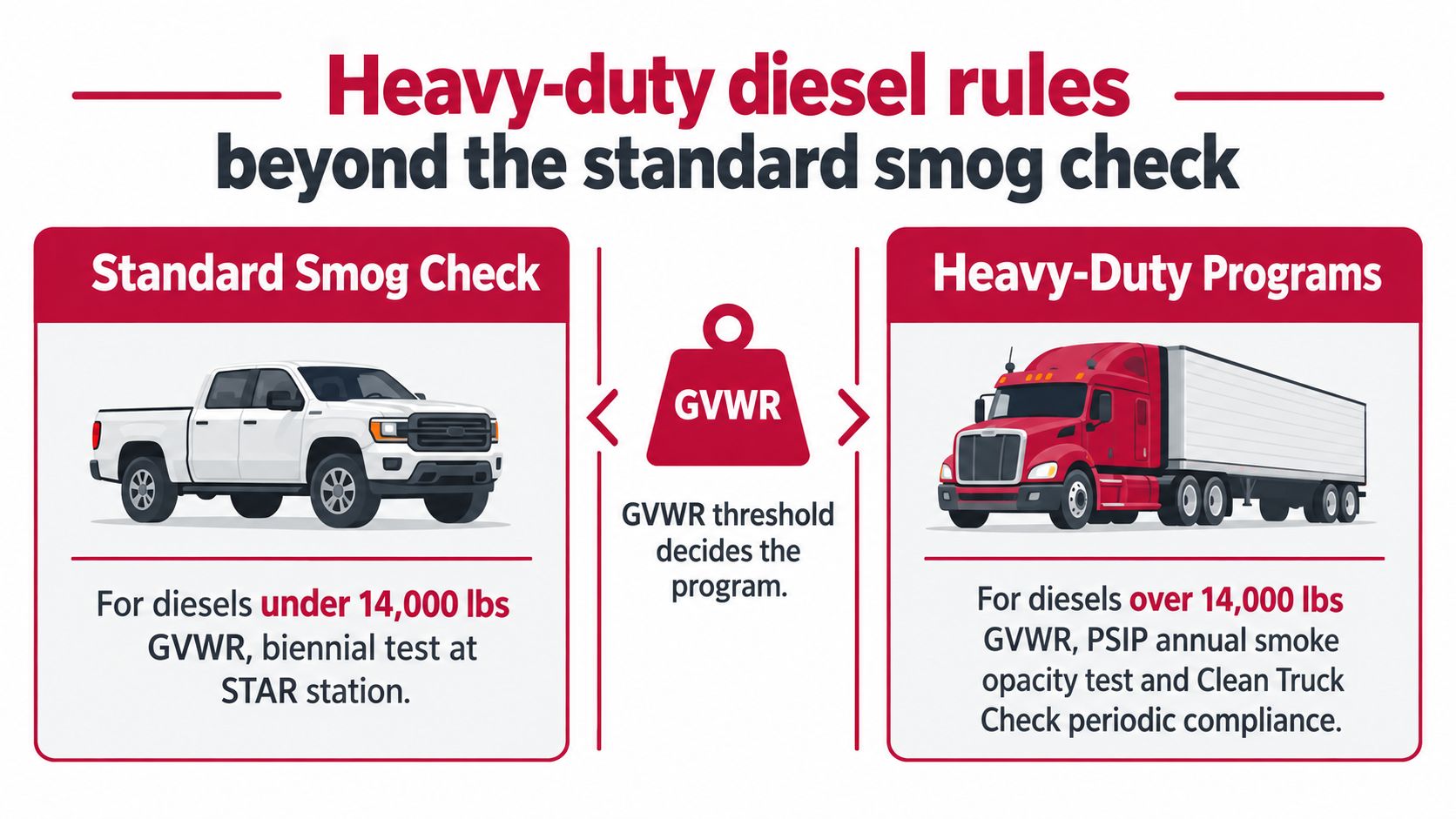
Fleet owners should build a unit-by-unit record showing GVWR, vehicle model year, engine model year, registration status, applicable CARB program, and inspection history. For heavy-duty compliance resources and service context, review clean air truck information, then confirm current obligations directly through CARB before operating or modifying a commercial vehicle.
Common exemptions and exclusions for diesel vehicles
Exemption questions cause many avoidable mistakes because “exempt from the standard Smog Check” doesn't always mean “free from every emissions rule.” A vehicle can sit outside DMV's light-duty inspection program and still face a CARB requirement based on weight, use, or commercial operation.
The clearest light-duty exclusion covers diesel vehicles from model year 1997 and older. Diesel vehicles over 14,000 pounds GVWR are also outside the standard light-duty Smog Check program, but they may fall into the heavy-duty programs described above. The BAR executive summary also identifies the light-duty coverage boundary for newer diesel vehicles.
Check the vehicle category before claiming an exemption
Some categories can be treated differently under the applicable program, including specialized off-road equipment, certain farm vehicles, military vehicles, and diesel-powered motorcycles. The registration classification and actual use matter. Don't rely on a seller's verbal assurance or an old forum post.
Newer vehicles may also be temporarily outside biennial or change-of-ownership testing. A current BAR reference guide identifies vehicles four model-years and newer as not subject to those tests. That timing rule is different from the older-diesel exclusion, so record the model year carefully.
| Vehicle category | Exempt from Smog Check? | Exempt from PSIP? | Documentation needed |
|---|---|---|---|
| Diesel, 1997 model year or older | Generally outside the standard light-duty program | Depends on weight, use, and coverage | Registration and vehicle records |
| Diesel, 1998 or newer, 14,000 pounds GVWR or less | Usually no, unless another exemption applies | Usually outside PSIP as a light-duty vehicle | DMV notice, registration, GVWR record |
| Diesel over 14,000 pounds GVWR | Outside the light-duty program | May be covered by heavy-duty requirements | GVWR, engine records, CARB records |
| Specialized farm, military, or off-road vehicle | May be excluded depending on classification and use | May be excluded or separately regulated | Registration class and use documentation |
| Four model-years and newer | Not subject to biennial or change-of-ownership checks under the applicable timing rule | Separate heavy-duty rules may still apply | Current registration and model-year record |
Out-of-state vehicles being registered in California can have separate first-registration requirements. An exemption from periodic testing doesn't automatically erase the need to meet California's applicable emissions standards when a vehicle is titled or transferred into the state.
Real-world scenarios for individual owners and small fleets
Maria owns a 2017 diesel Ram 1500 in Sacramento. Her renewal notice says a smog certificate is required, so she checks the door placard and confirms the truck falls within the light-duty GVWR boundary. She doesn't clear any diagnostic codes, drives it under the conditions recommended after maintenance, and checks the readiness status before booking a licensed inspection.
Her concern isn't the heavy-duty fleet rule. It's whether the truck's OBD system has completed its self-tests and whether the emissions equipment remains intact. If the vehicle is directed to a STAR station, she chooses a STAR-certified location and brings the renewal information and registration.
A small fleet faces a different decision
Devon manages four diesel box trucks for a delivery company. He starts by separating the vehicles according to GVWR and then records each engine model year, because the Truck and Bus Regulation uses engine and emissions-system requirements that don't always match the cab's model year.
Two units have older engines that require immediate compliance planning. Devon compares the cost and downtime of a compliant engine or emissions-system solution with the vehicle's remaining business value. The other trucks have newer engine configurations, but Devon still maintains the required CARB records and inspection schedule instead of assuming newer equipment is permanently clear.
A private owner prepares for one registration event. A fleet manager maintains a compliance system throughout the vehicle's operating life.
These examples show why the same word, “diesel,” isn't enough to choose a test. Maria needs a light-duty diagnostic inspection. Devon needs a program map for each truck, including engine information, operating weight, and heavy-duty reporting duties.
Repair, retest, and penalty steps to stay compliant
A failed diesel inspection gives you a result to investigate, not a reason to start replacing parts at random. Ask for the failure information, identify whether the issue involves a stored fault, readiness status, visual emissions equipment, or another inspection item, and repair the underlying condition before attempting a retest.
Start with the diagnostic record. If a code was cleared, the vehicle may need to complete its drive cycle again. If the DPF, EGR system, or Non-Methane Hydrocarbon Catalyst has been altered, missing, or incorrectly installed, the correct repair may involve restoring approved equipment rather than just changing software.
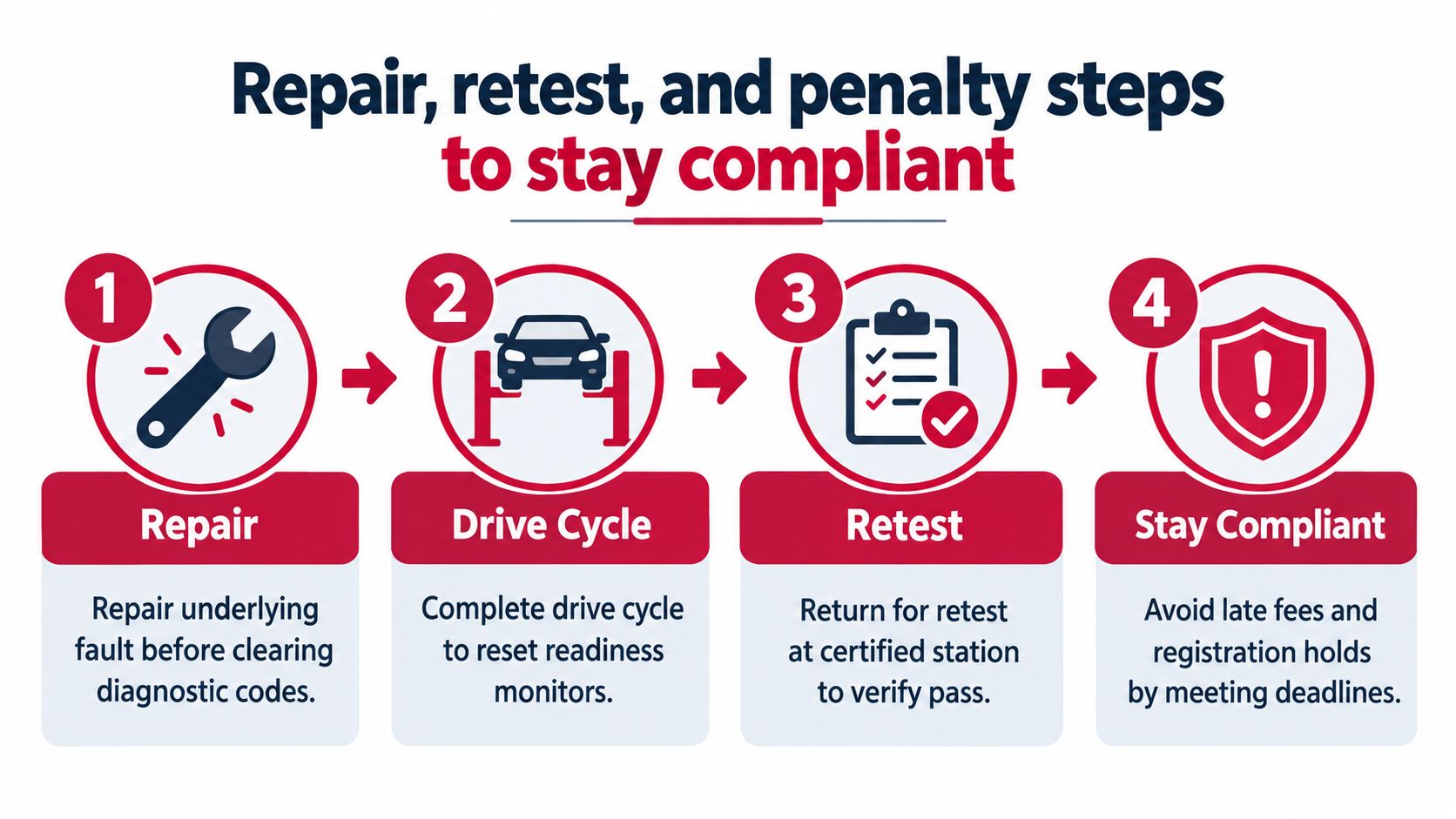
Follow a clean retest sequence
- Read the failure result carefully. Save the inspection report and ask which monitor, code, or equipment issue prevented a pass.
- Repair the cause. Use a qualified diesel technician when the issue involves the DPF, EGR, catalyst, sensors, wiring, or engine-control software.
- Complete the required drive conditions. A repaired vehicle still needs its monitors to run and report complete.
- Return for the retest. Bring the failed report, registration information, and repair documentation if requested.
Many stations offer a free retest under their own policy or coupon terms. Ask about the station's exact conditions before authorizing the first inspection. Income-eligible owners may also qualify for repair assistance through California's Consumer Assistance Program, but eligibility and available benefits must be confirmed with the program.
Don't ignore the registration consequence
A failed or refused inspection can delay registration renewal. Unresolved compliance problems can also create DMV holds or prevent a transfer from moving forward. Heavy-duty operators face separate enforcement exposure when a vehicle operates outside applicable CARB requirements, and violations can lead to civil penalties and other enforcement actions.
Keep the renewal notice, registration, inspection report, invoices, parts documentation, and any CARB records together. Good records won't make an illegal modification acceptable, but they'll help a technician or fleet manager identify what changed and what still needs attention.
Putting it together, your diesel smog compliance checklist
Use the vehicle's records, not its appearance, to choose the correct California diesel compliance path. A clean exterior, quiet idle, and absence of visible smoke don't establish exemption or guarantee an OBD pass.
For a private diesel owner
- Confirm the model year. A diesel from 1997 or older is outside the standard light-duty Smog Check program. A newer diesel may be included.
- Read the GVWR placard. If the rating is 14,000 pounds or less, evaluate the light-duty program. If it's over that boundary, investigate heavy-duty CARB requirements.
- Check the DMV notice. The notice tells you whether certification is required for your current registration transaction.
- Apply the timing rule. For applicable vehicles, add eight years to the model year to identify the first biennial inspection point.
- Check readiness before testing. For 2007 and newer light-duty diesels, confirm that all applicable monitors are ready except the DPF and Non-Methane Hydrocarbon Catalyst monitors, which may remain unset under the July 2023 rule.
- Use the right station. Choose a licensed station that can handle your vehicle and follow any STAR direction on the DMV record.
- Bring your paperwork. Have the renewal notice, registration, identification, and repair records available.
For a small fleet manager
Create a record for every unit with GVWR, vehicle model year, engine model year, registration classification, CARB program, inspection dates, and exemption documentation. Separate light-duty Smog Check tasks from PSIP and Truck and Bus Regulation duties so one completed inspection doesn't create a false sense of fleet-wide compliance.
Schedule engine and emissions-system reviews before a registration deadline. For heavy-duty vehicles, confirm current CARB reporting, inspection, and operating requirements directly with the agency because those obligations are distinct from the ordinary DMV smog certificate.
The most reliable workflow is simple: classify first, verify exemptions second, check readiness or heavy-duty inspection status third, and book the correct service last. That order prevents the common mistake of arriving at a station with a vehicle that belongs in a different compliance program.
Fire House Smog provides STAR-certified test-only smog inspections for cars, trucks, and qualifying diesel vehicles, along with California DMV registration renewal and ownership-transfer services. If you're in Antioch or East Contra Costa County, bring your renewal paperwork and vehicle information, then visit Fire House Smog to confirm the appropriate testing and registration service.
If the check engine light is on, your vehicle will fail the California smog check before any other inspection item is evaluated. In BAR's 2025 data, 9.36% of OBD-II-inspected vehicles failed on the OBD-II portion, and 4.59% failed because readiness monitors weren't complete (BAR's 2025 Smog Check Executive Summary).
That's the situation many drivers discover after receiving a registration renewal notice. The car runs smoothly, the deadline is approaching, and the glowing dashboard light seems like a minor annoyance. Then the technician connects the inspection equipment and explains that the test can't produce a passing result while the malfunction indicator lamp, or MIL, is illuminated.
A recently repaired vehicle can create a second problem. Turning the light off with a scan tool or disconnecting the battery may leave the dashboard dark while the OBD system still reports incomplete monitors. California's readiness requirements make that distinction especially important, so a clear light is not the same as a smog-ready car.
Table of Contents
- What BAR Actually Checks When the Light Is On
- Reading the MIL the Way a Smog Tech Does
- Decoding the Trouble Codes Behind the Light
- Readiness Monitors and the 2025 Rule Change
- A Real-World Example of Clearing Codes Too Soon
- When to DIY, When to Call a Licensed Shop
- Retest Rules and Your Pre-Test Checklist
What BAR Actually Checks When the Light Is On
At a STAR station, the technician does not begin by judging how smoothly the car runs or by measuring the tailpipe. For applicable 1996-and-newer OBD-II vehicles under 14,001 GVWR, California's inspection checks the malfunction indicator lamp, readiness monitors, and stored diagnostic trouble codes (California BAR Smog Check Manual).
The inspection starts with the lamp sequence. With the key on and the engine off, the check engine light must illuminate. After the engine starts, it must turn off. BAR's OBD reference states that the vehicle fails if the MIL does not illuminate during the key-on, engine-off check, or if it stays illuminated or flashes while the engine is running (BAR OBD Test Reference).
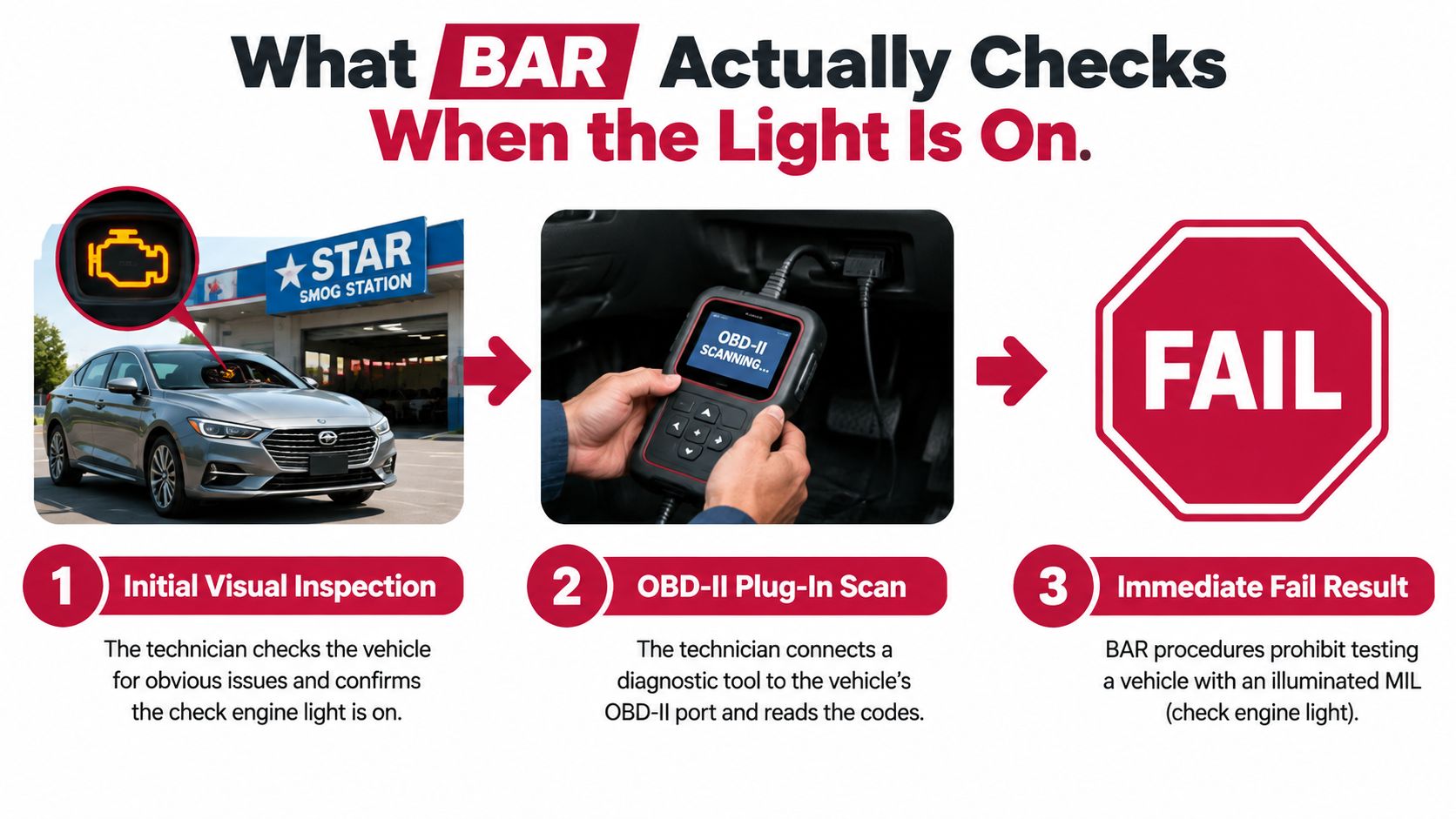
Why the inspection stops early
A lit MIL is a formal OBD failure. The technician records the result, and the vehicle needs diagnosis and repair before a passing certificate can be issued. A car that drives normally, produces clean-looking exhaust, or passes another inspection item receives no credit for an active emissions fault.
The same rule applies at a state-directed STAR station and at a test-only location selected by the owner. A light that returns after a recent repair is handled like any other unresolved fault.
Clearing the code before arriving does not make the vehicle smog-ready. The repair must hold, and the OBD system must complete its required checks. That gap is especially important after California's October 2025 readiness rule change.
Practical rule: Do not use the smog inspection as a diagnostic appointment. Scan the vehicle, repair the cause, drive it through the required conditions, and verify readiness before paying for the test.
California's vehicle inspection and maintenance program began in 1982, when the state became the 20th state to adopt one. The Bureau of Automotive Repair became its administrator in 1984, establishing the enforcement structure used for inspections today (California Bureau of Automotive Repair history).
Reading the MIL the Way a Smog Tech Does
A vehicle can show a dark dashboard and still fail the inspection. A smog technician follows the lamp sequence instead of judging the car by how smoothly it starts or drives.
The inspection begins with KOEO, meaning key on, engine off. The ignition is switched on without starting the engine, and the technician confirms that the MIL illuminates during the dashboard bulb check.
A dark MIL at this stage is a problem. It can point to a burned-out bulb, a modified instrument cluster, or an electronic fault that prevents the warning from appearing. BAR requires the lamp to illuminate during KOEO, so normal idling does not excuse a missing warning signal.
What changes once the engine starts
The next stage is KOER, or key on, engine running. After the engine starts, the MIL should turn off. If it stays on or flashes, the vehicle fails the OBD portion under the California BAR OBD test requirements.
A steady light usually indicates a confirmed fault recognized by the engine computer. A flashing light signals a more urgent operating condition, often an active misfire that can damage emissions equipment. Use that pattern to decide whether driving to a repair facility is safe, then get a diagnostic scan. The lamp alone cannot identify the failed component.
The technician connects a scan tool to the vehicle's Data Link Connector, usually beneath the dashboard. This connection allows the equipment to read MIL status, diagnostic trouble codes, and readiness information from the engine control module.
The dashboard can hide the vehicle's actual smog status. Clearing codes may switch the lamp off while leaving self-tests incomplete or diagnostic information unresolved. The inspection equipment checks the electronic record stored in the vehicle computer, not merely the warning light the driver sees. A clear MIL is only one checkpoint, not proof that the car is ready for certification.
Decoding the Trouble Codes Behind the Light
The code tells you where to begin, not what part to replace automatically. OBD-II systems can report stored, pending, and permanent diagnostic trouble codes, and each category affects the repair plan differently.
A stored code is a confirmed fault that has met the computer's criteria for recording. It may command the MIL on. A pending code represents a condition detected during an early or incomplete confirmation process. It might not illuminate the dash yet, but it still deserves attention because the computer is monitoring the same system.
Permanent codes are different. They're retained in a protected portion of the vehicle computer and generally won't disappear because someone used a scan tool or disconnected the battery. The relevant monitor must run successfully and verify that the original problem has been corrected.
OBD-II code categories and smog check impact
| Code Type | Illuminates MIL? | Cleared by Disconnect? | Counts as Failure? | How It Clears |
|---|---|---|---|---|
| Stored or confirmed | Often, when the fault meets MIL criteria | It may erase stored memory, but can reset readiness | An illuminated MIL fails the OBD inspection | Repair the cause, then allow the system to verify the repair |
| Pending | Not necessarily | Memory and monitor status may be reset | It signals an unresolved condition that needs diagnosis before testing | The monitor confirms the condition is gone or promotes it to a confirmed fault |
| Permanent | Not necessarily | No, it remains stored | It can keep the vehicle from being ready after repair | The vehicle's own monitor must complete successfully |
Consider a pending catalyst-efficiency code such as P0420. The light may still be off, but a technician's scan can reveal that the computer has detected a concern with catalytic-converter performance. Reading that code is only the first step. The repair decision depends on supporting data, sensor behavior, exhaust leaks, misfire history, and the vehicle's readiness state.
Before booking an inspection, drivers should review their scan results and understand the difference between emissions test results. Clearing a code without identifying the cause often trades a visible problem for a hidden readiness problem.
Readiness Monitors and the 2025 Rule Change
Readiness monitors are the vehicle computer's self-tests for emissions systems. They check the catalytic converter, evaporative system, oxygen sensors, EGR system, and secondary-air system. “Ready” means a monitor completed its test. “Incomplete” means the driving conditions needed for that test have not occurred.
Before the rule change, California allowed limited incomplete monitors based on vehicle age. 1996–2000 vehicles fail with more than two incomplete emissions monitors, while 2001-and-newer vehicles fail with more than one incomplete monitor, according to the state's existing inspection requirements.
The requirement changed on October 1, 2025. BAR announced that every readiness monitor must be set for a vehicle to pass a Smog Check. After a code clear or battery disconnect, the vehicle therefore needs every applicable monitor completed before testing. A scan showing no current trouble code does not confirm that the monitors have finished their checks.
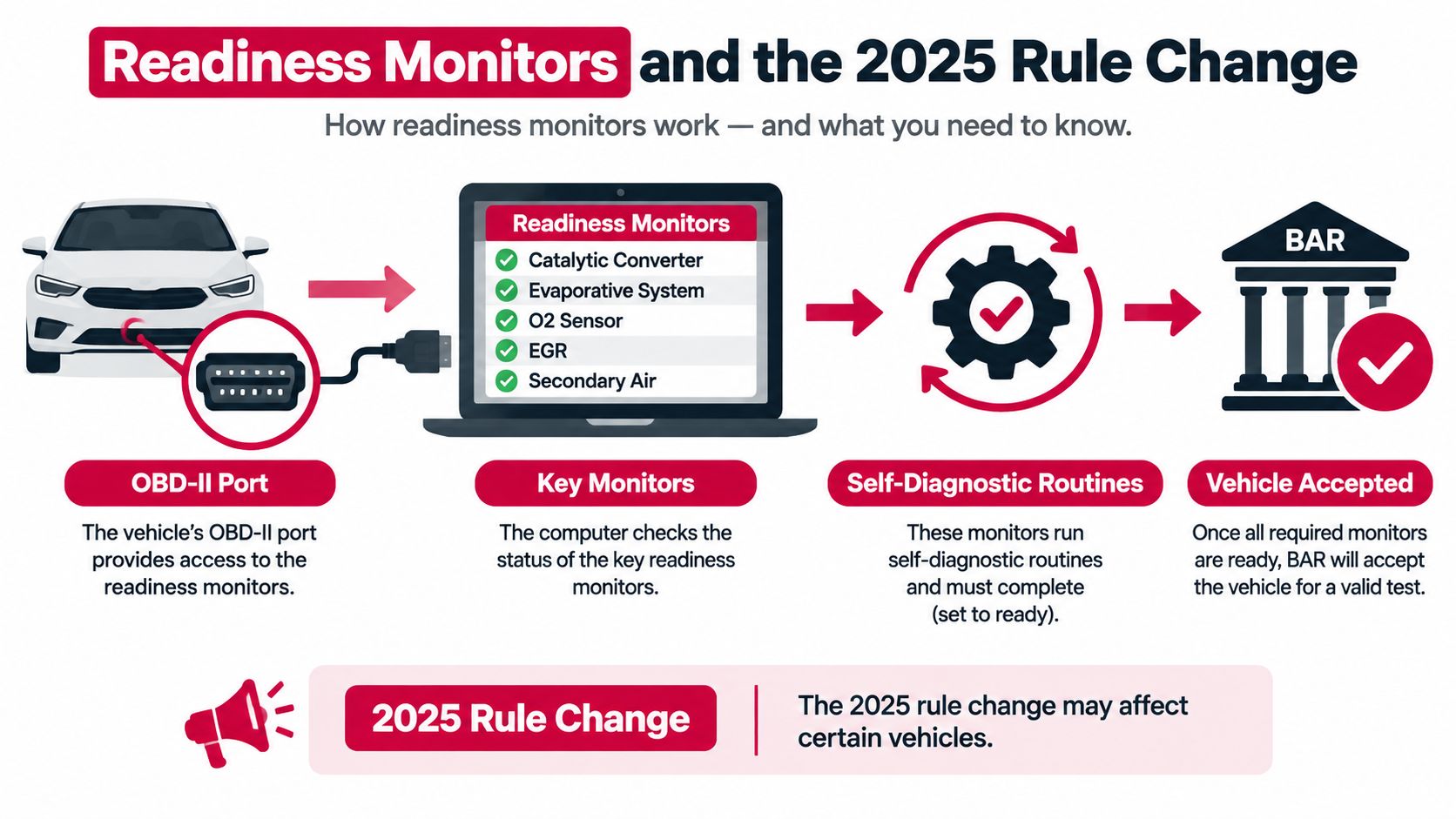
How to prepare without guessing
Use a scan tool that lists each monitor separately. A generic “no codes” message is not enough. After a battery replacement or code clear, drive through varied normal conditions, including cold starts, steady cruising, deceleration, and periods of idling. The manufacturer's service information provides the correct drive-cycle guidance for that vehicle. Do not trust a universal mileage promise.
Do not clear codes again before the appointment. Clearing them resets monitor progress. A weak battery can interrupt the same process if it loses power, so repair battery problems before relying on the readiness report.
Repair, drive, scan, then test.
For a monitor-by-monitor explanation, review this guide to OBD readiness monitors.
A Real-World Example of Clearing Codes Too Soon
A driver with a 2017 Camry noticed an EVAP-related warning and replaced a gas cap. After using a consumer scan tool to clear the P0455 code, the owner drove directly to a STAR station a few days later. The check engine light remained off, so the owner expected a straightforward pass.
The scan told a different story. Several monitors were still incomplete, including the catalyst and EVAP monitors. The vehicle hadn't necessarily proven that the repair failed. It hadn't completed the self-tests needed to establish readiness.
What the owner should have done
The technician's useful answer wasn't to replace more parts immediately. The owner needed to drive the vehicle through varied conditions and return for another readiness scan. A guided routine using the normal commute plus a longer highway loop gave the computer opportunities to run different emissions checks.
That distinction protects drivers from unnecessary repairs. A readiness failure after a code clear doesn't automatically prove that the catalytic converter, purge valve, or oxygen sensor is defective. It proves that the vehicle's testing process is incomplete.
A dark dashboard light only answers one question. The readiness report answers whether the computer has finished checking the emissions systems.
The frustration is understandable. The owner had paid for a repair, cleared the warning, and made a trip to the station expecting the problem to be over. The wasted trip came from treating code removal as proof of repair.
The practical lesson is patience, not delay for its own sake. After any repair that involves clearing memory, get a scan showing the MIL is off and the required monitors are ready. If the light returns during that driving period, stop preparing for the smog check and diagnose the underlying fault instead.
When to DIY, When to Call a Licensed Shop
Some repairs are reasonable for a careful owner. A loose fuel cap is an obvious first check, and a cracked vacuum hose may be visible with the hood open. Replacing a weak battery or correcting a poor electrical connection can also prevent new diagnostic problems, but the vehicle still needs a readiness scan afterward.
A DIY repair makes sense when the cause is clear, the part is accessible, and you can verify the result. It doesn't make sense when the code points toward a system that requires specialized testing.
Use professional diagnostics for complex faults
Catalyst-efficiency codes need more than a code lookup. A technician should check for exhaust leaks, fuel-control issues, ignition misfires, oxygen-sensor signals, and other conditions that can falsely condemn an expensive converter.
Multiple-cylinder misfires deserve prompt attention because they can affect drivability and emissions equipment. EVAP leaks are another strong reason to call a shop, especially when a visual inspection finds nothing and the system needs a smoke test.
A check engine light that returns soon after clearing is also a poor DIY gamble. Repeatedly erasing it only resets monitors and removes useful diagnostic information.
| Situation | Recommended Action | Typical Cost Range |
|---|---|---|
| Loose fuel cap or visible hose issue | Correct the obvious fault, then verify codes and readiness | Ask for a parts-and-labor quote before purchasing parts |
| Single, well-understood sensor fault | Compare test data before replacing the sensor | Request diagnostic and replacement pricing separately |
| Catalyst-efficiency code | Use a licensed shop for exhaust, sensor, and misfire testing | Get a written estimate before authorizing a converter |
| Multiple-cylinder misfire | Stop treating it as a simple smog-prep issue and diagnose promptly | Ask what tests support the proposed repair |
| EVAP leak without a visible cause | Request a smoke test and system-level diagnosis | Confirm whether diagnostic time is billed separately |
| Light returns after clearing | Return for diagnosis instead of clearing it again | Compare the diagnostic fee with the cost of another failed trip |
The cheapest decision isn't always the cheapest part. It's the decision that prevents repeated testing, unnecessary replacements, and lost time.
When you need a test-only inspection after repairs, Fire House Smog is one local option for checking whether the vehicle is ready for the California inspection. A test-only station can report the inspection result without selling the repair that follows.
Before authorizing work, ask the shop which code is active, what test confirmed the failed component, whether readiness will be checked after repair, and what documentation you'll receive. A good technician should explain the evidence, not just read a code and name an expensive part.
Retest Rules and Your Pre-Test Checklist
A clear check-engine light does not prove that the vehicle is ready for a smog test. Before returning after a failure, read the original Vehicle Inspection Report and ask the station about its retest process, after-failure fee, and any free retest window under its policy and coupon terms. Bring repair receipts, scan results, and the inspection paperwork so the technician can verify what changed.
Station eligibility can determine whether the retest is valid. A STAR station is required for certain directed vehicles, while other vehicles may qualify at a licensed non-STAR station. If the original result specifies STAR, confirm the requirement before choosing a nearby location.
Run this final check before driving over
- Confirm the MIL behavior: With the key on and the engine off, the lamp should illuminate. After starting, it should turn off and stay off.
- Scan every readiness monitor: A “no codes” result is not enough. Confirm that the monitors required for your vehicle show ready under the current BAR rules.
- Review recent repairs: Keep receipts, diagnostic reports, and parts information with the Vehicle Inspection Report.
- Avoid a last-minute code clear: Clearing memory can leave the vehicle incomplete, even when the MIL is off.
- Check battery condition: A power interruption can erase monitor progress.
- Use normal mixed driving: Short trips may not create the conditions needed for every monitor to run.
- Ask about station type: Verify whether your vehicle requires a STAR inspection before arriving.
- Ask about repair assistance: If documented repairs meet the applicable requirements, a BAR-licensed repair station can explain whether an Electronic Authorization Form may support a Directed Vehicle Reinspection waiver.
BAR performance data show why this check matters. The 2025 executive summary reports OBD-related failures at 9.36% overall and readiness failures at 4.59% among OBD-II-inspected vehicles (BAR's 2025 Smog Check Executive Summary). Check the computer's readiness status before paying for another inspection.
Fire House Smog is a STAR-certified, test-only station at 2900 Lone Tree Way in Antioch, and it provides California DMV registration services. If the MIL is off and the readiness report is complete, bring your documents and confirm the current retest and coupon terms before arriving.
Fire House Smog can perform a STAR-certified, test-only smog inspection and check whether the OBD system is ready after a repair or code clear. Visit Fire House Smog in Antioch before the registration deadline, and bring the Vehicle Inspection Report and repair records for a retest.
You pull into a smog station in Antioch or Pittsburg expecting a routine renewal, but your diesel pickup won't complete the onboard diagnostic check. The dashboard may look normal, yet the test computer reports an unset monitor, an emissions fault, or a problem with the vehicle's exhaust system. For many owners, diesel emissions standards only become real at that moment.
The rules are easier to manage once you separate them into layers. Federal requirements set a national floor, California adds its own requirements through the California Air Resources Board, and local air-quality rules can affect commercial operators and fleets. The practical questions are simple: What pollutants does the truck control, what equipment must remain installed, what does the smog inspection check, and what happens if the diesel exhaust fluid system triggers a speed restriction?
Table of Contents
- What Diesel Emissions Standards Actually Govern
- The Pollutants Standards Target and Why
- How Diesel Emissions Standards Evolved
- Federal EPA Rules Compared to California CARB
- How Diesel Vehicles Get Tested
- The Real-World Gap Between Lab and Road
- What the 2027 Heavy-Duty Rule Means for You
- Practical Steps for California Diesel Owners
What Diesel Emissions Standards Actually Govern
Diesel emissions standards don't describe one universal test. They govern several connected responsibilities, including the pollutants coming from the tailpipe, the vehicle's onboard diagnostic system, required equipment such as a diesel particulate filter, proper use of diesel exhaust fluid, and prohibitions against tampering with emissions controls.
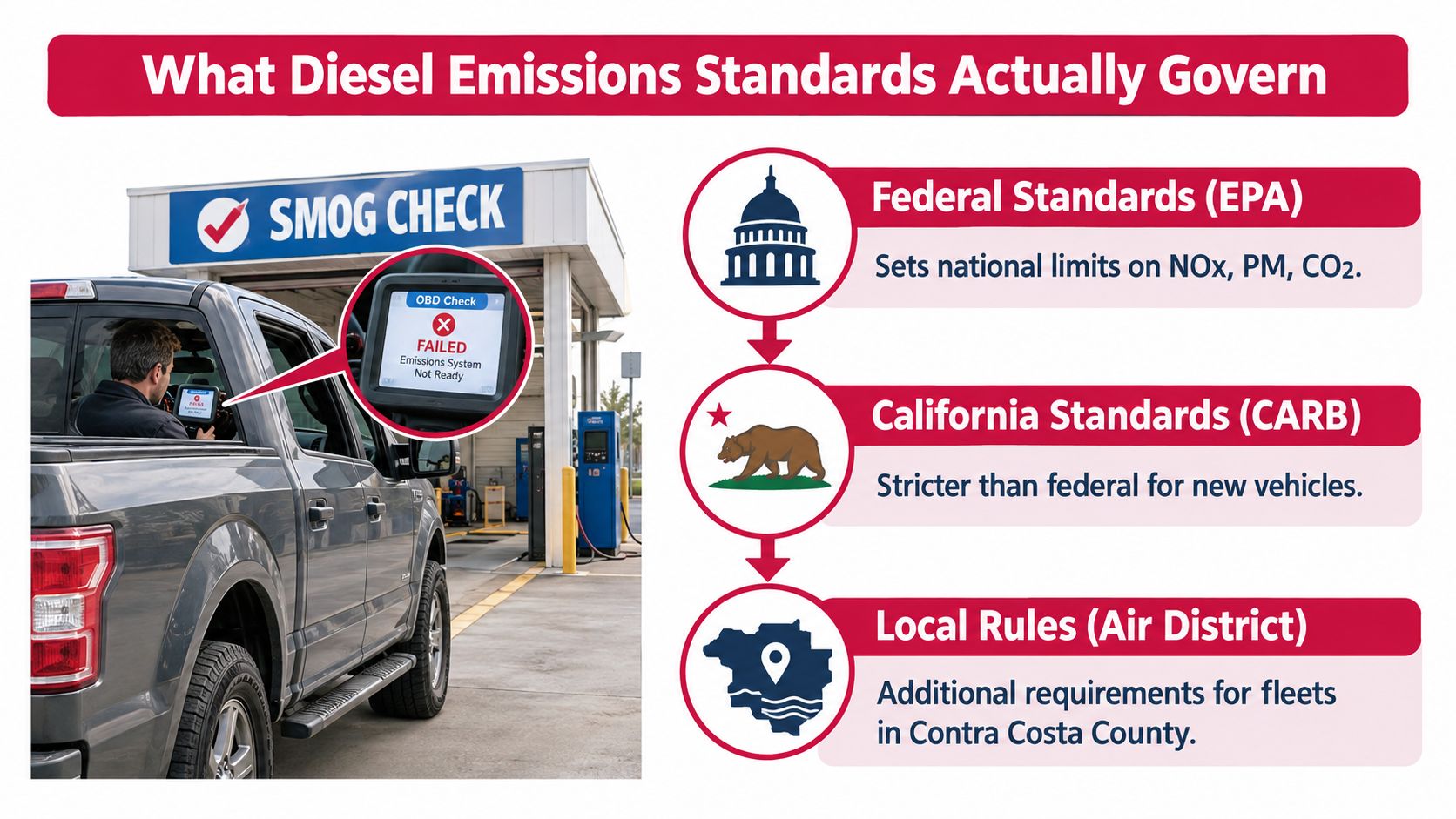
Three rulemaking layers
The U.S. Environmental Protection Agency sets national limits under the Clean Air Act. Federal rules apply across the country and establish requirements for engine certification, useful life, onboard diagnostics, and pollution-control equipment. EPA's newer heavy-duty rule focuses especially on nitrogen oxides during normal operation, low-load driving, and idling, as described in the agency's 2027-and-later heavy-duty emissions rule.
California can set stricter vehicle emissions requirements through CARB authority under the Clean Air Act. Other states may adopt California requirements under Section 177, which is why a California-certified configuration can differ from a federal-only configuration.
Local agencies, including the Bay Area Air District, address air quality within their jurisdiction. Their rules can affect fleet operations, commercial vehicles, idling, and equipment used near warehouses, construction areas, and other high-activity locations.
Different vehicles, different obligations
A light-duty diesel pickup, a heavy-duty tractor, an off-road machine, and a stationary generator don't all follow the same rule set. Model year, gross vehicle weight rating, engine type, intended use, registration location, and whether the vehicle operates on public roads all matter.
The purpose reaches beyond passing paperwork. NOx and particulate matter affect the air people breathe, particularly in communities near busy roads and freight corridors. A smog inspection checks whether the vehicle remains compliant, but the larger regulatory objective is reducing pollution before it reaches neighborhoods in East Contra Costa County.
The Pollutants Standards Target and Why
A diesel engine creates a mixture of gases and particles. Regulators focus heavily on NOx, particulate matter, and particle number because each pollutant behaves differently in the atmosphere and in the human body.
NOx, or nitrogen oxides, are gases produced during high-temperature combustion. Sunlight can help transform NOx and other pollutants into ground-level ozone, the main ingredient in smog. A rough everyday comparison is the sharp, metallic smell people associate with air after lightning. The smell isn't a measurement, but it helps explain why the pollution can be chemically active even when you can't see a cloud from the exhaust.
PM, or particulate matter, consists of solid and liquid particles. Large soot particles may appear as black smoke, while finer particles can be difficult or impossible to see. Think of fireplace smoke trapped inside a room. Even after the visible haze fades, small particles may remain suspended in the air.
PN, or particle number, counts particles rather than weighing them. Modern diesel rules use both mass and particle number because a small mass of ultrafine particles can still represent many individual particles. Euro 6 diesel limits include a particle-number ceiling of 6.0×10^11 particles per kilometer, alongside limits for NOx and PM, according to The AA's Euro emissions standards guide.
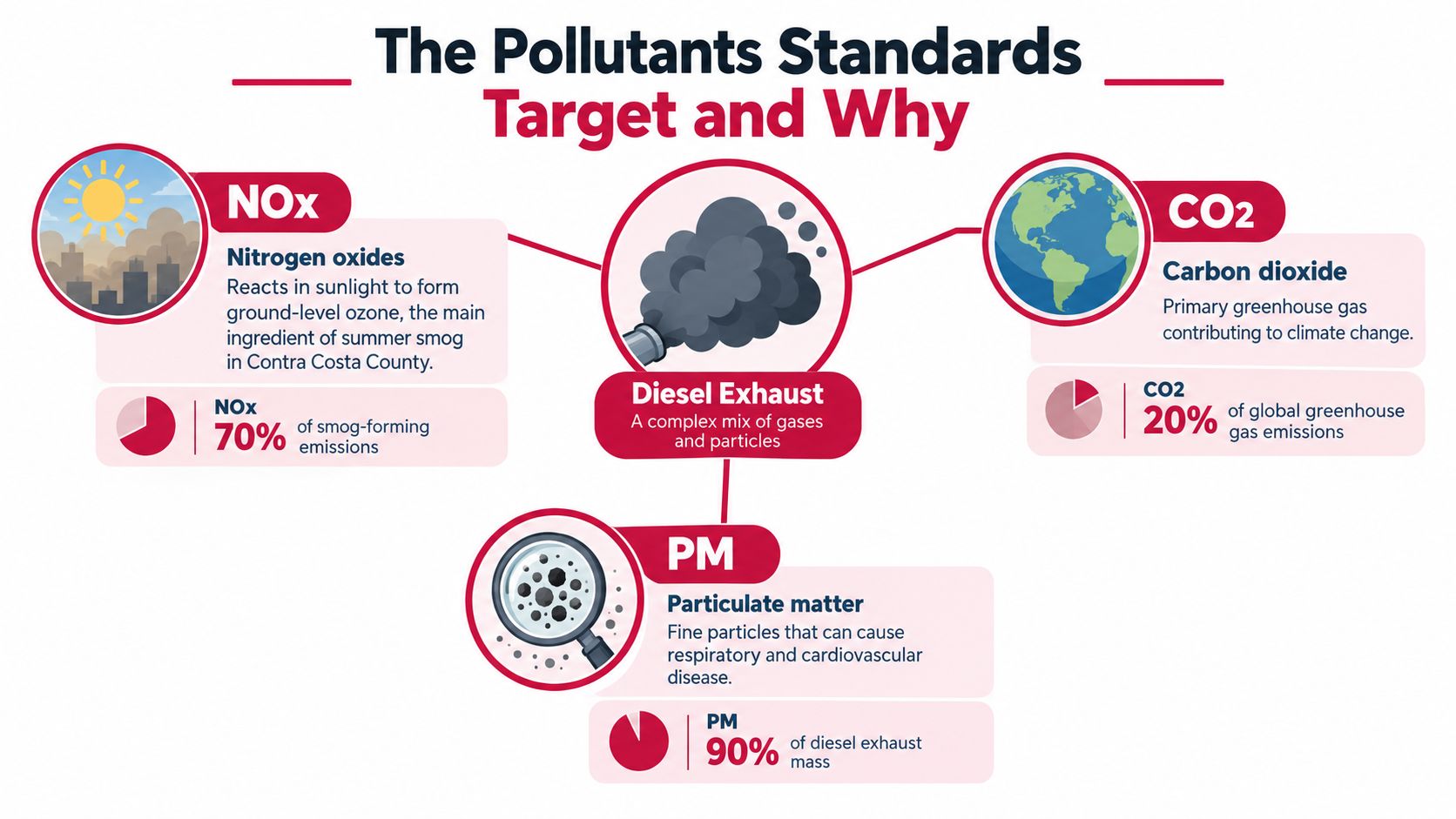
The equipment that controls them
A diesel particulate filter, or DPF, traps soot before it leaves the exhaust. The vehicle periodically raises exhaust temperature to burn accumulated soot in a process called regeneration. A clogged, damaged, or removed DPF can create both a mechanical problem and a compliance problem.
Selective catalytic reduction, or SCR, addresses NOx. The system injects DEF into the exhaust, where it helps convert NOx into less harmful compounds. DEF isn't fuel, and pouring it into the diesel tank can cause serious damage. It belongs in the dedicated DEF tank.
Health agencies and regulators focus on these pollutants because diesel exhaust can contribute to respiratory and cardiovascular harm. The control strategy therefore combines combustion design, DPF filtration, SCR chemistry, temperature management, sensors, and software. A vehicle can have a clean-looking tailpipe and still fail if one of those systems isn't working correctly.
How Diesel Emissions Standards Evolved
Older diesel engines earned their smoky reputation because earlier rules and technologies provided far less control over soot and NOx. Over time, regulators moved from broad smoke limits toward pollutant-specific caps measured under defined engine cycles.
A major U.S. milestone arrived with the 2007 heavy-duty highway rule. EPA says the requirements began taking effect with model year 2007 heavy-duty highway engines and vehicles and were tied to low-sulfur diesel fuel requirements. That transition pushed manufacturers toward aftertreatment systems designed to control both NOx and particulate matter, as documented in EPA's historical diesel emissions material.
The next major change is the EPA rule for 2027 and later commercial vehicles. The normal-operation NOx limit becomes 0.035 g/bhp-hr, with 0.050 g/bhp-hr at low load and 10.0 g/hr at idle. EPA's rule reflects a move from the earlier 0.20 g/bhp-hr heavy-duty diesel NOx allowance to the much tighter 0.035 g/bhp-hr level. Industry coverage cited in the supplied EPA rule summary describes the new normal-operation limit as more than 80% stricter than the current standard, while the EPA final-rule page explains the regulatory change.
The limits tell the story
The following table uses only the heavy-duty figures supplied in the verified data. It shows why the technology in a newer diesel truck can't be judged by looking only at the engine block.
| Model Year | NOx Limit | PM Limit | Key Technology Required |
|---|---|---|---|
| 2007 heavy-duty highway rule | Earlier rule milestone, numeric limit not provided here | Earlier rule milestone, numeric limit not provided here | Low-sulfur fuel and aftertreatment-based control |
| Earlier heavy-duty certification level | 0.20 g/bhp-hr | Not provided here | Engine controls and aftertreatment development |
| 2027 and later, normal operation | 0.035 g/bhp-hr | 0.005 g/bhp-hr | Advanced combustion control, SCR, DEF management, DPF, and expanded monitoring |
| 2027 and later, low load | 0.050 g/bhp-hr | 0.005 g/bhp-hr | Strong low-temperature and low-load emissions control |
Europe established another important reference point with Euro 6. For diesel passenger cars, Euro 6 sets NOx at 0.08 g/km, PM at 0.005 g/km, and particle number at 6.0×10^11/km, according to the supplied AA reference. Compared with Euro 5, the Euro 6 NOx limit represented roughly a 67% reduction, requiring manufacturers to combine high-pressure common-rail combustion control with SCR and DPF systems.
The direction is clear. Diesel compliance has shifted from visible smoke control to precise limits for gases, particle mass, particle count, low-load operation, and idle conditions.
Federal EPA Rules Compared to California CARB
Federal and California rules overlap, but they aren't interchangeable. EPA establishes national requirements, while California can adopt stricter standards and enforcement practices that affect vehicles registered or operated in the state.
The supplied comparison brief identifies an earlier federal heavy-duty NOx level of 0.20 g/bhp-hr and California Low NOx Omnibus targets of 0.05 g/bhp-hr for model year 2024 engines and 0.02 g/bhp-hr by model year 2027. Those figures should be checked against the certification label and applicable CARB documents for a specific engine family, because a truck's legal standard depends on its model year, engine category, and certification configuration.
| Standard | EPA Tier 4 Final | California CARB Low NOx |
|---|---|---|
| Heavy-duty NOx figure identified in the supplied rule comparison | 0.20 g/bhp-hr | 0.05 g/bhp-hr beginning with 2024 model-year engines, tightening to 0.02 g/bhp-hr by 2027 |
| PM figure identified in the supplied comparison | 0.01 g/bhp-hr | Comparable PM control with stricter useful-life durability requirements |
| Compliance emphasis | Federal certification and in-use requirements | Lower NOx targets, durability, and California-specific implementation |
Why California owners notice first
California's rules can affect the vehicle before a federal deadline reaches the rest of the country. The supplied CARB comparison also identifies emissions warranty coverage that can extend to 15 years or 435,000 miles in California, depending on the applicable vehicle and component requirements. That is a durability obligation, not a promise that every repair will be free.
A California-certified diesel usually carries an emissions label identifying the configuration approved for the vehicle. Replacing a DPF, SCR component, sensor, or calibration with a nonapproved part can create a compliance issue even if the replacement appears to function mechanically.
For a plain-language overview of how federal and state requirements fit together, see this guide to vehicle emissions standards. For East Contra Costa owners, the practical question is whether the truck's equipment and software match its certification label, not merely whether the engine starts and drives.
How Diesel Vehicles Get Tested
A California diesel smog inspection begins with the vehicle's identity and applicable test procedure. For many 1998-and-newer diesel vehicles, the inspector connects to the OBD-II system and checks whether required monitors have completed and whether diagnostic trouble codes indicate an emissions fault.
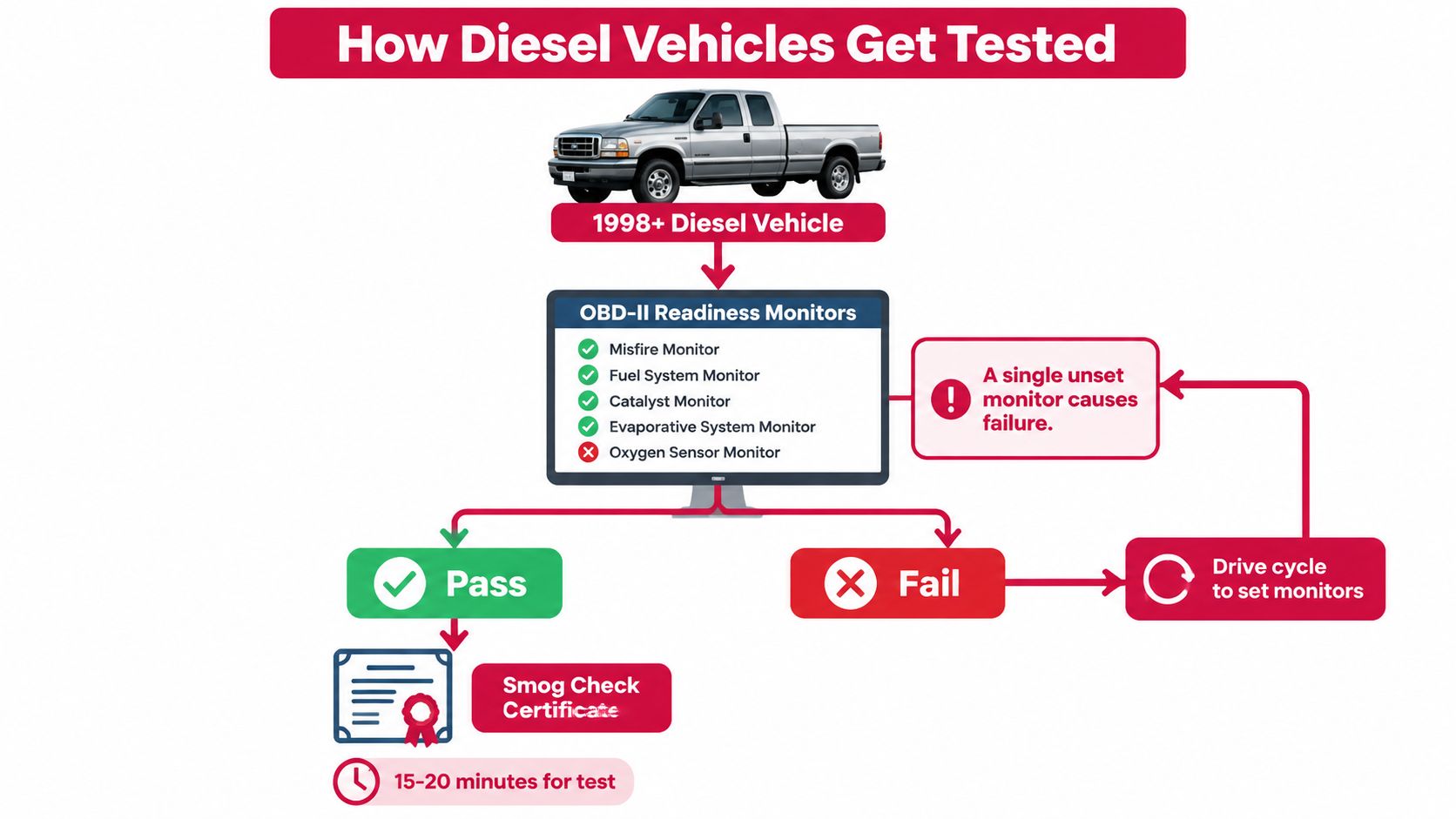
What the inspector checks
The vehicle may need more than a scanner connection. A diesel inspection can include:
- OBD-II readiness: The monitors must show the required completed status. A monitor that remains unset can cause a failure even when the dashboard light is off.
- Diagnostic faults: Active emissions-related trouble codes can fail the inspection.
- Visual equipment inspection: The technician checks the emissions label and confirms required equipment, including the DPF where applicable.
- Tampering review: Missing, altered, or defeated emissions equipment can prevent a passing result.
- Smoke evaluation: Applicable diesel procedures can include a snap-acceleration opacity test, which checks visible smoke during a controlled acceleration.
A vehicle can fail because it is too dirty, but it can also fail because it hasn't completed its drive cycle after a battery replacement or code clearing. Clearing a code right before the appointment doesn't repair the fault. It can also erase monitor history, leaving the vehicle unready.
Preparing before you pay
California has special smog-check rules and exemptions that depend on model year and vehicle type. The supplied procedure notes identify a $1,500 smog-check exemption for vehicles eight model years old and newer, but owners should confirm the current DMV applicability for their exact vehicle because exemptions and fees can differ by registration category.
A directed vehicle may need a STAR-certified or test-only station. If DMV sends a vehicle for a directed inspection after a failure or other trigger, the owner generally can't return to a regular station and choose a different test type.
Before the appointment: Check the registration notice, confirm the vehicle's model year and weight rating, keep the emissions label intact, and ask whether recent repairs or battery disconnection left an OBD monitor incomplete.
For a diesel-specific explanation of California inspection requirements, review this guide to smog testing for diesel vehicles. If the vehicle fails, ask the station about retest eligibility and whether a qualifying free retest applies under its policy or coupon terms. A retest checks the vehicle again after repairs or after the monitors complete their required drive cycle. It doesn't waive the need to correct the underlying fault.
The Real-World Gap Between Lab and Road
A certification result answers a narrow question. It shows how an engine performed under an approved test procedure, in defined conditions, with specified equipment and controls. It doesn't guarantee that every delivery route, grade, temperature, load, or stop-and-go pattern will produce the same result.
Independent research and policy summaries have identified a real-world gap between certified and actual diesel NOx emissions. The supplied research notes that modern heavy-duty diesels have exceeded certification limits in on-road testing, while comparative reviews have found that Euro 6 diesel cars retained higher NOx limits than gasoline cars. The Imperial College London discussion of diesel emissions provides background on why laboratory compliance and road performance can diverge.
Low-load operation is especially important. A diesel engine crawling through deliveries in Concord or Pacheco may produce exhaust temperatures that challenge SCR performance. SCR needs suitable exhaust conditions for effective chemical conversion, so a system can be well maintained and still face its hardest work during cold starts, light loads, and repeated stops.
How regulators respond
California and federal regulators use in-use approaches to test emissions outside the laboratory. Portable emissions measurement systems, commonly called PEMS, can measure emissions while a heavy-duty vehicle operates on the road. EPA also uses Not-to-Exceed provisions to address emissions during operating conditions outside the primary certification cycle.
These tools matter because a truck that passes its certification test can still contribute to local ozone formation if its control system performs poorly during actual work. The gap is one reason newer rules pay more attention to low-load operation, useful-life durability, and monitoring rather than relying only on a single laboratory result.
DEF behavior belongs in this discussion. If exhaust temperature is low or the SCR system detects a fault, the vehicle may increase warnings and eventually trigger an inducement strategy. The driver experiences that regulatory system as a dashboard message, a reduced operating mode, or a speed limitation.
What the 2027 Heavy-Duty Rule Means for You
For commercial diesel owners, EPA's 2027-and-later rule changes the design target for new heavy-duty vehicles. The normal-operation NOx limit is 0.035 g/bhp-hr, while the rule also sets 0.050 g/bhp-hr at low load and 10.0 g/hr at idle, according to EPA's final multi-pollutant standards.
The low-load figure is important for delivery trucks, vocational vehicles, and fleets that spend substantial time moving slowly or waiting. Older certification methods didn't place the same emphasis on those conditions. Newer vehicles therefore need better temperature management, sensor accuracy, SCR control, and software strategies.
Current vehicles versus new builds
The rule applies primarily to vehicles and engines covered by its model-year phase-in. It doesn't automatically rewrite the certification label on every older truck already on the road. Current owners still need to maintain the equipment required for their vehicle, avoid tampering, and respond to emissions warnings.
The operational effects can appear through DEF and SCR management. A truck that runs low on DEF, detects poor fluid quality, or develops a sensor fault can issue escalating warnings. EPA's DEF guidance describes inducement behavior for affected diesel engines, including a phased response that can ultimately limit vehicle speed to 25 mph, as explained in the agency's diesel exhaust fluid guidance.
| Standard Phase | NOx Limit | Useful Life | NTE Multiplier |
|---|---|---|---|
| Earlier heavy-duty certification level | 0.20 g/bhp-hr | Vehicle-specific, not provided here | Vehicle-specific, not provided here |
| 2027 and later, normal operation | 0.035 g/bhp-hr | Longer useful-life requirements apply, exact mileage not provided here | Exact multiplier not provided here |
| 2027 and later, low load | 0.050 g/bhp-hr | Longer useful-life requirements apply, exact mileage not provided here | Exact multiplier not provided here |
| 2027 and later, idle | 10.0 g/hr | Longer useful-life requirements apply, exact mileage not provided here | Exact multiplier not provided here |
Planning for uptime
Fleet managers should treat DEF quality, tank level, dosing hardware, NOx sensors, exhaust temperature sensors, and SCR health as uptime issues. A warning ignored on Friday can become a restricted vehicle during a Monday route. Newer systems may require more diagnostic attention because they monitor emissions performance more closely.
California requirements can add another planning layer for vehicles operated in-state. Before ordering replacements or buying used equipment, compare the vehicle's certification label, engine family, registration category, and applicable CARB requirements. For practical fleet compliance questions, this resource on clean-air trucks can help owners identify issues to discuss with a qualified technician or compliance advisor.
Practical Steps for California Diesel Owners
Start with the registration renewal date, not the day before it. Read the DMV notice carefully and confirm whether your diesel vehicle requires a smog check, then verify the vehicle category, model year, and gross vehicle weight rating.
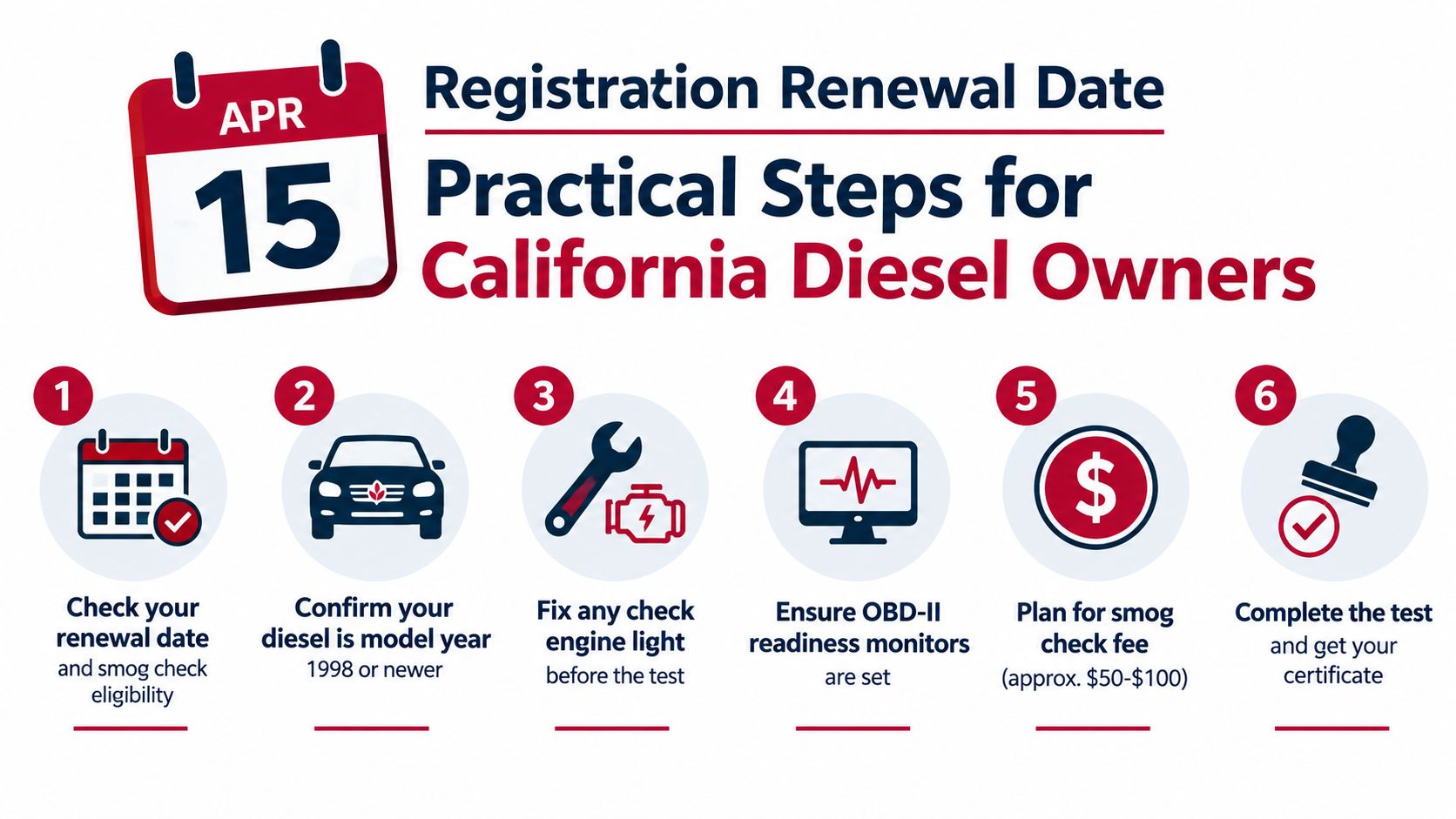
A practical preparation list
- Check the renewal notice: Confirm the due date and whether DMV directs you to a particular type of inspection.
- Verify vehicle details: Many California diesel requirements turn on model year, vehicle type, and weight rating. Don't assume a pickup and a commercial truck follow the same procedure.
- Resolve warning lights: Repair an active check-engine light before testing. Ask the repair shop to identify the actual cause rather than clearing the code.
- Complete the drive cycle: After battery disconnection or emissions repairs, the monitors may need normal driving conditions before they report ready. A scanner can show readiness status before you schedule the inspection.
- Inspect the emissions hardware: Check that the DPF, SCR components, DEF lines, sensors, and under-hood emissions label are present and undamaged. Never substitute a nonapproved bypass or defeat device.
- Choose the correct station: A STAR-certified test-only station may be required for a directed vehicle. A regular station may not be authorized to complete the inspection your DMV notice requires.
Fleet operators should keep service records for DEF-system repairs, DPF regeneration work, sensor replacements, and software updates. Documentation helps technicians diagnose recurring problems and helps managers decide whether a vehicle needs repair, scheduled replacement, or a different operating assignment.
A clean truck isn't only easier on local air. It also avoids the lost route time that follows an ignored emissions warning.
Fire House Smog is a STAR-certified test-only station at 2900 Lone Tree Way in Antioch that performs smog inspections for cars, trucks, and some recreational vehicles, with vehicle-size limits worth confirming before arrival. It also provides California DMV registration services, and its published contact number is 925-754-1600.
If your diesel pickup, van, or light-duty truck is due for renewal in East Contra Costa County, visit Fire House Smog to confirm the appropriate inspection and registration-service options before you arrive. Bring your DMV notice, leave time to address any unresolved OBD readiness issue, and ask about retest eligibility if the vehicle doesn't pass the first inspection.
You've just opened a California DMV renewal notice, and the question is sitting there in plain sight: does your motorhome need a smog check, or does its recreational classification make it exempt? The answer isn't a simple yes or no. California generally evaluates a qualifying RV through the same emissions framework used for other vehicles, then applies additional filters for fuel type, model year, and vehicle weight.
That's why two motorhomes parked side by side can follow different compliance paths. A gasoline coach may need a regular inspection, while a newer RV may qualify for a smog abatement fee instead. A heavy-duty diesel motorhome may fall outside the standard Bureau of Automotive Repair inspection program but still have separate California Air Resources Board obligations.
The practical details matter, too. A station needs enough bay space, suitable equipment, and staff familiar with the vehicle. Registration status, renewal timing, and whether the RV is temporarily outside California can also affect what you should do next. Calling before you drive across town can prevent a wasted trip.
Table of Contents
- Introduction Why RV Owners Get Confused About Smog Checks
- How California Decides Which RVs Need a Smog Check
- Exemptions and Special Cases That Change Your Requirement
- What Happens During an RV Smog Test and How Results Work
- How to Prepare Your RV and What to Bring to the Station
- Common Reasons RVs Fail and How Retests Work
- Getting Your RV Smog Check Done in Antioch Without the Hassle
Introduction Why RV Owners Get Confused About Smog Checks
An RV owner named Maria receives her renewal notice and remembers hearing that “motorhomes don't need smog.” Her Class A coach is clearly a recreational vehicle, so the exemption sounds plausible. But recreational use and emissions classification aren't the same thing in California.
The California Bureau of Automotive Repair Smog Check guidance includes qualifying RVs and motorhomes under the same broad rules that apply to other vehicles. Gasoline, hybrid, and alternative-fuel vehicles from model year 1976 and newer generally need a Smog Check, while diesel vehicles from model year 1998 and newer generally need one, subject to the state's other requirements. The inspection is generally required every other year for registration renewal.
That doesn't mean every RV follows an identical process. California's system works more like a set of screening gates than a single RV rule.
The three questions that matter first
Start with the fuel. Is the motorhome gasoline, hybrid, another qualifying alternative fuel, diesel, or natural gas?
Next, check the model year. The age of the vehicle can place it inside or outside the ordinary inspection framework, while newer vehicles may qualify for an abatement-fee option.
Finally, look at the vehicle's gross vehicle weight rating, especially for diesel and natural-gas motorhomes. Weight can shift a vehicle from a standard BAR inspection path to a heavier-duty CARB compliance program.
Practical rule: Don't rely on the word “RV” alone. Identify the fuel, model year, weight, and registration situation before booking a test.
This guide follows that decision path. You'll learn how California determines whether an RV needs testing, which exemptions and special cases change the answer, what happens inside the inspection bay, how to prepare, and what to do after a failure. The final section focuses on arranging an RV inspection in Antioch while checking station capacity and DMV timing before you arrive.
How California Decides Which RVs Need a Smog Check
California's RV smog decision starts with the powertrain, then narrows through model year, weight, and registration details. That sequence matters because an RV's living features do not determine its emissions category.
Start with fuel and model year
Under the Bureau of Automotive Repair's Smog Check requirements, gasoline, hybrid, and alternative-fuel vehicles model year 1976 and newer generally require a Smog Check. Diesel vehicles model year 1998 and newer generally require one as well, provided they meet the applicable state criteria.
A motorhome with beds, a kitchen, or other living equipment still follows the emissions rules for its underlying vehicle. A gasoline motorhome built in 1976 or later generally enters the gasoline inspection framework. A diesel motorhome built in 1998 or later follows the corresponding diesel requirements.
The renewal notice helps identify the administrative step, but it does not replace the eligibility check. Fuel and model year can point to a standard inspection, an abatement-fee option, or another compliance path.
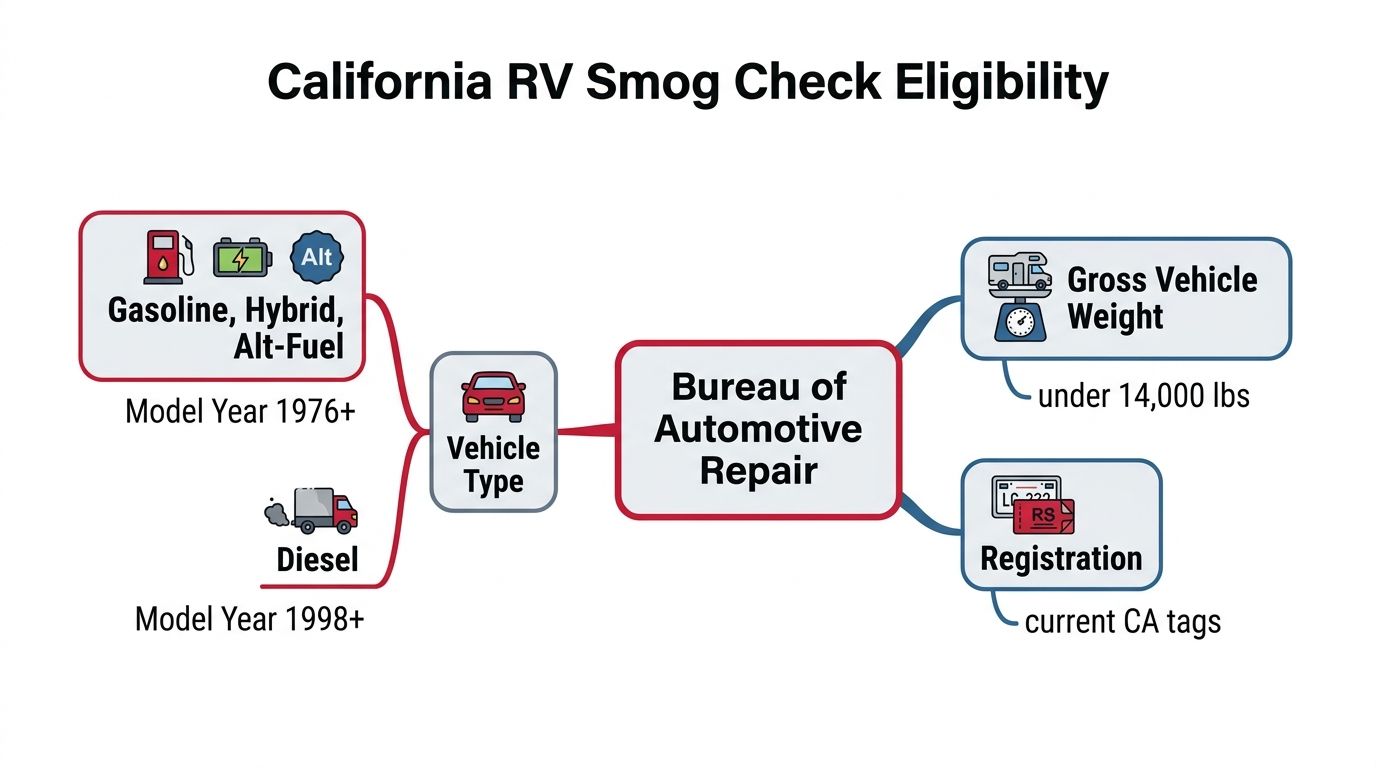
Apply the weight filter
Weight becomes especially important for diesel and natural-gas motorhomes. The California DMV smog inspection guidance identifies an exemption from the standard smog inspection rule for diesel vehicles with a gross vehicle weight of more than 14,000 pounds. Natural-gas vehicles above that threshold are also exempt from the standard rule.
That route can still involve separate emissions responsibilities. The vehicle may leave the ordinary inspection lane and fall under a heavier-duty regulatory program instead. Check the GVWR on the vehicle documents, registration, or manufacturer information rather than estimating from the RV's size.
Use this sequence before contacting a station:
- Identify the fuel. Gasoline, hybrid, alternative fuel, diesel, or natural gas.
- Confirm the model year. Age rules come before the recreational layout.
- Check GVWR. A heavier diesel or natural-gas motorhome may follow a different path.
- Review registration status. Renewal, transfer, relocation, or temporary out-of-state status can affect the required paperwork and timing.
Station logistics also belong in the decision. A large RV may not fit in every test bay, and some locations have test-only limits or cannot handle the vehicle's configuration. Owners seeking an RV-specific overview can review smog checks for motorhomes before booking.
RV status starts the review, but fuel, year, weight, registration, and station capacity determine the practical route.
Exemptions and Special Cases That Change Your Requirement
A renewal notice can arrive while your RV is stored outside California, or while you are still unsure whether its age and fuel type change the inspection rule. “Exempt” describes a specific route, not a free pass from registration duties. The right question is which requirement replaces the ordinary Smog Check.
Newer vehicles and the abatement-fee option
California has a newer-vehicle pathway that began on January 1, 2019. Vehicles less than four model years old can pay a smog abatement fee instead of receiving a Smog Check for the first eight years they are registered. Gasoline-powered vehicles less than eight model years old do not need a smog inspection at renewal.
For a newer gasoline motorhome on a recent chassis, the current renewal may therefore require the fee rather than a test. Follow the DMV instructions and pay any amount that applies. The distinction is simple: the vehicle may be exempt from testing while still subject to registration compliance.
Heavy-duty diesel and natural-gas motorhomes
If your RV falls into the heavy-duty category discussed in the previous section, do not assume the standard Smog Check is the only emissions obligation. Heavy-duty diesel motorhomes may instead be subject to CARB's Clean Truck Check requirements.
The CARB 2025 Clean Truck Check motorhome fact sheet indicates that diesel motorhomes over 14,000 pounds GVWR must report in the Clean Truck Check Vehicle Inspection System, pay annual compliance fees, and submit passing emissions tests by applicable due dates beginning January 1, 2025. Use the weight information from your vehicle documents, then verify the current heavy-duty requirements before planning a renewal.
The practical decision tree looks like this:
| RV Profile | Smog Check Needed | What Applies Instead |
|---|---|---|
| Gasoline, hybrid, or alternative-fuel RV from model year 1976 and newer, below applicable exemption thresholds | Generally yes | Biennial inspection for renewal when required |
| Diesel RV from model year 1998 and newer, below the heavy-duty exemption threshold | Generally yes | Applicable diesel inspection and renewal process |
| Gasoline-powered RV less than eight model years old | No inspection at renewal under the newer-vehicle window | DMV smog abatement process when required |
| RV in the heavy-duty category described earlier | No standard Smog Check | Separate heavy-duty compliance requirements may apply |
| RV temporarily located outside California | Timing may differ | Temporary administrative exemption process may apply |
Temporary out-of-state situations
An RV temporarily outside California is not automatically covered forever by an earlier smog result. California treats some out-of-state cases as limited administrative exceptions. The vehicle's location, renewal timing, and completed paperwork all matter, so follow the instructions for the applicable temporary exemption form.
For an overview of California smog exemptions, keep the categories separate. A temporary exemption changes the process for a particular renewal period. A vehicle-based exemption comes from characteristics such as age, fuel, or weight. That distinction helps you choose the correct paperwork before the registration deadline.
What Happens During an RV Smog Test and How Results Work
A smog test is similar to a health screening. The technician doesn't judge the RV by its paint, floor plan, or camping amenities. The technician checks the vehicle's emissions-related condition using the inspection steps appropriate for that vehicle.
The inspection has several layers
The first layer is a visual review. The technician looks for required emissions equipment and obvious problems that could affect compliance. On an electronically monitored vehicle, the technician may connect diagnostic equipment to communicate with the onboard computer.
The next layer is the OBD-II scan when the vehicle supports that system. The scan checks for stored fault information and whether the vehicle's emissions monitors have completed their required checks. A check-engine light, disconnected system, or recently cleared fault can affect the result.
The final layer depends on the vehicle and test procedure. Some vehicles receive an emissions measurement, while others are evaluated through computer data and visual inspection. Fuel type, model year, and vehicle configuration determine which equipment the station uses.
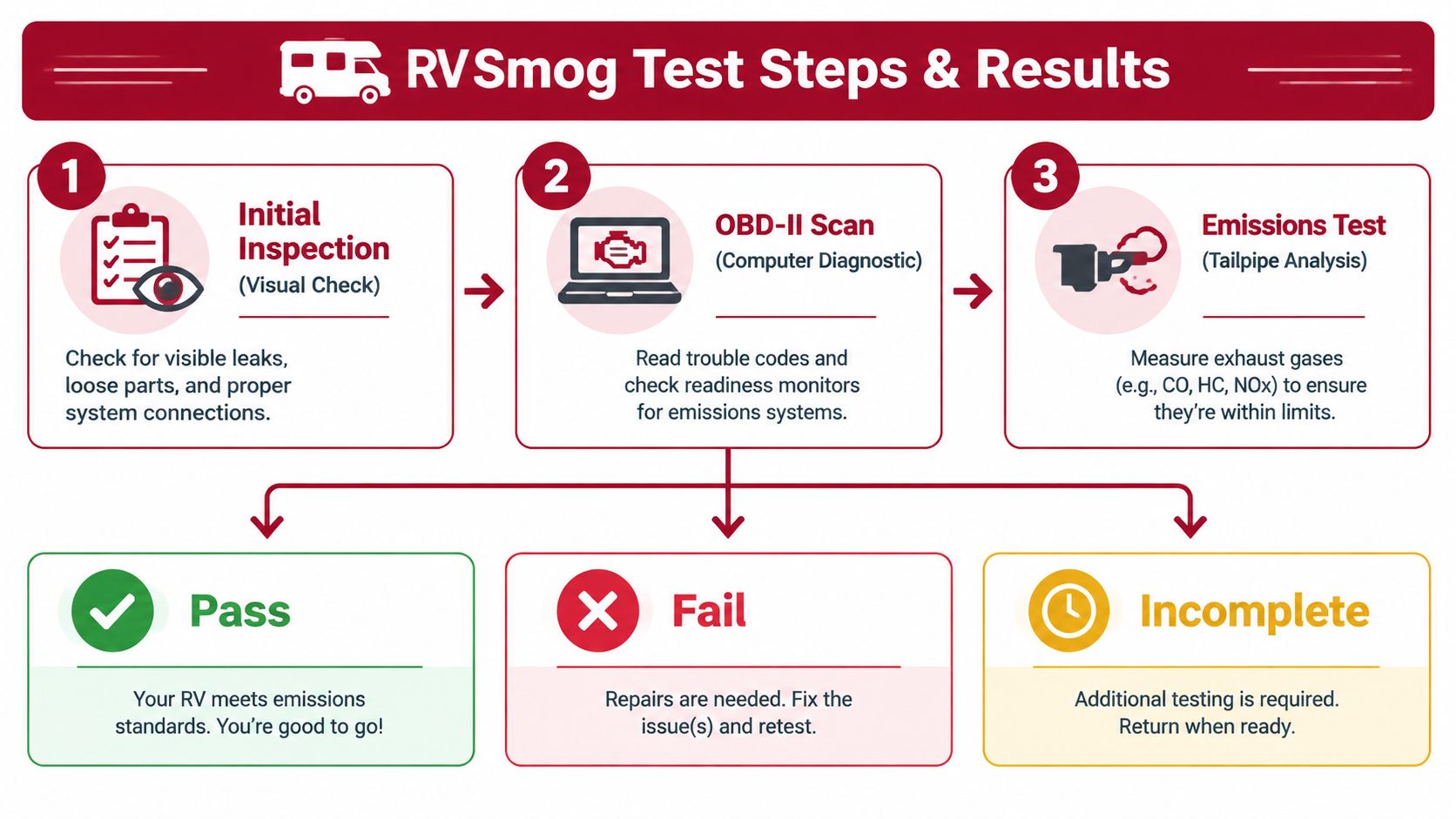
What pass, fail, and incomplete mean
A pass means the vehicle met the applicable inspection requirements. The station submits the result electronically, and the owner receives documentation for the registration process.
A fail means the inspection identified a problem that must be diagnosed and corrected before the vehicle can pass. The failure result should identify the relevant reason or emission-related issue. Don't authorize random parts replacement based only on a general failed result. Ask for a diagnostic explanation.
An incomplete result often means the vehicle's readiness monitors haven't finished their checks. This can happen after battery power has been disconnected or diagnostic trouble codes have been cleared. The correct next step may be additional driving under appropriate conditions, followed by another inspection, rather than immediate replacement of a component.
Before you leave the station, ask for the result paperwork and confirm what the DMV will receive electronically.
Large RVs also create a physical challenge. A station may have the right testing credentials but lack the bay length, clearance, lift arrangement, or equipment needed for a particular motorhome. Confirming capacity before arrival is part of the test process, not an optional courtesy.
How to Prepare Your RV and What to Bring to the Station
Preparation starts before you turn into the station. A motorhome that has been sitting for a long period can be harder to inspect than one that arrives warmed up and ready for normal operation.
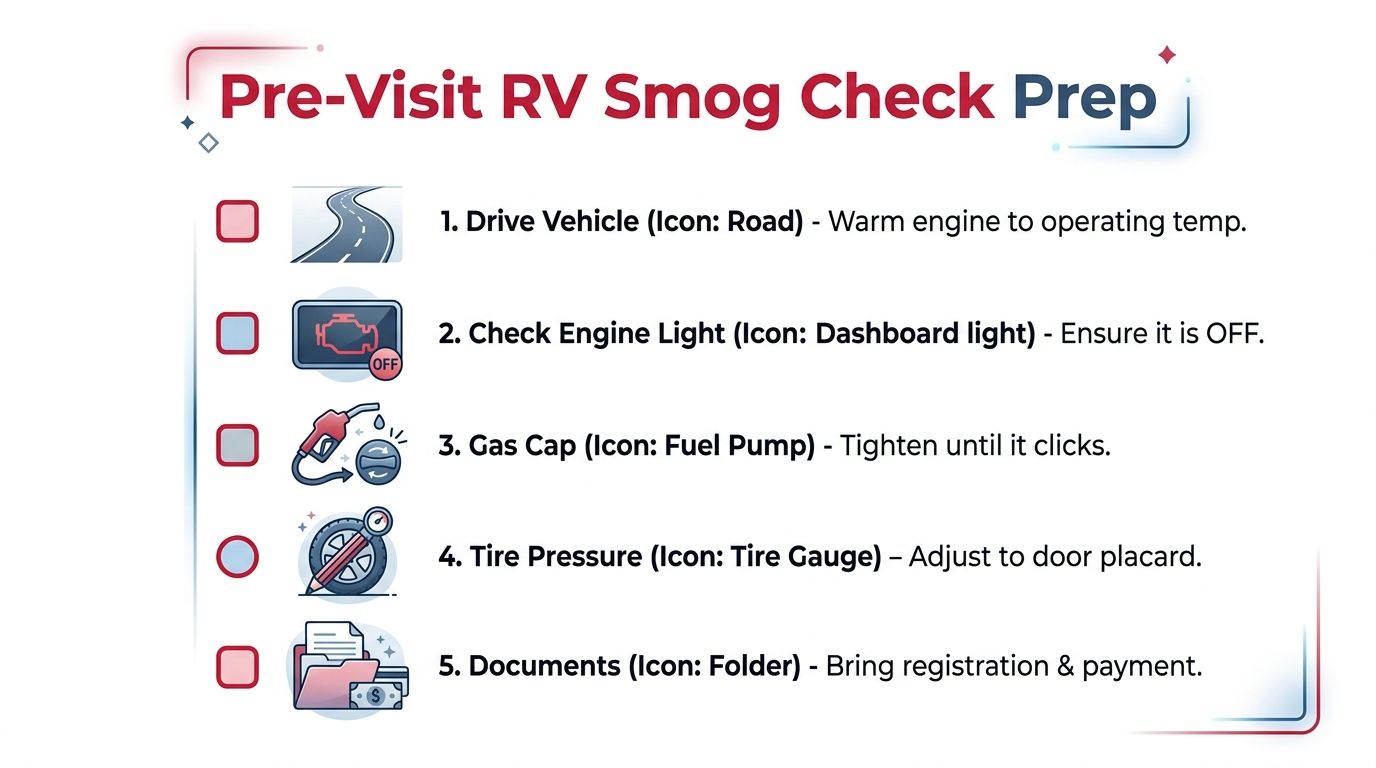
Complete a basic vehicle check
Drive long enough for the engine to reach normal operating temperature before the appointment, unless the station gives you different instructions. A warm engine allows the inspection to reflect normal operating conditions.
Then work through the simple items:
- Check the dashboard: If the check-engine light is illuminated, tell the station before testing.
- Secure the gas cap: Tighten it properly. A loose cap can contribute to an evaporative-emissions problem.
- Review tire pressure: Set the tires according to the vehicle's placard and use the correct pressure information for the coach.
- Avoid clearing codes: Disconnecting the battery or erasing diagnostic codes can leave monitors incomplete.
- Bring the documents: Carry the renewal notice, current registration, identification, payment method, and any prior test information.
Call the station before leaving home. Give the staff the RV's approximate dimensions, fuel type, model year, and whether it's a motorhome or another recreational configuration. Ask whether the site performs the required inspection, whether it's test-only, and whether repairs must be handled elsewhere.
Coordinate the DMV timing
A passed test doesn't help if you miss the registration deadline. Ask how quickly the result is transmitted and whether the location offers DMV renewal services. If you're planning to complete the renewal at the same visit, confirm the service hours separately from smog-testing hours because they may not match.
A test-only station won't sell you repairs, which can make the result easier to understand. It also means you'll need a repair provider if the RV fails. Keep the inspection report so the repair technician can work from the actual diagnostic information.
Common Reasons RVs Fail and How Retests Work
An RV failure usually points to a specific emissions problem, not to the fact that the vehicle is large. The coach may have a worn oxygen sensor, a catalytic-converter problem, or a leak in the evaporative-emissions system. Each fault needs diagnosis before repairs begin.
A recently disconnected battery can create a different result. The vehicle may have no active warning light, yet its readiness monitors may not have completed their checks. In that situation, the station may report an incomplete result instead of a clean pass.
Read the result before choosing repairs
Ask the technician to explain the failure codes and the part of the inspection that produced them. A diagnostic scanner can identify stored codes, but the code alone doesn't always prove which component has failed. A competent repair diagnosis may involve checking wiring, vacuum lines, sensor operation, or exhaust performance.
The common smog check failure reasons can help you recognize the categories, but your own inspection report should control the next step.
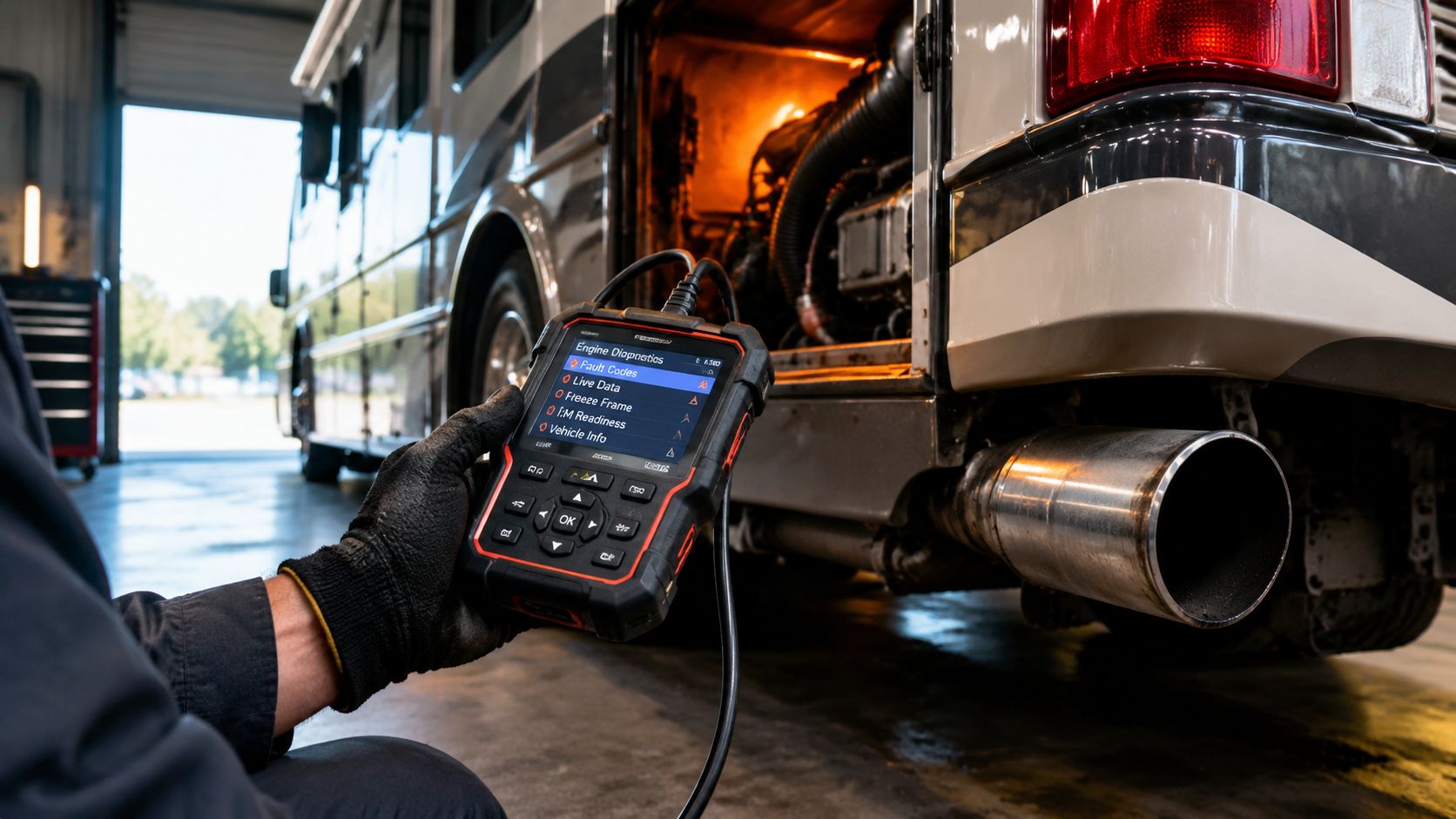
Plan the retest carefully
After repairs, the vehicle may need to be driven so the computer can complete its checks. Don't assume that replacing a part immediately makes the RV ready for another inspection. Ask the repair provider whether the vehicle's monitors are ready and whether any codes remain.
Some station coupon policies provide a free retest, subject to the site's terms. Confirm the policy before authorizing the first test and keep the coupon or transaction details. A retest is generally tied to the original inspection and doesn't replace the need to correct the underlying condition.
Ownership transfers and out-of-state registration situations can change the timing. A renewal, a California transfer, and a temporary out-of-state exemption aren't interchangeable. Heavy-duty diesel motorhomes also follow the separate Clean Truck Check track described earlier, so a standard Smog Check result may not satisfy every obligation.
Getting Your RV Smog Check Done in Antioch Without the Hassle
An Antioch RV owner can reduce the appointment to a few checks. Identify the fuel type, model year, and GVWR, then read the DMV notice for its renewal deadline. Those details form a decision tree: the fuel-year-weight combination points to the likely requirement, while the vehicle's dimensions determine where the inspection can happen.
Call the station with the coach's length, height, and configuration before driving over. A passenger-car bay is like a doorway that fits a sedan but not necessarily a motorhome, so staff need the RV's measurements to confirm bay and equipment capacity.
Fire House Smog operates as a STAR-certified, test-only smog station at 2900 Lone Tree Way, Antioch, California 94509. It performs inspections for some RVs and motorhomes, subject to size and equipment limits. Call 925-754-1600 before arrival to confirm that the vehicle fits the site's setup.
Test-only means the station conducts the inspection without selling repair work. If the RV fails, you can take the report to a repair provider of your choice and return for a retest under the applicable site policy. This separation helps keep the test result and repair decision distinct.
The station has two service bays and offers smog testing seven days a week with extended hours. DMV services, including renewal processing and on-site sticker printing, operate during posted service hours, Monday through Saturday from 9:30 AM to 5:00 PM and Sunday from 12:00 PM to 4:00 PM. Confirm weekend availability for the DMV task you need.
Bring the renewal notice, registration, payment, and prior emissions paperwork. Schedule early enough to address a failure before the DMV deadline.
Call Fire House Smog at 925-754-1600 with your coach's dimensions before the renewal deadline to confirm bay fit and book the inspection.
You've just bought a used car from a friend, signed what you thought was the right paperwork, and driven home with the keys. Then you discover the title has a missing signature, the smog certificate isn't available, or the seller hasn't filed the release of liability. The car is in your driveway, but the ownership record still belongs to someone else.
Learning how to transfer ownership of a car in California means treating the transaction as a compliance process, not a simple exchange. The buyer, seller, lienholder, and California Department of Motor Vehicles each have specific responsibilities. A small paperwork error can delay the title, leave the seller connected to the vehicle, or force both parties to make another DMV visit.
Table of Contents
- Why the Transfer Process Trips People Up
- Gathering the Required Documents Before You Start
- Completing the Ownership Transfer Step by Step
- Handling Special Cases and Complicated Transfers
- Using a Licensed DMV Registration Service Instead of the DMV Office
- Key Deadlines and Mistakes to Avoid During Your Transfer
Why the Transfer Process Trips People Up
Most private-party sales begin informally. The buyer and seller agree on a price, exchange payment, and sign the certificate of title. That part feels finished. The administrative transfer, however, still requires correctly completed documents, the right supporting records, and prompt filing with the DMV.
California gives the buyer a short window to start the transfer. The buyer must begin the process with the DMV within 10 days of the sale, while the seller's Notice of Transfer and Release of Liability filing is due within 5 days. The California DMV title-transfer guidance explains these deadlines and the consequences of leaving the record unchanged.
The seller's risk doesn't end at the handoff
A seller who hands over the keys but doesn't file the release of liability can remain exposed to vehicle-related issues until the DMV records the transfer. That exposure can become especially frustrating when the buyer delays registration, submits an incomplete title, or discovers a lien that wasn't cleared.
The buyer faces a different problem. Driving a vehicle that hasn't been properly transferred can create registration, insurance, and enforcement complications. The purchase agreement may prove that money changed hands, but it doesn't replace the state's ownership record.
Practical rule: Don't leave the transaction assuming the signed title is the finish line. It's the starting document for the DMV workflow.
Small errors create large delays
Common trouble spots include:
- Wrong signatures: The registered owner must release interest on the title. A lienholder or legal owner may also need to sign.
- Unclear mileage information: The odometer disclosure must be completed where required, using the appropriate transfer documentation.
- Missing title: A buyer can't substitute a handwritten note for a lost certificate of title. California uses specific replacement and transfer forms.
- Unresolved lien: The lienholder's interest must be released before the ownership record can be cleanly updated.
- Out-of-state history: A vehicle coming into California may require additional verification rather than the same process used for a California-titled car.
The safest approach is to identify the vehicle's exact transfer scenario before anyone signs. A standard California private sale is one path. A missing title, estate transfer, or interstate vehicle can change the paperwork and the way the DMV accepts the application.
Gathering the Required Documents Before You Start
Prepare the paperwork before making an appointment, visiting a registration service, or submitting anything online. California transfers are easier when every name, vehicle identification number, date, and signature matches across the documents.
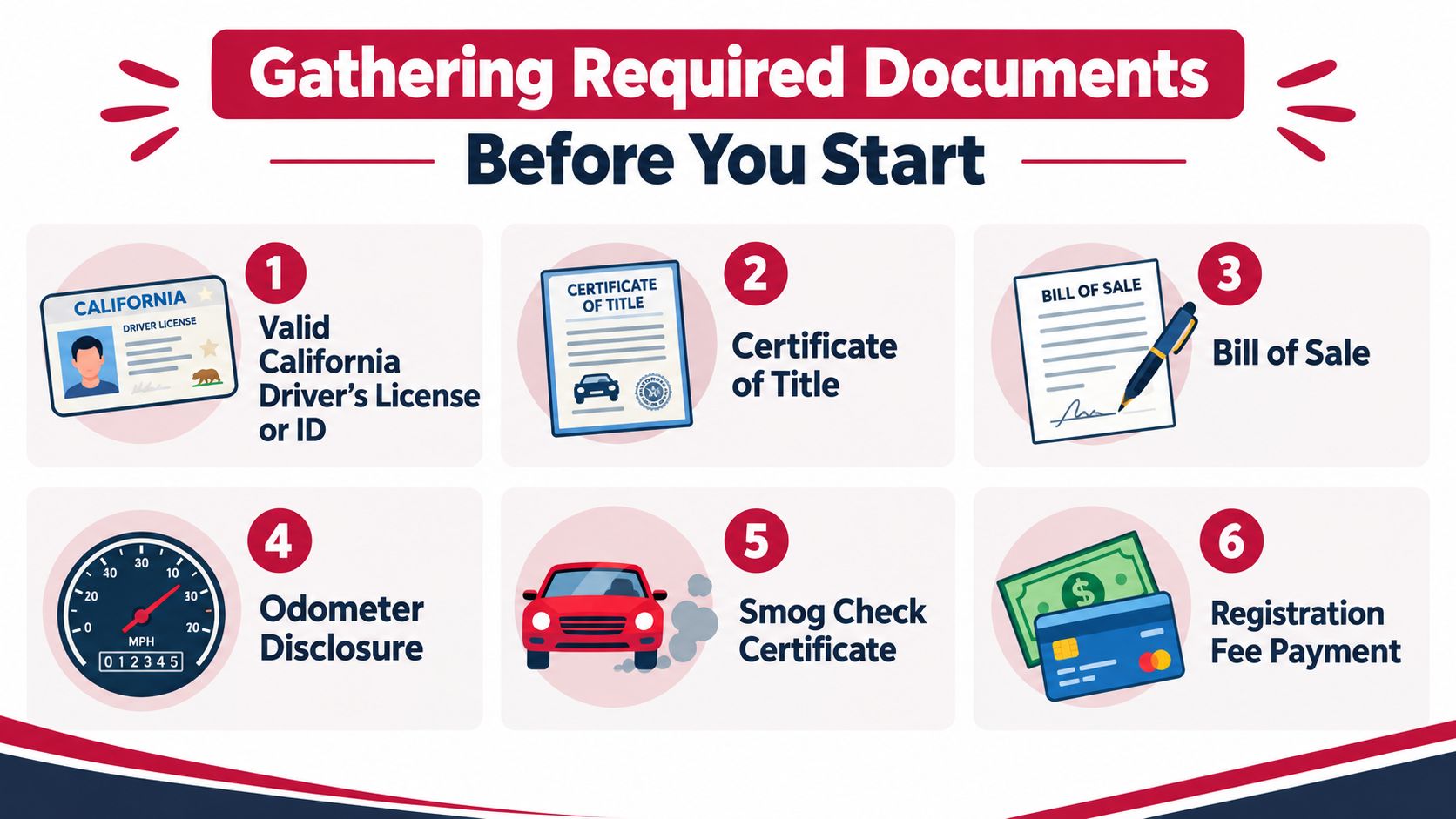
Start with the title and identity documents
The certificate of title is the central ownership document. The seller should review the assignment area carefully, sign exactly as the name appears on the title, and provide the buyer with the completed original. Never guess where a signature belongs. If a legal owner or lienholder appears on the record, that party's release may also be necessary.
The buyer should bring valid identification and verify the vehicle identification number against the car itself, the title, and the registration record. A single character mismatch can cause the DMV or a registration provider to stop the transfer for clarification.
A bill of sale can document the transaction details, even when it isn't the primary ownership instrument. Keep a copy showing the vehicle, buyer, seller, sale date, and transaction terms.
Check mileage, smog, and payment requirements
Odometer information needs careful attention. California uses REG 262, the Vehicle/Vessel Transfer and Reassignment Form, to document odometer mileage in situations where the form is required. Don't erase, overwrite, or casually correct mileage entries. Ask the DMV or a licensed provider how to handle a damaged form instead.
Smog certification is another frequent source of delay. Whether a smog check is required depends on the vehicle and transaction circumstances, so confirm the requirement before submitting the transfer. If certification is needed, complete it before the paperwork is presented.
The buyer also needs to be ready for the applicable transfer fees and taxes. The exact amount depends on the transaction and vehicle record, so use the DMV's fee calculation process or have a licensed registration provider review it.
For a practical document checklist, keep the California vehicle registration documents guide available while assembling your file.
Know what changes when the title is missing
A missing title requires a different route. California uses REG 227 for an Application for Replacement or Transfer of Title when the original title is unavailable, subject to the facts of the case and the signatures required.
A replacement-title transfer can also involve notarization. California DMV procedures state that, for vehicles three model years or older, the legal owner or lienholder signature on certain replacement-title transfers must be notarized. The California DMV basic transfer requirements also describe the registered owner's release, lienholder requirements, and odometer documentation.
Before submission, compare your file against this short checklist:
- Original title or REG 227: Confirm which document applies.
- REG 262 when required: Complete mileage information without alterations.
- Smog documentation: Verify whether the vehicle and transaction require certification.
- Lien release: Obtain the legal owner's release when a lien remains on record.
- Identification and payment: Bring acceptable identification and funds for the calculated charges.
- Copies: Photograph or copy every signed page before handing over originals.
Completing the Ownership Transfer Step by Step
The cleanest transfer follows the transaction order. Handle the seller's signatures first, confirm the vehicle information, then let the buyer submit the ownership application without waiting for paperwork to drift between households.
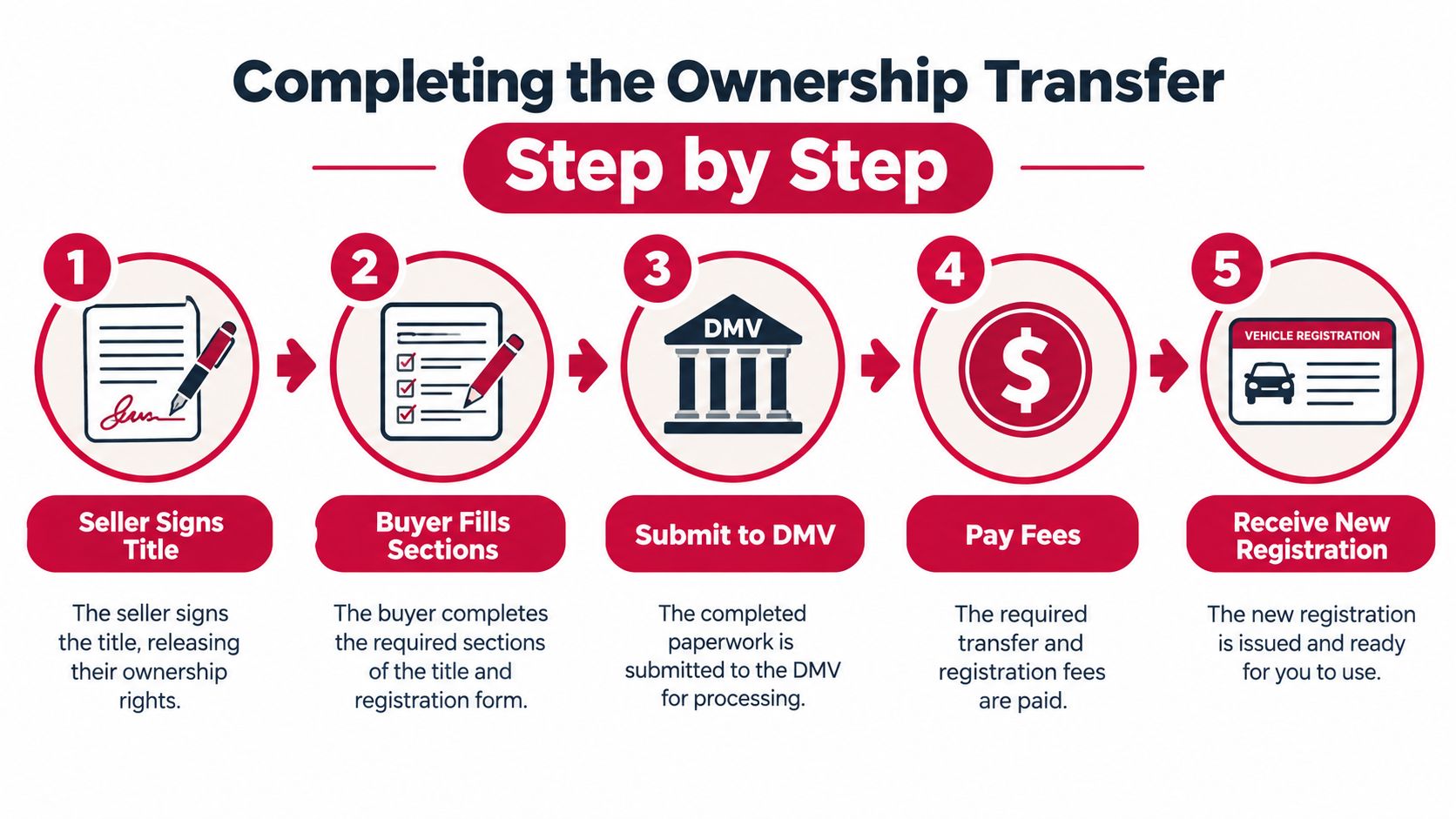
1. The seller completes the assignment
The seller signs the certificate of title in the correct seller section and completes any required sale details. The seller should check the name spelling, vehicle identification number, and sale date before giving the document to the buyer.
If the title includes a lienholder or legal owner, don't assume the buyer can resolve it later. Obtain the required release or confirm the lienholder's role before the transaction is treated as complete.
2. The buyer verifies the application
The buyer checks that the title, bill of sale, odometer disclosure, and supporting forms all identify the same vehicle. Review the VIN on the dashboard or door label, not just the paperwork. If the vehicle information differs, stop and resolve the discrepancy before filing.
The buyer also confirms whether a smog certification is required and whether the vehicle's registration record has unresolved issues. Submitting an incomplete packet can create a request for more documents and delay issuance of the new title.
3. The seller files the release of liability
The seller files the Notice of Transfer and Release of Liability promptly. This filing tells the DMV that the vehicle has changed hands and helps separate the seller from future responsibility while the buyer completes the title transfer.
The release of liability doesn't transfer ownership by itself. It protects the seller's position, while the buyer's title and registration application updates the official ownership record.
4. The buyer submits and pays
The buyer submits the transfer documents through the available DMV channel or through a licensed registration service that handles the transaction. Pay the calculated transfer fees, registration charges, and applicable taxes through the accepted payment method.
At a DMV office, bring the complete original packet and be prepared for the clerk to review each document. A registration service can review the file before submission, which is useful when the title is old, the transaction includes a lien release, or the vehicle's history isn't straightforward.
Keep copies of the signed title, forms, receipts, and release filings. These records give both parties a paper trail if the DMV later requests clarification.
A visual walkthrough can help first-time buyers understand the sequence:
5. The buyer confirms the result
The transfer isn't finished merely because documents were accepted at a counter. Confirm that the buyer receives the updated registration record, stickers, plates, or other issued items applicable to the vehicle.
If the DMV or service provider gives a receipt or temporary evidence of submission, store it with the transaction file. Follow up if the title or registration doesn't arrive as expected, and respond quickly to any request for a corrected form.
Handling Special Cases and Complicated Transfers
A generic private-sale checklist breaks down when the vehicle comes from another state, the owner has died, or the original title is unavailable. These situations require a decision based on the record, not a guess based on what worked for a friend's car.
Out-of-state vehicles
An out-of-state vehicle may need more than a signed title. California can require additional registration, identification, inspection, emissions, or ownership documentation depending on the vehicle's history and the state that issued the title.
Start by collecting the out-of-state title, current registration information, sale records, lien release, and identification. Don't wait until the California counter visit to discover that the seller's signature format or lien status requires another document.
For a focused review of the interstate process, see this guide to out-of-state title transfers.
Inherited and deceased-owner vehicles
An inherited vehicle isn't handled like an ordinary buyer-seller sale. The person authorized to act for the estate may need to provide death documentation, probate or estate paperwork, a properly assigned title, and forms that establish authority to transfer the vehicle.
Government guidance for ownership transfers, including New Jersey's deceased-owner and estate transfer procedures, illustrates the broader point: estate cases carry extra rules, document requirements, and appointment or notarization issues. California applicants should confirm the current California requirements for the specific estate status instead of relying on a standard bill of sale.
The practical decision tree is straightforward:
- Named transfer authority exists: Use the title and estate documents that establish the authorized person's role.
- Probate is open: Confirm what the executor or administrator may sign and whether court documentation is required.
- No clear authority exists: Don't sign as the owner. Resolve the estate authority before presenting the transfer.
- Title is missing: Ask which replacement-title and estate forms must be filed together.
Family transfers and missing titles
A family relationship doesn't automatically remove title requirements. Gift, inheritance, and family transactions can have different tax treatment and documentation rules, so describe the transaction accurately and confirm the applicable forms.
A missing or damaged title should trigger a document review before submission. Use the applicable replacement or transfer form, identify any lienholder, and make sure every required signature is completed in the proper place.
Digital transfer systems can reduce routine paperwork, but online convenience stops when the record contains unresolved fines, insurance issues, lien questions, identity mismatches, deceased-owner status, or interstate registration changes. India's official ownership-transfer information shows how requirements can vary by transaction and jurisdiction, while Singapore and Ireland demonstrate that some markets support online ownership changes with exceptions. The lesson for California owners is practical: use digital tools for eligible routine cases, but switch to a direct DMV or licensed-provider review when the record is complicated.
Using a Licensed DMV Registration Service Instead of the DMV Office
A California DMV office remains the direct government channel, but eligible registration transactions can also go through a licensed provider. A provider may review the documents, calculate charges, submit the transfer, and issue available registration items under its authorized services. For owners comparing licensed DMV registration services in California, the main question is whether the case needs a government decision or careful administrative handling.
The trade-off comes down to who needs to make the decision. The DMV is the right route for disputed ownership, unclear estate authority, unusual legal questions, or record issues that only the agency can resolve. A licensed provider may save time on routine transfers, missing-document guidance, California and out-of-state vehicle paperwork, and transactions handled by owners who cannot spend hours waiting at a branch.
Compare the two routes
| DMV office | Licensed registration service |
|---|---|
| Direct government counter for complex record issues | Local document review before submission |
| Appropriate when the DMV must resolve a legal or record question | Useful for eligible ownership transfers and registration tasks |
| May require planning around office access and availability | May offer broader local hours and on-site issuance |
| Government fees still apply | Service charges may apply in addition to government fees |
A provider does not remove a required lien release, estate document, smog inspection, or corrected signature. It cannot approve a transfer that California law or the vehicle record does not permit. Its practical value is different: an experienced reviewer can catch preventable errors and handle eligible paperwork without requiring a branch visit for every routine task.
When local processing makes sense
Fire House Smog is a licensed California DMV registration services provider in Antioch. Its listed services include ownership transfers for California and out-of-state vehicles, registration renewals, and on-site sticker and plate issuance when applicable. It also operates a STAR-certified test-only smog station, allowing owners who need emissions certification to address that requirement at the same location, subject to the vehicle and service details.
Fire House Smog lists DMV service hours from Monday through Saturday, with Sunday service available for limited transactions. Smog testing is available throughout the week. Confirm current hours, required documents, and whether the specific transfer can be completed before visiting.
Use the DMV directly when ownership is contested or legally unclear. Choose a licensed provider when the transfer is eligible, the documents are ready for review, and reducing administrative time matters more than completing every step personally.
Key Deadlines and Mistakes to Avoid During Your Transfer
The deadlines are the part to write down immediately. The buyer must start the California transfer with the DMV within 10 days of the sale, and the seller must file the release of liability within 5 days, as stated in California DMV title-transfer guidance.
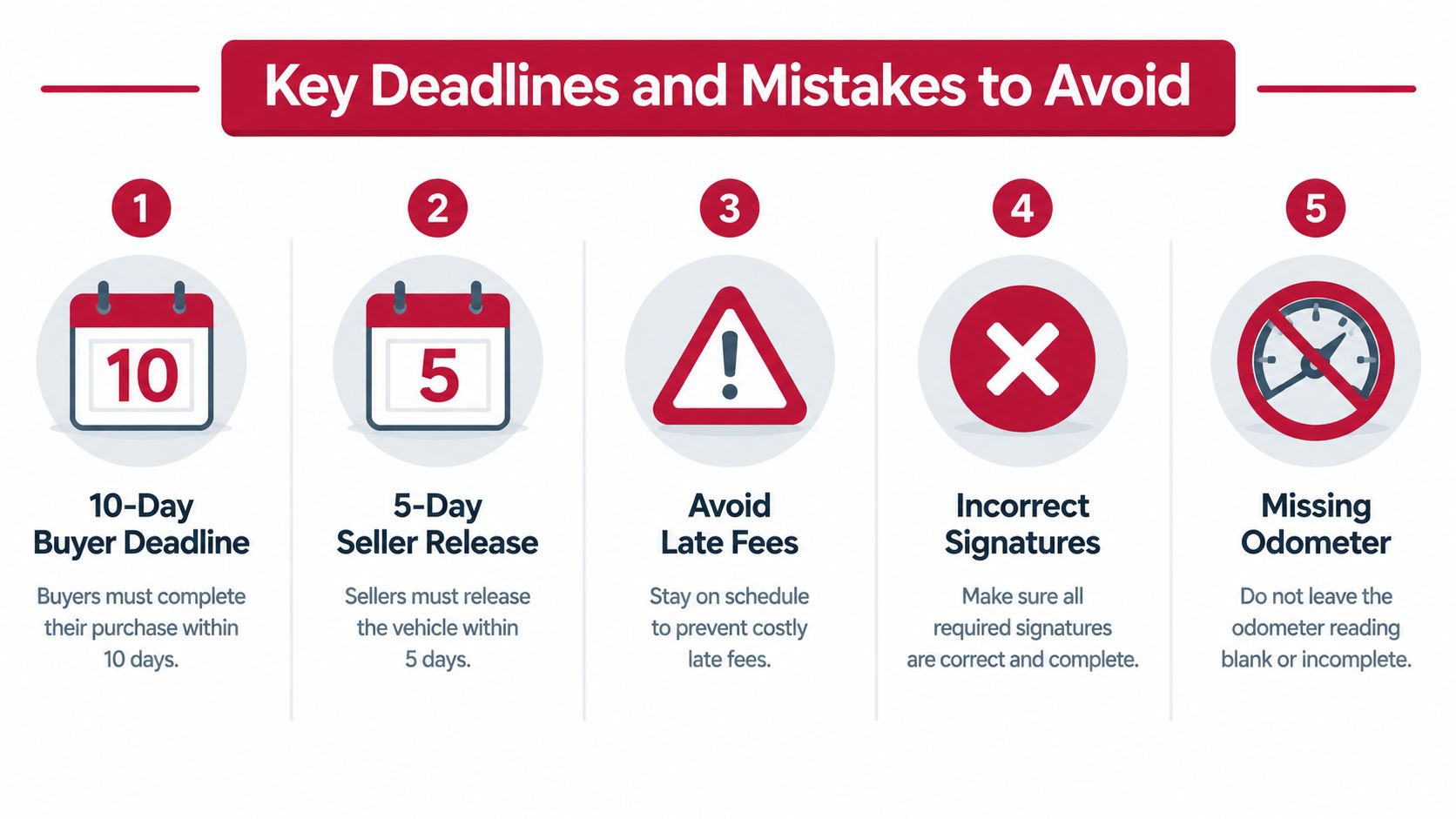
Use this final check before submitting:
- Buyer deadline: Start the transfer promptly and keep the receipt.
- Seller protection: File the release of liability within the required window.
- Title signatures: Match names and sign only in the correct fields.
- Odometer record: Complete the required mileage disclosure without alterations.
- Special cases: Stop and get document guidance for liens, estates, missing titles, and out-of-state vehicles.
A licensed registration service can help review eligible paperwork, but it can't replace missing legal authority or an unresolved lien.
If your California ownership transfer involves a missing title, an out-of-state vehicle, smog certification, or registration issuance, visit Fire House Smog in Antioch for licensed DMV registration services and STAR-certified smog testing. Bring your title and supporting documents so the staff can identify missing requirements before submission.
You bought a used car from a private seller in Antioch, signed the paperwork, and drove home with the keys. Then you realize the title, registration, smog certificate, plates, and DMV deadlines are all separate pieces of the same transaction. The question isn't whether you need a title transfer or registration. In many California purchase situations, you need both, and each one solves a different problem.
Title transfer changes the legal owner. Registration updates the vehicle's California record and supports lawful road use. The signed title sitting in your glove box doesn't complete the job by itself. California DMV rules require the seller to submit a Notice of Transfer and Release of Liability within 5 calendar days, while the buyer must complete the ownership transfer and pay the required fees. DMV also frames ownership-change record updates as due within 10 days of the sale or transfer. California DMV explains the Notice of Transfer and Release of Liability requirements.
| Question | Title transfer | Vehicle registration |
|---|---|---|
| Main purpose | Records who legally owns the vehicle | Keeps the vehicle's California record current for road use |
| Trigger | Sale, gift, inheritance, or another ownership change | Purchase, move to California, renewal, replacement, or record update |
| Core paperwork | California Certificate of Title and required signatures | Registration application, title or ownership documents, fees, and possible smog paperwork |
| Common supporting items | Odometer disclosure, lien release, replacement-title paperwork if needed | Smog certification, fees, use tax, registration card, and applicable forms |
| Result | Ownership record moves to the new owner | Updated registration record, card, sticker, or plates as applicable |
Table of Contents
- Two Different DMV Moments Most Drivers Mix Up
- What Title Transfer and Registration Actually Mean
- California Rules, Documents, and Fees for Each
- Side-by-Side Comparison at a Glance
- Real Antioch Scenarios That Show Which One You Need
- How Fire House Smog Handles Both on Site
- Practical Recommendations and Common Questions
Two Different DMV Moments Most Drivers Mix Up
The Antioch buyer who leaves a private sale with a signed title often focuses on the registration sticker. That's understandable, but it misses the legal step underneath it. The title transfer puts the vehicle in the buyer's name. Registration documents the vehicle's current California status and road-use authorization.
Those tasks may happen during the same DMV transaction, but they aren't interchangeable. If the title transfer isn't completed, the DMV may not be able to finish the ownership record or related registration work. If registration isn't current, owning the vehicle doesn't automatically make it compliant for driving on public roads.
Start with the event that caused the paperwork
A private sale, inheritance, gift, or move from another state changes the paperwork path. A routine renewal usually doesn't change ownership, so it generally calls for registration service rather than a new title transfer. A dealer may submit much of the paperwork for you, but the transaction still involves ownership documentation, registration, taxes, and fees.
California gives the seller a short reporting deadline. The seller must notify the DMV within 5 calendar days by filing a Notice of Transfer and Release of Liability, while the buyer must complete the transfer requirements and pay applicable fees. DMV guidance also identifies 10 days as the ownership-change record-update window. The DMV's title-transfer guidance distinguishes the seller's notice from the buyer's transfer responsibility.
Practical rule: If the vehicle changed owners, handle the title paperwork first and bundle registration into the same visit whenever possible.
A STAR-certified smog check can be part of the transaction when California requires emissions certification. Don't assume the smog question is separate from the purchase. Before you schedule a visit, identify whether you're dealing with a private sale, out-of-state vehicle, inheritance, or renewal.
For a plain-language look at the ongoing registration side, review vehicle registration renewal guidance.
What Title Transfer and Registration Actually Mean
A title transfer is the legal ownership update. The California Certificate of Title identifies the vehicle's ownership record, and the buyer and seller generally complete the required title information before the buyer submits the transfer to the DMV. Required odometer disclosure can also be part of the package, particularly for qualifying privately sold vehicles.
Registration answers a different question. It connects the vehicle to a California DMV record, registration card, and current proof that required registration obligations have been addressed. Registration can involve fees, use tax, emissions documentation, and, where applicable, a planned nonoperation status.
Ownership and road status are connected, not identical
After an Antioch private-party purchase, the buyer commonly handles both ownership transfer and registration together. The signed title supports the ownership change, while the registration portion records the vehicle in California and applies the required fees and compliance checks.
A renewal is different. If you still own the same vehicle and only the tags are expiring, you generally need to renew registration rather than transfer the title again. Moving from another state, receiving a vehicle through inheritance, or accepting a vehicle as a gift can require both ownership paperwork and California registration.
The paperwork reflects that distinction:
- Title documents: The signed California Certificate of Title is central to a normal transfer. If the title is missing, replacement-or-transfer paperwork is required.
- Registration documents: The buyer may need the signed title, smog certification, fees, and use tax when registering a privately purchased vehicle.
- Ownership corrections: A lienholder or registered-owner change requires the DMV record to be updated and the title transferred to the new owner.
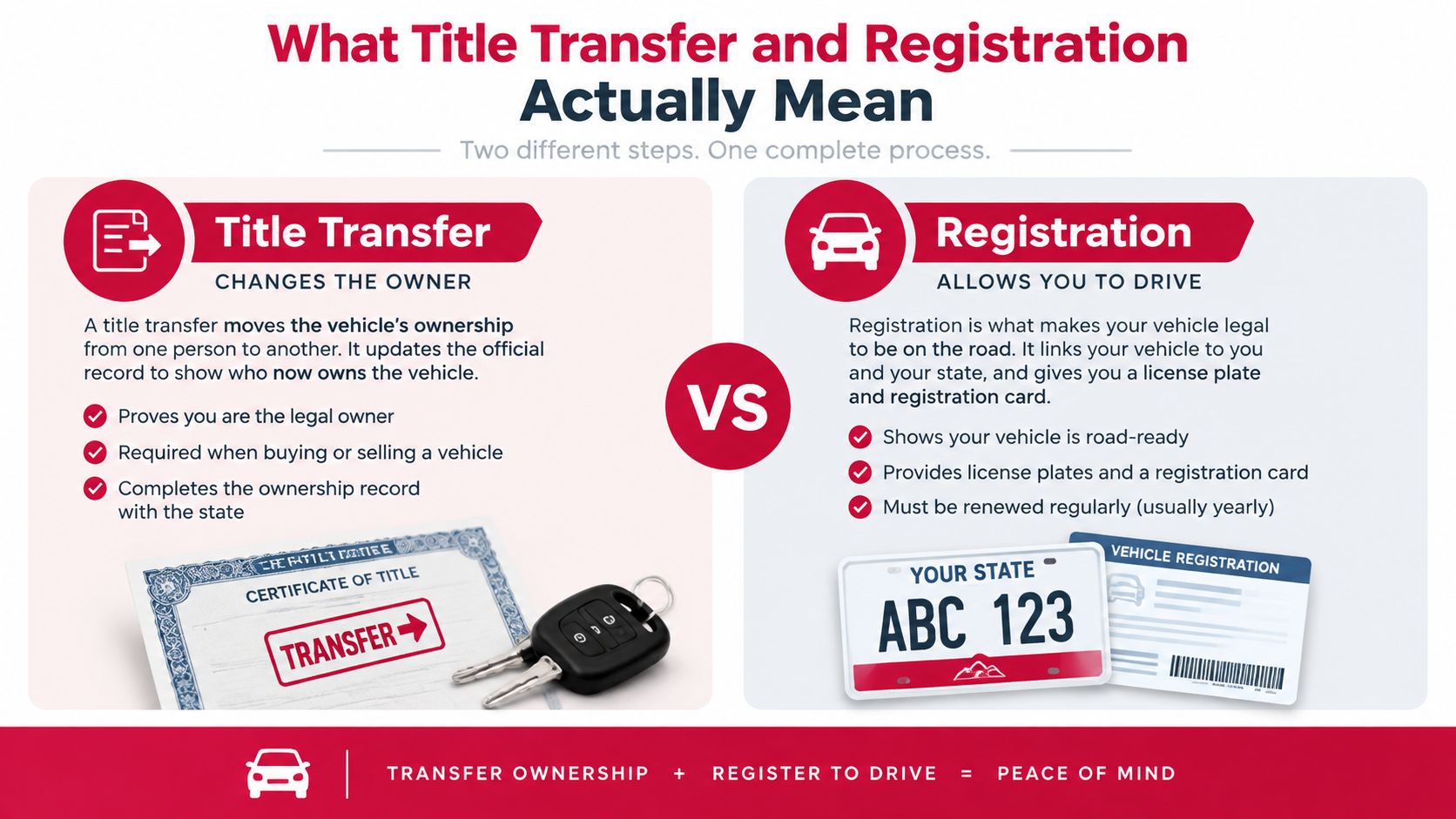
The title answers, “Who owns this vehicle?” Registration answers, “Is this vehicle properly documented and current for California road use?” Keep those questions separate and the process becomes much easier to organize.
California Rules, Documents, and Fees for Each
An Antioch private-party purchase can require more paperwork than a routine tag renewal. After a sale or transfer, the seller must submit the Notice of Transfer and Release of Liability within 5 calendar days. The buyer must complete the ownership and registration steps, with DMV materials identifying an ownership-change record update within 10 days. California DMV's private-party registration instructions outline how the signed title, smog certification, odometer disclosure, fees, and use tax may fit into the package.
What belongs in the title file
For a standard California transfer, bring the California Certificate of Title with the required buyer and seller signatures. A lost, damaged, or unavailable title requires replacement-or-transfer paperwork before DMV can complete the ownership change. REG 227 applies to missing or replacement title situations.
The transaction may also require supporting documents:
| Requirement | Title Transfer | Vehicle Registration |
|---|---|---|
| Ownership proof | Signed California title, or replacement-title paperwork when the title is missing | Signed title or another acceptable ownership document |
| Emissions paperwork | May be required as part of the related transfer and registration transaction | Smog certification may be required for applicable private-party or out-of-state transactions |
| Financial obligations | Transfer fee and other applicable charges | Registration fees, use tax, vehicle-related charges, and applicable county or district amounts |
| Supporting forms | Odometer disclosure, lien documents, and forms for special circumstances | Application forms, weight declarations, REG 256, REG 139, or other applicable documents |
| Submission | DMV field office or mail, depending on the transaction | DMV field office, mail, online renewal, or an authorized registration service |
For a privately sold vehicle, check whether odometer disclosure applies to a vehicle under 10 years old. Bring the smog certification, applicable fees, and use tax when required. Confirm the current document package before leaving for DMV, especially if the vehicle came from another state or the title has a lien.
Don't treat fees as one flat charge
A single transaction can combine a title-transfer fee, registration fees, use tax, and other charges based on the vehicle and the circumstances. A dealer purchase may call for the certificate of title or an out-of-state title for a used vehicle, title-transfer fees or use tax, and forms such as REG 256, REG 139, or weight declarations when applicable.
Gather the paperwork first, then get a current DMV estimate. Old online posts often show amounts that no longer apply. For an Antioch-area document checklist, use Fire House Smog's vehicle registration documents guide. Bring only the forms that match your transaction, and skip transfer paperwork for a simple renewal when ownership has not changed.
Side-by-Side Comparison at a Glance
| Criterion | Title transfer | Vehicle registration |
|---|---|---|
| Purpose | Establishes the new legal owner | Keeps the vehicle documented and authorized for California road use |
| When required | Sale, gift, inheritance, lien change, or another ownership change | Purchase, move to California, renewal, replacement, or registration update |
| Primary form used | REG 262 may support odometer or transfer details when required | REG 343 may support an application, or an online renewal may be used when eligible |
| Typical documents | Signed title, required odometer disclosure, lien release, and replacement-title paperwork if needed | Title or ownership proof, smog certification when required, fees, use tax, and registration information |
| DMV fees involved | Transfer fee plus other applicable transaction charges | Registration fees, use tax, and other applicable charges |
| What you receive | Updated California title showing the new owner | Updated registration card and sticker, with plates or other proof when applicable |
Purpose and timing
The title transfer follows an ownership event. California DMV guidance identifies the buyer's transfer deadline as 10 calendar days after the sale or transfer, while the seller's Notice of Transfer and Release of Liability is due within 5 calendar days. Registration follows the vehicle's operating status, so renewal can occur without a new ownership change.
Forms and documents
REG 262 may be relevant when odometer or transfer information is required. REG 343 can support an Application for Title or Registration, while online renewal may be available for an eligible unchanged ownership record. Don't sign a form just because a seller or buyer hands it to you. Check that every required field matches the transaction.
Smog, tax, and plates
Smog certification isn't the same thing as the title-transfer fee or registration fee. It can be required for a transfer or California registration, while a renewal may require emissions compliance based on the vehicle's renewal circumstances. Use tax can apply to a transfer, and the exact amount depends on the transaction rather than a universal flat rule.
Plate handling also matters. A private seller should follow DMV directions for the sale and handle the plates as required. The buyer shouldn't assume the plates, title, and registration all move together automatically.
The short version: Title transfer proves ownership. Registration proves current California road status.
Real Antioch Scenarios That Show Which One You Need
Antioch and East County drivers usually don't ask for a definition first. They ask, “What do I bring for my situation?” Match the event to the service before you make the trip.
You bought from a private seller in Antioch
Bring the signed California title and review whether an odometer disclosure, smog certification, use tax, and other fees apply. You need the ownership transfer and the registration portion of the transaction, not just a sticker renewal. The buyer's transfer window is 10 calendar days, and the seller has 5 calendar days to file the Notice of Transfer and Release of Liability.
Useful service line: On-site DMV processing, with smog certification if the transaction requires it.
You moved from Texas to Antioch
An out-of-state vehicle can require California title and registration paperwork, VIN verification, and smog certification. Bring the out-of-state title or other ownership documents, identification, and any lien information. Don't skip VIN verification just because the vehicle is already titled elsewhere.
Useful service line: VIN verification paired with California registration and title processing.
You inherited a vehicle from a relative in Brentwood
Inheritance changes ownership, so renewal alone isn't enough. The transaction may require estate or transfer documentation, the appropriate DMV form, and registration fees. Because inherited-vehicle paperwork depends on the facts of the estate and the ownership record, bring the death certificate or estate documents if the DMV directs you to provide them.
Useful service line: On-site DMV ownership transfer, with registration handling.
Your tags expired months ago
This is a registration problem if ownership hasn't changed. Check whether a smog certification is required and expect the DMV to calculate applicable renewal charges and penalties based on the record. Don't start a title transfer unless the vehicle changed owners.
Useful service line: Registration renewal and smog certification.
You bought through a Contra Costa dealership
The dealer commonly handles much of the title and registration submission, but the buyer still needs to understand the use tax and other charges included in the transaction. Keep copies of the purchase and title documents until the California record is complete.
Useful service line: Smog certification when required, plus on-site DMV help if the dealer leaves an unresolved registration or title issue.
How Fire House Smog Handles Both on Site
Antioch drivers often lose time by separating paperwork that can be handled during one planned visit. A licensed DMV registration service can process eligible renewals and ownership transactions, while a STAR-certified station can handle the emissions inspection when California requires one.
Fire House Smog is a STAR-certified test-only smog station and licensed DMV registration services provider. Its service lines include on-site registration renewals, ownership transfers for California and out-of-state vehicles, VIN-related support, and smog inspections for eligible cars, trucks, and some recreational vehicles. Confirm vehicle-size or transaction-specific requirements before arriving.
Bring the complete file
For an ownership change, bring the title and all documents connected to the transaction. Depending on the facts, that can include replacement-title paperwork, odometer information, lien documents, identification, smog certification, and forms such as REG 262, REG 343, REG 5, or REG 256.
The station's DMV service location is 2720 Hillcrest Avenue in Antioch, and the publisher's service information identifies weekend availability and bilingual staff. Call before you go if you're combining smog, VIN verification, and title work, especially for an out-of-state vehicle or RV.
A combined visit works best when you identify every trigger first, ownership change, California registration, emissions certification, VIN verification, or renewal.
The same DMV fees still apply. A service fee may be added for handling the transaction. For location details and service information, see Fire House Smog in Antioch.
Practical Recommendations and Common Questions
Use one decision rule at the counter. If ownership changed, start with title transfer and add registration. If ownership didn't change, handle registration renewal or replacement only. That keeps you from paying for the wrong service and prevents a routine renewal from turning into an unnecessary ownership transaction.
Before leaving home, check the three problems that cause the most avoidable delays:
- Missing smog certification: Confirm whether the transaction or renewal requires a smog check.
- Incomplete odometer or transfer paperwork: Review REG 262 and the title for signatures and required information.
- Out-of-state vehicle: Plan for VIN verification and bring the out-of-state ownership documents.
Questions Antioch drivers ask
How long does a title transfer take in person versus by mail? Processing time depends on the transaction and whether the paperwork is complete. In-person submission lets staff identify missing items immediately, while mail requires you to send the complete package and wait for DMV processing.
Is the transfer fee separate from registration fees? Yes, treat title-transfer charges and registration charges as separate categories. The final amount depends on the transaction and vehicle record, so request a current estimate.
What if the title is lost? Use replacement-or-transfer paperwork, including REG 227 when applicable. The DMV must have acceptable ownership documentation before it can complete the transfer.
Do I need a smog check before transferring the vehicle? Sometimes. California DMV may require smog certification for the related transfer or registration, depending on the vehicle and situation. Confirm before arriving.
How do I handle a lien release? Bring the lien-release documentation and any title information showing the lien status. The DMV may need to update both the ownership and lienholder records.
Can a spouse sign for a deceased co-owner? Don't assume a spouse can sign automatically. The DMV may require estate, survivorship, or other supporting documentation, so confirm the correct process before signing.
Fire House Smog offers STAR-certified smog checks, VIN verification support, and on-site DMV services for eligible title transfers and registration renewals in Antioch. Bring your ownership documents and call ahead if your transaction combines several requirements, then visit Fire House Smog to handle the paperwork and emissions step in one stop.