
If the check engine light is on, your vehicle will fail the California smog check before any other inspection item is evaluated. In BAR's 2025 data, 9.36% of OBD-II-inspected vehicles failed on the OBD-II portion, and 4.59% failed because readiness monitors weren't complete (BAR's 2025 Smog Check Executive Summary).
That's the situation many drivers discover after receiving a registration renewal notice. The car runs smoothly, the deadline is approaching, and the glowing dashboard light seems like a minor annoyance. Then the technician connects the inspection equipment and explains that the test can't produce a passing result while the malfunction indicator lamp, or MIL, is illuminated.
A recently repaired vehicle can create a second problem. Turning the light off with a scan tool or disconnecting the battery may leave the dashboard dark while the OBD system still reports incomplete monitors. California's readiness requirements make that distinction especially important, so a clear light is not the same as a smog-ready car.
Table of Contents
- What BAR Actually Checks When the Light Is On
- Reading the MIL the Way a Smog Tech Does
- Decoding the Trouble Codes Behind the Light
- Readiness Monitors and the 2025 Rule Change
- A Real-World Example of Clearing Codes Too Soon
- When to DIY, When to Call a Licensed Shop
- Retest Rules and Your Pre-Test Checklist
What BAR Actually Checks When the Light Is On
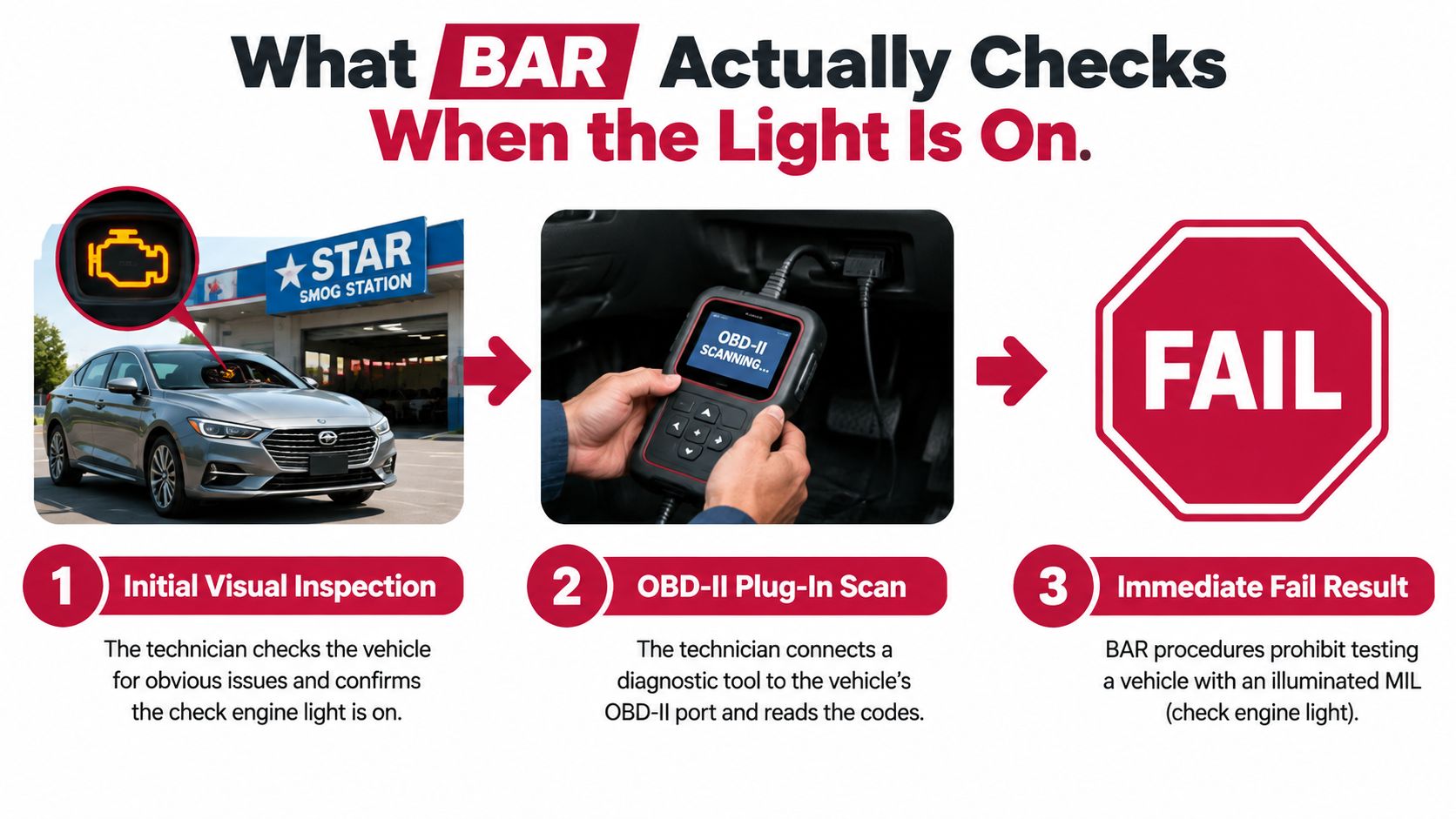
At a STAR station, the technician does not begin by judging how smoothly the car runs or by measuring the tailpipe. For applicable 1996-and-newer OBD-II vehicles under 14,001 GVWR, California's inspection checks the malfunction indicator lamp, readiness monitors, and stored diagnostic trouble codes (California BAR Smog Check Manual).
The inspection starts with the lamp sequence. With the key on and the engine off, the check engine light must illuminate. After the engine starts, it must turn off. BAR's OBD reference states that the vehicle fails if the MIL does not illuminate during the key-on, engine-off check, or if it stays illuminated or flashes while the engine is running (BAR OBD Test Reference).
Why the inspection stops early
A lit MIL is a formal OBD failure. The technician records the result, and the vehicle needs diagnosis and repair before a passing certificate can be issued. A car that drives normally, produces clean-looking exhaust, or passes another inspection item receives no credit for an active emissions fault.
The same rule applies at a state-directed STAR station and at a test-only location selected by the owner. A light that returns after a recent repair is handled like any other unresolved fault.
Clearing the code before arriving does not make the vehicle smog-ready. The repair must hold, and the OBD system must complete its required checks. That gap is especially important after California's October 2025 readiness rule change.
Practical rule: Do not use the smog inspection as a diagnostic appointment. Scan the vehicle, repair the cause, drive it through the required conditions, and verify readiness before paying for the test.
California's vehicle inspection and maintenance program began in 1982, when the state became the 20th state to adopt one. The Bureau of Automotive Repair became its administrator in 1984, establishing the enforcement structure used for inspections today (California Bureau of Automotive Repair history).
Reading the MIL the Way a Smog Tech Does
A vehicle can show a dark dashboard and still fail the inspection. A smog technician follows the lamp sequence instead of judging the car by how smoothly it starts or drives.
The inspection begins with KOEO, meaning key on, engine off. The ignition is switched on without starting the engine, and the technician confirms that the MIL illuminates during the dashboard bulb check.
A dark MIL at this stage is a problem. It can point to a burned-out bulb, a modified instrument cluster, or an electronic fault that prevents the warning from appearing. BAR requires the lamp to illuminate during KOEO, so normal idling does not excuse a missing warning signal.
What changes once the engine starts
The next stage is KOER, or key on, engine running. After the engine starts, the MIL should turn off. If it stays on or flashes, the vehicle fails the OBD portion under the California BAR OBD test requirements.
A steady light usually indicates a confirmed fault recognized by the engine computer. A flashing light signals a more urgent operating condition, often an active misfire that can damage emissions equipment. Use that pattern to decide whether driving to a repair facility is safe, then get a diagnostic scan. The lamp alone cannot identify the failed component.
The technician connects a scan tool to the vehicle's Data Link Connector, usually beneath the dashboard. This connection allows the equipment to read MIL status, diagnostic trouble codes, and readiness information from the engine control module.
The dashboard can hide the vehicle's actual smog status. Clearing codes may switch the lamp off while leaving self-tests incomplete or diagnostic information unresolved. The inspection equipment checks the electronic record stored in the vehicle computer, not merely the warning light the driver sees. A clear MIL is only one checkpoint, not proof that the car is ready for certification.
Decoding the Trouble Codes Behind the Light
The code tells you where to begin, not what part to replace automatically. OBD-II systems can report stored, pending, and permanent diagnostic trouble codes, and each category affects the repair plan differently.
A stored code is a confirmed fault that has met the computer's criteria for recording. It may command the MIL on. A pending code represents a condition detected during an early or incomplete confirmation process. It might not illuminate the dash yet, but it still deserves attention because the computer is monitoring the same system.
Permanent codes are different. They're retained in a protected portion of the vehicle computer and generally won't disappear because someone used a scan tool or disconnected the battery. The relevant monitor must run successfully and verify that the original problem has been corrected.
OBD-II code categories and smog check impact
| Code Type | Illuminates MIL? | Cleared by Disconnect? | Counts as Failure? | How It Clears |
|---|---|---|---|---|
| Stored or confirmed | Often, when the fault meets MIL criteria | It may erase stored memory, but can reset readiness | An illuminated MIL fails the OBD inspection | Repair the cause, then allow the system to verify the repair |
| Pending | Not necessarily | Memory and monitor status may be reset | It signals an unresolved condition that needs diagnosis before testing | The monitor confirms the condition is gone or promotes it to a confirmed fault |
| Permanent | Not necessarily | No, it remains stored | It can keep the vehicle from being ready after repair | The vehicle's own monitor must complete successfully |
Consider a pending catalyst-efficiency code such as P0420. The light may still be off, but a technician's scan can reveal that the computer has detected a concern with catalytic-converter performance. Reading that code is only the first step. The repair decision depends on supporting data, sensor behavior, exhaust leaks, misfire history, and the vehicle's readiness state.
Before booking an inspection, drivers should review their scan results and understand the difference between emissions test results. Clearing a code without identifying the cause often trades a visible problem for a hidden readiness problem.
Readiness Monitors and the 2025 Rule Change
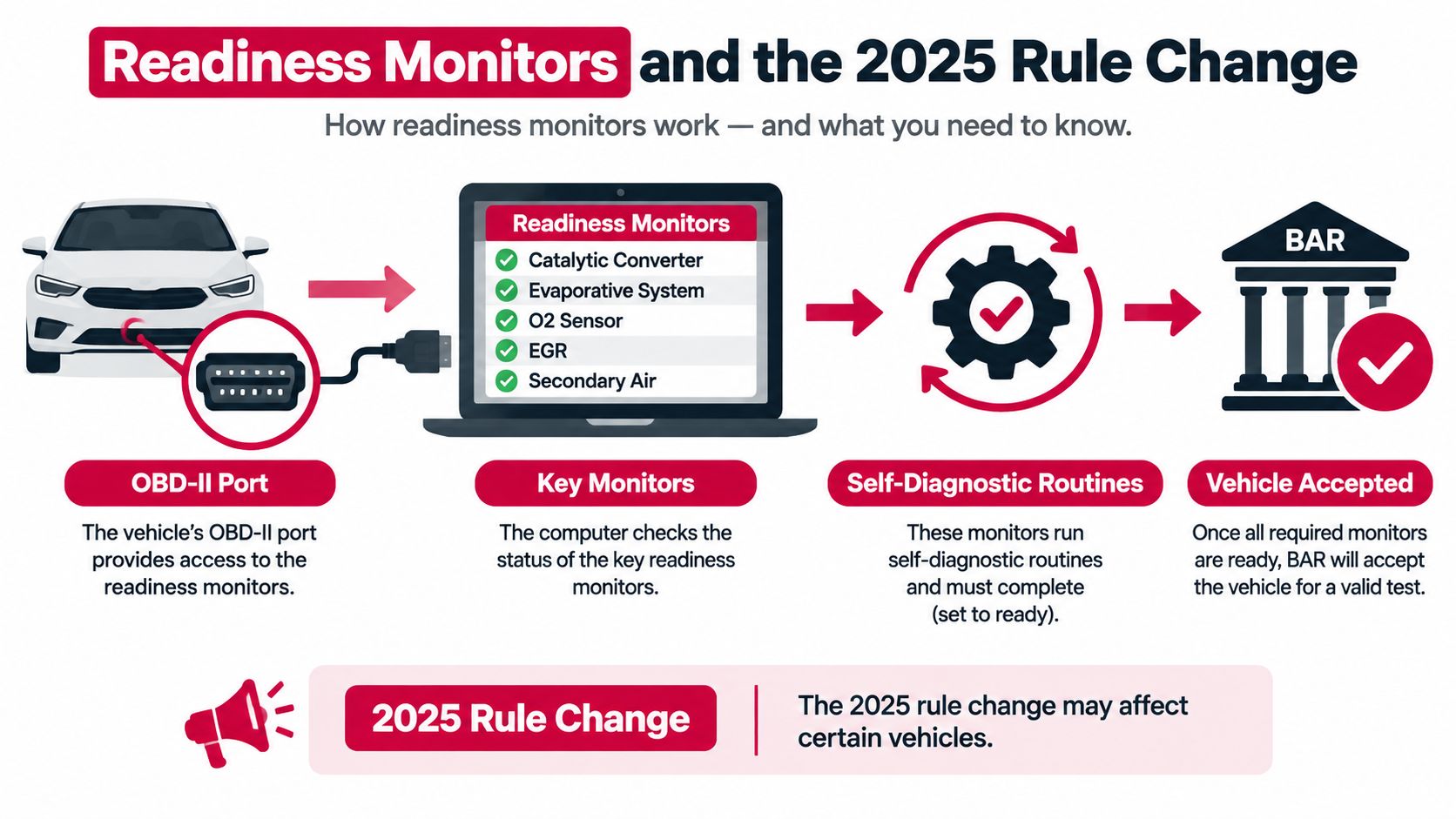
Readiness monitors are the vehicle computer's self-tests for emissions systems. They check the catalytic converter, evaporative system, oxygen sensors, EGR system, and secondary-air system. “Ready” means a monitor completed its test. “Incomplete” means the driving conditions needed for that test have not occurred.
Before the rule change, California allowed limited incomplete monitors based on vehicle age. 1996–2000 vehicles fail with more than two incomplete emissions monitors, while 2001-and-newer vehicles fail with more than one incomplete monitor, according to the state's existing inspection requirements.
The requirement changed on October 1, 2025. BAR announced that every readiness monitor must be set for a vehicle to pass a Smog Check. After a code clear or battery disconnect, the vehicle therefore needs every applicable monitor completed before testing. A scan showing no current trouble code does not confirm that the monitors have finished their checks.
How to prepare without guessing
Use a scan tool that lists each monitor separately. A generic “no codes” message is not enough. After a battery replacement or code clear, drive through varied normal conditions, including cold starts, steady cruising, deceleration, and periods of idling. The manufacturer's service information provides the correct drive-cycle guidance for that vehicle. Do not trust a universal mileage promise.
Do not clear codes again before the appointment. Clearing them resets monitor progress. A weak battery can interrupt the same process if it loses power, so repair battery problems before relying on the readiness report.
Repair, drive, scan, then test.
For a monitor-by-monitor explanation, review this guide to OBD readiness monitors.
A Real-World Example of Clearing Codes Too Soon
A driver with a 2017 Camry noticed an EVAP-related warning and replaced a gas cap. After using a consumer scan tool to clear the P0455 code, the owner drove directly to a STAR station a few days later. The check engine light remained off, so the owner expected a straightforward pass.
The scan told a different story. Several monitors were still incomplete, including the catalyst and EVAP monitors. The vehicle hadn't necessarily proven that the repair failed. It hadn't completed the self-tests needed to establish readiness.
What the owner should have done
The technician's useful answer wasn't to replace more parts immediately. The owner needed to drive the vehicle through varied conditions and return for another readiness scan. A guided routine using the normal commute plus a longer highway loop gave the computer opportunities to run different emissions checks.
That distinction protects drivers from unnecessary repairs. A readiness failure after a code clear doesn't automatically prove that the catalytic converter, purge valve, or oxygen sensor is defective. It proves that the vehicle's testing process is incomplete.
A dark dashboard light only answers one question. The readiness report answers whether the computer has finished checking the emissions systems.
The frustration is understandable. The owner had paid for a repair, cleared the warning, and made a trip to the station expecting the problem to be over. The wasted trip came from treating code removal as proof of repair.
The practical lesson is patience, not delay for its own sake. After any repair that involves clearing memory, get a scan showing the MIL is off and the required monitors are ready. If the light returns during that driving period, stop preparing for the smog check and diagnose the underlying fault instead.
When to DIY, When to Call a Licensed Shop
Some repairs are reasonable for a careful owner. A loose fuel cap is an obvious first check, and a cracked vacuum hose may be visible with the hood open. Replacing a weak battery or correcting a poor electrical connection can also prevent new diagnostic problems, but the vehicle still needs a readiness scan afterward.
A DIY repair makes sense when the cause is clear, the part is accessible, and you can verify the result. It doesn't make sense when the code points toward a system that requires specialized testing.
Use professional diagnostics for complex faults
Catalyst-efficiency codes need more than a code lookup. A technician should check for exhaust leaks, fuel-control issues, ignition misfires, oxygen-sensor signals, and other conditions that can falsely condemn an expensive converter.
Multiple-cylinder misfires deserve prompt attention because they can affect drivability and emissions equipment. EVAP leaks are another strong reason to call a shop, especially when a visual inspection finds nothing and the system needs a smoke test.
A check engine light that returns soon after clearing is also a poor DIY gamble. Repeatedly erasing it only resets monitors and removes useful diagnostic information.
| Situation | Recommended Action | Typical Cost Range |
|---|---|---|
| Loose fuel cap or visible hose issue | Correct the obvious fault, then verify codes and readiness | Ask for a parts-and-labor quote before purchasing parts |
| Single, well-understood sensor fault | Compare test data before replacing the sensor | Request diagnostic and replacement pricing separately |
| Catalyst-efficiency code | Use a licensed shop for exhaust, sensor, and misfire testing | Get a written estimate before authorizing a converter |
| Multiple-cylinder misfire | Stop treating it as a simple smog-prep issue and diagnose promptly | Ask what tests support the proposed repair |
| EVAP leak without a visible cause | Request a smoke test and system-level diagnosis | Confirm whether diagnostic time is billed separately |
| Light returns after clearing | Return for diagnosis instead of clearing it again | Compare the diagnostic fee with the cost of another failed trip |
The cheapest decision isn't always the cheapest part. It's the decision that prevents repeated testing, unnecessary replacements, and lost time.
When you need a test-only inspection after repairs, Fire House Smog is one local option for checking whether the vehicle is ready for the California inspection. A test-only station can report the inspection result without selling the repair that follows.
Before authorizing work, ask the shop which code is active, what test confirmed the failed component, whether readiness will be checked after repair, and what documentation you'll receive. A good technician should explain the evidence, not just read a code and name an expensive part.
Retest Rules and Your Pre-Test Checklist
A clear check-engine light does not prove that the vehicle is ready for a smog test. Before returning after a failure, read the original Vehicle Inspection Report and ask the station about its retest process, after-failure fee, and any free retest window under its policy and coupon terms. Bring repair receipts, scan results, and the inspection paperwork so the technician can verify what changed.
Station eligibility can determine whether the retest is valid. A STAR station is required for certain directed vehicles, while other vehicles may qualify at a licensed non-STAR station. If the original result specifies STAR, confirm the requirement before choosing a nearby location.
Run this final check before driving over
- Confirm the MIL behavior: With the key on and the engine off, the lamp should illuminate. After starting, it should turn off and stay off.
- Scan every readiness monitor: A “no codes” result is not enough. Confirm that the monitors required for your vehicle show ready under the current BAR rules.
- Review recent repairs: Keep receipts, diagnostic reports, and parts information with the Vehicle Inspection Report.
- Avoid a last-minute code clear: Clearing memory can leave the vehicle incomplete, even when the MIL is off.
- Check battery condition: A power interruption can erase monitor progress.
- Use normal mixed driving: Short trips may not create the conditions needed for every monitor to run.
- Ask about station type: Verify whether your vehicle requires a STAR inspection before arriving.
- Ask about repair assistance: If documented repairs meet the applicable requirements, a BAR-licensed repair station can explain whether an Electronic Authorization Form may support a Directed Vehicle Reinspection waiver.
BAR performance data show why this check matters. The 2025 executive summary reports OBD-related failures at 9.36% overall and readiness failures at 4.59% among OBD-II-inspected vehicles (BAR's 2025 Smog Check Executive Summary). Check the computer's readiness status before paying for another inspection.
Fire House Smog is a STAR-certified, test-only station at 2900 Lone Tree Way in Antioch, and it provides California DMV registration services. If the MIL is off and the readiness report is complete, bring your documents and confirm the current retest and coupon terms before arriving.
Fire House Smog can perform a STAR-certified, test-only smog inspection and check whether the OBD system is ready after a repair or code clear. Visit Fire House Smog in Antioch before the registration deadline, and bring the Vehicle Inspection Report and repair records for a retest.
You arrive at the smog station with no warning lights, no rough idle, and no obvious performance problem. Then the technician connects a scan tool and tells you the car can't be tested because one or more OBD readiness monitors are incomplete. It feels like a failure even though nobody has found a broken part.
Usually, the issue is that the vehicle's computer hasn't finished checking itself. A battery disconnect, cleared diagnostic codes, recent repair, or driving routine made up mostly of short trips can leave those tests unfinished. California's requirements make this especially important because the state is moving toward a pass standard that requires every applicable monitor to be set.
Table of Contents
- Why Your Car Was Turned Away at the Smog Test
- What OBD Readiness Monitors Do
- California Smog Check Requirements for Readiness Monitors
- How to Check Monitor Status with an OBD-II Scanner
- Common Reasons Monitors Show Not Ready
- Drive Cycles That Set Stubborn Monitors
- Your Pre-Smog Checklist and When to Visit a STAR Station
Why Your Car Was Turned Away at the Smog Test
The technician didn't turn you away because the car looked unsafe or because the engine sounded bad. The station connected to the vehicle's OBD II system and found that its emissions self-tests hadn't completed. Federal OBD inspection rules recognize an unset readiness flag as evidence that the vehicle isn't ready for a complete emissions evaluation, not automatic proof that an emissions component has failed. The EPA's description of OBD inspection rules explains why a vehicle with unset readiness flags may be rejected from further testing.
Your car's computer needs to verify that systems such as the catalytic converter, oxygen sensors, fuel system, and evaporative controls are working within expected limits. Some checks happen during ordinary operation. Others require a particular combination of engine temperature, speed, load, fuel level, and time. If those conditions haven't occurred, the computer can't mark the test complete.
Why a healthy-feeling car can still be unready
A recent repair may have solved the original problem but erased the computer's stored testing history. Disconnecting the battery can do the same thing. Clearing a diagnostic trouble code with a scanner may switch several monitors back to Not Ready, even if the check engine light stays off while the vehicle begins a new round of testing.
That creates the frustrating sequence many owners experience:
- The repair is completed: The suspected fault may be fixed.
- The memory is cleared: The vehicle loses its completed monitor records.
- The car is driven too casually: Short trips may not provide the conditions needed for every test.
- The inspection comes too soon: The station sees incomplete monitors and can't complete the emissions evaluation.
A useful explanation of related smog check fail reasons can help you separate an incomplete-monitor rejection from a true emissions fault. The next step isn't guessing or repeatedly clearing codes. It's finding out which monitors are incomplete, then giving the vehicle the conditions it needs to run them.
Practical rule: An illuminated check engine light points to a fault. An incomplete readiness monitor points to an unfinished self-test. They're related, but they aren't the same diagnosis.
What OBD Readiness Monitors Do
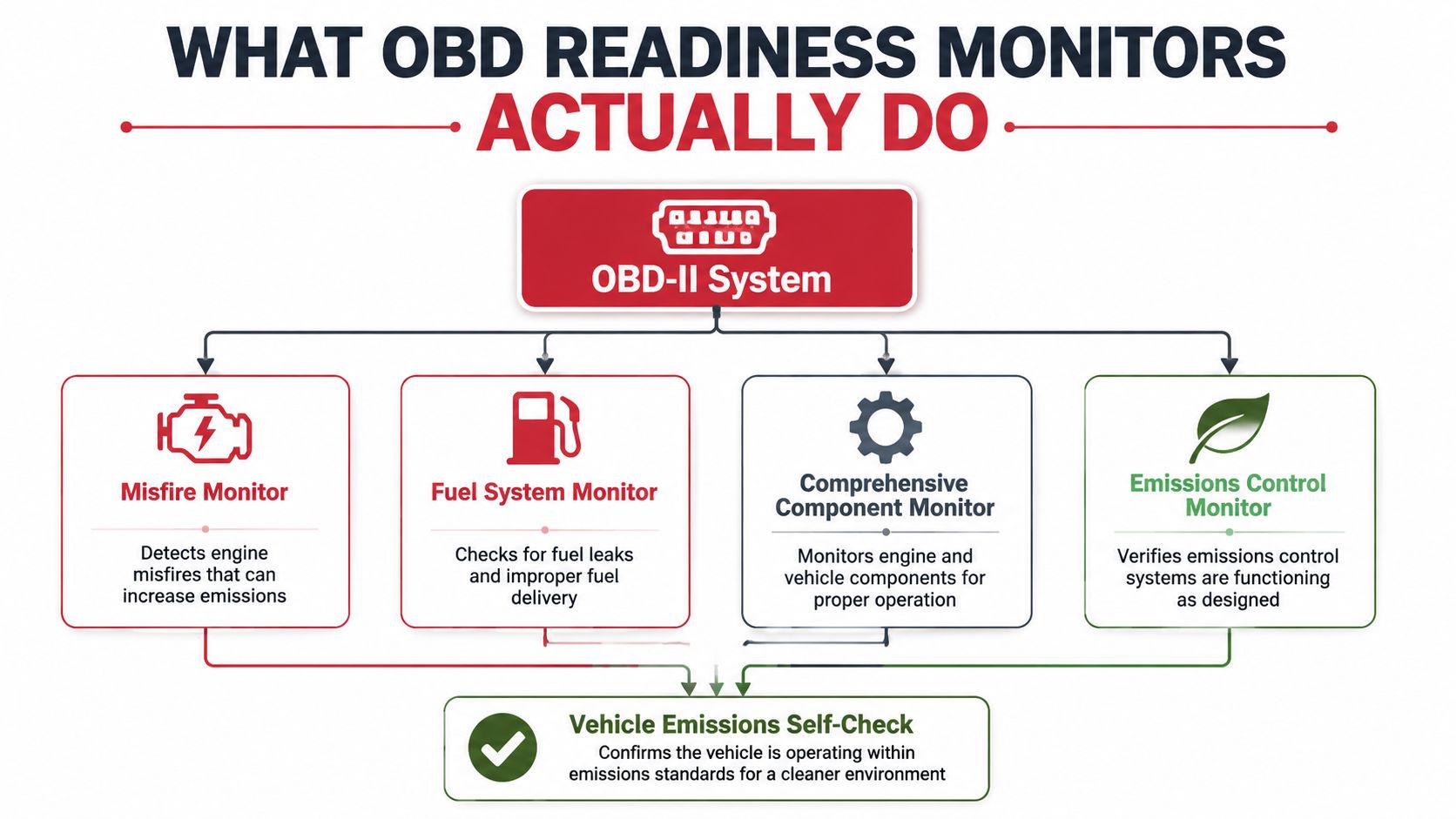
After a repair or battery disconnect, your vehicle may start with several emissions tests unfinished. The OBD-II system works like an onboard checklist. Each readiness monitor runs a specific self-test when the right operating conditions occur. If the result meets the programmed standard, the computer records the monitor as Ready or Complete.
These monitors judge system behavior while the engine operates. The catalyst monitor uses sensor data to assess catalytic-converter performance. The oxygen-sensor monitor checks whether the sensors and related circuits respond as expected. The evaporative system monitor looks for conditions linked to fuel-vapor control and leak detection.
The checklist runs under specific conditions
Some monitors are continuous. The vehicle can evaluate misfire, fuel-system, and component operation during much of normal driving. Other monitors are non-continuous and need a particular sequence, such as a cold start followed by warm operation, steady cruising, or deceleration.
A short trip around the block may provide none of those conditions. The engine might already be warm, the vehicle might not maintain the needed speed, or traffic might interrupt the sequence. This mismatch explains many failures after a repair. The owner drives regularly, but the vehicle's testing logic is waiting for a narrower pattern.
What each status means
- Ready or Complete: The computer finished that applicable test and stored its result.
- Not Ready or Incomplete: The test has not finished. This status does not prove a part is defective, but it can prevent the inspection from proceeding under California's applicable requirements.
- Not Supported: The vehicle does not use that monitor for its engine or emissions configuration. An unsupported monitor generally does not create a problem because it is not an applicable test.
California's Bureau of Automotive Repair describes readiness monitors as OBD self-tests that verify emissions-control functionality. The practical distinction is between applicable and supported monitors. You do not need to force a test the vehicle was never designed to run. You need to complete every monitor that applies to that vehicle, particularly under California's stricter October 2025 completion requirement.
California Smog Check Requirements for Readiness Monitors
California readiness rules have changed from a limited-allowance model toward a much stricter completion standard. The state's Bureau of Automotive Repair reported that updated standards for 2007 and newer light-duty diesel vehicles took effect on July 5, 2023, narrowing which diesel monitors could remain unset. BAR also announced that, effective October 1, 2025, all readiness monitors must be set for a vehicle to pass a Smog Check inspection. These requirements are described in BAR's explanation of the new OBD readiness monitor regulations.
The practical impact is significant. Under the earlier framework, some vehicle categories could pass with a limited number of unset monitors, depending on fuel type and model year. The newer direction treats monitor completion as a hard eligibility condition, while BAR recognizes that unusual vehicle designs may require review or an exception.
Which systems the computer may test
The OBD system can include monitors for:
- Misfire
- Fuel system
- Components
- Catalyst
- Evaporative emissions
- Oxygen sensor
- Oxygen-sensor heater
- Diesel particulate filter
- Non-Methane Hydrocarbon catalyst
- NOx and SCR aftertreatment systems on applicable diesel vehicles
The EPA's diesel OBD guidance describes 11 readiness-monitor bits in both gasoline and diesel OBD systems, with diesel vehicles receiving additional assignments for aftertreatment equipment. Your scanner may show fewer named monitors if some aren't supported by your vehicle.
| Requirement | Current Rule | October 2025 Rule |
|---|---|---|
| Applicable readiness monitors | Pass criteria can vary by fuel type and model year, with limited allowances in some categories | All monitors that can feasibly be set must be complete for a pass, subject to applicable exceptions |
| Gasoline vehicles | Earlier standards differed by model year and could permit a limited unset monitor allowance | Completion becomes the central pass condition |
| Diesel vehicles | Diesel standards can be stricter and use diesel-specific monitor categories | All applicable monitors must be set under the updated standard |
| Unique vehicle designs | Some vehicles may have difficulty completing a monitor through ordinary operation | BAR and CARB may address qualifying design-related difficulties |
Don't assume that every vehicle follows the same threshold. Model year, fuel type, engine configuration, and monitor support matter. California also evaluates hybrid systems according to the monitors supported by their particular OBD configuration, so a hybrid owner should check the vehicle-specific status rather than rely on a gasoline-car rule of thumb.
How to Check Monitor Status with an OBD-II Scanner
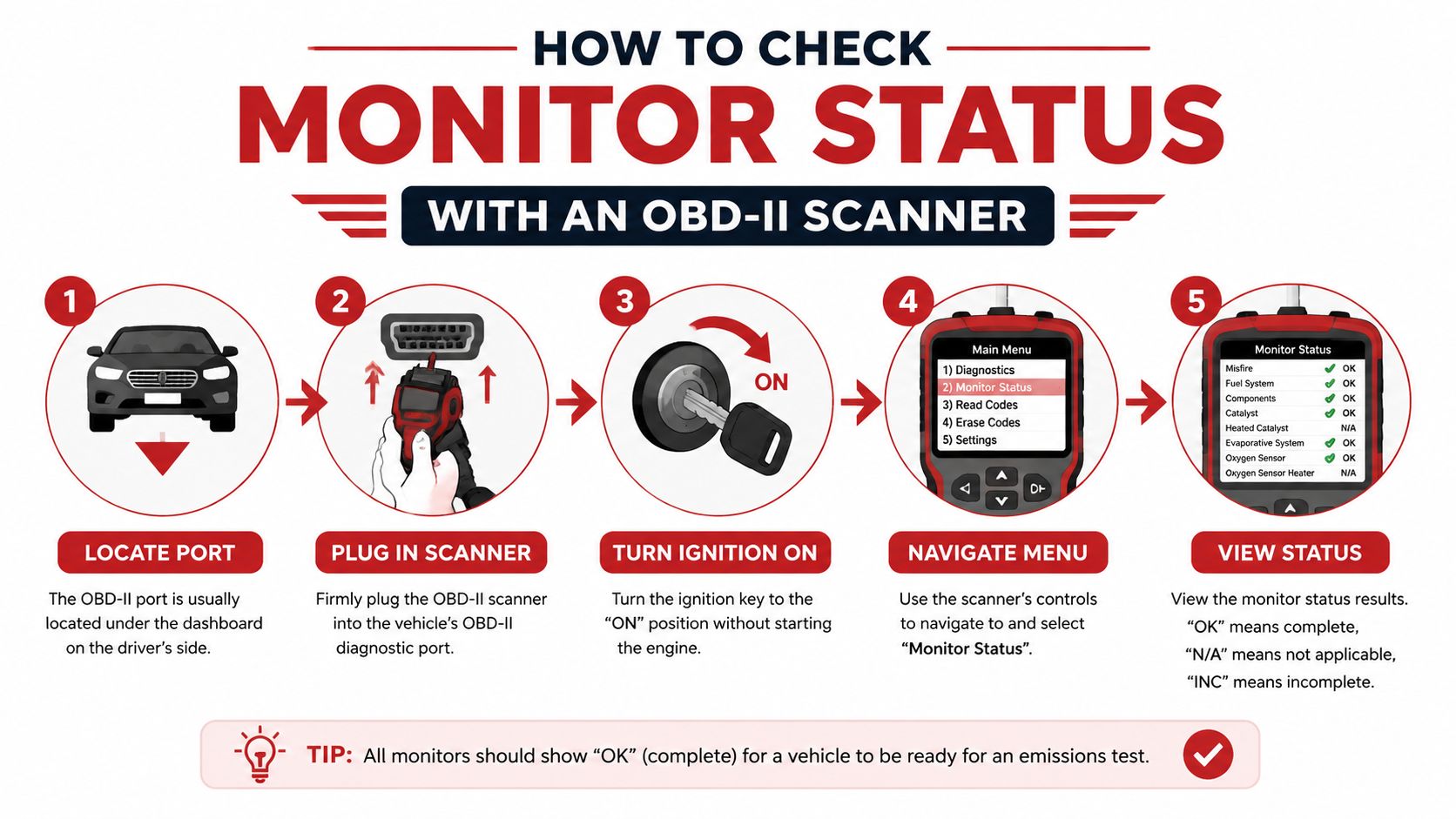
You don't need to wait for the smog station to discover the problem. A scan tool with an I/M readiness function can show whether each applicable monitor is Ready, Not Ready, or Not Supported.
The diagnostic connector is usually under the driver's side dashboard, near the steering column. Plug the scanner into the port with the ignition off, then turn the ignition on without starting the engine unless the tool instructs you otherwise. Select the emissions, I/M readiness, or monitor-status menu.
Read the screen before you clear anything
A basic code reader with readiness functionality is enough for this specific check. Some Bluetooth adapters paired with apps such as Torque or Carista can also display readiness information from the driver's seat. The exact menu names vary, but the meaning of the results remains straightforward.
- Ready: That monitor completed its self-test.
- Not Ready: The vehicle hasn't met the conditions needed to finish it, or a fault is preventing completion.
- Not Supported: That monitor doesn't apply to the vehicle.
Write down the results before taking further action. If the scanner shows a stored or pending fault, don't erase it just to turn off the light. Clearing the code also removes useful diagnostic information and can reset completed monitors. A check engine light and smog check guide can help you understand why an apparently resolved warning may still affect inspection readiness.
What to do with the results
If only a monitor is incomplete and no active fault is present, the next step is usually a suitable drive cycle. If the same monitor stays incomplete after appropriate driving, or the check engine light returns, the vehicle needs diagnosis rather than more random mileage.
Before visiting the station, scan the car again. That simple check can prevent an unnecessary appointment when the computer still shows an unfinished test.
Common Reasons Monitors Show Not Ready
Most incomplete-monitor problems come from a mismatch between how the vehicle performs its tests and how the owner drives. The car may spend its life on short errands, stop-and-go streets, or repeated cold starts. Those trips keep the vehicle moving, but they may never create the stable conditions required for a non-continuous monitor.
Power loss and code clearing
A disconnected battery removes power from the control module and can erase monitor history. Clearing diagnostic trouble codes with a scan tool has a similar effect. In both situations, the computer starts over and waits for the applicable self-tests to run again.
This is why clearing a check engine code immediately before a smog appointment often creates a new problem. The warning may disappear temporarily, but the inspection computer can still see that the readiness record is incomplete.
The absence of a warning light doesn't automatically mean the vehicle is ready for inspection.
Driving patterns can block the test
A monitor may need a cold start, a gradual warm-up, steady cruising, specific deceleration, or a period of undisturbed parking. Heavy traffic can interrupt the sequence. A vehicle that only makes brief trips may never complete a catalyst or evaporative-system test, even though it's driven every day.
Fuel level can also matter for evaporative testing. If the tank is nearly empty or nearly full, the computer may postpone that test because the vapor-space conditions aren't suitable.
Faults and vehicle-specific behavior
A pending fault can prevent a monitor from completing normally. A stored emissions code may also indicate that the computer has detected a problem that requires repair before the monitor can produce a passing result.
Some vehicles are more particular about the order and conditions of their tests. The catalyst and EVAP monitors are common sources of frustration because they may require a carefully timed sequence rather than general driving. If one monitor repeatedly refuses to set, use manufacturer service information or have a technician check for a system fault instead of assuming the scanner is wrong.
Drive Cycles That Set Stubborn Monitors
There isn't one universal drive cycle that works for every make and model. The manufacturer controls the conditions and logic used by the vehicle's computer, so the owner's manual or service information should take priority. A practical routine can still help you create the types of conditions many monitors need.
Start with the vehicle's temperature
Begin with the engine fully cold when the manufacturer's procedure calls for a cold start. Let the vehicle start normally, then drive gently through a mixture of streets and open-road conditions. Avoid aggressive acceleration, unnecessary idling, and stopping the engine before the sequence has a chance to develop.
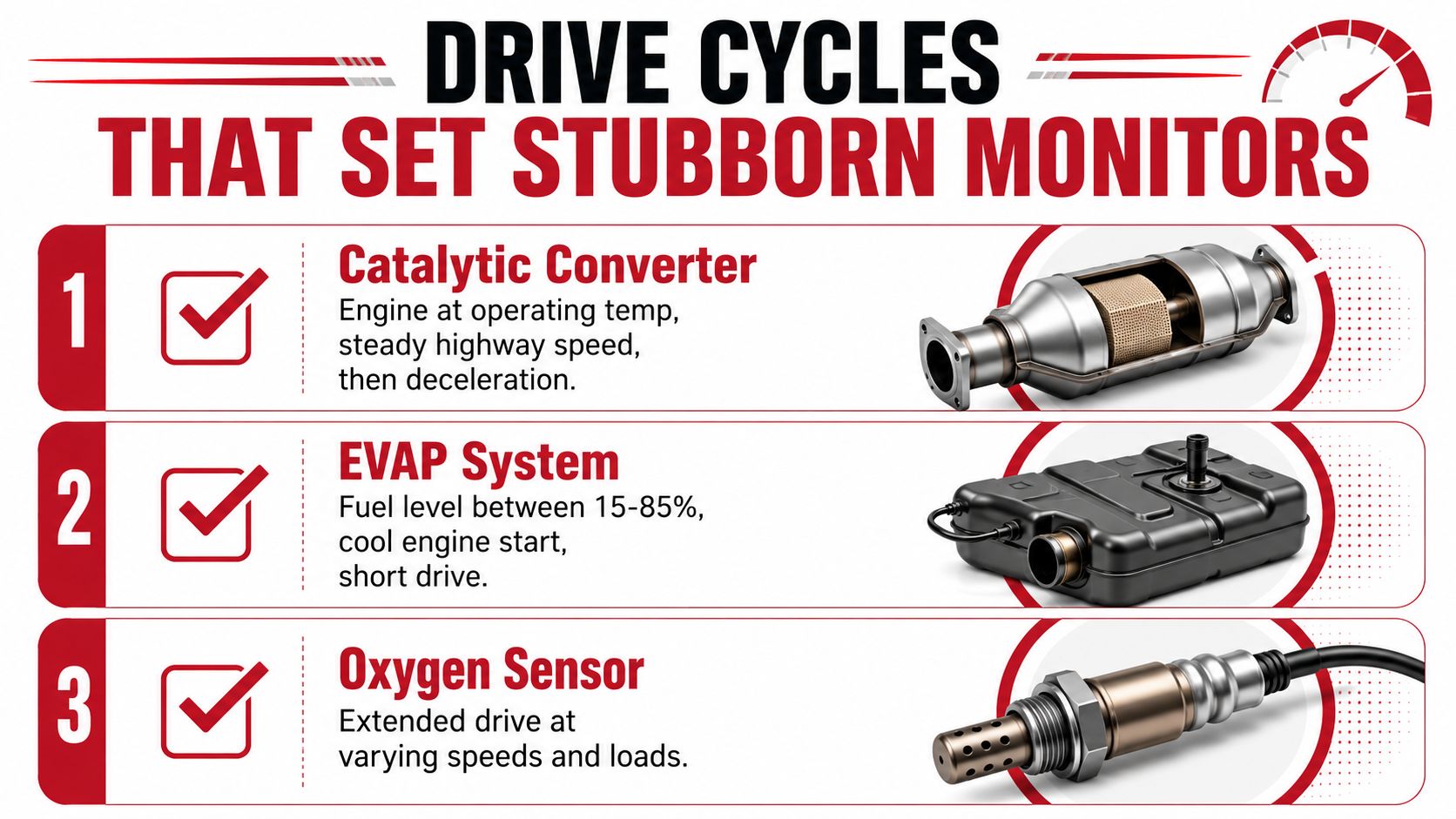
A catalyst or oxygen-sensor test often needs the engine at operating temperature, followed by steady driving and controlled deceleration. Choose a safe route where you can maintain consistent speed without creating a traffic hazard.
Give each monitor the right opportunity
- Catalyst monitor: Use a fully warmed engine, steady open-road driving, and a controlled deceleration when traffic and safety permit. The computer compares sensor behavior while the catalyst is operating under suitable conditions.
- Oxygen-sensor monitor: Include extended driving with changing speeds and engine loads. The system needs enough operating variation to evaluate sensor response.
- EVAP monitor: Keep the fuel level within the vehicle manufacturer's specified range, then allow the car to sit undisturbed after driving if the procedure calls for a leak test. EVAP testing depends heavily on vapor conditions and temperature.
Don't try to force a test by driving recklessly or repeatedly revving the engine. A normal, safe routine is preferable, and some monitors may complete only after the vehicle has been parked and cooled.
Confirm instead of guessing
Drive normally across several separate trips, then check the scanner after each meaningful sequence. If the same monitor remains incomplete, look up the exact procedure for the vehicle's make, model, year, and engine. If a code returns, stop trying to set the monitor and diagnose the underlying issue.
Your Pre-Smog Checklist and When to Visit a STAR Station
Treat readiness as something to verify before the appointment, not something to discover at the inspection bay. Use this checklist after a repair, battery replacement, code clear, or long period of vehicle storage.
- Check the warning light: Make sure the malfunction indicator light isn't illuminated. If it has returned, diagnose the code before scheduling the test.
- Avoid resetting the computer: Don't disconnect the battery or clear codes after the repair unless a technician tells you to do so.
- Check the scanner: Confirm that every applicable monitor reads Ready, not merely that the dashboard light is off.
- Use suitable driving: Mix ordinary city driving with safe open-road operation so the computer can encounter different testing conditions.
- Review fuel conditions: Keep the fuel level within the range recommended for your vehicle's EVAP procedure.
- Scan again before leaving: A final check can show whether a monitor is still incomplete and save you a wasted trip.
A STAR-certified test-only station can make sense when the vehicle has already failed, the registration requires directed testing, or the monitor pattern is difficult to interpret. Fire House Smog is a STAR-certified, test-only station in Antioch that performs smog inspections and can explain the readiness results without selling in-house repair work. You can review what a STAR-certified smog station does before choosing where to test.
Bring the failed test paperwork, repair records, and scanner results if you have them. Those details give the technician a clearer starting point than a simple statement that the car “runs fine.”
Fire House Smog offers STAR-certified test-only smog inspections, readiness-focused guidance, and California DMV registration services at its Antioch location. Check your monitor status before you arrive, then visit Fire House Smog to schedule a test or ask about your vehicle's next step.