
You pull into a smog station in Antioch or Pittsburg expecting a routine renewal, but your diesel pickup won't complete the onboard diagnostic check. The dashboard may look normal, yet the test computer reports an unset monitor, an emissions fault, or a problem with the vehicle's exhaust system. For many owners, diesel emissions standards only become real at that moment.
The rules are easier to manage once you separate them into layers. Federal requirements set a national floor, California adds its own requirements through the California Air Resources Board, and local air-quality rules can affect commercial operators and fleets. The practical questions are simple: What pollutants does the truck control, what equipment must remain installed, what does the smog inspection check, and what happens if the diesel exhaust fluid system triggers a speed restriction?
Table of Contents
- What Diesel Emissions Standards Actually Govern
- The Pollutants Standards Target and Why
- How Diesel Emissions Standards Evolved
- Federal EPA Rules Compared to California CARB
- How Diesel Vehicles Get Tested
- The Real-World Gap Between Lab and Road
- What the 2027 Heavy-Duty Rule Means for You
- Practical Steps for California Diesel Owners
What Diesel Emissions Standards Actually Govern
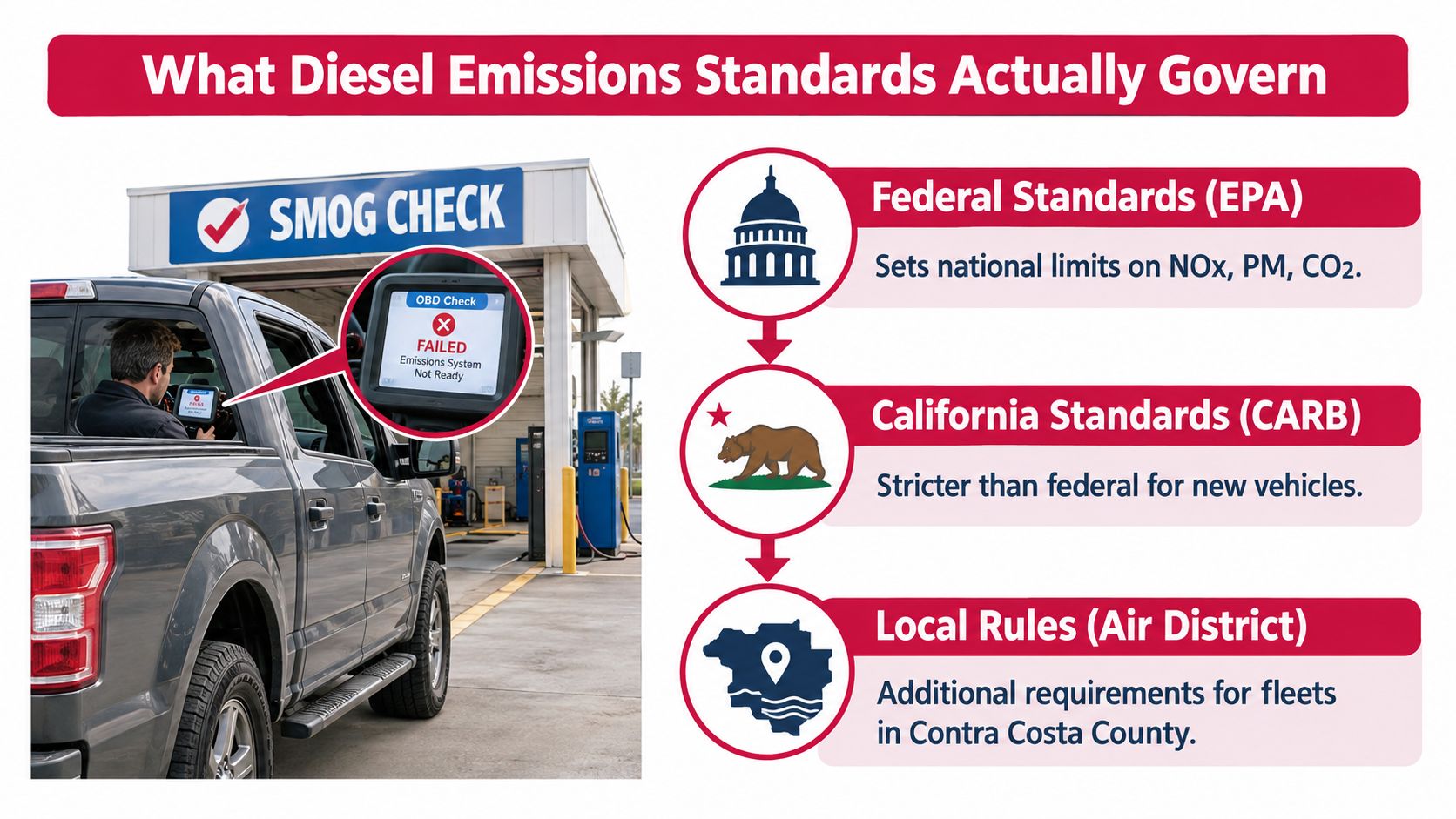
Diesel emissions standards don't describe one universal test. They govern several connected responsibilities, including the pollutants coming from the tailpipe, the vehicle's onboard diagnostic system, required equipment such as a diesel particulate filter, proper use of diesel exhaust fluid, and prohibitions against tampering with emissions controls.
Three rulemaking layers
The U.S. Environmental Protection Agency sets national limits under the Clean Air Act. Federal rules apply across the country and establish requirements for engine certification, useful life, onboard diagnostics, and pollution-control equipment. EPA's newer heavy-duty rule focuses especially on nitrogen oxides during normal operation, low-load driving, and idling, as described in the agency's 2027-and-later heavy-duty emissions rule.
California can set stricter vehicle emissions requirements through CARB authority under the Clean Air Act. Other states may adopt California requirements under Section 177, which is why a California-certified configuration can differ from a federal-only configuration.
Local agencies, including the Bay Area Air District, address air quality within their jurisdiction. Their rules can affect fleet operations, commercial vehicles, idling, and equipment used near warehouses, construction areas, and other high-activity locations.
Different vehicles, different obligations
A light-duty diesel pickup, a heavy-duty tractor, an off-road machine, and a stationary generator don't all follow the same rule set. Model year, gross vehicle weight rating, engine type, intended use, registration location, and whether the vehicle operates on public roads all matter.
The purpose reaches beyond passing paperwork. NOx and particulate matter affect the air people breathe, particularly in communities near busy roads and freight corridors. A smog inspection checks whether the vehicle remains compliant, but the larger regulatory objective is reducing pollution before it reaches neighborhoods in East Contra Costa County.
The Pollutants Standards Target and Why
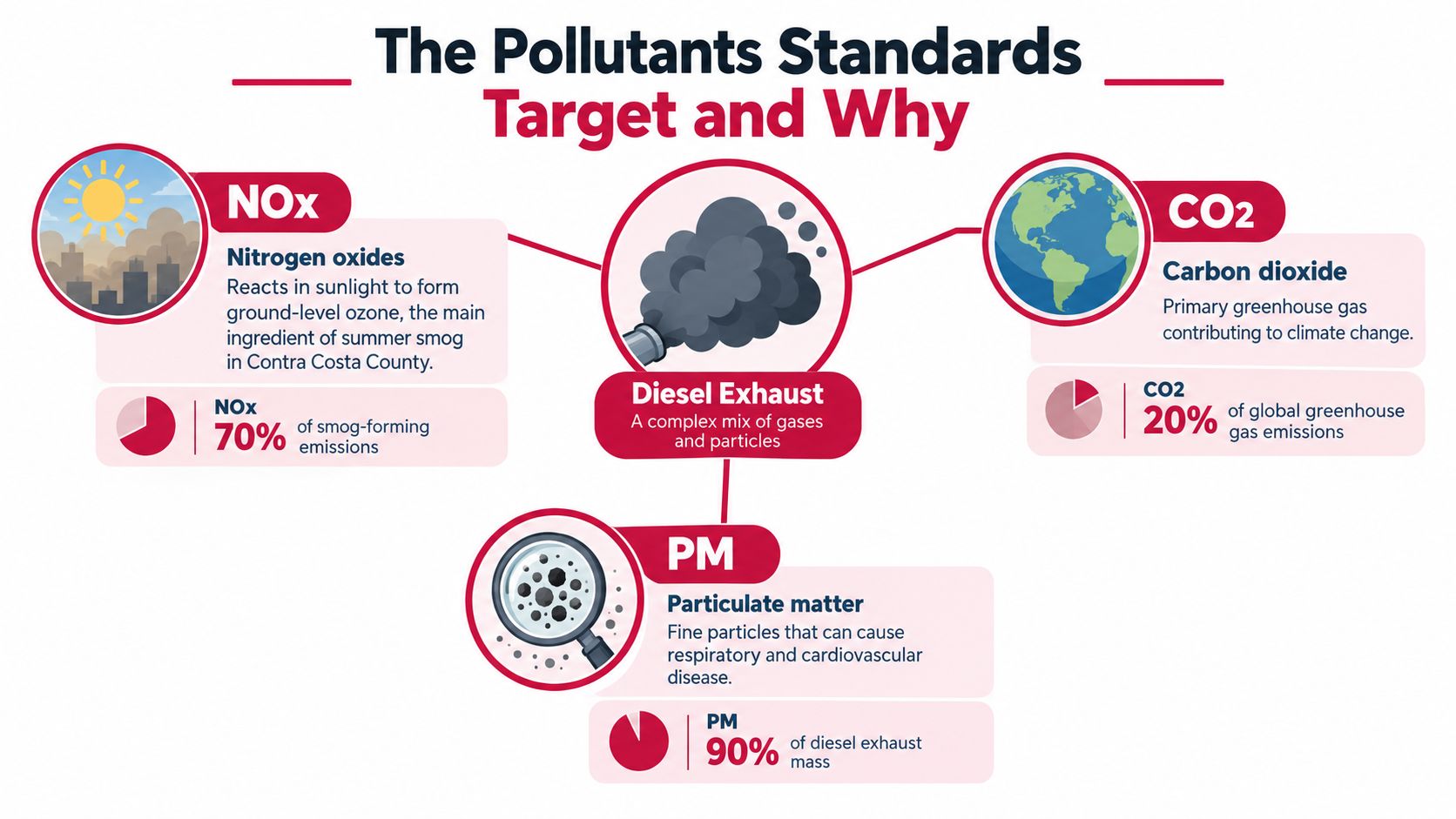
A diesel engine creates a mixture of gases and particles. Regulators focus heavily on NOx, particulate matter, and particle number because each pollutant behaves differently in the atmosphere and in the human body.
NOx, or nitrogen oxides, are gases produced during high-temperature combustion. Sunlight can help transform NOx and other pollutants into ground-level ozone, the main ingredient in smog. A rough everyday comparison is the sharp, metallic smell people associate with air after lightning. The smell isn't a measurement, but it helps explain why the pollution can be chemically active even when you can't see a cloud from the exhaust.
PM, or particulate matter, consists of solid and liquid particles. Large soot particles may appear as black smoke, while finer particles can be difficult or impossible to see. Think of fireplace smoke trapped inside a room. Even after the visible haze fades, small particles may remain suspended in the air.
PN, or particle number, counts particles rather than weighing them. Modern diesel rules use both mass and particle number because a small mass of ultrafine particles can still represent many individual particles. Euro 6 diesel limits include a particle-number ceiling of 6.0×10^11 particles per kilometer, alongside limits for NOx and PM, according to The AA's Euro emissions standards guide.
The equipment that controls them
A diesel particulate filter, or DPF, traps soot before it leaves the exhaust. The vehicle periodically raises exhaust temperature to burn accumulated soot in a process called regeneration. A clogged, damaged, or removed DPF can create both a mechanical problem and a compliance problem.
Selective catalytic reduction, or SCR, addresses NOx. The system injects DEF into the exhaust, where it helps convert NOx into less harmful compounds. DEF isn't fuel, and pouring it into the diesel tank can cause serious damage. It belongs in the dedicated DEF tank.
Health agencies and regulators focus on these pollutants because diesel exhaust can contribute to respiratory and cardiovascular harm. The control strategy therefore combines combustion design, DPF filtration, SCR chemistry, temperature management, sensors, and software. A vehicle can have a clean-looking tailpipe and still fail if one of those systems isn't working correctly.
How Diesel Emissions Standards Evolved
Older diesel engines earned their smoky reputation because earlier rules and technologies provided far less control over soot and NOx. Over time, regulators moved from broad smoke limits toward pollutant-specific caps measured under defined engine cycles.
A major U.S. milestone arrived with the 2007 heavy-duty highway rule. EPA says the requirements began taking effect with model year 2007 heavy-duty highway engines and vehicles and were tied to low-sulfur diesel fuel requirements. That transition pushed manufacturers toward aftertreatment systems designed to control both NOx and particulate matter, as documented in EPA's historical diesel emissions material.
The next major change is the EPA rule for 2027 and later commercial vehicles. The normal-operation NOx limit becomes 0.035 g/bhp-hr, with 0.050 g/bhp-hr at low load and 10.0 g/hr at idle. EPA's rule reflects a move from the earlier 0.20 g/bhp-hr heavy-duty diesel NOx allowance to the much tighter 0.035 g/bhp-hr level. Industry coverage cited in the supplied EPA rule summary describes the new normal-operation limit as more than 80% stricter than the current standard, while the EPA final-rule page explains the regulatory change.
The limits tell the story
The following table uses only the heavy-duty figures supplied in the verified data. It shows why the technology in a newer diesel truck can't be judged by looking only at the engine block.
| Model Year | NOx Limit | PM Limit | Key Technology Required |
|---|---|---|---|
| 2007 heavy-duty highway rule | Earlier rule milestone, numeric limit not provided here | Earlier rule milestone, numeric limit not provided here | Low-sulfur fuel and aftertreatment-based control |
| Earlier heavy-duty certification level | 0.20 g/bhp-hr | Not provided here | Engine controls and aftertreatment development |
| 2027 and later, normal operation | 0.035 g/bhp-hr | 0.005 g/bhp-hr | Advanced combustion control, SCR, DEF management, DPF, and expanded monitoring |
| 2027 and later, low load | 0.050 g/bhp-hr | 0.005 g/bhp-hr | Strong low-temperature and low-load emissions control |
Europe established another important reference point with Euro 6. For diesel passenger cars, Euro 6 sets NOx at 0.08 g/km, PM at 0.005 g/km, and particle number at 6.0×10^11/km, according to the supplied AA reference. Compared with Euro 5, the Euro 6 NOx limit represented roughly a 67% reduction, requiring manufacturers to combine high-pressure common-rail combustion control with SCR and DPF systems.
The direction is clear. Diesel compliance has shifted from visible smoke control to precise limits for gases, particle mass, particle count, low-load operation, and idle conditions.
Federal EPA Rules Compared to California CARB
Federal and California rules overlap, but they aren't interchangeable. EPA establishes national requirements, while California can adopt stricter standards and enforcement practices that affect vehicles registered or operated in the state.
The supplied comparison brief identifies an earlier federal heavy-duty NOx level of 0.20 g/bhp-hr and California Low NOx Omnibus targets of 0.05 g/bhp-hr for model year 2024 engines and 0.02 g/bhp-hr by model year 2027. Those figures should be checked against the certification label and applicable CARB documents for a specific engine family, because a truck's legal standard depends on its model year, engine category, and certification configuration.
| Standard | EPA Tier 4 Final | California CARB Low NOx |
|---|---|---|
| Heavy-duty NOx figure identified in the supplied rule comparison | 0.20 g/bhp-hr | 0.05 g/bhp-hr beginning with 2024 model-year engines, tightening to 0.02 g/bhp-hr by 2027 |
| PM figure identified in the supplied comparison | 0.01 g/bhp-hr | Comparable PM control with stricter useful-life durability requirements |
| Compliance emphasis | Federal certification and in-use requirements | Lower NOx targets, durability, and California-specific implementation |
Why California owners notice first
California's rules can affect the vehicle before a federal deadline reaches the rest of the country. The supplied CARB comparison also identifies emissions warranty coverage that can extend to 15 years or 435,000 miles in California, depending on the applicable vehicle and component requirements. That is a durability obligation, not a promise that every repair will be free.
A California-certified diesel usually carries an emissions label identifying the configuration approved for the vehicle. Replacing a DPF, SCR component, sensor, or calibration with a nonapproved part can create a compliance issue even if the replacement appears to function mechanically.
For a plain-language overview of how federal and state requirements fit together, see this guide to vehicle emissions standards. For East Contra Costa owners, the practical question is whether the truck's equipment and software match its certification label, not merely whether the engine starts and drives.
How Diesel Vehicles Get Tested
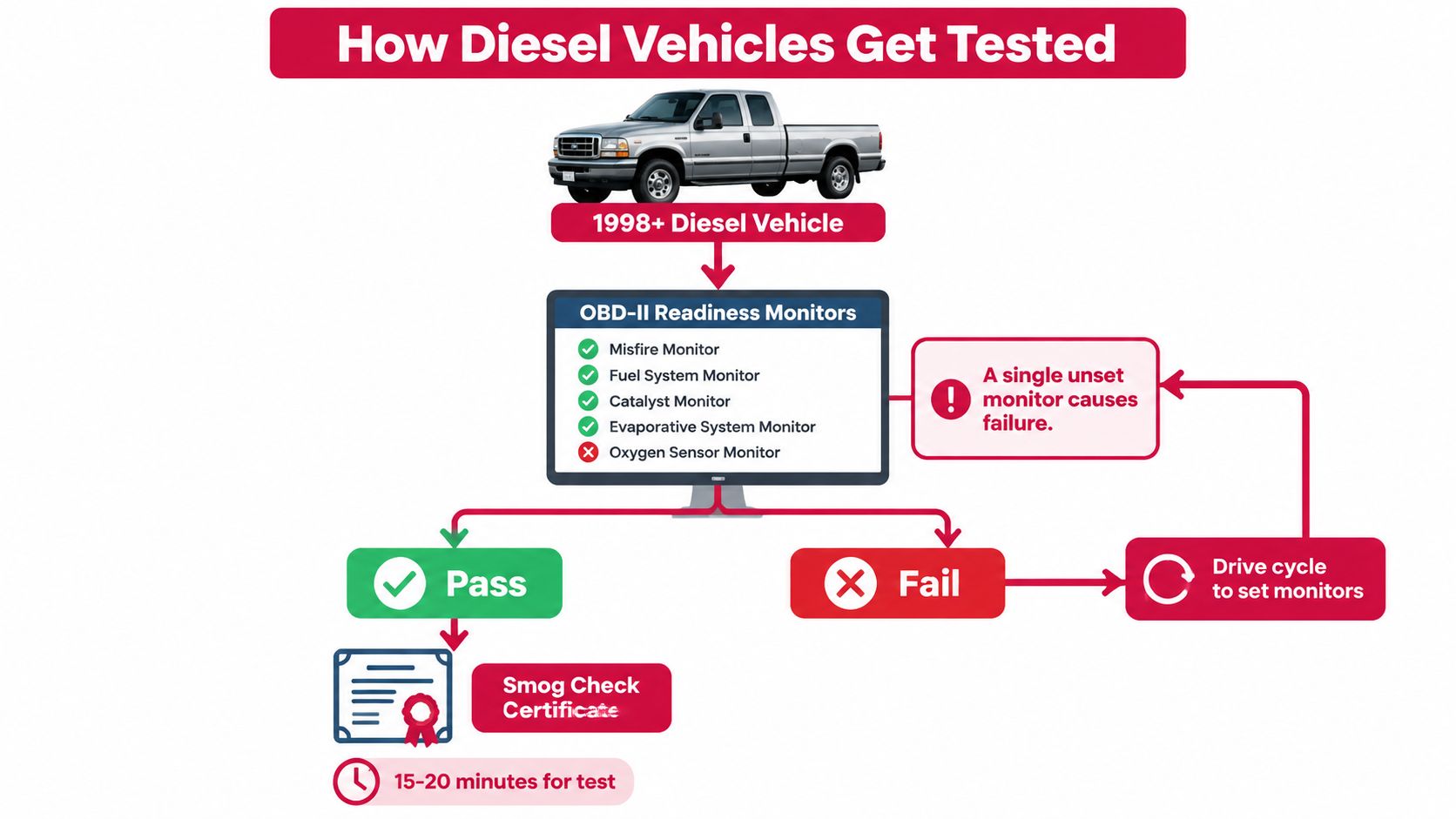
A California diesel smog inspection begins with the vehicle's identity and applicable test procedure. For many 1998-and-newer diesel vehicles, the inspector connects to the OBD-II system and checks whether required monitors have completed and whether diagnostic trouble codes indicate an emissions fault.
What the inspector checks
The vehicle may need more than a scanner connection. A diesel inspection can include:
- OBD-II readiness: The monitors must show the required completed status. A monitor that remains unset can cause a failure even when the dashboard light is off.
- Diagnostic faults: Active emissions-related trouble codes can fail the inspection.
- Visual equipment inspection: The technician checks the emissions label and confirms required equipment, including the DPF where applicable.
- Tampering review: Missing, altered, or defeated emissions equipment can prevent a passing result.
- Smoke evaluation: Applicable diesel procedures can include a snap-acceleration opacity test, which checks visible smoke during a controlled acceleration.
A vehicle can fail because it is too dirty, but it can also fail because it hasn't completed its drive cycle after a battery replacement or code clearing. Clearing a code right before the appointment doesn't repair the fault. It can also erase monitor history, leaving the vehicle unready.
Preparing before you pay
California has special smog-check rules and exemptions that depend on model year and vehicle type. The supplied procedure notes identify a $1,500 smog-check exemption for vehicles eight model years old and newer, but owners should confirm the current DMV applicability for their exact vehicle because exemptions and fees can differ by registration category.
A directed vehicle may need a STAR-certified or test-only station. If DMV sends a vehicle for a directed inspection after a failure or other trigger, the owner generally can't return to a regular station and choose a different test type.
Before the appointment: Check the registration notice, confirm the vehicle's model year and weight rating, keep the emissions label intact, and ask whether recent repairs or battery disconnection left an OBD monitor incomplete.
For a diesel-specific explanation of California inspection requirements, review this guide to smog testing for diesel vehicles. If the vehicle fails, ask the station about retest eligibility and whether a qualifying free retest applies under its policy or coupon terms. A retest checks the vehicle again after repairs or after the monitors complete their required drive cycle. It doesn't waive the need to correct the underlying fault.
The Real-World Gap Between Lab and Road
A certification result answers a narrow question. It shows how an engine performed under an approved test procedure, in defined conditions, with specified equipment and controls. It doesn't guarantee that every delivery route, grade, temperature, load, or stop-and-go pattern will produce the same result.
Independent research and policy summaries have identified a real-world gap between certified and actual diesel NOx emissions. The supplied research notes that modern heavy-duty diesels have exceeded certification limits in on-road testing, while comparative reviews have found that Euro 6 diesel cars retained higher NOx limits than gasoline cars. The Imperial College London discussion of diesel emissions provides background on why laboratory compliance and road performance can diverge.
Low-load operation is especially important. A diesel engine crawling through deliveries in Concord or Pacheco may produce exhaust temperatures that challenge SCR performance. SCR needs suitable exhaust conditions for effective chemical conversion, so a system can be well maintained and still face its hardest work during cold starts, light loads, and repeated stops.
How regulators respond
California and federal regulators use in-use approaches to test emissions outside the laboratory. Portable emissions measurement systems, commonly called PEMS, can measure emissions while a heavy-duty vehicle operates on the road. EPA also uses Not-to-Exceed provisions to address emissions during operating conditions outside the primary certification cycle.
These tools matter because a truck that passes its certification test can still contribute to local ozone formation if its control system performs poorly during actual work. The gap is one reason newer rules pay more attention to low-load operation, useful-life durability, and monitoring rather than relying only on a single laboratory result.
DEF behavior belongs in this discussion. If exhaust temperature is low or the SCR system detects a fault, the vehicle may increase warnings and eventually trigger an inducement strategy. The driver experiences that regulatory system as a dashboard message, a reduced operating mode, or a speed limitation.
What the 2027 Heavy-Duty Rule Means for You
For commercial diesel owners, EPA's 2027-and-later rule changes the design target for new heavy-duty vehicles. The normal-operation NOx limit is 0.035 g/bhp-hr, while the rule also sets 0.050 g/bhp-hr at low load and 10.0 g/hr at idle, according to EPA's final multi-pollutant standards.
The low-load figure is important for delivery trucks, vocational vehicles, and fleets that spend substantial time moving slowly or waiting. Older certification methods didn't place the same emphasis on those conditions. Newer vehicles therefore need better temperature management, sensor accuracy, SCR control, and software strategies.
Current vehicles versus new builds
The rule applies primarily to vehicles and engines covered by its model-year phase-in. It doesn't automatically rewrite the certification label on every older truck already on the road. Current owners still need to maintain the equipment required for their vehicle, avoid tampering, and respond to emissions warnings.
The operational effects can appear through DEF and SCR management. A truck that runs low on DEF, detects poor fluid quality, or develops a sensor fault can issue escalating warnings. EPA's DEF guidance describes inducement behavior for affected diesel engines, including a phased response that can ultimately limit vehicle speed to 25 mph, as explained in the agency's diesel exhaust fluid guidance.
| Standard Phase | NOx Limit | Useful Life | NTE Multiplier |
|---|---|---|---|
| Earlier heavy-duty certification level | 0.20 g/bhp-hr | Vehicle-specific, not provided here | Vehicle-specific, not provided here |
| 2027 and later, normal operation | 0.035 g/bhp-hr | Longer useful-life requirements apply, exact mileage not provided here | Exact multiplier not provided here |
| 2027 and later, low load | 0.050 g/bhp-hr | Longer useful-life requirements apply, exact mileage not provided here | Exact multiplier not provided here |
| 2027 and later, idle | 10.0 g/hr | Longer useful-life requirements apply, exact mileage not provided here | Exact multiplier not provided here |
Planning for uptime
Fleet managers should treat DEF quality, tank level, dosing hardware, NOx sensors, exhaust temperature sensors, and SCR health as uptime issues. A warning ignored on Friday can become a restricted vehicle during a Monday route. Newer systems may require more diagnostic attention because they monitor emissions performance more closely.
California requirements can add another planning layer for vehicles operated in-state. Before ordering replacements or buying used equipment, compare the vehicle's certification label, engine family, registration category, and applicable CARB requirements. For practical fleet compliance questions, this resource on clean-air trucks can help owners identify issues to discuss with a qualified technician or compliance advisor.
Practical Steps for California Diesel Owners
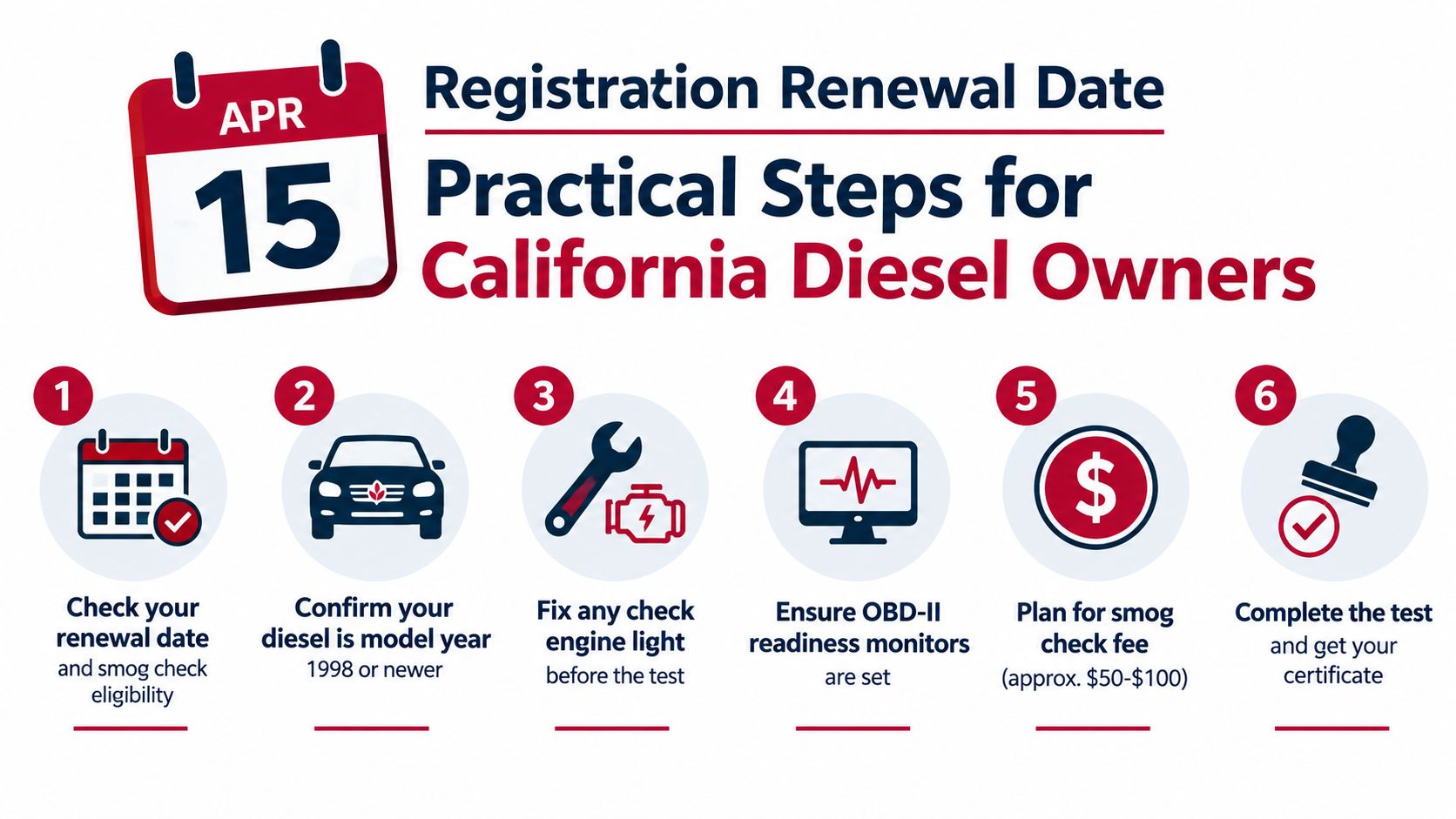
Start with the registration renewal date, not the day before it. Read the DMV notice carefully and confirm whether your diesel vehicle requires a smog check, then verify the vehicle category, model year, and gross vehicle weight rating.
A practical preparation list
- Check the renewal notice: Confirm the due date and whether DMV directs you to a particular type of inspection.
- Verify vehicle details: Many California diesel requirements turn on model year, vehicle type, and weight rating. Don't assume a pickup and a commercial truck follow the same procedure.
- Resolve warning lights: Repair an active check-engine light before testing. Ask the repair shop to identify the actual cause rather than clearing the code.
- Complete the drive cycle: After battery disconnection or emissions repairs, the monitors may need normal driving conditions before they report ready. A scanner can show readiness status before you schedule the inspection.
- Inspect the emissions hardware: Check that the DPF, SCR components, DEF lines, sensors, and under-hood emissions label are present and undamaged. Never substitute a nonapproved bypass or defeat device.
- Choose the correct station: A STAR-certified test-only station may be required for a directed vehicle. A regular station may not be authorized to complete the inspection your DMV notice requires.
Fleet operators should keep service records for DEF-system repairs, DPF regeneration work, sensor replacements, and software updates. Documentation helps technicians diagnose recurring problems and helps managers decide whether a vehicle needs repair, scheduled replacement, or a different operating assignment.
A clean truck isn't only easier on local air. It also avoids the lost route time that follows an ignored emissions warning.
Fire House Smog is a STAR-certified test-only station at 2900 Lone Tree Way in Antioch that performs smog inspections for cars, trucks, and some recreational vehicles, with vehicle-size limits worth confirming before arrival. It also provides California DMV registration services, and its published contact number is 925-754-1600.
If your diesel pickup, van, or light-duty truck is due for renewal in East Contra Costa County, visit Fire House Smog to confirm the appropriate inspection and registration-service options before you arrive. Bring your DMV notice, leave time to address any unresolved OBD readiness issue, and ask about retest eligibility if the vehicle doesn't pass the first inspection.