
You've just opened a California DMV renewal notice, and the question is sitting there in plain sight: does your motorhome need a smog check, or does its recreational classification make it exempt? The answer isn't a simple yes or no. California generally evaluates a qualifying RV through the same emissions framework used for other vehicles, then applies additional filters for fuel type, model year, and vehicle weight.
That's why two motorhomes parked side by side can follow different compliance paths. A gasoline coach may need a regular inspection, while a newer RV may qualify for a smog abatement fee instead. A heavy-duty diesel motorhome may fall outside the standard Bureau of Automotive Repair inspection program but still have separate California Air Resources Board obligations.
The practical details matter, too. A station needs enough bay space, suitable equipment, and staff familiar with the vehicle. Registration status, renewal timing, and whether the RV is temporarily outside California can also affect what you should do next. Calling before you drive across town can prevent a wasted trip.
Table of Contents
- Introduction Why RV Owners Get Confused About Smog Checks
- How California Decides Which RVs Need a Smog Check
- Exemptions and Special Cases That Change Your Requirement
- What Happens During an RV Smog Test and How Results Work
- How to Prepare Your RV and What to Bring to the Station
- Common Reasons RVs Fail and How Retests Work
- Getting Your RV Smog Check Done in Antioch Without the Hassle
Introduction Why RV Owners Get Confused About Smog Checks
An RV owner named Maria receives her renewal notice and remembers hearing that “motorhomes don't need smog.” Her Class A coach is clearly a recreational vehicle, so the exemption sounds plausible. But recreational use and emissions classification aren't the same thing in California.
The California Bureau of Automotive Repair Smog Check guidance includes qualifying RVs and motorhomes under the same broad rules that apply to other vehicles. Gasoline, hybrid, and alternative-fuel vehicles from model year 1976 and newer generally need a Smog Check, while diesel vehicles from model year 1998 and newer generally need one, subject to the state's other requirements. The inspection is generally required every other year for registration renewal.
That doesn't mean every RV follows an identical process. California's system works more like a set of screening gates than a single RV rule.
The three questions that matter first
Start with the fuel. Is the motorhome gasoline, hybrid, another qualifying alternative fuel, diesel, or natural gas?
Next, check the model year. The age of the vehicle can place it inside or outside the ordinary inspection framework, while newer vehicles may qualify for an abatement-fee option.
Finally, look at the vehicle's gross vehicle weight rating, especially for diesel and natural-gas motorhomes. Weight can shift a vehicle from a standard BAR inspection path to a heavier-duty CARB compliance program.
Practical rule: Don't rely on the word “RV” alone. Identify the fuel, model year, weight, and registration situation before booking a test.
This guide follows that decision path. You'll learn how California determines whether an RV needs testing, which exemptions and special cases change the answer, what happens inside the inspection bay, how to prepare, and what to do after a failure. The final section focuses on arranging an RV inspection in Antioch while checking station capacity and DMV timing before you arrive.
How California Decides Which RVs Need a Smog Check
California's RV smog decision starts with the powertrain, then narrows through model year, weight, and registration details. That sequence matters because an RV's living features do not determine its emissions category.
Start with fuel and model year
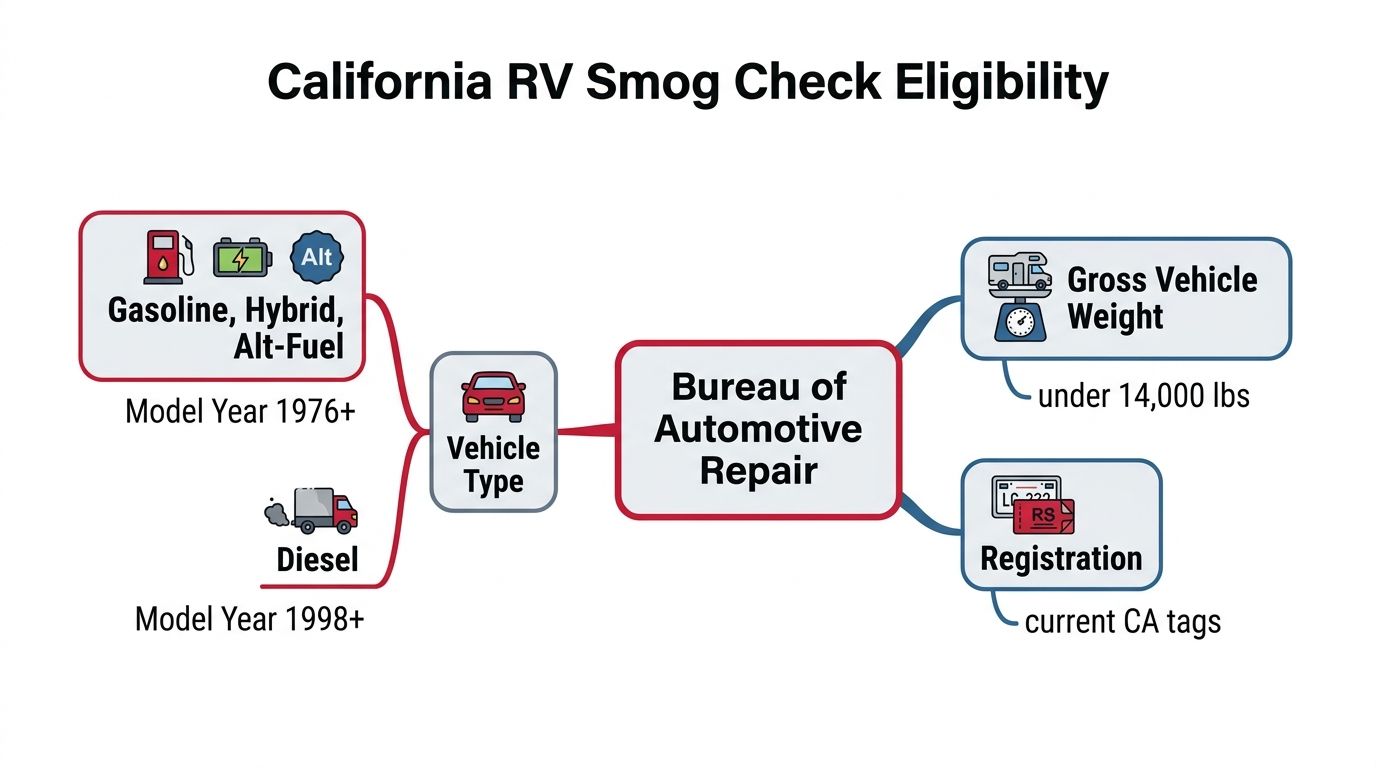
Under the Bureau of Automotive Repair's Smog Check requirements, gasoline, hybrid, and alternative-fuel vehicles model year 1976 and newer generally require a Smog Check. Diesel vehicles model year 1998 and newer generally require one as well, provided they meet the applicable state criteria.
A motorhome with beds, a kitchen, or other living equipment still follows the emissions rules for its underlying vehicle. A gasoline motorhome built in 1976 or later generally enters the gasoline inspection framework. A diesel motorhome built in 1998 or later follows the corresponding diesel requirements.
The renewal notice helps identify the administrative step, but it does not replace the eligibility check. Fuel and model year can point to a standard inspection, an abatement-fee option, or another compliance path.
Apply the weight filter
Weight becomes especially important for diesel and natural-gas motorhomes. The California DMV smog inspection guidance identifies an exemption from the standard smog inspection rule for diesel vehicles with a gross vehicle weight of more than 14,000 pounds. Natural-gas vehicles above that threshold are also exempt from the standard rule.
That route can still involve separate emissions responsibilities. The vehicle may leave the ordinary inspection lane and fall under a heavier-duty regulatory program instead. Check the GVWR on the vehicle documents, registration, or manufacturer information rather than estimating from the RV's size.
Use this sequence before contacting a station:
- Identify the fuel. Gasoline, hybrid, alternative fuel, diesel, or natural gas.
- Confirm the model year. Age rules come before the recreational layout.
- Check GVWR. A heavier diesel or natural-gas motorhome may follow a different path.
- Review registration status. Renewal, transfer, relocation, or temporary out-of-state status can affect the required paperwork and timing.
Station logistics also belong in the decision. A large RV may not fit in every test bay, and some locations have test-only limits or cannot handle the vehicle's configuration. Owners seeking an RV-specific overview can review smog checks for motorhomes before booking.
RV status starts the review, but fuel, year, weight, registration, and station capacity determine the practical route.
Exemptions and Special Cases That Change Your Requirement
A renewal notice can arrive while your RV is stored outside California, or while you are still unsure whether its age and fuel type change the inspection rule. “Exempt” describes a specific route, not a free pass from registration duties. The right question is which requirement replaces the ordinary Smog Check.
Newer vehicles and the abatement-fee option
California has a newer-vehicle pathway that began on January 1, 2019. Vehicles less than four model years old can pay a smog abatement fee instead of receiving a Smog Check for the first eight years they are registered. Gasoline-powered vehicles less than eight model years old do not need a smog inspection at renewal.
For a newer gasoline motorhome on a recent chassis, the current renewal may therefore require the fee rather than a test. Follow the DMV instructions and pay any amount that applies. The distinction is simple: the vehicle may be exempt from testing while still subject to registration compliance.
Heavy-duty diesel and natural-gas motorhomes
If your RV falls into the heavy-duty category discussed in the previous section, do not assume the standard Smog Check is the only emissions obligation. Heavy-duty diesel motorhomes may instead be subject to CARB's Clean Truck Check requirements.
The CARB 2025 Clean Truck Check motorhome fact sheet indicates that diesel motorhomes over 14,000 pounds GVWR must report in the Clean Truck Check Vehicle Inspection System, pay annual compliance fees, and submit passing emissions tests by applicable due dates beginning January 1, 2025. Use the weight information from your vehicle documents, then verify the current heavy-duty requirements before planning a renewal.
The practical decision tree looks like this:
| RV Profile | Smog Check Needed | What Applies Instead |
|---|---|---|
| Gasoline, hybrid, or alternative-fuel RV from model year 1976 and newer, below applicable exemption thresholds | Generally yes | Biennial inspection for renewal when required |
| Diesel RV from model year 1998 and newer, below the heavy-duty exemption threshold | Generally yes | Applicable diesel inspection and renewal process |
| Gasoline-powered RV less than eight model years old | No inspection at renewal under the newer-vehicle window | DMV smog abatement process when required |
| RV in the heavy-duty category described earlier | No standard Smog Check | Separate heavy-duty compliance requirements may apply |
| RV temporarily located outside California | Timing may differ | Temporary administrative exemption process may apply |
Temporary out-of-state situations
An RV temporarily outside California is not automatically covered forever by an earlier smog result. California treats some out-of-state cases as limited administrative exceptions. The vehicle's location, renewal timing, and completed paperwork all matter, so follow the instructions for the applicable temporary exemption form.
For an overview of California smog exemptions, keep the categories separate. A temporary exemption changes the process for a particular renewal period. A vehicle-based exemption comes from characteristics such as age, fuel, or weight. That distinction helps you choose the correct paperwork before the registration deadline.
What Happens During an RV Smog Test and How Results Work
A smog test is similar to a health screening. The technician doesn't judge the RV by its paint, floor plan, or camping amenities. The technician checks the vehicle's emissions-related condition using the inspection steps appropriate for that vehicle.
The inspection has several layers
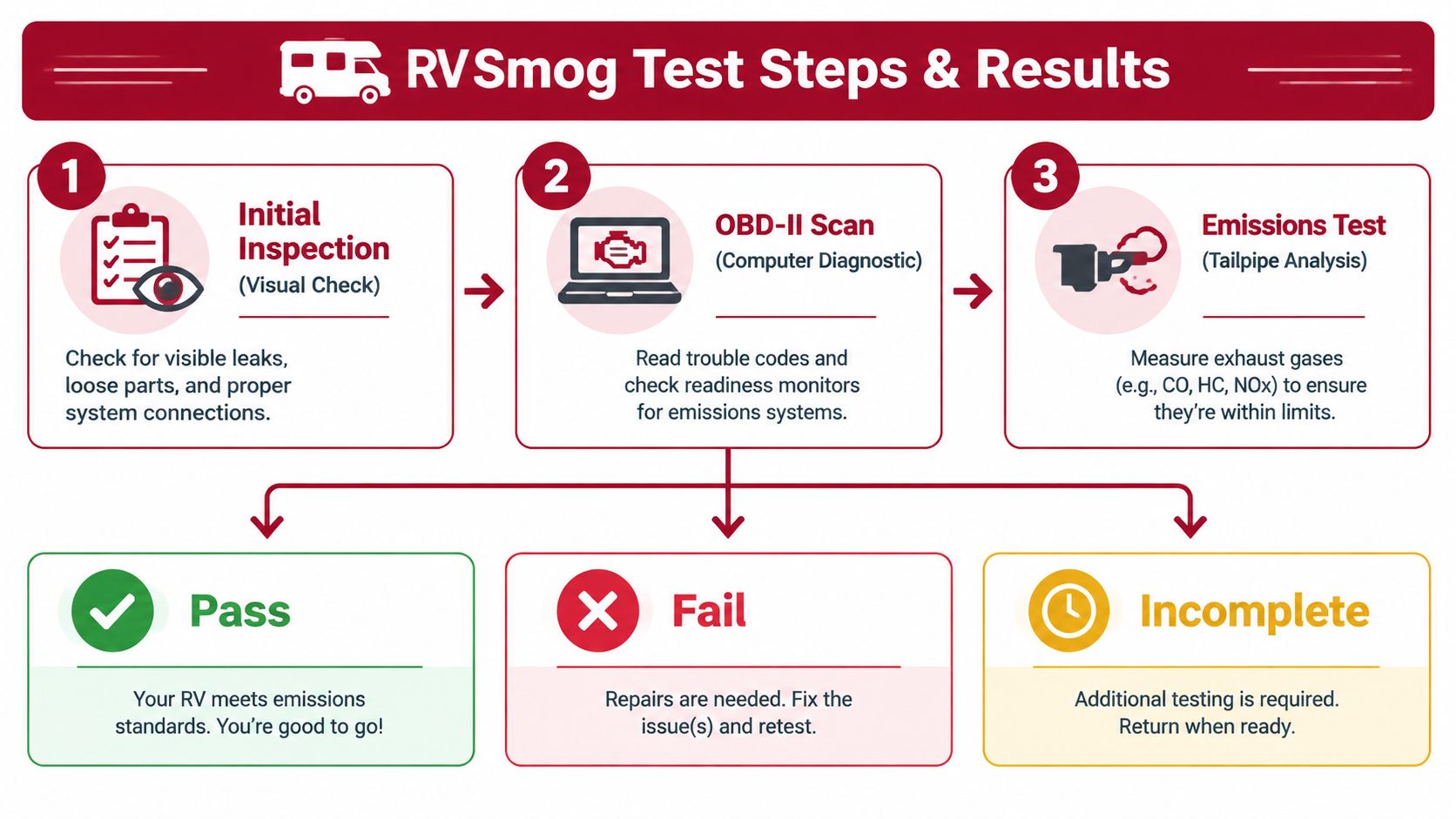
The first layer is a visual review. The technician looks for required emissions equipment and obvious problems that could affect compliance. On an electronically monitored vehicle, the technician may connect diagnostic equipment to communicate with the onboard computer.
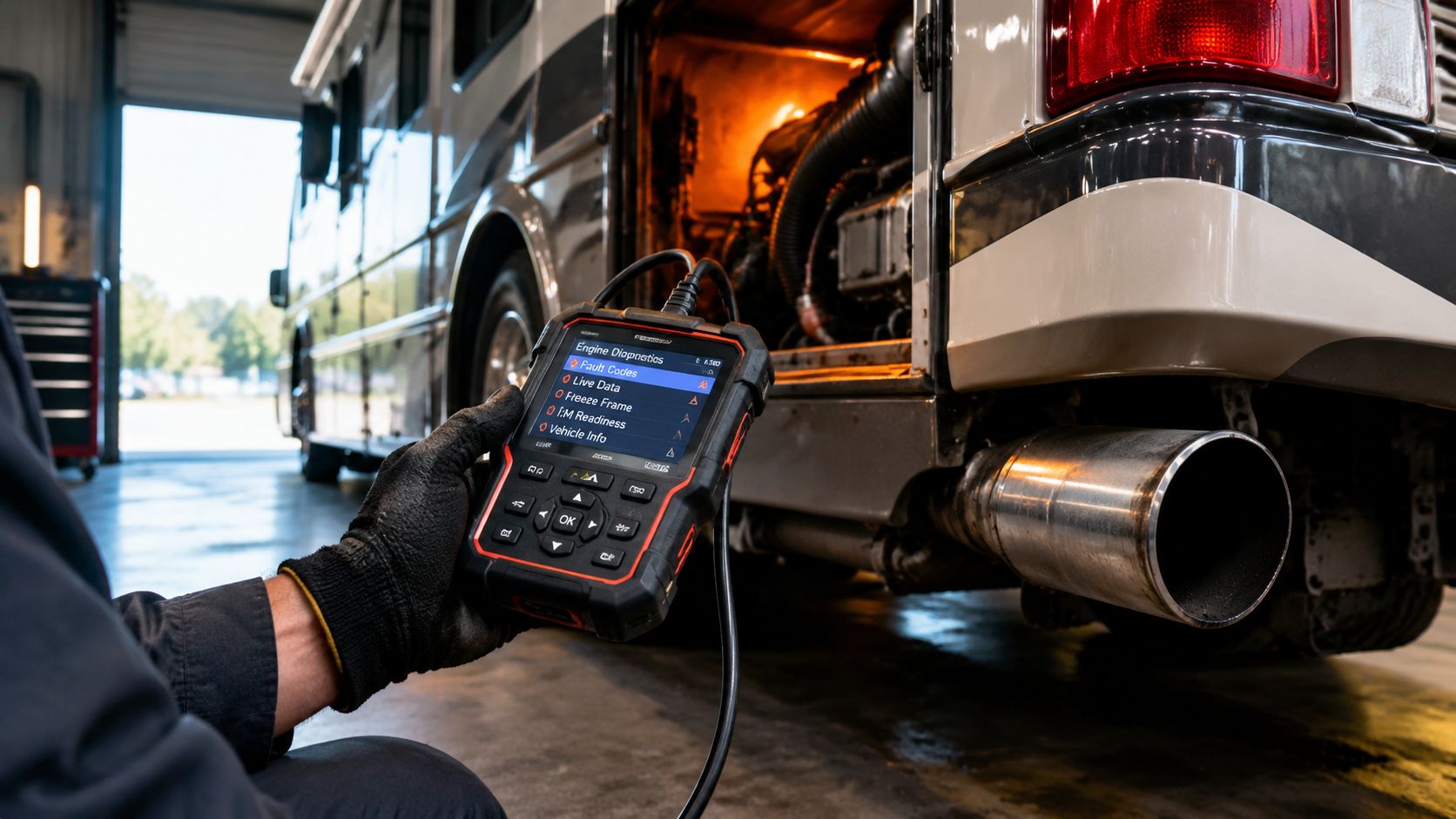
The next layer is the OBD-II scan when the vehicle supports that system. The scan checks for stored fault information and whether the vehicle's emissions monitors have completed their required checks. A check-engine light, disconnected system, or recently cleared fault can affect the result.
The final layer depends on the vehicle and test procedure. Some vehicles receive an emissions measurement, while others are evaluated through computer data and visual inspection. Fuel type, model year, and vehicle configuration determine which equipment the station uses.
What pass, fail, and incomplete mean
A pass means the vehicle met the applicable inspection requirements. The station submits the result electronically, and the owner receives documentation for the registration process.
A fail means the inspection identified a problem that must be diagnosed and corrected before the vehicle can pass. The failure result should identify the relevant reason or emission-related issue. Don't authorize random parts replacement based only on a general failed result. Ask for a diagnostic explanation.
An incomplete result often means the vehicle's readiness monitors haven't finished their checks. This can happen after battery power has been disconnected or diagnostic trouble codes have been cleared. The correct next step may be additional driving under appropriate conditions, followed by another inspection, rather than immediate replacement of a component.
Before you leave the station, ask for the result paperwork and confirm what the DMV will receive electronically.
Large RVs also create a physical challenge. A station may have the right testing credentials but lack the bay length, clearance, lift arrangement, or equipment needed for a particular motorhome. Confirming capacity before arrival is part of the test process, not an optional courtesy.
How to Prepare Your RV and What to Bring to the Station
Preparation starts before you turn into the station. A motorhome that has been sitting for a long period can be harder to inspect than one that arrives warmed up and ready for normal operation.
Complete a basic vehicle check
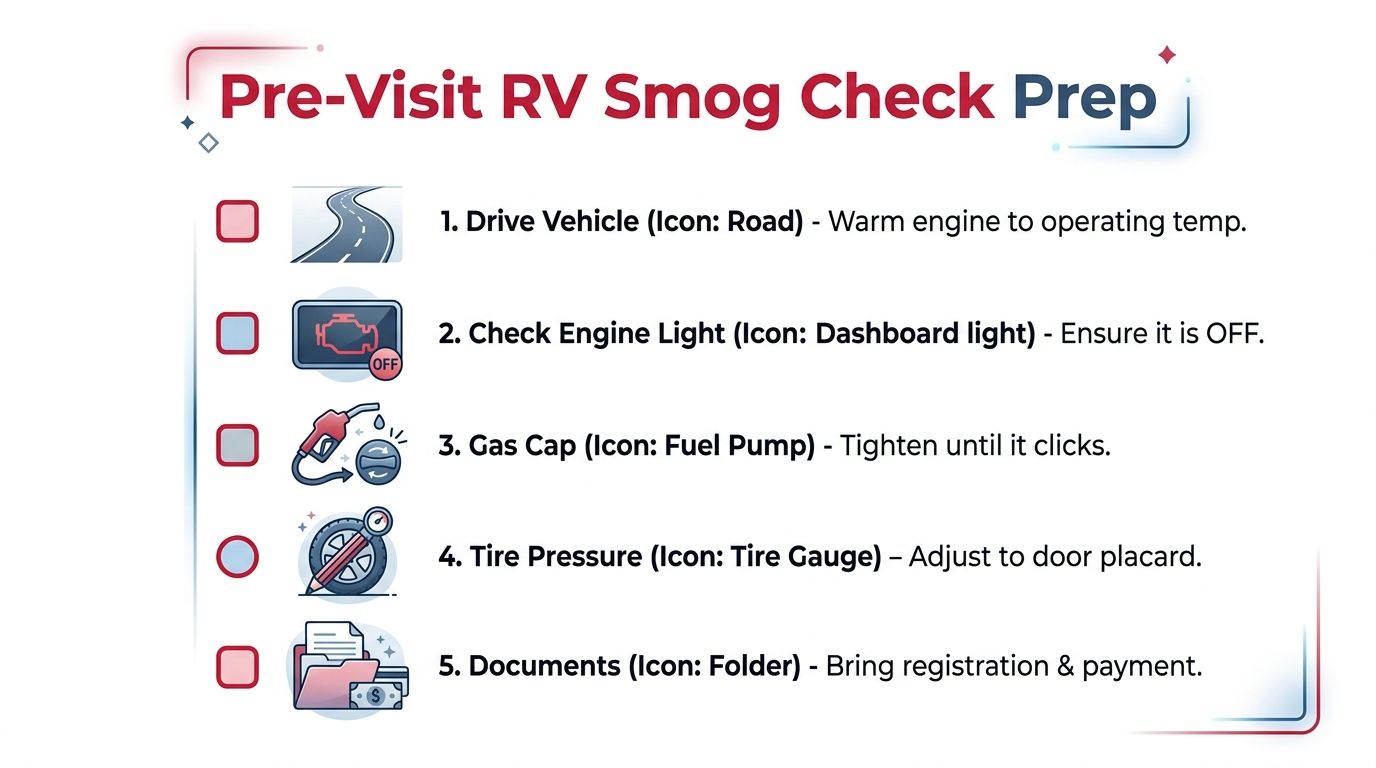
Drive long enough for the engine to reach normal operating temperature before the appointment, unless the station gives you different instructions. A warm engine allows the inspection to reflect normal operating conditions.
Then work through the simple items:
- Check the dashboard: If the check-engine light is illuminated, tell the station before testing.
- Secure the gas cap: Tighten it properly. A loose cap can contribute to an evaporative-emissions problem.
- Review tire pressure: Set the tires according to the vehicle's placard and use the correct pressure information for the coach.
- Avoid clearing codes: Disconnecting the battery or erasing diagnostic codes can leave monitors incomplete.
- Bring the documents: Carry the renewal notice, current registration, identification, payment method, and any prior test information.
Call the station before leaving home. Give the staff the RV's approximate dimensions, fuel type, model year, and whether it's a motorhome or another recreational configuration. Ask whether the site performs the required inspection, whether it's test-only, and whether repairs must be handled elsewhere.
Coordinate the DMV timing
A passed test doesn't help if you miss the registration deadline. Ask how quickly the result is transmitted and whether the location offers DMV renewal services. If you're planning to complete the renewal at the same visit, confirm the service hours separately from smog-testing hours because they may not match.
A test-only station won't sell you repairs, which can make the result easier to understand. It also means you'll need a repair provider if the RV fails. Keep the inspection report so the repair technician can work from the actual diagnostic information.
Common Reasons RVs Fail and How Retests Work
An RV failure usually points to a specific emissions problem, not to the fact that the vehicle is large. The coach may have a worn oxygen sensor, a catalytic-converter problem, or a leak in the evaporative-emissions system. Each fault needs diagnosis before repairs begin.
A recently disconnected battery can create a different result. The vehicle may have no active warning light, yet its readiness monitors may not have completed their checks. In that situation, the station may report an incomplete result instead of a clean pass.
Read the result before choosing repairs
Ask the technician to explain the failure codes and the part of the inspection that produced them. A diagnostic scanner can identify stored codes, but the code alone doesn't always prove which component has failed. A competent repair diagnosis may involve checking wiring, vacuum lines, sensor operation, or exhaust performance.
The common smog check failure reasons can help you recognize the categories, but your own inspection report should control the next step.
Plan the retest carefully
After repairs, the vehicle may need to be driven so the computer can complete its checks. Don't assume that replacing a part immediately makes the RV ready for another inspection. Ask the repair provider whether the vehicle's monitors are ready and whether any codes remain.
Some station coupon policies provide a free retest, subject to the site's terms. Confirm the policy before authorizing the first test and keep the coupon or transaction details. A retest is generally tied to the original inspection and doesn't replace the need to correct the underlying condition.
Ownership transfers and out-of-state registration situations can change the timing. A renewal, a California transfer, and a temporary out-of-state exemption aren't interchangeable. Heavy-duty diesel motorhomes also follow the separate Clean Truck Check track described earlier, so a standard Smog Check result may not satisfy every obligation.
Getting Your RV Smog Check Done in Antioch Without the Hassle
An Antioch RV owner can reduce the appointment to a few checks. Identify the fuel type, model year, and GVWR, then read the DMV notice for its renewal deadline. Those details form a decision tree: the fuel-year-weight combination points to the likely requirement, while the vehicle's dimensions determine where the inspection can happen.
Call the station with the coach's length, height, and configuration before driving over. A passenger-car bay is like a doorway that fits a sedan but not necessarily a motorhome, so staff need the RV's measurements to confirm bay and equipment capacity.
Fire House Smog operates as a STAR-certified, test-only smog station at 2900 Lone Tree Way, Antioch, California 94509. It performs inspections for some RVs and motorhomes, subject to size and equipment limits. Call 925-754-1600 before arrival to confirm that the vehicle fits the site's setup.
Test-only means the station conducts the inspection without selling repair work. If the RV fails, you can take the report to a repair provider of your choice and return for a retest under the applicable site policy. This separation helps keep the test result and repair decision distinct.
The station has two service bays and offers smog testing seven days a week with extended hours. DMV services, including renewal processing and on-site sticker printing, operate during posted service hours, Monday through Saturday from 9:30 AM to 5:00 PM and Sunday from 12:00 PM to 4:00 PM. Confirm weekend availability for the DMV task you need.
Bring the renewal notice, registration, payment, and prior emissions paperwork. Schedule early enough to address a failure before the DMV deadline.
Call Fire House Smog at 925-754-1600 with your coach's dimensions before the renewal deadline to confirm bay fit and book the inspection.