Opening a DMV renewal notice can turn a routine errand into an immediate question: why does this letter say STAR station required? The answer usually isn't that your car needs a completely different kind of emissions test. It means California has directed you to a station with an additional Bureau of Automotive Repair certification.
An all star smog check follows the state's normal inspection process, but the station must meet higher operational and performance standards. This guide explains when STAR certification matters, how to verify a legitimate station, what happens in the testing bay, and what you should do if your vehicle fails.
Table of Contents
- What an All Star Smog Check Really Means
- How the STAR Program Started and Why It Exists
- STAR vs Regular and Test-Only Stations
- The Higher Standards STAR Stations Must Meet
- When California Requires a STAR Smog Check
- How to Verify a Station and What Testing Involves
- Your Next Steps for Booking a STAR Smog Check
What an All Star Smog Check Really Means
STAR is a certification for the station, not a separate test for the vehicle. California's Smog Check process can include an OBD II inspection, visual emissions-control checks, and other required procedures depending on the vehicle. The California Smog Check program explains that vehicles from model year 2000 onward are inspected primarily through OBD II, while older vehicles may require additional evaporative-system and fuel-cap checks.
Think of STAR like a higher-level license displayed over the regular station license. A standard licensed station may be authorized to perform ordinary Smog Check inspections. A STAR-certified station has also demonstrated that it can meet BAR requirements for equipment, operations, and inspection performance.
That distinction matters because California doesn't send every vehicle to the same type of station. Some drivers can choose a regular licensed station. Others receive a DMV notice directing them to a STAR station, which means the certification changes where the inspection may be completed.
What STAR changes for you
At the bay, the technician still connects the vehicle to testing equipment and checks the systems required for that vehicle. The practical difference is the station's authority and oversight. A STAR station has been approved to handle vehicles that California considers part of a higher-risk inspection group, including vehicles identified through DMV direction.
A test-only STAR station can inspect and certify a vehicle, but it doesn't sell repair work. That separation can make the process easier to understand because the business evaluating the vehicle isn't also diagnosing and selling the repair.
Practical rule: Read the DMV notice before booking. If it says STAR station required, a nearby regular shop may not be able to complete the certification you need.
You can also review a plain-language explanation of what STAR-certified smog testing means before choosing a location. The four questions to answer are simple: Is STAR required for this vehicle, is the station certified, what will the inspection include, and what happens if the result is a fail?
How the STAR Program Started and Why It Exists
You arrive for a Smog Check expecting a simple pass-or-fail result. Behind that result, California also needs confidence that the station followed the right procedure and recorded the vehicle's information accurately. The STAR program was created to provide that added oversight.
California established STAR through Assembly Bill 2289, and the program began on January 1, 2013. It replaced the former Gold Shield Program, which ended on December 31, 2012. The Bureau of Automotive Repair STAR FAQ explains that STAR was designed to improve inspection quality and support California's emissions-reduction requirements.
The basic model works like a quality-control system. California identifies stations that can perform inspections under closer performance controls, then uses the program to direct certain vehicles to those locations. STAR certification applies to both test-only and test-and-repair businesses. It describes how a station's inspection work is monitored, not whether the business performs mechanical repairs.
Why station quality affects the driver
Your vehicle is only one part of a Smog Check. The technician must use approved equipment, follow the required testing procedure, enter accurate vehicle details, and interpret the result correctly. A skipped step or poorly maintained machine can produce a result that does not accurately reflect the vehicle's condition.
For the driver, STAR changes the level of accountability surrounding the inspection. BAR uses performance measures to compare a station's results with those of similar vehicles and reviews incidents that may indicate testing problems. This does not guarantee a passing result or make every repair recommendation correct. It gives the inspection process a clearer system for identifying problems and monitoring station performance.
The program also handles a large share of California's testing. In California's 2025 data, STAR stations represented 49% of licensed Smog Check stations but performed 83% of all Smog Check tests, according to BAR's STAR program information. STAR locations therefore completed a disproportionately large share of inspections compared with their number of facilities.
That reach explains why STAR is more than a label on a shop sign. It affects how California manages inspection quality and, for some drivers, which station can complete the required inspection.
STAR vs Regular and Test-Only Stations
Drivers often treat “STAR,” “test-only,” and “test-and-repair” as three competing station categories. They are different labels that describe different things. STAR describes certification, while test-only and test-and-repair describe what the business is allowed to do after inspecting the vehicle.
A regular station may perform standard Smog Check services for vehicles that aren't subject to a STAR direction. A STAR station may be test-only or test-and-repair, but it must meet the additional BAR requirements attached to STAR certification.
| Station Type | Can Perform Repairs | Can Process STAR or Directed Notices | Best For |
|---|---|---|---|
| Regular test-and-repair station | Yes | Not necessarily | Drivers whose renewal doesn't require STAR and who want inspection and repair at one business |
| Regular test-only station | No | Not necessarily | Drivers seeking an inspection without repair sales when STAR isn't required |
| STAR test-and-repair station | Yes | Yes, when authorized for the vehicle | Drivers who need STAR testing and may want diagnosis or repairs at the same location |
| STAR test-only station | No | Yes | Drivers who need STAR certification and prefer a testing-only business |
The important distinction after a failure
A test-only station can't repair the vehicle. If the inspection finds a problem, the station should provide the inspection result and explain the next step, but you'll need a separate repair provider. A STAR test-and-repair station may diagnose and repair the vehicle, although the station's authority to certify a particular directed vehicle still depends on the applicable rules.
A regular shop isn't automatically less competent at repairs. It may just not have the STAR certification needed for a DMV-directed inspection. Conversely, a STAR label doesn't mean the station is a full-service repair facility.
The BAR's explanation of STAR-certified test-only centers can help you understand why some drivers deliberately choose a station that doesn't sell repairs. The model separates the inspection decision from repair revenue, which gives the customer a clearer boundary between testing and fixing.
Prices vary by station, vehicle, location, and services included. A STAR station may charge a different fee from a nearby regular station, so ask for the current price before authorizing the inspection.
The Higher Standards STAR Stations Must Meet
STAR certification rests on measurable requirements rather than a sign on the building. BAR reviews station performance and can evaluate whether the business continues to meet the program's standards. That means certification isn't a permanent reward earned once and kept without review.
The BAR STAR program requirements include several performance measures. One compares the station's Similar Vehicle Failure Rate with the industry-wide failure rate for similar vehicles. For STAR eligibility, that station rate must be at least 50% of the industry-wide failure rate for similar vehicles. The same source lists a Gear Shift Incident rate no greater than 2% of certified vehicles and an Excessive Test Deviation Rate of no more than 1.
What the scorecard means in everyday terms
| Metric | Standard Required |
|---|---|
| Similar Vehicle Failure Rate | At least 50% of the industry-wide failure rate for similar vehicles |
| Gear Shift Incident rate | No greater than 2% of certified vehicles |
| Excessive Test Deviation Rate | No more than 1 |
| Ongoing program compliance | The station must continue meeting BAR operational and performance requirements |
A failure-rate comparison doesn't mean a STAR station should make every vehicle pass. A vehicle with a genuine emissions problem should fail, regardless of the station's certification. The comparison helps BAR identify unusual station patterns that may deserve closer review.
Gear-shift incidents and test deviations relate to how the inspection is carried out. For a driver, those controls support a more consistent process, particularly when the vehicle's result is unexpected. The standards also give BAR a basis for accountability if testing behavior falls outside acceptable limits.
STAR certification is best understood as a continuing performance obligation, not a one-time quality badge.
The certification also doesn't promise a repair, a pass, or a particular wait time. It tells you that the station has qualified for the STAR program and must continue operating within the program's rules.
When California Requires a STAR Smog Check
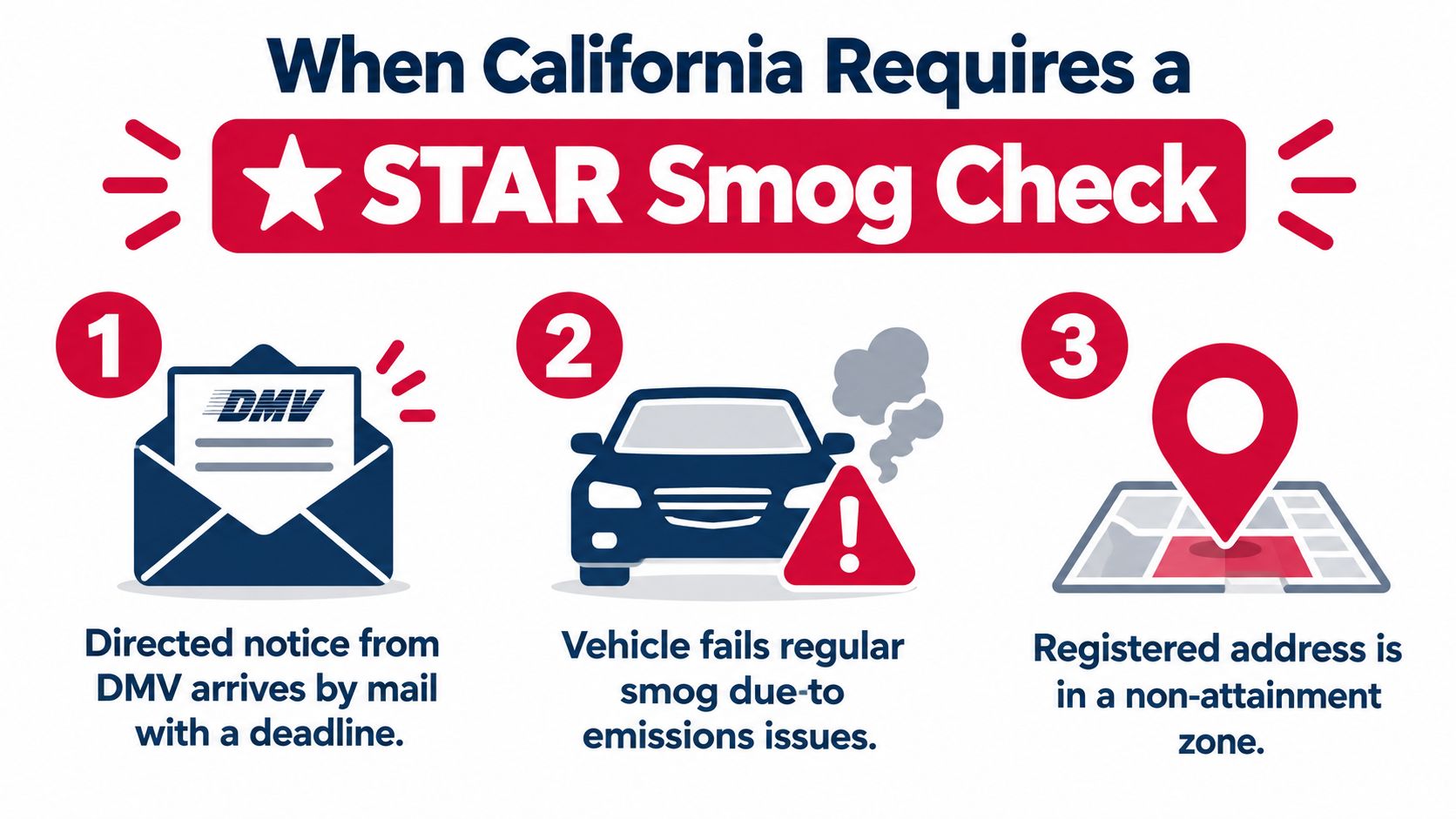
You are renewing your registration, and the DMV notice says your vehicle must visit a STAR station. That instruction changes where you can test. It is different from a general reminder to complete a Smog Check, so read the notice carefully before booking an appointment or driving to a shop.
A directed notice places the vehicle in a more controlled inspection pathway. California may direct a vehicle because of its testing history or emissions profile. Vehicle age, an ownership transfer, or a routine renewal can require a Smog Check without automatically requiring STAR testing.
Check the instruction, not the rumor
Use the notice as your starting point:
- Read the renewal notice. Look for wording that requires a STAR station or identifies a specific inspection type.
- Match the vehicle details. Confirm that the notice belongs to the vehicle you are taking for testing and that the registration information is current.
- Check the station listing. Use the BAR listing to find nearby STAR-certified businesses and see whether each offers test-only or test-and-repair service.
- Call before your visit. Ask whether the station can process the exact requirement shown on your notice.
A first-time California registration or ownership transfer may involve a Smog Check, but neither situation alone establishes a STAR requirement. A failed ordinary inspection also does not automatically mean every later test must take place at a STAR station. The DMV instruction or applicable BAR process determines the required testing location.
After a directed test, the station must submit the required electronic certification. If that certification is missing, the DMV may be unable to complete your registration renewal. A failed result can lead to repairs and another inspection, but the result itself does not turn every future test into a STAR requirement.
California also has special provisions for older and collector vehicles. BAR's current materials state that collector-vehicle exemptions are scheduled to be extended in stages beginning January 1, 2028, subject to final rulemaking, as reflected in the DMV's Smog Inspections guidance. Abbreviated inspections remain available for certain vehicles that are 35 years old or older. Check the current requirements before assuming your vehicle qualifies for an exemption.
How to Verify a Station and What Testing Involves
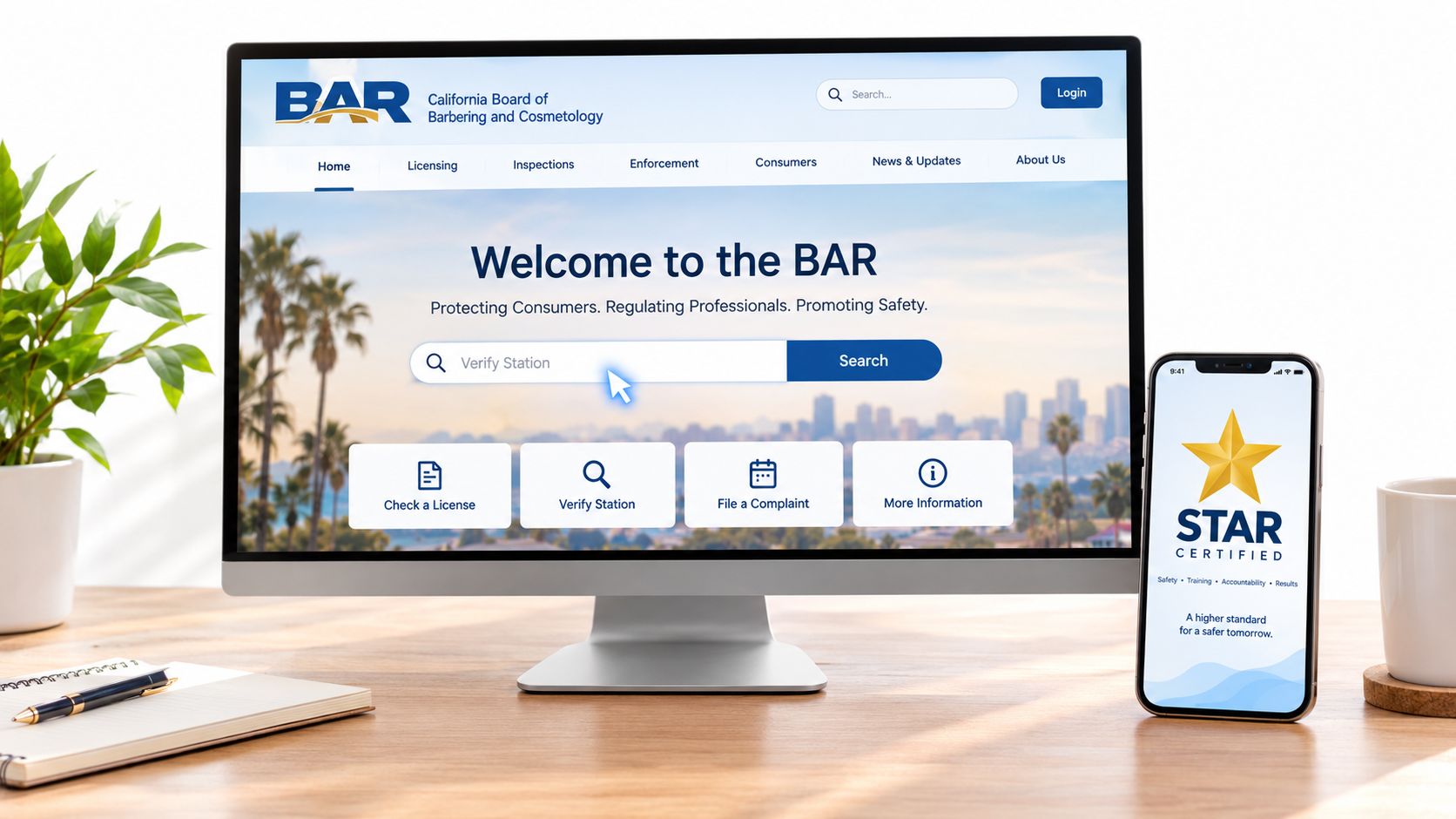
Start with the BAR station lookup rather than relying only on a business name, search advertisement, or a sign in a parking lot. Enter the location information, review the station's listing, and confirm the STAR designation, station type, license information, and any disciplinary information shown in the official record.
A legitimate business should also display the required station information at its location. Look for a posted STAR decal or other official signage, then compare the business name and address with the BAR listing. If the listing says test-only but an employee immediately proposes repair work, ask who would perform the repair and whether the inspection business is separate.
What the technician checks
For a newer vehicle, the technician generally connects an approved tool to the vehicle's OBD II system and reviews emissions-related information. The malfunction indicator lamp must illuminate with the key on and engine off, then turn off once the engine is running. If that required behavior isn't present, the vehicle fails the OBD portion.
The inspection can also include visual and functional checks of emissions equipment. Older vehicles may require different procedures, including tailpipe or evaporative-system checks, depending on the vehicle and the applicable program rules. A technician should be able to explain which procedure applies without promising a result in advance.
The visit length varies with the vehicle, station workload, and inspection type. Ask about the expected timing when you book rather than relying on a generic estimate.
After a pass, the station electronically sends the certification to DMV. You generally don't need to carry a paper certificate to a DMV counter, although you should keep your receipt and any inspection documentation.
After a fail, a test-only station can explain the result and provide the report, but it doesn't perform the repair. BAR and DMV guidance direct failed vehicles toward the appropriate next steps, including the BAR Referee Program in situations where that process applies.
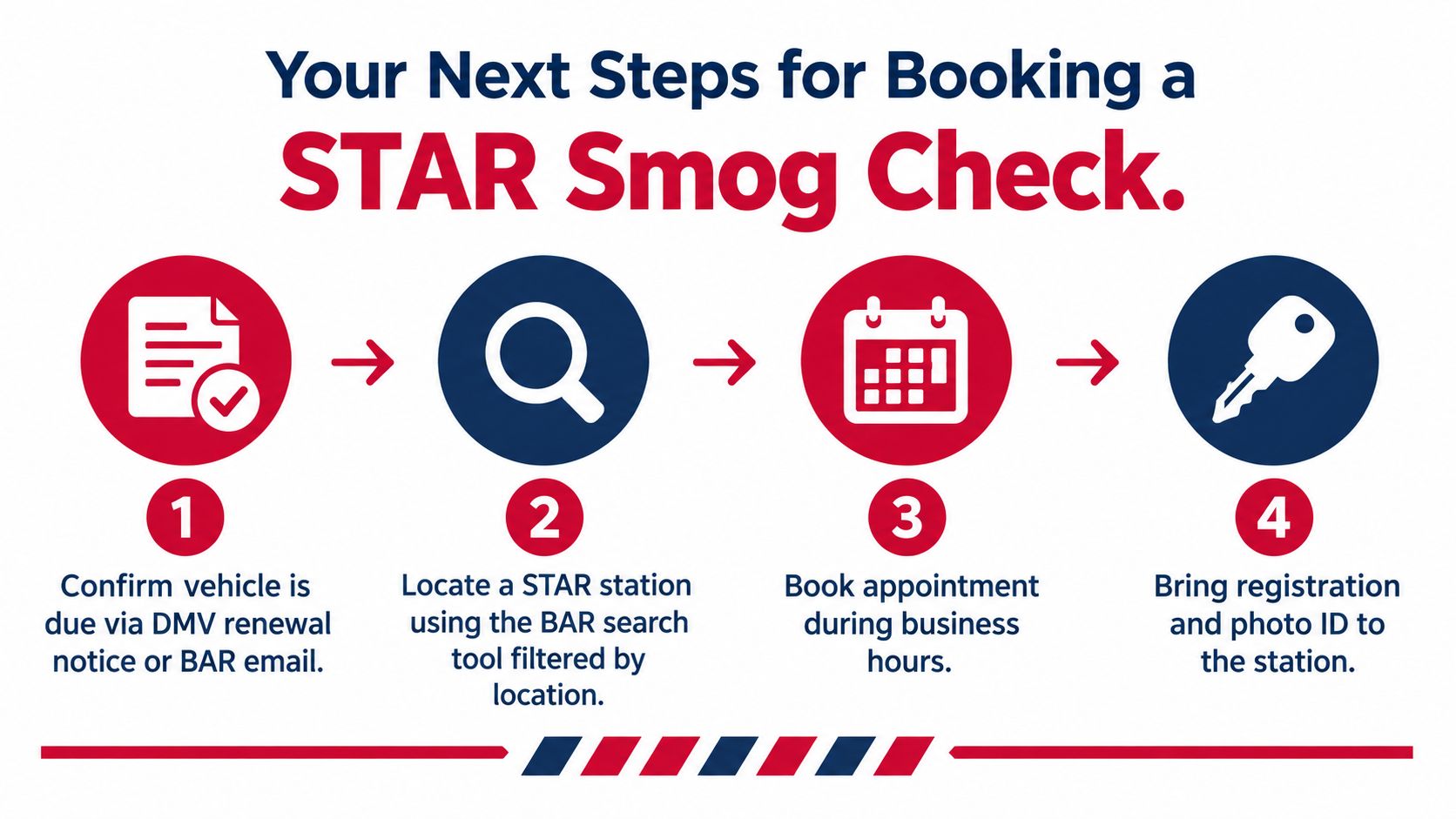
Your Next Steps for Booking a STAR Smog Check
You can avoid most last-minute problems by treating the appointment as a document and deadline task, not just a quick drive to a repair shop.
- Confirm the requirement. Check the DMV renewal notice or official BAR communication. Identify whether it says STAR station required and note the registration deadline.
- Find the correct station. Use the BAR search tool and filter the results by location and certification type. Confirm whether the business is test-only or test-and-repair.
- Call before booking. Ask the station to confirm its STAR status, current fee, accepted payment methods, appointment policy, and ability to handle your vehicle.
- Prepare your documents. Bring the DMV or BAR notice, current registration information, and a form of identification. The station may need accurate vehicle and owner details to complete the transaction.
Before arrival, drive long enough for the engine to reach normal operating temperature, unless your vehicle's condition makes that unsafe. Check that the fuel cap seals correctly, and remove aftermarket electronics that could create warning-light issues or interfere with the vehicle's normal diagnostic systems.
For more guidance on the cost of a STAR smog check, contact the station directly because pricing depends on the vehicle and service. Don't approve repairs based only on a verbal explanation. If the vehicle fails, request the complete Vehicle Inspection Report, keep every receipt and estimate, and ask whether you may qualify for California's Consumer Assistance Program if the repair burden meets the program's requirements.
A sensible planning window is 6 to 8 weeks before registration renewal. That gives you time to arrange repairs, complete a retest, resolve questions about the result, and allow the electronic certification to reach DMV without turning the renewal deadline into an emergency.
Fire House Smog provides STAR-certified test-only smog inspections and California DMV registration services at its Antioch location. Visit Fire House Smog to review the available services and contact the station before booking your STAR inspection.