STAR Certified Smog Check Test Only Center Guide
You're staring at a renewal notice, and one line keeps catching your eye, STAR required. That usually leads to the same question at the counter, on the phone, or in the driveway, what's the difference between a regular smog shop, a STAR certified smog check test only center, and a place that can fix the car too?
In plain terms, STAR is California's higher-standard inspection tier, and test-only means the station can inspect your vehicle but can't sell the repair. If you're trying to avoid a second trip, understand whether you're required to go STAR at all, and figure out what happens if your car fails, the details matter more than the label on the sign.
Table of Contents
- What a STAR Certified Smog Check Test Only Center Actually Is
- STAR Certification and Test Only Status Explained Separately
- How a Test Only Station Differs from Regular Smog Shops
- What Happens During a Test Only Smog Inspection
- Who Needs a STAR Test and What About RVs and Exempt Vehicles
- Fees Documents Retests and the On Site DMV Experience
- Why Drivers in Antioch and East Contra Costa Choose a Local Test Only Station
- STAR Smog Questions Drivers Ask Before They Book
What a STAR Certified Smog Check Test Only Center Actually Is
A lot of drivers arrive with the same look on their face, a DMV envelope in one hand and a phone in the other, trying to decode what STAR means before they waste an afternoon. A STAR certified smog check test only center sits inside California's broader Smog Check system, so it isn't a separate program, it's a higher-controlled part of the same system.
California's Bureau of Automotive Repair says the STAR program started in January 2013, and in calendar year 2023, 48% of licensed stations were STAR certified while 83% of all Smog Check tests were performed by STAR stations, according to the BAR's 2024 Smog Check Performance Report. The same report says California's Smog Check program removes about 400 tons of smog-forming pollutants every day and serves more than 10 million vehicles each year at more than 5,000 independently owned stations statewide, which shows why STAR is part of a large regulatory network, not a boutique service (BAR 2024 Smog Check Performance Report).
What the label tells you
STAR tells you the station has met higher BAR performance standards. Test only tells you the station is licensed to inspect vehicles, not to do the repair work itself. Those are separate layers, and a business can be one, the other, both, or neither.
That distinction matters on visit day. A test-only station can tell you whether the vehicle passes or fails, but it doesn't turn into a repair shop if the car needs work. If you're used to full-service auto shops, that can feel unusual at first, but it's the point of the model.
A real-world example helps: a driver with a renewal notice marked STAR can show up at a STAR test-only center, get the inspection, and leave with the result, without being steered into a repair estimate from the same counter. That separation is useful when you want clarity first and a repair decision later.
Practical rule: if your paper says STAR, the station status matters. If you're not sure whether you need repairs, test-only keeps the inspection separate from the sales pitch.
STAR Certification and Test Only Status Explained Separately
A driver can roll up to a station with a renewal notice, see the word STAR, and still not know what that means for the visit. The cleanest way to read the label is to separate two questions. One asks whether the station meets BAR's higher oversight standard. The other asks whether the station is allowed to do inspections only, or inspections plus repairs.
STAR certification is about oversight and consistency. BAR requires a STAR-certified test-only center to meet controls that go beyond ordinary smog stations, including the ability to inspect all vehicle types subject to Smog Check, maintain the BAR-certified inspection equipment required by the Smog Check Manual, and keep calibrated equipment passing calibration at least once every 10 calendar days when calibration is required (BAR STAR Certification).
That matters because the inspection process has to hold up under the same rules every day, whether the car is a small commuter vehicle or something more complex. If the required equipment is missing, out of calibration, or not being maintained to BAR standards, the station is not operating with the consistency the program expects. For a first-time customer, that means the result comes from a process BAR has already tightened, instead of from a shop's own judgment call.
Test only is a different question
Test only describes what the shop is allowed to do, not how strict its oversight is. A test-only station can inspect vehicles, but it cannot sell emissions repairs. A test-and-repair shop can inspect and repair. A STAR station can meet BAR's higher standard, yet it may still be either test-only or test-and-repair.
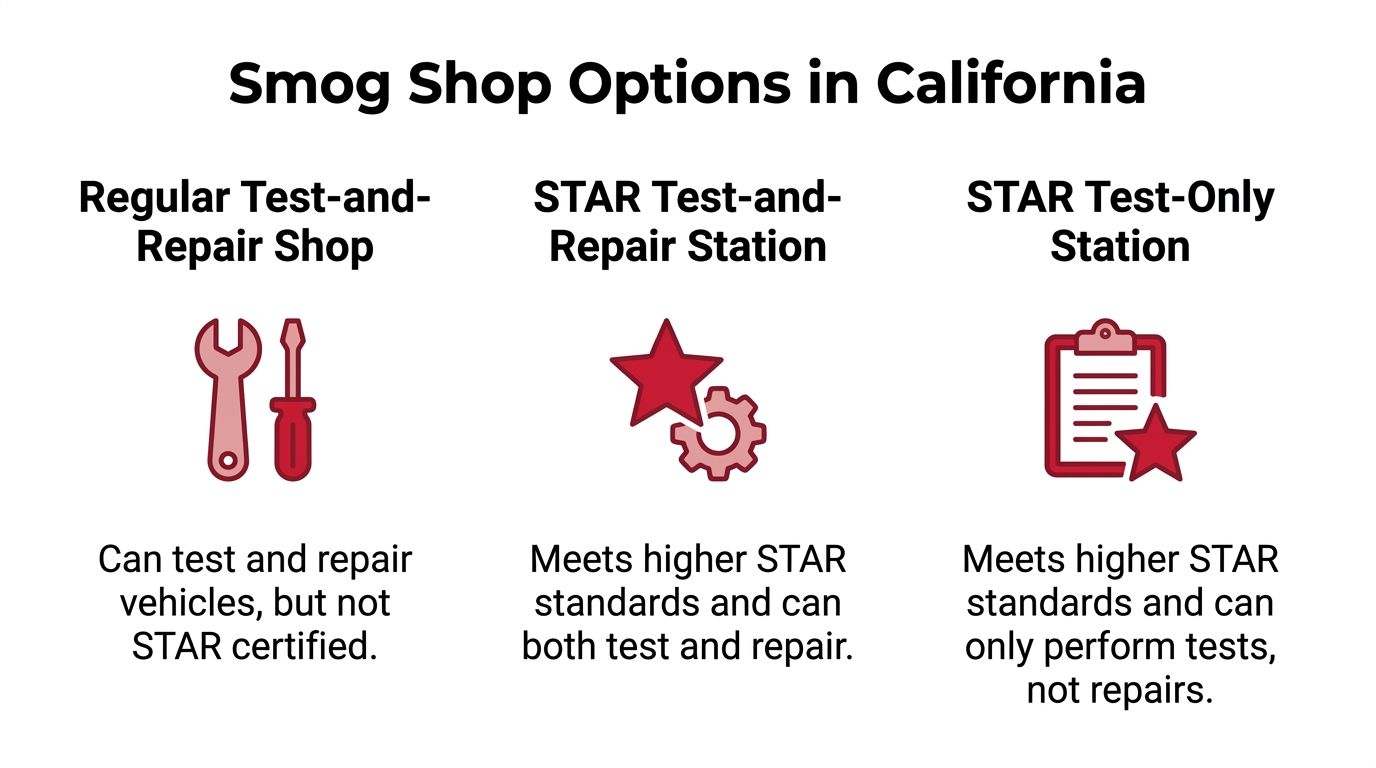
The simplest way to separate the two labels is this. STAR describes the standard of oversight. test only describes whether the station is allowed to fix the vehicle after the inspection. A referee can call the play and still not coach either team, and the same split applies here.
For a driver, that split changes the tone of the visit. A test-only station gives you the inspection result without the same counter pressure to turn a failure into an in-house repair job. A test-and-repair station has a different business setup, because the shop can diagnose, quote, and repair under the same roof.
That is why the combinations matter. A station can be STAR and test-only, STAR and test-and-repair, or a regular test-and-repair shop without STAR status. The label on the sign gives you one piece of the picture, and the renewal notice tells you which setup fits your situation. If you want a plain-language walkthrough from the station side, Fire House Smog's STAR certification explanation lays out the same distinction in simple terms.
How a Test Only Station Differs from Regular Smog Shops
A regular smog shop can often do more than one thing, which sounds convenient until the vehicle is borderline and you're trying to decide who you trust with the result. A STAR test-only station gives you a narrower service, inspection without repair, and that narrower service removes the in-house incentive to push a fix right after the failure.
The 2025 BAR Smog Check Executive Summary Report makes the scale of test-only clear. STAR Test-Only stations performed 5,916,245 initial tests and recorded 481,639 failures, an 8.14% failure rate. STAR Test-and-Repair stations performed 2,766,051 initial tests with 227,215 failures, an 8.21% failure rate. STAR Test-Only stations also issued 5,822,635 certificates overall, compared with 2,710,210 certificates from STAR Test-and-Repair stations (BAR 2025 Smog Check Executive Summary Report).
What those numbers mean for a driver
Those figures don't tell you whether your car will pass, but they do show something useful. Test-only STAR stations are not a niche fallback, they're operating at very large scale and handling a volume close to the combined total of STAR Test-and-Repair stations. That makes test-only a central part of California's inspection network, not an afterthought.
The consumer experience is different too. At a regular smog shop, some drivers feel pressure because the same business that fails the car may also want to repair it. At a test-only station, the result stands on its own. If the car needs work, you can take the report somewhere else and decide what to do without buying into the first estimate you hear.
Fire House Smog's test-only overview describes that same split clearly, inspection only, no repair upsell. That's the key difference most first-time customers are really looking for, even if they don't say it that way.
What Happens During a Test Only Smog Inspection
A first-time visit usually starts with the same small ritual, pull in, hand over the paperwork, and wait for the technician to confirm the vehicle details. The inspection is designed to be straightforward, but the exact steps depend on the vehicle year and the state rules that apply to it.
The bay workflow
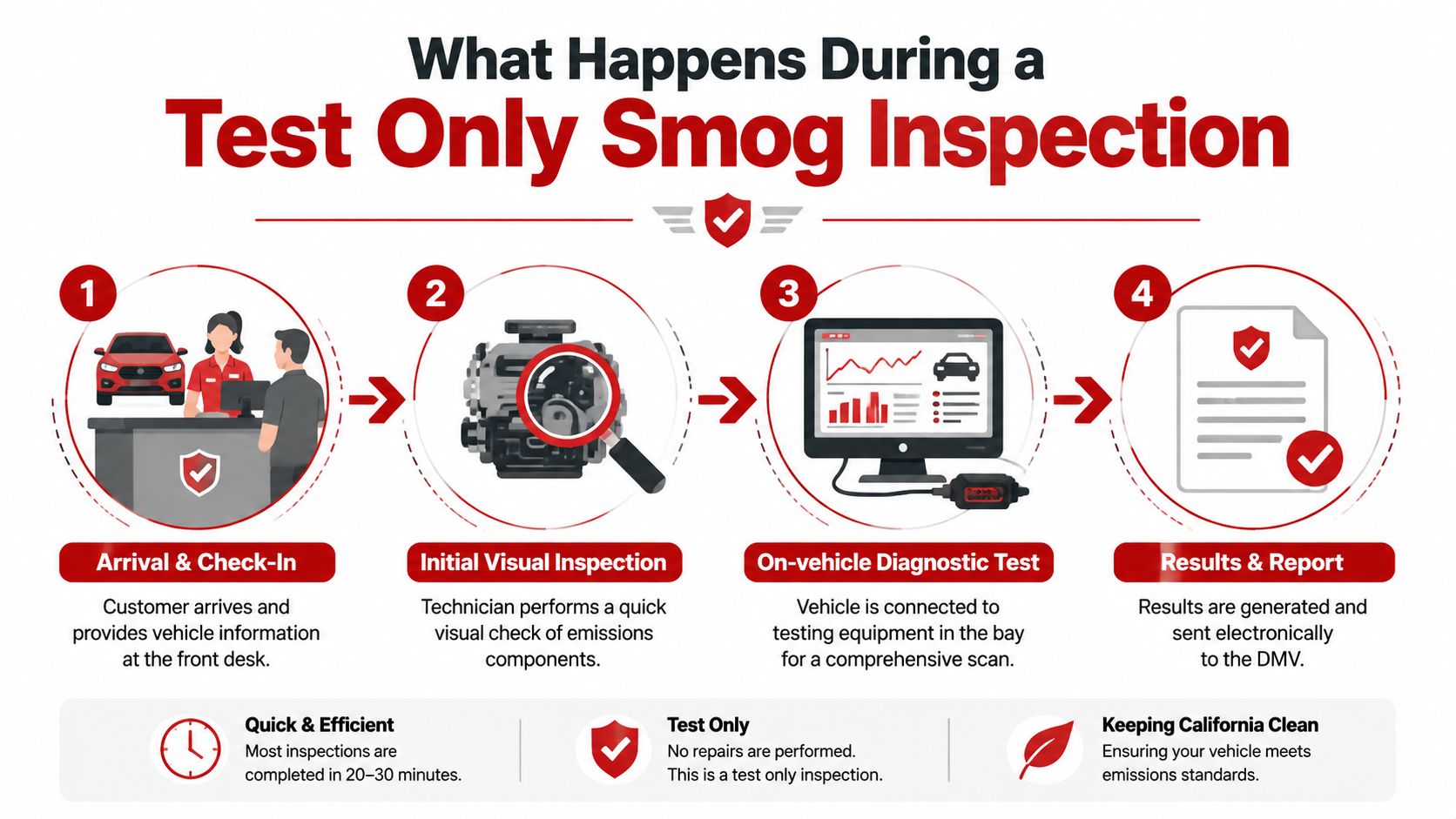
At a test-only station, the technician checks the vehicle visually, then connects the required test equipment. For 1996-and-newer vehicles, that normally means an OBD-II diagnostic connection. Older vehicles may also involve a tailpipe-style emissions check, depending on the vehicle class and what BAR requires for that inspection.
Most drivers care about one thing here, how soon they'll know. The station's job is to generate a result, not to turn the visit into a sales conversation.
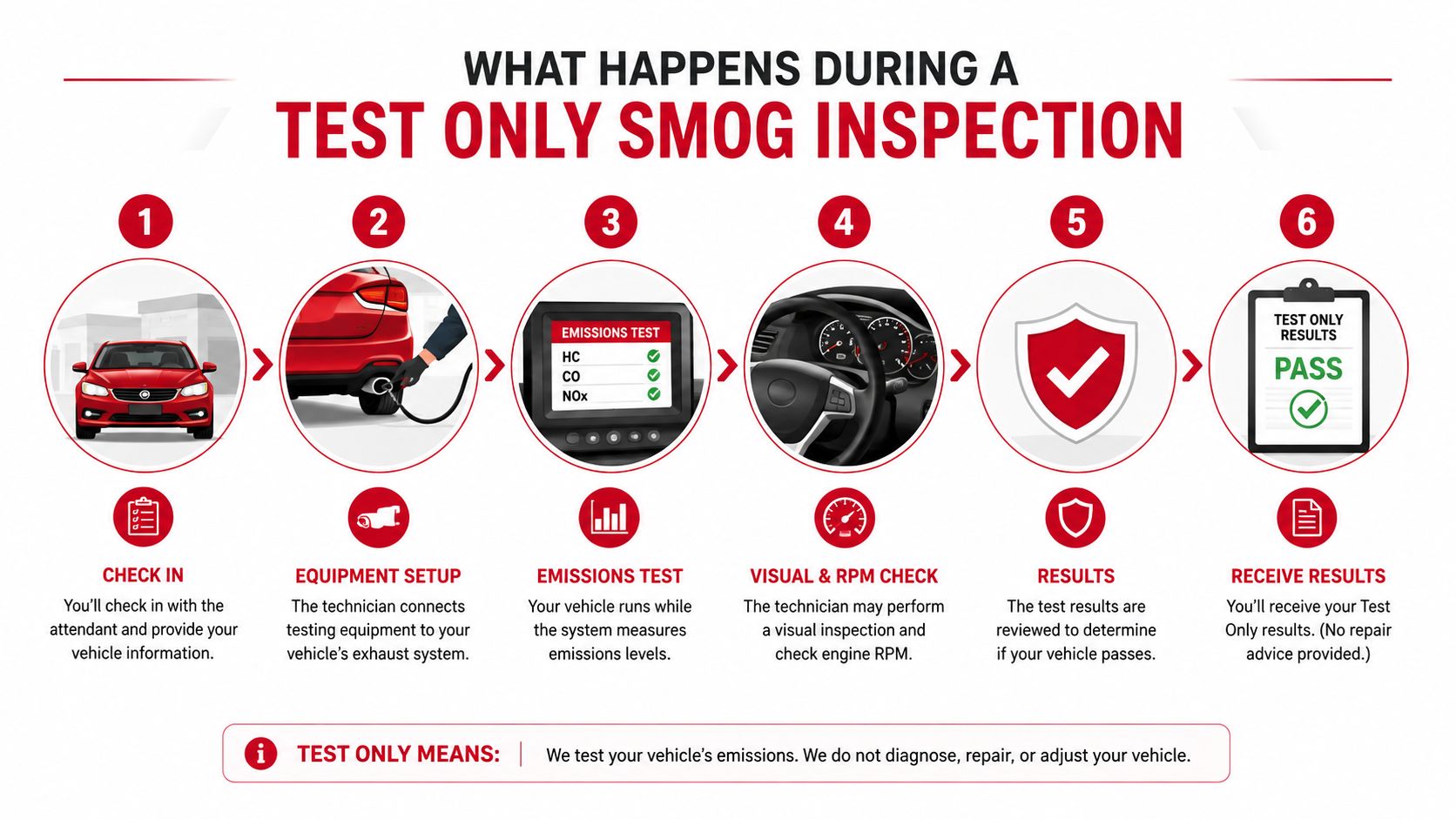
If the car passes, the result is transmitted electronically and the driver gets what they need to continue the DMV process. If it fails, the station provides the report, and the next decision is whether to repair first or look at an approved repair path elsewhere. That split is exactly why test-only centers work well for drivers who want the inspection separated from the repair decision.
| Smog Inspection Stages at a Test Only Station | |||
|---|---|---|---|
| Stage | What the Technician Does | What the Driver Experiences | Typical Time |
| Arrival and check-in | Confirms the vehicle and paperwork | Hands over the renewal notice or vehicle details | Brief |
| Visual inspection | Looks over emissions-related components | Waits near the counter or in the lobby | Short |
| Diagnostic testing | Runs the vehicle through the required equipment | Stays nearby while the test is completed | Short |
| Results and report | Generates the pass, fail, or directed result | Receives the outcome and next-step paperwork | Brief |
The main thing to remember is that the station is measuring compliance, not negotiating a fix. That makes the visit feel cleaner and more predictable, especially when you already suspect the vehicle may be close to the line.
Who Needs a STAR Test and What About RVs and Exempt Vehicles
A renewal notice can look simple until one line changes the whole errand. One driver needs a STAR test, another needs a regular smog inspection, and a third does not need a smog check at all. The DMV says a smog inspection is generally required for registration renewal, with important exceptions for gasoline vehicles 1975 and older, diesel vehicles from 1997 and older or over 14,000 pounds GVW, natural gas vehicles over 14,000 pounds, electric vehicles, and gasoline vehicles less than eight model-years old. The renewal notice is the document that tells you whether your specific renewal requires STAR, a standard smog inspection, or no smog check at all (California DMV Smog Inspections).
That is why STAR searches can feel confusing when the question is eligibility. If the vehicle is exempt, the issue is not finding a station, it is reading the paperwork correctly. If the notice calls for STAR, then the station type matters, and the safest first step is to trust the renewal notice before you plan the visit.
RVs and unusual vehicles need a call ahead
Fire House Smog notes that some recreational vehicles and motorhomes can be tested, subject to size and equipment constraints. A vehicle can be eligible on paper and still be hard to fit in a bay, so a quick phone call can prevent a wasted drive. The business lists 925-754-1600 as the contact line for screening those cases.
RVs, diesel vans, motorhomes, and newer vehicles that may fall into an exemption category all benefit from the same approach. Read the renewal notice first, then confirm the vehicle fit with the station before you head over. A test-only center keeps the question narrow, the car gets inspected or it does not, and the station can tell you whether the vehicle belongs in the lane at all.
Fees Documents Retests and the On Site DMV Experience
Most drivers want to know three things before they leave the house, what to bring, what the test costs, and whether they're going to need a second appointment. Fire House Smog's pricing page explains its smog-test pricing and coupon policy, including a discount on the test and a free retest when required under the site's terms (Fire House Smog smog check cost information).
Bring the renewal notice, a valid ID, payment, and any previous test paperwork if you already have a failure report. That makes the handoff quicker and helps the technician confirm the right vehicle record. If you've recently disconnected the battery or cleared codes, bring the last report too, because it can help you understand where the car stands before you drive off again.
The DMV side of the visit
Fire House Smog also handles DMV registration tasks on site, including renewals and ownership transfers, with sticker printing during posted hours. That turns the stop into more than just a test, which matters if your schedule only allows one errand day. The station says smog testing is available seven days a week, while DMV service hours run Monday through Saturday, 9:30 AM to 5:00 PM, and Sunday, 12:00 PM to 4:00 PM.
That combination is useful for a simple reason. The smog result and the registration task often sit back-to-back in real life, so finishing both in one trip saves time and lowers the chance of forgetting a follow-up. For drivers who already know they need a renewal and a smog certificate, the station's two-service flow is easier than bouncing between separate offices.
Why Drivers in Antioch and East Contra Costa Choose a Local Test Only Station
A local test-only station earns its keep by reducing the number of decisions a driver has to make on the same day. At 2900 Lone Tree Way, Antioch, CA 94509, Fire House Smog gives East Contra Costa drivers a direct stop with parking, a phone line for unusual vehicles, and a setup built around inspection rather than repair sales.
What makes the local option practical
The first advantage is the layout. Two service bays help keep the line moving, which matters when you're trying to fit a smog test between work, school pickup, or a registration deadline. The second advantage is timing. Smog testing is offered seven days a week with extended weekday and weekend hours, so drivers don't have to build the whole day around a narrow appointment window.
The third advantage is fit. If you're bringing a truck, a diesel, or a motorhome, a local station can tell you quickly whether the vehicle is a match for its bays and equipment. That is more useful than driving across town to discover the answer at the curb.
When a local station is the better choice
If you already know you need a STAR test, a local test-only center is usually the cleaner choice when you want the result without a repair pitch. If you also need registration work, a station that handles DMV services on site keeps the trip simple. If you're unsure about RV eligibility, a quick call before you leave is the safest move.
For Antioch and nearby communities, the logic is straightforward. Pick the station that can inspect the vehicle, handle the paperwork, and tell you the result without adding a second errand unless you need one.
STAR Smog Questions Drivers Ask Before They Book
Can a STAR test-only center help a marginal car pass?
It can't change the pass or fail rules. STAR means the station meets higher BAR standards, and test-only means it doesn't sell repairs, so the inspection is cleaner, but the vehicle still has to meet the same emissions requirements.
How do I know from my renewal notice whether I need STAR?
BAR says your renewal notice tells you when you must go to a STAR station. If the notice calls for STAR, use that instruction. If the notice doesn't require it, you may not need a STAR site at all.
What if the check-engine light is on or the monitors aren't ready?
That's the kind of problem that often leads to a failed inspection, because the car hasn't met the readiness conditions the state needs. If the battery was recently disconnected, give the car time and driving miles before you test.
Should I go to a STAR test-only station first or a test-and-repair shop first?
If you want a neutral result and a clean paper trail, test-only first makes sense. If you already know the car needs diagnosis and repair, a repair-capable shop may be the better first stop, but that's a different goal than getting the smog certificate done efficiently.
If you want a straightforward smog visit in Antioch, Fire House Smog handles STAR test-only inspections, DMV registration services, and on-site tag issuance under one roof. If you're sorting out a renewal notice, an unusual vehicle, or a test you don't want tied to a repair pitch, visit Fire House Smog and plan the stop around the vehicle you drive.