
Your registration renewal shows up, you open it, and one line jumps out immediately: “Smog Certification Required at a STAR station.” For a lot of drivers, that sentence feels bigger and more complicated than it really is. It sounds like your car has been flagged for something serious, or that you now have to hunt down some special government facility.
Usually, it's much simpler than that.
If you're trying to understand smog test only centers STAR certified, the main thing to know is that California uses different kinds of licensed smog stations for different situations. Some stations only test. Some test and repair. Some are STAR certified, which means they meet stricter performance standards. Once you understand those labels, the whole process gets a lot less stressful.
Table of Contents
- Your DMV Notice Says STAR Station Required Now What
- Decoding the Jargon STAR Certified vs Test-Only
- Test-Only vs Test-and-Repair Which Station Is Right for You
- How to Prepare for Your Smog Check
- Fire House Smog Your Antioch STAR Certified & DMV Partner
- Frequently Asked Questions About Smog Checks
Your DMV Notice Says STAR Station Required Now What
First, take a breath. A STAR requirement doesn't automatically mean you did anything wrong, and it doesn't mean your car is being “punished.”
California built the STAR program to make emissions testing more reliable in the areas where cleaner air enforcement matters most. More than two-thirds of smog check stations in California are STAR certified, which makes STAR the normal standard in much of the state, not some rare exception. The state's transportation materials explain that the program exists so vehicles with a higher potential to contribute to smog are tested at facilities with proven reliability through the California Senate smog check program overview.
That's why this line appears on so many renewal notices. It's an administrative sorting system, not a character judgment on your vehicle.
What the notice is really telling you
The notice is saying one thing: go to the right kind of licensed station.
That's where people get tripped up. Drivers often mix up these separate ideas:
- STAR certified means the station meets stricter state performance standards.
- Test-only means the station performs inspections only and doesn't do repairs.
- Test-and-repair means the station can inspect the car and also fix it if needed.
A station can be STAR certified and still be either test-only or test-and-repair.
Practical rule: Read the DMV notice carefully. If it says STAR station, focus first on finding a STAR-certified shop. Then confirm whether your vehicle specifically needs test-only service or whether any STAR station will work.
Why people overcomplicate this
A lot of first-time customers assume “STAR required” means they must go to the most restrictive option available. That isn't always true. Some vehicles do need a specific type of STAR station. Others only need any station within the STAR program.
What matters most is choosing a station that matches your notice and your situation. If your car has been running fine and you want a neutral inspection with no repair sales attached, a test-only center often feels simpler and more comfortable.
Decoding the Jargon STAR Certified vs Test-Only
These two terms sound similar, but they answer different questions.
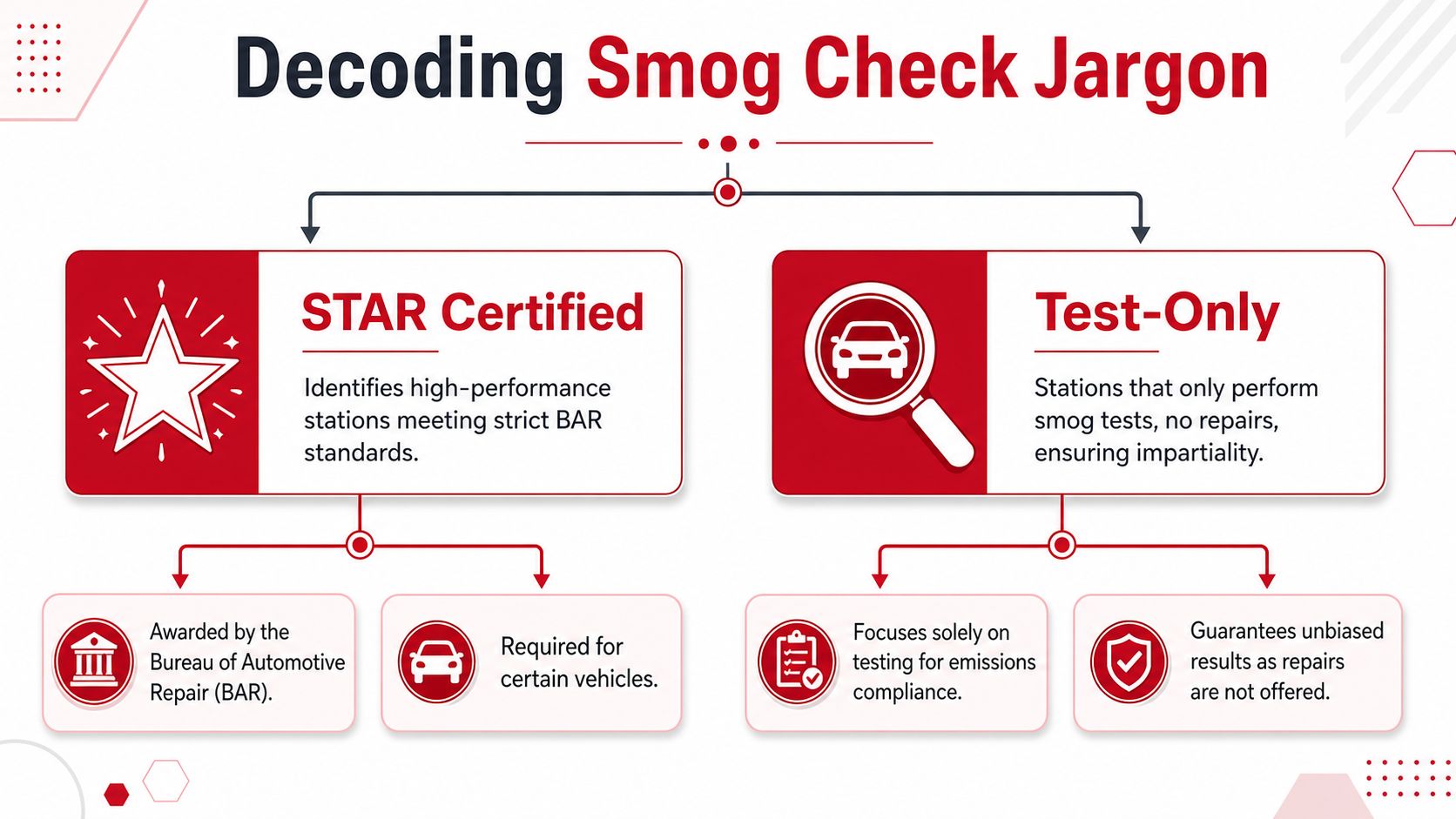
STAR certified answers: How is the station approved?
Test-only answers: What is the station allowed to do?
What STAR certified really means
Think of STAR certification like a higher-performance license category. The Bureau of Automotive Repair uses it for stations that meet stricter operational and accuracy standards than regular stations.
For some vehicles, that higher standard isn't optional. BAR states that STAR-certified test-only centers are authorized to inspect directed vehicles and gross polluters that ordinary test-and-repair stations can't handle, and the program requires these facilities to exceed baseline accuracy thresholds, including a long-term Fail-to-Pass Rate score of at least 0.40 through the BAR STAR certification requirements.
That sounds technical, but the takeaway is simple. California wants certain vehicles inspected at stations with stronger testing performance.
What test-only means in practice
A test-only center is exactly what it sounds like. The shop inspects the car, reports the result, and certifies it if it passes. The shop does not repair smog failures.
That separation matters because it removes the repair sale from the inspection itself. If the shop can't sell you a catalytic converter, oxygen sensor, or emissions repair, there's less reason for you to worry about pressure or upsells.
A test-only station functions like a diagnostic checkpoint. Its job is to measure and verify, not to sell the fix.
That's why many drivers prefer smog test only centers STAR certified when they want a neutral result. If the car passes, you're done. If it doesn't, you leave with a report and take the car to a repair shop of your choice.
A quick way to remember the difference
Use this shortcut:
- STAR certified = the station meets stricter state standards.
- Test-only = the station inspects but doesn't repair.
- STAR test-only = a shop with stricter approval standards that also stays separate from repair sales.
For a first-time customer, that last category often feels the clearest. You know why you're there, and you know what the station can and can't do.
Test-Only vs Test-and-Repair Which Station Is Right for You
This decision usually comes down to one question: Do you want a neutral inspection first, or do you want repair convenience if the car fails?
Both station types are legitimate. The better choice depends on your car's condition, your schedule, and how much risk you think there is of a failure.
When a test-only station makes sense
A STAR test-only center fits well when you believe the car is in decent shape and you want a straightforward inspection with no repair sales attached.
That's especially appealing if you've already handled maintenance, recently completed repairs elsewhere, or just want a clean yes-or-no answer from a station that isn't trying to turn the visit into a repair estimate. If you want an example of that kind of setup, this Antioch test-only smog center shows the typical model.
Common reasons drivers choose test-only:
- They want impartiality: The station has no in-house repair revenue tied to the result.
- They already fixed the car elsewhere: They only need certification.
- They value speed: Test-only shops often focus their workflow on inspections rather than repair scheduling.
When a test-and-repair station may be easier
The tradeoff shows up if the vehicle fails.
A test-and-repair station can inspect the vehicle, diagnose the issue, perform emissions-related work, and then retest on site. A test-only station can't do that. If your car fails at a test-only shop, you'll need to leave, get repairs somewhere else, and come back for another inspection.
That “two-stop” process is the part many guides skip. The SmogTips explanation of the STAR station program points out that test-only failures often create extra delay and added cost because repairs and recertification happen in separate places.
If your car has a history of check-engine problems, rough running, or recent emissions repairs, the convenience of a test-and-repair station can outweigh the neutrality of test-only.
STAR Test-Only vs. STAR Test-and-Repair at a Glance
| Feature | STAR Test-Only Center (e.g., Fire House Smog) | STAR Test-and-Repair Station |
|---|---|---|
| Main job | Performs inspections and certifications only | Performs inspections, repairs, and recertification |
| Repair sales | None on site | Repairs available on site |
| Bias concern | Lower, because no repairs are sold | Some drivers prefer a separate tester |
| If the vehicle passes | You're finished | You're finished |
| If the vehicle fails | You must go elsewhere for repairs, then return for retest | Repairs and retest may happen in one location |
| Best fit | Drivers who want a neutral inspection | Drivers who want repair convenience |
For many people, the practical answer is simple. If the car seems healthy, test-only can feel clean and low-pressure. If you suspect a problem, test-and-repair may save time.
How to Prepare for Your Smog Check
The easiest smog check is the one you show up ready for. Most of the stress comes from uncertainty, not the inspection itself.
A common point of confusion is whether every STAR-directed vehicle must go to a test-only center. That's not always the case. A discussion often referenced by California drivers notes that about 1.9% of vehicles are randomly selected for STAR testing, and most of those aren't gross polluters, which means many drivers can use a regular STAR station rather than hunting only for test-only service, as summarized in this California STAR testing discussion.
Before you leave home
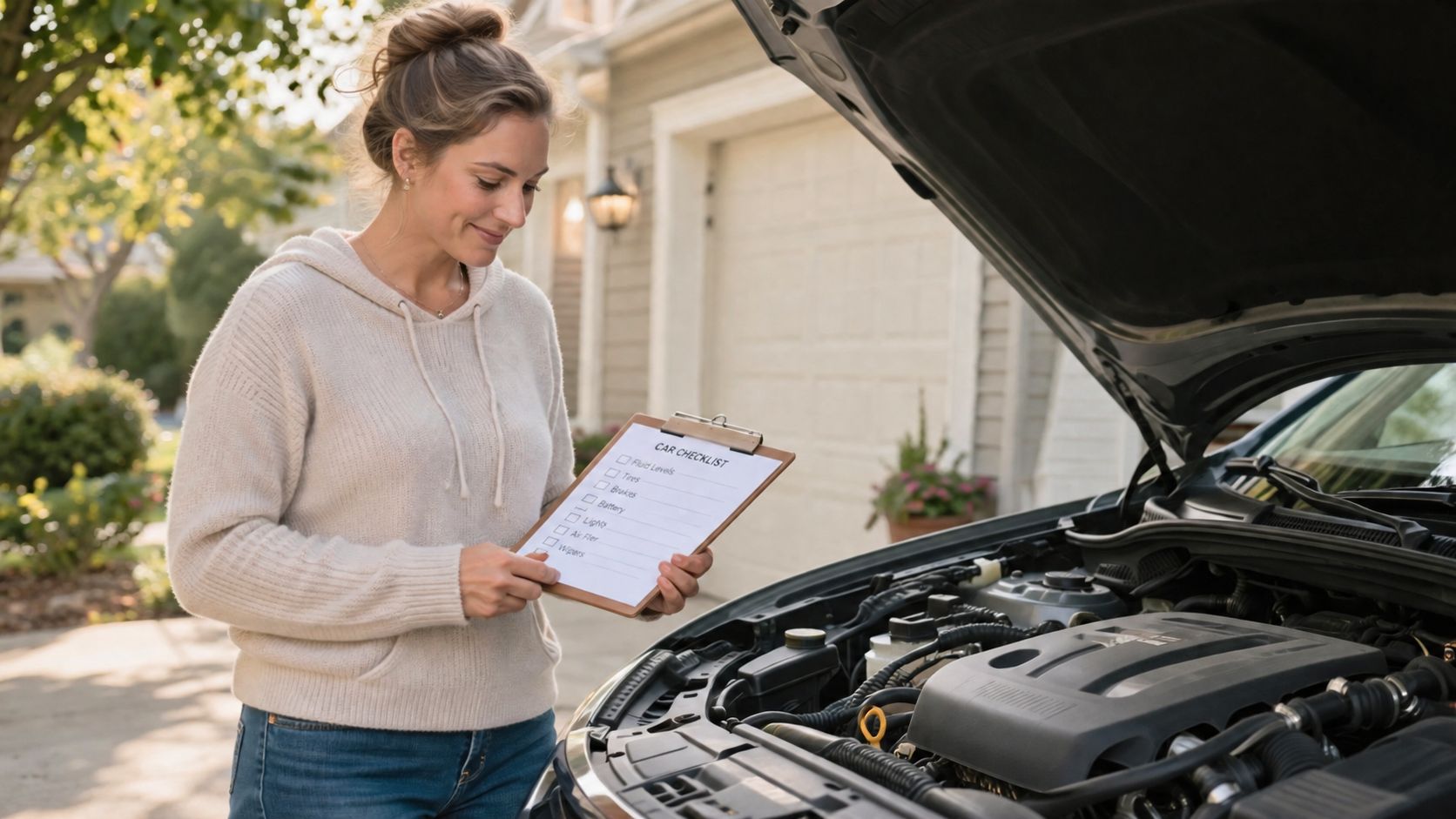
Give yourself a better shot at a smooth visit with a few simple checks:
- Watch the dashboard: If the Check Engine light is on, don't assume the car will “probably be fine.” Have the issue diagnosed first.
- Drive the car first: A short drive before the test helps the vehicle reach normal operating temperature.
- Bring your paperwork: Your renewal notice and current registration details help the station verify what the DMV is asking for.
- Don't guess about station type: If the notice wording is unclear, call the station before driving over.
- Review common failure issues: This guide to smog check fail reasons can help you spot obvious trouble before the appointment.
What the visit usually feels like
Here's the normal customer experience.
You pull in, provide your vehicle information, and the technician confirms what kind of inspection your car needs. The inspection itself may include an electronic systems check, a visual review of emissions-related components, and the required testing procedure for that vehicle type.
If the vehicle passes, the certificate is handled electronically. If it doesn't, you'll receive a report showing what needs attention.
This walkthrough gives a useful visual sense of the process:
Bring the car in the same way you normally drive it. Last-minute tinkering, battery disconnects, or rushed DIY fixes can create more confusion than they solve.
A calm way to think about the appointment
Treat the smog check like a compliance inspection, not a personal test. Your job isn't to outsmart the machine. It's to show up with the right paperwork, a warmed-up car, and realistic expectations.
That mindset alone makes the visit easier.
Fire House Smog Your Antioch STAR Certified & DMV Partner
For Antioch drivers, one practical advantage matters more than almost anything else: finishing the smog check and handling registration without making a second trip.
A test-only model keeps the inspection separate from repair sales. California service information notes that STAR Test Only centers can't perform smog check repairs, which creates a non-bias testing environment, and that typical STAR Test Only pricing ranges from $29.95 to $59.95 plus an $8.25 state certificate fee through this California service listing for STAR Test Only smog checks.
Why the combined service matters
The part many drivers dislike isn't only the smog test. It's the extra errand after the smog test.
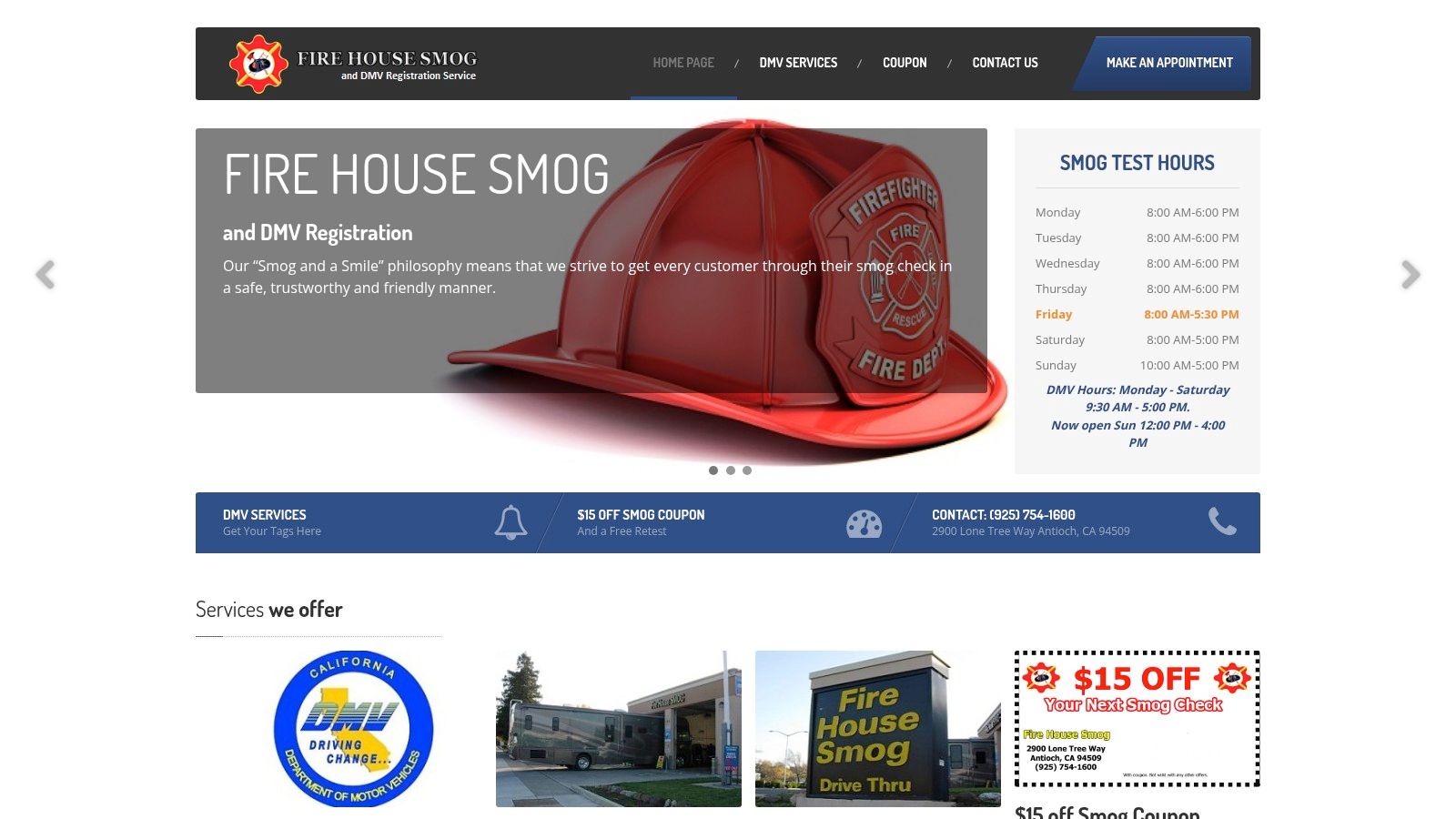
A station that also handles DMV registration services can remove that second stop. Fire House Smog offers both test-only smog inspections and on-site DMV services as a licensed business partner, which means a passing vehicle owner may be able to complete the renewal and receive registration materials in the same visit. For local drivers comparing options, this STAR-certified smog test near Antioch page shows the service category.
That combination is useful for:
- Busy commuters: Fewer separate appointments.
- Families with tight schedules: Less waiting around with kids in the car.
- Fleet or multi-vehicle owners: A more predictable paperwork process.
What to expect on site
The location at 2900 Lone Tree Way in Antioch offers smog testing for passenger cars, SUVs, light-duty trucks, and some RVs within equipment limits. The business also operates two service bays, provides smog testing seven days a week, and offers DMV service hours Monday through Saturday, with Sunday availability for limited services, based on the publisher information provided above.
That doesn't guarantee zero wait, but it does mean the workflow is built around quick inspections and registration support rather than repair work.
If you're the kind of driver who wants the inspection kept separate from repairs, while also avoiding a later DMV line, this setup solves both problems in one stop.
Frequently Asked Questions About Smog Checks
What usually causes a failure
The most common issues are usually basic emissions-related problems, not mysterious government traps.
Drivers often run into:
- Dashboard warning lights: Especially the Check Engine light.
- Sensor or emissions component problems: Items like oxygen-sensor-related faults can affect readiness or emissions results.
- Fuel vapor issues: Even something simple like a loose gas cap can create trouble.
- Recent repair resets: If a battery was disconnected or codes were just cleared, the vehicle may not be ready for inspection.
What happens if the car fails at a test-only station
You'll get a report showing the reason for the failure. Then you take the car to a repair shop of your choice, have the issue corrected, and return for a retest.
That's the main downside of test-only service. It protects you from repair upsells during the inspection, but it also means the repair step happens somewhere else.
A failure at a test-only shop doesn't trap you. It just separates the diagnosis result from the repair decision.
How retests work
Retest rules depend on the station's policy. Some drivers assume a return visit is automatic or included no matter what. It's better to ask directly before the first inspection.
For Fire House Smog, the publisher information states that a free retest is available when required, subject to site policy and coupon terms. That means you should confirm the current terms at the counter or when scheduling so there aren't any surprises.
If you're unsure where to go, call ahead, read your DMV notice carefully, and choose the station type that matches both the notice and your comfort level. That's usually all it takes to make a confusing requirement feel manageable.
If you need a neutral smog inspection and want to handle registration in the same visit, Fire House Smog provides STAR-certified test-only smog checks along with on-site DMV services in Antioch. Call ahead if your notice is unclear or if you're bringing a larger vehicle, and confirm current retest and registration-service details before you go.

You open your DMV renewal notice, scan for the amount due, and then spot the line that changes your whole errand list: Smog Certification Required.
That one line raises a bunch of practical questions fast. Why does your car need this now? Why does California seem stricter than other states? What do all those terms like CARB, STAR, LEV, and ZEV mean? Most of all, what do you need to do so you can pass the test, renew your registration, and get back on the road without wasting a day?
California emissions standards can feel like a wall of jargon until you connect the policy to what happens in the bay during a real smog inspection. Once you do that, the system makes more sense. The state sets the rules. Testing stations apply them. Your vehicle either shows it's operating within those limits, or it doesn't.
Table of Contents
- Why Your DMV Renewal Says Smog Check Required
- Decoding CARB and the Alphabet Soup of Emissions
- How California's Rules Differ from Federal Standards
- The Road to 2035 and the Future of Driving in California
- Your Vehicle's Smog Check and the Role of STAR Stations
- A Simple Checklist for Passing Your Smog Test
Why Your DMV Renewal Says Smog Check Required
You open your DMV renewal notice, ready to pay the fee and move on. Then one line stops you cold: Smog Check Required.
For many California drivers, that is the moment state policy stops feeling abstract and starts feeling personal. The registration process pauses until the state gets proof that your vehicle's emissions equipment is still doing its job. In other words, the DMV is not asking whether your car starts and drives. It is asking whether the vehicle still meets the emissions rules tied to its age, design, and equipment.
That connection can feel confusing at first. Registration sounds like paperwork. A smog check sounds like a repair issue. In California, the two are linked. The renewal notice acts like a checkpoint between your car and another registration cycle.
The rules behind that checkpoint come from several parts of the state system, but the practical effect is simple for a driver. If your notice says a smog inspection is required, the DMV needs an up-to-date passing result before renewal can be completed.
The notice is really a compliance checkpoint
A helpful way to look at it is this: your renewal notice is a report card request for the emissions side of the car.
Over time, parts wear out. Oxygen sensors get lazy. Catalytic converters stop cleaning exhaust as well as they should. An EVAP system leak can turn on the check engine light even when the car seems to run fine. California requires periodic checks so those problems do not stay hidden for years while the vehicle remains registered.
That distinction is important because drivers often mix up two different ideas:
- How the car feels to drive
- How cleanly the car is operating according to emissions rules
A vehicle can run "pretty normal" and still fail a smog inspection. That surprises a lot of owners the first time it happens.
Practical rule: A smog check verifies emissions performance, not just basic drivability.
If you are sorting out deadlines, fees, and paperwork at the same time, this guide to California DMV registration renewal requirements can help clarify the registration side of the process.
Why California ties this to registration
California keeps a close eye on vehicle emissions because cars and trucks are a major part of the state's air pollution problem. That is the big-picture reason. Your smog notice is the everyday version of that policy.
But for the driver standing at the mailbox, the more useful takeaway is practical. The state uses the renewal cycle because it is one of the few moments when nearly every vehicle owner has to check in. That makes registration an effective point for verifying emissions compliance.
It also explains why the requirement can feel strict. You are not being singled out. Your notice is part of a statewide system designed to catch emissions problems before another registration period begins.
What to do when you see the notice
Start with the basics. Check whether the vehicle needs a test now, whether the check engine light is on, and whether you recently disconnected the battery or had repairs done. Those details can affect the result.
Then choose the right station. A STAR-certified, test-only station such as Fire House Smog can be especially useful when you want a straightforward inspection without the pressure of upselling repairs. That setup helps many drivers get a clear answer about where they stand before the registration clock runs out.
From the driver's seat, the key points are straightforward:
- The DMV notice is the trigger. It tells you a current passing smog result is required for renewal.
- The inspection checks emissions systems. It is not a general judgment about whether the car feels fine on the road.
- A little preparation saves time. Catching warning signs early can reduce retests, delays, and registration stress.
Decoding CARB and the Alphabet Soup of Emissions
A lot of the stress around California emissions standards comes from the acronyms. They sound technical, but the ideas are manageable once you translate them into plain language.
Who CARB is and why drivers hear about it
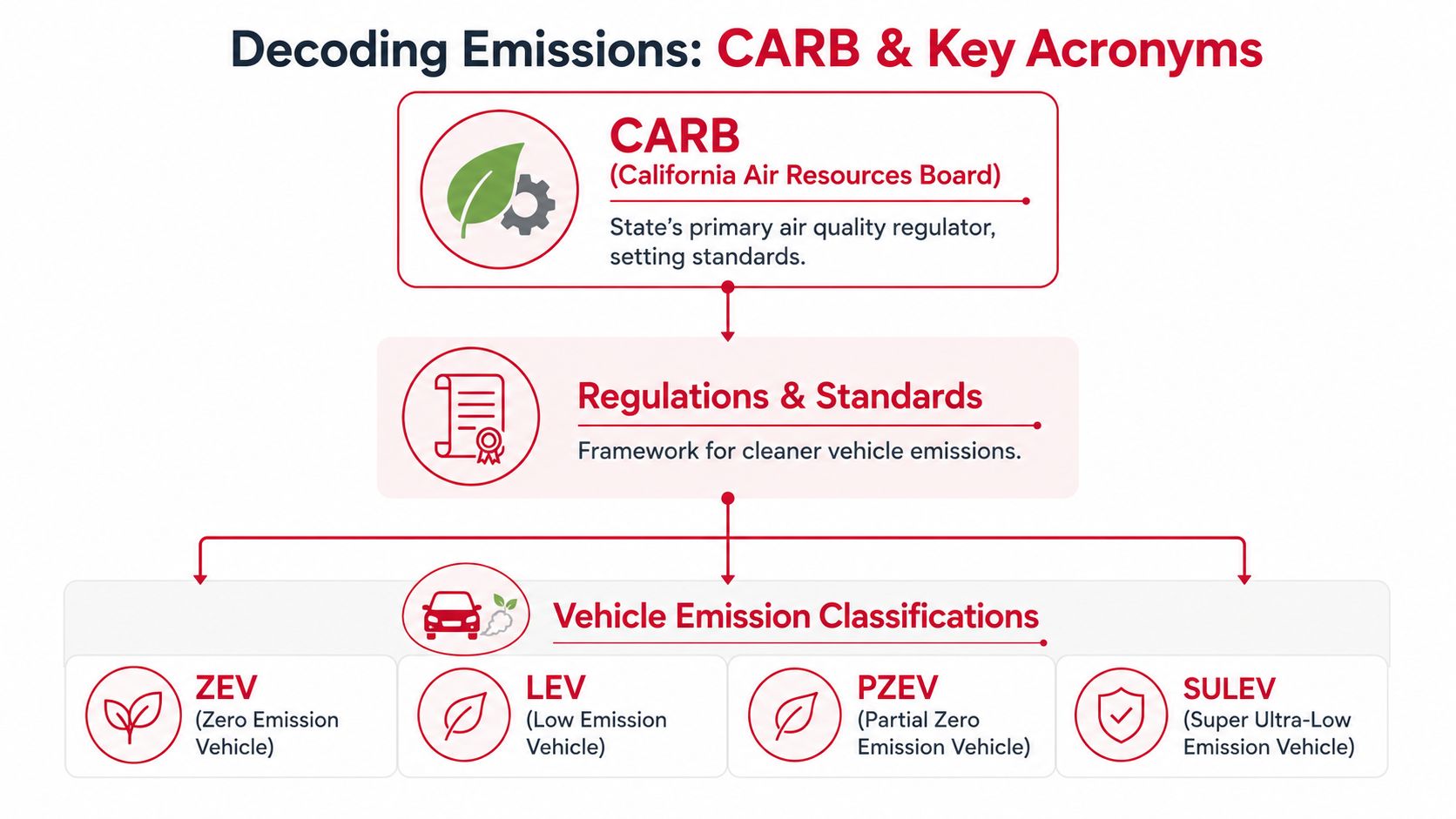
Think of CARB as California's air-quality rulemaker for vehicles. It sets standards for what manufacturers must build and what counts as compliant in this state. If you've ever noticed that a car sold in California has specific emissions labeling or equipment requirements, CARB is the reason.
Drivers usually hear about CARB indirectly. The check-engine light comes on. A replacement part needs to be emissions compliant. A smog station checks readiness monitors or tailpipe-related systems. All of that sits downstream from CARB's rules.
One practical example is the state's tighter particulate standard for light-duty vehicles. Under California's LEV III standards, the particulate matter limit for new light-duty vehicles was tightened from 10 mg/mi to 3 mg/mi for vehicles certified by model year 2021, with an in-use compliance standard of 6 mg/mi, as summarized by DieselNet's California light-duty standards reference. In shop terms, that means emissions-control hardware isn't optional decoration. The vehicle needs working systems that can keep pollution below a stricter threshold.
The common emissions acronyms in plain English
The easiest way to understand these labels is to treat them like an environmental report card for the vehicle.
| Acronym | Full Name | Simple Analogy |
|---|---|---|
| CARB | California Air Resources Board | The state teacher who writes the rules and grades the test |
| LEV | Low-Emission Vehicle | A solid passing grade |
| ULEV | Ultra-Low-Emission Vehicle | Better than passing, cleaner than basic compliance |
| SULEV | Super Ultra-Low-Emission Vehicle | Near the top of the class for very low emissions |
| PZEV | Partial Zero-Emission Vehicle | Very clean tailpipe performance with extra emissions protections |
| ZEV | Zero-Emission Vehicle | The A+ category for no tailpipe emissions |
These labels don't all mean the same thing in practice.
LEV means the vehicle meets a low-emissions standard, but it still emits pollution. ULEV and SULEV step down farther. PZEV usually refers to a very clean gasoline vehicle with additional evaporative-emissions controls. ZEV means no tailpipe emissions at all, such as a battery-electric vehicle.
A clean-running gasoline car and a zero-tailpipe-emissions car aren't in the same category. California tracks that difference very closely.
Drivers often run into these terms when shopping for a newer vehicle, reading an emissions label under the hood, or trying to understand why some vehicles sail through a test while others struggle as they age.
If your DMV notice specifically requires a STAR inspection, it also helps to understand the role of a STAR smog test-only station. The acronym side of emissions law and the station type on your notice often connect more closely than people expect.
How California's Rules Differ from Federal Standards
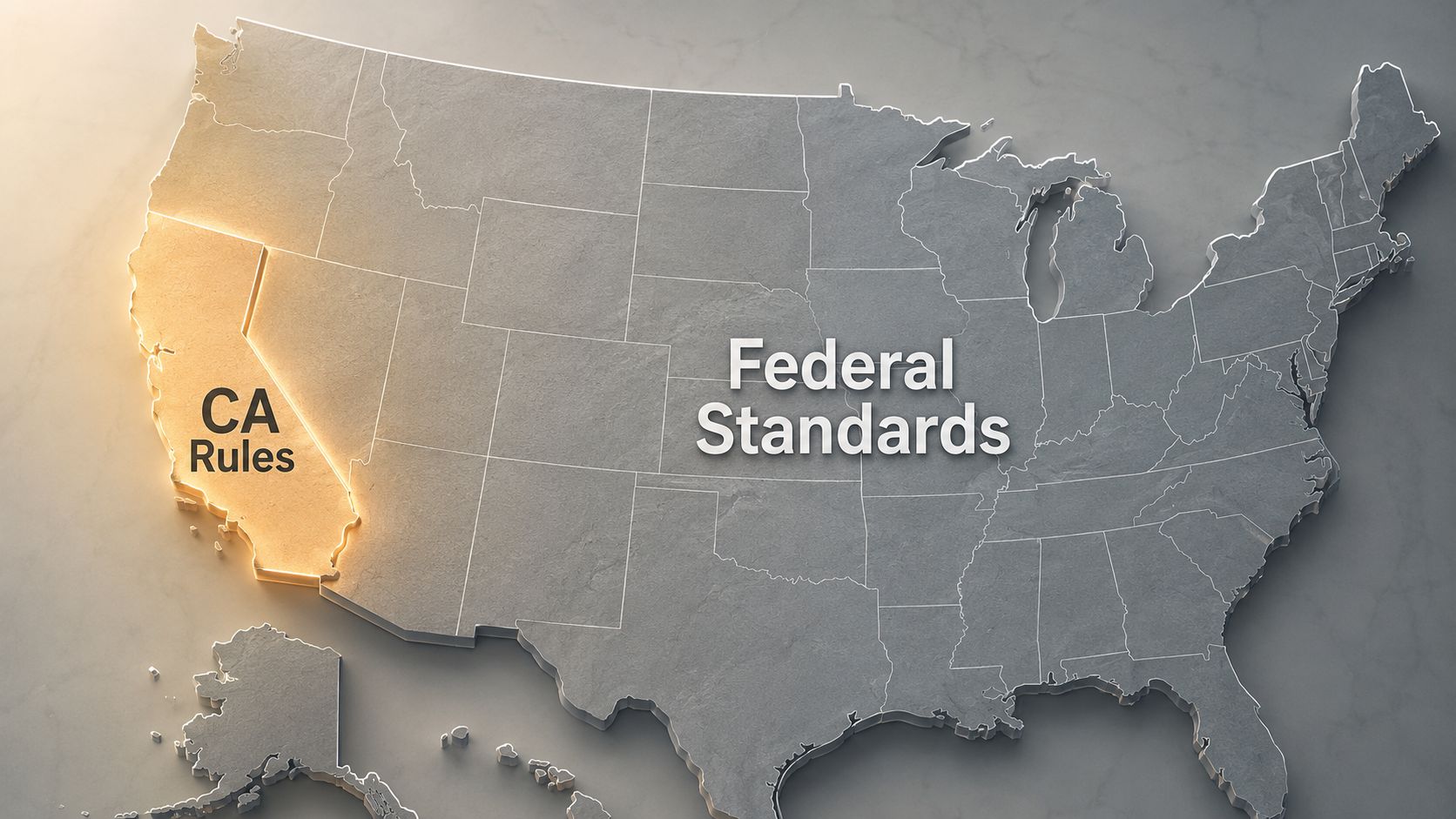
Your car can run fine, no warning light can be on, and you can still feel confused about why California seems stricter than the rest of the country. That confusion is normal. Federal rules set the baseline for the whole U.S., but California is allowed to require more from vehicles sold and registered here.
Why California sets its own path
The practical reason is simple. California has long had serious air-quality problems, especially in dense metro areas and inland valleys where pollution can linger. State regulators have responded by building tighter vehicle rules than the national minimum.
For a driver, it helps to picture federal standards as the minimum passing score on a test. California often grades on a stricter curve. Automakers still have to meet federal requirements, but many vehicles sold here also need to satisfy California-specific emissions rules.
That stricter approach reaches beyond the tailpipe alone. California pays close attention to evaporative emissions, onboard diagnostics, catalyst performance, and how a vehicle behaves right after startup. Those details may sound technical, but they connect directly to real smog check outcomes as a car ages.
What that means for your vehicle
Here is where drivers usually notice the difference:
- Vehicle certification can be stricter: Some vehicles are built or calibrated to meet California emissions requirements, not just federal ones.
- Emissions parts get more attention: Catalytic converters, oxygen sensors, evaporative components, and readiness monitors all have to do their jobs correctly.
- Cold-start performance matters: California focuses on the dirty first moments after startup, when emissions are often at their highest.
A good example is the state's 50-degree F cold-start standard for certain newer light-duty vehicles. California regulations require certification testing at a nominal 50°F for 2026 and later model year vehicles because emissions controls are less effective when the engine and catalyst are cold, as described in the California regulation text hosted by Cornell Law School.
In plain English, California is not only asking, "Does the car run clean once it's warmed up?" It is also asking, "How quickly does it clean itself up after a cold start?"
That distinction can expose borderline problems sooner. A weakening catalytic converter, a lazy oxygen sensor, or an evaporative fault may not be obvious to the owner day to day, but California's tighter framework is more likely to catch it during the inspection process.
So no, the average driver is not taking a completely different smog test in some dramatic way just because they are in California. The better way to understand it is that your test sits inside a stricter rulebook. If you want a clearer side-by-side explanation, this guide to California and federal vehicle emissions standards breaks the terms down into plain driver language.
The Road to 2035 and the Future of Driving in California
A lot of people hear one headline about California and jump straight to the wrong conclusion. They assume the state is about to outlaw every gasoline car on the road. That's not what the rule says.
What the ACCII rule actually says
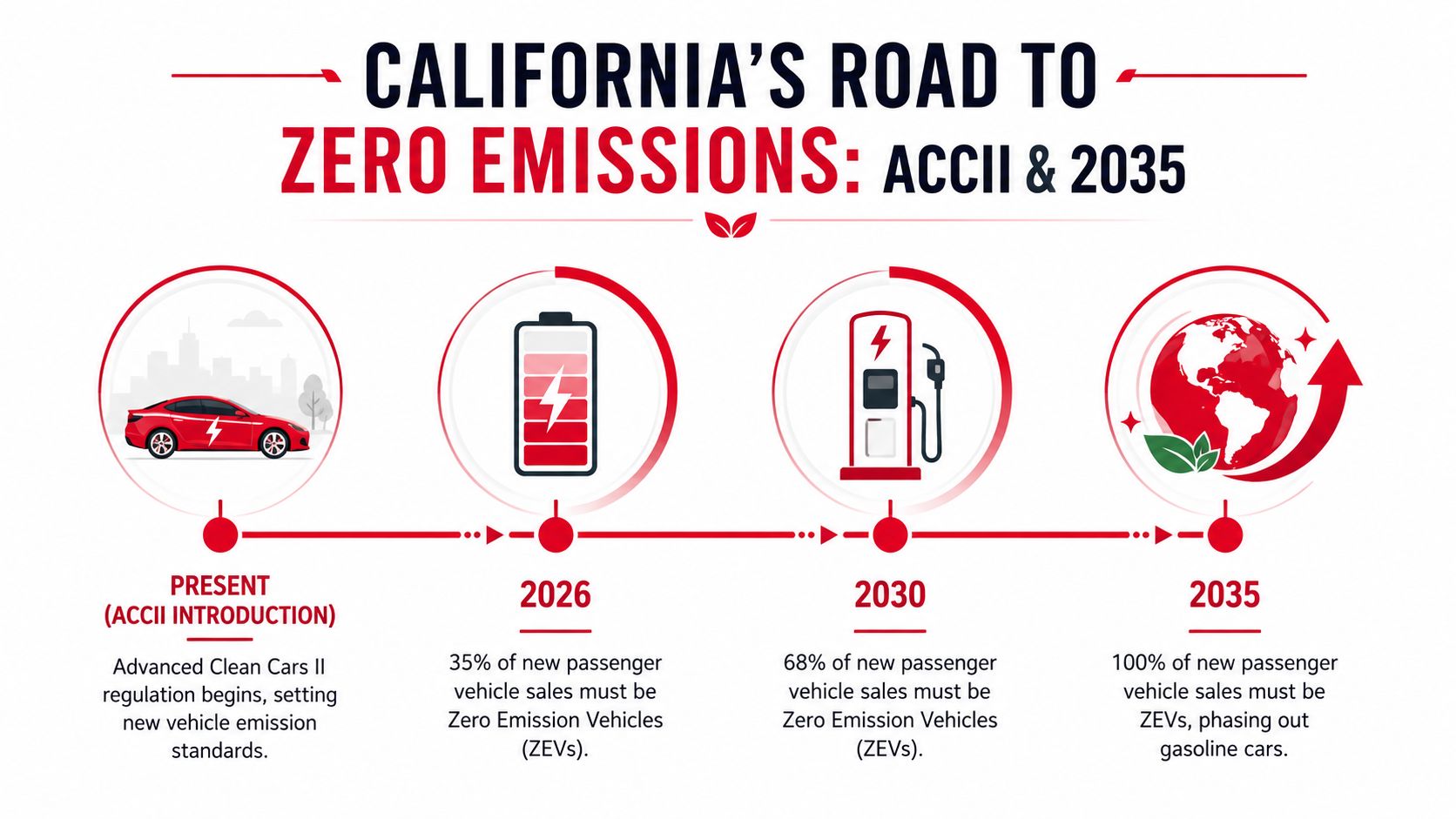
California's Advanced Clean Cars II, often shortened to ACCII, is a sales rule for new vehicles. It requires that 100% of all new light-duty vehicles sold in the state be zero-emission vehicles by 2035, with the phase-in starting with the 2026 model year, according to the American Action Forum summary of California's ZEV rule.
The same source explains that the program ramps up over time rather than flipping overnight. That's why you'll keep hearing about 2026 as an important starting point. It's where the future sales mix begins changing more visibly.
For buyers, this matters because the new-car market will keep shifting toward battery-electric and other zero-emission options. Automakers planning for California can't treat this as a side issue. They have to build product lines that fit the rule.
What it does not mean for current owners
This rule does not mean California is banning your existing gasoline car from the road.
It also doesn't mean used gasoline vehicles suddenly become illegal to own, drive, or sell. If you already have a gas-powered car or truck, the practical question remains the same as it is today: can you keep it registered, maintained, and compliant with the emissions rules that apply to it?
That distinction matters because drivers often mix up two different ideas:
- Rules for new vehicles sold in the future
- Rules for vehicles already in service
Those are not the same thing.
The 2035 target is about what dealers can sell new. It is not a command for current owners to scrap working gasoline vehicles.
There are also cost and benefit discussions wrapped into ACCII. The rule summary cited above states that CARB projected substantial costs and projected benefits through the 2040 model year, with benefits tied heavily to gasoline savings and carbon reductions. For most drivers, though, the immediate takeaway isn't about long-range policy math. It's that California has clearly signaled where the new-vehicle market is heading.
If you're keeping your current car, that future doesn't change the basics. You still need to pay attention to maintenance, warning lights, emissions equipment, and the requirements on your registration notice.
Your Vehicle's Smog Check and the Role of STAR Stations
The policy now turns into a real appointment, a real test, and a real pass or fail.
How policy turns into a pass or fail
A smog inspection isn't guessing. The station is checking whether your vehicle's emissions systems and onboard diagnostics line up with California's requirements for that vehicle.
That can include the condition of the catalytic converter, the status of the check-engine light, readiness monitors, visible emissions components, and whether the vehicle appears to have the correct emissions equipment installed. Newer standards matter here because they shape what performance level the car is expected to maintain.
Take two examples from the rules discussed earlier.
First, California's tighter particulate matter threshold means cleaner output is expected from modern light-duty vehicles. Second, the state's cold-start focus matters because many emissions failures show up when a vehicle can't control pollution quickly after startup. A worn catalyst, incorrect replacement part, or unresolved sensor issue can push a car out of compliance even if it still seems to drive normally.
Why STAR and test-only matter
Some DMV notices don't just say you need a smog check. They say you need it from a STAR-certified station.
STAR is a state designation for stations that meet specific program requirements. If your notice calls for STAR, a non-STAR station won't satisfy that requirement. That's the first practical reason to check the wording on the renewal form before you drive anywhere.
The second issue is business model. Some shops both test and repair. Others are test-only.
That difference matters because 13% of smog checks in California involve vehicles that fail initially but pass on retest without repairs, which has raised concerns about bias at non-test-only locations, according to the California Air Resources Board program page discussing LEV testing and related station concerns. A test-only station doesn't sell repairs, so it removes the incentive tied to repair revenue.
Shop-floor advice: If you want a neutral result, choose a station that only tests and doesn't profit from diagnosing the same failure into a repair order.
That doesn't mean every test-and-repair shop is doing anything improper. It means drivers should understand the incentive structure before choosing where to go.
Here's the practical comparison:
| Station type | What it does | Main driver concern |
|---|---|---|
| Test-and-repair | Inspects and may also sell repairs | Possible conflict if the same shop benefits from a failed result |
| Test-only | Performs the inspection only | You may need a separate repair shop if the vehicle fails |
| STAR-certified test-only | Performs required STAR inspections without repair sales | Useful when the DMV specifically requires STAR and you want a neutral test |
If you want to see the inspection environment before booking, this video gives a quick look at the process and station setup:
A station can also affect what happens after the test. Some locations only send the certificate electronically and leave you to finish registration elsewhere. Others combine services. Fire House Smog is a factual example of the second model. It's a STAR-certified test-only station and licensed DMV service provider in Antioch, so a driver may be able to complete a smog check and DMV renewal tasks in one stop, with on-site tag issuance during posted hours.
What drivers usually get confused about
The most common misunderstandings are straightforward:
- "If the car runs fine, it should pass." Not always. Emissions failures often come from control systems you can't feel while driving.
- "Any smog station is fine." Not if your notice requires STAR.
- "A fail means I need major repairs." Sometimes yes, sometimes no. The failure reason matters.
- "Passing after a retest proves the first failure was valid." Not necessarily. That's one reason neutrality matters.
Smog checks go more smoothly when you pick the right station type first, not after a failed visit.
A Simple Checklist for Passing Your Smog Test
The easiest way to handle California emissions standards is to turn them into a short routine. You don't need to memorize regulations. You need to avoid the common mistakes that lead to delays.
Before you leave home
Read the DMV notice carefully. Look for whether it says a STAR station is required. That one detail decides where you can go.
Make sure the check-engine light isn't on. If it's illuminated, deal with that first. A warning light is one of the clearest signs that the car may not be ready to pass.
Don't ignore recent battery disconnects or repairs. If codes were cleared or the battery was disconnected, the vehicle may need normal driving before its systems show ready again.
A rushed test right after clearing codes is one of the most avoidable reasons people have to come back.
- Drive the car before the inspection. A normal warm-up drive helps the engine and emissions systems operate under more stable conditions than a cold vehicle that has been sitting.
At the station and after the result
Bring your registration information and confirm whether the station can handle the type of vehicle you're bringing. That matters even more if you're showing up with something larger than a typical passenger car.
Then follow this simple decision path:
- If the car passes, the certificate is transmitted and you move on to registration.
- If the car fails, read the failure reason before authorizing anything elsewhere.
- If you need a retest, ask about station policy in advance so you know whether a return visit includes any retest option.
A smart station choice can also save a second errand. Some locations offer on-site registration help and sticker printing, which is useful if you want to handle compliance and DMV paperwork in the same stop instead of splitting the day between agencies and service counters.
The short version is this:
- Check the notice
- Warm up the car
- Make sure there are no active warning lights
- Use the correct station type
- Understand the result before taking the next step
That approach won't guarantee every older vehicle passes, but it does remove a lot of avoidable friction from the process.
If you need a STAR-certified test-only inspection in Antioch, Fire House Smog handles smog checks for cars, SUVs, light-duty trucks, and some RVs, and it also offers on-site California DMV services with tag issuance during posted hours. For drivers who want a neutral test without repair sales, plus the option to complete registration tasks in one place, it's a practical local option.
You open your DMV renewal notice, scan for the amount due, and then see the line nobody likes: smog certification required. If you own a diesel in California, that notice tends to raise more questions than answers. Gas drivers often assume your process is the same as theirs. It isn't.
Diesel owners deal with stricter rules, a smoke test many people misunderstand, and OBD checks that can trip you up even after you've already made the repair. I've seen plenty of owners walk in thinking, “The truck runs fine, so I should be good,” and then get blindsided by an incomplete monitor or smoke that hangs a little too long.
The good news is that the process is manageable when you know what the station is checking. You need to know whether your diesel is subject to testing, what causes failures, how to prep the vehicle before test day, what happens during the inspection, and what to do if you pass or fail.
Table of Contents
- Your Diesel Needs a Smog Check. Now What?
- Which Diesel Vehicles Need a Smog Test in California
- Top Reasons Diesel Vehicles Fail the Smog Test
- How to Prepare Your Diesel for a Smog Test
- The Process at a STAR Test-Only Smog Station
- After the Test Passing Failing and Next Steps
Your Diesel Needs a Smog Check. Now What?
Most diesel owners start in the same place. Registration notice in hand, keys on the counter, and a mild sense that this is going to be more annoying than it should be. That feeling is fair. Diesel testing in California has more traps than most drivers expect.
A common scenario goes like this. You've got a pickup or SUV that starts fine, pulls strong, and doesn't seem to have any obvious issue. You assume the smog test for diesel vehicles is just another quick formality. Then somebody tells you a glowing check engine light means failure. Somebody else says to just clear the code. Then a forum post says smoke is okay if it's “not too bad.” That kind of advice gets people into trouble.
What works is a simple approach.
- Read the renewal notice carefully: If DMV says a smog check is required, treat that as your starting point.
- Figure out whether your diesel falls under the California testing rule: Model year and GVWR matter.
- Check the dashboard before you go: If warning lights are on, don't gamble.
- Drive the vehicle enough after repairs: Clearing codes at the last minute usually creates a different problem.
- Go in prepared: A warm engine and a vehicle in normal running condition usually make the process smoother.
Practical rule: Don't use the smog station as your first diagnostic step if the truck is already warning you that something's wrong.
Owners who do best aren't the ones with perfect vehicles. They're the ones who show up understanding what the inspection involves.
Which Diesel Vehicles Need a Smog Test in California
You open your DMV renewal notice, see the smog requirement, and the first question is usually simple. Does my diesel need this test, or am I exempt?
For California diesel owners, the rule is pretty straightforward once you ignore the bad advice floating around online. Most diesel vehicles with a 1998 or newer model year and a GVWR of 14,000 pounds or less need a smog check every two years, as outlined in this California diesel smog requirement overview. If you drive a light-duty diesel pickup, SUV, or passenger vehicle, assume you are in the program until your door-jamb label and registration details prove otherwise.
That catches a lot of California owners off guard, especially people who just bought a newer diesel and expect the same early-year break gasoline vehicles can get. Diesel does not work that way.
The rule that matters in the real world
At a STAR test-only station, this is the first thing I want an owner to confirm before we even talk about readiness monitors, warning lights, or smoke. Model year and GVWR decide whether your diesel belongs in the biennial smog program. If your truck is covered, the DMV will keep asking for a smog certification at renewal time while it stays registered in California.
If your diesel is older or heavier, the answer can be different. That is why guessing by appearance is a mistake. A truck that looks like a light-duty pickup still needs to be judged by its actual gross vehicle weight rating, not by what the owner or seller assumed.
Quick reference table
| Vehicle Type | Smog Check Required? |
|---|---|
| Diesel, model year 1998 or newer, GVWR 14,000 lbs or less | Yes, biennially |
| Diesel, model year 1997 or older | No, exempt from this biennial requirement |
| Diesel over 14,000 lbs GVWR | No, exempt from this biennial requirement |
The fastest way to sort this out is to check the sticker on the driver's door or door frame and find the GVWR there. Then match that number with the model year on your registration. If you own a pickup and want a more specific breakdown, this guide to a truck smog check in California will help.
A few practical points save people headaches at the counter and in the test bay:
- Do not assume your diesel gets an abatement-fee shortcut. Covered diesel vehicles are generally in the testing cycle, not on a temporary pass.
- Do not test too early unless you need to. Your passing certificate has a deadline tied to DMV timing, so random early testing can create extra work.
- Check the weight rating, not the badge. A 2500, 3500, or similar trim name does not settle the question by itself.
The right move is simple. Verify the model year. Verify the GVWR. Once you know whether your diesel is in the California program, the rest of the smog process gets a lot less confusing.
Top Reasons Diesel Vehicles Fail the Smog Test
California diesel failures usually come from two places. The vehicle reports a problem through the OBD system, or it pushes out smoke that hangs too long during the test. At a STAR test-only shop, we see both every week, and neither one is a surprise once you know what the technician is checking.
The check engine light problem
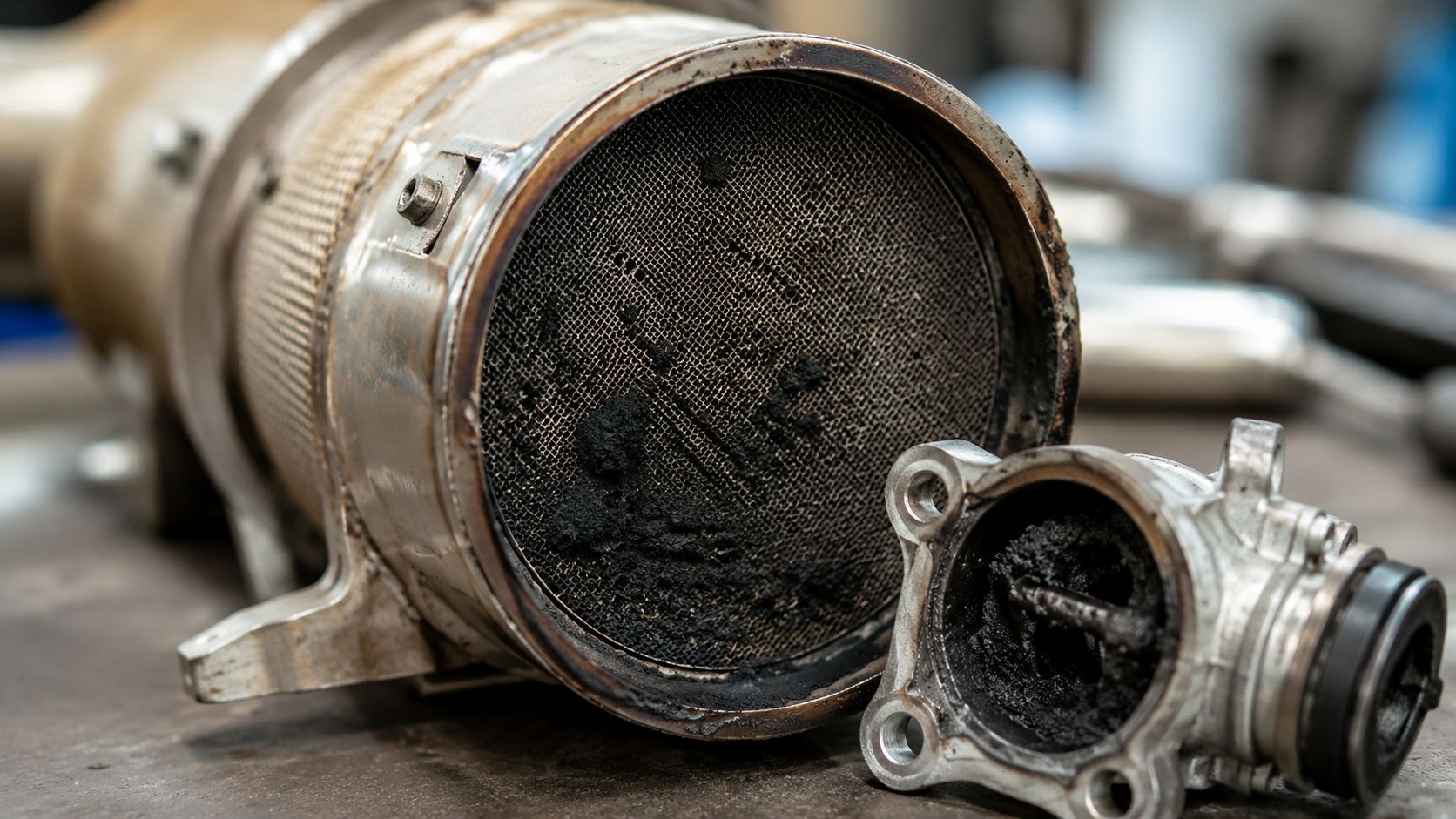
If your check engine light is on, stop there and handle it before you book the test. A diesel with an active fault is telling you something is wrong, and California smog equipment is going to see it.
The mistake I want owners to avoid is clearing codes right before coming in. That move usually makes things worse. You still have the original fault, and now the readiness monitors may show incomplete, which can block a passing result.
Here is what that means in plain language:
- An active warning light puts your diesel in a bad position: The fault is part of the inspection picture from the start.
- A recently reset computer raises another problem: The vehicle may not have finished its self-checks.
- A real repair includes drive time afterward: The system has to run its tests and show ready status.
At the shop, this is one of the easiest fail patterns to spot. The owner says the truck is running fine. The computer says otherwise.
Visible smoke during the snap test
Smoke is the other big one, a criterion on which California gets more specific than many drivers expect. The issue is not whether the exhaust looked dramatic to you in the driveway. The issue is whether smoke stays visible too long during the BAR snap-acceleration procedure.
A diesel vehicle fails if a visible smoke plume observed 5 to 15 feet from the tailpipe lingers for more than 3 seconds on either of the final two BAR Snap Tests, according to the California Smog Check Manual.
That catches a lot of owners off guard. A truck can seem acceptable in daily driving and still fail in the bay because the smoke hangs after a quick throttle snap in neutral. If your diesel puffs on startup, hazes under a hard rev, or leaves a cloud that does not clear right away, take that seriously.
Common causes include a restricted DPF, EGR problems, injector issues, turbo problems, and poor maintenance. If you want a broader breakdown of common reasons vehicles fail a smog check, that guide helps. For diesel owners in California, the practical lesson is simple. Lingering smoke is not cosmetic. It is a direct path to failure at a STAR station.
How to Prepare Your Diesel for a Smog Test
Preparation is where you save yourself time, money, and aggravation. Don't overcomplicate it. You're trying to show up with a diesel that is warm, stable, free of warning lights, and fully ready in the OBD system.
Your pre-test checklist
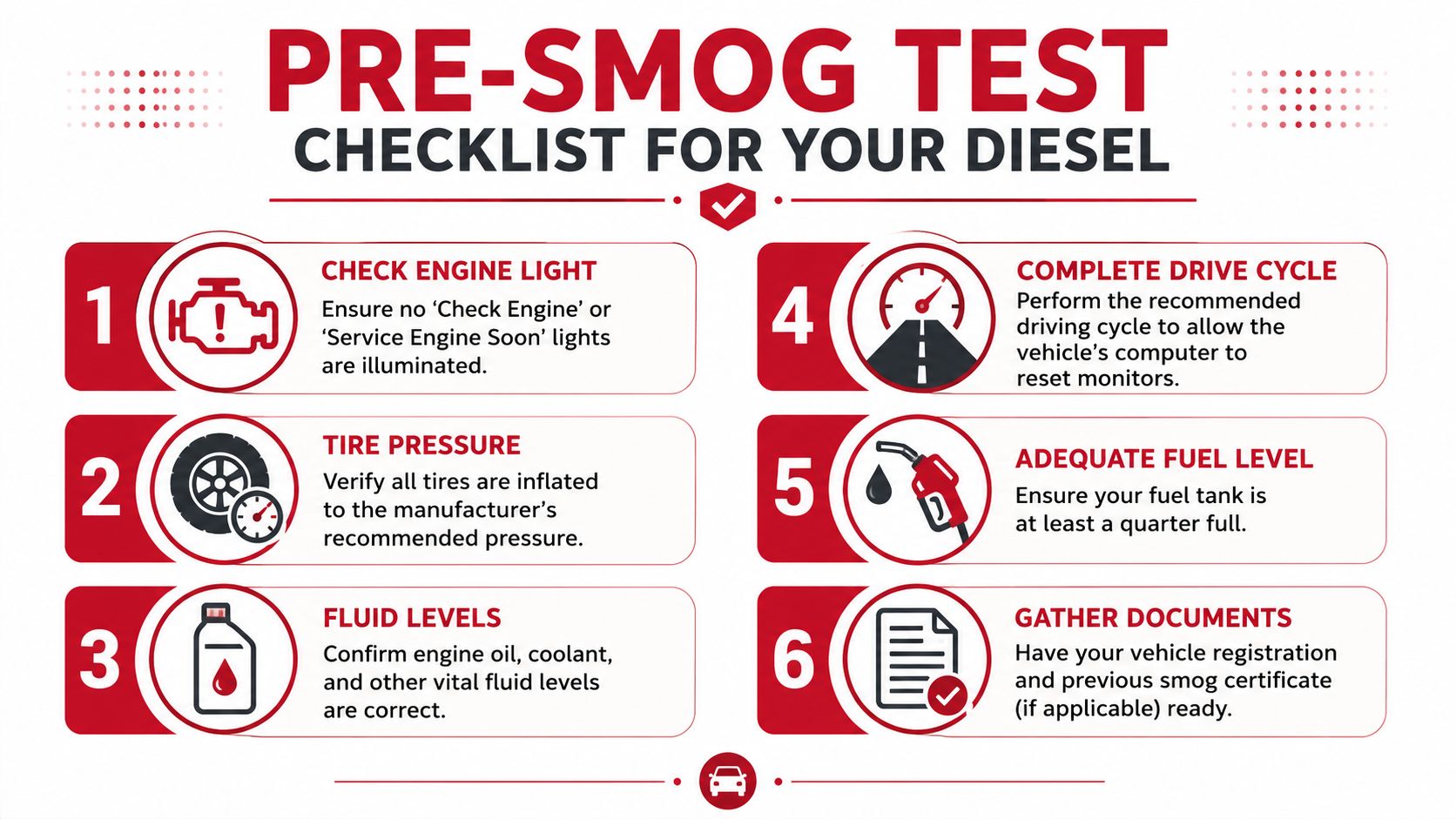
Start with the dashboard. If the Check Engine or Service Engine Soon light is on, handle that first. And if you just cleared it, don't rush straight into the test lane. BAR requires complete OBDII monitors, and a recent reset can leave the vehicle unreadable for pass purposes, as covered in this BAR monitor completion discussion for diesel testing.
Use this checklist before you go:
- Fix the actual fault: Don't erase symptoms. Repair the cause.
- Drive it after repair: The vehicle needs normal operation long enough for the system to run its checks.
- Check for obvious smoke: Have someone watch the exhaust while you briefly raise rpm in a safe area.
- Make sure fluid levels are normal: Low fluids can create drivability problems you don't need on test day.
- Bring your paperwork: Registration paperwork helps keep the visit simple.
This quick video helps visualize the preparation mindset before inspection:
What to do the day of the test
Drive the vehicle long enough to get it fully warm before you arrive. Cold diesels tend to behave worse. They can idle rougher, haze more, and generally make a bad first impression.
A few practical habits help:
- Avoid last-minute battery disconnects. That can wipe out readiness status.
- Don't show up right after major engine work unless you've driven it. Repaired isn't the same as ready.
- If you suspect smoke, postpone and diagnose it. Hope is not a strategy.
- Keep the visit routine. No weird fuel experiments or backyard fixes the morning of the test.
Shop-floor advice: The best smog appointment is the boring one. Warm engine, no lights, normal idle, no surprises.
If you handle those basics, you put yourself in the best position to pass on the first trip.
The Process at a STAR Test-Only Smog Station
A lot of stress disappears once you know what happens in the lane. The inspection isn't mysterious. It's a sequence. The technician checks the vehicle, checks the system, performs the diesel procedure, and records the result.
What the technician does
For a California diesel in the covered class, the station generally looks at three things that matter to owners most.
First is the visual side. The technician is looking for obvious issues and emissions-related concerns that make the vehicle unfit for testing or compliance.
Second is the OBDII check. The station connects to the vehicle and reads the emissions system status. Active faults, stored problems, and incomplete readiness can surface during this process.
Third is the BAR Snap Test. During that procedure, the technician places the vehicle in neutral and quickly pushes the accelerator to 2,000 to 3,000 RPM and releases it to evaluate smoke opacity and duration, according to the California smog check guide describing the BAR Snap Test.
That's the part customers usually notice because they hear the engine rev. But by the time the throttle gets snapped, a lot of the inspection picture is already forming.
Why test-only matters
A test-only station has one major advantage. The shop isn't trying to sell you a repair while it's evaluating your vehicle. That removes the repair upsell angle that makes many drivers uneasy.
That matters even more for diesel owners, because failures can involve systems that are expensive, technical, and easy to misunderstand. At a test-only station, the result is the result. You pass, or you get a report showing what needs attention.
In practical terms, a well-run STAR test-only location is helpful because it usually offers:
- Cleaner decision-making: You're getting an inspection, not a sales pitch.
- Faster throughput: Multiple bays can keep lines moving.
- Convenience if registration is due: Some locations also handle DMV-related tasks on site.
- Better fit for work schedules: Evening and weekend availability helps owners who can't disappear midday.
For drivers in Antioch and nearby areas, that setup is exactly why places that combine STAR testing with registration support are popular. When you can test the diesel and then handle your DMV business in one stop, the whole process feels less like a bureaucratic obstacle and more like a routine errand.
After the Test Passing Failing and Next Steps
Once the inspection ends, things get simple. You're on one of two tracks. Either the diesel passed and you move on, or it failed and you need to use the report the right way.
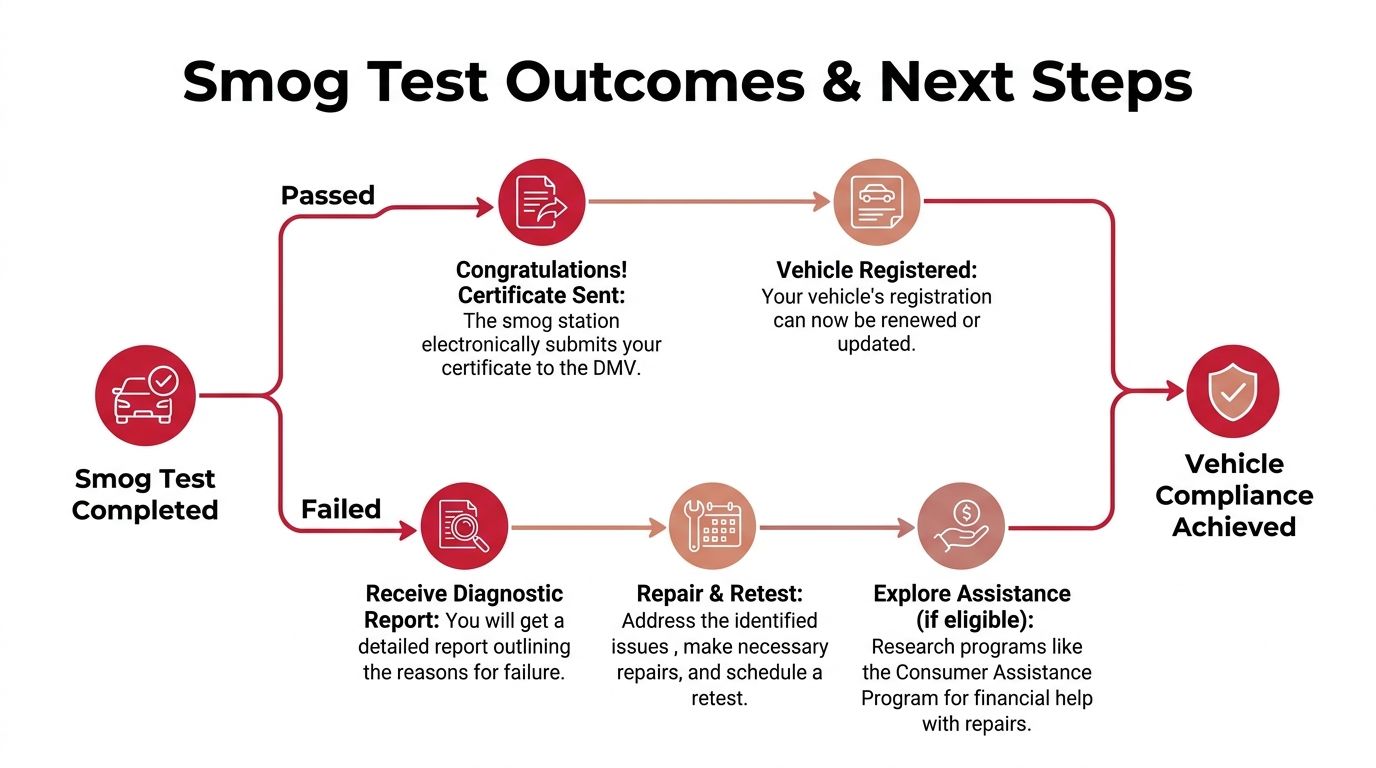
If your diesel passes
If the vehicle passes, the station electronically sends the certificate information to DMV. That's the outcome everyone wants because it turns the smog test for diesel vehicles into a one-and-done visit.
At that point, keep your receipt and finish any remaining registration steps. If your registration renewal is the next task, a location that also offers California DMV registration renewal services can make that part faster.
Pass, save your paperwork, and don't wait around if registration is still pending.
If your diesel fails
If the vehicle fails, don't guess. Read the Vehicle Inspection Report carefully. That report tells you why the station could not certify the diesel.
Different failures call for different next moves:
- OBD-related failure: Take the report to a qualified repair shop and address the fault, then drive the vehicle enough for readiness to return.
- Smoke-related failure: Have the engine and emissions system checked before coming back. Lingering smoke rarely fixes itself.
- Visual or equipment issue: Correct the noncompliant condition exactly, not approximately.
Here's the mistake to avoid. Don't throw random parts at the vehicle because a friend had “the same issue.” Diesel failures often overlap in symptoms. A proper diagnosis saves money.
If you're testing at a station with a free retest policy, use it according to the posted terms. That can reduce the sting of a failed first attempt. The important thing is to return only after the issue is repaired and the vehicle is ready, not just quieter, cleaner-looking, or temporarily reset.
A failed inspection is frustrating, but it's still manageable. Use the report, repair the underlying problem, then retest with confidence.
If you need a straightforward place to handle your diesel smog check and registration follow-up, Fire House Smog in Antioch offers STAR-certified test-only inspections, on-site DMV services, weekend availability, and a practical process that keeps things simple for diesel owners.
Your renewal notice is sitting on the passenger seat, your registration deadline is getting close, and now you're trying to figure out where to get a smog check without burning half your day. That's the Brentwood reality. The hard part usually isn't the test itself. It's sorting through confusing station types, figuring out whether your car needs STAR, and avoiding a wasted trip.
A lot of local pages make this worse. They throw out a list of stations, mention smog in general terms, and skip the details that matter when you need to get in, get tested, and move on. If you're searching for Smog Check Brentwood CA, you need practical answers, not filler.
Table of Contents
- Your Guide to Smog Checks in Brentwood
- Brentwood and Contra Costa County Smog Check Rules
- The Advantage of a STAR Certified Test-Only Station
- Fire House Smog Your All-in-One Stop in Antioch
- How to Prepare for a Fast and Easy Smog Test
- Answers to Common Brentwood Smog Check Questions
Your Guide to Smog Checks in Brentwood
Most Brentwood drivers start the same way. You open the DMV notice, spot the smog requirement, and then start asking the wrong first question. Not “Who's closest?” but “Who can handle this correctly the first time?”
That distinction matters. A lot of drivers lose time because they pick a shop before they understand what their notice requires. Some need a regular inspection. Some need a STAR station. Some assume any place with smog in the name can do everything. That's where the hassle begins.
The fastest smog check is the one you only have to do once.
If your goal is simple, honest, efficient service, you want a station that keeps the process clean. No repair pitch. No guessing. No bouncing between locations unless your vehicle needs repair work elsewhere.
Brentwood residents also have a practical advantage nearby. You don't have to limit yourself to whatever happens to be around the corner. For a lot of drivers, the smarter move is a short drive to Antioch for a setup built around speed, objective testing, and DMV convenience in one stop.
That's the point of this guide. Not to overwhelm you with regulations, but to help you avoid the common mistakes that cost time. If you've been searching for Smog Check Brentwood CA, this is how to handle it with less confusion and fewer surprises.
Brentwood and Contra Costa County Smog Check Rules
State Requirements for Brentwood Drivers
Brentwood drivers follow the smog rules for Contra Costa County. For many vehicles, that means a smog inspection is part of registration renewal, and your DMV notice will tell you whether your car needs one now or qualifies for an exemption.
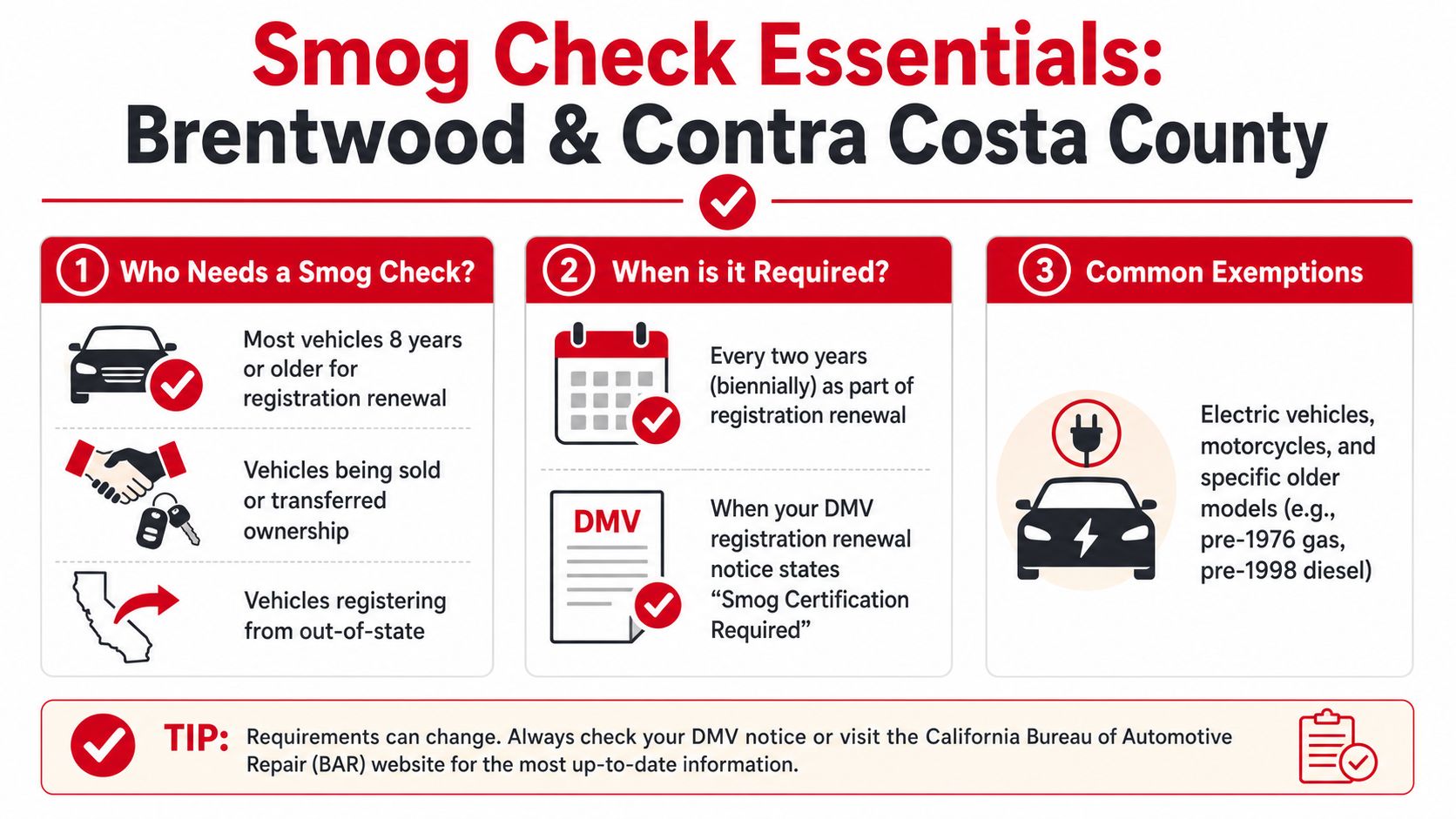
The two details that matter most are the model year and the wording on your renewal notice. Newer vehicles may fall under the temporary abatement period instead of a regular inspection. Hybrids are not automatically exempt, which surprises a lot of Brentwood owners who assume better fuel economy means no testing requirement.
Your notice is the final word. Read it before you book anything.
What trips Brentwood drivers up
The biggest mistake is timing. If you test too early and then wait too long to finish registration, you can create a second errand for yourself. If you wait until the last minute, you risk scrambling for a qualified station, especially if your notice calls for STAR service.
That is why Brentwood residents should choose a shop that can handle the requirement cleanly and fast. A STAR Test-Only smog station near Brentwood is the safer bet when you want an objective inspection without a repair sales pitch mixed into the process.
A failed test usually is not a mystery. If the check engine light is on, if the monitors are not ready after a battery disconnect, or if emissions-related software has been altered, the car can fail and you will need repairs before a valid retest.
Keep the rules simple:
- Check the DMV notice first: It tells you whether a smog check is required now and whether STAR is required.
- Do not assume a newer car always needs a test: Some newer vehicles fall into the abatement period instead.
- Do not assume a hybrid is exempt: Many hybrid owners still need biennial testing.
- Do not delay after testing: Handle registration while your certificate is still usable.
Here is the practical advice. If your renewal notice mentions smog, treat it like a deadline, not a maybe. And if you want the least frustrating option from Brentwood, make the short drive to Antioch and get it done at a station built for speed, trust, and DMV convenience in one stop.
The Advantage of a STAR Certified Test-Only Station
A lot of Brentwood drivers lose time on smog checks for one simple reason. They pick a shop that mixes testing with repair sales, then wonder whether the recommendation is really about emissions or revenue.
A STAR-certified test-only station cuts out that problem.
Why STAR matters
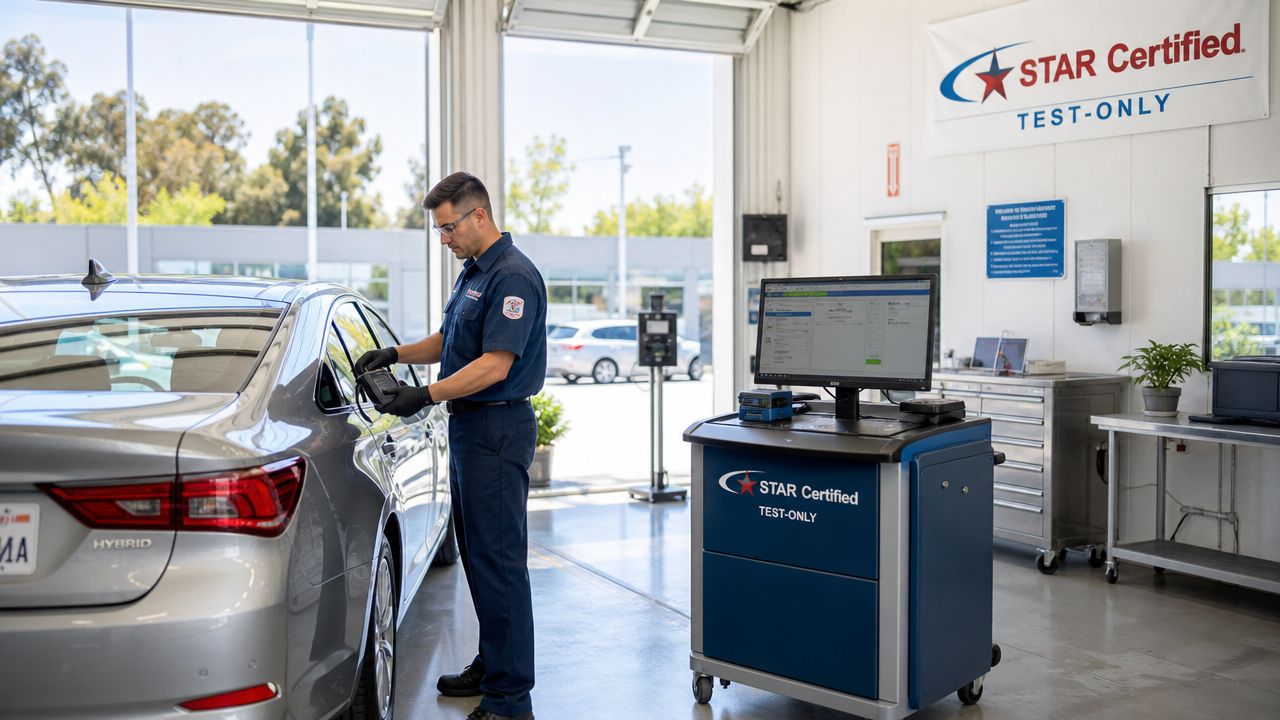
If your DMV notice calls for STAR, you need a station approved for that requirement. No guessing. No showing up at the wrong place and starting over. STAR stations are held to stricter performance standards, so the designation means something practical for drivers who need the test done right the first time.
For Brentwood residents, that matters because the biggest headache is usually not the inspection itself. It is the wasted trip.
Why Test-Only is the smarter consumer choice
Test-only is the better setup for anyone who wants a straight answer. The shop tests the car. It does not sell the repair work tied to a failed result. That removes the most common trust issue drivers have with smog checks.
Here is the main advantage:
- No repair upsell tied to the outcome. You are paying for an inspection, not walking into a sales funnel.
- Clearer incentives. A test-only station has one job. Verify whether the vehicle passes.
- Better fit for STAR-directed vehicles. If your notice specifies STAR, a test-only shop handles that requirement without adding extra noise.
This matters even more if you are busy and want the errand handled once. Brentwood drivers who choose a STAR Test-Only smog station near Brentwood usually want the same three things. Speed, trust, and no wasted motion.
That is exactly why Fire House Smog stands out. It gives Brentwood residents the objectivity of STAR Test-Only service, and it does it in nearby Antioch at a shop built to move cars through efficiently. Two bays help keep the line moving. The test-only model keeps the inspection honest. For drivers who are tired of vague answers and extra stops, that is the smarter choice.
Fire House Smog Your All-in-One Stop in Antioch
Brentwood drivers don't need another generic station list. They need a place that solves the actual problem. The problem is rarely “Where can I technically get tested?” It's “Where can I handle this quickly, avoid a hard sell, and stop the errand from turning into a DMV day?”
That's why many local drivers choose Antioch over staying strictly inside Brentwood city limits. A short drive can buy you a much smoother process.
What makes it worth the short drive from Brentwood
Fire House Smog is at 2900 Lone Tree Way in Antioch, which is an easy route for many Brentwood residents. The setup is built around throughput and convenience, not clutter. It's a STAR-certified test-only station, so the inspection side stays objective, and it also provides on-site DMV registration services.
That combination matters more than is commonly understood. If your smog check is tied to registration, handling both in one location can eliminate the extra DMV stop entirely. Fire House Smog processes California renewals, ownership transfers, and related registration tasks with on-site tag issuance during posted hours.
The hours also work for real schedules. Smog testing is available seven days a week with extended evening and weekend hours. DMV service hours are Monday through Saturday from 9:30 AM to 5:00 PM and Sunday from 12:00 PM to 4:00 PM, with some weekend services limited.
Another practical advantage is capacity. Fire House Smog has two service bays, which helps move vehicles through faster and reduces the bottleneck that slows down small one-bay shops.
If you value speed, trust, and convenience in one errand, this is the kind of setup that saves frustration.
For drivers comparing options, the local Antioch details are on the Antioch smog check page.
Fire House Smog services at a glance
| Service | Description | Availability |
|---|---|---|
| Smog inspections | STAR-certified test-only smog checks for passenger cars, SUVs, and light-duty trucks | Seven days a week |
| RV and motorhome smog | Some RVs and motorhomes accepted, subject to size and equipment limits | Call ahead |
| DMV registration renewals | On-site California renewal processing with sticker printing | During posted DMV hours |
| Ownership transfers | California and out-of-state transfer support, including plates and stickers when needed | During posted DMV hours |
| Retest support | Free retest available when required, based on site policy and coupon terms | Ask at visit |
How to Prepare for a Fast and Easy Smog Test
Your pre-visit checklist
If you want the quickest path through a smog check, do a little prep before you leave home. Most delays are preventable. They happen because drivers show up cold, missing paperwork, or at the wrong type of station.
Start with the most important item. Read your DMV renewal notice carefully. The DMV says that if the notice reads “SMOG Certification Required at a STAR station,” your vehicle must be inspected at a STAR station, and a non-STAR station cannot issue the certificate according to the California DMV smog inspections guidance.
Then handle the basics:
- Check the dashboard: If the check engine light is on, don't expect a clean test result.
- Bring the notice: It saves time and helps confirm whether your vehicle is directed to STAR.
- Warm up the vehicle: A normal drive before the test can help avoid showing up with a cold vehicle.
- Don't guess on registration paperwork: If you'll also handle DMV needs, review the required paperwork on Fire House Smog's vehicle registration documents page.
- Call ahead for unusual vehicles: RVs and larger vehicles may need a quick confirmation first.
One more point. If your notice specifically names STAR, do not roll the dice on a regular station because it's closer. That's how people lose an hour and end up starting over.
A two-minute check of the renewal notice can save a completely wasted trip.
Answers to Common Brentwood Smog Check Questions
What if my vehicle fails
A failed smog check usually means one thing. The vehicle needs repair work before it can be certified.
What you do next depends on where you tested. At a STAR Test-Only station, the shop handles the inspection and gives you a clean pass or fail result. It does not turn into a repair shop after the test. That separation is a good thing because it removes the pressure to sell repairs on the spot.
If your vehicle fails, ask for the printout, fix the issue at a qualified repair facility, and come back for the retest. Keep the process simple. Test at a place that has no reason to upsell you, then decide on repairs with a clear head.
Some drivers may also qualify for state assistance with emissions-related repairs through California's Consumer Assistance Program. The Bureau of Automotive Repair explains eligibility and program details on its Smog Check Program page.
What gross polluter and directed vehicle notices really mean
A lot of Brentwood drivers waste time.
If your renewal notice says your vehicle is directed to a STAR station, follow that instruction exactly. Do not assume any smog shop can handle it. Directed vehicles and gross polluters have stricter testing requirements, and the wrong stop can turn into a wasted trip.
The station type matters. A STAR Test-Only station can inspect directed vehicles, including vehicles flagged as gross polluters, but it does not perform emissions-related repairs. That matters because some drivers show up expecting one shop to handle everything. It will not.
Here is the practical breakdown:
- Can a Test-Only station inspect a gross polluter? Yes, if it is authorized for that inspection.
- Can a Test-Only station repair the vehicle after a fail? No.
- Are all STAR stations the same? No. Some test only. Some test and repair.
- Should you confirm the station type before you go? Yes. Do it before you leave home.
For Brentwood drivers, the smart play is straightforward. Use a nearby STAR Test-Only shop that stays in its lane, moves cars through quickly, and can also help with DMV tasks in one stop. That is why Fire House Smog stands out over generic Brentwood listings. You get objective STAR testing, on-site DMV services, and a two-bay setup in Antioch that helps keep the line moving. If your goal is less waiting, less guesswork, and no repair-sales pressure, that is the better option.
Your registration notice shows up. You open it, see that your truck needs a smog check, and the questions start right away.
Does my truck even fall under the regular program? Is this the same thing as Clean Truck Check? If it's diesel, does the weight rating change the rule? If I pass, can I finish my DMV renewal the same day, or am I headed into another line somewhere else?
Those questions are common because California doesn't treat every truck the same. Fuel type matters. Model year matters. Gross Vehicle Weight Rating (GVWR) matters. And for heavier diesel trucks, the rules often shift into a different compliance system entirely. If you own a pickup, work truck, fleet unit, or a truck you're trying to sell or register, getting the category right is the first step that saves time.
Table of Contents
- Your DMV Notice Arrived, Now What?
- Which Trucks Require a California Smog Check
- Exemptions and Special Cases for Trucks
- The Smog Test Process From Start to Finish
- Practical Tips to Pass Your Truck's Smog Check
- Your One-Stop Solution in Antioch: Fire House Smog
Your DMV Notice Arrived, Now What?
Most truck owners do the same thing first. They look at the notice, then at the truck, then back at the notice, trying to figure out whether this is a routine registration step or the start of a compliance headache.
A common example is the owner of a diesel pickup who assumes diesel means exempt. Sometimes that's wrong. Another example is the owner of a heavier commercial truck who books a standard smog check appointment, only to learn the truck belongs under a different emissions program. The problem usually isn't the inspection itself. It's identifying the right rule before you lose time.
Read the notice, then check the truck's basics
Before you schedule anything, confirm these details from your registration or door-jamb label:
- Fuel type: Gasoline, diesel, hybrid, or another alternative fuel.
- Model year: Newer trucks often follow a different path than older ones.
- GVWR: This is the dividing line that changes the rule for many diesel trucks.
- Renewal or ownership change: A sale can trigger a different smog requirement than a routine renewal.
If you're also trying to finish registration, it helps to handle the smog requirement alongside the paperwork. Fire House Smog also offers California DMV registration renewal services, which is useful when the goal is to leave with both the inspection and renewal handled in one stop.
Practical rule: Don't ask, “Does my truck need smog?” Ask, “Which California program applies to my truck?”
What usually slows people down
The biggest delays come from assumptions:
- “It's a truck, so it must work like my car.” Not always.
- “It's diesel, so I'm exempt.” Sometimes true, sometimes false.
- “If it's heavy-duty, I don't need to think about smog at all.” That can create the worst surprise of all.
If your notice arrived and your registration deadline is coming up, the fastest move is to classify the truck correctly first. Once that part is clear, the next steps become straightforward.
Which Trucks Require a California Smog Check
A customer with a diesel pickup and a customer with a diesel box truck can walk in on the same day and leave with two different answers. That usually surprises people. In California, truck smog requirements turn on three facts: fuel type, model year, and gross vehicle weight rating (GVWR).
Get those three right first, and the rest gets much easier.
For gasoline, hybrid, and many alternative-fuel trucks, the standard Smog Check program usually applies if the truck is 1976 or newer and old enough to be out of the newer-vehicle exemption period. The California Bureau of Automotive Repair explains that vehicles in the first several model years pay a smog abatement fee instead of getting a biennial inspection under the regular program, then move into the testing cycle later on, as outlined on the BAR Smog Check program page.
Diesel trucks follow a different cutoff that causes a lot of confusion. Under California rules, diesel-powered vehicles with a model year of 1998 or newer and a GVWR of 14,000 pounds or less fall into the standard biennial Smog Check requirement. The California DMV lists that light-duty diesel rule in its Smog Inspections page.
The dividing line is the part many truck owners miss. A diesel truck can be newer and still not belong in the ordinary station-based smog program if its GVWR is too high.
California Truck Smog Check Requirements 2026
| Truck Type | Smog Check Required? | Key Conditions |
|---|---|---|
| Gasoline truck | Yes, in many cases | Applies on a biennial cycle for 1976 or newer trucks once they are past the newer-vehicle exemption period |
| Hybrid truck | Yes, in many cases | Usually follows the same standard Smog Check timing as other eligible light-duty vehicles |
| Alternative-fuel truck | Yes, in many cases | Requirement depends on fuel type, age, and registration event |
| Diesel truck, 1998 or newer, 14,000 lbs GVWR or less | Yes | Must complete a biennial smog check under the standard program |
| Diesel truck over 14,000 lbs GVWR | No, not under the standard program | Usually handled outside the regular station-based Smog Check system |
| Newer eligible truck still within the exemption window | No physical test yet | Smog abatement applies instead of a physical inspection during that period |
| Truck being sold | Sometimes | Ownership transfer rules can trigger a smog requirement depending on age and fuel type |
Heavy-duty trucks are where the article title can mislead people. Some trucks do need a standard smog check at a station like Fire House Smog. Others fall under Clean Truck Check, which is a separate compliance program aimed at heavier diesel vehicles, not the regular biennial inspection most pickup owners are used to.
That distinction matters before you book an appointment. If the truck is a light-duty gasoline, hybrid, alternative-fuel, or qualifying diesel truck, a STAR-certified test-only station is the right path. If the truck is over the light-duty diesel weight threshold, the question shifts from "Do I need a smog test today?" to "Am I in the standard Smog Check program or in Clean Truck Check?"
One practical tip from the shop side: check the GVWR on the door label, not what the truck weighs today and not what you use it for. California uses the vehicle's rated classification, and that single number often decides whether you need a regular smog inspection or a different compliance route entirely.
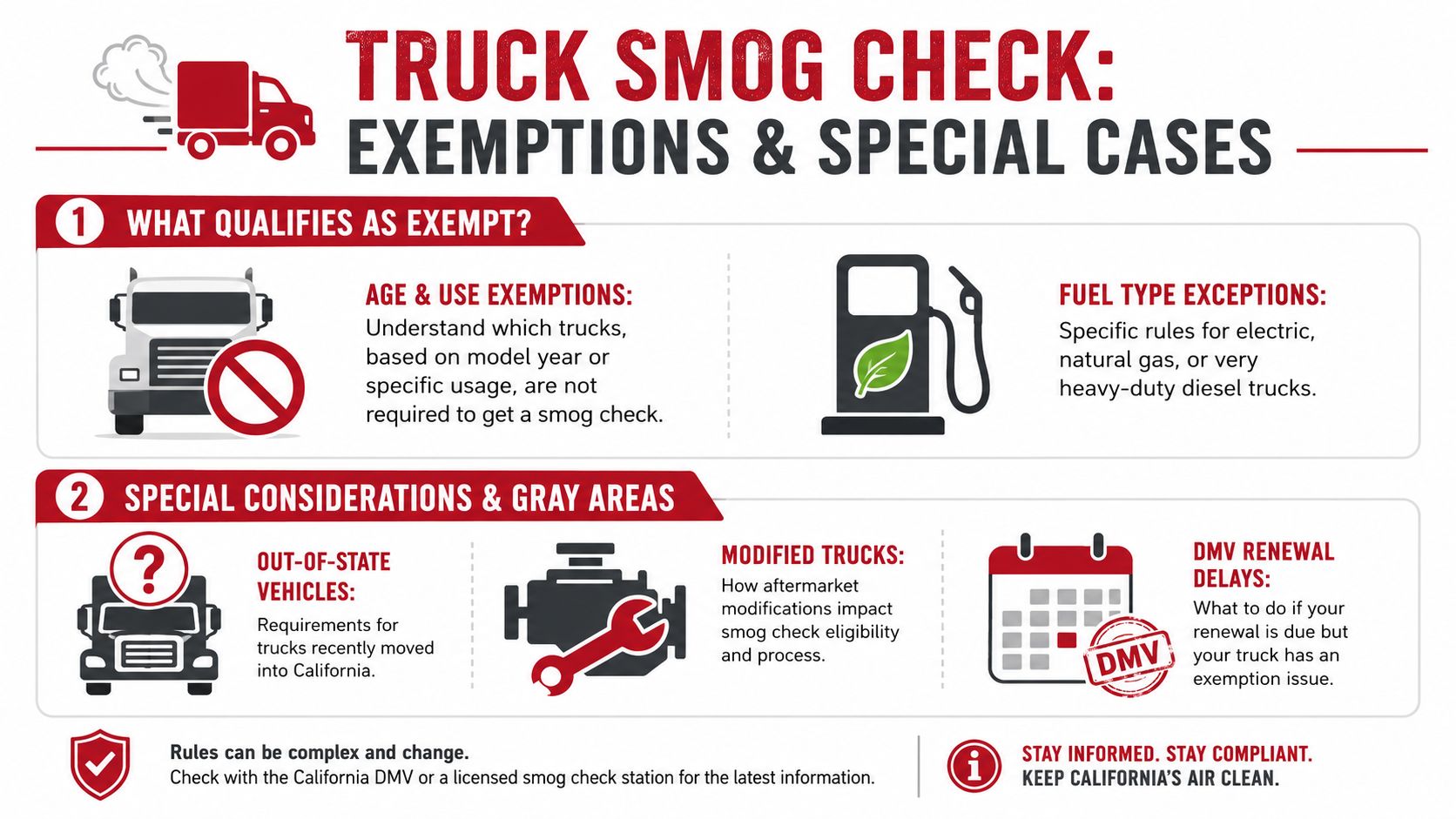
Exemptions and Special Cases for Trucks
Truck owners usually get tripped up here after they already know their weight class. The next question is whether an apparent exemption means "no test at a station" or "different compliance program entirely."
The biggest mistake truck owners make
The most common mistake is assuming a heavy truck is exempt from everything because it does not go through the standard Smog Check lane.
For trucks with a GVWR over 14,000 lbs, the regular station-based smog inspection usually is not the controlling program. As Geotab's California truck smog guide explains, heavier diesel vehicles can fall under Clean Truck Check instead, including recurring OBD compliance requirements for certain model years. That is a different process, a different schedule, and a different problem to solve than the biennial inspection a light-duty pickup owner handles at a STAR station.
From the shop side, this is the practical consequence. A customer with a half-ton or three-quarter-ton truck may only need the normal inspection path. A customer with a heavier diesel may need to verify Clean Truck Check status before booking a station visit at all. Getting that wrong wastes time and can delay registration.
Exempt from the standard smog test does not mean exempt from California emissions compliance.
Other gray areas that cause delays
Newer trucks can also confuse the schedule. Some vehicles are still in the exemption window, so the owner pays a smog abatement fee instead of doing a physical inspection. Then a DMV notice arrives later, and it looks inconsistent. Usually it is just the truck aging into the regular requirement.
Out-of-state trucks are another frequent problem. California may require separate emissions compliance steps for trucks brought in from outside the state, especially for diesel and other non-gasoline vehicles. The rule is handled through the state program, not by relying on whatever testing the previous state required, according to the California Air Resources Board Clean Truck Check program information.
A few special cases are worth checking before you head to the station:
- RVs and motorhomes: Test eligibility is only part of the issue. Physical bay clearance matters too.
- Modified trucks: Aftermarket parts, deleted equipment, or missing emissions labels can stop the inspection quickly.
- Ownership transfers: A truck that is not due for normal renewal smog can still need certification for a sale.
- Diesel work trucks near the cutoff: A small difference in GVWR can put one truck in the regular Smog Check system and another in Clean Truck Check.
This is the part many owners want clarified in plain English. Light-duty trucks usually need the familiar station process. Heavy-duty diesel trucks often follow Clean Truck Check instead. If the paperwork is unclear, a STAR-certified test-only station like Fire House Smog can tell you whether you are booking the right type of appointment before you lose a day chasing the wrong requirement.
The Smog Test Process From Start to Finish
You pull in with a DMV notice on the seat and one question in mind. Is this a quick check, or is this going to turn into a problem? For most light-duty trucks in the regular California Smog Check program, the visit is straightforward if the truck is ready and you brought the right paperwork. For heavier diesel trucks that fall under Clean Truck Check, the process is different, which is why confirming the program before the appointment saves time.
What to bring and what the technician checks
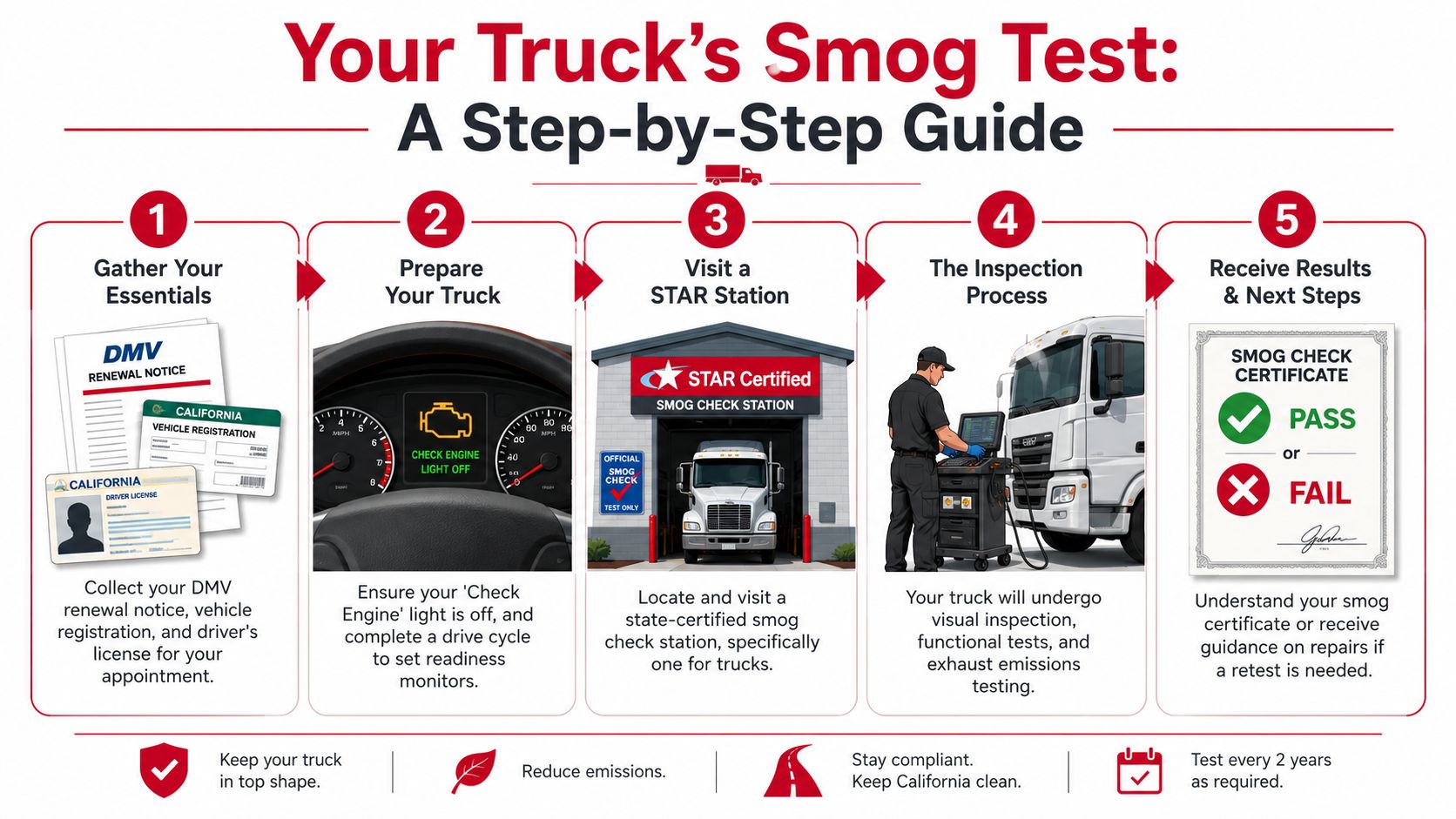
Bring your registration and the DMV notice if you received one. If you want to handle registration-related tasks at the same stop, keep your driver's license ready too. At a station like Fire House Smog, that matters because on-site DMV services can save you a second errand after the test is done.
Once the truck is checked in, the technician verifies the vehicle information, confirms the test type, and starts the inspection. For many gasoline trucks and newer light-duty models, the process centers on the emissions system status reported through the vehicle computer. Some older vehicles can still require a tailpipe portion, and every applicable vehicle gets a visual check for emissions components that are supposed to be there.
The inspection usually comes down to three parts:
Vehicle and equipment verification
The technician confirms the VIN, checks the emissions label when needed, and looks for missing, disconnected, or obviously tampered emissions parts.OBD-II and functional checks
The system is scanned for fault codes, monitor readiness, and command status related to emissions performance.Tailpipe testing when required
Older applicable trucks may still get an exhaust measurement based on the test standard for that vehicle.
If you want a clearer picture of what commonly causes a failed inspection, review these truck smog check fail reasons before you book.
A short explainer helps here:
What happens after the inspection
If the truck passes, the result is sent electronically to the state. In most cases, that clears the smog requirement tied to your registration. If the truck fails, you receive a report showing where the problem showed up, such as an active trouble code, incomplete readiness monitors, or a visual equipment issue.
That distinction matters at a test-only station. A STAR-certified test-only shop inspects the vehicle and reports the result. It does not turn the failed test into a repair sale.
Fire House Smog is a STAR-certified test-only station with two service bays, and that setup helps in a practical way. Owners can get the correct inspection for a qualifying light-duty truck, confirm whether they are dealing with standard Smog Check or a different heavy-duty requirement, and handle DMV-related tasks on site instead of piecing the process together at multiple stops.
The best appointment is the one where the truck is ready to test. Warning lights, recent battery disconnects, and visible emissions tampering still stop plenty of trucks before the paperwork is even the hard part.
Practical Tips to Pass Your Truck's Smog Check
Most smog failures are not surprises to the truck. They're surprises to the owner.
What helps before you arrive
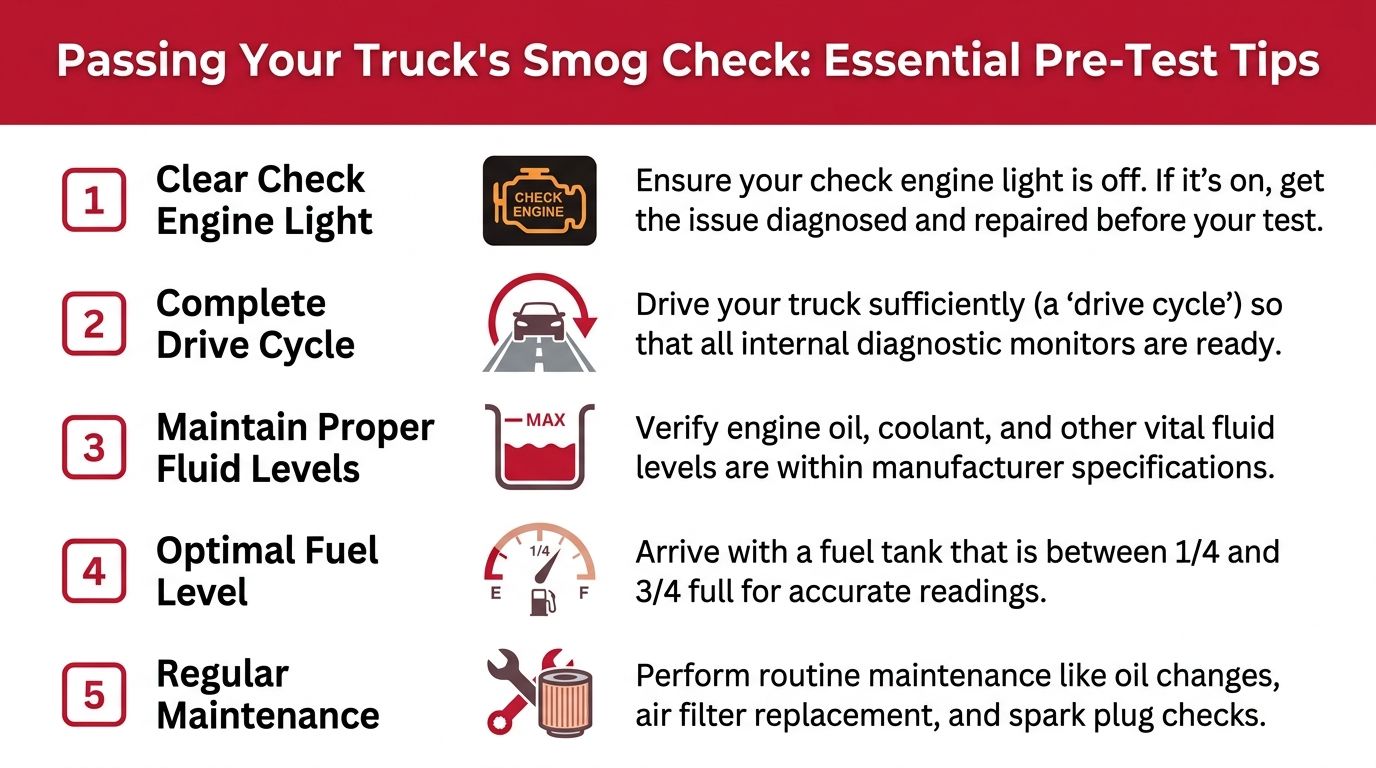
The first thing I tell customers is simple. If the Check Engine light is on, don't book the test expecting luck to save you. A lit check engine light causes an automatic failure regardless of tailpipe readings, as explained in Lytx's truck smog check guide.
That one rule changes how you should prepare.
- Handle warning lights first: A glowing MIL is a stop sign, not a maybe.
- Drive the truck before the test: A normal drive before the appointment helps the truck arrive warmed up and operating normally.
- Don't disconnect the battery right before testing: That can create readiness issues and turn a repair into a failed inspection.
- Look for obvious equipment problems: Missing caps, disconnected hoses, or visible tampering waste everyone's time.
- Stay current on routine maintenance: Dirty filters, neglected tune-up items, and unresolved drivability problems don't help.
For many owners, the most useful prep is not mechanical expertise. It's honesty. If the truck runs rough, stalls, smells rich, or has had a warning light recently cleared, it probably isn't ready.
“If you just cleared a code this morning, wait. A rushed test is usually more expensive than a delayed one.”
If you want a quick reference on common reasons vehicles fail, Fire House Smog has a page on smog check fail reasons that lines up with what technicians see every day.
If your truck fails
A fail result doesn't mean the truck is done for. It means the problem has to be corrected before certification.
What works after a failure is targeted repair. Read the failure report carefully, repair the actual issue, and then return for a retest. What doesn't work is replacing random parts and hoping one of them fixes it.
A test-only station is useful here because the inspection result stands on its own. There's no built-in incentive to turn a failed test into a repair ticket. That separation is one reason many truck owners prefer the test-only route when they want a straightforward answer.
Your One-Stop Solution in Antioch: Fire House Smog
When truck owners get frustrated, it's usually not because the inspection itself is impossible. It's because the process gets split into too many errands. One place for testing. Another for DMV work. Another call to verify whether the station can handle a truck or RV size.
That's where a local station setup matters. Fire House Smog in Antioch is a STAR-certified test-only smog station and a licensed DMV registration services provider located on Lone Tree Way. It handles smog inspections for cars, trucks, and some RVs, subject to size and equipment limits, and it processes California registration renewals, ownership transfers, and related DMV transactions with on-site tag issuance during posted hours.
For truck owners, the practical advantages are straightforward:
- Test-only model: You get the inspection without repair sales pressure.
- Two service bays: That helps move vehicles through more efficiently.
- Seven-day smog availability: Easier for working drivers and small business owners.
- On-site DMV services: Useful when your goal is to finish the compliance step and the registration step together.
- Truck-focused service mix: You can review their local Antioch smog check services before you go.
If you have a light-duty truck that needs a standard inspection, or you're sorting out a renewal and want fewer moving parts, that kind of setup can save a lot of unnecessary back-and-forth. If you have a large RV or a vehicle with unusual fitment, call first and confirm the station can accommodate it.
If your truck needs a smog check and you want to handle the inspection and DMV paperwork with less friction, contact Fire House Smog. They provide STAR-certified test-only inspections, on-site DMV services, and practical help for Antioch and East Contra Costa County drivers trying to get registration done without extra stops.

Your registration notice shows up. You glance at the line about smog certification, then start searching for a smog check in Concord, CA and immediately run into a mess of coupons, STAR listings, test-only stations, and repair shops that all sound the same.
They aren't the same.
The biggest mistake local drivers make isn't showing up with a problem car. It's choosing a station without understanding what that station can do if the car fails. In Concord and Antioch, that distinction matters a lot. A test-only station can inspect your vehicle, but it can't repair it. A test-and-repair shop can inspect and fix, but some drivers prefer test-only because there's no repair upsell tied to the result. If you know that going in, the whole process is easier.
Table of Contents
- Your DMV Smog Notice Arrived What Now
- How to Prepare Your Vehicle for a First-Time Pass
- The Smog Check Process from Start to Finish
- Passed or Failed What Are Your Next Steps
- Smart Tips to Save Time and Money in Antioch
- Frequently Asked Questions for Local Drivers
Your DMV Smog Notice Arrived What Now
You open the DMV renewal notice, see “smog certification required,” and the first question is usually the wrong one. It is not “Where's the closest shop?” It is “Do I need a test-only station or a test-and-repair station?”
That choice decides whether this is a quick stop or a two-trip problem.
California requires smog certification for many registration renewals in areas like Concord and Antioch. As outlined in AAA's California Smog Check overview, the program generally applies to many gasoline, hybrid, and alternative-fuel vehicles (1976 or newer) and diesel vehicles (1998 or newer), with some exemptions for newer gasoline models.
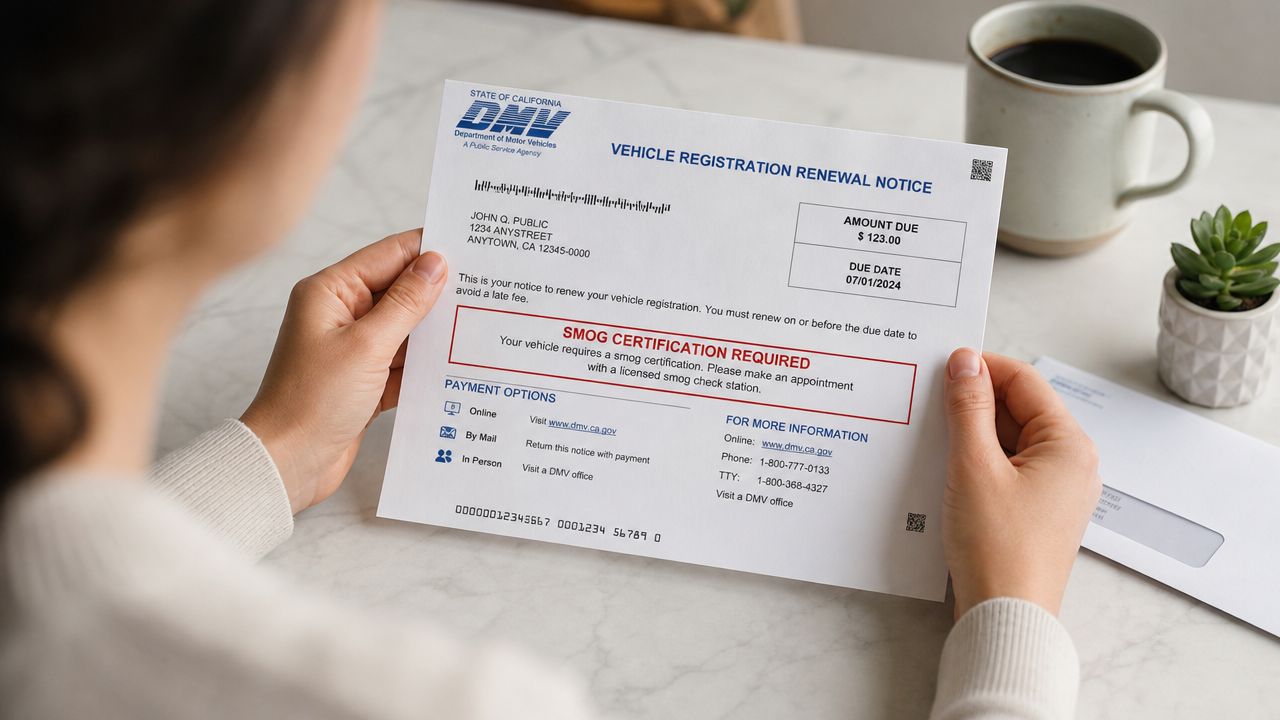
The shop type matters more than drivers expect
A test-only station inspects the vehicle and reports the result. Its function is limited to inspection.
A test-and-repair station can run the inspection, diagnose the reason for a failure, and perform the repair work.
That sounds simple, but it causes plenty of confusion locally. A driver goes to a test-only center because it is nearby or because the price looks good, then finds out too late that a failed car cannot be fixed there. At a place like a STAR test-only shop, including stations such as Fire House Smog when operating in that role, the process stops at the failed certificate. You still need another shop for repairs.
The two-step process after a failed test-only inspection
This is the part many drivers miss.
If you fail at a test-only station, the next move is not to wait around for a repair quote. You have to follow two separate steps:
- Take the failed vehicle to a test-and-repair shop or repair facility for diagnosis and emissions-related repairs.
- Return for the required retest after the repair is complete, based on the station rules and your paperwork.
That extra handoff is why test-only works well for some cars and wastes time for others. If the vehicle has been running fine, no warning lights, no recent battery disconnect, and no known drivability issues, a neutral test-only inspection can make sense. If the car has a check engine light history, runs rough, or has already failed before, going straight to a test-and-repair shop often saves a trip.
SmogTips explains how Concord test-only stations handle failed vehicles, and it matches what local drivers run into every week.
If you are also trying to finish registration on the same timeline, review the California DMV registration renewal process and paperwork steps before you go. That helps you line up the inspection, any needed repairs, and your DMV deadline without unnecessary delays.
How to Prepare Your Vehicle for a First-Time Pass
A lot of first-time failures are avoidable. The pattern I see in Concord and Antioch is usually the same. The car drives in looking fine, but the check engine light is on, the battery was disconnected last weekend, or the owner comes straight from topping off the tank.
That matters even more if you plan to test at a test-only station. If the car fails there, you are starting a two-step cleanup process instead of wrapping everything up in one place. Good prep cuts down the odds of that extra trip.
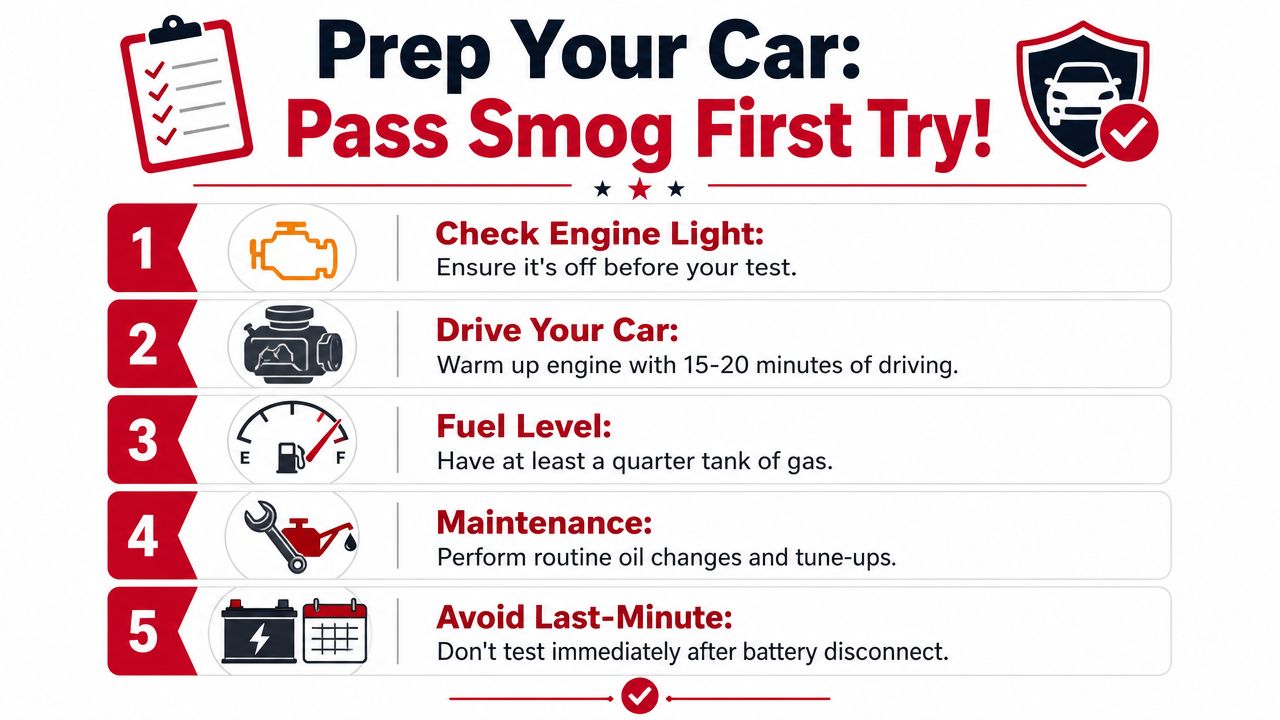
What to do before you leave home
Start with the items that cause the most preventable failures.
- Make sure the Check Engine light is off: If the light is on, wait until the problem is diagnosed and repaired before testing.
- Drive the car long enough to get fully warm: A cold engine is not ideal for inspection. Normal driving before the appointment gives the emissions system time to operate the way it should.
- Hold off after battery disconnects or code clearing: If power was recently disconnected, or someone cleared codes, the readiness monitors may not be complete yet.
- Bring your paperwork: Your renewal notice and current registration help speed up check-in.
- Check for obvious issues: A loose gas cap, overdue maintenance, rough idle, or strong fuel smell can all point to trouble you should address first.
Readiness monitors trip up more people than they expect
Modern vehicles run self-checks in the background. The smog machine looks for those monitors to show a completed status. If they are not ready, the car can fail even if it seems to run well on the road.
I tell drivers the same thing every week. Clearing codes the night before a smog appointment usually turns one problem into two. The original fault may still be there, and now the monitors are incomplete too.
If you recently repaired the car, replaced the battery, or disconnected power, give it normal driving time before your appointment. A car that feels fixed is not always a car that is ready for inspection.
Drivers who look up common smog check fail reasons in California often focus on parts like oxygen sensors or catalytic converters. That research helps, but monitor status is just as important. A repaired car still needs enough normal driving to prove those systems are working.
Fuel level matters too
This catches people off guard.
Your tank should not be near empty, and it should not be filled to the brim right before the test. On some vehicles, the EVAP monitor will stay incomplete if the fuel level is outside the range the system wants to see.
A good middle-ground tank level makes life easier. If you are planning to test at a test-only shop, that small detail can save you from failing for a preventable reason and having to leave for repairs, then come back later for the next step.
The Smog Check Process from Start to Finish
You pull into a Concord smog shop on your lunch break, expecting a quick yes or no. The part that catches drivers off guard is that the process depends on what kind of station you chose. At a test-only shop, the technician can inspect and report. If the car fails, that shop does not do the repair, so your next step is separate.
For most passenger vehicles, the visit itself is fairly quick if the car is ready and the paperwork lines up. The usual flow is check-in, vehicle identification, equipment hookup, inspection, and results.
What the technician checks
California smog inspections generally include three parts, as explained in Geotab's California smog check guide: a visual inspection, an OBD system check, and the required emissions test for that vehicle.
| Part of test | What happens |
|---|---|
| Visual inspection | The tech checks that required emissions parts are present and appear correct for the vehicle, including items like the catalytic converter and other related equipment where required. |
| OBD check | The inspection machine communicates with the car's computer to look for stored trouble codes, a check engine light command, and monitor readiness status. |
| Emissions measurement | Depending on the vehicle, the station performs the appropriate tailpipe or diesel smoke procedure required by the state program. |
In the bay, the order is pretty simple. The technician verifies the VIN and plate information, connects the testing equipment, and confirms the car matches the record the state expects to see. After that, the machine walks the tech through the required test steps for that model year and fuel type.
The test-only detail many drivers miss
This matters more than people expect in Concord and Antioch.
A test-only station can tell you whether the vehicle passed. It can also show you why it failed. It cannot switch over and fix the issue if the shop is licensed only for testing. That is the point many drivers miss, and it is why a failed visit at a place like Fire House Smog can turn into a two-step process instead of a one-stop errand.
The first step is the inspection and failure report. The second step is taking that report to a licensed repair shop, fixing the cause, then returning for a retest at the appropriate station. If you want to see how a local in-and-out test-only smog center operates, that overview helps set expectations before you arrive.
Where delays usually happen
The slowdowns are usually not dramatic mechanical problems. They are often process problems.
A car may fail because the computer shows a fault code, the monitors are not ready, or an emissions component is missing or modified. I see plenty of vehicles that drive fine but still stop the test because the OBD side is not lined up with state requirements. That is especially frustrating at a test-only station, because the answer is immediate but the fix has to happen somewhere else.
One common example is an incomplete EVAP monitor. The driver leaves with a failed test, books a repair shop, then learns the issue may be monitor status rather than a bad part. That is why reading the failure printout closely saves time. It tells you whether you are chasing a hardware problem, a readiness problem, or both.
After the paperwork and initial setup, this short video gives a good visual feel for the inspection environment:
Most modern cars pass or fail based on a short list of things. The emissions equipment has to be present, the computer has to be ready, and the system cannot be reporting an active fault.
Passed or Failed What Are Your Next Steps
You pull into a test-only station, the car runs fine, and then the printer hands you a fail sheet. That is the moment a lot of Concord and Antioch drivers lose time, not because the problem is huge, but because they are unclear on what happens next.
The next step depends on one thing. Did you test at a test-only station, or at a test-and-repair shop? That distinction matters more than people expect.
If your car passes
A pass is simple. The station files the certificate electronically with the DMV, and the certificate fee is added to the inspection price.
You usually do not need to carry proof around for registration purposes. Still, keep your paperwork. If there is ever a DMV timing issue or a question about a recent repair, that printout saves a phone call and sometimes a second trip.
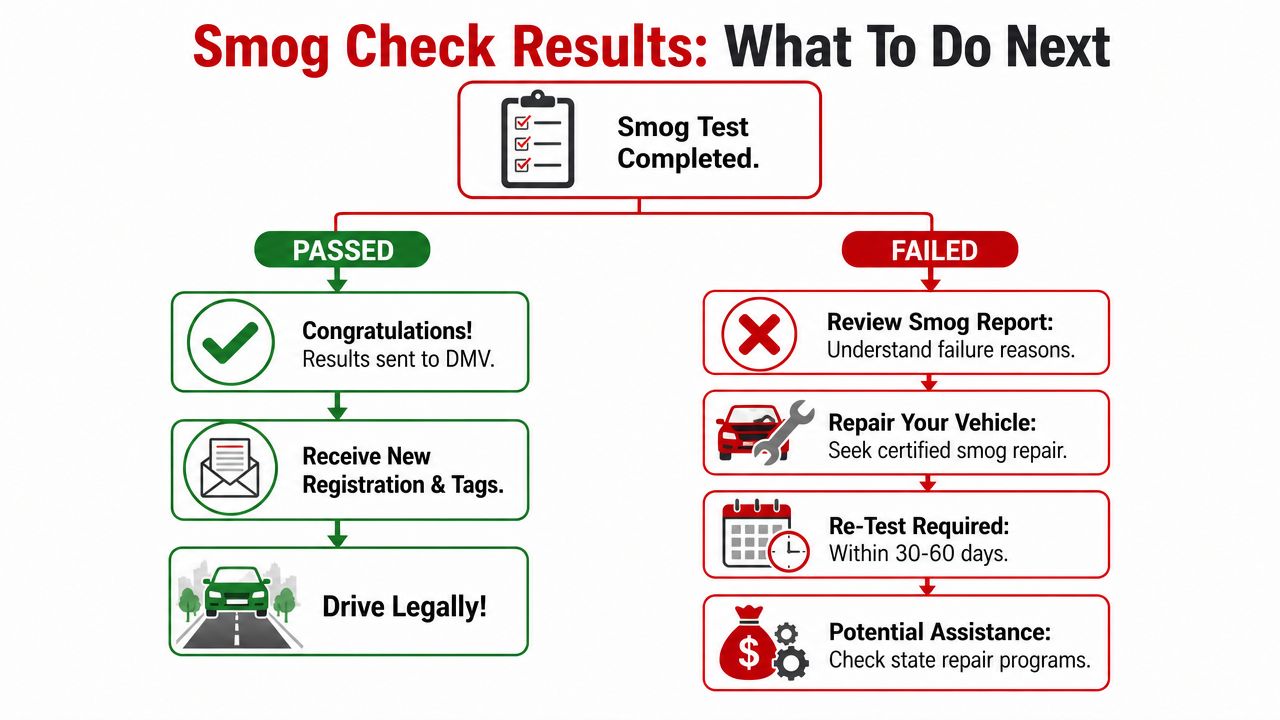
After a passing test, do these three things:
- Finish your registration: Once the DMV has the pass on file, you can complete renewal.
- Keep the inspection receipt: Store it with your registration papers.
- Make a note for next time: Smog checks usually come back on a two-year cycle for vehicles that require them.
If your car fails at a test-only station
This is where station type really matters.
A test-only station can inspect the car and give you the failure report. It cannot fix the car. A test-and-repair shop can diagnose the issue, repair it, and then handle the retest. If you fail at a place like Fire House Smog, you are starting a two-step process, not a one-stop visit.
Here is the exact sequence to follow after a fail at a test-only center:
- Take the failure report with you. Do not rely on memory or a verbal summary.
- Bring the car to a licensed repair shop that handles smog-related diagnosis and repair.
- Have the shop repair the failed item or items listed on the report.
- Ask whether the repair reset any readiness monitors. If it did, the car may need a drive cycle before it can pass.
- Return for the retest once the repair shop says the vehicle is ready.
That fourth step is the one drivers miss all the time. The car may be fixed but still not ready to test if the onboard monitors have not completed. That creates the frustrating “repaired but still not passable today” situation.
A free retest usually means the station waives the second inspection fee under its policy. It does not cover diagnosis or repair work done somewhere else.
What a failure usually means
A failed smog check does not automatically mean an expensive repair. In my experience, the causes range from minor to costly, and the paperwork usually points you in the right direction if you read it closely.
Common reasons include:
- Stored trouble codes
- Readiness monitors not set
- EVAP system problems
- Faulty oxygen sensors
- Catalytic converter problems
- Missing or modified emissions equipment
- Simple issues such as a loose or incorrect gas cap
Older vehicles usually have a narrower margin for passing, especially if they have high mileage or overdue maintenance. Newer cars more often fail because of check engine light history, monitor status, or recent battery disconnects.
What to ask the repair shop before you leave the keys
A good repair visit starts with the right questions. Hand the shop the fail report and be direct.
Ask:
- What exact line on the report caused the failure?
- Are you repairing a bad part, or are we dealing with monitor readiness?
- Will this repair clear codes and reset monitors?
- How much driving is needed before I come back for a retest?
- Do you see anything else likely to stop the next test?
That last question can save you a second repair bill. A careful shop will often spot a weak battery, aftermarket part, or pending fault that has not turned into a full failure yet.
The short version is simple. If you pass, finish registration. If you fail at a test-only station, repair first, then retest. Once drivers understand that split between test-only and test-and-repair, the whole process gets a lot less confusing.
Smart Tips to Save Time and Money in Antioch
The cheapest smog check isn't always the least expensive day. A low advertised price doesn't help if you make multiple trips, miss work, or sit in a DMV line afterward.
For a typical 2000+ gasoline vehicle in Concord, the inspection usually runs $49.75 to $59.75 plus the $8.25 state certificate fee, and the visit is commonly finished in 20 to 30 minutes at a STAR-certified station, based on Concord-area smog pricing and turnaround details. That gives you a realistic baseline when you compare offers.
Where drivers waste time
A few habits create most of the hassle:
- Chasing the lowest coupon without checking station type: If you choose test-only without realizing what happens after a fail, the cheap coupon can turn into extra driving and delay.
- Going at the wrong time of day: If your schedule is tight, look for extended evening or weekend availability.
- Separating smog and DMV errands: Two stops means more waiting, more parking, and more chances something slips.
What works better
I'd prioritize convenience over headline price when the difference is small.
Look for a location that can handle the smog inspection and, if you pass, process your registration renewal on-site. That's a significant time saver for East Contra Costa drivers. You avoid a second trip and skip the usual DMV-office routine.
A practical shopping checklist looks like this:
| What to compare | Why it matters |
|---|---|
| Station type | Determines whether repairs can happen on-site after a fail. |
| Hours | Evening and weekend access helps working drivers. |
| Vehicle fit | Important if you have a truck, van, or RV. |
| DMV services | Lets you wrap up registration in one stop after a pass. |
The smoothest smog visit is the one that doesn't turn into three separate errands.
Frequently Asked Questions for Local Drivers
Do out-of-state vehicles need a California smog inspection
If you're bringing in an out-of-state vehicle for California registration, check the registration requirements before you show up. The smog requirement depends on the vehicle and registration situation, and the cleanest path is to confirm the paperwork first so you don't make an unnecessary trip.
I have a heavy diesel truck. Is that a regular smog check
Not always. A recent regulatory change affects diesel vehicles over 14,000 GVWR, model year 2014 and newer. Those vehicles fall under Clean Truck Check, which is a separate compliance requirement and not the same as a standard smog test, according to this Clean Truck Check summary for local diesel owners.
Are all diesel appointments the same
No. This is a common pitfall for fleet owners. A shop advertising diesel testing may still not be the right provider for a heavy-duty vehicle that needs Clean Truck Check compliance instead of a standard passenger-vehicle style inspection.
If you want a straightforward option for East Contra Costa drivers, Fire House Smog is a STAR-certified test-only station in Antioch that also offers on-site DMV registration services. It's a good fit if you want an unbiased inspection, quick turnaround, and the ability to handle registration in the same stop after a passing result.

Your renewal notice shows up, and your eyes go straight to the line that means one more errand, one more fee, and one more chance to get caught by fine print. If the notice says you need a smog check, you're probably already searching for a Smog Test Only Discount and wondering which coupon is real, which one hides extra charges, and whether “free retest” means free.
That confusion is normal. Most drivers don't need a long lecture on emissions rules. They need practical help figuring out how to pay less, avoid coupon traps, and get through the test without a second surprise at the counter. If you're in Antioch, that usually means understanding how test-only pricing works, what terms matter, and how to use a discount at an Antioch smog check station without overcomplicating it.
Table of Contents
- That DMV Notice Just Arrived Now What
- Why Test-Only Stations Offer Better Discounts
- How to Find Legitimate Smog Test Coupons
- Decoding the Fine Print on Your Coupon
- Using Your Discount at Fire House Smog in Antioch
- Frequently Asked Questions About Smog Discounts
That DMV Notice Just Arrived Now What
The handling of that DMV envelope typically follows a familiar routine. The recipient opens it, scans for the due date, then stops when the smog requirement appears. The next thought is usually simple. How much is this going to cost?
In Antioch, the smart move isn't to call the first shop you remember. It's to check whether your notice points you toward a test-only requirement and then look for a coupon that applies to that category. That's where people save money without getting dragged into unclear pricing.
A common mistake is treating every smog station like it works the same way. It doesn't. If your renewal specifically pushes you toward a test-only path, the right discount can lower the inspection cost and keep the transaction cleaner because the station isn't trying to sell repairs on the back end.
The best time to read coupon terms is before you start the car, not when you're standing at the counter with your registration due.
Why Test-Only Stations Offer Better Discounts
A test-only coupon usually gives you a cleaner deal because the station is selling one thing: the inspection.
That matters. A shop that also does repairs has two revenue paths on the same visit. A test-only station does not. California separates those roles for a reason, and that separation helps the price stay easier to read. If the shop cannot turn a failed test into repair work, the coupon has less room to function as a low-price teaser.
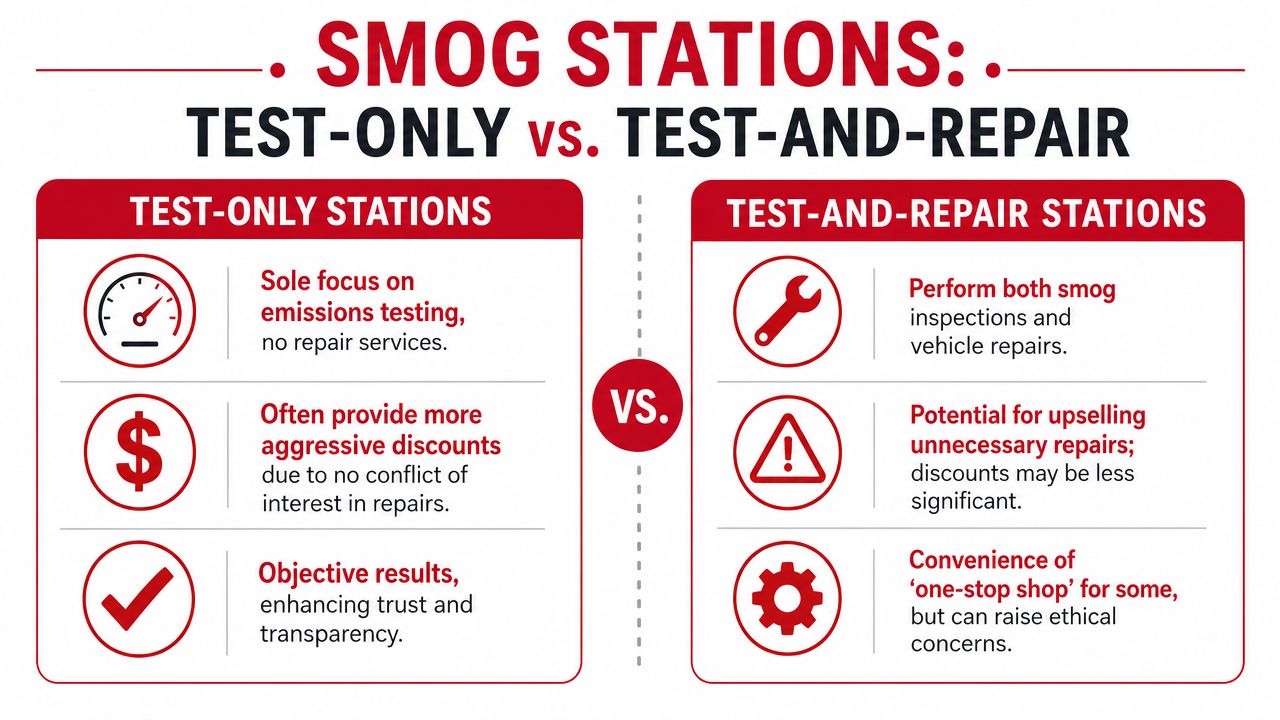
Why the pricing is easier to compare
At a test-only station, the questions are narrower. Does the coupon cover your vehicle class? Is the certificate fee included or separate? If the car fails, do you get a free retest, a discounted retest, or no retest break at all?
That last point gets missed all the time. Two coupons can show the same headline price and still have very different value once you read the retest terms. One shop may offer a free retest within a short window. Another may require you to pay again if you leave and come back after repairs. If you are comparing discounts seriously, the retest policy belongs near the top of the list, not buried at the bottom.
Here's the practical difference:
| Station type | What it does | What to check before you book |
|---|---|---|
| Test-only | Performs the inspection only | Coupon scope, certificate fee, retest terms, excluded vehicle types |
| Test-and-repair | Performs the inspection and may offer repairs | Intro price, repair upsell risk, whether the low test price depends on later work |
Drivers in Antioch can use that difference to their advantage. A straightforward test-only coupon is easier to compare across shops because you are judging the inspection terms, not trying to guess how the shop makes the numbers work on the back end.
The fine print is where the real discount lives
The best discounts are not always the loudest ones. I've seen plenty of smog offers with a strong top-line price and weak terms underneath. The useful coupon is the one that stays useful after you check the exclusions.
Look closely for details like these:
- whether the price applies to STAR or test-only vehicles
- whether trucks, older model years, or specialty vehicles are excluded
- whether the quoted price already includes the state certificate
- whether a free retest is limited to a certain number of days
- whether the station accepts another local discount on top of the posted coupon
That last one is rarely advertised clearly, but it is worth asking about. Some stations will not stack anything. Others may allow a coupon plus a small in-shop discount, especially if the terms do not conflict. The only way to know is to ask before the test starts.
Practical rule: Judge a smog coupon by the total out-the-door terms and the retest policy, not just the first number in bold.
Test-only stations do not automatically have the cheapest offer in every case. They do tend to give drivers a more honest comparison. For anyone trying to keep a renewal simple and avoid surprise costs, that is usually the better bargain.
How to Find Legitimate Smog Test Coupons
Good smog coupons aren't hard to find. Good smog coupons with clear terms are harder. That's the distinction that matters.
Start with the station's own website, because that's where you're most likely to see current offers and any restrictions tied to that location. If you're checking East Contra Costa County options, one place to look is this STAR smog test coupon page. Station-run coupon pages are usually more reliable than old directory listings or reposted screenshots that stay online long after the deal changes.
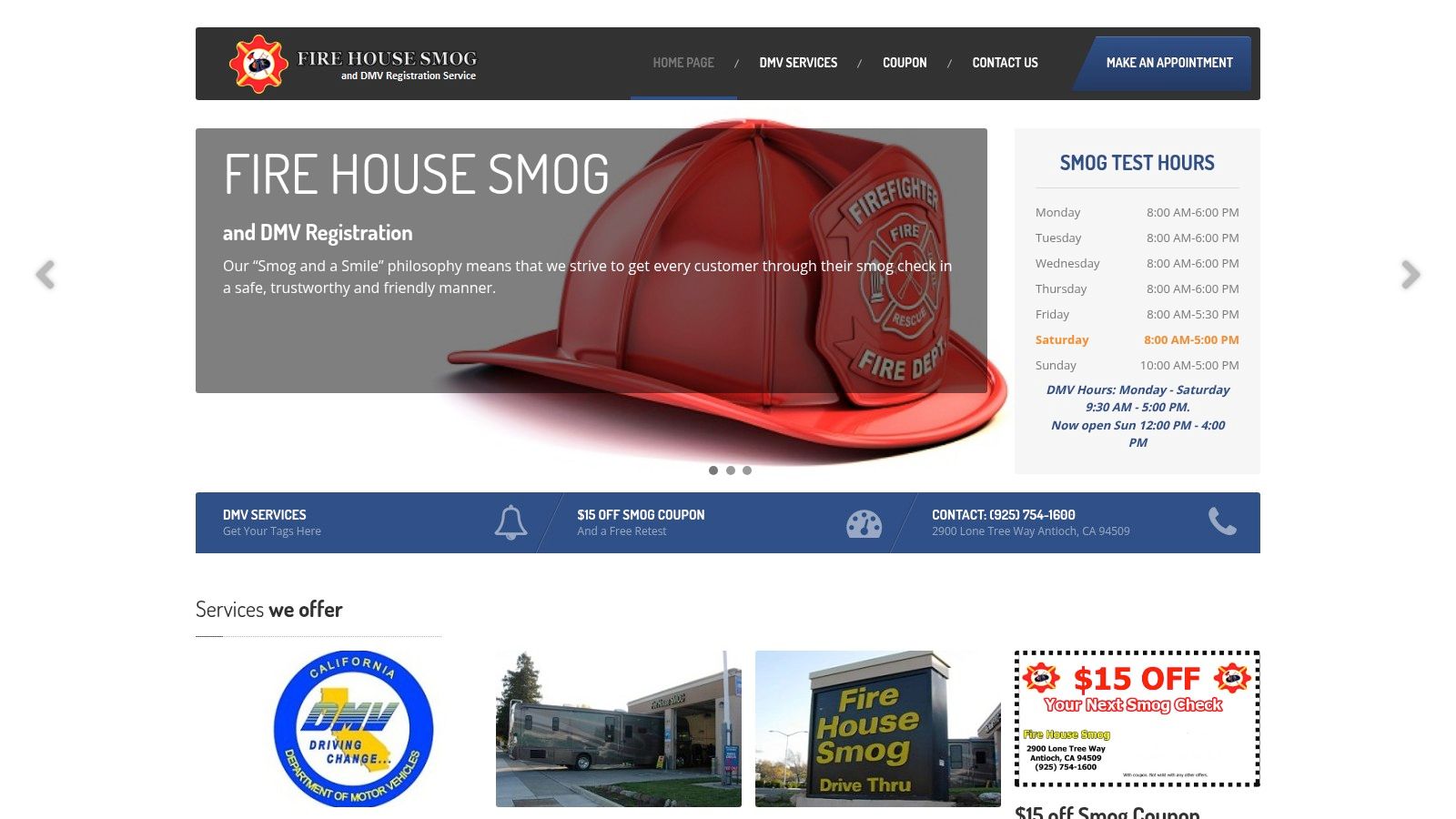
Where coupons usually show up
Drivers tend to find valid offers in a few repeat places:
- Station websites: Best for current terms, especially if the business updates coupons directly.
- Local mailers: Useful if you keep the flyer and check the expiration date.
- Deal platforms: Helpful for comparing discounts, but the listing description may be shorter than the actual in-shop terms.
- Google search results and map listings: Good for discovery, not always good for details.
One benchmark helps filter nonsense from reality. Some California test-only centers advertise deals like a $39.75 smog check, which is lower than a typical $45 to $70 range for model year 2000 and newer vehicles in major markets, and the fixed $8.25 certificate fee is a state pass-through rather than a markup item, as explained in STAR Smog Center's pricing FAQ. That tells you two things. First, real discounts exist. Second, the advertised special may apply only to the base inspection charge.
A quick screening method
When I look at a smog coupon, I don't start with the discount amount. I start with the exclusions.
Use this checklist before you commit:
- Check the vehicle category. Sedans, SUVs, trucks, vans, diesel vehicles, and some RVs may not all price the same.
- Look for “plus certificate” wording. If it appears, the advertised coupon price probably doesn't include the state certificate fee.
- Confirm station type. A test-only discount should be used at a test-only location, especially if your DMV paperwork points you that way.
- Read the expiration date. Old coupon pages waste time.
- Call if your vehicle isn't standard. Larger vehicles and specialty setups often have separate terms.
If the coupon headline is large and the restrictions are tiny, assume the restrictions matter more than the headline.
The people who overpay usually don't miss the coupon. They miss the terms attached to it.
Decoding the Fine Print on Your Coupon
Most smog coupon confusion comes from three phrases: free retest, certificate extra, and some vehicles excluded. None of those are harmless filler. Each one can change the final bill.
The tricky part is that drivers often read coupons as promises, while stations write them as limited offers. That gap is where frustration starts. A coupon can still be legitimate and still apply only to a narrow slice of vehicles or situations.
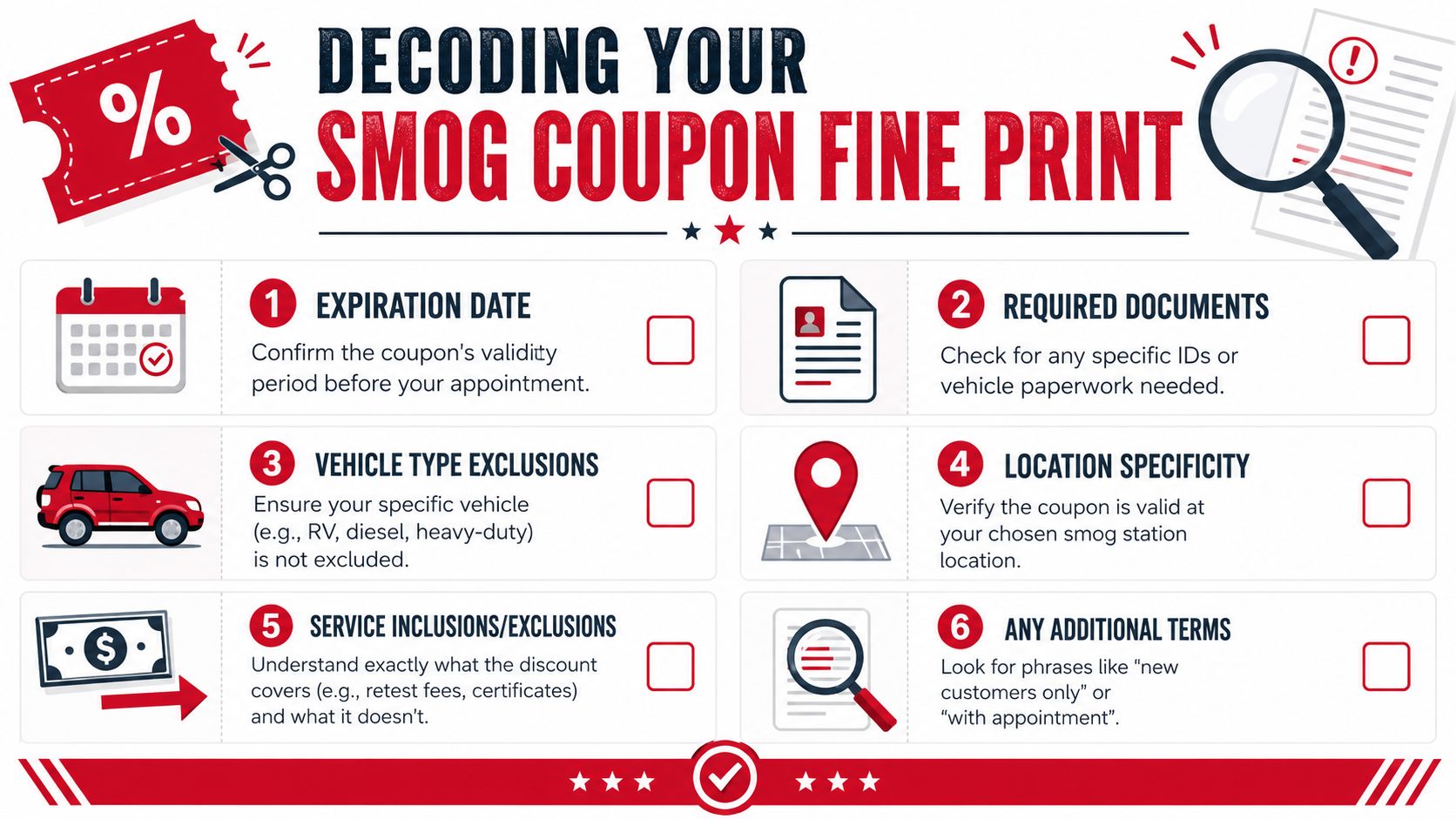
What free retest usually means
A lot of people assume “free retest” means unlimited second chances after any change they make to the car. That's where coupon language gets expensive.
Existing coverage often misses an important point. Test-only stations like Fire House Smog may offer free retests only if the vehicle fails due to emissions equipment issues, not if the owner installs new parts mid-test, according to Crown Smog Check's explanation of retest limits. If a guide online says “free retest” without defining the condition, it's incomplete.
Before you hand over the keys, ask one direct question: “Under what exact condition does the free retest apply?”
That single sentence clears up more confusion than the coupon itself.
Terms that deserve a slow read
Some coupon restrictions matter more than others:
- Vehicle exclusions: Trucks, vans, diesel vehicles, and certain RVs may fall outside the headline offer.
- Included charges: The coupon may reduce the inspection price but not include every fee shown at checkout.
- Appointment requirements: Some offers only apply if you mention the coupon when you arrive or book ahead.
- Customer type restrictions: A few specials apply only to new customers or one vehicle per visit.
Here's a simple way to read the offer:
| Coupon phrase | What it usually signals |
|---|---|
| Free retest | A narrow policy, not a blanket promise |
| Plus certificate | The state certificate fee is separate |
| Most vehicles | Your vehicle may fall outside the advertised price |
| STAR / test-only | The offer may be tied to a specific inspection type |
What drivers should ask before approving the test
If you want the fast version, ask these at check-in:
- “Is this coupon valid for my exact vehicle?”
- “Does the posted price include the certificate fee or not?”
- “What voids the free retest?”
That's enough to separate a real bargain from a misunderstanding.
Using Your Discount at Fire House Smog in Antioch
If you're planning to use a coupon locally, the smoothest approach is to arrive with the offer ready on your phone or printed out, confirm it applies before the test starts, and clarify the retest terms at the counter. That avoids the awkward version of the visit where the car is already in the bay and the pricing conversation starts too late.
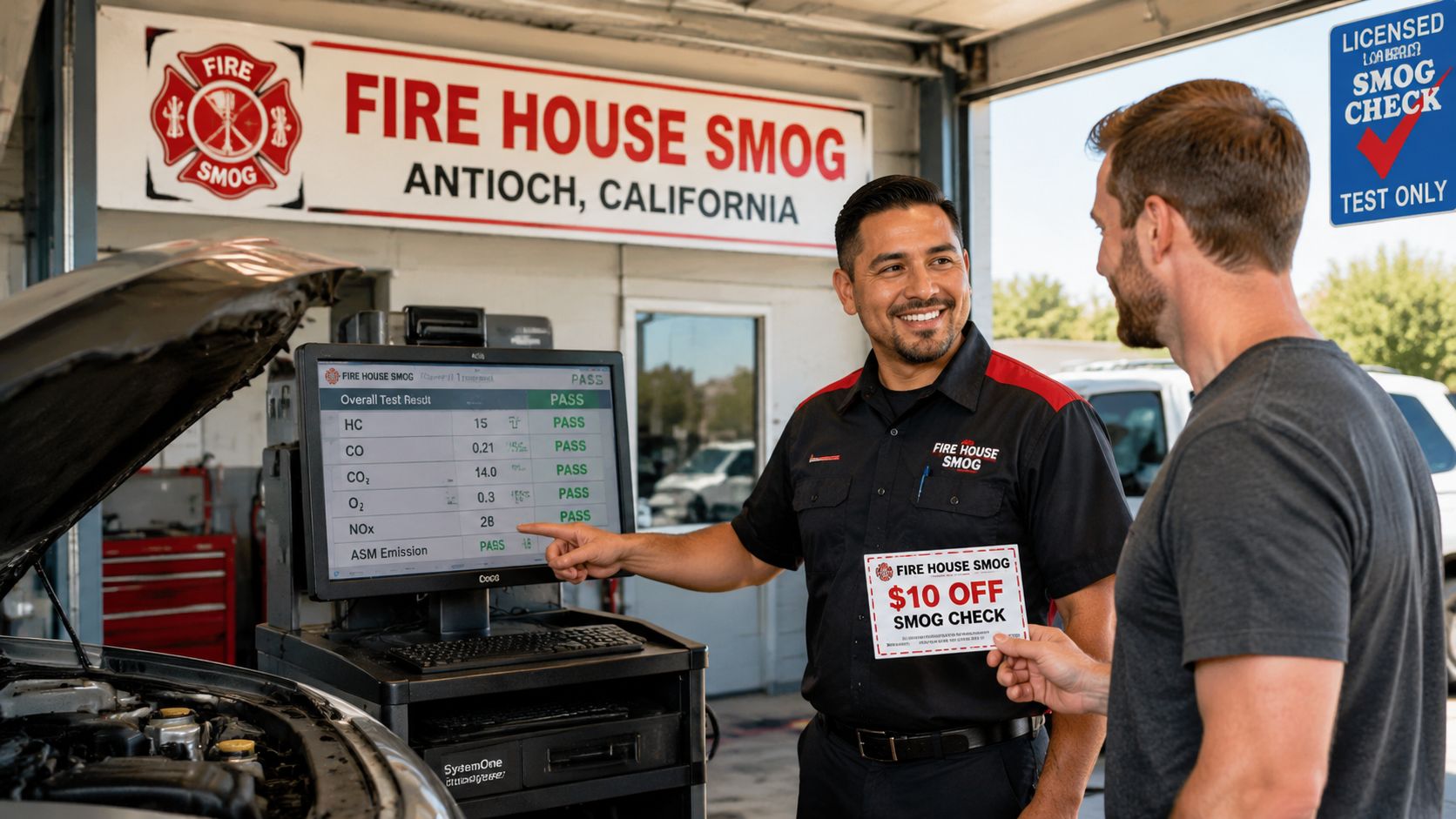
What the visit usually looks like
At Fire House Smog's in-out test-only center, the process is straightforward if you come prepared. Bring the vehicle, your renewal-related paperwork if you have it handy, and the coupon you intend to use. Since it's a STAR-certified test-only operation, the main point is inspection and certification, not repair sales.
The station operates with two service bays and offers smog testing seven days a week with extended evening and weekend hours, which helps if you're trying to fit a required inspection around work or family logistics. For DMV-related services, posted hours are Monday through Saturday 9:30 AM to 5:00 PM and Sunday 12:00 PM to 4:00 PM, with limited services possible on weekends. That matters if you want to pair the smog visit with registration help on site.
Why checking your coupon first saves time
Low-price smog offers work because the station keeps the process efficient. Industry guidance points to First Pass Rate as a key benchmark, and the average passing rate in high-traffic areas is about 88%, according to Diamond Certified's smog check guide. Shops offering discounted inspections have to keep equipment calibrated and workflow tight, because repeat tests eat into already thin margins.
That's why you don't want any avoidable delays at check-in. If your vehicle is a nonstandard fit, has unusual equipment, or you're relying on a free retest clause, ask before the test begins.
A short explainer can also help if you want to see how the process generally works:
Best way to use the discount without friction
Use a simple sequence:
- Show the coupon first. Don't wait until payment.
- State your vehicle type clearly. Sedan pricing often differs from larger vehicles.
- Ask about the retest condition. Especially important if the offer mentions one.
- Confirm whether DMV service is needed after the inspection. That can save a second trip.
- Keep the paperwork until registration is finished. It's easier than trying to reconstruct the visit later.
A coupon works best when it changes only one variable, the inspection price, and leaves no uncertainty about the rest.
Frequently Asked Questions About Smog Discounts
Can you combine a senior or military discount with another coupon
Sometimes a shop allows it. Sometimes the coupon language blocks it.
What matters is the station's posted policy, not a statewide rule that says every discount has to stand alone. BAR pricing rules focus on clear fee disclosure, especially the certificate fee. They do not force a shop to stack offers. That is why the smartest move is to ask one direct question before the test starts: “Can you apply this coupon with my senior or military discount on the same transaction?”
At Fire House Smog, ask that at check-in, not after the inspection is finished. That is when misunderstandings usually start.
What if your vehicle is sent to a test-only station and then fails badly
A hard fail changes the math.
You still get the benefit of a shop that only tests and does not sell you repairs on the spot. But if the car comes back with a Gross Polluter result or another serious failure, the discount on the inspection is no longer the main issue. Time, repair planning, and retest rules matter more. In some cases, owners may qualify for repair assistance through California's consumer assistance program, but that is a separate process and not something a test-only station handles during the same visit.
The practical takeaway is simple. If your coupon advertises a free retest, read the limit closely. Some offers cover only a return visit within a short window and only after repairs are completed elsewhere.
Does a STAR requirement automatically mean the smog check will cost more
No. STAR status by itself does not set the price.
The final cost usually comes down to the base rate, your vehicle category, whether the coupon excludes certain model years or larger vehicles, and whether the certificate fee is already included in the ad. A regular station and a STAR station can both run fair pricing. The difference is in the details printed under the headline price.
How long is the certificate good for
A smog certificate is valid for 90 days, according to Smog Check Deals' California smog discount overview.
That window matters more than drivers think. Test too early, then wait on registration or repairs, and you may end up paying for another inspection.
Is every free retest offer worth chasing
No. “Free retest” sounds better than it often is.
Some coupons only include the retest if you return within a tight deadline. Some exclude Gross Polluter results. Some apply only if the initial failure was close, or only if no parts had to be replaced. Others are valid only for the original vehicle category listed on the coupon. Those limits are not always obvious in the ad itself.
The useful coupon is the one with terms you can explain in one sentence. If the retest policy sounds vague on the phone, expect friction at the counter.
If you want a local option that handles STAR-certified test-only smog inspections and DMV-related services in one place, check Fire House Smog. Review the current coupon terms before you go, confirm how the retest policy applies to your vehicle, and bring the offer with you at check-in so the discount is settled up front.
You open the DMV renewal notice, see the smog requirement, and immediately start doing math in your head. Is the old car going to pass. Is this going to turn into a repair bill. Did that battery disconnect last month just create a new problem.
That anxiety is common, especially when the vehicle is older but still runs fine day to day. Plenty of owners assume a car that drives well will breeze through the test, then get blindsided by an emissions failure, a readiness issue, or a rule they thought didn't apply to “classic” vehicles.
A smog check for older cars in California gets easier once you separate rumor from rule and prep the car for the test it will receive. The practical side matters just as much as the legal side. A warm engine, a complete drive cycle, and choosing the right testing path can save a lot of wasted time and unnecessary repair work.
Table of Contents
- That DMV Notice Arrived What Now
- California Smog Rules for Older Cars Explained
- Preparing Your Vintage Car for Its Smog Check
- The STAR Test Process for Pre-2000 Vehicles
- What to Do If Your Older Car Fails the Smog Check
- Your Antioch Smog Check Partner Fire House Smog
- Frequently Asked Questions About Older Car Smog Checks
- Do I need a smog check to sell an older car
- Can historic plates make my car exempt
- How long is a smog certificate valid
- What is the difference between test-only and test-and-repair
- Do all older cars get the same kind of smog test
- What is the best last-minute thing I can do before the appointment
- If my older car fails, do I have any options besides paying for repairs right away
- If my exempt older vehicle doesn't need biennial smog, can I ignore emissions equipment
That DMV Notice Arrived What Now
Most owners go through the same sequence. First comes denial. “This thing's old, but it's maintained.” Then comes the internet search spiral. One site says older cars are exempt. Another says they're not. A friend swears special plates fix the problem. None of that helps when registration is due.
The first thing to do is slow down and identify what kind of “older car” you have under California rules. A seventies car sits in a very different category than a late nineties sedan. An older diesel follows different rules than an older gasoline car. A transfer of ownership can trigger a requirement even when a routine renewal might not.
That's where people lose money. They approve repairs before confirming the actual requirement, or they go into a test with a cold engine, stale oil, or recently cleared codes and turn a manageable situation into a failure.
Practical rule: Treat the smog check like a specific inspection procedure, not a general judgment on whether your car is “good” or “bad.”
Older vehicles can still pass cleanly. The ones that struggle usually have one of three problems. The owner misunderstood the rule, the car wasn't prepared for the test conditions, or the first failure was handled poorly.
If you're holding that notice right now, the path is straightforward. Confirm whether the car is required to test, prepare it like an older vehicle instead of a modern one, understand what the station is going to do, and know your options if the first result isn't what you wanted. That approach keeps the process calm and keeps you from paying for work you may not need.
California Smog Rules for Older Cars Explained
A lot of confusion starts with one bad assumption. Owners hear “older car” and assume California treats every older vehicle the same. It doesn't.
The exemption line that matters most
For gasoline vehicles, the cutoff is simple. 1975 and older are exempt from the biennial smog check. 1976 and newer usually are not. That is why owners of late seventies, eighties, and nineties cars get caught off guard. The car may feel vintage, but under California registration rules it is still in the testing program, as reflected in California's current classic car smog rule coverage.
Fuel type changes the answer too. Many diesel vehicles follow a different year cutoff, and weight matters. Electric vehicles and motorcycles are outside the regular smog check program. Hybrids are not automatically exempt just because they are partly electric.
That distinction matters at the counter and at the test station. I have seen owners spend money chasing tune-up parts before confirming whether the car needed a test, or what kind of test applied.
A quick reference table
| Vehicle Type | Model Year | Smog Check Required? |
|---|---|---|
| Gasoline | 1975 and older | No for biennial smog requirement |
| Gasoline | 1976 and newer | Yes |
| Hybrid | 1976 and newer threshold applies within the biennial program | Yes |
| Diesel under 14,000 lbs | 1997 and older | No |
| Diesel under 14,000 lbs | 1998 and newer | Yes |
| Electric | Any model year | No |
| Motorcycle | Any model year | No |
Special situations owners miss
Registration event matters almost as much as model year.
A car can be old enough to confuse people and still avoid a regular renewal test for a period of time if it is relatively newer by DMV standards. California uses a smog abatement fee for many vehicles in their first several model years instead of requiring a physical inspection at renewal. That exception does not usually help with first-time California registration from out of state. It also does not erase smog requirements that come up during certain ownership transfers.
Here is the practical version owners should remember:
- Out-of-state vehicles: A vehicle brought into California can need a smog check even if a similar in-state renewal would not.
- Private-party sales: Smog requirements often come up at transfer, and timing can become a problem if the seller waits too long.
- Certificate timing: A passing certificate only stays usable for a limited window, so test too early and you may have to do it again.
- Late renewals: Waiting on the DMV notice does not pause penalties.
The other rule older-car owners need to know is less obvious. A vehicle can be exempt from biennial testing and still be expected to keep its original emissions equipment in place. Removing or disabling required components can still create problems under the California Smog Check Program overview.
That is where standard advice falls short. The rulebook tells you whether the car needs a test. It does not tell you how to avoid an unnecessary failure. On older cars, that usually comes down to test timing, a proper drive cycle so monitors can set, and knowing when a Smog Referee is the better option than arguing with a regular station about an engine change, label issue, or equipment question. Those are the details that save owners money.
Preparing Your Vintage Car for Its Smog Check
A smog check for older cars usually goes better when the owner focuses on simple prep, not panic repairs. Start with the basics that affect how the car runs on test day. Older engines are less forgiving than newer ones, and small issues that seem harmless in normal driving can show up during emissions testing.
What to check before you leave home
Use this as a practical pre-test checklist:
- Engine temperature: Don't show up with a cold engine. Drive long enough for full operating temperature so the catalytic converter and sensors are doing their job.
- Check Engine light: If the light is on, deal with that first. Clearing codes right before the test often creates a new problem because monitors may not be ready yet.
- Oil condition: If the oil is very dirty or overdue, change it before the test. Old oil can contribute to a rough-running engine.
- Tire pressure: Inflate tires to the correct specification. That helps the car behave normally during testing conditions.
- Fluid levels: Check and top off the basics. You want the engine operating steadily, not compensating for avoidable maintenance issues.
- Battery history: If the battery was recently disconnected or replaced, assume the car may need extra driving before it's fully test-ready.
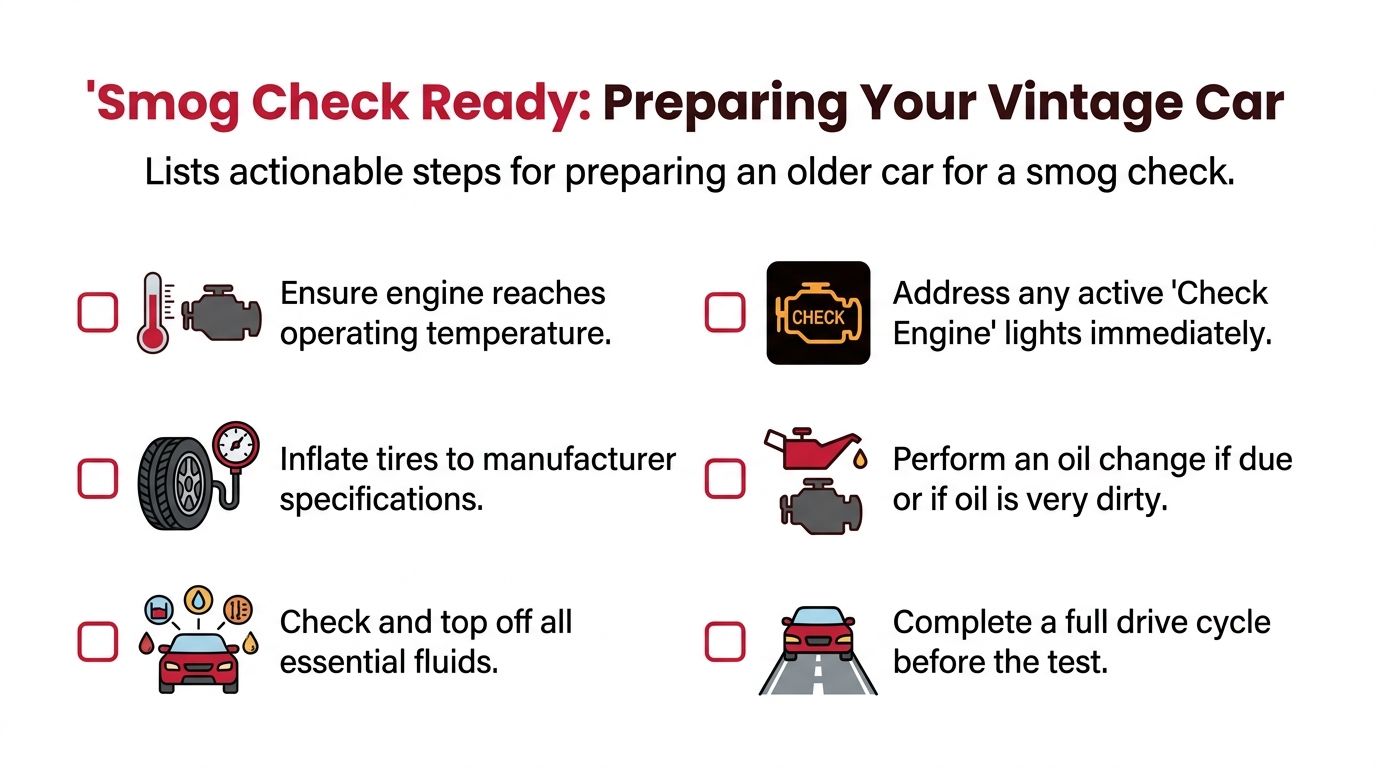
Why the pre-test drive cycle helps
One of the most overlooked tricks is the pre-test drive cycle. Reddit users and experienced owners report that driving a specific 30-mile route, usually a mix of highway and city driving, can help prime the O2 sensors and catalytic converter, especially on 1995 to 2000 vehicles that struggle after battery disconnections, according to this owner discussion about the 30-mile drive cycle.
That advice lines up with what older-car owners see in real life. A car can feel fine and still not be ready for inspection if the monitors haven't settled back in after power loss or recent code clearing. The drive cycle gives the system time to run its checks under normal conditions.
Here's what tends to work better than random short trips:
- Start with the car fully warmed up.
- Drive a mix of steady-speed road time and stop-and-go sections.
- Avoid idling in a parking lot and calling it “warm.”
- Don't disconnect the battery again before the test.
“If you just cleared codes, don't rush straight to the station. Give the car a real drive first.”
What doesn't work is guessing. Spraying fuel additives into the tank at the last minute, clearing codes on the way over, or showing up after the car sat for days usually creates more trouble than it solves. Older cars reward steady prep, not shortcuts.
The STAR Test Process for Pre-2000 Vehicles
Older cars make people nervous partly because they expect a mysterious process. It isn't mysterious once you know what lane your vehicle falls into.
What BAR-97 means in plain English
Vehicles built in 1999 and older use the BAR-97 test rather than the newer OBD-II style process used for later vehicles. That older test uses tailpipe emissions sampling and analog diagnostic equipment, and it checks what's coming out of the exhaust instead of relying mainly on the car's onboard reporting, as described in this overview of California's BAR-97 testing for older vehicles.
For owners, the practical takeaway is simple. Mechanical condition matters a lot more on these vehicles. Tune, vacuum integrity, catalytic converter health, and basic engine operation have a direct effect on the result.
The same source notes that BAR-97 testing measures HC, CO, and NOx at the tailpipe, and the inspection window for these vehicles is longer than for newer cars. That's one reason older-car smog appointments can feel more involved.
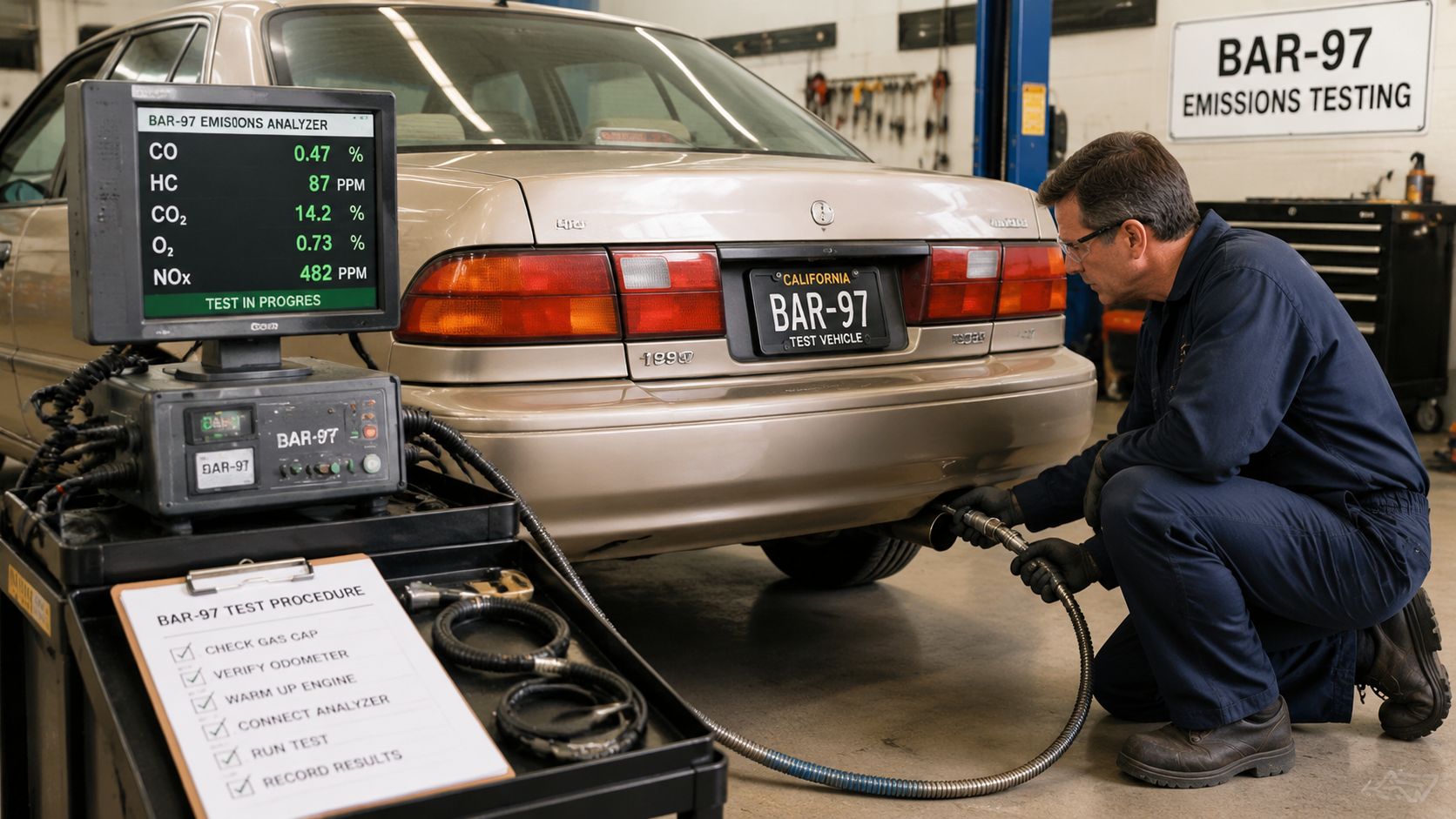
Why station type matters
If your notice requires a STAR station, pay attention to that requirement. Don't assume every shop handles the same vehicles in the same way.
For older vehicles, many owners prefer a test-only setup because the incentives are cleaner. The shop is there to inspect, not to fail the car and immediately sell a repair package. If you need a STAR inspection, a STAR smog test-only station in Antioch gives you that narrower, more impartial role.
That matters most when the car is borderline or has already had work done elsewhere. You want an accurate result first. Then, if repairs are needed, you can make a calm decision instead of reacting under pressure.
What to Do If Your Older Car Fails the Smog Check
A failed result doesn't always mean the car needs a major repair. It means you need to read the failure correctly before spending money.
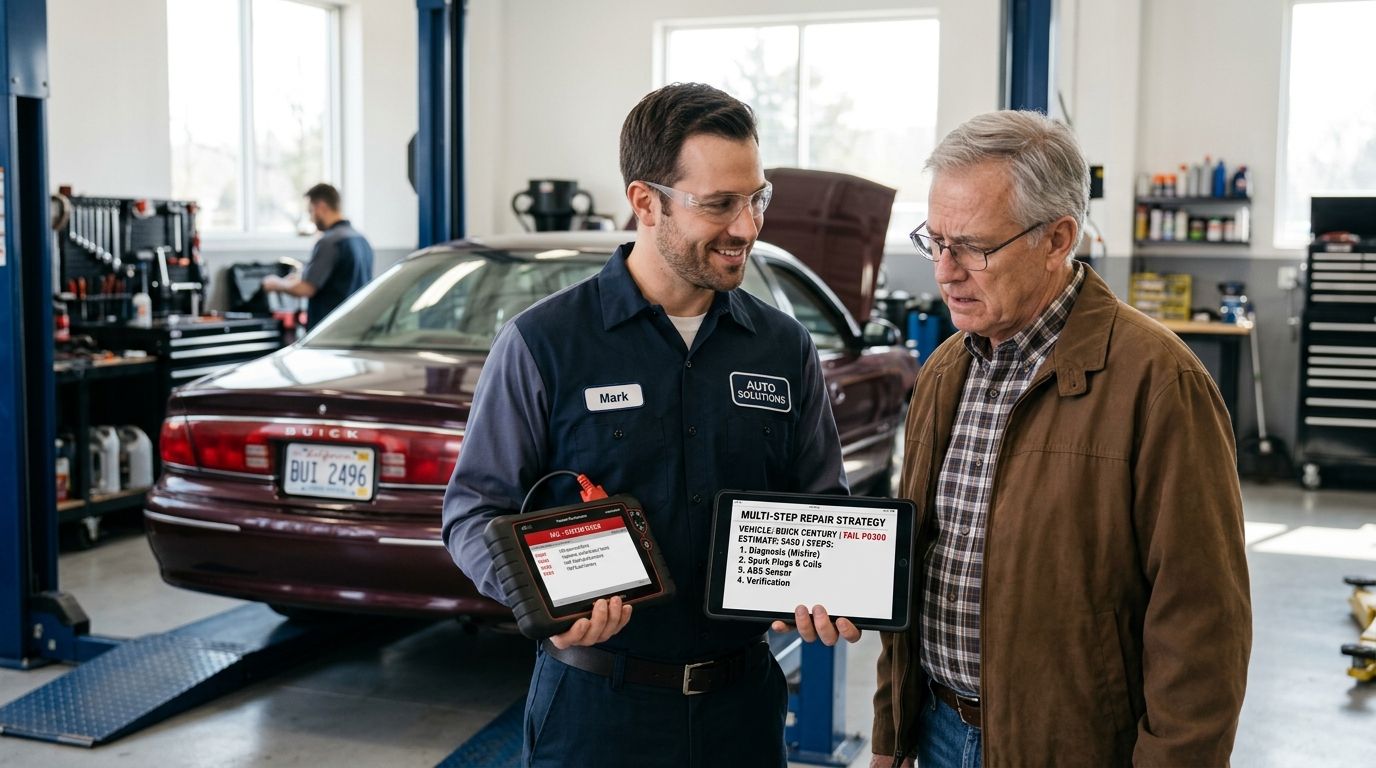
Read the failure before approving repairs
There's a big difference between a true emissions problem and a procedural issue. A car might fail because of actual tailpipe output, a readiness problem, missing or altered equipment, or something that points to a narrow fault rather than a full system rebuild.
Start with this sequence:
- Get the exact reason in writing: Don't leave with a vague memory of what the technician said.
- Match the failure to recent events: Battery disconnect, code clearing, long storage, or recent engine work can all matter.
- Avoid one-shot repair decisions: On older cars, replacing parts by guesswork gets expensive fast.
- Ask about retest policy: Some stations offer a free retest under coupon or posted policy terms, which can make a second attempt much easier after a targeted fix.
If you want a clearer sense of what usually trips cars up, this guide to common smog check fail reasons is a useful starting point.
Common mistake: Owners hear “fail” and approve everything suggested in the first five minutes. That's how small emissions problems turn into large invoices.
When to use the Smog Check Referee
Some older cars don't fit cleanly into standard advice. Collector vehicles, modified vehicles, and stubborn repeat failures are where owners should think about a second opinion.
The Smog Check Referee Program offers a free, independent technical review to determine whether the failure reflects a genuine emissions problem or a testing issue, and in some cases it may waive the repair requirement, according to the BAR Referee review process for smog check results.
That option is more valuable than most owners realize. If the car has an unusual setup, a long repair history, or a result that doesn't match how the vehicle is equipped, the referee path can keep you from chasing the wrong fix.
A short explainer helps if you haven't seen the process before.
Use the referee route when the failure feels questionable, not as a substitute for obvious maintenance. If the catalytic converter is damaged, vacuum lines are disconnected, or the engine is running poorly, that still has to be addressed. But when the case is murky, a second opinion can be the smartest move.
Your Antioch Smog Check Partner Fire House Smog
For local drivers, convenience matters almost as much as the technical side. Older cars don't love unnecessary trips, long waits, or being bounced between the test station and the DMV.
Why the setup is useful for older vehicles
Fire House Smog is a STAR-certified test-only station and licensed DMV registration provider in Antioch. The test-only model is useful for owners who want an inspection without repair upselling, and the station's two-bay setup helps keep vehicles moving instead of stacking up in a single line.
The location also handles California DMV renewals, ownership transfers, and related registration tasks with on-site tag issuance during posted hours. That's a practical advantage when you've already done the hard part and just want the paperwork finished.
Local details that make the process easier
The shop is located at 2900 Lone Tree Way, Antioch, CA 94509, and you can reach it at 925-754-1600. Smog testing is available seven days a week, with extended weekday and weekend availability, and DMV services run Monday through Saturday from 9:30 AM to 5:00 PM and Sunday from 12:00 PM to 4:00 PM.
For Antioch and East Contra Costa County drivers, that combination solves a real problem. You don't have to line up one place for a test and another for registration handling if both are needed.
If you want station details before heading over, the Antioch smog check service page lays out the local service options clearly.
Frequently Asked Questions About Older Car Smog Checks
Do I need a smog check to sell an older car
In many private-party sales, yes. If the car is outside California's newer-vehicle transfer exemption, the seller usually needs to provide a passing smog certificate before the title changes hands.
The practical mistake is testing too early. Smog certificates expire, and older cars can drift out of tune if they sit, so line up the inspection close enough to the sale that you are not paying for the same test twice.
Can historic plates make my car exempt
Historic or collector plates do not automatically remove the smog requirement.
What matters is the vehicle's year, fuel type, and how California classifies it. I have seen owners show up convinced the plate solves everything, then lose time because the car still falls into a test-required category. Check the actual exemption status first, not the badge on the plate.
How long is a smog certificate valid
A smog certificate is valid for 90 days.
That window matters more than owners expect. If you are selling the car, finishing registration late, or waiting on DMV paperwork, watch the calendar. Once the certificate expires, the state can require a fresh test.
What is the difference between test-only and test-and-repair
A test-only station inspects the car and reports the result. A test-and-repair shop can inspect it and sell the repair work.
For an older car, test-only often gives you a cleaner starting point. You get the numbers without having to make a repair decision on the spot. If the car fails, you can compare repair options, ask better questions, and decide whether a regular shop, marque specialist, or Smog Referee makes the most sense.
Do all older cars get the same kind of smog test
No. A pre-2000 car does not move through the program the same way a newer OBD-II vehicle does, and diesel rules are different again.
That is why advice from a neighbor with a different model year can send you in the wrong direction. The right prep depends on the engine management system, the emissions label under the hood, and whether the car needs a STAR station.
What is the best last-minute thing I can do before the appointment
Give the car a proper warm-up drive.
For many older vehicles, a short freeway run followed by normal city driving helps more than any fuel additive poured in the tank the night before. The goal is to get the engine fully hot, stabilize idle quality, and, on cars that track readiness, complete enough of the drive cycle for the monitors to set. If the battery was disconnected recently or repairs were just done, do not assume a quick trip around the block is enough.
If my older car fails, do I have any options besides paying for repairs right away
Yes. Start by reading the failure printout carefully. High hydrocarbons, high carbon monoxide, and a functional failure do not point to the same problem, and treating them like they do is how owners waste money.
If the car has a hard-to-find configuration, an engine swap question, or a dispute over required equipment, the California Smog Referee program can be the right next step. It is also useful when standard shop advice is not lining up with what the car is.
If my exempt older vehicle doesn't need biennial smog, can I ignore emissions equipment
No. Exempt from routine testing does not mean free to remove emissions parts.
That catches owners during a later sale, a referee inspection, or any situation where the car is checked for required equipment. Keeping the emissions system intact is usually cheaper than trying to put a half-modified older car back to stock under deadline pressure.
If you want a straightforward smog check for older cars in East Contra Costa County, Fire House Smog offers STAR-certified test-only inspections, DMV registration help, and seven-day availability at 2900 Lone Tree Way in Antioch. Call first if you've got an unusual vehicle or RV, and bring the DMV notice so the visit goes faster.

That renewal notice shows up at the worst time. You're already juggling work, errands, and family stuff, and now you need a smog check before registration gets held up. Most drivers in Antioch want the same thing: use a good STAR smog test coupon, get in and out without drama, and avoid wasting half a day at the DMV.
There's a smarter way to handle it. Get the smog check done, use the coupon correctly, and if the location also handles registration services, finish the paperwork in the same stop instead of making a second trip. That combo is what saves the most time in practice.
Table of Contents
- Your Smog Test Solution in Antioch
- Locating and Using Your Smog Coupon
- Preparing for Your Smog Check Appointment
- The STAR Test Process and Free Retest Policy
- Combine Your Smog and DMV Services to Save Time
- Frequently Asked Questions About Smog Testing
Your Smog Test Solution in Antioch
In Antioch, the practical goal isn't just passing a smog test. It's finishing the whole registration chore with the fewest stops, the least waiting, and no surprise costs. If your DMV notice says you need a STAR station, that detail matters. Since certain vehicles are directed to these higher-performing stations under California's STAR Program, you need the right shop, not just the closest one. The Bureau of Automotive Repair says the program was created by Assembly Bill 2289, and certified stations must meet a minimum First Pass Rate score of 0.40 to qualify as STAR stations (BAR STAR program FAQ).
For local drivers, the easier move is to look for a station that handles the inspection side efficiently and sits where access is simple. If you're checking local options, the Antioch smog check service page is a useful place to confirm location details and service fit before you leave home.
Practical rule: If your renewal notice mentions STAR, don't gamble on a regular station first. Start at a STAR location and skip the avoidable detour.
The time savings come from planning the visit as one errand, not two. Have your notice ready, bring your coupon, and think ahead about whether you can also take care of your registration on-site after the vehicle passes. That's the piece many people miss.
Locating and Using Your Smog Coupon
A good coupon only helps if you know exactly what it covers. The easiest mistake is seeing a discount banner, showing up, and then finding out your vehicle type or model year has different pricing. Spend a minute reading the offer before you drive over.
Where to find the deal
The coupon is usually posted right on the business website or discount page. If you want to check an active offer, the smog test-only discount page is the logical place to start.
When you pull up a coupon, look for these details before you rely on it:
- Vehicle coverage: Some offers apply broadly to passenger cars, SUVs, and light-duty trucks, while larger or specialty vehicles may have separate terms.
- Test type: Make sure the offer applies to the inspection you need, especially if your renewal directs you to a STAR station.
- Retest language: A coupon that includes a free retest can matter a lot more than a slightly larger front-end discount.
- Business hours: This becomes important if you want to pair the smog visit with registration services on the same trip.
How to read the fine print without getting tripped up
A lot of drivers assume a STAR smog test coupon won't save much because STAR testing must cost more. That's the myth. The better way to think about the bill is to separate the state fee from the shop's base test fee.
The clearest published explanation is that the $8.25 certificate fee is a state-mandated pass-through charge that shops can't mark up, and the only variable is the base test fee, which varies by location rather than by STAR status (California smog coupon pricing explanation). That's why a coupon at a STAR station can be a real discount, not a gimmick.
Here's the quick version:
| Cost piece | What controls it | What to know |
|---|---|---|
| Certificate fee | State rule | The $8.25 fee is fixed and passed through |
| Base test fee | Shop/location | This is where coupons actually help |
| Repair costs | Separate issue | Test-only stations don't fold repair sales into the visit |
That last point is important. A test-only setup keeps the inspection separate from repair work, which is usually what people want when they're trying to avoid pressure and keep the visit straightforward.
If you're comparing coupons, don't just chase the biggest number in bold. Check whether the offer includes a retest and whether the station can also help you finish registration the same day.
Preparing for Your Smog Check Appointment
You pull into a STAR station with your coupon buried in email, your renewal notice still on the kitchen counter, and no idea whether you can finish registration there too. That is how a quick Antioch errand turns into two trips. A little prep fixes that.
Bring the right items
Have your DMV renewal notice ready if one was mailed to you. Bring your current registration if you have it, keep the coupon open on your phone before you park, and carry a payment method you know the station accepts.
If your plan is the combo play, smog test plus on-site DMV service, confirm that before you leave home. Ask whether they can process your registration right after a passing test and whether they need any extra paperwork. That one phone call can save you a trip across town and a long wait at the DMV office.
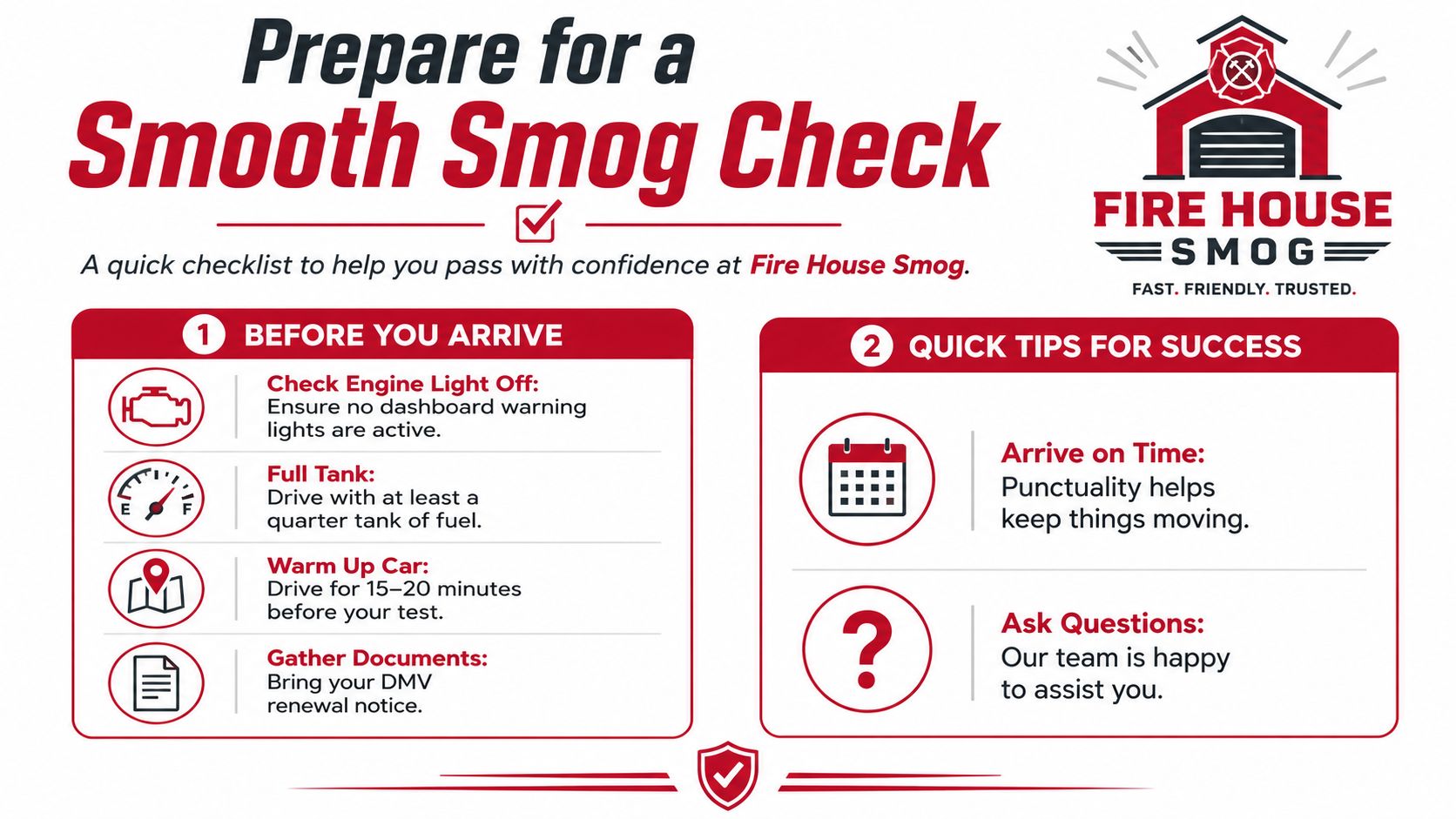
Drivers with RVs, motorhomes, or other larger vehicles should call ahead for another reason. Bay size and equipment limits vary by station, and it is much better to learn that on the phone than in the parking lot.
A simple checklist keeps the visit clean:
- Renewal notice ready
- Current registration if available
- Coupon already pulled up
- Payment method ready
- Quick call ahead for oversized vehicles
- Ask if on-site DMV registration is available the same visit
Simple prep that helps
Start with the obvious one. If the Check Engine light is on, deal with that before you schedule the test. Showing up anyway usually wastes the coupon and your time.
Drive the car for a bit before the appointment if you can. A warmed-up vehicle tends to be easier to process than one that came straight out of an overnight cold start. Keep a normal amount of fuel in the tank too, since arriving on fumes creates avoidable problems.
Timing matters more than people expect. The Bureau of Automotive Repair advises drivers to set aside enough time for the inspection and paperwork, and Antioch stations can get backed up during lunch hours, after work, and near registration deadlines (California BAR Smog Check program overview). If you want to test and finish DMV paperwork in one stop, give yourself a little cushion instead of trying to squeeze it into the last 20 minutes of the day.
Here is the practical version I give neighbors:
- Drive the car before the visit
- Do not show up with the Check Engine light on
- Keep fuel at a reasonable level
- Have the coupon open before you arrive
- Bring the paperwork needed to finish registration if the station offers DMV services
That last step is the one many articles miss. The primary time-saver is not just shaving a few dollars off the STAR test with a coupon. It is walking out with the smog done and the registration handled on the same stop.
The STAR Test Process and Free Retest Policy
A common Antioch mistake is treating the STAR test like the hard part and the paperwork like a separate problem. The better approach is to handle the inspection with a station that can also help you finish registration, especially if your coupon includes a free retest. That gives you one clear plan instead of two disconnected errands.
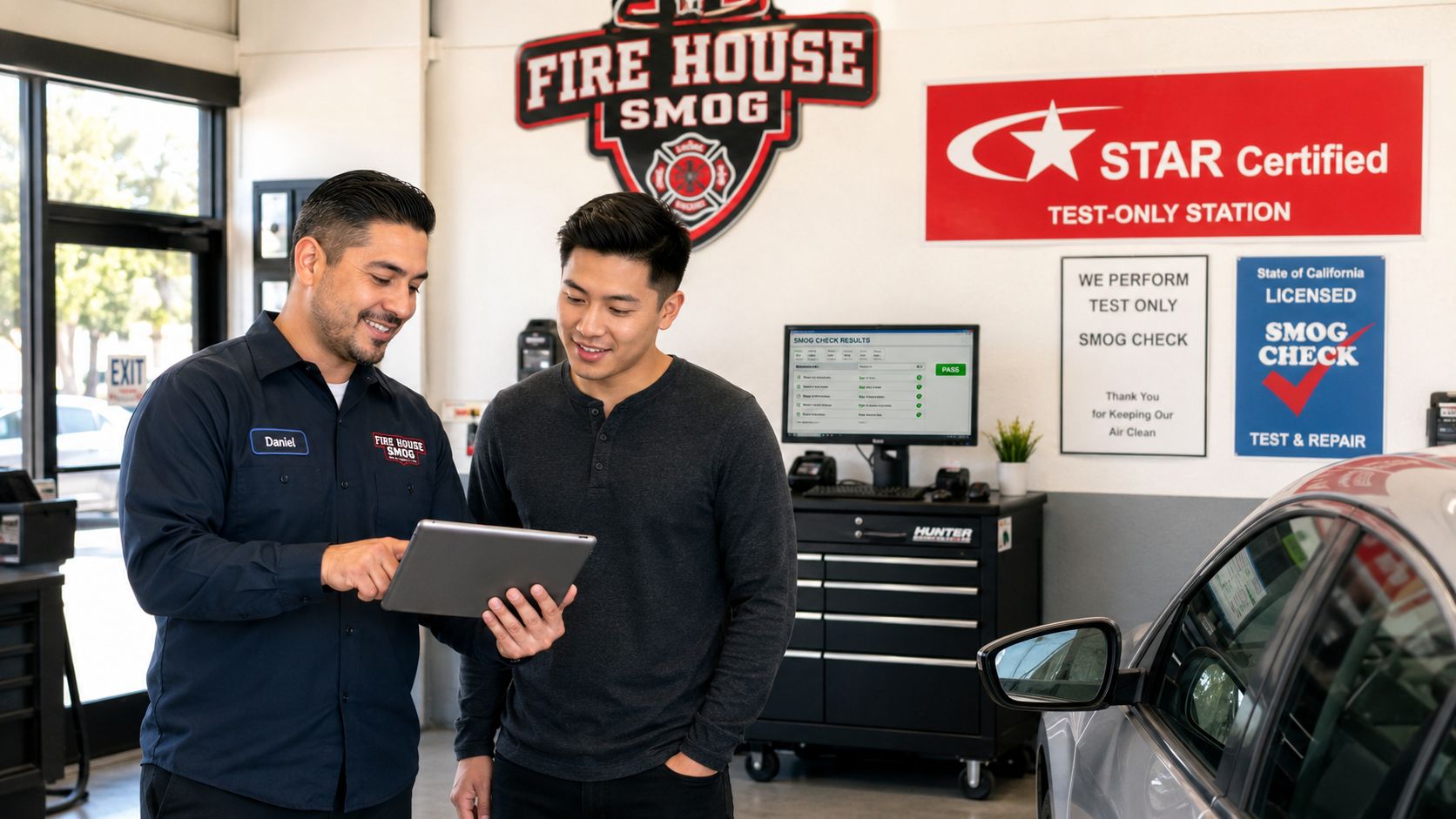
What STAR means
STAR is a state performance designation for smog stations. If your DMV notice says your car must go to a STAR station, that is part of the requirement for registration renewal, not an optional upgrade. California BAR explains the program and the referral requirement on its Smog Check program page.
For the driver, the practical point is simple. Go to the station type listed on your notice the first time, so you do not lose time repeating the visit.
Why test-only can be the safer choice
STAR and test-only are related ideas, but they are not interchangeable. A STAR station meets the state's performance standards. A test-only station focuses on inspection work and does not use the smog check visit to sell repairs on the spot.
California's Consumer Assistance Program materials describe test-only stations as inspection locations for vehicles directed there by the DMV or BAR, while repairs are handled separately through eligible repair shops or other service providers (California BAR Consumer Assistance Program). That separation matters. It removes the pressure some drivers feel when a failed test immediately turns into a repair quote.
There is a trade-off. If the vehicle fails, you still need to repair it somewhere else. In my experience, many drivers prefer that extra step because the inspection feels cleaner and easier to trust.
How the free retest policy saves money
A free retest changes the math on a failed first visit. Instead of paying for another full inspection after repairs, you come back within the station's stated time window and recheck the vehicle under the coupon terms.
That policy is only helpful if you use it correctly. Read the vehicle inspection report, fix the problem based on the report, and return before the retest period expires. Guessing at parts is where people burn money.
Here is the practical order that tends to work best:
- Review the failed items on the inspection report
- Take the car to a repair shop that can diagnose the cause, not just swap parts
- Keep the retest paperwork in the car so it does not get forgotten
- Return within the coupon's free retest window
- If registration is due now, ask whether the station can finish the paperwork on-site through its Antioch DMV registration service
That last step is the part many drivers miss. A coupon saves a few dollars on the test. Pairing the STAR test with on-site DMV help can save the extra trip, the waiting room time, and the hassle of figuring out what still needs to be filed after the car passes.
Combine Your Smog and DMV Services to Save Time
A common Antioch mistake is treating the smog check and the DMV paperwork as two separate jobs. That usually means one stop for the STAR test, another stop later for registration, stickers, or transfer forms. If the station can handle both, use the coupon for the inspection and finish the paperwork before you leave.
That combination is where the actual time savings show up. The coupon trims the inspection price. The on-site DMV service cuts out the second drive, the line, and the guessing about whether the state has everything it needs to complete your registration.
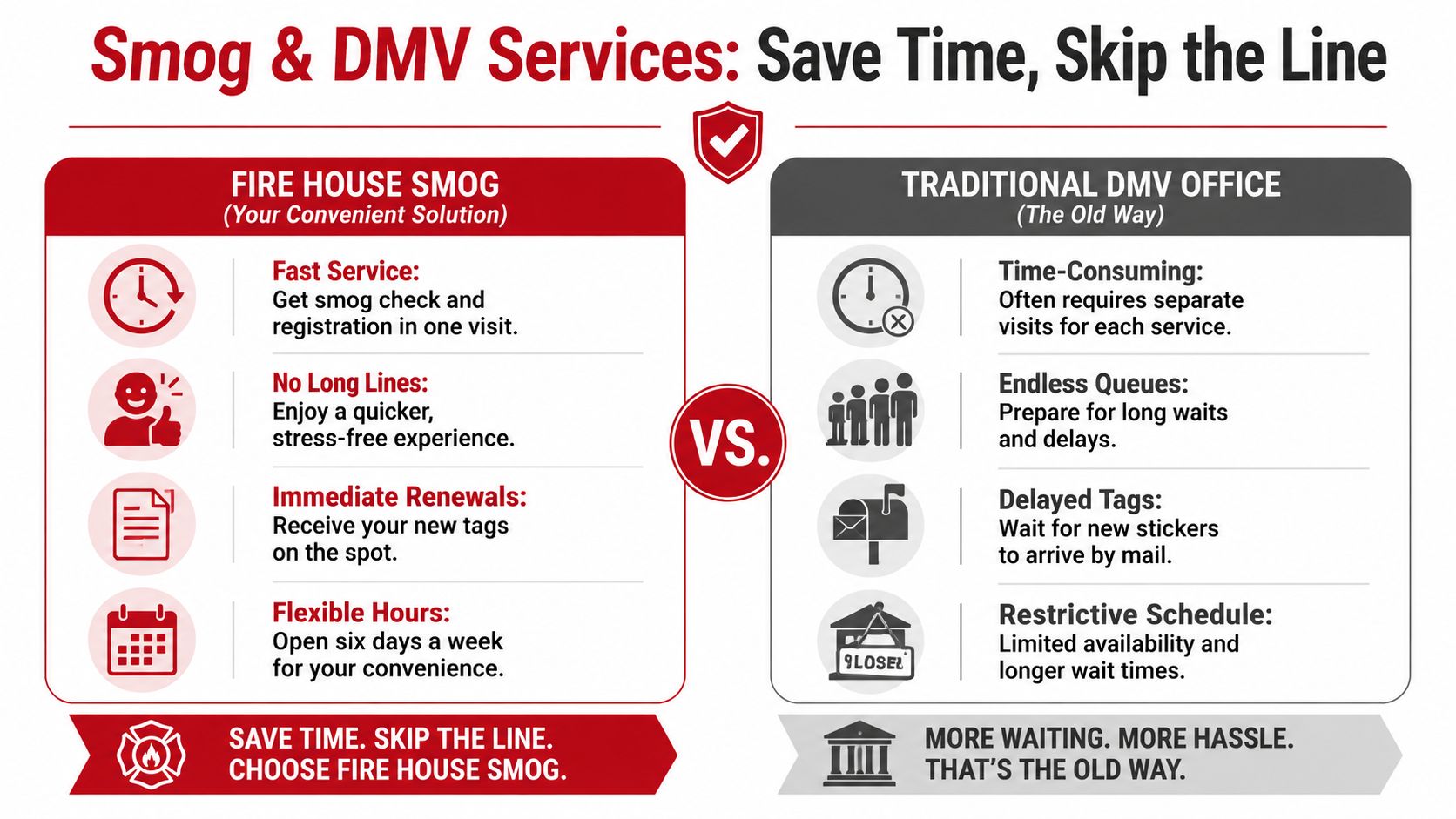
I've seen this matter most for drivers who are already close to a registration deadline. Once the car passes, they want the process finished that day, not partially finished. A station with local DMV registration services in Antioch can be the difference between one errand and an afternoon lost to paperwork.
Why bundling makes practical sense
The trade-off is simple. A basic smog-only visit may look cheaper or easier at first, but it often leaves you with unfinished business. A bundled visit can save more in total time, especially if you need tags, renewal help, or title-related paperwork handled right away.
That matters even more in busy parts of California, where STAR participation is widespread and drivers often look for stations that can keep the whole compliance process moving. The state's BAR STAR program explains how STAR stations fit into California's inspection system and why some vehicles must test at those locations (California BAR STAR program overview).
What you can often finish during the same visit
If the location also offers DMV support, one stop may cover:
- Registration renewals after the smog certificate is submitted
- Tags and stickers so the visit ends with current paperwork in hand
- Ownership transfer paperwork if the vehicle was recently bought or sold
- Some out-of-state registration steps that otherwise turn into a separate DMV trip
For Antioch drivers, that is the better use of a STAR smog test coupon. Saving a few dollars is nice. Saving the extra trip is usually better.
Frequently Asked Questions About Smog Testing
Some questions always come up right before people head in. These are the ones that matter most in practice.
Do you need an appointment
Not always. Many drivers can show up directly, especially at stations built for quick throughput. Still, calling ahead is smart if you're on a tight schedule, if you want to pair the test with DMV paperwork, or if your vehicle is larger than a standard passenger car.
If your day is packed, a quick confirmation call is worth more than guessing.
What if your car fails
At a test-only station, the staff can't repair the vehicle. That can feel inconvenient in the moment, but it also means the result is neutral. You're free to choose where the repair gets done.
Published guidance notes that many test-only stations offer a free retest within a stated period, and retest success after repairs reaches 89% (smog retest effectiveness and neutral testing explanation). That's why a fail isn't the end of the road. It usually means fix the emissions issue properly, then come back within the coupon or policy terms.
If repair cost is the worry, there may be help. Some California motorists who qualify can receive up to $500 in repair assistance through the Consumer Assistance Program after a failed smog test (California emissions testing and CAP overview). Ask about eligibility before assuming you're fully on your own.
What about RVs and larger vehicles
Some can be tested, some can't. It depends on bay space and equipment limits. That's why larger vehicles should always call ahead first instead of assuming any STAR station can handle them.
A few final practical answers:
- Coupon on your phone or printed? Either usually works, but have it ready before check-in.
- Can you bundle smog and registration? If the location offers DMV services and the timing lines up, yes, and that's often the best move.
- Should you test if the check engine light is on? No. Fix that first.
If you want the shortest path through this errand, use the coupon, arrive prepared, and handle the registration piece in the same visit when possible. That's the difference between a quick stop and a half-day headache.
If you need a STAR-certified test-only station in Antioch that also offers on-site registration help, Fire House Smog is set up for exactly that kind of one-stop visit. Bring your renewal notice, pull up your coupon before you arrive, and ask about finishing your DMV paperwork while you're there so you can leave with the smog check done and the registration task off your list.
You're probably here because one of three things happened. Your DMV renewal notice says you need a smog check, you typed car emissions testing near me because your registration deadline is getting close, or you just bought, sold, or moved a vehicle and want to avoid surprises.
That stress is normal. Most first-time drivers don't know what the test includes, what can make a car fail, or whether they need a regular station or a STAR station. The good news is that the process is much simpler when you know what the state is checking and how to prepare before you pull in.
Table of Contents
- Understanding California's Smog Check Program
- How to Prepare for Your Emissions Test
- Your Step-by-Step Guide to the Smog Test
- Why Cars Fail Smog Tests and How to Avoid It
- What Happens After Your Smog Test Results
- Fire House Smog Your All-in-One Smog and DMV Solution
- Your Smog Check Questions Answered
Understanding California's Smog Check Program
California's smog program exists for a practical reason. The state requires emissions testing for many vehicles so cars on the road stay within emissions standards tied to registration and air quality rules. According to the California Smog Check Program overview, gasoline-powered, hybrid, and alternative-fuel vehicles made in 1976 or later generally need testing every two years, while vehicles that are eight model years old or newer are exempt from testing during that early period and pay a smog abatement fee instead.
For drivers in Antioch, that matters because Contra Costa County is part of the kind of area where smog compliance is part of normal vehicle ownership. The same source notes that STAR-certified stations are used in high-pollution areas and that the program removes about 400 tons of smog-forming pollutants from California's air every day.
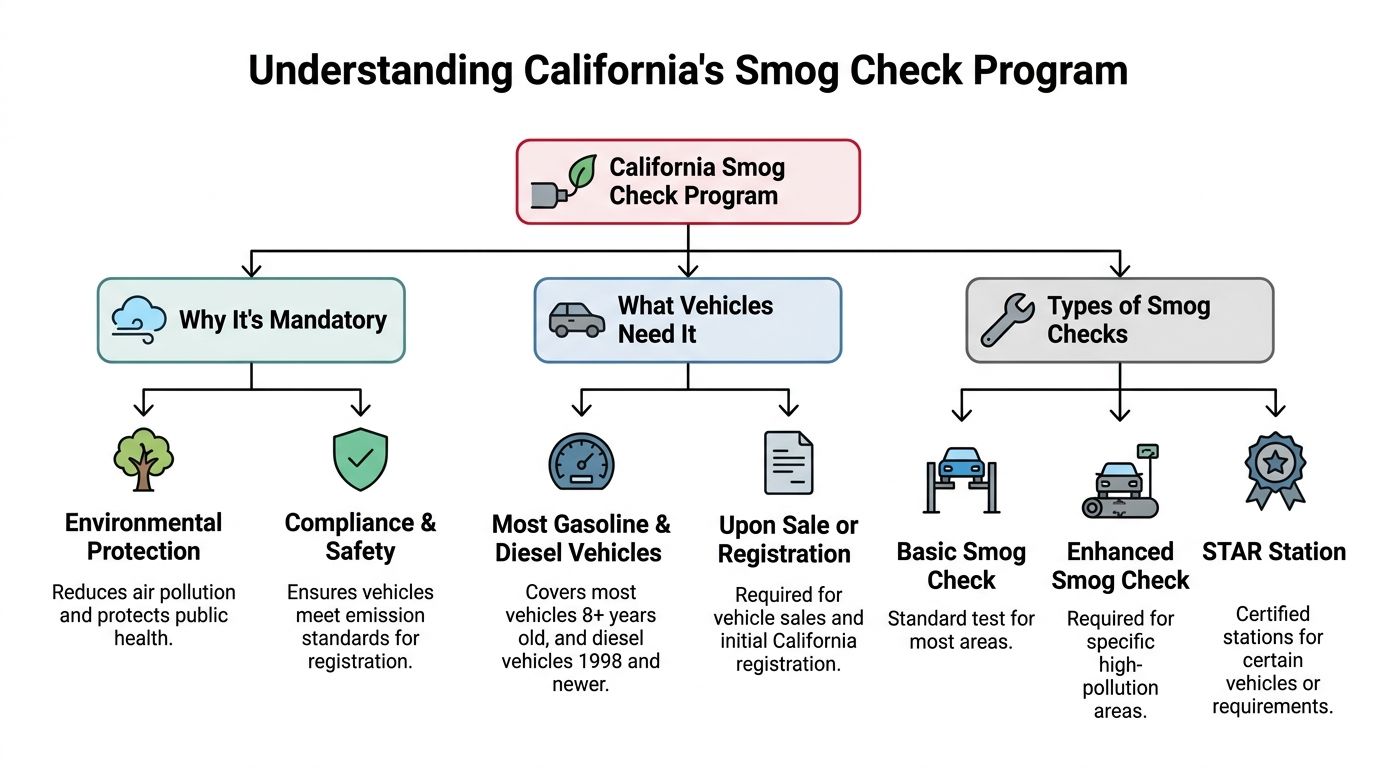
Why California requires smog checks
Think of a smog check as a compliance and maintenance checkpoint, not a punishment. The state wants to catch vehicles that are releasing more pollution than they should, especially as parts age, sensors drift, or emissions equipment stops working correctly.
Practical rule: If your registration renewal notice asks for smog, treat it like a required step for registration, not an optional tune-up suggestion.
California also separates out certain vehicles. Electric vehicles, motorcycles, trailers, and gasoline-powered vehicles from 1975 or earlier are generally excluded from the testing requirement, though owners still need to keep emissions systems intact under state rules noted in that same program overview.
Which vehicles usually need testing
Most Antioch drivers can sort themselves into one of these buckets:
- Newer gasoline vehicles: If your car is within its first eight model years, you'll typically pay the abatement fee instead of taking a biennial test.
- Older gasoline vehicles: Once the vehicle ages out of that early exemption, biennial testing usually applies.
- Hybrid vehicles: Hybrids are part of the required list under current California rules.
- Diesel vehicles: Some diesel vehicles also require testing under California's program rules.
If you're searching for local help, start with a STAR-certified smog check in Antioch so you don't waste time at the wrong kind of station.
How to Prepare for Your Emissions Test
A little prep can save you from the most frustrating kind of failure, the one caused by something simple. Most drivers don't need to be mechanics. You just need to arrive with a car that's ready to be read properly and a few basics handled before check-in.
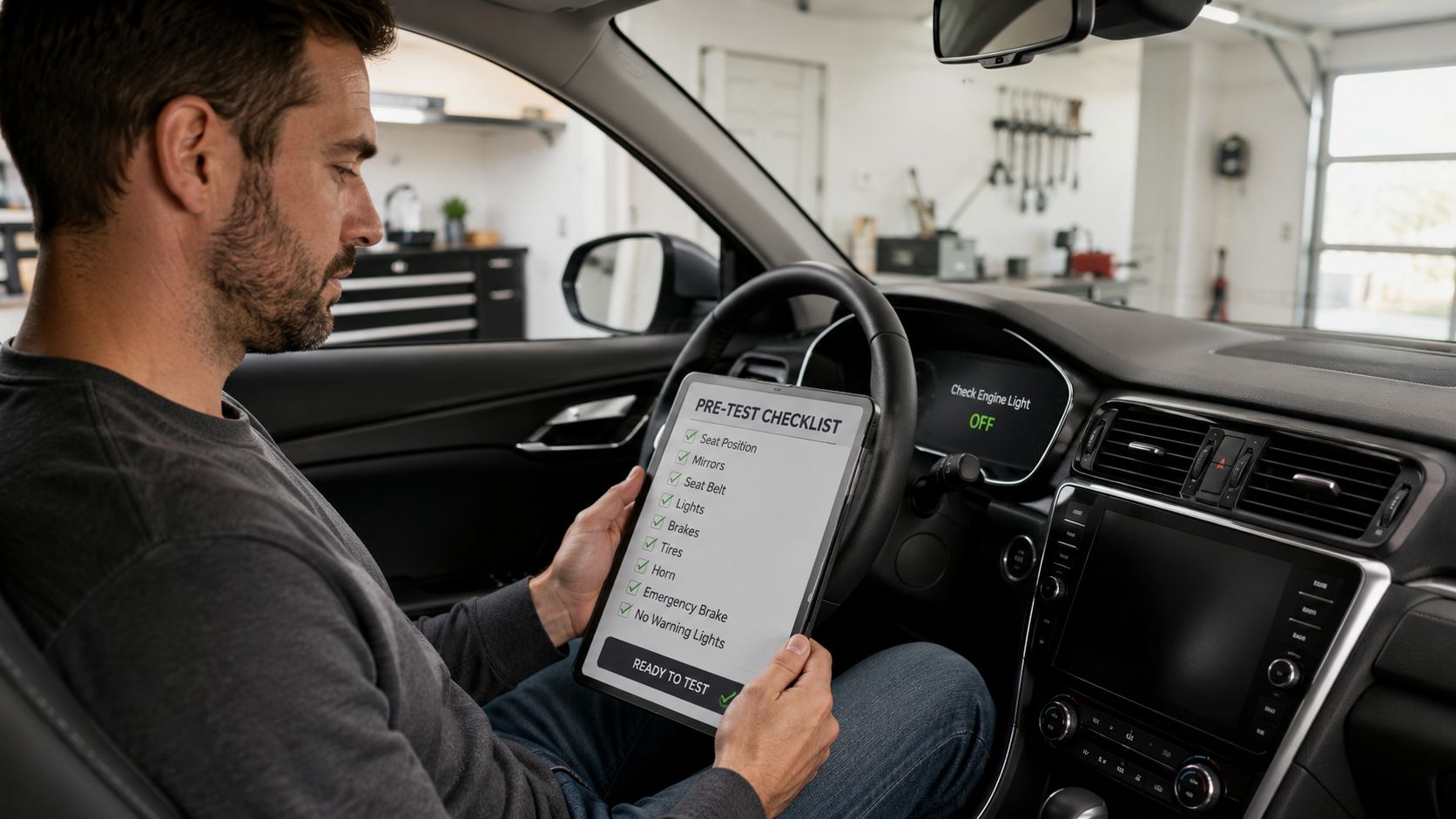
The easy checks to do before you leave home
Start with the dashboard. If your Check Engine light is on, don't ignore it and hope for the best. That light often points to the exact kind of issue that can stop an emissions inspection from passing.
Then think about recent work on the car. If the battery was disconnected, replaced, or the car recently had certain repairs, the onboard computer may not be ready yet. That becomes important during modern emissions testing.
A short prep list helps:
- Drive the car first: Don't bring it in cold if you can avoid it. A normal drive helps the car reach regular operating condition.
- Check the gas cap: Make sure it's there and tightened properly. A loose or damaged cap can create trouble.
- Look for warning lights: If the dash is lit up, get that diagnosed before testing.
- Avoid last-minute battery disconnects: Resetting the car's memory right before a test can create readiness problems.
A smog test goes smoother when the car has been driven normally and nothing has recently reset the vehicle computer.
What to bring and what to avoid
Bring the paperwork that helps the visit move quickly. Your renewal notice is helpful if you have it. Current registration details are useful too, especially if you're trying to complete your DMV requirement without guesswork.
Later in your prep, it helps to see the process in motion:
A few things drivers should avoid before they head out:
- Don't clear codes right before the test: That can wipe out readiness information the inspector needs.
- Don't assume a recent repair means the car is instantly ready: The repair may be fine, but the system may still need normal driving to complete self-checks.
- Don't wait until the final day if you can help it: If something small needs attention, extra time lowers the pressure.
Your Step-by-Step Guide to the Smog Test
Many drivers feel more comfortable knowing what the appointment entails. The process is straightforward. You arrive, check in, the technician confirms what kind of test your vehicle needs, and then the inspection starts.
What check-in looks like
When you pull in, the first few minutes are usually simple. A technician or staff member gets your basic vehicle information, confirms the service needed, and lines the car up for the inspection bay. At a busy shop, two service bays can make a real difference because they help keep cars moving instead of stacking everyone into one long line.
For a first-timer, this is the part that feels more routine than dramatic. You're not negotiating a repair estimate. You're confirming identity, vehicle details, and the type of compliance check required.
What happens during the inspection
A California smog inspection typically includes a few separate checks rather than one single “machine test.” For many drivers, the technician is looking at three broad areas.
First is the visual inspection. The technician checks whether required emissions components appear to be present and properly installed.
Second is the functional side. On many newer vehicles, that includes connecting to the vehicle computer through the OBDII system. The California smog testing overview by year notes that vehicles model year 2000 and newer include an OBDII inspection as part of the test, which reads the vehicle's computerized diagnostics data.
Third is the emissions compliance measurement that applies based on the vehicle and test type. The technician verifies whether the vehicle meets the state requirement for that inspection cycle.
Most drivers are surprised by how ordinary the visit feels. The test is usually more about verification than mystery.
When the inspection is finished, you get the result and the next step becomes clear right away.
Why Cars Fail Smog Tests and How to Avoid It
Failure usually comes from a short list of problems. Some are true emissions faults. Others are preventable readiness issues that catch drivers off guard because the car seems to run fine.
The failure points drivers run into most often
Here are the trouble spots I'd tell any first-time driver to think about before searching for Car emissions testing near me and heading out.
| Issue | What It Is | Simple Check |
|---|---|---|
| Check Engine light | The car's computer has detected a fault that affects monitored systems | Look at the dash before you leave |
| Loose or faulty gas cap | The fuel vapor system may not seal correctly | Tighten the cap and inspect for wear |
| Incomplete OBD readiness | The onboard system hasn't finished its self-checks | Avoid recent battery resets and drive normally first |
| Emissions component problem | Parts like sensors or converters may not be working correctly | If the car runs rough or has warning lights, get it diagnosed |
| Modified or missing equipment | Required emissions parts may be altered or absent | Make sure factory-style emissions equipment is still in place |
A lot of people assume a smog failure means the engine is about to die. That's often not true. Some failures come from items that don't feel dramatic while driving, like a leak in the evaporative system, a sensor issue, or computer monitors that haven't reset.
The common smog check fail reasons guide is worth reviewing if you want a local breakdown of what inspectors commonly see.
The OBD monitor issue that catches people off guard
This is one of the most misunderstood parts of modern testing. If a battery was disconnected, replaced, or certain repairs were done recently, the car's computer may erase readiness information. The vehicle might drive normally, idle fine, and still not be ready for inspection.
According to the Connecticut vehicle testing explanation of OBD readiness, a week of combined highway and city driving is often needed to reset OBD monitors after a battery disconnect or repair. That plain-language advice is useful far beyond Connecticut because the basic driver mistake is the same everywhere. People clear codes, swap a battery, or finish a repair and head directly to a smog station before the system has completed its checks.
If you recently disconnected the battery, don't assume the car is ready just because the warning light is off.
That's why a vehicle can “feel fixed” but still fail on inspection day. The solution is often patience and normal driving, not panic.
What Happens After Your Smog Test Results
Once the inspection ends, you're on one of two paths. Both are manageable.
If your car passes
If the vehicle passes, the biggest relief is that you're usually done with the emissions requirement for that cycle. The result is typically transmitted electronically, which helps complete the registration side without making you chase paper proof from office to office.
If you also need help with your registration steps, a local California DMV registration renewal service can save you from dealing with a separate trip and more waiting.
For most drivers, a pass means the test fades into the background quickly. You handle the paperwork, finish renewal, and move on.
If your car doesn't pass
A failed result feels personal, but it usually isn't. It means the car didn't meet one part of the requirement on that visit. The next step is figuring out whether the problem is a readiness issue, a simple repair item, or a larger emissions-related fault.
The important thing is trust. A test-only station doesn't profit by turning your failed inspection into an in-house repair order. That separation matters because it keeps the testing result independent from repair sales pressure.
If your vehicle needs work, get the issue diagnosed and repaired by the shop you choose. Then return for the retest under the station's policy and coupon terms if that applies. That setup makes the process feel a lot less like a dead end.
- Keep your report: It helps the repair shop understand what needs attention.
- Ask what kind of failure it was: Readiness and component failures are not the same thing.
- Don't rush back too early: If the issue involved monitor readiness, the car may need more normal driving before a retest.
Fire House Smog Your All-in-One Smog and DMV Solution
The biggest time drain in vehicle compliance usually isn't the inspection itself. It's the bouncing around afterward. One location for testing and another for registration. One set of hours for weekdays and another office that closes before you can get there.
That's where a combined smog-and-DMV setup helps Antioch drivers most.
Why the one-stop setup matters
Fire House Smog is a STAR-certified test-only station and a licensed DMV registration services provider in Antioch. That combination matters because it cuts out two common frustrations at once. You don't have repair upselling tied to the smog result, and you don't have to default to a DMV office line for every registration task.
The shop also operates with two service bays, which helps reduce bottlenecks when several drivers arrive around the same time. For people squeezing this errand into lunch, after work, or a weekend window, that practical detail matters more than flashy marketing language.
A station that only tests and also handles DMV tasks solves two separate headaches in one stop.
What Antioch drivers can handle in one visit
Fire House Smog can handle more than a standard passenger-car inspection. Based on the business information provided, Antioch-area drivers can use it for:
- STAR-certified smog checks: Passenger cars, SUVs, and light-duty trucks are the core fit.
- Some RV and motorhome smog checks: Because size and equipment matter, it's smart to call ahead.
- Registration renewals: On-site DMV service includes sticker printing during posted hours.
- Ownership transfers: That includes California vehicles and out-of-state vehicles.
- On-site tags and related registration help: Useful when you want to leave with more than a test receipt.
Hours are another quality-of-life advantage. Smog testing is available seven days a week with extended evening and weekend availability. DMV service hours are listed as Monday through Saturday, 9:30 AM to 5:00 PM, and Sunday, 12:00 PM to 4:00 PM, with limited services possible on weekends.
For Antioch drivers, that means fewer workday disruptions. It also means small business owners, families with packed schedules, and people handling title or registration issues don't have to build their whole day around a government office visit.
Your Smog Check Questions Answered
Do I need a smog check when selling a car
In many California vehicle sale situations, smog compliance becomes part of the transfer process. If you're selling, don't guess. Confirm the exact requirement tied to the vehicle and transfer.
What if my renewal notice says STAR station
Use a STAR-certified station. If your notice specifies STAR, going to a non-STAR location can waste a trip.
My car runs fine. Can it still fail
Yes. A car can drive normally and still fail because of a sensor issue, a gas cap problem, or incomplete OBD readiness after battery service or repairs.
How long should I drive after battery work before testing
Don't rely on one short errand. As noted earlier, normal mixed driving over about a week is often needed for readiness monitors to reset after a battery disconnect or certain repairs.
Can I handle registration at the same place
Yes, if you choose a shop that also offers licensed DMV services. That's one of the easiest ways to avoid extra lines and another trip across town.
Can larger vehicles come in too
Some RVs and motorhomes can be tested, but bay space and equipment limits matter. Calling ahead is the safest move.
If you want a smoother way to handle smog and registration in Antioch, contact Fire House Smog. It's a STAR-certified test-only station at 2900 Lone Tree Way with on-site DMV services, two service bays, seven-day smog availability, and help for renewals, transfers, and some RVs. Call first if you've got a larger vehicle or want to confirm DMV service timing.