
Your registration renewal shows up, you open it, and one line jumps out immediately: “Smog Certification Required at a STAR station.” For a lot of drivers, that sentence feels bigger and more complicated than it really is. It sounds like your car has been flagged for something serious, or that you now have to hunt down some special government facility.
Usually, it's much simpler than that.
If you're trying to understand smog test only centers STAR certified, the main thing to know is that California uses different kinds of licensed smog stations for different situations. Some stations only test. Some test and repair. Some are STAR certified, which means they meet stricter performance standards. Once you understand those labels, the whole process gets a lot less stressful.
Table of Contents
- Your DMV Notice Says STAR Station Required Now What
- Decoding the Jargon STAR Certified vs Test-Only
- Test-Only vs Test-and-Repair Which Station Is Right for You
- How to Prepare for Your Smog Check
- Fire House Smog Your Antioch STAR Certified & DMV Partner
- Frequently Asked Questions About Smog Checks
Your DMV Notice Says STAR Station Required Now What
First, take a breath. A STAR requirement doesn't automatically mean you did anything wrong, and it doesn't mean your car is being “punished.”
California built the STAR program to make emissions testing more reliable in the areas where cleaner air enforcement matters most. More than two-thirds of smog check stations in California are STAR certified, which makes STAR the normal standard in much of the state, not some rare exception. The state's transportation materials explain that the program exists so vehicles with a higher potential to contribute to smog are tested at facilities with proven reliability through the California Senate smog check program overview.
That's why this line appears on so many renewal notices. It's an administrative sorting system, not a character judgment on your vehicle.
What the notice is really telling you
The notice is saying one thing: go to the right kind of licensed station.
That's where people get tripped up. Drivers often mix up these separate ideas:
- STAR certified means the station meets stricter state performance standards.
- Test-only means the station performs inspections only and doesn't do repairs.
- Test-and-repair means the station can inspect the car and also fix it if needed.
A station can be STAR certified and still be either test-only or test-and-repair.
Practical rule: Read the DMV notice carefully. If it says STAR station, focus first on finding a STAR-certified shop. Then confirm whether your vehicle specifically needs test-only service or whether any STAR station will work.
Why people overcomplicate this
A lot of first-time customers assume “STAR required” means they must go to the most restrictive option available. That isn't always true. Some vehicles do need a specific type of STAR station. Others only need any station within the STAR program.
What matters most is choosing a station that matches your notice and your situation. If your car has been running fine and you want a neutral inspection with no repair sales attached, a test-only center often feels simpler and more comfortable.
Decoding the Jargon STAR Certified vs Test-Only
These two terms sound similar, but they answer different questions.
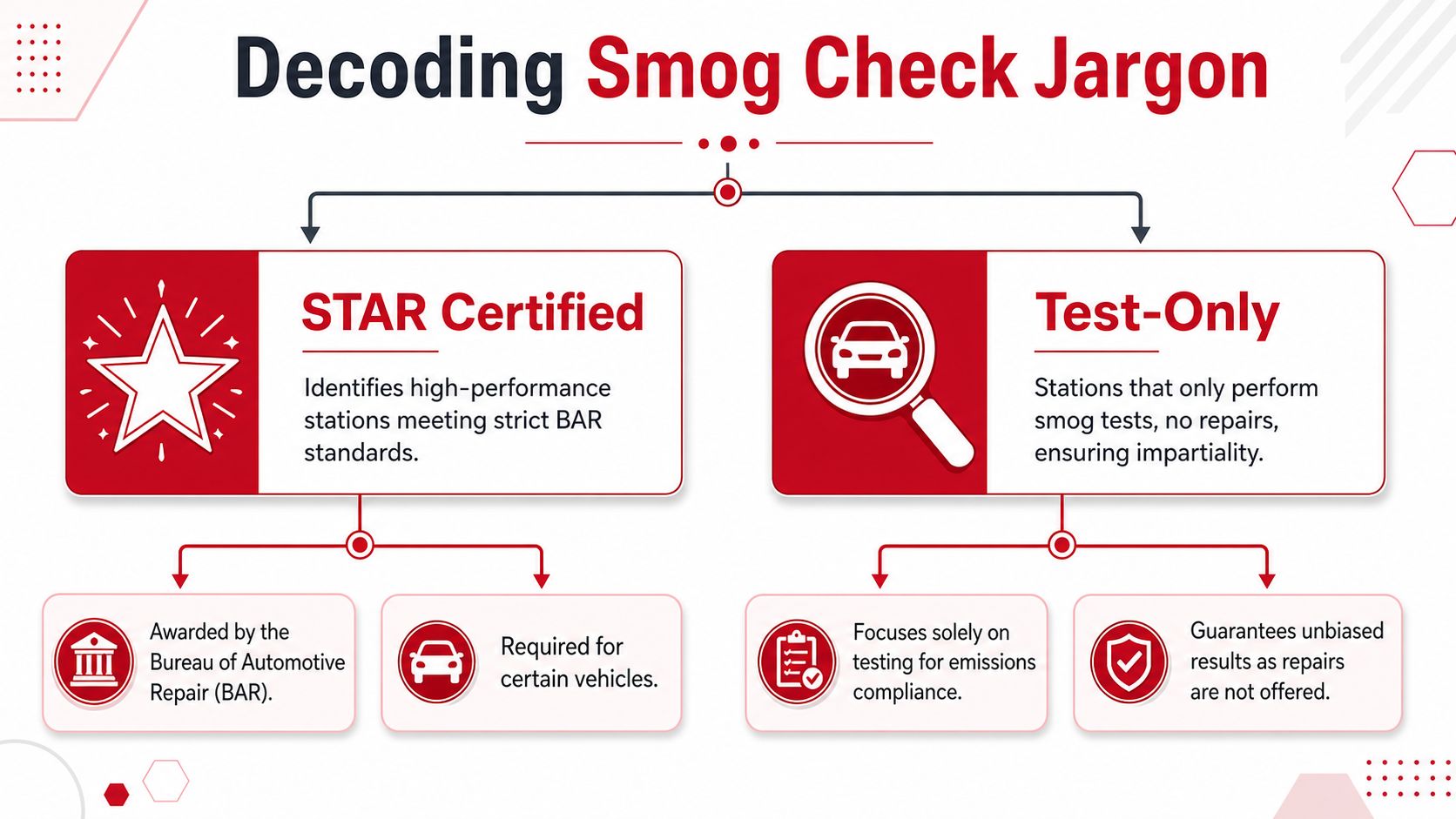
STAR certified answers: How is the station approved?
Test-only answers: What is the station allowed to do?
What STAR certified really means
Think of STAR certification like a higher-performance license category. The Bureau of Automotive Repair uses it for stations that meet stricter operational and accuracy standards than regular stations.
For some vehicles, that higher standard isn't optional. BAR states that STAR-certified test-only centers are authorized to inspect directed vehicles and gross polluters that ordinary test-and-repair stations can't handle, and the program requires these facilities to exceed baseline accuracy thresholds, including a long-term Fail-to-Pass Rate score of at least 0.40 through the BAR STAR certification requirements.
That sounds technical, but the takeaway is simple. California wants certain vehicles inspected at stations with stronger testing performance.
What test-only means in practice
A test-only center is exactly what it sounds like. The shop inspects the car, reports the result, and certifies it if it passes. The shop does not repair smog failures.
That separation matters because it removes the repair sale from the inspection itself. If the shop can't sell you a catalytic converter, oxygen sensor, or emissions repair, there's less reason for you to worry about pressure or upsells.
A test-only station functions like a diagnostic checkpoint. Its job is to measure and verify, not to sell the fix.
That's why many drivers prefer smog test only centers STAR certified when they want a neutral result. If the car passes, you're done. If it doesn't, you leave with a report and take the car to a repair shop of your choice.
A quick way to remember the difference
Use this shortcut:
- STAR certified = the station meets stricter state standards.
- Test-only = the station inspects but doesn't repair.
- STAR test-only = a shop with stricter approval standards that also stays separate from repair sales.
For a first-time customer, that last category often feels the clearest. You know why you're there, and you know what the station can and can't do.
Test-Only vs Test-and-Repair Which Station Is Right for You
This decision usually comes down to one question: Do you want a neutral inspection first, or do you want repair convenience if the car fails?
Both station types are legitimate. The better choice depends on your car's condition, your schedule, and how much risk you think there is of a failure.
When a test-only station makes sense
A STAR test-only center fits well when you believe the car is in decent shape and you want a straightforward inspection with no repair sales attached.
That's especially appealing if you've already handled maintenance, recently completed repairs elsewhere, or just want a clean yes-or-no answer from a station that isn't trying to turn the visit into a repair estimate. If you want an example of that kind of setup, this Antioch test-only smog center shows the typical model.
Common reasons drivers choose test-only:
- They want impartiality: The station has no in-house repair revenue tied to the result.
- They already fixed the car elsewhere: They only need certification.
- They value speed: Test-only shops often focus their workflow on inspections rather than repair scheduling.
When a test-and-repair station may be easier
The tradeoff shows up if the vehicle fails.
A test-and-repair station can inspect the vehicle, diagnose the issue, perform emissions-related work, and then retest on site. A test-only station can't do that. If your car fails at a test-only shop, you'll need to leave, get repairs somewhere else, and come back for another inspection.
That “two-stop” process is the part many guides skip. The SmogTips explanation of the STAR station program points out that test-only failures often create extra delay and added cost because repairs and recertification happen in separate places.
If your car has a history of check-engine problems, rough running, or recent emissions repairs, the convenience of a test-and-repair station can outweigh the neutrality of test-only.
STAR Test-Only vs. STAR Test-and-Repair at a Glance
| Feature | STAR Test-Only Center (e.g., Fire House Smog) | STAR Test-and-Repair Station |
|---|---|---|
| Main job | Performs inspections and certifications only | Performs inspections, repairs, and recertification |
| Repair sales | None on site | Repairs available on site |
| Bias concern | Lower, because no repairs are sold | Some drivers prefer a separate tester |
| If the vehicle passes | You're finished | You're finished |
| If the vehicle fails | You must go elsewhere for repairs, then return for retest | Repairs and retest may happen in one location |
| Best fit | Drivers who want a neutral inspection | Drivers who want repair convenience |
For many people, the practical answer is simple. If the car seems healthy, test-only can feel clean and low-pressure. If you suspect a problem, test-and-repair may save time.
How to Prepare for Your Smog Check
The easiest smog check is the one you show up ready for. Most of the stress comes from uncertainty, not the inspection itself.
A common point of confusion is whether every STAR-directed vehicle must go to a test-only center. That's not always the case. A discussion often referenced by California drivers notes that about 1.9% of vehicles are randomly selected for STAR testing, and most of those aren't gross polluters, which means many drivers can use a regular STAR station rather than hunting only for test-only service, as summarized in this California STAR testing discussion.
Before you leave home
Give yourself a better shot at a smooth visit with a few simple checks:
- Watch the dashboard: If the Check Engine light is on, don't assume the car will “probably be fine.” Have the issue diagnosed first.
- Drive the car first: A short drive before the test helps the vehicle reach normal operating temperature.
- Bring your paperwork: Your renewal notice and current registration details help the station verify what the DMV is asking for.
- Don't guess about station type: If the notice wording is unclear, call the station before driving over.
- Review common failure issues: This guide to smog check fail reasons can help you spot obvious trouble before the appointment.
What the visit usually feels like
Here's the normal customer experience.
You pull in, provide your vehicle information, and the technician confirms what kind of inspection your car needs. The inspection itself may include an electronic systems check, a visual review of emissions-related components, and the required testing procedure for that vehicle type.
If the vehicle passes, the certificate is handled electronically. If it doesn't, you'll receive a report showing what needs attention.
This walkthrough gives a useful visual sense of the process:
Bring the car in the same way you normally drive it. Last-minute tinkering, battery disconnects, or rushed DIY fixes can create more confusion than they solve.
A calm way to think about the appointment
Treat the smog check like a compliance inspection, not a personal test. Your job isn't to outsmart the machine. It's to show up with the right paperwork, a warmed-up car, and realistic expectations.
That mindset alone makes the visit easier.
Fire House Smog Your Antioch STAR Certified & DMV Partner
For Antioch drivers, one practical advantage matters more than almost anything else: finishing the smog check and handling registration without making a second trip.
A test-only model keeps the inspection separate from repair sales. California service information notes that STAR Test Only centers can't perform smog check repairs, which creates a non-bias testing environment, and that typical STAR Test Only pricing ranges from $29.95 to $59.95 plus an $8.25 state certificate fee through this California service listing for STAR Test Only smog checks.
Why the combined service matters
The part many drivers dislike isn't only the smog test. It's the extra errand after the smog test.
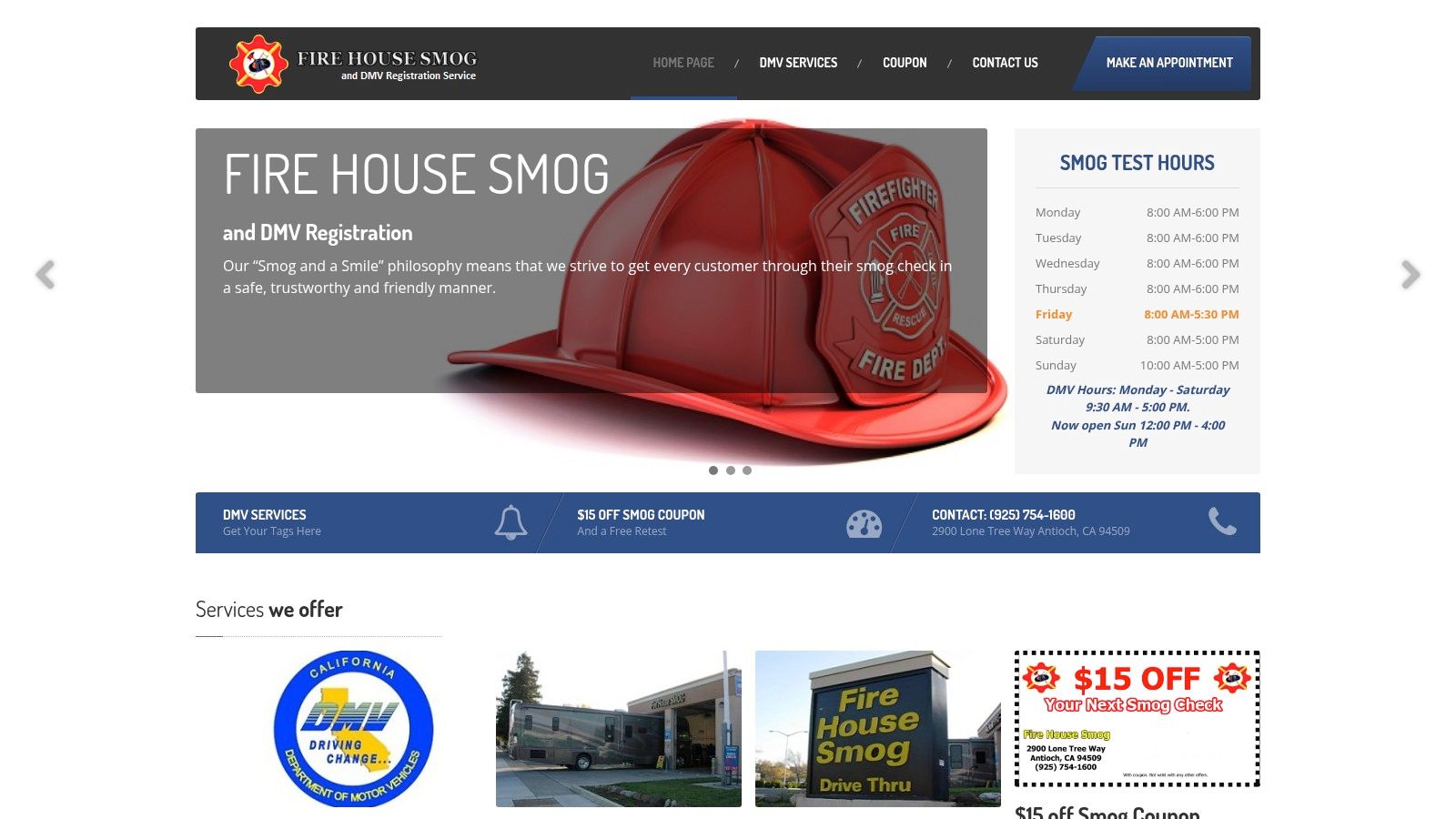
A station that also handles DMV registration services can remove that second stop. Fire House Smog offers both test-only smog inspections and on-site DMV services as a licensed business partner, which means a passing vehicle owner may be able to complete the renewal and receive registration materials in the same visit. For local drivers comparing options, this STAR-certified smog test near Antioch page shows the service category.
That combination is useful for:
- Busy commuters: Fewer separate appointments.
- Families with tight schedules: Less waiting around with kids in the car.
- Fleet or multi-vehicle owners: A more predictable paperwork process.
What to expect on site
The location at 2900 Lone Tree Way in Antioch offers smog testing for passenger cars, SUVs, light-duty trucks, and some RVs within equipment limits. The business also operates two service bays, provides smog testing seven days a week, and offers DMV service hours Monday through Saturday, with Sunday availability for limited services, based on the publisher information provided above.
That doesn't guarantee zero wait, but it does mean the workflow is built around quick inspections and registration support rather than repair work.
If you're the kind of driver who wants the inspection kept separate from repairs, while also avoiding a later DMV line, this setup solves both problems in one stop.
Frequently Asked Questions About Smog Checks
What usually causes a failure
The most common issues are usually basic emissions-related problems, not mysterious government traps.
Drivers often run into:
- Dashboard warning lights: Especially the Check Engine light.
- Sensor or emissions component problems: Items like oxygen-sensor-related faults can affect readiness or emissions results.
- Fuel vapor issues: Even something simple like a loose gas cap can create trouble.
- Recent repair resets: If a battery was disconnected or codes were just cleared, the vehicle may not be ready for inspection.
What happens if the car fails at a test-only station
You'll get a report showing the reason for the failure. Then you take the car to a repair shop of your choice, have the issue corrected, and return for a retest.
That's the main downside of test-only service. It protects you from repair upsells during the inspection, but it also means the repair step happens somewhere else.
A failure at a test-only shop doesn't trap you. It just separates the diagnosis result from the repair decision.
How retests work
Retest rules depend on the station's policy. Some drivers assume a return visit is automatic or included no matter what. It's better to ask directly before the first inspection.
For Fire House Smog, the publisher information states that a free retest is available when required, subject to site policy and coupon terms. That means you should confirm the current terms at the counter or when scheduling so there aren't any surprises.
If you're unsure where to go, call ahead, read your DMV notice carefully, and choose the station type that matches both the notice and your comfort level. That's usually all it takes to make a confusing requirement feel manageable.
If you need a neutral smog inspection and want to handle registration in the same visit, Fire House Smog provides STAR-certified test-only smog checks along with on-site DMV services in Antioch. Call ahead if your notice is unclear or if you're bringing a larger vehicle, and confirm current retest and registration-service details before you go.