Vehicle registration renewal is the mandatory annual process of updating your vehicle's legal status with the state, proving you have insurance and have met requirements like a smog check, which allows you to legally drive on public roads. In California, that process can't be completed online unless your electronic smog certification is already on file with the DMV, so the order you do things in matters.
If you're reading this because you found a DMV renewal notice on the counter, remembered your tags are about to expire, or realized you still haven't handled your smog check, you're in the same spot as a lot of busy California drivers. The process feels simple until one missing step blocks the whole thing.
That's where most confusion starts. People think renewal just means paying a bill. It doesn't. It means the state verifies that your vehicle is still properly registered, properly insured, and, when required, properly emissions-tested.
If you want to understand what vehicle registration renewal is, what California checks, and how to avoid wasted trips and long lines, this guide will walk you through it in plain language.
Table of Contents
- That DMV Notice in Your Mailbox
- Why You Must Renew Your Vehicle Registration Annually
- Your California Renewal Checklist Documents and Deadlines
- How to Renew Your Registration in California From Online to On-Site
- Understanding Renewal Costs and Late Penalties
- The Easiest Way to Renew Your Registration in Antioch
That DMV Notice in Your Mailbox
That envelope usually creates the same reaction. You glance at it, set it down, and tell yourself you'll deal with it later. Then later turns into “Do I need a smog check first?” or “Can I just pay online tonight?”
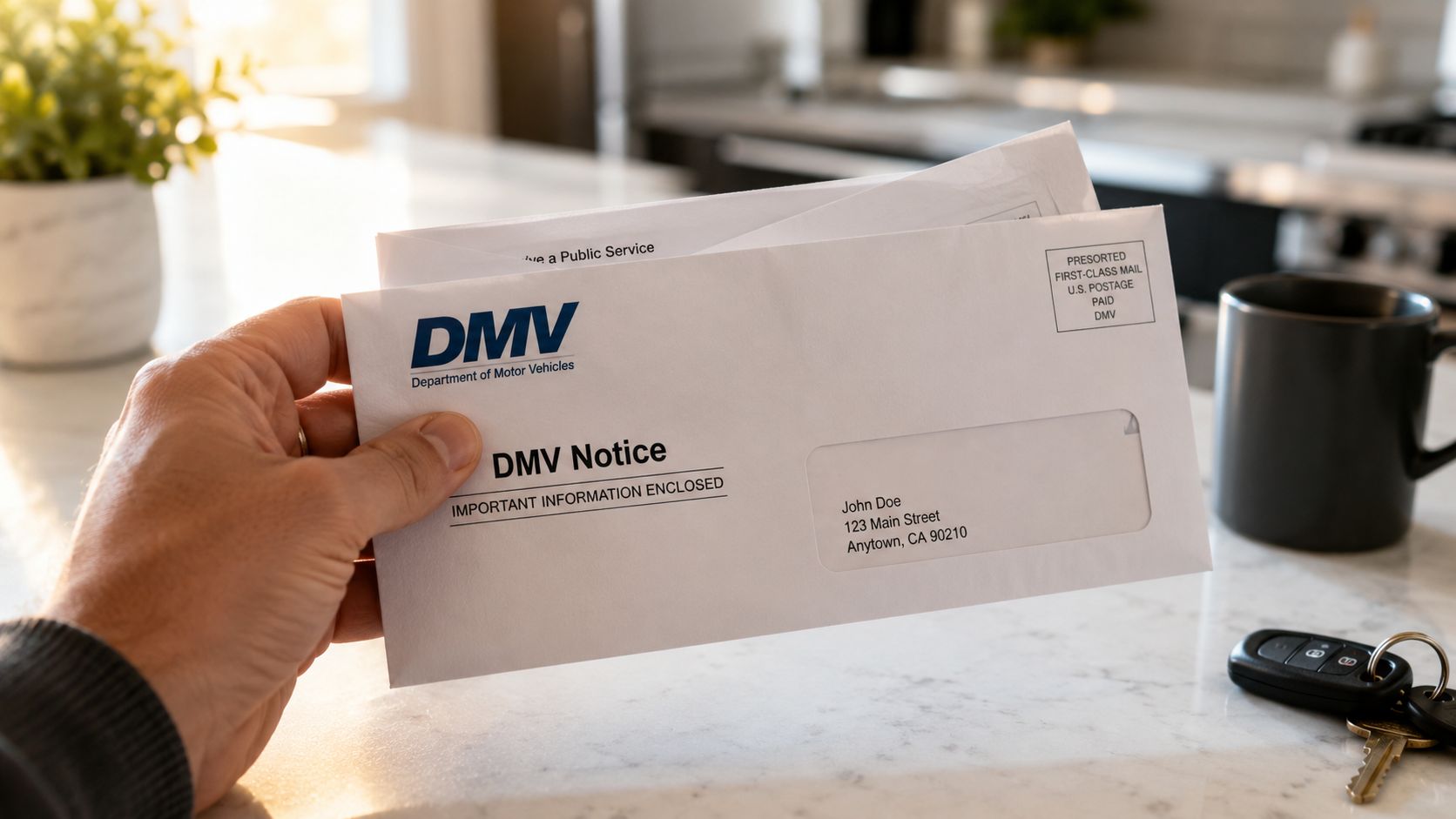
Vehicle registration renewal means renewing the state's permission for your vehicle to stay legally registered for road use. It's not the same as renewing your driver's license, and it's not just replacing a sticker.
A helpful way to think about it is this. Your license says you can drive. Your registration says this vehicle can be on public roads.
Practical rule: If your registration isn't current, paying attention to insurance alone won't fix it. The vehicle itself must be renewed with the state.
The DMV notice is really a prompt to verify three things:
- Your vehicle record is current. The state wants the registration tied to the right owner and the right vehicle details.
- Your compliance items are cleared. That can include insurance and, for many vehicles, emissions compliance.
- Your payment is submitted on time. Renewal only goes smoothly when the prerequisites are already lined up.
That's why renewal feels annoying when you're rushed. It's a chain of steps, and one missing link can stop the whole process.
Many California drivers get tripped up because they start at the payment screen. The better approach is to start with readiness. Do you have your notice or plate information? Is your insurance active? If your vehicle needs smog, has that result been sent in electronically?
Once those pieces are in place, renewal becomes routine instead of frustrating.
Why You Must Renew Your Vehicle Registration Annually
Driving on public roads comes with ongoing obligations. Registration renewal is one of them.
California doesn't treat registration as a one-time purchase that lasts forever. It works more like a recurring authorization. Each year, the state confirms that the vehicle remains properly documented and eligible to operate on shared roads.
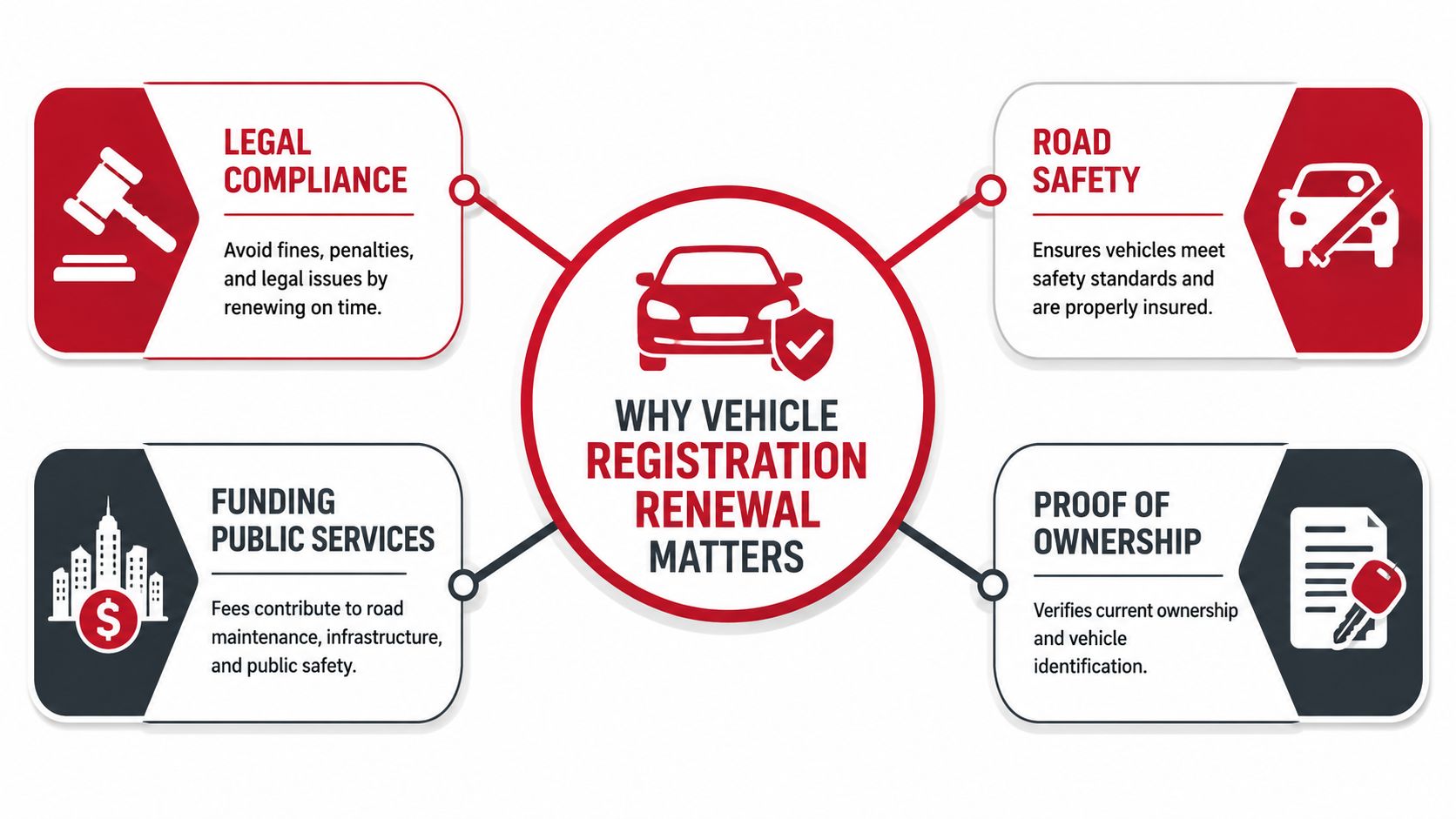
The legal reason
In the United States, renewal is an annual legal requirement. California's DMV says renewal can be denied even if fees are paid when a vehicle doesn't have valid smog certification on file or has outstanding parking tickets, and the DMV also states that electronic smog certification must already be on file before online renewal can proceed through the California vehicle registration renewal process.
That's the part many people don't expect. Payment alone doesn't solve everything. The DMV checks for compliance issues before it finishes the renewal.
The public-interest reason
Registration is also part of how the state manages safe and lawful road use. Think of it as a public-road operating agreement. You use state roads, and in return the state requires current records, valid insurance, and compliance with emissions rules where applicable.
That matters because renewal connects your vehicle to systems other agencies use too. Insurance isn't just something you keep in the glovebox. States increasingly verify it electronically, and the renewal process depends on those records matching.
Renewal isn't just paperwork. It's a state check that your vehicle still meets the conditions for legal use.
The California pain point most people hit
For many California drivers, the hardest part isn't understanding the law. It's handling the smog requirement at the right time.
Here's where people lose time:
- They try to renew online first. Then they discover the DMV has no smog result on file yet.
- They assume a paid fee guarantees completion. It doesn't if another hold is still active.
- They wait until the last minute. Then every extra errand feels urgent.
If you treat renewal like a short checklist instead of a single payment task, it gets much easier. The next step is knowing exactly what to gather before you start.
Your California Renewal Checklist Documents and Deadlines
Most renewal problems come from missing one item, not from the process being complicated. If you pull together what you need first, you can usually avoid repeat trips and stalled transactions.
What to gather before you start
Start with the basics:
- Your renewal notice, if you have it. This usually gives you the fastest path because it ties directly to your vehicle record.
- Your plate number or VIN. If the notice is missing, these details help locate the registration record.
- Current insurance information. California expects active coverage that can be matched to your vehicle record.
- Payment method. Different renewal channels may accept different forms of payment.
- Smog compliance, if required. This is often the item that decides whether you can finish today or not.
A lot of drivers ask about timing. Renewal systems around the world often use strict windows. One cited example outside California is India's 60-day pre-expiry application window for a standardized 5-year renewal duration, while some U.S. jurisdictions still rely on mailed forms and checks, such as New York's MV-3 process through a centralized center in Utica, described in this registration procedure reference. The lesson for California drivers is simple: don't assume every state handles timing and paperwork the same way.
If you want a practical list of paperwork situations, including common registration scenarios, this vehicle registration documents guide is a useful local reference.
When smog becomes the sticking point
Readers usually get confused at this point, so keep the sequence clear.
If your vehicle needs a smog check for renewal, the test must be completed first. In California, the electronic result has to reach DMV records before an online renewal can go through, as noted earlier.
That leads to a common misunderstanding: drivers often think the smog certificate is a paper they submit themselves. In practice, what matters is that the certification is transmitted and visible in the system.
If your renewal won't complete online, check the smog status before assuming the DMV website is the problem.
A few questions help you sort it out quickly:
- Does your renewal notice mention smog? If yes, handle that before trying to pay.
- Were you directed to a STAR station? If so, use the station type required by your notice.
- Did you just buy the vehicle or move to California? Ownership transfers and first-time California registration can involve separate emissions and document requirements.
- Do you have an unusual vehicle type? Some trucks, diesels, and RV-related cases can require extra verification.
Here's a simple comparison to keep straight:
| Requirement | Standard Annual Renewal | Ownership Transfer |
|---|---|---|
| Registration notice or vehicle record lookup | Usually enough to start | Transfer documents are typically needed |
| Insurance verification | Required | Required |
| Smog compliance | Often required based on DMV record | May be required depending on transaction details |
| Main goal | Extend current registration | Update legal ownership and registration record |
The takeaway is practical. Annual renewal is usually easier than a transfer, but both can stop cold if the emissions or insurance piece isn't ready.
How to Renew Your Registration in California From Online to On-Site
California gives you more than one way to renew. The right option depends on what's already done and how much time you want to spend solving problems.
The common renewal paths
Online renewal is the cleanest route when your record is already ready. It works well if your insurance is current, your smog requirement is cleared, and there are no holds that block issuance.
Mail renewal can still work for some drivers, but it's slower and less forgiving when something is missing. If you're close to expiration, mail can feel uncertain because you're waiting on processing instead of resolving issues in real time.
DMV field office service gives you face-to-face help, which is useful when the case is messy. It's also the option many people dread because it can take longer and usually requires more time carved out of your day.
Here's a quick comparison:
- Online
- Best for: Clean records and completed smog compliance
- Main drawback: You may only discover a hold after starting
- Mail
- Best for: Drivers who plan early and don't need immediate resolution
- Main drawback: Harder to correct issues quickly
- In person at a DMV office
- Best for: Complicated cases that need review
- Main drawback: More waiting and more schedule disruption
When one-stop service makes sense
For a lot of Antioch-area drivers, the biggest delay isn't the payment itself. It's having to do the smog check in one place and then solve the registration somewhere else.
That's why some people use a licensed DMV business partner that can handle both. One local option is DMV registration services near Antioch, where Fire House Smog provides STAR-certified test-only smog checks and on-site California DMV renewal services during posted service hours.
The practical benefit is straightforward. If your renewal depends on smog, combining those tasks can reduce extra stops and cut down on back-and-forth.
A short look at the process helps:
- Bring your renewal information.
- Complete the smog check if your notice requires it.
- Confirm the record is ready for DMV processing.
- Finish the registration transaction on site if eligible.
- Leave with updated documentation and tag issuance when available.
If you want to see how that service setup looks before visiting, this short video gives context:
For busy drivers, the main advantage is not having to guess which step comes first.
Understanding Renewal Costs and Late Penalties
Registration notices often look more complicated than they really are. You'll usually see several line items rather than one simple total.
What you're paying for
The exact amount on your notice can vary, but the structure usually reflects the state's registration-related charges and other required fees tied to that vehicle record. What matters most for most drivers is not memorizing every line item. It's understanding that the notice total is the amount tied to your vehicle's current renewal status.
If anything on the record is unresolved, the transaction may not process cleanly even when you're ready to pay.
For drivers trying to understand the line items before they head out, this registration renewal fee explainer can help decode what you're seeing on the notice.
Why waiting gets expensive fast
Late renewal matters because penalties don't stay theoretical. Other jurisdictions show the same pattern clearly. In the Dominican Republic, over 360,000 vehicles missed the registration sticker renewal deadline, and surcharges ranged from RD$2,000 for a single-year lapse to RD$3,100 for multi-year non-renewals, according to this report on missed vehicle renewals and surcharges.
California has its own penalty structure, and the practical lesson is the same. Once a registration goes late, the problem usually gets more expensive and more annoying, not less.
Paying attention before expiration is almost always easier than sorting out penalties, missing paperwork, and blocked records after the fact.
The most expensive delay is often the one caused by procrastination mixed with confusion. A driver waits because they think renewal is just a payment. Then they learn a required smog test or another hold still has to be cleared first.
The Easiest Way to Renew Your Registration in Antioch
If your goal is simple, get legal, avoid lines, and move on with your day, the easiest path is usually the one that removes extra stops.
Who this helps most
This works especially well for:
- Commuters with tight schedules. You don't want to spend a workday chasing separate errands.
- Families with more than one vehicle. Repeating the process across multiple cars gets old fast.
- Drivers who need smog and renewal together. That combination is where most time gets lost.
- Owners of cars, light trucks, and some RVs. A station that handles more than one vehicle type can simplify planning.
Fire House Smog is a STAR-certified test-only smog station and licensed DMV registration services provider at 2900 Lone Tree Way, Antioch, CA 94509. It offers smog testing seven days a week, has two service bays, and provides DMV service hours Monday through Saturday 9:30 AM to 5:00 PM and Sunday 12:00 PM to 4:00 PM, with 925-754-1600 for questions.
Local details you can use
The test-only model matters for some drivers because the station isn't selling repairs. That can make the visit feel more straightforward when all you need is emissions testing and registration help.
On-site DMV renewal service also matters because it addresses the most common Antioch-area pain point: people don't want one trip for smog and another for registration if both are part of the same task.
If you call ahead, you can also ask whether your vehicle type, especially if it's larger or RV-related, fits the service setup for that day. That small step can save you a wasted drive.
The core idea is simple. What is vehicle registration renewal? It's an annual legal requirement. But in practice, it goes fastest when the insurance, smog, and registration pieces are handled in the right order and, if possible, in one place.
If you want a faster local option for smog checks and California DMV renewals, Fire House Smog in Antioch handles STAR-certified smog testing and on-site registration services during posted hours, so you can clear the requirements and finish the process with fewer stops.

You've unpacked the boxes, changed your address, and maybe figured out which grocery store you like. Then the vehicle paperwork catches up with you. Your car still has an out-of-state title, your registration timing suddenly matters, and California wants more than just a signature and a fee.
That's often where difficulties arise. The official checklist sounds simple until you're standing at the counter missing a VIN verification, holding a smog report from the wrong time window, or learning that the base fee was only the smallest part of the total bill. An out of state title transfer in California is manageable, but it works best when you treat it like a document process first and a DMV visit second.
Drivers in Antioch and the rest of East Contra Costa County run into the same friction points over and over. The paperwork has to line up. The smog certificate has to be current. The title has to be usable, not just “some proof that I own the car.” If there's a lien, an electronic title, or a missing signature, the process slows down fast.
This guide is written the way I'd explain it to a new California resident who wants to get it done once, not twice. It focuses on what happens on the ground, what commonly fails, and how to move through the smog and registration parts with fewer surprises.
Table of Contents
- Welcome to California Now Let's Tackle the DMV
- Your Document and Fee Checklist Before You Start
- The Core Steps for a Smooth Title Transfer
- Understanding California's Smog Check Requirement
- Navigating Common Transfer Complications
- Skip the DMV Line and Finalize Your Registration
Welcome to California Now Let's Tackle the DMV
You unpack the house, update your insurance, and assume the car can wait until you have a free morning. Then the California paperwork starts asking for a VIN verification, a California smog certificate, and an original title that may still be sitting in a folder from your last state.
California handles an out of state transfer as a new vehicle record, not a simple address change. The state needs to confirm the vehicle, confirm ownership, and enter it into California's title and registration system correctly. That is why new residents get tripped up. The issue usually is not one big problem. It is a missed signature, a lender hold, a smog delay, or showing up before the vehicle record is ready to be finalized.
Where transfers usually go off track
The patterns are pretty consistent at the counter and at the smog station.
- The title is not ready for transfer: It may be signed in the wrong spot, missing a release, or still held electronically or by a lender.
- The owner handles steps in the wrong order: People head to DMV first, then learn they still need VIN verification or a California smog certificate.
- Out of state assumptions cause delays: A registration card, an old emissions test, or incomplete ownership paperwork often does not satisfy California's requirements.
- The move pushes the car paperwork down the list: By the time drivers deal with it, they are rushed and more likely to miss something.
One practical rule helps more than any checklist. Do not make your final DMV trip until the title path is clear, the smog question is settled, the VIN verification plan is set, and your California insurance is active.
A more effective approach
The smoothest cases follow the same order. First, confirm you have the ownership document that California can accept. Next, find out whether the vehicle will need smog. Then handle the verification and bring a complete packet for registration, instead of hoping the clerk can patch together missing pieces at the window.
That last part matters. California counter staff can tell you what is missing, but they usually cannot solve missing ownership records, lender delays, or failed smog issues on the spot.
At Fire House Smog, we see this every week. The official instructions tell you what the state requires. The primary frustration is knowing which item will stop the file from moving. If you want to avoid the common paperwork misses before you head out, use this California title transfer paperwork checklist.
Treat the transfer like a compliance file, not a quick errand. That mindset saves repeat trips.
Your Document and Fee Checklist Before You Start
Preparation saves more time here than speed. Before you leave home, you want a complete packet and a realistic idea of cost.
The documents that should be in your folder
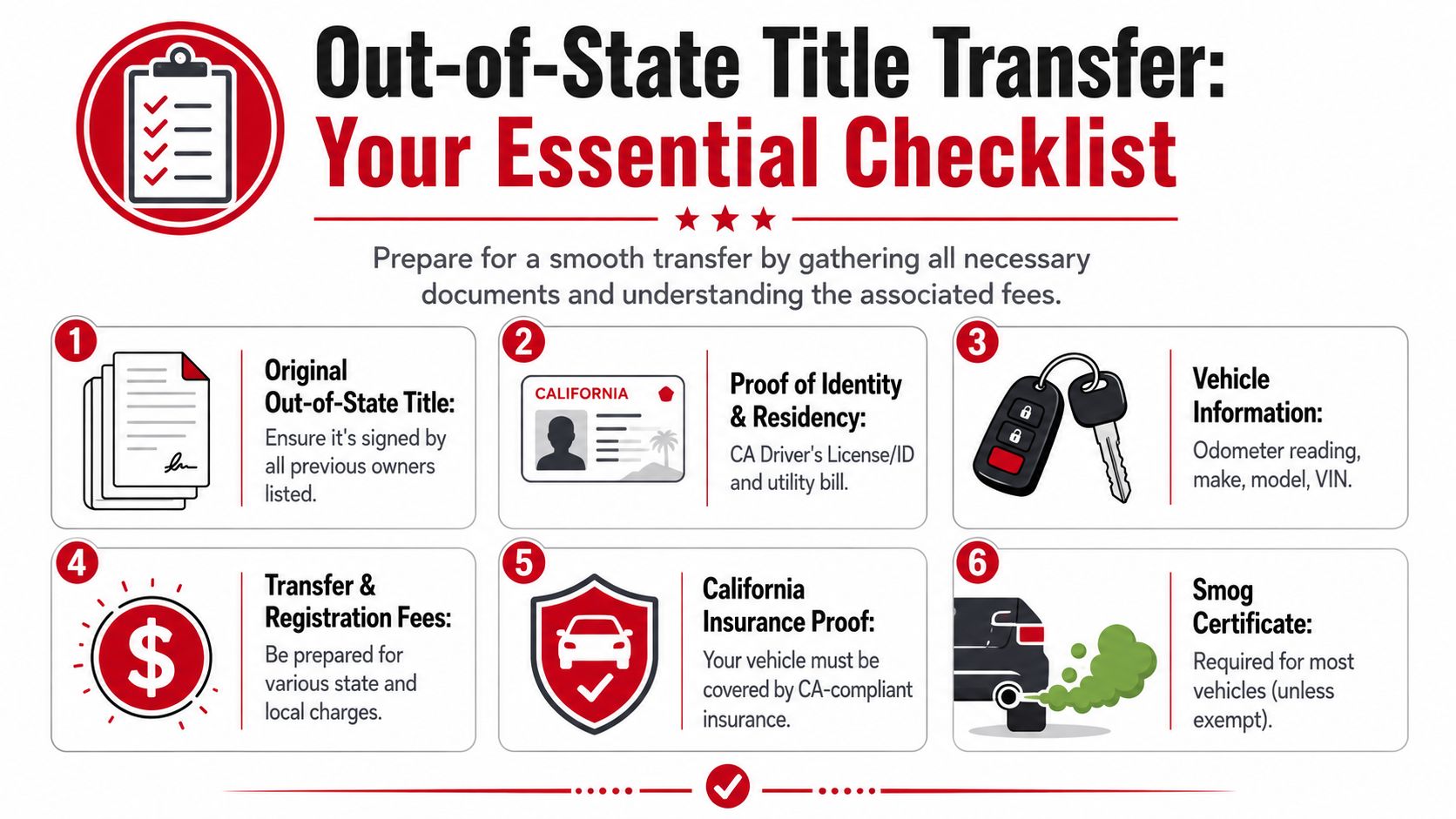
For a standard California out of state title transfer, the required core items are consistent:
- Form REG 343: This is the Application for Title or Registration.
- Form REG 31: This is the Verification of Vehicle form.
- Original out-of-state title: It should be properly signed where required.
- California insurance proof: The vehicle must be covered under California-compliant insurance.
- Smog certificate if your vehicle isn't exempt: This belongs in your packet before the final filing stage.
- Ownership support if needed: If your situation involves a lien, a missing title, or title release issues, bring the supporting records that connect ownership clearly.
If you want a practical prep sheet before you go, this title transfer paperwork checklist is useful for organizing the documents people most often forget.
The fees people underestimate
A lot of drivers hear “title transfer fee” and assume that's the whole story. It isn't.
According to California title transfer fee guidance, the base title transfer fee is $15, but the total cost typically ranges from $150 to $300 or more once use tax, registration fees, and possible penalties are added. The same source states that use tax is calculated at 7.25% to 10.25% of the purchase price, depending on the local jurisdiction.
Here's the practical breakdown:
| Cost item | What to expect |
|---|---|
| Base transfer fee | $15 |
| Use tax | 7.25% to 10.25% of purchase price, depending on location |
| Title only fee | $27 for a new title only |
| Duplicate title | $27 if a duplicate is needed |
| Registration fee if registration has lapsed | Approximately $62 |
| Total transfer cost | Often $150 to $300 or more once all required charges are included |
The checklist that prevents repeat trips
Use this as your last review before you leave:
- Check the title first: Make sure you have the original out-of-state title and that signatures are complete.
- Confirm insurance is California-compliant: Out-of-state proof often creates confusion if the policy hasn't been updated.
- Know your smog status: If your vehicle isn't exempt, don't assume you can finish the process without the certificate.
- Bring the vehicle information with you: VIN, make, model, and odometer details need to match the paperwork.
- Budget beyond the headline fee: Use tax usually changes the total more than people expect.
- Watch the clock: The same fee guidance notes that failing to complete the transfer within 30 days of purchase may trigger added penalties.
Bring originals when possible. A clean folder with complete paperwork beats trying to reconstruct ownership details at the counter.
The Core Steps for a Smooth Title Transfer
A lot of new California residents hit the same snag. They have the car, the old title, and a free morning, then find out one missing form or one unresolved title issue stops the whole filing.
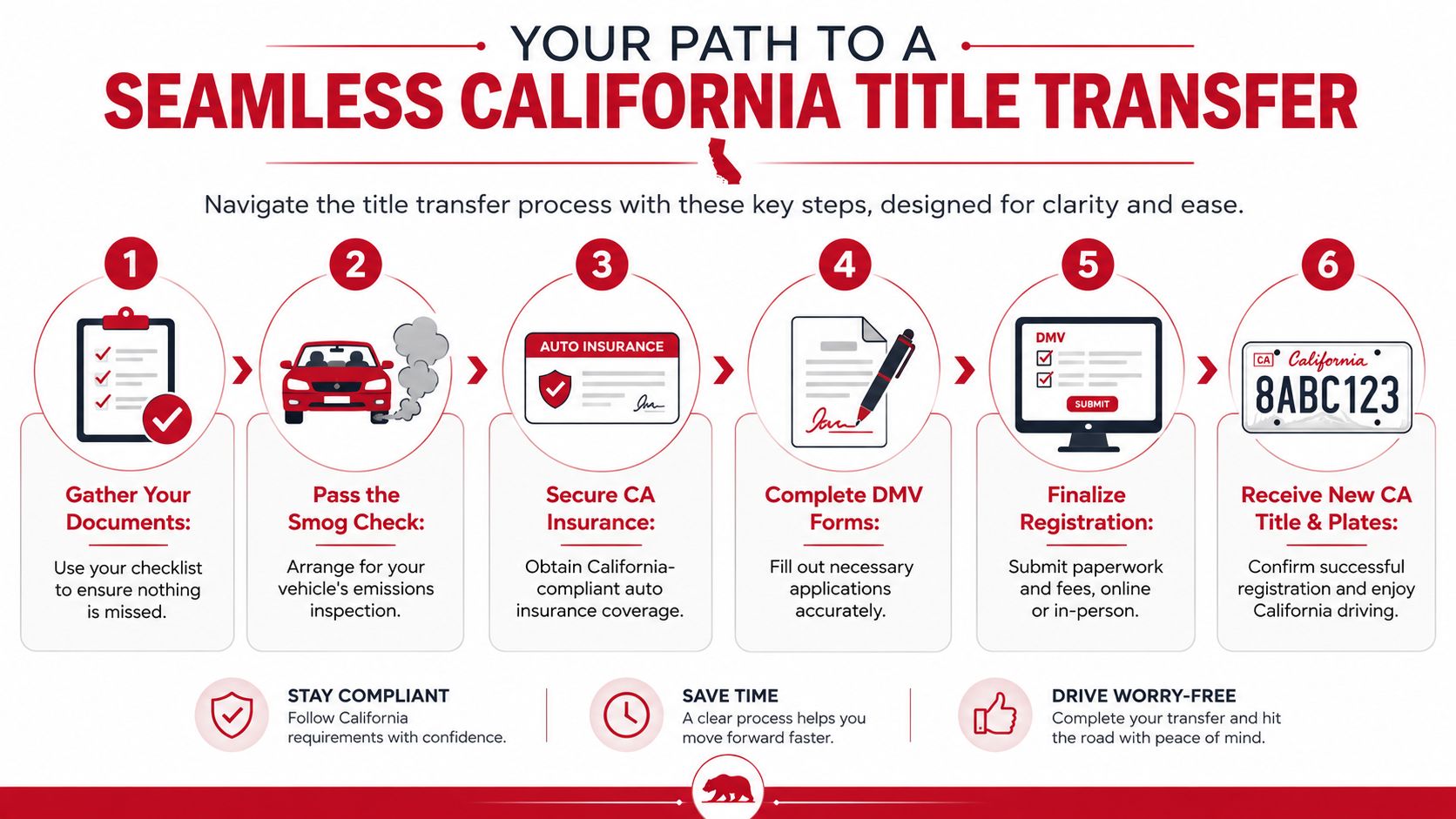
The process goes much better when you handle it in the order DMV staff and verification partners see every day. The usual filing packet includes Form REG 343, the original out-of-state title, a VIN verification on Form REG 31, a California smog certificate if your vehicle needs one, and payment for taxes and registration charges. The part the official instructions often gloss over is sequence. If you do the expensive or time-consuming steps before checking ownership problems, you can waste a trip.
Start by confirming the title can actually transfer
Check the title before you book anything.
Look for missing seller signatures, mismatched names, lienholder information that was never released, or a title that was replaced by another document in the prior state. I have seen people complete a smog check and line up at DMV only to learn the title was signed in the wrong place or still showed a bank interest. California will not clean that up for you at the counter. You have to fix it with the seller, lender, or prior state first.
If the ownership chain is not clean, stop there and resolve it before spending time on the rest.
Get the VIN verification done early
For an out-of-state vehicle, California usually wants the vehicle physically verified so the VIN and basic vehicle details match the paperwork. That is where Form REG 31 comes in.
This step causes more repeat trips than people expect because it depends on the vehicle being present and the paperwork matching what is on the car. If the VIN plate is hard to read, the door label is missing, or the title has one digit off, the application can stall until that gets sorted out. If you want a plain-English overview of what the inspector is checking, Fire House Smog has a helpful guide to California VIN verification requirements.
A simple rule helps here. Do not save VIN verification for the same visit when you plan to file everything else unless you are certain the car and documents match.
Complete smog before your final DMV filing
Handle smog before you make the registration trip, not after.
Out-of-state owners often assume a recent inspection from another state will carry over. California does not treat it that way. If your vehicle is one that needs a California smog certificate, DMV will expect that result to already be on file when you finish the registration. At Fire House Smog, this is usually the point where people get frustrated, because they thought they were one signature away from being done and instead learn the vehicle still needs a California test.
The trade-off is simple. Doing smog earlier adds one errand up front, but it prevents a failed DMV visit later.
Submit the application with a complete packet
Once the title is clean, the VIN is verified, and smog is handled if required, bring the full packet for final processing:
- Form REG 343
- The original out-of-state title
- Completed VIN verification on Form REG 31
- Smog certification, if required
- California insurance information
- Payment for fees and taxes
Small mistakes matter here. A blank odometer field, a name that does not match your ID, or a title signed with cross-outs can send the file back for correction.
Here is the order that usually saves the most time:
| Best order | Why it works |
|---|---|
| Review the title first | Catches deal-breaking ownership issues before you spend time elsewhere |
| Do the VIN verification | Identifies mismatches while the vehicle is available for inspection |
| Complete the smog check if required | Prevents the last-step registration stall that catches many new residents |
| Fill out REG 343 carefully | Reduces avoidable clerical rejections |
| Go to DMV or registration partner with everything ready | Gives the clerk one complete file instead of a partial application |
In practice, the hard part is rarely the law itself. It is the missing signature, the unreadable VIN, or the smog step left for last.
Understanding California's Smog Check Requirement
A lot of out of state transfers stall at smog. The owner has the title, the forms, the insurance, and then learns California will not finish registration until the vehicle clears emissions.
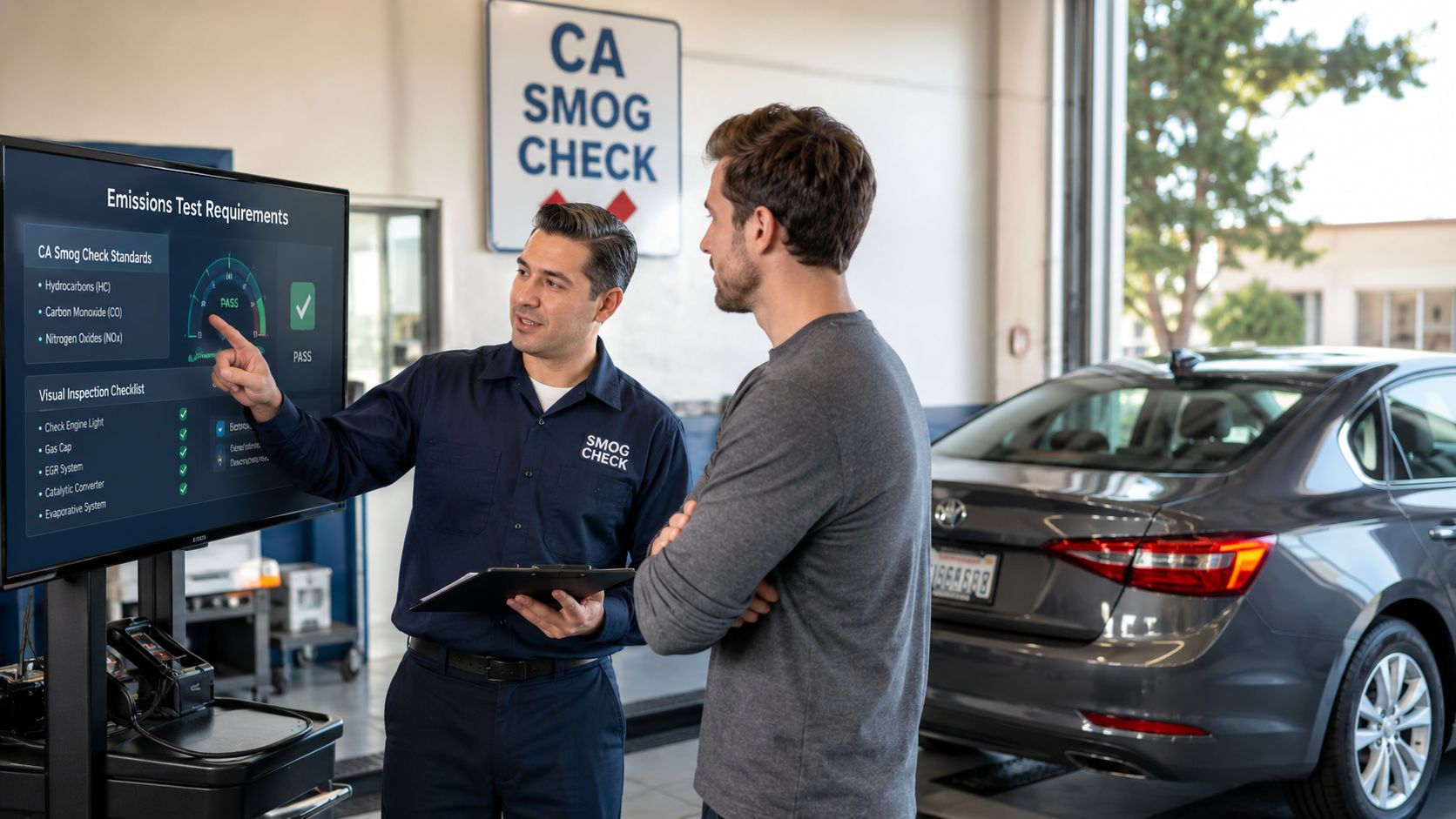
For most out of state vehicles being registered in California, a California smog certification is required before the transfer can be completed. The test has to be done at a California-licensed station, and some vehicles are directed to a STAR-certified station. The DMV summary sounds simple. The part it does not spell out is what usually goes wrong on the ground: people rely on an old test from another state, test the car too late, or assume their vehicle is exempt without confirming the rule that applies to their model year and fuel type.
Which vehicles usually need it
Start with the practical assumption that your vehicle needs a smog check unless you know it falls into an exemption. Electric vehicles are commonly exempt. Older vehicles can also fall outside the requirement based on model year and fuel type.
That is the point people should verify early.
If you drive a gasoline vehicle, a diesel vehicle, or a hybrid, and it is not clearly exempt, plan for a California smog check as part of the transfer. That keeps you from building the rest of the file around a guess.
What a STAR station changes
A STAR station is not just a regular shop with a different sign. It is a station that meets California's tighter program standards for certain inspections. If your registration case calls for a STAR inspection, going to a non-STAR shop first wastes time and money because you may have to test again at the correct facility.
That is one of the failure points the DMV website tends to gloss over. The rule is easy enough to read. The frustrating part is learning you tested at the wrong place only after you are trying to wrap up registration.
Using a shop that handles these transfer cases every day helps because staff can flag those issues before you start. At Fire House Smog, the station is STAR-certified, test-only, and also provides DMV registration services, so a new California resident can get the smog done and then finish the registration step in the same place once the paperwork is ready.
Before you go further, this video gives a helpful visual sense of the smog process and what drivers should expect.
What to do if the vehicle doesn't pass
A failed test does not kill the title transfer. It delays final registration until the emissions problem is corrected.
The first job is to read the failure report carefully and find out whether the issue looks like overdue maintenance, a sensor problem, or a repair issue that needs diagnosis. At a test-only station, the result is usually easier to trust because the shop is not trying to sell the repair in the same visit. That matters when you are deciding what to fix first and whether the car is worth further work.
One practical mistake to avoid is going straight to the DMV after a failed test and hoping the clerk can make an exception. They cannot finish the registration without a passing result when smog is required.
Treat smog as a gatekeeper item. Once it is handled correctly, the last registration step gets much easier.
Navigating Common Transfer Complications
Straightforward transfers move well. The difficult ones usually fail for predictable reasons.
According to expert data on California out-of-state transfer failures, approximately 30–40% of out-of-state title transfers face initial rejection due to documentation gaps, most often a missing valid smog certificate, incomplete REG 343 sections, or missing VIN verification on REG 31. The same source notes that when a vehicle has a lien, obtaining the title from the out-of-state lienholder can add 2–4 weeks to the process.
That tracks with what causes the most stress in real life. It's usually not a mystery rule. It's an incomplete chain of ownership or a record that California can't immediately accept.
When the title isn't clean and ready
A title can be “missing” in more than one way.
Sometimes the owner can't find it. Sometimes the lender still holds it. Sometimes the seller signed part of it but not all of it. Leased vehicles can create another version of the same problem because the registered user and the legal owner aren't always the same party on paper.
When that happens, don't rush into the DMV hoping they'll sort it out from your registration card. They usually need actual ownership documentation that supports the transfer.
Common trouble spots include:
- Active liens: The lender may need to release the lien or provide title-related paperwork before California can issue a clean new title.
- Seller errors: Missing signatures, name mismatches, or incomplete transfer sections can stop the filing.
- Lost title situations: You may need to work back through the original state or lienholder before California can finish the conversion.
- Leased vehicles: The leasing company's role changes the document path, so confirm what ownership papers they require before you schedule anything.
Why electronic titles create delays
Electronic title systems create a newer kind of problem. A driver assumes the title exists because the prior state shows ownership electronically, but California may still need a physical title or a paper version issued through the originating state's process.
The verified data specifically notes that e-title incompatibility is a growing bottleneck and that California does not universally accept out-of-state e-titles without additional verification steps. In practical terms, this means a transfer can stall even when ownership is legitimate, because the paperwork format isn't yet usable.
If your prior state used an electronic title, verify early whether a paper title must be requested. That question can save weeks.
The important takeaway is that complications aren't random. They fit patterns. If your vehicle has a lien, an electronic title, a lease structure, salvage history, or title gaps, pause and solve the ownership record before you worry about counter service speed.
Skip the DMV Line and Finalize Your Registration
Individuals can handle the forms. What they want to avoid is the long, uncertain final step.
That's the part where a licensed registration service changes the experience. Instead of making the DMV counter your only option, you can use a provider that's authorized to process registration work after the vehicle clears the required compliance pieces.
What an easier final step looks like
For many Antioch-area drivers, the most practical route is to complete the smog inspection, bring the ownership paperwork together, and finalize the registration side through a local DMV service provider rather than waiting for a traditional office appointment.
A provider offering DMV registration services near Antioch can handle renewals, ownership transfers, and related registration tasks on site when your documents are in order. That matters because the final step of an out of state title transfer is rarely difficult in theory. It's difficult because of lines, scheduling, and avoidable return trips.
Local details that matter
If you're in East Contra Costa County, the practical details are straightforward:
- Location: 2900 Lone Tree Way, Antioch, CA 94509
- Phone: 925-754-1600
- DMV service hours: Monday through Saturday 9:30 AM to 5:00 PM, Sunday 12:00 PM to 4:00 PM
- Smog availability: Seven days a week, with extended evening and weekend coverage
- Service type: STAR-certified test-only smog inspections and licensed DMV registration services
- Vehicle scope: Cars, trucks, and some RVs, subject to equipment and size limits
The on-the-ground advantage is simple. You can deal with emissions compliance and registration-related processing through the same location, and the test-only setup avoids the tension that comes with mixing diagnostics, repair sales, and paperwork under one roof.
For a new resident, that often makes the whole process feel more manageable. You're not guessing which step to do next. You're finishing the transfer with a complete packet and a shorter path to plates, stickers, and updated California records.
If you want a practical place to handle the smog and registration side of an out of state title transfer, Fire House Smog offers STAR-certified smog checks and licensed DMV registration services at 2900 Lone Tree Way in Antioch. Call 925-754-1600 to confirm your vehicle type, paperwork needs, and current DMV service availability before you stop by.
A STAR-certified smog check is California's higher-standard emissions test for certain vehicles the DMV directs to special stations, and the program has been in effect since January 2013. About 60% of active smog stations have been accepted into the STAR program, but only those stations can inspect many directed vehicles and gross polluters.
You open your registration notice, scan the page, and then stop at the line that says your car needs a STAR station. Most drivers have the same reaction. What does that even mean, and did something go wrong with your car?
Usually, this notice doesn't mean you did anything wrong. It means California wants a more closely controlled inspection for your vehicle. For a worried car owner, that can feel intimidating at first. In practice, it's a quality-control system designed to produce a more trustworthy result.
What confuses people most is that “STAR” sounds like marketing language. It isn't. It's a state certification tied to station performance, equipment standards, and inspector accuracy. And if you're looking at a STAR Test-Only station, there's another layer that matters to you as a consumer. That shop can inspect your car, but it can't sell you the repair.
That difference is a big deal. It changes the test from a sales opportunity into something much closer to an audit. If you want peace of mind that the result is based on your car's actual emissions, not on a repair estimate waiting in the background, that model makes a lot of sense.
Table of Contents
- Introduction That Confusing DMV Notice
- What Is the California STAR Program
- STAR Test-Only vs STAR Test and Repair Stations
- Why Your DMV Notice Says STAR Station Required
- Passing Your STAR Smog Test A Step-by-Step Guide
- After the Test Understanding Your Results
- Get Your STAR Certified Smog Check in Antioch
Introduction That Confusing DMV Notice
If you're searching for what is STAR certified smog, you're probably dealing with a DMV renewal notice that feels more cryptic than helpful. You just want to renew your registration, and suddenly the state is telling you where your car has to be tested.
That's a common situation. A STAR-certified smog check is a higher-standard California emissions inspection required for certain vehicles, usually because the DMV wants the test done at a station with tighter oversight and stronger performance standards.
Why this catches drivers off guard
The concept of a regular smog check is well-known. The confusing part is the added STAR label. Drivers often wonder if their car has been singled out, whether it already failed somewhere behind the scenes, or whether the test will be harsher.
In plain language, the state is trying to make sure some vehicles get checked at stations that have proven they can produce reliable results. That's the main idea.
Practical rule: If your notice says STAR station required, don't shop for any smog shop. Shop specifically for a STAR-certified station, and if you want the most neutral setup, look for STAR Test-Only.
What most people really want to know
When a customer asks me about STAR, the main questions are usually these:
- Why my car? Did the DMV flag something specific?
- Is this different from a regular smog check? Yes, the station standards are different.
- Can I still pass? Absolutely, if the vehicle is in compliance.
- Should I use a test-only station? If you want a cleaner separation between inspection and repair, many drivers prefer that route.
By the end of the process, the goal is simple. You want a result you can trust, whether your car passes or needs work.
What Is the California STAR Program
A California smog check is only helpful if the result is trustworthy. The STAR program was built around that idea.
California launched STAR in January 2013 as part of a broader update to the Smog Check system. Under the program, the Bureau of Automotive Repair certifies stations that meet tighter standards for testing equipment and inspector performance, as described in the California Senate Smog Check fact sheet/index.pdf).
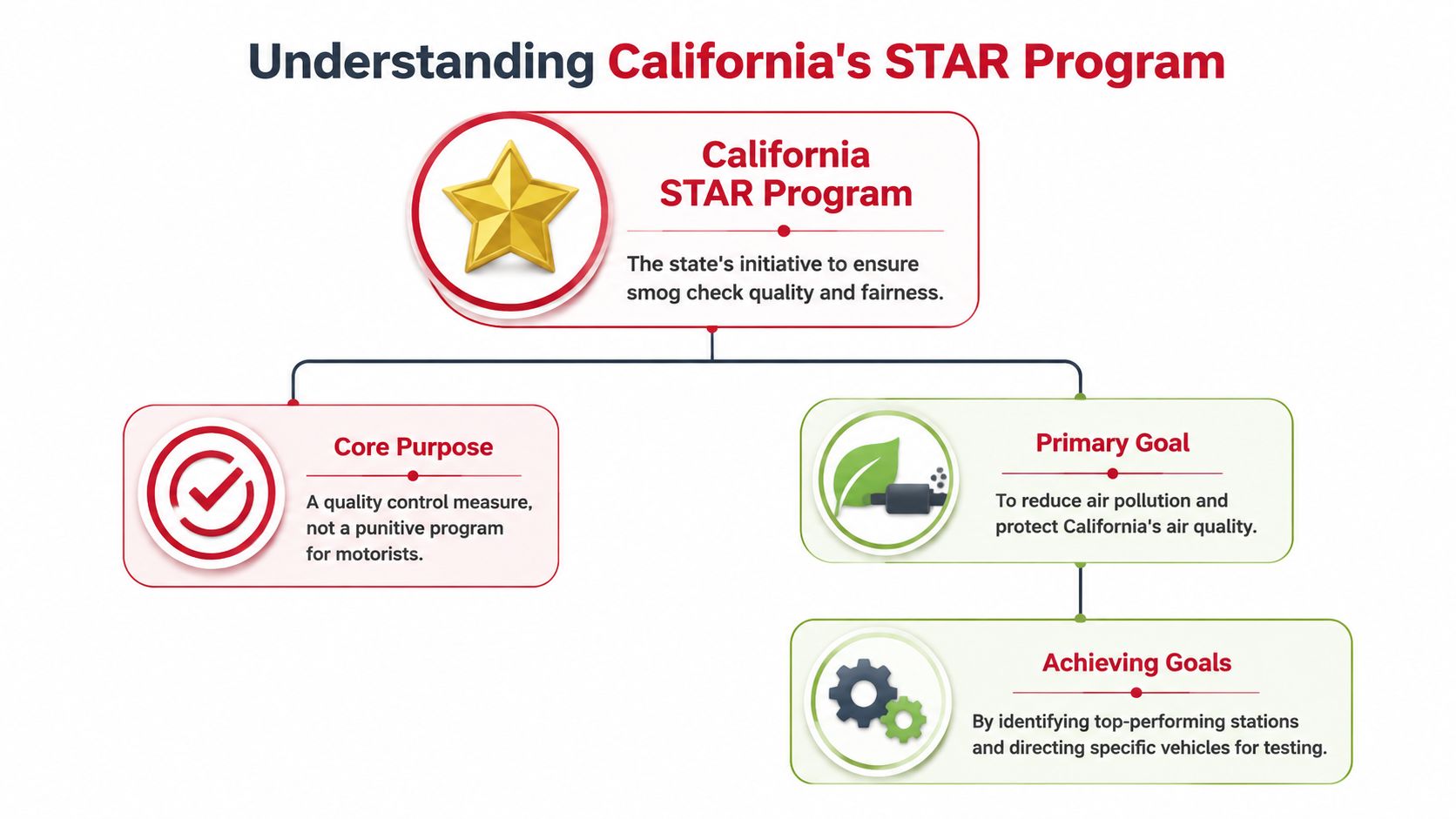
For a vehicle owner, the easiest way to understand STAR is this. It works like an extra layer of quality control. The state uses it to make sure certain vehicles are inspected at stations with stronger oversight, so the result carries more weight.
That consumer-protection angle is easy to miss. Many drivers hear "STAR" and assume it means a tougher version of the same test. In practice, it is also a way to reduce doubt about the inspection itself, especially when the state wants a cleaner, more dependable reading.
What STAR is actually designed to do
STAR helps California monitor vehicles that may need closer attention, including directed vehicles and gross polluters, according to the same fact sheet. In plain English, those are the cars the state wants checked in a more controlled setting because accuracy matters more with them.
That is why many drivers prefer the STAR Test-Only model when it is available to them. A test-only station inspects the vehicle but does not sell the emissions repair. The setup feels more like an audit than a sales appointment. For owners, that can provide real peace of mind because the station's job is to measure and report, not diagnose and fix in the same visit.
If you want more background on the rules your vehicle is being measured against, this overview of California vehicle emissions standards connects the smog check process to the state's clean-air requirements.
What STAR means in plain English
For the average owner, the STAR label means the station operates under tighter state scrutiny. A smog test is only useful if the result is dependable. A pass should mean your car met the standard. A fail should point to a real emissions problem, not a sloppy inspection or a questionable call.
Here's a simple breakdown:
| Term | Plain-English meaning |
|---|---|
| Regular smog station | Can inspect many vehicles, but not every DMV-directed one |
| STAR station | Meets higher state standards and can inspect certain directed vehicles |
| Directed vehicle | A vehicle the DMV requires to be tested at a STAR station |
| Gross polluter | A vehicle emitting far above legal limits |
The key idea is reliability. California does not just want more smog tests. It wants credible tests, especially for the vehicles most likely to create pollution problems or raise questions about the accuracy of the result.
So when someone asks, what is STAR certified smog, the best answer is broader than a definition. It is a state-run quality-control system that helps protect consumers by steering certain cars to stations held to a higher standard. And when that inspection happens at a STAR Test-Only station, many owners feel more confident that the result is unbiased.
STAR Test-Only vs STAR Test and Repair Stations
You pull into a STAR station because your DMV notice says you need one. Then you see two labels that sound almost the same: STAR Test-Only and STAR Test and Repair. That is where many owners pause, because the difference affects more than convenience. It affects how independent the inspection feels.
What a STAR Test-Only station does
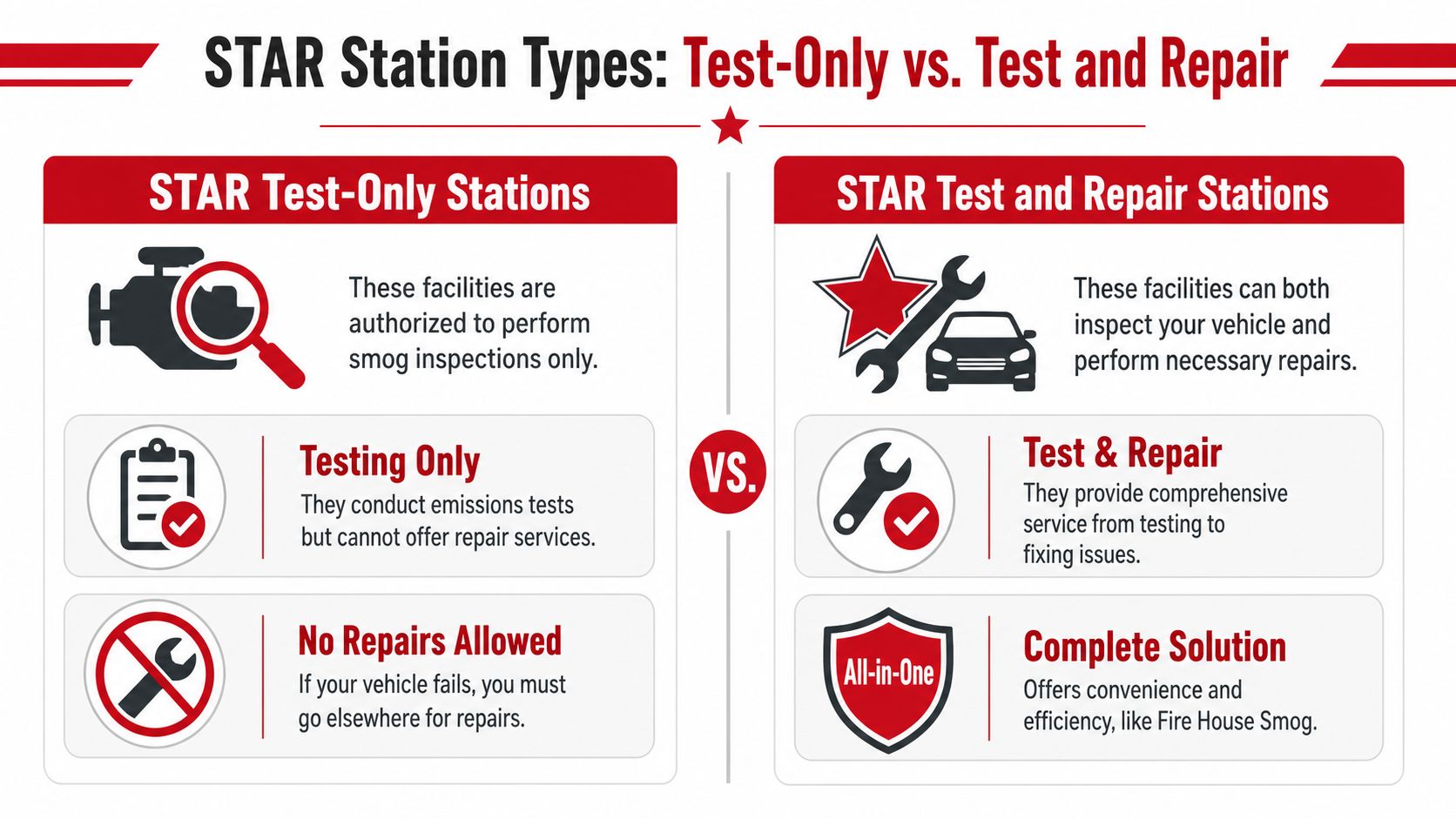
A STAR Test-Only station inspects the vehicle and reports the result. It does not perform emissions repairs, as explained in this overview of the STAR smog check station program.
That business model matters.
If the shop cannot sell you the repair, the test works more like an audit. The technician's job is to measure what the car is doing, document it correctly, and send the result to the state. For many drivers, that removes a layer of doubt. You are not wondering whether a failed test might turn into a repair estimate five minutes later.
If you want a practical breakdown of how that setup works, this guide to STAR-certified test-only centers explains the process in plain language.
What a STAR Test and Repair station does
A STAR Test and Repair station can do both jobs. It can inspect your car, diagnose the problem if it fails, and complete the repair work.
Some owners prefer that one-stop setup. If your vehicle has an issue, you may be able to move from test to repair without visiting a second shop. That can save time.
Still, the structure is different from test-only. The same business that finds the problem can also sell the fix. Many honest shops operate this way, but some drivers are more comfortable separating those roles.
Why many owners see test-only as the cleaner model
The strongest consumer-protection benefit of the STAR system shows up here. A STAR Test-Only station gives you a result without a repair sale attached to it.
A simple comparison helps:
- Test-Only works like an independent inspection.
- Test and Repair works like an inspection plus repair option.
Both are legitimate. The question is what gives you more confidence.
If your main concern is trust, the test-only model often feels safer because the station does not profit from failing the car and then fixing it. That is why many directed vehicle owners view STAR Test-Only stations as more than a category on a sign. They see them as a safeguard built into the smog check system.
A side-by-side comparison
| Station type | Can inspect | Can repair | Main consumer question |
|---|---|---|---|
| STAR Test-Only | Yes | No | “Am I getting an independent result?” |
| STAR Test and Repair | Yes | Yes | “Do I want the test and repair in one place?” |
The same SmogTips guide notes that California uses the test-only model for many vehicles in Enhanced Smog Check Areas. That fits the larger purpose of STAR. The program is not only about identifying higher-risk vehicles. It also gives owners a way to get an audit-style emissions check that feels fair, separate, and easier to trust.
For a concerned car owner, that peace of mind is a big part of what STAR certified smog really means.
Why Your DMV Notice Says STAR Station Required
The short answer is that your vehicle has been directed to a STAR station. The DMV didn't print that by accident. It means the state wants your car inspected at a station that has shown stronger performance in identifying emissions failures.
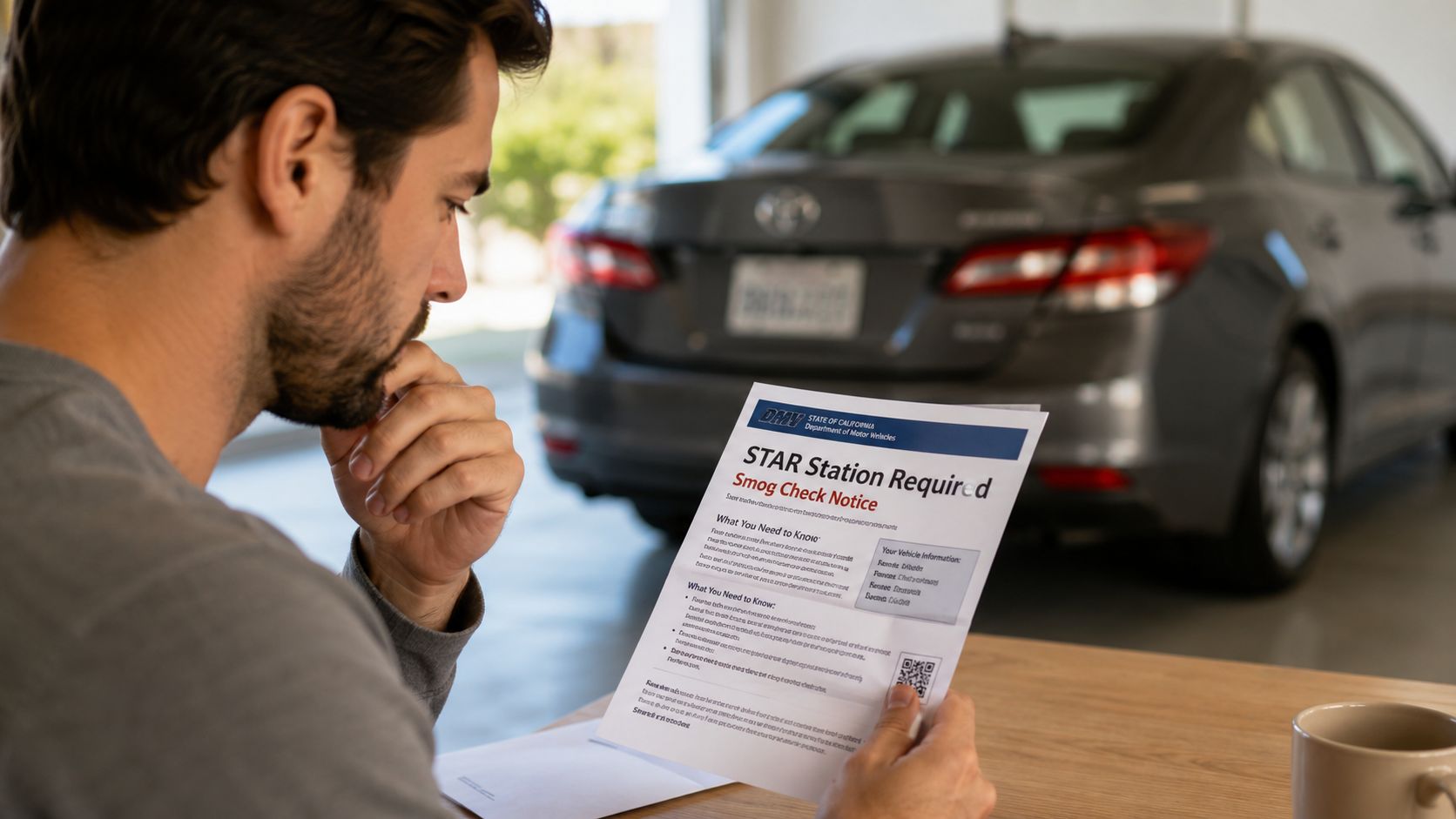
What “directed vehicle” means in plain language
A directed vehicle is one the system routes to a STAR station instead of letting it go to any regular smog shop. That can happen because of the car's prior test history or because similar vehicles are more likely to fail.
This part is important. The state isn't necessarily saying your car is bad. It's saying your car falls into a category where the inspection should happen at a station with a stronger record for catching real emissions problems.
The hidden metric most drivers never hear about
One reason STAR certification is harder to earn is a performance standard called Similar Vehicle Failure Rate, or SVFR. To qualify for STAR certification, a station's SVFR must be at least 50% of the industry-wide failure rate for similar vehicles, according to California regulation 16 CCR 3392.2.
That sounds technical, so let's translate it.
If a certain kind of vehicle commonly has emissions problems, the BAR wants STAR stations to show they are identifying those failures at a meaningful rate. In other words, STAR stations aren't supposed to pass everything. They're supposed to catch the vehicles that should fail.
STAR stations are selected with data. The point isn't to be tougher for the sake of being tougher. The point is to be more accurate with vehicles that carry more emissions risk.
A short visual walk-through can help if you want to see how the requirement works in practice:
Why that should reassure you
Drivers often read “STAR required” as a warning. A better way to read it is this: the state wants the result to come from a station with a verified track record.
That matters whether your car passes or fails. If it passes, you can feel more confident the vehicle is fully compliant. If it fails, you have a more credible reason to investigate the problem instead of wondering whether the result was sloppy or rushed.
Passing Your STAR Smog Test A Step-by-Step Guide
You pull into a STAR station with your DMV notice on the passenger seat, and one question is usually running through your mind: what exactly are they going to do to my car?
The good news is that a STAR smog check is not a mystery inspection. It follows a set process, and at a STAR Test-Only station, that process works a lot like an audit. The station's job is to measure and verify, not to sell you a repair. For many drivers, that separation is what makes the experience feel fair.
Before you go
The easiest way to avoid surprises is to show up with the car in normal driving condition.
If your Check Engine light is on, handle that first. That light means the car has already detected a problem, and a smog inspection is likely to catch it too. Going in anyway usually wastes time and adds stress.
It also helps to arrive with the vehicle warmed up. A short drive before the test gets the engine and emissions system to normal operating temperature, which gives the car the right conditions for inspection.
A simple pre-test checklist helps:
- Drive the car first: A normal trip before the appointment helps warm the engine and emissions components.
- Look at the dashboard: Warning lights can signal a problem that needs attention before testing.
- Pay attention to how the car feels: Rough idling, hard starts, or other obvious issues are worth addressing first.
- Bring your notice or registration information: That helps the station confirm the correct inspection for your vehicle.
What happens during the test
The exact procedure depends on the vehicle's model year and system type, but the flow is usually easy to follow.
Vehicle identification
The technician confirms the VIN, license plate, and inspection requirement so the right test is performed.Visual inspection
Emissions-related parts are checked for missing, disconnected, or altered components.Electronic and system checks
For many vehicles, the technician connects to the onboard diagnostic system to see whether the car has reported emissions faults or incomplete monitors.Tailpipe or functional testing, when required
Some vehicles need additional measurement or equipment checks based on their age and configuration.
That structure matters for a reason. At a STAR Test-Only station, the technician is there to document what the vehicle is doing on that day, the same way an independent inspector checks a home before a sale. That can give you peace of mind because the result is meant to be unbiased.
Why the equipment standard matters
The inspection is only as trustworthy as the equipment being used.
STAR-certified stations use BAR-certified Emission Inspection Systems, and those systems must be calibrated regularly under California regulation 16 CCR 3392.1. That calibration rule helps keep the readings accurate, so the machine is measuring your vehicle instead of reflecting a drifting sensor or poorly maintained test equipment.
In plain terms, the machine should stay on target. That is one more reason many vehicle owners feel more comfortable with the STAR model. The station is being checked, the equipment is being checked, and your car is being checked.
How to make the day easier
A little preparation can make the visit feel routine instead of tense.
- Give yourself extra time: A rushed arrival makes the process feel harder than it is.
- Ask questions if something is unclear: A good technician should be able to explain what type of inspection your car needs and why.
- Bring recent repair records if you have them: They can help clear up questions about emissions-related work or replaced parts.
If your vehicle is running properly, a STAR test should feel straightforward. For drivers sent to a STAR Test-Only station, that is often the biggest comfort of all. You are getting a measured, audit-style answer from a station set up to inspect first and leave sales pressure out of the test.
After the Test Understanding Your Results
Once the inspection is finished, you'll get one of two outcomes. Pass or fail. The emotional reaction can be strong, but the next steps are usually simpler than people expect.
If your vehicle passes
A pass means the vehicle met the inspection requirements. In most cases, the certificate is transmitted electronically to the DMV, and you can move forward with registration.
That's the cleanest outcome, and it's why many drivers want the confidence of a well-run STAR inspection. You're not left guessing whether the result will hold up.
If your vehicle fails
A fail doesn't mean your car is finished. It means the inspection found something that needs correction before the vehicle can be certified.
The first thing to read is the Vehicle Inspection Report, often called the VIR. That report tells you where the problem showed up. Depending on the vehicle and issue, the failure may relate to emissions readings, onboard diagnostics, or emissions equipment concerns.
Use the report this way:
- Read the failure area first: Don't guess at the problem before looking at the VIR.
- Take the VIR to a licensed repair facility: The report gives the repair shop a starting point.
- Return after repairs for retesting: The car has to be checked again after the underlying issue is addressed.
Why a STAR failure is worth taking seriously
The point of the STAR system is not to trap drivers. It's to produce a more dependable inspection result. If a STAR station reports a failure, that result is generally more useful because it comes from a system built around tighter oversight.
In practical terms, a failure can save time. It tells you there's a real emissions issue to fix instead of leaving you with a vague suspicion that the car “might be okay.”
Don't treat a failed STAR test like bad luck. Treat it like a diagnostic checkpoint that found something your vehicle needs.
Some stations, including Fire House Smog, offer a free retest based on site policy and coupon terms. That can make the follow-up easier once repairs are completed.
Get Your STAR Certified Smog Check in Antioch
Your renewal notice shows up, you read “STAR station required,” and the first question is usually simple: where can I get this done without turning a test into a sales pitch?
That is why many Antioch drivers prefer a STAR Test-Only station. The setup works like an audit. The station checks whether the vehicle meets California emissions rules, but it does not have an in-house repair outcome tied to the result. For a car owner, that separation can feel a lot more reassuring. You are there for a clear answer, not a bundled diagnosis-and-repair conversation.
That consumer protection angle matters. A STAR Test-Only visit gives you a cleaner reading of where your car stands today, especially if you want confidence that the inspection result is independent.
What to look for in a local station
A good local option should make the process easier, not more confusing. If your registration deadline is close, small practical details make a real difference.
Helpful features include:
- Test-only operation: The inspection stays separate from repair recommendations
- STAR certification: Needed if your DMV notice specifically requires a STAR station
- Quick service flow: Useful if you need to fit the test into a workday
- On-site DMV support: Helpful if you want to handle registration tasks in one stop
A factual local option
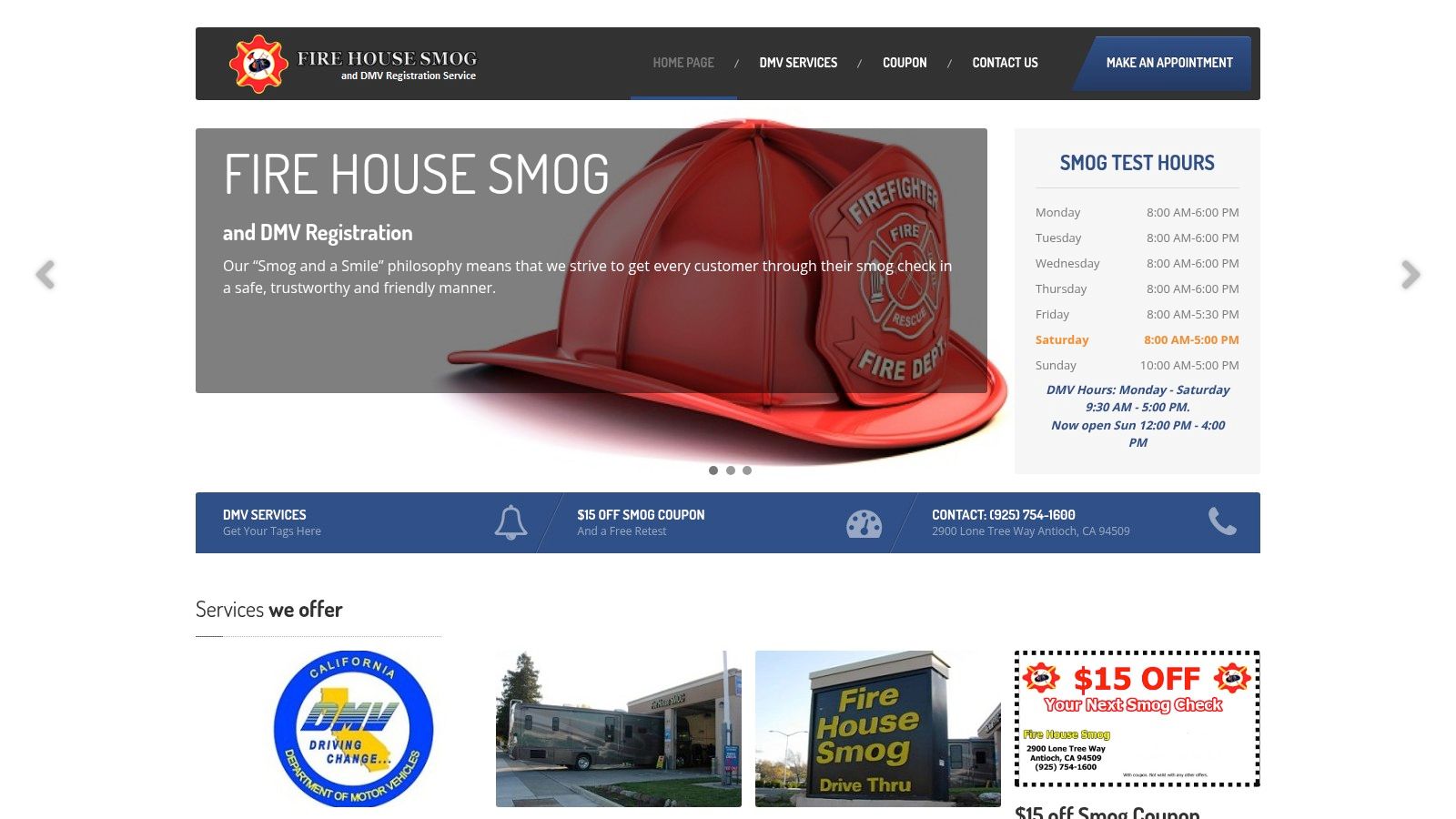
One local choice is STAR smog check service in Antioch, offered by Fire House Smog at 2900 Lone Tree Way, Antioch, CA 94509. The station operates as a STAR-certified test-only smog station, has two service bays, offers testing seven days a week, provides on-site DMV registration services with sticker printing, and can be reached at 925-754-1600 during posted hours.
For a driver trying to make sense of a DMV notice, that combination is practical. You can get the required inspection at a test-only station, keep the result separate from repair sales, and take care of some registration tasks in the same visit.
If you have been asking what STAR certified smog means in real life, this is the plain-English version. It is a tighter, more closely watched inspection process for certain vehicles. At a STAR Test-Only station, it also gives you something many drivers want most: confidence that the test result is unbiased.
Need a STAR-required inspection in Antioch? Fire House Smog provides STAR-certified test-only smog checks and on-site DMV registration services at 2900 Lone Tree Way, Antioch, CA 94509. You can call 925-754-1600 to confirm hours, ask whether your vehicle type can be accommodated, or check current retest and coupon details before you stop by.

Your registration renewal shows up, you open it, and one line jumps out immediately: “Smog Certification Required at a STAR station.” For a lot of drivers, that sentence feels bigger and more complicated than it really is. It sounds like your car has been flagged for something serious, or that you now have to hunt down some special government facility.
Usually, it's much simpler than that.
If you're trying to understand smog test only centers STAR certified, the main thing to know is that California uses different kinds of licensed smog stations for different situations. Some stations only test. Some test and repair. Some are STAR certified, which means they meet stricter performance standards. Once you understand those labels, the whole process gets a lot less stressful.
Table of Contents
- Your DMV Notice Says STAR Station Required Now What
- Decoding the Jargon STAR Certified vs Test-Only
- Test-Only vs Test-and-Repair Which Station Is Right for You
- How to Prepare for Your Smog Check
- Fire House Smog Your Antioch STAR Certified & DMV Partner
- Frequently Asked Questions About Smog Checks
Your DMV Notice Says STAR Station Required Now What
First, take a breath. A STAR requirement doesn't automatically mean you did anything wrong, and it doesn't mean your car is being “punished.”
California built the STAR program to make emissions testing more reliable in the areas where cleaner air enforcement matters most. More than two-thirds of smog check stations in California are STAR certified, which makes STAR the normal standard in much of the state, not some rare exception. The state's transportation materials explain that the program exists so vehicles with a higher potential to contribute to smog are tested at facilities with proven reliability through the California Senate smog check program overview.
That's why this line appears on so many renewal notices. It's an administrative sorting system, not a character judgment on your vehicle.
What the notice is really telling you
The notice is saying one thing: go to the right kind of licensed station.
That's where people get tripped up. Drivers often mix up these separate ideas:
- STAR certified means the station meets stricter state performance standards.
- Test-only means the station performs inspections only and doesn't do repairs.
- Test-and-repair means the station can inspect the car and also fix it if needed.
A station can be STAR certified and still be either test-only or test-and-repair.
Practical rule: Read the DMV notice carefully. If it says STAR station, focus first on finding a STAR-certified shop. Then confirm whether your vehicle specifically needs test-only service or whether any STAR station will work.
Why people overcomplicate this
A lot of first-time customers assume “STAR required” means they must go to the most restrictive option available. That isn't always true. Some vehicles do need a specific type of STAR station. Others only need any station within the STAR program.
What matters most is choosing a station that matches your notice and your situation. If your car has been running fine and you want a neutral inspection with no repair sales attached, a test-only center often feels simpler and more comfortable.
Decoding the Jargon STAR Certified vs Test-Only
These two terms sound similar, but they answer different questions.
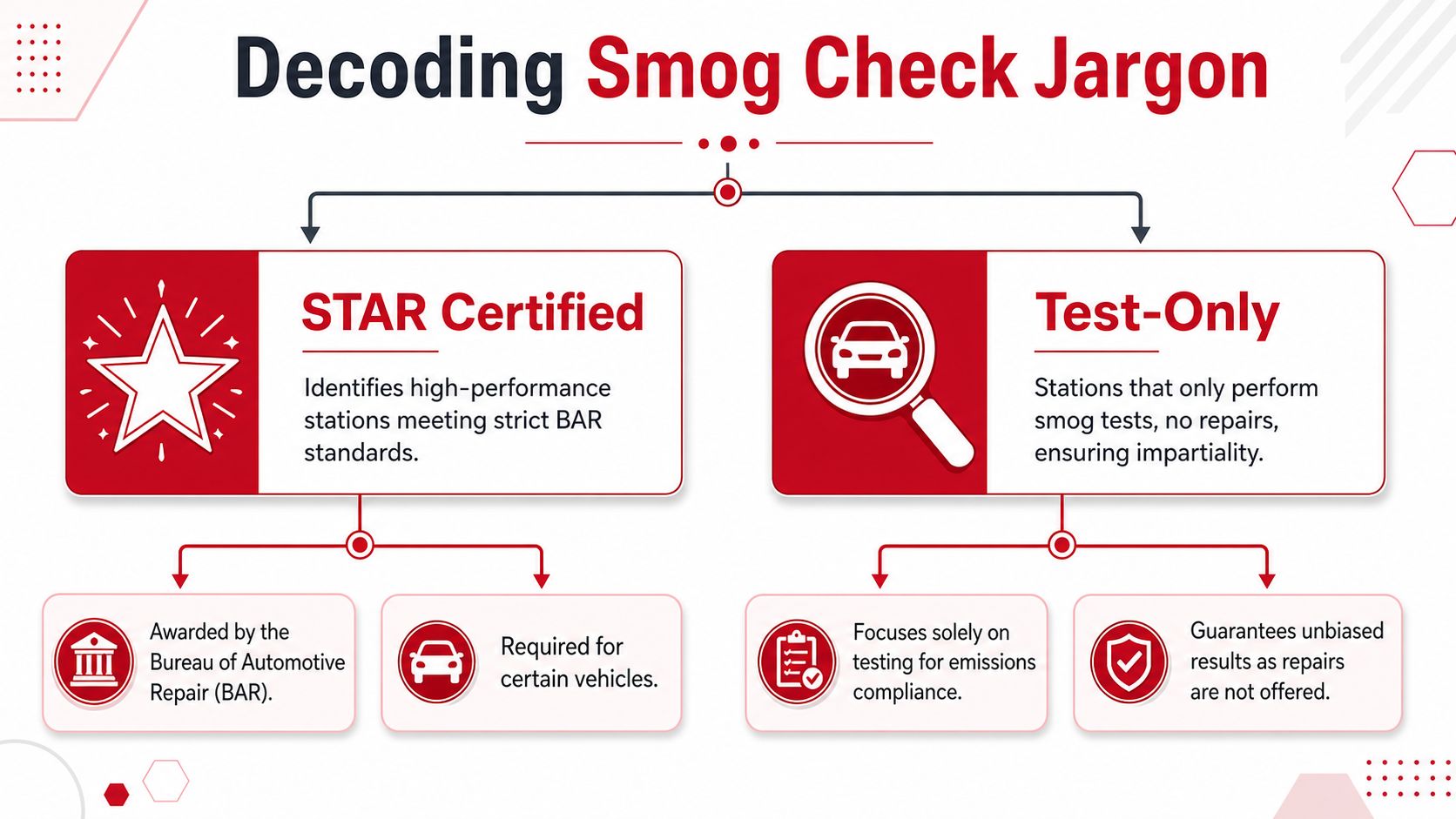
STAR certified answers: How is the station approved?
Test-only answers: What is the station allowed to do?
What STAR certified really means
Think of STAR certification like a higher-performance license category. The Bureau of Automotive Repair uses it for stations that meet stricter operational and accuracy standards than regular stations.
For some vehicles, that higher standard isn't optional. BAR states that STAR-certified test-only centers are authorized to inspect directed vehicles and gross polluters that ordinary test-and-repair stations can't handle, and the program requires these facilities to exceed baseline accuracy thresholds, including a long-term Fail-to-Pass Rate score of at least 0.40 through the BAR STAR certification requirements.
That sounds technical, but the takeaway is simple. California wants certain vehicles inspected at stations with stronger testing performance.
What test-only means in practice
A test-only center is exactly what it sounds like. The shop inspects the car, reports the result, and certifies it if it passes. The shop does not repair smog failures.
That separation matters because it removes the repair sale from the inspection itself. If the shop can't sell you a catalytic converter, oxygen sensor, or emissions repair, there's less reason for you to worry about pressure or upsells.
A test-only station functions like a diagnostic checkpoint. Its job is to measure and verify, not to sell the fix.
That's why many drivers prefer smog test only centers STAR certified when they want a neutral result. If the car passes, you're done. If it doesn't, you leave with a report and take the car to a repair shop of your choice.
A quick way to remember the difference
Use this shortcut:
- STAR certified = the station meets stricter state standards.
- Test-only = the station inspects but doesn't repair.
- STAR test-only = a shop with stricter approval standards that also stays separate from repair sales.
For a first-time customer, that last category often feels the clearest. You know why you're there, and you know what the station can and can't do.
Test-Only vs Test-and-Repair Which Station Is Right for You
This decision usually comes down to one question: Do you want a neutral inspection first, or do you want repair convenience if the car fails?
Both station types are legitimate. The better choice depends on your car's condition, your schedule, and how much risk you think there is of a failure.
When a test-only station makes sense
A STAR test-only center fits well when you believe the car is in decent shape and you want a straightforward inspection with no repair sales attached.
That's especially appealing if you've already handled maintenance, recently completed repairs elsewhere, or just want a clean yes-or-no answer from a station that isn't trying to turn the visit into a repair estimate. If you want an example of that kind of setup, this Antioch test-only smog center shows the typical model.
Common reasons drivers choose test-only:
- They want impartiality: The station has no in-house repair revenue tied to the result.
- They already fixed the car elsewhere: They only need certification.
- They value speed: Test-only shops often focus their workflow on inspections rather than repair scheduling.
When a test-and-repair station may be easier
The tradeoff shows up if the vehicle fails.
A test-and-repair station can inspect the vehicle, diagnose the issue, perform emissions-related work, and then retest on site. A test-only station can't do that. If your car fails at a test-only shop, you'll need to leave, get repairs somewhere else, and come back for another inspection.
That “two-stop” process is the part many guides skip. The SmogTips explanation of the STAR station program points out that test-only failures often create extra delay and added cost because repairs and recertification happen in separate places.
If your car has a history of check-engine problems, rough running, or recent emissions repairs, the convenience of a test-and-repair station can outweigh the neutrality of test-only.
STAR Test-Only vs. STAR Test-and-Repair at a Glance
| Feature | STAR Test-Only Center (e.g., Fire House Smog) | STAR Test-and-Repair Station |
|---|---|---|
| Main job | Performs inspections and certifications only | Performs inspections, repairs, and recertification |
| Repair sales | None on site | Repairs available on site |
| Bias concern | Lower, because no repairs are sold | Some drivers prefer a separate tester |
| If the vehicle passes | You're finished | You're finished |
| If the vehicle fails | You must go elsewhere for repairs, then return for retest | Repairs and retest may happen in one location |
| Best fit | Drivers who want a neutral inspection | Drivers who want repair convenience |
For many people, the practical answer is simple. If the car seems healthy, test-only can feel clean and low-pressure. If you suspect a problem, test-and-repair may save time.
How to Prepare for Your Smog Check
The easiest smog check is the one you show up ready for. Most of the stress comes from uncertainty, not the inspection itself.
A common point of confusion is whether every STAR-directed vehicle must go to a test-only center. That's not always the case. A discussion often referenced by California drivers notes that about 1.9% of vehicles are randomly selected for STAR testing, and most of those aren't gross polluters, which means many drivers can use a regular STAR station rather than hunting only for test-only service, as summarized in this California STAR testing discussion.
Before you leave home
Give yourself a better shot at a smooth visit with a few simple checks:
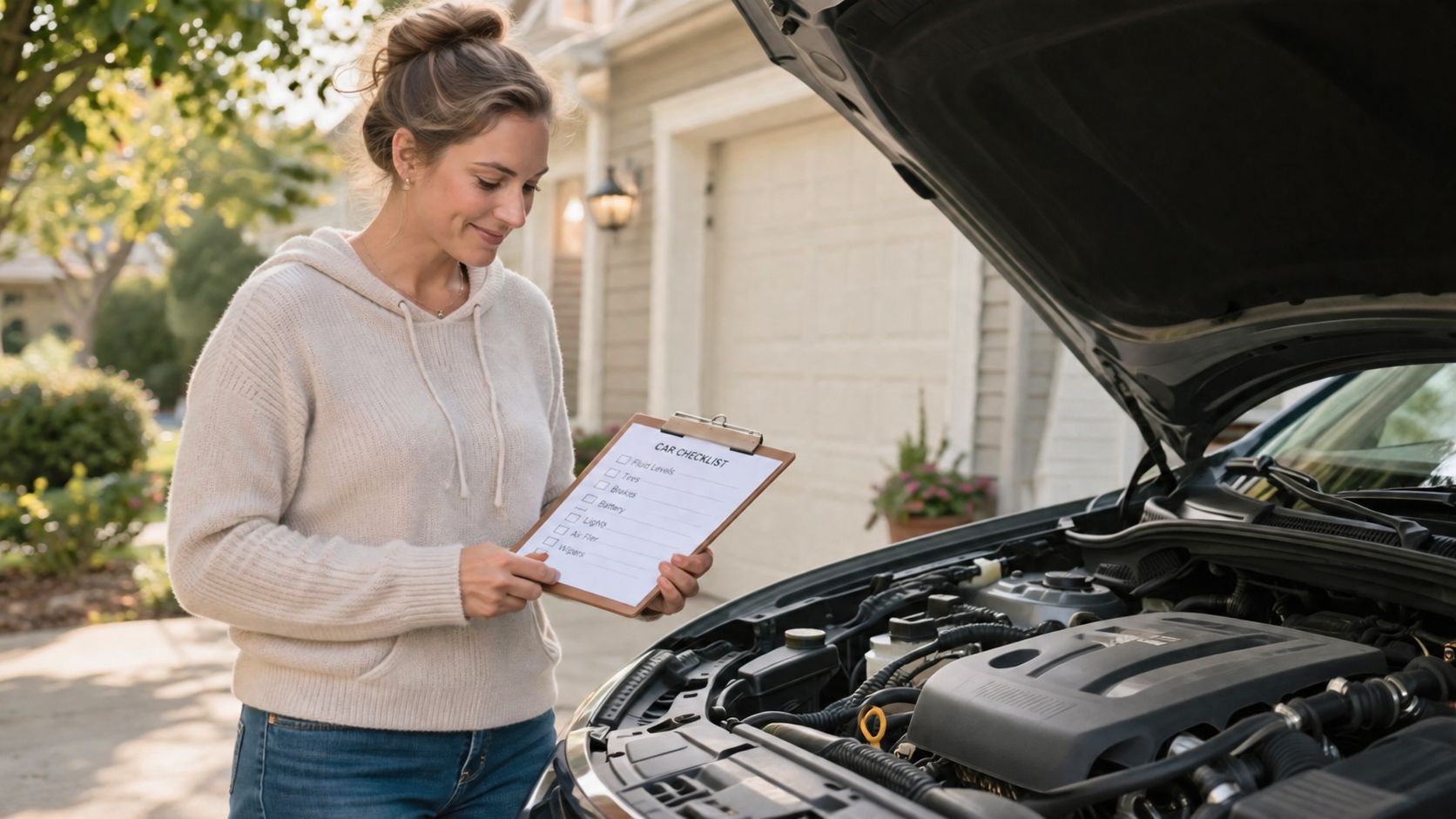
- Watch the dashboard: If the Check Engine light is on, don't assume the car will “probably be fine.” Have the issue diagnosed first.
- Drive the car first: A short drive before the test helps the vehicle reach normal operating temperature.
- Bring your paperwork: Your renewal notice and current registration details help the station verify what the DMV is asking for.
- Don't guess about station type: If the notice wording is unclear, call the station before driving over.
- Review common failure issues: This guide to smog check fail reasons can help you spot obvious trouble before the appointment.
What the visit usually feels like
Here's the normal customer experience.
You pull in, provide your vehicle information, and the technician confirms what kind of inspection your car needs. The inspection itself may include an electronic systems check, a visual review of emissions-related components, and the required testing procedure for that vehicle type.
If the vehicle passes, the certificate is handled electronically. If it doesn't, you'll receive a report showing what needs attention.
This walkthrough gives a useful visual sense of the process:
Bring the car in the same way you normally drive it. Last-minute tinkering, battery disconnects, or rushed DIY fixes can create more confusion than they solve.
A calm way to think about the appointment
Treat the smog check like a compliance inspection, not a personal test. Your job isn't to outsmart the machine. It's to show up with the right paperwork, a warmed-up car, and realistic expectations.
That mindset alone makes the visit easier.
Fire House Smog Your Antioch STAR Certified & DMV Partner
For Antioch drivers, one practical advantage matters more than almost anything else: finishing the smog check and handling registration without making a second trip.
A test-only model keeps the inspection separate from repair sales. California service information notes that STAR Test Only centers can't perform smog check repairs, which creates a non-bias testing environment, and that typical STAR Test Only pricing ranges from $29.95 to $59.95 plus an $8.25 state certificate fee through this California service listing for STAR Test Only smog checks.
Why the combined service matters
The part many drivers dislike isn't only the smog test. It's the extra errand after the smog test.
A station that also handles DMV registration services can remove that second stop. Fire House Smog offers both test-only smog inspections and on-site DMV services as a licensed business partner, which means a passing vehicle owner may be able to complete the renewal and receive registration materials in the same visit. For local drivers comparing options, this STAR-certified smog test near Antioch page shows the service category.
That combination is useful for:
- Busy commuters: Fewer separate appointments.
- Families with tight schedules: Less waiting around with kids in the car.
- Fleet or multi-vehicle owners: A more predictable paperwork process.
What to expect on site
The location at 2900 Lone Tree Way in Antioch offers smog testing for passenger cars, SUVs, light-duty trucks, and some RVs within equipment limits. The business also operates two service bays, provides smog testing seven days a week, and offers DMV service hours Monday through Saturday, with Sunday availability for limited services, based on the publisher information provided above.
That doesn't guarantee zero wait, but it does mean the workflow is built around quick inspections and registration support rather than repair work.
If you're the kind of driver who wants the inspection kept separate from repairs, while also avoiding a later DMV line, this setup solves both problems in one stop.
Frequently Asked Questions About Smog Checks
What usually causes a failure
The most common issues are usually basic emissions-related problems, not mysterious government traps.
Drivers often run into:
- Dashboard warning lights: Especially the Check Engine light.
- Sensor or emissions component problems: Items like oxygen-sensor-related faults can affect readiness or emissions results.
- Fuel vapor issues: Even something simple like a loose gas cap can create trouble.
- Recent repair resets: If a battery was disconnected or codes were just cleared, the vehicle may not be ready for inspection.
What happens if the car fails at a test-only station
You'll get a report showing the reason for the failure. Then you take the car to a repair shop of your choice, have the issue corrected, and return for a retest.
That's the main downside of test-only service. It protects you from repair upsells during the inspection, but it also means the repair step happens somewhere else.
A failure at a test-only shop doesn't trap you. It just separates the diagnosis result from the repair decision.
How retests work
Retest rules depend on the station's policy. Some drivers assume a return visit is automatic or included no matter what. It's better to ask directly before the first inspection.
For Fire House Smog, the publisher information states that a free retest is available when required, subject to site policy and coupon terms. That means you should confirm the current terms at the counter or when scheduling so there aren't any surprises.
If you're unsure where to go, call ahead, read your DMV notice carefully, and choose the station type that matches both the notice and your comfort level. That's usually all it takes to make a confusing requirement feel manageable.
If you need a neutral smog inspection and want to handle registration in the same visit, Fire House Smog provides STAR-certified test-only smog checks along with on-site DMV services in Antioch. Call ahead if your notice is unclear or if you're bringing a larger vehicle, and confirm current retest and registration-service details before you go.

You open your DMV renewal notice, scan for the amount due, and then spot the line that changes your whole errand list: Smog Certification Required.
That one line raises a bunch of practical questions fast. Why does your car need this now? Why does California seem stricter than other states? What do all those terms like CARB, STAR, LEV, and ZEV mean? Most of all, what do you need to do so you can pass the test, renew your registration, and get back on the road without wasting a day?
California emissions standards can feel like a wall of jargon until you connect the policy to what happens in the bay during a real smog inspection. Once you do that, the system makes more sense. The state sets the rules. Testing stations apply them. Your vehicle either shows it's operating within those limits, or it doesn't.
Table of Contents
- Why Your DMV Renewal Says Smog Check Required
- Decoding CARB and the Alphabet Soup of Emissions
- How California's Rules Differ from Federal Standards
- The Road to 2035 and the Future of Driving in California
- Your Vehicle's Smog Check and the Role of STAR Stations
- A Simple Checklist for Passing Your Smog Test
Why Your DMV Renewal Says Smog Check Required
You open your DMV renewal notice, ready to pay the fee and move on. Then one line stops you cold: Smog Check Required.
For many California drivers, that is the moment state policy stops feeling abstract and starts feeling personal. The registration process pauses until the state gets proof that your vehicle's emissions equipment is still doing its job. In other words, the DMV is not asking whether your car starts and drives. It is asking whether the vehicle still meets the emissions rules tied to its age, design, and equipment.
That connection can feel confusing at first. Registration sounds like paperwork. A smog check sounds like a repair issue. In California, the two are linked. The renewal notice acts like a checkpoint between your car and another registration cycle.
The rules behind that checkpoint come from several parts of the state system, but the practical effect is simple for a driver. If your notice says a smog inspection is required, the DMV needs an up-to-date passing result before renewal can be completed.
The notice is really a compliance checkpoint
A helpful way to look at it is this: your renewal notice is a report card request for the emissions side of the car.
Over time, parts wear out. Oxygen sensors get lazy. Catalytic converters stop cleaning exhaust as well as they should. An EVAP system leak can turn on the check engine light even when the car seems to run fine. California requires periodic checks so those problems do not stay hidden for years while the vehicle remains registered.
That distinction is important because drivers often mix up two different ideas:
- How the car feels to drive
- How cleanly the car is operating according to emissions rules
A vehicle can run "pretty normal" and still fail a smog inspection. That surprises a lot of owners the first time it happens.
Practical rule: A smog check verifies emissions performance, not just basic drivability.
If you are sorting out deadlines, fees, and paperwork at the same time, this guide to California DMV registration renewal requirements can help clarify the registration side of the process.
Why California ties this to registration
California keeps a close eye on vehicle emissions because cars and trucks are a major part of the state's air pollution problem. That is the big-picture reason. Your smog notice is the everyday version of that policy.
But for the driver standing at the mailbox, the more useful takeaway is practical. The state uses the renewal cycle because it is one of the few moments when nearly every vehicle owner has to check in. That makes registration an effective point for verifying emissions compliance.
It also explains why the requirement can feel strict. You are not being singled out. Your notice is part of a statewide system designed to catch emissions problems before another registration period begins.
What to do when you see the notice
Start with the basics. Check whether the vehicle needs a test now, whether the check engine light is on, and whether you recently disconnected the battery or had repairs done. Those details can affect the result.
Then choose the right station. A STAR-certified, test-only station such as Fire House Smog can be especially useful when you want a straightforward inspection without the pressure of upselling repairs. That setup helps many drivers get a clear answer about where they stand before the registration clock runs out.
From the driver's seat, the key points are straightforward:
- The DMV notice is the trigger. It tells you a current passing smog result is required for renewal.
- The inspection checks emissions systems. It is not a general judgment about whether the car feels fine on the road.
- A little preparation saves time. Catching warning signs early can reduce retests, delays, and registration stress.
Decoding CARB and the Alphabet Soup of Emissions
A lot of the stress around California emissions standards comes from the acronyms. They sound technical, but the ideas are manageable once you translate them into plain language.
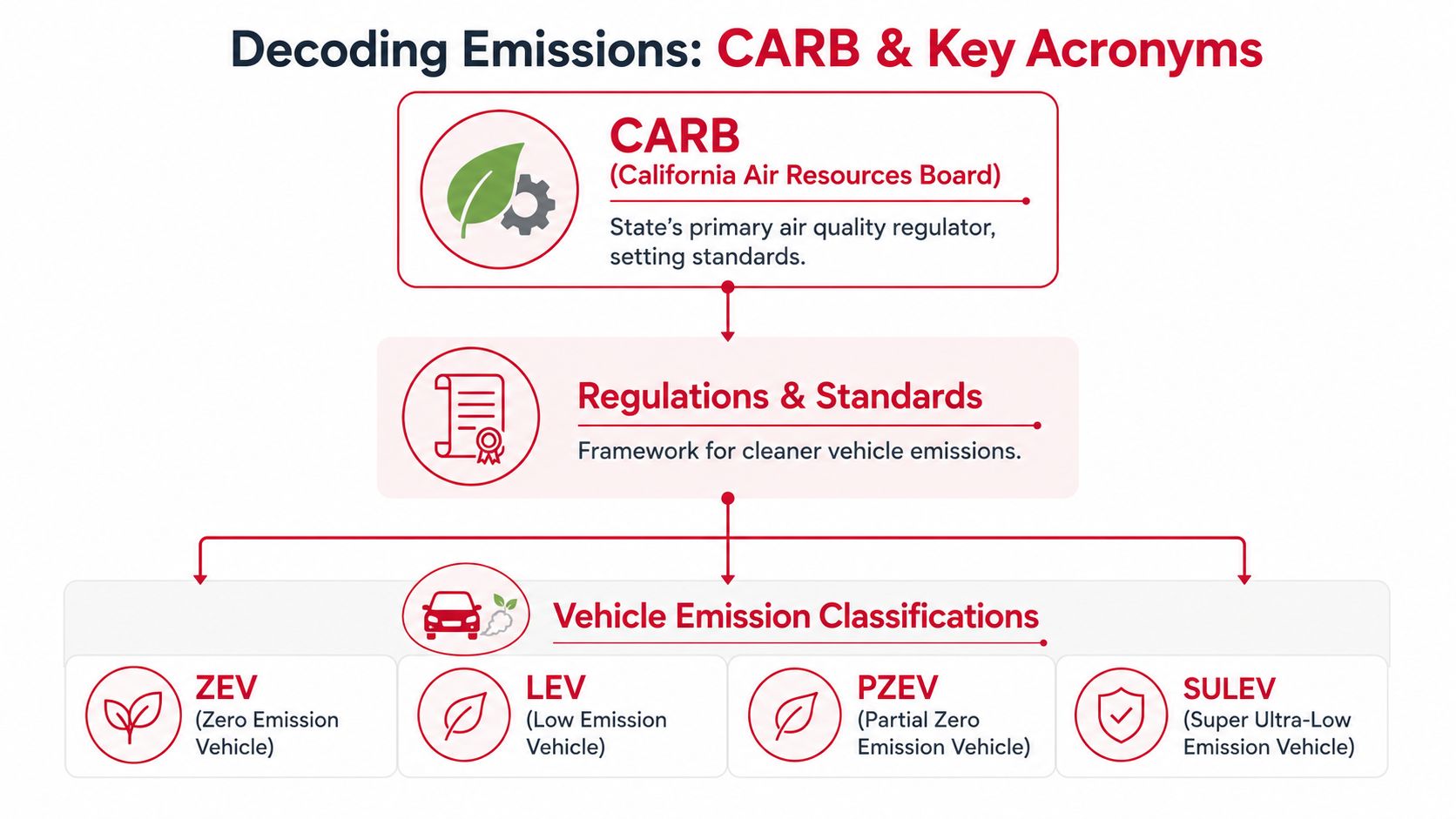
Who CARB is and why drivers hear about it
Think of CARB as California's air-quality rulemaker for vehicles. It sets standards for what manufacturers must build and what counts as compliant in this state. If you've ever noticed that a car sold in California has specific emissions labeling or equipment requirements, CARB is the reason.
Drivers usually hear about CARB indirectly. The check-engine light comes on. A replacement part needs to be emissions compliant. A smog station checks readiness monitors or tailpipe-related systems. All of that sits downstream from CARB's rules.
One practical example is the state's tighter particulate standard for light-duty vehicles. Under California's LEV III standards, the particulate matter limit for new light-duty vehicles was tightened from 10 mg/mi to 3 mg/mi for vehicles certified by model year 2021, with an in-use compliance standard of 6 mg/mi, as summarized by DieselNet's California light-duty standards reference. In shop terms, that means emissions-control hardware isn't optional decoration. The vehicle needs working systems that can keep pollution below a stricter threshold.
The common emissions acronyms in plain English
The easiest way to understand these labels is to treat them like an environmental report card for the vehicle.
| Acronym | Full Name | Simple Analogy |
|---|---|---|
| CARB | California Air Resources Board | The state teacher who writes the rules and grades the test |
| LEV | Low-Emission Vehicle | A solid passing grade |
| ULEV | Ultra-Low-Emission Vehicle | Better than passing, cleaner than basic compliance |
| SULEV | Super Ultra-Low-Emission Vehicle | Near the top of the class for very low emissions |
| PZEV | Partial Zero-Emission Vehicle | Very clean tailpipe performance with extra emissions protections |
| ZEV | Zero-Emission Vehicle | The A+ category for no tailpipe emissions |
These labels don't all mean the same thing in practice.
LEV means the vehicle meets a low-emissions standard, but it still emits pollution. ULEV and SULEV step down farther. PZEV usually refers to a very clean gasoline vehicle with additional evaporative-emissions controls. ZEV means no tailpipe emissions at all, such as a battery-electric vehicle.
A clean-running gasoline car and a zero-tailpipe-emissions car aren't in the same category. California tracks that difference very closely.
Drivers often run into these terms when shopping for a newer vehicle, reading an emissions label under the hood, or trying to understand why some vehicles sail through a test while others struggle as they age.
If your DMV notice specifically requires a STAR inspection, it also helps to understand the role of a STAR smog test-only station. The acronym side of emissions law and the station type on your notice often connect more closely than people expect.
How California's Rules Differ from Federal Standards
Your car can run fine, no warning light can be on, and you can still feel confused about why California seems stricter than the rest of the country. That confusion is normal. Federal rules set the baseline for the whole U.S., but California is allowed to require more from vehicles sold and registered here.
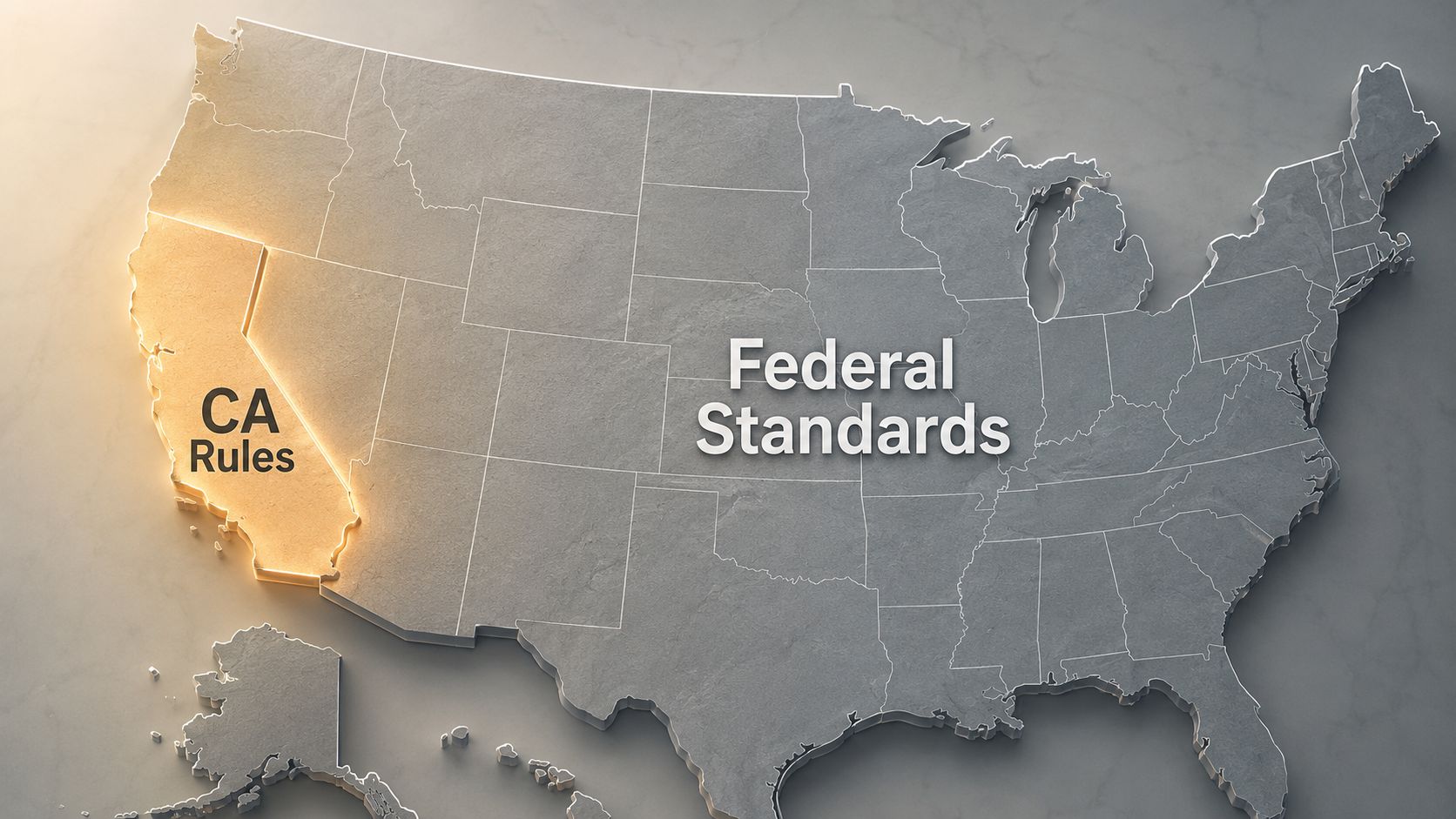
Why California sets its own path
The practical reason is simple. California has long had serious air-quality problems, especially in dense metro areas and inland valleys where pollution can linger. State regulators have responded by building tighter vehicle rules than the national minimum.
For a driver, it helps to picture federal standards as the minimum passing score on a test. California often grades on a stricter curve. Automakers still have to meet federal requirements, but many vehicles sold here also need to satisfy California-specific emissions rules.
That stricter approach reaches beyond the tailpipe alone. California pays close attention to evaporative emissions, onboard diagnostics, catalyst performance, and how a vehicle behaves right after startup. Those details may sound technical, but they connect directly to real smog check outcomes as a car ages.
What that means for your vehicle
Here is where drivers usually notice the difference:
- Vehicle certification can be stricter: Some vehicles are built or calibrated to meet California emissions requirements, not just federal ones.
- Emissions parts get more attention: Catalytic converters, oxygen sensors, evaporative components, and readiness monitors all have to do their jobs correctly.
- Cold-start performance matters: California focuses on the dirty first moments after startup, when emissions are often at their highest.
A good example is the state's 50-degree F cold-start standard for certain newer light-duty vehicles. California regulations require certification testing at a nominal 50°F for 2026 and later model year vehicles because emissions controls are less effective when the engine and catalyst are cold, as described in the California regulation text hosted by Cornell Law School.
In plain English, California is not only asking, "Does the car run clean once it's warmed up?" It is also asking, "How quickly does it clean itself up after a cold start?"
That distinction can expose borderline problems sooner. A weakening catalytic converter, a lazy oxygen sensor, or an evaporative fault may not be obvious to the owner day to day, but California's tighter framework is more likely to catch it during the inspection process.
So no, the average driver is not taking a completely different smog test in some dramatic way just because they are in California. The better way to understand it is that your test sits inside a stricter rulebook. If you want a clearer side-by-side explanation, this guide to California and federal vehicle emissions standards breaks the terms down into plain driver language.
The Road to 2035 and the Future of Driving in California
A lot of people hear one headline about California and jump straight to the wrong conclusion. They assume the state is about to outlaw every gasoline car on the road. That's not what the rule says.
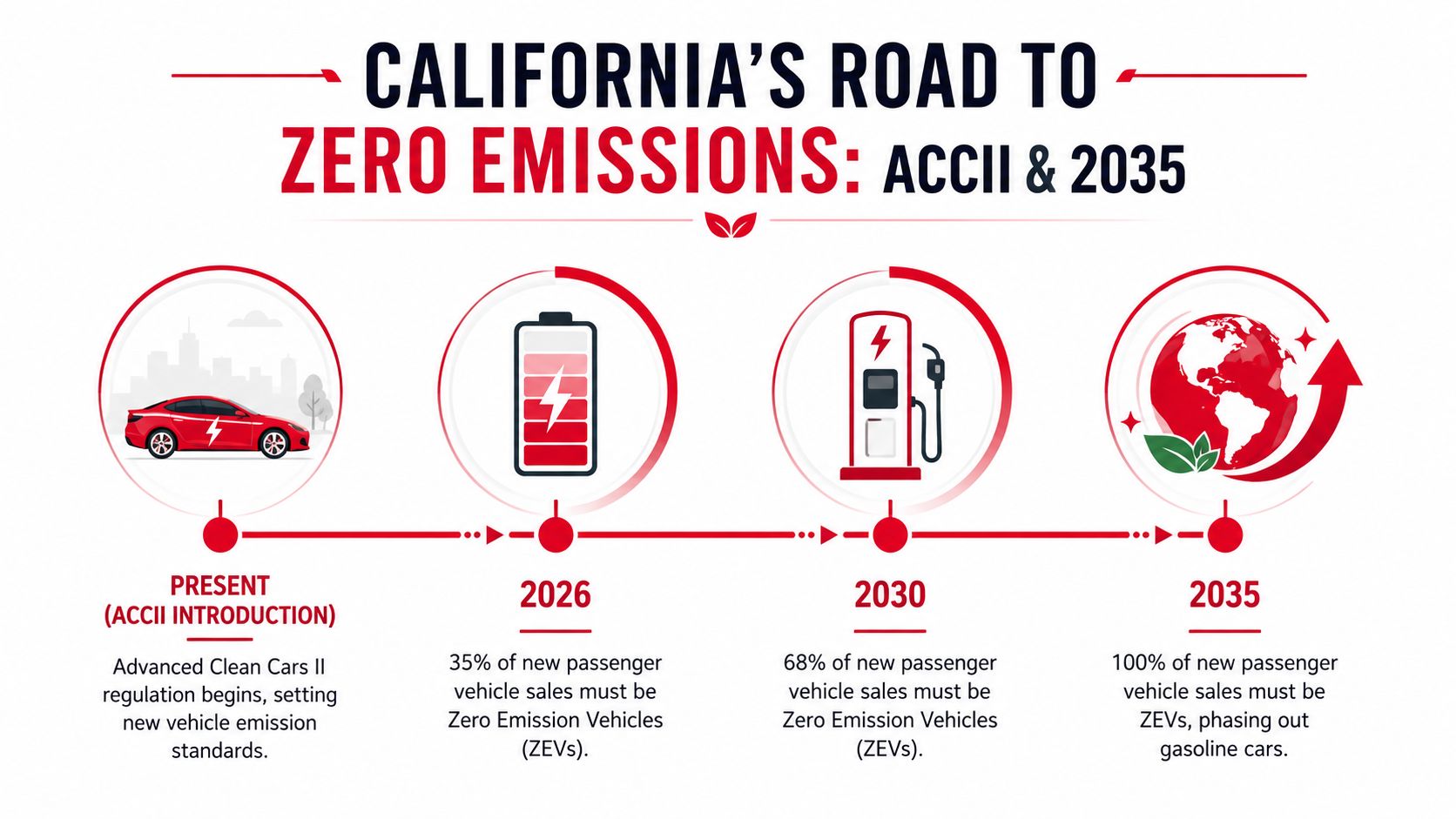
What the ACCII rule actually says
California's Advanced Clean Cars II, often shortened to ACCII, is a sales rule for new vehicles. It requires that 100% of all new light-duty vehicles sold in the state be zero-emission vehicles by 2035, with the phase-in starting with the 2026 model year, according to the American Action Forum summary of California's ZEV rule.
The same source explains that the program ramps up over time rather than flipping overnight. That's why you'll keep hearing about 2026 as an important starting point. It's where the future sales mix begins changing more visibly.
For buyers, this matters because the new-car market will keep shifting toward battery-electric and other zero-emission options. Automakers planning for California can't treat this as a side issue. They have to build product lines that fit the rule.
What it does not mean for current owners
This rule does not mean California is banning your existing gasoline car from the road.
It also doesn't mean used gasoline vehicles suddenly become illegal to own, drive, or sell. If you already have a gas-powered car or truck, the practical question remains the same as it is today: can you keep it registered, maintained, and compliant with the emissions rules that apply to it?
That distinction matters because drivers often mix up two different ideas:
- Rules for new vehicles sold in the future
- Rules for vehicles already in service
Those are not the same thing.
The 2035 target is about what dealers can sell new. It is not a command for current owners to scrap working gasoline vehicles.
There are also cost and benefit discussions wrapped into ACCII. The rule summary cited above states that CARB projected substantial costs and projected benefits through the 2040 model year, with benefits tied heavily to gasoline savings and carbon reductions. For most drivers, though, the immediate takeaway isn't about long-range policy math. It's that California has clearly signaled where the new-vehicle market is heading.
If you're keeping your current car, that future doesn't change the basics. You still need to pay attention to maintenance, warning lights, emissions equipment, and the requirements on your registration notice.
Your Vehicle's Smog Check and the Role of STAR Stations
The policy now turns into a real appointment, a real test, and a real pass or fail.
How policy turns into a pass or fail
A smog inspection isn't guessing. The station is checking whether your vehicle's emissions systems and onboard diagnostics line up with California's requirements for that vehicle.
That can include the condition of the catalytic converter, the status of the check-engine light, readiness monitors, visible emissions components, and whether the vehicle appears to have the correct emissions equipment installed. Newer standards matter here because they shape what performance level the car is expected to maintain.
Take two examples from the rules discussed earlier.
First, California's tighter particulate matter threshold means cleaner output is expected from modern light-duty vehicles. Second, the state's cold-start focus matters because many emissions failures show up when a vehicle can't control pollution quickly after startup. A worn catalyst, incorrect replacement part, or unresolved sensor issue can push a car out of compliance even if it still seems to drive normally.
Why STAR and test-only matter
Some DMV notices don't just say you need a smog check. They say you need it from a STAR-certified station.
STAR is a state designation for stations that meet specific program requirements. If your notice calls for STAR, a non-STAR station won't satisfy that requirement. That's the first practical reason to check the wording on the renewal form before you drive anywhere.
The second issue is business model. Some shops both test and repair. Others are test-only.
That difference matters because 13% of smog checks in California involve vehicles that fail initially but pass on retest without repairs, which has raised concerns about bias at non-test-only locations, according to the California Air Resources Board program page discussing LEV testing and related station concerns. A test-only station doesn't sell repairs, so it removes the incentive tied to repair revenue.
Shop-floor advice: If you want a neutral result, choose a station that only tests and doesn't profit from diagnosing the same failure into a repair order.
That doesn't mean every test-and-repair shop is doing anything improper. It means drivers should understand the incentive structure before choosing where to go.
Here's the practical comparison:
| Station type | What it does | Main driver concern |
|---|---|---|
| Test-and-repair | Inspects and may also sell repairs | Possible conflict if the same shop benefits from a failed result |
| Test-only | Performs the inspection only | You may need a separate repair shop if the vehicle fails |
| STAR-certified test-only | Performs required STAR inspections without repair sales | Useful when the DMV specifically requires STAR and you want a neutral test |
If you want to see the inspection environment before booking, this video gives a quick look at the process and station setup:
A station can also affect what happens after the test. Some locations only send the certificate electronically and leave you to finish registration elsewhere. Others combine services. Fire House Smog is a factual example of the second model. It's a STAR-certified test-only station and licensed DMV service provider in Antioch, so a driver may be able to complete a smog check and DMV renewal tasks in one stop, with on-site tag issuance during posted hours.
What drivers usually get confused about
The most common misunderstandings are straightforward:
- "If the car runs fine, it should pass." Not always. Emissions failures often come from control systems you can't feel while driving.
- "Any smog station is fine." Not if your notice requires STAR.
- "A fail means I need major repairs." Sometimes yes, sometimes no. The failure reason matters.
- "Passing after a retest proves the first failure was valid." Not necessarily. That's one reason neutrality matters.
Smog checks go more smoothly when you pick the right station type first, not after a failed visit.
A Simple Checklist for Passing Your Smog Test
The easiest way to handle California emissions standards is to turn them into a short routine. You don't need to memorize regulations. You need to avoid the common mistakes that lead to delays.
Before you leave home
Read the DMV notice carefully. Look for whether it says a STAR station is required. That one detail decides where you can go.
Make sure the check-engine light isn't on. If it's illuminated, deal with that first. A warning light is one of the clearest signs that the car may not be ready to pass.
Don't ignore recent battery disconnects or repairs. If codes were cleared or the battery was disconnected, the vehicle may need normal driving before its systems show ready again.
A rushed test right after clearing codes is one of the most avoidable reasons people have to come back.
- Drive the car before the inspection. A normal warm-up drive helps the engine and emissions systems operate under more stable conditions than a cold vehicle that has been sitting.
At the station and after the result
Bring your registration information and confirm whether the station can handle the type of vehicle you're bringing. That matters even more if you're showing up with something larger than a typical passenger car.
Then follow this simple decision path:
- If the car passes, the certificate is transmitted and you move on to registration.
- If the car fails, read the failure reason before authorizing anything elsewhere.
- If you need a retest, ask about station policy in advance so you know whether a return visit includes any retest option.
A smart station choice can also save a second errand. Some locations offer on-site registration help and sticker printing, which is useful if you want to handle compliance and DMV paperwork in the same stop instead of splitting the day between agencies and service counters.
The short version is this:
- Check the notice
- Warm up the car
- Make sure there are no active warning lights
- Use the correct station type
- Understand the result before taking the next step
That approach won't guarantee every older vehicle passes, but it does remove a lot of avoidable friction from the process.
If you need a STAR-certified test-only inspection in Antioch, Fire House Smog handles smog checks for cars, SUVs, light-duty trucks, and some RVs, and it also offers on-site California DMV services with tag issuance during posted hours. For drivers who want a neutral test without repair sales, plus the option to complete registration tasks in one place, it's a practical local option.
You open your DMV renewal notice, scan for the amount due, and then see the line nobody likes: smog certification required. If you own a diesel in California, that notice tends to raise more questions than answers. Gas drivers often assume your process is the same as theirs. It isn't.
Diesel owners deal with stricter rules, a smoke test many people misunderstand, and OBD checks that can trip you up even after you've already made the repair. I've seen plenty of owners walk in thinking, “The truck runs fine, so I should be good,” and then get blindsided by an incomplete monitor or smoke that hangs a little too long.
The good news is that the process is manageable when you know what the station is checking. You need to know whether your diesel is subject to testing, what causes failures, how to prep the vehicle before test day, what happens during the inspection, and what to do if you pass or fail.
Table of Contents
- Your Diesel Needs a Smog Check. Now What?
- Which Diesel Vehicles Need a Smog Test in California
- Top Reasons Diesel Vehicles Fail the Smog Test
- How to Prepare Your Diesel for a Smog Test
- The Process at a STAR Test-Only Smog Station
- After the Test Passing Failing and Next Steps
Your Diesel Needs a Smog Check. Now What?
Most diesel owners start in the same place. Registration notice in hand, keys on the counter, and a mild sense that this is going to be more annoying than it should be. That feeling is fair. Diesel testing in California has more traps than most drivers expect.
A common scenario goes like this. You've got a pickup or SUV that starts fine, pulls strong, and doesn't seem to have any obvious issue. You assume the smog test for diesel vehicles is just another quick formality. Then somebody tells you a glowing check engine light means failure. Somebody else says to just clear the code. Then a forum post says smoke is okay if it's “not too bad.” That kind of advice gets people into trouble.
What works is a simple approach.
- Read the renewal notice carefully: If DMV says a smog check is required, treat that as your starting point.
- Figure out whether your diesel falls under the California testing rule: Model year and GVWR matter.
- Check the dashboard before you go: If warning lights are on, don't gamble.
- Drive the vehicle enough after repairs: Clearing codes at the last minute usually creates a different problem.
- Go in prepared: A warm engine and a vehicle in normal running condition usually make the process smoother.
Practical rule: Don't use the smog station as your first diagnostic step if the truck is already warning you that something's wrong.
Owners who do best aren't the ones with perfect vehicles. They're the ones who show up understanding what the inspection involves.
Which Diesel Vehicles Need a Smog Test in California
You open your DMV renewal notice, see the smog requirement, and the first question is usually simple. Does my diesel need this test, or am I exempt?
For California diesel owners, the rule is pretty straightforward once you ignore the bad advice floating around online. Most diesel vehicles with a 1998 or newer model year and a GVWR of 14,000 pounds or less need a smog check every two years, as outlined in this California diesel smog requirement overview. If you drive a light-duty diesel pickup, SUV, or passenger vehicle, assume you are in the program until your door-jamb label and registration details prove otherwise.
That catches a lot of California owners off guard, especially people who just bought a newer diesel and expect the same early-year break gasoline vehicles can get. Diesel does not work that way.
The rule that matters in the real world
At a STAR test-only station, this is the first thing I want an owner to confirm before we even talk about readiness monitors, warning lights, or smoke. Model year and GVWR decide whether your diesel belongs in the biennial smog program. If your truck is covered, the DMV will keep asking for a smog certification at renewal time while it stays registered in California.
If your diesel is older or heavier, the answer can be different. That is why guessing by appearance is a mistake. A truck that looks like a light-duty pickup still needs to be judged by its actual gross vehicle weight rating, not by what the owner or seller assumed.
Quick reference table
| Vehicle Type | Smog Check Required? |
|---|---|
| Diesel, model year 1998 or newer, GVWR 14,000 lbs or less | Yes, biennially |
| Diesel, model year 1997 or older | No, exempt from this biennial requirement |
| Diesel over 14,000 lbs GVWR | No, exempt from this biennial requirement |
The fastest way to sort this out is to check the sticker on the driver's door or door frame and find the GVWR there. Then match that number with the model year on your registration. If you own a pickup and want a more specific breakdown, this guide to a truck smog check in California will help.
A few practical points save people headaches at the counter and in the test bay:
- Do not assume your diesel gets an abatement-fee shortcut. Covered diesel vehicles are generally in the testing cycle, not on a temporary pass.
- Do not test too early unless you need to. Your passing certificate has a deadline tied to DMV timing, so random early testing can create extra work.
- Check the weight rating, not the badge. A 2500, 3500, or similar trim name does not settle the question by itself.
The right move is simple. Verify the model year. Verify the GVWR. Once you know whether your diesel is in the California program, the rest of the smog process gets a lot less confusing.
Top Reasons Diesel Vehicles Fail the Smog Test
California diesel failures usually come from two places. The vehicle reports a problem through the OBD system, or it pushes out smoke that hangs too long during the test. At a STAR test-only shop, we see both every week, and neither one is a surprise once you know what the technician is checking.
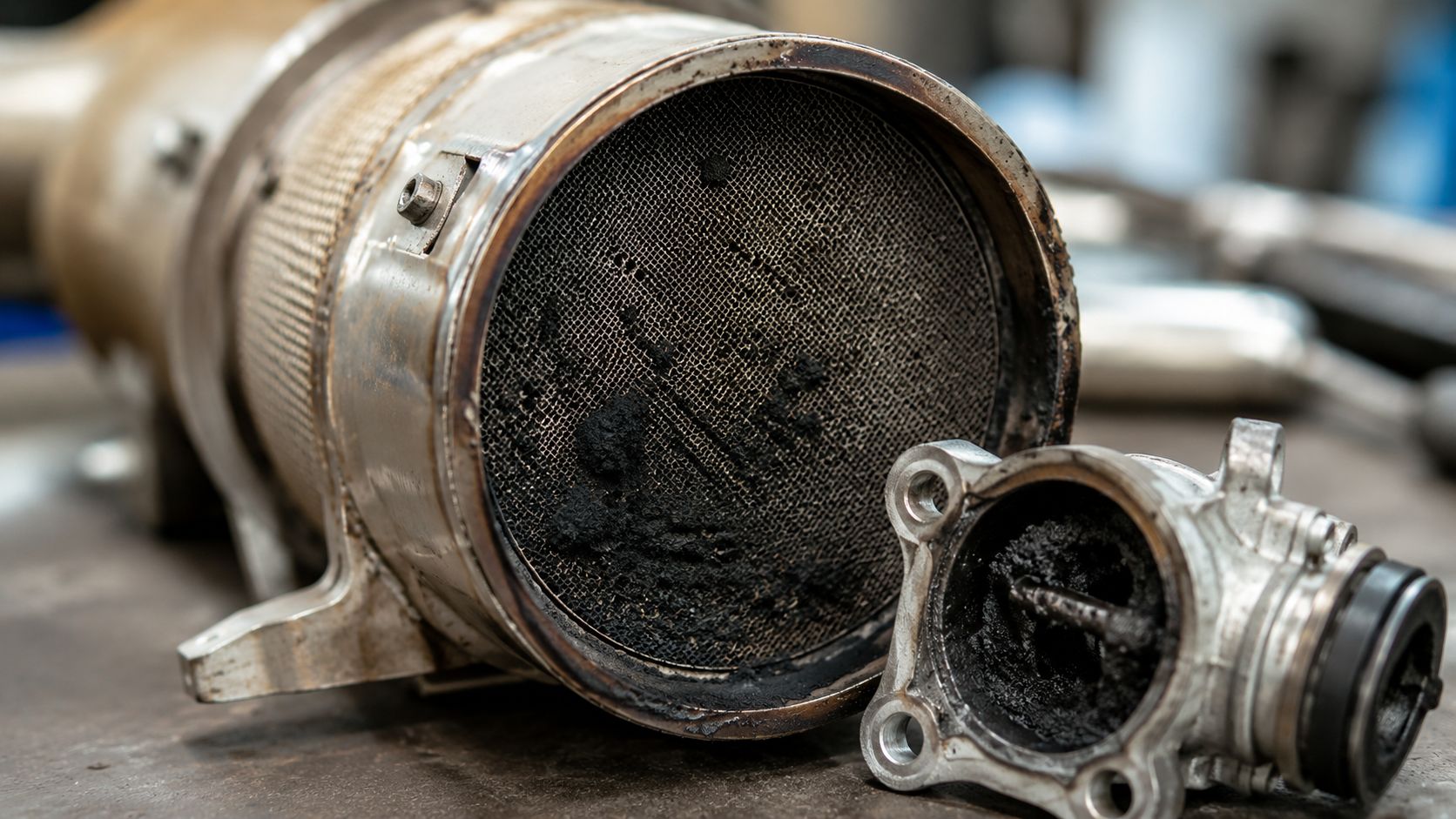
The check engine light problem
If your check engine light is on, stop there and handle it before you book the test. A diesel with an active fault is telling you something is wrong, and California smog equipment is going to see it.
The mistake I want owners to avoid is clearing codes right before coming in. That move usually makes things worse. You still have the original fault, and now the readiness monitors may show incomplete, which can block a passing result.
Here is what that means in plain language:
- An active warning light puts your diesel in a bad position: The fault is part of the inspection picture from the start.
- A recently reset computer raises another problem: The vehicle may not have finished its self-checks.
- A real repair includes drive time afterward: The system has to run its tests and show ready status.
At the shop, this is one of the easiest fail patterns to spot. The owner says the truck is running fine. The computer says otherwise.
Visible smoke during the snap test
Smoke is the other big one, a criterion on which California gets more specific than many drivers expect. The issue is not whether the exhaust looked dramatic to you in the driveway. The issue is whether smoke stays visible too long during the BAR snap-acceleration procedure.
A diesel vehicle fails if a visible smoke plume observed 5 to 15 feet from the tailpipe lingers for more than 3 seconds on either of the final two BAR Snap Tests, according to the California Smog Check Manual.
That catches a lot of owners off guard. A truck can seem acceptable in daily driving and still fail in the bay because the smoke hangs after a quick throttle snap in neutral. If your diesel puffs on startup, hazes under a hard rev, or leaves a cloud that does not clear right away, take that seriously.
Common causes include a restricted DPF, EGR problems, injector issues, turbo problems, and poor maintenance. If you want a broader breakdown of common reasons vehicles fail a smog check, that guide helps. For diesel owners in California, the practical lesson is simple. Lingering smoke is not cosmetic. It is a direct path to failure at a STAR station.
How to Prepare Your Diesel for a Smog Test
Preparation is where you save yourself time, money, and aggravation. Don't overcomplicate it. You're trying to show up with a diesel that is warm, stable, free of warning lights, and fully ready in the OBD system.
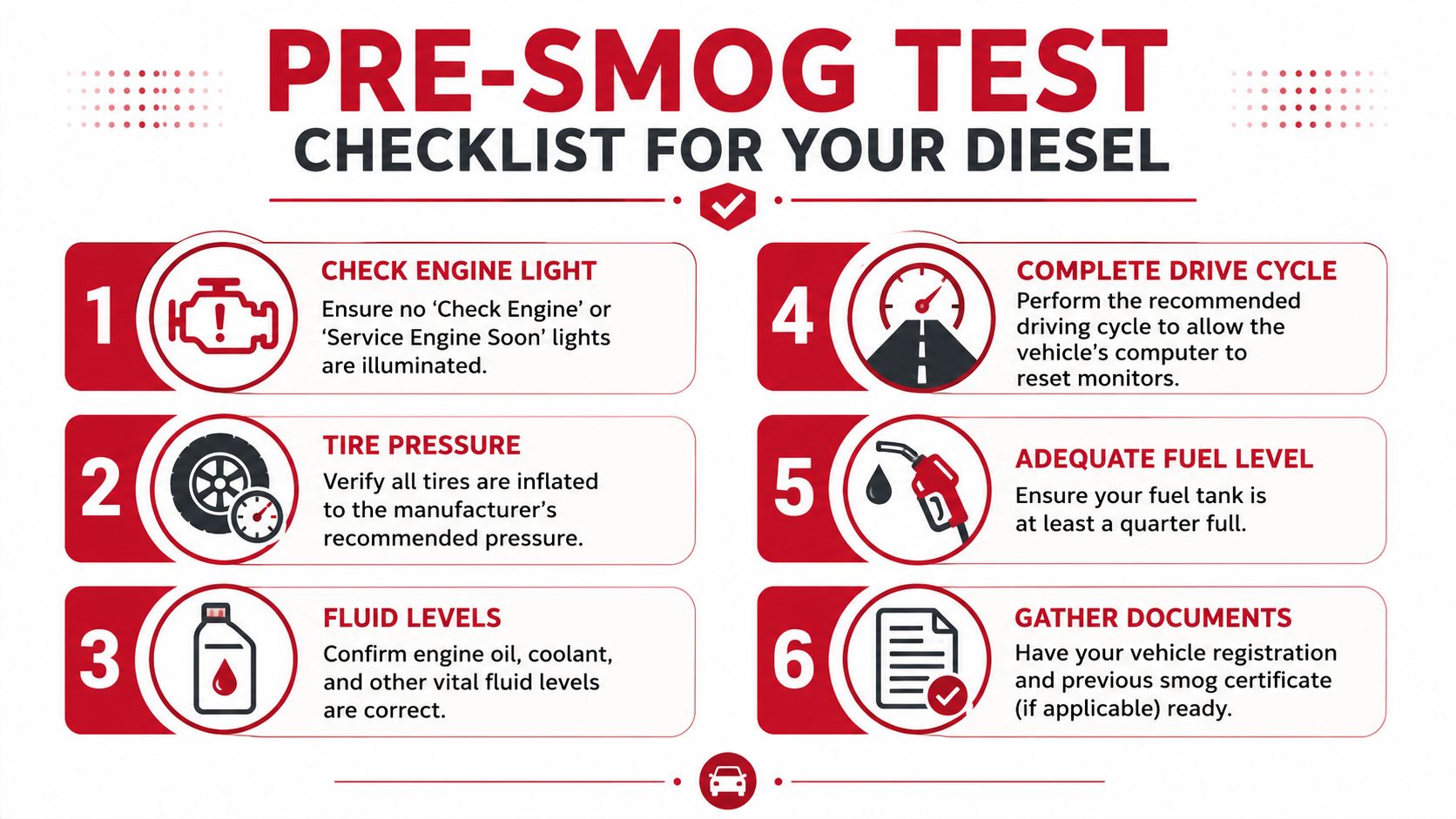
Your pre-test checklist
Start with the dashboard. If the Check Engine or Service Engine Soon light is on, handle that first. And if you just cleared it, don't rush straight into the test lane. BAR requires complete OBDII monitors, and a recent reset can leave the vehicle unreadable for pass purposes, as covered in this BAR monitor completion discussion for diesel testing.
Use this checklist before you go:
- Fix the actual fault: Don't erase symptoms. Repair the cause.
- Drive it after repair: The vehicle needs normal operation long enough for the system to run its checks.
- Check for obvious smoke: Have someone watch the exhaust while you briefly raise rpm in a safe area.
- Make sure fluid levels are normal: Low fluids can create drivability problems you don't need on test day.
- Bring your paperwork: Registration paperwork helps keep the visit simple.
This quick video helps visualize the preparation mindset before inspection:
What to do the day of the test
Drive the vehicle long enough to get it fully warm before you arrive. Cold diesels tend to behave worse. They can idle rougher, haze more, and generally make a bad first impression.
A few practical habits help:
- Avoid last-minute battery disconnects. That can wipe out readiness status.
- Don't show up right after major engine work unless you've driven it. Repaired isn't the same as ready.
- If you suspect smoke, postpone and diagnose it. Hope is not a strategy.
- Keep the visit routine. No weird fuel experiments or backyard fixes the morning of the test.
Shop-floor advice: The best smog appointment is the boring one. Warm engine, no lights, normal idle, no surprises.
If you handle those basics, you put yourself in the best position to pass on the first trip.
The Process at a STAR Test-Only Smog Station
A lot of stress disappears once you know what happens in the lane. The inspection isn't mysterious. It's a sequence. The technician checks the vehicle, checks the system, performs the diesel procedure, and records the result.
What the technician does
For a California diesel in the covered class, the station generally looks at three things that matter to owners most.
First is the visual side. The technician is looking for obvious issues and emissions-related concerns that make the vehicle unfit for testing or compliance.
Second is the OBDII check. The station connects to the vehicle and reads the emissions system status. Active faults, stored problems, and incomplete readiness can surface during this process.
Third is the BAR Snap Test. During that procedure, the technician places the vehicle in neutral and quickly pushes the accelerator to 2,000 to 3,000 RPM and releases it to evaluate smoke opacity and duration, according to the California smog check guide describing the BAR Snap Test.
That's the part customers usually notice because they hear the engine rev. But by the time the throttle gets snapped, a lot of the inspection picture is already forming.
Why test-only matters
A test-only station has one major advantage. The shop isn't trying to sell you a repair while it's evaluating your vehicle. That removes the repair upsell angle that makes many drivers uneasy.
That matters even more for diesel owners, because failures can involve systems that are expensive, technical, and easy to misunderstand. At a test-only station, the result is the result. You pass, or you get a report showing what needs attention.
In practical terms, a well-run STAR test-only location is helpful because it usually offers:
- Cleaner decision-making: You're getting an inspection, not a sales pitch.
- Faster throughput: Multiple bays can keep lines moving.
- Convenience if registration is due: Some locations also handle DMV-related tasks on site.
- Better fit for work schedules: Evening and weekend availability helps owners who can't disappear midday.
For drivers in Antioch and nearby areas, that setup is exactly why places that combine STAR testing with registration support are popular. When you can test the diesel and then handle your DMV business in one stop, the whole process feels less like a bureaucratic obstacle and more like a routine errand.
After the Test Passing Failing and Next Steps
Once the inspection ends, things get simple. You're on one of two tracks. Either the diesel passed and you move on, or it failed and you need to use the report the right way.
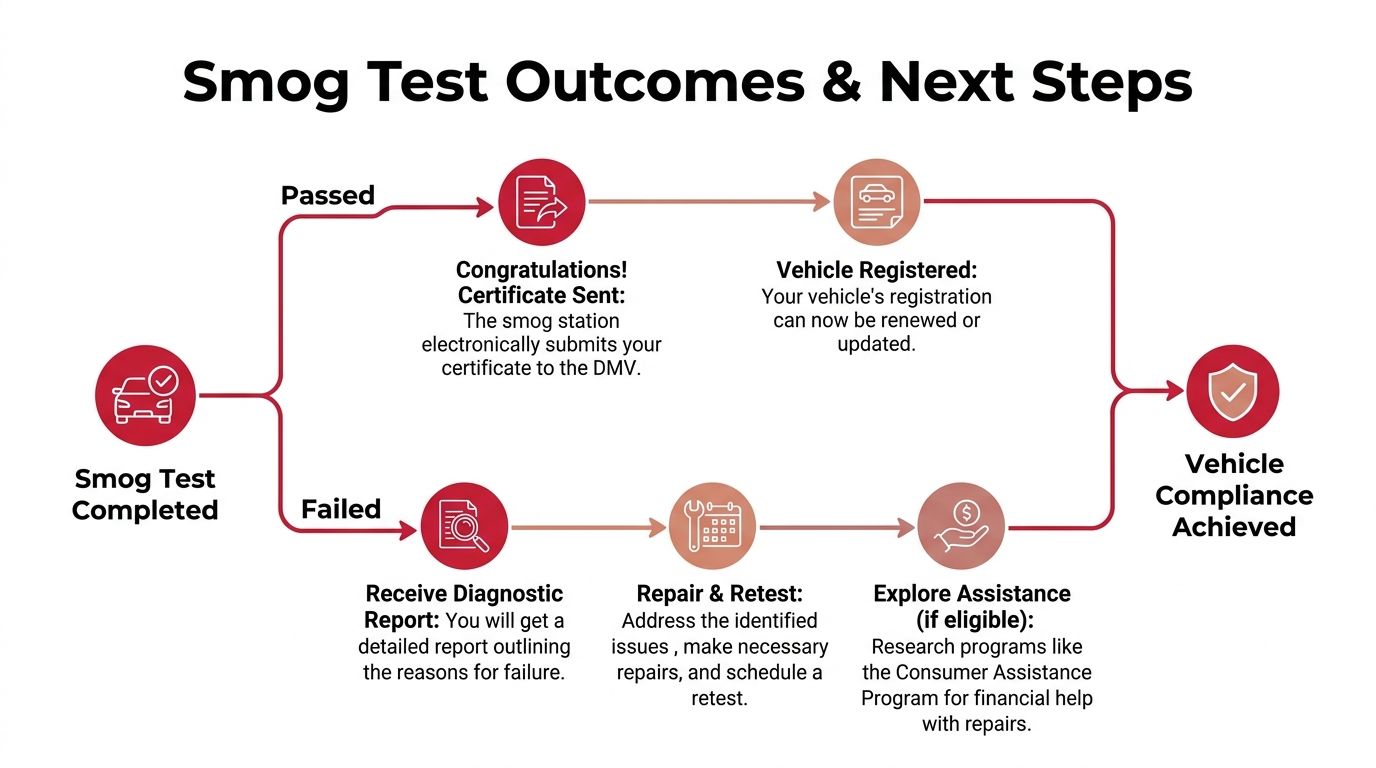
If your diesel passes
If the vehicle passes, the station electronically sends the certificate information to DMV. That's the outcome everyone wants because it turns the smog test for diesel vehicles into a one-and-done visit.
At that point, keep your receipt and finish any remaining registration steps. If your registration renewal is the next task, a location that also offers California DMV registration renewal services can make that part faster.
Pass, save your paperwork, and don't wait around if registration is still pending.
If your diesel fails
If the vehicle fails, don't guess. Read the Vehicle Inspection Report carefully. That report tells you why the station could not certify the diesel.
Different failures call for different next moves:
- OBD-related failure: Take the report to a qualified repair shop and address the fault, then drive the vehicle enough for readiness to return.
- Smoke-related failure: Have the engine and emissions system checked before coming back. Lingering smoke rarely fixes itself.
- Visual or equipment issue: Correct the noncompliant condition exactly, not approximately.
Here's the mistake to avoid. Don't throw random parts at the vehicle because a friend had “the same issue.” Diesel failures often overlap in symptoms. A proper diagnosis saves money.
If you're testing at a station with a free retest policy, use it according to the posted terms. That can reduce the sting of a failed first attempt. The important thing is to return only after the issue is repaired and the vehicle is ready, not just quieter, cleaner-looking, or temporarily reset.
A failed inspection is frustrating, but it's still manageable. Use the report, repair the underlying problem, then retest with confidence.
If you need a straightforward place to handle your diesel smog check and registration follow-up, Fire House Smog in Antioch offers STAR-certified test-only inspections, on-site DMV services, weekend availability, and a practical process that keeps things simple for diesel owners.
Your renewal notice is sitting on the passenger seat, your registration deadline is getting close, and now you're trying to figure out where to get a smog check without burning half your day. That's the Brentwood reality. The hard part usually isn't the test itself. It's sorting through confusing station types, figuring out whether your car needs STAR, and avoiding a wasted trip.
A lot of local pages make this worse. They throw out a list of stations, mention smog in general terms, and skip the details that matter when you need to get in, get tested, and move on. If you're searching for Smog Check Brentwood CA, you need practical answers, not filler.
Table of Contents
- Your Guide to Smog Checks in Brentwood
- Brentwood and Contra Costa County Smog Check Rules
- The Advantage of a STAR Certified Test-Only Station
- Fire House Smog Your All-in-One Stop in Antioch
- How to Prepare for a Fast and Easy Smog Test
- Answers to Common Brentwood Smog Check Questions
Your Guide to Smog Checks in Brentwood
Most Brentwood drivers start the same way. You open the DMV notice, spot the smog requirement, and then start asking the wrong first question. Not “Who's closest?” but “Who can handle this correctly the first time?”
That distinction matters. A lot of drivers lose time because they pick a shop before they understand what their notice requires. Some need a regular inspection. Some need a STAR station. Some assume any place with smog in the name can do everything. That's where the hassle begins.
The fastest smog check is the one you only have to do once.
If your goal is simple, honest, efficient service, you want a station that keeps the process clean. No repair pitch. No guessing. No bouncing between locations unless your vehicle needs repair work elsewhere.
Brentwood residents also have a practical advantage nearby. You don't have to limit yourself to whatever happens to be around the corner. For a lot of drivers, the smarter move is a short drive to Antioch for a setup built around speed, objective testing, and DMV convenience in one stop.
That's the point of this guide. Not to overwhelm you with regulations, but to help you avoid the common mistakes that cost time. If you've been searching for Smog Check Brentwood CA, this is how to handle it with less confusion and fewer surprises.
Brentwood and Contra Costa County Smog Check Rules
State Requirements for Brentwood Drivers
Brentwood drivers follow the smog rules for Contra Costa County. For many vehicles, that means a smog inspection is part of registration renewal, and your DMV notice will tell you whether your car needs one now or qualifies for an exemption.
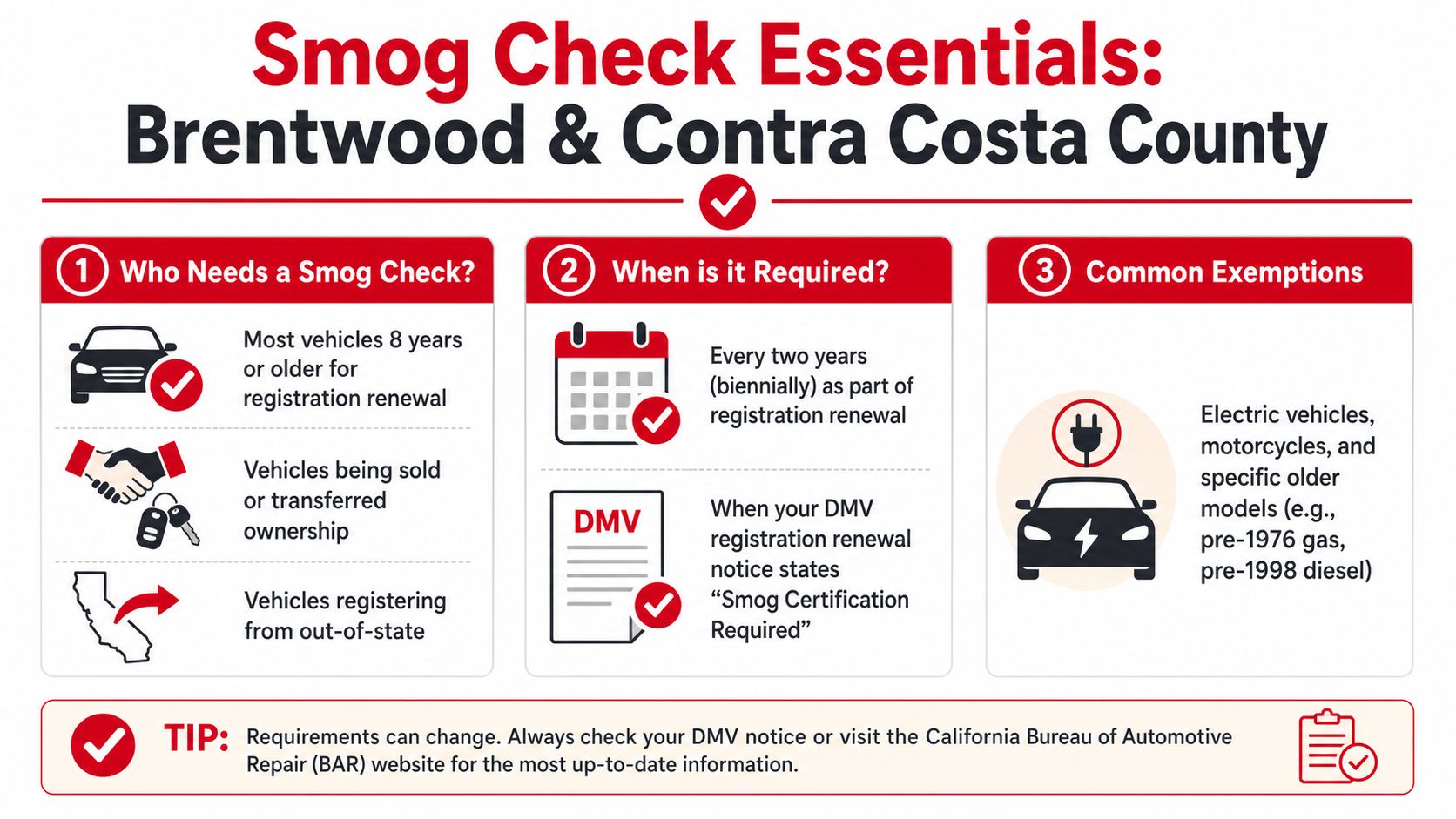
The two details that matter most are the model year and the wording on your renewal notice. Newer vehicles may fall under the temporary abatement period instead of a regular inspection. Hybrids are not automatically exempt, which surprises a lot of Brentwood owners who assume better fuel economy means no testing requirement.
Your notice is the final word. Read it before you book anything.
What trips Brentwood drivers up
The biggest mistake is timing. If you test too early and then wait too long to finish registration, you can create a second errand for yourself. If you wait until the last minute, you risk scrambling for a qualified station, especially if your notice calls for STAR service.
That is why Brentwood residents should choose a shop that can handle the requirement cleanly and fast. A STAR Test-Only smog station near Brentwood is the safer bet when you want an objective inspection without a repair sales pitch mixed into the process.
A failed test usually is not a mystery. If the check engine light is on, if the monitors are not ready after a battery disconnect, or if emissions-related software has been altered, the car can fail and you will need repairs before a valid retest.
Keep the rules simple:
- Check the DMV notice first: It tells you whether a smog check is required now and whether STAR is required.
- Do not assume a newer car always needs a test: Some newer vehicles fall into the abatement period instead.
- Do not assume a hybrid is exempt: Many hybrid owners still need biennial testing.
- Do not delay after testing: Handle registration while your certificate is still usable.
Here is the practical advice. If your renewal notice mentions smog, treat it like a deadline, not a maybe. And if you want the least frustrating option from Brentwood, make the short drive to Antioch and get it done at a station built for speed, trust, and DMV convenience in one stop.
The Advantage of a STAR Certified Test-Only Station
A lot of Brentwood drivers lose time on smog checks for one simple reason. They pick a shop that mixes testing with repair sales, then wonder whether the recommendation is really about emissions or revenue.
A STAR-certified test-only station cuts out that problem.
Why STAR matters
If your DMV notice calls for STAR, you need a station approved for that requirement. No guessing. No showing up at the wrong place and starting over. STAR stations are held to stricter performance standards, so the designation means something practical for drivers who need the test done right the first time.
For Brentwood residents, that matters because the biggest headache is usually not the inspection itself. It is the wasted trip.
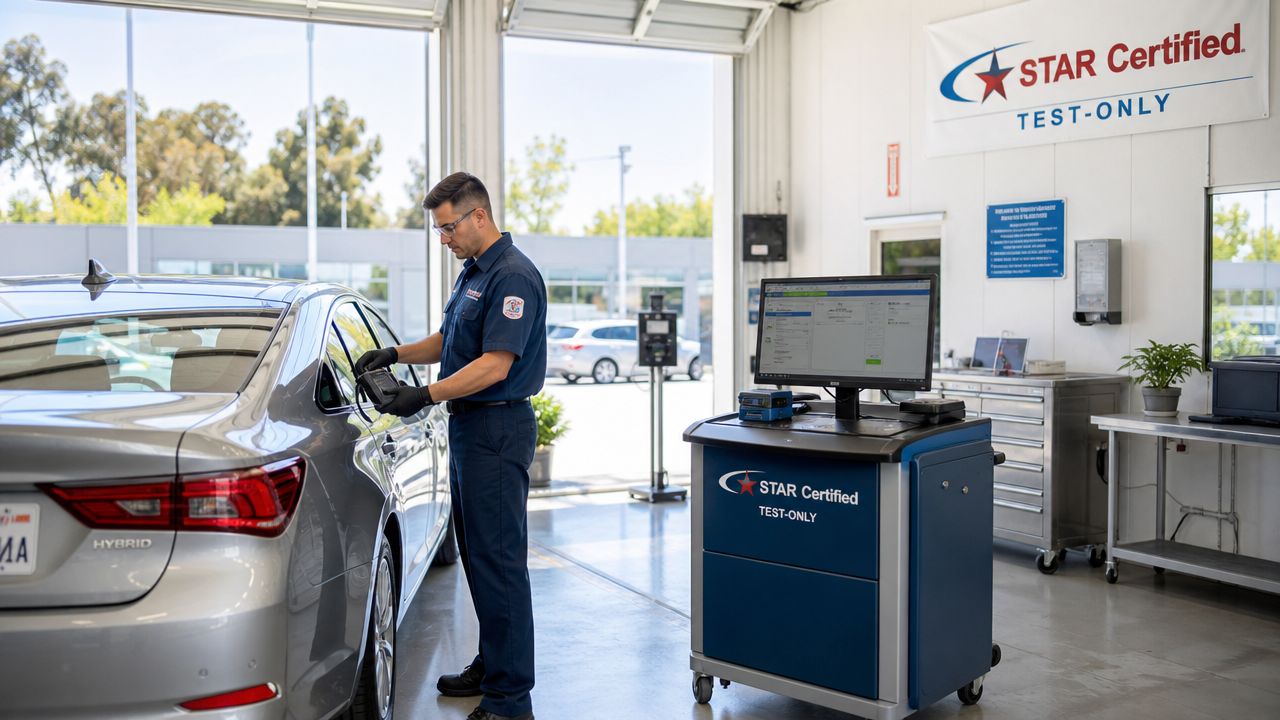
Why Test-Only is the smarter consumer choice
Test-only is the better setup for anyone who wants a straight answer. The shop tests the car. It does not sell the repair work tied to a failed result. That removes the most common trust issue drivers have with smog checks.
Here is the main advantage:
- No repair upsell tied to the outcome. You are paying for an inspection, not walking into a sales funnel.
- Clearer incentives. A test-only station has one job. Verify whether the vehicle passes.
- Better fit for STAR-directed vehicles. If your notice specifies STAR, a test-only shop handles that requirement without adding extra noise.
This matters even more if you are busy and want the errand handled once. Brentwood drivers who choose a STAR Test-Only smog station near Brentwood usually want the same three things. Speed, trust, and no wasted motion.
That is exactly why Fire House Smog stands out. It gives Brentwood residents the objectivity of STAR Test-Only service, and it does it in nearby Antioch at a shop built to move cars through efficiently. Two bays help keep the line moving. The test-only model keeps the inspection honest. For drivers who are tired of vague answers and extra stops, that is the smarter choice.
Fire House Smog Your All-in-One Stop in Antioch
Brentwood drivers don't need another generic station list. They need a place that solves the actual problem. The problem is rarely “Where can I technically get tested?” It's “Where can I handle this quickly, avoid a hard sell, and stop the errand from turning into a DMV day?”
That's why many local drivers choose Antioch over staying strictly inside Brentwood city limits. A short drive can buy you a much smoother process.
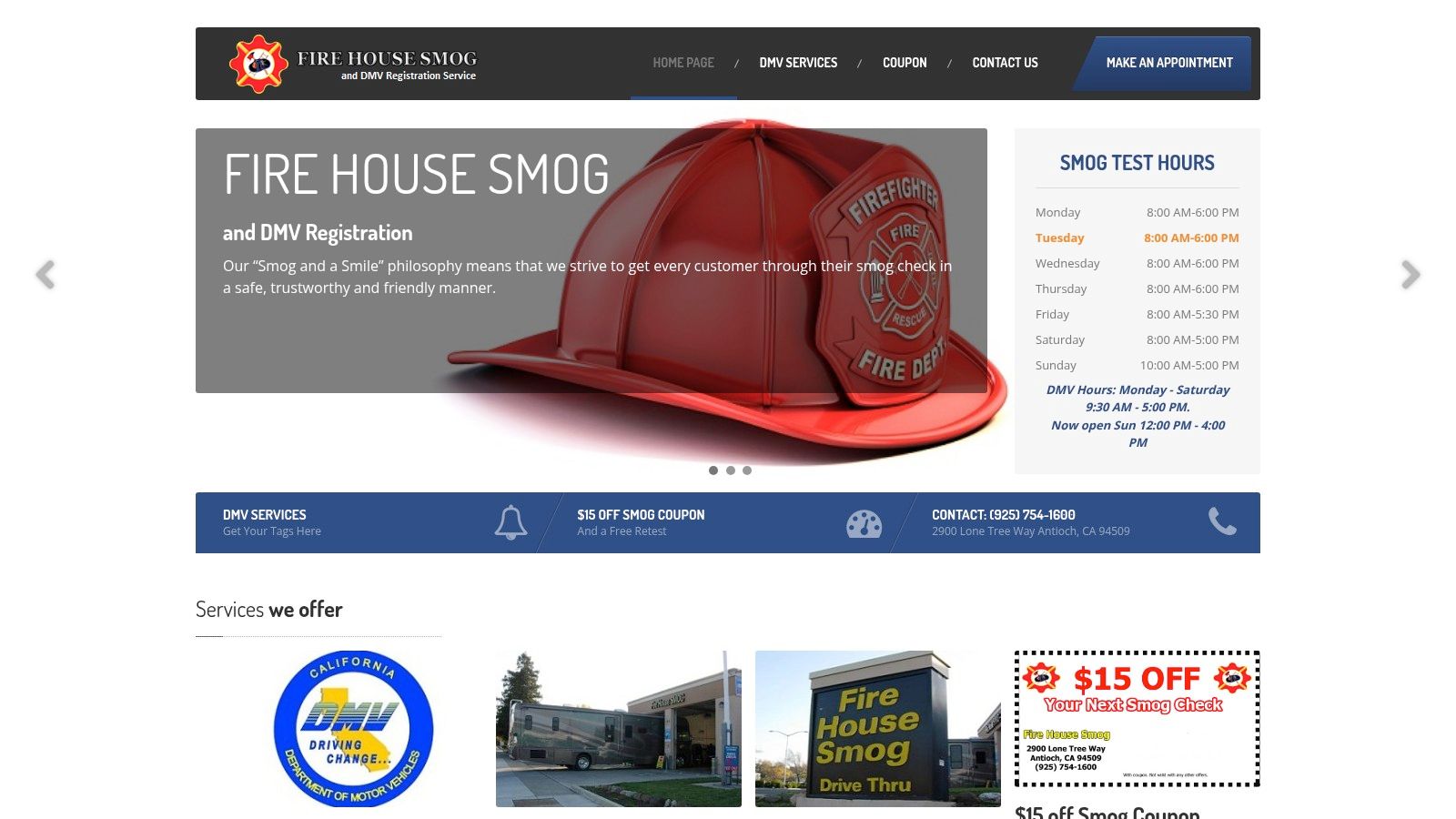
What makes it worth the short drive from Brentwood
Fire House Smog is at 2900 Lone Tree Way in Antioch, which is an easy route for many Brentwood residents. The setup is built around throughput and convenience, not clutter. It's a STAR-certified test-only station, so the inspection side stays objective, and it also provides on-site DMV registration services.
That combination matters more than is commonly understood. If your smog check is tied to registration, handling both in one location can eliminate the extra DMV stop entirely. Fire House Smog processes California renewals, ownership transfers, and related registration tasks with on-site tag issuance during posted hours.
The hours also work for real schedules. Smog testing is available seven days a week with extended evening and weekend hours. DMV service hours are Monday through Saturday from 9:30 AM to 5:00 PM and Sunday from 12:00 PM to 4:00 PM, with some weekend services limited.
Another practical advantage is capacity. Fire House Smog has two service bays, which helps move vehicles through faster and reduces the bottleneck that slows down small one-bay shops.
If you value speed, trust, and convenience in one errand, this is the kind of setup that saves frustration.
For drivers comparing options, the local Antioch details are on the Antioch smog check page.
Fire House Smog services at a glance
| Service | Description | Availability |
|---|---|---|
| Smog inspections | STAR-certified test-only smog checks for passenger cars, SUVs, and light-duty trucks | Seven days a week |
| RV and motorhome smog | Some RVs and motorhomes accepted, subject to size and equipment limits | Call ahead |
| DMV registration renewals | On-site California renewal processing with sticker printing | During posted DMV hours |
| Ownership transfers | California and out-of-state transfer support, including plates and stickers when needed | During posted DMV hours |
| Retest support | Free retest available when required, based on site policy and coupon terms | Ask at visit |
How to Prepare for a Fast and Easy Smog Test
Your pre-visit checklist
If you want the quickest path through a smog check, do a little prep before you leave home. Most delays are preventable. They happen because drivers show up cold, missing paperwork, or at the wrong type of station.
Start with the most important item. Read your DMV renewal notice carefully. The DMV says that if the notice reads “SMOG Certification Required at a STAR station,” your vehicle must be inspected at a STAR station, and a non-STAR station cannot issue the certificate according to the California DMV smog inspections guidance.
Then handle the basics:
- Check the dashboard: If the check engine light is on, don't expect a clean test result.
- Bring the notice: It saves time and helps confirm whether your vehicle is directed to STAR.
- Warm up the vehicle: A normal drive before the test can help avoid showing up with a cold vehicle.
- Don't guess on registration paperwork: If you'll also handle DMV needs, review the required paperwork on Fire House Smog's vehicle registration documents page.
- Call ahead for unusual vehicles: RVs and larger vehicles may need a quick confirmation first.
One more point. If your notice specifically names STAR, do not roll the dice on a regular station because it's closer. That's how people lose an hour and end up starting over.
A two-minute check of the renewal notice can save a completely wasted trip.
Answers to Common Brentwood Smog Check Questions
What if my vehicle fails
A failed smog check usually means one thing. The vehicle needs repair work before it can be certified.
What you do next depends on where you tested. At a STAR Test-Only station, the shop handles the inspection and gives you a clean pass or fail result. It does not turn into a repair shop after the test. That separation is a good thing because it removes the pressure to sell repairs on the spot.
If your vehicle fails, ask for the printout, fix the issue at a qualified repair facility, and come back for the retest. Keep the process simple. Test at a place that has no reason to upsell you, then decide on repairs with a clear head.
Some drivers may also qualify for state assistance with emissions-related repairs through California's Consumer Assistance Program. The Bureau of Automotive Repair explains eligibility and program details on its Smog Check Program page.
What gross polluter and directed vehicle notices really mean
A lot of Brentwood drivers waste time.
If your renewal notice says your vehicle is directed to a STAR station, follow that instruction exactly. Do not assume any smog shop can handle it. Directed vehicles and gross polluters have stricter testing requirements, and the wrong stop can turn into a wasted trip.
The station type matters. A STAR Test-Only station can inspect directed vehicles, including vehicles flagged as gross polluters, but it does not perform emissions-related repairs. That matters because some drivers show up expecting one shop to handle everything. It will not.
Here is the practical breakdown:
- Can a Test-Only station inspect a gross polluter? Yes, if it is authorized for that inspection.
- Can a Test-Only station repair the vehicle after a fail? No.
- Are all STAR stations the same? No. Some test only. Some test and repair.
- Should you confirm the station type before you go? Yes. Do it before you leave home.
For Brentwood drivers, the smart play is straightforward. Use a nearby STAR Test-Only shop that stays in its lane, moves cars through quickly, and can also help with DMV tasks in one stop. That is why Fire House Smog stands out over generic Brentwood listings. You get objective STAR testing, on-site DMV services, and a two-bay setup in Antioch that helps keep the line moving. If your goal is less waiting, less guesswork, and no repair-sales pressure, that is the better option.
Your registration notice shows up. You open it, see that your truck needs a smog check, and the questions start right away.
Does my truck even fall under the regular program? Is this the same thing as Clean Truck Check? If it's diesel, does the weight rating change the rule? If I pass, can I finish my DMV renewal the same day, or am I headed into another line somewhere else?
Those questions are common because California doesn't treat every truck the same. Fuel type matters. Model year matters. Gross Vehicle Weight Rating (GVWR) matters. And for heavier diesel trucks, the rules often shift into a different compliance system entirely. If you own a pickup, work truck, fleet unit, or a truck you're trying to sell or register, getting the category right is the first step that saves time.
Table of Contents
- Your DMV Notice Arrived, Now What?
- Which Trucks Require a California Smog Check
- Exemptions and Special Cases for Trucks
- The Smog Test Process From Start to Finish
- Practical Tips to Pass Your Truck's Smog Check
- Your One-Stop Solution in Antioch: Fire House Smog
Your DMV Notice Arrived, Now What?
Most truck owners do the same thing first. They look at the notice, then at the truck, then back at the notice, trying to figure out whether this is a routine registration step or the start of a compliance headache.
A common example is the owner of a diesel pickup who assumes diesel means exempt. Sometimes that's wrong. Another example is the owner of a heavier commercial truck who books a standard smog check appointment, only to learn the truck belongs under a different emissions program. The problem usually isn't the inspection itself. It's identifying the right rule before you lose time.
Read the notice, then check the truck's basics
Before you schedule anything, confirm these details from your registration or door-jamb label:
- Fuel type: Gasoline, diesel, hybrid, or another alternative fuel.
- Model year: Newer trucks often follow a different path than older ones.
- GVWR: This is the dividing line that changes the rule for many diesel trucks.
- Renewal or ownership change: A sale can trigger a different smog requirement than a routine renewal.
If you're also trying to finish registration, it helps to handle the smog requirement alongside the paperwork. Fire House Smog also offers California DMV registration renewal services, which is useful when the goal is to leave with both the inspection and renewal handled in one stop.
Practical rule: Don't ask, “Does my truck need smog?” Ask, “Which California program applies to my truck?”
What usually slows people down
The biggest delays come from assumptions:
- “It's a truck, so it must work like my car.” Not always.
- “It's diesel, so I'm exempt.” Sometimes true, sometimes false.
- “If it's heavy-duty, I don't need to think about smog at all.” That can create the worst surprise of all.
If your notice arrived and your registration deadline is coming up, the fastest move is to classify the truck correctly first. Once that part is clear, the next steps become straightforward.
Which Trucks Require a California Smog Check
A customer with a diesel pickup and a customer with a diesel box truck can walk in on the same day and leave with two different answers. That usually surprises people. In California, truck smog requirements turn on three facts: fuel type, model year, and gross vehicle weight rating (GVWR).
Get those three right first, and the rest gets much easier.
For gasoline, hybrid, and many alternative-fuel trucks, the standard Smog Check program usually applies if the truck is 1976 or newer and old enough to be out of the newer-vehicle exemption period. The California Bureau of Automotive Repair explains that vehicles in the first several model years pay a smog abatement fee instead of getting a biennial inspection under the regular program, then move into the testing cycle later on, as outlined on the BAR Smog Check program page.
Diesel trucks follow a different cutoff that causes a lot of confusion. Under California rules, diesel-powered vehicles with a model year of 1998 or newer and a GVWR of 14,000 pounds or less fall into the standard biennial Smog Check requirement. The California DMV lists that light-duty diesel rule in its Smog Inspections page.
The dividing line is the part many truck owners miss. A diesel truck can be newer and still not belong in the ordinary station-based smog program if its GVWR is too high.
California Truck Smog Check Requirements 2026
| Truck Type | Smog Check Required? | Key Conditions |
|---|---|---|
| Gasoline truck | Yes, in many cases | Applies on a biennial cycle for 1976 or newer trucks once they are past the newer-vehicle exemption period |
| Hybrid truck | Yes, in many cases | Usually follows the same standard Smog Check timing as other eligible light-duty vehicles |
| Alternative-fuel truck | Yes, in many cases | Requirement depends on fuel type, age, and registration event |
| Diesel truck, 1998 or newer, 14,000 lbs GVWR or less | Yes | Must complete a biennial smog check under the standard program |
| Diesel truck over 14,000 lbs GVWR | No, not under the standard program | Usually handled outside the regular station-based Smog Check system |
| Newer eligible truck still within the exemption window | No physical test yet | Smog abatement applies instead of a physical inspection during that period |
| Truck being sold | Sometimes | Ownership transfer rules can trigger a smog requirement depending on age and fuel type |
Heavy-duty trucks are where the article title can mislead people. Some trucks do need a standard smog check at a station like Fire House Smog. Others fall under Clean Truck Check, which is a separate compliance program aimed at heavier diesel vehicles, not the regular biennial inspection most pickup owners are used to.
That distinction matters before you book an appointment. If the truck is a light-duty gasoline, hybrid, alternative-fuel, or qualifying diesel truck, a STAR-certified test-only station is the right path. If the truck is over the light-duty diesel weight threshold, the question shifts from "Do I need a smog test today?" to "Am I in the standard Smog Check program or in Clean Truck Check?"
One practical tip from the shop side: check the GVWR on the door label, not what the truck weighs today and not what you use it for. California uses the vehicle's rated classification, and that single number often decides whether you need a regular smog inspection or a different compliance route entirely.
Exemptions and Special Cases for Trucks
Truck owners usually get tripped up here after they already know their weight class. The next question is whether an apparent exemption means "no test at a station" or "different compliance program entirely."
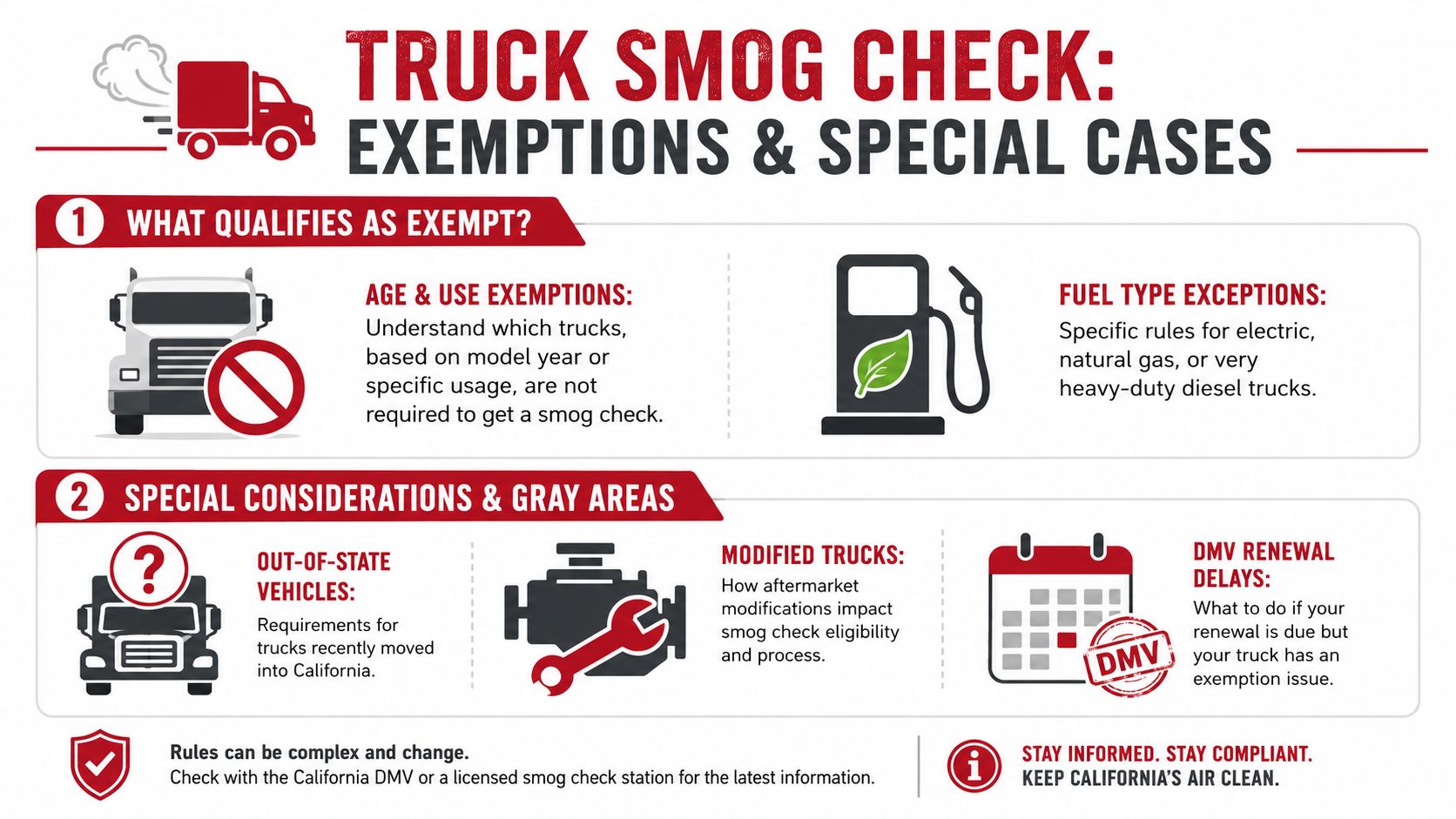
The biggest mistake truck owners make
The most common mistake is assuming a heavy truck is exempt from everything because it does not go through the standard Smog Check lane.
For trucks with a GVWR over 14,000 lbs, the regular station-based smog inspection usually is not the controlling program. As Geotab's California truck smog guide explains, heavier diesel vehicles can fall under Clean Truck Check instead, including recurring OBD compliance requirements for certain model years. That is a different process, a different schedule, and a different problem to solve than the biennial inspection a light-duty pickup owner handles at a STAR station.
From the shop side, this is the practical consequence. A customer with a half-ton or three-quarter-ton truck may only need the normal inspection path. A customer with a heavier diesel may need to verify Clean Truck Check status before booking a station visit at all. Getting that wrong wastes time and can delay registration.
Exempt from the standard smog test does not mean exempt from California emissions compliance.
Other gray areas that cause delays
Newer trucks can also confuse the schedule. Some vehicles are still in the exemption window, so the owner pays a smog abatement fee instead of doing a physical inspection. Then a DMV notice arrives later, and it looks inconsistent. Usually it is just the truck aging into the regular requirement.
Out-of-state trucks are another frequent problem. California may require separate emissions compliance steps for trucks brought in from outside the state, especially for diesel and other non-gasoline vehicles. The rule is handled through the state program, not by relying on whatever testing the previous state required, according to the California Air Resources Board Clean Truck Check program information.
A few special cases are worth checking before you head to the station:
- RVs and motorhomes: Test eligibility is only part of the issue. Physical bay clearance matters too.
- Modified trucks: Aftermarket parts, deleted equipment, or missing emissions labels can stop the inspection quickly.
- Ownership transfers: A truck that is not due for normal renewal smog can still need certification for a sale.
- Diesel work trucks near the cutoff: A small difference in GVWR can put one truck in the regular Smog Check system and another in Clean Truck Check.
This is the part many owners want clarified in plain English. Light-duty trucks usually need the familiar station process. Heavy-duty diesel trucks often follow Clean Truck Check instead. If the paperwork is unclear, a STAR-certified test-only station like Fire House Smog can tell you whether you are booking the right type of appointment before you lose a day chasing the wrong requirement.
The Smog Test Process From Start to Finish
You pull in with a DMV notice on the seat and one question in mind. Is this a quick check, or is this going to turn into a problem? For most light-duty trucks in the regular California Smog Check program, the visit is straightforward if the truck is ready and you brought the right paperwork. For heavier diesel trucks that fall under Clean Truck Check, the process is different, which is why confirming the program before the appointment saves time.
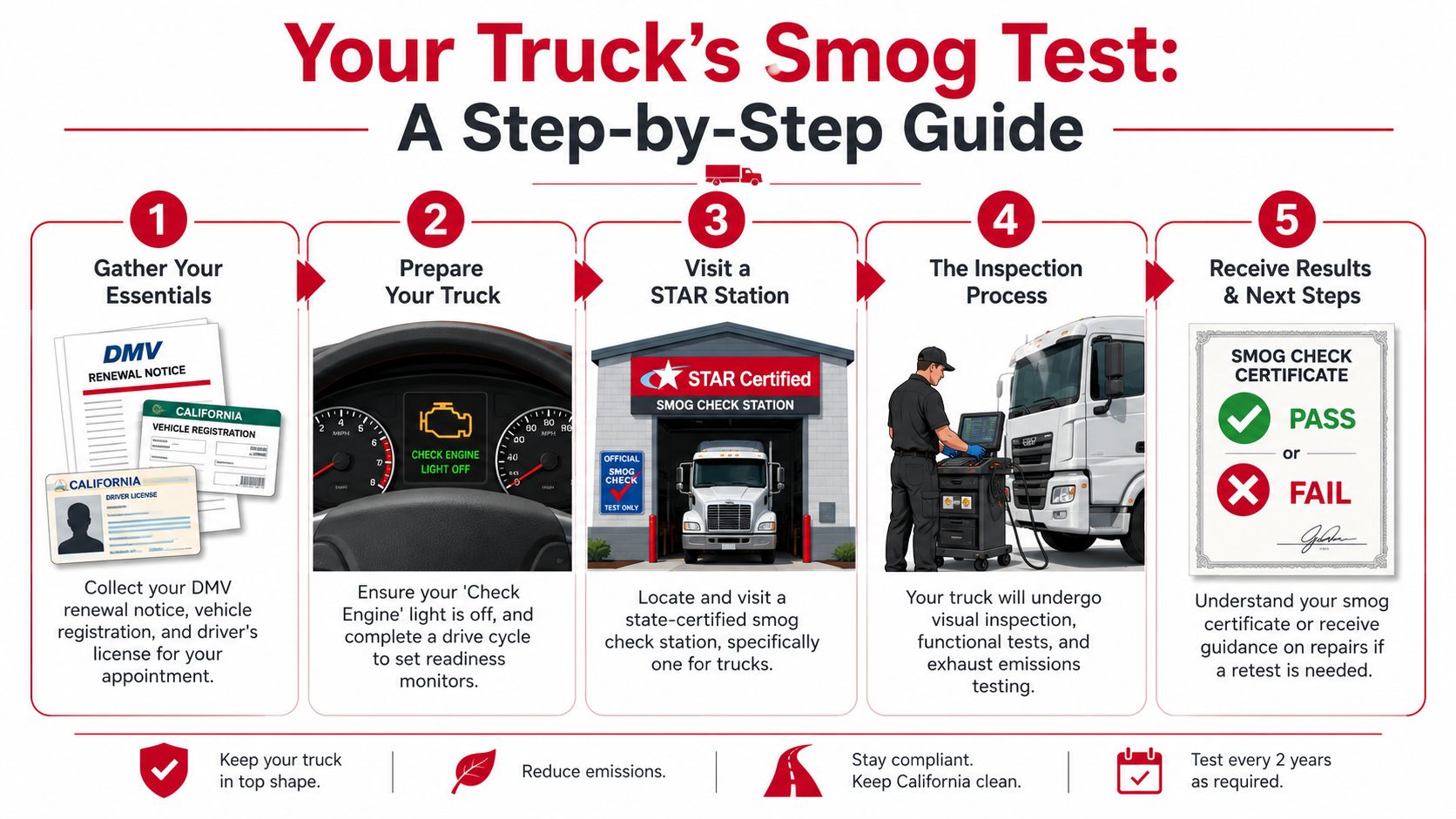
What to bring and what the technician checks
Bring your registration and the DMV notice if you received one. If you want to handle registration-related tasks at the same stop, keep your driver's license ready too. At a station like Fire House Smog, that matters because on-site DMV services can save you a second errand after the test is done.
Once the truck is checked in, the technician verifies the vehicle information, confirms the test type, and starts the inspection. For many gasoline trucks and newer light-duty models, the process centers on the emissions system status reported through the vehicle computer. Some older vehicles can still require a tailpipe portion, and every applicable vehicle gets a visual check for emissions components that are supposed to be there.
The inspection usually comes down to three parts:
Vehicle and equipment verification
The technician confirms the VIN, checks the emissions label when needed, and looks for missing, disconnected, or obviously tampered emissions parts.OBD-II and functional checks
The system is scanned for fault codes, monitor readiness, and command status related to emissions performance.Tailpipe testing when required
Older applicable trucks may still get an exhaust measurement based on the test standard for that vehicle.
If you want a clearer picture of what commonly causes a failed inspection, review these truck smog check fail reasons before you book.
A short explainer helps here:
What happens after the inspection
If the truck passes, the result is sent electronically to the state. In most cases, that clears the smog requirement tied to your registration. If the truck fails, you receive a report showing where the problem showed up, such as an active trouble code, incomplete readiness monitors, or a visual equipment issue.
That distinction matters at a test-only station. A STAR-certified test-only shop inspects the vehicle and reports the result. It does not turn the failed test into a repair sale.
Fire House Smog is a STAR-certified test-only station with two service bays, and that setup helps in a practical way. Owners can get the correct inspection for a qualifying light-duty truck, confirm whether they are dealing with standard Smog Check or a different heavy-duty requirement, and handle DMV-related tasks on site instead of piecing the process together at multiple stops.
The best appointment is the one where the truck is ready to test. Warning lights, recent battery disconnects, and visible emissions tampering still stop plenty of trucks before the paperwork is even the hard part.
Practical Tips to Pass Your Truck's Smog Check
Most smog failures are not surprises to the truck. They're surprises to the owner.
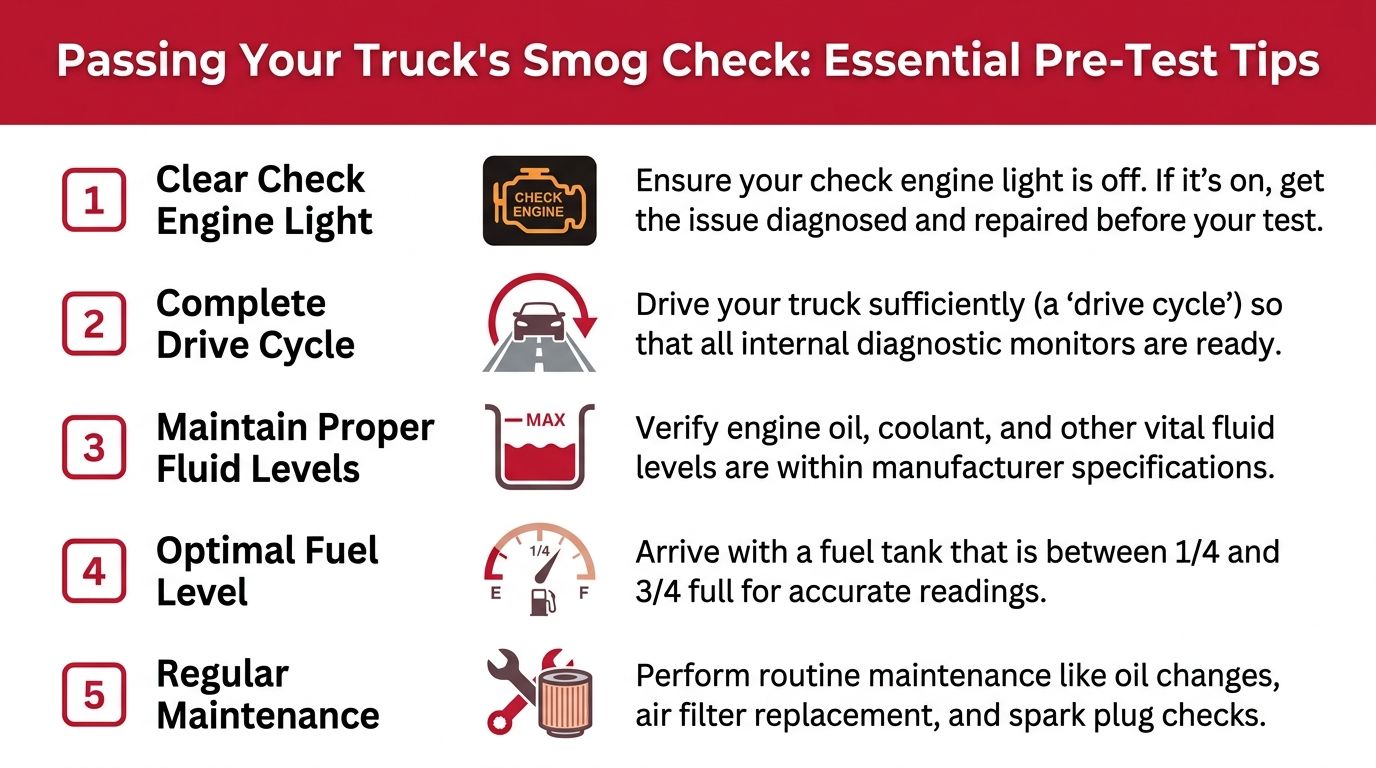
What helps before you arrive
The first thing I tell customers is simple. If the Check Engine light is on, don't book the test expecting luck to save you. A lit check engine light causes an automatic failure regardless of tailpipe readings, as explained in Lytx's truck smog check guide.
That one rule changes how you should prepare.
- Handle warning lights first: A glowing MIL is a stop sign, not a maybe.
- Drive the truck before the test: A normal drive before the appointment helps the truck arrive warmed up and operating normally.
- Don't disconnect the battery right before testing: That can create readiness issues and turn a repair into a failed inspection.
- Look for obvious equipment problems: Missing caps, disconnected hoses, or visible tampering waste everyone's time.
- Stay current on routine maintenance: Dirty filters, neglected tune-up items, and unresolved drivability problems don't help.
For many owners, the most useful prep is not mechanical expertise. It's honesty. If the truck runs rough, stalls, smells rich, or has had a warning light recently cleared, it probably isn't ready.
“If you just cleared a code this morning, wait. A rushed test is usually more expensive than a delayed one.”
If you want a quick reference on common reasons vehicles fail, Fire House Smog has a page on smog check fail reasons that lines up with what technicians see every day.
If your truck fails
A fail result doesn't mean the truck is done for. It means the problem has to be corrected before certification.
What works after a failure is targeted repair. Read the failure report carefully, repair the actual issue, and then return for a retest. What doesn't work is replacing random parts and hoping one of them fixes it.
A test-only station is useful here because the inspection result stands on its own. There's no built-in incentive to turn a failed test into a repair ticket. That separation is one reason many truck owners prefer the test-only route when they want a straightforward answer.
Your One-Stop Solution in Antioch: Fire House Smog
When truck owners get frustrated, it's usually not because the inspection itself is impossible. It's because the process gets split into too many errands. One place for testing. Another for DMV work. Another call to verify whether the station can handle a truck or RV size.
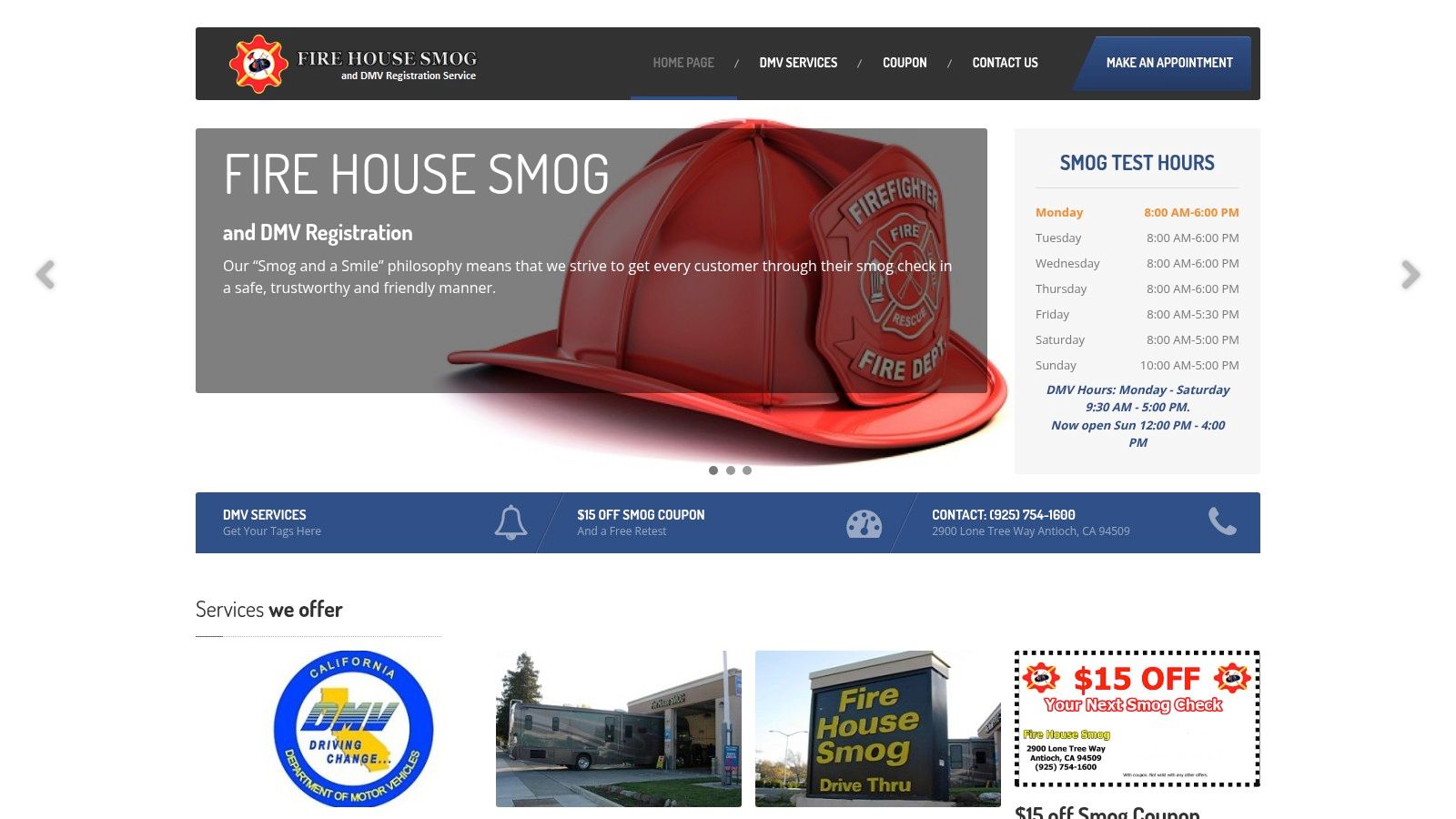
That's where a local station setup matters. Fire House Smog in Antioch is a STAR-certified test-only smog station and a licensed DMV registration services provider located on Lone Tree Way. It handles smog inspections for cars, trucks, and some RVs, subject to size and equipment limits, and it processes California registration renewals, ownership transfers, and related DMV transactions with on-site tag issuance during posted hours.
For truck owners, the practical advantages are straightforward:
- Test-only model: You get the inspection without repair sales pressure.
- Two service bays: That helps move vehicles through more efficiently.
- Seven-day smog availability: Easier for working drivers and small business owners.
- On-site DMV services: Useful when your goal is to finish the compliance step and the registration step together.
- Truck-focused service mix: You can review their local Antioch smog check services before you go.
If you have a light-duty truck that needs a standard inspection, or you're sorting out a renewal and want fewer moving parts, that kind of setup can save a lot of unnecessary back-and-forth. If you have a large RV or a vehicle with unusual fitment, call first and confirm the station can accommodate it.
If your truck needs a smog check and you want to handle the inspection and DMV paperwork with less friction, contact Fire House Smog. They provide STAR-certified test-only inspections, on-site DMV services, and practical help for Antioch and East Contra Costa County drivers trying to get registration done without extra stops.

Your registration notice shows up. You glance at the line about smog certification, then start searching for a smog check in Concord, CA and immediately run into a mess of coupons, STAR listings, test-only stations, and repair shops that all sound the same.
They aren't the same.
The biggest mistake local drivers make isn't showing up with a problem car. It's choosing a station without understanding what that station can do if the car fails. In Concord and Antioch, that distinction matters a lot. A test-only station can inspect your vehicle, but it can't repair it. A test-and-repair shop can inspect and fix, but some drivers prefer test-only because there's no repair upsell tied to the result. If you know that going in, the whole process is easier.
Table of Contents
- Your DMV Smog Notice Arrived What Now
- How to Prepare Your Vehicle for a First-Time Pass
- The Smog Check Process from Start to Finish
- Passed or Failed What Are Your Next Steps
- Smart Tips to Save Time and Money in Antioch
- Frequently Asked Questions for Local Drivers
Your DMV Smog Notice Arrived What Now
You open the DMV renewal notice, see “smog certification required,” and the first question is usually the wrong one. It is not “Where's the closest shop?” It is “Do I need a test-only station or a test-and-repair station?”
That choice decides whether this is a quick stop or a two-trip problem.
California requires smog certification for many registration renewals in areas like Concord and Antioch. As outlined in AAA's California Smog Check overview, the program generally applies to many gasoline, hybrid, and alternative-fuel vehicles (1976 or newer) and diesel vehicles (1998 or newer), with some exemptions for newer gasoline models.
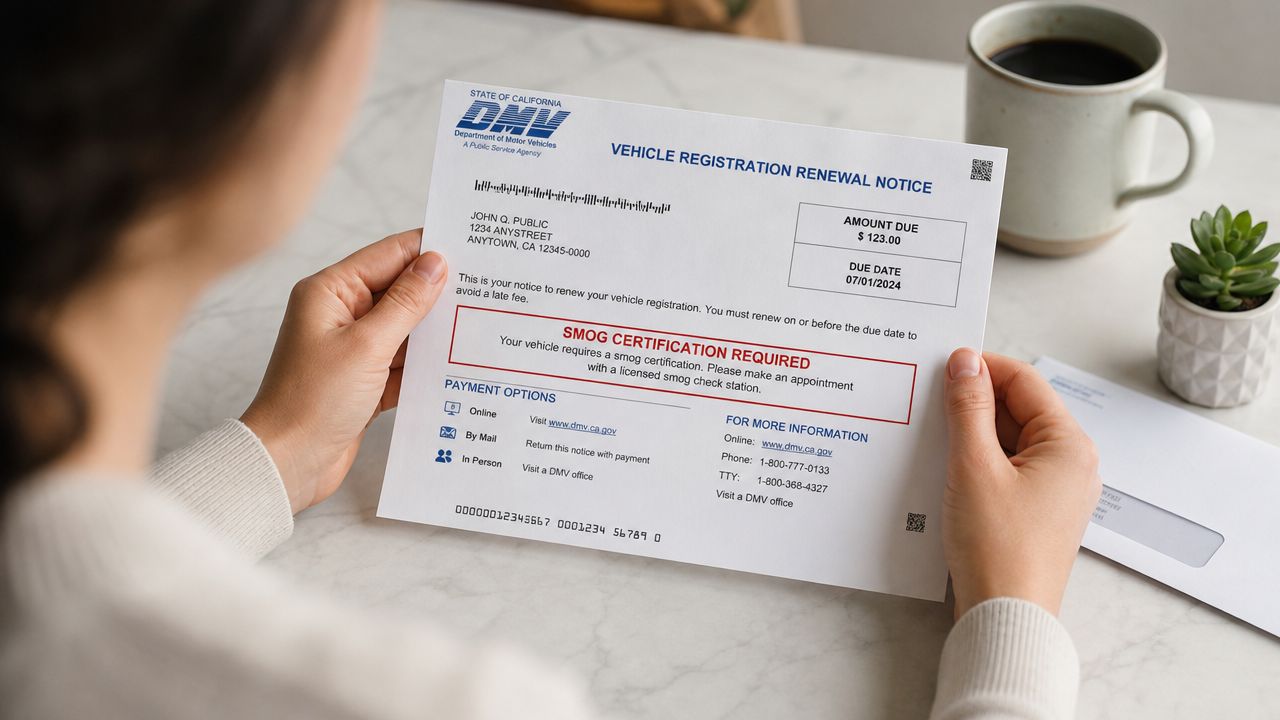
The shop type matters more than drivers expect
A test-only station inspects the vehicle and reports the result. Its function is limited to inspection.
A test-and-repair station can run the inspection, diagnose the reason for a failure, and perform the repair work.
That sounds simple, but it causes plenty of confusion locally. A driver goes to a test-only center because it is nearby or because the price looks good, then finds out too late that a failed car cannot be fixed there. At a place like a STAR test-only shop, including stations such as Fire House Smog when operating in that role, the process stops at the failed certificate. You still need another shop for repairs.
The two-step process after a failed test-only inspection
This is the part many drivers miss.
If you fail at a test-only station, the next move is not to wait around for a repair quote. You have to follow two separate steps:
- Take the failed vehicle to a test-and-repair shop or repair facility for diagnosis and emissions-related repairs.
- Return for the required retest after the repair is complete, based on the station rules and your paperwork.
That extra handoff is why test-only works well for some cars and wastes time for others. If the vehicle has been running fine, no warning lights, no recent battery disconnect, and no known drivability issues, a neutral test-only inspection can make sense. If the car has a check engine light history, runs rough, or has already failed before, going straight to a test-and-repair shop often saves a trip.
SmogTips explains how Concord test-only stations handle failed vehicles, and it matches what local drivers run into every week.
If you are also trying to finish registration on the same timeline, review the California DMV registration renewal process and paperwork steps before you go. That helps you line up the inspection, any needed repairs, and your DMV deadline without unnecessary delays.
How to Prepare Your Vehicle for a First-Time Pass
A lot of first-time failures are avoidable. The pattern I see in Concord and Antioch is usually the same. The car drives in looking fine, but the check engine light is on, the battery was disconnected last weekend, or the owner comes straight from topping off the tank.
That matters even more if you plan to test at a test-only station. If the car fails there, you are starting a two-step cleanup process instead of wrapping everything up in one place. Good prep cuts down the odds of that extra trip.
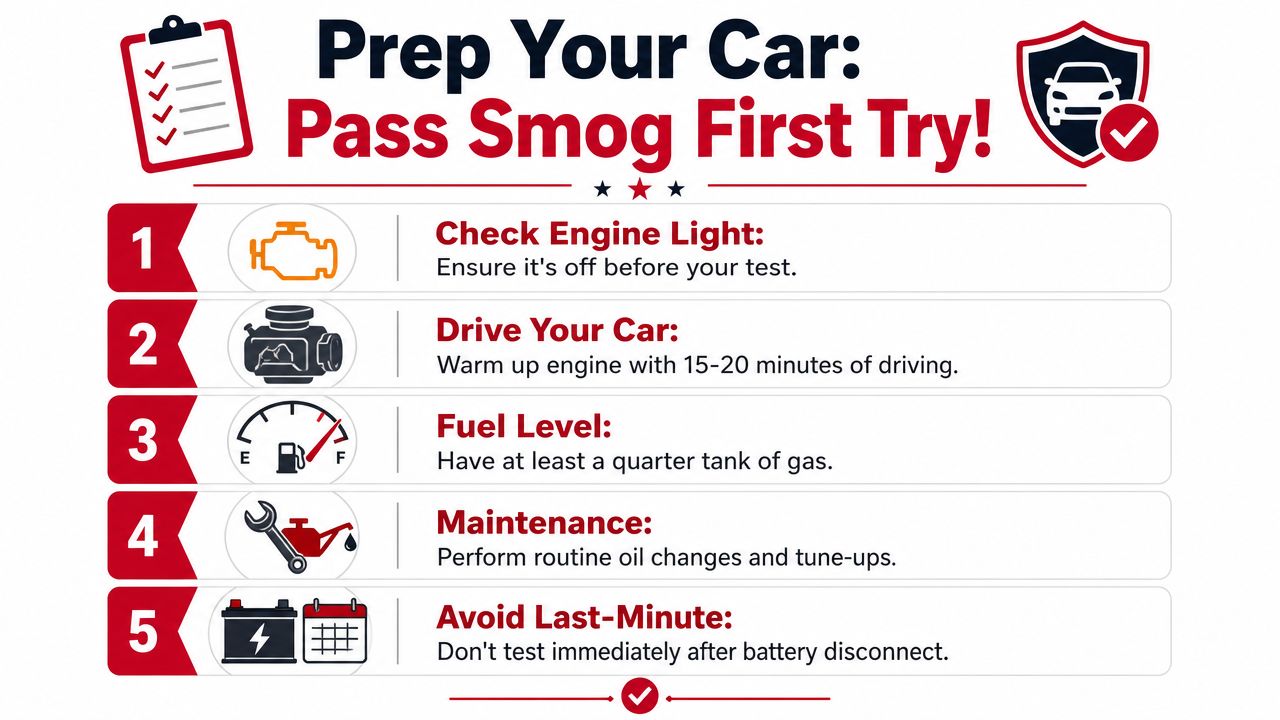
What to do before you leave home
Start with the items that cause the most preventable failures.
- Make sure the Check Engine light is off: If the light is on, wait until the problem is diagnosed and repaired before testing.
- Drive the car long enough to get fully warm: A cold engine is not ideal for inspection. Normal driving before the appointment gives the emissions system time to operate the way it should.
- Hold off after battery disconnects or code clearing: If power was recently disconnected, or someone cleared codes, the readiness monitors may not be complete yet.
- Bring your paperwork: Your renewal notice and current registration help speed up check-in.
- Check for obvious issues: A loose gas cap, overdue maintenance, rough idle, or strong fuel smell can all point to trouble you should address first.
Readiness monitors trip up more people than they expect
Modern vehicles run self-checks in the background. The smog machine looks for those monitors to show a completed status. If they are not ready, the car can fail even if it seems to run well on the road.
I tell drivers the same thing every week. Clearing codes the night before a smog appointment usually turns one problem into two. The original fault may still be there, and now the monitors are incomplete too.
If you recently repaired the car, replaced the battery, or disconnected power, give it normal driving time before your appointment. A car that feels fixed is not always a car that is ready for inspection.
Drivers who look up common smog check fail reasons in California often focus on parts like oxygen sensors or catalytic converters. That research helps, but monitor status is just as important. A repaired car still needs enough normal driving to prove those systems are working.
Fuel level matters too
This catches people off guard.
Your tank should not be near empty, and it should not be filled to the brim right before the test. On some vehicles, the EVAP monitor will stay incomplete if the fuel level is outside the range the system wants to see.
A good middle-ground tank level makes life easier. If you are planning to test at a test-only shop, that small detail can save you from failing for a preventable reason and having to leave for repairs, then come back later for the next step.
The Smog Check Process from Start to Finish
You pull into a Concord smog shop on your lunch break, expecting a quick yes or no. The part that catches drivers off guard is that the process depends on what kind of station you chose. At a test-only shop, the technician can inspect and report. If the car fails, that shop does not do the repair, so your next step is separate.
For most passenger vehicles, the visit itself is fairly quick if the car is ready and the paperwork lines up. The usual flow is check-in, vehicle identification, equipment hookup, inspection, and results.
What the technician checks
California smog inspections generally include three parts, as explained in Geotab's California smog check guide: a visual inspection, an OBD system check, and the required emissions test for that vehicle.
| Part of test | What happens |
|---|---|
| Visual inspection | The tech checks that required emissions parts are present and appear correct for the vehicle, including items like the catalytic converter and other related equipment where required. |
| OBD check | The inspection machine communicates with the car's computer to look for stored trouble codes, a check engine light command, and monitor readiness status. |
| Emissions measurement | Depending on the vehicle, the station performs the appropriate tailpipe or diesel smoke procedure required by the state program. |
In the bay, the order is pretty simple. The technician verifies the VIN and plate information, connects the testing equipment, and confirms the car matches the record the state expects to see. After that, the machine walks the tech through the required test steps for that model year and fuel type.
The test-only detail many drivers miss
This matters more than people expect in Concord and Antioch.
A test-only station can tell you whether the vehicle passed. It can also show you why it failed. It cannot switch over and fix the issue if the shop is licensed only for testing. That is the point many drivers miss, and it is why a failed visit at a place like Fire House Smog can turn into a two-step process instead of a one-stop errand.
The first step is the inspection and failure report. The second step is taking that report to a licensed repair shop, fixing the cause, then returning for a retest at the appropriate station. If you want to see how a local in-and-out test-only smog center operates, that overview helps set expectations before you arrive.
Where delays usually happen
The slowdowns are usually not dramatic mechanical problems. They are often process problems.
A car may fail because the computer shows a fault code, the monitors are not ready, or an emissions component is missing or modified. I see plenty of vehicles that drive fine but still stop the test because the OBD side is not lined up with state requirements. That is especially frustrating at a test-only station, because the answer is immediate but the fix has to happen somewhere else.
One common example is an incomplete EVAP monitor. The driver leaves with a failed test, books a repair shop, then learns the issue may be monitor status rather than a bad part. That is why reading the failure printout closely saves time. It tells you whether you are chasing a hardware problem, a readiness problem, or both.
After the paperwork and initial setup, this short video gives a good visual feel for the inspection environment:
Most modern cars pass or fail based on a short list of things. The emissions equipment has to be present, the computer has to be ready, and the system cannot be reporting an active fault.
Passed or Failed What Are Your Next Steps
You pull into a test-only station, the car runs fine, and then the printer hands you a fail sheet. That is the moment a lot of Concord and Antioch drivers lose time, not because the problem is huge, but because they are unclear on what happens next.
The next step depends on one thing. Did you test at a test-only station, or at a test-and-repair shop? That distinction matters more than people expect.
If your car passes
A pass is simple. The station files the certificate electronically with the DMV, and the certificate fee is added to the inspection price.
You usually do not need to carry proof around for registration purposes. Still, keep your paperwork. If there is ever a DMV timing issue or a question about a recent repair, that printout saves a phone call and sometimes a second trip.
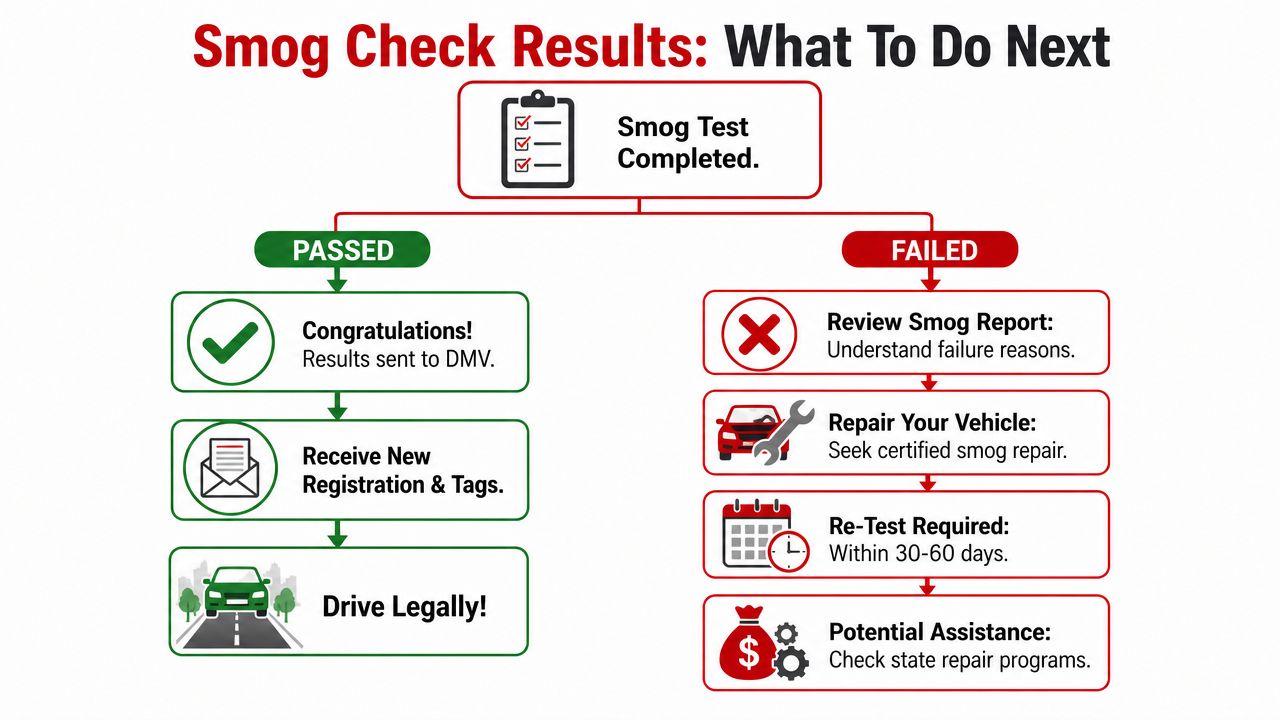
After a passing test, do these three things:
- Finish your registration: Once the DMV has the pass on file, you can complete renewal.
- Keep the inspection receipt: Store it with your registration papers.
- Make a note for next time: Smog checks usually come back on a two-year cycle for vehicles that require them.
If your car fails at a test-only station
This is where station type really matters.
A test-only station can inspect the car and give you the failure report. It cannot fix the car. A test-and-repair shop can diagnose the issue, repair it, and then handle the retest. If you fail at a place like Fire House Smog, you are starting a two-step process, not a one-stop visit.
Here is the exact sequence to follow after a fail at a test-only center:
- Take the failure report with you. Do not rely on memory or a verbal summary.
- Bring the car to a licensed repair shop that handles smog-related diagnosis and repair.
- Have the shop repair the failed item or items listed on the report.
- Ask whether the repair reset any readiness monitors. If it did, the car may need a drive cycle before it can pass.
- Return for the retest once the repair shop says the vehicle is ready.
That fourth step is the one drivers miss all the time. The car may be fixed but still not ready to test if the onboard monitors have not completed. That creates the frustrating “repaired but still not passable today” situation.
A free retest usually means the station waives the second inspection fee under its policy. It does not cover diagnosis or repair work done somewhere else.
What a failure usually means
A failed smog check does not automatically mean an expensive repair. In my experience, the causes range from minor to costly, and the paperwork usually points you in the right direction if you read it closely.
Common reasons include:
- Stored trouble codes
- Readiness monitors not set
- EVAP system problems
- Faulty oxygen sensors
- Catalytic converter problems
- Missing or modified emissions equipment
- Simple issues such as a loose or incorrect gas cap
Older vehicles usually have a narrower margin for passing, especially if they have high mileage or overdue maintenance. Newer cars more often fail because of check engine light history, monitor status, or recent battery disconnects.
What to ask the repair shop before you leave the keys
A good repair visit starts with the right questions. Hand the shop the fail report and be direct.
Ask:
- What exact line on the report caused the failure?
- Are you repairing a bad part, or are we dealing with monitor readiness?
- Will this repair clear codes and reset monitors?
- How much driving is needed before I come back for a retest?
- Do you see anything else likely to stop the next test?
That last question can save you a second repair bill. A careful shop will often spot a weak battery, aftermarket part, or pending fault that has not turned into a full failure yet.
The short version is simple. If you pass, finish registration. If you fail at a test-only station, repair first, then retest. Once drivers understand that split between test-only and test-and-repair, the whole process gets a lot less confusing.
Smart Tips to Save Time and Money in Antioch
The cheapest smog check isn't always the least expensive day. A low advertised price doesn't help if you make multiple trips, miss work, or sit in a DMV line afterward.
For a typical 2000+ gasoline vehicle in Concord, the inspection usually runs $49.75 to $59.75 plus the $8.25 state certificate fee, and the visit is commonly finished in 20 to 30 minutes at a STAR-certified station, based on Concord-area smog pricing and turnaround details. That gives you a realistic baseline when you compare offers.
Where drivers waste time
A few habits create most of the hassle:
- Chasing the lowest coupon without checking station type: If you choose test-only without realizing what happens after a fail, the cheap coupon can turn into extra driving and delay.
- Going at the wrong time of day: If your schedule is tight, look for extended evening or weekend availability.
- Separating smog and DMV errands: Two stops means more waiting, more parking, and more chances something slips.
What works better
I'd prioritize convenience over headline price when the difference is small.
Look for a location that can handle the smog inspection and, if you pass, process your registration renewal on-site. That's a significant time saver for East Contra Costa drivers. You avoid a second trip and skip the usual DMV-office routine.
A practical shopping checklist looks like this:
| What to compare | Why it matters |
|---|---|
| Station type | Determines whether repairs can happen on-site after a fail. |
| Hours | Evening and weekend access helps working drivers. |
| Vehicle fit | Important if you have a truck, van, or RV. |
| DMV services | Lets you wrap up registration in one stop after a pass. |
The smoothest smog visit is the one that doesn't turn into three separate errands.
Frequently Asked Questions for Local Drivers
Do out-of-state vehicles need a California smog inspection
If you're bringing in an out-of-state vehicle for California registration, check the registration requirements before you show up. The smog requirement depends on the vehicle and registration situation, and the cleanest path is to confirm the paperwork first so you don't make an unnecessary trip.
I have a heavy diesel truck. Is that a regular smog check
Not always. A recent regulatory change affects diesel vehicles over 14,000 GVWR, model year 2014 and newer. Those vehicles fall under Clean Truck Check, which is a separate compliance requirement and not the same as a standard smog test, according to this Clean Truck Check summary for local diesel owners.
Are all diesel appointments the same
No. This is a common pitfall for fleet owners. A shop advertising diesel testing may still not be the right provider for a heavy-duty vehicle that needs Clean Truck Check compliance instead of a standard passenger-vehicle style inspection.
If you want a straightforward option for East Contra Costa drivers, Fire House Smog is a STAR-certified test-only station in Antioch that also offers on-site DMV registration services. It's a good fit if you want an unbiased inspection, quick turnaround, and the ability to handle registration in the same stop after a passing result.

Your renewal notice shows up, and your eyes go straight to the line that means one more errand, one more fee, and one more chance to get caught by fine print. If the notice says you need a smog check, you're probably already searching for a Smog Test Only Discount and wondering which coupon is real, which one hides extra charges, and whether “free retest” means free.
That confusion is normal. Most drivers don't need a long lecture on emissions rules. They need practical help figuring out how to pay less, avoid coupon traps, and get through the test without a second surprise at the counter. If you're in Antioch, that usually means understanding how test-only pricing works, what terms matter, and how to use a discount at an Antioch smog check station without overcomplicating it.
Table of Contents
- That DMV Notice Just Arrived Now What
- Why Test-Only Stations Offer Better Discounts
- How to Find Legitimate Smog Test Coupons
- Decoding the Fine Print on Your Coupon
- Using Your Discount at Fire House Smog in Antioch
- Frequently Asked Questions About Smog Discounts
That DMV Notice Just Arrived Now What
The handling of that DMV envelope typically follows a familiar routine. The recipient opens it, scans for the due date, then stops when the smog requirement appears. The next thought is usually simple. How much is this going to cost?
In Antioch, the smart move isn't to call the first shop you remember. It's to check whether your notice points you toward a test-only requirement and then look for a coupon that applies to that category. That's where people save money without getting dragged into unclear pricing.
A common mistake is treating every smog station like it works the same way. It doesn't. If your renewal specifically pushes you toward a test-only path, the right discount can lower the inspection cost and keep the transaction cleaner because the station isn't trying to sell repairs on the back end.
The best time to read coupon terms is before you start the car, not when you're standing at the counter with your registration due.
Why Test-Only Stations Offer Better Discounts
A test-only coupon usually gives you a cleaner deal because the station is selling one thing: the inspection.
That matters. A shop that also does repairs has two revenue paths on the same visit. A test-only station does not. California separates those roles for a reason, and that separation helps the price stay easier to read. If the shop cannot turn a failed test into repair work, the coupon has less room to function as a low-price teaser.
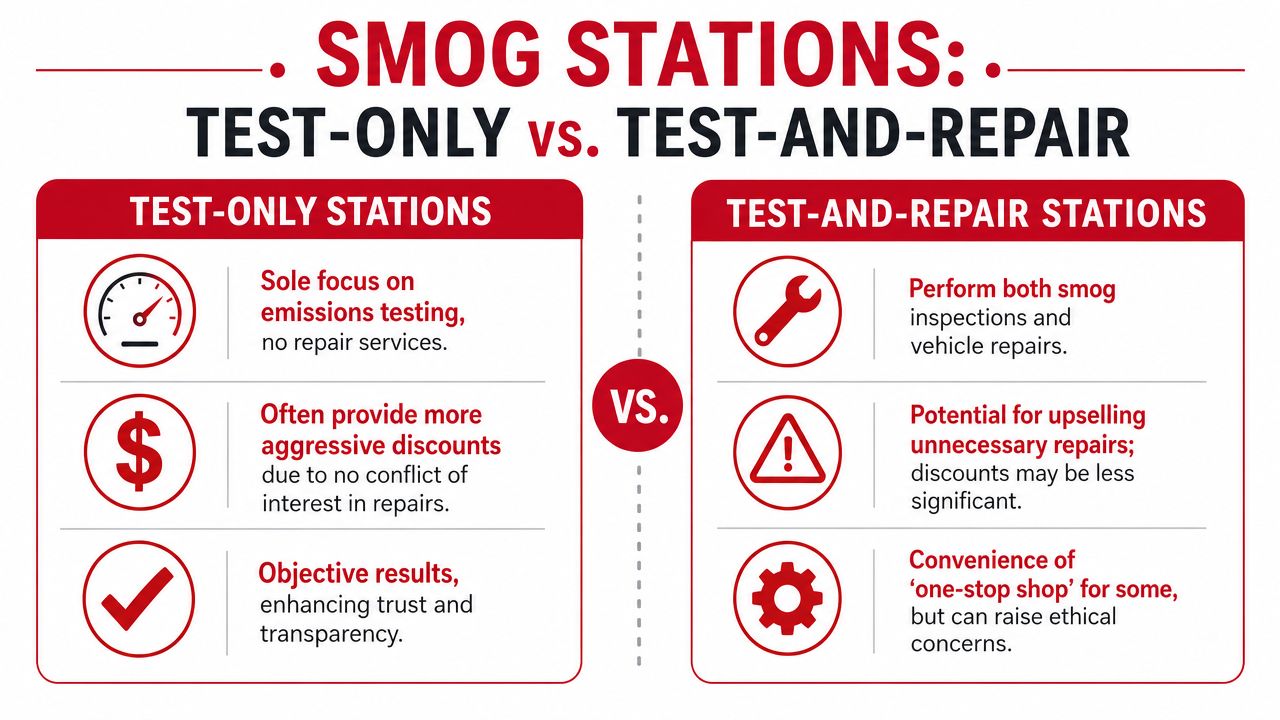
Why the pricing is easier to compare
At a test-only station, the questions are narrower. Does the coupon cover your vehicle class? Is the certificate fee included or separate? If the car fails, do you get a free retest, a discounted retest, or no retest break at all?
That last point gets missed all the time. Two coupons can show the same headline price and still have very different value once you read the retest terms. One shop may offer a free retest within a short window. Another may require you to pay again if you leave and come back after repairs. If you are comparing discounts seriously, the retest policy belongs near the top of the list, not buried at the bottom.
Here's the practical difference:
| Station type | What it does | What to check before you book |
|---|---|---|
| Test-only | Performs the inspection only | Coupon scope, certificate fee, retest terms, excluded vehicle types |
| Test-and-repair | Performs the inspection and may offer repairs | Intro price, repair upsell risk, whether the low test price depends on later work |
Drivers in Antioch can use that difference to their advantage. A straightforward test-only coupon is easier to compare across shops because you are judging the inspection terms, not trying to guess how the shop makes the numbers work on the back end.
The fine print is where the real discount lives
The best discounts are not always the loudest ones. I've seen plenty of smog offers with a strong top-line price and weak terms underneath. The useful coupon is the one that stays useful after you check the exclusions.
Look closely for details like these:
- whether the price applies to STAR or test-only vehicles
- whether trucks, older model years, or specialty vehicles are excluded
- whether the quoted price already includes the state certificate
- whether a free retest is limited to a certain number of days
- whether the station accepts another local discount on top of the posted coupon
That last one is rarely advertised clearly, but it is worth asking about. Some stations will not stack anything. Others may allow a coupon plus a small in-shop discount, especially if the terms do not conflict. The only way to know is to ask before the test starts.
Practical rule: Judge a smog coupon by the total out-the-door terms and the retest policy, not just the first number in bold.
Test-only stations do not automatically have the cheapest offer in every case. They do tend to give drivers a more honest comparison. For anyone trying to keep a renewal simple and avoid surprise costs, that is usually the better bargain.
How to Find Legitimate Smog Test Coupons
Good smog coupons aren't hard to find. Good smog coupons with clear terms are harder. That's the distinction that matters.
Start with the station's own website, because that's where you're most likely to see current offers and any restrictions tied to that location. If you're checking East Contra Costa County options, one place to look is this STAR smog test coupon page. Station-run coupon pages are usually more reliable than old directory listings or reposted screenshots that stay online long after the deal changes.
Where coupons usually show up
Drivers tend to find valid offers in a few repeat places:
- Station websites: Best for current terms, especially if the business updates coupons directly.
- Local mailers: Useful if you keep the flyer and check the expiration date.
- Deal platforms: Helpful for comparing discounts, but the listing description may be shorter than the actual in-shop terms.
- Google search results and map listings: Good for discovery, not always good for details.
One benchmark helps filter nonsense from reality. Some California test-only centers advertise deals like a $39.75 smog check, which is lower than a typical $45 to $70 range for model year 2000 and newer vehicles in major markets, and the fixed $8.25 certificate fee is a state pass-through rather than a markup item, as explained in STAR Smog Center's pricing FAQ. That tells you two things. First, real discounts exist. Second, the advertised special may apply only to the base inspection charge.
A quick screening method
When I look at a smog coupon, I don't start with the discount amount. I start with the exclusions.
Use this checklist before you commit:
- Check the vehicle category. Sedans, SUVs, trucks, vans, diesel vehicles, and some RVs may not all price the same.
- Look for “plus certificate” wording. If it appears, the advertised coupon price probably doesn't include the state certificate fee.
- Confirm station type. A test-only discount should be used at a test-only location, especially if your DMV paperwork points you that way.
- Read the expiration date. Old coupon pages waste time.
- Call if your vehicle isn't standard. Larger vehicles and specialty setups often have separate terms.
If the coupon headline is large and the restrictions are tiny, assume the restrictions matter more than the headline.
The people who overpay usually don't miss the coupon. They miss the terms attached to it.
Decoding the Fine Print on Your Coupon
Most smog coupon confusion comes from three phrases: free retest, certificate extra, and some vehicles excluded. None of those are harmless filler. Each one can change the final bill.
The tricky part is that drivers often read coupons as promises, while stations write them as limited offers. That gap is where frustration starts. A coupon can still be legitimate and still apply only to a narrow slice of vehicles or situations.
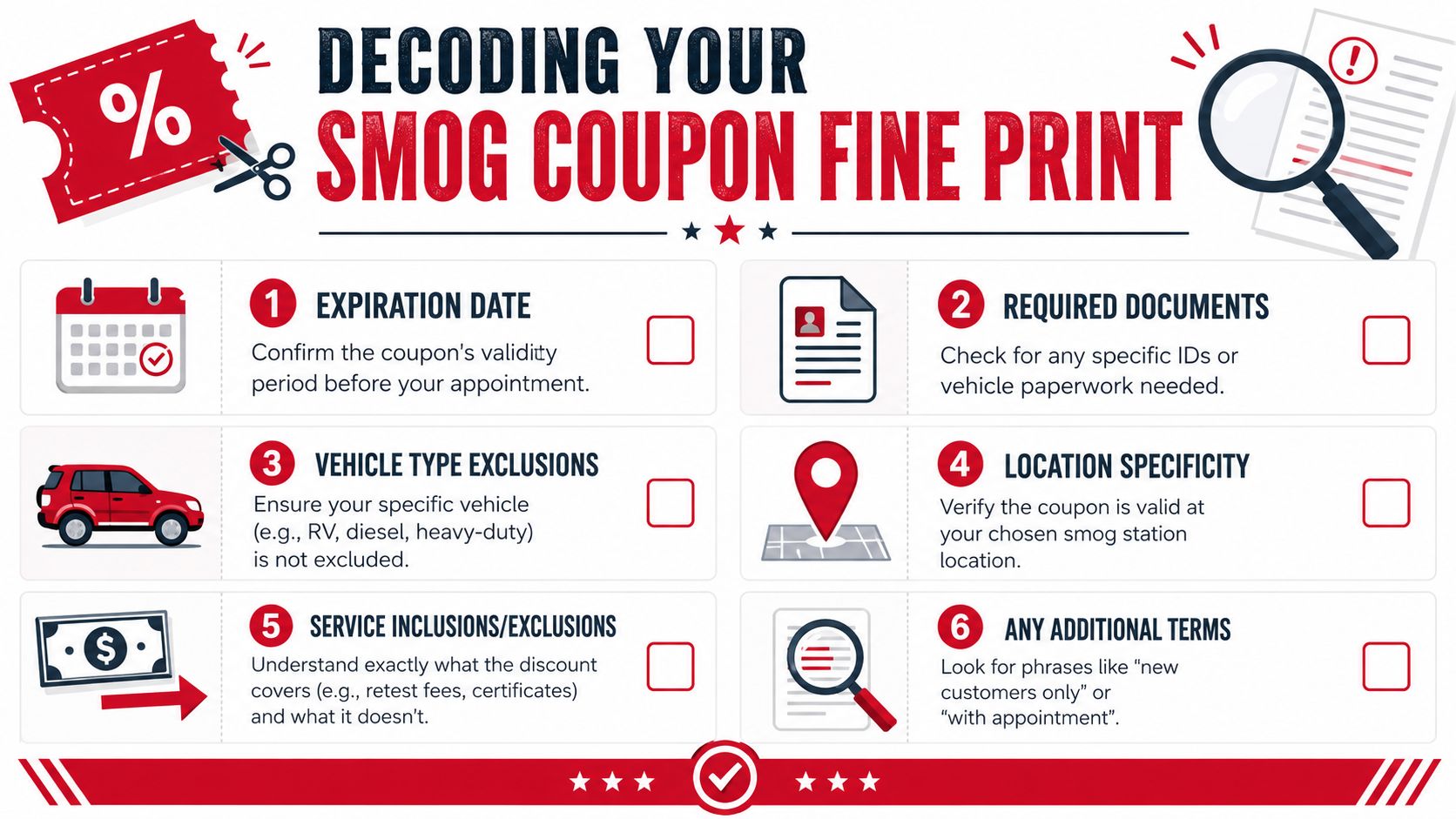
What free retest usually means
A lot of people assume “free retest” means unlimited second chances after any change they make to the car. That's where coupon language gets expensive.
Existing coverage often misses an important point. Test-only stations like Fire House Smog may offer free retests only if the vehicle fails due to emissions equipment issues, not if the owner installs new parts mid-test, according to Crown Smog Check's explanation of retest limits. If a guide online says “free retest” without defining the condition, it's incomplete.
Before you hand over the keys, ask one direct question: “Under what exact condition does the free retest apply?”
That single sentence clears up more confusion than the coupon itself.
Terms that deserve a slow read
Some coupon restrictions matter more than others:
- Vehicle exclusions: Trucks, vans, diesel vehicles, and certain RVs may fall outside the headline offer.
- Included charges: The coupon may reduce the inspection price but not include every fee shown at checkout.
- Appointment requirements: Some offers only apply if you mention the coupon when you arrive or book ahead.
- Customer type restrictions: A few specials apply only to new customers or one vehicle per visit.
Here's a simple way to read the offer:
| Coupon phrase | What it usually signals |
|---|---|
| Free retest | A narrow policy, not a blanket promise |
| Plus certificate | The state certificate fee is separate |
| Most vehicles | Your vehicle may fall outside the advertised price |
| STAR / test-only | The offer may be tied to a specific inspection type |
What drivers should ask before approving the test
If you want the fast version, ask these at check-in:
- “Is this coupon valid for my exact vehicle?”
- “Does the posted price include the certificate fee or not?”
- “What voids the free retest?”
That's enough to separate a real bargain from a misunderstanding.
Using Your Discount at Fire House Smog in Antioch
If you're planning to use a coupon locally, the smoothest approach is to arrive with the offer ready on your phone or printed out, confirm it applies before the test starts, and clarify the retest terms at the counter. That avoids the awkward version of the visit where the car is already in the bay and the pricing conversation starts too late.
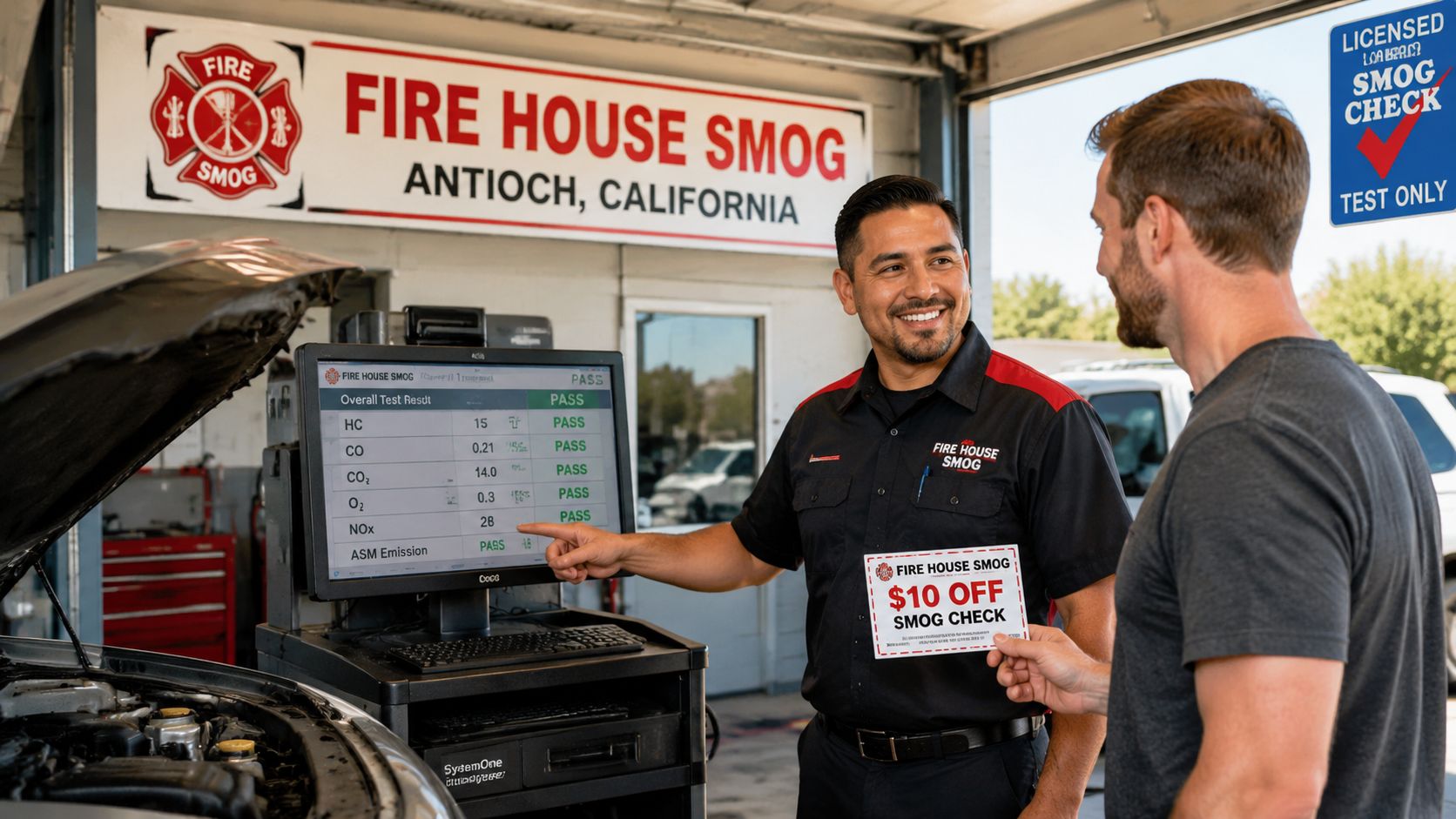
What the visit usually looks like
At Fire House Smog's in-out test-only center, the process is straightforward if you come prepared. Bring the vehicle, your renewal-related paperwork if you have it handy, and the coupon you intend to use. Since it's a STAR-certified test-only operation, the main point is inspection and certification, not repair sales.
The station operates with two service bays and offers smog testing seven days a week with extended evening and weekend hours, which helps if you're trying to fit a required inspection around work or family logistics. For DMV-related services, posted hours are Monday through Saturday 9:30 AM to 5:00 PM and Sunday 12:00 PM to 4:00 PM, with limited services possible on weekends. That matters if you want to pair the smog visit with registration help on site.
Why checking your coupon first saves time
Low-price smog offers work because the station keeps the process efficient. Industry guidance points to First Pass Rate as a key benchmark, and the average passing rate in high-traffic areas is about 88%, according to Diamond Certified's smog check guide. Shops offering discounted inspections have to keep equipment calibrated and workflow tight, because repeat tests eat into already thin margins.
That's why you don't want any avoidable delays at check-in. If your vehicle is a nonstandard fit, has unusual equipment, or you're relying on a free retest clause, ask before the test begins.
A short explainer can also help if you want to see how the process generally works:
Best way to use the discount without friction
Use a simple sequence:
- Show the coupon first. Don't wait until payment.
- State your vehicle type clearly. Sedan pricing often differs from larger vehicles.
- Ask about the retest condition. Especially important if the offer mentions one.
- Confirm whether DMV service is needed after the inspection. That can save a second trip.
- Keep the paperwork until registration is finished. It's easier than trying to reconstruct the visit later.
A coupon works best when it changes only one variable, the inspection price, and leaves no uncertainty about the rest.
Frequently Asked Questions About Smog Discounts
Can you combine a senior or military discount with another coupon
Sometimes a shop allows it. Sometimes the coupon language blocks it.
What matters is the station's posted policy, not a statewide rule that says every discount has to stand alone. BAR pricing rules focus on clear fee disclosure, especially the certificate fee. They do not force a shop to stack offers. That is why the smartest move is to ask one direct question before the test starts: “Can you apply this coupon with my senior or military discount on the same transaction?”
At Fire House Smog, ask that at check-in, not after the inspection is finished. That is when misunderstandings usually start.
What if your vehicle is sent to a test-only station and then fails badly
A hard fail changes the math.
You still get the benefit of a shop that only tests and does not sell you repairs on the spot. But if the car comes back with a Gross Polluter result or another serious failure, the discount on the inspection is no longer the main issue. Time, repair planning, and retest rules matter more. In some cases, owners may qualify for repair assistance through California's consumer assistance program, but that is a separate process and not something a test-only station handles during the same visit.
The practical takeaway is simple. If your coupon advertises a free retest, read the limit closely. Some offers cover only a return visit within a short window and only after repairs are completed elsewhere.
Does a STAR requirement automatically mean the smog check will cost more
No. STAR status by itself does not set the price.
The final cost usually comes down to the base rate, your vehicle category, whether the coupon excludes certain model years or larger vehicles, and whether the certificate fee is already included in the ad. A regular station and a STAR station can both run fair pricing. The difference is in the details printed under the headline price.
How long is the certificate good for
A smog certificate is valid for 90 days, according to Smog Check Deals' California smog discount overview.
That window matters more than drivers think. Test too early, then wait on registration or repairs, and you may end up paying for another inspection.
Is every free retest offer worth chasing
No. “Free retest” sounds better than it often is.
Some coupons only include the retest if you return within a tight deadline. Some exclude Gross Polluter results. Some apply only if the initial failure was close, or only if no parts had to be replaced. Others are valid only for the original vehicle category listed on the coupon. Those limits are not always obvious in the ad itself.
The useful coupon is the one with terms you can explain in one sentence. If the retest policy sounds vague on the phone, expect friction at the counter.
If you want a local option that handles STAR-certified test-only smog inspections and DMV-related services in one place, check Fire House Smog. Review the current coupon terms before you go, confirm how the retest policy applies to your vehicle, and bring the offer with you at check-in so the discount is settled up front.