What should you expect when a sign says full service station? Many drivers assume it means an attendant pumps fuel, while others expect oil checks, windshield cleaning, a smog inspection, or even DMV paperwork. Both assumptions can be partly right, but the phrase has changed over time and doesn't describe one universal package today.
The safest approach is to ask what the station provides before you pull in. A traditional full-service fuel stop, a modern convenience plaza, a test-only smog station, and a business offering DMV services may all serve different needs. Understanding that distinction can save you an unnecessary trip, an unexpected charge, or a wait for a service the station doesn't perform.
Table of Contents
- What Full Service Station Actually Means Today
- Services You Will Find at Full Service Stations
- Full Service Versus Self Service and Test Only Stations
- Cost Expectations and Regional Variations
- When Full Service Stations Provide Real Value
- Finding Local Alternatives and Specialized Services
What Full Service Station Actually Means Today
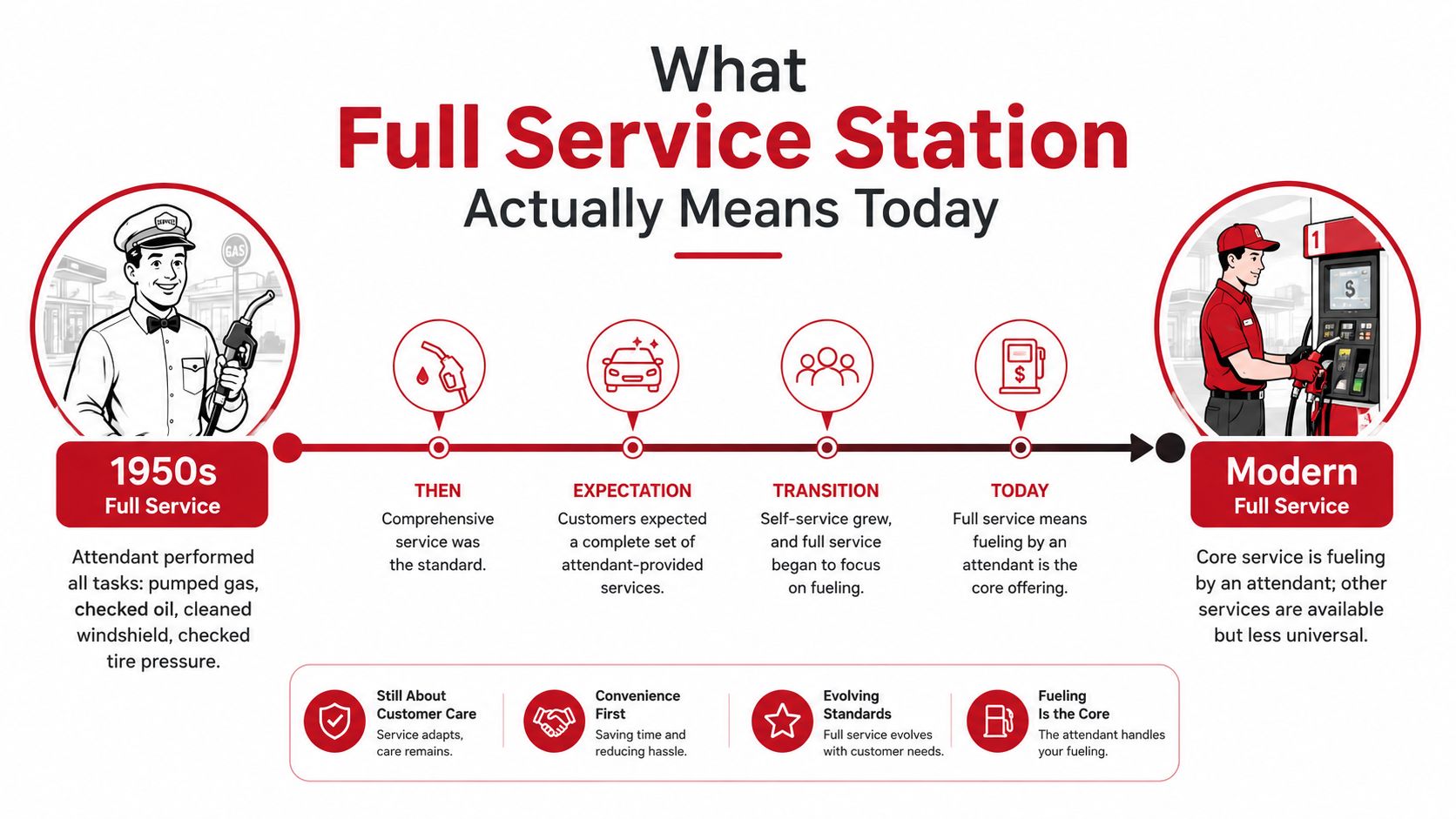
A driver arriving at an older full service station might once have stayed in the vehicle while an attendant handled nearly everything at the pump. The attendant filled the tank, checked the oil, cleaned the windshield, and sometimes checked tire pressure. That broad routine is why many people still picture a uniformed worker performing a complete inspection whenever they hear full service.
Today, the phrase usually starts with one core promise: an attendant dispenses the fuel for you. Other services may be available, but they're not automatically included. A station may offer windshield cleaning and fluid checks, while another uses the same wording for a larger operation that also includes vehicle maintenance, emissions testing, or registration services.
How the original model changed
The American fuel market moved heavily toward self-service. Census of Retail Trade data show that the share of gasoline stations offering some self-service rose from 8% to 80% over the measured period, a major structural change documented in the U.S. Census working paper on gasoline retailing. A 2005 report also observed that only about 20% of nearly 169,000 U.S. gas stations still offered full-serve service at that time, as discussed in the same historical source.
The commonly cited starting point for American self-service is 1947 in Los Angeles, when Frank Ulrich opened a station using the slogan, “Save 5 cents, serve yourself, why pay more?” That moment matters because it captures the economic appeal of shifting pump work from employees to customers. Over time, safer equipment, operating costs, and customer price sensitivity helped self-service become the normal experience in many markets.
What the sign doesn't guarantee
“Full service” shouldn't be confused with “full service center.” The first usually describes fueling assistance. The second can refer to repairs, inspections, maintenance, or administrative services, depending on the business.
Before choosing a station, ask three practical questions:
- Fueling: Will an attendant pump the fuel, or does the station only use the phrase for its broader business?
- Vehicle care: Are fluid checks, tire checks, oil changes, or repairs offered?
- Paperwork: Does the location perform smog checks or DMV registration work, or does it only sell fuel?
That short conversation gives you a more accurate answer than the sign alone.
Services You Will Find at Full Service Stations
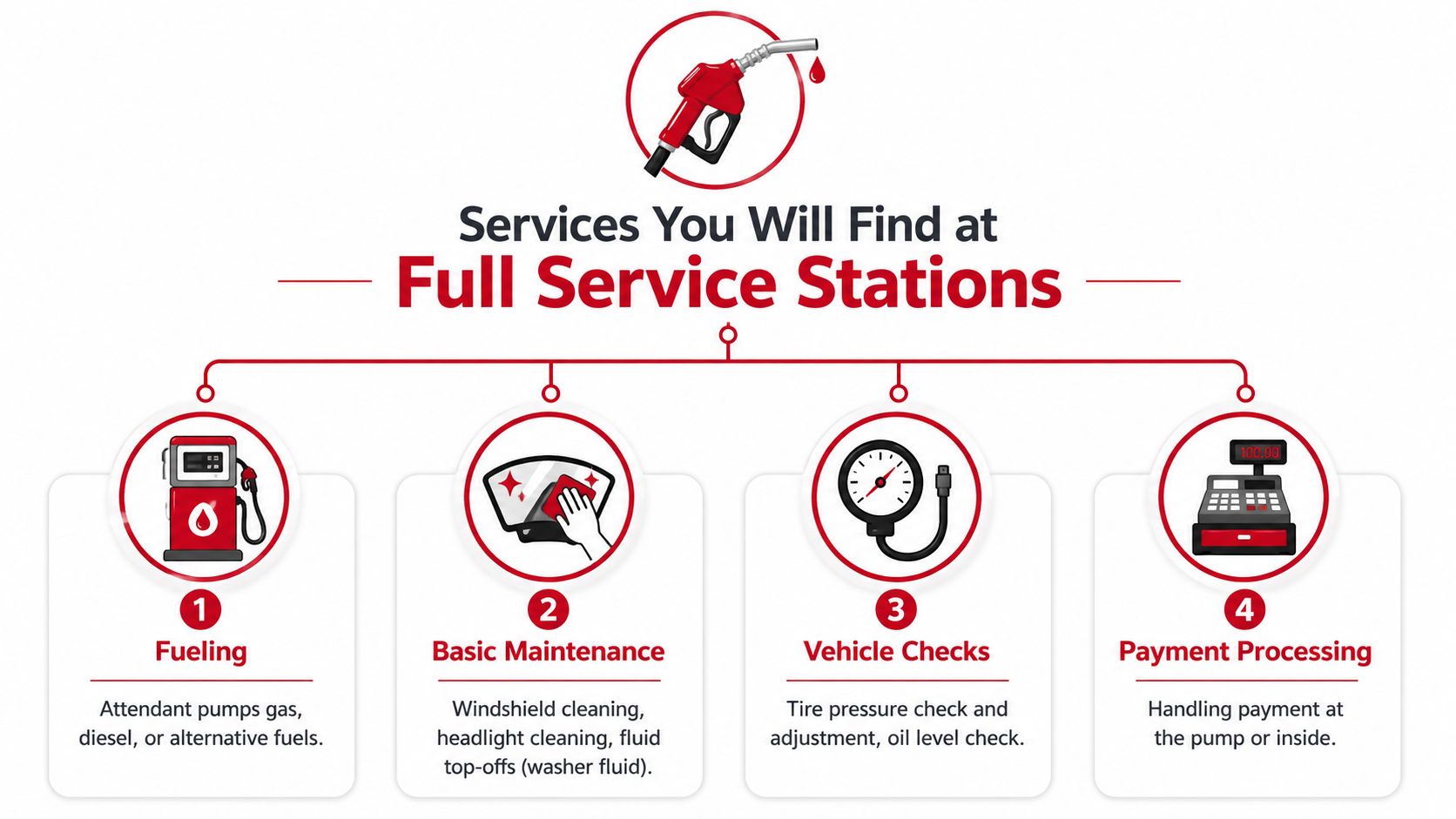
A modern full-service station typically offers several distinct services: fueling assistance, basic maintenance checks, and occasionally emissions or registration work. Availability varies by location, so the station sign alone cannot tell you which combination is available.
Attendant-assisted fueling
The defining task is straightforward for the driver and regulated for the operator. An attendant selects the appropriate fuel, handles the nozzle, starts dispensing, watches the operation, and ends the flow correctly. FDNY's motor fuel facility study materials describe a full-service motor fuel-dispensing facility as one where attendants dispense fuel and personally supervise the operation.
That supervision provides a practical safety checkpoint. The attendant can verify nozzle handling, monitor the automatic shutoff, and follow required fueling procedures. It also lowers the chance of a distracted customer driving away with the nozzle connected or using the equipment incorrectly.
Environmental controls operate in the background. UK guidance sets Stage 1 controls for unloading petrol into storage and specifies vapor recovery for vehicle refueling systems, including recovery of roughly 85% to 115% of displaced tank vapors, according to official petrol storage and refueling guidance. Vapor-tight connections, recovery hardware, auto-shutoff nozzles, and containment features support that process.
Basic maintenance and vehicle checks
Some stations continue to offer familiar extras:
- Windshield care: An attendant may clean the windshield or headlights, depending on station policy.
- Fluid checks: A worker may check engine oil or add washer fluid. Ask whether fluids are included or billed separately.
- Tire service: Staff may measure and adjust tire pressure, although puncture repair and tire replacement may require another provider.
- Quick visual checks: An attendant may notice an obviously low tire, damaged light, or visible fluid concern without performing a full inspection.
These tasks provide information rather than diagnosis. If a check reveals a warning light, leak, worn belt, or brake concern, request a written explanation and a separate estimate.
Testing and administrative help
Some locations have expanded beyond traditional attendant service. They may host a smog inspection lane, provide safety certification, or process registration renewals and ownership paperwork. Each service can have its own requirements, prices, and operating hours, so confirm the details before arriving.
A specialized provider offering test-only smog and vehicle services may suit a driver who needs emissions testing rather than fueling assistance. Ask whether your vehicle qualifies, whether an appointment is required, and whether the business performs testing only or also sells repairs. This distinction matters because a station that checks emissions may not diagnose or fix the issue that caused a failed test.
Full Service Versus Self Service and Test Only Stations
Which station fits your next stop? The answer depends on the specific service you need, fueling assistance, a quick self-serve visit, or a focused emissions inspection. Each label describes a different scope of work. A full service station may combine attendant fueling with other conveniences, while self-service and test-only sites usually keep their roles narrower.
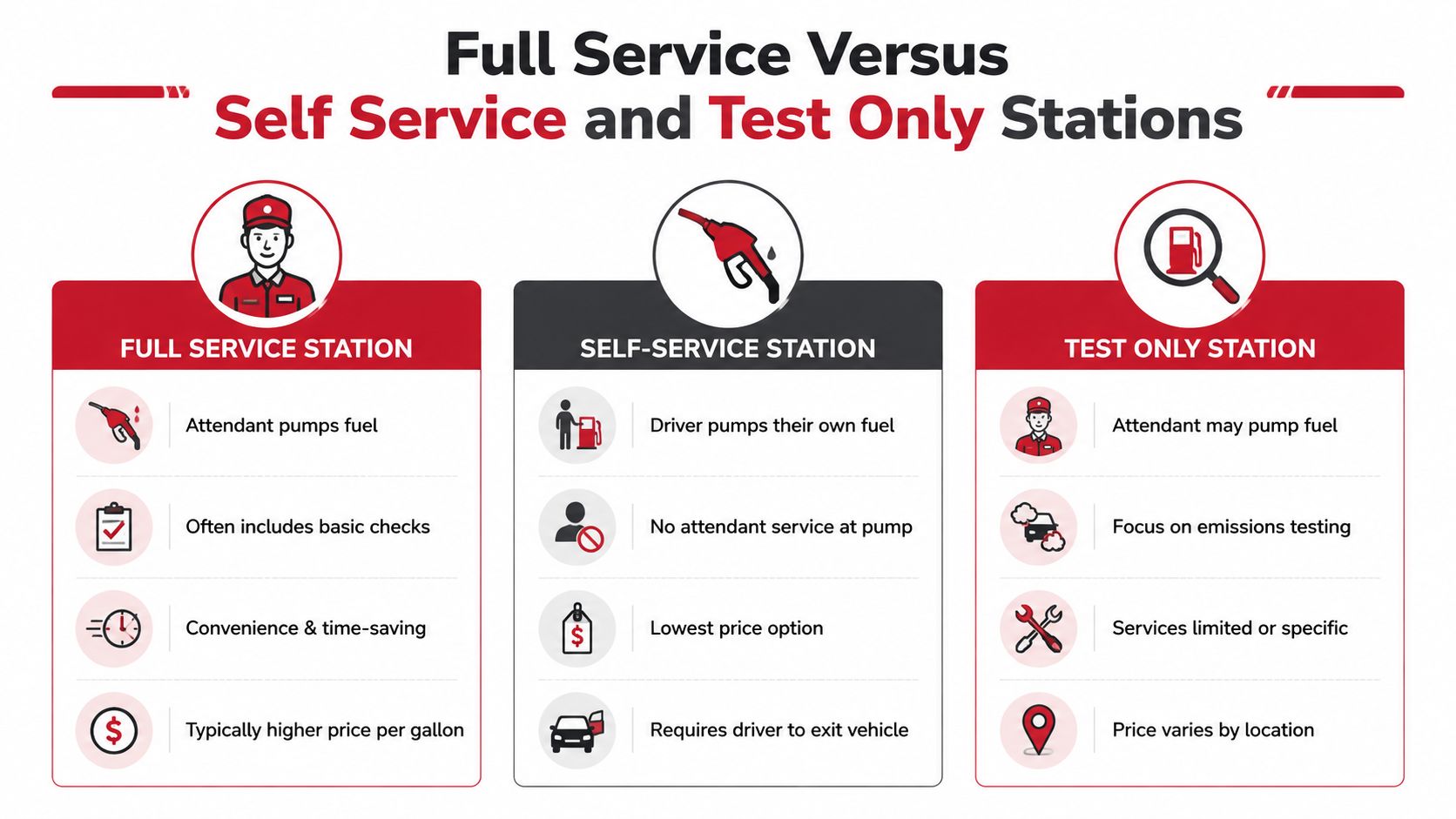
| Station type | Best suited to | What you generally receive | Main trade-off |
|---|---|---|---|
| Full service station | Drivers who want attendant assistance or several services at one location | Attendant-pumped fuel, with location-specific convenience services such as testing or paperwork | Fuel or service pricing may be higher |
| Self-service station | Drivers who want control and flexibility while buying fuel | Customer-pumped fuel and standard payment options | You handle fueling yourself and leave the vehicle |
| Test-only station | Drivers who need emissions testing or a specific inspection | A focused inspection service, often without repair sales | It does not replace fueling or broad mechanical work |
When self-service makes sense
Self-service suits a vehicle that is running normally when refueling is the only task. You choose the pump, select the fuel, pay, and leave without waiting for an attendant. That setup works well for a quick stop and for drivers comparing prices at nearby stations.
The boundaries are clear. You receive fuel service, while tasks such as attendant assistance or additional vehicle services may be unavailable or handled separately.
When test-only is the better choice
A test-only facility concentrates on inspection. This focused setup can make the visit easier to understand when you need an emissions result for registration. Before arriving, confirm that the site is authorized for the required test and can handle your vehicle category.
A provider offering test-only smog and vehicle services may suit a driver who needs emissions testing rather than fueling assistance. Ask whether an appointment is required and whether the business performs testing only or also sells repairs. That distinction matters after a failed test, because the testing site may not diagnose or repair the underlying problem.
Practical rule: Choose the narrowest service that fully solves the problem. Use a fuel stop for fuel, and use an inspection specialist for an emissions requirement.
Match the station to the driver
Attendant service may suit a parent with a sleeping child, a person who cannot comfortably stand beside the pump, or a fleet operator trying to reduce interruptions. A confident driver with a healthy vehicle may prefer self-service for a direct, hands-on stop. A California owner facing a registration-related emissions requirement should verify testing eligibility before choosing either option.
Cost Expectations and Regional Variations
There isn't one national price for full service. The amount you pay depends on local competition, labor requirements, station design, fuel pricing, and whether you're purchasing an additional service such as a smog inspection or registration transaction.
Start by separating the bill into parts:
- Fuel price: Compare the posted price with nearby self-service locations rather than assuming the premium is fixed.
- Attendant service: Ask whether the station adds a separate service charge or builds the cost into the fuel price.
- Vehicle work: Confirm prices for tire inflation, fluid top-offs, oil service, or repairs before work begins.
- Testing and paperwork: Treat smog checks and DMV transactions as separate services with their own eligibility rules and fees.
Regional rules also shape availability. Some markets preserve attendant fueling through local practice or regulation, while other areas have few traditional full service locations. Japan's station network illustrates the wider consolidation trend, with total service-station numbers falling from 60,421 in 1994 to 30,747 by 2017, according to the Japanese service-station study. The same source reports that self-service growth accelerated after regulatory changes, then slowed to about 200 stations per year after 2010, with growth around the 1% range.
| Service type | Full service station | Self service | Test-only station |
|---|---|---|---|
| Fueling | Attendant may pump fuel | Driver pumps fuel | Fueling may be incidental or unavailable |
| Basic checks | May be available | Usually self-managed | Usually outside the main service |
| Smog inspection | Available at some locations | Generally not included | Primary focus |
| DMV registration | Available at selected businesses | Usually unavailable | May be offered separately |
| Price structure | Fuel plus possible service charges | Fuel-focused pricing | Inspection or paperwork fee |
A market can preserve full service while shifting toward broader convenience packages. In the UAE, traditional full-service stations held 54.5% share in 2025, while highway service plazas were reported to grow at a 6.6% CAGR and capture 20% to 30% higher revenue density, according to the market discussion of evolving fuel-station formats. For California drivers comparing inspection options, review what a STAR smog check can cost before visiting.
When Full Service Stations Provide Real Value
Full service earns its keep when the attendant solves a problem you have. If you can safely pump fuel, don't need assistance, and are only looking for the lowest-cost stop, self-service may be the sensible choice. Convenience becomes more valuable when getting out of the vehicle is difficult, the weather is unpleasant, or several tasks need attention at once.
Drivers who benefit most
An attendant can provide practical help for people with mobility limitations, older drivers, and anyone who can't comfortably stand at the pump. The value isn't theoretical. The driver avoids handling the nozzle, walking across the forecourt, and managing payment while moving around the vehicle.
Full service can also help a busy owner who needs a quick check before a long drive. A tire-pressure reading or oil-level check won't replace scheduled maintenance, but it may reveal a problem that deserves attention before the vehicle travels farther.
The extra cost makes sense when it removes a real barrier, not when it simply adds a service you won't use.
Fleet operators may benefit from consistent procedures and fewer interruptions for drivers. That doesn't mean every fleet should use full service. Managers should compare fuel policies, receipt handling, vehicle checks, and wait times against the needs of their routes.
The model can also help a driver who isn't familiar with a vehicle. An attendant may identify the fuel type or explain the basic pump process, but don't confuse that assistance with mechanical expertise. Ask for a qualified technician when the issue involves warning lights, unusual noises, leaks, or drivability.
For a visual explanation of attendant interaction and service flow, this video provides useful context:
When the premium isn't worthwhile
If your only goal is to refuel and leave, attendant service may offer little benefit. The same applies when a station advertises “full service” but doesn't provide the inspection, repair, or registration task you need. Always verify the package before joining a queue.
A good decision test is straightforward:
- Need assistance at the vehicle: Full service may justify the added cost.
- Need a basic fuel stop: Self-service is often simpler.
- Need emissions paperwork: Use a qualified testing provider.
- Need repairs: Ask for a repair estimate from a shop equipped for the problem.
Finding Local Alternatives and Specialized Services
Start with the exact task, then search for the provider that performs it regularly. Search terms such as “test-only smog station,” “DMV registration renewal,” “mobile mechanic,” or “tire repair” will produce more useful results than searching only for “full service station.”
For emissions testing, verify the required certification before you book. California drivers may need a STAR-certified location, depending on the registration notice and vehicle requirements. Ask whether the business tests your vehicle type, whether it performs repairs, whether retesting is available under its policy, and how long the visit normally takes.
Questions to ask before visiting
- Service scope: Does the business perform the exact inspection, renewal, or repair you need?
- Vehicle fit: Can it accommodate your car, truck, diesel vehicle, or recreational vehicle?
- Documents: What registration or ownership paperwork should you bring?
- Pricing: Is the quoted amount for the complete service, or can separate charges apply?
- Scheduling: Are walk-ins accepted, and when are the busiest periods?
- Repair separation: If the site is test-only, where should you go if the vehicle fails?
A specialist may be preferable because the workflow is focused. A test-only operation, for example, doesn't have the same repair-sales structure as a shop that diagnoses and repairs failed vehicles. That doesn't guarantee a result, but it gives you a clearer question to ask: did the vehicle pass the required test, and what should I do next if it didn't?
Drivers in East Contra Costa County can compare local options through auto repair services in Antioch, while still checking the provider's exact scope before arriving. Look for a physical address, posted hours, clear service descriptions, and an explanation of what happens after a failed test. Be cautious when a business won't explain its fees, pressures you into unrelated repairs, or claims that every vehicle receives the same service without checking its specifications.
Build your own small network instead of expecting one station to do everything. Keep one dependable fuel option, one inspection provider, one repair shop, and one registration resource in your contacts. That approach makes the next vehicle problem a quick decision rather than a rushed search.
Fire House Smog provides STAR-certified test-only smog checks and California DMV services, including registration renewals, ownership transfers, and on-site tag issuance. If you need a focused emissions or registration solution in Antioch, visit Fire House Smog to review available services, hours, and location details.