

You're holding a renewal notice, your registration is close to expiring, and the nearest California DMV office already looks like a bad use of your morning. You could join the walk-in queue, hope an appointment opens, or spend a few minutes checking whether the task belongs online, at a kiosk, or with a licensed registration provider.
The smart way to skip the DMV line is to route the job correctly before you leave home. Routine renewals, smog-related renewals, ownership transfers, and complex title problems don't belong in the same queue. Use the wrong channel and you'll lose time twice. Use the right one and a task that normally requires a field-office visit may be completed without entering the lobby.
Table of Contents
- Why the DMV Line Feels Worse Than It Should
- What Self-Service Channels Can and Cannot Handle
- Locking Down a DMV Appointment That Actually Saves Time
- Smog Check Plus Registration in a Single Stop
- When an In-Person DMV Visit Is Still Unavoidable
- Cutting the Hidden Delays Before You Pay
- Your Shortcut Decision Plan
Why the DMV Line Feels Worse Than It Should
It's a weekday morning in Antioch. Coffee is in one hand, your registration notice is in the other, and the queue display barely changes. A routine renewal now threatens to consume the entire morning.
The wait feels unreasonable because the DMV's own targets separate customers by channel. California DMV reporting set a goal of no more than 45 minutes of queue time for customers without appointments and 15 minutes for customers with appointments. Appointment holders were also targeted for no more than 3 minutes to receive a queue ticket. In the May 2019 report, customers without appointments averaged 49 minutes of total wait time, including 34 minutes in the queue and 15 minutes of pre-queue processing. The report said that total was still 11 minutes below the department's one-hour combined wait-time goal. The department's field-office wait-time report provides that baseline.
That explains the search for “skip dmv line.” The core issue is choosing the wrong channel. A clean, routine renewal may need no counter visit, while a title correction or VIN verification requires direct DMV handling.
Three practical ways around the walk-in queue
- Online or kiosk service: Use these for eligible routine renewals when the vehicle record is clean and the address is current.
- A scheduled appointment: Choose this when the DMV must process the transaction directly and the service accepts appointments.
- A licensed third-party provider: Use one when you need a smog inspection and registration work together, or when you need physical tags or a sticker without waiting for mail.
A smog check paired with a licensed DMV partner station can turn a two-trip, two-hour errand into one 20-minute stop when the renewal qualifies and the required vehicle inspection is completed there. Review this California DMV registration renewal guidance before leaving, then bring the renewal notice, current vehicle information, and any requested identification or payment method.
California's reporting also shows why self-service and partner channels matter. Before field-office closures during COVID-19, online transactions represented about one-quarter of the DMV's monthly transactions. During the closures, self-service online transactions rose to nearly half of monthly transactions, according to the Legislative Analyst's Office report on DMV operations.
Skipping the line is a routing decision. Match the task to the channel before driving to the office.
What Self-Service Channels Can and Cannot Handle
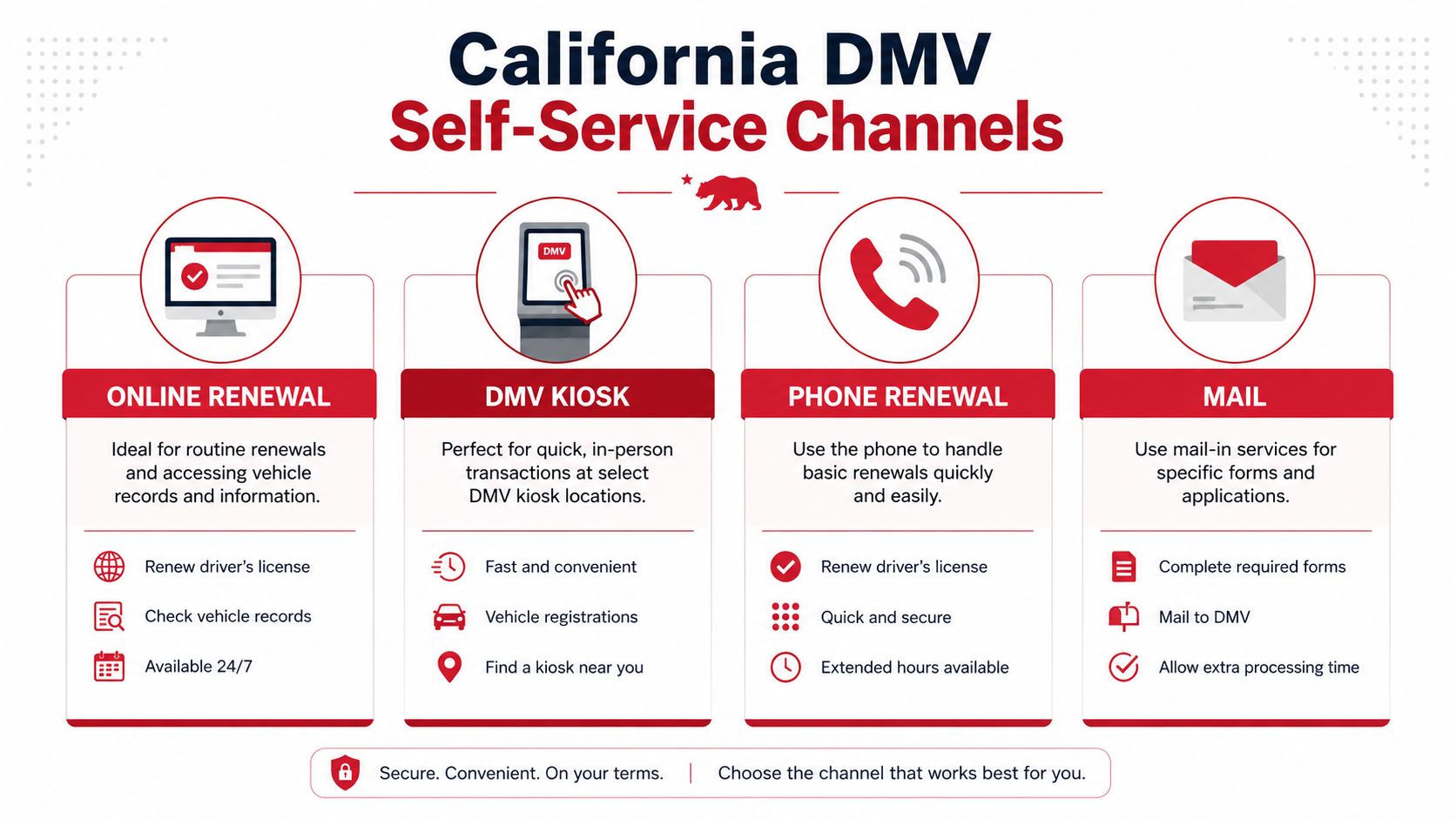
California's self-service system is useful, but it isn't universal. Online renewal, kiosks, phone service, and mail each handle a different level of complexity. The mistake I see most often is treating a failed online eligibility check as a technical inconvenience when it's a signal that the vehicle record needs human attention.
Online renewal is the default for clean records
Online renewal is the first choice for a routine tag renewal when the DMV confirms eligibility. It's convenient for drivers who don't need immediate physical proof and can wait for processing. California DMV says online renewals are typically processed in about one week, while renewal processing guidance explains that paper and assisted channels can take longer when an order needs additional review.
Before paying, check the renewal requirements and the vehicle's current status. A smog requirement, registration hold, address mismatch, or incomplete record can stop the transaction after you've already invested time in it.
Kiosks are built for speed
A DMV kiosk is the strongest official option when you need a quick renewal and the transaction meets every requirement. California DMV says kiosks can update renewal records instantly if all requirements are met, which makes them useful when you want a completed record without waiting for an online order to process.
Kiosks still won't resolve a title dispute, clear a hold, verify a VIN, or correct complicated ownership information. They're efficient because they stay narrow. That's exactly why they're fast.
Phone and mail are fallback channels
Phone renewal can help drivers who can't complete a digital transaction but still have a basic renewal. Mail remains appropriate for specific forms and situations where paper submission is required. Neither option is the right answer when you need an immediate sticker, a same-day record update, or assistance with a blocked vehicle file.
Practical rule: If the online system says you're not eligible, stop trying variations of the same form. Find out what blocked the renewal before choosing another channel.
The California DMV registration services guidance is useful for understanding when a licensed provider may be more practical than an office visit. A provider can review the transaction, identify missing requirements, and handle eligible registration work without sending you into a general field-office queue.
The best sequence is eligibility check, address check, requirement check, payment. Reverse that order and you risk paying into a process that still needs correction.
Locking Down a DMV Appointment That Actually Saves Time
An appointment only saves time when the DMV is the correct destination and your paperwork is complete. Otherwise, you've traded a walk-in wait for a scheduled trip that ends at the counter with a missing document.
Start by identifying the exact service. Don't book a general appointment because the notice says “registration.” A routine eligible renewal may be faster online or at a kiosk. An ownership transfer, title correction, VIN issue, REAL ID transaction, or record problem may require a field office or a specific authorized provider.
Prepare before you book
Use the DMV's online tools to check the vehicle status and renewal eligibility first. Read the appointment description carefully, then gather the documents tied to that transaction. For a renewal, that commonly means the renewal notice or current registration, identification, proof of insurance when relevant, payment, and smog documentation if the DMV requires it.
Appointments are most valuable when the task needs staff review. They're less useful for a renewal that a kiosk can complete immediately or a registration service that a licensed partner can process locally.
Don't wait on an appointment that solves the wrong problem
If the available appointment is weeks away, look at the other authorized channels before accepting the delay. A kiosk may handle an eligible renewal. Online service may be sufficient if you don't need same-day physical proof. A licensed third-party registration provider may handle a renewal, transfer, or smog-related transaction without requiring a field-office counter.
Same-day walk-in service can exist for limited tasks, but availability and requirements vary by office. Never assume a walk-in option will cover your transaction. Check the DMV's current instructions before driving over.
Bring originals or acceptable documents, not screenshots of paperwork that requires verification. Confirm the vehicle identification number, names, signatures, and addresses before the appointment. The DMV can process a prepared transaction quickly. It can't turn incomplete ownership paperwork into a completed transfer.
Smog Check Plus Registration in a Single Stop
For drivers whose renewal requires emissions testing, the most efficient route may be a combined visit to a STAR-certified smog station that also provides licensed DMV registration services. You complete the inspection first, then finish the eligible registration transaction at the same location instead of making a separate smog trip followed by a DMV office trip.
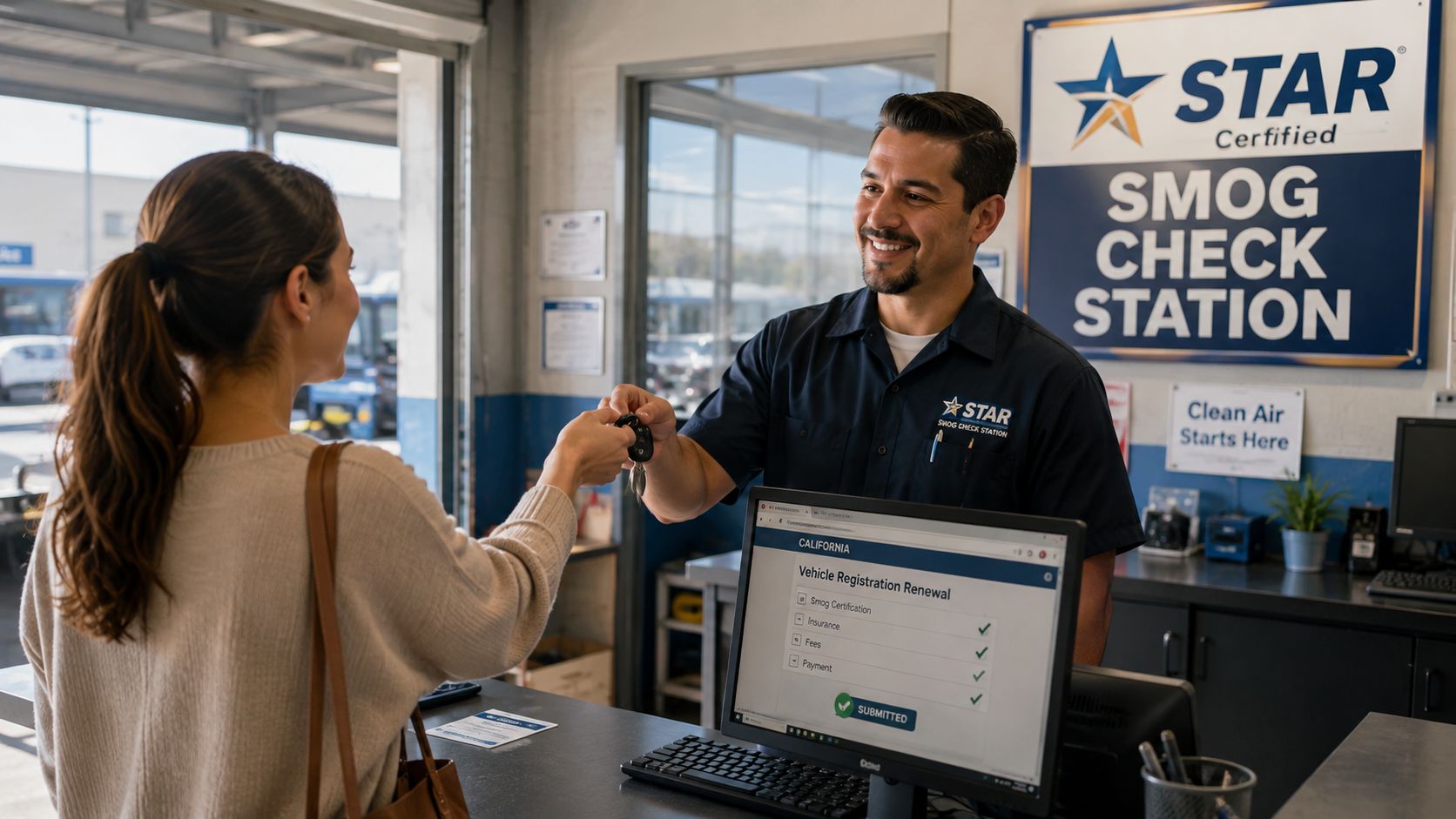
The order matters. Confirm that your vehicle needs a smog check, bring the vehicle to the station, complete the inspection, and then provide the registration documents for processing. If the transaction is eligible and the paperwork is complete, a licensed provider may issue the registration materials or sticker on site, according to its services and operating procedures.
Bring the documents that prevent a second trip
Pack the following before leaving:
- Current registration or renewal notice: This gives the provider the account and vehicle details needed to locate the transaction.
- Smog documentation: Bring the certificate or make sure the electronic result has posted before registration processing begins.
- Identification: Use an acceptable government-issued ID for the transaction.
- Payment: Bring an approved payment method and enough account information to complete the DMV charges and service fees.
- Ownership paperwork: For transfers, bring the title and every required signature. Out-of-state vehicles may need additional documents or a VIN verification.
This combined route beats online renewal when you need a physical sticker immediately, when a smog requirement blocks online completion, or when you don't want to manage separate appointments. It also beats a DMV appointment when the transaction is within the provider's license and the provider can complete it locally.
A test-only STAR station doesn't sell repair work. That separation means the business isn't combining the emissions test with an in-house repair sale. If a vehicle fails, ask about the available retest policy and whether you need repairs elsewhere before returning.
For Antioch and East Contra Costa County drivers, smog check and registration services in Antioch can be relevant when one location can handle the inspection and eligible DMV work. Fire House Smog operates as a STAR-certified test-only smog station and licensed DMV registration services provider at 2900 Lone Tree Way in Antioch, with smog testing available seven days a week and DMV service hours listed separately. Some RVs and motorhomes can be accommodated subject to size and equipment limits, so call before arriving with a large vehicle.
Don't assume every partner handles every transaction. Ask whether the station can process your vehicle type, ownership situation, out-of-state paperwork, and desired same-day service.
A practical comparison looks like this:
| Method | Typical Time | Best For | Limitation |
|---|---|---|---|
| Online renewal | About 1 week for typical processing | Eligible routine renewals | Not immediate, and blocked records still need another route |
| DMV kiosk | Instant record update when requirements are met | Fast eligible renewals | Doesn't resolve complex title or status problems |
| DMV appointment | Depends on appointment availability and office processing | Transactions requiring DMV staff | Missing documents can still end the visit unsuccessfully |
| Licensed smog and registration provider | Varies by inspection, paperwork, and transaction | Smog-required renewals and eligible registration work | Services, vehicle limits, and hours vary by provider |
Watch the workflow before choosing. The goal isn't to avoid the DMV building. It's to finish the task with the least unnecessary handoff.
If you're considering the combined route, this short video provides additional context before you schedule a visit.
When an In-Person DMV Visit Is Still Unavoidable
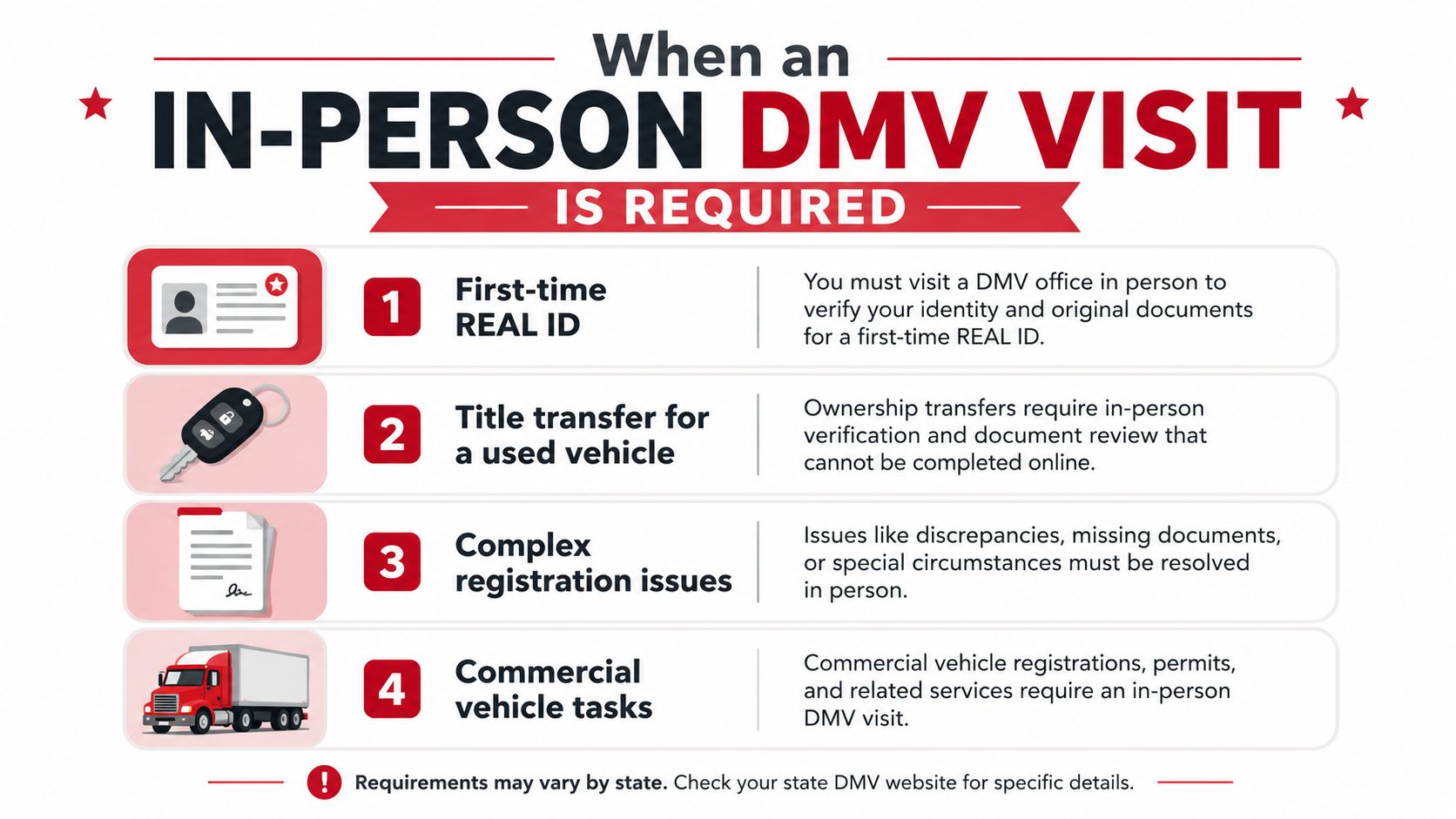
Some transactions don't belong online, at a kiosk, or at a routine renewal counter. Trying to force them through a shortcut wastes more time than booking the right appointment in the first place.
Common examples include VIN verifications for out-of-state vehicles, ownership transfers involving lien or title problems, suspended or hold-flagged registrations, REAL ID transactions, and complex corrections that the virtual office can't complete. Commercial vehicle work may also require a specialized process rather than a standard passenger-vehicle renewal.
Check the status before choosing a location
Start with the DMV's online vehicle and registration status tools. Look for holds, incomplete requirements, failed eligibility checks, or instructions that specifically direct you to an office. If the system identifies a VIN verification or ownership issue, don't book a generic renewal appointment and hope the clerk can redirect it.
A licensed partner may handle some ownership transfers and related registration work, including certain out-of-state transactions. That doesn't mean every out-of-state vehicle can be completed there. The deciding factors are the paperwork, the vehicle record, the required verification, and the provider's authorization.
Make the unavoidable visit shorter
Complete every available form before arriving. Organize the title, bills of sale, lien documents, identification, insurance information, and notices in the order the transaction requires. Check signatures and names carefully. A single missing signature can turn a scheduled visit into a document-correction trip.
Book an appointment when the DMV requires direct handling, and arrive with the exact documents listed for that service. You're still visiting the office, but you're avoiding the extra delay caused by an unsuitable appointment type or incomplete file.
The accurate promise is not “never visit the DMV.” It's don't use a field-office line for a task another channel can legally and reliably complete.
Cutting the Hidden Delays Before You Pay
Most wasted time starts before the car leaves the driveway. A stale address, unchecked smog requirement, unsigned title, or premature payment can create rework that no appointment can eliminate.
California DMV specifically advises changing an incorrect address online and allowing 3 business days for the update to process before completing renewal. The California DMV renewal instructions make that sequence important. Renewing first can attach the transaction to the wrong address or leave the record out of sync.
Run this checklist at home
- Verify eligibility: Confirm that the vehicle is eligible for the selected renewal channel before paying.
- Confirm the address: Compare the address on the notice with the current address on the DMV record. Update it first if needed.
- Check smog status: Find out whether the DMV requires a current smog result and whether the result has posted.
- Review ownership documents: Check names, signatures, lien information, and vehicle details on the title or transfer documents.
- Choose the channel: Use online service or a kiosk for a clean eligible renewal, an appointment for required DMV handling, and a licensed provider for eligible local registration work.
- Call before driving: Ask the provider whether it handles your vehicle type, transaction, RV dimensions, out-of-state paperwork, and same-day sticker needs.
The address check deserves special attention because it's easy to overlook. The smog check deserves equal attention because an online renewal can stop when emissions compliance is still outstanding.
California DMV also warns that assisted renewal processing can take up to 30 days after payment, as described in its renewal guidance. That creates a real difference between completing a transaction and having immediate physical confirmation. If you need a sticker or registration certainty today, ask the provider what can be issued on site before you pay.
Don't hand over payment until the person processing the transaction confirms the vehicle record and documents are sufficient. That one conversation can prevent the most expensive kind of delay, a completed payment followed by an unresolved registration problem.
Your Shortcut Decision Plan
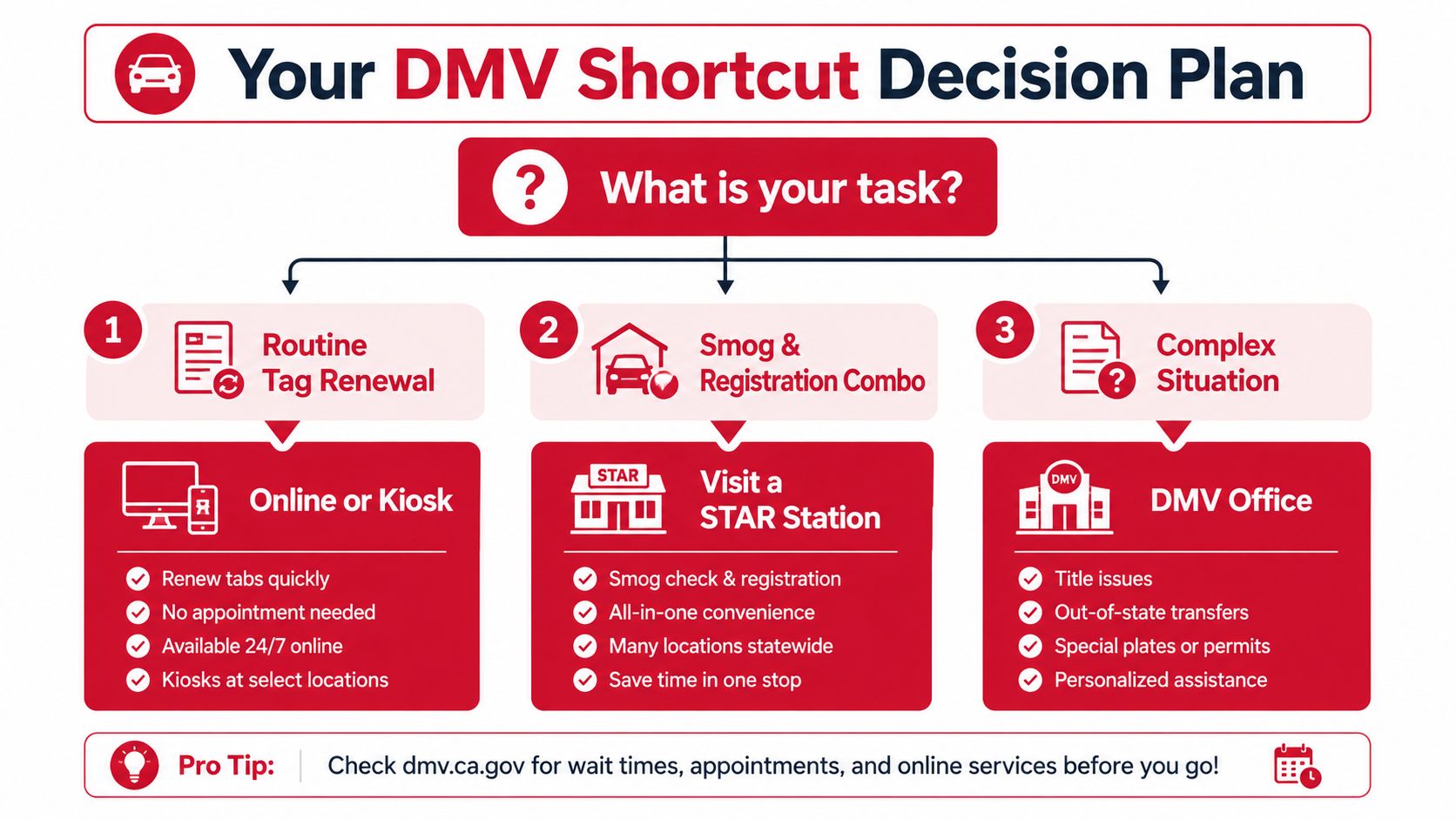
Match the task to the channel:
- Routine eligible tag renewal: Use online renewal or a DMV kiosk.
- Renewal with a required smog check: Use a STAR-certified station that also handles eligible registration services.
- Need a physical sticker quickly: Ask a licensed provider whether on-site issuance is available for your transaction.
- Ownership transfer: Confirm whether a qualified partner can process it. Bring the title and required signatures.
- Out-of-state vehicle, VIN issue, hold, REAL ID, or complex correction: Check the DMV instructions and book the appropriate appointment.
Before leaving, confirm eligibility, address accuracy, smog status, documents, payment, vehicle limits, and service hours.
For Antioch and East Contra Costa County drivers, the practical next step is to call Fire House Smog at 925-754-1600 or visit 2900 Lone Tree Way with your renewal notice, current registration, ID, payment, and any required ownership paperwork. The station offers STAR-certified test-only smog inspections and licensed DMV registration services, so ask whether your specific transaction can be completed during the same visit.
Visit Fire House Smog to combine a STAR-certified smog inspection with eligible California DMV registration services in Antioch. Call ahead to confirm your vehicle and paperwork qualify, especially for RVs, out-of-state vehicles, ownership transfers, or same-day sticker issuance.