Opening a DMV renewal notice can turn a routine errand into an immediate question: why does this letter say STAR station required? The answer usually isn't that your car needs a completely different kind of emissions test. It means California has directed you to a station with an additional Bureau of Automotive Repair certification.
An all star smog check follows the state's normal inspection process, but the station must meet higher operational and performance standards. This guide explains when STAR certification matters, how to verify a legitimate station, what happens in the testing bay, and what you should do if your vehicle fails.
Table of Contents
- What an All Star Smog Check Really Means
- How the STAR Program Started and Why It Exists
- STAR vs Regular and Test-Only Stations
- The Higher Standards STAR Stations Must Meet
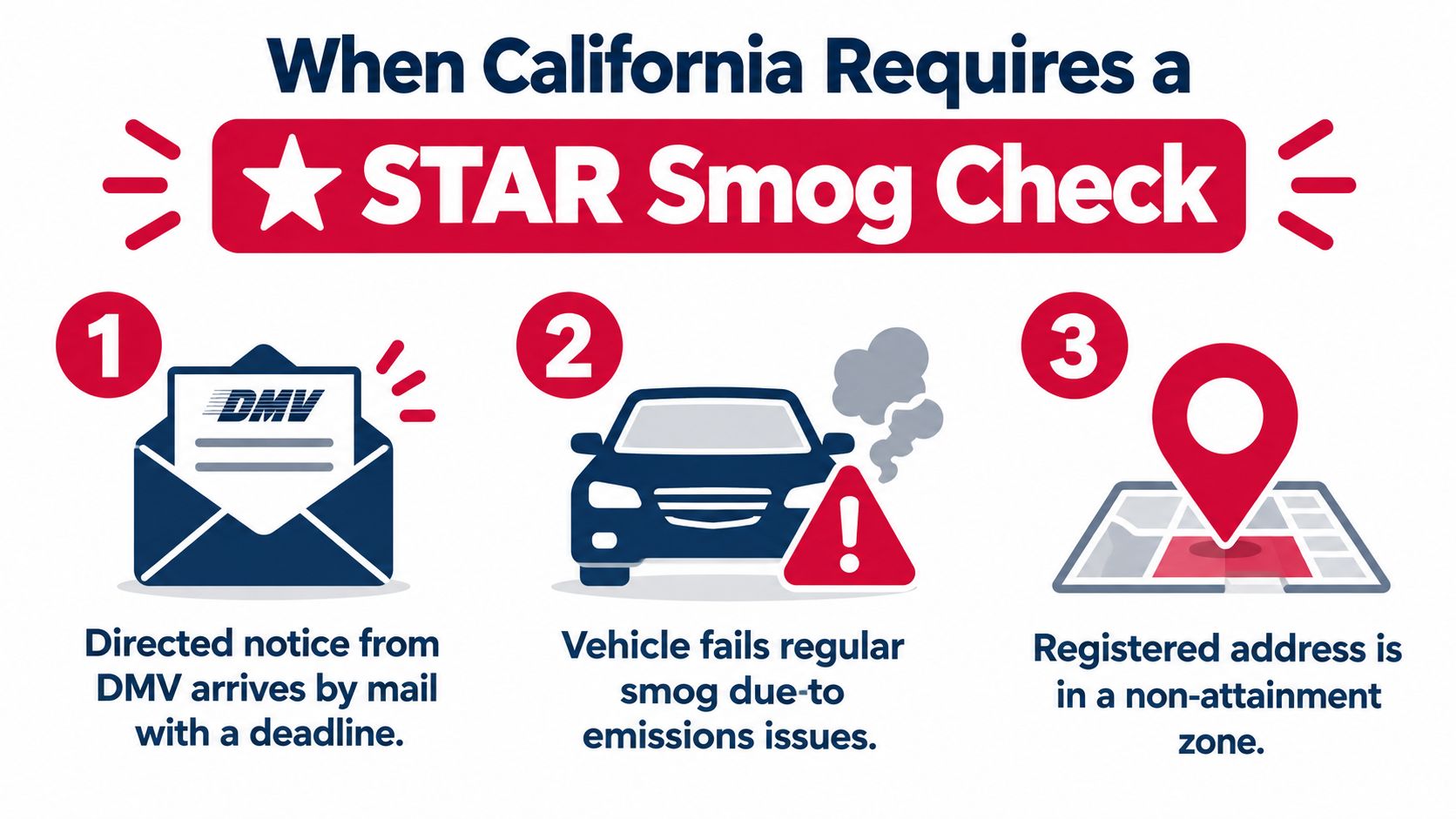
- When California Requires a STAR Smog Check
- How to Verify a Station and What Testing Involves
- Your Next Steps for Booking a STAR Smog Check
What an All Star Smog Check Really Means
STAR is a certification for the station, not a separate test for the vehicle. California's Smog Check process can include an OBD II inspection, visual emissions-control checks, and other required procedures depending on the vehicle. The California Smog Check program explains that vehicles from model year 2000 onward are inspected primarily through OBD II, while older vehicles may require additional evaporative-system and fuel-cap checks.
Think of STAR like a higher-level license displayed over the regular station license. A standard licensed station may be authorized to perform ordinary Smog Check inspections. A STAR-certified station has also demonstrated that it can meet BAR requirements for equipment, operations, and inspection performance.
That distinction matters because California doesn't send every vehicle to the same type of station. Some drivers can choose a regular licensed station. Others receive a DMV notice directing them to a STAR station, which means the certification changes where the inspection may be completed.
What STAR changes for you
At the bay, the technician still connects the vehicle to testing equipment and checks the systems required for that vehicle. The practical difference is the station's authority and oversight. A STAR station has been approved to handle vehicles that California considers part of a higher-risk inspection group, including vehicles identified through DMV direction.
A test-only STAR station can inspect and certify a vehicle, but it doesn't sell repair work. That separation can make the process easier to understand because the business evaluating the vehicle isn't also diagnosing and selling the repair.
Practical rule: Read the DMV notice before booking. If it says STAR station required, a nearby regular shop may not be able to complete the certification you need.
You can also review a plain-language explanation of what STAR-certified smog testing means before choosing a location. The four questions to answer are simple: Is STAR required for this vehicle, is the station certified, what will the inspection include, and what happens if the result is a fail?
How the STAR Program Started and Why It Exists
You arrive for a Smog Check expecting a simple pass-or-fail result. Behind that result, California also needs confidence that the station followed the right procedure and recorded the vehicle's information accurately. The STAR program was created to provide that added oversight.
California established STAR through Assembly Bill 2289, and the program began on January 1, 2013. It replaced the former Gold Shield Program, which ended on December 31, 2012. The Bureau of Automotive Repair STAR FAQ explains that STAR was designed to improve inspection quality and support California's emissions-reduction requirements.
The basic model works like a quality-control system. California identifies stations that can perform inspections under closer performance controls, then uses the program to direct certain vehicles to those locations. STAR certification applies to both test-only and test-and-repair businesses. It describes how a station's inspection work is monitored, not whether the business performs mechanical repairs.
Why station quality affects the driver
Your vehicle is only one part of a Smog Check. The technician must use approved equipment, follow the required testing procedure, enter accurate vehicle details, and interpret the result correctly. A skipped step or poorly maintained machine can produce a result that does not accurately reflect the vehicle's condition.
For the driver, STAR changes the level of accountability surrounding the inspection. BAR uses performance measures to compare a station's results with those of similar vehicles and reviews incidents that may indicate testing problems. This does not guarantee a passing result or make every repair recommendation correct. It gives the inspection process a clearer system for identifying problems and monitoring station performance.
The program also handles a large share of California's testing. In California's 2025 data, STAR stations represented 49% of licensed Smog Check stations but performed 83% of all Smog Check tests, according to BAR's STAR program information. STAR locations therefore completed a disproportionately large share of inspections compared with their number of facilities.
That reach explains why STAR is more than a label on a shop sign. It affects how California manages inspection quality and, for some drivers, which station can complete the required inspection.
STAR vs Regular and Test-Only Stations
Drivers often treat “STAR,” “test-only,” and “test-and-repair” as three competing station categories. They are different labels that describe different things. STAR describes certification, while test-only and test-and-repair describe what the business is allowed to do after inspecting the vehicle.
A regular station may perform standard Smog Check services for vehicles that aren't subject to a STAR direction. A STAR station may be test-only or test-and-repair, but it must meet the additional BAR requirements attached to STAR certification.
| Station Type | Can Perform Repairs | Can Process STAR or Directed Notices | Best For |
|---|---|---|---|
| Regular test-and-repair station | Yes | Not necessarily | Drivers whose renewal doesn't require STAR and who want inspection and repair at one business |
| Regular test-only station | No | Not necessarily | Drivers seeking an inspection without repair sales when STAR isn't required |
| STAR test-and-repair station | Yes | Yes, when authorized for the vehicle | Drivers who need STAR testing and may want diagnosis or repairs at the same location |
| STAR test-only station | No | Yes | Drivers who need STAR certification and prefer a testing-only business |
The important distinction after a failure
A test-only station can't repair the vehicle. If the inspection finds a problem, the station should provide the inspection result and explain the next step, but you'll need a separate repair provider. A STAR test-and-repair station may diagnose and repair the vehicle, although the station's authority to certify a particular directed vehicle still depends on the applicable rules.
A regular shop isn't automatically less competent at repairs. It may just not have the STAR certification needed for a DMV-directed inspection. Conversely, a STAR label doesn't mean the station is a full-service repair facility.
The BAR's explanation of STAR-certified test-only centers can help you understand why some drivers deliberately choose a station that doesn't sell repairs. The model separates the inspection decision from repair revenue, which gives the customer a clearer boundary between testing and fixing.
Prices vary by station, vehicle, location, and services included. A STAR station may charge a different fee from a nearby regular station, so ask for the current price before authorizing the inspection.
The Higher Standards STAR Stations Must Meet
STAR certification rests on measurable requirements rather than a sign on the building. BAR reviews station performance and can evaluate whether the business continues to meet the program's standards. That means certification isn't a permanent reward earned once and kept without review.
The BAR STAR program requirements include several performance measures. One compares the station's Similar Vehicle Failure Rate with the industry-wide failure rate for similar vehicles. For STAR eligibility, that station rate must be at least 50% of the industry-wide failure rate for similar vehicles. The same source lists a Gear Shift Incident rate no greater than 2% of certified vehicles and an Excessive Test Deviation Rate of no more than 1.
What the scorecard means in everyday terms
| Metric | Standard Required |
|---|---|
| Similar Vehicle Failure Rate | At least 50% of the industry-wide failure rate for similar vehicles |
| Gear Shift Incident rate | No greater than 2% of certified vehicles |
| Excessive Test Deviation Rate | No more than 1 |
| Ongoing program compliance | The station must continue meeting BAR operational and performance requirements |
A failure-rate comparison doesn't mean a STAR station should make every vehicle pass. A vehicle with a genuine emissions problem should fail, regardless of the station's certification. The comparison helps BAR identify unusual station patterns that may deserve closer review.
Gear-shift incidents and test deviations relate to how the inspection is carried out. For a driver, those controls support a more consistent process, particularly when the vehicle's result is unexpected. The standards also give BAR a basis for accountability if testing behavior falls outside acceptable limits.
STAR certification is best understood as a continuing performance obligation, not a one-time quality badge.
The certification also doesn't promise a repair, a pass, or a particular wait time. It tells you that the station has qualified for the STAR program and must continue operating within the program's rules.
When California Requires a STAR Smog Check
You are renewing your registration, and the DMV notice says your vehicle must visit a STAR station. That instruction changes where you can test. It is different from a general reminder to complete a Smog Check, so read the notice carefully before booking an appointment or driving to a shop.
A directed notice places the vehicle in a more controlled inspection pathway. California may direct a vehicle because of its testing history or emissions profile. Vehicle age, an ownership transfer, or a routine renewal can require a Smog Check without automatically requiring STAR testing.
Check the instruction, not the rumor
Use the notice as your starting point:
- Read the renewal notice. Look for wording that requires a STAR station or identifies a specific inspection type.
- Match the vehicle details. Confirm that the notice belongs to the vehicle you are taking for testing and that the registration information is current.
- Check the station listing. Use the BAR listing to find nearby STAR-certified businesses and see whether each offers test-only or test-and-repair service.
- Call before your visit. Ask whether the station can process the exact requirement shown on your notice.
A first-time California registration or ownership transfer may involve a Smog Check, but neither situation alone establishes a STAR requirement. A failed ordinary inspection also does not automatically mean every later test must take place at a STAR station. The DMV instruction or applicable BAR process determines the required testing location.
After a directed test, the station must submit the required electronic certification. If that certification is missing, the DMV may be unable to complete your registration renewal. A failed result can lead to repairs and another inspection, but the result itself does not turn every future test into a STAR requirement.
California also has special provisions for older and collector vehicles. BAR's current materials state that collector-vehicle exemptions are scheduled to be extended in stages beginning January 1, 2028, subject to final rulemaking, as reflected in the DMV's Smog Inspections guidance. Abbreviated inspections remain available for certain vehicles that are 35 years old or older. Check the current requirements before assuming your vehicle qualifies for an exemption.
How to Verify a Station and What Testing Involves
Start with the BAR station lookup rather than relying only on a business name, search advertisement, or a sign in a parking lot. Enter the location information, review the station's listing, and confirm the STAR designation, station type, license information, and any disciplinary information shown in the official record.
A legitimate business should also display the required station information at its location. Look for a posted STAR decal or other official signage, then compare the business name and address with the BAR listing. If the listing says test-only but an employee immediately proposes repair work, ask who would perform the repair and whether the inspection business is separate.
What the technician checks
For a newer vehicle, the technician generally connects an approved tool to the vehicle's OBD II system and reviews emissions-related information. The malfunction indicator lamp must illuminate with the key on and engine off, then turn off once the engine is running. If that required behavior isn't present, the vehicle fails the OBD portion.
The inspection can also include visual and functional checks of emissions equipment. Older vehicles may require different procedures, including tailpipe or evaporative-system checks, depending on the vehicle and the applicable program rules. A technician should be able to explain which procedure applies without promising a result in advance.
The visit length varies with the vehicle, station workload, and inspection type. Ask about the expected timing when you book rather than relying on a generic estimate.
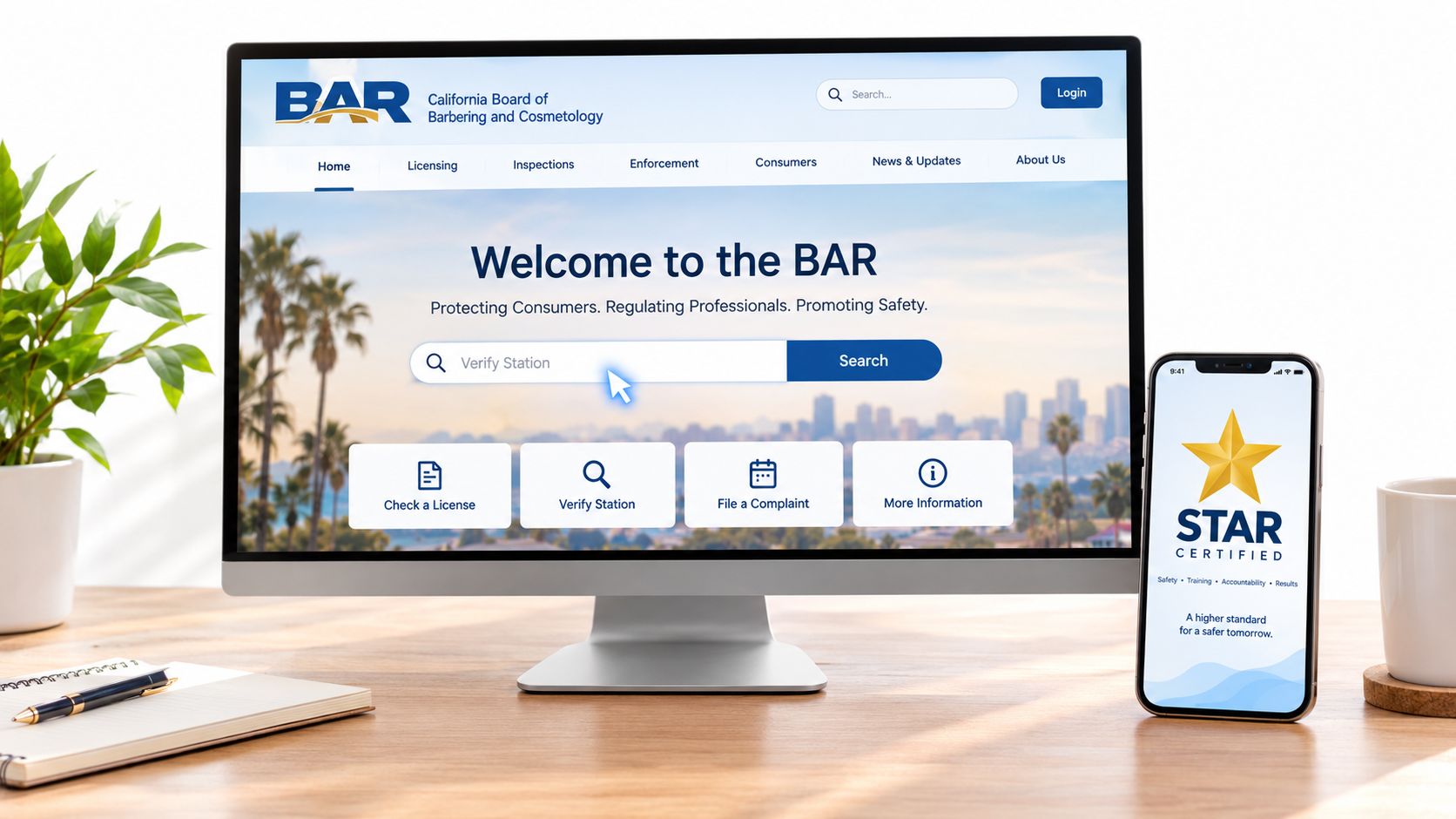
After a pass, the station electronically sends the certification to DMV. You generally don't need to carry a paper certificate to a DMV counter, although you should keep your receipt and any inspection documentation.
After a fail, a test-only station can explain the result and provide the report, but it doesn't perform the repair. BAR and DMV guidance direct failed vehicles toward the appropriate next steps, including the BAR Referee Program in situations where that process applies.
Your Next Steps for Booking a STAR Smog Check
You can avoid most last-minute problems by treating the appointment as a document and deadline task, not just a quick drive to a repair shop.
- Confirm the requirement. Check the DMV renewal notice or official BAR communication. Identify whether it says STAR station required and note the registration deadline.
- Find the correct station. Use the BAR search tool and filter the results by location and certification type. Confirm whether the business is test-only or test-and-repair.
- Call before booking. Ask the station to confirm its STAR status, current fee, accepted payment methods, appointment policy, and ability to handle your vehicle.
- Prepare your documents. Bring the DMV or BAR notice, current registration information, and a form of identification. The station may need accurate vehicle and owner details to complete the transaction.
Before arrival, drive long enough for the engine to reach normal operating temperature, unless your vehicle's condition makes that unsafe. Check that the fuel cap seals correctly, and remove aftermarket electronics that could create warning-light issues or interfere with the vehicle's normal diagnostic systems.
For more guidance on the cost of a STAR smog check, contact the station directly because pricing depends on the vehicle and service. Don't approve repairs based only on a verbal explanation. If the vehicle fails, request the complete Vehicle Inspection Report, keep every receipt and estimate, and ask whether you may qualify for California's Consumer Assistance Program if the repair burden meets the program's requirements.
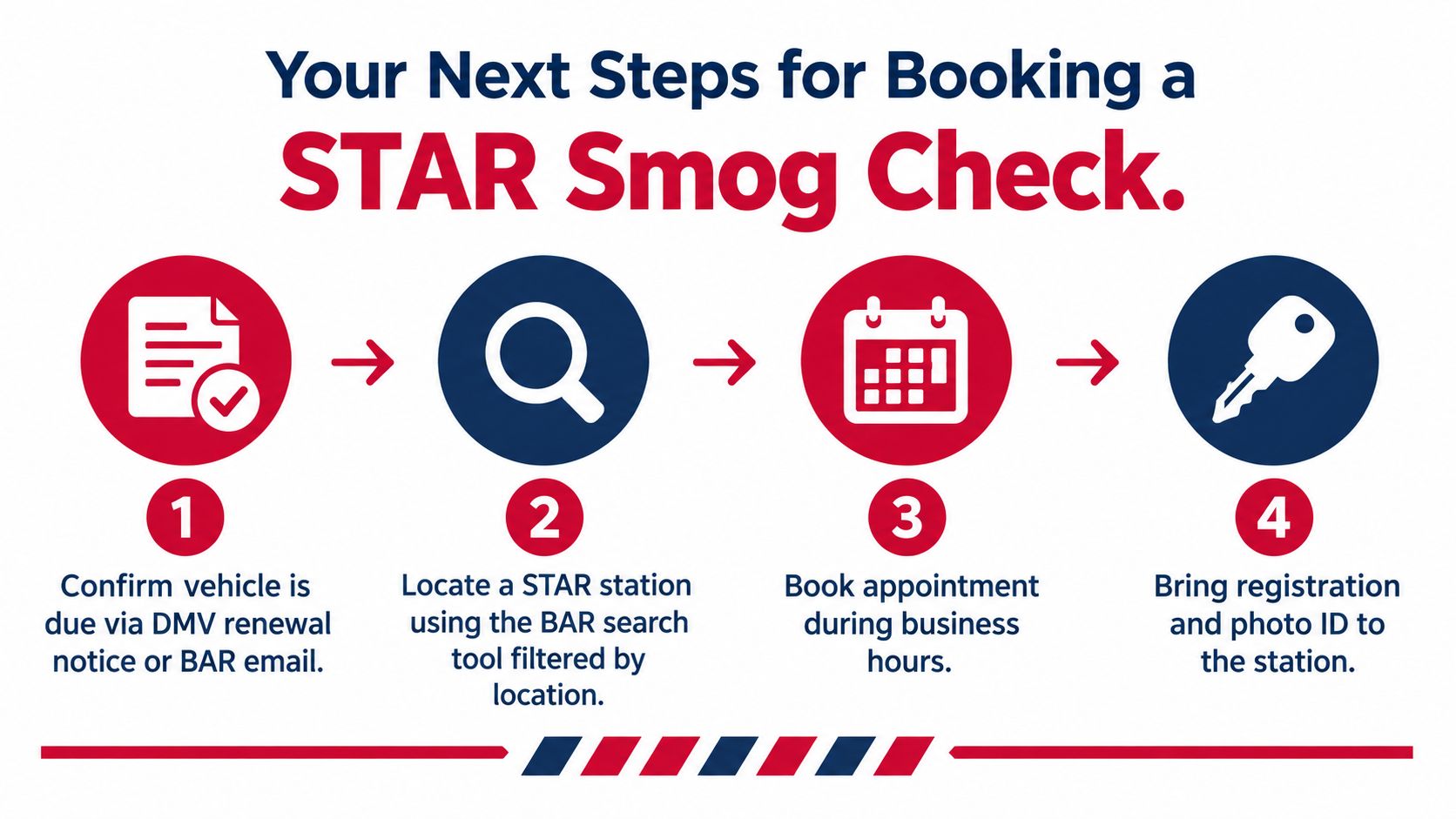
A sensible planning window is 6 to 8 weeks before registration renewal. That gives you time to arrange repairs, complete a retest, resolve questions about the result, and allow the electronic certification to reach DMV without turning the renewal deadline into an emergency.
Fire House Smog provides STAR-certified test-only smog inspections and California DMV registration services at its Antioch location. Visit Fire House Smog to review the available services and contact the station before booking your STAR inspection.
You've just picked up your vehicle from a California smog station, and the paper in your hand says FAIL. Your registration renewal is due, the repair estimate is unknown, and you may be wondering whether you can keep driving or whether the car has suddenly become too expensive to keep.
A failed result is serious, but it isn't a dead end. California has a defined process involving the DMV, the Bureau of Automotive Repair, repair shops, STAR Certified stations, retesting, and financial assistance. The right next step depends on why the vehicle failed, where the DMV directed you to go, and whether repairing the car makes financial sense.
Table of Contents
- That “FAIL” Notice Just Landed What Now
- Understanding the DMV Registration Hold
- Your First Three Steps After Failing
- Navigating Vehicle Repairs and Retesting
- Exploring Waivers and Financial Assistance Programs
- Frequently Asked Questions About Smog Failures
That “FAIL” Notice Just Landed What Now
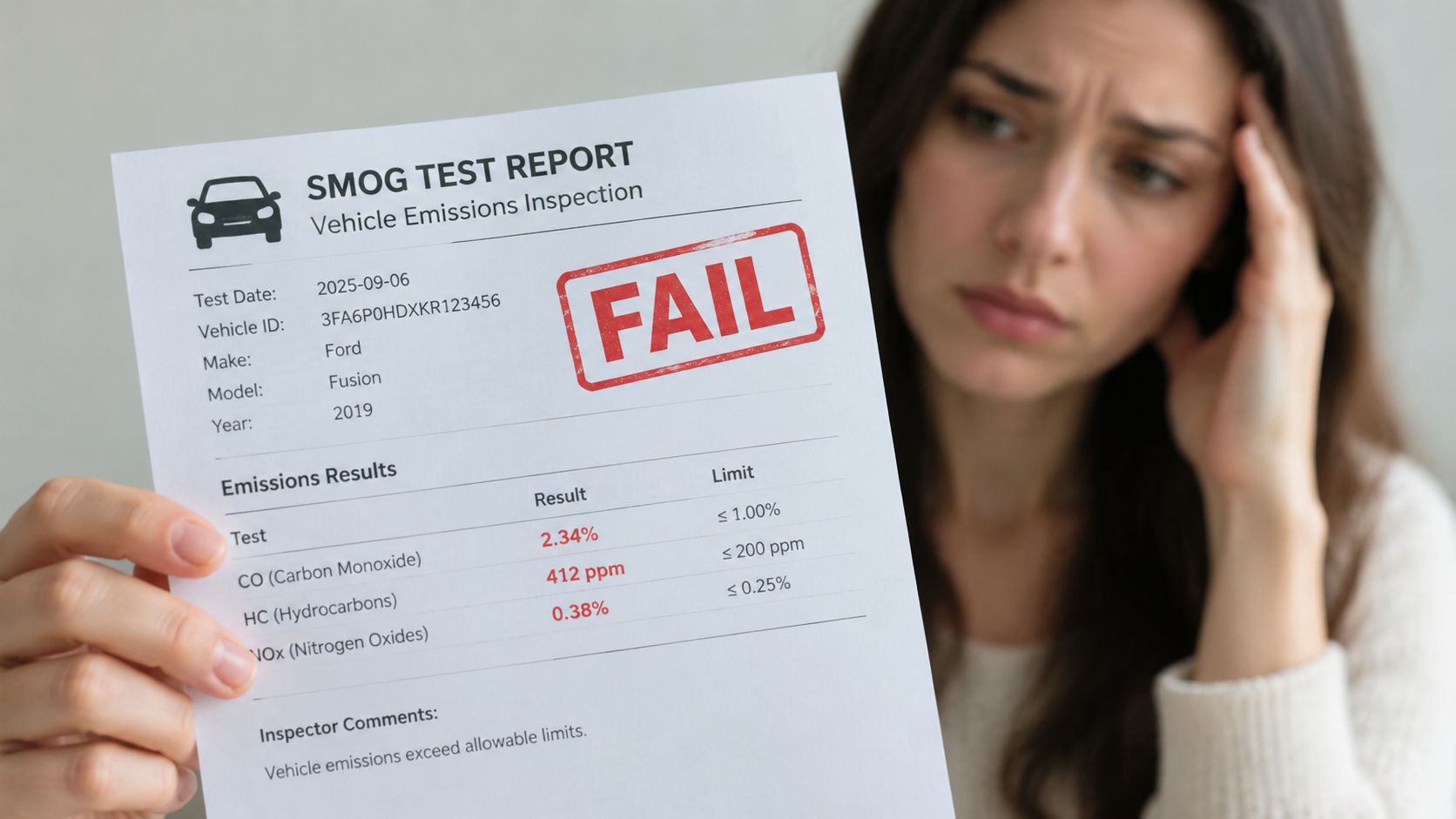
The first thing to understand is that a failed smog test doesn't automatically mean your vehicle is unusable. It means the vehicle didn't meet the applicable emissions requirements during that inspection, and you now need to resolve the listed problem before completing the registration process.
The driver in this situation often makes one of two mistakes. Some approve an expensive repair before understanding the inspection report. Others disconnect the battery or clear diagnostic codes, hoping the warning light will disappear. Neither approach is a sound starting point. The Vehicle Inspection Report, or VIR, should guide the next decision.
Start with the paperwork
Keep the failed inspection report. It identifies the area that needs attention and can show whether the failure involved the onboard diagnostic system, emissions readings, readiness, or a visual and functional inspection. Bring that document to any repair facility you consult.
You can also review guidance on understanding emissions test results before authorizing work. The objective is simple: identify the failure, confirm the diagnosis, then decide whether repair or a state assistance option is the sensible path.
Practical rule: Don't buy parts based only on a warning light or a guess. Diagnose the cause shown by the failed report.
Your existing registration isn't necessarily canceled on the spot. The immediate problem is usually that you can't complete renewal until the vehicle meets the required smog condition. If the car is directed to a particular type of station, follow that instruction rather than paying for a retest at a location that can't certify it.
The rest of the process comes down to three questions: What failed? Who must perform the repair or retest? Is repair financially justified for this vehicle?
Understanding the DMV Registration Hold
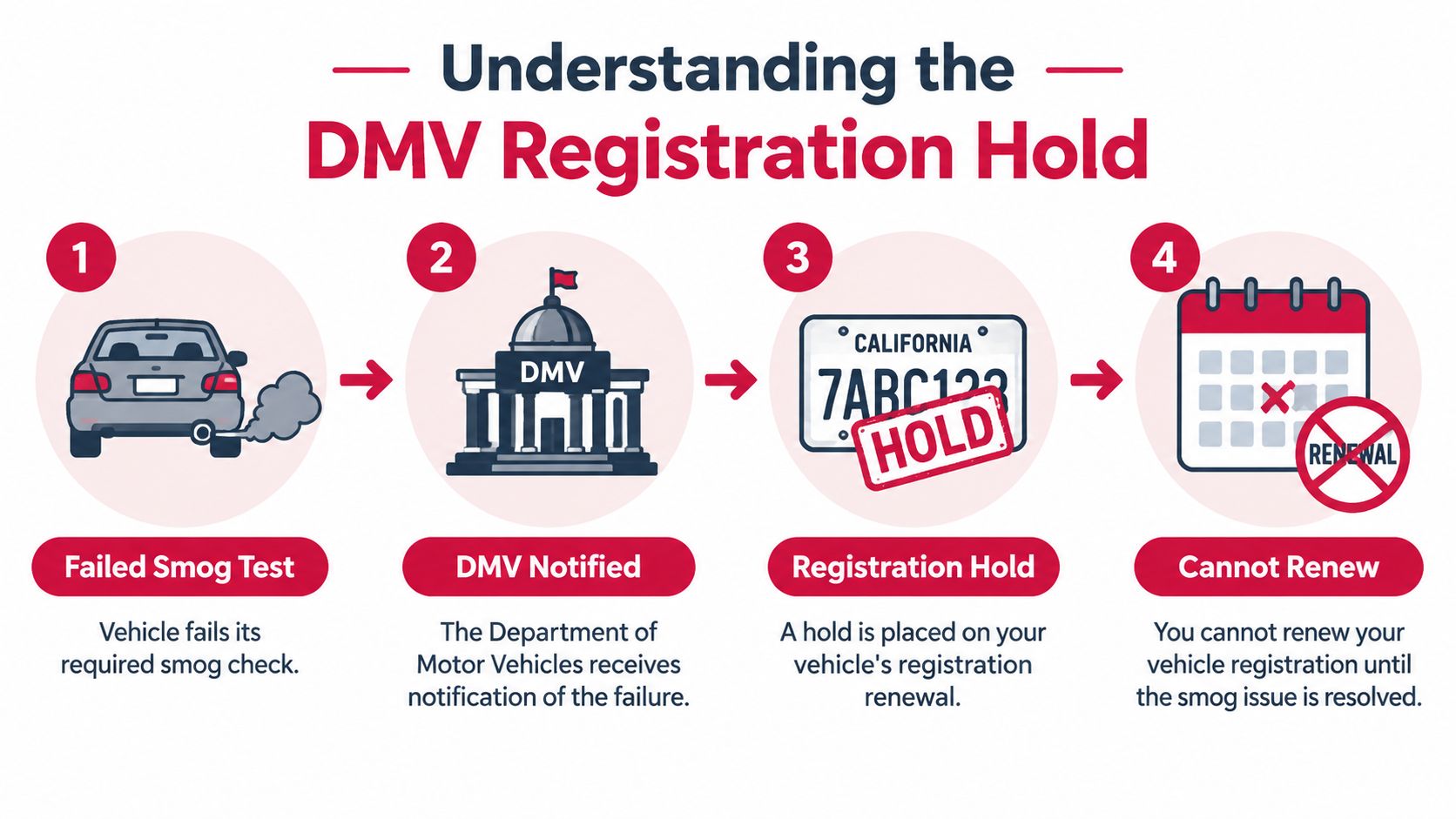
In California, a failed smog check can block DMV registration renewal until the vehicle is repaired and passes a retest. The DMV directs drivers with a failed inspection to contact the Bureau of Automotive Repair Referee Program for next steps, while BAR determines whether the vehicle needs additional certification at a STAR Certified station or with a BAR Referee. California DMV's smog inspection guidance describes the connection between the failed inspection and the renewal process.
This isn't the same as receiving a traffic citation. It's an administrative hold tied to emissions compliance. You may still have time before the current registration expires, but the DMV won't complete the renewal while the required smog issue remains unresolved.
Why California uses this process
California's smog program covers most gasoline vehicles from model year 1996 onward and many diesel vehicles, so the registration consequence affects ordinary passenger cars and light trucks, not just unusual or heavily modified vehicles. The state connects inspection results with registration because a failed vehicle may continue producing emissions above the permitted level unless the owner repairs and certifies it.
The basic sequence looks like this:
- The vehicle fails its required inspection.
- The failure is associated with the vehicle's registration record.
- Renewal remains blocked until the smog requirement is satisfied.
- A passing retest or approved alternative allows the registration process to continue.
Some vehicles have a straightforward path through repair and retesting. Others require more oversight. A car that exceeds gross-polluter standards, or one directed to a STAR station on the DMV renewal notice, may need after-repair certification at a STAR Certified station or review by a BAR Referee.
If you're dealing with renewal at the same time, this guide to California DMV registration renewal explains the related administrative process. The important point is that the hold has a defined solution. Repair the emissions problem, complete the correct certification, and submit the passing result through the normal DMV process.
Your First Three Steps After Failing
Don't start by searching for the cheapest replacement sensor. Start by collecting facts. A failed smog inspection gives you a decision point, and the quality of the decision depends on how carefully you read the result.
Step one, read the VIR line by line
Look for the specific field marked as failed. A warning light or diagnostic code may point toward an emissions problem, but it doesn't always identify the failed part. The inspection report may also indicate an issue with readiness, a visual component, or another functional requirement.
Write down the exact failure description and any diagnostic information. Take the report to a repair shop that can test the underlying system rather than replacing a commonly associated component.
Step two, classify the failure
The repair strategy changes depending on the category.
- OBD-related failure: The vehicle computer may be reporting an unresolved emissions fault or may not have completed its required self-checks.
- Warning-light failure: An illuminated check-engine light can prevent a passing result until the cause is repaired and the system is ready for inspection.
- Tailpipe emissions failure: Older vehicles may fail because measured pollutants exceed the applicable limit.
- Visual failure: Missing, disconnected, modified, or visibly incorrect emissions equipment can prevent certification.
- Functional failure: Systems such as fuel-vapor controls or exhaust-gas recirculation may need testing before a repair is approved.
This classification keeps you from treating every failed test as a catalytic-converter problem. A shop should verify the cause with scan data, electrical testing, vacuum or leak testing, and component inspection as appropriate.
Step three, separate diagnosis from certification
A general repair shop may be the right place to diagnose and repair the vehicle. The retest station has a different role. If the vehicle must be certified at a STAR station, use the station type shown on the report or renewal notice.
A STAR-certified, test-only station is especially useful for an independent retest because it doesn't sell the repair. That arrangement removes the direct incentive to recommend parts or labor after a failure. The station evaluates whether the vehicle passes, while a separate repair facility handles the diagnosis and mechanical work.
For a clearer breakdown of common causes, review reasons a vehicle can fail a smog check. Don't clear codes or disconnect the battery merely to make the warning light disappear. Those actions can erase useful diagnostic information and leave the emissions monitors incomplete, creating another inspection problem instead of solving the original one.
Navigating Vehicle Repairs and Retesting
The repair and retest path depends on the vehicle's failure status. A regular failure may be repaired and certified at a Test-and-Repair station when the vehicle doesn't exceed gross-polluter standards. A vehicle that exceeds those standards, or one originally directed to a STAR station by the DMV renewal notice, may need certification at a STAR Certified station or a BAR Referee. BAR explains these pathways in its Consumer Assistance Program repair guidance.
What gross-polluter status changes
“Gross polluter” isn't a casual description of an old or dirty car. It's a regulatory status indicating emissions are substantially beyond the applicable threshold. Once that status applies, the vehicle may no longer follow the ordinary test-and-repair route.
That distinction matters because a repair shop can complete excellent mechanical work, yet the vehicle may still need certification at the required STAR location. Before paying for a second inspection, check the VIR and DMV notice for station instructions. Retesting at the wrong location can waste time and leave the compliance problem open.
A sensible repair sequence looks like this:
- Confirm the failed system. Ask the technician to explain the diagnostic evidence.
- Get a written estimate. Separate necessary emissions repairs from maintenance recommendations.
- Check program eligibility before work begins. Some assistance programs require approval before repairs are performed.
- Complete the repair and any required drive cycle. The vehicle's emissions monitors may need to return to a ready state.
- Use the required station for certification. Follow the DMV or BAR direction on STAR and Referee involvement.
The repair decision shouldn't be based on the most dramatic possible failure. A failed oxygen sensor, wiring fault, vacuum leak, ignition problem, or emissions-control failure can each require a different diagnostic approach. The report tells you where to begin, but competent testing determines which component needs replacement.
BAR also recognizes that failure can lead to more than one outcome. Eligible consumers may pursue repair assistance, while owners whose vehicles aren't practical to repair may qualify for retirement or replacement through the Consumer Assistance Program. That makes the retest decision part of a broader ownership decision, especially when the vehicle is older, has other mechanical issues, or has little resale value.
Exploring Waivers and Financial Assistance Programs
A failed smog test creates a financial question as much as a mechanical one. Before authorizing repairs, compare the estimate with the vehicle's condition, market value, expected reliability, and eligibility for California assistance.
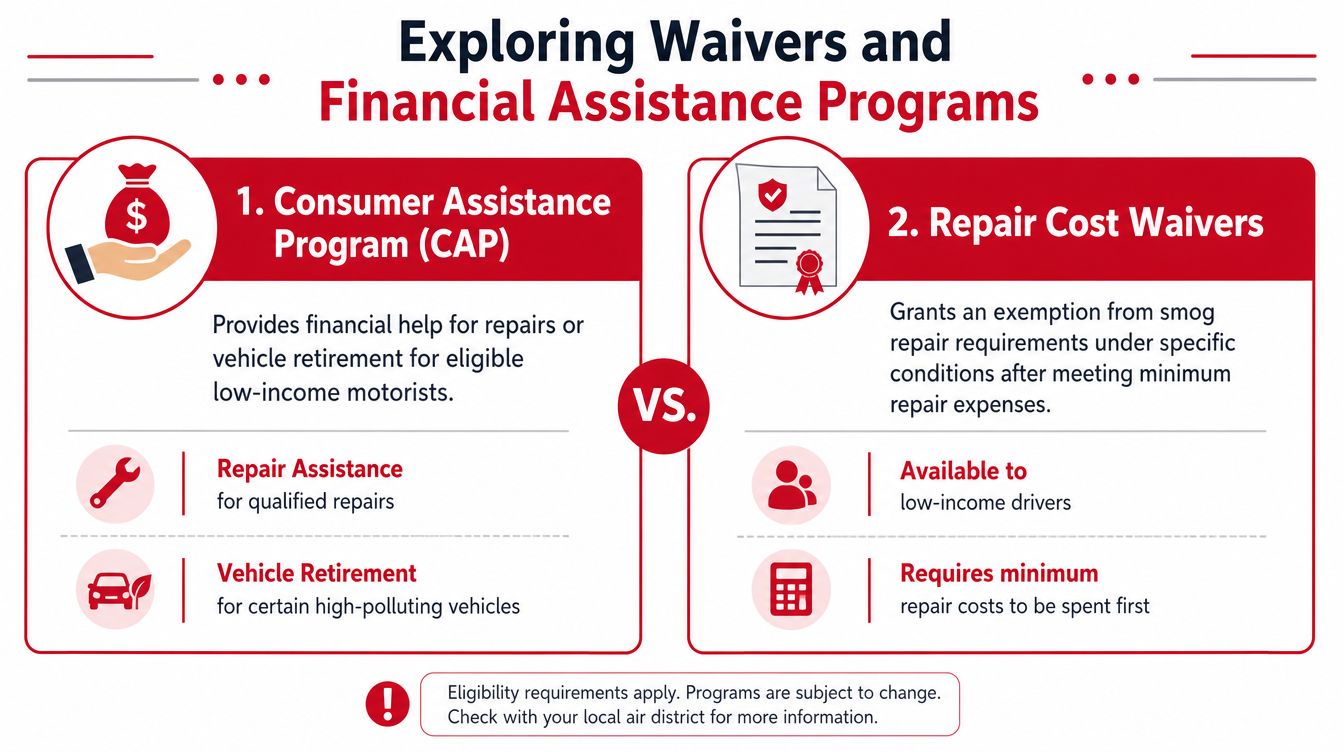
The Consumer Assistance Program, or CAP, can cover more than $1,450 in emissions-related repairs for eligible drivers, as described in California's failed-smog assistance guidance. CAP can also pay approximately $1,350 to $2,000 to retire a qualifying vehicle, according to the same guidance. These figures don't mean every applicant qualifies or that every repair receives the maximum amount. Eligibility and program conditions control the outcome.
Compare the choices before spending
| Option | When it may fit | Main trade-off |
|---|---|---|
| Repair and retest | The vehicle is dependable and the diagnosis supports a reasonable repair | You spend money keeping an older vehicle on the road |
| CAP repair assistance | You meet program requirements and the needed work qualifies | Approval and repair conditions must be followed |
| Vehicle retirement | The car is low-value, high-emitting, or has several major problems | You lose the vehicle but may receive program payment |
| Repair Cost Waiver | You meet strict requirements after completing qualifying repairs | It doesn't eliminate the need to satisfy the program's conditions |
A repair estimate that looks manageable on a reliable vehicle may be unreasonable on a car with failing transmission, severe rust, electrical faults, or other major defects. Conversely, retiring a vehicle can be a poor choice when the emissions repair is limited and the rest of the car is sound.
Waivers require careful verification
A Repair Cost Waiver isn't a general exemption that anyone receives after a failed test. It has specific conditions, and eligible low-income drivers may need to spend the required minimum on qualifying repairs before the waiver can apply. Ask BAR or the relevant program administrator about current requirements before assuming a waiver will clear the registration hold.
Use this decision filter:
- Repair the car when the failure is diagnosable, the vehicle is mechanically dependable, and the estimate is proportionate to its remaining value.
- Explore CAP repair assistance when household eligibility and the repair pathway line up.
- Consider retirement when the emissions work is only one of several expensive problems.
- Ask about a waiver only after confirming the exact requirements and eligible repair documentation.
The strongest financial decision is the one based on the complete vehicle, not the failed component alone.
Frequently Asked Questions About Smog Failures
Can I drive after the vehicle fails?
A failed result doesn't automatically answer every operating question. California offers a 60-day Temporary Operating Permit for certain failed-biennial or failed-transfer smog cases. The DMV requires the failed inspection report, registration fees, proof of insurance, and a $50 nonrefundable fee, and only one biennial-smog TOP per vehicle in a two-year period may be issued, according to the DMV Temporary Operating Permit requirements.
The permit is not automatic. Confirm that your vehicle and situation qualify before relying on it.
What should I do if I disagree with the result?
Don't argue with the station before reviewing the report. If the DMV or BAR directed your vehicle to a Referee, contact the BAR Referee Program and follow its instructions. Bring the failed report, repair records, and any related documentation.
Why use a test-only station for the retest?
A test-only station doesn't sell the repair that might follow a failure. That separation reduces the conflict of interest between diagnosing a problem and selling the work. A STAR-certified test-only location is also appropriate when the vehicle's paperwork requires STAR certification.
Should I repair or retire the car?
Compare the verified repair estimate with the vehicle's overall condition and its eligibility for CAP. Repair may make sense for a dependable vehicle with one clear emissions issue. Retirement deserves consideration when the car is low-value, high-emitting, or burdened by other major repairs.
Fire House Smog provides STAR-certified test-only smog inspections and can help eligible customers understand the retest process after a failure, with free retests available under applicable policy and coupon terms. Visit Fire House Smog to review available services and plan your next step.
In California, most gas-powered cars and light trucks 8 model years and newer are exempt this year, while vehicles 6 model years and older, diesel trucks under 14,000 lbs, and cars sent to a STAR station by the DMV must pass an emissions test to register or renew. If you're standing at the counter in Antioch with a renewal notice in hand, the rule is simple, the DMV cares about a passing smog certificate before it finishes the paperwork.
A lot of drivers only hear the word “smog” when renewal time shows up, so the process feels bigger than it is. At the shop, it's just a set of checks that tells the state whether your vehicle is putting out too much pollution for its age and type. At the DMV counter, it becomes the gatekeeper for registration, which is why a missing certificate can stop the renewal process even when everything else looks ready.
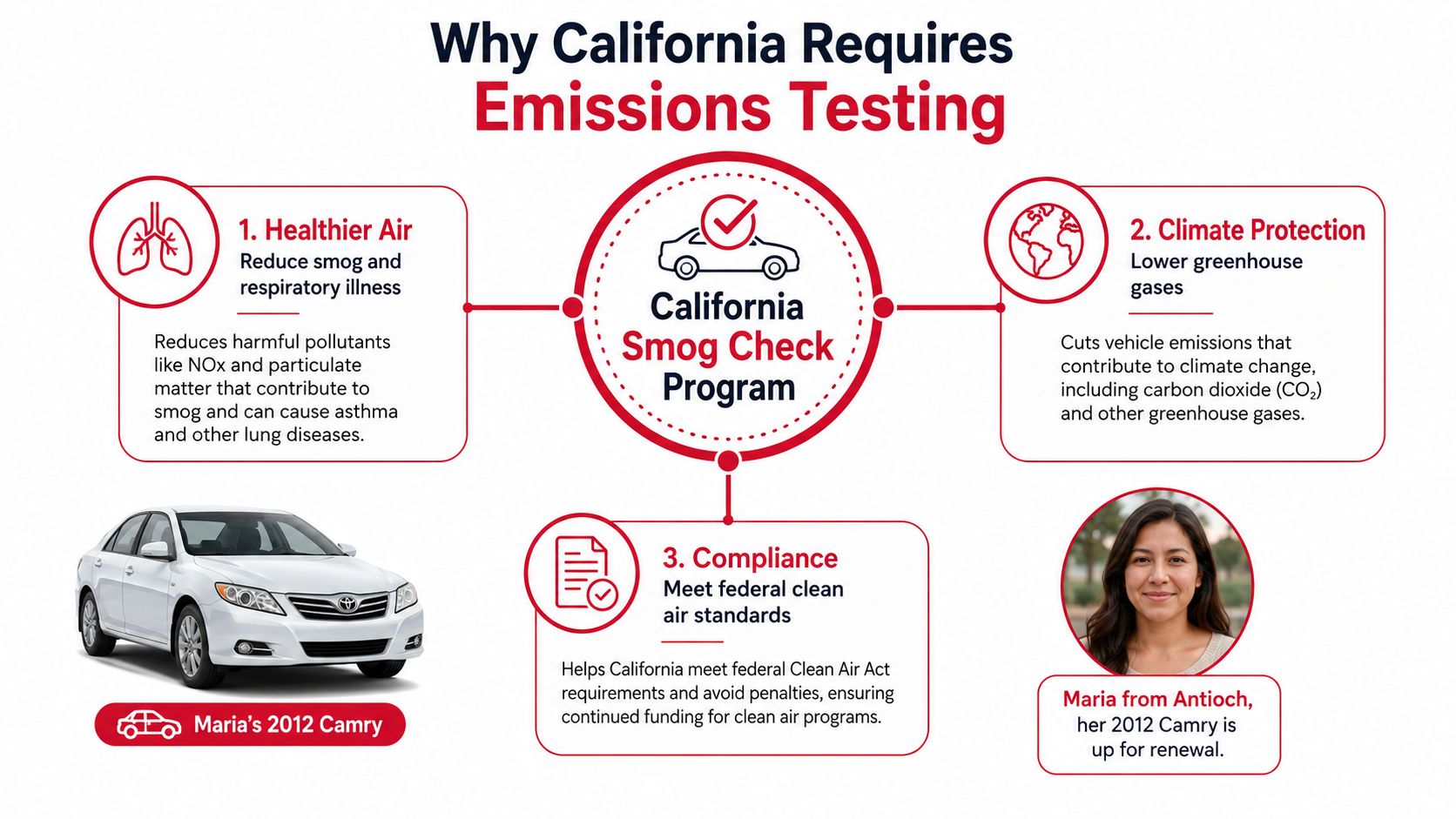
Table of Contents
- Why California Requires Emissions Testing
- Which Vehicles Must Be Tested
- STAR, Test-Only, and Regular Smog Stations Explained
- When and How Often You Need to Test
- Exemptions and Special Vehicle Cases
- How to Prepare Before You Arrive
- What Happens During the Test
- Failures, Retests and Your Next Steps
Why California Requires Emissions Testing
Maria from Antioch brings in her 2012 Camry because her registration renewal is coming up, and she wants to know why the state still asks for a smog check. The short answer is that California uses emissions testing to keep high-polluting vehicles from slipping through the registration process. In the federal framework, the Clean Air Act gave states and regulators the structure to run inspection and maintenance programs, and EPA guidance says those programs were formalized through the 1990 amendments and the original I/M rule followed in 1992 (EPA guidance on inspection and maintenance programs).
What the shop is trying to catch
A smog check is not one single test. It is an umbrella term for the visual inspection, the on-board diagnostics scan, and, for some older vehicles, the tailpipe portion that people usually picture when they hear “emissions test.” EPA describes the purpose as finding high-emitting in-use vehicles with short, warmed-up tests that can be done in idle mode or loaded mode, while still tracking real-world emissions problems (EPA emissions-testing technical guidance).
That matters in places like the Bay Area and the Central Valley because a dirty-running car doesn't stay in one zip code. It joins traffic, idles in lines, and adds to the air everyone breathes. The state's job is to reduce that risk before the vehicle gets another year on the road.
Practical rule: if the DMV needs a smog certificate, the certificate is part of the renewal, not a separate courtesy step.
How the DMV uses the test
The registration system is the enforcement hook. If the vehicle needs a smog check and the certificate doesn't clear, the DMV renewal doesn't clear either. That's why drivers often hear about emissions testing right when they need tags, plates, or a renewed registration card.
For Antioch drivers, that's usually the point where the process becomes very practical. You go to the station, the technician checks the car, and the result is sent into the registration workflow if the vehicle passes. The system is meant to be fast enough for everyday drivers, but firm enough that a failed vehicle can't skip the line.
Which Vehicles Must Be Tested
The easiest way to sort California emissions testing requirements is to put your vehicle into one of a few buckets. If your car is a newer gasoline model, you may be exempt. If it's older, diesel, or specifically flagged by the DMV, you may need to go in.
The three decision points that matter most
First, gasoline cars and light trucks 8 model years and newer are exempt this registration cycle. That means a 2018 vehicle is off the hook in 2026. Second, vehicles 6 model years and older fall into the regular biennial cycle, so they need a smog check every other renewal. Third, any vehicle that gets a DMV-directed STAR notice must go where the notice says, regardless of age.
Diesel adds a separate lane. Diesel trucks under 14,000 pounds GVWR follow a different annual rule through the state's heavy-duty program, so they don't fit neatly into the gasoline-car pattern. If you're unsure, the renewal notice usually tells you more than a general rule ever will.
Fast if-then guide
- If your gasoline car is 8 model years old or newer, you're usually exempt for this cycle.
- If your vehicle is 6 model years old or older, expect a biennial smog check.
- If the DMV mailed you a STAR-directed notice, follow that notice even if a regular station looks closer.
- If you own a diesel truck under 14,000 pounds GVWR, check the diesel-specific requirement rather than the gasoline schedule.
- If you're transferring a vehicle from out of state or changing ownership, expect an off-cycle visit.
| Vehicle Category | Model Year Rule | Test Frequency | Station Type Required |
|---|---|---|---|
| Gasoline cars and light trucks | 8 model years and newer exempt | No test this cycle | Any applicable station only if DMV directs it |
| Gasoline cars and light trucks | 6 model years and older | Every other renewal | Regular, STAR, or test-only, depending on DMV notice |
| Diesel trucks under 14,000 lbs GVWR | Separate diesel rule | Annual cycle | Follow the diesel-specific requirement |
| Out-of-state transfer or change of ownership | Based on transfer event | Off-cycle when required | As directed by the DMV notice |
| DMV-directed STAR vehicle | Any age | As directed | STAR station or test-only when specified |
If you want a station that handles California smog work and DMV paperwork in one place, Fire House Smog's STAR-certified smog station is set up for that kind of visit.
STAR, Test-Only, and Regular Smog Stations Explained
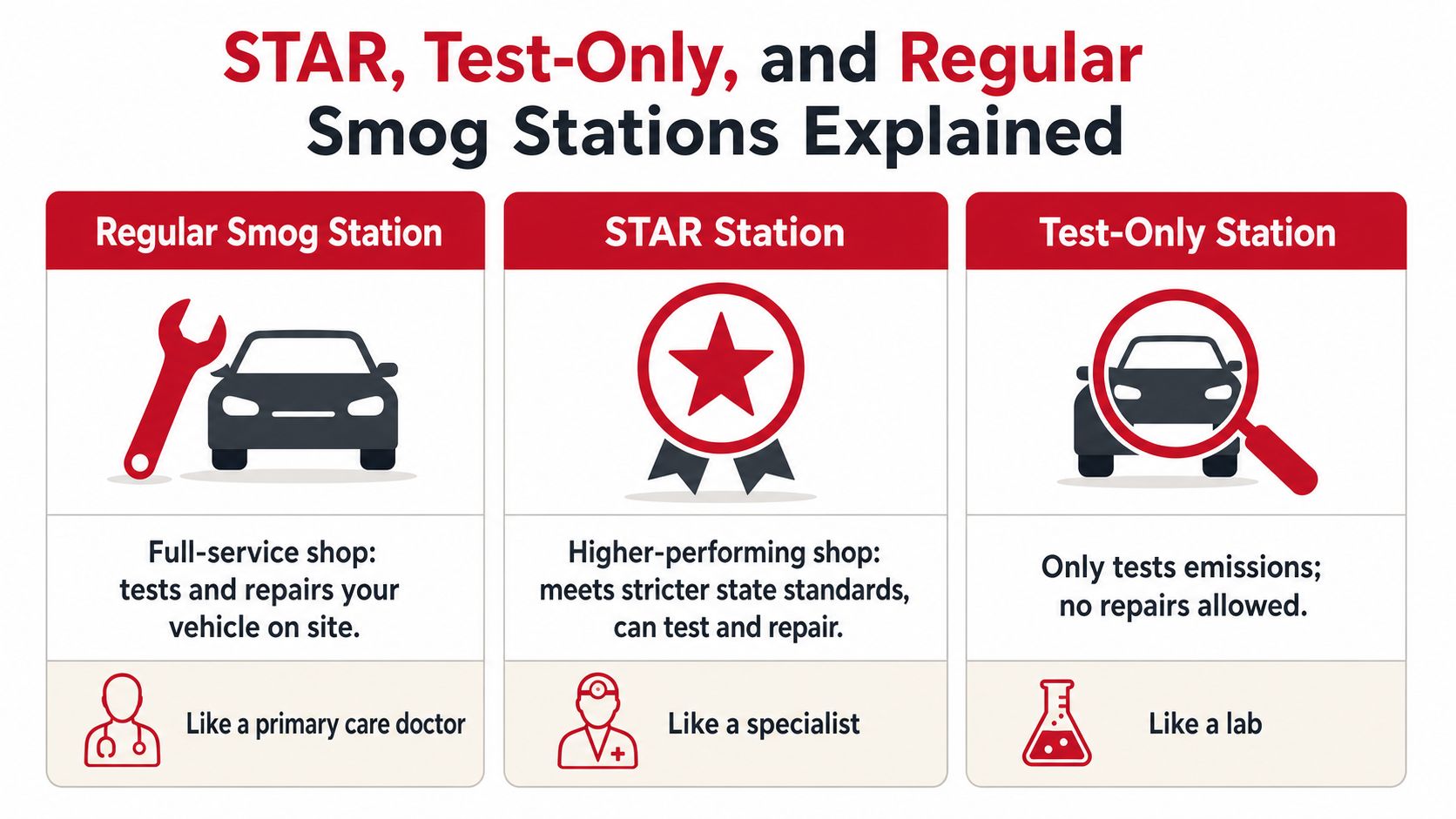
The station type changes where you're allowed to go, even when the inspection looks similar from the waiting room. A regular smog station can test vehicles and perform repairs. A STAR station meets additional state performance standards and handles vehicles that require closer oversight. A test-only station conducts the inspection but does not repair the vehicle it checks.
Why station type changes the trip
A regular station is convenient when you want testing and repairs handled at the same location. A STAR station can also test and repair, but it must meet stricter state standards. The DMV may direct certain vehicles there for closer control. A test-only station performs the inspection only. If the vehicle fails, you must take it somewhere else for diagnosis or repair.
That difference matters for drivers in Antioch and East Contra Costa County. If the DMV notice directs you to a STAR or test-only station, visiting the wrong shop can mean another drive, another line, and time away from work. The notice determines the station type, not the station your neighbor used last year.
How the DMV decides where you go
The DMV can assign a vehicle to STAR based on its inspection history or random selection. Repeated high emissions can also place the vehicle in a more closely controlled category. The state is trying to keep the highest-risk cars under closer watch.
A test-only station separates inspection from repair, so the result is focused on compliance rather than repair sales.
Read the renewal notice before choosing a location. If it says STAR, select a STAR station, such as Fire House Smog's STAR-certified smog station. If it specifies test-only, choose a station that performs inspections without repairs. Regular stations remain appropriate when the DMV does not assign a different type.
The right station prevents an avoidable second visit. At the shop counter, bring the notice and confirm the required station type before the vehicle enters the test lane.
When and How Often You Need to Test
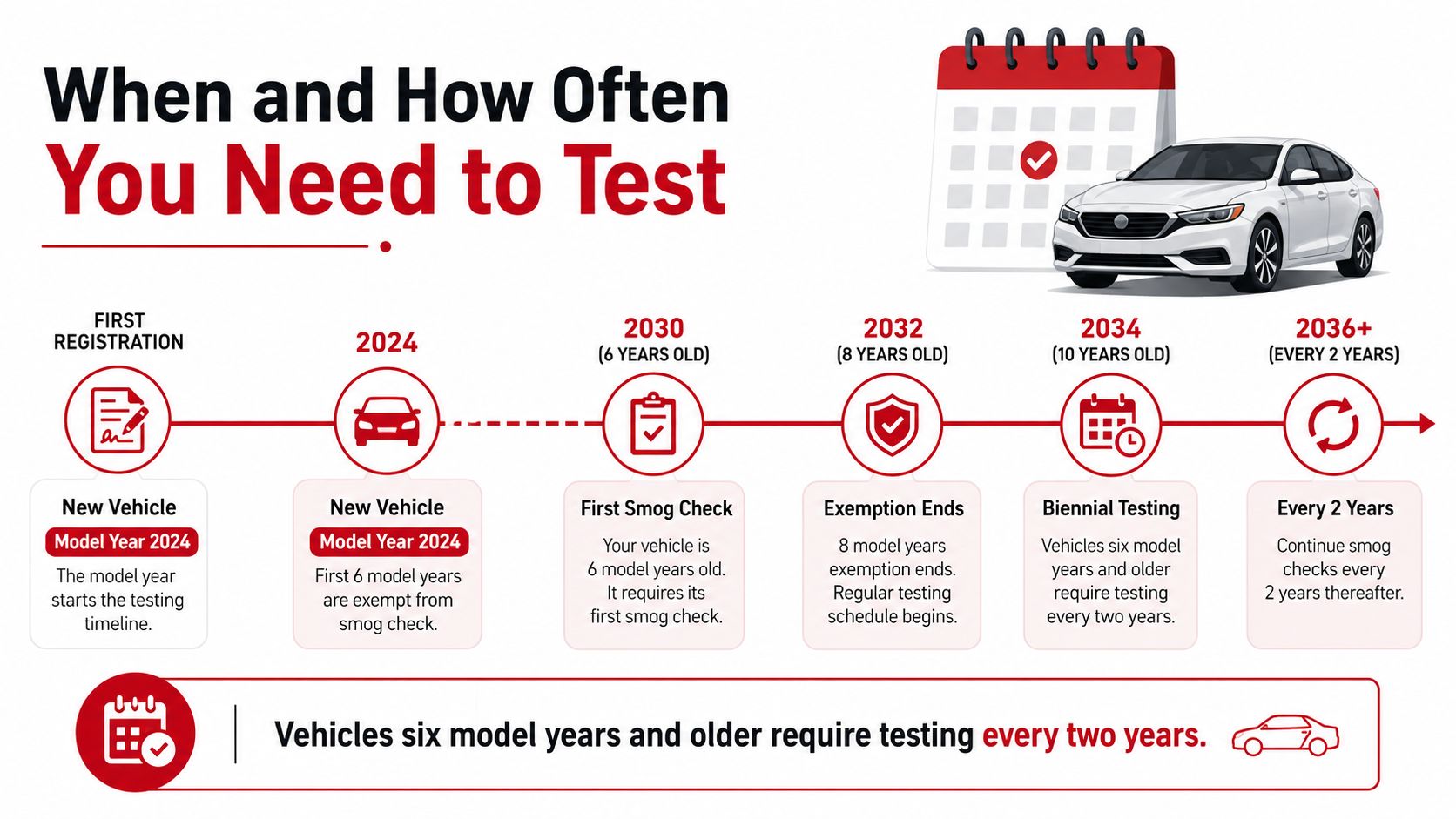
The DMV renewal notice is the best calendar you have. California's biennial cycle is tied to the vehicle's model year, not to when you bought it or when you feel like dealing with it, so the model year determines when the smog requirement starts and how often it returns.
Reading the cycle the right way
A simple way to think about it is this. Newer gasoline vehicles get a long exemption window, then the smog requirement begins once the vehicle reaches the older category that the state regulates. After that, the vehicle comes back every other renewal. The renewal notice matters because it tells you the due date the DMV wants, and that date controls the registration process.
For a 2024 model-year vehicle, the timeline starts with the no-test window, then the first required smog check comes later in the vehicle's life, and after that the pattern continues on the same two-year rhythm. The date printed by the DMV still wins if it conflicts with a general rule you heard from a friend.
Off-cycle visits that catch people off guard
Not every smog appointment follows the regular renewal clock. An out-of-state title transfer can trigger a visit before California issues plates. A change of ownership can do the same. A vehicle that's been stored, brought back into service, or previously failed and got a DMV-directed follow-up may also need to go back off-cycle.
Diesel trucks under 14,000 pounds live in their own lane, so their timing doesn't follow the same gasoline pattern. That's why the registration card and renewal notice matter so much. They're the state's instructions for your specific vehicle, not a generic sample notice.
Practical rule: if the DMV letter and a general online rule disagree, the DMV letter is the one to follow.
That rule saves drivers from showing up early, too late, or at the wrong kind of station. It also keeps the visit focused on what the DMV needs, which is the fastest path from the bay back to the renewal counter.
Exemptions and Special Vehicle Cases
Some vehicles never need a smog check, and others only need one when a specific event happens. The trick is to sort “never,” “not yet,” and “only if the DMV asks” into separate buckets. That distinction keeps drivers from paying for a test they don't owe.
Vehicles that are usually exempt
The most common exemptions are straightforward. Battery-electric vehicles and hydrogen fuel cell vehicles do not need smog tests. Motorcycles, trailers, farm equipment, and most vehicles older than 1975 are also outside the regular smog cycle. New gasoline cars and light trucks get the 8 model year exemption window described earlier, so a 2026 model sold in 2025 would be exempt through that early period.
Hybrid vehicles are different. They still follow the biennial cycle when the state places them in the tested category, because they still have a gas engine that can emit pollution. That's a common point of confusion at the counter.
Special cases that still trip people up
An out-of-state vehicle being registered in California for the first time usually must pass before plates are issued. A transfer of ownership can also bring testing back into the picture, even if the seller just had one done recently. And if the DMV has flagged a prior problem, that flag can override a driver's assumption that the car is exempt.
There are also hardship tools for some drivers. California has hardship extensions and economic hardship waivers for eligible cases, and those requests depend on income limits and proof that the needed repairs are beyond the state-set cost threshold. If a driver qualifies, that changes the repair path, but it doesn't erase the need to document the issue.
| Vehicle Type | Smog Check Required? | Notes |
|---|---|---|
| Battery-electric vehicle | No | No tailpipe emissions to test |
| Hydrogen fuel cell vehicle | No | Exempt from smog testing |
| Motorcycle | No | Outside the regular program |
| Trailer | No | Not a self-propelled emissions source |
| Most vehicles older than 1975 | No | Common exemption category |
| Hybrid vehicle | Sometimes | Follows the applicable smog cycle when required |
| Diesel truck under 14,000 lbs GVWR | Yes, under diesel rules | Separate annual requirement |
| Out-of-state first registration | Yes, when required | Must pass before plates are issued |
For drivers who want a local place to handle both emissions work and registration tasks, Fire House Smog's smog exemption guide is a useful reference before heading out.
How to Prepare Before You Arrive
The cleanest smog visit starts the night before. A little prep helps the technician move straight into the inspection instead of pausing for paperwork, a dead battery, or a loose gas cap that could have been fixed at home in thirty seconds.
What to bring
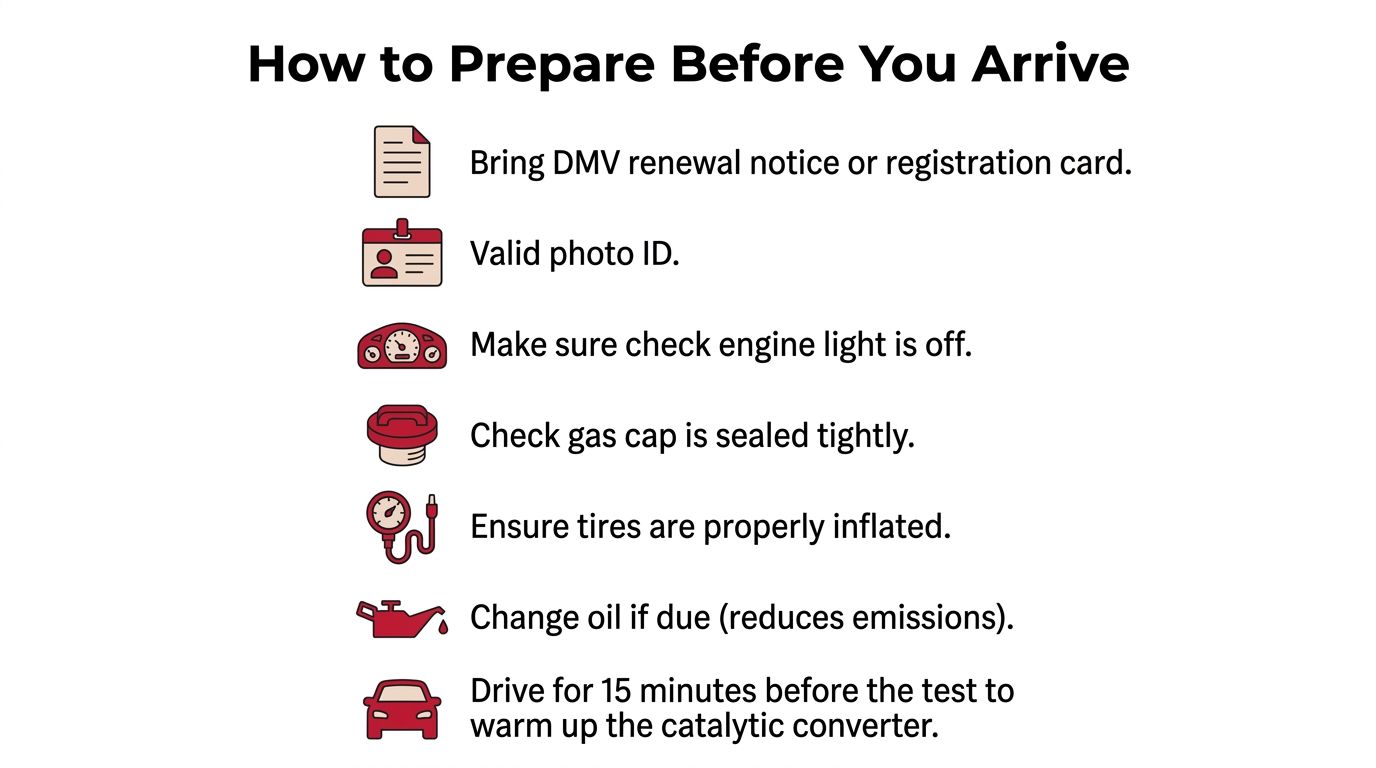
- DMV renewal notice or registration card: This tells the station what the DMV expects.
- Valid photo ID: The shop may need to verify who's dropping off the vehicle.
- Prior smog certificate if you're retesting: That keeps the follow-up visit tied to the original failure.
- Payment method: Many shops take cash, card, and sometimes check, but it's smart to confirm before you leave.
What to check on the car
Warm the engine before you arrive. A drive of at least fifteen minutes helps the catalytic converter and other parts reach normal operating temperature, which is how the test is meant to be performed. Make sure the check engine light is off, because that light often points to a problem the scan will catch.
A tight gas cap matters too. If it doesn't seal properly, the system can fail the pressure check. Even tire pressure can help keep the car stable during any loaded testing setup, so don't ignore it if the tires look uneven.
Practical rule: if the battery was recently disconnected, take the car on a short drive first so the readiness monitors can relearn normal operation.
The inside of the car matters less than the engine, but it still helps to remove loose items so the technician can move freely and confirm the VIN without clutter. At busy stations in Antioch, arriving a few minutes early keeps the appointment smooth, especially if the renewal notice has a STAR or test-only instruction written on it.
What Happens During the Test
At a STAR station in Antioch, the visit usually starts with a quick intake at the bay. The technician checks the VIN, fuel type, and registration details so the car matches the paperwork. That first step is simple, but it prevents the wrong vehicle from getting tested under the wrong rule.
The inspection inside and under the hood
The technician then does the visual checks required for the vehicle. On newer cars, the OBD-II scan reads readiness monitors and trouble codes from the car's computer. On older vehicles, the inspection can include the tailpipe portion and related emissions checks, which is why the process looks different depending on what you drive.
Gas caps may be pressure-tested as part of the process, because a bad seal can let pollution escape where it shouldn't. The technician may also look at emissions-related parts under the hood to make sure they're present and connected. The point is not to make your life hard, it's to confirm the car still matches the emissions system it was built to use.
What the driver experiences
Most drivers wait in the lobby while the inspection runs. The full visit is usually short enough to fit into a normal errand stop, and the technician shares the result before anything gets sent into the DMV system. If the vehicle passes, the certificate moves the registration forward. If it fails, the printed result becomes the starting point for repairs.
The process is standardized statewide by BAR, so the same basic steps apply whether you're tested in Antioch or elsewhere in California. If the car fails and the station offers a retest coupon or retest policy, ask about the window and the fee before you leave. That small question can save you a second surprise trip.
Failures, Retests and Your Next Steps
A failed smog test is not the end of the road. It just tells you where the car needs work before the DMV will accept the certificate. The useful part is that the report points to the problem instead of leaving you to guess.
What the three outcomes look like
A pass means the certificate is sent to the DMV and the registration path keeps moving. A fail means you get a printed repair report that shows which component, system, or readiness item didn't meet the requirement. A directed-repair notice means the DMV wants the vehicle handled in a particular way, often because the case needs more control than a routine renewal.
After a fail, the next step is usually repair and retest. California gives drivers a 30-day window to make repairs and return, and the retest fee is a normal part of that process unless the station's policy says otherwise. Some stations offer a free-retest coupon within the required period at the same location, which can lower the cost if you come back on time.
Getting help when repair costs are the problem
The state also has Consumer Assistance Program options through ARB, including Repair Assistance and Vehicle Retirement for income-eligible drivers. Those programs can help when the repair bill is more than the vehicle owner can reasonably absorb. The exact eligibility rules matter, so this is one of those moments where the paperwork is as important as the wrench work.
The station's result page can help you understand what the paper means before you call around for repairs. If you need that translation, the emissions test results guide is a practical place to start.
Once you know the failure reason, call the shop, schedule the return visit, and confirm whether the DMV wants a STAR station for the retest. Bring the original paperwork back with you, because that keeps the second visit tied to the first one instead of starting over.
If your registration is due and you want the paperwork handled without bouncing between offices, Fire House Smog can perform the smog check and help with DMV registration tasks in Antioch. Visit Fire House Smog to plan your visit, confirm station requirements, and get your vehicle checked before the renewal deadline.
Gasoline-powered vehicles from model year 1975 and older are permanently exempt from California smog checks. Newer vehicles have separate age-based exemptions, eight model years for registration renewal and four model years for ownership transfers.
If you're renewing registration, buying an older car, or standing at the DMV counter with a notice that says a smog certificate is required, the model year matters more than the vehicle's mileage, purchase date, or how clean its emissions history has been. California doesn't use one universal exemption rule. It uses different rules for classic gasoline vehicles, newer vehicles during registration renewal, and newer vehicles changing ownership.
That distinction prevents two common mistakes: assuming a vehicle is exempt when it isn't, or paying for a test that the DMV doesn't require. Use the vehicle's model year, fuel type, and transaction type to identify the right category before you schedule an inspection.
Table of Contents
- California Smog Exemption Rules at a Glance
- The 1975 and Older Classic Vehicle Exemption
- New Vehicle Exemptions for Renewal and Ownership Transfer
- Special Rules for EVs Hybrids Motorcycles and Diesel Vehicles
- How to Verify Your Vehicle Exemption Status
- Common Smog Exemption Misconceptions to Avoid
- Quick Reference Checklist and Next Steps
California Smog Exemption Rules at a Glance
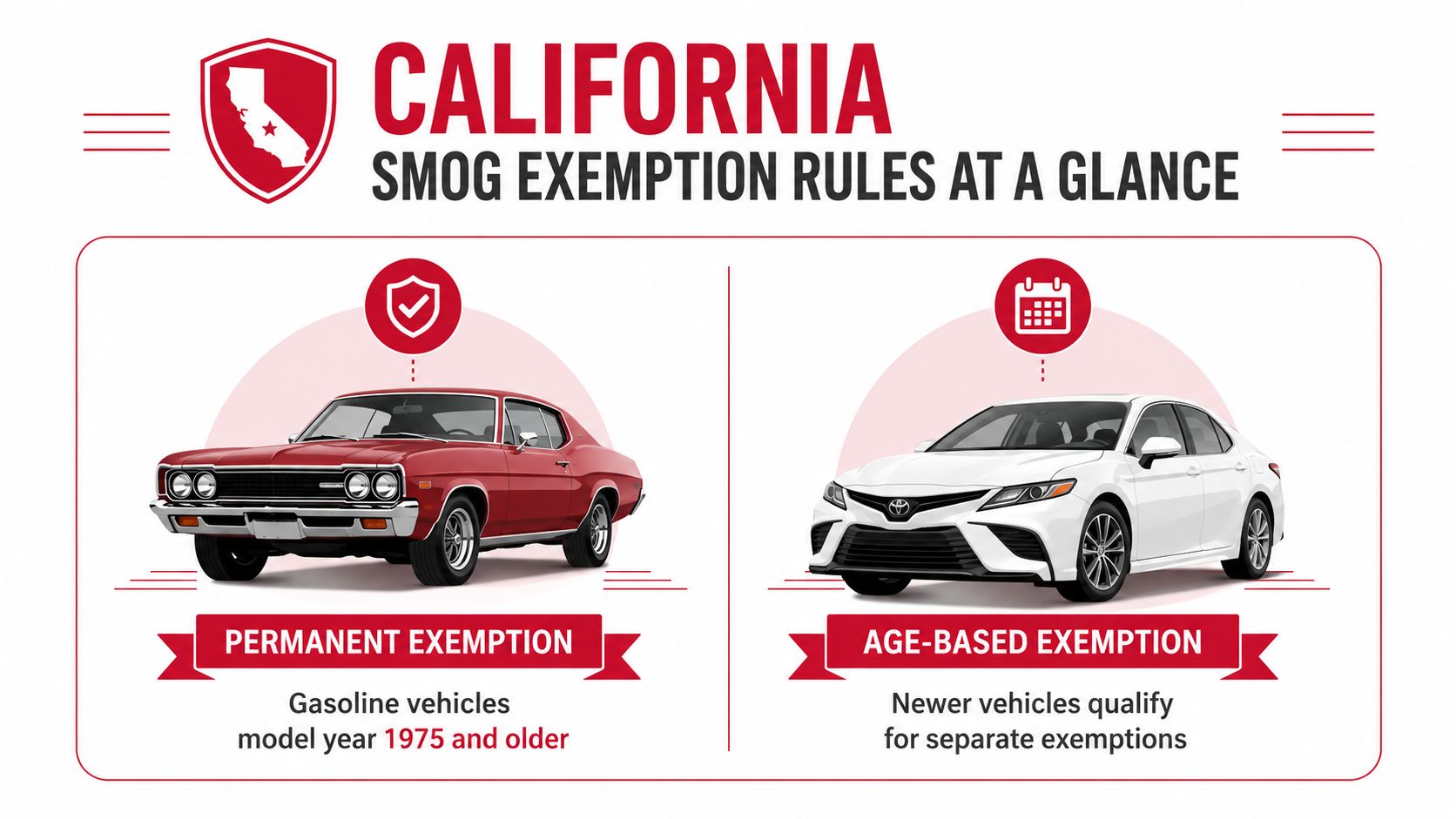
California separates smog exemptions by vehicle category and transaction. Classic gasoline vehicles, newer vehicles at registration renewal, and newer vehicles during ownership transfer each follow a different rule. The fixed classic cutoff covers gasoline-powered vehicles with a model year of 1975 or older, while the newer-vehicle exemptions use model-year age windows. California's current smog exemption guidance distinguishes these categories clearly.
Use this three-part check before scheduling an inspection:
- Classic gasoline vehicle: Model year 1975 or older remains exempt under the fixed cutoff.
- Registration renewal: Vehicles eight model years old or newer are exempt from the biennial renewal smog check.
- Ownership transfer: Vehicles four model years old or newer are exempt from a smog inspection during the transfer.
Calculate the applicable model-year window
Start with the transaction, then apply the correct age rule. Do not use the renewal window for a title transfer, or the transfer window for a registration renewal. The same vehicle can qualify under one category and require testing under another.
For a renewal, add eight to the vehicle's model year to identify the first model year that may require an inspection. For example, a vehicle's model year provides the starting point for that calculation, not its purchase year, mileage, or emissions history. The California DMV smog inspection guidance provides the official process, and the renewal notice remains the final check for that vehicle.
The 1975 and Older Classic Vehicle Exemption
If you own a gasoline car from 1975 or earlier, check the model year before booking a smog test. California's classic-vehicle exemption uses a fixed cutoff, not a rolling age rule. A 1975 vehicle qualifies under that cutoff, while a 1976 vehicle does not become exempt by getting older.
The rule applies to the vehicle's documented model year and fuel type. California does not treat every gasoline car that reaches a certain age as a classic exemption vehicle. If the title, registration record, and vehicle identification show a gasoline-powered model year of 1975 or older, the exemption generally applies.
Use the model year, not the calendar year
Check the model year shown on the title, registration record, or identification information. Do not base eligibility on the purchase year, manufacturing date, mileage, or how long the vehicle has been stored.
| Vehicle Model Year | Exemption Status | Notes |
|---|---|---|
| 1975 | Exempt | Meets California's fixed gasoline-vehicle cutoff |
| 1974 | Exempt | Also meets the classic vehicle exemption |
| 1976 | Not exempt under the classic cutoff | Older age does not change the cutoff |
The practical distinction is simple. A 1975 gasoline car may renew registration without a standard smog inspection under the classic exemption. A 1976 gasoline car should not be treated as exempt solely because it is an older vehicle. Confirm the DMV record before relying on the exemption.
Practical rule: Vehicle age alone does not create a classic exemption. The documented model year must meet California's fixed cutoff.
Keep the DMV record accurate
A smog exemption does not remove other registration duties. Maintain valid ownership, registration, and vehicle information. If the DMV record lists the wrong model year or fuel type, provide the supporting title and vehicle documents before assuming the system will recognize the exemption.
Substantial modifications also require careful recordkeeping. Keep the title and related documentation available. A modification does not automatically remove or preserve exemption status, so resolve unclear information with the DMV rather than paying for an inspection unnecessarily.
For a plain-language explanation of older gasoline-vehicle rules, review this California smog exemption guide for older cars. If the DMV system flags a qualifying vehicle for testing, correct the record issue first.
New Vehicle Exemptions for Renewal and Ownership Transfer
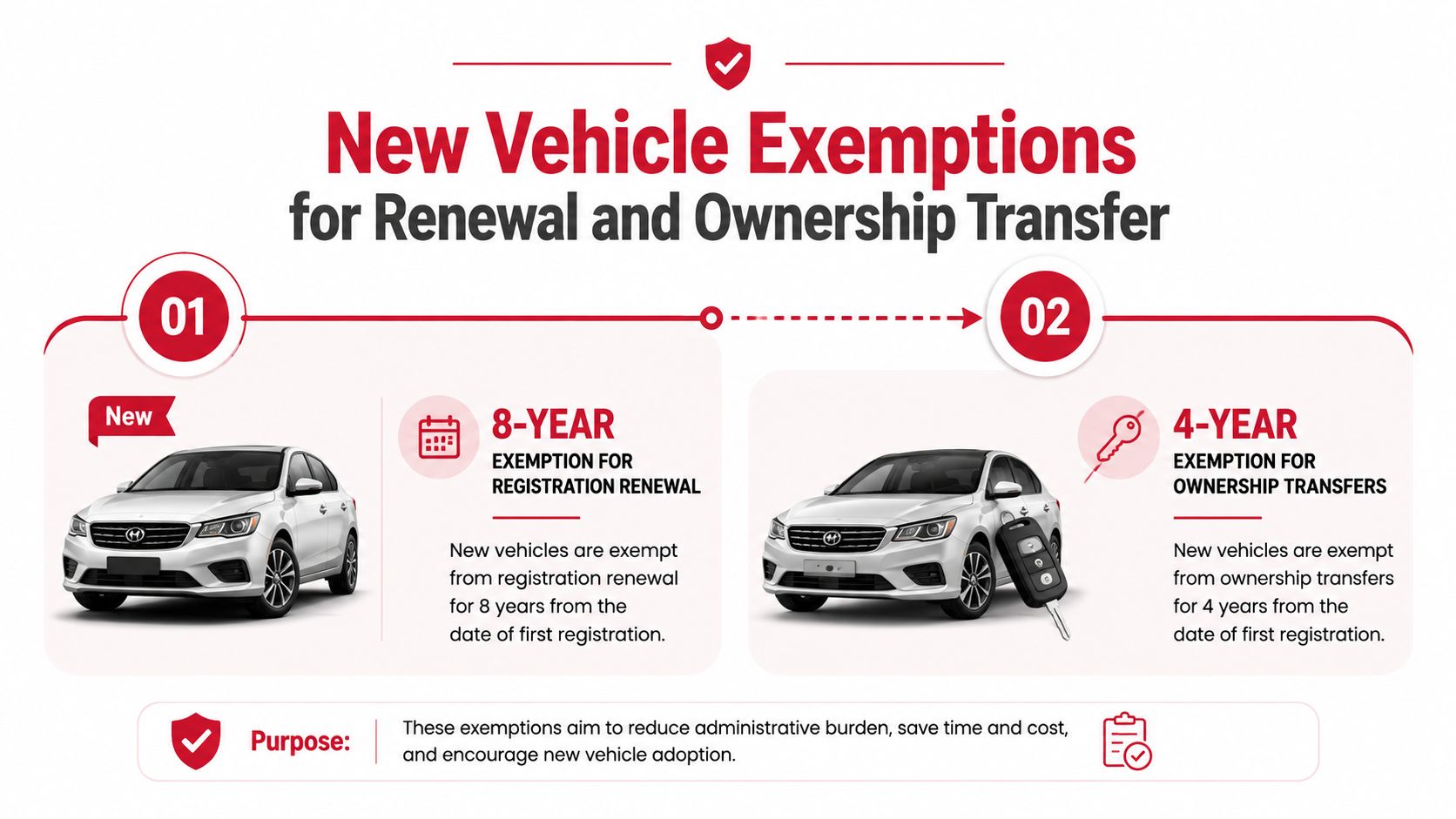
A vehicle can qualify for one exemption during registration renewal and a different exemption during an ownership transfer. California generally exempts gasoline, hybrid, and alternative-fuel vehicles that are eight model years old or newer from the biennial Smog Check at renewal. For an ownership transfer, the vehicle must generally be four model years old or newer.
Use the official model year for both calculations. The purchase date, the date you acquired the vehicle, and the date it entered your household do not change the vehicle's model-year age. Add eight to the model year to identify the first year a renewal smog check is generally required. A 2020 model-year vehicle generally first needs a renewal smog check in 2028, subject to the vehicle's registration record and transaction details.
Calculate the renewal timing
Follow these steps:
- Find the vehicle's official model year.
- Add eight to that model year.
- Treat the result as the first year a renewal smog check is generally required.
- Compare the result with the DMV renewal notice or online vehicle record.
A 2026 model-year gasoline vehicle generally would not need its first registration-renewal smog check until 2034. A 2022 model-year vehicle would generally remain exempt at renewal through 2030 under the same calculation. These examples apply only to the renewal exemption. The vehicle's actual record controls what appears on the renewal notice.
Keep renewal and transfer separate
The ownership-transfer rule uses a shorter window. A vehicle that is four model years old or newer can generally transfer without the smog inspection required for an older vehicle transaction. Confirm the transaction type and review the transfer paperwork before signing over the title.
Handle the smog question before submitting transfer documents. This California vehicle registration transfer information explains the paperwork and identifies situations that may require further DMV action.
The purchase date does not reset the model-year clock. California bases these age-based exemptions on the vehicle's model year.
Ask two separate questions: “Am I renewing registration?” Apply the eight-year rule. “Am I transferring ownership?” Apply the four-year rule. A car being “new enough” is not a complete exemption test.
Special Rules for EVs Hybrids Motorcycles and Diesel Vehicles
Your vehicle's fuel type determines which exemption category to check. California separates three questions that are often combined: the permanent classic-vehicle cutoff, the temporary new-vehicle exemption, and the alternative-fuel rules. Use the model year first, then confirm the vehicle's official record.
An electric vehicle has no gasoline engine producing tailpipe emissions, so it does not follow the ordinary gasoline inspection pattern. A hybrid still has an internal combustion engine. Its fuel efficiency does not create a permanent exemption. Hybrids generally follow the newer-vehicle age window, which ends as the vehicle reaches the applicable model-year limit.
Compare the vehicle categories
| Vehicle Type | Exemption Rule | Model Year Cutoff |
|---|---|---|
| Gasoline-powered vehicle | Permanent classic exemption | 1975 and older |
| Newer gasoline vehicle | Age-based renewal exemption | Eight model years or newer |
| Hybrid vehicle | Age-based renewal exemption applies while within the qualifying age window | Eight model years or newer |
| Alternative-fuel vehicle | Age-based renewal exemption applies while within the qualifying age window | Eight model years or newer |
| Electric vehicle | No standard tailpipe smog check | Not based on a gasoline cutoff |
| Motorcycle | Generally outside the standard smog-check requirement | Not based on the gasoline cutoff |
For unusual fuel systems or emissions equipment, review this California emissions standards guide before assuming the ordinary gasoline rule applies. The registration event still matters, because an exemption at renewal does not automatically answer every ownership-transfer question.
Diesel needs a separate check
Diesel vehicles use a different cutoff. Diesel vehicles from model year 1997 and older are exempt, while newer diesel vehicles may face different testing requirements. Vehicle weight also affects certain diesel trucks and recreational vehicles. Vehicles over 14,000 pounds GVWR can receive different smog-check treatment.
“Diesel” alone is not enough information. Confirm the model year, gross vehicle weight rating, vehicle class, and registration use. RVs require the same care, since their size, equipment, and weight can affect both inspection availability and the requirements that apply.
Motorcycles are generally outside the standard smog-check requirement, but a modified alternative-fuel vehicle or diesel truck should not be evaluated with a generic age calculator. Check the DMV record and the applicable California emissions category before booking a test. That approach separates the permanent classic exemption from the temporary new-vehicle window and the distinct alternative-fuel treatment.
How to Verify Your Vehicle Exemption Status
A vehicle can meet an exemption category and still require a smog certificate for the transaction on your DMV record. Check the official record first, then compare it with the vehicle's model year, fuel type, and registration event. Keep the license plate, VIN, renewal notice, and model-year information ready.
Use the DMV record as the starting point
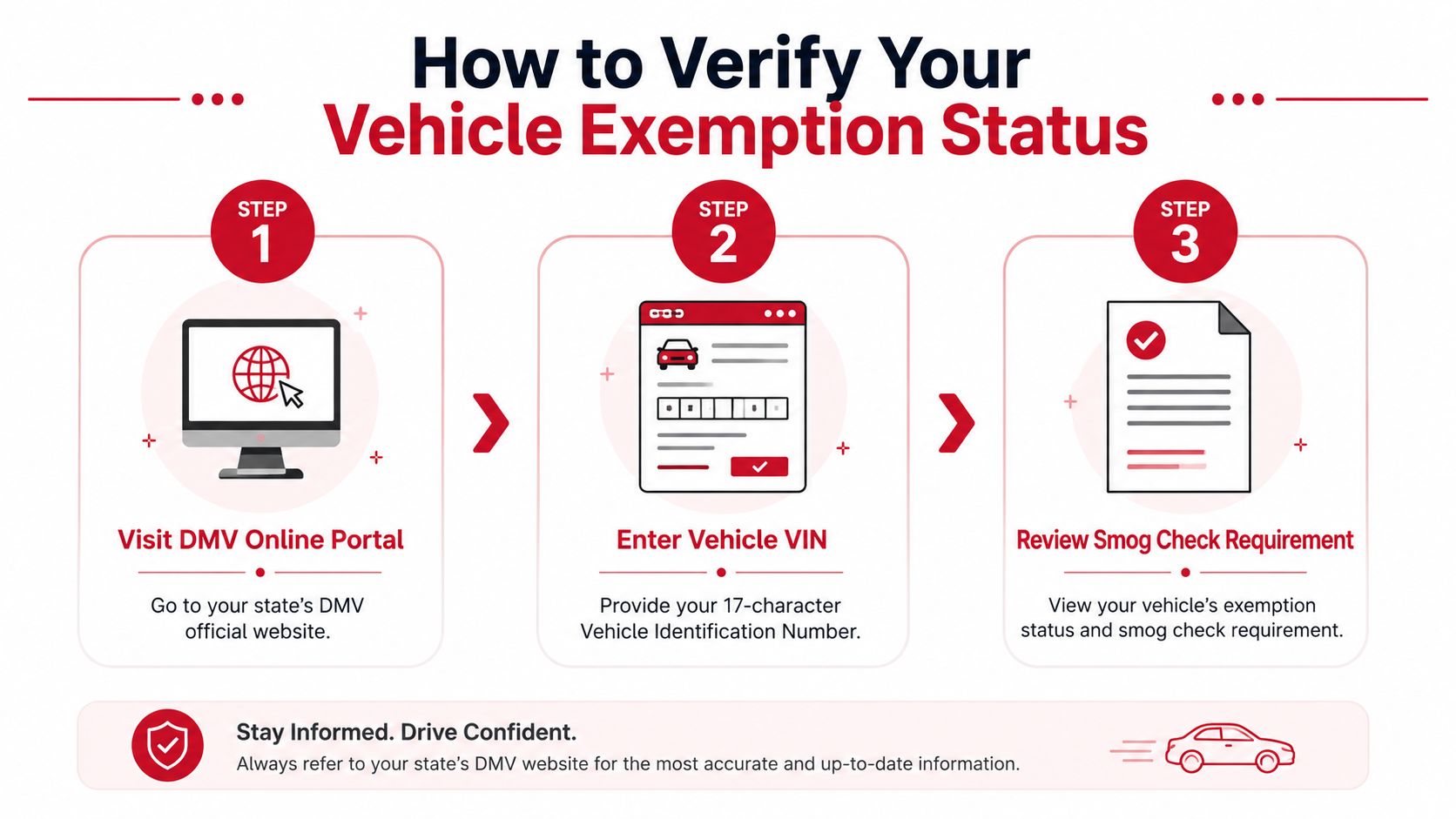
- Open the California DMV vehicle registration portal. Review the current renewal or transaction requirement through the state's online registration tools.
- Enter the requested vehicle information. The portal may ask for details such as the VIN or license plate.
- Read the smog requirement carefully. Confirm whether the current renewal or ownership transaction requires a smog certificate.
- Check the category behind the result. Compare the record with the vehicle's model year, fuel type, and the transaction you are completing.
- Save the result. Keep a digital or printed copy if the DMV record appears inconsistent with your vehicle documents.
Your renewal notice shows what the DMV expects for that specific registration event. A vehicle may fit the classic, new-vehicle, or alternative-fuel category, while the record still shows a requirement because of an incorrect model year, fuel type, ownership status, or vehicle classification.
If the DMV asks for a smog certificate, verify the record before assuming the notice is incorrect or booking an inspection.
If the DMV result conflicts with the title, registration, or vehicle specifications, contact the DMV and the Bureau of Automotive Repair's Smog Check Program. Ask which record element triggered the requirement. If the agency confirms or corrects the exemption, request written documentation and keep it with your registration records.
For a visual walkthrough of the verification process, use the following guide:
Identify the transaction before taking action. Renewal, ownership transfer, and correction of a vehicle record can produce different smog requirements, even for the same vehicle.
Common Smog Exemption Misconceptions to Avoid
The biggest myth is that California exempts a gasoline vehicle once it reaches a certain rolling age. It doesn't. The current classic gasoline exemption uses the fixed 1975 model-year cutoff, so a 1976 vehicle doesn't qualify because it has become old.
An out-of-state vehicle doesn't become exempt merely because it was previously registered elsewhere. California applies its own registration and emissions rules when the vehicle enters the state, and the owner must evaluate the vehicle using its California transaction, model year, fuel type, and classification.
Four assumptions that cause trouble
- “I barely drive it, so I don't need a test.” Low mileage and occasional use don't create a general exemption. The rule is based on the applicable vehicle and transaction categories.
- “It passed before, so it's exempt now.” A clean prior inspection doesn't remove a later testing requirement. Check the current DMV notice.
- “It's a hybrid, so it never needs smog.” Hybrids can receive the newer-vehicle age exemption, but they aren't automatically exempt forever.
- “It's old enough for classic status.” California's gasoline cutoff is tied to model year 1975 and older, not to a rolling age label.
These mistakes usually happen because owners use one rule to answer every situation. That approach fails when a renewal rule gets confused with a transfer rule, or when a gasoline rule gets applied to diesel, hybrid, electric, or motorcycle categories.
Check the official record before you pay for testing, especially when transferring an out-of-state vehicle or correcting a title. A short verification step is more useful than relying on a broad statement that the car is “old,” “clean,” or “fuel efficient.”
Quick Reference Checklist and Next Steps
先按車輛類別和交易情境核對,別把經典車、新車或替代燃料車的規則混在一起:
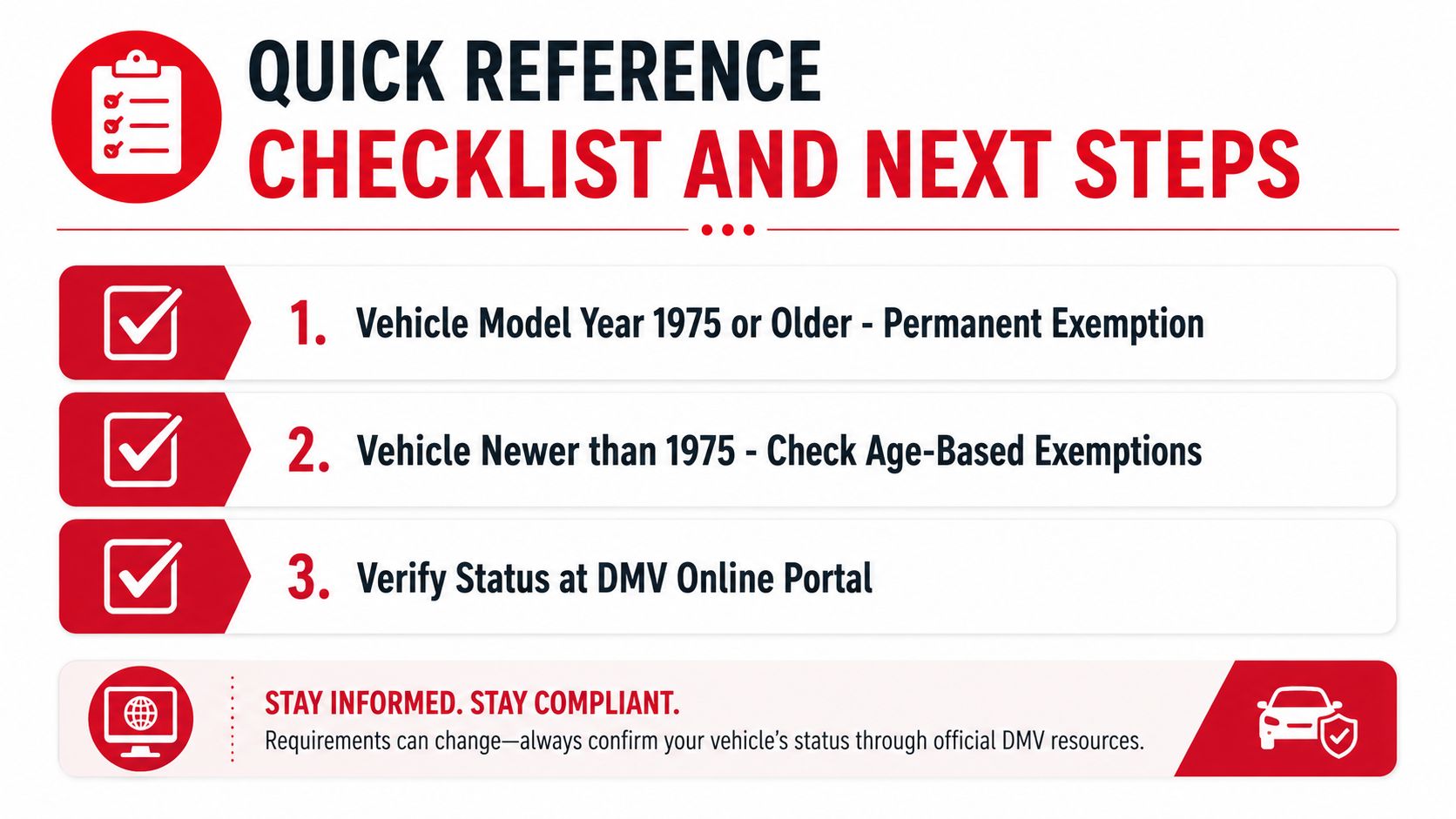
- 經典車: 汽油車若屬於 1975 年或更早的車款年份,通常符合經典車豁免條件。
- 新車續牌: 續牌時,確認車輛是否屬於 八個車款年份或更新,再依車款年份計算並核對 DMV 紀錄。
- 新車轉讓: 辦理所有權轉移時,確認車輛是否屬於 四個車款年份或更新,並查看轉讓文件。
- 替代燃料與其他類別: 電動車、混合動力車、柴油車、摩托車、重型卡車或休旅車,必須按自身類別判斷,不能直接套用汽油車規則。
- 最後確認: 檢查 California DMV 車輛紀錄和續牌通知,再預約 smog 檢查。
如果資料仍不清楚,請透過 California DMV smog inspection portal 核實,並使用 Bureau of Automotive Repair 的持牌檢查站資源。DMV 紀錄要求檢查時不要跳過,也不要在未確認要求前先付費檢查。
Fire House Smog 提供 STAR 認證僅檢查 smog 服務、California DMV 續牌及所有權轉移協助,地址是 Antioch 的 2900 Lone Tree Way。請瀏覽 Fire House Smog 查看服務。
Marcus in Antioch opened his mail and found the notice no truck owner wants: his 2012 Silverado 1500 needs a smog check before DMV will renew the registration. Without a valid certificate, the renewal stalls, and that can put a contractor's daily routine at risk, from hauling tools to reaching a job site.
“Clean air truck” isn't just a sales phrase. In California, it connects vehicle emissions, registration requirements, California Air Resources Board enforcement, and the inspection process at an approved smog station. The rules depend on the truck's fuel, weight, model year, and compliance history.
By the end, you'll know what California means by a clean air truck, how gasoline and diesel pickups follow different paths, what happens during a smog inspection, and how to prepare for a test-only STAR station. You'll also understand why older diesel equipment receives attention from CARB even when it doesn't use the same station-based test as a light-duty gasoline truck.
The practical takeaway is simple. By the last section, you'll know which station to use, what paperwork to bring, and what to check before paying for a test.
Table of Contents
- Why a Clean Air Truck Matters in California Right Now
- What a Clean Air Truck Means
- Diesel and Gasoline Trucks Under California Rules
- How Smog Checks and Certification Work
- Pre-Check Habits That Prevent Failed Smog Tests
- Getting Your Truck Compliant at a STAR Test-Only Station
- Common Misconceptions That Trip Up Truck Owners
- Your Next Steps and Where to Test in Antioch
Why a Clean Air Truck Matters in California Right Now
California treats emissions compliance as part of vehicle ownership, not as an optional maintenance project. If your renewal notice requires a smog check, the DMV generally needs the electronic certificate before it can complete the registration renewal. A truck that runs reliably can still fail because its emissions controls, diagnostic monitors, or inspection records don't satisfy the current test.
That's why the phrase clean air truck matters to owners. It describes a truck that meets the emissions requirements for its model year and passes the inspection required for its class. A clean-looking exterior, strong engine, or recent oil change doesn't establish compliance.
Practical rule: Read the DMV renewal notice before choosing a station. The notice tells you whether the state has placed a smog requirement on that registration renewal.
California's enforcement picture also reaches beyond the ordinary light-duty smog appointment. Visible smoke from a diesel truck can attract roadside attention, and commercial diesel operators may face CARB obligations that don't appear on a typical passenger-vehicle checklist. Heavy-duty trucks also matter disproportionately to air-quality policy. An EPA and Congressional Research Service summary states that heavy-duty trucks account for about 32% of mobile-source NOx emissions while representing roughly 2% of California's on-road vehicle fleet.
The policy direction is tightening, too. EPA's heavy-duty standards finalized in December 2022 are described as more than 80% stronger than the rules then in place, with model year 2027 and later trucks facing stricter emissions requirements. EPA's final-rule materials describe tailpipe NOx reductions of about 80% and particulate-matter reductions of 50% versus prior standards.
For an owner, the next step isn't to debate every future rule. It's to identify the truck category, follow the current registration instruction, and test before the deadline.
What a Clean Air Truck Means
A clean air truck meets the emissions standard assigned to its model year and vehicle class. That definition comes from a long federal rulemaking history, not from a badge, aftermarket claim, or a clean-looking exhaust.
The federal Clean Air Act of 1970 established national vehicle-emissions controls. Standards for cars and light-duty trucks followed in 1975, and EPA continued tightening nitrogen oxide limits for light trucks. EPA's historical summary records a 2.3 grams-per-mile NOx limit by 1979, followed by stricter requirements for heavier and lighter light-duty trucks in later years. EPA's clean-vehicle history identifies the Tier 2 program, finalized in 2000 and phased in from the 2004 model year, as a major change. Its 0.07 grams-per-mile NOx standard represented an 86% to 95% reduction for light trucks compared with prior requirements.
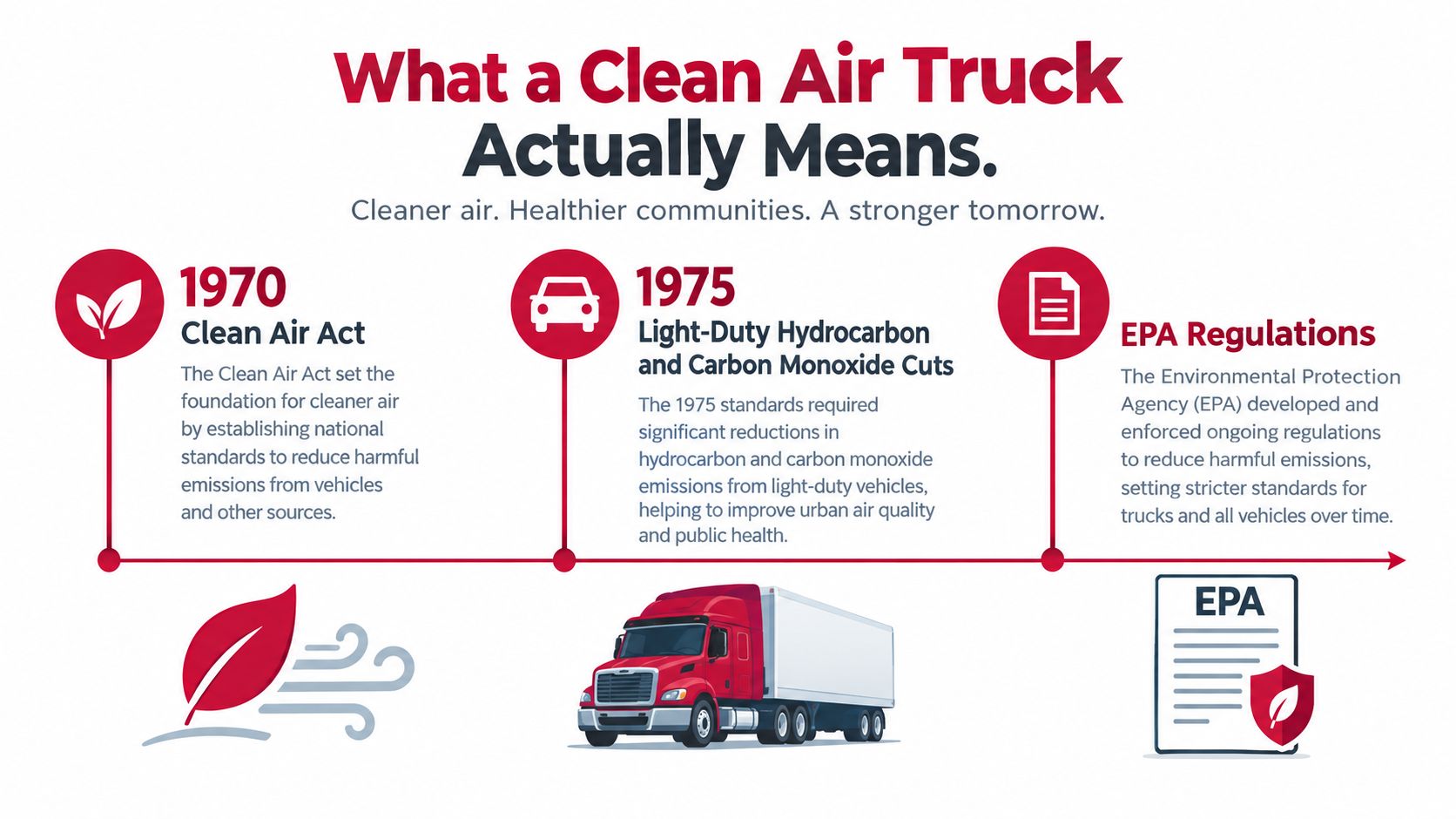
The heavy-duty reset
Diesel freight trucks reached another major compliance point with EPA's 2007 heavy-duty standards. New heavy-duty engines had to reduce particulate matter to 0.01 grams per brake horsepower-hour, a near-zero level. EPA's SmartWay timeline describes the 2007-era rules as reducing smog-forming emissions from trucks and buses by about 95% and particulate emissions by about 90% compared with earlier levels. Newer clean-diesel engines have also been described as producing about 99% lower NOx and 98% fewer particulate emissions than previous generations. EPA's SmartWay timeline places the newer model year 2027 requirements within that continuing progression.
California adds a separate layer through CARB programs and vehicle rules. New truck sales, fleet composition, and emissions performance are moving toward stronger zero-emission and near-zero-emission requirements, with light-duty phases covering model years 2027 through 2033, according to the ICCT policy update. Those requirements shape new-vehicle purchases and fleet planning. They do not cancel an older truck's current smog obligation.
For an owner, the working definition is straightforward: your truck must meet the standard tied to its model year and pass the California inspection required for its category. That is what determines registration readiness. A truck can have newer emissions technology and still fail if its required inspection, equipment, or emissions controls do not meet California's rules.
Diesel and Gasoline Trucks Under California Rules
Start with fuel type. A gasoline pickup and a diesel work truck may look similar in the driveway, but California can send them through different compliance paths.
A gasoline light-duty truck generally enters the recurring smog-check cycle based on model year and age. California's process commonly uses OBD-II testing for newer vehicles, while older vehicles may receive additional inspection procedures. Diesel light-duty trucks are handled differently, especially around particulate controls, fees, and the types of enforcement that apply.
Use this quick sorting table before you book:
| Category | Model Year Scope | Smog Check Required? | Annual Fee | Main Exemption |
|---|---|---|---|---|
| Gasoline light-duty truck | 1976 and newer, subject to California's age and registration rules | Often, when listed on the DMV renewal notice | Smog Abatement and transaction charges may apply | 1975 and older gasoline vehicles |
| Diesel light-duty truck | 1997 and newer, under 14,000 pounds GVWR | Subject to the applicable DMV cycle | Diesel particulate fee may apply | Pre-1997 diesel light-duty vehicles |
| Heavy-duty diesel truck | Heavy commercial class | Often outside the station smog-check line | CARB reporting and equipment obligations may apply | Station-test exemption does not remove CARB duties |
| Electric or hydrogen fuel-cell vehicle | Applicable zero-emission vehicle class | No tailpipe smog test | Registration rules still apply | No combustion tailpipe |
A gasoline owner should first confirm the renewal notice. A diesel light-duty owner should also account for CARB's diesel particulate fee structure and confirm whether the truck's weight and model year place it in the light-duty testing category. For diesel-specific testing information, review diesel smog testing in California.
Heavy-duty diesel owners need a different mindset. A truck may not receive the same station inspection as a light-duty pickup, yet CARB can still regulate it through programs involving reporting, idling, transport refrigeration equipment, and roadside visible-smoke enforcement. Don't mistake “no station smog check” for “no emissions responsibility.”
Your three-bucket decision is straightforward:
- Gasoline light-duty truck: Follow the DMV smog instruction and use the correct station type.
- Diesel light-duty truck: Confirm test eligibility, particulate-fee treatment, and equipment requirements.
- Heavy commercial diesel: Check the applicable CARB programs before assuming a station visit is the only obligation.
How Smog Checks and Certification Work
A California smog inspection combines electronic diagnosis with a physical emissions check. The exact procedure depends on the truck's age, fuel, equipment, and the inspection program attached to its registration.
A STAR-certified station meets additional state performance and testing requirements. A test-only station can inspect the vehicle but doesn't perform repair work. That separation matters because the station's job is to document the result, not sell you a repair package after a failure. The STAR-certified smog explanation gives owners more background on how the designation affects station selection.
What happens in the bay
For newer gasoline trucks, the technician connects to the vehicle's OBD-II system. The system reports diagnostic trouble codes and readiness monitors. The technician also checks emissions-related components visually and may perform a fuel-cap inspection or tailpipe procedure when the vehicle and test require it.
Older vehicles may receive a tailpipe emissions test. Newer diesel trucks can involve different inspection equipment and procedures, so the technician must follow the applicable BAR process rather than applying a gasoline checklist to every truck.
| Station Type | Can Test | Can Repair | Handles Directed or Random Referrals | Typical Use |
|---|---|---|---|---|
| Regular licensed station | Yes | May, depending on license and business model | Some referral work | Routine inspections and repairs |
| STAR-certified station | Yes | May be test-and-repair or test-only | Yes, when authorized | STAR-required vehicles |
| STAR test-only station | Yes | No | Yes, when authorized | Independent certification and referrals |
| Repair facility | Not necessarily | Yes | Not necessarily | Diagnosis and emissions repairs |
If the BAR system directs or randomly refers a vehicle to STAR, the owner must use an eligible STAR station. A failed inspection produces a noncompliance result rather than a registration certificate. The owner then repairs the identified problem and returns for a retest under the station's and state's eligibility rules.
Ask about retest terms before leaving. A same-station retest may be free within the qualifying period, while changing stations can mean paying for another inspection. Once the truck passes, the station transmits the certificate electronically to DMV, and the owner can complete the registration step.
Pre-Check Habits That Prevent Failed Smog Tests
Most owners don't need a complicated emissions strategy before a routine test. They need to avoid arriving with an obvious fault or an incomplete diagnostic system.
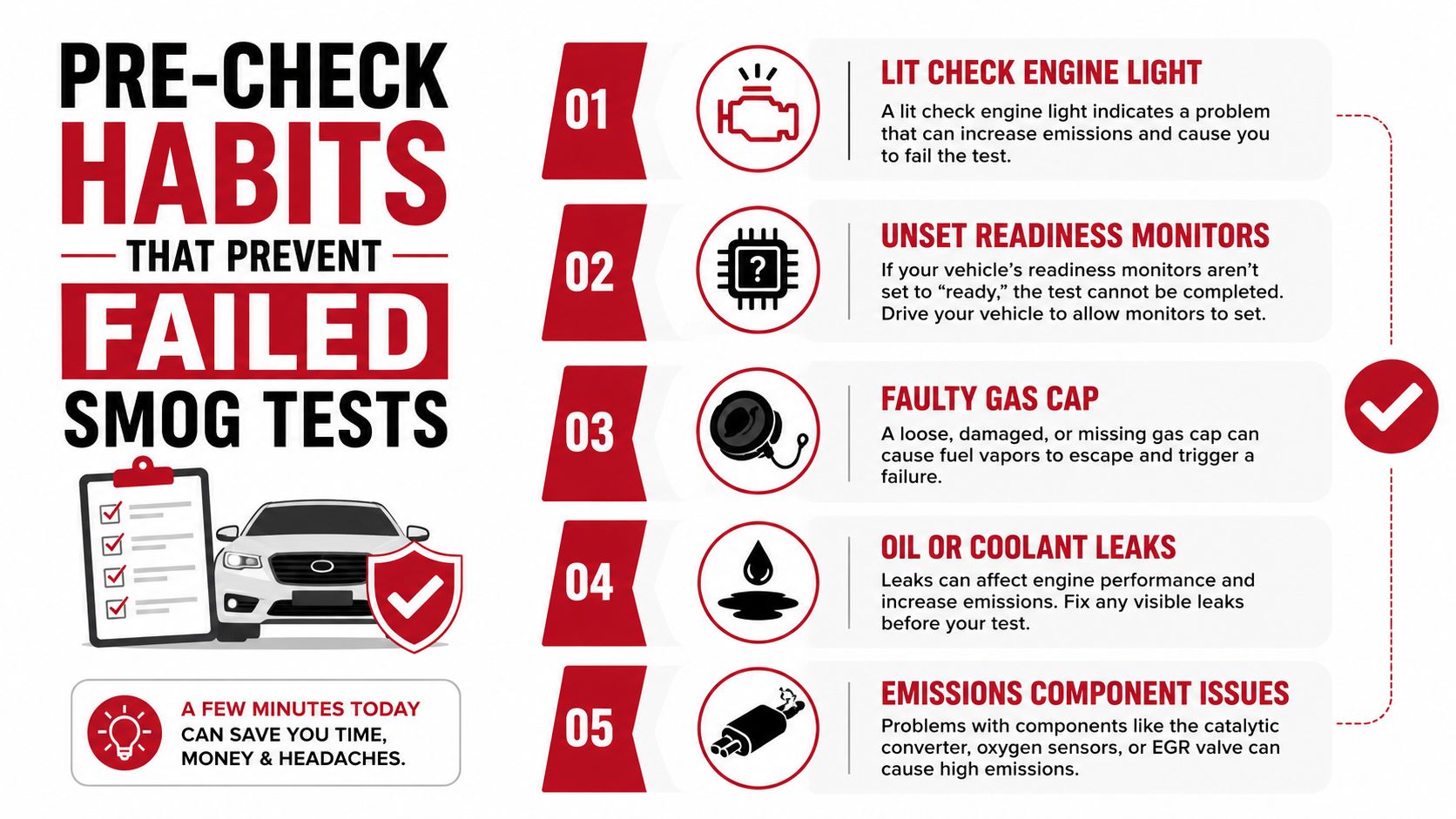
Start with the dashboard. An illuminated check-engine light, also called the malfunction indicator lamp, is a serious warning for an OBD-equipped truck. A vehicle can feel perfectly normal while storing an emissions code that causes an automatic failure.
Then check the readiness monitors. Disconnecting the battery or clearing codes resets the system's self-tests. The truck may need mixed driving before the monitors complete, and arriving too soon can leave the vehicle ineligible for a clean pass.
Your driveway checklist
- Inspect the fuel cap: Make sure the cap seals tightly and the gasket isn't cracked. A small EVAP leak can trigger a code.
- Look at emissions hardware: Check for obvious damage, missing shields, disconnected hoses, or an altered catalytic converter.
- Watch for leaks: Oil or coolant reaching the exhaust can create problems and may point to a larger mechanical issue.
- Check the warning lights: Don't assume a pending code is harmless. Have it diagnosed before scheduling the inspection.
- Drive normally after repairs: Use a mixed city and highway loop over several days so the vehicle can complete its self-checks.
A 50 to 70 mile mixed-driving routine is a practical preparation target for many vehicles, but it doesn't guarantee that every monitor will set. The truck's operating conditions and the specific fault determine how quickly the system completes its checks.
Avoid the battery-disconnect shortcut. Clearing the light without fixing the cause usually creates a second problem, incomplete readiness monitors, and a higher chance of referral or failure.
A failed test isn't always a major engine disaster. A loose cap, an EVAP fault, or an incomplete monitor can be easier to correct than a failed catalytic converter or diesel emissions component. Get the failure report, repair the listed issue, and retest instead of guessing.
Getting Your Truck Compliant at a STAR Test-Only Station
At a STAR test-only station such as Fire House Smog in Antioch, the process should be orderly. Bring the truck, registration paperwork, and the DMV renewal notice. If you're returning after a failure, bring the prior inspection paperwork or certificate of noncompliance so the technician can understand the retest situation.
The first step is document verification. The technician confirms the vehicle identification information, registration details, and the inspection type. A commercial owner with several vehicles should identify each truck clearly and ask whether the station can process the vehicles in a practical order.
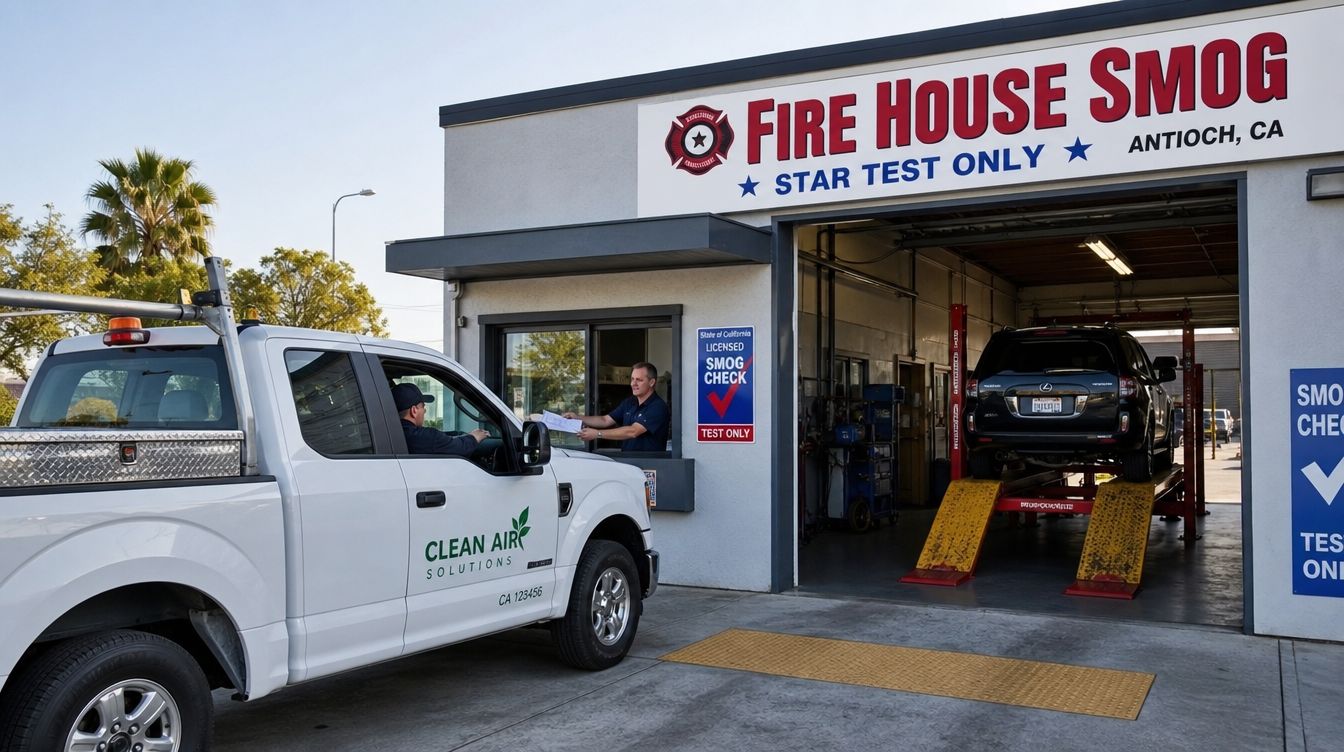
What the technician checks
The bay procedure may include a visual inspection of emissions equipment, a gas-cap test, an OBD-II connection, and a tailpipe test where applicable. The technician follows the state-required procedure for that truck rather than treating every pickup, diesel, and work vehicle the same way.
There are three practical outcomes:
- Pass: The station submits the smog certificate electronically to DMV.
- Fail: You receive documentation showing the noncompliance result and the reason for failure.
- Directed or random referral: The state requires the vehicle to complete the inspection at an eligible STAR station.
A test-only station doesn't repair the truck, which keeps the result separate from repair sales. If the truck fails, take the report to a qualified repair shop, address the exact cause, and ask the testing station about its retest policy before returning.
For contractors, operating hours matter. Fire House Smog is located at 2900 Lone Tree Way in Antioch, offers smog testing seven days a week, and provides DMV renewal and tag-printing services Monday through Saturday from 9:30 AM to 5:00 PM and Sunday from 12:00 PM to 4:00 PM, according to the publisher's supplied business information. The station lists two service bays and a phone number, 925-754-1600, for confirming vehicle fit and current service availability.
Common Misconceptions That Trip Up Truck Owners
Truck owners lose time when they treat California emissions rules as one-size-fits-all. Three assumptions cause repeated problems.
| Myth | Reality |
|---|---|
| Diesel trucks are exempt in California | Some diesel classes avoid the ordinary station test, but diesel light-duty vehicles can still face smog requirements, particulate-fee obligations, and CARB enforcement. |
| A check-engine light is fine if the truck drives normally | An illuminated emissions warning can indicate an active diagnostic fault, and incomplete readiness monitors can prevent a pass. |
| Every smog shop produces the same result | Station type matters when DMV or BAR requires STAR testing, including certain directed or random referrals. |
The first myth confuses test exemption with emissions exemption. A heavy-duty diesel truck may stay outside the regular station smog line while remaining subject to CARB rules involving smoke, idling, reporting, or emissions equipment. A light-duty diesel pickup can follow another path based on its model year and weight.
The second myth comes from relying on drivability. OBD systems monitor emissions functions that a driver may never feel from behind the wheel. A truck can start easily, pull a trailer, and idle smoothly while still failing the electronic portion of the inspection.
The third myth is expensive because the wrong station can create a scheduling problem. If the DMV or BAR directs the truck to STAR, choose an eligible STAR station before paying for an inspection elsewhere.
The certificate is the goal, not merely a running engine. Bring the truck to the station type shown by the registration or referral instructions.
Your Next Steps and Where to Test in Antioch
Handle the renewal in this order:
- Read the DMV notice: Confirm that the registration renewal requires a smog certificate and note any station or referral instruction.
- Gather paperwork: Bring the renewal notice, current registration, plates, and any prior smog paperwork if the truck is being retested.
- Prepare the diagnostic system: Inspect the fuel-cap seal, check for a lit malfunction indicator lamp, and have pending or stored emissions codes diagnosed.
- Drive before testing: Use mixed city and highway driving during the week before the appointment so readiness monitors have a chance to complete. A 50 to 100 mile preparation range is a practical target, but monitor completion still depends on the vehicle and repair history.
- Use the right station: Book a STAR test-only inspection when the DMV notice, BAR referral, or truck category requires it.
A light-duty gasoline or diesel truck owner in Antioch can review smog check service in Antioch before heading out. Bring the truck with enough fuel for the inspection, remove anything blocking access to the diagnostic connector, and tell the technician whether the battery was recently disconnected or codes were cleared.
Fire House Smog operates at 2900 Lone Tree Way, Antioch, California 94509. Its supplied business information lists smog testing seven days a week, DMV tag printing Monday through Saturday from 9:30 AM to 5:00 PM, Sunday DMV hours from 12:00 PM to 4:00 PM, and phone support at 925-754-1600. Confirm current hours and whether the truck fits the station's equipment limits before arrival, especially for larger work trucks and recreational vehicles.
A clean truck should leave with the certificate transmitted to DMV. If it fails, keep the report, repair the listed issue, and ask about the qualifying retest window before changing stations.
Fire House Smog provides STAR-certified test-only smog inspections for cars and light-duty trucks, along with DMV renewal services and on-site tag printing in Antioch. Bring your renewal notice and truck to Fire House Smog or call 925-754-1600 to confirm the correct service before you arrive.
You've got the renewal notice in one hand, the deadline in the other, and a simple question in mind, where's the California smog check near me that won't turn into a second trip, a surprise repair bill, or a DMV line later in the week? The answer depends on more than distance. In California, the right station type, the vehicle's model year, and whether you can finish registration on-site all change how smooth the day goes.
Table of Contents
- What a California Smog Check Near Me Really Involves
- How to Choose the Right Station Type Near You
- Preparing Your Vehicle and Paperwork Before You Go
- What Happens During the Inspection at a STAR Test-Only Station
- Handling Failures, Retests, and Repair Documentation
- Combining Your Smog Check With On-Site DMV Renewal
- RV, Fleet, and Specialty Vehicle Considerations
What a California Smog Check Near Me Really Involves
A driver opens a DMV renewal notice, sees the smog requirement, and assumes any station will do. In California, that assumption can send you to the wrong counter, the wrong lane, or the wrong kind of test. The station you choose can change the whole visit.
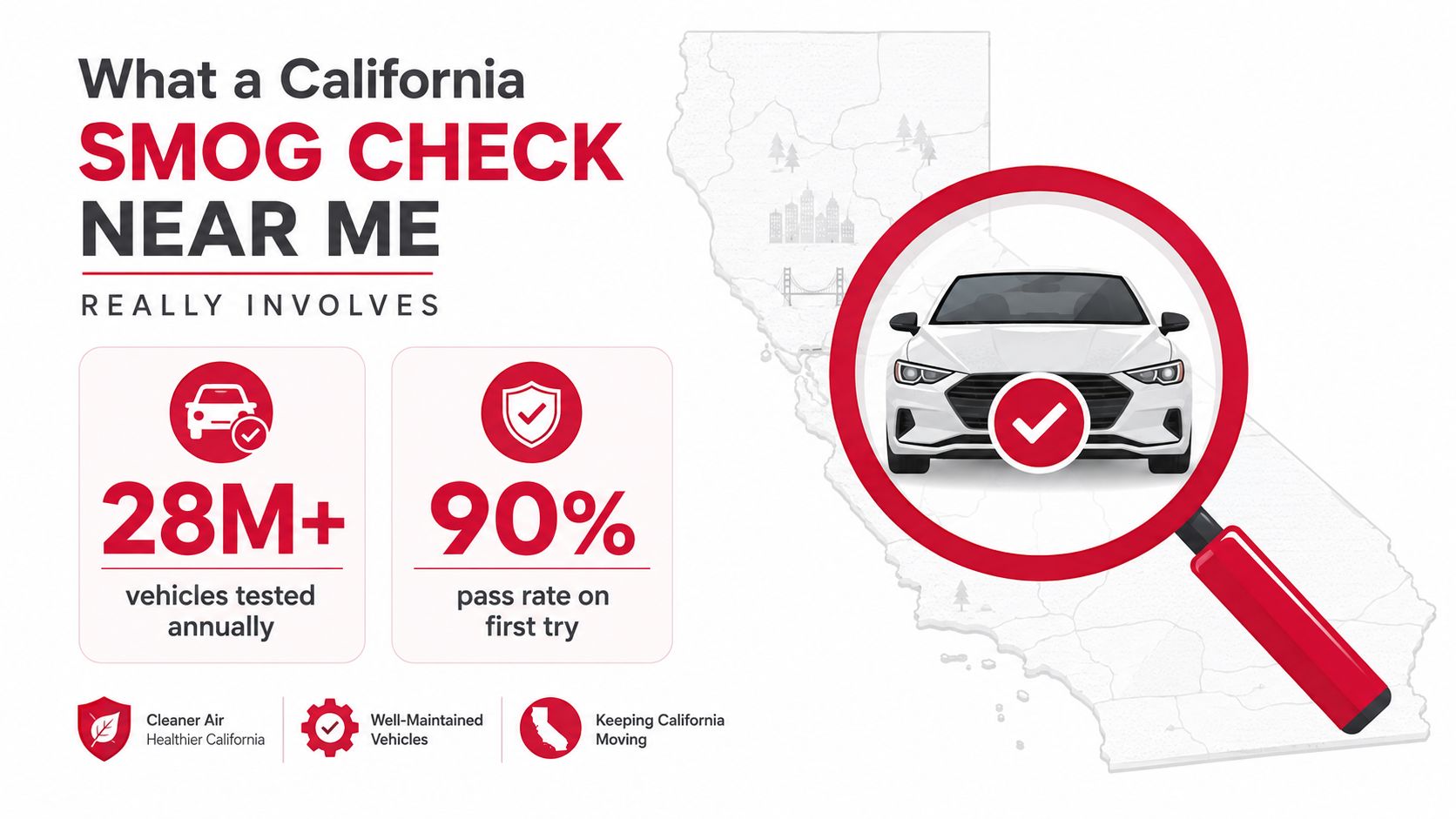
California's Bureau of Automotive Repair says most gasoline, hybrid, and alternative-fuel vehicles model year 1976 and newer, plus diesel vehicles model year 1998 and newer, are subject to Smog Check, and the inspection is generally required every other year for registration renewal (BAR 2025 Smog Check Executive Summary). That is why this is routine work for a large share of drivers, not a rare trip reserved for problem vehicles.
The scale matters, too. BAR reported 11,275,981 initial tests and 12,200,718 total tests in the 2025 summary, with an 8.51% failure rate for initial tests and a 9.04% failure rate overall. A California Senate fact sheet also says the program removes about 400 tons of smog-forming pollutants every day, and that more than 10 million vehicles get tested each year at more than 7,000 independently owned smog check stations statewide (California Senate fact sheet/index.pdf)).
Practical rule: the phrase smog check near me in California really means, “Which nearby station is authorized for my vehicle and my renewal notice?”
Station type changes the workflow. A test-only station performs the inspection and issues the result, while a station with different certification may also handle repairs or a different inspection path. The distinction matters because the wrong stop can mean a second drive, a different line, or a station that cannot process your vehicle the way your renewal notice requires.
If you want a local example of how a station can be set up for this workflow, STAR-certified smog station services show how one facility can fit the role without turning the visit into a repair estimate conversation.
How to Choose the Right Station Type Near You
Start with the renewal notice, not the map app. If it points you to a STAR-certified station or a test-only station, that instruction matters more than a five-minute shorter drive. Choosing the wrong type can leave you parked at the curb while the staff tells you to go somewhere else.
Read the notice for the station requirement
The renewal paperwork is the clearest signal you get. If the notice calls for a STAR station, a regular station won't give you the right path for that vehicle. If the notice doesn't specify, a nearby certified station can often handle the test, but it still needs to be the right kind of test site for your car.
A test-only station is simple by design. It tests the vehicle and certifies the result, but doesn't sell repairs, which removes the awkward incentive to turn a failed inspection into a repair job on the spot. A repair-capable station can still be legitimate, but the workflow is different and the customer experience often is, too.
Search for fit, not just proximity
Use the BAR station finder, then check the station's certification, posted hours, and whether it handles your vehicle class before you leave home. That's especially important if you drive something that isn't a standard sedan. Some RVs and motorhomes fit within a station's equipment and bay limits, but some don't, and a quick phone call saves a wasted trip.
If the vehicle barely fits in a parking stall or needs special handling to enter a bay, call first.
For a local test-only option, this in-out smog test-only center is an example of the kind of station setup drivers look for when they want a straightforward inspection path.
Use the renewal notice like a checklist
The practical decision points are simple.
- Check the certification callout: If STAR is required, don't guess.
- Confirm vehicle fit: Large vehicles need a yes from the station, not a maybe.
- Look at hours before you drive: Some stations work better for early morning, others for weekend timing.
- Ask what happens if you fail: A test-only station gives you a clean inspection result, which makes the next step more predictable.
That's the difference between searching for a station and searching for the right station. The goal isn't to find the closest building with a sign. It's to find the one that can legally test your vehicle, accept it, and keep the rest of the day moving.
Preparing Your Vehicle and Paperwork Before You Go
The easiest failures are the ones drivers can prevent at home. I've seen plenty of people arrive convinced the car is fine, only to discover the battery was disconnected last week, the check-engine light is still on, or the paperwork isn't in the car. A short pre-test routine solves most of that.
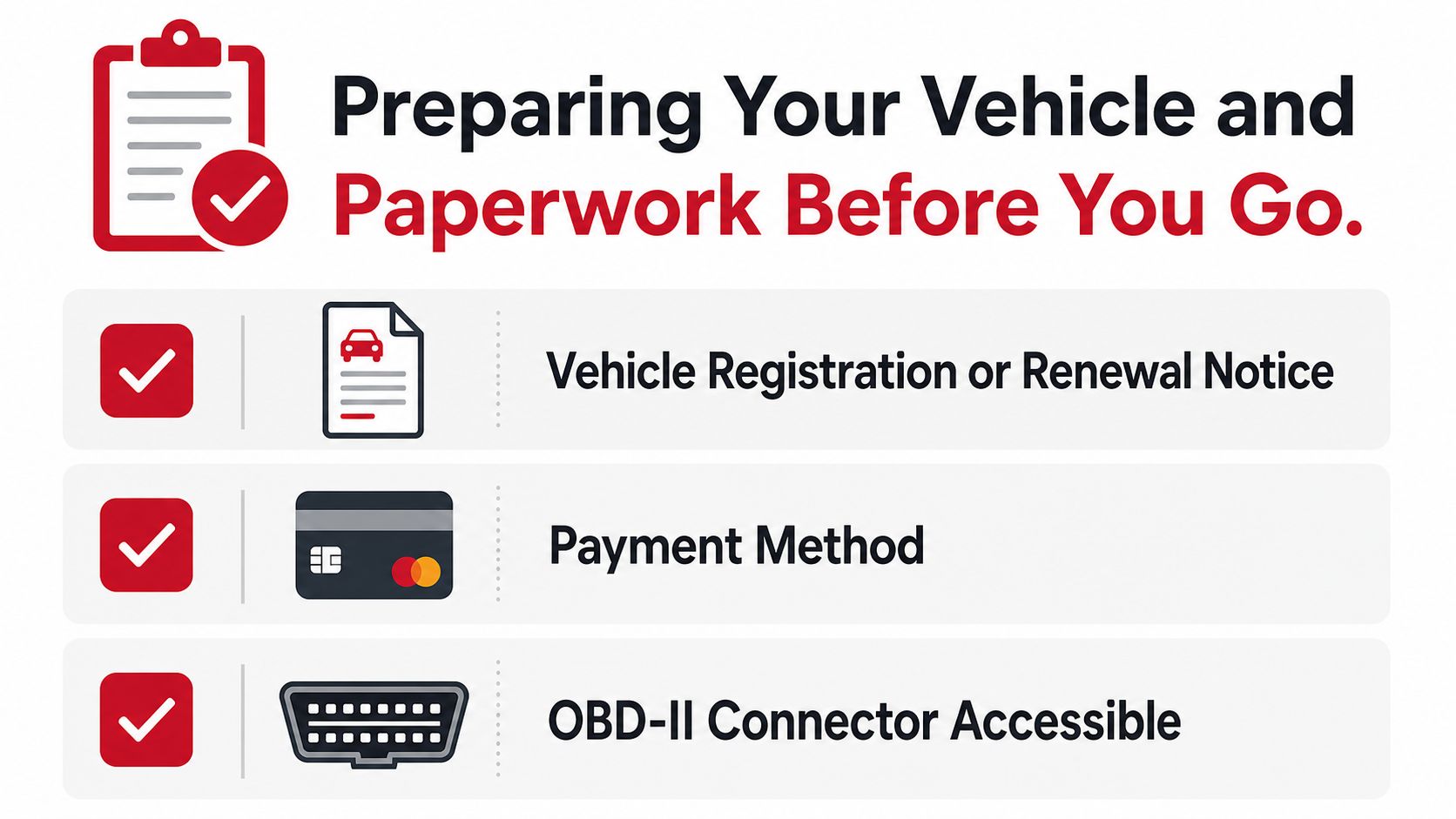
What to bring with you
Bring the vehicle registration or renewal notice, a payment method, and any prior certificate or failure paperwork you already have. If you're heading to a station that can finish registration on-site, having the right documents ready matters even more. Keep everything in one folder or glove box pocket so you're not digging through the car at the counter.
The car itself needs a quick check before you leave. The check-engine light has to be off, and the gas cap should seal properly. If the battery was recently disconnected or replaced, BAR advises drivers to keep driving for one to two weeks so readiness monitors can reset (BAR Smog Check guidance). That one step avoids a common modern-car failure where the vehicle looks fine but the computer hasn't completed its self-checks.
Build a short morning routine
A clean morning routine beats guesswork.
- Look at the dashboard first: The check-engine light should be off before you head out.
- Confirm the battery history: If it was recently changed or disconnected, give the monitors time to reset.
- Check the fuel cap: A loose or damaged cap can turn into a needless return trip.
- Keep the OBD-II port accessible: Don't bury it under accessories or aftermarket covers.
BAR says a smog inspection typically includes a visual inspection, a functional inspection, an OBD system check for most 2000-and-newer vehicles, or a tailpipe test for pre-2000 vehicles, and the full inspection usually takes about 30 minutes (BAR Smog Check guidance). That timing assumes you arrive ready. If your paperwork is missing or the car hasn't completed a drive cycle after a battery reset, the visit gets longer fast.
A clean pre-check doesn't guarantee a pass, but it removes the most common avoidable reasons for failure.
That matters because the modern test is as much about the vehicle's self-diagnostics as it is about what comes out of the tailpipe. If the car is prepared, the station can do its job without extra delay.
What Happens During the Inspection at a STAR Test-Only Station
The visit starts the same way almost every time. You pull into the lot, hand over the renewal notice and keys, and the technician moves the car into the bay. At a test-only station, the workflow stays focused on inspection, not sales pressure, which keeps the handoff simple.
The inspection steps in the bay
First comes the visual inspection. The technician checks emissions-related equipment for obvious tampering, missing parts, or damage. That's followed by the functional inspection, where the station verifies the systems are operating as they should. For 2000-and-newer vehicles, the technician connects to the OBD system. For older vehicles, the process shifts to a tailpipe test (BAR Smog Check guidance).
The point of a test-only bay is speed and clarity. The station is looking for whether the vehicle passes the state test, not for a reason to open a repair order. That makes the visit easier to understand. You're not negotiating a fix. You're getting the inspection result that registration depends on.
What the driver usually sees
Most of the time, the driver waits a short time while the tech runs the test and prints the result. BAR says the full inspection usually takes about 30 minutes (BAR Smog Check guidance). A busy station may move faster or slower depending on what's ahead of you, but the process itself is still straightforward.
If the vehicle passes, you leave with the certificate path cleared. If it doesn't, you get a failure result that tells you what stopped the pass. Either way, the visit is structured to end with a clear next step.
A STAR test-only station changes the tone of the visit. The technician tests the car, reports the result, and the repair conversation happens somewhere else if it needs to happen at all.
That separation matters in practice. Drivers get less confusion, and they know exactly where they stand before they spend money on repairs. For people trying to finish a renewal in one afternoon, that kind of clarity is the value.
Handling Failures, Retests, and Repair Documentation
A failed smog test is a starting point for the next step. The report tells you what stopped the pass, and that is the part you use to plan repairs. Once you know the failure category, the job gets much more specific.
What the failure categories mean
California BAR breaks failures into functional, OBDII, and visual categories in its 2022 summary (BAR 2022 Smog Check Executive Summary). Those categories matter because each one points to a different kind of problem, not just a generic “fix the car” answer.
| Common Smog Failure Categories and Typical Causes | What Is Checked | Common Triggers |
|---|---|---|
| Functional | Whether required components and systems work as expected | Check-engine light, readiness issues, equipment not operating correctly |
| OBDII | Onboard diagnostic data for newer vehicles | Monitor not ready, fault codes, recent battery disconnect |
| Visual | Emissions equipment present and unaltered | Missing catalytic converter, tampered parts, obvious leaks |
A driver who gets a failure printout usually wants the shortest path to a retest. The report helps the repair shop focus on the right system the first time. That saves a lot more time than guessing at parts and hoping the next inspection goes differently.
Why the paperwork matters
Keep every repair receipt if you end up needing a directed retest or documented follow-up. The first failure report tells the shop what to inspect, and the receipts show what was repaired. That paper trail matters when the next inspection depends on proof instead of just a verbal explanation.
Some fixes are simple. A loose gas cap can be handled quickly, while a failed oxygen sensor or a deeper emissions issue takes longer and should be documented carefully. The point is to repair the specific cause shown on the report, then return for the retest with the paperwork in hand.
A test-only station keeps that process cleaner because the inspection and the repair sale stay separate. You are not trying to sort out the result while someone is also selling you the fix. That makes the retest path easier to follow and keeps the decision making clearer.
Keep the failure report with the repair invoice until the registration is complete. People lose time when they try to recreate the paperwork later.
For drivers trying to finish everything in one trip, a station that also handles registration can shorten the back and forth after the repair is done. A local example is California DMV registration renewal services, which shows how some stations connect smog results with DMV follow-through.
The practical sequence stays the same. A failed test becomes repair, retest, certificate, registration. That is manageable when the documents stay organized from the start.
Combining Your Smog Check With On-Site DMV Renewal
Once the vehicle passes, the time-saver is finishing the registration without driving somewhere else. A station that's also a licensed DMV business partner can process the renewal on-site, which means one stop instead of two. For drivers trying to stay out of a DMV field office, that changes the whole day.
What can be handled in the same visit
On-site DMV renewal typically covers registration renewal, and some stations also handle ownership transfers for California and out-of-state vehicles, plus sticker and plate issuance when needed. That lets the certificate and the registration move together instead of sitting in separate queues. It's especially helpful when your smog due date and renewal deadline are close.
Fire House Smog publishes a local example of this combined workflow at California DMV registration renewal services. The station lists DMV service hours Monday to Saturday 9:30 AM to 5:00 PM and Sunday 12:00 PM to 4:00 PM, with smog testing available seven days a week ([publisher information provided in brief]). Its Antioch location is 2900 Lone Tree Way, and the contact number is 925-754-1600 ([publisher information provided in brief]).
Why the on-site model helps working drivers
Weekend availability changes the equation. If your schedule is packed during the week, a station that handles both smog and DMV work can save an extra trip, especially when the sticker can be printed on-site. That also reduces the risk of doing the smog test, then waiting days before you can finish the paperwork somewhere else.
The best single-trip plan is simple, pass the smog test, finish the renewal where you're already parked, and leave with the next step already done.
That doesn't mean every DMV task belongs at the smog station. Some situations still require a field office or additional documentation. But for standard renewals and the most common transfer work, a combined stop keeps the process tight and avoids unnecessary backtracking.
If you want to see how a station can structure that workflow in one place, the local renewal page is the right reference point.
RV, Fleet, and Specialty Vehicle Considerations
The standard advice works well for a sedan or light-duty truck. It falls apart faster when the vehicle is oversized, commercial, or part of a fleet schedule. Those drivers need to think about fit, timing, and paperwork before they ever pull into the lot.
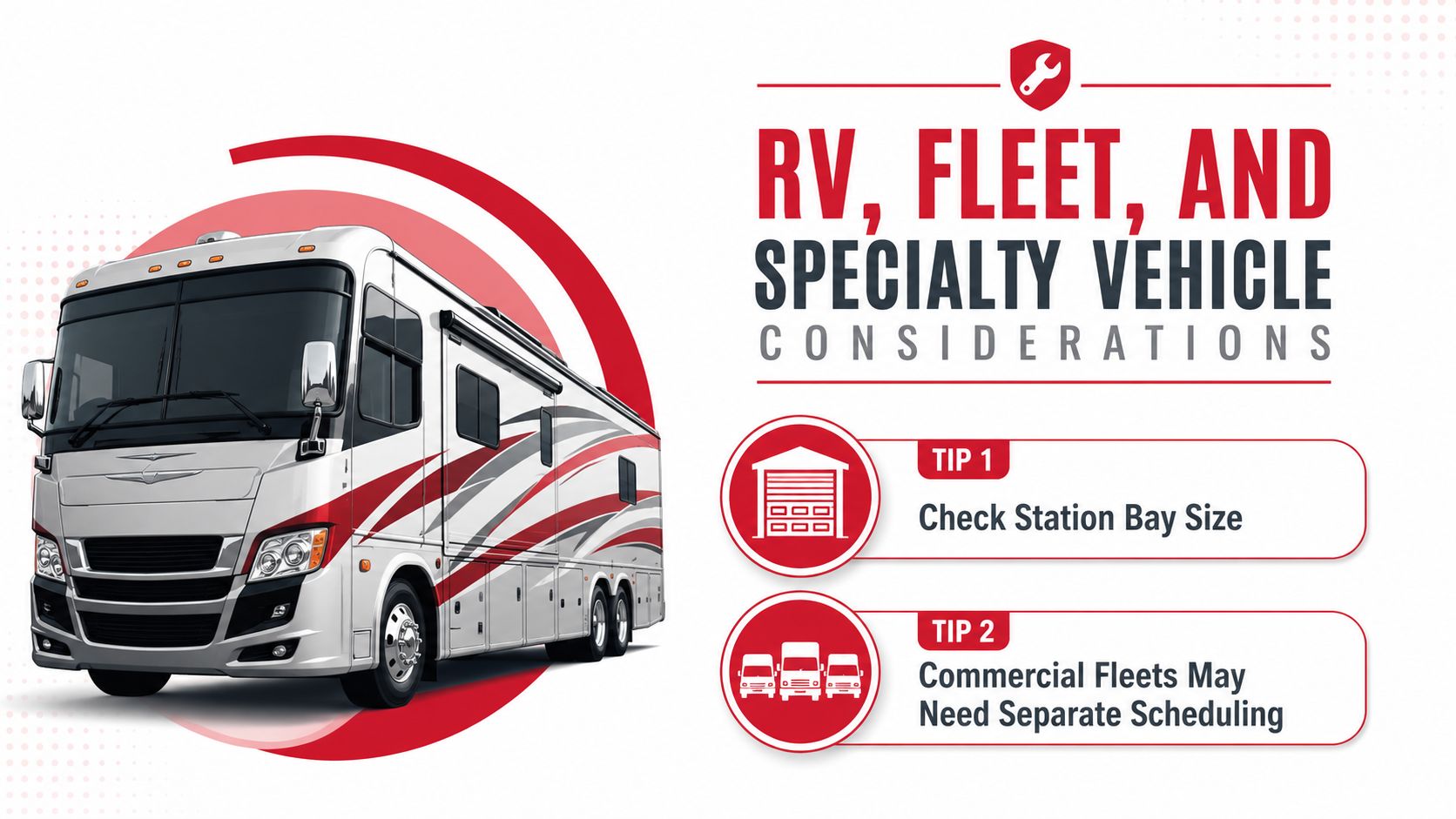
Start with bay size and equipment limits
Some RVs and motorhomes can be tested, but only if the station's bay size and equipment can handle them. That's why the phone call matters more for a large vehicle than for a compact car. A station may be certified and still not be physically set up for the vehicle you drive.
That same logic applies to fleets. If you're processing multiple vehicles, the limit isn't just certification, it's throughput. A two-bay station can move faster than a smaller one, and that matters when several vehicles need testing in the same day.
Specialty vehicles need a tighter plan
Diesel vehicles follow a different applicability rule than gasoline cars, since BAR says most diesel vehicles model year 1998 and newer are subject to Smog Check (BAR 2025 Smog Check Executive Summary). Hybrid and alternative-fuel vehicles are also part of the statewide system when they fall within the qualifying model-year range (BAR 2025 Smog Check Executive Summary). That means specialty drivers shouldn't assume the inspection path is the same just because the vehicle feels modern.
Out-of-state transfers can add another layer, especially when the paperwork needs to match the vehicle's status before DMV can finish the registration. When the vehicle type is unusual, or when the registration is tied to a business, call ahead and explain the exact make, model, and configuration. The right answer on the phone is cheaper than discovering a size or equipment issue at the curb.
Use the local setup to your advantage
A station with two service bays and extended hours can be useful for fleet work because it gives you more scheduling flexibility and reduces idle time between vehicles. That's why a test-only station with DMV capability is often a good fit for small-business drivers who want one location to handle more than one task.
Fire House Smog is one local example in Antioch. It's a STAR-certified test-only station, it handles emissions inspections for cars, trucks, and some recreational vehicles, and it processes DMV renewals on-site at 2900 Lone Tree Way ([publisher information provided in brief]). For Antioch and East Contra Costa County drivers, that kind of setup reduces the number of stops without turning the visit into a repair shop detour.
The cleanest workflow stays the same no matter what you drive. Confirm the station type on the notice. Run the pre-test checks. Bring the right paperwork. Choose a STAR-certified test-only station with hours that fit your schedule. Use the retest path if needed, then finish DMV renewal on-site in the same visit. As the fleet gets cleaner, older vehicles still show the higher failure rates, so preparation matters most where the margin is tight.
If you're due now, make the trip count. Visit Fire House Smog for a STAR-certified test-only smog check, on-site DMV renewal support, and a station setup built for drivers who want to handle the inspection and registration in one stop.
The actual smog test usually takes 15 to 30 minutes, but the total visit can run longer depending on your vehicle, the line, and whether your paperwork is ready. If you're staring at a renewal notice and trying to fit it between work, errands, and school pickup, the difference between test time and door-to-door time is the part that matters most.
Table of Contents
- Your Smog Check Time Budget
- The Test vs The Wait What Really Takes Time
- Key Factors That Influence Your Smog Check Duration
- Your Checklist for a Faster Smog Check
- The Fire House Smog Advantage in Antioch
- Frequently Asked Smog Check Questions
Your Smog Check Time Budget
A smog notice usually lands at the worst possible moment, right when your week is already full. The first question is simple, though, how long smog check visits take, and the honest answer is that the inspection itself is often quick while the full stop can stretch out.
For most drivers, the actual test is the short part. California STAR station guidance commonly puts newer vehicles around 15 minutes for 2000 and newer, mid-1990s vehicles around 25 minutes for 1996 to 1999, and 35 minutes or more for 1995 and older because the testing method changes with the vehicle's age and diagnostic setup (California STAR station guidance).
That's why a clean, efficient station matters. A driver might spend a short time on the bay, then another chunk of time checking in, waiting, or sorting out paperwork before the car even gets tested.
Practical rule: plan for the inspection time, then add extra room for the visit itself. If you only budget for the test, you'll feel rushed even when the station is working normally.
California's program is also recurring, not occasional. For gasoline, hybrid, and alternative-fuel vehicles model year 1976 and newer, plus diesel vehicles model year 1998 and newer, a Smog Check is generally required when registering or renewing registration, and for most covered vehicles that happens every 2 years (California BAR). That's why it helps to treat this as a routine appointment, not a surprise errand.
The Test vs The Wait What Really Takes Time
A smog visit works a lot like a doctor's appointment. There's the check-in, the waiting room, and the exam itself, and most of the frustration comes from pretending those are all the same thing.
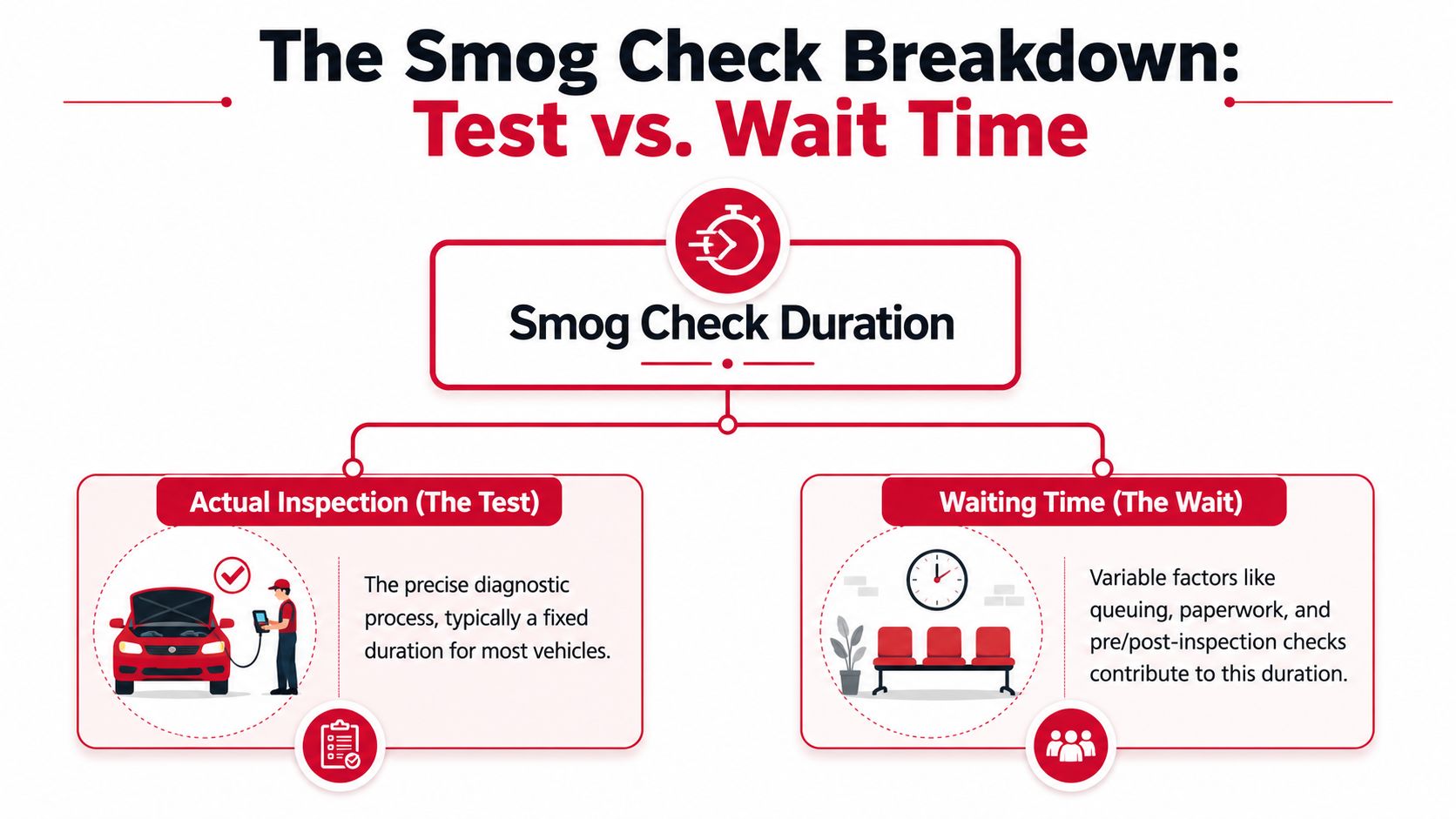
The actual inspection is the fixed part. Consumer guidance commonly describes the test itself as about 15 to 30 minutes, but that figure usually leaves out queueing, paperwork, failed readiness monitors, and the possibility of a retest (consumer timing guidance). That's the gap most drivers feel on site.
What belongs to test time
The test time is the technician working on your car. On a newer vehicle, that often means plugging into onboard diagnostics and checking what the computer reports. On an older car, the process can take longer because the station may need additional procedures beyond the simple plug-in readout.
What belongs to total visit time
The total visit includes everything else, and that's typically where the main delay occurs. Waiting for a bay, filling out forms, verifying whether the station type matches your DMV notice, and dealing with a car that isn't ready for inspection all extend the stop. If you're headed to a station that also offers a focused test-only flow, the process is usually easier to predict, which is why some drivers choose an in-out smog test only center like this option.
The key distinction is simple. Test time is the inspection. Total time is the whole visit. If you plan around only the inspection, you'll underestimate the errand.
Key Factors That Influence Your Smog Check Duration
The car in front of you might finish quickly while yours takes longer for reasons that have nothing to do with luck. The main variables are the vehicle itself, the test method, and how busy the station is when you arrive.
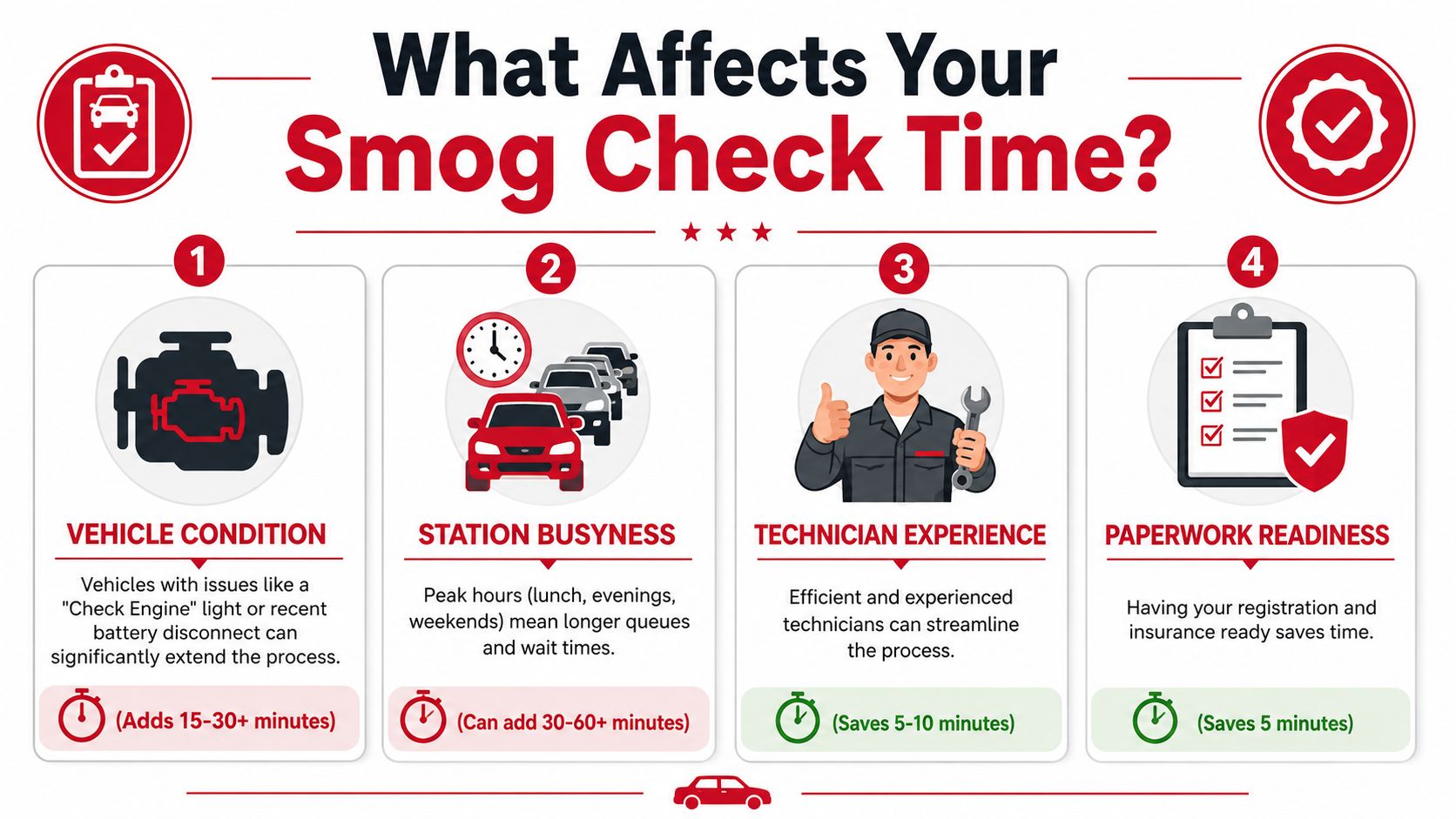
Vehicle age changes the process
Newer vehicles are usually faster because the test can rely more heavily on onboard diagnostics, while older cars may need extra steps. California STAR station guidance commonly lists about 15 minutes for 2000 and newer, 25 minutes for 1996 to 1999, and 35 minutes or more for 1995 and older (California STAR station guidance). That's a real operational difference, not a minor variation.
Older cars aren't “harder to pass” just because they're older. They're often slower to inspect because the station has to use a different procedure.
Readiness matters before the car rolls in
If a vehicle's computer isn't ready, the station may have to stop, explain the issue, or send the driver back after more driving. That's one reason a quick visit can turn into a longer one even when the bay itself is moving well. A check engine light or recent battery reset can create that kind of delay.
Station flow changes the clock
A busy shop adds time even when the inspection itself stays the same. A station with better workflow, cleaner check-in, and enough equipment to keep cars moving cuts down the dead time between arrival and departure. One reason drivers look for a STAR-certified test-only station is that the setup can be better aligned with a pure inspection visit, especially when a DMV notice requires a specific station type (STAR station FAQ).
Paperwork still slows people down
Drivers who show up without registration details or a clear idea of what their DMV notice asks for often lose time before the hood even opens. That's why the total visit can be much longer than the test. If you want to reduce the friction, use a station that keeps the process focused, and check whether you're facing a STAR requirement before you leave home.
Your Checklist for a Faster Smog Check
A fast visit starts before you turn into the lot. The easiest way to shorten the total stop is to remove the things that force the station to pause, verify, or ask you to come back later.
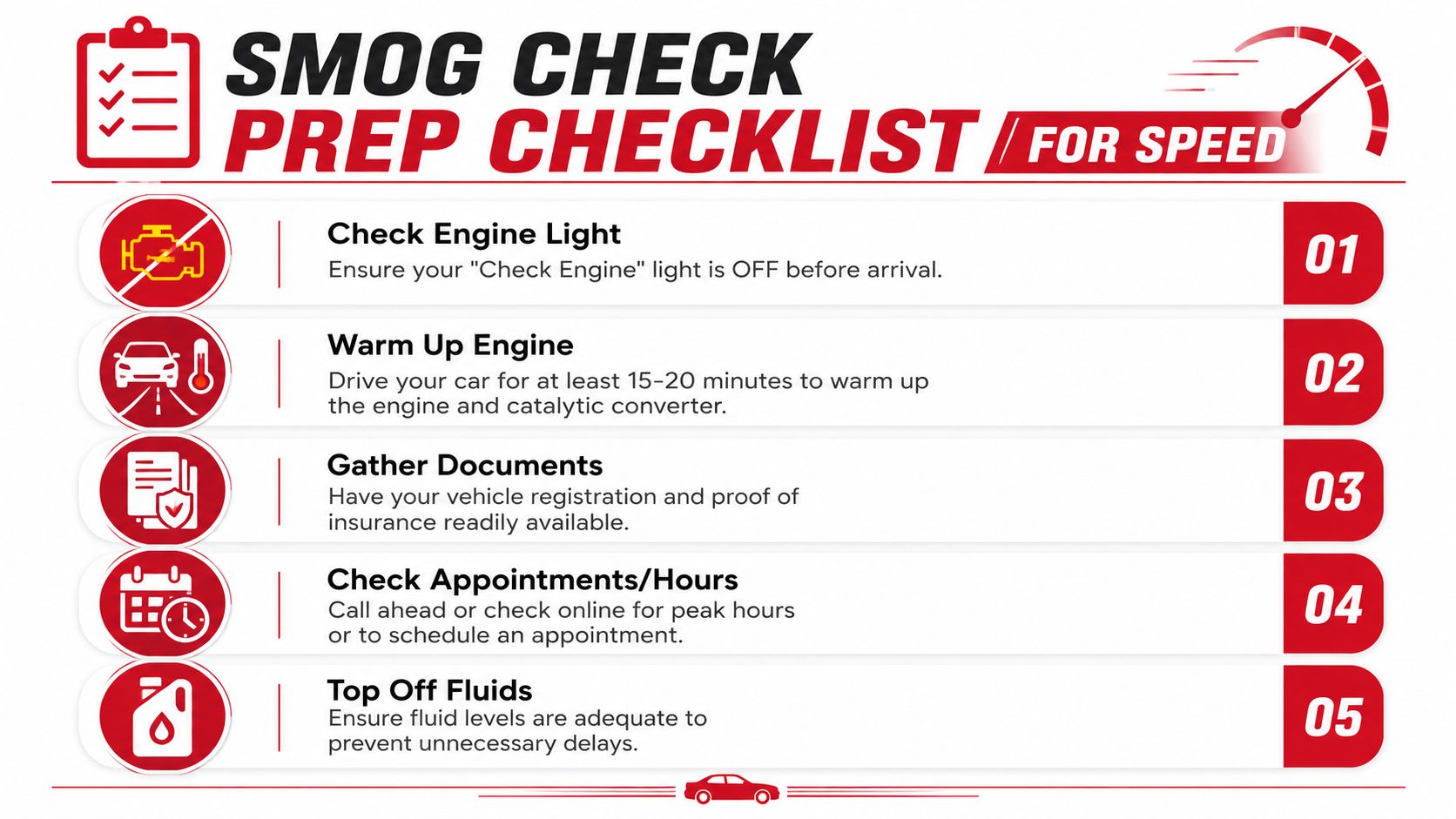
Get the car ready
- Drive the car first: A short drive helps the vehicle settle into normal operating conditions before inspection.
- Make sure the dash is clean: If the check engine light is on, don't expect a quick handoff.
- Keep your documents together: Registration and insurance are the basics, and hunting for them in the parking lot wastes time.
- Call before you leave: If you can verify hours or ask about the flow, you're less likely to land in the middle of a rush.
- Avoid last-minute surprises: If something about the car has changed recently, give yourself time to handle it before the visit.
Choose the right time
Mornings and calmer weekdays usually feel smoother than peak arrival windows, especially when other drivers are trying to beat the same deadline. A station that handles testing seven days a week with extended evening and weekend hours makes that easier to work around, because you're not forced into one narrow window.
Don't confuse preparation with guarantees
Good prep doesn't guarantee a pass, but it does reduce wasted trips. That matters more than people think because a failed first visit can turn a short stop into a second appointment. If you want a practical reference point for common failure causes, review these smog fail reasons before you go.
The Fire House Smog Advantage in Antioch
For Antioch drivers who care more about speed than browsing options, the station layout matters. Two service bays, a test-only model, and on-site DMV registration services all cut down on the extra steps that usually make a smog errand drag on.
A test-only station keeps the visit focused on inspection instead of repair conversations. That matters because there's no repair upsell built into the process, so you're getting a compliance check rather than a sales pitch. For drivers whose DMV notice points them to a specific station type, that same setup aligns with the STAR structure described by California's program and STAR station guidance (California STAR program FAQ).
Why the layout affects your clock
Two bays reduce the chance that every car stacks behind a single open lane. In plain terms, more capacity usually means less waiting, especially when multiple drivers show up at the same time. That's not a fancy claim, it's just how queueing works at small stations.
The on-site DMV piece is the other time saver. If you need registration renewal help along with the smog test, completing both stops in one place means one parking spot, one check-in, and one trip. That's a real convenience for drivers who don't want to bounce between an inspection station and a DMV counter.
You can also check STAR certified smog test options nearby if your notice specifically calls for a STAR station. That keeps you from showing up at the wrong place and adding another trip to your week.
The fastest smog visit is usually the one that avoids second stops. A station that handles testing and registration in one run removes a lot of hidden time.
Frequently Asked Smog Check Questions
What happens if my car fails?
You'll need to fix the issue and return for a retest. The exact repair path depends on what failed, but the important part is not to assume the first trip is the only trip. If the car isn't ready, a fast station can still be a short stop, but it won't be a final one.
How do I know if I need a STAR station?
Your DMV renewal notice is the first place to look. California's STAR system is designed for directed and non-directed vehicles, and some notices specifically require a STAR station, so the station type matters before you drive over (STAR station FAQ). If the notice names STAR, don't guess.
How often do I need a smog check in California?
For gasoline, hybrid, and alternative-fuel vehicles model year 1976 and newer, plus diesel vehicles model year 1998 and newer, California generally requires a Smog Check when registering or renewing registration, and for most covered vehicles the standard cadence is every 2 years (California BAR). That recurring schedule is why it pays to keep the process simple and repeatable.
The cleanest way to handle it is to treat the smog visit like a quick compliance stop, not an all-day errand. If your renewal is coming due, call ahead, bring your paperwork, and choose a station that can keep the line moving.
If your registration deadline is coming up, book your visit with Fire House Smog and handle the smog check and DMV side of the errand in one trip.
You open your DMV renewal notice, scan for the amount due, and then see the line nobody likes: smog certification required. If you own a diesel in California, that notice tends to raise more questions than answers. Gas drivers often assume your process is the same as theirs. It isn't.
Diesel owners deal with stricter rules, a smoke test many people misunderstand, and OBD checks that can trip you up even after you've already made the repair. I've seen plenty of owners walk in thinking, “The truck runs fine, so I should be good,” and then get blindsided by an incomplete monitor or smoke that hangs a little too long.
The good news is that the process is manageable when you know what the station is checking. You need to know whether your diesel is subject to testing, what causes failures, how to prep the vehicle before test day, what happens during the inspection, and what to do if you pass or fail.
Table of Contents
- Your Diesel Needs a Smog Check. Now What?
- Which Diesel Vehicles Need a Smog Test in California
- Top Reasons Diesel Vehicles Fail the Smog Test
- How to Prepare Your Diesel for a Smog Test
- The Process at a STAR Test-Only Smog Station
- After the Test Passing Failing and Next Steps
Your Diesel Needs a Smog Check. Now What?
Most diesel owners start in the same place. Registration notice in hand, keys on the counter, and a mild sense that this is going to be more annoying than it should be. That feeling is fair. Diesel testing in California has more traps than most drivers expect.
A common scenario goes like this. You've got a pickup or SUV that starts fine, pulls strong, and doesn't seem to have any obvious issue. You assume the smog test for diesel vehicles is just another quick formality. Then somebody tells you a glowing check engine light means failure. Somebody else says to just clear the code. Then a forum post says smoke is okay if it's “not too bad.” That kind of advice gets people into trouble.
What works is a simple approach.
- Read the renewal notice carefully: If DMV says a smog check is required, treat that as your starting point.
- Figure out whether your diesel falls under the California testing rule: Model year and GVWR matter.
- Check the dashboard before you go: If warning lights are on, don't gamble.
- Drive the vehicle enough after repairs: Clearing codes at the last minute usually creates a different problem.
- Go in prepared: A warm engine and a vehicle in normal running condition usually make the process smoother.
Practical rule: Don't use the smog station as your first diagnostic step if the truck is already warning you that something's wrong.
Owners who do best aren't the ones with perfect vehicles. They're the ones who show up understanding what the inspection involves.
Which Diesel Vehicles Need a Smog Test in California
You open your DMV renewal notice, see the smog requirement, and the first question is usually simple. Does my diesel need this test, or am I exempt?
For California diesel owners, the rule is pretty straightforward once you ignore the bad advice floating around online. Most diesel vehicles with a 1998 or newer model year and a GVWR of 14,000 pounds or less need a smog check every two years, as outlined in this California diesel smog requirement overview. If you drive a light-duty diesel pickup, SUV, or passenger vehicle, assume you are in the program until your door-jamb label and registration details prove otherwise.
That catches a lot of California owners off guard, especially people who just bought a newer diesel and expect the same early-year break gasoline vehicles can get. Diesel does not work that way.
The rule that matters in the real world
At a STAR test-only station, this is the first thing I want an owner to confirm before we even talk about readiness monitors, warning lights, or smoke. Model year and GVWR decide whether your diesel belongs in the biennial smog program. If your truck is covered, the DMV will keep asking for a smog certification at renewal time while it stays registered in California.
If your diesel is older or heavier, the answer can be different. That is why guessing by appearance is a mistake. A truck that looks like a light-duty pickup still needs to be judged by its actual gross vehicle weight rating, not by what the owner or seller assumed.
Quick reference table
| Vehicle Type | Smog Check Required? |
|---|---|
| Diesel, model year 1998 or newer, GVWR 14,000 lbs or less | Yes, biennially |
| Diesel, model year 1997 or older | No, exempt from this biennial requirement |
| Diesel over 14,000 lbs GVWR | No, exempt from this biennial requirement |
The fastest way to sort this out is to check the sticker on the driver's door or door frame and find the GVWR there. Then match that number with the model year on your registration. If you own a pickup and want a more specific breakdown, this guide to a truck smog check in California will help.
A few practical points save people headaches at the counter and in the test bay:
- Do not assume your diesel gets an abatement-fee shortcut. Covered diesel vehicles are generally in the testing cycle, not on a temporary pass.
- Do not test too early unless you need to. Your passing certificate has a deadline tied to DMV timing, so random early testing can create extra work.
- Check the weight rating, not the badge. A 2500, 3500, or similar trim name does not settle the question by itself.
The right move is simple. Verify the model year. Verify the GVWR. Once you know whether your diesel is in the California program, the rest of the smog process gets a lot less confusing.
Top Reasons Diesel Vehicles Fail the Smog Test
California diesel failures usually come from two places. The vehicle reports a problem through the OBD system, or it pushes out smoke that hangs too long during the test. At a STAR test-only shop, we see both every week, and neither one is a surprise once you know what the technician is checking.
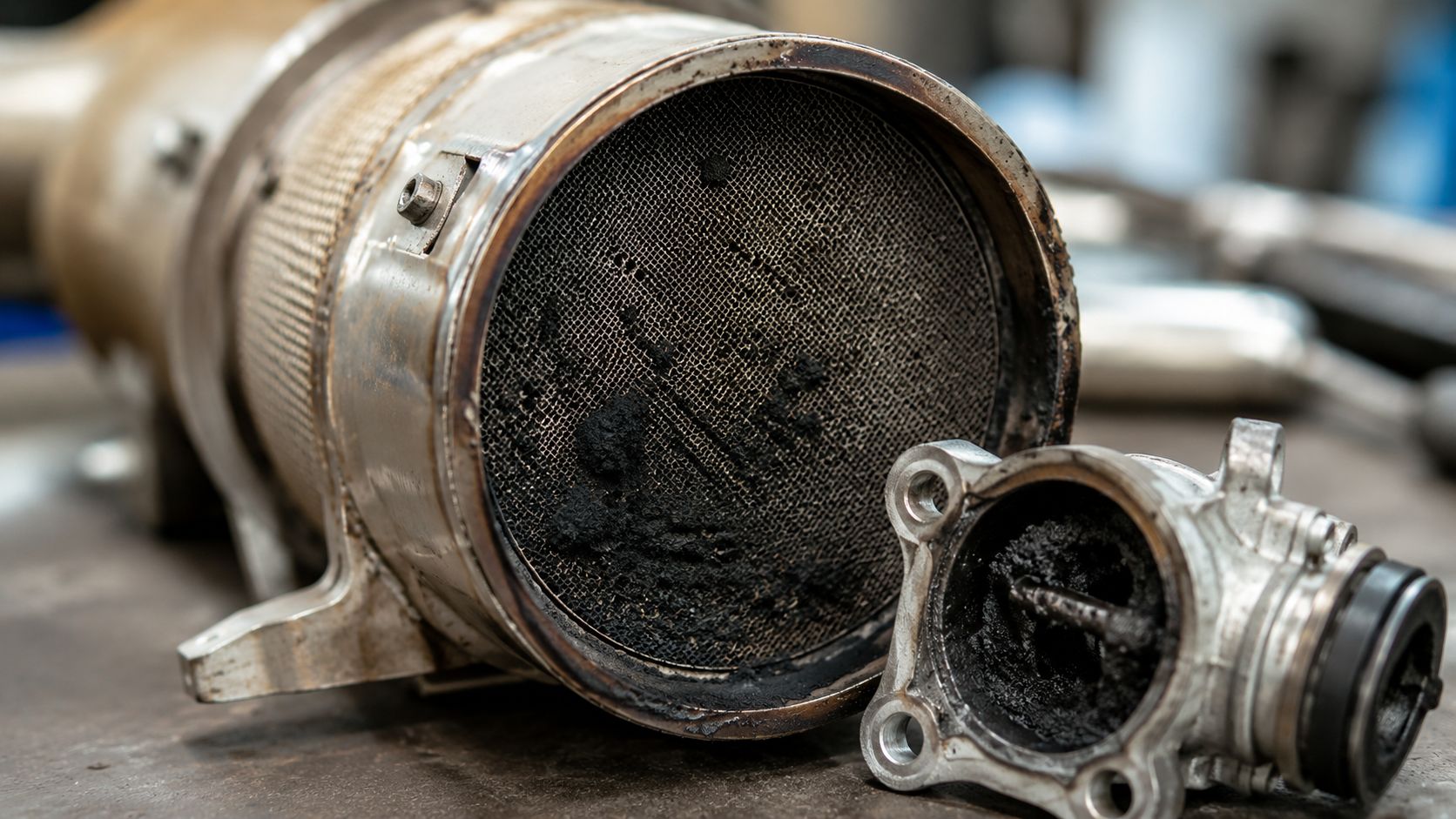
The check engine light problem
If your check engine light is on, stop there and handle it before you book the test. A diesel with an active fault is telling you something is wrong, and California smog equipment is going to see it.
The mistake I want owners to avoid is clearing codes right before coming in. That move usually makes things worse. You still have the original fault, and now the readiness monitors may show incomplete, which can block a passing result.
Here is what that means in plain language:
- An active warning light puts your diesel in a bad position: The fault is part of the inspection picture from the start.
- A recently reset computer raises another problem: The vehicle may not have finished its self-checks.
- A real repair includes drive time afterward: The system has to run its tests and show ready status.
At the shop, this is one of the easiest fail patterns to spot. The owner says the truck is running fine. The computer says otherwise.
Visible smoke during the snap test
Smoke is the other big one, a criterion on which California gets more specific than many drivers expect. The issue is not whether the exhaust looked dramatic to you in the driveway. The issue is whether smoke stays visible too long during the BAR snap-acceleration procedure.
A diesel vehicle fails if a visible smoke plume observed 5 to 15 feet from the tailpipe lingers for more than 3 seconds on either of the final two BAR Snap Tests, according to the California Smog Check Manual.
That catches a lot of owners off guard. A truck can seem acceptable in daily driving and still fail in the bay because the smoke hangs after a quick throttle snap in neutral. If your diesel puffs on startup, hazes under a hard rev, or leaves a cloud that does not clear right away, take that seriously.
Common causes include a restricted DPF, EGR problems, injector issues, turbo problems, and poor maintenance. If you want a broader breakdown of common reasons vehicles fail a smog check, that guide helps. For diesel owners in California, the practical lesson is simple. Lingering smoke is not cosmetic. It is a direct path to failure at a STAR station.
How to Prepare Your Diesel for a Smog Test
Preparation is where you save yourself time, money, and aggravation. Don't overcomplicate it. You're trying to show up with a diesel that is warm, stable, free of warning lights, and fully ready in the OBD system.
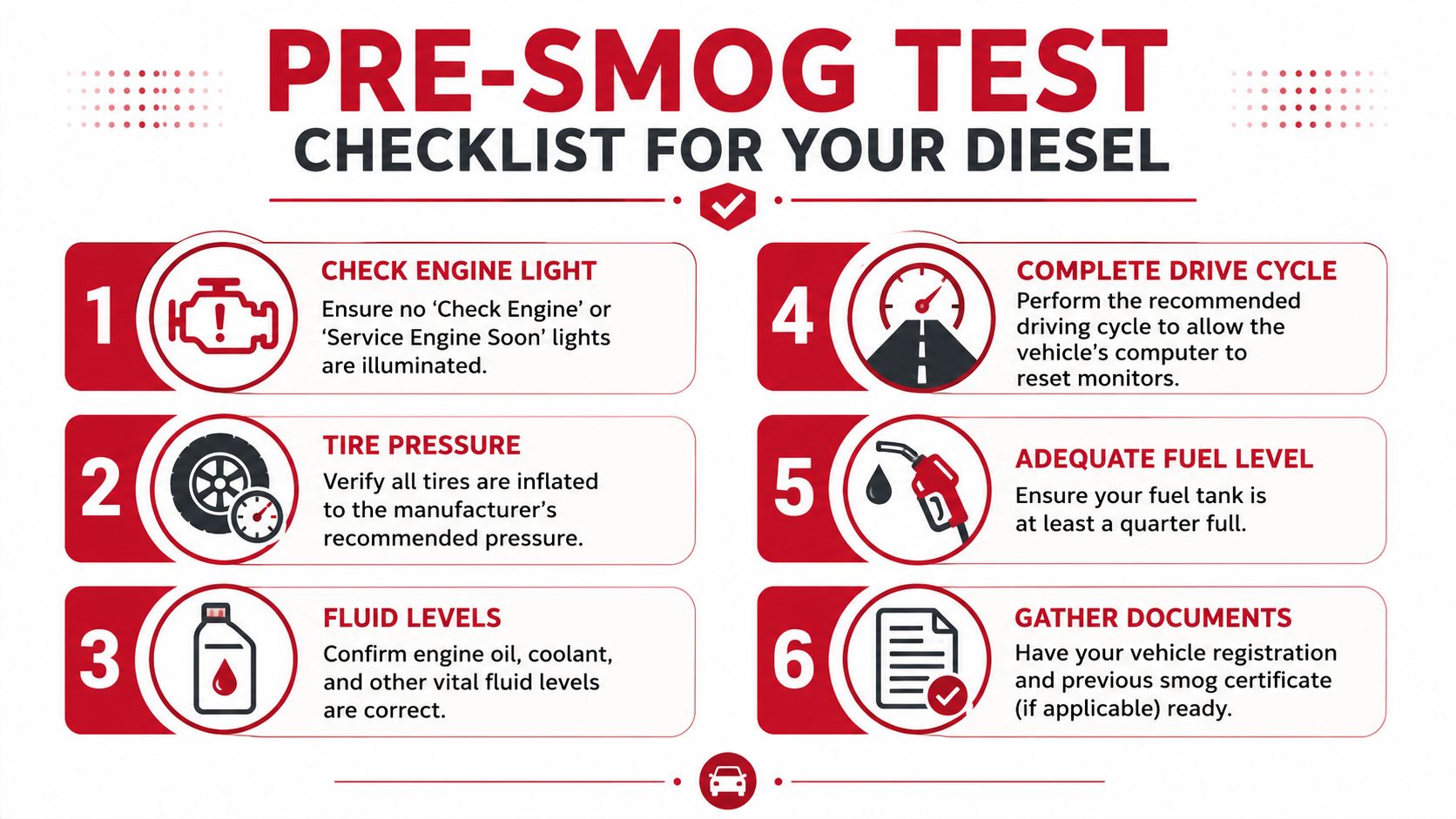
Your pre-test checklist
Start with the dashboard. If the Check Engine or Service Engine Soon light is on, handle that first. And if you just cleared it, don't rush straight into the test lane. BAR requires complete OBDII monitors, and a recent reset can leave the vehicle unreadable for pass purposes, as covered in this BAR monitor completion discussion for diesel testing.
Use this checklist before you go:
- Fix the actual fault: Don't erase symptoms. Repair the cause.
- Drive it after repair: The vehicle needs normal operation long enough for the system to run its checks.
- Check for obvious smoke: Have someone watch the exhaust while you briefly raise rpm in a safe area.
- Make sure fluid levels are normal: Low fluids can create drivability problems you don't need on test day.
- Bring your paperwork: Registration paperwork helps keep the visit simple.
This quick video helps visualize the preparation mindset before inspection:
What to do the day of the test
Drive the vehicle long enough to get it fully warm before you arrive. Cold diesels tend to behave worse. They can idle rougher, haze more, and generally make a bad first impression.
A few practical habits help:
- Avoid last-minute battery disconnects. That can wipe out readiness status.
- Don't show up right after major engine work unless you've driven it. Repaired isn't the same as ready.
- If you suspect smoke, postpone and diagnose it. Hope is not a strategy.
- Keep the visit routine. No weird fuel experiments or backyard fixes the morning of the test.
Shop-floor advice: The best smog appointment is the boring one. Warm engine, no lights, normal idle, no surprises.
If you handle those basics, you put yourself in the best position to pass on the first trip.
The Process at a STAR Test-Only Smog Station
A lot of stress disappears once you know what happens in the lane. The inspection isn't mysterious. It's a sequence. The technician checks the vehicle, checks the system, performs the diesel procedure, and records the result.
What the technician does
For a California diesel in the covered class, the station generally looks at three things that matter to owners most.
First is the visual side. The technician is looking for obvious issues and emissions-related concerns that make the vehicle unfit for testing or compliance.
Second is the OBDII check. The station connects to the vehicle and reads the emissions system status. Active faults, stored problems, and incomplete readiness can surface during this process.
Third is the BAR Snap Test. During that procedure, the technician places the vehicle in neutral and quickly pushes the accelerator to 2,000 to 3,000 RPM and releases it to evaluate smoke opacity and duration, according to the California smog check guide describing the BAR Snap Test.
That's the part customers usually notice because they hear the engine rev. But by the time the throttle gets snapped, a lot of the inspection picture is already forming.
Why test-only matters
A test-only station has one major advantage. The shop isn't trying to sell you a repair while it's evaluating your vehicle. That removes the repair upsell angle that makes many drivers uneasy.
That matters even more for diesel owners, because failures can involve systems that are expensive, technical, and easy to misunderstand. At a test-only station, the result is the result. You pass, or you get a report showing what needs attention.
In practical terms, a well-run STAR test-only location is helpful because it usually offers:
- Cleaner decision-making: You're getting an inspection, not a sales pitch.
- Faster throughput: Multiple bays can keep lines moving.
- Convenience if registration is due: Some locations also handle DMV-related tasks on site.
- Better fit for work schedules: Evening and weekend availability helps owners who can't disappear midday.
For drivers in Antioch and nearby areas, that setup is exactly why places that combine STAR testing with registration support are popular. When you can test the diesel and then handle your DMV business in one stop, the whole process feels less like a bureaucratic obstacle and more like a routine errand.
After the Test Passing Failing and Next Steps
Once the inspection ends, things get simple. You're on one of two tracks. Either the diesel passed and you move on, or it failed and you need to use the report the right way.
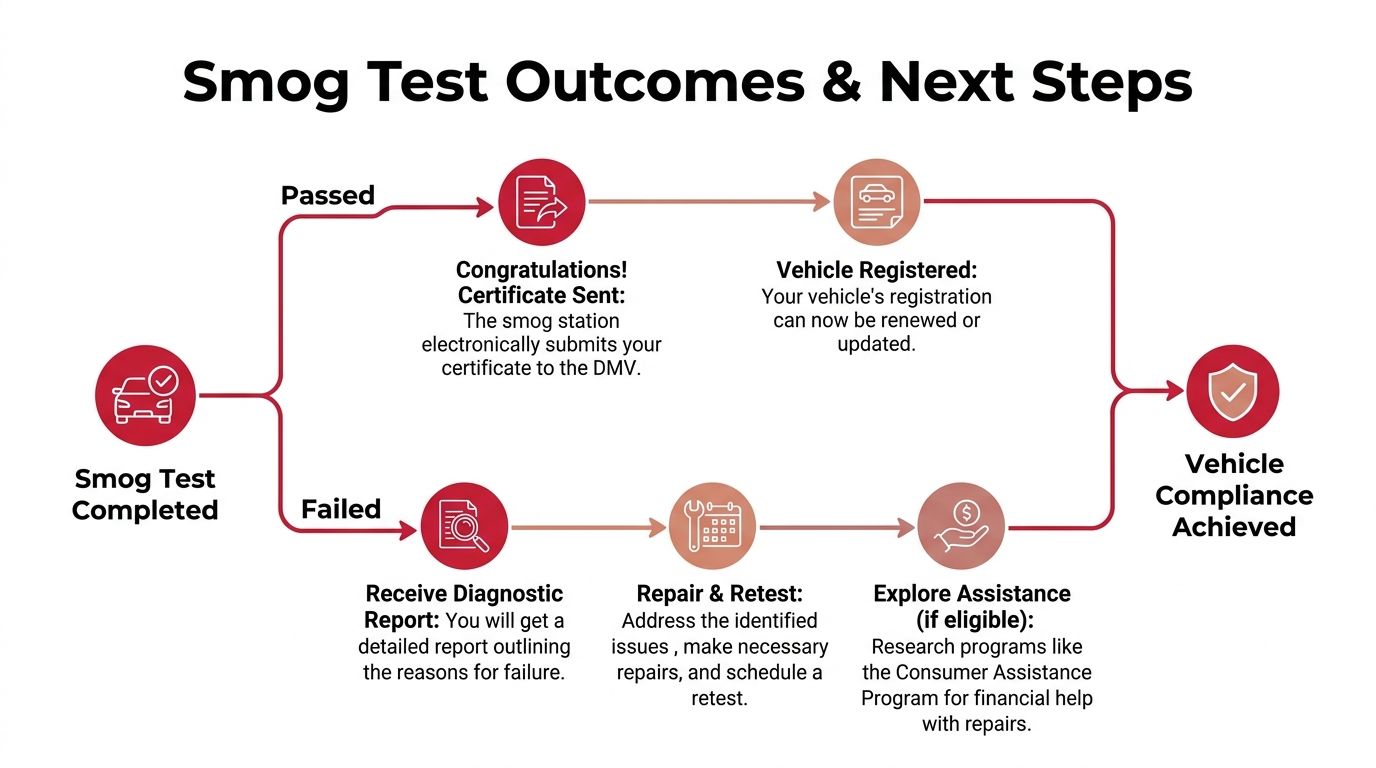
If your diesel passes
If the vehicle passes, the station electronically sends the certificate information to DMV. That's the outcome everyone wants because it turns the smog test for diesel vehicles into a one-and-done visit.
At that point, keep your receipt and finish any remaining registration steps. If your registration renewal is the next task, a location that also offers California DMV registration renewal services can make that part faster.
Pass, save your paperwork, and don't wait around if registration is still pending.
If your diesel fails
If the vehicle fails, don't guess. Read the Vehicle Inspection Report carefully. That report tells you why the station could not certify the diesel.
Different failures call for different next moves:
- OBD-related failure: Take the report to a qualified repair shop and address the fault, then drive the vehicle enough for readiness to return.
- Smoke-related failure: Have the engine and emissions system checked before coming back. Lingering smoke rarely fixes itself.
- Visual or equipment issue: Correct the noncompliant condition exactly, not approximately.
Here's the mistake to avoid. Don't throw random parts at the vehicle because a friend had “the same issue.” Diesel failures often overlap in symptoms. A proper diagnosis saves money.
If you're testing at a station with a free retest policy, use it according to the posted terms. That can reduce the sting of a failed first attempt. The important thing is to return only after the issue is repaired and the vehicle is ready, not just quieter, cleaner-looking, or temporarily reset.
A failed inspection is frustrating, but it's still manageable. Use the report, repair the underlying problem, then retest with confidence.
If you need a straightforward place to handle your diesel smog check and registration follow-up, Fire House Smog in Antioch offers STAR-certified test-only inspections, on-site DMV services, weekend availability, and a practical process that keeps things simple for diesel owners.
Your registration notice shows up. You open it, see that your truck needs a smog check, and the questions start right away.
Does my truck even fall under the regular program? Is this the same thing as Clean Truck Check? If it's diesel, does the weight rating change the rule? If I pass, can I finish my DMV renewal the same day, or am I headed into another line somewhere else?
Those questions are common because California doesn't treat every truck the same. Fuel type matters. Model year matters. Gross Vehicle Weight Rating (GVWR) matters. And for heavier diesel trucks, the rules often shift into a different compliance system entirely. If you own a pickup, work truck, fleet unit, or a truck you're trying to sell or register, getting the category right is the first step that saves time.
Table of Contents
- Your DMV Notice Arrived, Now What?
- Which Trucks Require a California Smog Check
- Exemptions and Special Cases for Trucks
- The Smog Test Process From Start to Finish
- Practical Tips to Pass Your Truck's Smog Check
- Your One-Stop Solution in Antioch: Fire House Smog
Your DMV Notice Arrived, Now What?
Most truck owners do the same thing first. They look at the notice, then at the truck, then back at the notice, trying to figure out whether this is a routine registration step or the start of a compliance headache.
A common example is the owner of a diesel pickup who assumes diesel means exempt. Sometimes that's wrong. Another example is the owner of a heavier commercial truck who books a standard smog check appointment, only to learn the truck belongs under a different emissions program. The problem usually isn't the inspection itself. It's identifying the right rule before you lose time.
Read the notice, then check the truck's basics
Before you schedule anything, confirm these details from your registration or door-jamb label:
- Fuel type: Gasoline, diesel, hybrid, or another alternative fuel.
- Model year: Newer trucks often follow a different path than older ones.
- GVWR: This is the dividing line that changes the rule for many diesel trucks.
- Renewal or ownership change: A sale can trigger a different smog requirement than a routine renewal.
If you're also trying to finish registration, it helps to handle the smog requirement alongside the paperwork. Fire House Smog also offers California DMV registration renewal services, which is useful when the goal is to leave with both the inspection and renewal handled in one stop.
Practical rule: Don't ask, “Does my truck need smog?” Ask, “Which California program applies to my truck?”
What usually slows people down
The biggest delays come from assumptions:
- “It's a truck, so it must work like my car.” Not always.
- “It's diesel, so I'm exempt.” Sometimes true, sometimes false.
- “If it's heavy-duty, I don't need to think about smog at all.” That can create the worst surprise of all.
If your notice arrived and your registration deadline is coming up, the fastest move is to classify the truck correctly first. Once that part is clear, the next steps become straightforward.
Which Trucks Require a California Smog Check
A customer with a diesel pickup and a customer with a diesel box truck can walk in on the same day and leave with two different answers. That usually surprises people. In California, truck smog requirements turn on three facts: fuel type, model year, and gross vehicle weight rating (GVWR).
Get those three right first, and the rest gets much easier.
For gasoline, hybrid, and many alternative-fuel trucks, the standard Smog Check program usually applies if the truck is 1976 or newer and old enough to be out of the newer-vehicle exemption period. The California Bureau of Automotive Repair explains that vehicles in the first several model years pay a smog abatement fee instead of getting a biennial inspection under the regular program, then move into the testing cycle later on, as outlined on the BAR Smog Check program page.
Diesel trucks follow a different cutoff that causes a lot of confusion. Under California rules, diesel-powered vehicles with a model year of 1998 or newer and a GVWR of 14,000 pounds or less fall into the standard biennial Smog Check requirement. The California DMV lists that light-duty diesel rule in its Smog Inspections page.
The dividing line is the part many truck owners miss. A diesel truck can be newer and still not belong in the ordinary station-based smog program if its GVWR is too high.
California Truck Smog Check Requirements 2026
| Truck Type | Smog Check Required? | Key Conditions |
|---|---|---|
| Gasoline truck | Yes, in many cases | Applies on a biennial cycle for 1976 or newer trucks once they are past the newer-vehicle exemption period |
| Hybrid truck | Yes, in many cases | Usually follows the same standard Smog Check timing as other eligible light-duty vehicles |
| Alternative-fuel truck | Yes, in many cases | Requirement depends on fuel type, age, and registration event |
| Diesel truck, 1998 or newer, 14,000 lbs GVWR or less | Yes | Must complete a biennial smog check under the standard program |
| Diesel truck over 14,000 lbs GVWR | No, not under the standard program | Usually handled outside the regular station-based Smog Check system |
| Newer eligible truck still within the exemption window | No physical test yet | Smog abatement applies instead of a physical inspection during that period |
| Truck being sold | Sometimes | Ownership transfer rules can trigger a smog requirement depending on age and fuel type |
Heavy-duty trucks are where the article title can mislead people. Some trucks do need a standard smog check at a station like Fire House Smog. Others fall under Clean Truck Check, which is a separate compliance program aimed at heavier diesel vehicles, not the regular biennial inspection most pickup owners are used to.
That distinction matters before you book an appointment. If the truck is a light-duty gasoline, hybrid, alternative-fuel, or qualifying diesel truck, a STAR-certified test-only station is the right path. If the truck is over the light-duty diesel weight threshold, the question shifts from "Do I need a smog test today?" to "Am I in the standard Smog Check program or in Clean Truck Check?"
One practical tip from the shop side: check the GVWR on the door label, not what the truck weighs today and not what you use it for. California uses the vehicle's rated classification, and that single number often decides whether you need a regular smog inspection or a different compliance route entirely.
Exemptions and Special Cases for Trucks
Truck owners usually get tripped up here after they already know their weight class. The next question is whether an apparent exemption means "no test at a station" or "different compliance program entirely."
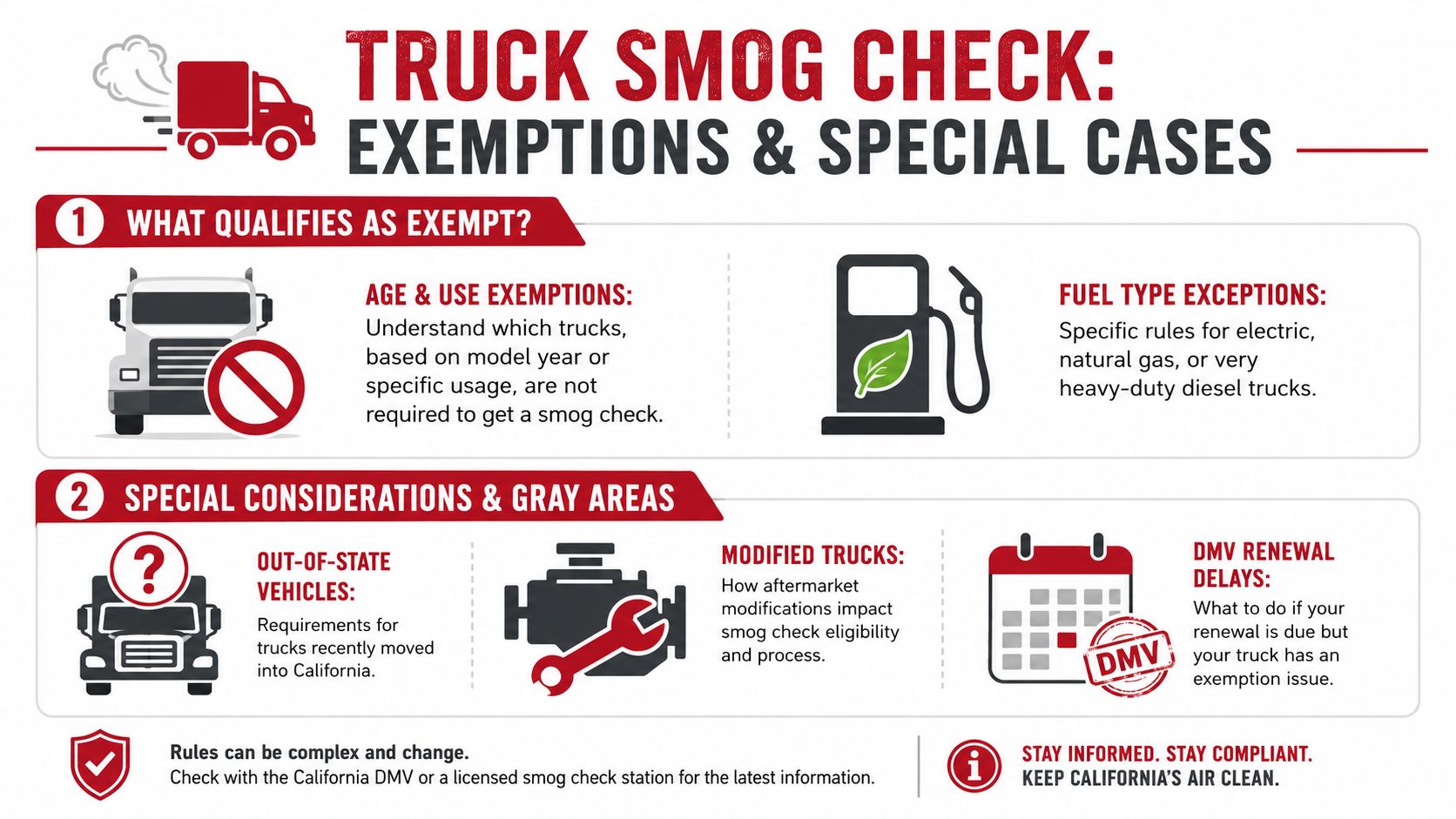
The biggest mistake truck owners make
The most common mistake is assuming a heavy truck is exempt from everything because it does not go through the standard Smog Check lane.
For trucks with a GVWR over 14,000 lbs, the regular station-based smog inspection usually is not the controlling program. As Geotab's California truck smog guide explains, heavier diesel vehicles can fall under Clean Truck Check instead, including recurring OBD compliance requirements for certain model years. That is a different process, a different schedule, and a different problem to solve than the biennial inspection a light-duty pickup owner handles at a STAR station.
From the shop side, this is the practical consequence. A customer with a half-ton or three-quarter-ton truck may only need the normal inspection path. A customer with a heavier diesel may need to verify Clean Truck Check status before booking a station visit at all. Getting that wrong wastes time and can delay registration.
Exempt from the standard smog test does not mean exempt from California emissions compliance.
Other gray areas that cause delays
Newer trucks can also confuse the schedule. Some vehicles are still in the exemption window, so the owner pays a smog abatement fee instead of doing a physical inspection. Then a DMV notice arrives later, and it looks inconsistent. Usually it is just the truck aging into the regular requirement.
Out-of-state trucks are another frequent problem. California may require separate emissions compliance steps for trucks brought in from outside the state, especially for diesel and other non-gasoline vehicles. The rule is handled through the state program, not by relying on whatever testing the previous state required, according to the California Air Resources Board Clean Truck Check program information.
A few special cases are worth checking before you head to the station:
- RVs and motorhomes: Test eligibility is only part of the issue. Physical bay clearance matters too.
- Modified trucks: Aftermarket parts, deleted equipment, or missing emissions labels can stop the inspection quickly.
- Ownership transfers: A truck that is not due for normal renewal smog can still need certification for a sale.
- Diesel work trucks near the cutoff: A small difference in GVWR can put one truck in the regular Smog Check system and another in Clean Truck Check.
This is the part many owners want clarified in plain English. Light-duty trucks usually need the familiar station process. Heavy-duty diesel trucks often follow Clean Truck Check instead. If the paperwork is unclear, a STAR-certified test-only station like Fire House Smog can tell you whether you are booking the right type of appointment before you lose a day chasing the wrong requirement.
The Smog Test Process From Start to Finish
You pull in with a DMV notice on the seat and one question in mind. Is this a quick check, or is this going to turn into a problem? For most light-duty trucks in the regular California Smog Check program, the visit is straightforward if the truck is ready and you brought the right paperwork. For heavier diesel trucks that fall under Clean Truck Check, the process is different, which is why confirming the program before the appointment saves time.
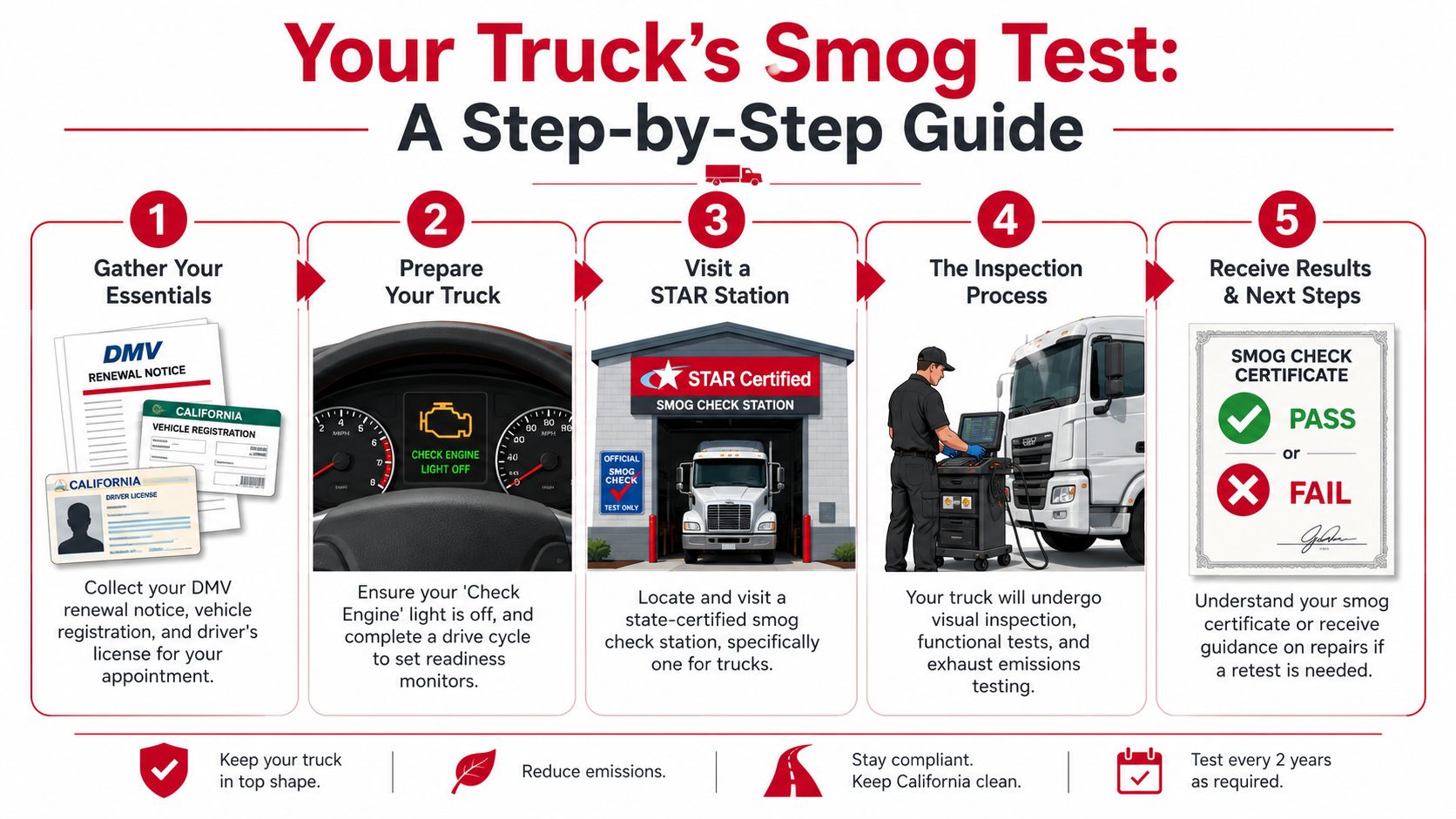
What to bring and what the technician checks
Bring your registration and the DMV notice if you received one. If you want to handle registration-related tasks at the same stop, keep your driver's license ready too. At a station like Fire House Smog, that matters because on-site DMV services can save you a second errand after the test is done.
Once the truck is checked in, the technician verifies the vehicle information, confirms the test type, and starts the inspection. For many gasoline trucks and newer light-duty models, the process centers on the emissions system status reported through the vehicle computer. Some older vehicles can still require a tailpipe portion, and every applicable vehicle gets a visual check for emissions components that are supposed to be there.
The inspection usually comes down to three parts:
Vehicle and equipment verification
The technician confirms the VIN, checks the emissions label when needed, and looks for missing, disconnected, or obviously tampered emissions parts.OBD-II and functional checks
The system is scanned for fault codes, monitor readiness, and command status related to emissions performance.Tailpipe testing when required
Older applicable trucks may still get an exhaust measurement based on the test standard for that vehicle.
If you want a clearer picture of what commonly causes a failed inspection, review these truck smog check fail reasons before you book.
A short explainer helps here:
What happens after the inspection
If the truck passes, the result is sent electronically to the state. In most cases, that clears the smog requirement tied to your registration. If the truck fails, you receive a report showing where the problem showed up, such as an active trouble code, incomplete readiness monitors, or a visual equipment issue.
That distinction matters at a test-only station. A STAR-certified test-only shop inspects the vehicle and reports the result. It does not turn the failed test into a repair sale.
Fire House Smog is a STAR-certified test-only station with two service bays, and that setup helps in a practical way. Owners can get the correct inspection for a qualifying light-duty truck, confirm whether they are dealing with standard Smog Check or a different heavy-duty requirement, and handle DMV-related tasks on site instead of piecing the process together at multiple stops.
The best appointment is the one where the truck is ready to test. Warning lights, recent battery disconnects, and visible emissions tampering still stop plenty of trucks before the paperwork is even the hard part.
Practical Tips to Pass Your Truck's Smog Check
Most smog failures are not surprises to the truck. They're surprises to the owner.
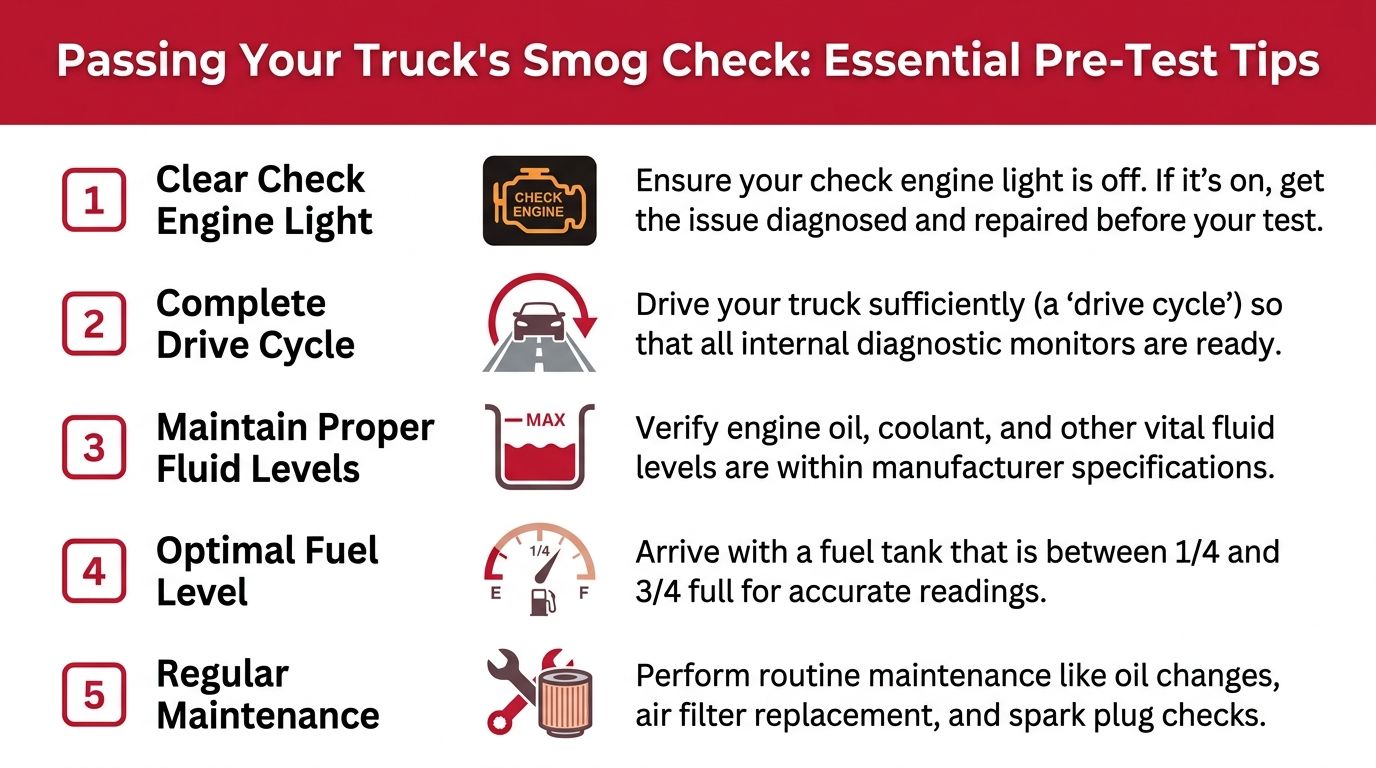
What helps before you arrive
The first thing I tell customers is simple. If the Check Engine light is on, don't book the test expecting luck to save you. A lit check engine light causes an automatic failure regardless of tailpipe readings, as explained in Lytx's truck smog check guide.
That one rule changes how you should prepare.
- Handle warning lights first: A glowing MIL is a stop sign, not a maybe.
- Drive the truck before the test: A normal drive before the appointment helps the truck arrive warmed up and operating normally.
- Don't disconnect the battery right before testing: That can create readiness issues and turn a repair into a failed inspection.
- Look for obvious equipment problems: Missing caps, disconnected hoses, or visible tampering waste everyone's time.
- Stay current on routine maintenance: Dirty filters, neglected tune-up items, and unresolved drivability problems don't help.
For many owners, the most useful prep is not mechanical expertise. It's honesty. If the truck runs rough, stalls, smells rich, or has had a warning light recently cleared, it probably isn't ready.
“If you just cleared a code this morning, wait. A rushed test is usually more expensive than a delayed one.”
If you want a quick reference on common reasons vehicles fail, Fire House Smog has a page on smog check fail reasons that lines up with what technicians see every day.
If your truck fails
A fail result doesn't mean the truck is done for. It means the problem has to be corrected before certification.
What works after a failure is targeted repair. Read the failure report carefully, repair the actual issue, and then return for a retest. What doesn't work is replacing random parts and hoping one of them fixes it.
A test-only station is useful here because the inspection result stands on its own. There's no built-in incentive to turn a failed test into a repair ticket. That separation is one reason many truck owners prefer the test-only route when they want a straightforward answer.
Your One-Stop Solution in Antioch: Fire House Smog
When truck owners get frustrated, it's usually not because the inspection itself is impossible. It's because the process gets split into too many errands. One place for testing. Another for DMV work. Another call to verify whether the station can handle a truck or RV size.
That's where a local station setup matters. Fire House Smog in Antioch is a STAR-certified test-only smog station and a licensed DMV registration services provider located on Lone Tree Way. It handles smog inspections for cars, trucks, and some RVs, subject to size and equipment limits, and it processes California registration renewals, ownership transfers, and related DMV transactions with on-site tag issuance during posted hours.
For truck owners, the practical advantages are straightforward:
- Test-only model: You get the inspection without repair sales pressure.
- Two service bays: That helps move vehicles through more efficiently.
- Seven-day smog availability: Easier for working drivers and small business owners.
- On-site DMV services: Useful when your goal is to finish the compliance step and the registration step together.
- Truck-focused service mix: You can review their local Antioch smog check services before you go.
If you have a light-duty truck that needs a standard inspection, or you're sorting out a renewal and want fewer moving parts, that kind of setup can save a lot of unnecessary back-and-forth. If you have a large RV or a vehicle with unusual fitment, call first and confirm the station can accommodate it.
If your truck needs a smog check and you want to handle the inspection and DMV paperwork with less friction, contact Fire House Smog. They provide STAR-certified test-only inspections, on-site DMV services, and practical help for Antioch and East Contra Costa County drivers trying to get registration done without extra stops.
You open the DMV renewal notice, see the smog requirement, and immediately start doing math in your head. Is the old car going to pass. Is this going to turn into a repair bill. Did that battery disconnect last month just create a new problem.
That anxiety is common, especially when the vehicle is older but still runs fine day to day. Plenty of owners assume a car that drives well will breeze through the test, then get blindsided by an emissions failure, a readiness issue, or a rule they thought didn't apply to “classic” vehicles.
A smog check for older cars in California gets easier once you separate rumor from rule and prep the car for the test it will receive. The practical side matters just as much as the legal side. A warm engine, a complete drive cycle, and choosing the right testing path can save a lot of wasted time and unnecessary repair work.
Table of Contents
- That DMV Notice Arrived What Now
- California Smog Rules for Older Cars Explained
- Preparing Your Vintage Car for Its Smog Check
- The STAR Test Process for Pre-2000 Vehicles
- What to Do If Your Older Car Fails the Smog Check
- Your Antioch Smog Check Partner Fire House Smog
- Frequently Asked Questions About Older Car Smog Checks
- Do I need a smog check to sell an older car
- Can historic plates make my car exempt
- How long is a smog certificate valid
- What is the difference between test-only and test-and-repair
- Do all older cars get the same kind of smog test
- What is the best last-minute thing I can do before the appointment
- If my older car fails, do I have any options besides paying for repairs right away
- If my exempt older vehicle doesn't need biennial smog, can I ignore emissions equipment
That DMV Notice Arrived What Now
Most owners go through the same sequence. First comes denial. “This thing's old, but it's maintained.” Then comes the internet search spiral. One site says older cars are exempt. Another says they're not. A friend swears special plates fix the problem. None of that helps when registration is due.
The first thing to do is slow down and identify what kind of “older car” you have under California rules. A seventies car sits in a very different category than a late nineties sedan. An older diesel follows different rules than an older gasoline car. A transfer of ownership can trigger a requirement even when a routine renewal might not.
That's where people lose money. They approve repairs before confirming the actual requirement, or they go into a test with a cold engine, stale oil, or recently cleared codes and turn a manageable situation into a failure.
Practical rule: Treat the smog check like a specific inspection procedure, not a general judgment on whether your car is “good” or “bad.”
Older vehicles can still pass cleanly. The ones that struggle usually have one of three problems. The owner misunderstood the rule, the car wasn't prepared for the test conditions, or the first failure was handled poorly.
If you're holding that notice right now, the path is straightforward. Confirm whether the car is required to test, prepare it like an older vehicle instead of a modern one, understand what the station is going to do, and know your options if the first result isn't what you wanted. That approach keeps the process calm and keeps you from paying for work you may not need.
California Smog Rules for Older Cars Explained
A lot of confusion starts with one bad assumption. Owners hear “older car” and assume California treats every older vehicle the same. It doesn't.
The exemption line that matters most
For gasoline vehicles, the cutoff is simple. 1975 and older are exempt from the biennial smog check. 1976 and newer usually are not. That is why owners of late seventies, eighties, and nineties cars get caught off guard. The car may feel vintage, but under California registration rules it is still in the testing program, as reflected in California's current classic car smog rule coverage.
Fuel type changes the answer too. Many diesel vehicles follow a different year cutoff, and weight matters. Electric vehicles and motorcycles are outside the regular smog check program. Hybrids are not automatically exempt just because they are partly electric.
That distinction matters at the counter and at the test station. I have seen owners spend money chasing tune-up parts before confirming whether the car needed a test, or what kind of test applied.
A quick reference table
| Vehicle Type | Model Year | Smog Check Required? |
|---|---|---|
| Gasoline | 1975 and older | No for biennial smog requirement |
| Gasoline | 1976 and newer | Yes |
| Hybrid | 1976 and newer threshold applies within the biennial program | Yes |
| Diesel under 14,000 lbs | 1997 and older | No |
| Diesel under 14,000 lbs | 1998 and newer | Yes |
| Electric | Any model year | No |
| Motorcycle | Any model year | No |
Special situations owners miss
Registration event matters almost as much as model year.
A car can be old enough to confuse people and still avoid a regular renewal test for a period of time if it is relatively newer by DMV standards. California uses a smog abatement fee for many vehicles in their first several model years instead of requiring a physical inspection at renewal. That exception does not usually help with first-time California registration from out of state. It also does not erase smog requirements that come up during certain ownership transfers.
Here is the practical version owners should remember:
- Out-of-state vehicles: A vehicle brought into California can need a smog check even if a similar in-state renewal would not.
- Private-party sales: Smog requirements often come up at transfer, and timing can become a problem if the seller waits too long.
- Certificate timing: A passing certificate only stays usable for a limited window, so test too early and you may have to do it again.
- Late renewals: Waiting on the DMV notice does not pause penalties.
The other rule older-car owners need to know is less obvious. A vehicle can be exempt from biennial testing and still be expected to keep its original emissions equipment in place. Removing or disabling required components can still create problems under the California Smog Check Program overview.
That is where standard advice falls short. The rulebook tells you whether the car needs a test. It does not tell you how to avoid an unnecessary failure. On older cars, that usually comes down to test timing, a proper drive cycle so monitors can set, and knowing when a Smog Referee is the better option than arguing with a regular station about an engine change, label issue, or equipment question. Those are the details that save owners money.
Preparing Your Vintage Car for Its Smog Check
A smog check for older cars usually goes better when the owner focuses on simple prep, not panic repairs. Start with the basics that affect how the car runs on test day. Older engines are less forgiving than newer ones, and small issues that seem harmless in normal driving can show up during emissions testing.
What to check before you leave home
Use this as a practical pre-test checklist:
- Engine temperature: Don't show up with a cold engine. Drive long enough for full operating temperature so the catalytic converter and sensors are doing their job.
- Check Engine light: If the light is on, deal with that first. Clearing codes right before the test often creates a new problem because monitors may not be ready yet.
- Oil condition: If the oil is very dirty or overdue, change it before the test. Old oil can contribute to a rough-running engine.
- Tire pressure: Inflate tires to the correct specification. That helps the car behave normally during testing conditions.
- Fluid levels: Check and top off the basics. You want the engine operating steadily, not compensating for avoidable maintenance issues.
- Battery history: If the battery was recently disconnected or replaced, assume the car may need extra driving before it's fully test-ready.
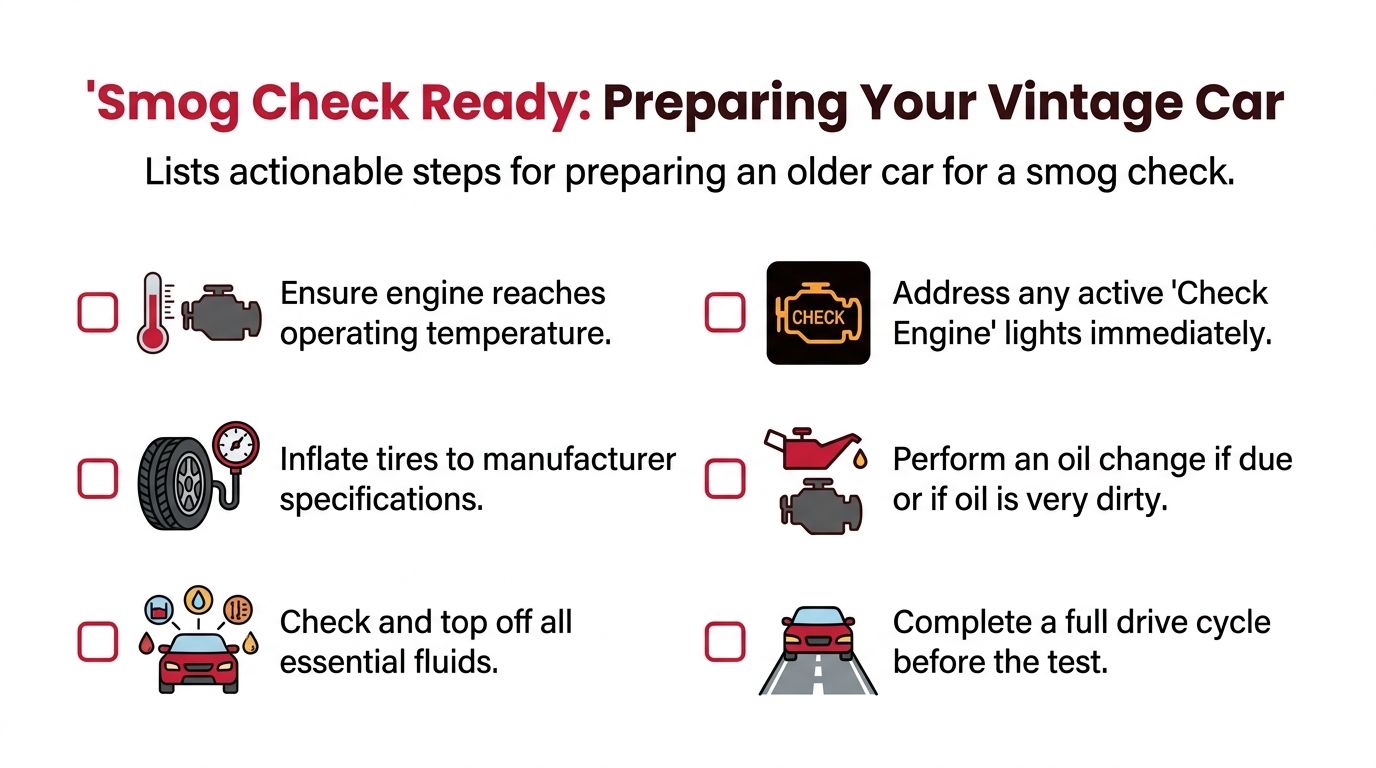
Why the pre-test drive cycle helps
One of the most overlooked tricks is the pre-test drive cycle. Reddit users and experienced owners report that driving a specific 30-mile route, usually a mix of highway and city driving, can help prime the O2 sensors and catalytic converter, especially on 1995 to 2000 vehicles that struggle after battery disconnections, according to this owner discussion about the 30-mile drive cycle.
That advice lines up with what older-car owners see in real life. A car can feel fine and still not be ready for inspection if the monitors haven't settled back in after power loss or recent code clearing. The drive cycle gives the system time to run its checks under normal conditions.
Here's what tends to work better than random short trips:
- Start with the car fully warmed up.
- Drive a mix of steady-speed road time and stop-and-go sections.
- Avoid idling in a parking lot and calling it “warm.”
- Don't disconnect the battery again before the test.
“If you just cleared codes, don't rush straight to the station. Give the car a real drive first.”
What doesn't work is guessing. Spraying fuel additives into the tank at the last minute, clearing codes on the way over, or showing up after the car sat for days usually creates more trouble than it solves. Older cars reward steady prep, not shortcuts.
The STAR Test Process for Pre-2000 Vehicles
Older cars make people nervous partly because they expect a mysterious process. It isn't mysterious once you know what lane your vehicle falls into.
What BAR-97 means in plain English
Vehicles built in 1999 and older use the BAR-97 test rather than the newer OBD-II style process used for later vehicles. That older test uses tailpipe emissions sampling and analog diagnostic equipment, and it checks what's coming out of the exhaust instead of relying mainly on the car's onboard reporting, as described in this overview of California's BAR-97 testing for older vehicles.
For owners, the practical takeaway is simple. Mechanical condition matters a lot more on these vehicles. Tune, vacuum integrity, catalytic converter health, and basic engine operation have a direct effect on the result.
The same source notes that BAR-97 testing measures HC, CO, and NOx at the tailpipe, and the inspection window for these vehicles is longer than for newer cars. That's one reason older-car smog appointments can feel more involved.
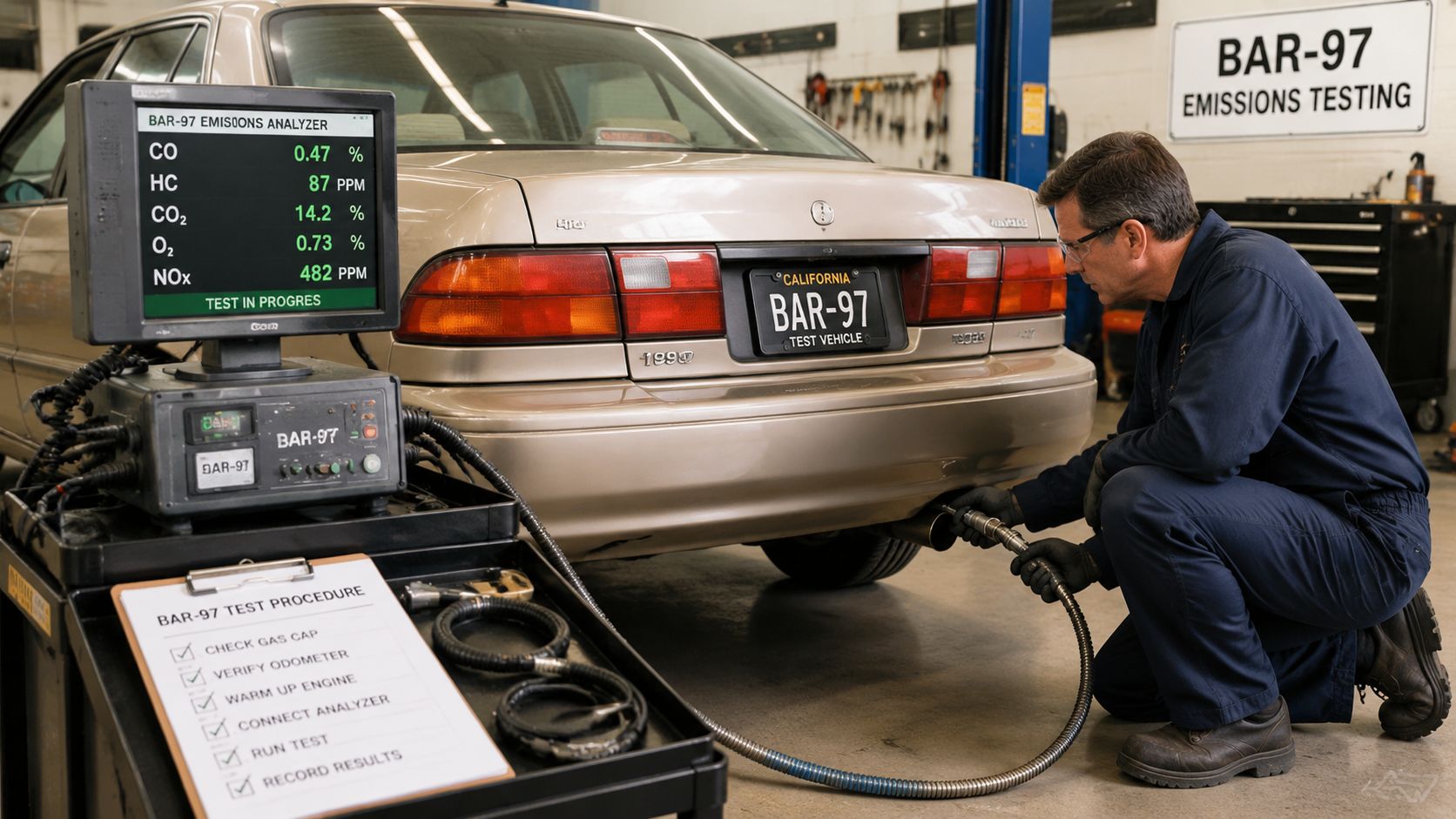
Why station type matters
If your notice requires a STAR station, pay attention to that requirement. Don't assume every shop handles the same vehicles in the same way.
For older vehicles, many owners prefer a test-only setup because the incentives are cleaner. The shop is there to inspect, not to fail the car and immediately sell a repair package. If you need a STAR inspection, a STAR smog test-only station in Antioch gives you that narrower, more impartial role.
That matters most when the car is borderline or has already had work done elsewhere. You want an accurate result first. Then, if repairs are needed, you can make a calm decision instead of reacting under pressure.
What to Do If Your Older Car Fails the Smog Check
A failed result doesn't always mean the car needs a major repair. It means you need to read the failure correctly before spending money.
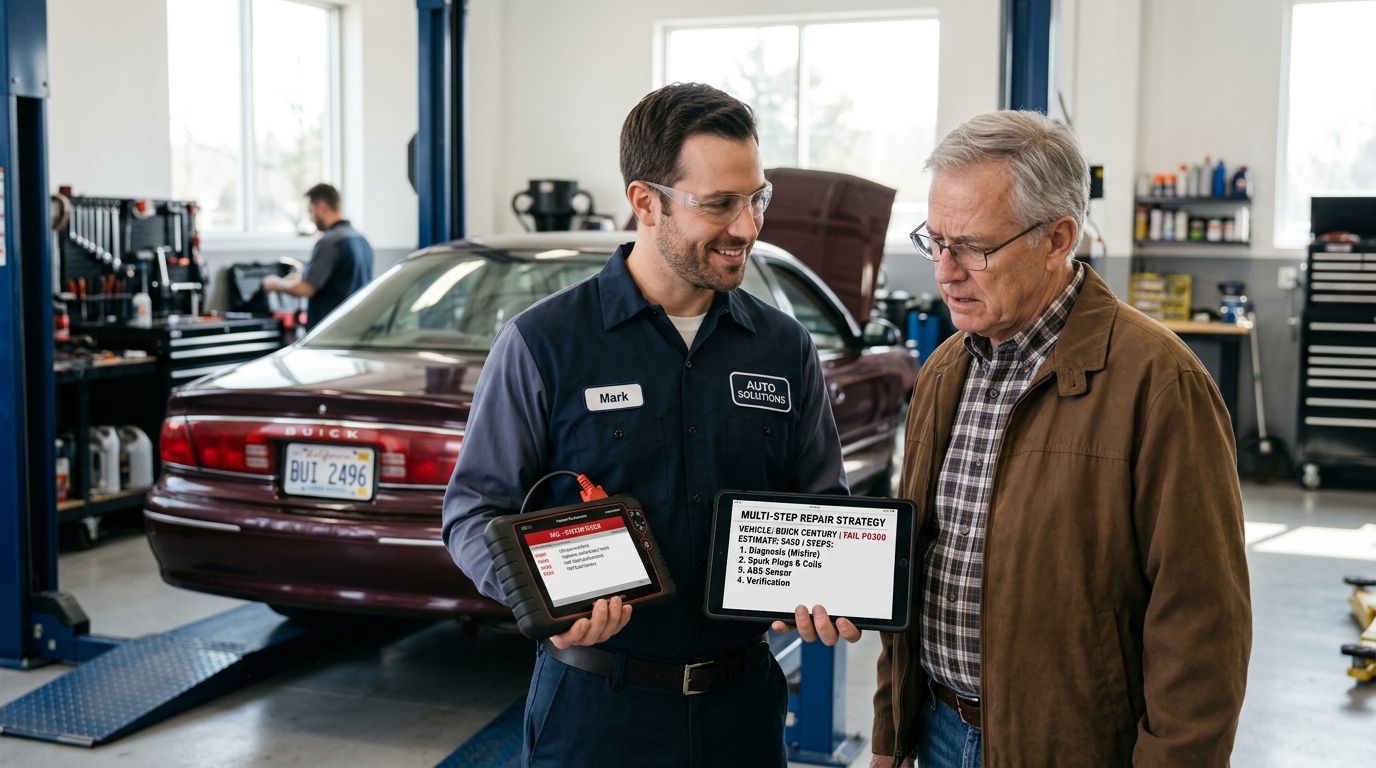
Read the failure before approving repairs
There's a big difference between a true emissions problem and a procedural issue. A car might fail because of actual tailpipe output, a readiness problem, missing or altered equipment, or something that points to a narrow fault rather than a full system rebuild.
Start with this sequence:
- Get the exact reason in writing: Don't leave with a vague memory of what the technician said.
- Match the failure to recent events: Battery disconnect, code clearing, long storage, or recent engine work can all matter.
- Avoid one-shot repair decisions: On older cars, replacing parts by guesswork gets expensive fast.
- Ask about retest policy: Some stations offer a free retest under coupon or posted policy terms, which can make a second attempt much easier after a targeted fix.
If you want a clearer sense of what usually trips cars up, this guide to common smog check fail reasons is a useful starting point.
Common mistake: Owners hear “fail” and approve everything suggested in the first five minutes. That's how small emissions problems turn into large invoices.
When to use the Smog Check Referee
Some older cars don't fit cleanly into standard advice. Collector vehicles, modified vehicles, and stubborn repeat failures are where owners should think about a second opinion.
The Smog Check Referee Program offers a free, independent technical review to determine whether the failure reflects a genuine emissions problem or a testing issue, and in some cases it may waive the repair requirement, according to the BAR Referee review process for smog check results.
That option is more valuable than most owners realize. If the car has an unusual setup, a long repair history, or a result that doesn't match how the vehicle is equipped, the referee path can keep you from chasing the wrong fix.
A short explainer helps if you haven't seen the process before.
Use the referee route when the failure feels questionable, not as a substitute for obvious maintenance. If the catalytic converter is damaged, vacuum lines are disconnected, or the engine is running poorly, that still has to be addressed. But when the case is murky, a second opinion can be the smartest move.
Your Antioch Smog Check Partner Fire House Smog
For local drivers, convenience matters almost as much as the technical side. Older cars don't love unnecessary trips, long waits, or being bounced between the test station and the DMV.
Why the setup is useful for older vehicles
Fire House Smog is a STAR-certified test-only station and licensed DMV registration provider in Antioch. The test-only model is useful for owners who want an inspection without repair upselling, and the station's two-bay setup helps keep vehicles moving instead of stacking up in a single line.
The location also handles California DMV renewals, ownership transfers, and related registration tasks with on-site tag issuance during posted hours. That's a practical advantage when you've already done the hard part and just want the paperwork finished.
Local details that make the process easier
The shop is located at 2900 Lone Tree Way, Antioch, CA 94509, and you can reach it at 925-754-1600. Smog testing is available seven days a week, with extended weekday and weekend availability, and DMV services run Monday through Saturday from 9:30 AM to 5:00 PM and Sunday from 12:00 PM to 4:00 PM.
For Antioch and East Contra Costa County drivers, that combination solves a real problem. You don't have to line up one place for a test and another for registration handling if both are needed.
If you want station details before heading over, the Antioch smog check service page lays out the local service options clearly.
Frequently Asked Questions About Older Car Smog Checks
Do I need a smog check to sell an older car
In many private-party sales, yes. If the car is outside California's newer-vehicle transfer exemption, the seller usually needs to provide a passing smog certificate before the title changes hands.
The practical mistake is testing too early. Smog certificates expire, and older cars can drift out of tune if they sit, so line up the inspection close enough to the sale that you are not paying for the same test twice.
Can historic plates make my car exempt
Historic or collector plates do not automatically remove the smog requirement.
What matters is the vehicle's year, fuel type, and how California classifies it. I have seen owners show up convinced the plate solves everything, then lose time because the car still falls into a test-required category. Check the actual exemption status first, not the badge on the plate.
How long is a smog certificate valid
A smog certificate is valid for 90 days.
That window matters more than owners expect. If you are selling the car, finishing registration late, or waiting on DMV paperwork, watch the calendar. Once the certificate expires, the state can require a fresh test.
What is the difference between test-only and test-and-repair
A test-only station inspects the car and reports the result. A test-and-repair shop can inspect it and sell the repair work.
For an older car, test-only often gives you a cleaner starting point. You get the numbers without having to make a repair decision on the spot. If the car fails, you can compare repair options, ask better questions, and decide whether a regular shop, marque specialist, or Smog Referee makes the most sense.
Do all older cars get the same kind of smog test
No. A pre-2000 car does not move through the program the same way a newer OBD-II vehicle does, and diesel rules are different again.
That is why advice from a neighbor with a different model year can send you in the wrong direction. The right prep depends on the engine management system, the emissions label under the hood, and whether the car needs a STAR station.
What is the best last-minute thing I can do before the appointment
Give the car a proper warm-up drive.
For many older vehicles, a short freeway run followed by normal city driving helps more than any fuel additive poured in the tank the night before. The goal is to get the engine fully hot, stabilize idle quality, and, on cars that track readiness, complete enough of the drive cycle for the monitors to set. If the battery was disconnected recently or repairs were just done, do not assume a quick trip around the block is enough.
If my older car fails, do I have any options besides paying for repairs right away
Yes. Start by reading the failure printout carefully. High hydrocarbons, high carbon monoxide, and a functional failure do not point to the same problem, and treating them like they do is how owners waste money.
If the car has a hard-to-find configuration, an engine swap question, or a dispute over required equipment, the California Smog Referee program can be the right next step. It is also useful when standard shop advice is not lining up with what the car is.
If my exempt older vehicle doesn't need biennial smog, can I ignore emissions equipment
No. Exempt from routine testing does not mean free to remove emissions parts.
That catches owners during a later sale, a referee inspection, or any situation where the car is checked for required equipment. Keeping the emissions system intact is usually cheaper than trying to put a half-modified older car back to stock under deadline pressure.
If you want a straightforward smog check for older cars in East Contra Costa County, Fire House Smog offers STAR-certified test-only inspections, DMV registration help, and seven-day availability at 2900 Lone Tree Way in Antioch. Call first if you've got an unusual vehicle or RV, and bring the DMV notice so the visit goes faster.