
You've agreed on a price, the seller has the keys ready, and you're trying to work out whether the title and an old smog receipt are enough to finish the sale. Before you hand over payment, check the paperwork dates. In California, used car registration starts with the seller's preparation, not just the buyer's trip to submit the transfer.
A clean handoff means the seller can provide the ownership documents, address any lien, and establish whether the vehicle needs a current smog certification. The buyer then has a complete package to file, rather than a car in the driveway and missing signatures to chase.
Table of Contents
- Deadlines and Fees for Your Transfer
- Smog Rules by Vehicle Age and Sale Type
- Documents and Transfer Steps
- On-Site Service or a DMV Office Visit
- Registration Mistakes and How to Fix Them
- Book Your Smog Check and Transfer Visit
Deadlines and Fees for Your Transfer
Write the sale date on your calendar before separating the paperwork. For the seller, two clocks are already running before money changes hands: the window to report the transfer and the life of a fresh smog certificate. Keep government charges, inspection costs, and any registration-service charge separate when comparing your total.
California used car transfer deadlines and fees
| Item | Timing or amount | Who handles it |
|---|---|---|
| Notice of Transfer and Release of Liability | Within 5 calendar days of sale, according to the California DMV transfer guidance | Seller |
| Ownership transfer | The DMV transfer charge plus use tax; filed through a licensed registration service such as Fire House Smog, the service charge is $55.00 plus the applicable DMV fee, including the sticker and any plate needed | Buyer |
| Transfer fees submitted to DMV | Submit promptly after sale; a late-penalty threshold is a deadline, not breathing room | Buyer |
| Smog transfer fee for qualifying newer vehicles | A DMV charge paid in place of an inspection, for vehicles inside the newer-vehicle exemption | Buyer |
| Use tax | Calculated from the purchase price and applicable location-based tax rate | Buyer |
| Smog certificate validity | 90 days from the test date, per the California Bureau of Automotive Repair smog-check guidance; the seller's passing certificate should still be inside that window on filing day | Seller in a private sale |
| Registration renewal after transfer | Renewal payments made shortly after expiration can still avoid penalties, but the registration itself is already out of date; renewals through a registration service run $30.00 plus the applicable DMV fee, sticker included | Buyer |
| Registration fees | Calculated for the vehicle, including applicable weight- and value-based charges | Buyer |
Calendar the seller's release-of-liability filing first. That filing creates a dated record of the reported transfer. It doesn't replace the buyer's ownership-transfer application, and neither party should assume the other has completed both tasks. A seller who files on day one and hands over a smog certificate with weeks of validity left gives the buyer the cleanest possible package to submit.
Budget for the transaction, not just the transfer charge
Ask for an itemized calculation before paying. A quoted transfer charge isn't necessarily the full amount needed to cover tax, registration, certification, and service charges. Use our vehicle transfer fee guide to distinguish those categories.
Practical rule: File when the package is complete, rather than waiting for the last possible day.
For a dealer purchase, confirm in writing what the dealer will submit and what remains yours to handle. Keep the purchase agreement and filing receipts together.
Smog Rules by Vehicle Age and Sale Type
Settle the smog question before the buyer arrives. In a private sale requiring certification, the seller should arrange the passing inspection rather than leave the buyer to discover an unresolved emissions problem after paying. The test date starts a clock that runs against your closing timeline, so a seller who tests early in the listing period keeps more of that window open for the paperwork that follows.
Use this visual to identify the questions to settle before closing.
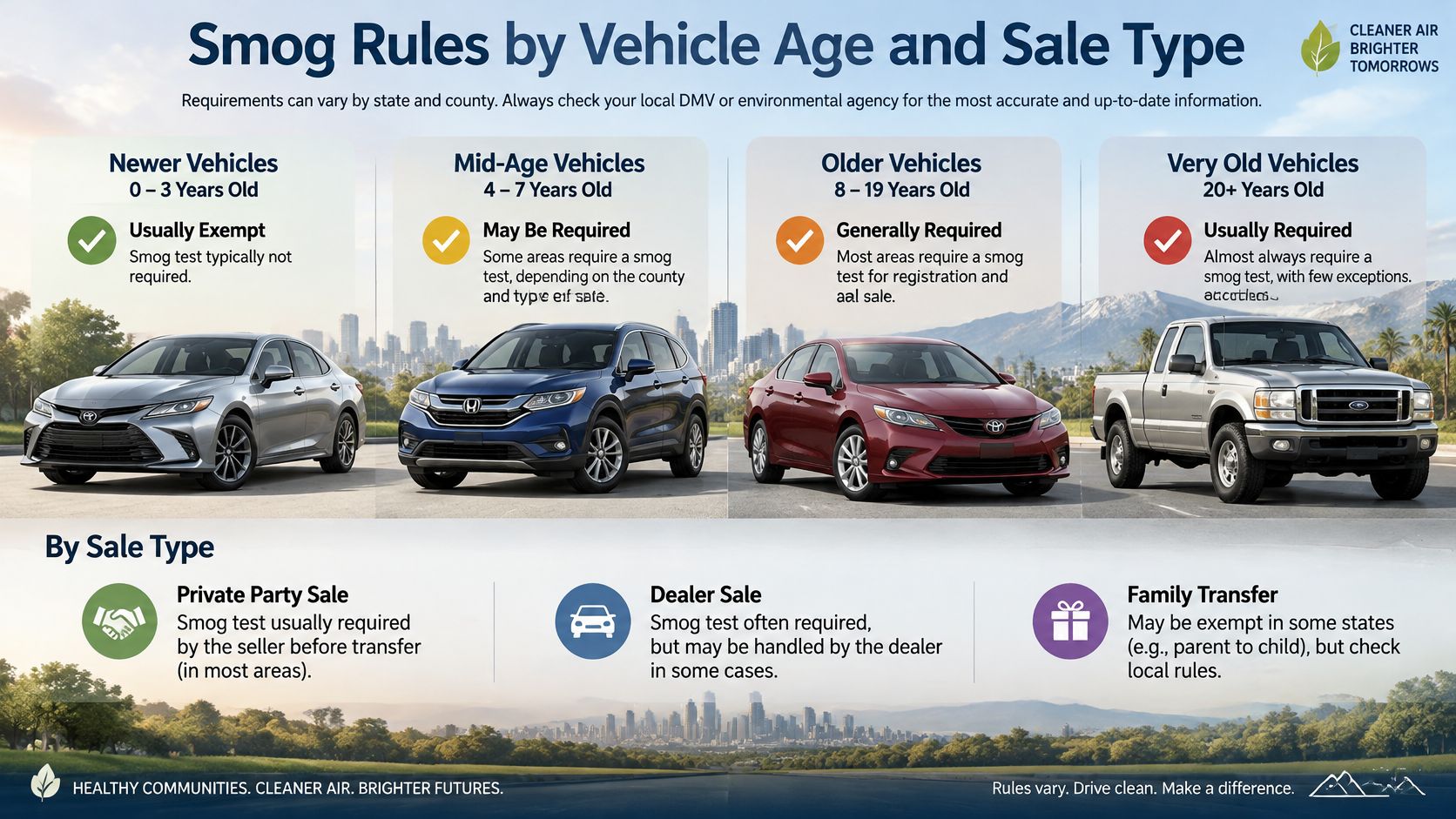
The key private-sale check is whether the seller's passing test falls within the 90-day validity window described in the Bureau of Automotive Repair smog check guidance. That same guidance distinguishes newer-vehicle treatment from the rules for older vehicles. A routine renewal exemption does not automatically carry over to an ownership transfer, so treat the test date as the start of the registration clock and work backward from the day you plan to file.
Smog requirements by vehicle age and sale situation
| Situation | Smog document or action | Who handles it |
|---|---|---|
| Vehicle within the applicable newer-vehicle exemption | Confirm transfer eligibility by exact model year; applicable transfer fee replaces certification | Buyer pays applicable fee |
| Older gasoline or diesel vehicle, private sale, current passing test | Confirm that the passing certification is valid for the transfer | Seller provides |
| Older vehicle with an expired test | Arrange a new smog test before submitting the transfer package | Seller arranges |
| Vehicle fails smog test | Obtain repairs and a passing retest before completing a transfer requiring certification | Seller |
| Vehicle bought out of state | Confirm California entry, certification, and verification requirements | Buyer confirms with DMV |
Check the exemption against the transaction
Age-based rules confuse sellers because renewal and ownership-transfer guidance describe different situations. Use the vehicle's exact model year, fuel type, and sale type when reviewing California smog exemptions, rather than relying on the seller's statement that the car is too new to need a test.
A recent biennial inspection may satisfy the certification requirement, but check the actual record and date. A receipt for an inspection that failed isn't a passing certification.
This video provides another way to review the smog-check process.
At Fire House Smog, we're a STAR-certified test-only station. We don't perform repairs, so if the vehicle fails, you arrange the repair work elsewhere and return for a free retest when required. That distinction matters for scheduling: a seller who needs a retest should build repair time into the calendar before the certification window closes.
Documents and Transfer Steps
Build the packet before choosing where to file. A missing signature can require another meeting with the seller, while an unresolved lien can require contact with the lender.
Gather the complete packet
- Ownership document: The California Certificate of Title, or the applicable REG 227 paperwork when the title is unavailable.
- Required signatures: Seller, buyer, and lienholder signatures appropriate to the transaction.
- Vehicle identification: The complete VIN, checked against the vehicle and every document.
- Sale details: Purchase date, purchase price, and the buyer's correct legal name and address.
- Mileage disclosure: A properly completed odometer disclosure wherever required.
- Lien release: Documentation releasing the lender's interest when applicable.
- Smog certification: A valid passing certification when the transfer requires it.
- Payment: An accepted payment method for applicable fees and use tax.
The California DMV transfers manual requires a complete VIN on REG 262, warns that errors or alterations void an odometer disclosure, and distinguishes consumer guidance to submit fees within 10 days of sale from a procedural 30-day late-penalty threshold. Treat the shorter guidance as the planning limit and aim to submit the completed package immediately.
Keep this checklist available while assembling the originals.
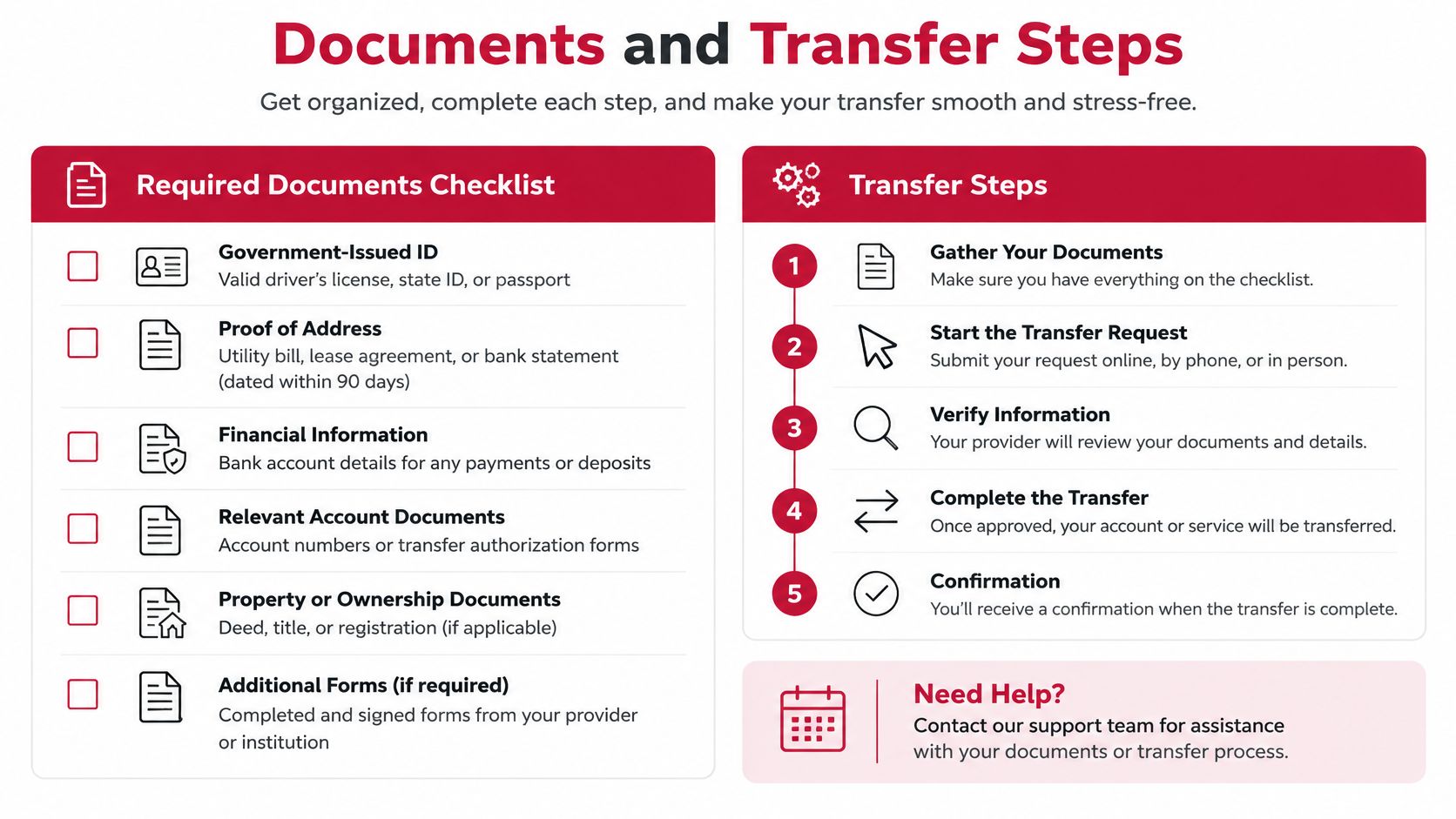
Complete the handoff in a workable order
Compare the title with the vehicle. Read the VIN character by character instead of checking only the ending. Confirm that the person signing as seller is identified appropriately on the ownership paperwork, and inspect the lienholder section. A matching license plate isn't enough to resolve an inconsistent VIN or ownership name.
Review the signature boxes together. Buyer and seller should identify their designated fields before either signs. If the title lists a lender, establish what release documentation is needed before treating the title as ready to transfer. A paid-off loan and a documented release aren't interchangeable.
Complete the odometer disclosure carefully. Read the vehicle's displayed mileage directly and enter it in the appropriate field in ink. Don't overwrite a digit, use correction fluid, or assume initials will validate an altered entry. If something goes wrong, stop and obtain instructions for replacement paperwork rather than adding more marks.
Enter the transaction details consistently. Use the actual purchase date and agreed price, and write the buyer's address completely, including an apartment or unit designation. A blank price can interrupt tax processing; inconsistent dates can make it harder to establish when obligations began. Compare these fields across the title, sale paperwork, and application before anyone leaves.
Have the seller file the release of liability. The seller should retain the submission confirmation with the sale documents. The buyer should still proceed with the ownership-transfer package independently. Waiting for the buyer to report that registration is finished leaves the seller without control over their own filing.
Submit the fees and transfer documents. Bring the originals to the chosen processing location and ask for a receipt identifying what was accepted and paid. If something is missing, ask exactly which document or field needs correction. Don't leave with only a verbal instruction to bring more paperwork.
Check the issued record. Review the registration card for the owner's name, address, VIN, and vehicle details. Check any sticker or plate issued for the transaction, and retain the receipt while remaining documents are processed. If something doesn't match, report the specific discrepancy rather than assuming it will correct itself.
Scan the packet before submission, but don't assume a phone image can replace an original signature document.
Our vehicle registration documents checklist can help you organize what to bring. Keep the title, lien paperwork, sale documents, and filing confirmation in a secure folder rather than leaving the entire ownership file in the vehicle.
Before leaving the counter, distinguish accepted for processing from fully completed. If additional action remains, write down who must take it, what document is needed, and how you'll confirm completion.
On-Site Service or a DMV Office Visit
Choose the location by transaction eligibility and your schedule, not just distance. A local visit helps only if the processor can handle the work and you arrive with a complete packet.
On-site service compared with a DMV office visit
| Factor | On-site service in Antioch | DMV office |
|---|---|---|
| Travel and queue | Local option; confirm current availability rather than assuming no wait | Closest offices to our station are Pittsburg and Concord; allow for travel and waiting |
| Weekday hours | Our DMV service hours are Monday through Friday, 9:30 AM–5:00 PM | Check the selected office's posted hours |
| Saturday hours | 9:30 AM–5:00 PM; services may be limited | Confirm whether the selected office offers Saturday appointments |
| Sunday hours | 12:00 PM–4:00 PM; services may be limited | Confirm availability before planning a Sunday visit |
| Transaction types | Eligible registration and ownership-transfer work within business-partner authority | Broader transaction handling, including matters requiring DMV review |
Match the route to the paperwork
We're a licensed California business partner for DMV registration services. That credential doesn't mean every unusual ownership issue can be resolved at an on-site counter. Call before visiting if the title has conflicting names, the vehicle came from another state, or a prior application was rejected.
A DMV office is the better starting point when DMV staff must determine eligibility or resolve a record problem beyond a business partner's authority. For an ordinary, complete transfer, a local appointment may fit your work schedule better.
Before you travel: Confirm the transaction type, required originals, accepted payment method, and service availability for that day.
Smog-test hours and DMV-service hours aren't identical. If you want both handled during the same visit, schedule around the registration-service window and confirm that the particular transaction can be processed.
VIN verification is not currently available at our station. If your transfer requires it, arrange that step separately rather than arriving expecting to finish it here. This is especially important when planning an out-of-state vehicle's California paperwork.
Registration Mistakes and How to Fix Them
An untidy entry isn't always something a processor can overlook. An altered odometer disclosure can invalidate the document, so the fastest recovery is usually to stop improvising and obtain the correct replacement paperwork.
Find the defect before resubmitting
- Altered odometer entry: Look for crossed-out digits, overwritten mileage, correction fluid, or inconsistent entries. Obtain the required replacement disclosure and any Statement of Facts requested for the correction. Submit once the replacement is properly completed and signed.
- Incomplete or mismatched VIN: Compare the vehicle identifier with the title and transfer documents. Don't guess a missing character or copy an identifier from an unrelated receipt. Resolve the mismatch before submitting the corrected packet.
- Missing lien release: A lender still appears on the ownership record, but there's no acceptable release. Contact the lender for the appropriate documentation. A payment confirmation alone shouldn't be treated as proof that the transfer paperwork is complete.
- Late or incomplete filing: You have the vehicle but no receipt confirming submission. Contact the processor promptly about paying applicable fees and completing outstanding documents. Don't postpone all action because part of the packet needs correction.
- Expired smog certification: The passing inspection no longer qualifies for the transaction. Arrange a new inspection and coordinate submission so the replacement certification remains usable.
Keep a correction record
When a package is rejected, keep the rejection notice with a copy of the submitted documents. Mark the exact defect on your copy, not on an original that must remain unaltered.
Ask whether the correction requires a new signature, replacement form, supporting statement, or another inspection. Then check the entire packet again before returning. Fixing only the first visible error can leave a second problem unresolved.
There's no useful universal promise for how long a correction will take. Your control is over obtaining the right document, keeping proof of payment and filing, and submitting the complete correction promptly.
Book Your Smog Check and Transfer Visit
Confirm the seller's documents and certification status before booking the final transfer visit. Check that the seller has filed their required notice, that any lien-release paperwork is available, and that the inspection record is suitable for the sale. If an item is missing, assign responsibility for obtaining it before either party assumes the transaction is finished.
Customers can make an appointment through the Fire House Smog website. Call (925) 754-1600 to confirm vehicle questions, coordinate the visit, or discuss an RV or motorhome, which must be checked against our size and equipment constraints before arrival.
Prepare for the appointment
Bring the original ownership paperwork and supporting documents, not just screenshots. Keep a separate copy of the packet for yourself, and have the purchase details available so the processor doesn't have to reconstruct them from messages between buyer and seller.
The $15 OFF Smog Coupon gives $15 off a smog test and includes a free retest. It can't be combined with other offers. Print the offer or mention at the service desk that you saw it on the website.
Don't schedule a required inspection so early that you leave little usable time for the sale, repairs if needed, and submission. Equally, don't leave the test until the handoff if the seller hasn't established whether the vehicle will pass.
Use this closing plan:
- Confirm documents this week: Resolve signatures, ownership details, and lien paperwork before the handoff.
- Time the inspection for the sale: Leave room for any needed repair and retest while keeping certification current.
- File when the packet is complete: Aim for same-day submission and retain the filing receipt.
Fire House Smog offers test-only smog inspections and eligible California ownership-transfer services to help you complete your used car registration paperwork. Visit Fire House Smog to arrange your appointment, and call ahead if your vehicle or transfer needs special preparation.
California stopped issuing official brake and light adjustment certificates on September 27, 2024, and for initial transactions on or after December 27, 2024 one electronic Vehicle Safety Systems Inspection certificate with a BAR-recorded Pass replaces the old brake and lamp pair. That's the opposite of the most popular advice you'll still find online, which tells you to search for a shop, ask for two papers, and bring them to DMV. Follow that advice in 2026 and you can pay for the wrong thing, book at the wrong station, or arrive with a form the clerk can't accept.
The problem isn't that your brakes and lights stopped mattering. They still have to work. The problem is the name on your notice. DMV paperwork, auction packets, salvage checklists, and old forum posts still use the retired label. Owners type that label into search, find a page that was never updated, and assume the paper still exists. A better approach is to treat official brake and light adjustment certificates as a legacy phrase and translate it. For most covered vehicles, the translation is a VSSI Pass. For a few older files, it's a form that's still recognized if its prefix and date qualify. For others, it's an exemption or a narrow distance exception. Pick the right translation first, and you won't waste a trip.
Table of Contents
- Which Document California Accepts Now
- How Two Brake and Lamp Certificates Became One Inspection
- How to Check an Old Brake or Lamp Form
- Four Real Cases Under the Current Rules
- How to Get a VSSI Certificate for DMV
- Finish the Registration After the Safety Record Is Set
Which Document California Accepts Now
You don't need background before you need an answer. Match your transaction date and vehicle class to one row below before you pay for any inspection. The current rule is simple. California no longer issues the old papers, and an initial transaction dated on or after December 27, 2024 is built around an electronic record, not a pair of certificates you carry in.
What to Submit Instead of a Brake and Light Certificate
| Situation | Document to use | Accepted now |
|---|---|---|
| Car, SUV, or light truck in a covered transaction | One electronic VSSI certificate with a BAR Pass | Yes, when VIN and certificate number match |
| Initial transaction on or after December 27, 2024 with only paper certificates | Old brake and lamp papers | No |
| Transaction that started on or before December 26, 2024 | Paper from that original transaction | Case by case; ask DMV how to handle it |
| Trailer at 3,000 pounds GVW or less | None | Exempt |
| Trailer over 3,000 pounds GVW | VSSI or the applicable official path | Required when the transaction says so |
| Motorcycle or large commercial vehicle with a qualified station available | VSSI from a station that inspects that class | Yes |
| Motorcycle or large commercial vehicle with no qualified station reasonably close | REG 256 Statement of Facts from a repair shop | Possible distance exception |
| Revived salvage or public-auction vehicle | VSSI, or an older B-91 or L-91 only if type and issue date still qualify | Check the transaction |
| REV 11/08 BC or LC form issued after November 29, 2015 | That obsolete adjustment form | No; get a new inspection |
The DMV guidance on the electronic VSSI transition states that, effective December 27, 2024, paper brake-and-light certificates are no longer accepted for initial transactions, while one electronic VSSI certificate with a BAR-recorded "Pass" replaces the former pair of separate brake and lamp certificates. That one sentence redraws your workflow. You aren't collecting two papers anymore. You're confirming that one electronic result exists and points to your vehicle.
That means three details have to match before you leave the station. The VIN, the certificate number, and the Pass result must all belong to the vehicle in your registration transaction. The DMV record or a BAR Inspection History screen print must display the certificate number, so don't rely on a verbal "you passed" at the counter. Ask the station to show you the record, read the VIN character by character if you have to, and keep the number with your paperwork. A transposed digit turns a finished inspection into a stalled transaction.
Check at the station, not at DMV. If the VIN, certificate number, and Pass don't match on the electronic record, fix it where the inspection happened. A DMV clerk can't correct a BAR record for you.
The date split in the table matters because older files don't always follow the new rule cleanly. Paper documentation may require special handling when the originating transaction occurred on or before December 26, 2024. If that's your file, don't guess in either direction. Don't assume the paper is automatically valid because it's old, and don't throw it away because the program ended. Ask DMV how that specific transaction should be handled, and bring the form so staff can see its type and issue date.
Three Points the Table Can't Carry
First, vehicle class controls where you can go. A regular station may not be equipped to inspect a motorcycle or a heavy truck, even if it handles passenger cars all day. Booking first and asking later wastes the appointment. When you call, name the exact vehicle, not just the document you think you need. Say "motorcycle" or "large commercial vehicle" and confirm the station inspects that class. If it doesn't, the next question isn't how to squeeze your vehicle into the wrong bay. It's whether a qualified station for that class is reasonably within reach.
Second, the trailer rule is a bright line, and owners often trip over it in both directions. A trailer at 3,000 pounds gross vehicle weight or less is the standing exemption, so its owner shouldn't be sent hunting for an inspection the rule doesn't require. A heavier trailer is a different story. It follows the transaction requirement, and "it's just a trailer" isn't an argument at the counter. Read the rating on the trailer, not the weight you happen to be hauling today. The rating is what places you on one side of the line or the other.
Third, a repair shop statement is a fallback, not a loophole. The DMV salvage procedures for vehicles sold by a public agency or auctioneer describe a Statement of Facts (REG 256) from a repair shop confirming that the brakes and lights work properly when an official station for that vehicle type isn't within a reasonable distance. The same procedures place the rollout in order, with station and technician licensing beginning March 27, 2024, inspections beginning July 8, 2024, and the former programs ending September 27, 2024.
Read that exception narrowly. If your car can reach an enrolled VSSI station, an informal note from a friendly shop isn't a substitute, and relying on one can delay registration. The REG 256 path exists for a documented access problem, such as a motorcycle or large commercial vehicle with no qualified station reasonably close. It's not a way to skip the electronic inspection because a shop letter is cheaper or closer. If you think the exception fits, put the question to DMV before you pay anyone, and be specific about the vehicle type and the distance problem.
Why Your Notice Still Prints the Old Words
Some DMV notices still print brake and light certificate even though the papers behind those words are retired. Treat that wording as leftover text, not proof the retired paper is still for sale. Government forms and third party checklists get updated on different schedules, and the old phrase survives in packets that were printed, copied, or posted years ago. Your job is to translate, not to hunt. When a notice uses the old name, ask which current document satisfies that line for your vehicle and transaction date.
That translation habit also keeps separate inspections separate. California drivers deal with several certificates, and they're not interchangeable. Reading about a vehicle emission test certificate is useful for a smog requirement, but an emissions result doesn't create a safety systems record. Each inspection answers a different question. Smog asks what comes out of the tailpipe. The VSSI asks whether the vehicle's safety systems pass. A clerk working a safety line item needs the safety record, and a smog certificate won't fill that slot no matter how recent it is.
Fees and inspection times vary by station and vehicle, so get those details when you book rather than trusting an old price list online. What you can lock down in advance is the document itself. Find your row in the table, confirm the station inspects your class, and verify the electronic Pass before you drive away. Those three steps prevent most of the confusion the old certificate name still causes.
How Two Brake and Lamp Certificates Became One Inspection
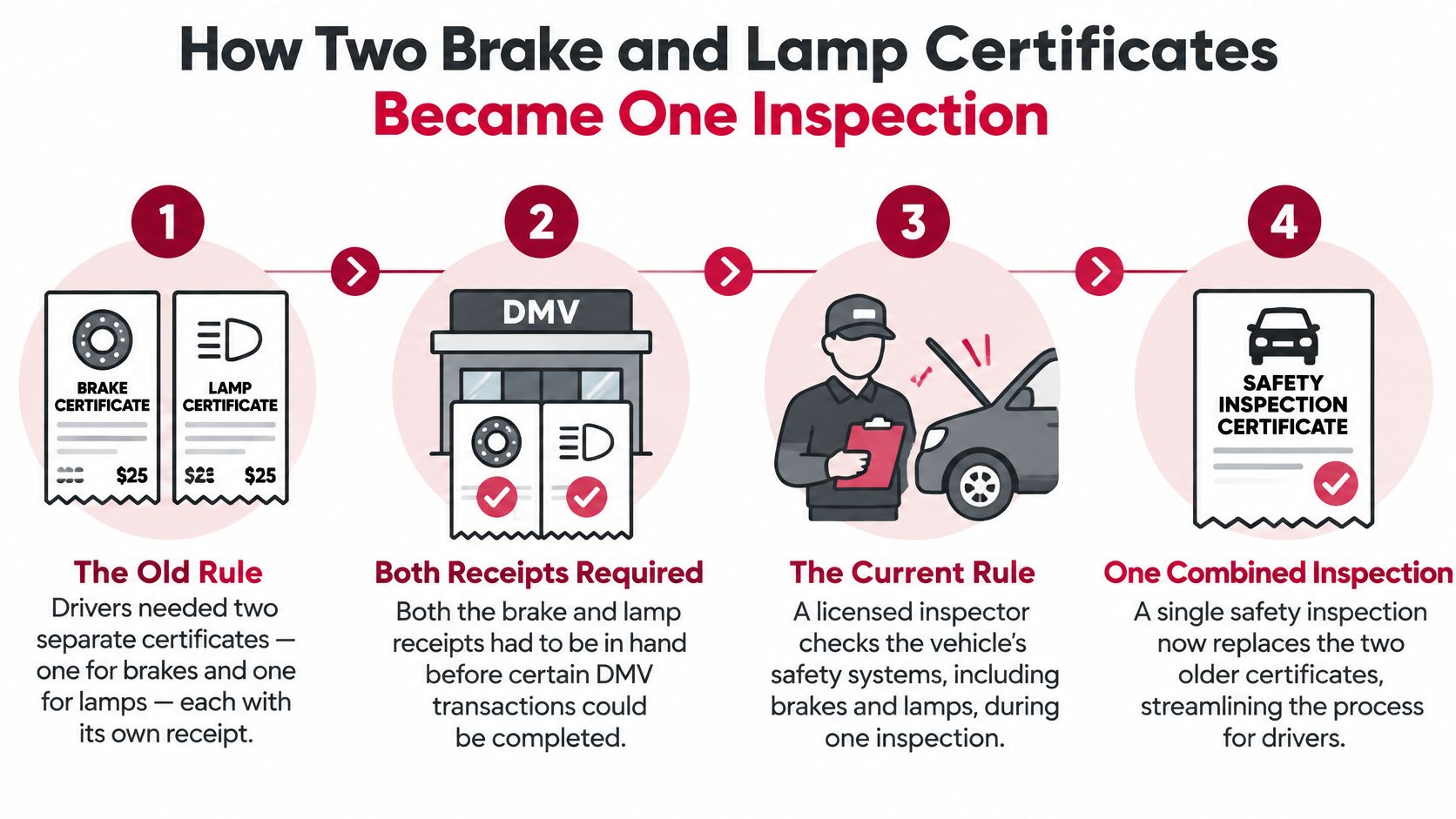
The old system worked like two separate store receipts. One receipt said your brakes had been checked and adjusted. The other said the same for your lamps. For certain DMV transactions, especially ones involving vehicles that needed safety documentation before they could return to the road, both receipts had to be in hand before the transaction could finish. Missing either one stopped the file, even if the other system was perfect.
Say you repaired a car and needed to complete a covered registration transaction under that old rule. You'd visit a licensed official brake station for the brake Certificate of Compliance, then handle the lamp side at a licensed lamp station. Sometimes one business held both licenses, sometimes not. Either way, the state treated brakes and lamps as two programs, two licenses, and two certificates. The owner carried the paper, and the paper carried the proof.
Why the License Mattered More Than the Paper
California tied each certificate to a license for a practical reason. A license linked the form to regulated equipment, station qualifications, and a qualified adjuster. Any shop could tell you a headlight looked fine. Only a licensed station with a licensed adjuster could issue the official certificate DMV would accept. That distinction protected the transaction. The state wasn't buying a shop's opinion. It was accepting a result produced inside a regulated program, by a person and a station it had approved for that exact category.
This is also why owners got tripped up by lookalikes. A repair invoice showing brake work isn't a brake certificate. A note saying the lights were aimed isn't a lamp certificate. The work and the official document were related, but they weren't the same thing. DMV acceptance depended on the document coming through the licensed path, with the right category on it. A brake form couldn't do a lamp form's job, and neither form meant much if the issuer lacked the matching license.
The Law That Folded Two Programs Into One
The Bureau of Automotive Repair safety program page reports that Assembly Bill 471, enacted in 2021, authorized BAR to consolidate the former brake and lamp programs into a single Vehicle Safety Systems Inspection program, and that on September 27, 2024 brake-and-lamp station and adjuster licenses were no longer valid and those stations and adjusters were no longer permitted to issue brake-and-lamp certificates of compliance. That's the turning point. After that date, a shop advertising a fresh official brake or lamp certificate is advertising something its old license no longer supports.
BAR's cleanup steps tell the same story. The bureau stated it would collect and refund unused certificates and monitor certificates submitted to DMV after the program ended. You don't collect and refund blank forms for a program that's still running. Those steps closed the supply of legitimate new paper and put old submissions under scrutiny. For owners, the message is blunt. A certificate printed on familiar stock isn't automatically a live document, and a station's old signage isn't a current license.
Under the replacement system, an enrolled station issues one electronic VSSI certificate when the vehicle passes, and that certificate is transmitted through the BAR system for applicable DMV requirements. Notice what changed and what didn't. The safety check didn't disappear. The split disappeared. One inspection produces one electronic record, so there's no second receipt to chase and no pair of papers to keep together in a glovebox. The proof now lives in the system DMV can verify, tied to the vehicle by its identifying information.
Two receipts became one record. If a shop wants to sell you the second receipt, it's selling you the old system.
BAR also warns that some DMV paperwork may still refer to old brake-and-light certificates, and those references shouldn't be interpreted as evidence that the former certificates remain available. That warning explains the confusion you're probably feeling. You aren't misreading your notice. The notice is using retired language. The current compliance document is generally a VSSI certificate, subject to the vehicle and transaction involved. When old words and new rules collide, follow the rule that's still issuing documents.
How to Check an Old Brake or Lamp Form
Maybe you aren't shopping for an inspection at all. Maybe a certificate is already sitting in your glovebox, your salvage folder, or an auction packet, and you want to know whether it's worth anything. Treat that as a desk check. Validity depends on the form, its prefix, its date, and the vehicle. Possessing a piece of paper proves nothing, because an apparently complete form can still be rejected for being obsolete or improperly issued.
Start by identifying which legacy format you're holding. The California DMV handbook material on brake and light certificates recognizes the Certificate of Compliance, Brake Adjustment (B-91) and Certificate of Compliance, Lamp Adjustment (L-91), revision 4/99, identified by certificate-number prefixes "BA" and "LA", and also older Certificate of Adjustment forms, revision 11/08, identified by "BC" for brake and "LC" for lamp certificates. Those names, revisions, and prefixes are your first sort. If you can't place the form in one of those families, stop there and ask DMV before building a transaction around it.
Run Five Checks in Order
Work through the form the way a clerk would, top to bottom.
- Form name and revision. Read the exact title and revision date printed on the form, such as 4/99 or 11/08. Don't rely on what the seller called it.
- Certificate prefix. Find the two letters starting the certificate number. BA and LA point to the B-91 and L-91 compliance forms. BC and LC point to the older adjustment forms.
- Issue date. BC and LC forms fail in this regard. The same DMV material sets a firm cutoff, stating that certificates with revision 11/08 and an issue date after November 29, 2015 were not acceptable, requiring the customer to obtain a new certificate.
- Adjustment category. Confirm the form covers the system you need. A lamp form offered as proof of a brake adjustment is the wrong document, however clean it looks.
- Issuing station. Identify who issued it and whether that station held the matching license for that adjustment when the form was issued. An unofficial issuer makes the paper unofficial.
Put the date check next to the prefix check in your mind, because together they decide the most common rejection. A BC or LC form with an 11/08 revision and a 2016 issue date can be filled out perfectly, signed, and still dead on arrival. The problem isn't handwriting or a missing stamp. The form family itself passed its cutoff. Arguing that the brakes were genuinely inspected back then won't rescue it, because DMV policy rejects the document type and date combination. The fix is a new inspection through the current path, not a better explanation of the old one.
Two Situations That Change the Desk Check
Vehicle category can end the check early. Brake-and-light certificates were generally unnecessary for trailers with a gross vehicle weight rating below 3,000 pounds, so don't send a small trailer owner hunting for a replacement form the transaction never required. Confirm the rating first. If the trailer sits under the line, the absence of a certificate isn't a defect in the file.
Access can change the answer too. Where a qualified inspection station for a particular vehicle type, such as a motorcycle or large commercial vehicle, wasn't reasonably accessible, DMV procedures could allow a repair-shop Statement of Facts instead. That's a circumstances question, not a form question. You'd need the vehicle type and the distance problem to fit the procedure, and DMV makes that call. Don't manufacture the exception after the fact to explain why a regular certificate is missing.
Desk rule. If the prefix, revision, or date fails, stop defending the old paper at the counter and get the electronic inspection.
One last habit saves time. Photograph the form front and back before you travel, and note the prefix, revision, and issue date in your phone. If DMV staff need to advise you, those three details let them answer quickly. And if the form fails the check, you'll know exactly why, which keeps you from paying a second shop to reproduce the same rejected document. The paper had a real job in its era. Your job now is to confirm whether that era's rules still accept it.
Four Real Cases Under the Current Rules
Rules get easier to use when you see them land on actual vehicles. Each case below has one problem and one correct document. The pattern repeats, and once you spot it, you'll read your own notice differently.
The collage below shows the paperwork side of these transactions, where the wrong form creates the delay.
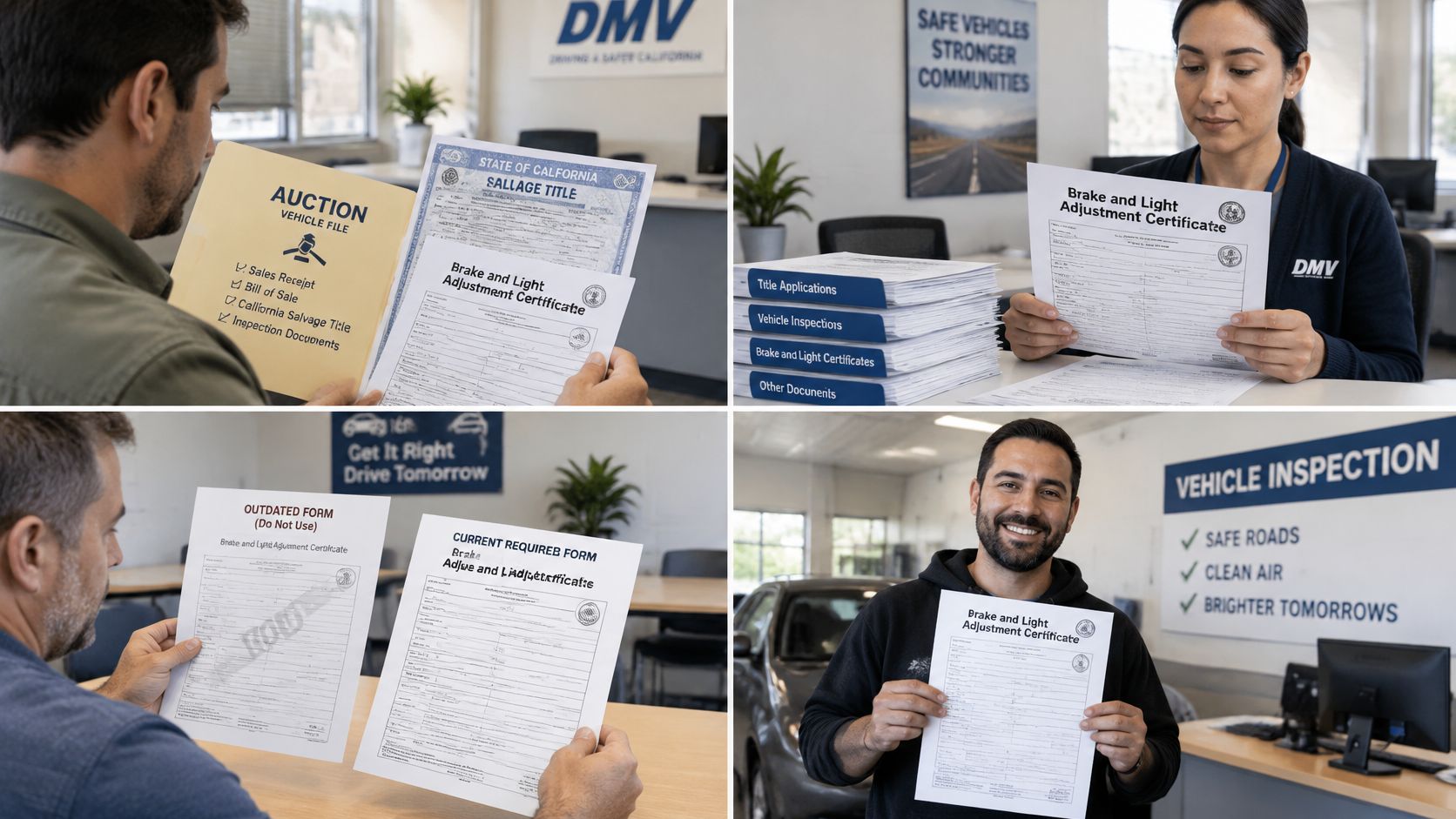
Case 1 The Auction Packet With Old Wording
A buyer purchases a damaged car at auction, repairs it, and starts clearing a California salvage title. The packet includes a checklist calling for an official brake and light adjustment certificate, so the buyer starts calling shops asking for a BA and LA pair. That search is the mistake. The buyer should ask whether this transaction now requires a VSSI Pass, then treat any older B-91 or L-91 in the file as a document to verify by type and issue date, not as automatic proof. If the packet holds a later issued REV 11/08 form instead, that form is the one that gets rejected. Correct document for a new inspection need: an electronic VSSI certificate.
Case 2 The Fresh Paper Bought in 2026
An owner's DMV notice uses the words brake and light, so the owner pays a shop in 2026 for a fresh paper brake-and-light certificate and brings it in with confidence. The confidence is misplaced. The Bureau of Automotive Repair VSSI guidance states that the old programs ended on September 27, 2024, when former station and adjuster licenses became invalid and those businesses could no longer issue brake-and-lamp certificates of compliance. A newly issued paper can't be submitted as if the program were still open. The owner doesn't need a refund argument first. The owner needs the right inspection. Correct document: an electronic Pass from an enrolled station, transmitted so DMV can verify it.
The video below walks through the inspection context behind cases like these, so you can see what the current process looks like in practice.
Case 3 The Motorcycle Nobody Nearby Inspects
A motorcycle owner calls several stations. Each one is polite, and each one says the same thing. They don't inspect motorcycles. The owner is tempted to book a passenger car appointment anyway and hope the station improvises. Don't. A station that can't inspect the class can't produce the record for it. The productive question goes to DMV. Ask whether a REG 256 Statement of Facts from a repair shop applies because no qualified station for motorcycles is within a reasonable distance. Bring specifics, including the vehicle type and the stations you contacted. Correct document, if DMV allows the exception: the REG 256. If a qualified station is reasonably available, the correct document goes back to a VSSI from that station.
Case 4 The Small Trailer and the Helpful Forum
An owner registers a small utility trailer and posts a question online. Three replies insist both certificates are required, and one links to a checklist from years ago. The trailer's gross vehicle weight rating is under 3,000 pounds. That owner should rely on the exemption and skip an inspection the rule doesn't require. Forum confidence doesn't override a weight rating. Correct document: none for that trailer. The owner saves the fee, the trip, and the argument by checking the rating before obeying the checklist.
Notice what all four owners had in common. Each one started from the old certificate name, and the name pointed three of them toward the wrong action. BAR directs consumers to obtain a vehicle safety systems inspection certificate instead, while warning that some DMV paperwork still uses outdated terminology. That's why the search itself creates risk. Typing the retired phrase finds retired instructions. Before you pay for anything, confirm the transaction specific requirement for your vehicle, your date, and your class. The right question isn't "who sells this certificate." It's "what document does California accept for this transaction now." Ask that, and the four cases collapse into one habit.
How to Get a VSSI Certificate for DMV
If your vehicle needs a current inspection, follow one numbered path. Don't improvise the order. Each step prevents a specific failure, and skipping ahead is how owners end up with a paid inspection that doesn't match their file.
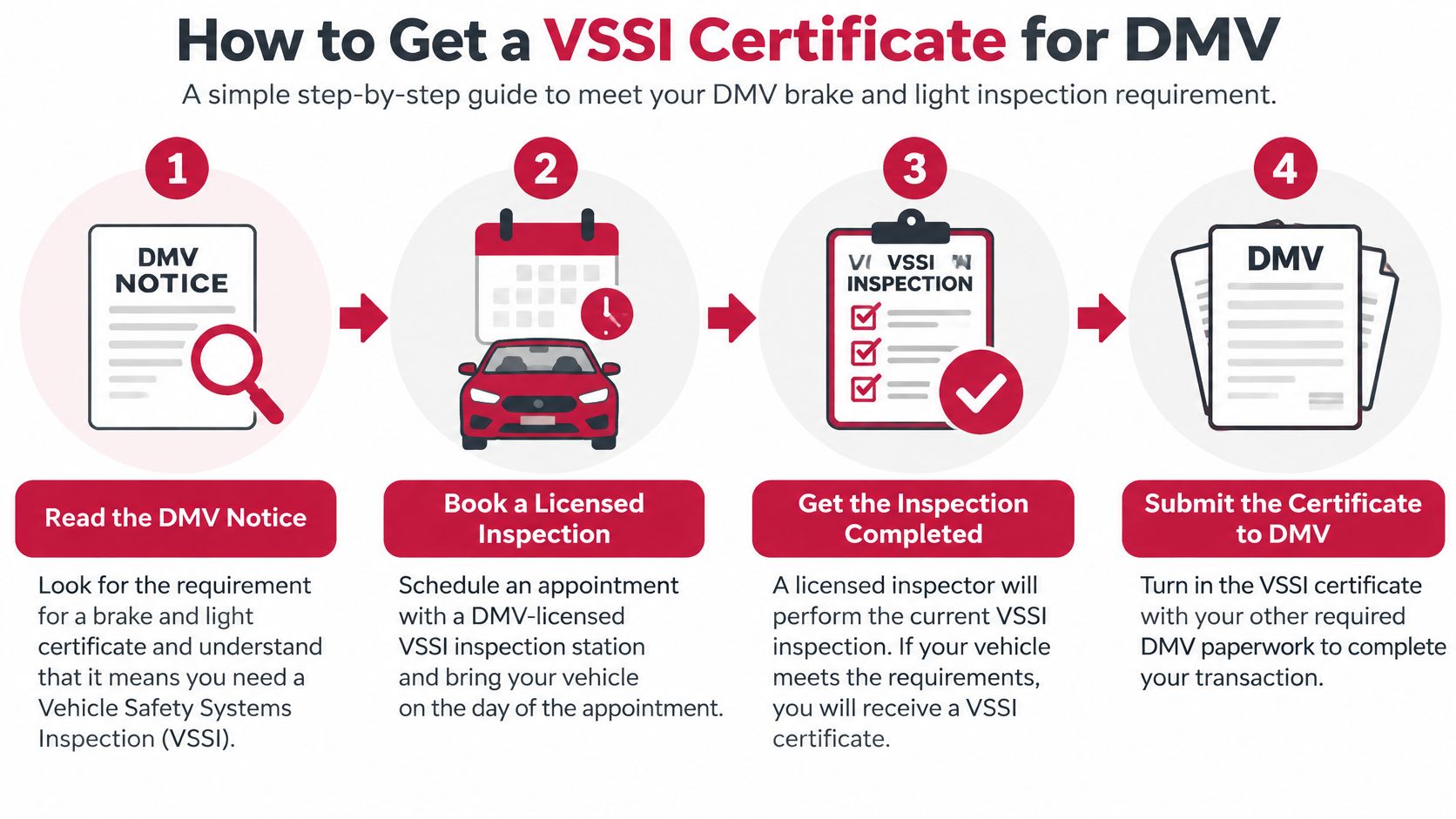
The Six Steps in Order
- Translate the notice. Read your DMV notice and convert the words brake and light certificate into a Vehicle Safety Systems Inspection, unless your vehicle is an exempt small trailer or you have a documented distance exception. Write "VSSI" on your copy so you ask shops for the right thing.
- Confirm the vehicle class. Tell the station exactly what you're bringing. A motorcycle or heavy truck shouldn't be booked at a station that only handles passenger cars. This one phone question prevents a wasted trip with a vehicle the bay can't take.
- Choose an enrolled VSSI station. Pick a station operating in the current program, not a shop still advertising a retired brake-and-lamp adjuster license. Old signage on the wall doesn't equal current enrollment.
- Get inspected once. Have the station perform the inspection and transmit the result through the BAR system. There's no second trip for a separate lamp certificate, because the combined inspection replaced the pair.
- Verify before you leave. Check that the VIN, the certificate number, and the Pass result match on the DMV record or the BAR Inspection History screen print. Read the VIN against your vehicle paperwork, not from memory.
- Use the electronic record. Take that verified record into your registration transaction. The certificate number is your reference if a clerk needs to locate the result.
Where Owners Usually Go Wrong
The most common failure happens at step 5, because it feels like paperwork after the work is done. It isn't. The electronic record is the product you paid for. If the VIN is wrong, DMV sees an inspection for some other vehicle, or for no vehicle it can match to your file. Fixing that at the station takes minutes while the technician and the record are in front of you. Fixing it later means another trip and a stalled registration.
The second failure is substitution. An informal note from a repair shop isn't the substitute for a car that can reach an enrolled station, however trustworthy the shop is. Trust isn't the standard. The program is. DMV acceptance follows the official electronic pathway for covered vehicles, and a letter outside that pathway leaves the clerk with nothing to verify. Save shop statements for the narrow distance situation where DMV procedures call for one.
There's also a date question hiding in older files. If your original transaction began on or before December 26, 2024, ask DMV how any paper from that file should be handled instead of assuming it's either automatically valid or automatically dead. Bring the paper, state the transaction start date, and let staff sort the handling. Guessing wrong in either direction costs you a trip. Guessing "valid" risks rejection at the counter. Guessing "dead" risks paying for an inspection you didn't need.
Local context helps at the booking stage too. If you're sorting out related work in the Antioch area, our page on Antioch brake and muffler services is a useful starting point for understanding nearby options, but the document rule doesn't change by neighborhood. Wherever you go, the station has to be enrolled for the inspection and able to take your vehicle class. Ask both questions on the same call.
Save the certificate number with your registration paperwork when you get home, in the same folder or the same phone note. If DMV, a buyer, or an insurer asks how the safety requirement was satisfied, you'll answer in seconds instead of digging through a glovebox. And keep the categories clean to the end. A smog check is a different inspection and doesn't replace a VSSI certificate.
Finish the Registration After the Safety Record Is Set
Start from the decision you've already made. If the lookup showed an exemption or a still valid older form, take that answer to the registration transaction and don't buy a new certificate. If your vehicle needed a current inspection, move to the DMV step only after the VSSI Pass, VIN, and certificate number match. Correct safety document first, registration second. Reversing that order is how files stall at the counter.
For the registration step itself, we're a licensed California business partner for DMV registration services, and our DMV registration services include CA renewals and ownership transfers. Regular CA vehicle registration renewals, including the sticker, cost $30.00 plus the applicable DMV fee. Review the documents a transaction needs on our page covering vehicle registration documents, then confirm directly which DMV services we can handle for your specific transaction before you book, because available services can change.
Call with your VIN, certificate number, and registration paperwork in front of you, so we can answer the transaction question in one conversation. Ask which vehicle classes and transactions we handle, and don't rely on any shop to issue a retired brake-and-lamp certificate. A smog check is a separate test and doesn't produce a brake, lamp, or VSSI certificate. Bring us a settled safety record, and the registration work becomes the straightforward part.
If your VSSI Pass is verified or your vehicle falls under a real exemption, we can help you finish the California registration step with renewals and ownership transfers handled by a licensed DMV business partner. Bring your VIN, certificate number, and paperwork, and visit Fire House Smog to confirm the services your transaction needs before you make the trip.
Most advice about how to check vehicle ownership starts in the wrong place. It tells you to run the plate, pull a vehicle history report, or type the VIN into a website and look for a name. In California, that search doesn't prove the person holding the keys can legally sell you the car.
A clean history report can still sit next to an open lien. A registration card can be current while the title names someone else. A seller can have the car in the driveway, know every repair it has had, and still lack a transferable right to sell it.
You're not hunting for one name. You're proving an unbroken, transferable chain of title, with fixed deadlines once money changes hands. If the title, VIN, seller identity, lien status, mileage, and signatures don't line up, don't treat the gap as paperwork for later. Stop the sale until they do.
Table of Contents
- What Actually Proves California Vehicle Ownership
- Information Deadlines and Privacy Limits
- Verify the Title Before You Pay
- When the Ownership Check Does Not Match
- Finish the Transfer With a Licensed Partner
What Actually Proves California Vehicle Ownership
California won't hand a stranger the registered owner's name and address from a license plate or VIN. That's the first correction most buyers need. A public owner lookup isn't a step you missed. It's a step that doesn't replace the seller producing the title.
The California Certificate of Title is the document that proves ownership. The California DMV guide to vehicle titles distinguishes that certificate from other records and identifies the registered owner, legal owner or lienholder, VIN, and odometer information on it. Read those fields separately. They answer different questions.
A registered owner is the person associated with registration and use of the vehicle. A legal owner or lienholder may be a lender with a financial claim until the loan is satisfied. When those names differ, possession of the car and a card in the glove box don't settle who can sign the title over to you.
Records That Look Like Proof but Are Not
A history report helps you screen a car. It may flag salvage, theft, brands, or mileage problems. It doesn't prove the seller is the legal owner, and it can't release a lien. Treat it as background, not as the ownership check itself.
The same caution applies to the seller's Notice of Transfer and Release of Liability. That filing tells DMV the seller reported the sale and asks to be released from later liability. It doesn't put ownership in the buyer's name. Buyers who confuse those two filings can drive away believing the transfer is finished when the official title work still isn't.
Financed and recently paid off cars add another wrinkle. California's Electronic Lien and Title system stores lienholder title information electronically. A lender can transmit lien satisfaction to DMV before any paper title reaches the seller. No paper in the driveway may be explainable, but it still has to be explained with records, not reassurance.
| Record | What it shows | What it does not prove | Where it comes from |
|---|---|---|---|
| California Certificate of Title | Legal ownership, registered owner, legal owner or lienholder, VIN, odometer | That registration fees are current | Seller, or DMV after a title is issued |
| Registration card | Registered owner and that the vehicle is registered | A right to transfer ownership | Vehicle or the owner's DMV record |
| Vehicle history or NMVTIS-style report | Brands such as salvage or theft, and some odometer or lien flags | That the person selling is the legal owner or that the lien is released | Commercial history provider |
| Notice of Transfer and Release of Liability | Seller has reported the sale and asked to be released from later liability | That ownership has transferred to the buyer | Seller files with DMV, often online |
| Electronic lien and title record | Lienholder holds the title electronically until the loan is satisfied | That a paper title is already in the seller's hands | Lender and DMV Electronic Lien and Title system |
| REG 227 duplicate or paperless title application | A request to replace a lost, stolen, damaged, or illegible title | Ownership until DMV issues the replacement | Seller or owner submits to DMV |
Walk the rows in order. The title answers who owns it. The registration card answers whether the vehicle is registered. The notice protects the seller after the sale. A REG 227 starts a replacement process, but the application itself isn't ownership.
If you're deciding whether you're looking at an ownership document or a registration document, read the plain comparison of title transfer versus registration before you agree on price. Then use a simple rule. Any row that fails is a stop, not a chore to clean up after payment.
Information Deadlines and Privacy Limits
Gather the facts before you open a DMV session or drive to meet a seller. Guessing at a character in a VIN or a name spelling at the counter wastes the trip and can put the wrong information into the packet.
What to Have in Hand
- Vehicle identifiers: The full VIN and, for a car already registered in California, the license plate number.
- Title names: The registered owner, any legal owner or lienholder, and the exact spelling used on the title.
- Sale facts: The odometer reading, sale date, purchase price, and contact details for buyer and seller.
- Identity documents: Photo ID for the person signing, plus any lien release the title requires.
- Supporting certificates: A smog certificate when this transfer requires one, kept separate from the title itself.
Keep two jobs apart. Checking a car you already own means signing in to your DMV online account and comparing the plate and VIN it shows with your title and registration card. Checking a car you might buy means the seller produces the title for you to inspect. There's no public owner name lookup that lets you skip that exchange.
Two Clocks Start at the Sale
People often treat the seller's filing and the buyer's filing as one task. They're separate duties, owed by different people, and one doesn't complete the other.
Seller clock: File the Notice of Transfer and Release of Liability within 5 days after the sale. Buyer clock: Submit the ownership transfer within 10 days after purchase.
The seller's notice helps keep later tolls, parking citations, and crash liability from being billed to the old owner. It does not transfer the title. The buyer's submission is the official ownership transfer, and waiting risks penalties and a record that still points to the prior owner.
| Deadline | Timing | What it does |
|---|---|---|
| Seller Notice of Transfer and Release of Liability | 5 days after sale | Stops later tolls and tickets from billing the old owner, but does not transfer ownership |
| Buyer ownership transfer | 10 days after purchase | Official title transfer still required; late filing risks penalties |
| Electronic lien paper title delivery | About 8 days per DMV average | A recent payoff plus this wait can be normal; silence from the lender beyond it is a problem to chase |
On money, expect the DMV transfer fee plus use tax based on the purchase price or the vehicle's current value, whichever the DMV rules require for that transaction. A licensed business partner adds its own service fee on top of the state amount, so don't mistake the service charge for the state charge. Ask for the two figures separately before you pay.
Before anyone leaves the driveway, photograph the signed title, the IDs used, the dashboard odometer, and the liability release confirmation. Keep online confirmation numbers with the transfer packet. If DMV follows up, you'll have a complete filing trail instead of a memory of what somebody clicked.
Verify the Title Before You Pay
A registration card and a set of keys do not prove that a seller can transfer ownership. The title must connect the legal owner to the person signing the sale, with any lien properly cleared. If that chain has a gap, pause before paying.
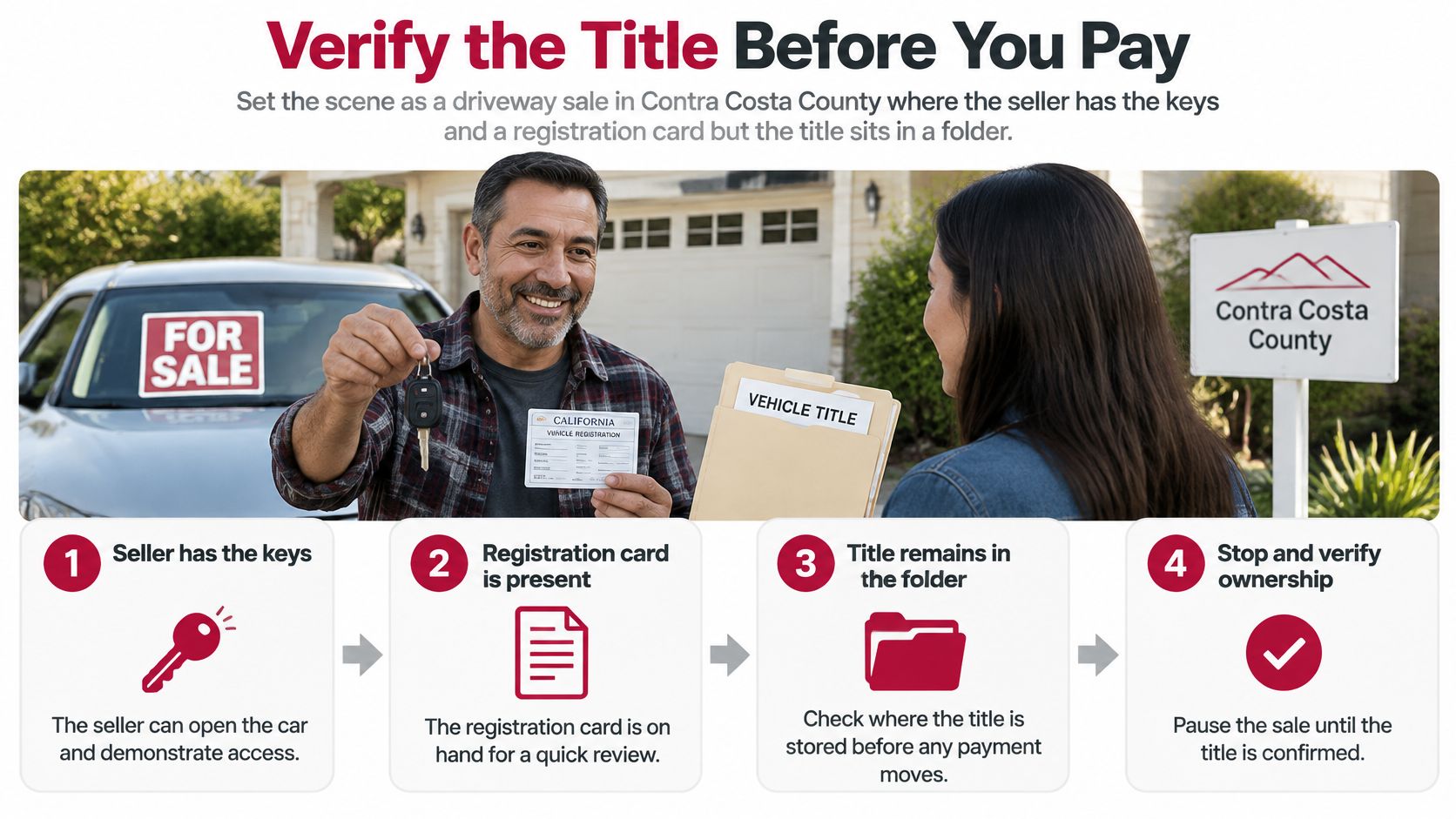
The California DMV guide to changing vehicle ownership gives the buyer 10 days after purchase to transfer ownership and the seller 5 days to file a Notice of Transfer and Release of Liability. Check the paperwork before money changes hands so there is time to address a missing signature or release.
The Eight Checks in Order
Get the original title. Ask to see the California Certificate of Title. If it is lost, stolen, damaged, or illegible, the owner needs to start REG 227 for a replacement. Do not pay in full based on a promise that the title will turn up.
Compare the VIN yourself. In daylight, match the VIN on the vehicle to the title, character by character. Check every digit and letter, including the check digit. A mismatch can mean the paperwork describes a different vehicle.
Match the seller to the title. Compare the name on the title with the photo ID of the person selling the vehicle. If they differ, ask for the missing link in the ownership chain. An explanation from a spouse, relative, friend, or prior buyer does not replace the required documentation.
Collect every required signature. Check that the buyer, seller, and any required lienholder have signed in the correct places. Do not leave reassignment spaces blank for someone to complete later. Each assignment should show a clear transfer from one owner to the next.
Verify the lien release. If a lienholder is listed, confirm the release before finalizing payment. A lien release on REG 227 must be notarized. A payoff screenshot may support the seller's account, but it does not replace the release needed for the transfer.
Capture the odometer reading. Record the vehicle's mileage and complete the required disclosure. Federal odometer disclosure rules apply to most newer vehicles, so read the disclosure section of the title and transfer form before you sign. Compare the written figure with the dashboard reading while both parties are present.
Confirm smog where required. Some transfers require smog certification and others do not. Confirm which rule applies to the vehicle and buyer before submitting the paperwork. Resolve title problems first, rather than spending money on a test before you know the transfer can proceed.
Calculate fees and use tax before filing. Account for the DMV transfer fee, any use tax, and applicable registration amounts. If you use a service provider, keep its charge separate from the state's fees so you know what each amount covers.
Stop if the VIN, seller's identity, lien status, mileage, or signatures do not match. Do not hand over the money or submit an incomplete packet.
A mismatch can delay the new title and leave the prior owner connected to the vehicle in DMV records. The buyer may also have difficulty registering or reselling a car without a clean transfer. Waiting for the right document is safer than trying to unwind a payment later.
Habits That Prevent Most Stalls
Sellers can file the release of liability on the day of sale and keep its confirmation with a copy of the signed title. That creates a dated record if a toll or ticket arrives after the sale.
Buyers should settle questions about the seller's name and any lien before paying for repairs, registration, or smog testing. A new battery does not repair a broken title chain, and parts receipts do not establish that the seller can transfer ownership.
Family and gift transfers still need a complete owner match, even when no money changes hands. The titled owner must make the transfer, or the missing assignment must be completed.
For an out-of-state vehicle, allow time to review the title before promising a registration date. Once the documents and ownership chain line up, file the transfer promptly and keep copies of the paperwork.
When the Ownership Check Does Not Match
The sale stalls on a Saturday. The ad said clear title, the test drive went fine, and the folder doesn't match the claim. Don't start by asking which form fixes it. Name the mismatch first. The correct next step depends on whether the problem is identity, lien, mileage, a missing title, or an unfinished earlier sale.
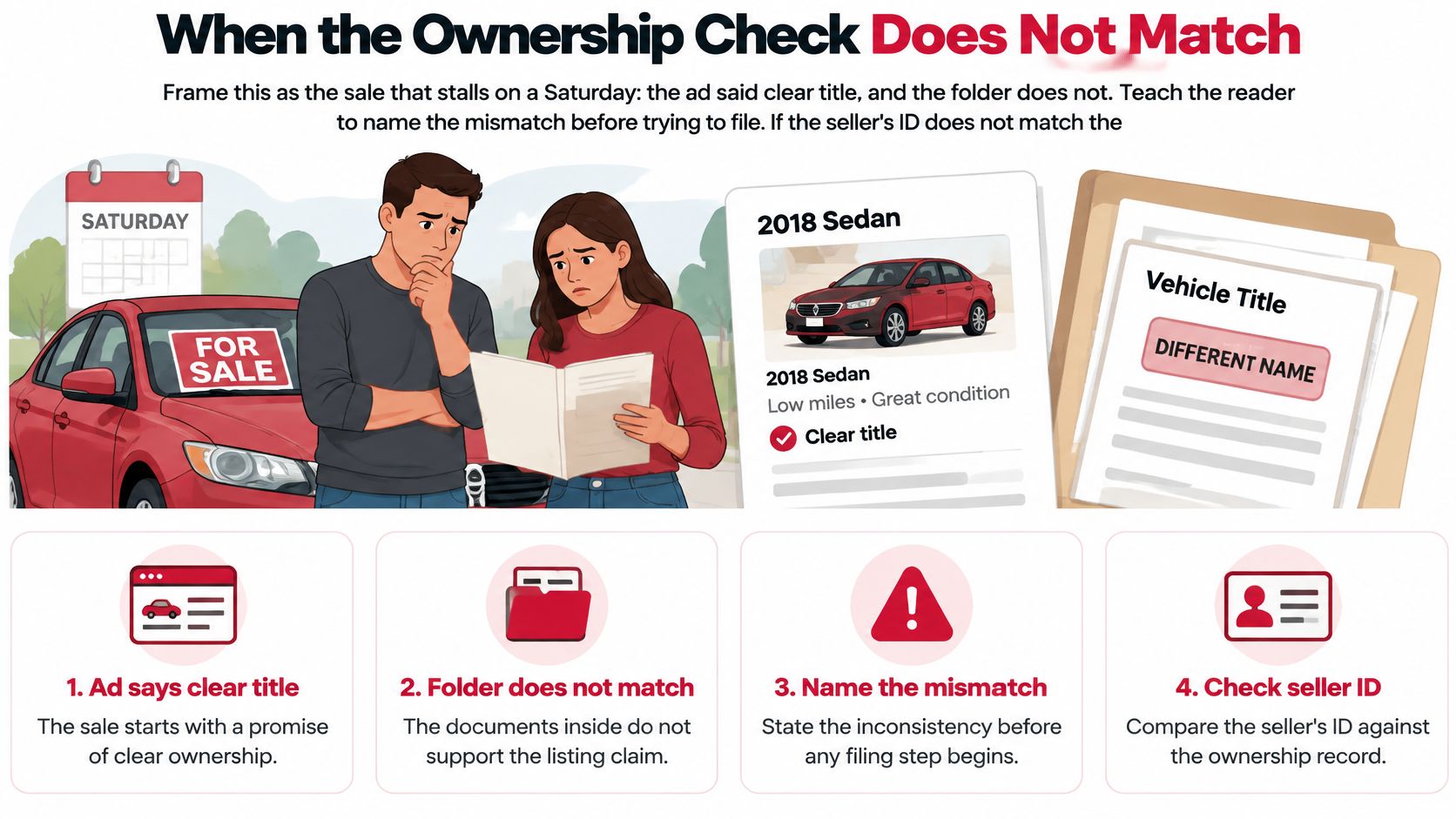
The California DMV guidance on title transfers and changes requires ownership or lienholder changes to be reported to DMV within 10 days, and an official title transfer is still required. That deadline doesn't excuse filing a packet you already know is incomplete. It means you should resolve the defect quickly and document what you did.
| What you see | Likely cause | What to do | Do not do |
|---|---|---|---|
| Seller ID does not match the title | Title never updated, or the seller is not the legal owner | Stop and require the titled owner or a complete chain of assignments | Accept a registration card as a substitute |
| No paper title in hand | Lost or damaged title, or an electronic lien not yet converted to paper | Use REG 227 for a lost title, or wait about eight days after a confirmed electronic payoff | File a transfer with a blank or missing title |
| Lien still listed | Loan unpaid, or release not recorded | Get a lien release, notarized when it is on REG 227 | Trust a verbal payoff or a payment screenshot alone |
| Odometer figures disagree | Disclosure error, noncomplying title, or a possible rollback | Reconcile the reading and use the required disclosure, including REG 262 when the title is noncomplying or extra reassignment is needed | Submit conflicting mileage |
| Out-of-state or foreign title | Incoming title may not meet California or federal disclosure rules | Confirm the title complies before choosing the California form | Assume every out-of-state title transfers the same way |
| Several names in the assignment chain | Prior sales were never finished with DMV | Complete each link before the current seller signs to you | Skip a missing owner to save time |
The Eight Day Electronic Lien Wait
No paper title doesn't always mean the seller is hiding something. After an electronic lien transaction, paper title delivery averages eight days, according to the DMV guidance linked above. A recent, confirmed payoff plus that short wait can be legitimate. Ask for the lender's payoff confirmation and a date you can verify.
Silence is different. If the lender won't confirm satisfaction, the seller can't say when the electronic record was released, or the promised paper title keeps slipping without a paper trail, pause the purchase. You're distinguishing a processing delay from an unresolved ownership problem, and the seller needs to supply the evidence.
When REG 262 Enters the Packet
Mileage mismatches need care because an error can look like fraud on paper. Federal rules generally require odometer disclosure during transfers. California may require the separate REG 262 when the title is noncomplying, a replacement title application is used, or additional reassignment is needed. For an out of state vehicle, the disclosure method depends on whether the incoming title already complies with applicable requirements.
Don't average two mileage figures, copy the lower one, or leave the space blank to deal with later. Reconcile the title, dashboard, and disclosure, then use the form that fits the title you have. If the numbers still conflict, walk away until the seller can explain them with records.
Multiple names in the reassignment boxes require the same patience. Each link has to be complete. Skipping a missing owner breaks the chain you're trying to prove. While you sort it out, you can review how to track a vehicle ownership transfer status so you know what a completed filing should look like.
An incomplete packet delays the new title while liability can stay with the prior owner. That's the chain of title test. You aren't hunting one name. You're proving an uninterrupted right to sell, from the titled owner through every assignment to you.
Finish the Transfer With a Licensed Partner
Once the title, VIN, seller, lien, and odometer agree, the remaining job is filing. You don't need another owner search. You need the transfer submitted correctly and current registration issued before the buyer's deadline becomes a problem.
You can submit to DMV directly or use a licensed California business partner for DMV registration services. That choice matters when a field office line would push a clean packet past its filing window. The nearest DMV offices to Antioch are in Pittsburg and Concord, so travel and queue time belong in the decision.
At Fire House Smog, 2900 Lone Tree Way in Antioch, we handle California renewals and ownership transfers, including California and out of state vehicles with the sticker and license plates as needed. Our transfer service is $55 plus the applicable DMV fee. State use tax and any registration fees DMV calculates are separate, so read the DMV amount and our service fee as two lines, not one bundled state charge.
You can review the filing path for a DMV transfer of ownership before you come in. DMV services run Monday through Friday 9:30 AM to 5:00 PM, Saturday 9:30 AM to 5:00 PM, and Sunday 12:00 PM to 4:00 PM, though weekend services may be limited. Call us at (925) 754-1600 or book through our website if you want to confirm weekend availability.
Smog is a separate requirement from the paperwork. When a transfer requires it, our station is STAR-certified and test-only, and we don't do repairs. That separation keeps the emissions result independent from any repair sale.
Bring a Packet That Can Be Filed
- Signed title: The original title with buyer, seller, and lienholder signatures completed as required.
- Identification: Photo ID matching the names used in the transfer.
- Odometer disclosure: The completed disclosure for this vehicle and title type.
- Lien release: The release when a lienholder appears, notarized when the form requires it.
- Smog certificate: The certificate when this transfer requires one.
If any one of those items is still missing, fix it before you ask any counter to file. A partner can submit a clean transfer efficiently. No counter can turn a broken chain of title into proof of ownership.
Bring your signed title, ID, odometer disclosure, any lien release, and smog certificate if required, and we'll help you finish the California or out of state ownership transfer without a field office queue. Visit Fire House Smog to book or call (925) 754-1600 before you come to 2900 Lone Tree Way in Antioch.
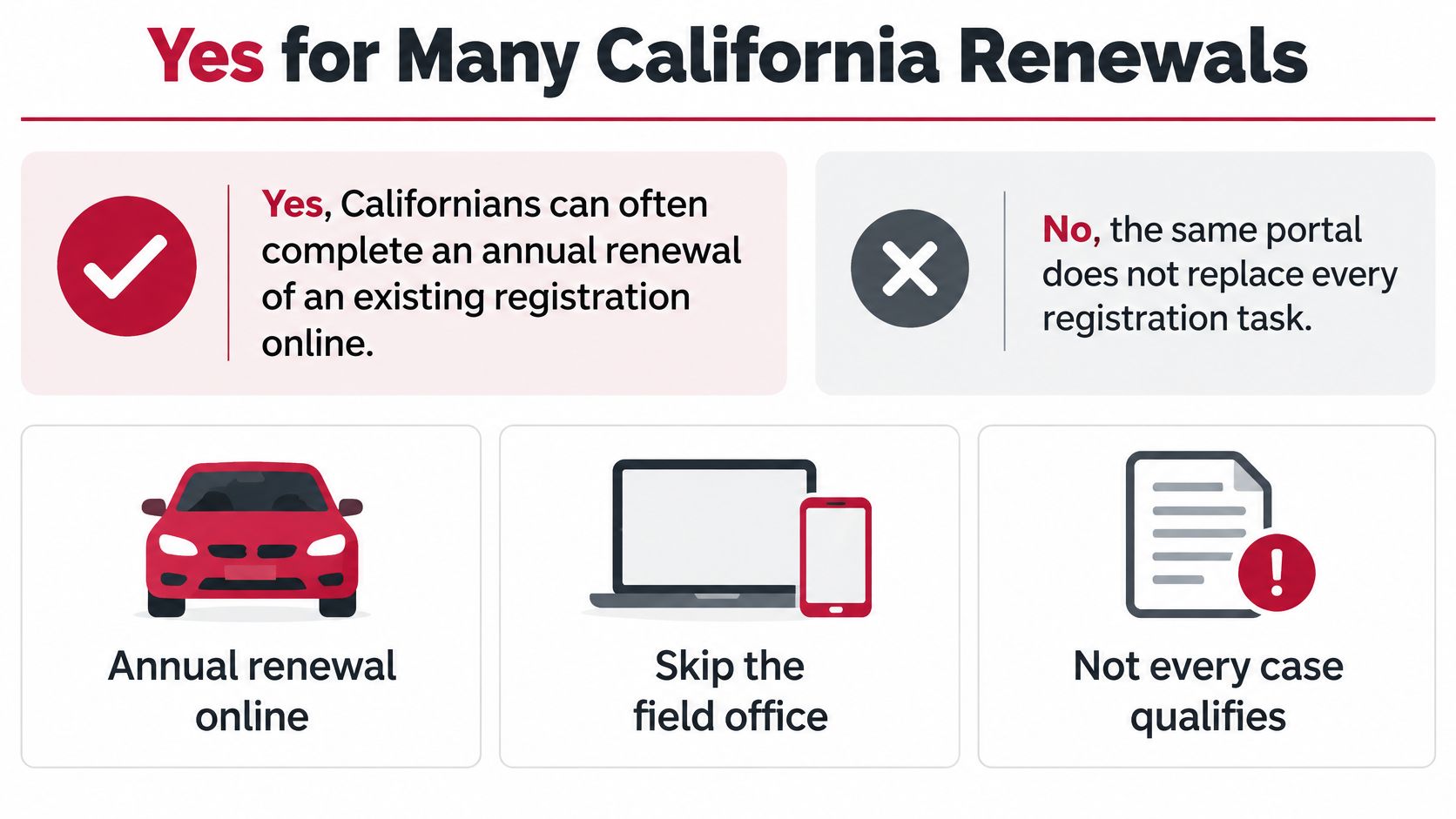
Yes, you can get car registration online in California when you're renewing an eligible vehicle already in your name. No, that isn't a blanket answer for title transfers, first-time registrations, or vehicles coming from another state.
Online renewal is a mainstream service: California DMV recorded 12,014,480 internet vehicle-registration-renewal customers in fiscal year 2021–2022, approximately 38.9% of renewal customers across all channels, according to its renewal customer report. The important distinction is what those customers were doing: renewing an existing registration record, not necessarily establishing ownership or registering a newly arrived vehicle.
Think of the DMV website as a self-checkout lane. It works well when the vehicle's record scans cleanly. It can't replace a missing title, supply an emissions certificate, or turn a payment receipt into a completed registration when required records are still missing.
Table of Contents
- Yes for Many California Renewals
- Which Registration Tasks Stay Online
- Smog Records and a Printed Sticker
- How to Renew an Eligible Vehicle Online
- When the Portal Will Not Finish the Renewal
- Transfers and Cars From Another State
- Renew Online or Finish in Antioch
Yes for Many California Renewals
An eligible annual renewal can often be completed online without a field-office visit. But the renewal portal isn't a substitute for every transaction people describe as registering a car.
California recorded 12,187,450 internet renewal customers out of 31,009,049 total renewal customers in fiscal year 2020–2021, about 39.3%, according to the California DMV's renewal customer report. That volume makes the practical point: online renewal isn't a workaround or a special exception. It's an established service for vehicles that meet the requirements.
Start with the job, not the payment
Before entering a plate number, decide what you're asking DMV to change. These are different jobs:
- Renew an existing record. You already own the vehicle, and you're extending its registration.
- Transfer a purchase. You bought the vehicle and need the ownership record changed.
- Register an out-of-state vehicle. You're bringing a vehicle into California's registration system and need the appropriate documents reviewed.
The self-checkout comparison helps here. An ordinary renewal resembles scanning a known item with a readable barcode. A purchase with missing signatures resembles bringing an item to checkout without the paperwork needed to identify who owns it. Repeatedly scanning the plate won't solve that problem.
Practical rule: Choose the transaction that matches the vehicle's ownership and registration status, not simply the webpage that accepts a payment.
Eligible doesn't mean nothing else is required
A car can belong to you and still need a supporting step before an online renewal clears. For example, the renewal notice may require a smog inspection. The inspection itself happens outside the website, even if the registration transaction can ultimately finish online.
That distinction answers a common version of the question, “Can you get car registration online?” You may be able to complete the administrative renewal online without being able to complete every prerequisite from your laptop.
Start with the notice and the vehicle's current ownership documents. If the owner is staying the same and you're renewing an established California record, the regular renewal service is a reasonable starting point. If the owner or state registration is changing, select the corresponding document-based process instead.
Which Registration Tasks Stay Online
California registration tasks and the channel that finishes them
| Transaction | Online path | Must already be true | If the portal stops you |
|---|---|---|---|
| Annual renewal of a car already in your name | Yes, when eligibility checks pass | Vehicle identifiers, required electronic insurance and smog records, and an accepted payment method are available | Clear the failed check, then renew online or use assisted renewal |
| Planned nonoperation | Online or by mail | File by the registration expiration date | A missed deadline can mean a late penalty |
| Renewal notice shows wrong address | Change the address online first | Allow the address update to process before renewing | Correct the mailing record rather than paying against the old address |
| Partial-year or other nonstandard renewal | Assisted renewal rather than routine self-service | Renewal notice and supporting certification are ready | Use DMV assisted processing |
| Ownership transfer after a purchase | Not a renewal of the seller's record | Ownership papers, signatures, transfer fees, and required compliance documents are complete | Use DMV or a licensed registration partner |
| Out-of-state vehicle | Not through the standard annual-renewal portal | Ownership and California compliance documents are assembled | Use an in-person or authorized-provider document review |
| Missing California title | Not a routine renewal solution | A replacement-title application and supporting ownership papers are prepared | Obtain assisted document review |
| Smog due or unpaid parking citations | Payment alone doesn't complete renewal | Required smog information is on file and citations are resolved | Finish compliance before treating registration as complete |
Use the table one vehicle at a time. A renewal notice for the car you've owned for years points toward the annual-renewal row. A bill of sale for a car you just purchased points toward a transfer, even if the seller also handed you a renewal notice.
A renewal notice and a bill of sale mean different things
Say you open your household car's renewal notice. Your name is correct, the vehicle is familiar, and you haven't changed ownership. Your task is to check the renewal requirements and complete the existing record.
Now say you buy a used pickup over the weekend. You have the keys and a signed bill of sale, but the California ownership record still needs attention. Paying a renewal charge associated with that plate doesn't establish that the truck belongs to you.
The same separation matters when you move to California with a vehicle registered elsewhere. You aren't just extending an existing California registration. You need the paperwork appropriate to bringing that vehicle into the state's system.
A plate number identifies a vehicle. It doesn't tell the portal that every ownership, address, and compliance requirement has been satisfied.
Choose a fallback that can fix the actual problem
A rejected renewal doesn't always mean you need a field-office appointment. Some problems require a corrected electronic record; others require a person to review documents. Match the fallback to what's missing.
For an ordinary renewal, preserve the portal's message before closing the page. For an ownership transaction, organize the title papers instead of continuing through a renewal checkout. For an out-of-state vehicle, confirm the document packet before making a trip.
This avoids a frustrating detour: reaching a payment screen, assuming you selected the right service, and discovering afterward that the vehicle still needs a different transaction.
Smog Records and a Printed Sticker
The website can process information, but it can't inspect your exhaust system or hand a sticker through your screen. Those physical steps explain why an otherwise online transaction can still involve a visit somewhere.
The inspection and the registration are connected, but they aren't the same service. When a smog certificate is required, the registration process needs the electronic certification associated with the vehicle. A photo of inspection paperwork on your phone isn't the same thing as that electronic record being available.
Complete the inspection before assuming the record is ready
If your notice calls for a smog check, arrange the test before treating the renewal as a simple payment task. Keep the inspection paperwork so you can identify the vehicle and discuss any mismatch if the renewal still shows an emissions requirement.
Our guide to California smog test validity can help you think through the timing of the inspection and the registration transaction. Don't assume an old test automatically satisfies the requirement attached to the current transaction.
At a test-only station, inspection and repair sales are separate. We don't perform repairs, so a failed test doesn't lead to an in-house repair invoice. The next action is to address the reason for failure and arrange the necessary retest.
- If the vehicle passes: Keep the paperwork and make sure the renewal can recognize the required certification.
- If it fails: Resolve the emissions issue before expecting the registration requirement to clear.
- If the portal still requests smog: Preserve that message and the inspection paperwork rather than assuming another payment will help.
Decide how you need to receive the sticker
Finishing an online transaction and holding the registration sticker are different milestones. Follow the DMV's completion and delivery instructions, and don't assume an online payment means you'll have a physical sticker immediately.
If you need counter assistance, verify that the transaction can be completed with the documents you have. An unresolved compliance requirement remains unresolved at a counter, even when printing is available.
Also check registration-counter hours separately from smog-testing hours. A station may be open for inspections while its registration counter isn't operating. Once the required electronic records are ready and no ownership documents are missing, the website remains a sensible tool for an eligible renewal.
How to Renew an Eligible Vehicle Online
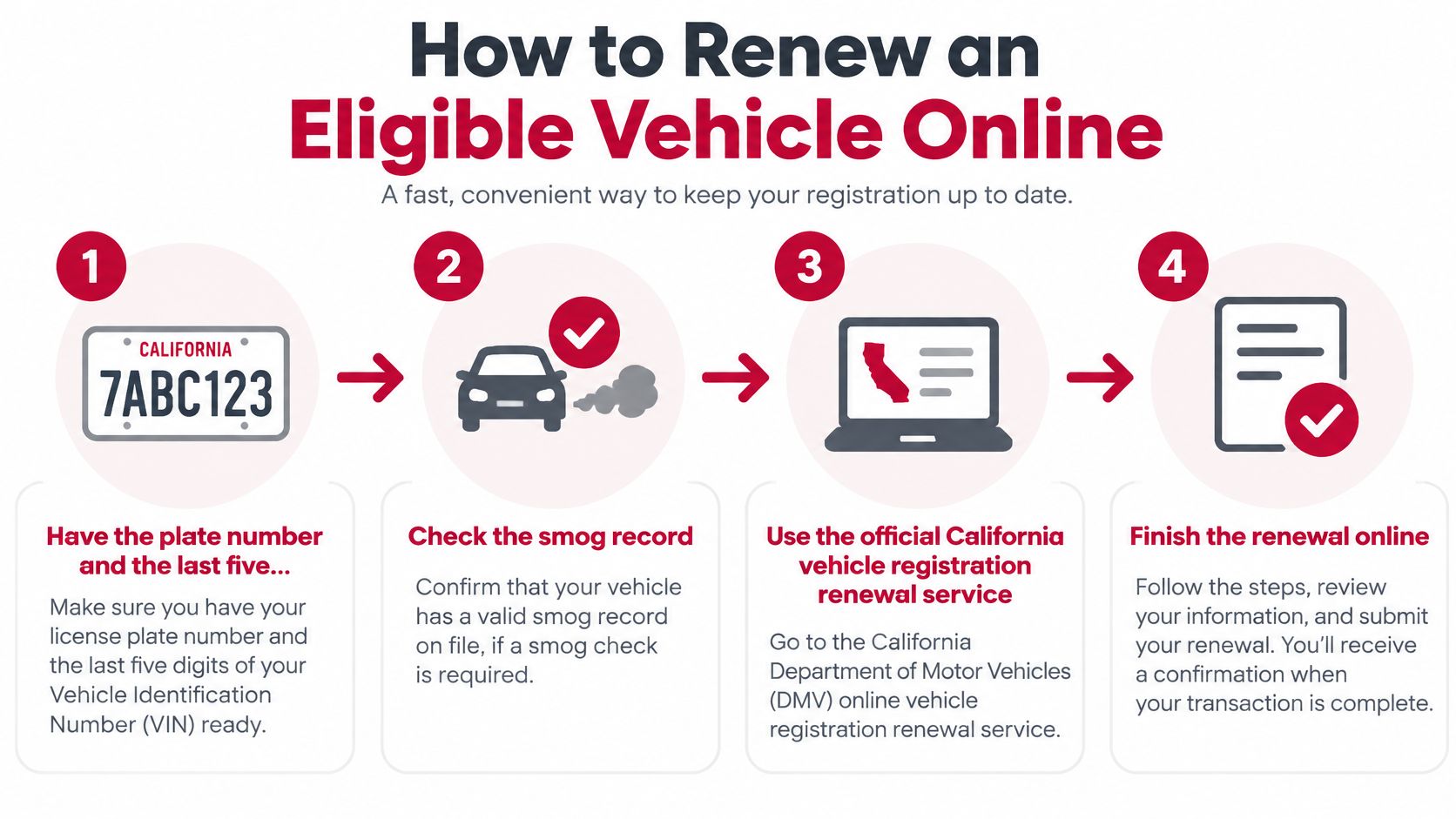
Start with a clean renewal: the car is already in your name, and you're extending its California registration rather than changing ownership. The California DMV vehicle-registration renewal service requires the plate number, the last five characters of the VIN or HIN, and an accepted electronic payment method, with required insurance and smog information on file.
Use this visual as a preparation checklist, then work through the actions below.
Prepare the record before paying
Gather the vehicle identifiers. Use the renewal notice or the vehicle's identifying information. Check each character carefully, especially when you manage several cars or work trucks.
Confirm electronic insurance reporting. Unless the vehicle is exempt, DMV needs the required insurance information electronically. Having a policy card in your wallet doesn't by itself establish that the electronic registration record has what it needs. Contact your insurer if the portal identifies an insurance problem.
Check the required smog record. Complete any required inspection and make sure the certification requirement is satisfied. Paying while the smog requirement remains open can leave you with fees paid but renewal unfinished.
Resolve parking citations and other holds. Read the notice and portal messages rather than skipping directly to checkout. If you recently resolved a citation, retain the receipt so you can address a record that hasn't cleared.
Pay the displayed fees. Use a credit card, debit card, or checking account accepted by the service. Review the vehicle information and amount before submitting.
Save the result and follow delivery instructions. Keep the confirmation and any status message. Watch for the registration card and sticker through the method DMV specifies, and act on any outstanding requirement rather than assuming the receipt closes the transaction.
For help organizing what to keep beside you, use our vehicle registration documents checklist. A readable notice, correct identifiers, and retained compliance receipts make it easier to resolve a rejected transaction without starting from memory.
Payment isn't clearance: The payment screen handles fees. A completed renewal also requires the vehicle's record to satisfy the applicable checks.
Read the final status, not just the charge
A successful charge tells you money moved. Read the completion language separately, including any instruction to submit a document or satisfy a requirement.
If the vehicle isn't being operated, consider the appropriate planned-nonoperation process rather than letting the renewal sit unresolved. Don't treat a pending issue as permission to ignore the expiration date.
This video provides another way to follow the renewal process.
If the portal asks for documents, displays an incorrect address, or won't accept the vehicle, save the exact message. It identifies what needs attention more reliably than a bank statement showing the payment.
When the Portal Will Not Finish the Renewal
Paid but not registered is the surprise to avoid. A payment receipt can exist while the registration remains incomplete because the vehicle still needs a required record or document.
Say an East Contra Costa driver pays during a lunch break, then discovers the required smog certification isn't on file. The useful next action is the inspection and confirmation of the certification record, not another attempt to pay the same renewal charge.
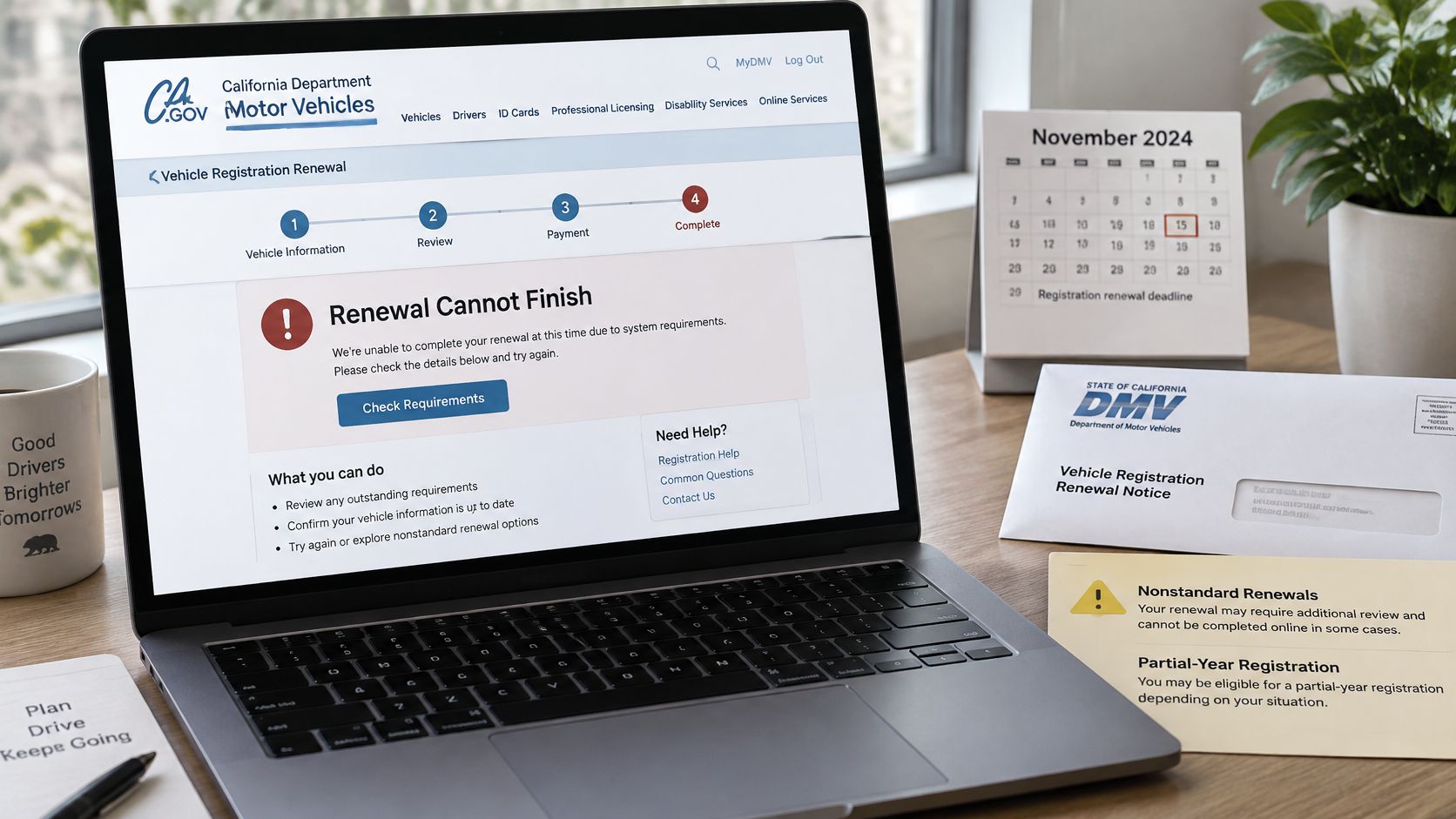
Match the stop to the fix
An incorrect address creates a timing problem. The California DMV's assisted renewal guidance instructs customers to change an incorrect address online and allow three business days before renewing, and states that renewal or planned nonoperation must be filed by the expiration date to avoid a late penalty.
Changing your address in a payment form isn't a substitute for correcting the DMV address record. Start with the address-change process, then allow the prescribed processing interval before attempting renewal.
Other stops call for different actions:
- Nonstandard renewal: Partial-year registration and other complex renewals need assisted processing. Prepare the renewal notice and smog certification when applicable.
- Insurance mismatch: Work with the insurer on the electronic reporting issue. Don't assume that entering payment details updates coverage information.
- Citation hold: Resolve the citation and retain proof. If the hold remains, seek help with the unresolved record rather than repeatedly submitting fees.
- Document request: Supply the requested paperwork through the appropriate assisted process. A routine checkout can't review missing supporting documents on its own.
Separate processing time from your deadline
The expiration date doesn't change just because you're working on a correction. Check it before choosing a process, particularly when an address update or document review is involved.
Don't improvise by sending duplicate payments. Save the confirmation, the unresolved message, and any supporting receipts, then use assisted DMV processing to establish what remains outstanding.
Fix the condition named in the rejection. Paying again doesn't replace an inspection, update an ownership record, or supply a missing signature.
A renewal problem and an ownership problem also require different responses. If the portal is rejecting a recently purchased vehicle because the paperwork still identifies the seller, you don't merely have a difficult annual renewal. You have a transfer to complete.
Transfers and Cars From Another State
People often search for online registration when they mean putting a newly purchased car in their name. California treats that as an ownership transfer, not an extension of the registration attached to the plate.
Under the California DMV title-transfer guidance, ownership changes must be reported within 10 days. A renewal payment doesn't substitute for that ownership transaction.
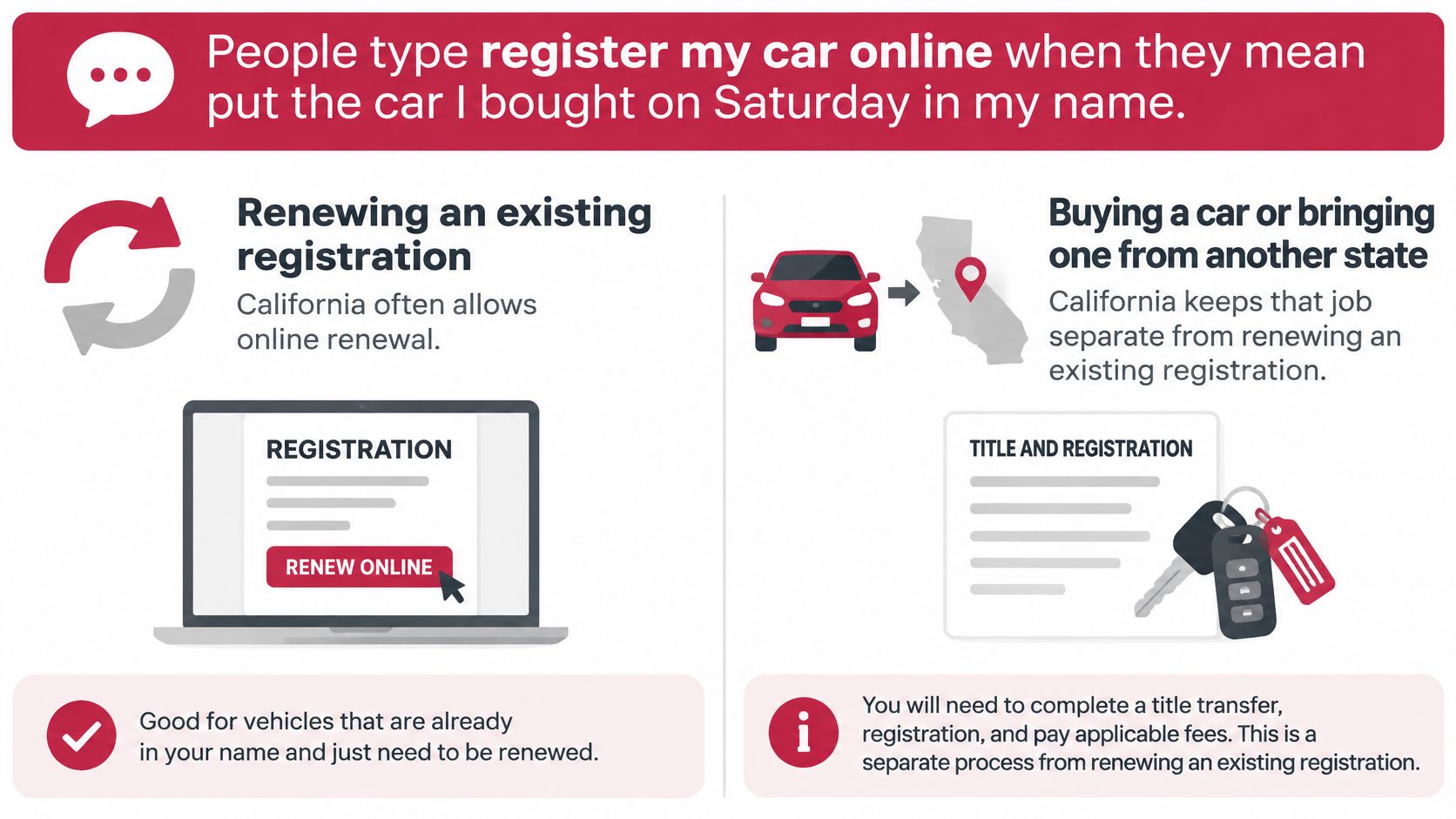
A California purchase needs a title packet
Say you buy a used sedan on Saturday. The seller gives you keys, a registration card, and a renewal notice. Before paying the renewal, check whether you have the documents needed to transfer ownership.
The packet can include:
- Ownership document: The California title, or the applicable replacement-title application if it's missing.
- Required signatures: The seller's and other required parties' signatures, including a lienholder when applicable.
- Odometer disclosure: The required mileage disclosure for the transaction.
- Fees and compliance documents: Transfer fees and smog certification when required.
A missing California title may require REG 227, rather than another trip through the renewal portal. Missing lienholder information or signatures also needs attention before you expect the ownership record to change.
Like a house, paying an annual bill doesn't change the name on the deed. Likewise, renewing the seller's registration doesn't establish you as the vehicle's new owner. Assuming otherwise can leave ownership records, liability questions, and penalties unresolved.
An out-of-state car starts from a different record
Now take a driver moving to California with a car registered elsewhere. The car may already belong to that driver, but there isn't a straightforward California annual-renewal record to extend.
The task is to assemble the ownership and California compliance documents appropriate to that vehicle. Our out-of-state vehicle registration guide helps distinguish that packet from an ordinary renewal notice.
Before visiting DMV or a licensed registration provider, gather the existing title and registration documents and identify any missing ownership papers. Confirm how any required inspection or verification will be handled. VIN Verification is not currently available at our station, so don't assume every part of an out-of-state transaction can happen at the same counter.
Online tools can help with document-based transactions, but they don't eliminate the documents themselves. The useful question isn't only whether you can start online. It's whether the channel you choose can finish the specific ownership and registration work your vehicle requires.
Renew Online or Finish in Antioch
Stay online when your vehicle's record is ready for routine renewal. That means the car is already in your name, required insurance and smog information is available electronically, the address is correct, and no unresolved citations or document requirements remain.
Choose counter assistance when you need help completing the record, have a title-transfer packet, or need an eligible transaction's sticker issued during the visit. Bring the renewal notice or ownership documents, the portal's rejection message, and any payment confirmation so the person reviewing the transaction can distinguish an unpaid fee from an unfinished requirement.
Check the counter hours before leaving
At Fire House Smog, we're a STAR-certified test-only station and licensed California DMV business partner at 2900 Lone Tree Way, Antioch, CA 94509. Our registration services include California renewals and ownership transfers; a regular California renewal, including the sticker, costs $30.00 plus the applicable DMV fee.
- Weekday DMV counter: Monday through Friday, 9:30 AM–5:00 PM.
- Weekend DMV counter: Saturday, 9:30 AM–5:00 PM, and Sunday, 12:00 PM–4:00 PM, with services possibly limited.
- Before bringing an RV or motorhome: Call (925) 754-1600 to check whether we can test it.
Smog-testing hours extend beyond the registration counter's schedule, so don't use the testing hours to plan a DMV transaction. Bring payment for both the station service fee and the applicable DMV fee, and call before traveling if you're unsure whether your documents are complete.
Fire House Smog offers test-only smog inspections, California registration renewals, and ownership-transfer assistance, with on-site sticker issuance for eligible completed transactions. Visit Fire House Smog and select Make an Appointment, or call to confirm what to bring before coming to our Antioch counter.
You bought the car on Saturday. The seller handed you the keys, you sent the money, and the signed title is on the kitchen table. Monday you look up the record and the seller's name is still there. That gap is your vehicle ownership transfer status. The handshake finished the sale. It did not finish the state's file.
Until that file changes, tickets, tolls, and questions about who owns the car can still land on the wrong person. The pages below walk each stage in order, then show how to name the blocker when a file stalls and who has to fix it.
Table of Contents
- What Transfer Status Means for a Car You Just Bought
- The Transfer Stages and What Each Status Means
- How to Check Your Transfer Status Step by Step
- How Long Each Transfer Step Typically Takes
- Documents and Fees Needed to Avoid a Hold
- Diagnose a Stalled Transfer and Choose Your Next Move
What Transfer Status Means for a Car You Just Bought
A handshake sale is like agreeing to buy a house. Vehicle ownership transfer status is the deed at the county office, and until that recording happens, the official owner on paper has not changed.
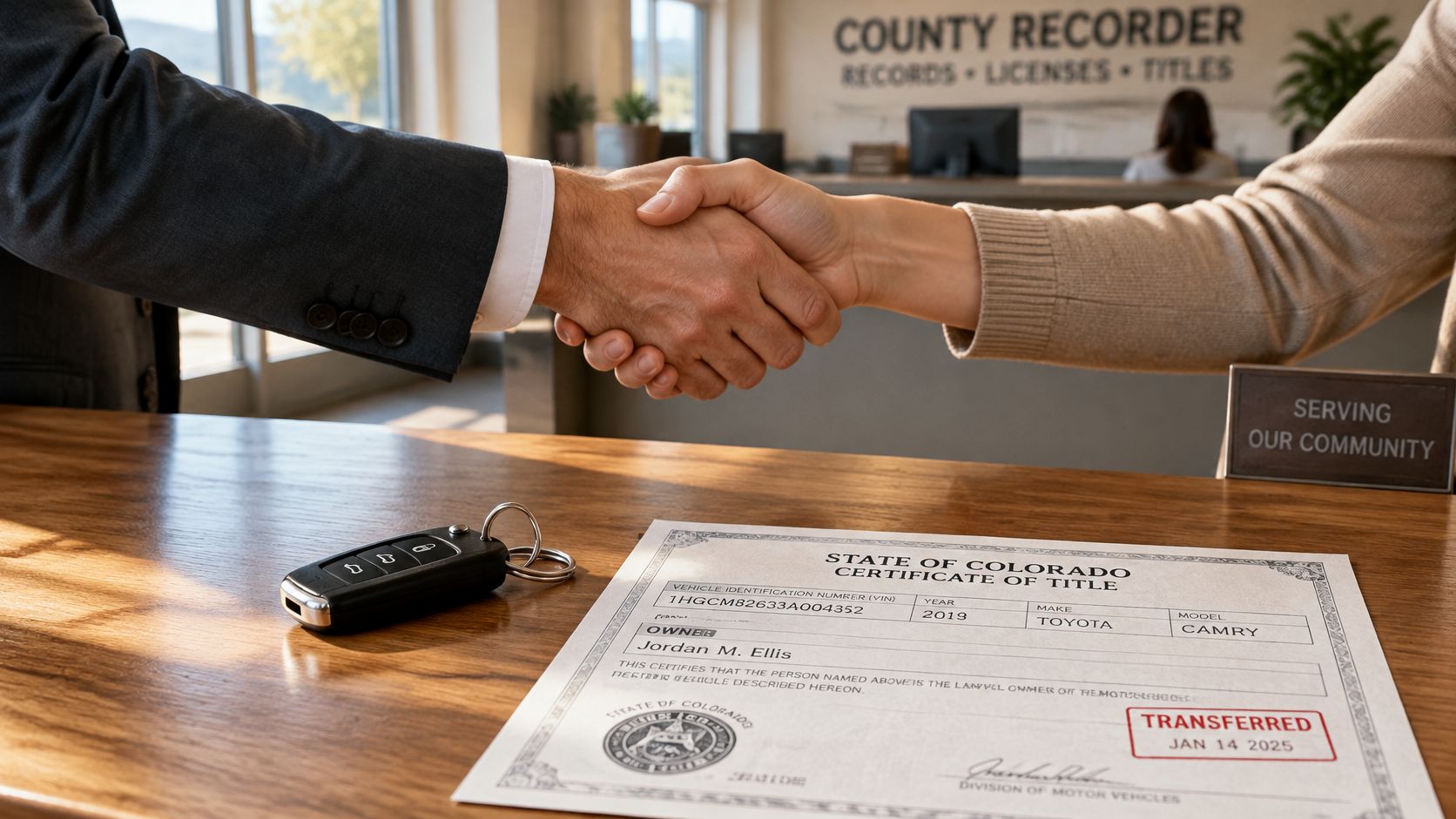
California treats the transfer as a legal-record update, not a private sale. The California DMV title transfer rules say that whenever a vehicle is bought or sold, or whenever the registered owner or lienholder changes, the Certificate of Title must move to the new owner.
A sale and a transfer are different events. The deal can be complete between two people while official ownership stays incomplete until DMV requirements, documents, and fees are satisfied.
Two clocks that start on the sale date
The buyer and seller must begin the ownership-transfer process with the DMV within 10 days of the sale. After selling or transferring the vehicle, the seller also has five days to submit a Notice of Transfer and Release of Liability. That notice helps separate the seller's future responsibility from the vehicle record. Miss either clock and the commercial deal can look finished while the official status is still open.
Why the DMV keeps the file
Title records establish legal ownership and preserve the vehicle-identification details needed for registration, resale, lien recording, and enforcement. A bill of sale shows what you and the seller agreed. It does not, by itself, change the name on the state file. People often treat a title transfer and a registration update as the same filing. They aren't, and title transfer versus registration is the distinction to settle before you assume one receipt covers both.
The first two things to check
Look at two lines before you do anything else. Does the record already show you as the new owner? Does a lienholder still appear? A registration card can update while a lender's interest is still on the title. Those two answers tell you whether you are waiting on ordinary processing or chasing a release.
The Transfer Stages and What Each Status Means
Screens don't all use the same words. Match the meaning in this table, not the exact label. Stages usually move forward in this order, and a problem can send the file back to a pending stage.
| Stage | What It Means | Who Must Act Next |
|---|---|---|
| Sale agreed, no DMV filing | The parties exchanged the vehicle. The DMV record still shows the seller. | Buyer and seller start the transfer within 10 days. |
| Application submitted | The DMV has the transfer paperwork and the fee payment. | The DMV processes. The buyer watches for the title and registration. |
| Lien release pending | A lienholder must release its interest before a clean title can issue. | The lienholder sends the electronic release. |
| Title in production | The record is updated and a paper title is being printed or mailed. | The DMV. The buyer waits for delivery. |
| Pending report or suspense | A fee deposit or a data mismatch stops automated processing. | The buyer, the seller, or the DMV corrects the item. |
| Complete | The title and registration both show the new owner. | The buyer keeps the new registration card. |
Sale agreed, then application submitted
At the first stage, nothing official has happened. You may have the keys and a signed title, and the public record still names the seller. Once the application and fees are in, the DMV holds the file. Your job shifts from filing to watching. An application number on the receipt is the handle you'll need for every later check.
Lien release, then title in production
A financed car can't get a clean title until the lender lets go. Lien release pending means the lender still has to send that release. You can't finish this stage by calling the DMV and asking them to ignore the lien. Title in production is the quieter stage. The name on the record has moved, and a paper title is being printed or mailed. Waiting is reasonable here, unless the expected window passes with no mail.
Pending, suspense, and complete
Pending report or suspense is not a polite word for "busy." A fee deposit that didn't post, or a data mismatch, stopped the automated path and pushed the file into manual work. Somebody has to correct the item. It might be you, the seller, or a DMV clerk after you show the fee record. Complete means both the title and the registration show the new owner. Keep the new registration card. Don't treat a registration-only update as this stage if a lienholder is still listed.
One action per stage keeps you from waiting on a problem that waiting won't fix. If the stage says a person must send or correct something, that person acts. If the stage says the DMV is printing or reviewing a clean file, you watch the date and recheck.
How to Check Your Transfer Status Step by Step
Four channels can answer where the file sits. Each one is good at a different job, and each one goes blind in a different way.
| Channel | Best For | What to Have Ready | Main Limit |
|---|---|---|---|
| DMV online status tool | Quick checks at any hour | VIN, plate, application or transaction number | Can lag behind processing |
| DMV telephone service | Questions about a specific hold | Application details and buyer ID | Long waits at busy times |
| DMV field office | Problems that need a clerk to review documents | Original documents and ID | Wait times; appointments may be needed |
| Lienholder or lender | Confirming a lien release was sent | Loan account number and VIN | Only knows the lien side of the record |
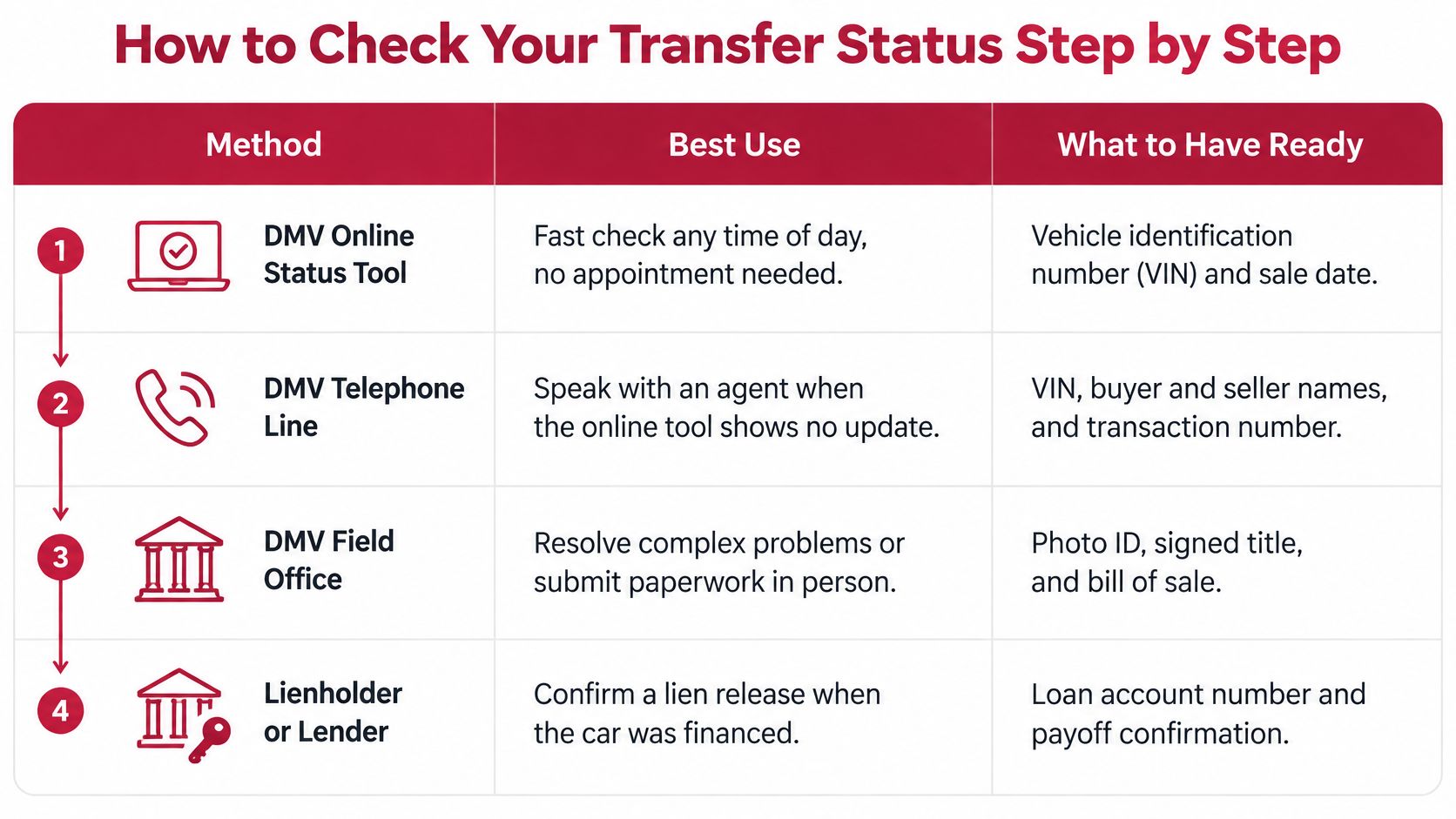
What each channel can and can't see
Online is the first look, not the last word. The status tool is there any hour, and it doesn't need an appointment. It can trail the work a clerk already did, so a blank or old result doesn't prove the file is stuck.
The phone line is for a named hold. Use it when the screen mentions a suspense item or hasn't moved. Waits run long at the start of the week and around lunch, so call with the application details already in front of you.
A field office is for paper a screen can't judge. A clerk can look at an original title, a bill of sale, or a signature that didn't scan cleanly. Expect a wait, and an appointment may be required.
The lender only knows the lien. A bank can tell you whether it sent the electronic release. It can't tell you whether the DMV accepted your fees or your odometer reading.
The online check, then the follow-up
- Gather the VIN, the license plate, the buyer name, and the application or transaction number from your receipt.
- Open the DMV online status tool on dmv.ca.gov and enter those details.
- Compare the result with the stage table above. Match the meaning if the wording differs.
- Write down the date of the last status change so the next check has a baseline.
- If nothing has changed after about 10 business days, or the status shows a hold, call the DMV telephone service at 1-800-777-0133. Confirm that number on dmv.ca.gov before you dial.
- If a lien is involved, ask the lender whether the electronic release was sent. A release that was never transmitted will not show up as a DMV delay.
A short walk-through of pulling the VIN and reading a status screen makes the first three steps easier to picture.
What to write down after every call
Keep a note for each contact. Record the date, the name of the agent, and any reference number. Write the exact phrase they used for the hold, not your summary of it. "Suspense, report of deposit of fees" is useful later. "They said it's processing" is not. If a second agent contradicts the first, you can read the earlier note back instead of starting over.
Practical rule: Recheck online before you call, and call the lender before you visit a field office about a missing title on a car that was financed.
How Long Each Transfer Step Typically Takes
Deadlines and processing times are not the same kind of number. The clocks from the first section are legal limits on when you must start. Processing times are typical estimates, and they move with workload and with how clean the file is.
Take a sale on January 5. The seller's Notice of Transfer and Release of Liability is due January 10. The buyer and seller must have the DMV transfer underway by January 15. If that filing is on time and nothing blocks it, a paper title from an electronic lien transaction is often expected about eight days later, around January 23.
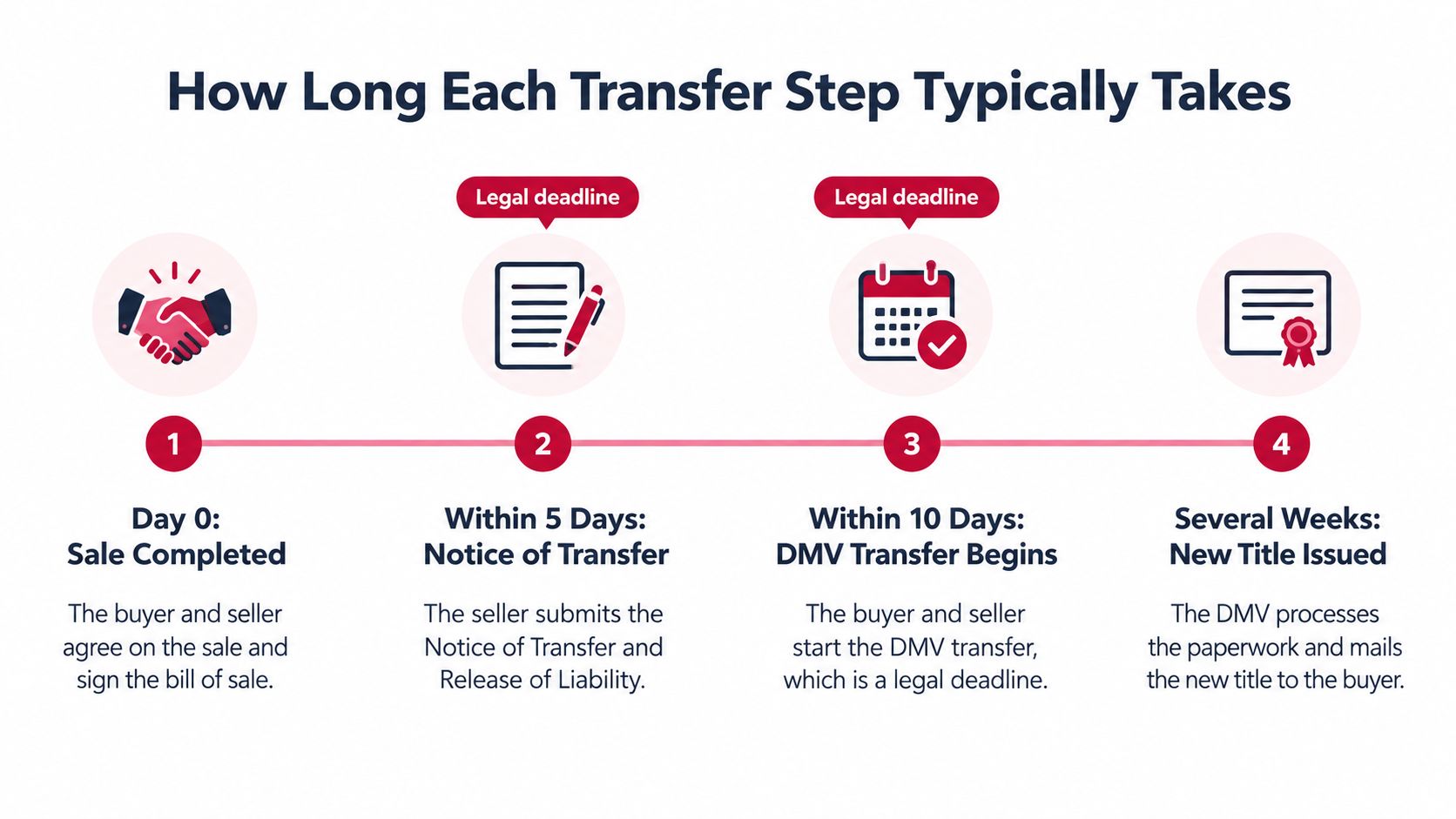
What "about eight days" actually measures
Under California's Electronic Lien and Title (ELT) program, the DMV keeps the ownership record electronically for participating lienholders instead of holding a paper title. The registered owner gets a paper registration card. When the lien is satisfied, the lienholder sends an electronic release. After that, the DMV can issue a sole-owner paper title or create a record for a replacement lienholder. The application for title or registration (REG 343) guidance says the average time to receive a paper title from an electronic transaction is about eight days.
That average assumes the file can move automatically. Pending reports of deposit of fees, or suspense transactions, can block automated title issuance and force manual processing. A rush application is a different path. Qualifying rush applications normally take 8 to 10 business days after DMV headquarters receives a complete, condition-free application. Rush does not repair a bad signature or an open lien. It shortens the queue for a file that is already clean.
When the January dates slip
File late and the whole example shifts. The electronic title doesn't start its roughly eight-day count until the DMV has a file it can work. Late-transfer penalties can apply after the filing window. The dollar amount isn't confirmed here, so check the current schedule rather than guessing from an old receipt.
A transfer-status check should verify both the registered-owner change and whether an active legal-owner or lienholder record remains. A vehicle can look transferred in registration data while the lien-release or title-production stage is still pending. If your expected date passes with no status change, don't add another week of waiting by habit. Move to the diagnosis below and name the blocker.
Documents and Fees Needed to Avoid a Hold
Most stalls start as a missing line on this list. The DMV can't invent a signature, a smog result, or a lender's name after you leave the counter.
| Document or Fee | Purpose | Practical Note |
|---|---|---|
| Signed Certificate of Title or approved replacement | Proves the seller's ownership and passes it on | Lender-held titles need the lender's release |
| Notice of Transfer and Release of Liability | Separates the seller's future responsibility | File it soon after the sale so later tickets don't stay on the seller |
| Smog certificate | Emissions compliance for a change of ownership | Exemptions apply; confirm before testing |
| Application for Title or Registration (REG 343) | Asks the DMV to issue title and registration to the buyer | Use the current form, not a saved copy from an older sale |
| Transfer fee | Processing the ownership change | Confirm the current amount on dmv.ca.gov before you pay |
| Title fee | Issuing the new title | Confirm the current amount on dmv.ca.gov; it is separate from the transfer fee |
| Registration fees and use tax | Registering the vehicle to the buyer | Varies by vehicle value and county; check the current schedule |
| Lienholder information | Recording any lien that remains | Required when a lender is involved |
| Proof of insurance | Required for registration | Keep a current policy document |
The vehicle registration documents checklist is a useful cross-check when you're assembling a file that also needs a smog certificate. A transfer packet and a renewal packet overlap, and they aren't identical.
Habits that keep a file out of suspense
- Sign only where the form indicates. A signature in the wrong box, or a buyer signing the seller's release line, is a common reason a clerk sends the packet back.
- Match the VIN and the odometer to the vehicle. One transposed digit is enough to stop automated processing. Read the dash, the title, and the application out loud against each other.
- Bring originals if you file in person. A photo of a title helps you at home. A clerk often needs the paper. If the title is lost, ask which approved replacement the DMV will accept before you invent a substitute.
- Confirm fees on dmv.ca.gov the week you file. Amounts change, and a short payment can sit as a report of deposit of fees instead of a completed transfer. Registration fees and use tax also move with vehicle value and county, so an old forum post is a bad guide.
Smog before you pay for a test
A change of ownership often needs a smog certificate, and model-year and vehicle-type exemptions exist. Confirm the exemption before you pay for a test you didn't need. If a certificate is required, an old one from the seller's last renewal may fall outside the window the DMV will accept for this sale. Ask before you assume last year's test still counts.
Diagnose a Stalled Transfer and Choose Your Next Move
Waiting is the right move only when the file is actually moving. A buyer who files on day six can see registration update within two weeks and still never receive a paper title, because a lender never released its interest. Registration data can show a transfer while the lien or title stage is still open. The DMV can also route a file to manual review when fees, lien records, or paper-title handling don't match.
California's electronic lien guidance is blunt about why an apparently complete transfer enters manual review. Pending reports of deposit of fees, suspense transactions, incorrect paper-title handling, or a lienholder's unresolved interest can prevent automated title issuance and delay later transfers. The rush title processing page is about speed for a clean application. It doesn't clear those blockers. At every stall, ask one question. What exactly is blocking my transfer, and who must fix it, the buyer, the seller, the lienholder, or the DMV?
| Symptom | Likely Blocker | Who Must Fix It |
|---|---|---|
| Status stuck at application submitted for weeks | Missing signature, VIN, or odometer error | Seller or buyer corrects and resubmits |
| Registration updated but no title | Lien release not yet recorded in ELT | Lienholder sends the electronic release |
| Title still lists a lienholder | Lien not satisfied, or release not sent | Lender, not the registered owner |
| Mailed title never arrives | Title sent to the lienholder or an old address | Lender for the title; buyer for the address |
| Status shows pending report or suspense | Fee deposit issue or incorrect paper-title handling | DMV, after the buyer checks the fee record |
| Smog certificate rejected at filing | Certificate outside the allowed window, or an exemption misread | Buyer re-tests or confirms the exemption with the DMV |
Three paths, not one waiting room
Path one, the file is still inside the window. The last status change is recent, no hold language appears, and you are inside the processing estimate from the January-style timeline above. Wait, and recheck on the expected date. Another call today won't print a title that is already in production.
Path two, the blocker is a document. The status has sat past that window, and the symptom is a signature, a VIN, an odometer line, a fee shortfall, or a smog certificate. Fix that item and resubmit. Do not file a second full application on top of the first one until a clerk tells you the first file is dead. Two open applications can create the duplicate-record problem you were trying to avoid.
Path three, a lender still holds the interest or the paper. Contact the lender first. Ask whether the loan is satisfied and whether the electronic release was sent. If the lender says the release is on the DMV record and the status still won't move, then call the DMV with the release date and your application number. The registered owner often cannot demand a title that the system is built to mail to the legal owner.
Verify the lien release, the signatures, the fees, the VIN, and the odometer. If the title is missing, confirm you are using the approved missing-title path rather than a photocopy. Also ask a question buyers skip. Will the lender, not the registered owner, receive the new title? A "lost" title is sometimes sitting at the bank because that is where the record said to send it.
When a local office can help, and when it can't
A licensed registration service can submit a complete California or out-of-state transfer and issue a sticker and plates when the file qualifies. DMV registration customer service through a business partner is one way to avoid a field-office line for that submission. Fire House Smog, a STAR-certified test-only station and licensed DMV registration provider at 2900 Lone Tree Way, Antioch, CA 94509, handles those transfers during posted hours, Monday to Saturday 9:30 AM to 5:00 PM and Sunday 12:00 PM to 4:00 PM, at 925-754-1600. It can move a complete file. It can't clear a DMV suspense item or force a lender to release a lien, so confirm the file is clean before you treat the visit as the fix.
Call ahead with the VIN, the status stage from the table, and the documents on the checklist. Say which path you are on. A clerk who hears "it's been three weeks" has less to work with than a clerk who hears "registration updated, ELT release not sent, lender is X."
If your transfer is waiting on a smog certificate or a complete ownership packet, Fire House Smog can inspect the vehicle and process California DMV ownership transfers, including stickers and plates when the file qualifies. Bring the VIN, your status stage, and the signed title or lender release so the visit starts from a real blocker instead of a guess. Visit Fire House Smog to check hours and what to bring before you drive over.
You find an expired registration card in the glove box, then open a renewal notice that arrived after a move. Maybe your car also needs a smog check, and you're wondering whether to pay now or wait until everything is ready. Before assuming you owe a flat late charge, separate two questions: Does the DMV consider your payment late, and what charges apply if it does?
California DMV registration renewal late fees depend on the vehicle record, the applicable deadline, and the length of the delay. You don't need to guess from someone else's renewal bill. You need the right deadline, the full assessed amount, and a clear plan for completing any remaining requirements.
Table of Contents
- When Your California Registration Is Actually Late
- California DMV Late Fee Amounts and How They Add Up
- Why Parking the Car or Failing Smog Rarely Stops Penalties
- What Short Delays and Multi-Year Lapses Really Cost
- Driving Holds and Other Costs of Waiting
- Where to Pay a Late California Registration Renewal
- Clear the Balance Before the Next Milestone
When Your California Registration Is Actually Late
An expired card is a reason to check your registration promptly. But if your notice arrived late, the printed expiration date isn't the only timing detail worth checking.
The DMV's late-renewal procedures state that payment is timely when fees are paid by midnight on the registration expiration date or within 60 days after the owner is notified through the renewal notice, whichever date is later. That later-date test matters when you're trying to understand a forwarded notice, a delayed notification, or a vehicle purchased near its renewal deadline.
Don't turn that rule into an assumed extension. A missing envelope doesn't, by itself, establish which notification date the DMV will recognize.
Compare the dates before accepting the charge
Start with the registration card and the notice you have. Then ask the DMV or the registration-service provider processing the transaction to confirm how the vehicle record treats the deadline.
- Check the expiration date. Use the date on the registration card rather than relying on your memory of when you usually renew.
- Identify the notification issue. Explain whether the notice arrived late, was forwarded, or never reached you.
- Verify the record. Ask which deadline applies before deciding that an assessed penalty is correct or that no penalty is owed.
- Flag a recent purchase. If you're handling a transfer, make that clear rather than treating it as an ordinary renewal.
Practical rule: A late notice is a reason to verify the deadline, not permission to assume you can keep driving or postpone payment.
Early renewal isn't a grace period
The DMV's registration-fee guidance and calculator explain that renewal fees are generated approximately 75 days before expiration, and generally become mandatory when an application is presented within 30 days before expiration. The same guidance recognizes payment on the next business day when the deadline falls on a weekend or state holiday.
Those rules serve different purposes. The early window lets you address renewal before the deadline; the business-day exception addresses a specific calendar situation. Neither creates a general grace period after expiration.
If the dates don't make sense, request a record review rather than estimating how many days late you are from the envelope alone.
California DMV Late Fee Amounts and How They Add Up
The late penalty isn't one flat charge. Once the DMV establishes that payment is delinquent, the bill combines a percentage-based penalty with separate registration and California Highway Patrol, or CHP, late fees.
The percentage applies to the vehicle license fee and any applicable weight fee, not automatically to every item on your renewal bill. That distinction matters because a renewal contains charges with different purposes.
California Registration Renewal Late Fee Bands
The following schedule follows the California DMV registration-fee table, including the combined fixed charges calculated from its registration and CHP columns.
| Delay window | Percent of license and weight fees | Registration late fee | CHP late fee | Fixed charges combined |
|---|---|---|---|---|
| 1–10 days | 10% | $10 | $10 | $20 |
| 11–30 days | 20% | $15 | $15 | $30 |
| 31 days through one year | 60% | $30 | $30 | $60 |
| More than one year through two years | 80% | $50 | $50 | $100 |
| More than two years | 160% | $100 | $100 | $200 |
Read across the applicable row, not just the final column. The combined fixed amount is only part of the late penalty, and the late penalty is added to the ordinary renewal charges.
Understand what the percentage uses
Think of the calculation as a set of separate components:
- License-fee component. Apply the relevant percentage to the vehicle license fee.
- Weight-fee component. Apply that percentage to any applicable weight fee.
- Fixed components. Add both the registration late fee and the CHP late fee from the applicable row.
Then account for the regular fees due. Don't multiply the entire renewal notice by the penalty percentage, and don't treat the fixed-charge column as the full balance.
This also explains why owners can be equally late but owe different amounts. Their vehicles may have different license fees or weight classifications. For a heavier vehicle with an applicable weight fee, the percentage component can make a meaningful difference.
For an overview of the underlying bill, the registration renewal fee guide can help you distinguish ordinary renewal charges from delinquency charges.
The useful question for a clerk or processor is straightforward: Which delay band applies, and which vehicle fees were used to calculate the percentage? Asking for that breakdown is more helpful than asking why your neighbor paid less.
You can use the schedule to understand an assessment. Use the vehicle record to confirm the amount you need to pay.
Why Parking the Car or Failing Smog Rarely Stops Penalties
Leaving a car in the driveway doesn't automatically tell the DMV that you've chosen nonoperation. Waiting for a smog certificate doesn't automatically pause the payment deadline, either.
Those misunderstandings often start with a reasonable thought: if you can't use the vehicle, why should renewal penalties apply? The DMV treats vehicle use, fee payment, and renewal completion as different issues.
The visual below separates the common assumptions from the registration problem that still needs attention.
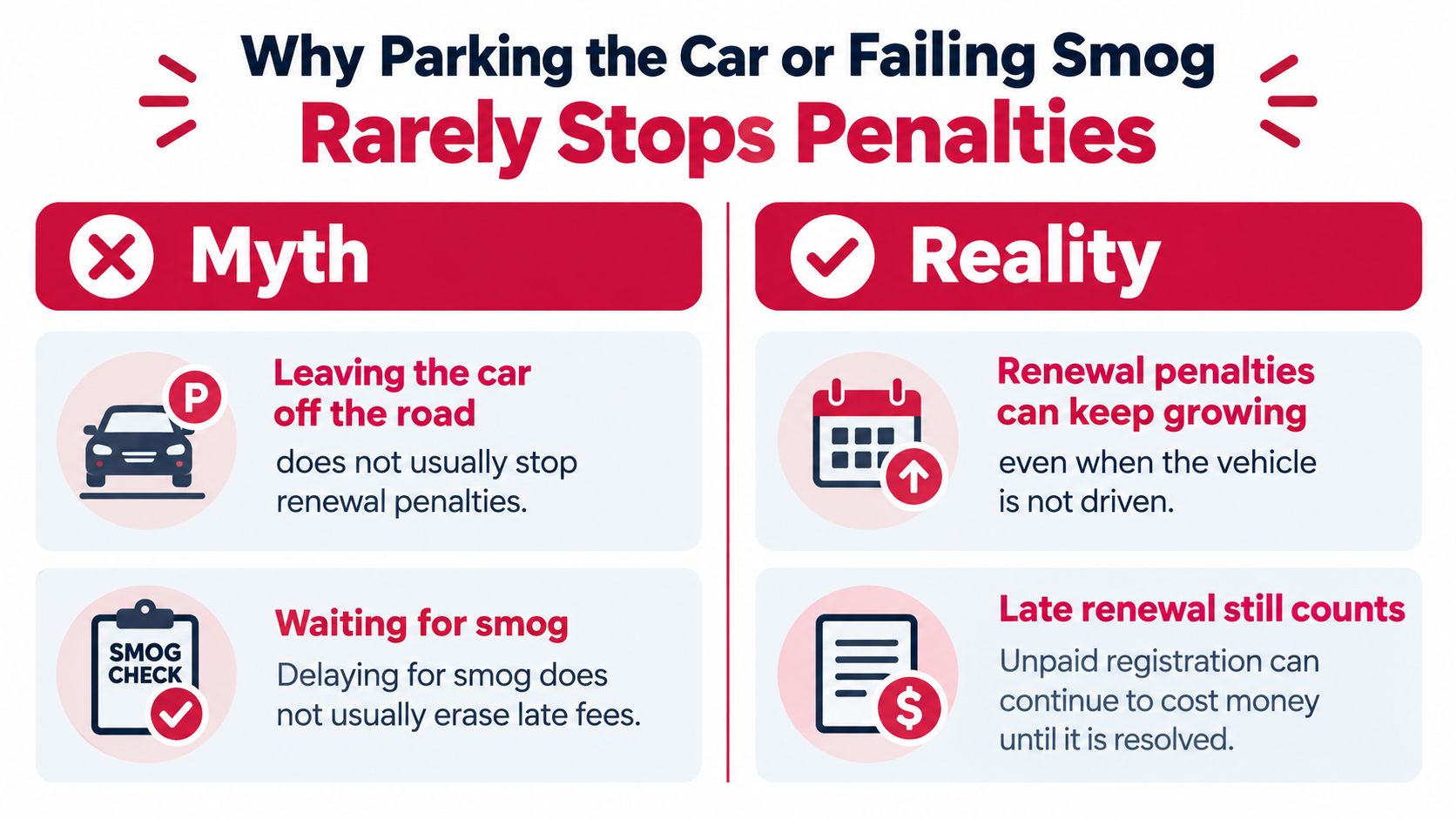
Nonoperation requires a filing
Under the DMV's Planned Nonoperation filing rules, PNO generally must be filed by the registration expiration date to avoid a penalty; it may be filed up to 90 days afterward if the vehicle wasn't operated, towed, stored, or parked on public roads, but a late filing can still carry penalties. Under those rules, after 91 days, full-year registration fees and penalties are due.
A PNO filing therefore isn't the same thing as asking the DMV to erase an existing balance. The filing has timing and use conditions, and it doesn't automatically remove amounts already owed.
- Parked on private property. That may be relevant to PNO eligibility, but it doesn't replace the filing.
- Used on public roads. Don't assume an otherwise unused vehicle meets the nonoperation conditions.
- Already delinquent. Ask what remains due instead of expecting a PNO request to cancel prior charges.
Missing smog doesn't mean missing the payment
The DMV guidance linked above also tells owners who lack smog certification or proof of insurance to pay renewal fees by the expiration date to avoid penalties. Paying the fees and finishing the renewal aren't always the same event.
If the vehicle failed its inspection, you still need to address the emissions problem. The explanation of what happens after a failed smog test can help you understand that separate task.
An unfinished smog requirement isn't a reason to leave the fee-payment question unresolved.
Ask what you can pay now, what requirement remains outstanding, and what must happen before the registration can be completed. That keeps a testing problem from becoming an avoidable payment problem as well.
What Short Delays and Multi-Year Lapses Really Cost
Consider two hypothetical drivers, not customer case studies. One discovers a recent missed renewal while sorting the mail. The other finds paperwork for a vehicle whose registration has been unresolved for years.
The desk scenes below illustrate those different situations, but neither driver can determine the full bill from the notice's appearance alone.
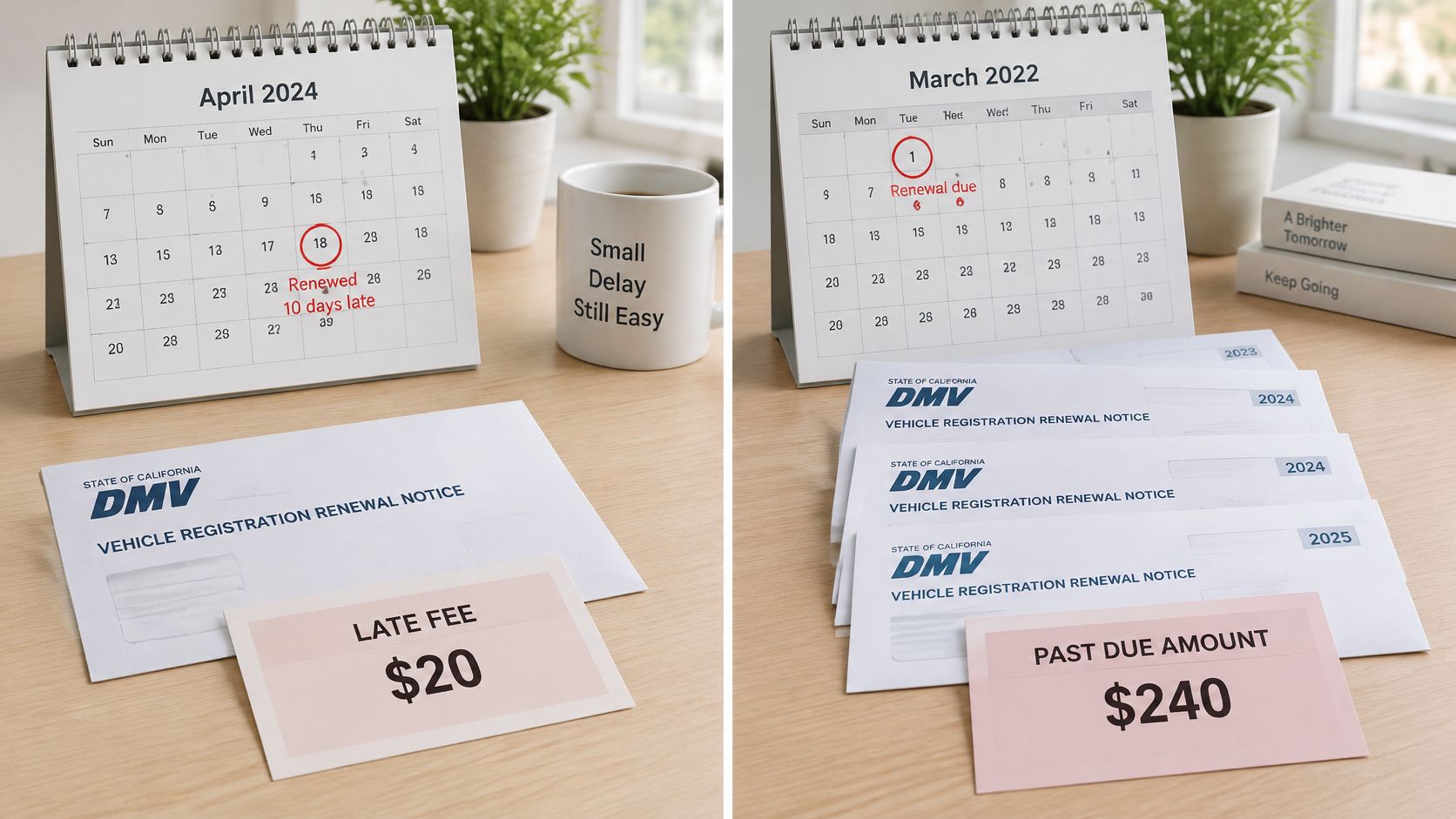
The recently missed renewal
The first driver checks the record and confirms that the payment falls into the shortest delinquency band shown earlier. There's still a percentage component, even though the delay was brief.
The mistake would be to look only at the fixed-charge column and set aside that amount. The driver also needs the vehicle-specific calculation and the ordinary renewal balance.
A sensible response is to ask for the complete assessment, then handle any unfinished certification separately. There's no need to assume the largest penalty applies, but there's also no reason to wait for another threshold before acting.
The vehicle left unresolved for years
The second driver has a different problem. The DMV's late-penalty schedule applies 80% of the license and applicable weight fees, plus $50 registration and $50 CHP late fees, when payment is more than one year but no more than two years late; beyond two years, those amounts rise to 160%, $100, and $100 respectively.
The important comparison is structural: both the percentage and the fixed charges rise. The older lapse doesn't preserve the same small overdue charge indefinitely.
For that owner, an old estimate isn't a reliable payment target. The record needs a current review, particularly if the vehicle has been sitting through changes in ownership, storage, or intended use.
This accompanying video provides another format for considering the renewal issue.
The practical lesson from both stories is the same without assuming identical bills:
- A recent lapse needs a complete calculation. A small fixed charge doesn't mean that's all you owe.
- An older lapse needs a fresh assessment. Don't rely on a remembered amount or an unopened notice.
- A threshold deserves attention before you cross it. Ask what the record requires now rather than waiting until you're ready to drive.
Neither story supports guessing a total from the age of the paperwork. The delay band explains the penalty structure; the vehicle record supplies the rest.
Driving Holds and Other Costs of Waiting
Paying a balance and confirming that a vehicle is ready for lawful operation are related, but they aren't interchangeable. A driver may address the money owed while still needing to finish a smog or documentation requirement.
As described in the DMV guidance cited earlier, late penalties are added to other fees due, and registration status may affect lawful vehicle operation. Before returning the vehicle to the road, confirm both the assessed balance and the status of the renewal.
The timeline below highlights the questions to resolve. It shouldn't be read as a promise that every expired registration follows an identical enforcement sequence.
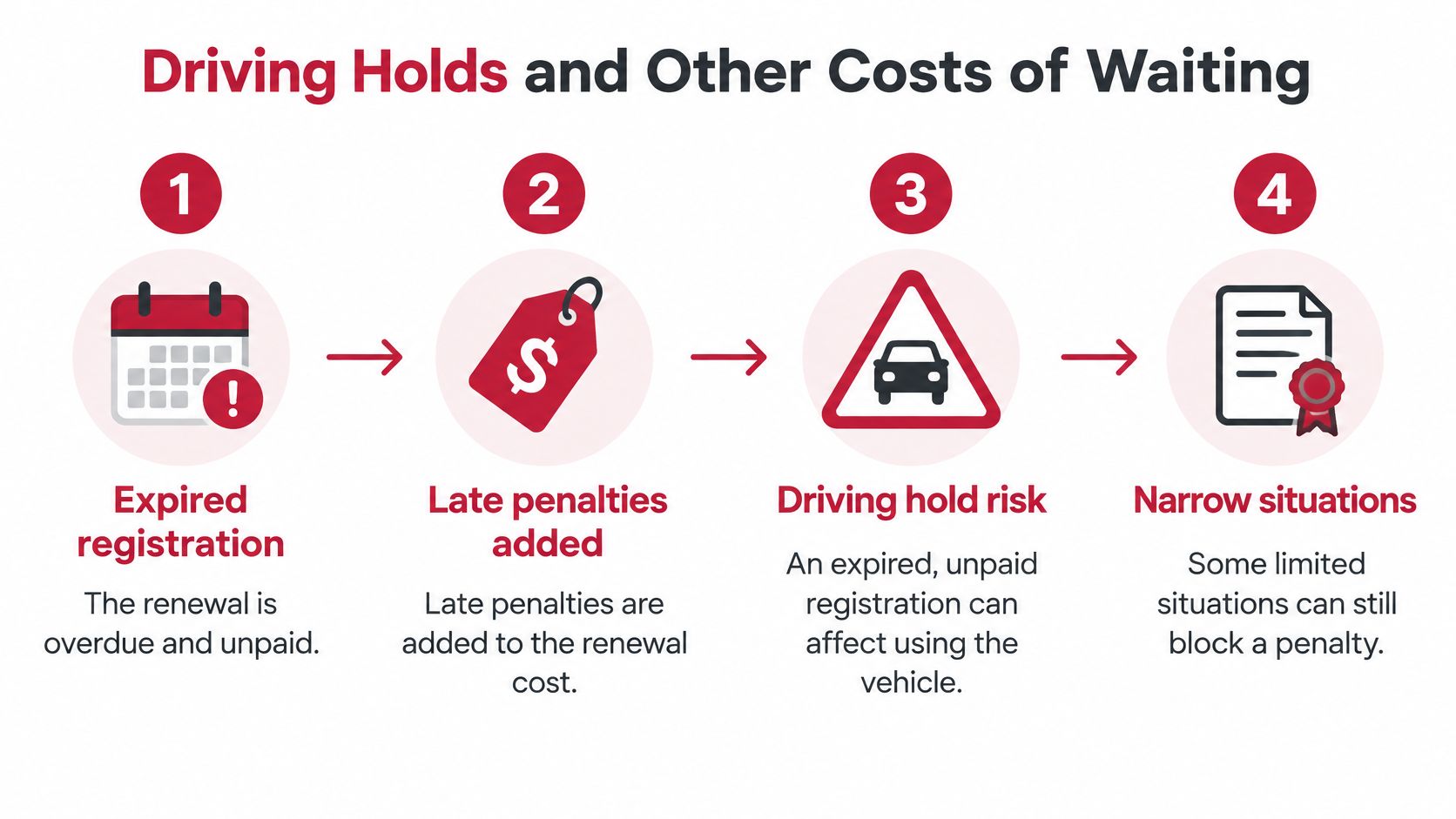
Ask about status, not just price
When you speak with a processor, make the intended outcome clear: you want to know what is required to complete registration, not merely how much money can be accepted.
- Confirm the full balance. Ask whether the quoted amount includes the applicable delinquency charges and ordinary renewal fees.
- Identify outstanding requirements. Find out whether certification or documentation still prevents completion.
- Confirm completion. Don't assume that a payment receipt alone answers every question about operating the vehicle.
This distinction is especially important when the car needs a smog inspection. Don't assume the trip to obtain certification is permitted because you intend to resolve the renewal afterward.
Exceptions depend on the circumstances
The DMV guidance discussed earlier recognizes limited exceptions involving certain properly documented nonoperation, repossession, transfer, storage, and military-deployment circumstances. These aren't interchangeable reasons to request a general waiver.
If one seems relevant, describe what happened accurately and ask what documentation the DMV requires. A storage situation, for example, needs review under the applicable rule rather than an assumption that any parked vehicle qualifies.
Before returning to the road: Verify that the payment and the outstanding registration requirements have both been addressed.
You don't need to predict an enforcement outcome to make a sound decision. You need a confirmed record, a clear explanation of anything still missing, and an appropriate payment or documented exception.
That approach avoids both extremes: treating an expired card as harmless and assuming consequences that the record hasn't established.
Where to Pay a Late California Registration Renewal
You can work directly with the DMV or use a licensed registration-service provider. The processing location doesn't change the state's penalty rules. Whoever handles the transaction must determine the applicable delinquency period and collect the required DMV and CHP amounts along with ordinary renewal fees.
The useful comparison is about what your transaction needs. A straightforward payment is different from a renewal that still needs emissions certification or a record review.
Choose the path that matches the problem
| Payment path | When it may fit | What to clarify |
|---|---|---|
| DMV online renewal | You want to handle an available renewal transaction yourself | Whether the record permits completion and what remains outstanding |
| DMV office | You need direct help reviewing the record or an unusual circumstance | What documents to bring and whether the matter can be completed |
| Licensed registration service | You want in-person processing, potentially alongside a smog visit | Available services, processing charges, and whether the record can be cleared |
An office visit can involve waiting, while an online payment won't necessarily solve a missing-certification issue. A licensed provider may offer on-site sticker printing when the record can be cleared, but don't assume every transaction qualifies for immediate completion.
Ask about the full transaction cost, including any service charge, before authorizing processing. State penalties and a provider's processing charge are different parts of the bill.
A local smog-and-renewal option
In Antioch, Fire House Smog is a STAR-certified test-only station and licensed DMV registration-services provider offering smog inspections, renewal processing with on-site sticker printing, and ownership transfers. Its local DMV registration-services information lists the location at 2900 Lone Tree Way, telephone 925-754-1600, and DMV service hours of Monday through Saturday, 9:30 AM to 5:00 PM, and Sunday, noon to 4:00 PM, with limited services possible on weekends.
The station handles passenger cars, SUVs, and light-duty trucks, plus some RVs when size and equipment allow. Its test-only model means it doesn't sell repairs, so a failed inspection still requires a separate repair plan.
For an ordinary renewal, paying the DMV yourself may meet your needs. If emissions certification is the missing piece, a combined testing-and-registration visit may be more practical.
Call ahead for an RV, a weekend transaction, or a record that may need more than routine processing. Confirming those details before traveling is more useful than assuming sticker printing is available for every unresolved renewal.
Clear the Balance Before the Next Milestone
Start with the vehicle record, not the amount you hope the bill will be. A forwarded notice, an unused car, and an unfinished smog test each raise different questions, so describe your situation clearly when you ask for help.
Your immediate goal is an accurate assessment and a workable completion plan. You don't need to solve the entire problem from the paperwork on your kitchen table.
Put the next actions in order
- Verify the deadline. If notification was delayed or the ownership recently changed, ask how the DMV record treats the payment date.
- Request the full assessed amount. Confirm that the calculation includes the percentage component and both fixed late charges, rather than budgeting from the fixed portion alone.
- Resolve the correct filing. If nonoperation applies, check eligibility and the permitted filing window. Otherwise, arrange the renewal payment.
- Finish outstanding requirements. Address smog certification, insurance documentation, or other items identified by the processor.
- Confirm the resulting status. Keep the receipt and ask whether anything remains before treating the renewal as complete.
Don't wait to ask about payment just because you're still arranging repairs. Likewise, don't treat a possible notice-related exception as permission to drive while the deadline question remains unresolved.
Make the visit useful
For drivers in Antioch and East Contra Costa County who still need emissions certification, a local test-only station with registration processing can be an option. Ask whether your vehicle and transaction can be handled together, especially if an RV or unusual record issue is involved.
Have the registration card, renewal notice, and relevant payment or filing records available for review. Explain any late-notice issue before processing begins so the timing question doesn't get lost in a discussion about the total.
The next milestone to focus on is practical: getting the record reviewed and taking the action it requires. An accurate answer today is more useful than another estimate you'll need to revisit later.
Visit Fire House Smog for STAR-certified test-only smog testing and California registration renewal processing with on-site sticker printing when your record can be cleared. If your renewal is overdue, call ahead to discuss the remaining requirements and confirm available DMV services before your visit.
In California, the vehicle transfer fee is a mandatory DMV charge the buyer pays within 10 days of taking ownership. It's separate from use tax, the vehicle license fee, and registration fees.
You've picked up the keys, signed the paperwork, and thought the car deal was finished. Then a DMV bill arrives with a total that looks much higher than the transfer fee you expected. The surprise usually comes from several separate charges appearing together, each tied to a different part of the transaction.
The useful question isn't only “What's the transfer fee?” It's also “Which other charges apply, and what must I do before a deadline?” California's rules make the ownership record and the timing of the paperwork financially important. Whether you bought from a dealer, a neighbor, or brought a vehicle into California, knowing what each line means can help you prepare and spot missing information.
Table of Contents
- The Surprise That Hits Every New California Car Owner
- What the Vehicle Transfer Fee Actually Covers
- Who Pays and When the Clock Starts Ticking
- The Other Charges That Travel With the Transfer Fee
- How Transfer Type Changes the Bill
- Where Smog Certification Fits Into the Transfer
- Handling the Transfer in One Stop at Fire House Smog
- Why the Transfer Fee Is Not a Flat Number
The Surprise That Hits Every New California Car Owner
A first-time buyer might read “vehicle transfer fee” on an estimate and assume it represents the full cost of putting the car in their name. But the bill can also include tax, registration balances, title-related charges, and penalties. Those amounts aren't all part of the transfer fee, even when they appear on the same estimate.
Consider a buyer who purchases a used car privately and receives a DMV estimate that's larger than expected. The estimate doesn't necessarily mean the transfer fee itself has changed. The buyer's county, the vehicle's registration status, and whether earlier ownership changes were properly recorded can all affect the total. A bill is easier to understand when you read each charge as its own obligation instead of treating the total as one unexplained price.
The buyer is generally responsible for the transfer fee, and the clock starts from the transaction date. That means the paperwork deserves attention as soon as the sale or gift is complete, not only when the next registration renewal comes around. A delay can create a separate penalty issue, even if the original transfer charge is straightforward.
A useful way to read the bill: First identify the government charge for recording ownership. Then check taxes, registration-related fees, and any late charges separately.
This guide follows that same order. It starts with what the transfer fee covers, then explains who pays and when, why other line items vary, and how transaction type and smog certification can affect the process. If you already have an estimate, compare its individual entries with the relevant details below rather than relying on the headline total.
What the Vehicle Transfer Fee Actually Covers
The vehicle transfer fee is the DMV charge for processing a change in ownership. California requires it when a vehicle changes hands through a sale, gift, donation, or trade. It pays for the administrative act of updating the ownership record. It isn't a percentage of the purchase price, and it doesn't stand in for every other charge due during registration.
Think of the fee like postage on a registered letter. The postage gets the document into the delivery system, but it doesn't represent the value of what's inside. In the same way, the transfer fee covers the ownership-record process, while tax and registration charges follow their own rules.
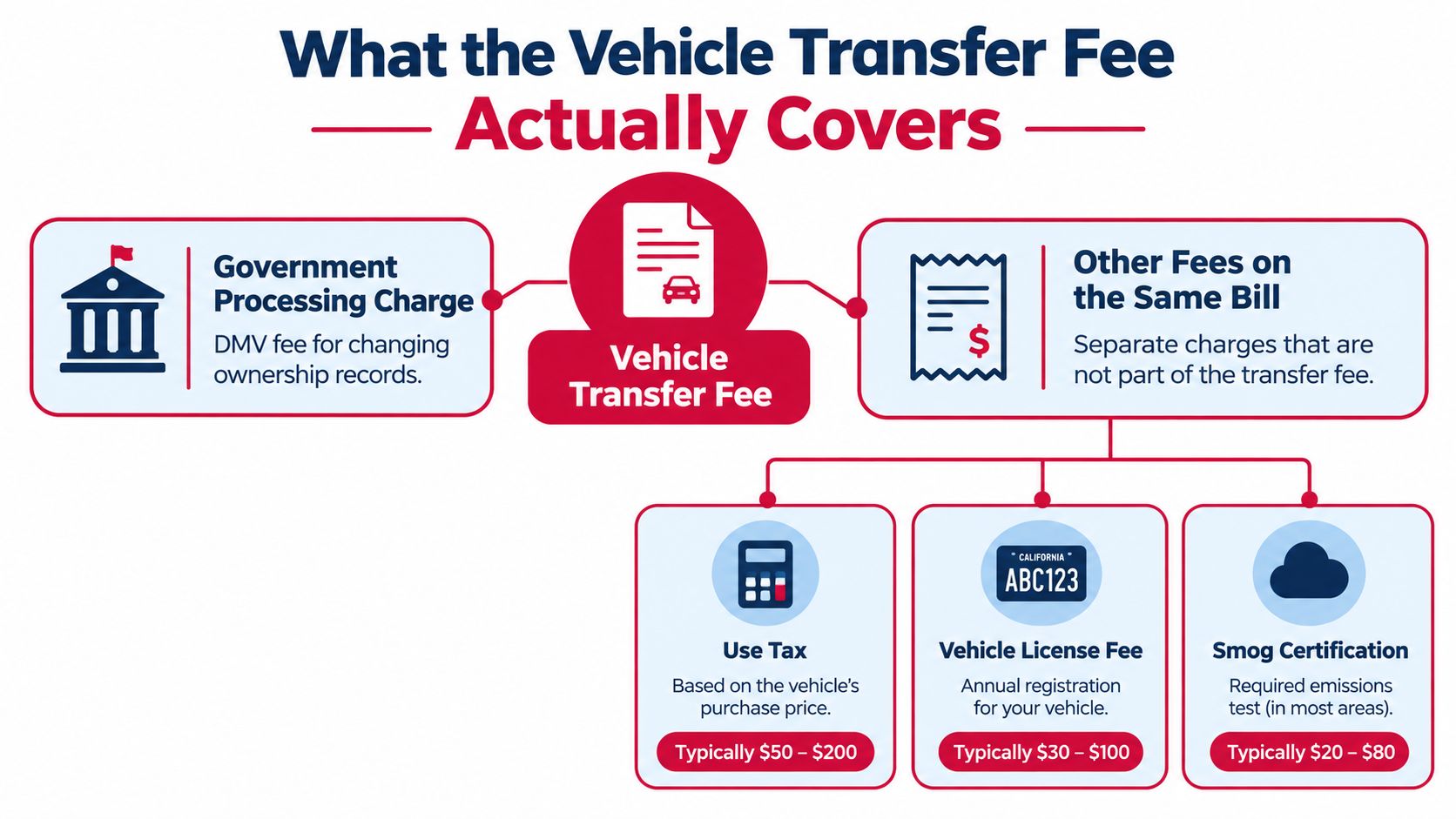
Separate charges on the same bill
A DMV estimate may list use tax, a vehicle license fee, renewal charges, county or district fees, weight fees, or special plate charges alongside the transfer fee. These are not all components of that fee. They arise from other requirements, so a transfer estimate can be higher than the transfer charge alone.
The distinction matters when you're comparing estimates or trying to work out why a bill changed. Ask what each line represents: Is it the charge for changing the ownership record, a tax, a registration balance, or a late assessment? A clearly itemized answer is more useful than a single total.
One vehicle, one transfer obligation
The DMV applies transfer fees separately to separate vehicles. If ownership changes hands more than once before the DMV is notified, the transfer record may also need to account for each intervening sale. So the same fee label can relate to more than one ownership change, not just the person who most recently brought the paperwork to the DMV.
Who Pays and When the Clock Starts Ticking
The buyer pays the transfer fees, and California hands that buyer two dates to track at once. Payment is due within 10 days of the transaction date, and penalties apply once the required payment has gone unsubmitted for 30 days, per the California DMV's title-transfer guidance. Read the first date as the deadline and the second as the point where the bill starts growing.
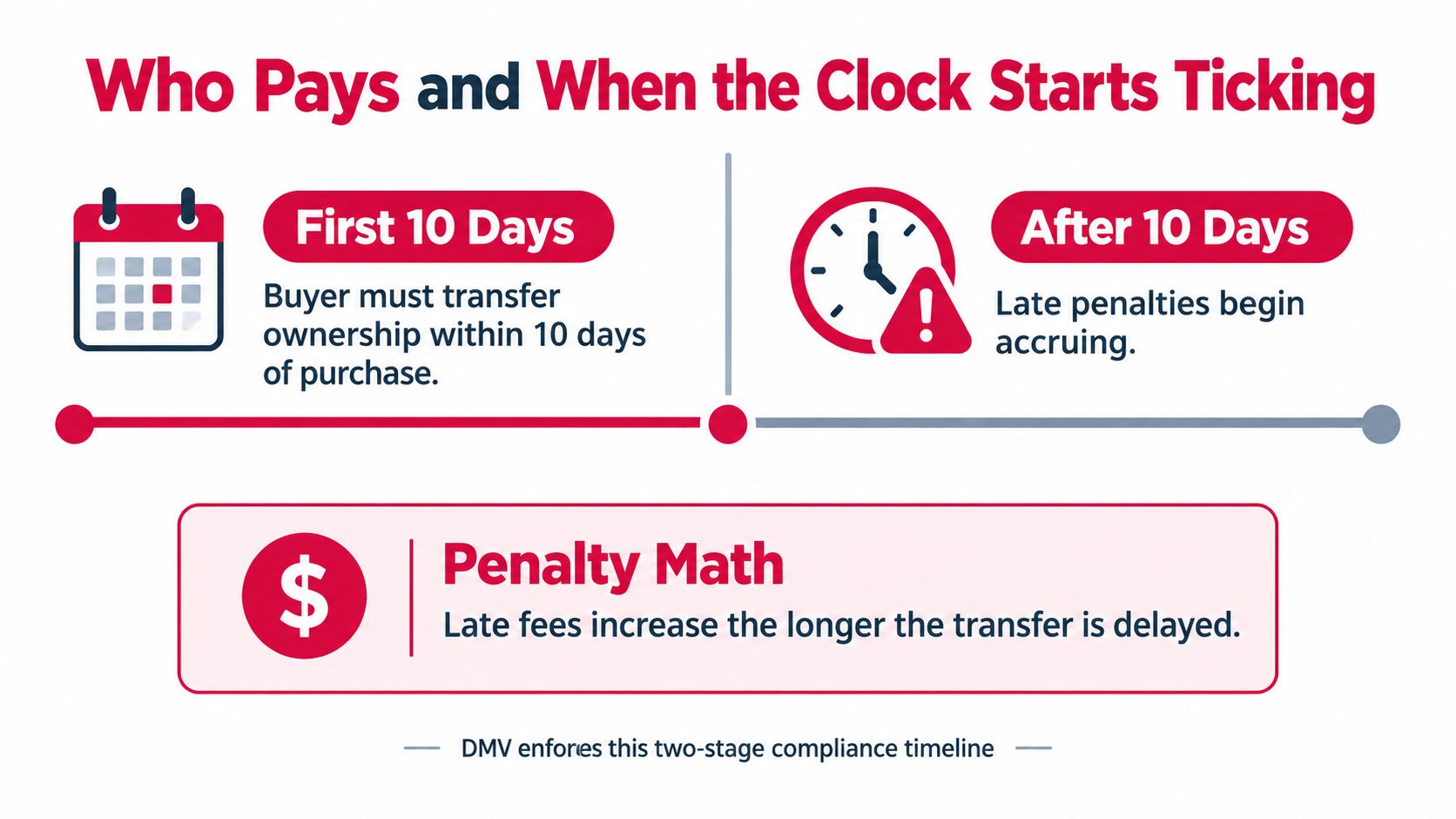
The gap between those dates trips up first-time buyers.
A buyer who files on day 25 did beat the penalty cutoff, but the obligation was already two weeks late. Transfer timing works like a parking meter with a grace period: enforcement may not show up right away, yet the time was still owed from the start.
Late charges can also attach to the registration side of the same bill. Under the DMV's registration-fee guidance, a registration delay of 1 to 10 days adds 10% of the vehicle-license and weight fees, plus $10 registration and $10 CHP late fees. Those penalties sit on the registration lines, and the transfer fee itself stays unchanged. Each line follows its own clock, so the cheapest transfer is the one filed early with complete paperwork.
What happens when ownership changed more than once
A vehicle that passes through several buyers before anyone notifies the DMV leaves a chain of transfers on the record. The DMV's multiple-transfer guidance states that only the last transfer in the chain draws a transfer penalty, while the fees tied to earlier transfers still apply.
Use tax paid by an earlier buyer cannot be credited toward what a later buyer owes. If the title history has gaps, ask the DMV or a qualified registration provider to reconstruct the sequence of sales before assuming the most recent transaction is the only one on the record.
Keep the transaction date, the signed title, and every ownership document together, then file promptly. For help pairing the transfer with the rest of the registration paperwork, review vehicle registration transfer services. Clear dates and complete documents are what turn an unpredictable bill into one you can estimate line by line.
The Other Charges That Travel With the Transfer Fee
The transfer fee is just one entry in a possible set of charges. The total can depend on the vehicle, the buyer's location, and the vehicle's registration status. Reading the bill line by line helps you distinguish taxes and registration costs from the administrative charge for changing ownership.
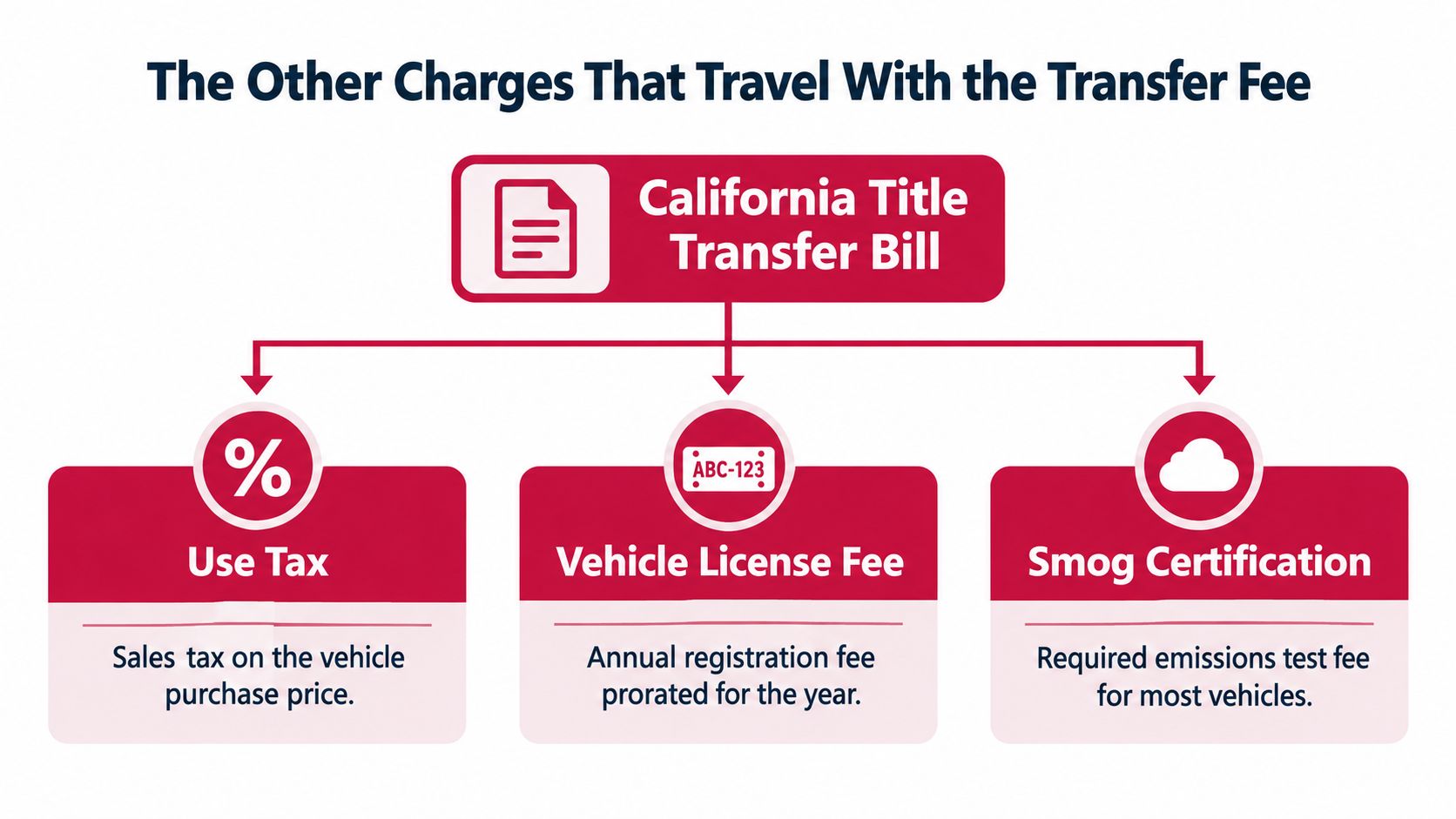
Use tax follows the buyer's location
For a taxable purchase, California use tax is generally calculated using the purchaser's city and county. The rate may range from 7.25% to 10.25%, so two buyers transferring similar vehicles can face different tax amounts because they live in different jurisdictions. The tax is distinct from the transfer fee, and the total due can't be estimated by looking at that fee alone. The California DMV title-transfer information describes this distinction and the factors that can affect a transfer bill.
VLF and other registration-related charges
For applicable vehicles, the vehicle license fee (VLF) is 0.65% of market value. The DMV uses the vehicle's VLF class and relevant model-year schedule, not the new owner's negotiated purchase price, to determine the amount. This is why a low sale price doesn't necessarily mean the VLF will be calculated from that price.
Other possible line items include renewal charges, county or district fees, weight fees, and special plate charges. Whether they apply depends on the vehicle and its registration circumstances. Ask for an itemized calculation if the estimate combines these amounts or if you can't tell which line is tied to the transfer.
Check the effective fee schedule
California periodically adjusts certain DMV charges through statutory consumer-price-index increases. A fee notice effective January 1, 2026, lists the title-only fee, off-highway-vehicle transfer fee, and moped original-or-transfer fee each increasing from $27 to $28. Those examples apply to the specific fees listed in that notice, not to every vehicle transfer. Check the DMV's current calculation for your vehicle and transaction rather than assuming a charge shown in an older estimate still applies.
For an overview of the wider registration estimate, see California vehicle registration costs. Treat each item as its own rule-based charge, and ask whether a figure is tax, registration, title processing, or an optional service fee.
How Transfer Type Changes the Bill
Two people can transfer similar cars in the same week and walk out with different totals. The transfer fee itself rarely explains the gap. The transaction type underneath it usually does, because a private sale, a gift, a donation, a trade, and an out-of-state title each carry slightly different tax treatment and paperwork.
Before relying on any estimate, identify what happened: Was the vehicle sold, given as a gift, donated, traded, or brought into California from another state?
| Transfer situation | What to check | Why the total may differ |
|---|---|---|
| Private-party sale | Confirm the transaction details, date, and current registration status. | Use tax may apply, and the buyer remains responsible for the transfer fees. |
| Gift | Make sure the transfer is being reported as a gift and ask how the DMV will assess tax. | A gift may be treated differently from a taxable purchase, but don't assume the tax outcome without confirming eligibility. |
| Donation | Check the transfer documents and whether the recipient is an organization or another party. | Donation paperwork and tax treatment may depend on the specific transaction. |
| Trade | Review the sale and trade paperwork as separate parts of the transaction. | The transfer still needs to be documented, and the full bill may include registration charges beyond the transfer fee. |
| Out-of-state title | Gather the existing title and ask what verification or California registration steps are required. | An out-of-state vehicle can need additional processing, so the estimate may differ from an in-state transfer. |
For taxable purchases, use tax follows the purchaser's city and county rather than one statewide figure. As covered under use tax above, the rate depends on the buyer's jurisdiction, consistent with the DMV title-transfer guidance referenced earlier, so confirm the applicable rate for your location instead of reusing a figure from another transaction.
The same caution applies to gifts and donations. Say a relative signs a car over to you for free. The paperwork may still ask when the vehicle changed hands, what it was worth, and whether the transfer qualifies for different tax treatment. Clarify what documentation the DMV needs before assuming the word "gift" on a form closes the file. If you buy privately instead, keep the signed title and transaction details together so the date and ownership path are clear.
Out-of-state titles deserve their own check. Ask whether the vehicle needs verification, whether its registration status changes the amount due, and which documents must accompany the title. Across every row of the table, the order of operations stays the same: identify the transfer type first, then estimate taxes and registration charges separately from the transfer fee.
Where Smog Certification Fits Into the Transfer
A smog certificate can be a separate requirement from the ownership-record fee, and it can affect how smoothly you complete registration. Don't assume every vehicle or every transfer follows the same emissions-testing rule. Confirm whether a smog check is required for your specific vehicle and situation before you plan the rest of the paperwork.
The timing matters. If the vehicle needs testing, completing that step before you submit the full transfer and registration package can help avoid a stop in processing. If you're unsure whether a recent certificate will meet the requirement, check with the DMV or a smog station before relying on it. The California smog-test requirements page offers additional guidance.
| Scenario | Smog required | Notes |
|---|---|---|
| Vehicle transfer where a smog inspection is required | Yes | Arrange the inspection and confirm the certificate is ready for the transfer process. |
| Vehicle with a recent passing certificate | Confirm first | Ask whether the existing certificate can be used for this transaction. |
| Vehicle with an exemption or a special circumstance | Confirm first | Don't assume an exemption applies based only on the vehicle's age or fuel type. |
| Vehicle that fails the inspection | A passing result may still be needed | Resolve the emissions issue and check the next steps before expecting registration processing to finish. |
A passing certificate doesn't replace the title, transfer payment, or any applicable tax. It addresses an emissions requirement. Keeping those steps distinct makes it easier to see what's still outstanding if the DMV or a service provider says the transfer can't yet be completed.
If the vehicle fails, ask the testing station what the result means and what options are available. Some stations offer a retest under their own policies, but confirm the terms directly. That way, you can plan around the testing requirement without confusing it with the transfer-fee deadline or assuming that one completed step clears the others.
Handling the Transfer in One Stop at Fire House Smog
A buyer handling both a smog requirement and DMV paperwork may prefer a provider that can address those tasks in one place. Fire House Smog is a STAR-certified test-only smog station and licensed DMV registration services provider in Antioch. It performs smog inspections and processes California ownership transfers, including support for out-of-state vehicles, with stickers and plates as needed.
A buyer arriving with a signed title and the right supporting documents can ask staff to check what's needed for the transaction and whether smog testing applies. Bring a valid ID, the signed title, any lien-release paperwork, and a smog certificate if you already have one. If a document is missing or the title record has an issue, clarify that before expecting the transfer to be completed.
What the service can handle
The station offers STAR-certified, test-only smog inspections for passenger vehicles and light-duty trucks, plus testing for some RVs and motorhomes when size and equipment allow. Its test-only model means it doesn't sell repairs, so testing and repair work aren't bundled into the same service.
For DMV matters, the site handles California registration renewals and ownership transfers, including out-of-state vehicle support. On-site tag and plate issuance is available when needed for eligible transactions. The station also has two service bays, and its published service information notes a free retest may be available subject to site policy and coupon terms. Confirm eligibility and current terms with the business.
Smog testing is available seven days a week, with extended evening and weekend hours. DMV services are listed for Monday through Saturday, 9:30 AM to 5:00 PM, and Sunday, 12:00 PM to 4:00 PM, though weekend services may be limited. The location is 2900 Lone Tree Way, Antioch, CA 94509. Check directly before visiting to confirm the service you need and the documents to bring.
Why the Transfer Fee Is Not a Flat Number
A vehicle transfer fee is a government charge, but the amount due on a transfer bill isn't necessarily one universal price. The fee is only one part of the transaction. The buyer's jurisdiction, vehicle class and weight, registration status, ownership history, and timing can each affect other line items or obligations.
Use this checklist before finalizing the transfer:
- Confirm the transaction type: Identify whether you're buying, receiving a gift, donating, trading, or registering an out-of-state vehicle.
- Check registration status: Find out whether the vehicle has an outstanding registration balance or another unresolved issue.
- Identify the buyer's city and county: Use tax depends on jurisdiction when the purchase is taxable.
- Review the title and lien status: Make sure the title is signed correctly and determine whether a lien release is needed.
- Ask about previous transfers: If the DMV wasn't notified of earlier sales, more than one transfer-fee obligation may apply.
- Confirm whether smog testing is required: Don't assume a vehicle is ready for registration until you've checked the applicable emissions requirement.
- Note the transaction date: Submit the required payment and paperwork promptly to avoid timing-related problems.
Once those details are in hand, ask for an itemized estimate. A clear breakdown should distinguish the government transfer charge from use tax, VLF, registration charges, penalties, and any optional service fee. That gives you a more reliable picture of the total than a headline transfer price.
If you're completing a California ownership transfer in Antioch, Fire House Smog offers smog inspections and DMV registration services, including ownership-transfer support. Contact the station or visit its Lone Tree Way location to confirm what documents your transaction requires and whether it can handle your transfer and any needed smog test.
California requires you to complete vehicle ownership-transfer paperwork within 10 days of the sale, and license plates can't be transferred separately from the vehicle's title and registration record. The plate number, VIN, registered owner, and vehicle record must move together through the California DMV process.
You may be standing beside a newly purchased car with the signed title in your hand, wondering whether you can remove your old plates and bolt them onto the replacement vehicle. That assumption causes many avoidable delays. California treats a plate transfer as an ownership and registration transaction, not a physical handoff of metal plates.
The straightforward path is manageable when you identify the plate type, confirm the smog requirement, prepare the correct forms, and submit everything on time. Special-interest, personalized, historical, exempt, missing, damaged, and out-of-state situations follow different rules, so the details matter.
Table of Contents
- Understanding California License Plate Transfers
- Documents and Forms You'll Need
- The Step-by-Step Transfer Process
- Smart Tips for a Smooth Transfer
- Special Plates Out-of-State and Dealer Transfers
- Getting Your Plates Transferred Without the Hassle
Understanding California License Plate Transfers
A buyer may leave the DMV with the right paperwork but still have the wrong expectation about the plates. California treats a plate transfer as part of the vehicle's ownership and registration record, not as a separate exchange of metal plates.
Ownership-transfer paperwork must be started within 10 days of the sale, and the DMV record must be updated within that same 10-day window when the registered owner or lienholder changes. The California DMV ownership-transfer rule ties the deadline to the vehicle record. Removing a plate and attaching it to another vehicle does not complete the transaction.
California connects the plate with the vehicle identification number, title chain, registration record, and registered owner. Those records establish which vehicle carries the plate and when responsibility changed. This is why a plate transfer can stall even when the physical plate is available.
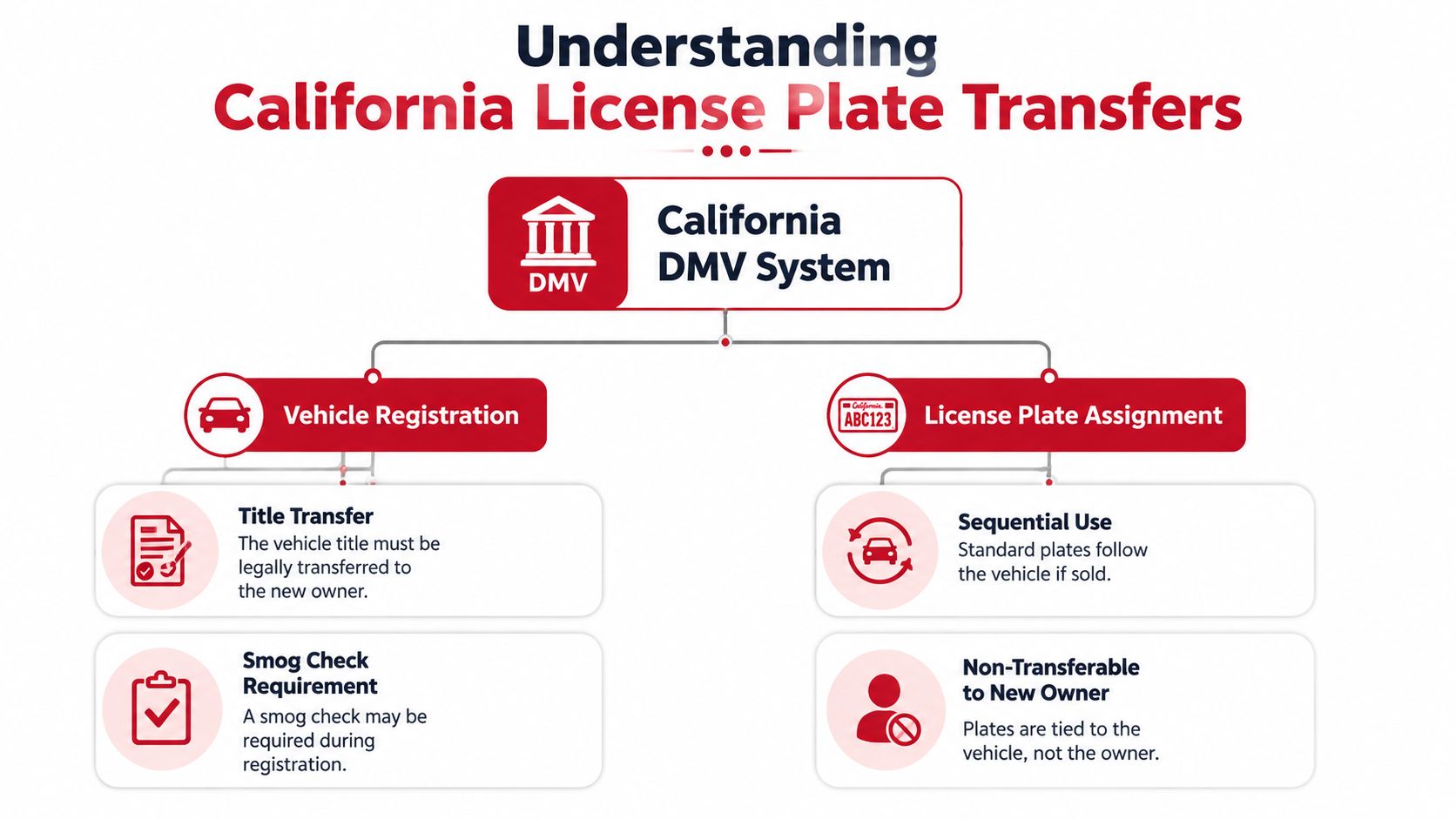
Why the release of liability matters
The seller's Notice of Transfer and Release of Liability records the sale and helps prevent responsibility for the vehicle from remaining with the seller. The notice requires the new owner's name and address, plate number, last five digits of the VIN, odometer reading at the time of sale, and date of sale, as described in the California DMV transfer guidance.
Enter each field directly from the transaction documents. A wrong plate number, missing VIN digit, or buyer address that conflicts with the paperwork can trigger follow-up questions and delay completion.
Practical rule: Handle the plate as one part of the complete ownership update. Do not attach it first and plan to correct the title record later.
Standard plates versus eligible special plates
Ordinary sequential plates generally stay assigned to the vehicle. Only certain personalized environmental, special recognition, and special-interest plates may be reassigned. The California DMV's license plate guidance identifies the plate class as the first factor in deciding whether reassignment is available.
The answer therefore depends on the plate and the record behind it. Registration status, renewal fees, ownership names, and the required form can change the result. Special plates may follow a separate reassignment process, so confirm eligibility before removing anything from the vehicle.
Documents and Forms You'll Need
A plate transfer can fail even when the plate is physically correct. California ties the plate to the vehicle record, ownership information, and registration status, so assemble the ownership paperwork before addressing the plate itself.
The signed California title is the main document when it is available. If the title is missing, complete the REG 227 application for a replacement or transfer title. Buyer and seller signatures must appear where required, and the applicable transfer fee must accompany the filing. A bill of sale can document the transaction, but it does not replace the DMV's title and registration requirements.
Core paperwork at a glance
| Document | When Required | Key Information Needed |
|---|---|---|
| Signed California title | Standard ownership transfer when the title is available | Buyer and seller signatures, vehicle and ownership details |
| REG 227 application | When the title is missing | Replacement or transfer title information and required signatures |
| Notice of Transfer and Release of Liability | Seller reports the completed sale | New owner's name and address, plate number, last five VIN digits, odometer reading, and sale date |
| Smog certification or smog transfer fee | Depends on the vehicle's model year and transfer circumstances | Current certification when required, or the applicable fee for newer vehicles |
| REG 17 | Eligible special-interest plate reassignment or interchange | Current plate ownership, requested reassignment, and required signatures |
| Related special-plate forms | Certain specialty or owner-issued plate situations | Ownership proof, registration status, plate details, and fees when applicable |
Use this vehicle registration documents checklist to organize the packet before visiting a DMV office or licensed registration provider. Keep originals together, then make copies or clear scans for your records.
Match every name and address
Check the title, registration record, buyer and seller details, and submitted forms line by line. A changed name, an active lienholder, or an address that differs from DMV records can stop the transaction until the discrepancy is resolved.
The Notice of Transfer and Release of Liability requires accurate vehicle and sale information, including the plate number, identifying details, buyer information, and sale date. Submit complete information rather than expecting the DMV to correct missing fields. Enter the last five VIN digits and odometer reading directly from the transaction documents.
Special plates require their own review. Ordinary sequential plates generally remain assigned to the vehicle, while eligible personalized environmental, special recognition, and special-interest plates may be reassigned or interchanged through the appropriate process. Confirm the plate class, ownership, registration status, and required form before removing the plate. A plate transfer and an ownership transfer are related filings, but they are not always the same transaction.
The Step-by-Step Transfer Process
A plate transfer can stall even after the buyer and seller sign the paperwork. California ties the plate to the vehicle record, ownership filing, and registration status, so complete each step in order and keep proof of what was submitted.
Start with the smog decision
California DMV and the Bureau of Automotive Repair state that most vehicles over four model years old need a current smog certification for a change of ownership, while vehicles four model years old or newer do not need the inspection and instead require a smog transfer fee, according to the California Smog Check guidance.
Do not rely on an older inspection because it appears in the vehicle history. For a private-party sale, confirm that the certificate is valid for the ownership change and recent enough for the transaction. Exempt vehicles and special transfer situations follow different rules, so verify the applicable exception before arranging the inspection.
Gather the signed title and supporting forms
Confirm that the title contains the required buyer and seller signatures. If the title is missing, complete the replacement-or-transfer title application before submitting the ownership change. Prepare the Notice of Transfer and Release of Liability information, the smog documentation or applicable fee, and any special-plate form required for plates other than ordinary sequential stock.
Use this California title transfer paperwork guide to check the paperwork sequence before leaving home. A missing signature or incomplete field is easier to fix before the DMV visit than at the counter.
File within the statutory window
Submit the ownership transfer to the DMV or an authorized registration service within the 10-day period. Use the actual sale date and make sure the filing matches the vehicle identifiers, plate number, and ownership information. Pay the transfer and registration charges required for the transaction.
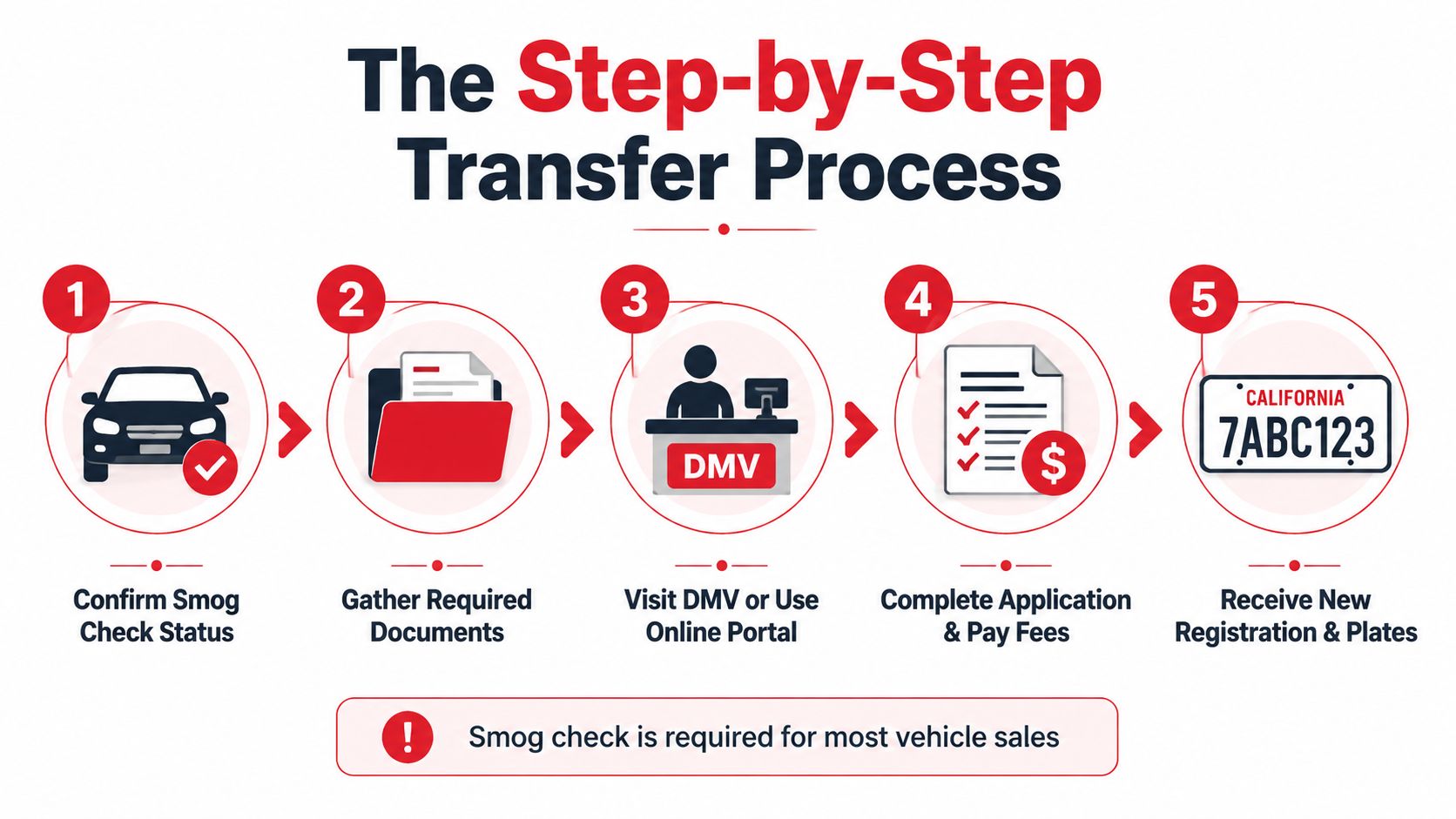
Before leaving, obtain a receipt, confirmation, or other evidence that the DMV or service provider accepted the filing. Keep it with the title records until the updated registration arrives. On-site registration services may reduce repeat visits when the packet is complete, but they still must follow the same record and plate requirements.
The following video offers a visual overview of the ownership and registration workflow:
If the DMV requests more information, respond with the same names, addresses, plate number, VIN details, and sale date used in the original filing. Consistent information helps prevent a correction from becoming a second transfer problem.
Smart Tips for a Smooth Transfer
Most stalled transfers don't fail because the owner misunderstood the fee. They stall because a document is incomplete, a plate condition doesn't match the record, or the applicant's address conflicts with the DMV file.
California's replacement-plate guidance explains that replacing plates can require surrendering the remaining plates and providing proof of identity. In some cases, a CHP vehicle verification may be required when the plates were issued within the last 90 days, and mail-in replacement requests require the registered owner to have the same address as the DMV record, according to the California DMV replacement-plate instructions.
Inspect the plates before filing
Look at both plates before you submit the transfer. If one is missing, stolen, badly damaged, or unreadable, tell the DMV or registration provider immediately instead of presenting the transaction as a normal plate movement.
Replacement and transfer are different tasks. A transfer changes the vehicle or ownership record. A replacement addresses the physical plate problem. Combining both without the required identity, surrender, or verification documents can stop the entire packet.
Treat address mismatches as a real issue
An address mismatch can affect more than where the registration card is mailed. It can prevent a mail-in replacement request, trigger a request for identity or residency information, and create confusion when the buyer's address on the Notice of Transfer differs from other documents.
Before submitting:
- Compare the address: Check the address on the title, registration record, replacement request, and release-of-liability filing.
- Confirm identity details: Use the legal names that belong to the vehicle record and transaction.
- Record the plate carefully: Recheck every character against the physical plate.
- Verify the VIN digits: The Notice of Transfer requires the last five VIN digits, not a guess based on another document.
- Separate damaged-plate work: Ask whether replacement or surrender paperwork must accompany the ownership transfer.
The fastest filing is the one that doesn't need a correction.
A licensed service provider can be useful when the transaction combines a missing title, smog requirement, replacement plate, address change, or out-of-state record. The provider can identify the form conflict before submission, but you're still responsible for supplying accurate ownership information and signing where required.
Special Plates Out-of-State and Dealer Transfers
Special plates don't follow the same path as ordinary sequential plates. California's DMV procedures distinguish special-interest plate transfers, owner-issued special plates, historical plates, and exempt-vehicle plates, and each category can impose different eligibility and surrender requirements.
For special-interest plates, both the current plate owner and the new owner generally submit REG 17. The current owner releases plate priority, while the new owner requests the plate. The California DMV special-plate transfer procedures also state that owner-issued special-plate interchange requires both vehicles to be currently registered, with renewal fees paid, and both plates eligible for reassignment.
Compare the common scenarios
| Situation | Main rule | Common extra requirement |
|---|---|---|
| Standard sequential plate | Usually remains tied to the vehicle during the ownership record update | Signed title, transfer filing, and required smog documentation |
| Special-interest or personalized plate | May be reassigned when the plate qualifies | REG 17 from the current and new owner |
| Owner-issued special plate interchange | Allowed only when both vehicles meet registration conditions | Both vehicles currently registered and renewal fees paid |
| DP, DV, CMOH, or POW plate | Ownership names may require additional proof | Statement of Facts showing the registered owner's connection to the plate |
| Historical plate on a collector vehicle | Can't be affixed before DMV approval | Surrender of prior plates if approval is granted |
| Exempt agency vehicle | Exempt plates generally must be surrendered when the vehicle leaves the exempt agency | Retention may be allowed only when moving to another exempt agency |
| Vehicle coming from another state | Requires a California registration and vehicle-record process | Plate surrender and inspection requirements depend on the transaction |
The DMV's special-plate interchange procedures also explain that eligible special plates can be reassigned or interchanged only when the vehicles are currently registered and renewal fees are paid. Some reassignment procedures state that a substitute license plate fee isn't due, although current registration fees still must be paid.
Out-of-state and dealer transactions
An out-of-state vehicle isn't a simple California plate swap. The vehicle must enter California's registration system, and the existing out-of-state plates may need to be surrendered to the California DMV. The exact inspection, title, and verification requirements depend on the vehicle and transaction, so don't assume that an out-of-state plate can be retained under California rules.
Dealer purchases often feel easier because the dealer submits much of the registration paperwork. That convenience doesn't change the underlying plate rules. Tell the dealer early that you want to retain an eligible special plate, and confirm whether the plate is being transferred, replaced, or left with the vehicle.
For a private sale, the buyer and seller usually have to coordinate signatures and disclosures themselves. A dealer may coordinate the packet, but you should still review the plate number, ownership names, address, and odometer information before signing.
Getting Your Plates Transferred Without the Hassle
A smooth transaction depends on decisions made before anyone reaches the counter. Identify the plate type first. Then verify whether the vehicle needs a current smog certification, locate the signed title or REG 227, prepare the Notice of Transfer and Release of Liability information, and check every address and VIN character.
Use this working checklist:
- Confirm the sale date: Count the filing window from the completed sale and aim to submit within the 10-day period.
- Classify the plate: Standard sequential, special-interest, personalized, historical, exempt, damaged, missing, or stolen plates don't all use the same process.
- Resolve the title: Bring the signed title, or complete the replacement-or-transfer title application if it's missing.
- Check smog status: Determine whether the vehicle falls within the smog-certification requirement or the newer-vehicle fee path.
- Prepare the liability notice: Have the buyer's name and address, plate number, last five VIN digits, odometer reading, and sale date ready.
- Submit and retain proof: Keep the receipt or confirmation until the DMV record and registration documents reflect the transaction.
A licensed DMV service provider can reduce the practical burden when you need ownership-transfer processing, registration work, smog certification, or on-site sticker and plate issuance. Fire House Smog in Antioch provides licensed DMV registration services and STAR-certified test-only smog inspections, with service hours listed as Monday through Saturday from 9:30 AM to 5:00 PM and Sunday from 12:00 PM to 4:00 PM. Availability for specific transactions can vary, so confirm the required documents before visiting.
You can skip the DMV line by using an authorized service option, but preparation still matters. No provider can correct an unsigned title, an inaccurate VIN, or an ownership detail that doesn't match the record without the proper supporting documents.
Visit Fire House Smog in Antioch for California ownership-transfer and registration assistance, including smog testing and applicable sticker or plate processing. Bring your signed title, identification, sale details, and any special-plate or replacement documents so the staff can review the transaction before submission.
You open a DMV renewal notice, see that a smog certificate is part of the process, and suddenly the errand feels bigger than a quick stop at the corner shop. That reaction makes sense. Smog check stations are not just service bays, they're the gatekeepers for a statewide compliance system that California uses to keep millions of vehicles moving through renewal on time.
If you've never dealt with one before, the rules can feel mixed together, especially when one notice says STAR, another says test only, and the DMV page talks about renewal, registration, and emissions in the same breath. The safest way to think about it is simple, a smog station verifies whether your vehicle meets the state's inspection requirement so your paperwork can keep moving. In California, that system is large enough that it's better to understand the whole picture first, then pick the right station for your car and your situation.
Table of Contents
- Why Smog Check Stations Matter to California Drivers
- How Smog Check Stations Work
- Test-Only STAR versus Test-and-Repair Stations
- What Happens During Your Smog Check Visit
- Using a Smog Station with On-Site DMV Services
- RVs Fleets and Other Vehicles That Need Special Handling
- What Makes a Test-Only STAR Station in Antioch Stand Out
- Choosing the Right Station and Preparing for Your Visit
Why Smog Check Stations Matter to California Drivers
The first time a renewal notice points you toward a smog inspection, it can feel like one more chore in a stack of chores. The better way to read it is as a checkpoint in a statewide system that keeps California's vehicle renewal process moving. The state's smog program has been in place since 1984, and California says it now includes more than 7,000 smog check stations, about 10 million vehicles tested each year, and about 400 tons of smog-forming pollutants per day reduced through the system overall, which is why these stations function as public infrastructure, not an occasional extra stop (California Smog Check Fact Sheet/index.pdf)).
For a driver, that bigger system shows up in a very practical way. If the certificate does not get completed, renewal can stall, and the DMV does not care whether the delay came from a busy schedule, a confusing notice, or a station you chose without checking the rules first.
Practical rule: treat the smog visit the way you'd treat a brake inspection before a long trip. It is a required checkpoint, like checking tire pressure before you head out, not a guess-and-hope errand.
Timing matters too. California's current rules require most vehicles to get a Smog Check every other year, and for a first-time test, the state says to add eight years to the model year, so a 2020 model-year vehicle first needs one in 2028 (California Smog Check Fact Sheet). That is why the question is not only where to go. It is also when the requirement starts and whether the station you pick matches the notice in your hands.
For drivers who want the rules behind the test, the vehicle emissions standards guide gives a plain-language overview of the emissions standards that shape the inspection. If you only need the short version, the station is the last checkpoint between your vehicle and a clean renewal path.
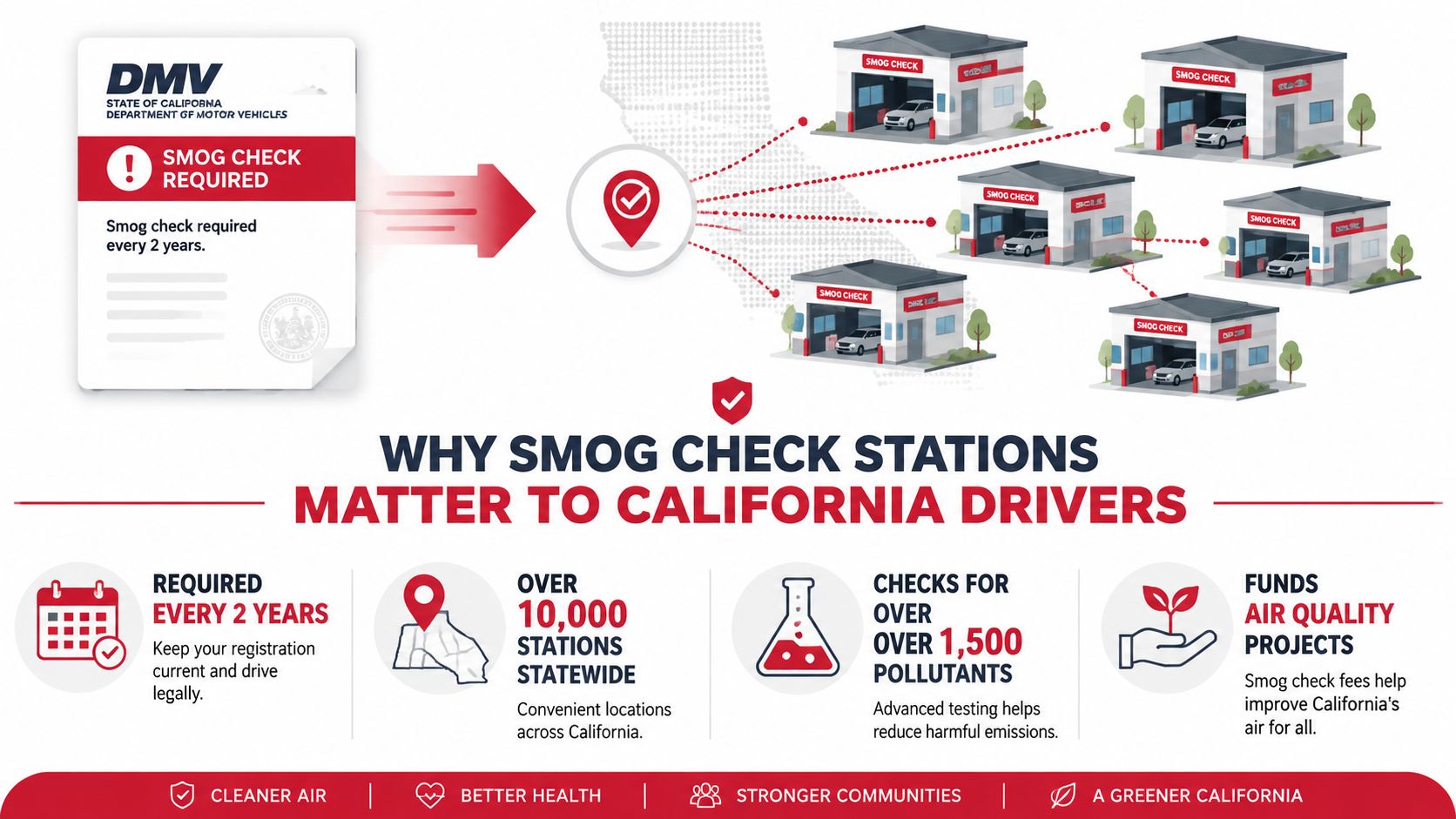
How Smog Check Stations Work
A smog check station is a controlled exam room for your car. The technician checks emissions-related systems with approved equipment instead of guessing from sound or appearance alone. California's test-only stations must use a BAR-97 emissions inspection system and keep supporting tools like an ignition timing light, vacuum pump or gauge, scan-code retrieval device, and a fuel-fillpipe restrictor gauge with defined dimensions and materials (California Code of Regulations, Section 3340.16).
That hardware list sounds old-school, but the inspection itself is increasingly digital. The BAR checklist says the station computer must run a BAR-tested and approved Microsoft-supported Windows version, and the emissions device must display and store live streaming OBD data, support bi-directional capability, and capture high-frequency abnormal signals regardless of screen refresh rate (BAR Smog Checklist). In plain English, the station is checking whether your vehicle's computer and emissions systems are talking to each other the way they should.
What the technician is looking for
The technician's job is narrower than many drivers expect. They look for emissions control issues, diagnostic trouble codes, visible tampering, and whether the onboard diagnostics behave correctly. They are not giving a general repair consultation or judging whether your transmission, suspension, or tires are in perfect shape.
A good smog bay reads your car the way a clinic reads a blood-pressure cuff, it is looking for a specific system response, not a full-body diagnosis.
That is why the inspection can feel technical even though the customer experience is simple. You bring the car in, the station connects to the vehicle, the computer checks the emissions side, and the state gets a record of whether your vehicle passed. If you want a shorter consumer-facing explanation of the timing, this smog check timing guide is a useful companion.
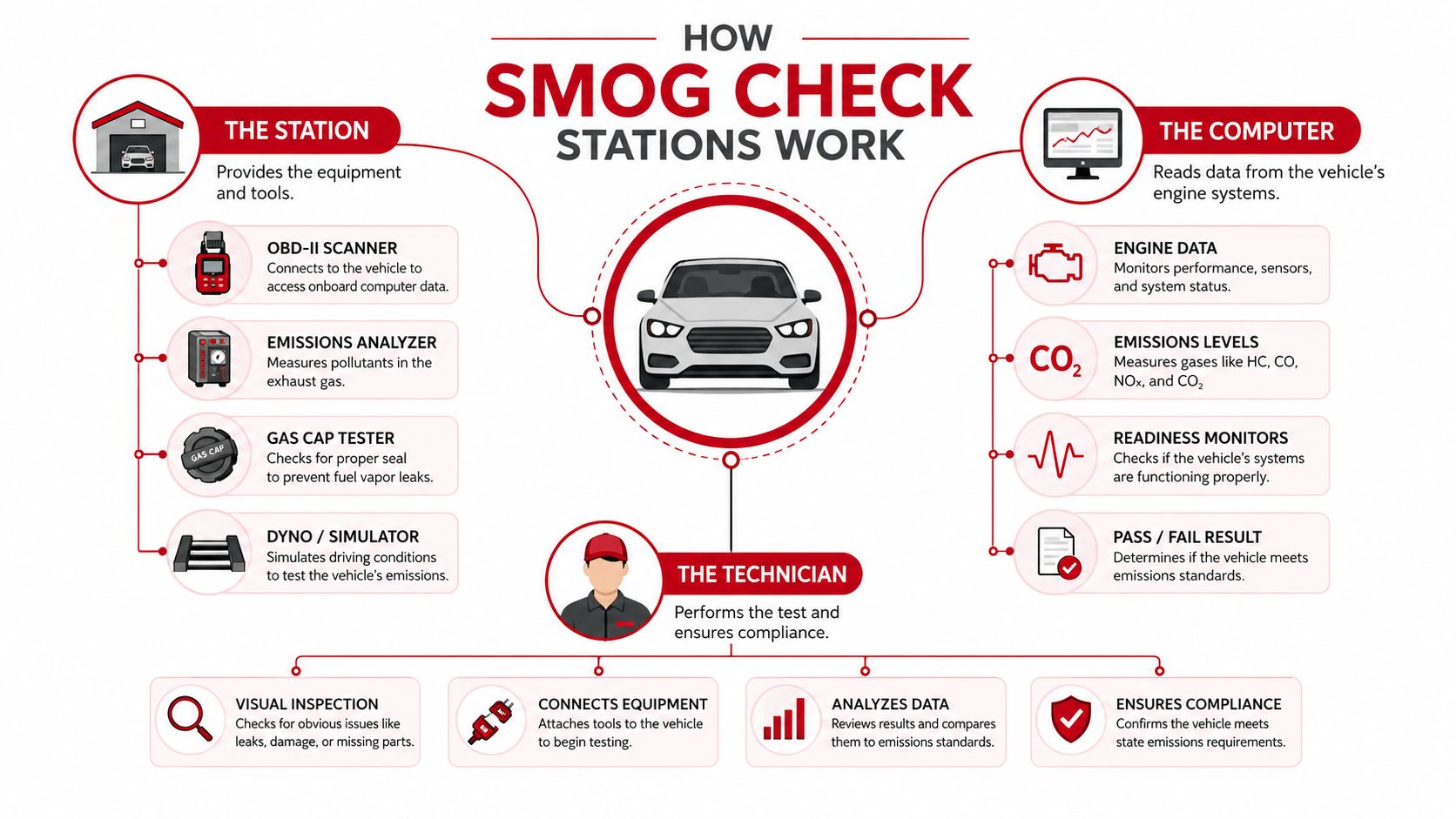
The fillpipe gauge is a good example of how exact the program gets. California specifies a non-sparking aluminum alloy 5052 tool with a test portion diameter of 0.9375–0.950 inches and a length of 5–12 inches, which shows that inspection hardware has to be reproducible from one station to the next (California Code of Regulations, Section 3340.16). That consistency is why a smog station is more than a mechanic with a scanner, it is a regulated testing site.
Test-Only STAR versus Test-and-Repair Stations
A first-time driver usually wants one clear answer. If the car fails, who can fix it, and who is there only to measure the result? A test-only station keeps those roles separate. The station performs the inspection and issues the outcome, but it does not profit from selling the repair that follows. A test-and-repair station can inspect the car and also handle qualifying repairs, which is convenient, though it places testing and repair under one roof.
California's BAR data helps show why those station types are treated differently. In the July 2025 executive summary, 1,019,416 initial tests produced 85,135 failures, a failure rate of 8.35%, and when all tests were counted, the failure rate was 8.88% (BAR July 2025 Executive Summary). The same report shows that BAR-97 stations had an overall failure rate of 17.69% versus 7.62% for OIS stations. That does not automatically mean one station type is doing a poorer job. It can also reflect the kinds of vehicles each category sees and how the inspection is carried out.
What STAR status signals
California uses STAR to direct certain vehicles to stations that meet higher performance standards. BAR has also said that vehicles certified by high-performing smog stations fail roadside checks at lower rates than those from lower-performing stations (BAR July 2025 Executive Summary). The label is about program performance, not waiting-room comfort or how polished the counter looks.
| Station Type | What It Does | Best Fit For |
|---|---|---|
| Test-only station | Performs the emissions inspection and issues the result | Drivers who want a pure inspection with no repair sales |
| Test-and-repair station | Tests the car and can also handle qualifying repairs | Drivers who want one stop for diagnosis and repair |
| STAR station | Meets higher program standards for directed vehicles | Drivers whose notice or vehicle profile requires STAR |
For a closer look at the category itself, the STAR-certified smog station guide gives a plain-English explanation of how these stations fit into the program. The main point is simple. A test-only lane, a repair-capable shop, and a STAR station each serve a different purpose, and the right one depends on what your notice requires and what kind of vehicle you are bringing in.
A station in Antioch shows how this works in practice. A driver can arrive for a required test, use a test-only STAR lane when the vehicle calls for it, and handle DMV-related errands in the same trip if the location offers that service. That setup matters for fleets too, because keeping testing separate from repair work can help a business move vehicles through without turning every stop into a repair consultation.
What Happens During Your Smog Check Visit
A smog visit is usually less mysterious than people expect once they understand the sequence. You pull in, the technician confirms the vehicle details, the car is connected to the inspection equipment, and the station checks the emissions-related systems that California requires. If the vehicle passes, the result gets handled electronically, and you leave with the paperwork trail needed for registration.
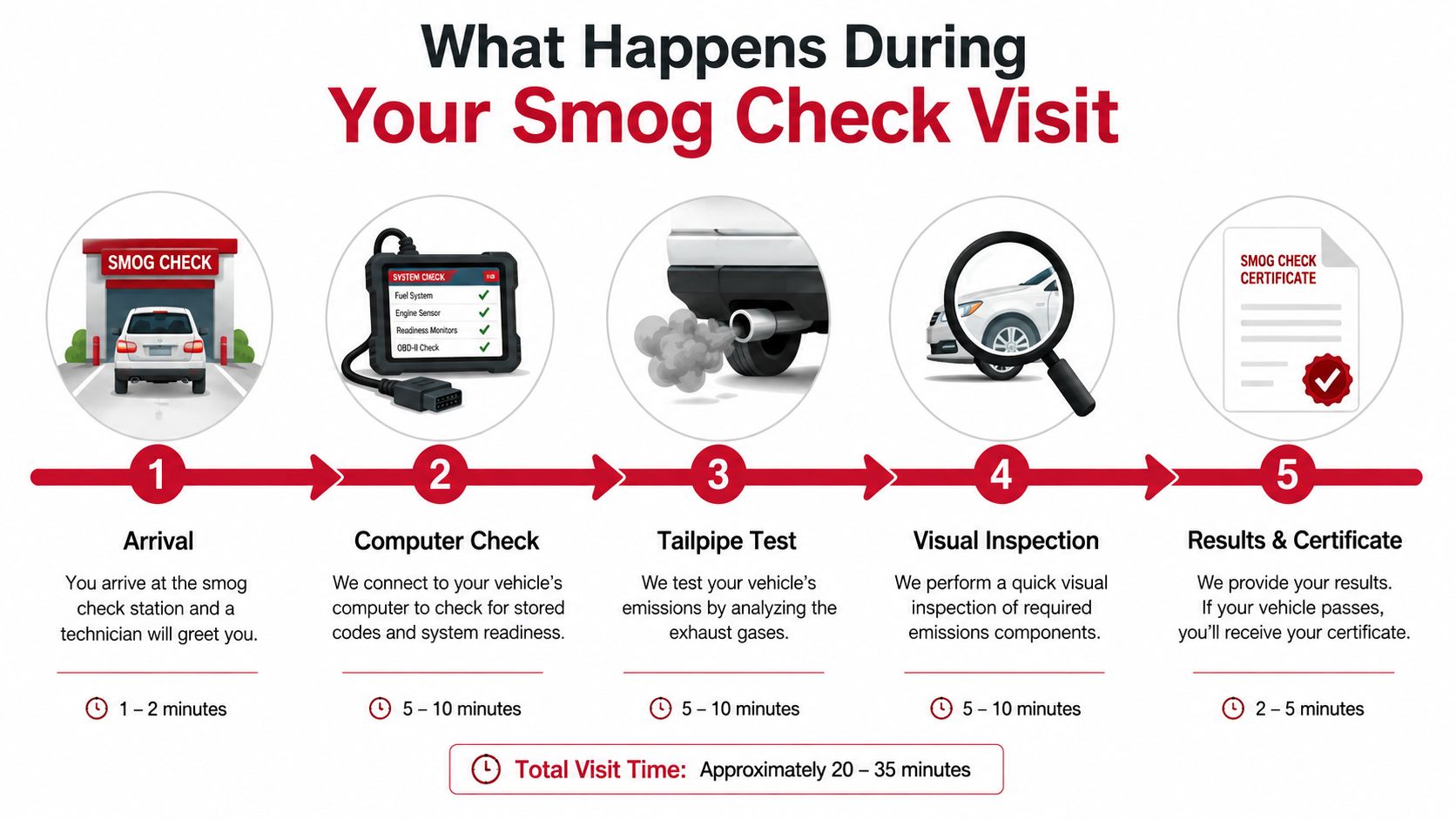
The visit from start to finish
The first step is paperwork and identification. The technician needs the right vehicle, the right registration information, and a car that's ready to be tested, which means the check engine light should already be addressed if it's on.
The second step is the diagnostics connection. On modern vehicles, the OBD system is the car's own language, and the station reads that language to see whether the emissions controls are behaving properly.
The third step is the physical inspection. The technician looks for visible emissions equipment issues and other problems that would interfere with a clean result.
If the car is only being warmed up, not driven enough to finish its self-checks, the station may see an incomplete picture even if the engine sounds fine.
The final step is the result. A pass keeps the renewal moving, while a fail usually comes with a report explaining what the station found. Some stations also offer a retest policy, which can matter if a repair is needed before the vehicle can return. When that happens, the station is no longer just a testing stop, it becomes part of the paper trail between repair, retest, and DMV completion.
A quick note on expectations. A smog inspection isn't a place for guesswork or persuasion, and the technician can't “override” a bad reading because a driver is in a hurry. The visit works best when you treat it like a checkpoint on a route, not a negotiation.
Using a Smog Station with On-Site DMV Services
A station that also handles DMV business changes the whole errand. Instead of finishing the smog test and then driving to a separate field office, you can often handle renewal-related paperwork in the same stop if the station is a licensed DMV business partner. That matters most when your main problem isn't the inspection itself, it's the time lost bouncing between two offices.
Fire House Smog in Antioch is a worked example of this setup. It offers on-site California DMV registration renewals with sticker printing, and it also handles ownership transfers for California and out-of-state vehicles, including stickers and plates as needed. For a driver staring at a renewal notice, that means the smog result and the DMV completion step can live in the same visit instead of becoming two separate trips.
What to bring and why it matters
A combined visit still works only if you show up prepared. Bring the renewal notice, any title or transfer paperwork you've been given, and a payment method that the station accepts. If your transaction involves an out-of-state title, the paperwork trail can be more involved, so it helps to ask what the station needs before you drive over.
Weekend and extended hours are useful because they cut down on the workday conflict most drivers run into. Fire House Smog lists Monday through Saturday 9:30 AM to 5:00 PM and Sunday 12:00 PM to 4:00 PM for DMV service hours, with limited services possible on weekends, which is exactly the kind of detail that prevents a wasted trip.
Driver shortcut: if your renewal notice points to smog plus registration, ask whether the station can finish both pieces before you leave. That one question can save a second line at the DMV.
The reason this model matters is simple. A DMV field office is good at government paperwork, but it isn't built around inspection throughput. A station with on-site DMV capability gives you the emissions result and the renewal handling in one place, which is the closest thing to a single-stop solution California drivers can get.
RVs Fleets and Other Vehicles That Need Special Handling
Not every vehicle fits neatly into a standard passenger-car appointment. RVs, motorhomes, and small fleet vehicles often need a quick phone call before they roll in because length, height, and bay clearance can change whether a station can test them safely. A two-bay layout helps, but it doesn't erase the fact that oversized vehicles take more planning than a sedan.
Real-world scheduling beats generic advice. A driver with a motorhome doesn't want to find out at the curb that the station can't handle the vehicle dimensions. A fleet manager doesn't want to send three work vans to a shop with limited throughput if one bay is tied up and the other is already full.
Why the station layout matters
A station with multiple bays can rotate vehicles more efficiently, especially when it also offers weekend availability. That matters for businesses that can't leave service vehicles off the road during weekday hours. It also matters for families trying to finish a registration task between school pickup and dinner.
Out-of-state title transfers fit into this same category of special handling. The smog test may be only one part of the visit, but the DMV paperwork can change what the station needs to verify, so those drivers should ask about document requirements before showing up.
Some stations are built around speed, others around breadth of service. The best match depends on whether you're arriving in a compact commuter car, a large utility vehicle, or a vehicle that needs both inspection and DMV processing in the same stop.
What Makes a Test-Only STAR Station in Antioch Stand Out
A test-only STAR station earns attention for a specific reason, it removes the repair incentive while still meeting a higher inspection standard. For drivers who worry about being sold work they didn't ask for, that combination can feel cleaner and easier to trust. The Antioch example also matters because it pairs the inspection with on-site DMV services, so the visit can solve both the smog requirement and the renewal problem.
The practical features line up with common driver frustrations. Two service bays help with throughput. Seven-day smog testing helps working drivers. Weekend DMV hours help people who can't disappear from work in the middle of the day. The drive-through layout on Lone Tree Way reduces the friction that usually makes inspection errands drag out longer than they should.
Why test-only is a feature
A test-only station doesn't make money by recommending fixes. That's useful when you want a straight result and a clean certificate trail. It's also useful when you already know your car needs repair elsewhere and just want the inspection handled by a separate party.
The Antioch location is also a good example of how one station can serve different needs without turning into a general repair shop. It can inspect passenger cars, SUVs, and light-duty trucks, and it can handle some RVs and motorhomes within size and equipment limits, which is exactly the kind of flexibility local drivers look for when a single vehicle can't be treated like a standard sedan.
If you're comparing nearby options, Fire House Smog is one option to consider for STAR-certified test-only inspection plus DMV registration support in one place. That matters most when your worry is accuracy, not upselling.
Choosing the Right Station and Preparing for Your Visit
A smog check goes more smoothly when you start with the notice in your hand instead of the nearest address on a map. If the DMV paperwork says STAR, that is the first filter. If the same trip needs renewal help, look for a licensed partner that can handle the smog result and the paperwork step at the same stop. If the vehicle is oversized or unusual, call ahead so you know the bay, equipment, and height limits before you drive over.
A simple way to picture the choice is like picking the right socket for a lug nut. The wrench has to match the job, or the process stalls before it starts.
A simple pre-visit checklist
- Confirm the notice requirement: Check whether your vehicle needs a regular station, STAR, or something more specific.
- Make the car test-ready: If the check engine light is on, handle that first.
- Drive before you go: Get the engine fully warmed up so the car is ready to report accurately.
- Bring the paperwork: Renewal notice, title documents if needed, and a payment method.
- Ask about the retest policy: If the car fails, find out what the station includes before you leave.
These steps are like checking tire pressure before a road trip. A little preparation helps the visit reflect the car's real condition instead of a problem that could have been fixed earlier.
Quick questions drivers ask
Do I always need a STAR station? No. The requirement depends on the notice and the vehicle profile, not on convenience.
What does a free retest mean? It usually means the station will inspect the car again after a qualifying repair, but you should confirm the terms before assuming anything.
How is on-site DMV renewal different from the field office? A DMV field office handles government transactions, while an on-site partner can process certain renewal tasks right where the smog test happens.
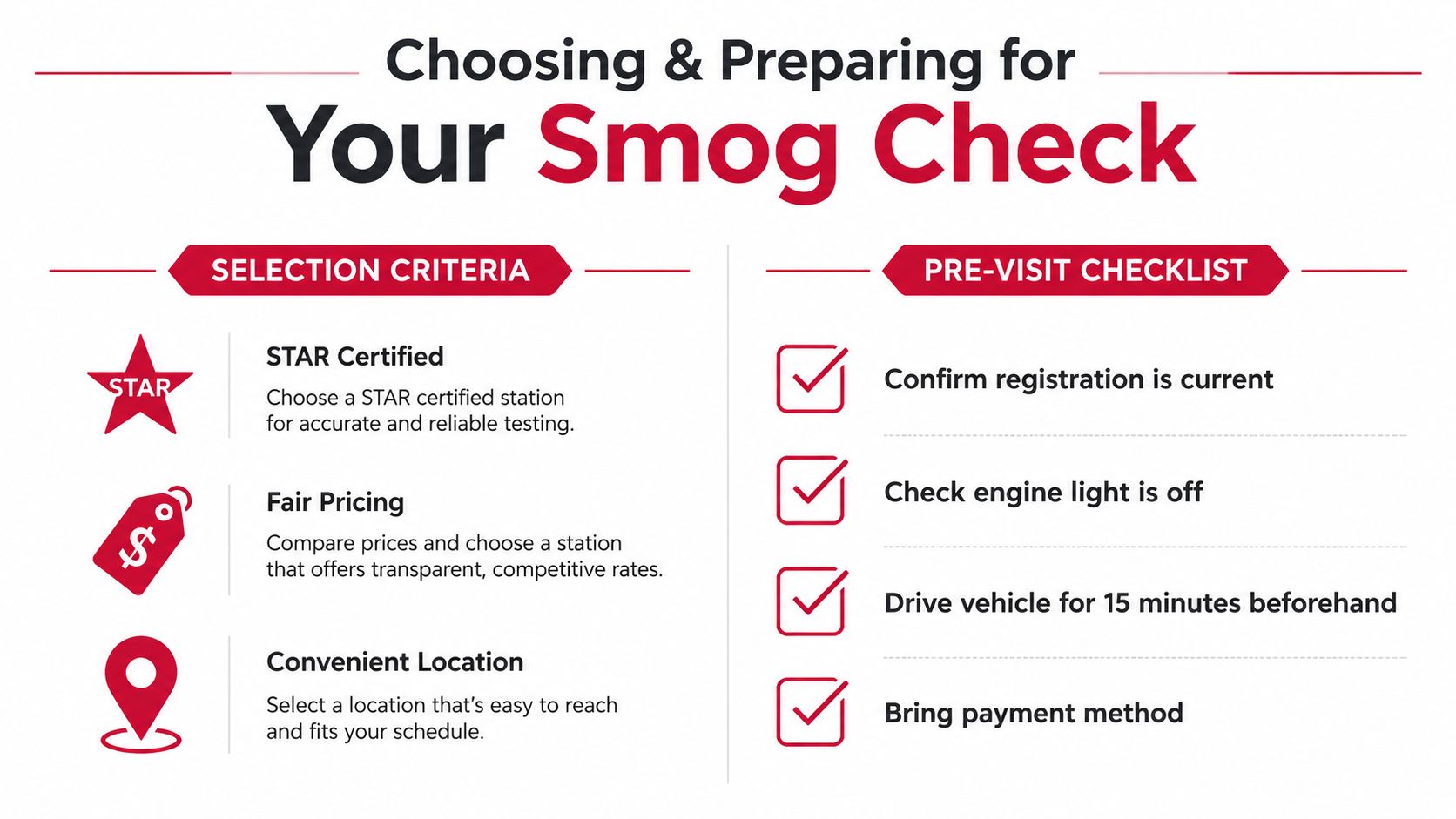
If your goal is to finish the inspection without another stop and leave with the renewal step handled, a station like Fire House Smog is built for that kind of visit. Review its services, compare them with your notice, and decide whether its smog and DMV options fit your plan when you are ready to move ahead.
The moving truck is finally unloaded. Your kitchen is still half in boxes, you're learning new roads, and somewhere between setting up utilities and changing your address, your car still has plates from your old state.
That's the part many new California residents underestimate. Out of state vehicle registration sounds simple until you run into smog rules, VIN verification, title questions, residency proof, and a DMV process that doesn't forgive missing paperwork. The difficulty isn't usually with the rule itself. Instead, it lies with the friction.
California gives you a path, but it expects you to move quickly and bring the right documents the first time. If you show up unprepared, the process turns into repeat visits, more time off work, and more confusion than it needs to be. A practical checklist helps. So does knowing what usually stalls an application before you ever stand in line. If you want a clean starting point, this vehicle registration document guide is a useful companion while you gather your packet.
Table of Contents
- Welcome to California Now About Your Car
- The Clock Is Ticking Your First 20 Days
- Gathering Your Essential Paperwork
- Navigating Smog Checks and VIN Verification
- Calculating and Paying Your Registration Fees
- Troubleshooting Common Registration Roadblocks
- Your Finish Line A Faster Path to California Plates
Welcome to California Now About Your Car
Most new residents reach the same moment. The car is sitting in the driveway with valid plates from somewhere else, so it feels like there's no rush. Then the questions start. Do you need California insurance first? Is a smog check always required? What if the title is still with the lender? Can you just wait until renewal time?
That's where people lose time. California doesn't treat out of state vehicle registration like a casual update. It treats it like a formal transfer into the state system, with its own inspection, paperwork, and fee process. The vehicle has to match California's records, California's emissions rules, and California's registration requirements before the state will finish the transfer.
What catches new residents off guard
The surprise usually isn't one big issue. It's three or four smaller ones stacked together.
- The title question: Many owners don't physically have the out-of-state title because a lienholder holds it.
- The inspection step: A vehicle can be running perfectly and still need separate California verification steps.
- The address mismatch: Insurance, ID, registration paperwork, and proof of residence need to line up cleanly.
- The truck or RV detail: Heavier vehicles often have extra paperwork that passenger-car owners never think about.
Practical rule: Don't judge your registration by whether the car drives fine. Judge it by whether your paperwork, identification details, and vehicle records match.
The smoothest registrations usually happen when the owner treats the process like a document project first and a DMV errand second. That means gathering ownership papers, confirming the vehicle's status, and handling inspections before your deadline is staring at you.
The Clock Is Ticking Your First 20 Days
California doesn't leave this open-ended. State regulations say California residents who buy a vehicle with out-of-state plates must apply for in-state registration and pay the required fees within 20 days of the purchase date, according to the California Air Resources Board background document.
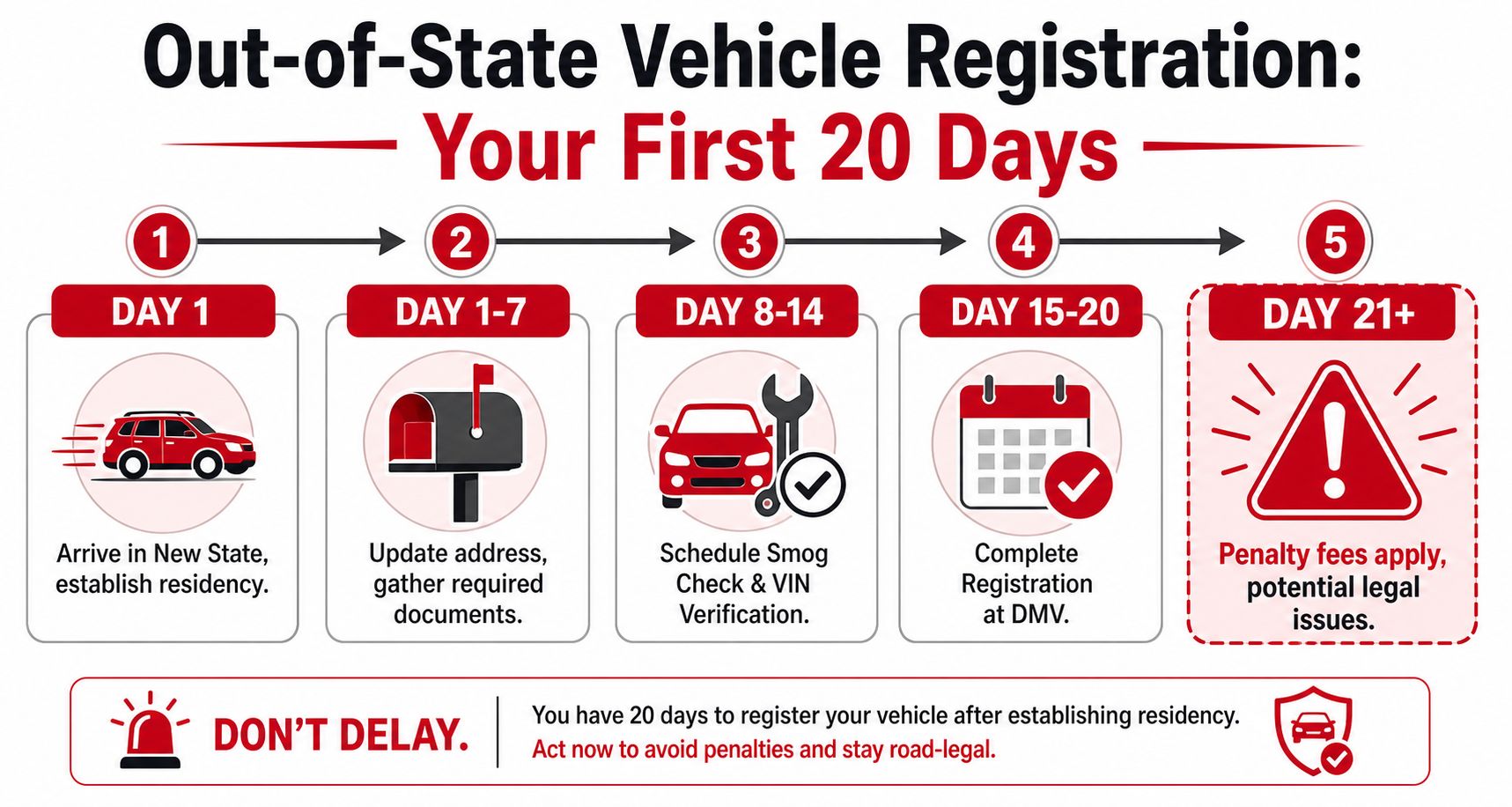
That deadline matters because people often assume they can wait until their old registration expires. California doesn't look at it that way. Once you're required to register here, delay creates risk. Even if the vehicle still looks fully legal to you, the state expects the transfer process to already be underway.
What counts as your starting point
For most new residents, the practical approach is simple. If you've moved here and are making California your home, start acting as if the clock is already running.
Waiting for the perfect moment usually creates the main problem. People postpone the process until they have a free weekday, until the lender sends paperwork, or until they decide whether they're “really settled.” By then, they're scrambling to book inspections and assemble documents under pressure.
What to do first
Handle the early steps in order so nothing bottlenecks later.
- Update your address records. Your California address needs to appear consistently across the documents you'll use.
- Locate ownership documents. If a lender holds the title, contact them immediately and ask what they require for an out-of-state transfer.
- Confirm whether the vehicle needs smog and VIN verification. In practice, it is advisable to assume both are required until verified otherwise.
- Check for truck or RV extras. Those vehicles often need a weight certificate in addition to the core registration packet.
- Book your inspection-related services early. Appointments and missing forms are what usually squeeze that 20-day window.
The deadline feels generous until you lose a week waiting on one document.
A good rule is to spend your first few days building the file, not debating the rule. Once you've got the title situation clear and the inspection steps scheduled, the rest of the process gets much easier to control.
Gathering Your Essential Paperwork
Most failed trips happen for one reason. The owner brings most of the documents, not all of them.
California wants a clean chain that proves who you are, what the vehicle is, who owns it, and where you now live. If one part of that chain is weak, the application slows down or stops. This is especially common in out of state transfers because lenders, previous state titles, and differing state forms create more room for mismatch. If you're dealing with ownership movement from another state, this out-of-state title transfer overview can help you understand the handoff.
Your core document packet
Start with ownership first. The original out-of-state title is the key document when it's available. If you still owe money on the car, the lienholder may hold it, and that changes how the transfer gets processed. Don't wait until the end to figure that out.
Next comes the application material. California typically requires a formal registration application, and the details on that form must match the vehicle and ownership records exactly. If the car is under the age threshold that triggers odometer disclosure requirements, make sure that disclosure is complete and readable. Missing odometer information is one of the recurring reasons transfers stall.
Then there's residency proof. On this point, many organized people still get tripped up because they bring documents that show activity in California but not necessarily clean proof of residence. Use current, consistent records and make sure the name and address formatting match across your packet as closely as possible.
California Out-of-State Registration Document Checklist
| Document | Purpose | Key Details |
|---|---|---|
| Out-of-state title | Proves ownership | If a lienholder holds it, contact them early for transfer instructions |
| Registration application | Starts the California record | Complete every ownership and vehicle field carefully |
| Current out-of-state registration | Helps verify existing vehicle record | Bring the latest valid card or renewal proof you have |
| California driver license or ID | Confirms identity | Name should align with title and application |
| Proof of California residency | Shows your in-state residence | Use documents with your current California address |
| Odometer disclosure | Required for certain vehicles | Especially important for vehicles under the applicable age threshold |
| Smog certificate, if required | Shows emissions compliance | Complete this before final processing if your vehicle needs it |
| VIN verification form or completed verification | Confirms vehicle identity | Must match the physical vehicle exactly |
| Weight certificate for trucks or RVs, if required | Supports classification and fees | Needed for qualifying vehicles, not standard passenger cars |
| Proof of insurance, if requested in your transaction flow | Supports registration file | Make sure the address and vehicle details are consistent |
A few practical habits make this much easier:
- Bring originals when possible: Copies help you stay organized, but originals often resolve questions on the spot.
- Check every name format: Middle initials, suffixes, and ownership wording matter more than people expect.
- Match addresses everywhere: A different apartment format or an old mailing address can slow a file down.
- Carry backup residency proof: If one document raises a question, a second one can save the trip.
If your paperwork tells three slightly different stories, the clerk has to stop and sort it out. That's when a quick visit turns into a delayed registration.
Keep the whole packet in one folder. Put ownership documents first, identity and residency documents second, then inspection records behind them. That order mirrors the way problems tend to be discovered, and it makes corrections faster if someone at the counter needs to review your file.
Navigating Smog Checks and VIN Verification
The most technical part of out of state vehicle registration in California isn't the form. It's the vehicle validation itself.
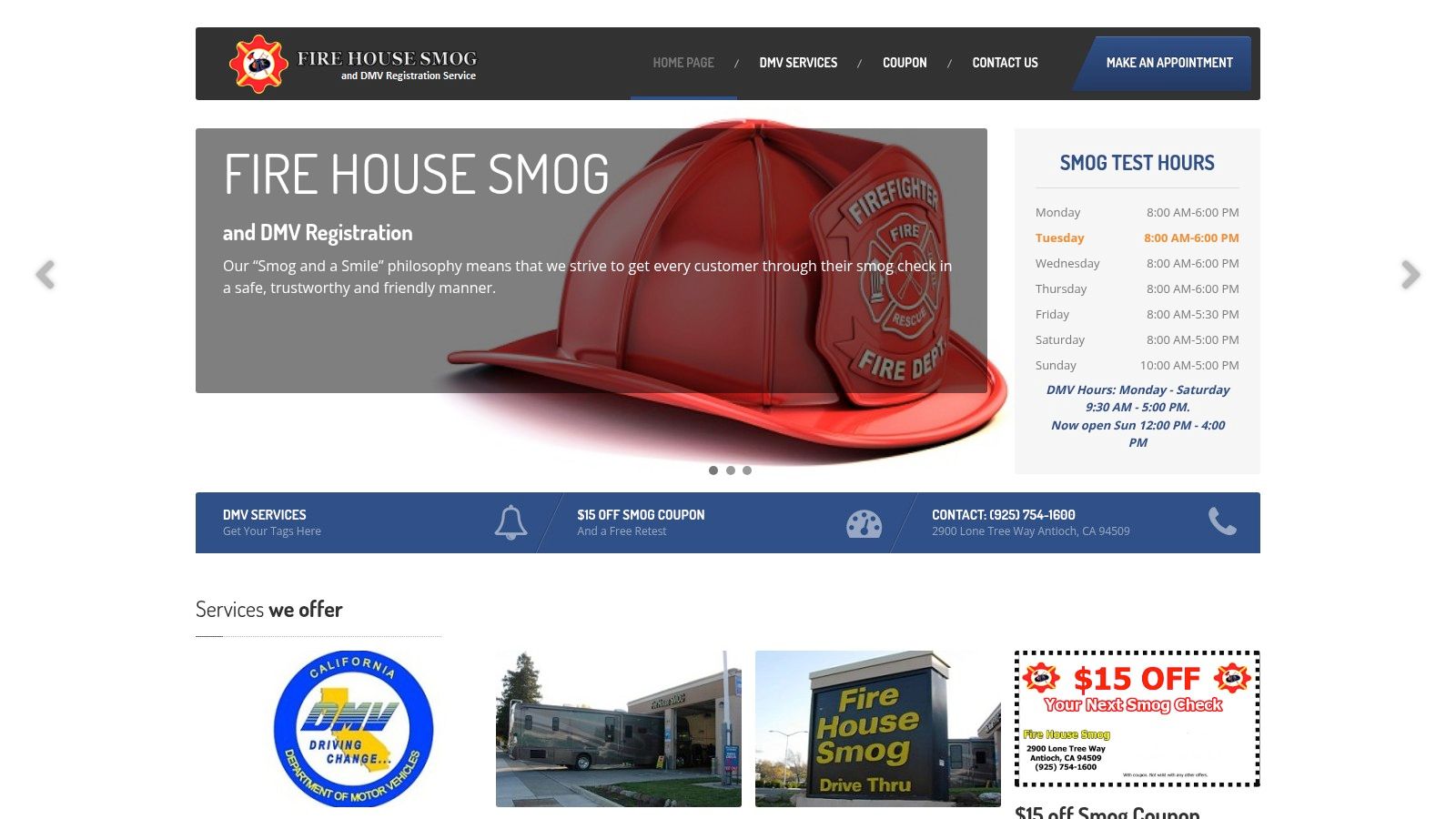
California requires a two-step technical validation for out-of-state registration that includes VIN verification by a licensed verifier and a weight certificate for trucks or RVs, with failure rates exceeding 15% because of missing odometer disclosures or mismatched VIN plates on vehicles under 20 years old, according to this out-of-state registration process analysis.
Why these two checks stop so many registrations
Owners often focus on smog because they've heard about California emissions rules for years. But VIN verification is just as important. California has to connect your paperwork to the actual vehicle in front of it. If the number on the title, the number on the registration record, and the number physically attached to the vehicle don't line up cleanly, the transfer won't move forward.
Smog has its own problem. People assume that because the car passed in another state, or because it renews fine where it came from, California will accept that history. It won't. California applies its own emissions compliance process.
A STAR-certified station matters here because California distinguishes between station types. If you're not sure what that label means, this STAR-certified smog explanation breaks down the role clearly.
What the verifier is actually checking
VIN verification is not a paperwork-only exercise. The verifier inspects the vehicle and compares the identifying number on the vehicle itself to the ownership record. On some vehicles, age, wear, prior repairs, or hard-to-read plates create avoidable delays.
Common issues include:
- Unreadable VIN plate details
- Mismatched paperwork from a previous state
- Incomplete odometer disclosure
- Weight-certificate omissions on trucks and RVs
- Assumptions that renewal rules are the same as transfer rules
That last issue is more common than people think. Owners often bring the mindset of a simple renewal into a transfer transaction, and California treats those as very different tasks.
Here's a quick visual walk-through of the general process before you arrive:
When a local DMV partner helps
This is the stage where combining services can remove a lot of friction. Instead of getting a smog inspection in one place, then chasing down verification help elsewhere, some owners use a local provider that handles both emissions testing and DMV-related registration tasks in the same workflow.
Fire House Smog is one example in Antioch. It's a STAR-certified test-only smog station and licensed DMV service provider that handles transfer-of-ownership work for California and out-of-state vehicles, with on-site sticker and plate processing as needed during posted service hours.
That matters most when your issue isn't dramatic. It's just logistical. If your paperwork is basically ready and your car needs the California compliance steps, reducing extra stops usually reduces mistakes too.
Calculating and Paying Your Registration Fees
Fees make people nervous because the bill doesn't come from one simple line item. California registration costs are a stack of charges tied to the vehicle, the transaction type, and sometimes the vehicle class.
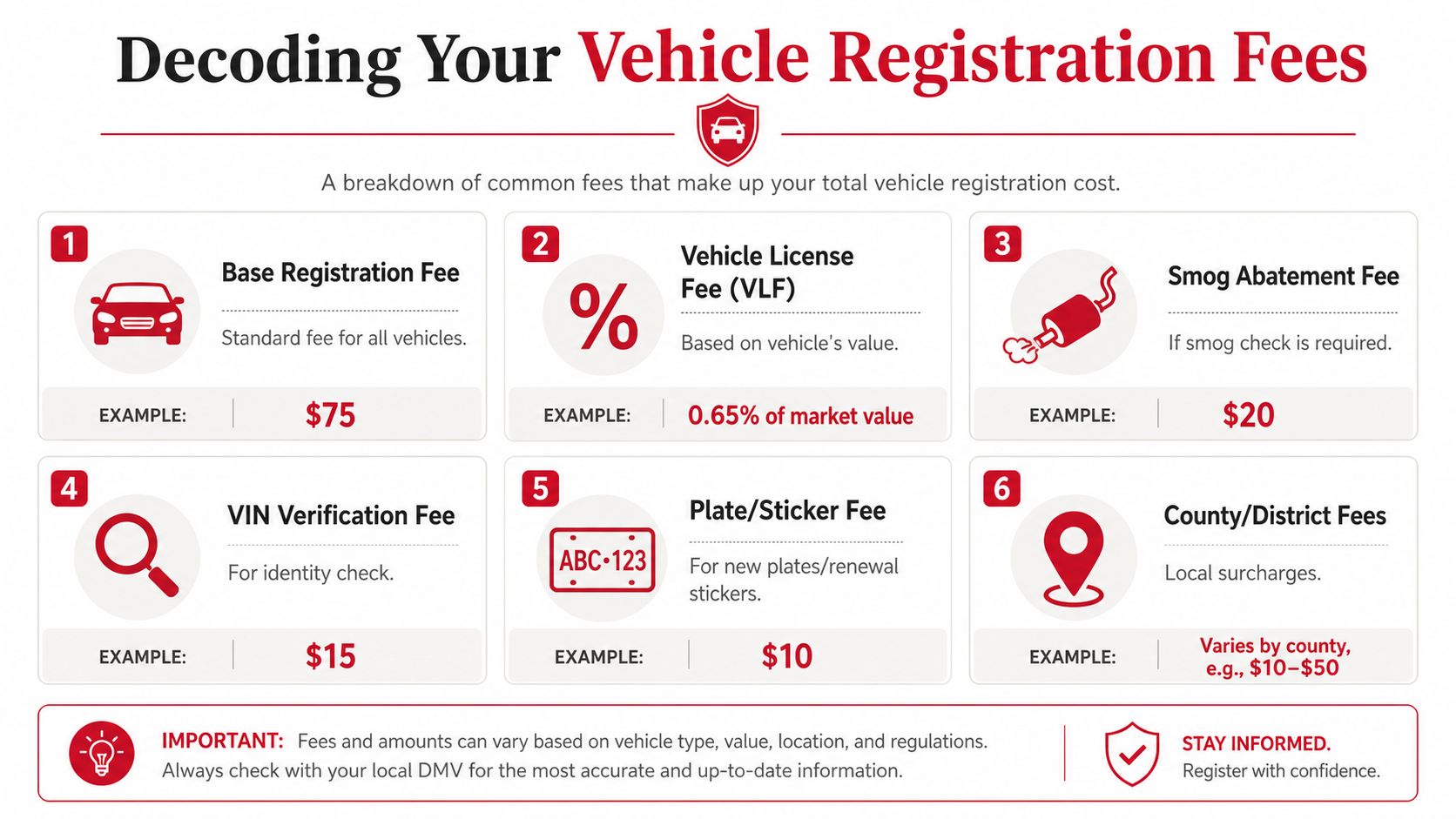
The practical mistake is expecting a neighbor's number to predict your own. Two people can move to California at the same time with completely different fee totals because their vehicles, titles, purchase histories, or classifications differ.
Why one person's bill looks nothing like another's
The final amount often reflects several moving parts, such as the basic registration charge, ownership-related charges, vehicle license components, use-tax exposure depending on the transaction, and class-specific costs for trucks or RVs. A heavier vehicle or a more complex transfer usually creates a different fee picture than a standard passenger car with clean paperwork.
That's why broad online guesses don't help much. The right way to think about fees is by category:
- Registration-related charges: The baseline cost of putting the vehicle into California's system.
- Vehicle-based charges: Some fees depend on the vehicle's classification or record details.
- Tax-related charges: Use tax can surprise people, especially after an out-of-state purchase.
- Transaction-specific add-ons: Plate, transfer, or related processing items may apply depending on the case.
If you own a truck or RV, budget extra attention rather than just extra money. Those files often involve additional classification steps before the fee side is even finalized.
Where late mistakes get expensive
California enforces this area aggressively. In one year, the California Highway Patrol collected over $1 million from 3,383 out-of-state license plate violations, with an average penalty of $297.58 per case, according to this CHP enforcement report summary.
That doesn't mean every delayed registration ends in a citation. It does mean the state treats intentional avoidance seriously, especially when a California resident appears to be using another state's plates to avoid California fees and taxes.
Don't treat fees as a reason to wait. Delay can turn one required payment into a more expensive problem.
The best financial move is usually the least dramatic one. Start early, classify the vehicle correctly, and get the documentation right before you submit. Most extra costs show up after preventable delays, not before.
Troubleshooting Common Registration Roadblocks
When registration goes sideways, it usually happens in familiar ways. The car fails smog. The title is somewhere you can't access quickly. The residency documents don't line up. Or the owner thinks living in California part-time is enough to justify using another state's registration.
None of those issues automatically kills the process. They just require the right next move.
If your smog check doesn't pass
Don't jump straight into random repairs. First, get the failure details and understand whether the issue is emissions-related, readiness-related, or tied to a vehicle condition that needs diagnosis.
Then be methodical:
- Read the inspection result carefully: The cause matters. A failed test and an incomplete test are not the same problem.
- Fix the actual issue: Don't authorize unrelated work just because you're on a deadline.
- Retest after the repair path is clear: Some stations offer a free retest under their posted policy and coupon terms, which can reduce the hassle of repeating the process.
If your title is missing or held by a lienholder
This is common, especially for recently financed vehicles. Contact the lender immediately and ask what they need for a California transfer. Some owners assume the DMV or service provider will request it automatically. Sometimes that's part of the process, sometimes it isn't, and waiting to find out at the counter wastes time you may not have.
Have your loan account information ready before you call. Ask specifically about title release timing, transfer authorization, and whether they send the title directly or provide another ownership document for the registration file.
Residency and domicile are not the same thing
This point causes real legal trouble because people hear casual advice from friends and assume physical presence is enough. It often isn't. According to this analysis of registration rules and domicile requirements, 34 states and D.C. require domicile, meaning intent to make a place your permanent home, not just temporary presence.
That matters for California residents trying to keep another state's registration as a convenience strategy. If your registration story, insurance address, tax filings, and daily reality don't line up, you're creating a file that can look deceptive.
A weekend place, a mailing address, or a relative's home usually isn't enough if your real home life is centered in California.
When in doubt, align everything with where you live. That means your license, insurance, registration, and supporting documents should point in the same direction. Clean consistency solves more registration problems than clever workarounds ever do.
Your Finish Line A Faster Path to California Plates
The clean version of this process is straightforward. Act quickly. Build a complete paperwork packet. Handle the smog and VIN requirements early. Then finish the registration before delays create fee or compliance trouble.
What slows people down isn't usually the law. It's fragmentation. One place checks emissions. Another place handles part of the paperwork. The title issue is still unresolved. A residency document has the wrong address format. By the time all of that gets sorted, the simple transfer no longer feels simple.
That's why many new residents choose a DMV partner instead of trying to decode everything in real time at the counter. If you can work with a provider that handles registration services and the inspection side in one local stop, you reduce the number of handoffs and the number of places a mistake can hide.
You don't need a complicated strategy for out of state vehicle registration in California. You need a complete file, the right inspections, and a process that doesn't force you to start over.
If you want help getting your California registration handled with fewer moving parts, Fire House Smog in Antioch provides STAR-certified smog testing and licensed DMV registration services for renewals, ownership transfers, and out-of-state vehicle transactions, with on-site tag issuance during posted hours.