You've arrived at the DMV with a renewal notice in your hand, but the line already stretches past the entrance. You need a registration renewal, perhaps a smog check too, and you're trying to work out whether this visit will take minutes or most of your day. That uncertainty is the part of DMV registration customer service that frustrates drivers most.
The process becomes easier to manage when you treat it as a workflow rather than a single counter visit. Your transaction moves through intake, document review, payment, system entry, and registration issuance. The right service channel can remove unnecessary steps, especially when an authorized business partner can combine emissions testing with registration work.
Table of Contents
- The DMV Registration Customer Service Experience at a Glance
- What DMV Registration Customer Service Actually Covers
- Choosing the Right Channel for Your Transaction
- How to Prepare Before You Contact DMV Customer Service
- Inside an On-Site Registration Partner Like Fire House Smog
- Common Registration Problems and How to Solve Them
- Misconceptions About DMV Registration Customer Service
- Your Pre-Visit Checklist and When to Choose a Partner
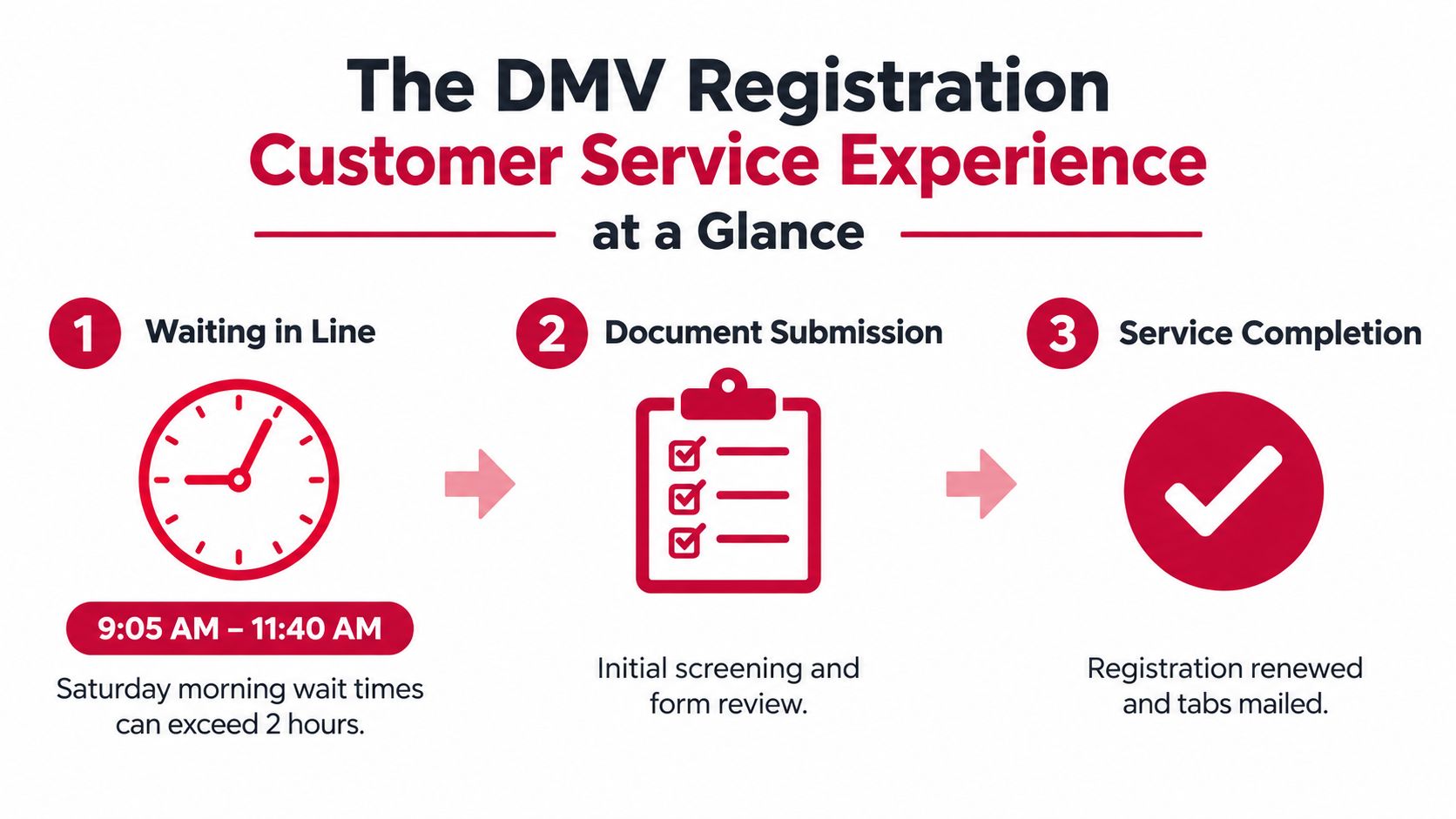
The DMV Registration Customer Service Experience at a Glance
A DMV registration visit usually follows a recognizable sequence. You first explain what you need, show identification, and enter the queue for that transaction. The clerk then checks the documents connected with your vehicle, confirms the required fees, enters the transaction into the registration system, and provides the completed registration materials.
The five points where time is spent
Intake: Tell the representative whether you need a renewal, title transfer, duplicate sticker, address update, or another service. This determines which queue and document set apply.
Document review: The representative checks items such as your registration record, title, smog information, insurance, identification, and payment details. Missing paperwork often stops the transaction here.
Payment and system entry: Once the documents pass review, the representative collects the required fees and submits the information through the approved registration system. Your receipt confirms that the transaction was entered, but it may not always mean every physical item is already in your hand.
Registration issuance: Depending on the channel and transaction, you may receive a registration card, year sticker, or plates. Some services issue materials immediately, while others mail them.
Follow-up: A hold, rejected document, mailing delay, or record correction creates a second service need. Keep your receipt and any confirmation number so the next representative can locate the transaction quickly.
Practical rule: Ask which stage your transaction is in before asking how much longer it will take. “Is the hold in document review or system processing?” gets a more useful answer than “How long is the wait?”
Wait times can change sharply when policy deadlines create a rush. An official Oregon transportation report recorded an average call wait of 12 minutes in 2025, while wait times improved to under 2 minutes in 2026 after demand eased, as described in the Oregon customer service report. The lesson applies broadly: a busy DMV day doesn't necessarily mean the transaction itself is difficult. Volume can be the problem.
What DMV Registration Customer Service Actually Covers
DMV registration customer service includes the routine tasks that keep a vehicle record accurate and current. A renewal extends the registration period. A title transfer changes ownership after a sale. A duplicate sticker replaces a lost item, while an address update keeps notices connected to the correct location.
Other requests are more specialized. A lien release removes a lender's interest after a loan is paid. A plate surrender records that a vehicle has been sold, totaled, or otherwise removed from active use. A field-office representative may also need to review a VIN verification or correct a complicated title record.
Three channels, one connected process
Most drivers use one of three channels:
- Field offices: These are designed for transactions that need face-to-face examination, identity checks, VIN verification, or detailed title review.
- Online services and phone systems: These are useful for straightforward renewals, address changes, status questions, and other requests that don't require a physical inspection or document examiner.
- Authorized business partners: DMV-licensed businesses handle an approved range of registration services, which can include renewals, title transfers, plates, and stickers.
An authorized partner isn't a separate registration system. The partner operates through DMV-approved channels and works with the vehicle record maintained by the agency. California DMV describes business partners as providers that can handle services including renewals, plates, stickers, title transfers, and reports of sale, and notes that these locations often have shorter waits than field offices in its registration business partner guidance.
Why the workflow matters
The same transaction can feel completely different depending on where it starts. A field office may need to divide your visit into document review, payment, and issuance at separate points. A partner location may combine related steps, such as a smog inspection and renewal, when the transaction qualifies.
The important question isn't just, “Can this place renew my registration?” Ask instead, “Can this channel complete every required step for my vehicle?” That distinction prevents a trip that ends with a receipt but no sticker, or a renewal attempt that must be restarted after a missing smog result is discovered.
Choosing the Right Channel for Your Transaction
Start with the transaction, not the location. A simple renewal with no record issue has different requirements from an out-of-state title transfer or a vehicle that needs VIN verification. Choosing the wrong entry point can create an extra handoff, even when every representative is doing the correct work.
| Channel | Typical Wait | Availability | Best For |
|---|---|---|---|
| Field office | Appointment or in-person queue | Office hours | VIN checks, complex title corrections, examiner review |
| Online service | No physical queue | Available through the DMV portal | Straightforward renewals, eligible address updates, duplicate records |
| Authorized partner | Depends on location and transaction | Posted business hours | Renewals, transfers, smog-related registration work, sticker or plate issuance |
Use the field office for exceptions
A field office is the safer choice when the record needs an examiner's attention. Examples include a VIN verification, an unresolved title problem, conflicting ownership documents, or a transfer that can't be completed through the online portal. Bring the original documents requested by the agency, not just photographs on your phone.
Use online service for clean, simple records
The DMV website works well when the vehicle is eligible for online renewal and the record contains no unresolved hold. Before submitting, confirm that the registration information, address, insurance details, and smog status are current. If the portal rejects the transaction, save the message. It often identifies the missing step you need to complete elsewhere.
Use a partner when steps belong together
An authorized business partner is useful when you need in-person help but don't need a field-office examiner. For an Antioch driver who needs both a smog inspection and a registration renewal, a partner such as Fire House Smog can handle those related steps at one location when the transaction qualifies. Review the available DMV registration service options before you leave home, then confirm hours and document requirements.
The best channel is the one that completes the whole workflow. A short online renewal is convenient only if no additional review is required. A partner visit is efficient only if you arrive with the documents and vehicle information needed to finish the transaction.
How to Prepare Before You Contact DMV Customer Service
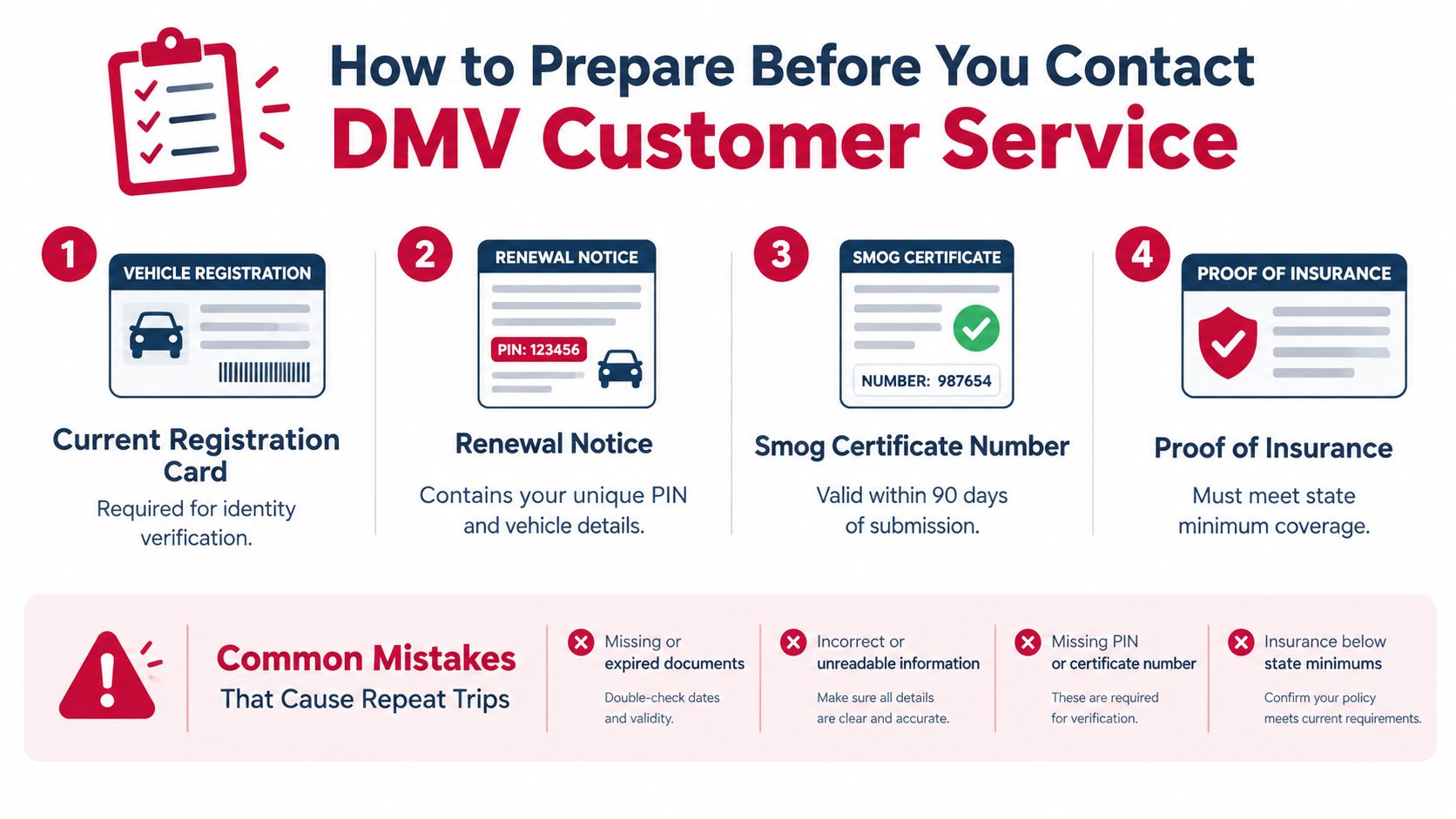
Most repeat visits come from one missing item, not from a complicated DMV rule. Prepare your documents before you choose a channel, and separate what you need for a renewal from what you need for a title transaction.
Build a transaction folder
For a standard renewal, gather:
- Current registration card: Use it to confirm the plate, vehicle identification number, and registered owner.
- Renewal notice: Keep the entire notice, including any reference or identification information.
- Smog information: Have the certificate or test details available if the vehicle is due for an inspection.
- Proof of insurance: Make sure it identifies the correct vehicle and meets the requirements for the jurisdiction.
- Valid identification: Bring an accepted ID for an in-person transaction.
- Payment method: Check what the selected channel accepts before you arrive.
For a transfer, add the title, signed ownership documents, lien-release paperwork when applicable, and any required bill of sale or release-of-liability document. Don't assume the representative can infer a missing signature or correct an incomplete title without additional paperwork.
Match your preparation to the channel
For an online request, log in before calling. Check whether the portal shows a smog requirement, an address mismatch, an unpaid balance, or a document upload request. Write down the exact error message and the confirmation number for any submission.
For a field office appointment, organize originals in the order the transaction requires. For a partner visit, bring the same core documents, but also bring the vehicle if a smog inspection is part of the work. A representative can process the registration only after the required supporting result is available.
For a more detailed document list, review vehicle registration documents from Fire House Smog. The list won't replace the DMV's requirements, but it can help you notice gaps before you travel.
You can also use this short video as a visual reminder of the preparation process:
Inside an On-Site Registration Partner Like Fire House Smog
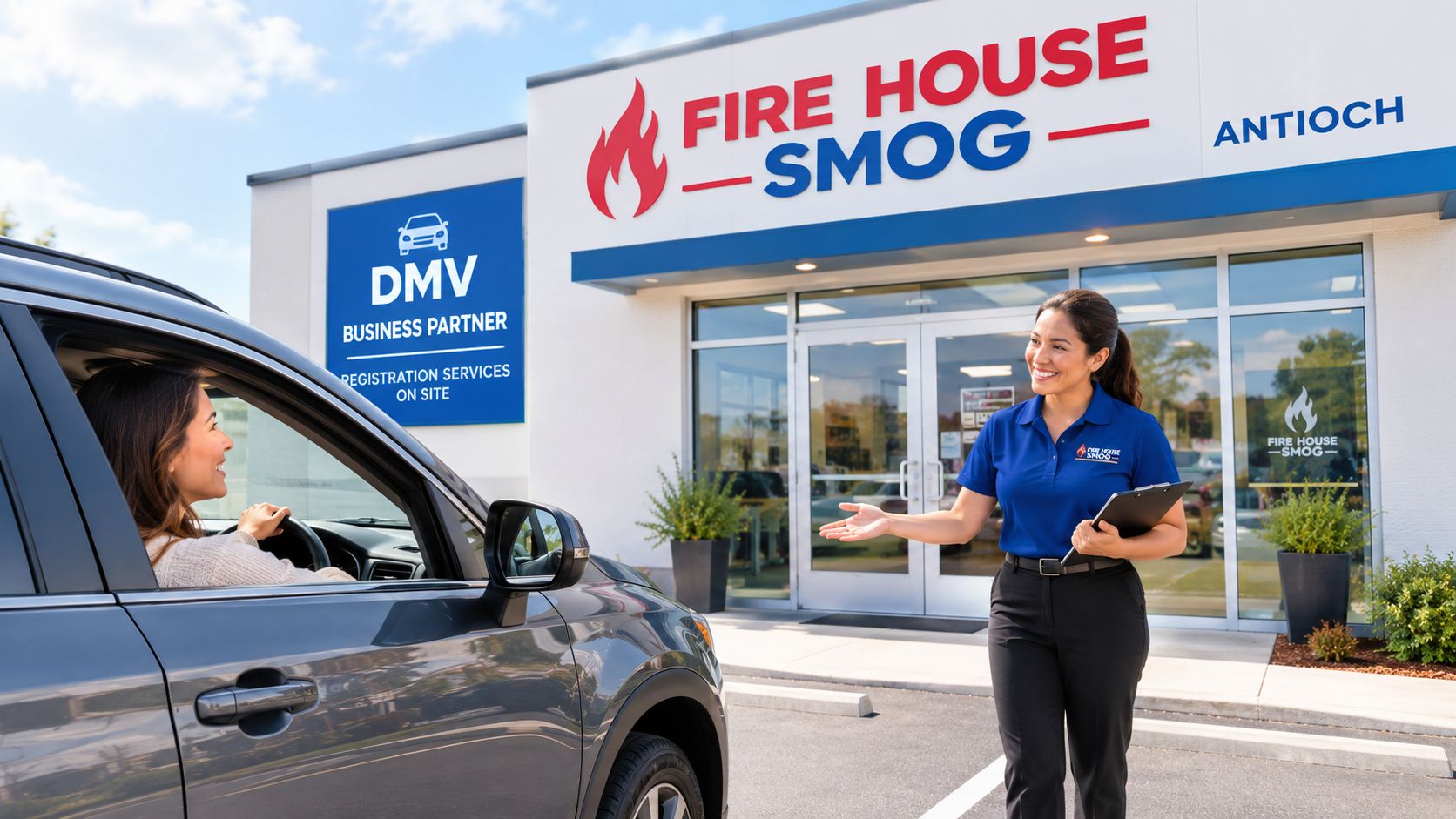
Consider a driver in Antioch whose renewal requires a smog inspection. The traditional workflow may split the task between an emissions station and a later DMV visit. The partner model brings the related steps together, provided the vehicle and transaction meet the requirements.
The driver arrives with the renewal information, identification, insurance details, and payment method. A technician performs the emissions inspection, and the result is submitted through the approved process. Once the registration record can be completed, the registration representative handles the DMV portion at the same location.
What the combined visit changes
The benefit isn't that the rules disappear. The same eligibility checks, fees, and record requirements still apply. The difference is the handoff. Instead of completing an inspection, locating a second appointment, carrying documents to another counter, and explaining the situation again, the driver can move from one related task to the next in a single location.
California's modernization work shows why the backend matters. The DMV's business-partner automation program describes six authorized first-line service providers supporting second-line business partners, making connectivity and transaction submission central to service delivery in the business partner automation program.
Faster front-counter service only saves time when the representative can validate the record, submit the transaction, and issue the approved output through the connected system.
At Fire House Smog, the relevant services include STAR-certified test-only smog inspections, California registration renewals, and ownership transfers, with sticker or plate services when applicable. Drivers should confirm the transaction, hours, and any vehicle-size limits before arriving. Information about the registration renewal fee process can help you prepare for the payment step.
Common Registration Problems and How to Solve Them
A rejected registration transaction usually points to one unfinished part of the workflow. Find that part first. Repeating the entire application without fixing the underlying issue only sends the same error back into the system.
| Problem | Cause | Fix |
|---|---|---|
| Smog result missing | The vehicle requires a qualifying inspection, or the result hasn't reached the record | Complete the required inspection at an appropriate certified station, then ask the representative to check the record again |
| Hold on title | A lien release, transfer document, or ownership detail is missing | Provide the missing paperwork and request that the transaction be resubmitted |
| Missing signature | The title or supporting statement wasn't signed in the required place | Complete the missing signature or required statement before returning |
| VIN issue | The vehicle identification number needs physical verification or doesn't match the record | Obtain the required VIN verification from the authorized verifier, then submit it with the transaction |
| Payment decline | The selected card or payment method wasn't accepted | Use another accepted method or guaranteed funds at the chosen counter |
Fix the specific blockage
A smog issue isn't solved by calling about a title. Ask whether the inspection result is present, accepted, and attached to the correct vehicle record. If the system still shows a requirement, the station or registration representative needs to identify whether the problem is the test, the transmission, or the vehicle's eligibility.
A title hold requires paperwork, not persuasion. Find the missing lien release or transfer document, check that names and vehicle details match, and have the representative retransmit the complete file. If the title is incomplete, don't write over uncertain information. Ask which form or correction the agency accepts.
Know when the phone isn't enough
Phone support can explain a status, but it may not be able to verify a physical VIN, inspect an original title, or accept a missing signature. Use the call to identify the required next action, then take that action through the channel authorized to complete it.
Keep every receipt, rejection message, and submission reference. Those records give the next representative a clear starting point and reduce the chance that you pay for or submit the same step twice.
Misconceptions About DMV Registration Customer Service
The field office is important, but it isn't the only place where registration work happens. California DMV-authorized business partners can provide defined services such as renewals, title transfers, stickers, and plates, while online tools handle eligible transactions without a counter visit.
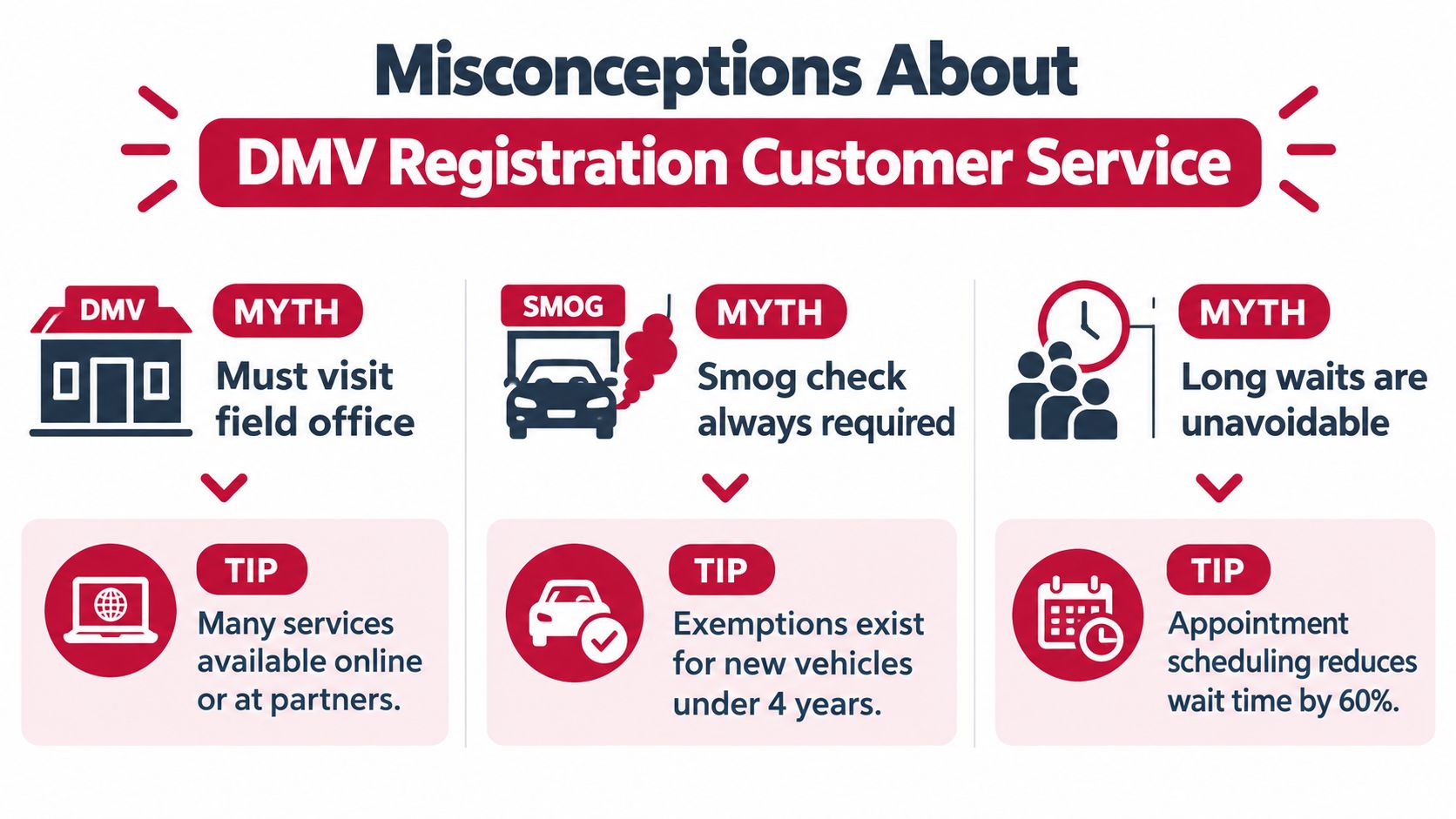
Myth one, tags always require a field office
A qualified partner may issue registration materials through approved DMV systems. Whether you receive a sticker, card, or plate depends on the transaction and the partner's authorized services. Confirm before visiting, especially if you need a particular item the same day.
Myth two, a phone agent can clear every block
A phone representative can explain what the record shows, but some problems require physical documents, an inspection, a VIN verification, or an in-person review. A title hold and a VIN discrepancy usually need evidence submitted through the appropriate channel.
Myth three, online renewal always works
Online renewal is a strong option for a clean, eligible record. It can stop when the vehicle needs a smog result, the title contains an unresolved issue, ownership information has changed, or the system requires documents that can't be verified automatically.
Two more assumptions that waste time
Late penalties are generally calculated through the registration system. A walk-in conversation doesn't automatically remove them. If you believe the amount is wrong, ask which review or correction process applies instead of assuming a clerk can delete the charge.
A “no smog due” message should also be read as a current record status, not a permanent promise. If the agency later flags a discrepancy, a qualifying certified station may need to complete the inspection and submit the result before the registration can move forward.
The fastest route isn't always the shortest line. It's the channel that can complete the blocked step.
Your Pre-Visit Checklist and When to Choose a Partner
Use this checklist before you contact DMV registration customer service:
- Confirm the transaction: Decide whether you're renewing, transferring ownership, updating information, replacing a document, or resolving a hold.
- Check the record: Review the DMV portal for a smog requirement, title issue, address problem, or payment notice.
- Gather vehicle details: Have the plate number, VIN, current odometer reading, and registration card available.
- Bring supporting documents: Include the renewal notice, title, lien release, insurance proof, identification, and any required smog information.
- Choose an accepted payment method: Don't wait until the counter to discover that your preferred method won't work.
- Save confirmation details: Keep receipts, error messages, and submission references after every contact.
A simple routing rule
Choose the DMV website for a straightforward renewal when the smog information is already on file and the record shows no hold. Use the phone line for status questions, general instructions, and address-related guidance. Choose a field office when an examiner must review a complex title, ownership dispute, VIN verification, or unusual transfer.
Choose an authorized partner when your renewal includes a smog inspection, when you need registration materials issued through an approved business channel, or when combining related steps in one visit matters more than using an online form. For Antioch-area drivers, Fire House Smog offers smog testing and on-site California DMV registration services during its posted hours, with service availability depending on the transaction and day.
California's move toward online services and partner automation shows that registration customer service is becoming a connected workflow, not just a line at a government counter. A modernization report described a major August 2024 milestone in which Rapid Registration allowed private-party, out-of-state, and new registrations to be handled entirely online for the first time, while more than two dozen services had moved online as part of the broader effort, according to coverage of modernized DMV services.
Before leaving home, ask one final question: which channel can complete every required step for this vehicle? That answer will usually save more time than choosing the location with the shortest advertised queue.
If your Antioch registration renewal also needs a smog inspection, bring your vehicle documents and payment information to Fire House Smog for STAR-certified testing and eligible on-site DMV registration services. Confirm the current hours and transaction requirements before visiting so the inspection, renewal, and registration materials can be handled through the right workflow.
You're staring at a California registration renewal notice, and the check engine light is glowing on your 2013 Camry. The car starts, drives normally, and doesn't seem to be making unusual noise. That doesn't matter at the smog station. In California, the check engine light, formally called the malfunction indicator lamp, is a regulatory trigger tied directly to the vehicle's emissions inspection.
The right move isn't to gamble on a quick test or erase the warning before you arrive. Diagnose the fault, repair the cause, let the vehicle complete its required self-tests, and only then book the inspection. That sequence prevents the wasted inspection fee and the second trip that follows a predictable failure.
Table of Contents
- What the Check Engine Light Means for Your California Smog Test
- How California Treats an Illuminated MIL During Inspection
- What Happens During the OBD-II Portion of the Smog Check
- Quick Pre-Test Checks You Can Do Before Booking
- Temporary Fixes Versus Professional Diagnostics
- Retest Options and Fire House Smog Policies
- Your Pre-Smog Checklist Before You Drive In
What the Check Engine Light Means for Your California Smog Test
California's Bureau of Automotive Repair treats the MIL as part of the OBD-II inspection, not as a suggestion for the driver. If the lamp is illuminated while the engine is running, the vehicle fails the applicable inspection under the California Smog Check Program. The vehicle can run smoothly, accelerate normally, and still fail because the computerized emissions system has reported a malfunction.
The lamp also has to behave correctly during the dashboard check. With the key on and the engine off, the MIL should illuminate. After the engine starts, it should turn off. That sequence confirms the warning circuit is present and responding rather than removed, disabled, or malfunctioning.
Vehicle age changes the inspection path
OBD-II applies to 1996 and newer gasoline-powered passenger vehicles and light-duty trucks, and to 1998 and newer diesel vehicles, according to BAR's OBD test reference. Newer vehicles receive an OBD-based evaluation, while older vehicles can follow different inspection procedures depending on their model year and equipment.
That means a driver shouldn't apply advice for an older car to a modern vehicle. The exact inspection path depends on the vehicle's fuel type, model year, and applicable Smog Check requirements.
Your decision path is straightforward:
- The light is on while running. Don't book the test yet. Get the fault diagnosed.
- The light was recently cleared. Don't assume the car is ready. Check the readiness monitors.
- The light is off and monitors are ready. A pre-test scan can confirm whether booking makes sense.
- The vehicle fails. Keep the Vehicle Inspection Report, complete the listed repairs, and ask the station about retest eligibility.
Practical rule: A smooth-driving car with an illuminated MIL is still a likely smog failure. The lamp's status matters before the inspector evaluates anything else.
How California Treats an Illuminated MIL During Inspection
The inspection begins with a functional question: does the MIL display the required behavior? California's OBD procedure treats the lamp status as a pass/fail item for applicable OBD-II vehicles. BAR states that a vehicle won't pass Smog Check with the check engine light on, so an inspector can't overlook the warning because the vehicle feels fine on the road.
A normal bulb check isn't a failure. With the key on and the engine off, the MIL should light with the other dashboard indicators. Once the engine starts, it should go out. A steady light while the engine is running indicates that the vehicle's system has commanded the lamp on, and that status produces a failure.
A flashing light deserves immediate attention. It commonly signals an active misfire that can damage the catalytic converter, so driving around hoping it disappears is a poor decision. Whether steady or flashing, an illuminated MIL does not become acceptable because the car passes a quick visual glance.
The cleared-code trap
Clearing trouble codes or disconnecting the battery can turn the dashboard light off temporarily, but it also resets readiness monitors. After emissions repairs, the vehicle must complete the relevant self-tests through normal driving or a manufacturer-specified drive cycle. The BAR explanation of the updated readiness rules makes the key point clear: a cleared lamp alone doesn't prove that the emissions system has verified the repair.
As of October 1, 2025, California requires all applicable readiness monitors to be set for a vehicle to pass, subject to limited fuel-type and model-year allowances described by BAR in its OBD test reference. A recently cleared code can therefore create a separate readiness failure even when the MIL is currently dark.
| MIL Status | Inspector Interpretation | Smog Outcome |
|---|---|---|
| Illuminated with engine running | The OBD system has commanded the lamp on | Fail |
| Illuminated during key-on, engine-off, then off after starting | Normal bulb-check sequence | Continue with the inspection |
| Does not illuminate during key-on, engine-off | Lamp circuit or required display behavior is not verified | Fail |
| Flashing while engine is running | Active fault condition requires prompt diagnosis | Do not test before diagnosis |
| Recently cleared and lamp off | Lamp status may look normal, but monitors may be incomplete | Possible readiness failure |
What Happens During the OBD-II Portion of the Smog Check
At an OBD-equipped station, the technician connects the inspection equipment to the vehicle's diagnostic link connector, commonly called the DLC. The equipment communicates with the vehicle's computer and retrieves the information needed for the official inspection record.
The scan evaluates more than the dashboard lamp. It can capture the vehicle identification information, MIL command status, whether the MIL has been on since the last code clear, stored diagnostic trouble codes, and readiness monitor results. These data points show whether the vehicle's emissions controls have completed their required self-checks and whether the computer has detected a reportable malfunction.
Ready and incomplete monitors
A readiness monitor marked ready has completed its applicable self-test. An incomplete or not-ready monitor hasn't finished the conditions needed for the system to evaluate that emissions component. Battery disconnection and code clearing can return monitors to an incomplete state, which is why arriving immediately after either event is risky.
Under California's current framework, the allowable monitor status depends on fuel type and model year. BAR's guidance describes limited allowances for certain vehicle groups, while the readiness rules effective October 1, 2025 require applicable monitors to be set, with exceptions handled according to the state's criteria.
You can learn more about how these self-tests work in this guide to OBD readiness monitors. The important practical point is that a scan tool reading isn't a repair. It only reports what the vehicle computer currently knows.
The technician then records the inspection results through the BAR inspection system. If the vehicle identification information raises an eVIN issue, the inspection may require an additional visual verification. A damaged, missing, or unreachable diagnostic connector can also prevent the required electronic inspection from being completed.
At the end, the station provides the BAR-OIS printout, which serves as the official record of the inspection. If the vehicle fails, keep that document. It identifies the failed items and gives the repair shop a starting point instead of leaving everyone to guess.
Quick Pre-Test Checks You Can Do Before Booking
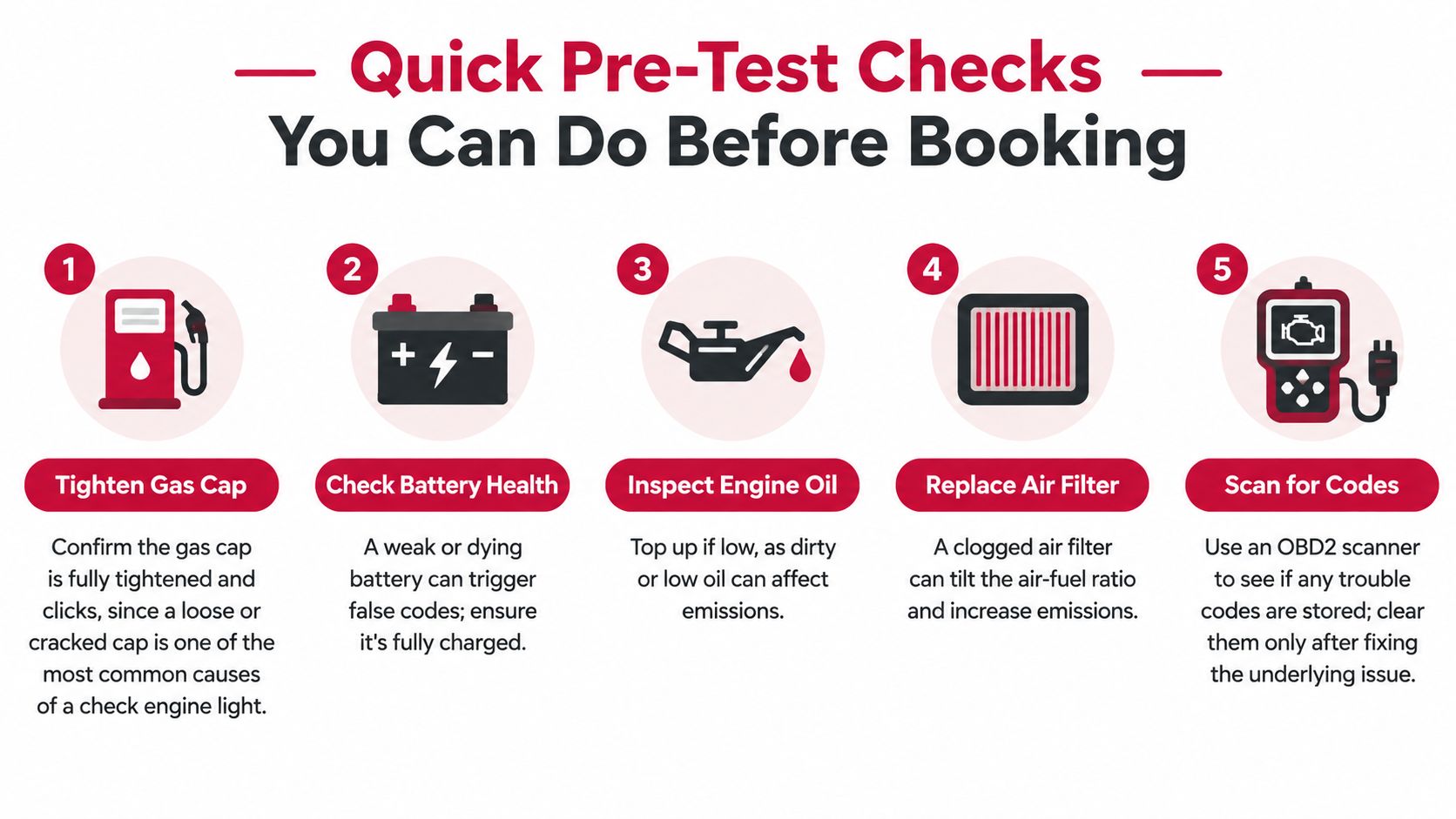
A few checks at home can keep you from paying for an inspection your vehicle was never ready to pass. Start with the gas cap. Remove it, inspect the seal for visible damage, reinstall it, and tighten it until it clicks. A loose or damaged cap can trigger an evaporative-emissions fault, and it's one of the easiest possibilities to rule out.
Then review what happened before the warning appeared. If the battery was disconnected or a code was cleared, the vehicle needs normal driving so its emissions monitors can rerun. A mixture of stop-and-go and highway driving gives the system varied operating conditions, but the manufacturer's drive-cycle instructions may be necessary for monitors that are difficult to set.
Use the dashboard and scanner together
Before starting the engine, look at the instrument cluster. Confirm that the MIL illuminates during the key-on check and then turns off after startup. A dim, intermittent, or missing lamp isn't something to ignore, because the inspection checks the lamp's commanded behavior.
If you have access to an inexpensive OBD-II scanner, read the stored codes and monitor status without erasing anything. You want the scanner to show no active MIL command and the applicable monitors in a ready state. A parts store scan can identify a code, but it usually isn't a full diagnosis.
What not to do
Don't clear the codes just before the appointment. The light may disappear, but the monitors can revert to not ready, creating a different reason for failure. If the MIL returns after you've driven normally, stop treating the problem as a cosmetic dashboard issue and arrange proper diagnostics.
Temporary Fixes Versus Professional Diagnostics
The shortcuts are familiar. Someone disconnects the battery, erases codes with a reader, installs a sensor borrowed from another vehicle, or pours in an additive advertised as an emissions fix. These actions may change what the dashboard shows, but they don't establish that the failed emissions component works.
A professional diagnostic process starts with the code and the conditions under which it appeared. A technician reviews freeze-frame information, tests the system with a capable scan tool, checks wiring and connectors, and isolates the actual cause. Depending on the fault, the repair could involve an oxygen sensor, catalytic converter, ignition component, fuel-control problem, or an EVAP leak.
Compare the choices honestly
| Approach | Typical Cost | Time | Smog Test Outcome Risk |
|---|---|---|---|
| Clear codes or disconnect the battery | Tool or battery-service cost may apply | Immediate dashboard change | High, because monitors can become not ready and the fault may return |
| Replace a part based only on a code | Varies by component and vehicle | Repair time plus monitor drive time | High if the code identifies a system rather than the failed part |
| Use an additive product | Product purchase and application time | Short-term | High, because it doesn't verify the underlying repair |
| Professional diagnosis and repair | Depends on the fault and labor required | Diagnosis, repair, then monitor completion | Lower, because the cause is tested and the vehicle can verify the repair |
Use a code reader as a screening tool, not as permission to erase the evidence. If the light returns, the vehicle runs roughly, or a monitor stays incomplete, pay for diagnosis before paying for another inspection. The common reasons for a smog failure can help you understand the report, but they can't replace vehicle-specific testing.
Fire House Smog operates as a test-only station, so it performs the inspection rather than selling in-house repairs. That separation can be useful when you want an inspection result and a clear failure report before choosing where to repair the vehicle.
Retest Options and Fire House Smog Policies
A failed inspection isn't the end of the registration process, but it is a document-driven process from that point forward. The technician provides a Vehicle Inspection Report, or VIR, showing the items that caused the failure. Read that report before authorizing repairs, because the listed failure may concern MIL status, readiness, trouble codes, or another inspection requirement.
The repair location depends on the vehicle's inspection category and the instructions on the report. Some vehicles may need a state-registered repair facility, and STAR, directed-repair, gross-polluter, or hardship situations can involve additional requirements. Don't assume any repair shop can handle every category.
Follow this order after a failure
- Keep the paperwork. Save the VIR and any printed diagnostic information.
- Repair the listed condition. Give the technician the exact failure details, not just “the car needs smog.”
- Allow verification time. After repairs, the vehicle must complete applicable self-tests and return to a ready state.
- Ask about retest eligibility. Fire House Smog's Antioch station offers a free or discounted retest within its defined policy window when the original inspection and qualifying repair work are completed at the same location, subject to site terms and coupon conditions.
- Bring documentation back. Take the prior VIR, repair invoices, identification, and any documents specified by the station.
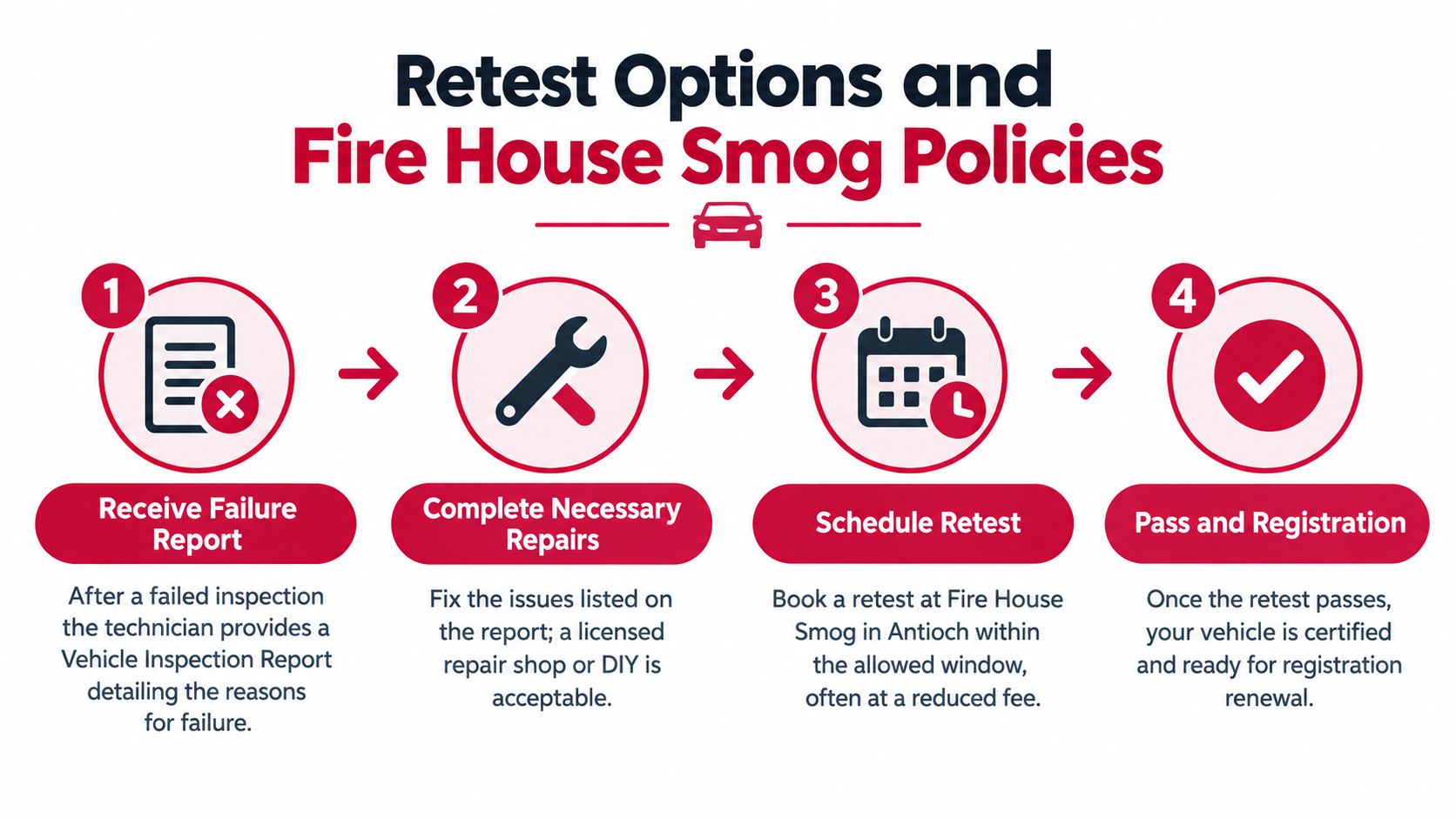
Call before returning. The station can confirm whether your vehicle qualifies for the applicable retest policy, what repair documentation is needed, and whether a directed or STAR-related requirement changes the process. That short call is more useful than driving back with incomplete paperwork.
The retest still evaluates the vehicle under California's inspection rules. A free or reduced retest doesn't waive the MIL requirement or readiness requirements. It only reduces the cost and inconvenience when the vehicle and documentation meet the station's policy.
For a fuller explanation of the next steps, review what happens after a failed smog test. Repair first, verify the monitors, then schedule the return inspection.
Your Pre-Smog Checklist Before You Drive In
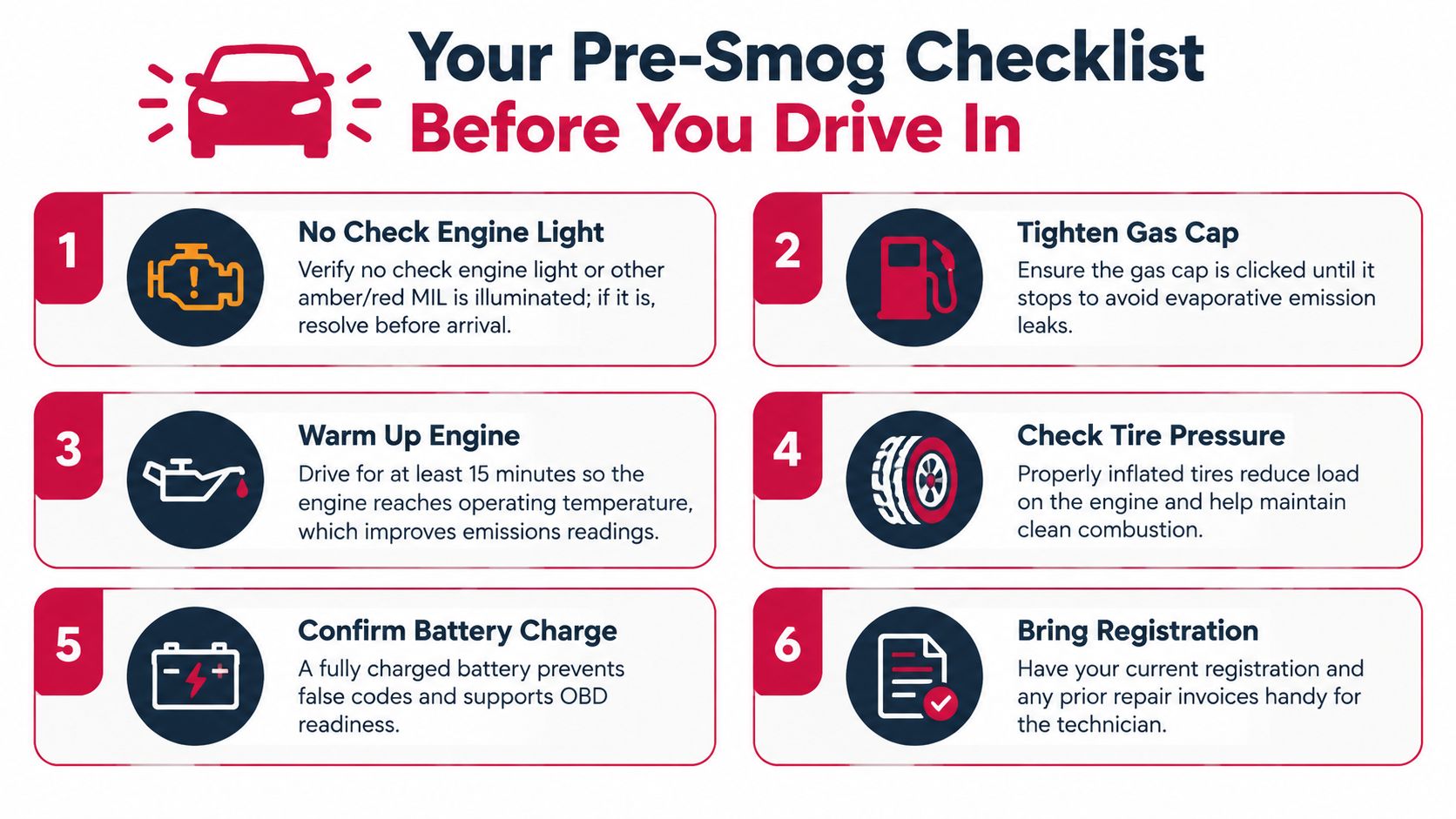
The final check should happen before you leave home, not after the technician connects the OBD equipment. Look at the dashboard with the key on and the engine off, start the vehicle, and confirm the MIL follows the normal sequence. If it stays on, stop there and arrange diagnosis.
Confirm that the battery hasn't recently been disconnected and that no one has erased codes since the last repair. A battery event can reset monitor status, so a dark dashboard light doesn't automatically mean the vehicle is ready for certification.
Run through these final decisions
- Dashboard warning light: The MIL should be off after startup. An illuminated lamp needs diagnosis before testing.
- Gas cap: Tighten it securely and inspect for obvious seal damage.
- Engine warm-up: Drive for at least 15 minutes before arrival, as specified in the preparation guidance provided for this inspection context. This helps bring the engine to operating temperature, but it doesn't replace required monitor completion.
- Fuel level: Keep the tank between one-quarter and three-quarters full when possible, unless your vehicle manufacturer or repair technician gives different instructions.
- Battery condition: Make sure the battery is charged and the vehicle starts normally.
- Documents: Bring your registration, prior VIR, repair invoices, and identification when they apply.
Fire House Smog in Antioch provides STAR-certified, test-only smog inspections and handles California DMV registration services at its Lone Tree Way location. If your vehicle has failed before or recently had emissions work, call ahead to confirm retest eligibility and required paperwork before scheduling.
The practical answer to the California smog test check engine light problem is simple: don't hide the warning, fix the cause, and verify readiness before you test. That approach gives the inspection a real chance to pass and leaves you with documentation if it doesn't.
If your check engine light is on, have the vehicle diagnosed first, then bring the repaired and monitor-ready vehicle to Fire House Smog in Antioch for a STAR-certified test-only inspection. Call ahead about retest eligibility, required documents, and the station's free or discounted retest policy before you make the trip.
You're at a two-bay test-only station on a Wednesday afternoon. One vehicle is already on the dynamometer, another is idling outside with its check-engine light glowing, and a third driver is staring at a phone, deciding whether to wait or leave. Everyone has the same question: will this quick STAR smog visit take about twenty minutes, or will it consume the afternoon?
The test itself can be short. The line isn't always short. Vehicle condition, readiness monitors, paperwork, bay availability, staffing, and the cars ahead of you determine how quickly you leave. California's Smog Check program is large and active, with 11,275,981 initial tests and 12,200,718 total tests recorded in 2025, while the initial failure rate was 8.51% and the overall failure rate was 9.04% according to the California Smog Check executive summary.
A quick visit is therefore a workflow outcome, not a promise printed on a sign. The practical questions are simple: does the station have a process that keeps bays moving, and have you brought in a vehicle that can complete the inspection?
Table of Contents
- The 20-Minute Question Every Driver Asks
- What STAR Certification and Test-Only Really Mean
- How a Test-Only Station Moves Cars Through Fast
- Documents, Prep, and the Actual Test Sequence
- Realistic Turnaround Times by Scenario
- Hours, Fees, Coupons, and the Free Retest Rule
- Practical Tips to Cut Your Wait
- Deciding Whether a Quick STAR Visit Is Right for You
The 20-Minute Question Every Driver Asks
At 2:15 on a normal weekday, a two-bay station can look busy without being backed up. One technician may be finishing a dynamometer test while another checks paperwork and connects an OBD scanner. A car outside with a warning light can change the rhythm immediately, because the technician may need to stop the normal sequence and explain that the vehicle isn't ready to pass.
That's why drivers confuse test time with wait time. A clean, prepared vehicle can move through the inspection promptly, but your total visit depends on what arrived before you. One bay may be occupied by a vehicle that needs a tailpipe procedure, while the other is handling a visual inspection, payment, and certificate paperwork. If the station has fewer technicians than open bays, the extra space won't help much.
Practical rule: Ask, “How many cars are ahead of me, and are both bays running?” That answer is more useful than a generic promise that the test is fast.
The best stations engineer speed around repeatable handoffs. They review the customer's paperwork before pulling the vehicle in, screen for warning lights and readiness problems, and keep repair discussions out of the testing lane. You control some of that outcome by arriving prepared. The station controls the rest through its certification standards, bay layout, staffing, equipment, and retest policy.
The central point is straightforward. Quick STAR smog service means fewer avoidable interruptions, not a relaxed inspection. California's STAR framework measures station performance, and the Bureau of Automotive Repair's STAR FAQ explains that short-term measures are updated monthly, pass/fail decisions are made quarterly, and the Follow-up Pass Rate is updated twice a year, in January and July.
What STAR Certification and Test-Only Really Mean
STAR certification is a performance designation from California's Bureau of Automotive Repair. It applies to stations that meet controlled performance standards, including similar-vehicle failure rates, gear-shift incidents, and excessive test deviations. The BAR STAR program requirements specify a Similar Vehicle Failure Rate of at least half the industry-wide failure rate for similar vehicles, a Gear Shift Incident rate no higher than 2%, and an Excessive Test Deviation Rate of no more than 1.
Those standards explain why a DMV notice may direct you to a STAR station. In 2025, STAR-certified stations represented 49% of licensed stations but performed 83% of all Smog Check tests, according to the 2026 Smog Check Performance Report information published by BAR. That concentration makes STAR a defined quality-control program, not a casual label for any shop that offers emissions testing.
Use a test-only station when repairs should stay out of the inspection
A STAR station can be test-only or test-and-repair. Test-only means the business performs the inspection but does not sell or perform the emissions repairs identified during it. That separation keeps the testing decision apart from the repair sale.
A test-only station may be appropriate or required for directed testing, including vehicles identified through DMV notices, certain gross-polluter procedures, and some ownership or registration situations. Check your renewal notice before booking. If it directs you to STAR, choose a STAR station rather than assuming any smog check will satisfy the requirement.
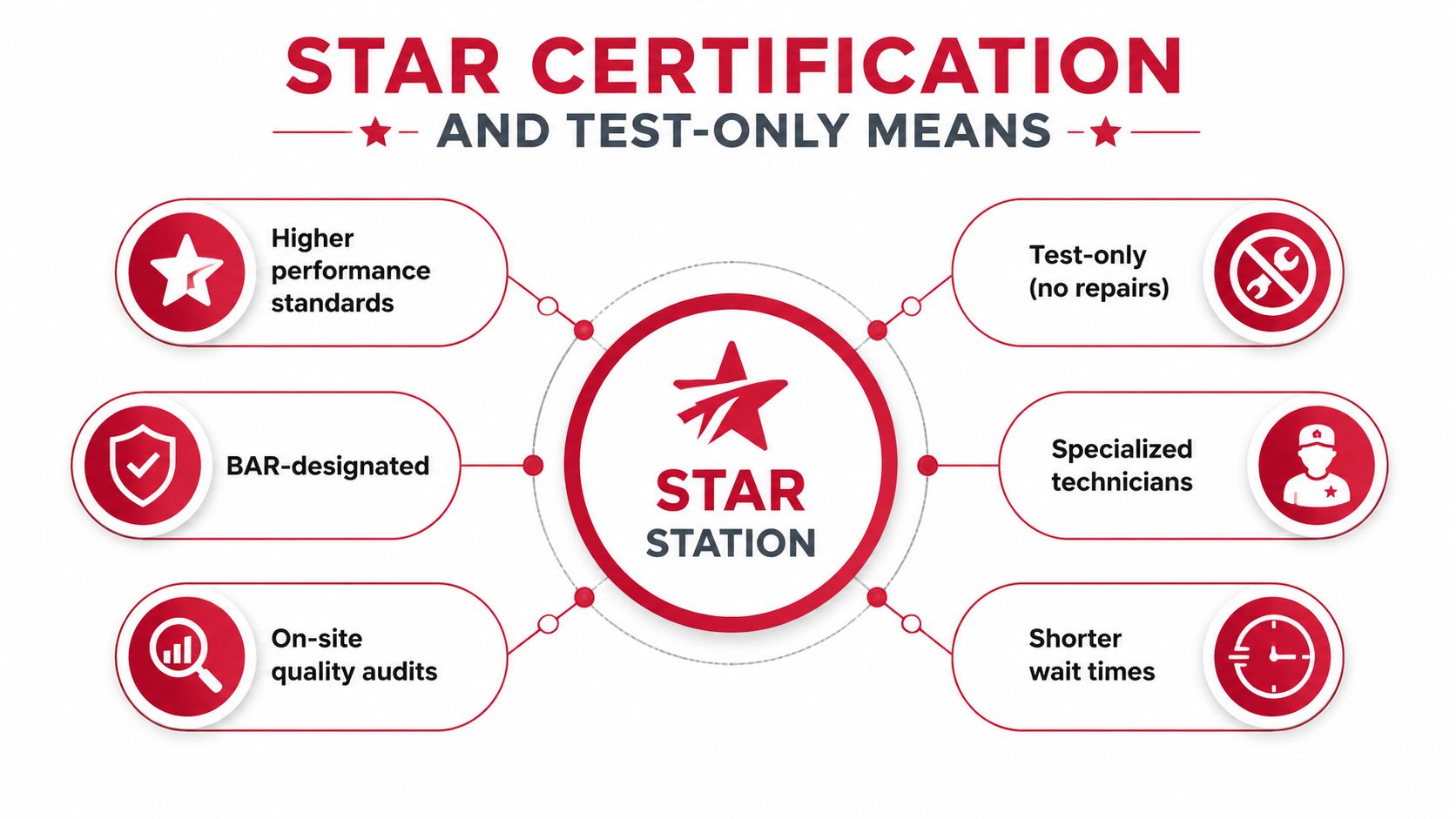
Test-only does not mean the inspection uses a tougher standard. The station follows California's approved procedure, including the applicable visual, OBD, dynamometer, or tailpipe elements. It also cannot issue a repair waiver or sell the repair needed after a failure.
For a plain-language explanation, read this guide to what STAR-certified smog means. The practical takeaway is simple: confirm the notice requirement, select the correct station type, and bring the vehicle in ready for the approved test.
How a Test-Only Station Moves Cars Through Fast
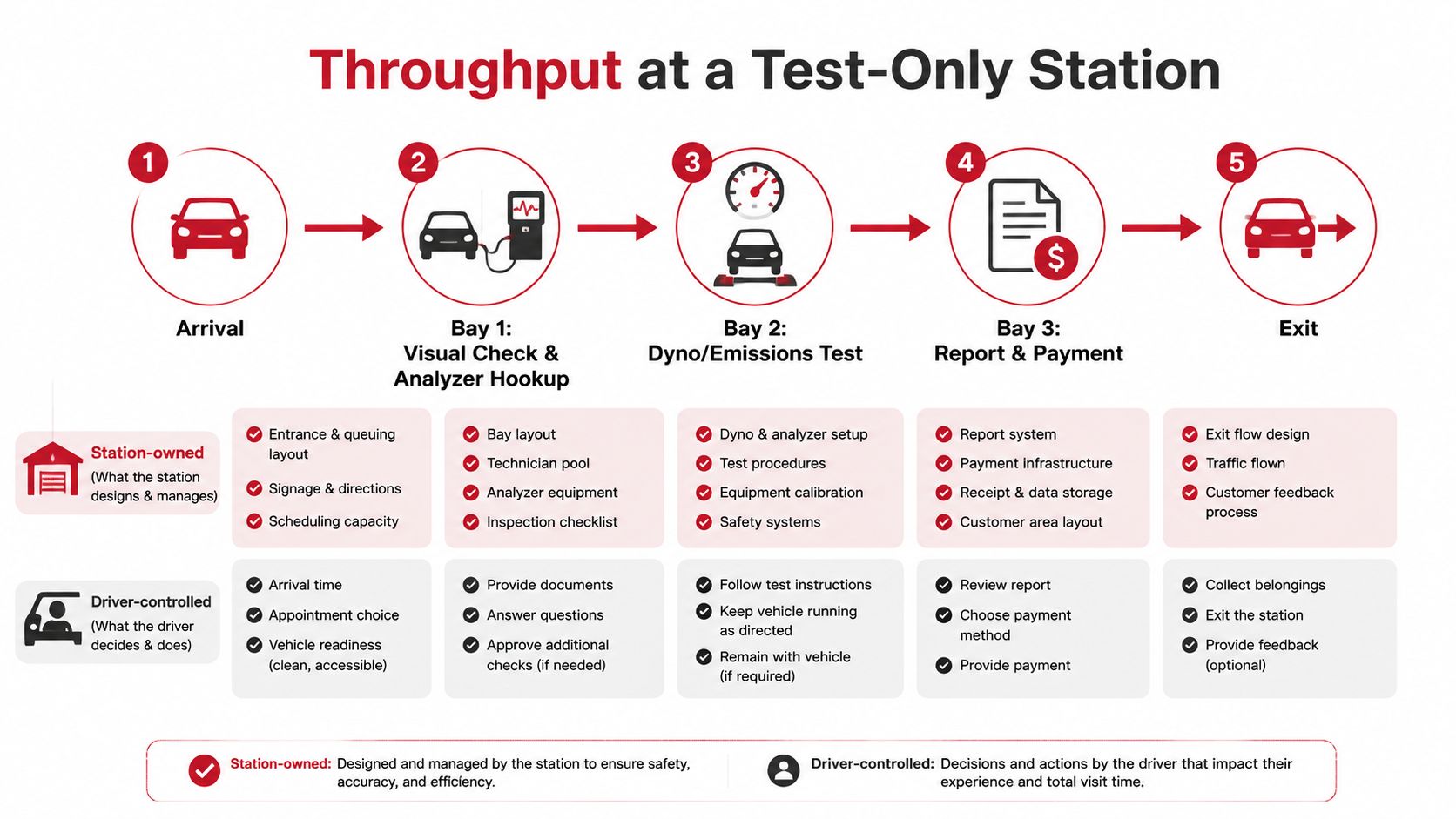
A fast station treats each vehicle as a sequence of handoffs. It doesn't let every appointment turn into an open-ended diagnosis. The technician confirms eligibility, checks the vehicle for obvious test blockers, connects the equipment, completes the required inspection, and prints the result.
At a two-bay station, the layout matters. One bay may handle an OBD-focused inspection while the other handles a dynamometer procedure. When the staff is coordinated, one vehicle can be leaving as another enters. When only one technician is working, both bays may exist but only one can move.
The station controls the process
A station's operational levers include:
- Bay assignment: Staff can send each vehicle to the appropriate equipment instead of creating unnecessary shuffling.
- Pre-screening: A quick check for a warning light, readiness issue, leaking fluids, or obvious modifications prevents wasted bay time.
- Paperwork preparation: Pulling registration details together before the inspection keeps the certificate and payment steps from becoming a bottleneck.
- Standardized testing: A defined sequence prevents technicians from wandering into repair diagnostics that a test-only facility isn't there to perform.
You control the other half. Bring your renewal notice or registration, disclose recent battery work or cleared codes, and don't arrive with a dashboard warning light you hope the technician won't notice. The technician will inspect the vehicle as presented, not as you wish it were presented.
The biggest bottleneck is often readiness, not the analyzer. If a vehicle's monitors aren't complete, the inspection may stop before the emissions portion can produce a valid result. California's OBD readiness regulation update says that, effective October 1, 2025, all readiness monitors must be set to pass. A station can be efficient, but it can't manufacture a completed drive cycle in the bay.
Documents, Prep, and the Actual Test Sequence
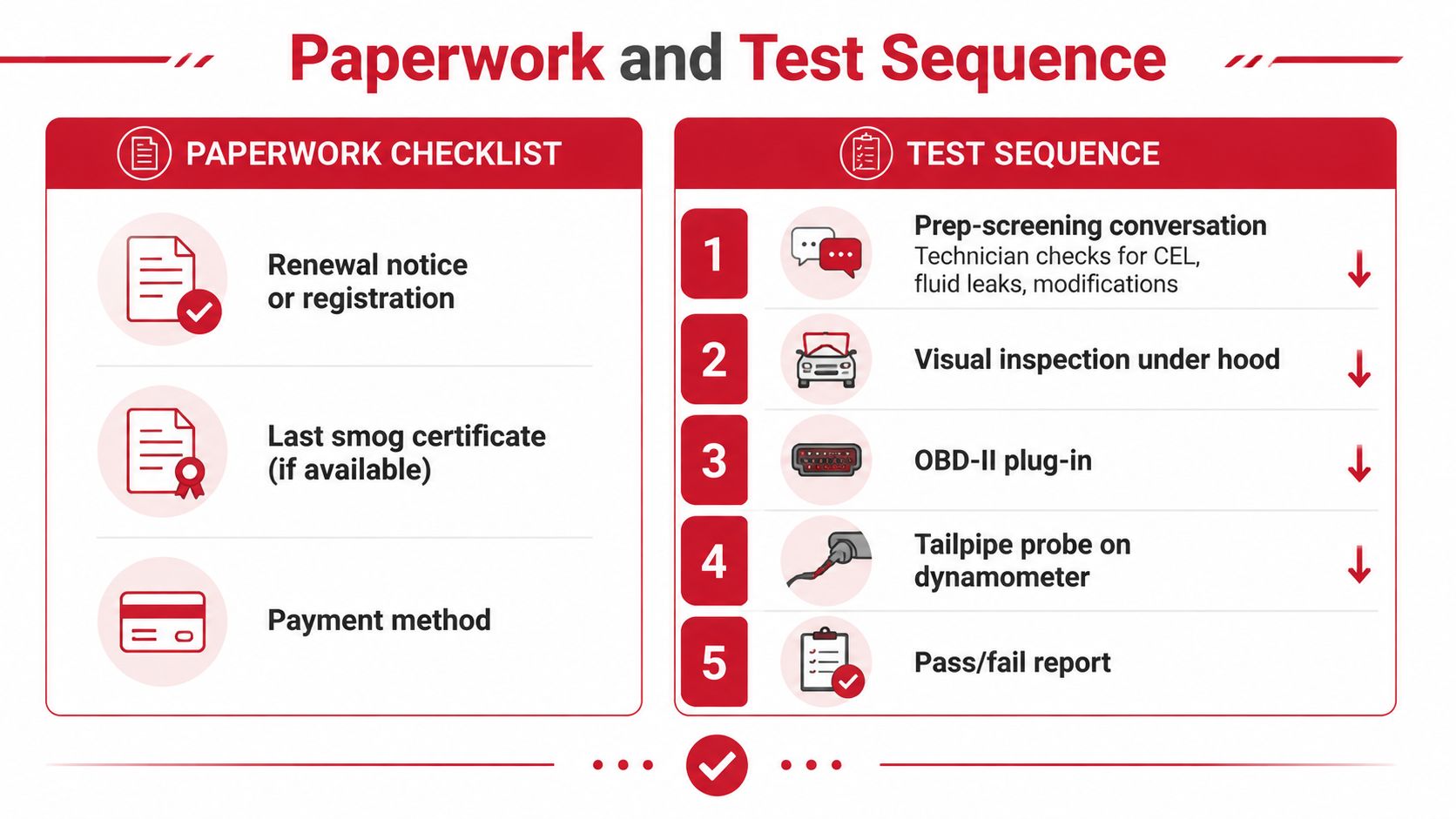
Bring the documents that let the technician identify the vehicle and complete the transaction without interruption. Your preparation folder should contain:
- Renewal notice or registration: The notice tells the technician what DMV event you're handling and whether STAR certification is specified.
- Last smog certificate, if available: It can help clarify recent testing history, though the station can determine the current inspection requirements.
- Payment method: Ask about accepted payment types and the total before the vehicle enters the bay.
The technician's pre-screening conversation is short, but answer it accurately. Mention a recent battery disconnect, cleared diagnostic codes, a repair that involved the engine computer, or a vehicle that has been sitting for an extended period. Those details can point to incomplete monitors even when the malfunction indicator lamp, commonly called the check-engine light, is off.
Readiness is not the same as a warning light
The malfunction indicator light tells you that the vehicle's onboard diagnostic system has detected a qualifying fault. Readiness monitors tell the technician whether the vehicle has completed its required self-checks. A light can be off while the monitors remain incomplete, especially after the battery has been disconnected or codes have been cleared.
For 1996-and-newer spark-ignition passenger vehicles and trucks under 14,001 GVWR, California's OBD II inspection checks the malfunction indicator light, fault codes, and readiness monitors, as described by BAR's OBD inspection guidance. The technician may reject or pause the test before emissions measurement if the vehicle shows a warning light, has incomplete required monitors, presents an inaccessible diagnostic connector, or has an obvious condition that prevents safe testing.
What happens in the bay
The sequence generally follows the vehicle's model year and equipment:
- The technician confirms the vehicle information and performs the initial screening.
- The station completes the required visual inspection, including relevant emissions equipment and warning indicators.
- The technician connects the OBD II interface when the vehicle uses that procedure.
- The vehicle undergoes the applicable tailpipe or dynamometer inspection.
- The station prints the pass or fail report and submits the certificate information through the state system.
A pass completes the emissions side of the visit. A failure produces a report that identifies the reason, but a test-only station won't become your repair shop. That clear boundary is useful because it keeps the inspection focused and lets you choose where to address the problem.
Realistic Turnaround Times by Scenario
A quick visit depends on the vehicle arriving ready, the bay available, and the station's screening process. A normally driven vehicle with complete monitors can move through a routine inspection. A warning light, incomplete readiness status, or older testing procedure can stop that workflow before a certificate is issued.
Use these ranges for planning, not as promises. Queue length, vehicle type, required procedure, and the technician's initial findings determine the actual visit time.
| Vehicle Scenario | Typical Visit | Notes |
|---|---|---|
| Clean, prepared vehicle with monitors complete | About 15 to 20 minutes | Fastest path when a bay is open and paperwork is ready |
| Vehicle with an incomplete monitor | Longer than a routine visit | The technician may stop the test and explain that more driving is required |
| Vehicle with the check-engine light on | No reliable quick turnaround | A passing certificate may require repairs and completed monitors first |
| Older vehicle requiring a tailpipe and dynamometer procedure | Longer than a modern OBD-only visit | Extra equipment and emissions steps add time |
Do not plan around the shortest scenario. A station can complete a failed test quickly, yet the visit still wastes time if the vehicle was not ready. See the readiness rules discussed earlier in this article before booking.
A test-only station cannot turn a check-engine-light vehicle into a passing inspection because you are in a hurry. Get a diagnostic assessment from a repair provider, fix the cause, complete the required driving, and return for testing. The station's bay count and retest policy affect how quickly you can recover from a failure, so ask about both before you arrive.
For more detail on queues, preparation, and inspection steps, review this guide to how long a smog check takes.
Ask the station a more useful question than “Can you do it in twenty minutes?” Confirm that your vehicle is ready, ask how many cars are ahead of you, and verify whether the station has an open bay. That workflow check gives you a realistic arrival-to-departure estimate.
Hours, Fees, Coupons, and the Free Retest Rule
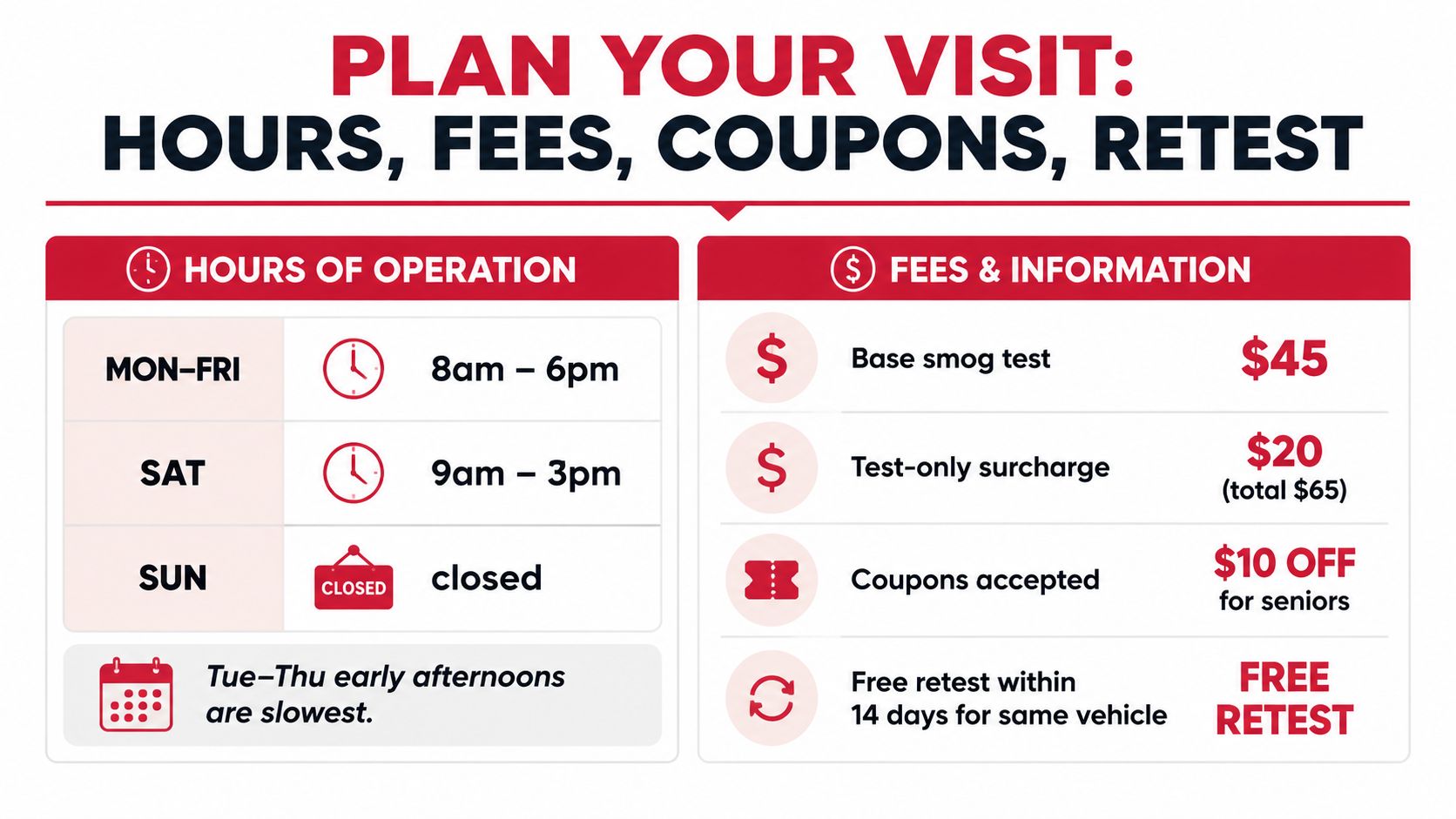
A fast visit starts with the station's real schedule, not a search listing. Check operating hours before leaving, then call if your vehicle has unusual equipment, a motorhome, a directed notice, or a recent failed test. Midweek mornings often produce a calmer queue than Monday, Saturday, lunch periods, or the final stretch before closing.
Ask for the full price before authorizing the test. California's mandatory state certificate fee is $8.25, and recent 2026 reporting placed the statewide average inspection cost at $68.56 before that fee, according to this California Smog Check 2026 cost and compliance update. The station may list a separate testing price, vehicle-type charge, payment fee, or convenience fee. Confirm the complete out-the-door amount.
Read the coupon terms before booking
Coupons apply under specific conditions. Check the vehicle class, service type, expiration terms, and participating station before you rely on the advertised discount. A free retest may require the original inspection to have been performed at that station, a return within the stated validity period, and the original paperwork or coupon.
Use this wording when you call:
“If my vehicle fails today, what exactly qualifies me for a free retest, how long is the offer valid, and do I have to return to the same station?”
Do not assume another shop will honor the offer. Do not assume the retest includes diagnosis or repairs. A test-only facility may waive the retest inspection under its policy while charging separately for outside repair work or another service. Ask what the policy covers before you leave after a failure.
A directed STAR notice can limit your station choice even when the vehicle appears ordinary. BAR updates performance measures on different schedules, so STAR selection is not based on one permanent label. Follow the DMV direction first, then compare price, bay availability, retest terms, and whether the station can process the related registration task.
As noted earlier, California's updated readiness rule requires all monitors to pass. For coupon terms and a focused list of questions, review this guide to a STAR smog test coupon. The useful comparison is the total cost after a pass, failure, or repeat visit, not the lowest advertised entry price.
Practical Tips to Cut Your Wait
The highest-value preparation happens before you leave home. Use this order, because it separates actions that prevent a wasted trip from tricks that merely sound automotive.
Call ahead for screening. Tell the station your vehicle's model year, whether the check-engine light is on, whether the battery was recently disconnected, and whether the DMV notice says STAR. A technician can often tell you whether the visit makes sense before you spend time driving there.
Choose the right arrival window. Midweek, midmorning visits usually give you a better chance of finding an open bay than Monday or Saturday rush periods. Avoid the lunch window and the last part of the day, when unfinished vehicles and paperwork can stack up.
Verify readiness with a scan tool. If you own an OBD II reader, check monitor status before booking. If you don't, ask a qualified technician to check it. California's current readiness rule makes this more important because all readiness monitors must be set to pass under the rule effective October 1, 2025, according to the BAR explanation of the updated OBD readiness requirements.
Drive normally after repairs. A vehicle that recently had codes cleared or a battery disconnected may need a manufacturer-specific drive cycle. Don't guess at the distance or route. Follow the vehicle's service information, and don't book the smog test until the monitors show ready.
Skip the myths
Running premium fuel, adding a mystery fuel additive, or arriving with an almost empty tank isn't a substitute for proper readiness. Those habits don't repair a failed oxygen sensor, restore a missing catalyst, or complete a monitor that hasn't run. Bring the car in normal operating condition, with properly inflated tires if the vehicle will use a dynamometer, and with the diagnostic connector accessible.
Have your registration and renewal notice in one folder. Remove clutter from the cabin, make sure the technician can access the dashboard, and disclose modifications rather than hoping they go unnoticed. These details won't change a failing emissions system, but they can prevent needless handling delays.
Deciding Whether a Quick STAR Visit Is Right for You
The fastest visit starts before you enter the bay. Decide whether the car is ready or needs screening first.
Book a quick STAR smog visit when the vehicle has been driven normally, the check-engine light is off, no recent battery reset or code clearing interrupted the monitors, and your registration paperwork is ready. Follow the DMV notice, confirm the station is STAR certified, ask about the current queue, and let the technician complete the inspection. Bay availability, readiness screening, and a clear retest policy determine speed more than a “quick” label.
Prepare first if the warning light is on, the vehicle was recently repaired, the battery was disconnected, the car has been sitting, or you already know a monitor is incomplete. A paid pre-inspection or diagnostic scan can cost less than a failed testing trip followed by another appointment. A test-only station can identify the failure, but it will not sell the repair that resolves it.
California requires a Smog Check for all out-of-state 1976 model-year and newer vehicles registering in California for the first time, along with other initial registration events determined by the DMV. The January 2026 BAR report cited earlier covers those requirements. It also explains that 100% battery-electric vehicles are exempt, while hybrids and plug-in hybrids remain subject to biennial inspection. Confirm your vehicle's category before booking.
Reserve an appointment, or visit promptly after receiving the renewal notice instead of waiting until the deadline. Bring the notice, registration details, and vehicle information in one folder. If you're in Antioch or East Contra Costa County, Fire House Smog is a STAR-certified test-only station at 2900 Lone Tree Way. Ask the station to confirm readiness screening and retest eligibility before you arrive.

A standard STAR smog check usually lands around $70 to $85 total for most passenger cars, because you're paying the station's inspection fee plus the $8.25 state certificate fee only after a pass. The best benchmark to keep in mind is the $68.56 statewide average inspection cost, which puts a typical out-the-door total at roughly $76.81 before any EFT or convenience fees.
You're probably standing at the counter with a renewal notice in one hand and a price quote in your head that doesn't quite make sense. One shop says one number, another says something else, and nobody explains why the legal test can cost more or less depending on where you go.
Table of Contents
- What Drivers Actually Pay for a STAR Smog Check
- How the Price Is Built
- Test Only Versus Test and Repair Stations
- How Vehicle Type Changes the Price
- Retest Policy and When You Get a Free One
- Coupons, Discounts, and How to Lower the Final Number
- What to Bring and How to Plan the Visit
- What the Price Buys You
What Drivers Actually Pay for a STAR Smog Check
Pull into a STAR station with a renewal notice, and the first number that matters is the all-in pass cost, not the sticker price on the wall. For a normal passenger car, that usually sits around $70 to $85 total, because the shop charges its inspection fee and California adds the $8.25 certificate fee only if the vehicle passes.
The number to trust is the pass total
That's the figure I'd use when you're comparing quotes in Antioch or anywhere else in California. A low posted inspection price can still end up expensive if the station layers on extras, while a higher quoted fee may already include the moving parts that matter at the register.
The benchmark behind that range is the $68.56 statewide average inspection cost reported in independent summaries based on BAR pricing data, which works out to about $76.81 out the door before any EFT or convenience fees. That's why a quote in the $70 to $85 band is normal for a standard STAR inspection, not a ripoff.
Practical rule: if the station can't tell you the pass total clearly, keep asking. A clean answer is usually a sign the shop knows its own pricing.
The important part is this. STAR pricing isn't one fixed state number for the test itself, so the station controls the inspection charge. The state only controls the certificate fee, and that fee only shows up if you pass.
How the Price Is Built
A STAR smog bill has three moving parts. Two are set by the shop, one is set by the state, and the final total depends on whether the car passes.
Start with the shop's inspection fee
The station sets its own posted inspection price. California does not fix that base smog fee statewide, so two shops in the same area can legally quote different numbers for the same kind of test. The number that matters is the pass total, because that is what you will hand over if the vehicle clears the inspection.
For Antioch-area drivers, the smart move is to compare the full pass price, not the teaser on the wall. The shop fee is the part that moves around, and that is where one station undercuts another, or hides a charge in the fine print. If you want the cleanest quote, ask for the out-the-door number before you pull in.
Add the state certificate fee only after a pass
California charges the $8.25 certificate fee only when the vehicle passes inspection. That fee is fixed, so it does not change from shop to shop. A pass adds it to the bill, and a fail does not trigger that same final total.
Watch for small electronic transmission fees
Some stations add a small fee for electronic transmission or similar processing. It is not the main cost driver, but it still changes the final number. A shop can advertise a low inspection price and then pad the receipt with a processing charge, so the quote only helps if it includes every item you will see at checkout.
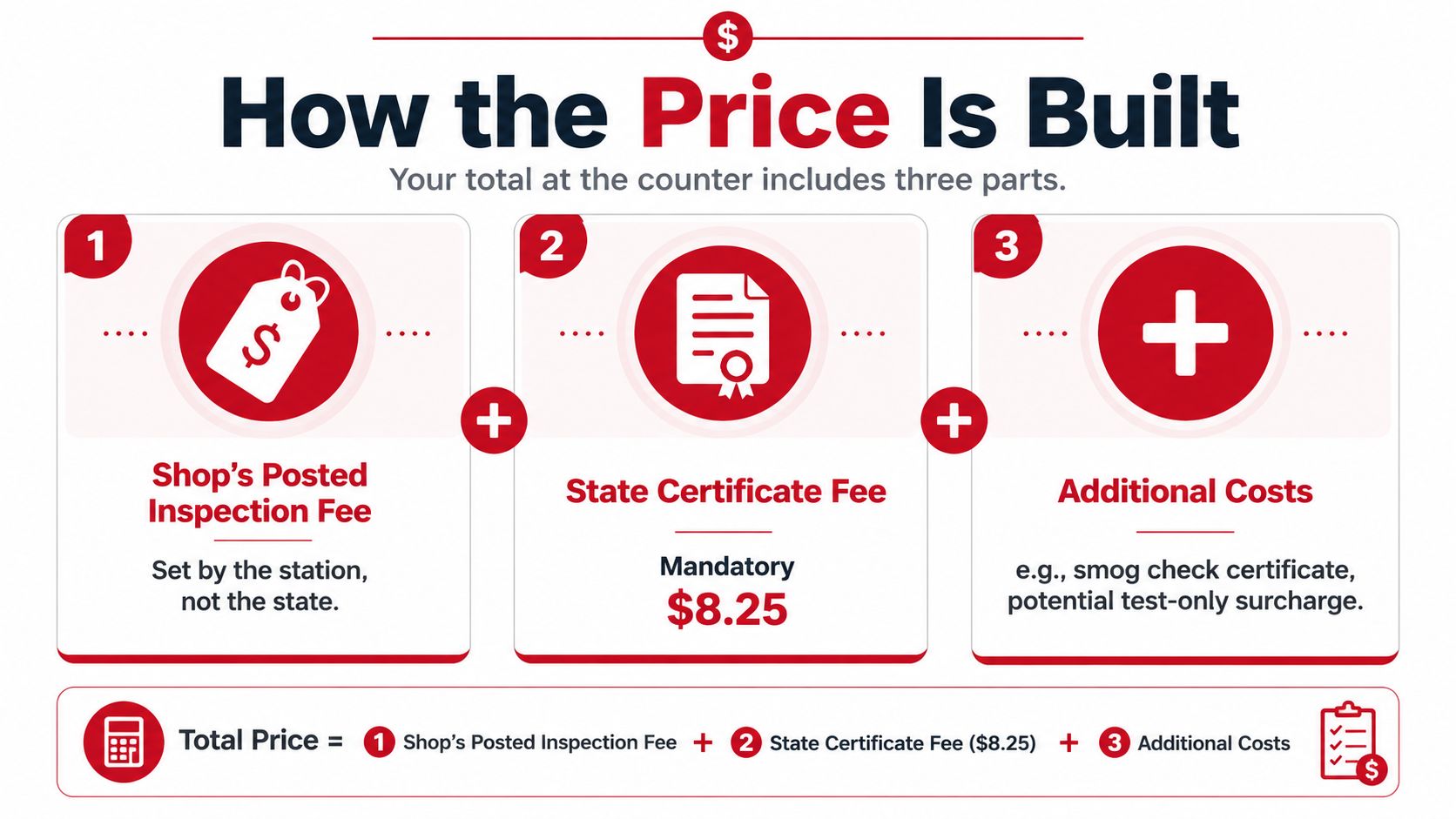
The bargaining space lives in the posted inspection fee, because the certificate fee is fixed. If you want a lower final number, compare the shop price first, then ask whether any extra transmission or convenience charge is being added on top. A STAR Test Only station usually makes that easier, and if you want a straight compliance visit without repair pressure, check out this smog test only center in Antioch.
Test Only Versus Test and Repair Stations
A STAR Test Only station and a STAR Test and Repair station do the same legal job, but they do not price that job the same way. The test-only model keeps the focus on the inspection itself, and that usually means a cleaner bill. Fire House Smog operates as a test-only STAR station with no repair sales, which removes the repair revenue pressure that can shape how some shops present the final number.
Test-only shops keep the bill cleaner
A test-only station has one job, inspect the vehicle and certify the result. There is no repair desk waiting to turn a failed test into a bigger ticket, so the inspection quote tends to stay more direct and easier to read.
That matters more than people admit. A shop that sells repairs can still be honest, but the structure is built so the same place that finds the failure can also sell the fix. If you are watching your budget, that is the part to watch.
My rule as a shop owner: if you already know you need a clean compliance test, go test-only first. Do not pay for a diagnosis you did not ask for.
| STAR Station Type Comparison | Average Inspection Fee | Repair Upsell Risk | Typical Use Case |
|---|---|---|---|
| STAR Test Only | $62.36 | Lower, because the station does not sell repairs | Drivers who want a compliance test only |
| STAR Test and Repair | $71.01 | Higher, because the shop can profit from the fix | Drivers who may want diagnosis and repair in one place |
For Antioch drivers, that difference shows up in the actual out-the-door number. A test-only shop is usually the smarter choice when you need the certificate and nothing else. A test-and-repair station makes sense only if you want one place to inspect the car, tell you what failed, and handle the repair work too.
How Vehicle Type Changes the Price
Vehicle class drives pricing harder than expected. The emissions workflow gets more complex as you move into older model years, different fuel types, and larger platforms, so the price climbs with the work.
The price ladder gets steeper as the vehicle gets older or bigger
A California STAR price sheet shows a clear progression. 2000-and-newer vehicles run $56.75 online or $71.75 regular, ’96–’99 vehicles run $86.75 online or $101.75 regular, 95 and older run $106.75 online or $121.75 regular, and RV or motorhome tests run $176.75 online or $191.75 regular, all before the $8.25 certificate fee.
That spread isn't arbitrary. Legacy emissions systems take more time, larger vehicles take more handling, and RV or motorhome testing can require a different workflow entirely. That's why older diesels, fleet vehicles, and RV owners should budget well above the common passenger-car band.
A practical way to read the sheet is simple, each step into a more complex class can add roughly $15 to $70+ before fees. That's the number that matters when you're trying to estimate the out-the-door cost before you leave home.
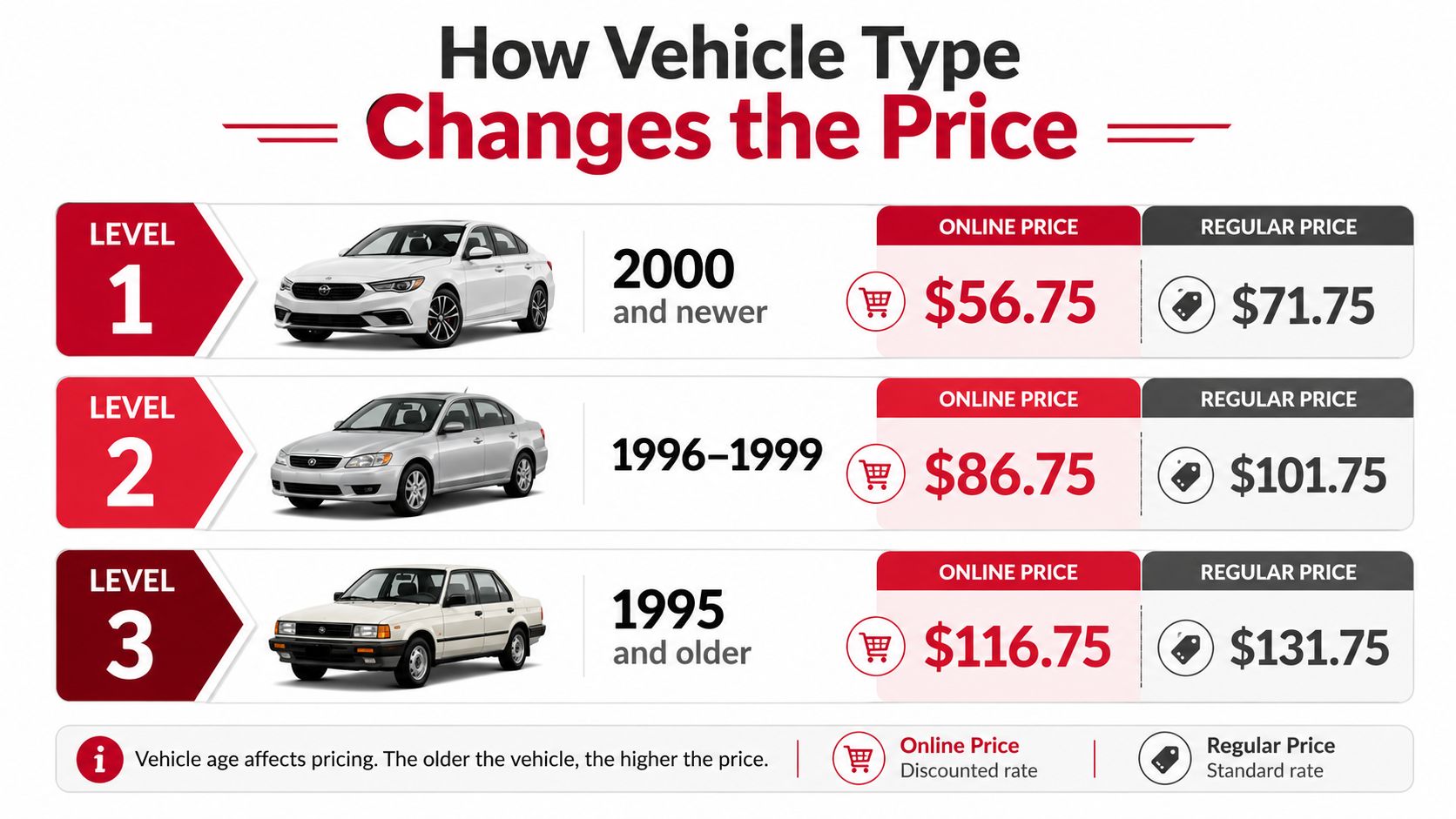
Budget for the vehicle you own, not the one you wish you owned
If you drive a newer light-duty car, you're usually in the lower pricing band. If you own an older car, a diesel, or a motorhome, don't compare your quote to a basic sedan and complain that the station is “overcharging.” The inspection is just different.
Retest Policy and When You Get a Free One
If your car fails, don't pay twice by accident. The smart move is to ask the station exactly how its free retest works before you leave the lot.
Bring the same vehicle back with the repair proof
A free retest usually applies when you return to the same station within the station's qualifying window and bring the car back for the same issue after a qualifying repair. That means the vehicle, the failure, and the paperwork all need to line up.
The key is to separate a valid retest from a brand-new test. If you go somewhere else, wait too long, or show up without the original failure paperwork, the station may treat it as a full-price visit instead of a courtesy retest.
Ask these two things before you drive off
- What paperwork do you need? Bring the original smog report and any repair receipt the shop expects.
- What counts as the same problem? Some failures are straightforward, others trigger a new inspection path if the vehicle has changed in a meaningful way.
That's the part drivers skip, and it costs them. A good station will explain the retest terms clearly, and you should make them do it before you leave.
Coupons, Discounts, and How to Lower the Final Number
If you want the lowest legal STAR price, start with coupons and end with a test-only station. Those are the two levers that usually matter most, because they attack the inspection fee before the fixed certificate fee ever gets involved.
Coupons cut the shop fee, not the state fee
A coupon reduces the station's posted inspection price. It does not erase the $8.25 state certificate fee, so your savings show up on the inspection side of the bill, not on the certificate line.
That's why coupon math is simple. If a vehicle would otherwise fall into a higher pricing tier, a decent coupon can move the receipt back toward the standard passenger-car range. On the higher-end vehicle classes, the savings are even more noticeable because the posted test price has more room to move.
For Antioch drivers who want a simple place to check current offers, Fire House Smog coupon details are worth looking at before you book. Just keep your eyes on the final pass total, not the headline discount alone.
Pick the structure that doesn't sell you a repair
A test-only station is the cleaner play because the shop isn't trying to convert a failed inspection into a repair ticket. You're paying for the compliance test, and that's it.
- Use coupons early: Apply them to the inspection fee before you compare totals.
- Choose test-only when you can: That keeps repair pressure off the table.
- Ask about the pass total: The number you want is the amount after the certificate fee.
Don't chase the lowest advertised price if the shop hides the real total in add-ons.
That's how drivers end up paying more than they expected. A fair quote tells you the inspection cost, the certificate fee, and any small processing charge up front.
What to Bring and How to Plan the Visit
A smooth smog visit starts before you put the car in drive. Bring your renewal notice or DMV notice, your valid ID, and your payment method, and keep any prior smog report handy if you're returning for a retest.
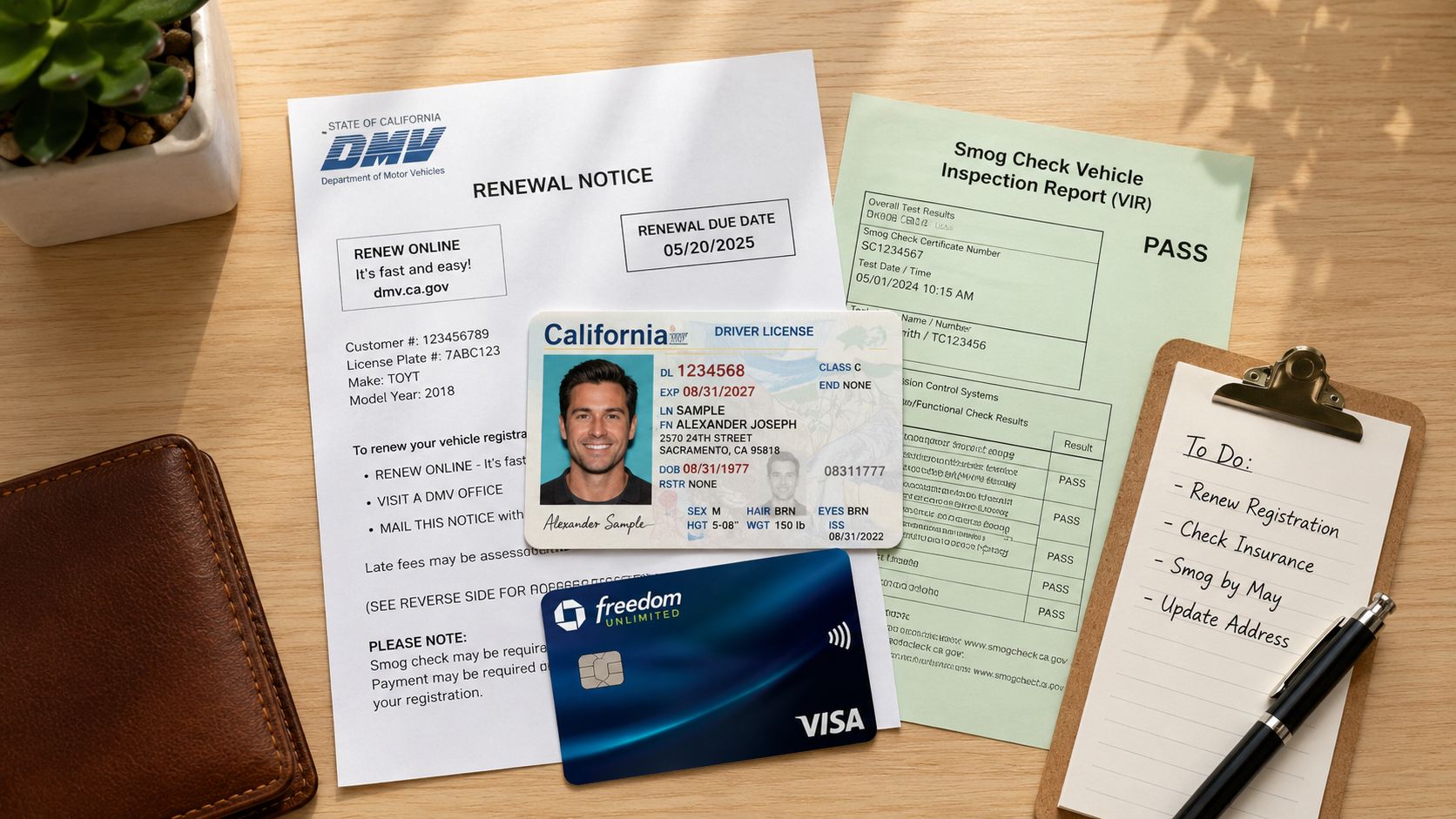
Use the station that matches your schedule
Fire House Smog operates at 2900 Lone Tree Way, Antioch, CA 94509, and the phone number is 925-754-1600. It offers smog testing seven days a week, with DMV registration renewals Monday through Saturday 9:30 AM to 5:00 PM and Sunday 12:00 PM to 4:00 PM, plus two service bays and on-site sticker printing. The station also recommends calling ahead for RVs, which is just common sense because large vehicles need more room and more planning. Vehicle registration document requirements are worth checking before you roll in.
Don't waste a trip on missing paperwork
- Bring your renewal notice: That's the fastest way to match the visit to the right transaction.
- Carry a valid ID and payment: You want no surprises at the counter.
- Keep your previous test report: This matters if you're coming back for a retest.
The point is to show up ready, not hopeful. A prepared driver gets through faster, and a station with two bays can move cars more efficiently when the paperwork is already in order.
What the Price Buys You
The receipt pays for more than a quick emissions test. In a test-only setup with on-site DMV services, you are paying for a cleaner process, fewer repair pitches, and less time wasted bouncing between offices.
The value is in the workflow, not just the number
At a station that handles smog testing and DMV renewals in one place, the price covers convenience that matters on a workday. You get the inspection done, handle registration tasks on-site, and leave with fewer stops on your list.
That matters even more in a test-only model, because the station is not trying to turn your visit into a repair sale. You get the compliance result, the DMV handling, and the sticker process without the usual upsell pressure.
Bottom line: a fair STAR price is the one that gets you legal, gets you out, and does not drag you into a second bill.
Weekend availability and two-service-bay throughput matter too. They do not change the legal fee structure, but they do change the value of the trip, especially if you would otherwise burn half a day at a crowded DMV counter.
If you want a straightforward STAR smog check in Antioch, go where the pricing is clear and the process is built for compliance, not repairs. Fire House Smog handles STAR test-only inspections, on-site DMV registration renewals, and sticker printing at 2900 Lone Tree Way, and you can check the details or plan your visit at Fire House Smog.
You're staring at a renewal notice, and one line keeps catching your eye, STAR required. That usually leads to the same question at the counter, on the phone, or in the driveway, what's the difference between a regular smog shop, a STAR certified smog check test only center, and a place that can fix the car too?
In plain terms, STAR is California's higher-standard inspection tier, and test-only means the station can inspect your vehicle but can't sell the repair. If you're trying to avoid a second trip, understand whether you're required to go STAR at all, and figure out what happens if your car fails, the details matter more than the label on the sign.
Table of Contents
- What a STAR Certified Smog Check Test Only Center Actually Is
- STAR Certification and Test Only Status Explained Separately
- How a Test Only Station Differs from Regular Smog Shops
- What Happens During a Test Only Smog Inspection
- Who Needs a STAR Test and What About RVs and Exempt Vehicles
- Fees Documents Retests and the On Site DMV Experience
- Why Drivers in Antioch and East Contra Costa Choose a Local Test Only Station
- STAR Smog Questions Drivers Ask Before They Book
What a STAR Certified Smog Check Test Only Center Actually Is
A lot of drivers arrive with the same look on their face, a DMV envelope in one hand and a phone in the other, trying to decode what STAR means before they waste an afternoon. A STAR certified smog check test only center sits inside California's broader Smog Check system, so it isn't a separate program, it's a higher-controlled part of the same system.
California's Bureau of Automotive Repair says the STAR program started in January 2013, and in calendar year 2023, 48% of licensed stations were STAR certified while 83% of all Smog Check tests were performed by STAR stations, according to the BAR's 2024 Smog Check Performance Report. The same report says California's Smog Check program removes about 400 tons of smog-forming pollutants every day and serves more than 10 million vehicles each year at more than 5,000 independently owned stations statewide, which shows why STAR is part of a large regulatory network, not a boutique service (BAR 2024 Smog Check Performance Report).
What the label tells you
STAR tells you the station has met higher BAR performance standards. Test only tells you the station is licensed to inspect vehicles, not to do the repair work itself. Those are separate layers, and a business can be one, the other, both, or neither.
That distinction matters on visit day. A test-only station can tell you whether the vehicle passes or fails, but it doesn't turn into a repair shop if the car needs work. If you're used to full-service auto shops, that can feel unusual at first, but it's the point of the model.
A real-world example helps: a driver with a renewal notice marked STAR can show up at a STAR test-only center, get the inspection, and leave with the result, without being steered into a repair estimate from the same counter. That separation is useful when you want clarity first and a repair decision later.
Practical rule: if your paper says STAR, the station status matters. If you're not sure whether you need repairs, test-only keeps the inspection separate from the sales pitch.
STAR Certification and Test Only Status Explained Separately
A driver can roll up to a station with a renewal notice, see the word STAR, and still not know what that means for the visit. The cleanest way to read the label is to separate two questions. One asks whether the station meets BAR's higher oversight standard. The other asks whether the station is allowed to do inspections only, or inspections plus repairs.
STAR certification is about oversight and consistency. BAR requires a STAR-certified test-only center to meet controls that go beyond ordinary smog stations, including the ability to inspect all vehicle types subject to Smog Check, maintain the BAR-certified inspection equipment required by the Smog Check Manual, and keep calibrated equipment passing calibration at least once every 10 calendar days when calibration is required (BAR STAR Certification).
That matters because the inspection process has to hold up under the same rules every day, whether the car is a small commuter vehicle or something more complex. If the required equipment is missing, out of calibration, or not being maintained to BAR standards, the station is not operating with the consistency the program expects. For a first-time customer, that means the result comes from a process BAR has already tightened, instead of from a shop's own judgment call.
Test only is a different question
Test only describes what the shop is allowed to do, not how strict its oversight is. A test-only station can inspect vehicles, but it cannot sell emissions repairs. A test-and-repair shop can inspect and repair. A STAR station can meet BAR's higher standard, yet it may still be either test-only or test-and-repair.
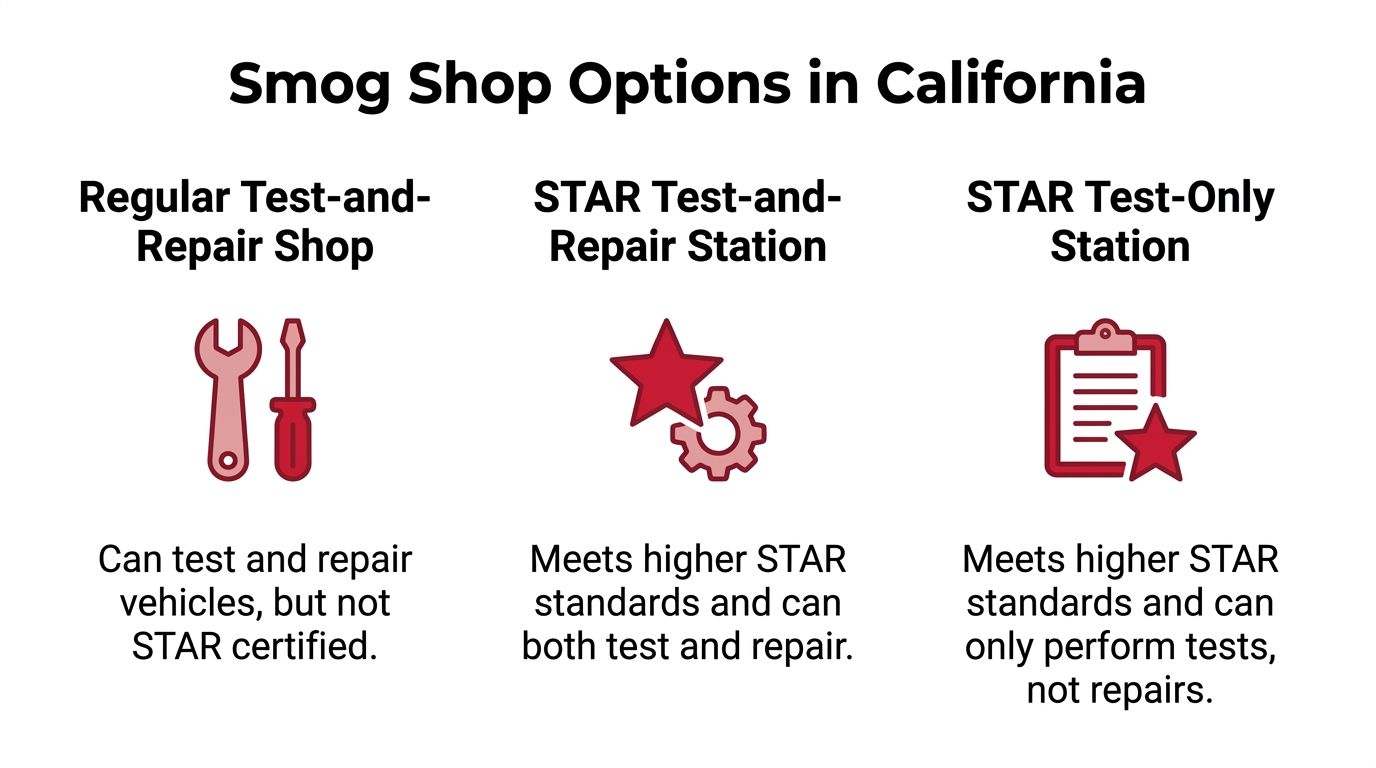
The simplest way to separate the two labels is this. STAR describes the standard of oversight. test only describes whether the station is allowed to fix the vehicle after the inspection. A referee can call the play and still not coach either team, and the same split applies here.
For a driver, that split changes the tone of the visit. A test-only station gives you the inspection result without the same counter pressure to turn a failure into an in-house repair job. A test-and-repair station has a different business setup, because the shop can diagnose, quote, and repair under the same roof.
That is why the combinations matter. A station can be STAR and test-only, STAR and test-and-repair, or a regular test-and-repair shop without STAR status. The label on the sign gives you one piece of the picture, and the renewal notice tells you which setup fits your situation. If you want a plain-language walkthrough from the station side, Fire House Smog's STAR certification explanation lays out the same distinction in simple terms.
How a Test Only Station Differs from Regular Smog Shops
A regular smog shop can often do more than one thing, which sounds convenient until the vehicle is borderline and you're trying to decide who you trust with the result. A STAR test-only station gives you a narrower service, inspection without repair, and that narrower service removes the in-house incentive to push a fix right after the failure.
The 2025 BAR Smog Check Executive Summary Report makes the scale of test-only clear. STAR Test-Only stations performed 5,916,245 initial tests and recorded 481,639 failures, an 8.14% failure rate. STAR Test-and-Repair stations performed 2,766,051 initial tests with 227,215 failures, an 8.21% failure rate. STAR Test-Only stations also issued 5,822,635 certificates overall, compared with 2,710,210 certificates from STAR Test-and-Repair stations (BAR 2025 Smog Check Executive Summary Report).
What those numbers mean for a driver
Those figures don't tell you whether your car will pass, but they do show something useful. Test-only STAR stations are not a niche fallback, they're operating at very large scale and handling a volume close to the combined total of STAR Test-and-Repair stations. That makes test-only a central part of California's inspection network, not an afterthought.
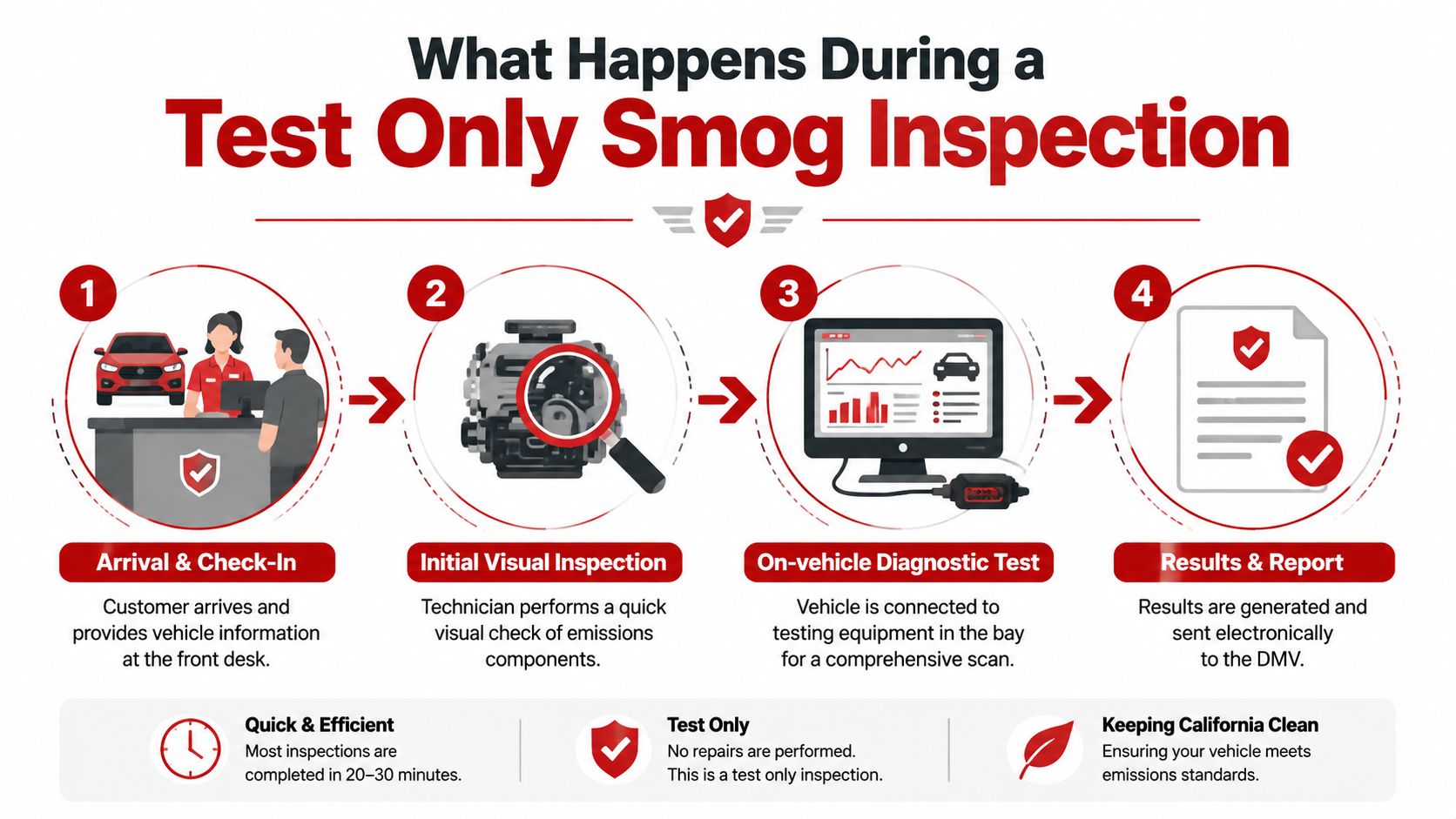
The consumer experience is different too. At a regular smog shop, some drivers feel pressure because the same business that fails the car may also want to repair it. At a test-only station, the result stands on its own. If the car needs work, you can take the report somewhere else and decide what to do without buying into the first estimate you hear.
Fire House Smog's test-only overview describes that same split clearly, inspection only, no repair upsell. That's the key difference most first-time customers are really looking for, even if they don't say it that way.
What Happens During a Test Only Smog Inspection
A first-time visit usually starts with the same small ritual, pull in, hand over the paperwork, and wait for the technician to confirm the vehicle details. The inspection is designed to be straightforward, but the exact steps depend on the vehicle year and the state rules that apply to it.
The bay workflow
At a test-only station, the technician checks the vehicle visually, then connects the required test equipment. For 1996-and-newer vehicles, that normally means an OBD-II diagnostic connection. Older vehicles may also involve a tailpipe-style emissions check, depending on the vehicle class and what BAR requires for that inspection.
Most drivers care about one thing here, how soon they'll know. The station's job is to generate a result, not to turn the visit into a sales conversation.
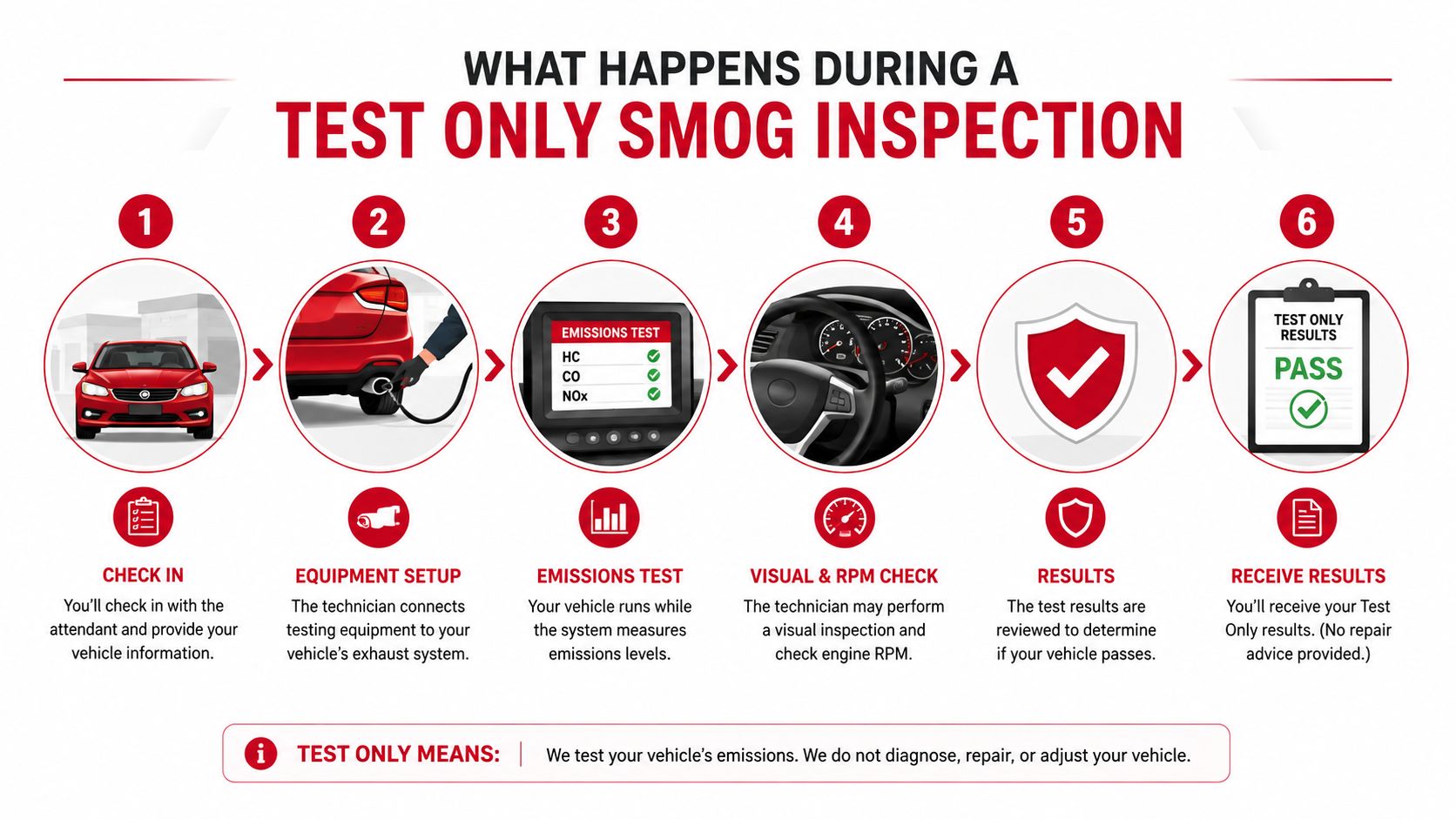
If the car passes, the result is transmitted electronically and the driver gets what they need to continue the DMV process. If it fails, the station provides the report, and the next decision is whether to repair first or look at an approved repair path elsewhere. That split is exactly why test-only centers work well for drivers who want the inspection separated from the repair decision.
| Smog Inspection Stages at a Test Only Station | |||
|---|---|---|---|
| Stage | What the Technician Does | What the Driver Experiences | Typical Time |
| Arrival and check-in | Confirms the vehicle and paperwork | Hands over the renewal notice or vehicle details | Brief |
| Visual inspection | Looks over emissions-related components | Waits near the counter or in the lobby | Short |
| Diagnostic testing | Runs the vehicle through the required equipment | Stays nearby while the test is completed | Short |
| Results and report | Generates the pass, fail, or directed result | Receives the outcome and next-step paperwork | Brief |
The main thing to remember is that the station is measuring compliance, not negotiating a fix. That makes the visit feel cleaner and more predictable, especially when you already suspect the vehicle may be close to the line.
Who Needs a STAR Test and What About RVs and Exempt Vehicles
A renewal notice can look simple until one line changes the whole errand. One driver needs a STAR test, another needs a regular smog inspection, and a third does not need a smog check at all. The DMV says a smog inspection is generally required for registration renewal, with important exceptions for gasoline vehicles 1975 and older, diesel vehicles from 1997 and older or over 14,000 pounds GVW, natural gas vehicles over 14,000 pounds, electric vehicles, and gasoline vehicles less than eight model-years old. The renewal notice is the document that tells you whether your specific renewal requires STAR, a standard smog inspection, or no smog check at all (California DMV Smog Inspections).
That is why STAR searches can feel confusing when the question is eligibility. If the vehicle is exempt, the issue is not finding a station, it is reading the paperwork correctly. If the notice calls for STAR, then the station type matters, and the safest first step is to trust the renewal notice before you plan the visit.
RVs and unusual vehicles need a call ahead
Fire House Smog notes that some recreational vehicles and motorhomes can be tested, subject to size and equipment constraints. A vehicle can be eligible on paper and still be hard to fit in a bay, so a quick phone call can prevent a wasted drive. The business lists 925-754-1600 as the contact line for screening those cases.
RVs, diesel vans, motorhomes, and newer vehicles that may fall into an exemption category all benefit from the same approach. Read the renewal notice first, then confirm the vehicle fit with the station before you head over. A test-only center keeps the question narrow, the car gets inspected or it does not, and the station can tell you whether the vehicle belongs in the lane at all.
Fees Documents Retests and the On Site DMV Experience
Most drivers want to know three things before they leave the house, what to bring, what the test costs, and whether they're going to need a second appointment. Fire House Smog's pricing page explains its smog-test pricing and coupon policy, including a discount on the test and a free retest when required under the site's terms (Fire House Smog smog check cost information).
Bring the renewal notice, a valid ID, payment, and any previous test paperwork if you already have a failure report. That makes the handoff quicker and helps the technician confirm the right vehicle record. If you've recently disconnected the battery or cleared codes, bring the last report too, because it can help you understand where the car stands before you drive off again.
The DMV side of the visit
Fire House Smog also handles DMV registration tasks on site, including renewals and ownership transfers, with sticker printing during posted hours. That turns the stop into more than just a test, which matters if your schedule only allows one errand day. The station says smog testing is available seven days a week, while DMV service hours run Monday through Saturday, 9:30 AM to 5:00 PM, and Sunday, 12:00 PM to 4:00 PM.
That combination is useful for a simple reason. The smog result and the registration task often sit back-to-back in real life, so finishing both in one trip saves time and lowers the chance of forgetting a follow-up. For drivers who already know they need a renewal and a smog certificate, the station's two-service flow is easier than bouncing between separate offices.
Why Drivers in Antioch and East Contra Costa Choose a Local Test Only Station
A local test-only station earns its keep by reducing the number of decisions a driver has to make on the same day. At 2900 Lone Tree Way, Antioch, CA 94509, Fire House Smog gives East Contra Costa drivers a direct stop with parking, a phone line for unusual vehicles, and a setup built around inspection rather than repair sales.
What makes the local option practical
The first advantage is the layout. Two service bays help keep the line moving, which matters when you're trying to fit a smog test between work, school pickup, or a registration deadline. The second advantage is timing. Smog testing is offered seven days a week with extended weekday and weekend hours, so drivers don't have to build the whole day around a narrow appointment window.
The third advantage is fit. If you're bringing a truck, a diesel, or a motorhome, a local station can tell you quickly whether the vehicle is a match for its bays and equipment. That is more useful than driving across town to discover the answer at the curb.
When a local station is the better choice
If you already know you need a STAR test, a local test-only center is usually the cleaner choice when you want the result without a repair pitch. If you also need registration work, a station that handles DMV services on site keeps the trip simple. If you're unsure about RV eligibility, a quick call before you leave is the safest move.
For Antioch and nearby communities, the logic is straightforward. Pick the station that can inspect the vehicle, handle the paperwork, and tell you the result without adding a second errand unless you need one.
STAR Smog Questions Drivers Ask Before They Book
Can a STAR test-only center help a marginal car pass?
It can't change the pass or fail rules. STAR means the station meets higher BAR standards, and test-only means it doesn't sell repairs, so the inspection is cleaner, but the vehicle still has to meet the same emissions requirements.
How do I know from my renewal notice whether I need STAR?
BAR says your renewal notice tells you when you must go to a STAR station. If the notice calls for STAR, use that instruction. If the notice doesn't require it, you may not need a STAR site at all.
What if the check-engine light is on or the monitors aren't ready?
That's the kind of problem that often leads to a failed inspection, because the car hasn't met the readiness conditions the state needs. If the battery was recently disconnected, give the car time and driving miles before you test.
Should I go to a STAR test-only station first or a test-and-repair shop first?
If you want a neutral result and a clean paper trail, test-only first makes sense. If you already know the car needs diagnosis and repair, a repair-capable shop may be the better first stop, but that's a different goal than getting the smog certificate done efficiently.
If you want a straightforward smog visit in Antioch, Fire House Smog handles STAR test-only inspections, DMV registration services, and on-site tag issuance under one roof. If you're sorting out a renewal notice, an unusual vehicle, or a test you don't want tied to a repair pitch, visit Fire House Smog and plan the stop around the vehicle you drive.
The actual smog test usually takes 15 to 30 minutes, but the total visit can run longer depending on your vehicle, the line, and whether your paperwork is ready. If you're staring at a renewal notice and trying to fit it between work, errands, and school pickup, the difference between test time and door-to-door time is the part that matters most.
Table of Contents
- Your Smog Check Time Budget
- The Test vs The Wait What Really Takes Time
- Key Factors That Influence Your Smog Check Duration
- Your Checklist for a Faster Smog Check
- The Fire House Smog Advantage in Antioch
- Frequently Asked Smog Check Questions
Your Smog Check Time Budget
A smog notice usually lands at the worst possible moment, right when your week is already full. The first question is simple, though, how long smog check visits take, and the honest answer is that the inspection itself is often quick while the full stop can stretch out.
For most drivers, the actual test is the short part. California STAR station guidance commonly puts newer vehicles around 15 minutes for 2000 and newer, mid-1990s vehicles around 25 minutes for 1996 to 1999, and 35 minutes or more for 1995 and older because the testing method changes with the vehicle's age and diagnostic setup (California STAR station guidance).
That's why a clean, efficient station matters. A driver might spend a short time on the bay, then another chunk of time checking in, waiting, or sorting out paperwork before the car even gets tested.
Practical rule: plan for the inspection time, then add extra room for the visit itself. If you only budget for the test, you'll feel rushed even when the station is working normally.
California's program is also recurring, not occasional. For gasoline, hybrid, and alternative-fuel vehicles model year 1976 and newer, plus diesel vehicles model year 1998 and newer, a Smog Check is generally required when registering or renewing registration, and for most covered vehicles that happens every 2 years (California BAR). That's why it helps to treat this as a routine appointment, not a surprise errand.
The Test vs The Wait What Really Takes Time
A smog visit works a lot like a doctor's appointment. There's the check-in, the waiting room, and the exam itself, and most of the frustration comes from pretending those are all the same thing.
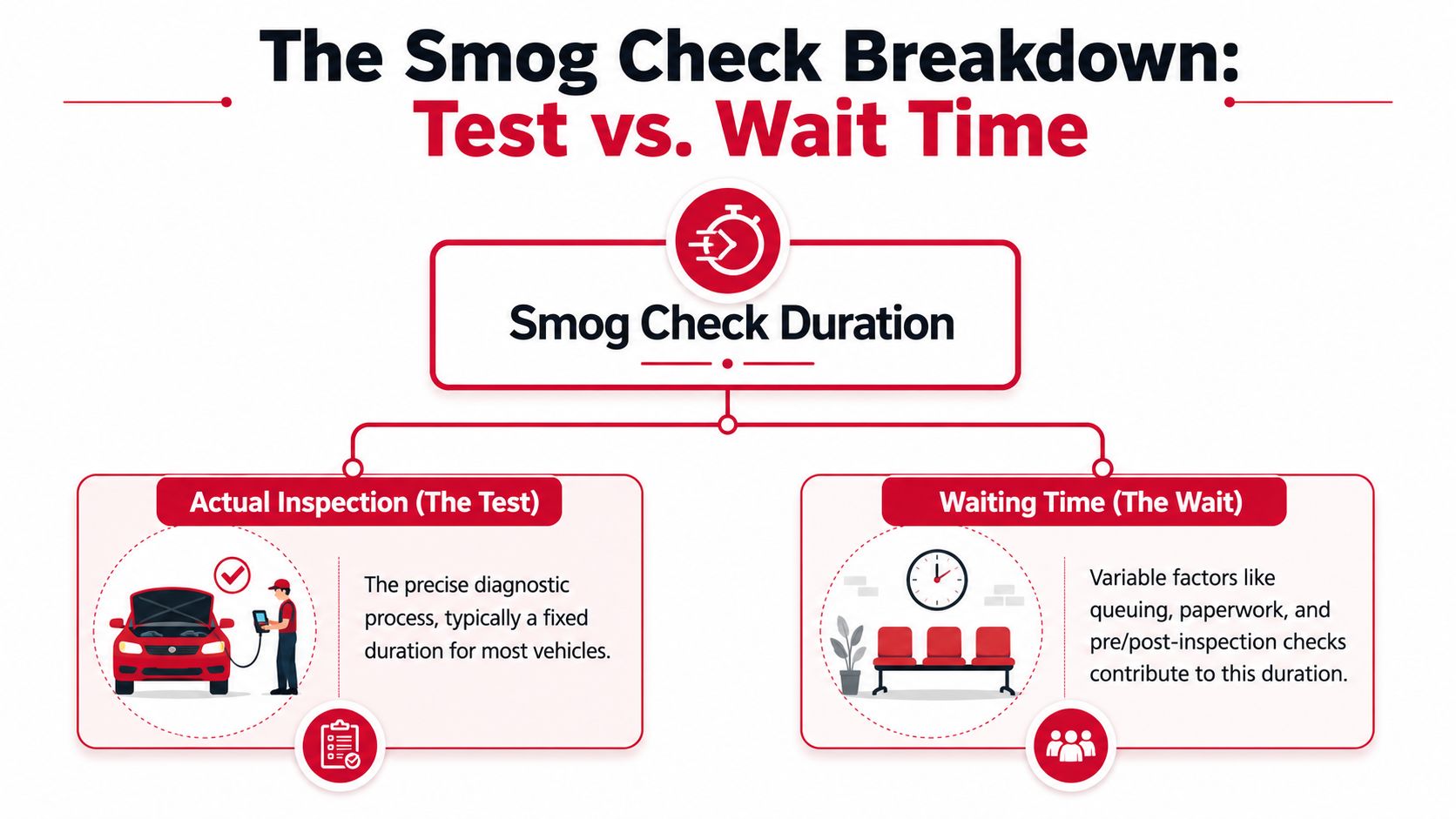
The actual inspection is the fixed part. Consumer guidance commonly describes the test itself as about 15 to 30 minutes, but that figure usually leaves out queueing, paperwork, failed readiness monitors, and the possibility of a retest (consumer timing guidance). That's the gap most drivers feel on site.
What belongs to test time
The test time is the technician working on your car. On a newer vehicle, that often means plugging into onboard diagnostics and checking what the computer reports. On an older car, the process can take longer because the station may need additional procedures beyond the simple plug-in readout.
What belongs to total visit time
The total visit includes everything else, and that's typically where the main delay occurs. Waiting for a bay, filling out forms, verifying whether the station type matches your DMV notice, and dealing with a car that isn't ready for inspection all extend the stop. If you're headed to a station that also offers a focused test-only flow, the process is usually easier to predict, which is why some drivers choose an in-out smog test only center like this option.
The key distinction is simple. Test time is the inspection. Total time is the whole visit. If you plan around only the inspection, you'll underestimate the errand.
Key Factors That Influence Your Smog Check Duration
The car in front of you might finish quickly while yours takes longer for reasons that have nothing to do with luck. The main variables are the vehicle itself, the test method, and how busy the station is when you arrive.
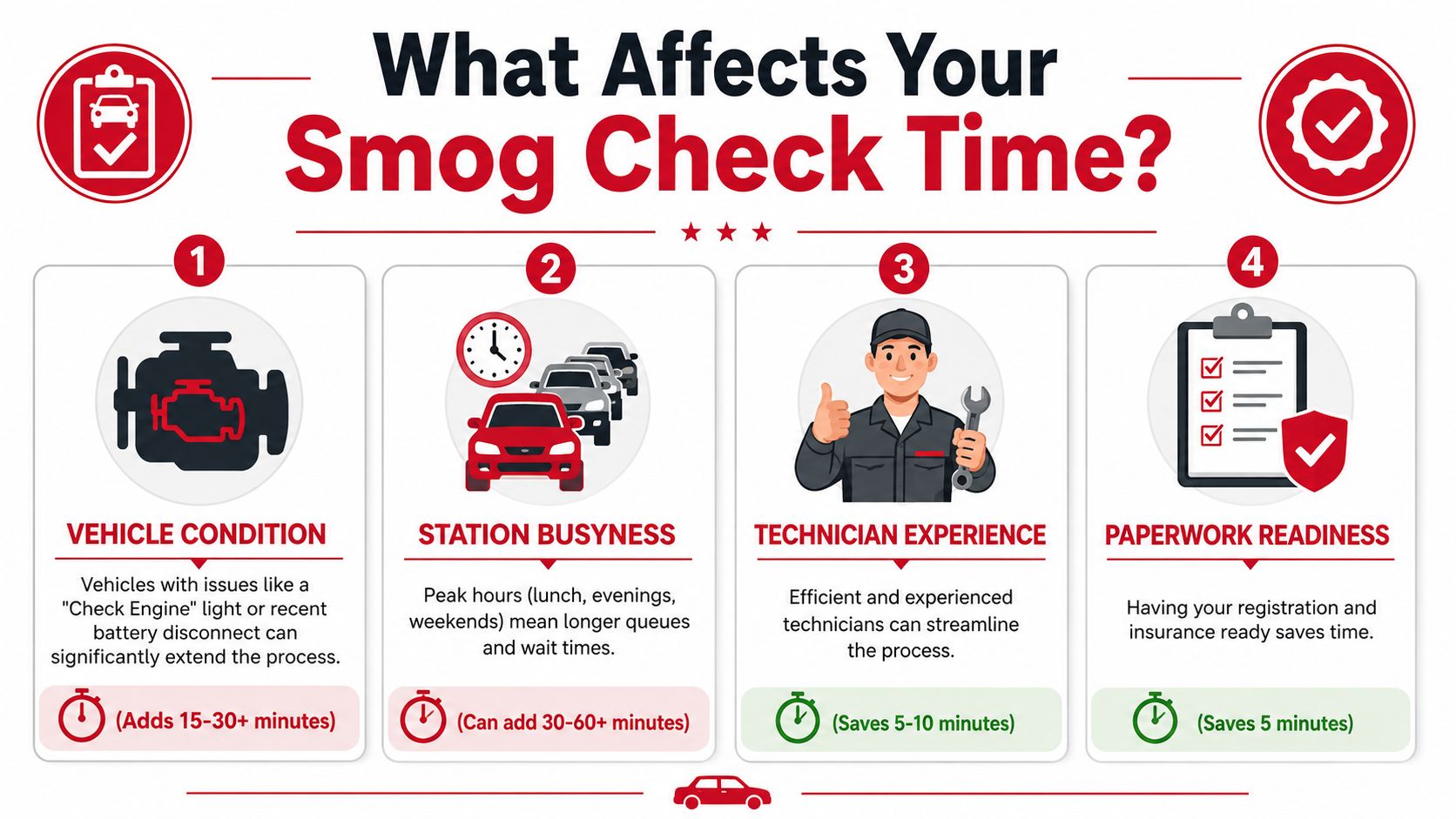
Vehicle age changes the process
Newer vehicles are usually faster because the test can rely more heavily on onboard diagnostics, while older cars may need extra steps. California STAR station guidance commonly lists about 15 minutes for 2000 and newer, 25 minutes for 1996 to 1999, and 35 minutes or more for 1995 and older (California STAR station guidance). That's a real operational difference, not a minor variation.
Older cars aren't “harder to pass” just because they're older. They're often slower to inspect because the station has to use a different procedure.
Readiness matters before the car rolls in
If a vehicle's computer isn't ready, the station may have to stop, explain the issue, or send the driver back after more driving. That's one reason a quick visit can turn into a longer one even when the bay itself is moving well. A check engine light or recent battery reset can create that kind of delay.
Station flow changes the clock
A busy shop adds time even when the inspection itself stays the same. A station with better workflow, cleaner check-in, and enough equipment to keep cars moving cuts down the dead time between arrival and departure. One reason drivers look for a STAR-certified test-only station is that the setup can be better aligned with a pure inspection visit, especially when a DMV notice requires a specific station type (STAR station FAQ).
Paperwork still slows people down
Drivers who show up without registration details or a clear idea of what their DMV notice asks for often lose time before the hood even opens. That's why the total visit can be much longer than the test. If you want to reduce the friction, use a station that keeps the process focused, and check whether you're facing a STAR requirement before you leave home.
Your Checklist for a Faster Smog Check
A fast visit starts before you turn into the lot. The easiest way to shorten the total stop is to remove the things that force the station to pause, verify, or ask you to come back later.
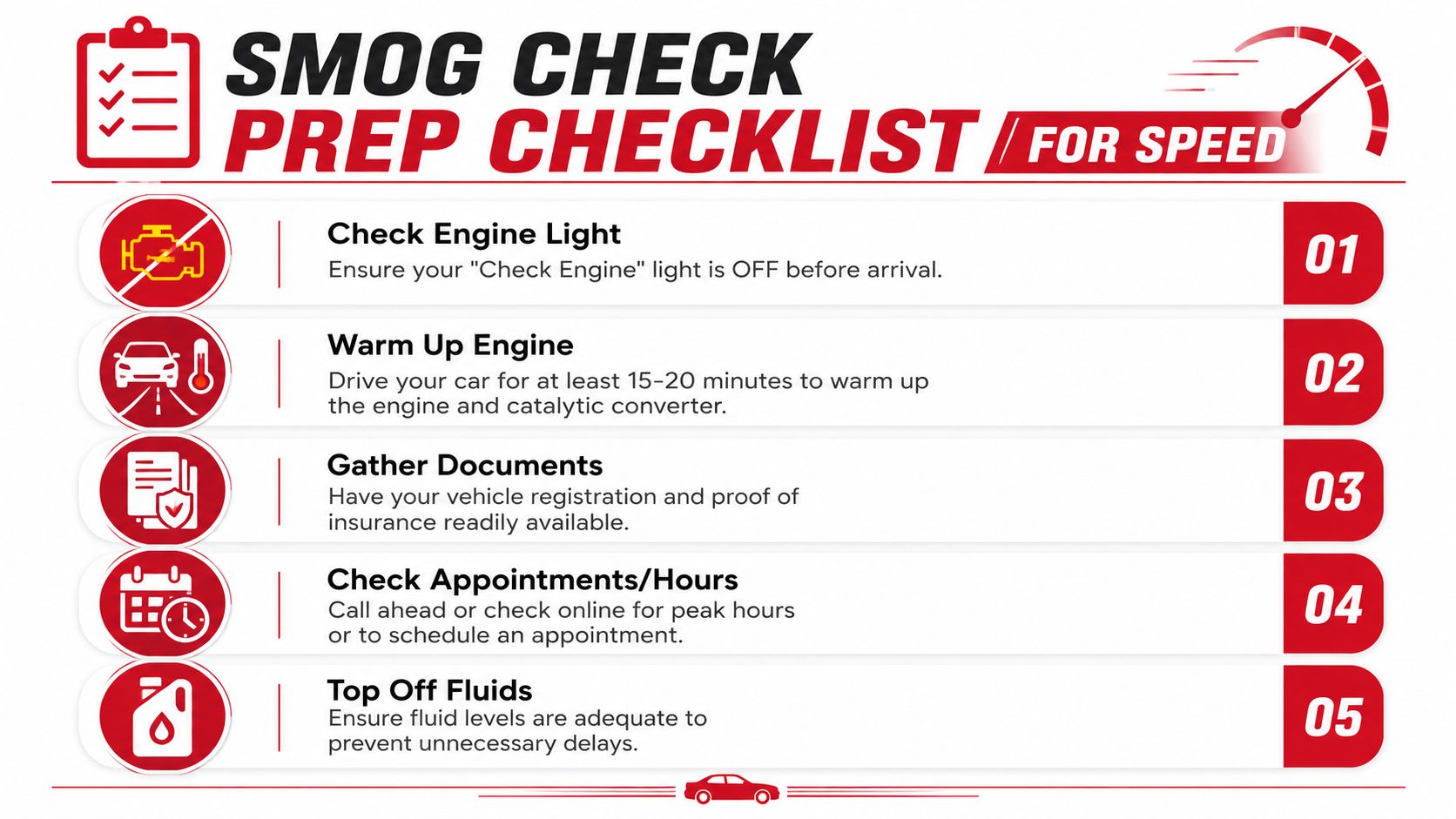
Get the car ready
- Drive the car first: A short drive helps the vehicle settle into normal operating conditions before inspection.
- Make sure the dash is clean: If the check engine light is on, don't expect a quick handoff.
- Keep your documents together: Registration and insurance are the basics, and hunting for them in the parking lot wastes time.
- Call before you leave: If you can verify hours or ask about the flow, you're less likely to land in the middle of a rush.
- Avoid last-minute surprises: If something about the car has changed recently, give yourself time to handle it before the visit.
Choose the right time
Mornings and calmer weekdays usually feel smoother than peak arrival windows, especially when other drivers are trying to beat the same deadline. A station that handles testing seven days a week with extended evening and weekend hours makes that easier to work around, because you're not forced into one narrow window.
Don't confuse preparation with guarantees
Good prep doesn't guarantee a pass, but it does reduce wasted trips. That matters more than people think because a failed first visit can turn a short stop into a second appointment. If you want a practical reference point for common failure causes, review these smog fail reasons before you go.
The Fire House Smog Advantage in Antioch
For Antioch drivers who care more about speed than browsing options, the station layout matters. Two service bays, a test-only model, and on-site DMV registration services all cut down on the extra steps that usually make a smog errand drag on.
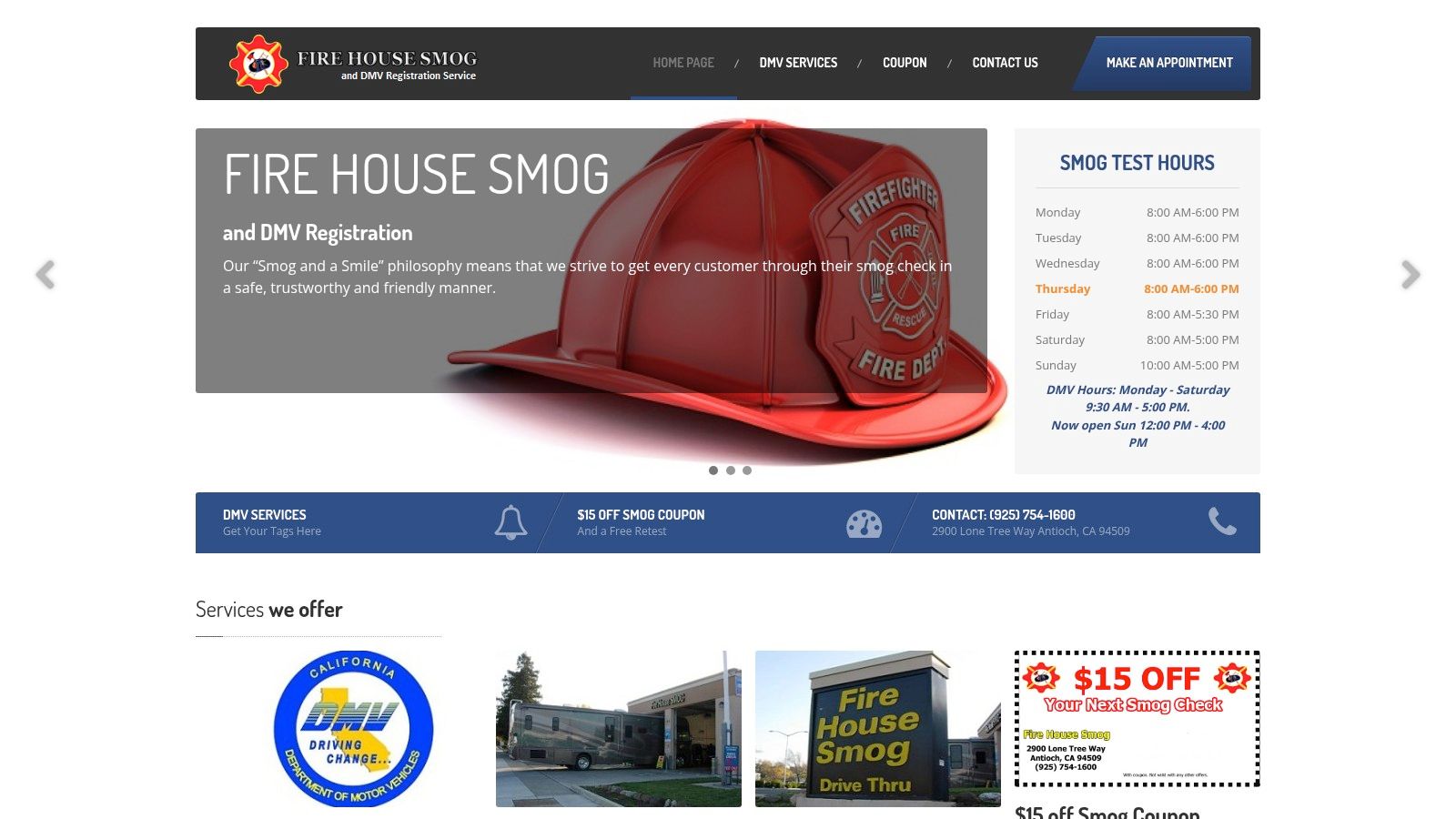
A test-only station keeps the visit focused on inspection instead of repair conversations. That matters because there's no repair upsell built into the process, so you're getting a compliance check rather than a sales pitch. For drivers whose DMV notice points them to a specific station type, that same setup aligns with the STAR structure described by California's program and STAR station guidance (California STAR program FAQ).
Why the layout affects your clock
Two bays reduce the chance that every car stacks behind a single open lane. In plain terms, more capacity usually means less waiting, especially when multiple drivers show up at the same time. That's not a fancy claim, it's just how queueing works at small stations.
The on-site DMV piece is the other time saver. If you need registration renewal help along with the smog test, completing both stops in one place means one parking spot, one check-in, and one trip. That's a real convenience for drivers who don't want to bounce between an inspection station and a DMV counter.
You can also check STAR certified smog test options nearby if your notice specifically calls for a STAR station. That keeps you from showing up at the wrong place and adding another trip to your week.
The fastest smog visit is usually the one that avoids second stops. A station that handles testing and registration in one run removes a lot of hidden time.
Frequently Asked Smog Check Questions
What happens if my car fails?
You'll need to fix the issue and return for a retest. The exact repair path depends on what failed, but the important part is not to assume the first trip is the only trip. If the car isn't ready, a fast station can still be a short stop, but it won't be a final one.
How do I know if I need a STAR station?
Your DMV renewal notice is the first place to look. California's STAR system is designed for directed and non-directed vehicles, and some notices specifically require a STAR station, so the station type matters before you drive over (STAR station FAQ). If the notice names STAR, don't guess.
How often do I need a smog check in California?
For gasoline, hybrid, and alternative-fuel vehicles model year 1976 and newer, plus diesel vehicles model year 1998 and newer, California generally requires a Smog Check when registering or renewing registration, and for most covered vehicles the standard cadence is every 2 years (California BAR). That recurring schedule is why it pays to keep the process simple and repeatable.
The cleanest way to handle it is to treat the smog visit like a quick compliance stop, not an all-day errand. If your renewal is coming due, call ahead, bring your paperwork, and choose a station that can keep the line moving.
If your registration deadline is coming up, book your visit with Fire House Smog and handle the smog check and DMV side of the errand in one trip.

Your registration renewal shows up, you open it, and one line jumps out immediately: “Smog Certification Required at a STAR station.” For a lot of drivers, that sentence feels bigger and more complicated than it really is. It sounds like your car has been flagged for something serious, or that you now have to hunt down some special government facility.
Usually, it's much simpler than that.
If you're trying to understand smog test only centers STAR certified, the main thing to know is that California uses different kinds of licensed smog stations for different situations. Some stations only test. Some test and repair. Some are STAR certified, which means they meet stricter performance standards. Once you understand those labels, the whole process gets a lot less stressful.
Table of Contents
- Your DMV Notice Says STAR Station Required Now What
- Decoding the Jargon STAR Certified vs Test-Only
- Test-Only vs Test-and-Repair Which Station Is Right for You
- How to Prepare for Your Smog Check
- Fire House Smog Your Antioch STAR Certified & DMV Partner
- Frequently Asked Questions About Smog Checks
Your DMV Notice Says STAR Station Required Now What
First, take a breath. A STAR requirement doesn't automatically mean you did anything wrong, and it doesn't mean your car is being “punished.”
California built the STAR program to make emissions testing more reliable in the areas where cleaner air enforcement matters most. More than two-thirds of smog check stations in California are STAR certified, which makes STAR the normal standard in much of the state, not some rare exception. The state's transportation materials explain that the program exists so vehicles with a higher potential to contribute to smog are tested at facilities with proven reliability through the California Senate smog check program overview.
That's why this line appears on so many renewal notices. It's an administrative sorting system, not a character judgment on your vehicle.
What the notice is really telling you
The notice is saying one thing: go to the right kind of licensed station.
That's where people get tripped up. Drivers often mix up these separate ideas:
- STAR certified means the station meets stricter state performance standards.
- Test-only means the station performs inspections only and doesn't do repairs.
- Test-and-repair means the station can inspect the car and also fix it if needed.
A station can be STAR certified and still be either test-only or test-and-repair.
Practical rule: Read the DMV notice carefully. If it says STAR station, focus first on finding a STAR-certified shop. Then confirm whether your vehicle specifically needs test-only service or whether any STAR station will work.
Why people overcomplicate this
A lot of first-time customers assume “STAR required” means they must go to the most restrictive option available. That isn't always true. Some vehicles do need a specific type of STAR station. Others only need any station within the STAR program.
What matters most is choosing a station that matches your notice and your situation. If your car has been running fine and you want a neutral inspection with no repair sales attached, a test-only center often feels simpler and more comfortable.
Decoding the Jargon STAR Certified vs Test-Only
These two terms sound similar, but they answer different questions.
STAR certified answers: How is the station approved?
Test-only answers: What is the station allowed to do?
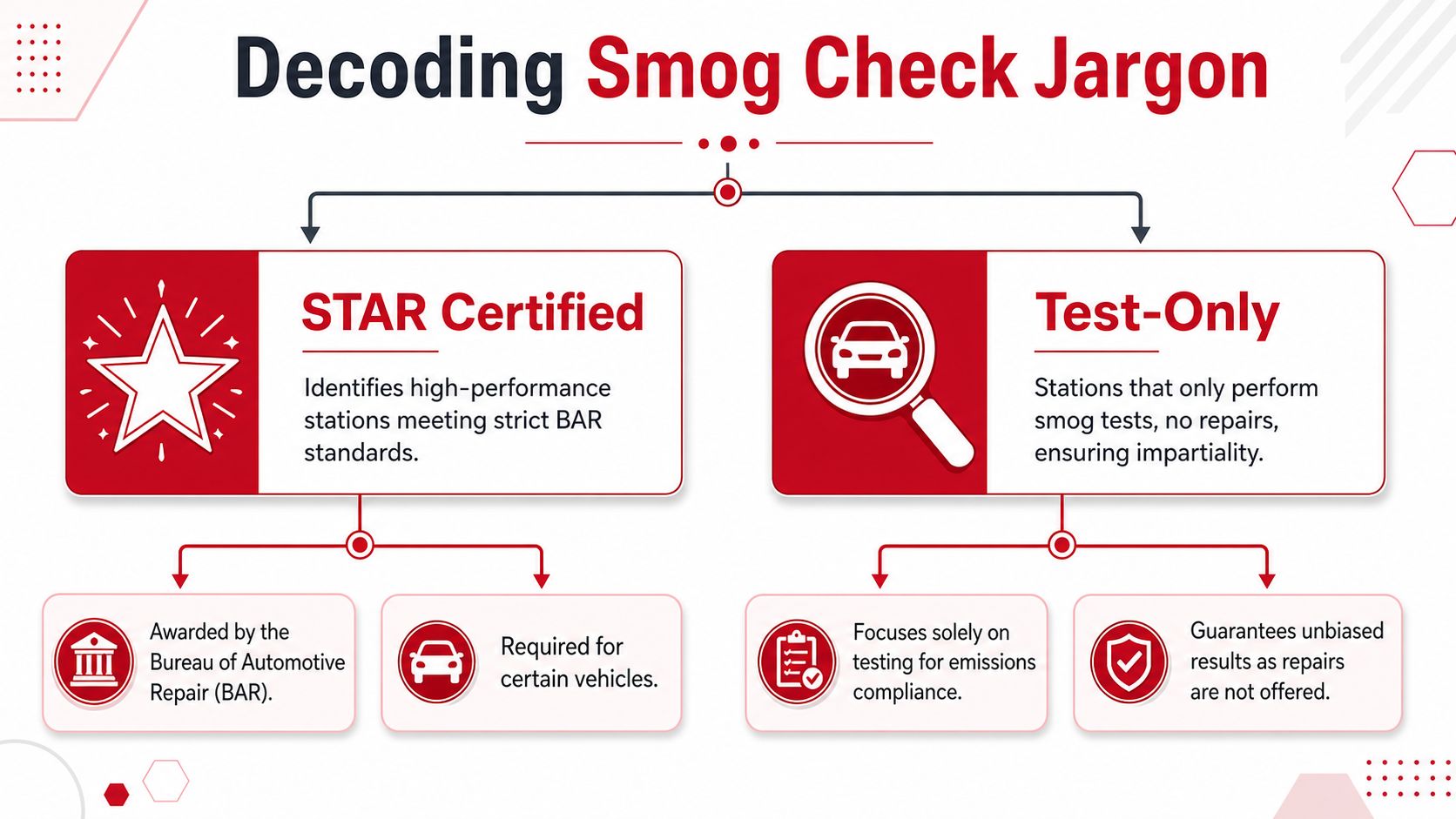
What STAR certified really means
Think of STAR certification like a higher-performance license category. The Bureau of Automotive Repair uses it for stations that meet stricter operational and accuracy standards than regular stations.
For some vehicles, that higher standard isn't optional. BAR states that STAR-certified test-only centers are authorized to inspect directed vehicles and gross polluters that ordinary test-and-repair stations can't handle, and the program requires these facilities to exceed baseline accuracy thresholds, including a long-term Fail-to-Pass Rate score of at least 0.40 through the BAR STAR certification requirements.
That sounds technical, but the takeaway is simple. California wants certain vehicles inspected at stations with stronger testing performance.
What test-only means in practice
A test-only center is exactly what it sounds like. The shop inspects the car, reports the result, and certifies it if it passes. The shop does not repair smog failures.
That separation matters because it removes the repair sale from the inspection itself. If the shop can't sell you a catalytic converter, oxygen sensor, or emissions repair, there's less reason for you to worry about pressure or upsells.
A test-only station functions like a diagnostic checkpoint. Its job is to measure and verify, not to sell the fix.
That's why many drivers prefer smog test only centers STAR certified when they want a neutral result. If the car passes, you're done. If it doesn't, you leave with a report and take the car to a repair shop of your choice.
A quick way to remember the difference
Use this shortcut:
- STAR certified = the station meets stricter state standards.
- Test-only = the station inspects but doesn't repair.
- STAR test-only = a shop with stricter approval standards that also stays separate from repair sales.
For a first-time customer, that last category often feels the clearest. You know why you're there, and you know what the station can and can't do.
Test-Only vs Test-and-Repair Which Station Is Right for You
This decision usually comes down to one question: Do you want a neutral inspection first, or do you want repair convenience if the car fails?
Both station types are legitimate. The better choice depends on your car's condition, your schedule, and how much risk you think there is of a failure.
When a test-only station makes sense
A STAR test-only center fits well when you believe the car is in decent shape and you want a straightforward inspection with no repair sales attached.
That's especially appealing if you've already handled maintenance, recently completed repairs elsewhere, or just want a clean yes-or-no answer from a station that isn't trying to turn the visit into a repair estimate. If you want an example of that kind of setup, this Antioch test-only smog center shows the typical model.
Common reasons drivers choose test-only:
- They want impartiality: The station has no in-house repair revenue tied to the result.
- They already fixed the car elsewhere: They only need certification.
- They value speed: Test-only shops often focus their workflow on inspections rather than repair scheduling.
When a test-and-repair station may be easier
The tradeoff shows up if the vehicle fails.
A test-and-repair station can inspect the vehicle, diagnose the issue, perform emissions-related work, and then retest on site. A test-only station can't do that. If your car fails at a test-only shop, you'll need to leave, get repairs somewhere else, and come back for another inspection.
That “two-stop” process is the part many guides skip. The SmogTips explanation of the STAR station program points out that test-only failures often create extra delay and added cost because repairs and recertification happen in separate places.
If your car has a history of check-engine problems, rough running, or recent emissions repairs, the convenience of a test-and-repair station can outweigh the neutrality of test-only.
STAR Test-Only vs. STAR Test-and-Repair at a Glance
| Feature | STAR Test-Only Center (e.g., Fire House Smog) | STAR Test-and-Repair Station |
|---|---|---|
| Main job | Performs inspections and certifications only | Performs inspections, repairs, and recertification |
| Repair sales | None on site | Repairs available on site |
| Bias concern | Lower, because no repairs are sold | Some drivers prefer a separate tester |
| If the vehicle passes | You're finished | You're finished |
| If the vehicle fails | You must go elsewhere for repairs, then return for retest | Repairs and retest may happen in one location |
| Best fit | Drivers who want a neutral inspection | Drivers who want repair convenience |
For many people, the practical answer is simple. If the car seems healthy, test-only can feel clean and low-pressure. If you suspect a problem, test-and-repair may save time.
How to Prepare for Your Smog Check
The easiest smog check is the one you show up ready for. Most of the stress comes from uncertainty, not the inspection itself.
A common point of confusion is whether every STAR-directed vehicle must go to a test-only center. That's not always the case. A discussion often referenced by California drivers notes that about 1.9% of vehicles are randomly selected for STAR testing, and most of those aren't gross polluters, which means many drivers can use a regular STAR station rather than hunting only for test-only service, as summarized in this California STAR testing discussion.
Before you leave home
Give yourself a better shot at a smooth visit with a few simple checks:
- Watch the dashboard: If the Check Engine light is on, don't assume the car will “probably be fine.” Have the issue diagnosed first.
- Drive the car first: A short drive before the test helps the vehicle reach normal operating temperature.
- Bring your paperwork: Your renewal notice and current registration details help the station verify what the DMV is asking for.
- Don't guess about station type: If the notice wording is unclear, call the station before driving over.
- Review common failure issues: This guide to smog check fail reasons can help you spot obvious trouble before the appointment.
What the visit usually feels like
Here's the normal customer experience.
You pull in, provide your vehicle information, and the technician confirms what kind of inspection your car needs. The inspection itself may include an electronic systems check, a visual review of emissions-related components, and the required testing procedure for that vehicle type.
If the vehicle passes, the certificate is handled electronically. If it doesn't, you'll receive a report showing what needs attention.
This walkthrough gives a useful visual sense of the process:
Bring the car in the same way you normally drive it. Last-minute tinkering, battery disconnects, or rushed DIY fixes can create more confusion than they solve.
A calm way to think about the appointment
Treat the smog check like a compliance inspection, not a personal test. Your job isn't to outsmart the machine. It's to show up with the right paperwork, a warmed-up car, and realistic expectations.
That mindset alone makes the visit easier.
Fire House Smog Your Antioch STAR Certified & DMV Partner
For Antioch drivers, one practical advantage matters more than almost anything else: finishing the smog check and handling registration without making a second trip.
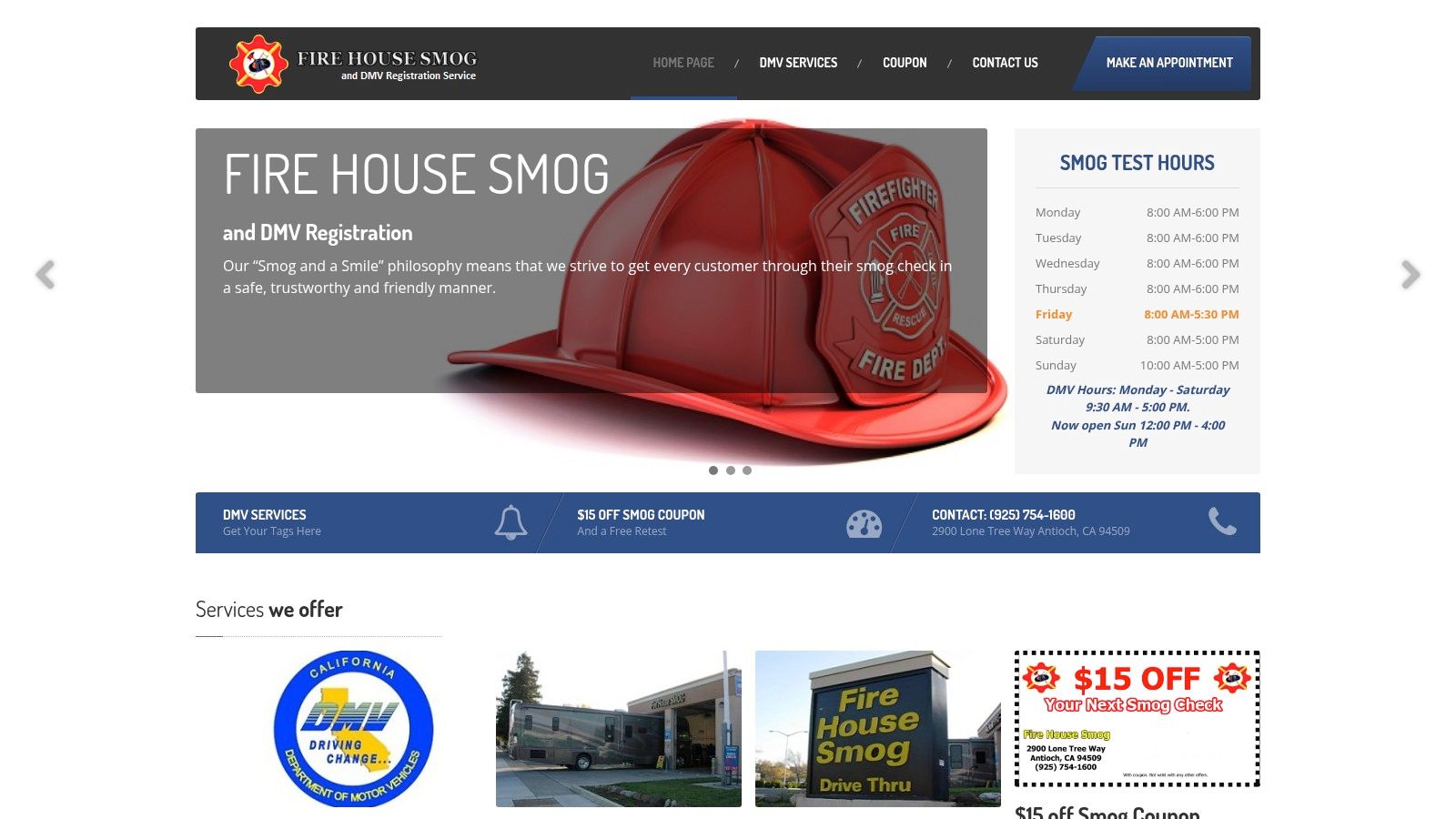
A test-only model keeps the inspection separate from repair sales. California service information notes that STAR Test Only centers can't perform smog check repairs, which creates a non-bias testing environment, and that typical STAR Test Only pricing ranges from $29.95 to $59.95 plus an $8.25 state certificate fee through this California service listing for STAR Test Only smog checks.
Why the combined service matters
The part many drivers dislike isn't only the smog test. It's the extra errand after the smog test.
A station that also handles DMV registration services can remove that second stop. Fire House Smog offers both test-only smog inspections and on-site DMV services as a licensed business partner, which means a passing vehicle owner may be able to complete the renewal and receive registration materials in the same visit. For local drivers comparing options, this STAR-certified smog test near Antioch page shows the service category.
That combination is useful for:
- Busy commuters: Fewer separate appointments.
- Families with tight schedules: Less waiting around with kids in the car.
- Fleet or multi-vehicle owners: A more predictable paperwork process.
What to expect on site
The location at 2900 Lone Tree Way in Antioch offers smog testing for passenger cars, SUVs, light-duty trucks, and some RVs within equipment limits. The business also operates two service bays, provides smog testing seven days a week, and offers DMV service hours Monday through Saturday, with Sunday availability for limited services, based on the publisher information provided above.
That doesn't guarantee zero wait, but it does mean the workflow is built around quick inspections and registration support rather than repair work.
If you're the kind of driver who wants the inspection kept separate from repairs, while also avoiding a later DMV line, this setup solves both problems in one stop.
Frequently Asked Questions About Smog Checks
What usually causes a failure
The most common issues are usually basic emissions-related problems, not mysterious government traps.
Drivers often run into:
- Dashboard warning lights: Especially the Check Engine light.
- Sensor or emissions component problems: Items like oxygen-sensor-related faults can affect readiness or emissions results.
- Fuel vapor issues: Even something simple like a loose gas cap can create trouble.
- Recent repair resets: If a battery was disconnected or codes were just cleared, the vehicle may not be ready for inspection.
What happens if the car fails at a test-only station
You'll get a report showing the reason for the failure. Then you take the car to a repair shop of your choice, have the issue corrected, and return for a retest.
That's the main downside of test-only service. It protects you from repair upsells during the inspection, but it also means the repair step happens somewhere else.
A failure at a test-only shop doesn't trap you. It just separates the diagnosis result from the repair decision.
How retests work
Retest rules depend on the station's policy. Some drivers assume a return visit is automatic or included no matter what. It's better to ask directly before the first inspection.
For Fire House Smog, the publisher information states that a free retest is available when required, subject to site policy and coupon terms. That means you should confirm the current terms at the counter or when scheduling so there aren't any surprises.
If you're unsure where to go, call ahead, read your DMV notice carefully, and choose the station type that matches both the notice and your comfort level. That's usually all it takes to make a confusing requirement feel manageable.
If you need a neutral smog inspection and want to handle registration in the same visit, Fire House Smog provides STAR-certified test-only smog checks along with on-site DMV services in Antioch. Call ahead if your notice is unclear or if you're bringing a larger vehicle, and confirm current retest and registration-service details before you go.
You open the DMV renewal notice, see the smog requirement, and immediately start doing math in your head. Is the old car going to pass. Is this going to turn into a repair bill. Did that battery disconnect last month just create a new problem.
That anxiety is common, especially when the vehicle is older but still runs fine day to day. Plenty of owners assume a car that drives well will breeze through the test, then get blindsided by an emissions failure, a readiness issue, or a rule they thought didn't apply to “classic” vehicles.
A smog check for older cars in California gets easier once you separate rumor from rule and prep the car for the test it will receive. The practical side matters just as much as the legal side. A warm engine, a complete drive cycle, and choosing the right testing path can save a lot of wasted time and unnecessary repair work.
Table of Contents
- That DMV Notice Arrived What Now
- California Smog Rules for Older Cars Explained
- Preparing Your Vintage Car for Its Smog Check
- The STAR Test Process for Pre-2000 Vehicles
- What to Do If Your Older Car Fails the Smog Check
- Your Antioch Smog Check Partner Fire House Smog
- Frequently Asked Questions About Older Car Smog Checks
- Do I need a smog check to sell an older car
- Can historic plates make my car exempt
- How long is a smog certificate valid
- What is the difference between test-only and test-and-repair
- Do all older cars get the same kind of smog test
- What is the best last-minute thing I can do before the appointment
- If my older car fails, do I have any options besides paying for repairs right away
- If my exempt older vehicle doesn't need biennial smog, can I ignore emissions equipment
That DMV Notice Arrived What Now
Most owners go through the same sequence. First comes denial. “This thing's old, but it's maintained.” Then comes the internet search spiral. One site says older cars are exempt. Another says they're not. A friend swears special plates fix the problem. None of that helps when registration is due.
The first thing to do is slow down and identify what kind of “older car” you have under California rules. A seventies car sits in a very different category than a late nineties sedan. An older diesel follows different rules than an older gasoline car. A transfer of ownership can trigger a requirement even when a routine renewal might not.
That's where people lose money. They approve repairs before confirming the actual requirement, or they go into a test with a cold engine, stale oil, or recently cleared codes and turn a manageable situation into a failure.
Practical rule: Treat the smog check like a specific inspection procedure, not a general judgment on whether your car is “good” or “bad.”
Older vehicles can still pass cleanly. The ones that struggle usually have one of three problems. The owner misunderstood the rule, the car wasn't prepared for the test conditions, or the first failure was handled poorly.
If you're holding that notice right now, the path is straightforward. Confirm whether the car is required to test, prepare it like an older vehicle instead of a modern one, understand what the station is going to do, and know your options if the first result isn't what you wanted. That approach keeps the process calm and keeps you from paying for work you may not need.
California Smog Rules for Older Cars Explained
A lot of confusion starts with one bad assumption. Owners hear “older car” and assume California treats every older vehicle the same. It doesn't.
The exemption line that matters most
For gasoline vehicles, the cutoff is simple. 1975 and older are exempt from the biennial smog check. 1976 and newer usually are not. That is why owners of late seventies, eighties, and nineties cars get caught off guard. The car may feel vintage, but under California registration rules it is still in the testing program, as reflected in California's current classic car smog rule coverage.
Fuel type changes the answer too. Many diesel vehicles follow a different year cutoff, and weight matters. Electric vehicles and motorcycles are outside the regular smog check program. Hybrids are not automatically exempt just because they are partly electric.
That distinction matters at the counter and at the test station. I have seen owners spend money chasing tune-up parts before confirming whether the car needed a test, or what kind of test applied.
A quick reference table
| Vehicle Type | Model Year | Smog Check Required? |
|---|---|---|
| Gasoline | 1975 and older | No for biennial smog requirement |
| Gasoline | 1976 and newer | Yes |
| Hybrid | 1976 and newer threshold applies within the biennial program | Yes |
| Diesel under 14,000 lbs | 1997 and older | No |
| Diesel under 14,000 lbs | 1998 and newer | Yes |
| Electric | Any model year | No |
| Motorcycle | Any model year | No |
Special situations owners miss
Registration event matters almost as much as model year.
A car can be old enough to confuse people and still avoid a regular renewal test for a period of time if it is relatively newer by DMV standards. California uses a smog abatement fee for many vehicles in their first several model years instead of requiring a physical inspection at renewal. That exception does not usually help with first-time California registration from out of state. It also does not erase smog requirements that come up during certain ownership transfers.
Here is the practical version owners should remember:
- Out-of-state vehicles: A vehicle brought into California can need a smog check even if a similar in-state renewal would not.
- Private-party sales: Smog requirements often come up at transfer, and timing can become a problem if the seller waits too long.
- Certificate timing: A passing certificate only stays usable for a limited window, so test too early and you may have to do it again.
- Late renewals: Waiting on the DMV notice does not pause penalties.
The other rule older-car owners need to know is less obvious. A vehicle can be exempt from biennial testing and still be expected to keep its original emissions equipment in place. Removing or disabling required components can still create problems under the California Smog Check Program overview.
That is where standard advice falls short. The rulebook tells you whether the car needs a test. It does not tell you how to avoid an unnecessary failure. On older cars, that usually comes down to test timing, a proper drive cycle so monitors can set, and knowing when a Smog Referee is the better option than arguing with a regular station about an engine change, label issue, or equipment question. Those are the details that save owners money.
Preparing Your Vintage Car for Its Smog Check
A smog check for older cars usually goes better when the owner focuses on simple prep, not panic repairs. Start with the basics that affect how the car runs on test day. Older engines are less forgiving than newer ones, and small issues that seem harmless in normal driving can show up during emissions testing.
What to check before you leave home
Use this as a practical pre-test checklist:
- Engine temperature: Don't show up with a cold engine. Drive long enough for full operating temperature so the catalytic converter and sensors are doing their job.
- Check Engine light: If the light is on, deal with that first. Clearing codes right before the test often creates a new problem because monitors may not be ready yet.
- Oil condition: If the oil is very dirty or overdue, change it before the test. Old oil can contribute to a rough-running engine.
- Tire pressure: Inflate tires to the correct specification. That helps the car behave normally during testing conditions.
- Fluid levels: Check and top off the basics. You want the engine operating steadily, not compensating for avoidable maintenance issues.
- Battery history: If the battery was recently disconnected or replaced, assume the car may need extra driving before it's fully test-ready.
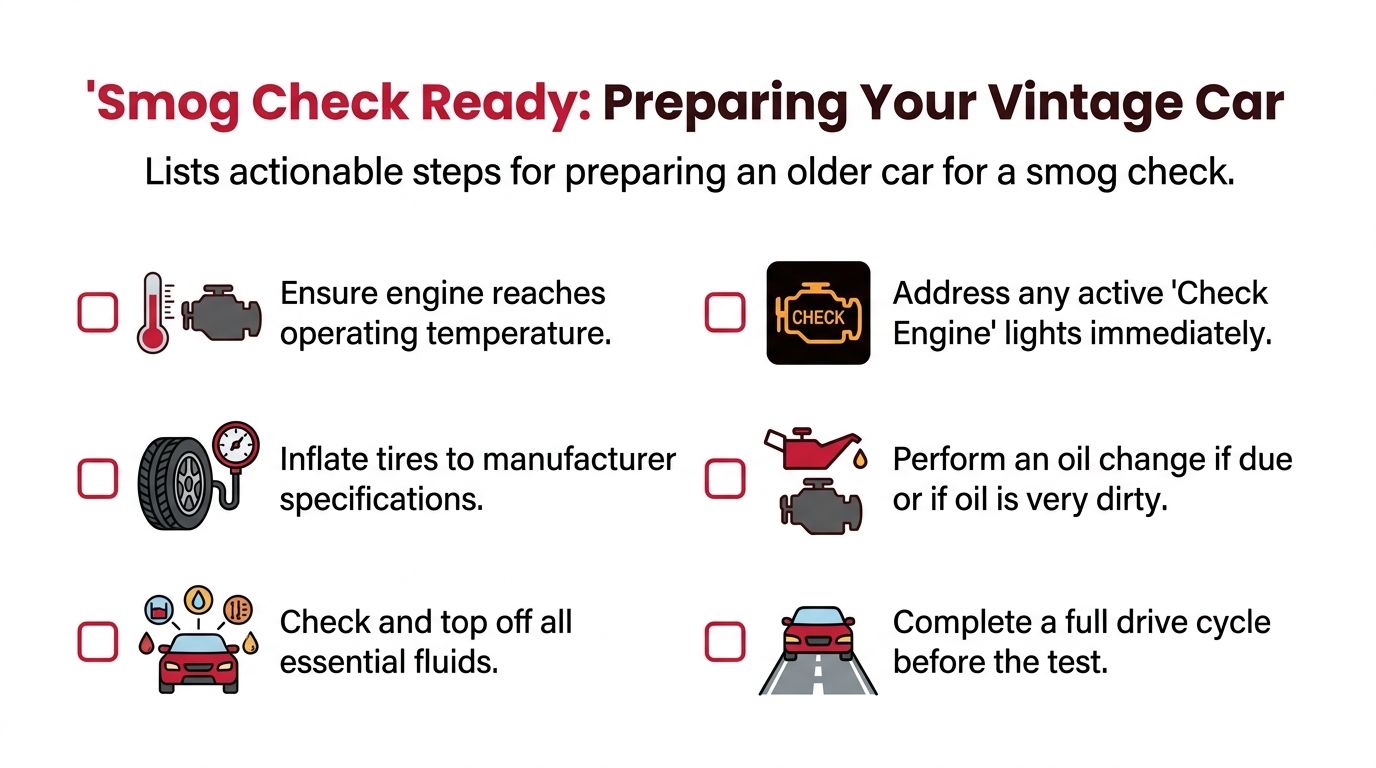
Why the pre-test drive cycle helps
One of the most overlooked tricks is the pre-test drive cycle. Reddit users and experienced owners report that driving a specific 30-mile route, usually a mix of highway and city driving, can help prime the O2 sensors and catalytic converter, especially on 1995 to 2000 vehicles that struggle after battery disconnections, according to this owner discussion about the 30-mile drive cycle.
That advice lines up with what older-car owners see in real life. A car can feel fine and still not be ready for inspection if the monitors haven't settled back in after power loss or recent code clearing. The drive cycle gives the system time to run its checks under normal conditions.
Here's what tends to work better than random short trips:
- Start with the car fully warmed up.
- Drive a mix of steady-speed road time and stop-and-go sections.
- Avoid idling in a parking lot and calling it “warm.”
- Don't disconnect the battery again before the test.
“If you just cleared codes, don't rush straight to the station. Give the car a real drive first.”
What doesn't work is guessing. Spraying fuel additives into the tank at the last minute, clearing codes on the way over, or showing up after the car sat for days usually creates more trouble than it solves. Older cars reward steady prep, not shortcuts.
The STAR Test Process for Pre-2000 Vehicles
Older cars make people nervous partly because they expect a mysterious process. It isn't mysterious once you know what lane your vehicle falls into.
What BAR-97 means in plain English
Vehicles built in 1999 and older use the BAR-97 test rather than the newer OBD-II style process used for later vehicles. That older test uses tailpipe emissions sampling and analog diagnostic equipment, and it checks what's coming out of the exhaust instead of relying mainly on the car's onboard reporting, as described in this overview of California's BAR-97 testing for older vehicles.
For owners, the practical takeaway is simple. Mechanical condition matters a lot more on these vehicles. Tune, vacuum integrity, catalytic converter health, and basic engine operation have a direct effect on the result.
The same source notes that BAR-97 testing measures HC, CO, and NOx at the tailpipe, and the inspection window for these vehicles is longer than for newer cars. That's one reason older-car smog appointments can feel more involved.
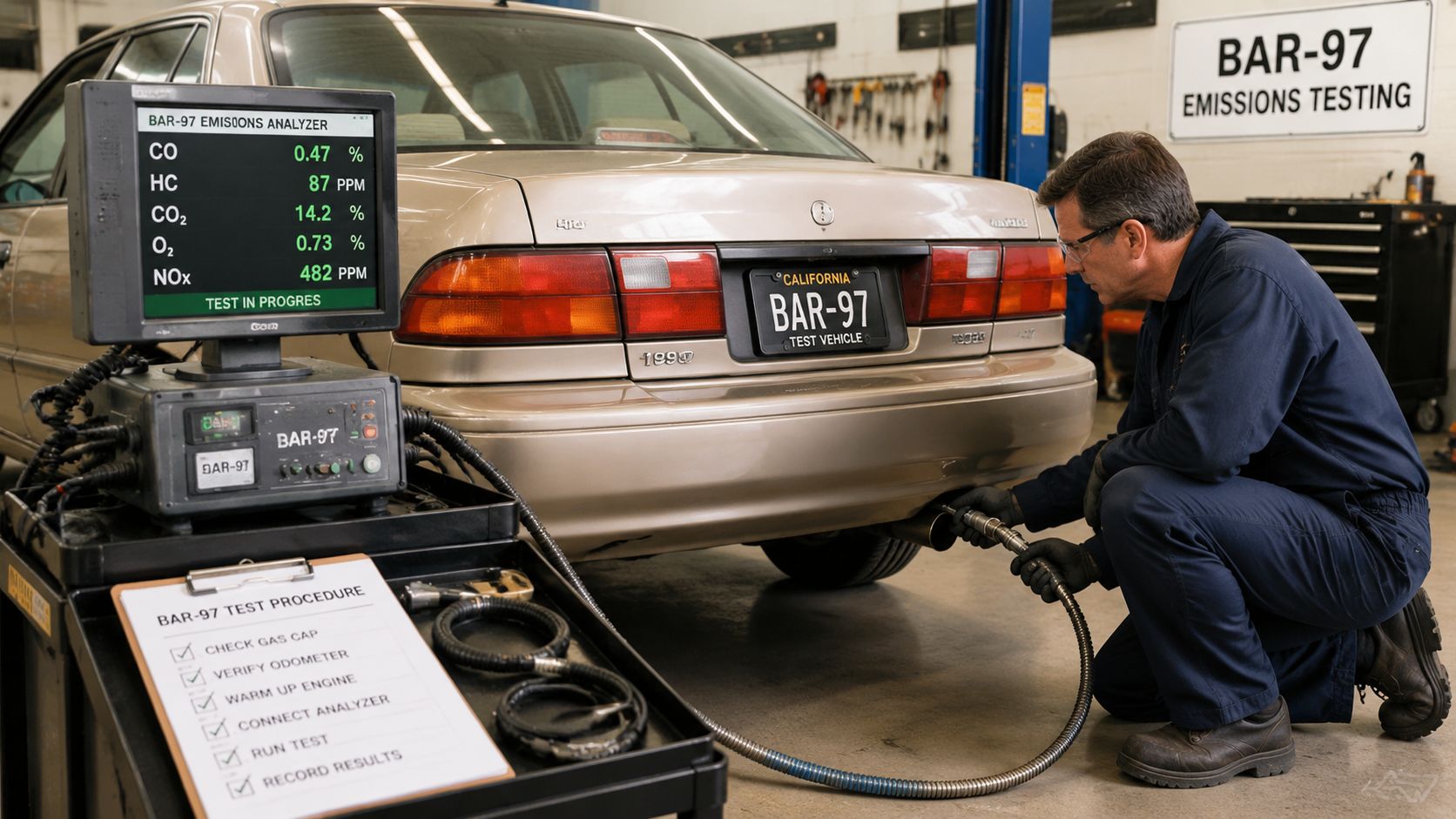
Why station type matters
If your notice requires a STAR station, pay attention to that requirement. Don't assume every shop handles the same vehicles in the same way.
For older vehicles, many owners prefer a test-only setup because the incentives are cleaner. The shop is there to inspect, not to fail the car and immediately sell a repair package. If you need a STAR inspection, a STAR smog test-only station in Antioch gives you that narrower, more impartial role.
That matters most when the car is borderline or has already had work done elsewhere. You want an accurate result first. Then, if repairs are needed, you can make a calm decision instead of reacting under pressure.
What to Do If Your Older Car Fails the Smog Check
A failed result doesn't always mean the car needs a major repair. It means you need to read the failure correctly before spending money.
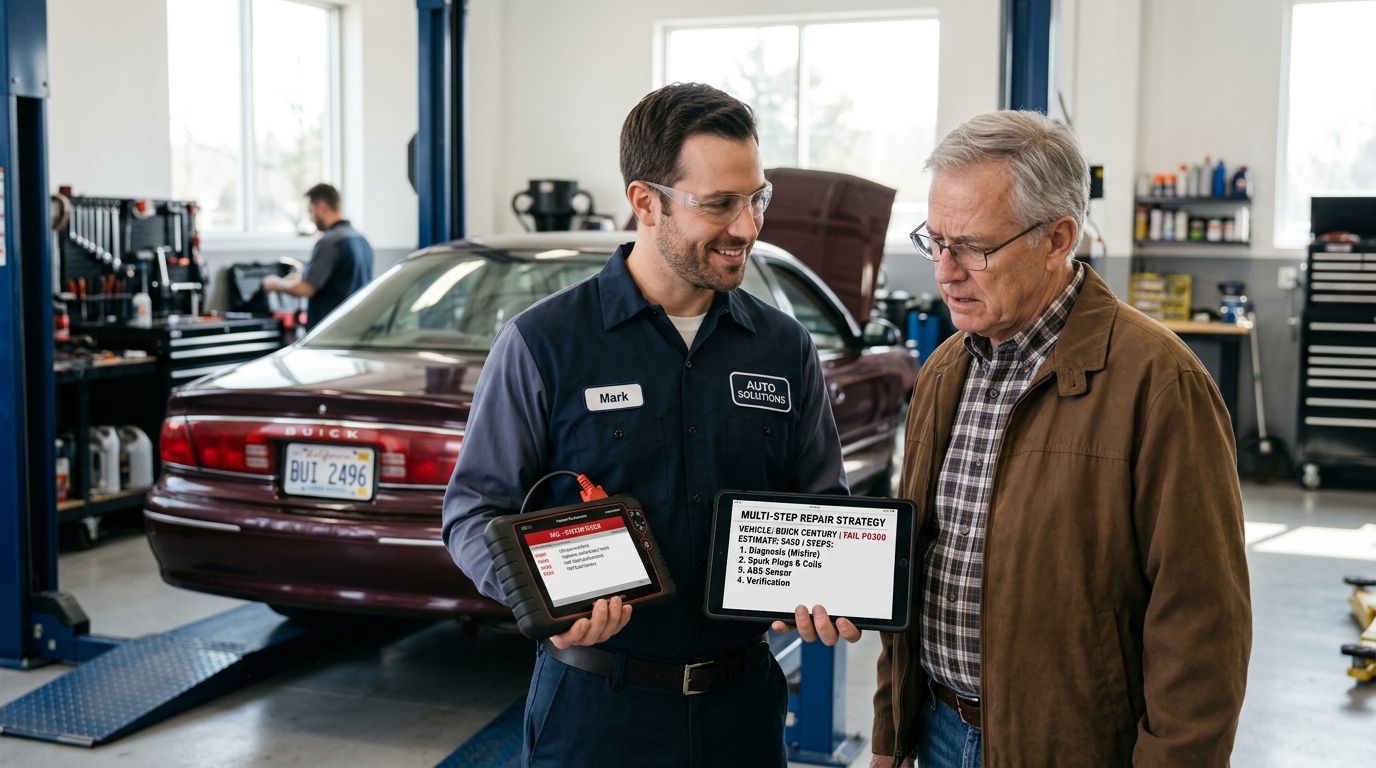
Read the failure before approving repairs
There's a big difference between a true emissions problem and a procedural issue. A car might fail because of actual tailpipe output, a readiness problem, missing or altered equipment, or something that points to a narrow fault rather than a full system rebuild.
Start with this sequence:
- Get the exact reason in writing: Don't leave with a vague memory of what the technician said.
- Match the failure to recent events: Battery disconnect, code clearing, long storage, or recent engine work can all matter.
- Avoid one-shot repair decisions: On older cars, replacing parts by guesswork gets expensive fast.
- Ask about retest policy: Some stations offer a free retest under coupon or posted policy terms, which can make a second attempt much easier after a targeted fix.
If you want a clearer sense of what usually trips cars up, this guide to common smog check fail reasons is a useful starting point.
Common mistake: Owners hear “fail” and approve everything suggested in the first five minutes. That's how small emissions problems turn into large invoices.
When to use the Smog Check Referee
Some older cars don't fit cleanly into standard advice. Collector vehicles, modified vehicles, and stubborn repeat failures are where owners should think about a second opinion.
The Smog Check Referee Program offers a free, independent technical review to determine whether the failure reflects a genuine emissions problem or a testing issue, and in some cases it may waive the repair requirement, according to the BAR Referee review process for smog check results.
That option is more valuable than most owners realize. If the car has an unusual setup, a long repair history, or a result that doesn't match how the vehicle is equipped, the referee path can keep you from chasing the wrong fix.
A short explainer helps if you haven't seen the process before.
Use the referee route when the failure feels questionable, not as a substitute for obvious maintenance. If the catalytic converter is damaged, vacuum lines are disconnected, or the engine is running poorly, that still has to be addressed. But when the case is murky, a second opinion can be the smartest move.
Your Antioch Smog Check Partner Fire House Smog
For local drivers, convenience matters almost as much as the technical side. Older cars don't love unnecessary trips, long waits, or being bounced between the test station and the DMV.
Why the setup is useful for older vehicles
Fire House Smog is a STAR-certified test-only station and licensed DMV registration provider in Antioch. The test-only model is useful for owners who want an inspection without repair upselling, and the station's two-bay setup helps keep vehicles moving instead of stacking up in a single line.
The location also handles California DMV renewals, ownership transfers, and related registration tasks with on-site tag issuance during posted hours. That's a practical advantage when you've already done the hard part and just want the paperwork finished.
Local details that make the process easier
The shop is located at 2900 Lone Tree Way, Antioch, CA 94509, and you can reach it at 925-754-1600. Smog testing is available seven days a week, with extended weekday and weekend availability, and DMV services run Monday through Saturday from 9:30 AM to 5:00 PM and Sunday from 12:00 PM to 4:00 PM.
For Antioch and East Contra Costa County drivers, that combination solves a real problem. You don't have to line up one place for a test and another for registration handling if both are needed.
If you want station details before heading over, the Antioch smog check service page lays out the local service options clearly.
Frequently Asked Questions About Older Car Smog Checks
Do I need a smog check to sell an older car
In many private-party sales, yes. If the car is outside California's newer-vehicle transfer exemption, the seller usually needs to provide a passing smog certificate before the title changes hands.
The practical mistake is testing too early. Smog certificates expire, and older cars can drift out of tune if they sit, so line up the inspection close enough to the sale that you are not paying for the same test twice.
Can historic plates make my car exempt
Historic or collector plates do not automatically remove the smog requirement.
What matters is the vehicle's year, fuel type, and how California classifies it. I have seen owners show up convinced the plate solves everything, then lose time because the car still falls into a test-required category. Check the actual exemption status first, not the badge on the plate.
How long is a smog certificate valid
A smog certificate is valid for 90 days.
That window matters more than owners expect. If you are selling the car, finishing registration late, or waiting on DMV paperwork, watch the calendar. Once the certificate expires, the state can require a fresh test.
What is the difference between test-only and test-and-repair
A test-only station inspects the car and reports the result. A test-and-repair shop can inspect it and sell the repair work.
For an older car, test-only often gives you a cleaner starting point. You get the numbers without having to make a repair decision on the spot. If the car fails, you can compare repair options, ask better questions, and decide whether a regular shop, marque specialist, or Smog Referee makes the most sense.
Do all older cars get the same kind of smog test
No. A pre-2000 car does not move through the program the same way a newer OBD-II vehicle does, and diesel rules are different again.
That is why advice from a neighbor with a different model year can send you in the wrong direction. The right prep depends on the engine management system, the emissions label under the hood, and whether the car needs a STAR station.
What is the best last-minute thing I can do before the appointment
Give the car a proper warm-up drive.
For many older vehicles, a short freeway run followed by normal city driving helps more than any fuel additive poured in the tank the night before. The goal is to get the engine fully hot, stabilize idle quality, and, on cars that track readiness, complete enough of the drive cycle for the monitors to set. If the battery was disconnected recently or repairs were just done, do not assume a quick trip around the block is enough.
If my older car fails, do I have any options besides paying for repairs right away
Yes. Start by reading the failure printout carefully. High hydrocarbons, high carbon monoxide, and a functional failure do not point to the same problem, and treating them like they do is how owners waste money.
If the car has a hard-to-find configuration, an engine swap question, or a dispute over required equipment, the California Smog Referee program can be the right next step. It is also useful when standard shop advice is not lining up with what the car is.
If my exempt older vehicle doesn't need biennial smog, can I ignore emissions equipment
No. Exempt from routine testing does not mean free to remove emissions parts.
That catches owners during a later sale, a referee inspection, or any situation where the car is checked for required equipment. Keeping the emissions system intact is usually cheaper than trying to put a half-modified older car back to stock under deadline pressure.
If you want a straightforward smog check for older cars in East Contra Costa County, Fire House Smog offers STAR-certified test-only inspections, DMV registration help, and seven-day availability at 2900 Lone Tree Way in Antioch. Call first if you've got an unusual vehicle or RV, and bring the DMV notice so the visit goes faster.

That renewal notice shows up at the worst time. You're already juggling work, errands, and family stuff, and now you need a smog check before registration gets held up. Most drivers in Antioch want the same thing: use a good STAR smog test coupon, get in and out without drama, and avoid wasting half a day at the DMV.
There's a smarter way to handle it. Get the smog check done, use the coupon correctly, and if the location also handles registration services, finish the paperwork in the same stop instead of making a second trip. That combo is what saves the most time in practice.
Table of Contents
- Your Smog Test Solution in Antioch
- Locating and Using Your Smog Coupon
- Preparing for Your Smog Check Appointment
- The STAR Test Process and Free Retest Policy
- Combine Your Smog and DMV Services to Save Time
- Frequently Asked Questions About Smog Testing
Your Smog Test Solution in Antioch
In Antioch, the practical goal isn't just passing a smog test. It's finishing the whole registration chore with the fewest stops, the least waiting, and no surprise costs. If your DMV notice says you need a STAR station, that detail matters. Since certain vehicles are directed to these higher-performing stations under California's STAR Program, you need the right shop, not just the closest one. The Bureau of Automotive Repair says the program was created by Assembly Bill 2289, and certified stations must meet a minimum First Pass Rate score of 0.40 to qualify as STAR stations (BAR STAR program FAQ).
For local drivers, the easier move is to look for a station that handles the inspection side efficiently and sits where access is simple. If you're checking local options, the Antioch smog check service page is a useful place to confirm location details and service fit before you leave home.
Practical rule: If your renewal notice mentions STAR, don't gamble on a regular station first. Start at a STAR location and skip the avoidable detour.
The time savings come from planning the visit as one errand, not two. Have your notice ready, bring your coupon, and think ahead about whether you can also take care of your registration on-site after the vehicle passes. That's the piece many people miss.
Locating and Using Your Smog Coupon
A good coupon only helps if you know exactly what it covers. The easiest mistake is seeing a discount banner, showing up, and then finding out your vehicle type or model year has different pricing. Spend a minute reading the offer before you drive over.
Where to find the deal
The coupon is usually posted right on the business website or discount page. If you want to check an active offer, the smog test-only discount page is the logical place to start.
When you pull up a coupon, look for these details before you rely on it:
- Vehicle coverage: Some offers apply broadly to passenger cars, SUVs, and light-duty trucks, while larger or specialty vehicles may have separate terms.
- Test type: Make sure the offer applies to the inspection you need, especially if your renewal directs you to a STAR station.
- Retest language: A coupon that includes a free retest can matter a lot more than a slightly larger front-end discount.
- Business hours: This becomes important if you want to pair the smog visit with registration services on the same trip.
How to read the fine print without getting tripped up
A lot of drivers assume a STAR smog test coupon won't save much because STAR testing must cost more. That's the myth. The better way to think about the bill is to separate the state fee from the shop's base test fee.
The clearest published explanation is that the $8.25 certificate fee is a state-mandated pass-through charge that shops can't mark up, and the only variable is the base test fee, which varies by location rather than by STAR status (California smog coupon pricing explanation). That's why a coupon at a STAR station can be a real discount, not a gimmick.
Here's the quick version:
| Cost piece | What controls it | What to know |
|---|---|---|
| Certificate fee | State rule | The $8.25 fee is fixed and passed through |
| Base test fee | Shop/location | This is where coupons actually help |
| Repair costs | Separate issue | Test-only stations don't fold repair sales into the visit |
That last point is important. A test-only setup keeps the inspection separate from repair work, which is usually what people want when they're trying to avoid pressure and keep the visit straightforward.
If you're comparing coupons, don't just chase the biggest number in bold. Check whether the offer includes a retest and whether the station can also help you finish registration the same day.
Preparing for Your Smog Check Appointment
You pull into a STAR station with your coupon buried in email, your renewal notice still on the kitchen counter, and no idea whether you can finish registration there too. That is how a quick Antioch errand turns into two trips. A little prep fixes that.
Bring the right items
Have your DMV renewal notice ready if one was mailed to you. Bring your current registration if you have it, keep the coupon open on your phone before you park, and carry a payment method you know the station accepts.
If your plan is the combo play, smog test plus on-site DMV service, confirm that before you leave home. Ask whether they can process your registration right after a passing test and whether they need any extra paperwork. That one phone call can save you a trip across town and a long wait at the DMV office.
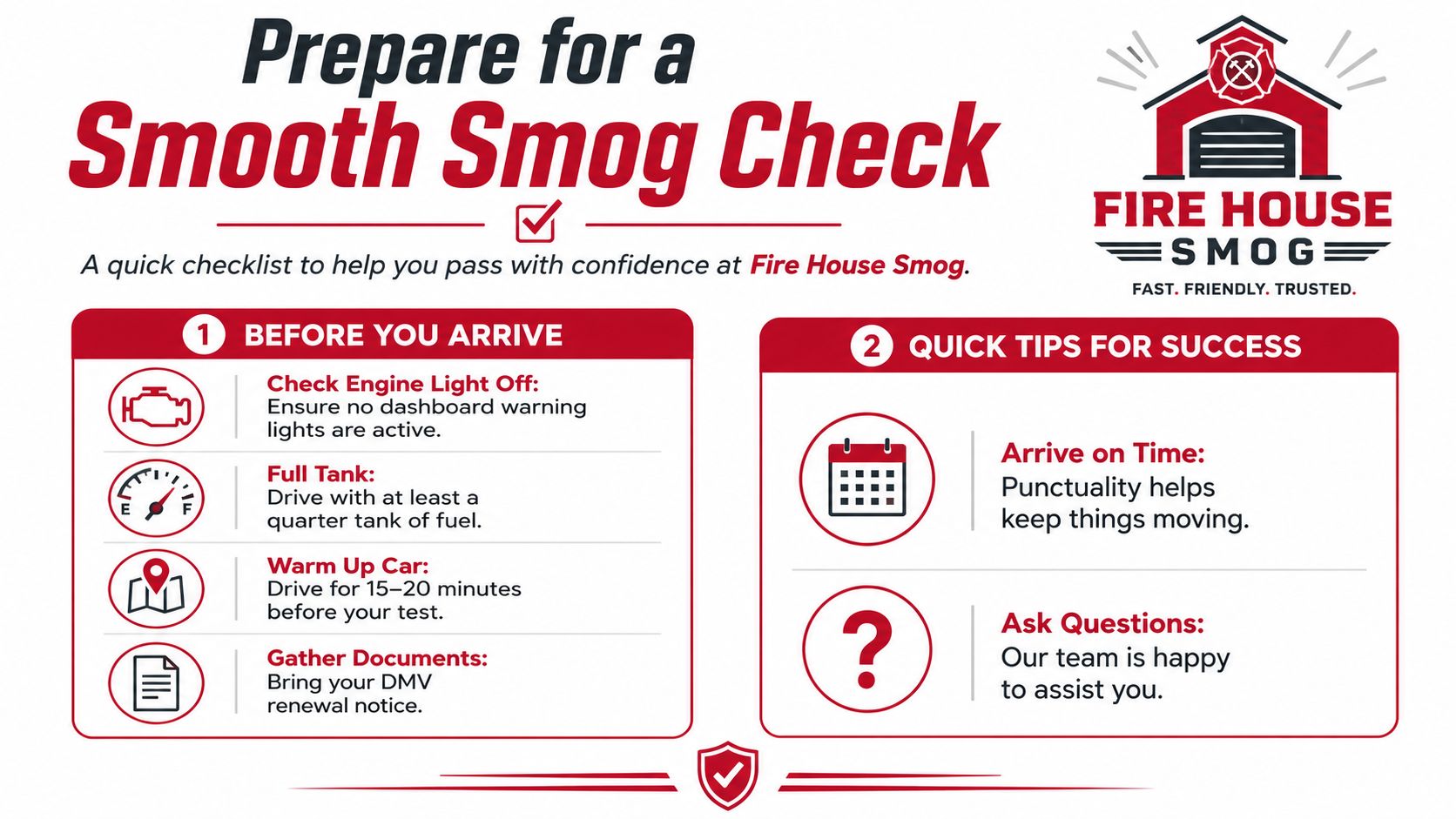
Drivers with RVs, motorhomes, or other larger vehicles should call ahead for another reason. Bay size and equipment limits vary by station, and it is much better to learn that on the phone than in the parking lot.
A simple checklist keeps the visit clean:
- Renewal notice ready
- Current registration if available
- Coupon already pulled up
- Payment method ready
- Quick call ahead for oversized vehicles
- Ask if on-site DMV registration is available the same visit
Simple prep that helps
Start with the obvious one. If the Check Engine light is on, deal with that before you schedule the test. Showing up anyway usually wastes the coupon and your time.
Drive the car for a bit before the appointment if you can. A warmed-up vehicle tends to be easier to process than one that came straight out of an overnight cold start. Keep a normal amount of fuel in the tank too, since arriving on fumes creates avoidable problems.
Timing matters more than people expect. The Bureau of Automotive Repair advises drivers to set aside enough time for the inspection and paperwork, and Antioch stations can get backed up during lunch hours, after work, and near registration deadlines (California BAR Smog Check program overview). If you want to test and finish DMV paperwork in one stop, give yourself a little cushion instead of trying to squeeze it into the last 20 minutes of the day.
Here is the practical version I give neighbors:
- Drive the car before the visit
- Do not show up with the Check Engine light on
- Keep fuel at a reasonable level
- Have the coupon open before you arrive
- Bring the paperwork needed to finish registration if the station offers DMV services
That last step is the one many articles miss. The primary time-saver is not just shaving a few dollars off the STAR test with a coupon. It is walking out with the smog done and the registration handled on the same stop.
The STAR Test Process and Free Retest Policy
A common Antioch mistake is treating the STAR test like the hard part and the paperwork like a separate problem. The better approach is to handle the inspection with a station that can also help you finish registration, especially if your coupon includes a free retest. That gives you one clear plan instead of two disconnected errands.
What STAR means
STAR is a state performance designation for smog stations. If your DMV notice says your car must go to a STAR station, that is part of the requirement for registration renewal, not an optional upgrade. California BAR explains the program and the referral requirement on its Smog Check program page.
For the driver, the practical point is simple. Go to the station type listed on your notice the first time, so you do not lose time repeating the visit.
Why test-only can be the safer choice
STAR and test-only are related ideas, but they are not interchangeable. A STAR station meets the state's performance standards. A test-only station focuses on inspection work and does not use the smog check visit to sell repairs on the spot.
California's Consumer Assistance Program materials describe test-only stations as inspection locations for vehicles directed there by the DMV or BAR, while repairs are handled separately through eligible repair shops or other service providers (California BAR Consumer Assistance Program). That separation matters. It removes the pressure some drivers feel when a failed test immediately turns into a repair quote.
There is a trade-off. If the vehicle fails, you still need to repair it somewhere else. In my experience, many drivers prefer that extra step because the inspection feels cleaner and easier to trust.
How the free retest policy saves money
A free retest changes the math on a failed first visit. Instead of paying for another full inspection after repairs, you come back within the station's stated time window and recheck the vehicle under the coupon terms.
That policy is only helpful if you use it correctly. Read the vehicle inspection report, fix the problem based on the report, and return before the retest period expires. Guessing at parts is where people burn money.
Here is the practical order that tends to work best:
- Review the failed items on the inspection report
- Take the car to a repair shop that can diagnose the cause, not just swap parts
- Keep the retest paperwork in the car so it does not get forgotten
- Return within the coupon's free retest window
- If registration is due now, ask whether the station can finish the paperwork on-site through its Antioch DMV registration service
That last step is the part many drivers miss. A coupon saves a few dollars on the test. Pairing the STAR test with on-site DMV help can save the extra trip, the waiting room time, and the hassle of figuring out what still needs to be filed after the car passes.
Combine Your Smog and DMV Services to Save Time
A common Antioch mistake is treating the smog check and the DMV paperwork as two separate jobs. That usually means one stop for the STAR test, another stop later for registration, stickers, or transfer forms. If the station can handle both, use the coupon for the inspection and finish the paperwork before you leave.
That combination is where the actual time savings show up. The coupon trims the inspection price. The on-site DMV service cuts out the second drive, the line, and the guessing about whether the state has everything it needs to complete your registration.
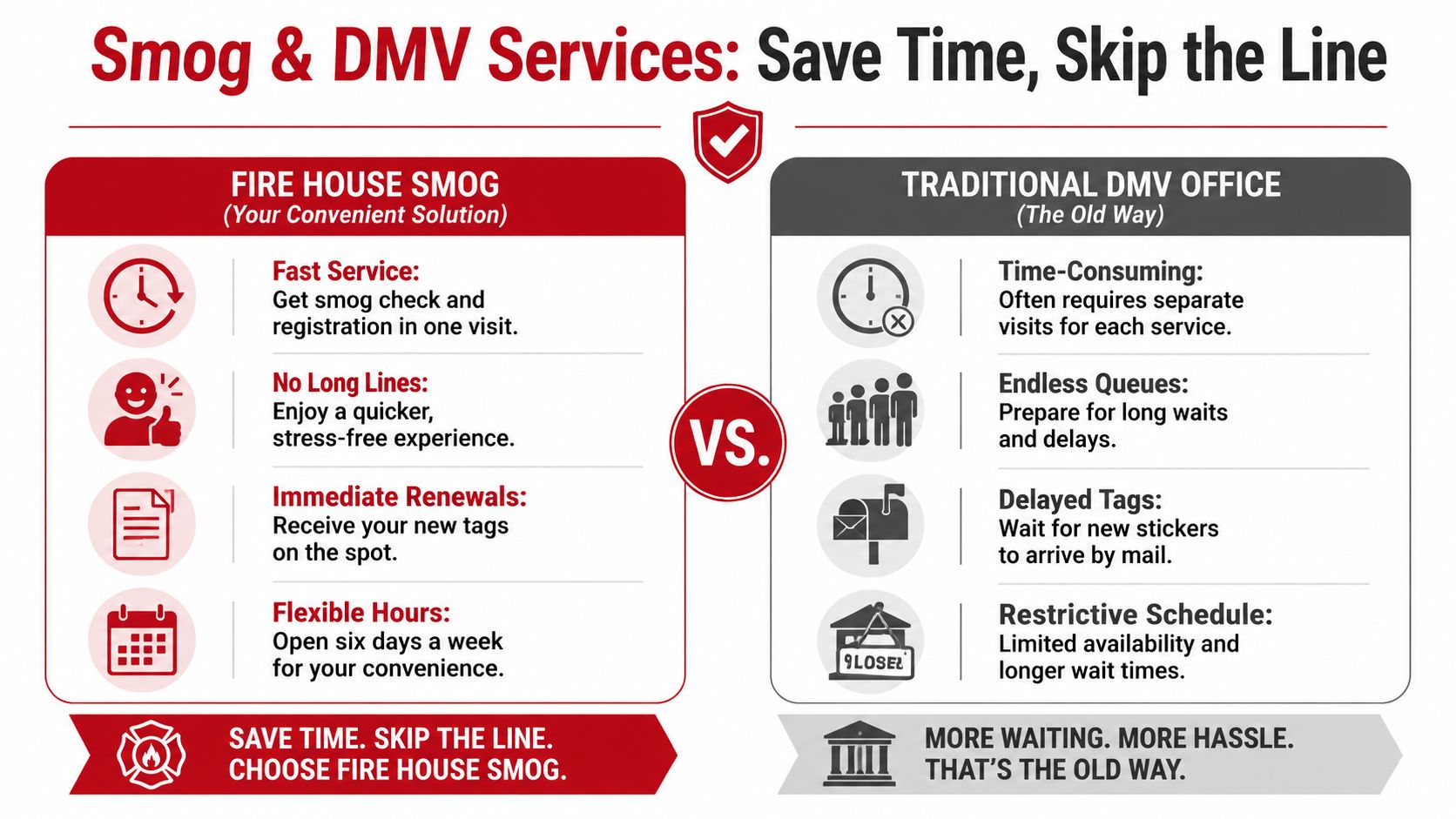
I've seen this matter most for drivers who are already close to a registration deadline. Once the car passes, they want the process finished that day, not partially finished. A station with local DMV registration services in Antioch can be the difference between one errand and an afternoon lost to paperwork.
Why bundling makes practical sense
The trade-off is simple. A basic smog-only visit may look cheaper or easier at first, but it often leaves you with unfinished business. A bundled visit can save more in total time, especially if you need tags, renewal help, or title-related paperwork handled right away.
That matters even more in busy parts of California, where STAR participation is widespread and drivers often look for stations that can keep the whole compliance process moving. The state's BAR STAR program explains how STAR stations fit into California's inspection system and why some vehicles must test at those locations (California BAR STAR program overview).
What you can often finish during the same visit
If the location also offers DMV support, one stop may cover:
- Registration renewals after the smog certificate is submitted
- Tags and stickers so the visit ends with current paperwork in hand
- Ownership transfer paperwork if the vehicle was recently bought or sold
- Some out-of-state registration steps that otherwise turn into a separate DMV trip
For Antioch drivers, that is the better use of a STAR smog test coupon. Saving a few dollars is nice. Saving the extra trip is usually better.
Frequently Asked Questions About Smog Testing
Some questions always come up right before people head in. These are the ones that matter most in practice.
Do you need an appointment
Not always. Many drivers can show up directly, especially at stations built for quick throughput. Still, calling ahead is smart if you're on a tight schedule, if you want to pair the test with DMV paperwork, or if your vehicle is larger than a standard passenger car.
If your day is packed, a quick confirmation call is worth more than guessing.
What if your car fails
At a test-only station, the staff can't repair the vehicle. That can feel inconvenient in the moment, but it also means the result is neutral. You're free to choose where the repair gets done.
Published guidance notes that many test-only stations offer a free retest within a stated period, and retest success after repairs reaches 89% (smog retest effectiveness and neutral testing explanation). That's why a fail isn't the end of the road. It usually means fix the emissions issue properly, then come back within the coupon or policy terms.
If repair cost is the worry, there may be help. Some California motorists who qualify can receive up to $500 in repair assistance through the Consumer Assistance Program after a failed smog test (California emissions testing and CAP overview). Ask about eligibility before assuming you're fully on your own.
What about RVs and larger vehicles
Some can be tested, some can't. It depends on bay space and equipment limits. That's why larger vehicles should always call ahead first instead of assuming any STAR station can handle them.
A few final practical answers:
- Coupon on your phone or printed? Either usually works, but have it ready before check-in.
- Can you bundle smog and registration? If the location offers DMV services and the timing lines up, yes, and that's often the best move.
- Should you test if the check engine light is on? No. Fix that first.
If you want the shortest path through this errand, use the coupon, arrive prepared, and handle the registration piece in the same visit when possible. That's the difference between a quick stop and a half-day headache.
If you need a STAR-certified test-only station in Antioch that also offers on-site registration help, Fire House Smog is set up for exactly that kind of one-stop visit. Bring your renewal notice, pull up your coupon before you arrive, and ask about finishing your DMV paperwork while you're there so you can leave with the smog check done and the registration task off your list.
You open your registration notice, scan for the due date, and then spot the line that throws you off: STAR Smog Check Required.
That wording makes a lot of drivers think something is wrong with the car. It can also sound like the test will be tougher, more expensive, or more likely to fail your vehicle. Usually, it means something much simpler. The DMV wants your car inspected at a station that meets a higher standard for testing quality.
If you're trying to figure out what a STAR test-only station is, why your notice mentions it, and what you're supposed to do next in Antioch, this guide breaks it down in plain English.
Table of Contents
- What 'STAR Smog Check Required' on Your DMV Notice Means
- What Makes a Smog Station 'STAR Certified'?
- Choosing Between a Test-Only vs a Test-and-Repair Station
- How to Prepare Your Vehicle for a Smog Check
- What to Expect During the Smog Test Process
- Your Local STAR Test-Only Solution in Antioch Fire House Smog
What 'STAR Smog Check Required' on Your DMV Notice Means
You open your registration notice expecting the usual renewal steps, then one line changes the mood: STAR Smog Check Required. Many Antioch drivers read that and assume the DMV found a problem with their car.
In most cases, that line is about the type of station you must visit, not a verdict on your vehicle's condition.
A simple way to read it is this: the DMV is giving you a lane to use, like being directed to a specific checkout line. Your car is still getting a smog inspection, but the inspection has to be done at a station approved for STAR work. If you need a local STAR smog check station in Antioch, the goal is to choose a shop that can issue the certificate your renewal requires.
What that means for you
Your next step is practical. Go straight to a STAR-certified station.
If you stop at a non-STAR shop first, that shop may not be able to complete the certification tied to your DMV notice. That can turn one errand into two.
Practical rule: If the notice says STAR is required, choose a STAR-certified station from the start.
What it does not mean
Drivers often worry that a STAR test is somehow harder on the car. That is a common myth.
The better way to understand it is this: STAR refers to the station's approval and oversight. Test-only adds another layer of confidence because the shop is focused on inspection, not selling repairs during the same visit. For many vehicle owners, that combination means a more impartial result and fewer doubts about whether the recommendation was influenced by repair work.
So if your notice says STAR, don't read it as a warning label on your car. Read it as an instruction about where to go. That small shift clears up most of the stress before the appointment even starts.
What Makes a Smog Station 'STAR Certified'?
You open your registration notice, see the word STAR, and it can feel like your car just got placed in a tougher category. That reaction is common. The reassuring part is that STAR describes the shop's approval status, not a harsher version of the smog test.
A STAR station is a smog station that the California Bureau of Automotive Repair recognizes for meeting stricter performance and oversight standards. The focus is on how the station performs inspections, tracks accuracy, and follows state requirements over time.
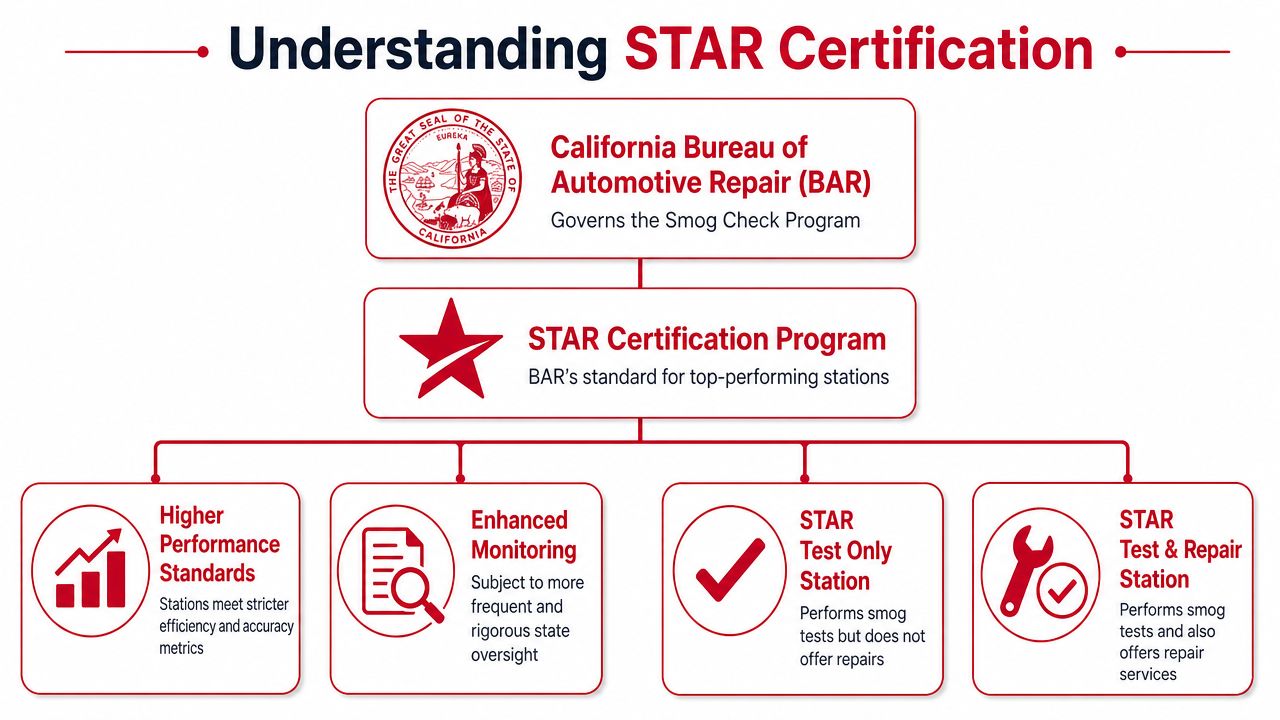
STAR refers to the station, not your car
This is the part that clears up the most confusion.
Drivers often hear “STAR” and assume the vehicle will be tested more aggressively. What changes is the level of accountability on the shop. BAR expects STAR stations to maintain stronger inspection performance, which helps the state rely on those results with more confidence.
A school testing room works as a useful comparison. The exam is the same, but one room may be supervised more closely to make sure procedures are followed correctly. The student is not facing a harder test. The supervision is tighter on the testing process.
That is why STAR and test-only make sense together for many drivers. STAR points to higher oversight. Test-only means the station is focused on inspection rather than repair sales. Put together, that can give you a more neutral, dependable result, which is exactly what many car owners want from a required inspection.
When seeking a local STAR smog check station in Antioch, the practical question is whether the station is approved to complete the inspection your DMV notice calls for.
Why some vehicles are sent to STAR stations
California uses STAR stations as part of its quality-control system in certain cases. That is why some drivers are directed to a STAR location while others can choose from a wider group of smog stations.
The easiest way to read that requirement is as a routing decision by the state. Your vehicle is being sent to a shop that meets a specific approval standard. It is not being singled out for a tougher technical exam.
That distinction matters. Once you understand that STAR is about station certification and oversight, the process feels much less intimidating.
Choosing Between a Test-Only vs a Test-and-Repair Station
Once you understand STAR, the next phrase that matters is test-only.
A lot of drivers assume all smog shops work the same way. They don't. Some inspect and repair. Others only inspect. That difference changes the customer experience in a big way.
The biggest difference is repairs
A STAR test-only station can perform Regular and STAR smog inspections, but it is legally prohibited from performing emission repairs, which helps create a non-bias outcome without repair revenue incentives, according to SmogTips' explanation of the STAR station program.
That legal limit is the whole point.
If a station can't sell you the repair, it has less room for the kind of suspicion many drivers already have. You don't have to wonder whether a failed test will immediately turn into a repair estimate from the same counter.
For some people, a test-and-repair station is convenient because one place can handle both steps. For others, especially drivers who want a neutral reading first, test-only feels more comfortable. An in-and-out smog test-only center is built around that inspection-first model.
Side-by-side comparison
| Feature | STAR Test-Only Station (e.g., Fire House Smog) | Test & Repair Station |
|---|---|---|
| Main role | Performs inspections | Performs inspections and repairs |
| Repair work on emissions issues | Not allowed | Allowed |
| STAR inspections | Yes, if certified | Yes, if certified |
| Regular smog inspections | Yes | Yes |
| Conflict-of-interest concern | Lower, because the shop can't sell repairs from a failed test | Higher potential concern, because the shop may also recommend and perform repairs |
| Best fit for | Drivers who want an inspection without in-house repair sales | Drivers who want testing and possible repairs in one location |
Which option fits your situation
Choose test-only if you want a clean yes-or-no answer first.
Choose test-and-repair if your priority is handling a likely failure and repair process under one roof. That can save trips, but it's a different kind of relationship with the shop.
If your DMV notice specifically requires STAR, make sure the station is STAR-certified first. After that, decide whether you prefer the neutrality of test-only or the convenience of test-and-repair.
For anxious drivers, the strongest benefit of a STAR test-only station is peace of mind. The station's job is to inspect, not to build a repair ticket.
How to Prepare Your Vehicle for a Smog Check
The easiest smog checks are usually the ones where the driver did a few simple things beforehand.
A little prep won't fix a real emissions problem, but it can prevent avoidable issues and help the appointment go more smoothly.
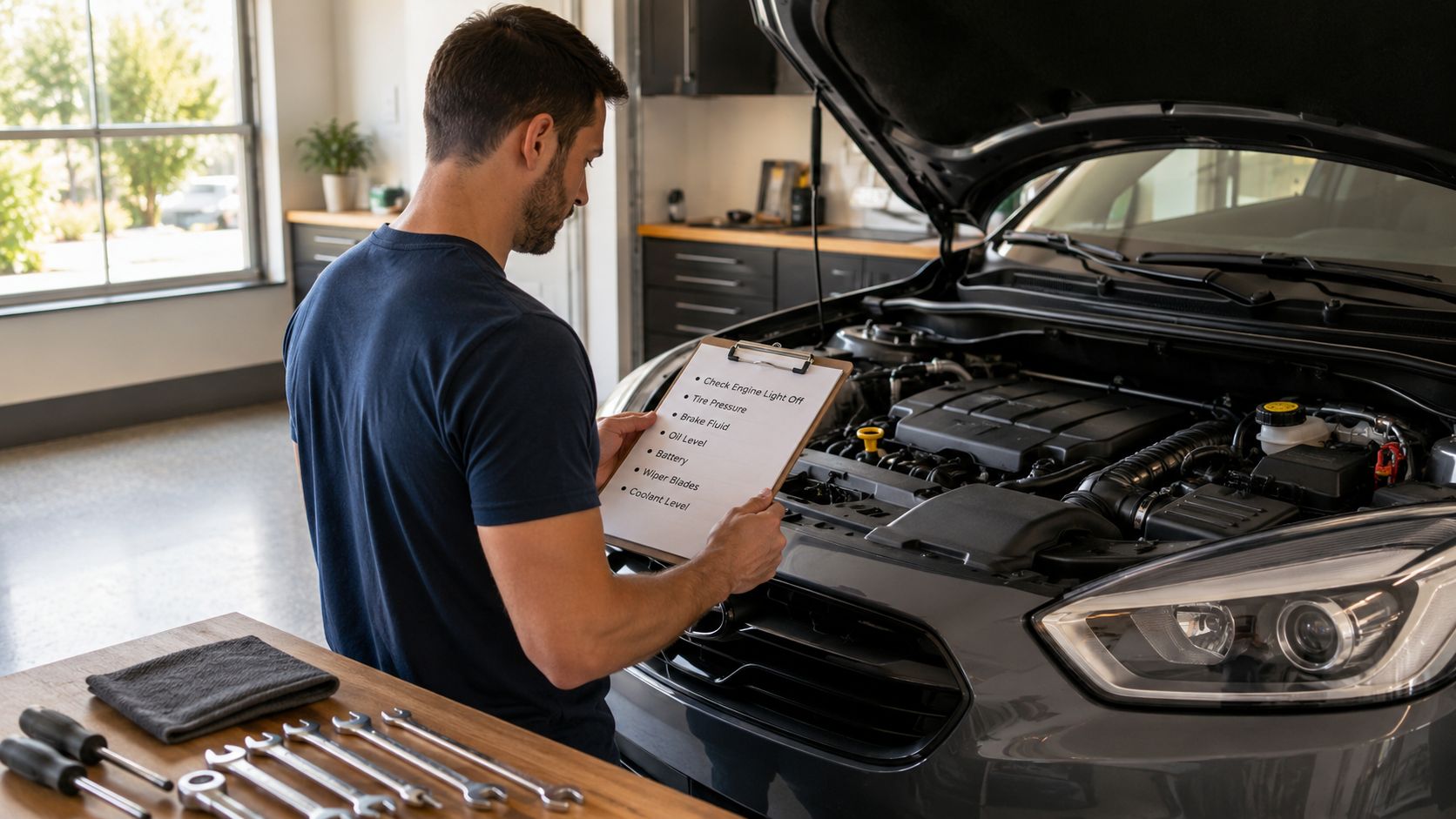
A short pre-test checklist
Start with the basics:
- Drive the car first: A short drive before the appointment helps warm the vehicle up. Cars that have been sitting a long time can be more finicky during inspection.
- Check the dashboard: If the Check Engine light is on, that's a strong sign you should diagnose the issue before testing.
- Look for obvious problems: Loose gas caps, visible smoke, or recent battery disconnects can create headaches.
- Make sure the car is usable for testing: If the tires are low or the battery is weak, take care of that before you go.
- Review common failure causes: This guide on why vehicles fail a smog check can help you spot issues before the visit.
What to bring with you
Keep your paperwork simple and easy to reach.
Bring:
- Your DMV renewal notice
- Current registration
- Proof of insurance
- Payment method
If you're unsure how the visit works from the driver's side, this short walkthrough gives a helpful visual overview:
A calm approach works best
Drivers sometimes rush in right before closing, with a cold engine, missing paperwork, and no idea whether the car has an active warning light. That creates stress before the technician even starts.
Give yourself a little margin. A prepared visit feels faster, cleaner, and a lot less frustrating.
What to Expect During the Smog Test Process
When you arrive, the process is usually more routine than people expect. You hand over the vehicle information, the technician confirms what kind of inspection is required, and then the car goes through the required checks.
The visit itself typically takes about 20 to 30 minutes, and for passing vehicles there is a mandatory $8.25 State Certificate fee, as described in All Star Smog Testing's summary of the California STAR program.
What the technician checks
The inspection involves visual and functional testing. The shop is looking at whether required emissions-related components are present and whether key systems respond as expected.
For vehicles that use OBDII, the inspection also includes reading the car's onboard data. That helps confirm the vehicle's reported information and emissions-related status.
What many drivers notice is how ordinary this looks in real life. The tech isn't inventing a custom test because your notice says STAR. The station is following the standard procedure it is authorized to perform.
How the visit usually ends
There are two basic outcomes.
If the vehicle passes, the certification is handled for your registration requirement. If it doesn't pass, the technician will tell you the result and give you the paperwork you need for the next step.
That failed result can still be useful. It tells you the car needs attention before registration can move forward, and it gives you a clear starting point for repairs elsewhere if you used a test-only station.
A failed smog test is frustrating, but it's still information you can act on. The report tells you where to focus, instead of leaving you guessing.
The main takeaway is that the process is structured, familiar, and usually quick. Most of the stress comes from the unknown before the appointment, not from the appointment itself.
Your Local STAR Test-Only Solution in Antioch Fire House Smog
You open your DMV notice, see that STAR is required, and the first question is usually simple: where do I go that checks the right box without turning this into a bigger project than it needs to be?
For Antioch drivers, the practical answer is a station that is both STAR-certified and test-only. Those two labels work well together. STAR means the shop is approved to perform the inspection your DMV notice calls for. Test-only means the station inspects the vehicle but does not use the visit to sell repairs. For many drivers, that combination feels more straightforward because the result is the result.
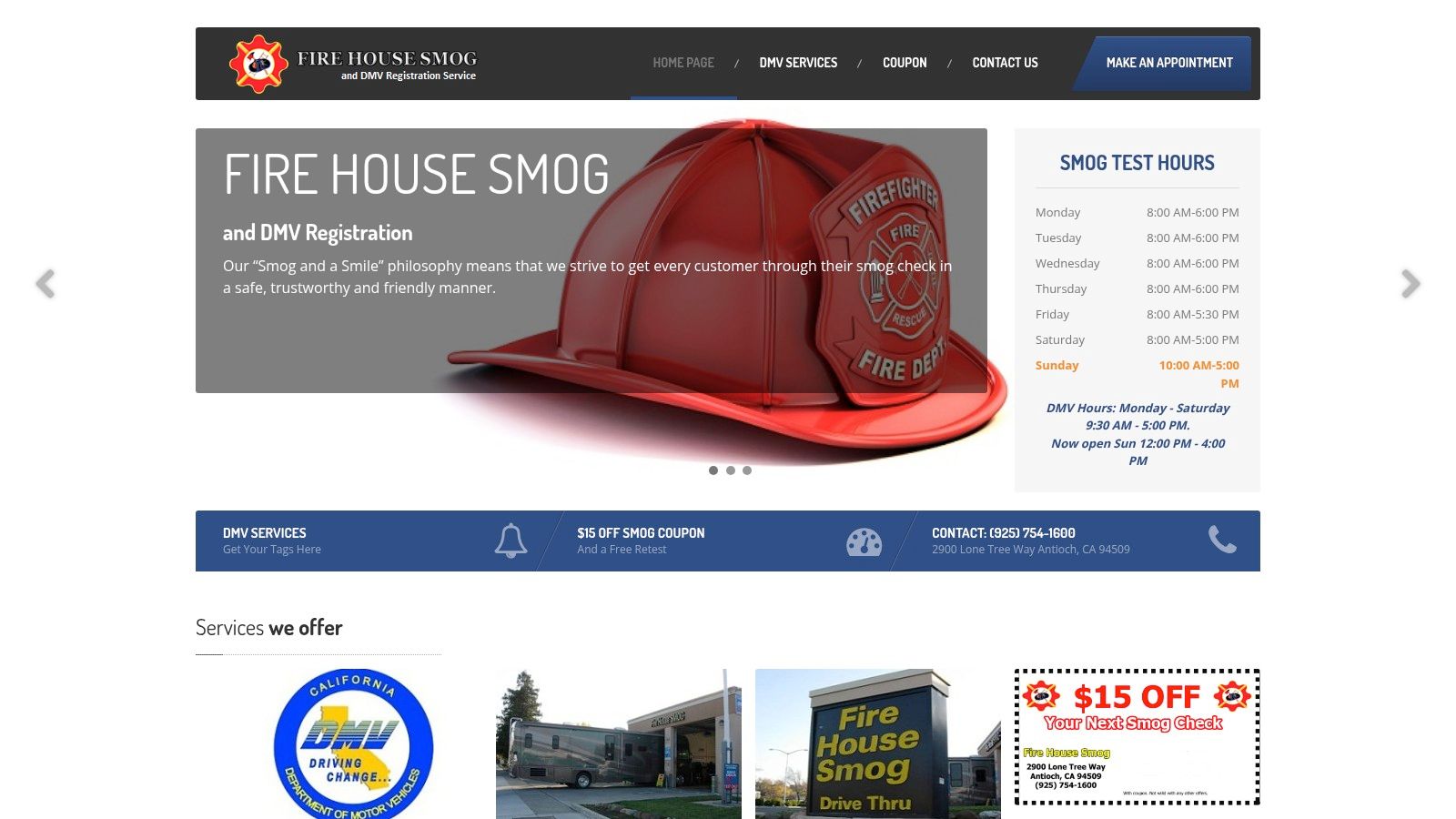
That pairing also clears up a common misunderstanding. A STAR test is not a tougher version of the smog check for your car. It is the same type of inspection performed at a station that meets stricter state performance standards. A good comparison is using a certified scale instead of a random one. The item being weighed has not changed. The standard for the equipment and process has.
Why this setup fits busy Antioch drivers
Fire House Smog is a STAR-certified test-only smog station and licensed DMV registration services provider in Antioch. That matters for local drivers who want one place that can handle the inspection and, in many cases, the registration steps that follow.
The business information provided for Fire House Smog highlights a few details that can make the errand easier:
- Seven-day smog availability: useful if work or family schedules limit weekday options
- Two service bays: helpful for keeping cars moving through the shop
- On-site DMV renewal services with sticker printing: can save a second stop for eligible registration needs
- Free retest policy: available per site policy and coupon terms
- Service for cars, SUVs, light-duty trucks, and some RVs: with a call-ahead recommendation for larger vehicles
A key benefit is clarity. If your notice says STAR, you need a shop authorized for STAR inspections. If you also prefer a station that focuses only on testing, a STAR test-only location matches both needs at once.
Location and service details
If that is the kind of station you want in Antioch, the published business details for Fire House Smog are:
- Address: 2900 Lone Tree Way, Antioch, CA 94509
- Phone: 925-754-1600
- DMV service hours: Monday through Saturday 9:30 AM to 5:00 PM, and Sunday 12:00 PM to 4:00 PM
- DMV services offered: renewals, ownership transfers, and related registration support with on-site tag issuance during posted hours
For a driver trying to get registration handled before a deadline, that setup can remove a lot of friction. You know the station can perform a STAR-required inspection. You know the test-only model keeps the visit focused on inspection results. And if your paperwork lines up, you may be able to take care of registration tasks in the same stop.
If you need a STAR-certified test-only inspection in Antioch, or want to handle a smog check and DMV registration task in one stop, Fire House Smog offers local service for passenger vehicles, light-duty trucks, and qualifying registration needs.