A STAR smog check in California usually costs $50 to $80, and a standard vehicle at a STAR station often lands around $55 to $60. The part that catches people off guard is that the number on the sign often isn't the number on the receipt.
You're probably here because a DMV notice showed up, your registration is due, and the words “STAR station required” instantly turned a basic errand into a pricing mystery. That's normal. Most drivers don't need a deep lesson in emissions testing. They just want to know what they'll pay, why one shop advertises one number and charges another, and how to avoid getting nickeled and dimed over a routine smog check.
The practical way to shop for a STAR smog check isn't to chase the lowest headline price. It's to ask for the out-the-door total before you go. That means the base test price, the state certificate fee, and any add-ons tied to your vehicle type or test requirements. Once you know how those pieces fit together, the pricing starts to make sense.
Table of Contents
- Your DMV Notice Arrived Now What
- What a STAR Certified Smog Check Means for Your Wallet
- Key Factors That Change Your Final Smog Check Cost
- Understanding Your Out the Door Price and Hidden Fees
- How Fire House Smog Offers Transparent Pricing
- Practical Tips to Avoid Extra Charges and Pass the First Time
Your DMV Notice Arrived Now What
You open the renewal notice, see Smog Check Required at a STAR Station, and the first practical question is simple. What will the full bill be today, not just the price on the coupon?
For many drivers, the surprise is not the inspection itself. It is the gap between the advertised base price and the amount they pay at the counter. A low number in an ad may only cover the test. Your out the door total can also include the state certificate fee and vehicle-specific pricing that depends on what you brought in.
That is why the right question is not, “How cheap is your smog?” It is, “What is my total price for this vehicle, including the certificate fee?”
What drivers are usually dealing with
In the shop, these are the situations that come up most often:
- Registration renewal: The DMV is waiting on a passing smog result before renewal can be completed.
- A STAR-directed vehicle: Your notice requires a STAR station, so a regular smog shop may not be able to help.
- A vehicle with pricing variables: Some cars, trucks, vans, SUVs, and diesels cost more to test than the smallest advertised rate.
For those also sorting out the rest of the DMV bill, this guide to California registration renewal fees helps put the smog portion in context.
Practical rule: Ask for the out the door price for your exact vehicle, including the certificate.
Why the first quote often misses the real total
I have seen this happen plenty of times. A driver calls around, hears a very low base price, and assumes that is the full amount. Then they arrive with a vehicle that falls outside the ad special, or they find out the certificate fee was never included in the quote.
That does not always mean the shop is doing anything improper. It usually means the advertised number was incomplete. If you want a useful quote, give the year, make, model, fuel type, and whether your DMV notice says STAR. That gets you much closer to the actual receipt instead of the marketing number.
What a STAR Certified Smog Check Means for Your Wallet
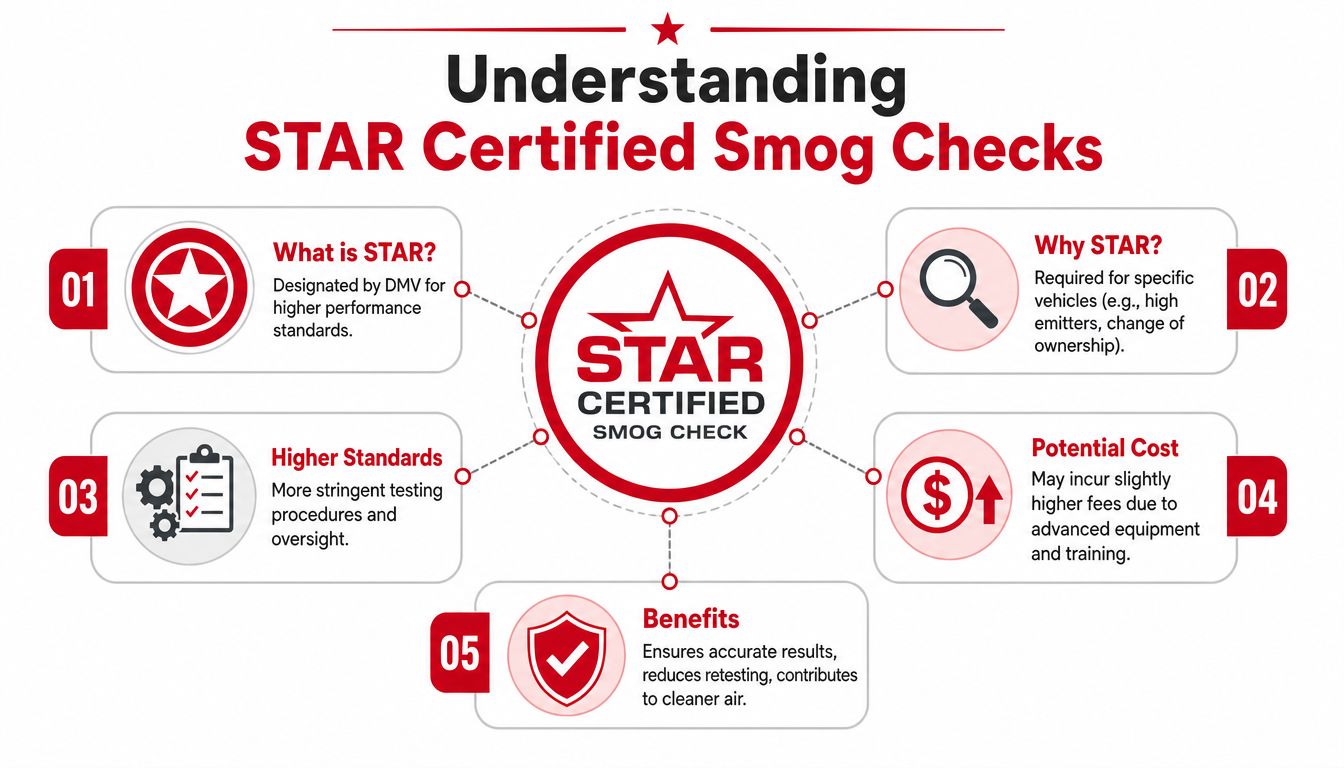
A STAR station isn't just a regular smog shop with a different sign. It's a station that meets higher performance standards set by California's Bureau of Automotive Repair, which is why some vehicles are specifically directed there.
Why STAR usually costs more
For standard vehicles, a STAR-certified smog check typically costs $55 to $60, while the broader range for general smog checks is $29.95 to $69.95, according to this STAR vs regular smog check comparison. That higher STAR price is tied to stricter standards and more frequent BAR oversight.
That doesn't mean you're paying for fluff. It means the station is being held to a tighter standard. If your DMV notice says STAR, you don't have much use for the cheapest non-STAR ad in town because that station may not be allowed to test your vehicle for the purpose you need.
What the STAR requirement is really doing
Think of STAR stations as the honors class of smog testing. Not because they're fancy, but because they're measured more closely.
That matters for vehicles the state wants tested under a stricter process. In practice, that can protect you from sloppy testing, bad records, and situations where a vehicle has to be retested because the first inspection wasn't handled correctly.
A STAR requirement usually feels annoying at first. In practice, it's the state telling you to use a station that meets a higher bar for accuracy and consistency.
What works and what doesn't
What works is choosing a station that clearly confirms two things before you drive over:
- Your vehicle can be tested there
- The quote is for the full service you need
What doesn't work is assuming every smog station is interchangeable. It isn't. If your notice says STAR, then the comparison is between STAR stations, not between a STAR station and a bargain ad from a regular shop.
Key Factors That Change Your Final Smog Check Cost
Two drivers can call the same STAR station on the same day and get different prices. Usually, the difference comes from the vehicle, not the shop.
That matters because the low number in an ad is usually built around the easiest vehicle to test. Once you change the body style, fuel type, model year, or inspection type, the final price can move.
Vehicle type changes the labor
A basic gasoline sedan is usually the quickest job. Larger vehicles often take more setup time, more bay space, and sometimes a different testing approach. That is why trucks, SUVs, vans, diesels, and motorhomes are often quoted above the base rate.
Motorhomes are a good example. They are not priced like a compact car, and any ad that makes them sound interchangeable is leaving out part of the story.
Age and test type can raise the price
Older vehicles can take longer to inspect correctly, especially when the testing process is less straightforward than it is on newer models. Some cars also come in for a different reason than a routine registration renewal, such as a change of ownership or out-of-state registration. That can affect the quote too.
The practical point is simple. A station cannot give you an honest out-the-door estimate from a headline price alone.
| Vehicle Type or Condition | How It Can Affect Price |
|---|---|
| Truck, SUV, or van | Often priced above a basic sedan |
| Older vehicle | May take longer and cost more to inspect |
| Motorhome | Commonly priced much higher than a standard car |
| Diesel vehicle | Often falls into a higher price category |
| Change of ownership or out-of-state inspection | May be quoted differently than a standard renewal |
The questions worth asking before you go
To get a real quote, give the station the details that change the job:
- Body style: Sedan, SUV, pickup, van, or motorhome
- Fuel type: Gasoline or diesel
- Model year: Older vehicles often need a closer look
- Registration situation: Renewal, change of ownership, or out-of-state paperwork
To reduce the chance of paying for a retest, review common smog check fail reasons before you book.
The best quote is based on your exact vehicle and paperwork, not a "starts at" number.
Understanding Your Out the Door Price and Hidden Fees
A driver sees a $29.75 STAR smog special online, pulls in expecting to spend about thirty bucks, and leaves wondering why the total is higher. That happens every day. The gap is usually not magic. It is the difference between a promo price and the out-the-door price.
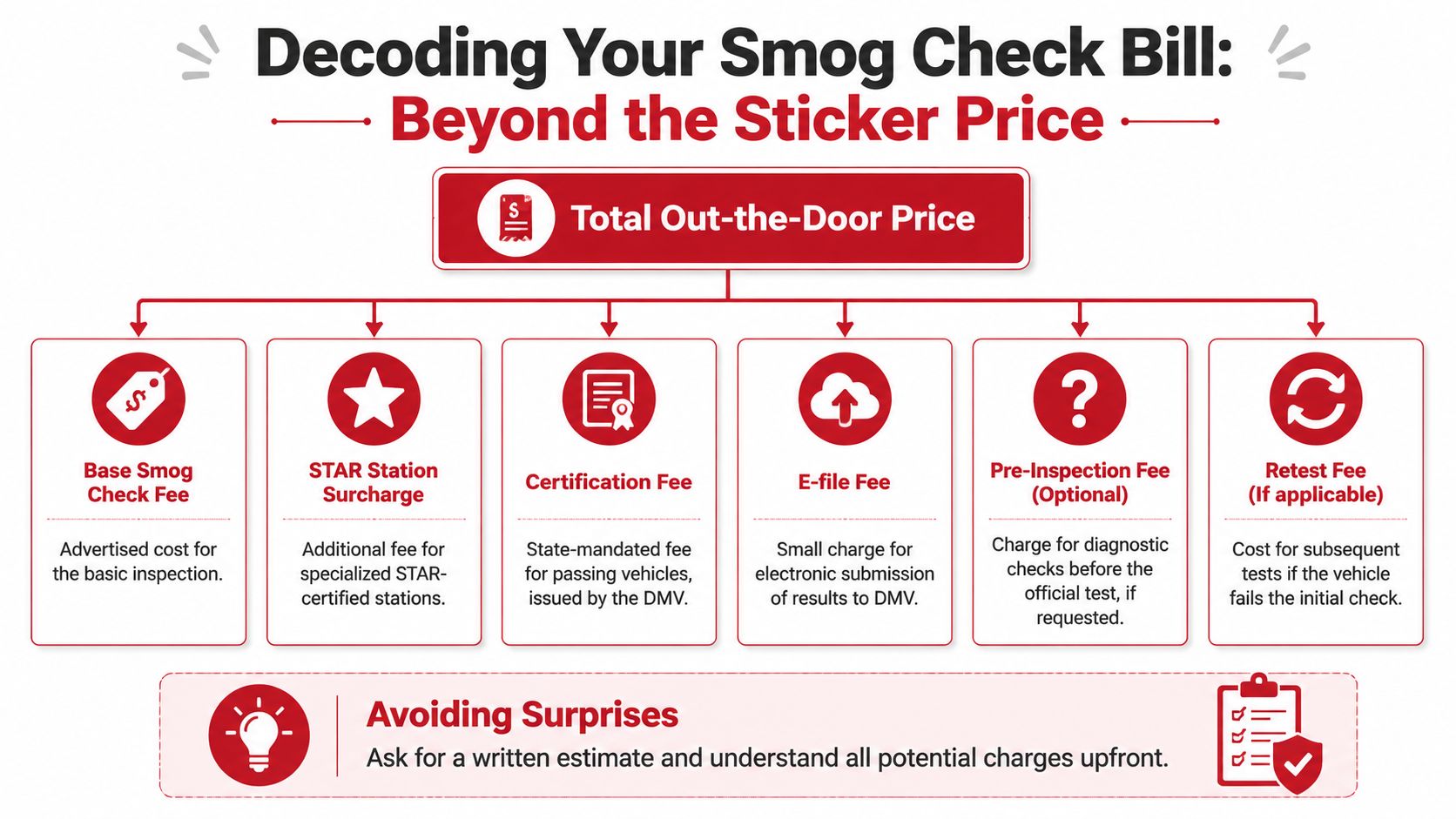
That out-the-door number is what matters. It includes the test charge, the certificate fee if the vehicle passes, and any added amount tied to the vehicle or the type of test being performed. If a shop only leads with the lowest base price, you still do not know what you are going to pay.
The fee every passing vehicle pays
One charge catches people off guard more than any other. California adds a fixed $8.25 Smog Certificate Fee on a passing test. That fee is separate from the station's testing price.
So a low advertised number may be real as a base test price and still not be the final bill. Confusion starts because the ad and the receipt are talking about two different numbers.
Where the final bill usually changes
In the bay, the pattern is pretty simple. Shops advertise the starting price because it looks good. The customer pays the full price based on the actual vehicle and the full transaction.
A clear quote should break the total into these parts:
- Base test fee: The station's charge to perform the inspection
- Certificate fee: The fixed $8.25 added on a passing vehicle
- Common add-ons: Extra cost tied to vehicle size, age, fuel type, or test complexity
Those add-ons are not always improper. Some vehicles do take more time, use different equipment, or fall outside the cheapest advertised category. The problem is poor disclosure. If the fine print does the actual talking, comparison shopping gets harder than it should be.
The question that gets a straight answer
Ask for the full number up front.
“What is my out-the-door price for this vehicle, including the certificate fee and any add-ons?”
That question cuts through the marketing fast. A transparent station can answer it without dodging, because it already knows the difference between a headline special and a real quote. A vague answer usually means the advertised price is only the beginning.
The fair way to compare shops is simple. Compare total price, not starting price.
How Fire House Smog Offers Transparent Pricing
The easiest way to judge a smog station is to see whether its business model lines up with what customers want. Clear pricing. Straight answers. No pressure around repairs.
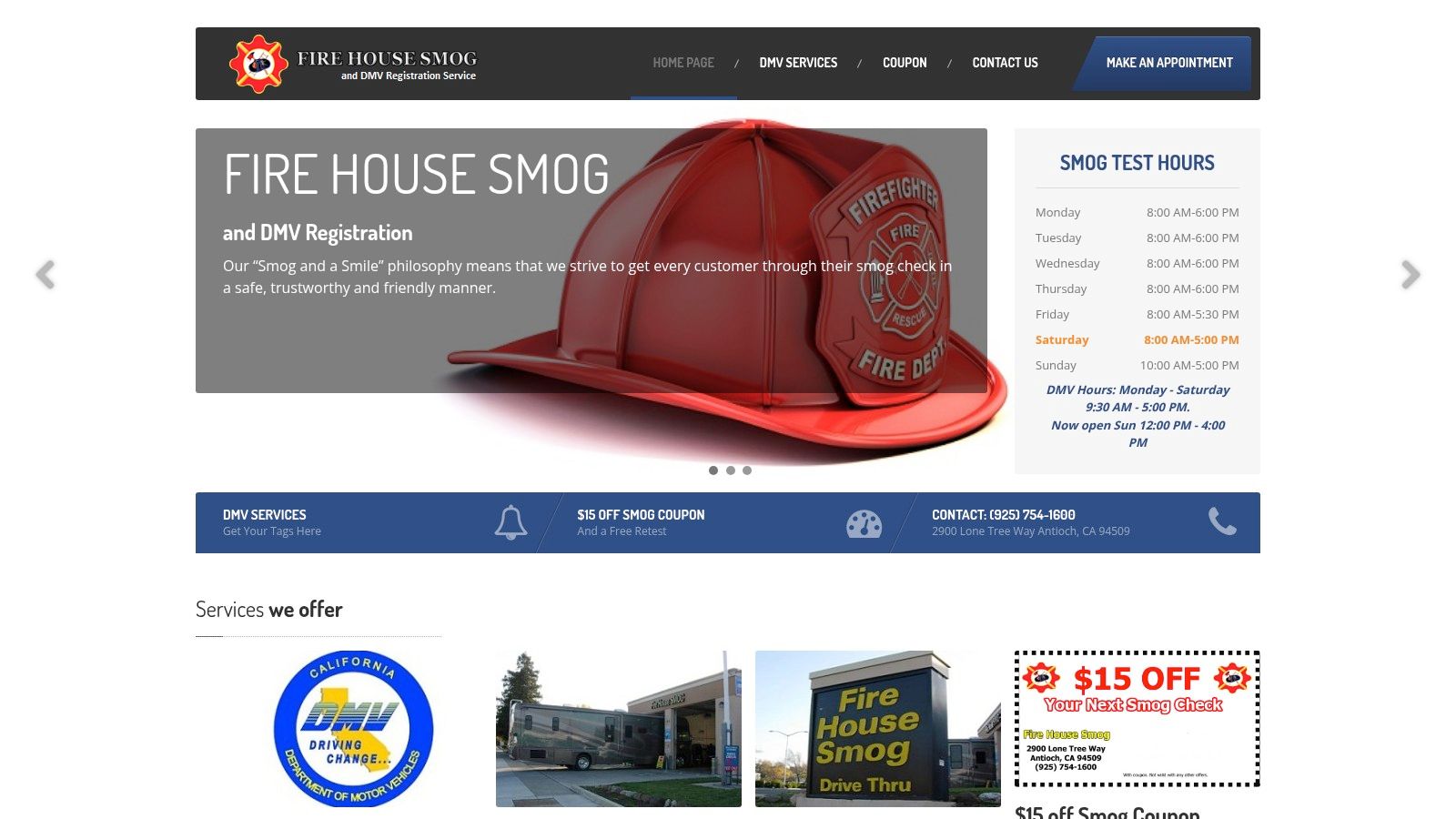
Fire House Smog operates as a STAR-certified test-only station and also provides on-site DMV services in Antioch. That matters because a test-only shop doesn't sell emissions repairs in-house, which removes the repair-sales conflict that drivers worry about when a vehicle doesn't pass.
Why test-only matters
At a test-only station, the shop's job is to inspect and report. It isn't also trying to turn a failed result into repair work on the same ticket.
That setup doesn't guarantee a pass. No honest station can do that. What it does give customers is cleaner separation between the inspection itself and any repair decisions they may need to make elsewhere.
Practical convenience that saves hassle
Fire House Smog also handles DMV registration services on site, including renewals and related paperwork, which can save a separate trip when everything lines up. For drivers who are already juggling renewal deadlines, that convenience matters more than flashy advertising.
Other practical details stand out too:
- Seven-day smog testing availability: Helpful if weekday scheduling is a problem.
- Two service bays: Better flow than a tiny one-bay operation.
- Free retest policy: Available when required, based on site policy and coupon terms.
What transparent pricing looks like in practice
Transparent pricing isn't just posting a low number. It's making it easy for a customer to understand what they're paying for before the car goes into the bay.
That means a shop should be willing to tell you:
- whether the quote is for a STAR inspection,
- whether your vehicle type changes the price,
- and whether the final number includes the state certificate fee when applicable.
When a station answers those questions clearly, the transaction feels normal. When it doesn't, customers end up suspicious even if the actual work is fine.
Practical Tips to Avoid Extra Charges and Pass the First Time
The cheapest smog check is the one you only pay for once. A little prep before you arrive can reduce the chance of a failed test, a retest, or wasted time standing around a parking lot trying to figure out what went wrong.
Start with the basics that drivers can control.
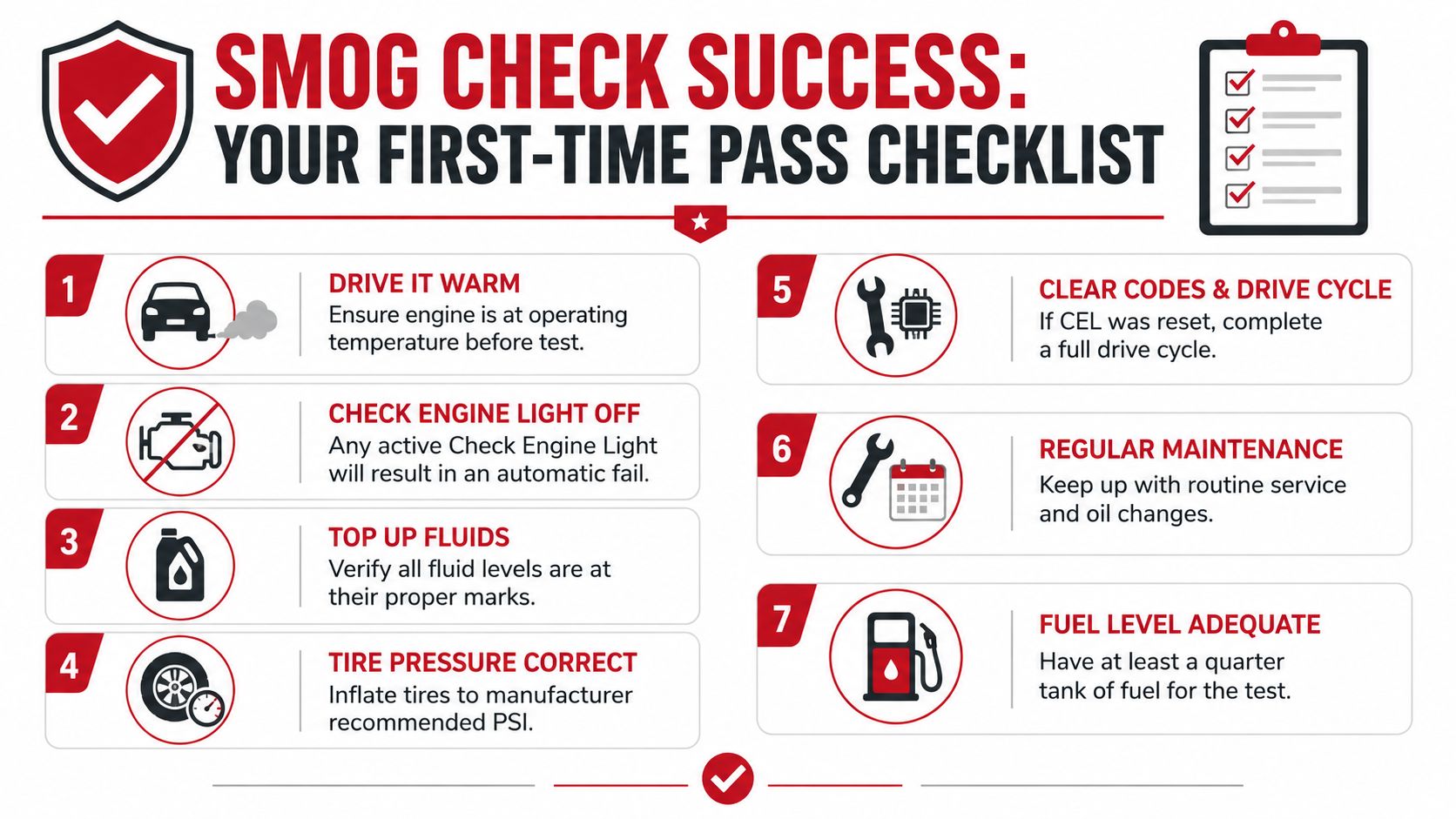
Simple things that help
- Drive the car before the test: Don't bring it in cold if you can avoid it. A warmed-up engine and exhaust system generally put the car in a better testing condition than a vehicle that just started a few minutes ago.
- Make sure the Check Engine light is off: If it's on, deal with that first. Going straight to the smog station usually wastes time and money.
- Don't clear codes right before testing: If someone disconnected the battery or reset the system, the car may not be ready for inspection yet.
- Check basic maintenance items: Old oil, neglected maintenance, or obvious problems can work against you.
- Bring enough fuel: Don't show up nearly empty.
If you want a local option for a STAR test-only visit, you can review the smog test only discount center before heading out.
A quick visual checklist helps many drivers remember the basics before they leave home.
What not to do on test day
Some mistakes are common:
- Don't arrive right after a battery disconnect
- Don't ignore warning lights and hope for the best
- Don't assume a coupon answers the full pricing question
- Don't wait until the registration deadline if you already suspect a problem
A smooth smog visit usually starts before you get to the station. Warm car, no warning lights, no last-minute surprises.
If you've been asking how much does a STAR smog check cost, the practical answer is this: the posted number matters less than showing up prepared and confirming the full price in advance. That's what keeps the process fast, fair, and predictable.
If you need a STAR-certified test-only smog check with on-site DMV help in Antioch, Fire House Smog is built for exactly that. You can handle your inspection, ask for a clear out-the-door quote, and take care of many registration tasks in one stop without the repair upsell that drivers often want to avoid.

That DMV renewal notice usually lands at the wrong time. You're busy, the registration deadline is close, and now you need a smog check without turning it into a half-day project or getting pulled into a repair conversation you didn't plan for.
That's why a Smog Test Only Discount Center matters. If your goal is simple, get tested, get your certificate sent in, and move on, a test-only shop is often the cleanest path. In Antioch, that matters even more because drivers often want one stop that handles the smog check quickly and, if possible, takes care of registration needs too.
California runs one of the largest vehicle emissions programs in the country. The state's Smog Check Program requires testing for approximately 10 million vehicles annually, and the program helped reduce on-road hydrocarbon emissions by 80 to 90% and nitrogen oxides by over 70% between 1980 and 2020, according to the California Bureau of Automotive Repair Smog Check overview. For most drivers, though, the big issue isn't the statewide policy. It's getting through your own appointment with less hassle.
Table of Contents
- Your Guide to a Stress-Free Smog Check
- What Is a STAR Test-Only Center
- Fire House Smog Services in Antioch
- Using Your Discount and Free Retest
- Your Pre-Test Checklist to Pass the First Time
- Location Hours and Contact Information
Your Guide to a Stress-Free Smog Check
Drivers don't want a “smog experience.” They want a certificate sent to the DMV and one less thing on their list. The stress usually comes from three places. You're not sure whether your car will pass, you don't want to wait around, and you don't want a simple inspection to turn into a sales pitch.
A smog test only discount center solves a lot of that upfront. The job is narrow by design. The station tests the vehicle, reports the result, and submits the certificate electronically when the vehicle passes. That narrower setup is exactly what many drivers need when they're trying to renew registration quickly.
A common Antioch scenario looks like this: you check your renewal notice, realize smog is required, and start searching for a place that's open when you're off work. You also want clear pricing, not a vague “come in and we'll see.” That's where discount offers and test-only service become practical, not just marketing language.
Practical rule: If you already know you only need the inspection, a test-only station usually creates fewer detours.
Another benefit is psychological. When a shop doesn't repair cars on-site, the conversation tends to stay focused on compliance. You're there for a result, not a bundle of extra recommendations. That doesn't guarantee a pass, of course. It does make the process feel cleaner and easier to trust.
For local drivers, the most useful setup is a station that combines STAR-certified testing, a visible coupon, and on-site DMV support. That mix saves the most time because it cuts down repeat trips and reduces confusion about what to do next.
What Is a STAR Test-Only Center
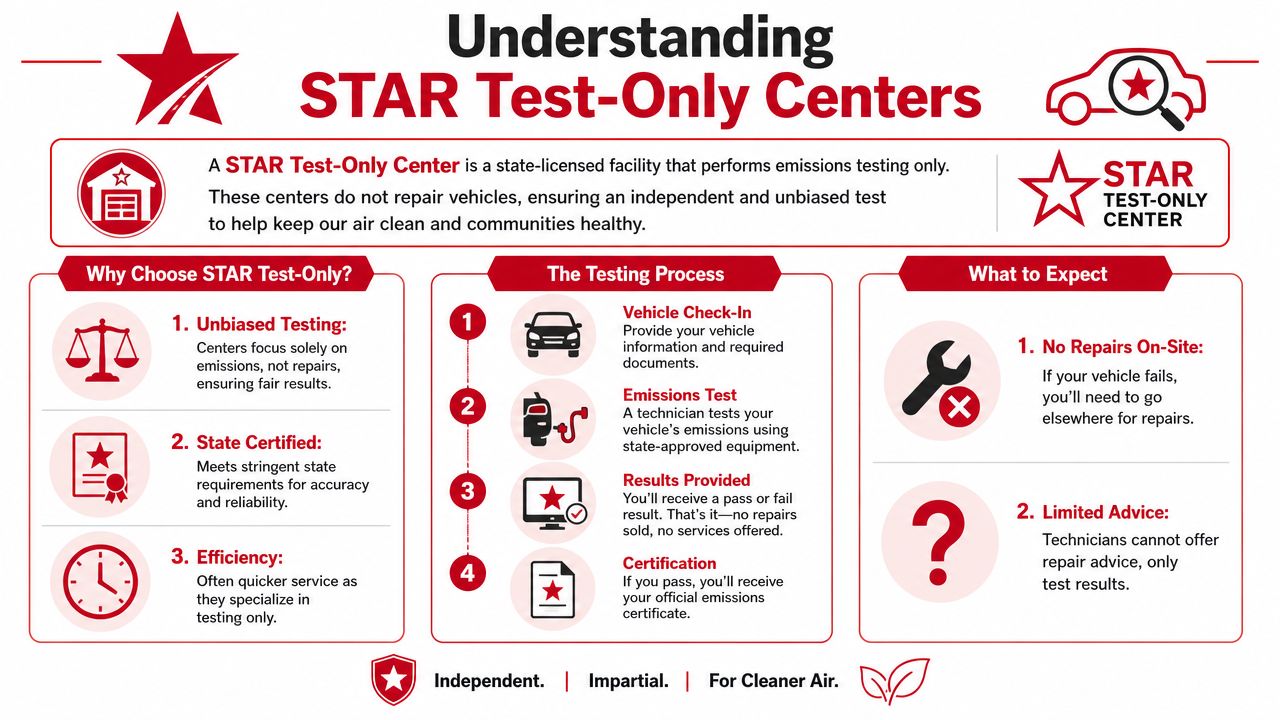
A STAR test-only center handles one job: inspect your vehicle's emissions and report the result to the state. It does not repair the car. For many Antioch drivers, that separation is the main advantage because it keeps the visit focused on the inspection instead of turning into a repair estimate.
“STAR” and “test-only” mean different things.
“STAR” is a California designation for stations that meet tighter performance and oversight standards within the state smog program, as outlined by the California Bureau of Automotive Repair STAR Program. In plain terms, the station has to keep its equipment, testing process, and inspection quality in line with state requirements.
That matters for a simple reason. Drivers need a result they can trust, whether the car passes or fails.
“Test-only” matters even more from the customer side. A shop that does not perform repairs on-site has less reason to turn a failed inspection into a sales conversation. The station tests the vehicle, explains the result, and submits the certificate electronically if the car passes. If it does not pass, you can take that result to the repair shop of your choice.
California's consumer guidance on smog inspections also separates station types and explains that some stations only inspect, while others inspect and repair. That distinction is part of how drivers can choose the setup that fits their situation, as described by the California Department of Consumer Affairs smog check information.
Here is the practical trade-off. A test-and-repair shop can be convenient if you already expect repairs and want everything done in one place. A test-only station is usually the better fit when you want a neutral inspection first and do not want the inspector to have a financial stake in the repair decision.
| Feature | Test-Only Center (e.g., Fire House Smog) | Test-and-Repair Shop |
|---|---|---|
| Main job | Emissions inspection only | Inspection plus repair work |
| Repair incentive | None in-house | Present because repairs are sold on-site |
| Customer experience | Focused on the test result and compliance | May include repair recommendations and pricing |
| Best fit | Drivers who want an unbiased inspection | Drivers who want testing and repairs in one visit |
For local drivers, that model works well when it is paired with clear pricing, STAR certification, and practical help after the test. The Antioch smog check service page shows how that service is set up at Fire House Smog. The short version is simple: if you need an accurate inspection without the usual conflict of interest, a STAR test-only center is often the smarter choice.
Fire House Smog Services in Antioch
The local value isn't just “we do smog checks.” It's whether the shop handles the practical stuff that usually wastes your time. In Antioch, that means vehicle eligibility, faster throughput, and DMV-related tasks that can be handled on-site instead of sending you somewhere else.
What drivers usually need most
The common needs are straightforward:
- Passenger vehicle testing: Cars, SUVs, and light-duty trucks are the core use case for a STAR-certified test-only station.
- Diesel and larger-vehicle questions: Some stations can handle certain diesel vehicles and some recreational vehicles, but size and equipment limits matter. Calling ahead saves a wasted trip.
- DMV renewals on-site: This is one of the biggest convenience wins. If the station also handles registration renewals and sticker printing, you can avoid a separate DMV stop.
- Ownership transfers: If you bought or sold a vehicle, registration paperwork can become the bigger headache than the smog test itself.
- Fleet service: Small business owners don't need drama. They need a predictable place to move vehicles through inspections with less downtime.
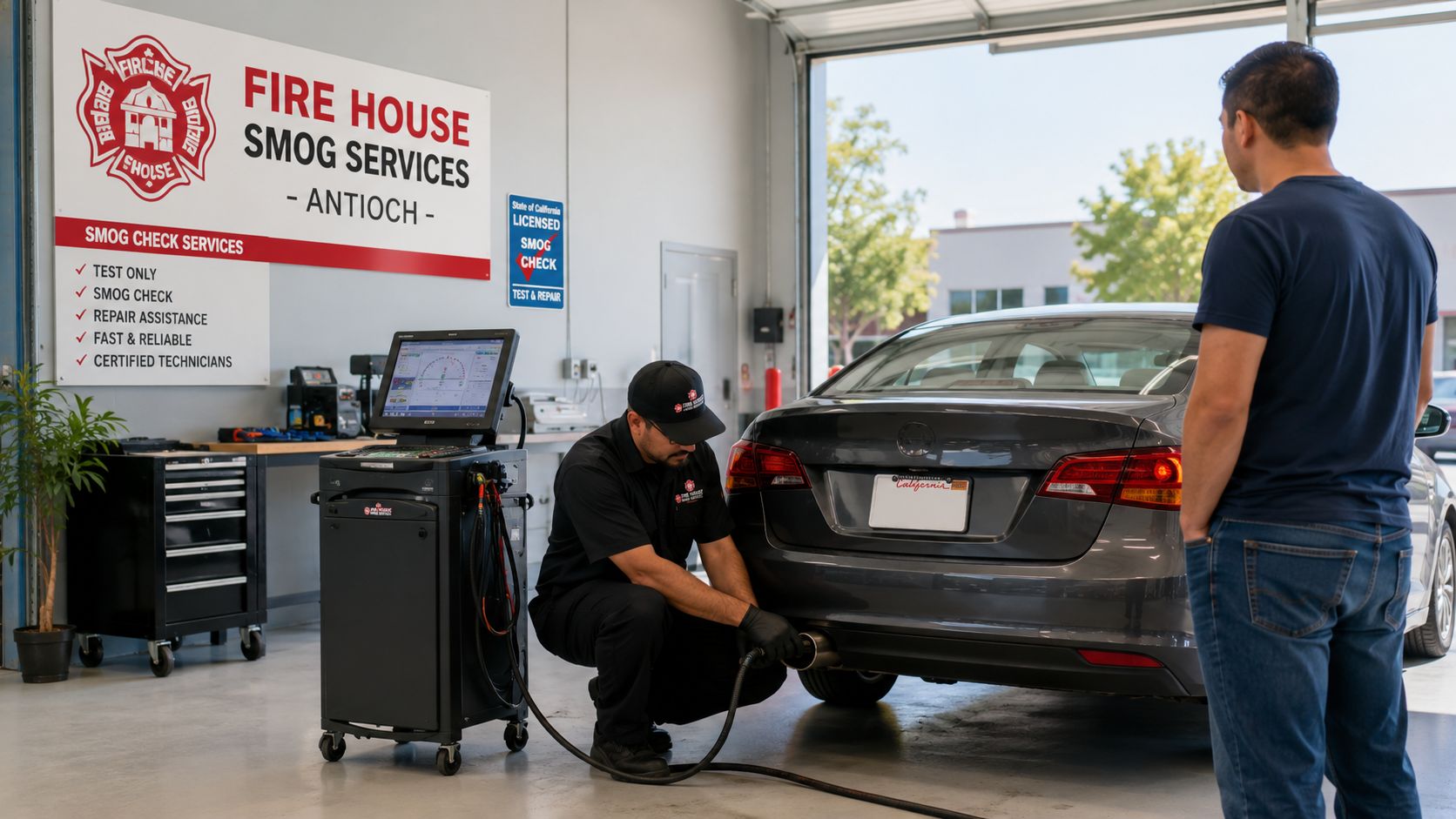
That combination is where one local shop can do more than a basic smog lane. Fire House Smog operates as a STAR-certified test-only smog check station and licensed DMV registration services provider in Antioch, handling smog inspections for cars, trucks, and some RVs, along with registration renewals, ownership transfers, and related tag or plate services on-site.
A shop that can test the car and handle the registration step cuts out the most annoying part of the process, the second errand.
Why the workflow matters
Capacity affects your day more than most drivers realize. A station can be honest, licensed, and still slow if cars pile up and the layout creates bottlenecks.
Verified operational guidance notes that stations with an optimized multi-bay workflow can process vehicles efficiently. With two service bays and a testing-focused setup, a station like this can handle roughly 12 to 16 vehicles per day, which helps reduce wait times during busy periods, according to this test-only center throughput overview.
That doesn't mean every visit is instant. It does mean the workflow is built for movement, not for juggling smog jobs around repair tickets, parts delays, or cars stuck on lifts.
Here's what tends to work best for customers:
- Call ahead for unusual vehicles: RVs, motorhomes, and oversized vehicles can have fit or equipment issues.
- Use weekday DMV service when possible: If your goal includes registration or transfer work, going during the full DMV service window usually avoids confusion.
- Choose a test-only lane when you want neutrality: If you don't need repairs, you don't gain much from standing in line at a repair shop.
For fleet owners, this matters even more. A neutral testing environment makes recordkeeping cleaner and helps separate compliance from maintenance planning.
Using Your Discount and Free Retest
Those searching for a smog test only discount center are trying to keep a required expense from getting bigger than it needs to be. That's reasonable. Smog isn't a fun purchase, so a clear coupon matters more than fancy branding.
The useful part is when the discount is easy to find and easy to redeem. If a coupon takes five clicks, has vague conditions, or isn't honored consistently, it doesn't save you time. It just adds one more thing to ask about at the counter.
How to use the coupon
The simplest approach is:
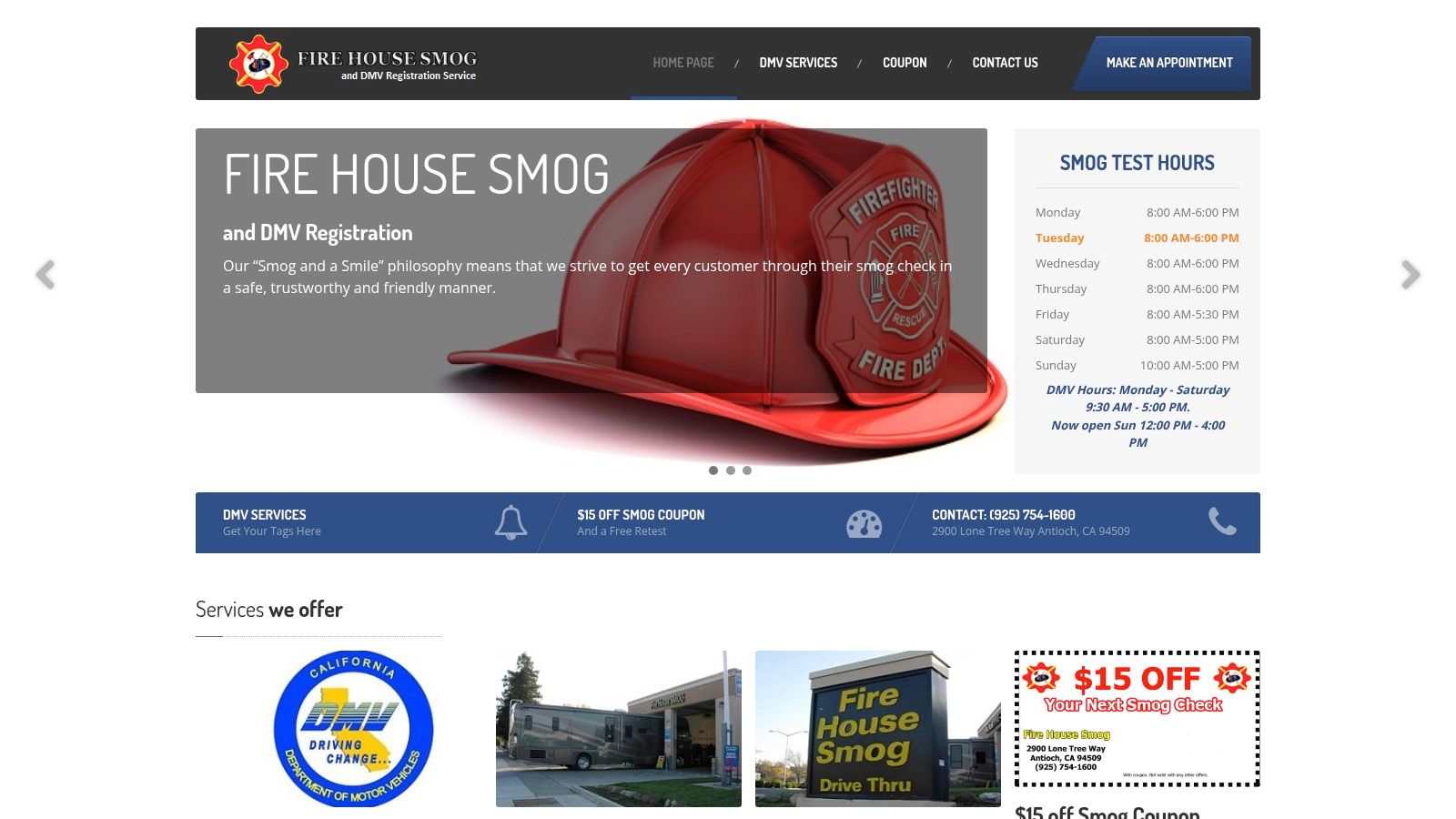
- Open the posted coupon page first. The current offer is listed on the Fire House Smog coupon page.
- Check the terms before you drive over. Look for vehicle restrictions, testing type, and any policy tied to the free retest.
- Bring the coupon with you. Digital display is usually easiest, but confirm if you prefer a printed copy.
- Mention it before the transaction is finalized. That avoids awkward backtracking after the test is already written up.
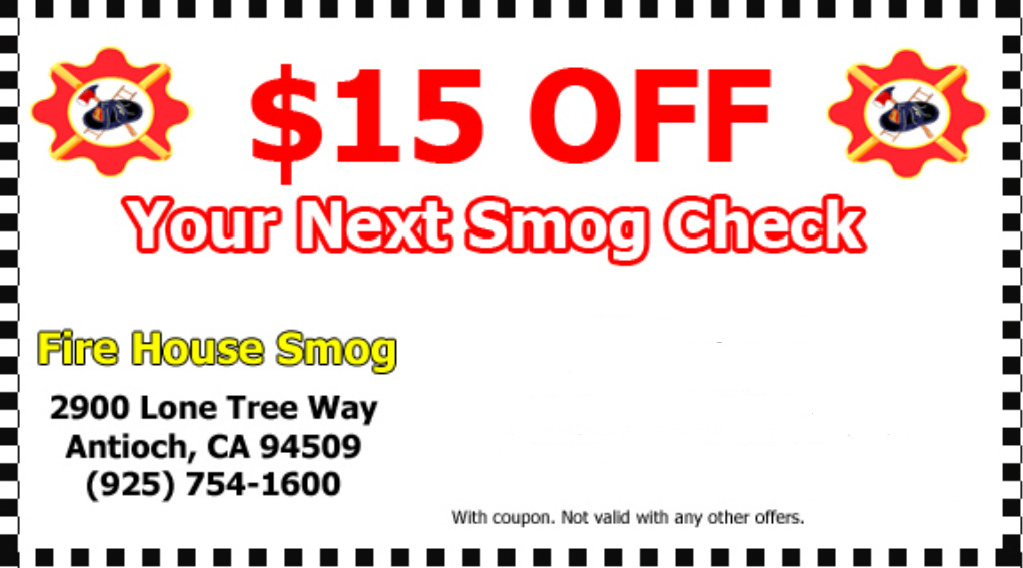
Publisher information provided for this article states that the coupon policy includes $15 off smog testing and a free retest, subject to site policy and coupon terms. That's the kind of offer that matters because it addresses both the first visit and the possibility that you may need to return after repairs elsewhere.
How to think about the free retest
A free retest is helpful, but only if you understand what it is and what it isn't.
- It lowers repeat-cost risk: If the vehicle needs outside repair and you come back under the coupon terms, the second visit may be less frustrating financially.
- It doesn't replace diagnosis: A test-only station reports the result. If the car fails, you'll still need a repair facility to address the actual issue.
- It works best when expectations are clear: Ask what qualifies, how long the retest window lasts under current policy, and whether all vehicle categories are included.
What saves the most money: Use the coupon on the first visit, and use the free retest policy as a backup, not as your main plan.
The best discount is still passing the first time. That starts before you leave home.
Your Pre-Test Checklist to Pass the First Time
You pull out of the driveway, drive across Antioch, wait your turn, and then find out the car was never ready for testing. That is the trip to avoid.
A test-only station helps by keeping the process straightforward. The station inspects and reports. It does not sell repairs, which means you get a clean result without the pressure that can come from a repair-and-test shop. Your part is showing up with the vehicle in normal running condition so the reading reflects how it performs.
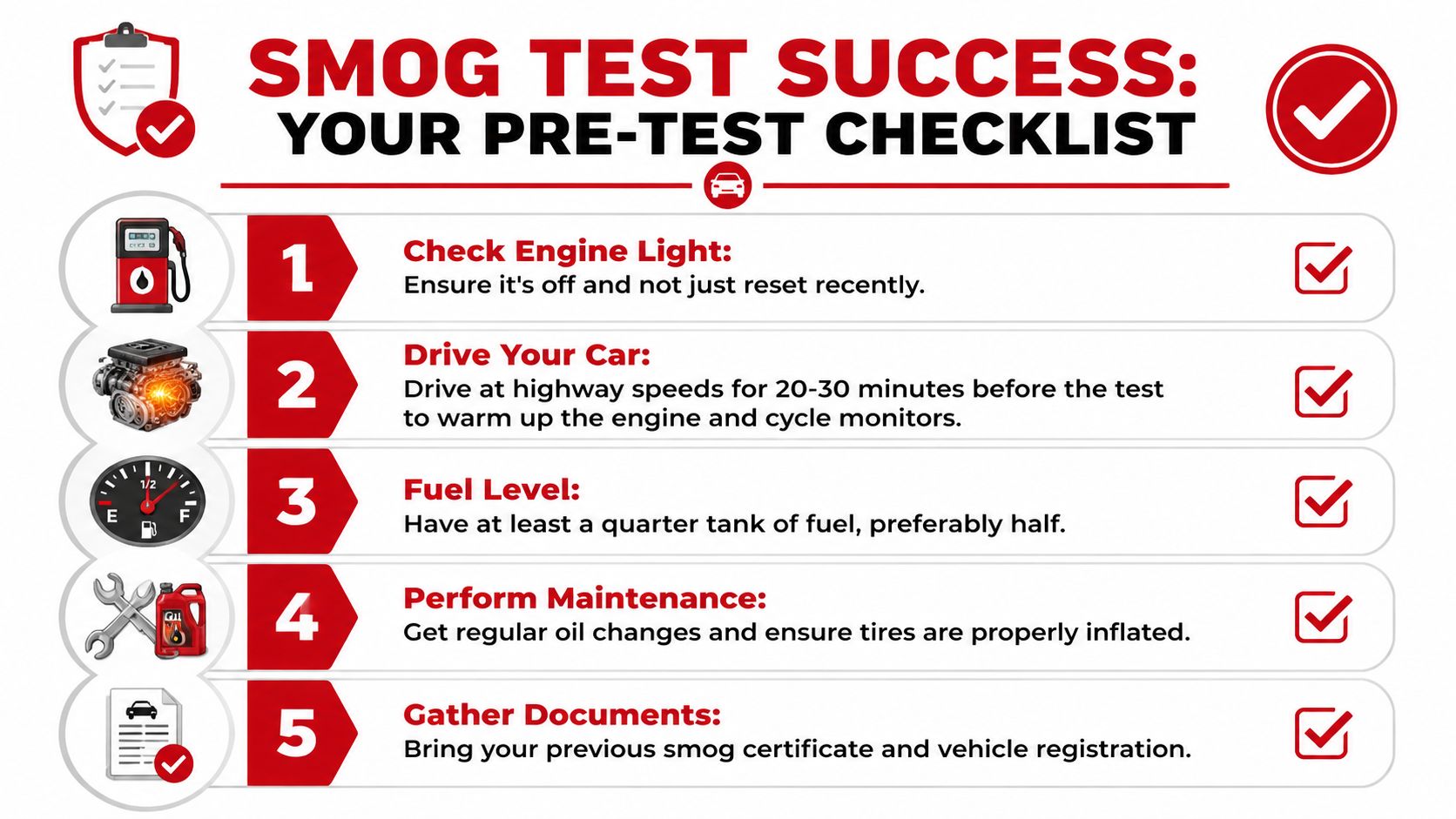
What to check before you leave home
Start with the items that cause the most preventable failures.
- Check Engine light off: If the light is on, handle that before testing. If codes were just cleared, the car may still show incomplete readiness monitors and fail for that reason alone.
- Fuel level in a normal range: Don't arrive nearly empty or packed full right after a fill-up. A moderate level is the safer bet.
- No obvious drivability problems: Rough idle, fuel smell, stalling, or visible leaks are signs to fix the problem first.
- Battery has not been disconnected recently: Many vehicles need normal driving time after a disconnect before all emissions monitors reset.
- Basic maintenance caught up: Dirty oil, overdue air filters, and neglected spark plugs can work against you on an older vehicle.
- Registration notice or paperwork ready: Keep it easy to reach so check-in takes two minutes instead of ten.
STAR-certified means the station meets California requirements for equipment, training, and inspection procedures. In plain terms, the test is standardized. That is good for drivers because the focus stays on the vehicle's condition, not on guesswork about where to test. If you want to confirm fit for your vehicle before you head over, use the Fire House Smog contact page.
What helps on test day
Bring the car in warm.
A short drive before the test usually helps more than people expect, especially on vehicles that spend most of their time on quick local trips. The catalytic converter and emissions system work better at normal operating temperature. A cold engine can make a healthy car look worse than it really is.
Use this routine:
- Drive 15 to 20 minutes first: Steady city or highway driving is better than starting the car and heading straight to the station.
- Skip the long parking-lot idle: If you warm it up, keep the visit moving.
- Pay attention on the way over: Misfire, hesitation, surging, or a new warning light means the car is telling you something.
- Do not treat the test like diagnosis: A smog inspection shows pass or fail. If there is a fault, repairs happen somewhere else.
That last point matters. The test-only model protects you from mixed incentives. You get an inspection result, not a sales pitch tied to the same visit.
If the car has been running normally for several days, the warning lights are off, and you drive it in warmed up, you have already cut down a lot of avoidable trouble.
Location Hours and Contact Information
Convenience matters most at the end of the process. Once you've decided where to go, you need the address, phone number, and service hours in one place, especially because smog hours and DMV hours aren't always the same.
Where to go
Fire House Smog is located at 2900 Lone Tree Way, Antioch, CA 94509. The phone number is 925-754-1600. For directions, service questions, or to confirm vehicle fit before arrival, use the Fire House Smog contact page.
If you're bringing an RV, motorhome, or another vehicle that might test the limits of bay space or equipment, calling first is the smart move. That quick check can save a pointless drive across town.
Hours at a glance
Smog testing is available seven days a week with extended hours. DMV-related services operate on a narrower schedule, and weekend DMV service may be limited depending on the task.
| Service | Monday-Saturday | Sunday |
|---|---|---|
| Smog testing | Extended daytime and evening hours | Available |
| DMV services | 9:30 AM to 5:00 PM | 12:00 PM to 4:00 PM |
A lot of driver frustration comes from showing up for the right place at the wrong time. Keep the two schedules separate in your mind. If you only need the smog check, you have more flexibility. If you also need registration or title-related help, plan around the DMV service window.
If you need a straightforward smog inspection and DMV help in Antioch, Fire House Smog is one local option for STAR-certified test-only service, on-site registration support, and posted coupon savings.