You bought a used car from a private seller in Antioch, signed the paperwork, and drove home with the keys. Then you realize the title, registration, smog certificate, plates, and DMV deadlines are all separate pieces of the same transaction. The question isn't whether you need a title transfer or registration. In many California purchase situations, you need both, and each one solves a different problem.
Title transfer changes the legal owner. Registration updates the vehicle's California record and supports lawful road use. The signed title sitting in your glove box doesn't complete the job by itself. California DMV rules require the seller to submit a Notice of Transfer and Release of Liability within 5 calendar days, while the buyer must complete the ownership transfer and pay the required fees. DMV also frames ownership-change record updates as due within 10 days of the sale or transfer. California DMV explains the Notice of Transfer and Release of Liability requirements.
| Question | Title transfer | Vehicle registration |
|---|---|---|
| Main purpose | Records who legally owns the vehicle | Keeps the vehicle's California record current for road use |
| Trigger | Sale, gift, inheritance, or another ownership change | Purchase, move to California, renewal, replacement, or record update |
| Core paperwork | California Certificate of Title and required signatures | Registration application, title or ownership documents, fees, and possible smog paperwork |
| Common supporting items | Odometer disclosure, lien release, replacement-title paperwork if needed | Smog certification, fees, use tax, registration card, and applicable forms |
| Result | Ownership record moves to the new owner | Updated registration record, card, sticker, or plates as applicable |
Table of Contents
- Two Different DMV Moments Most Drivers Mix Up
- What Title Transfer and Registration Actually Mean
- California Rules, Documents, and Fees for Each
- Side-by-Side Comparison at a Glance
- Real Antioch Scenarios That Show Which One You Need
- How Fire House Smog Handles Both on Site
- Practical Recommendations and Common Questions
Two Different DMV Moments Most Drivers Mix Up
The Antioch buyer who leaves a private sale with a signed title often focuses on the registration sticker. That's understandable, but it misses the legal step underneath it. The title transfer puts the vehicle in the buyer's name. Registration documents the vehicle's current California status and road-use authorization.
Those tasks may happen during the same DMV transaction, but they aren't interchangeable. If the title transfer isn't completed, the DMV may not be able to finish the ownership record or related registration work. If registration isn't current, owning the vehicle doesn't automatically make it compliant for driving on public roads.
Start with the event that caused the paperwork
A private sale, inheritance, gift, or move from another state changes the paperwork path. A routine renewal usually doesn't change ownership, so it generally calls for registration service rather than a new title transfer. A dealer may submit much of the paperwork for you, but the transaction still involves ownership documentation, registration, taxes, and fees.
California gives the seller a short reporting deadline. The seller must notify the DMV within 5 calendar days by filing a Notice of Transfer and Release of Liability, while the buyer must complete the transfer requirements and pay applicable fees. DMV guidance also identifies 10 days as the ownership-change record-update window. The DMV's title-transfer guidance distinguishes the seller's notice from the buyer's transfer responsibility.
Practical rule: If the vehicle changed owners, handle the title paperwork first and bundle registration into the same visit whenever possible.
A STAR-certified smog check can be part of the transaction when California requires emissions certification. Don't assume the smog question is separate from the purchase. Before you schedule a visit, identify whether you're dealing with a private sale, out-of-state vehicle, inheritance, or renewal.
For a plain-language look at the ongoing registration side, review vehicle registration renewal guidance.
What Title Transfer and Registration Actually Mean
A title transfer is the legal ownership update. The California Certificate of Title identifies the vehicle's ownership record, and the buyer and seller generally complete the required title information before the buyer submits the transfer to the DMV. Required odometer disclosure can also be part of the package, particularly for qualifying privately sold vehicles.
Registration answers a different question. It connects the vehicle to a California DMV record, registration card, and current proof that required registration obligations have been addressed. Registration can involve fees, use tax, emissions documentation, and, where applicable, a planned nonoperation status.
Ownership and road status are connected, not identical
After an Antioch private-party purchase, the buyer commonly handles both ownership transfer and registration together. The signed title supports the ownership change, while the registration portion records the vehicle in California and applies the required fees and compliance checks.
A renewal is different. If you still own the same vehicle and only the tags are expiring, you generally need to renew registration rather than transfer the title again. Moving from another state, receiving a vehicle through inheritance, or accepting a vehicle as a gift can require both ownership paperwork and California registration.
The paperwork reflects that distinction:
- Title documents: The signed California Certificate of Title is central to a normal transfer. If the title is missing, replacement-or-transfer paperwork is required.
- Registration documents: The buyer may need the signed title, smog certification, fees, and use tax when registering a privately purchased vehicle.
- Ownership corrections: A lienholder or registered-owner change requires the DMV record to be updated and the title transferred to the new owner.
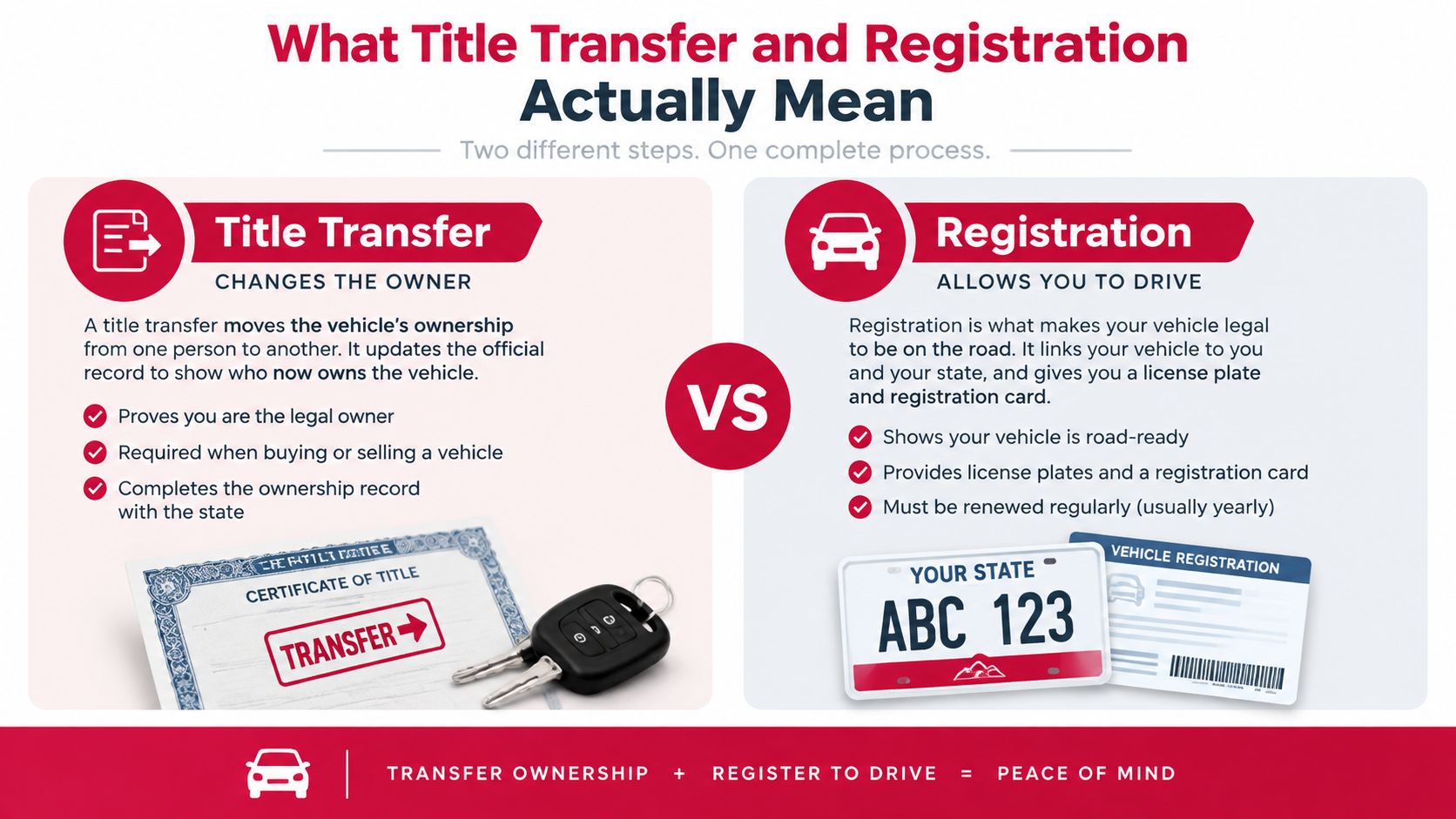
The title answers, “Who owns this vehicle?” Registration answers, “Is this vehicle properly documented and current for California road use?” Keep those questions separate and the process becomes much easier to organize.
California Rules, Documents, and Fees for Each
An Antioch private-party purchase can require more paperwork than a routine tag renewal. After a sale or transfer, the seller must submit the Notice of Transfer and Release of Liability within 5 calendar days. The buyer must complete the ownership and registration steps, with DMV materials identifying an ownership-change record update within 10 days. California DMV's private-party registration instructions outline how the signed title, smog certification, odometer disclosure, fees, and use tax may fit into the package.
What belongs in the title file
For a standard California transfer, bring the California Certificate of Title with the required buyer and seller signatures. A lost, damaged, or unavailable title requires replacement-or-transfer paperwork before DMV can complete the ownership change. REG 227 applies to missing or replacement title situations.
The transaction may also require supporting documents:
| Requirement | Title Transfer | Vehicle Registration |
|---|---|---|
| Ownership proof | Signed California title, or replacement-title paperwork when the title is missing | Signed title or another acceptable ownership document |
| Emissions paperwork | May be required as part of the related transfer and registration transaction | Smog certification may be required for applicable private-party or out-of-state transactions |
| Financial obligations | Transfer fee and other applicable charges | Registration fees, use tax, vehicle-related charges, and applicable county or district amounts |
| Supporting forms | Odometer disclosure, lien documents, and forms for special circumstances | Application forms, weight declarations, REG 256, REG 139, or other applicable documents |
| Submission | DMV field office or mail, depending on the transaction | DMV field office, mail, online renewal, or an authorized registration service |
For a privately sold vehicle, check whether odometer disclosure applies to a vehicle under 10 years old. Bring the smog certification, applicable fees, and use tax when required. Confirm the current document package before leaving for DMV, especially if the vehicle came from another state or the title has a lien.
Don't treat fees as one flat charge
A single transaction can combine a title-transfer fee, registration fees, use tax, and other charges based on the vehicle and the circumstances. A dealer purchase may call for the certificate of title or an out-of-state title for a used vehicle, title-transfer fees or use tax, and forms such as REG 256, REG 139, or weight declarations when applicable.
Gather the paperwork first, then get a current DMV estimate. Old online posts often show amounts that no longer apply. For an Antioch-area document checklist, use Fire House Smog's vehicle registration documents guide. Bring only the forms that match your transaction, and skip transfer paperwork for a simple renewal when ownership has not changed.
Side-by-Side Comparison at a Glance
| Criterion | Title transfer | Vehicle registration |
|---|---|---|
| Purpose | Establishes the new legal owner | Keeps the vehicle documented and authorized for California road use |
| When required | Sale, gift, inheritance, lien change, or another ownership change | Purchase, move to California, renewal, replacement, or registration update |
| Primary form used | REG 262 may support odometer or transfer details when required | REG 343 may support an application, or an online renewal may be used when eligible |
| Typical documents | Signed title, required odometer disclosure, lien release, and replacement-title paperwork if needed | Title or ownership proof, smog certification when required, fees, use tax, and registration information |
| DMV fees involved | Transfer fee plus other applicable transaction charges | Registration fees, use tax, and other applicable charges |
| What you receive | Updated California title showing the new owner | Updated registration card and sticker, with plates or other proof when applicable |
Purpose and timing
The title transfer follows an ownership event. California DMV guidance identifies the buyer's transfer deadline as 10 calendar days after the sale or transfer, while the seller's Notice of Transfer and Release of Liability is due within 5 calendar days. Registration follows the vehicle's operating status, so renewal can occur without a new ownership change.
Forms and documents
REG 262 may be relevant when odometer or transfer information is required. REG 343 can support an Application for Title or Registration, while online renewal may be available for an eligible unchanged ownership record. Don't sign a form just because a seller or buyer hands it to you. Check that every required field matches the transaction.
Smog, tax, and plates
Smog certification isn't the same thing as the title-transfer fee or registration fee. It can be required for a transfer or California registration, while a renewal may require emissions compliance based on the vehicle's renewal circumstances. Use tax can apply to a transfer, and the exact amount depends on the transaction rather than a universal flat rule.
Plate handling also matters. A private seller should follow DMV directions for the sale and handle the plates as required. The buyer shouldn't assume the plates, title, and registration all move together automatically.
The short version: Title transfer proves ownership. Registration proves current California road status.
Real Antioch Scenarios That Show Which One You Need
Antioch and East County drivers usually don't ask for a definition first. They ask, “What do I bring for my situation?” Match the event to the service before you make the trip.
You bought from a private seller in Antioch
Bring the signed California title and review whether an odometer disclosure, smog certification, use tax, and other fees apply. You need the ownership transfer and the registration portion of the transaction, not just a sticker renewal. The buyer's transfer window is 10 calendar days, and the seller has 5 calendar days to file the Notice of Transfer and Release of Liability.
Useful service line: On-site DMV processing, with smog certification if the transaction requires it.
You moved from Texas to Antioch
An out-of-state vehicle can require California title and registration paperwork, VIN verification, and smog certification. Bring the out-of-state title or other ownership documents, identification, and any lien information. Don't skip VIN verification just because the vehicle is already titled elsewhere.
Useful service line: VIN verification paired with California registration and title processing.
You inherited a vehicle from a relative in Brentwood
Inheritance changes ownership, so renewal alone isn't enough. The transaction may require estate or transfer documentation, the appropriate DMV form, and registration fees. Because inherited-vehicle paperwork depends on the facts of the estate and the ownership record, bring the death certificate or estate documents if the DMV directs you to provide them.
Useful service line: On-site DMV ownership transfer, with registration handling.
Your tags expired months ago
This is a registration problem if ownership hasn't changed. Check whether a smog certification is required and expect the DMV to calculate applicable renewal charges and penalties based on the record. Don't start a title transfer unless the vehicle changed owners.
Useful service line: Registration renewal and smog certification.
You bought through a Contra Costa dealership
The dealer commonly handles much of the title and registration submission, but the buyer still needs to understand the use tax and other charges included in the transaction. Keep copies of the purchase and title documents until the California record is complete.
Useful service line: Smog certification when required, plus on-site DMV help if the dealer leaves an unresolved registration or title issue.
How Fire House Smog Handles Both on Site
Antioch drivers often lose time by separating paperwork that can be handled during one planned visit. A licensed DMV registration service can process eligible renewals and ownership transactions, while a STAR-certified station can handle the emissions inspection when California requires one.
Fire House Smog is a STAR-certified test-only smog station and licensed DMV registration services provider. Its service lines include on-site registration renewals, ownership transfers for California and out-of-state vehicles, VIN-related support, and smog inspections for eligible cars, trucks, and some recreational vehicles. Confirm vehicle-size or transaction-specific requirements before arriving.
Bring the complete file
For an ownership change, bring the title and all documents connected to the transaction. Depending on the facts, that can include replacement-title paperwork, odometer information, lien documents, identification, smog certification, and forms such as REG 262, REG 343, REG 5, or REG 256.
The station's DMV service location is 2720 Hillcrest Avenue in Antioch, and the publisher's service information identifies weekend availability and bilingual staff. Call before you go if you're combining smog, VIN verification, and title work, especially for an out-of-state vehicle or RV.
A combined visit works best when you identify every trigger first, ownership change, California registration, emissions certification, VIN verification, or renewal.
The same DMV fees still apply. A service fee may be added for handling the transaction. For location details and service information, see Fire House Smog in Antioch.
Practical Recommendations and Common Questions
Use one decision rule at the counter. If ownership changed, start with title transfer and add registration. If ownership didn't change, handle registration renewal or replacement only. That keeps you from paying for the wrong service and prevents a routine renewal from turning into an unnecessary ownership transaction.
Before leaving home, check the three problems that cause the most avoidable delays:
- Missing smog certification: Confirm whether the transaction or renewal requires a smog check.
- Incomplete odometer or transfer paperwork: Review REG 262 and the title for signatures and required information.
- Out-of-state vehicle: Plan for VIN verification and bring the out-of-state ownership documents.
Questions Antioch drivers ask
How long does a title transfer take in person versus by mail? Processing time depends on the transaction and whether the paperwork is complete. In-person submission lets staff identify missing items immediately, while mail requires you to send the complete package and wait for DMV processing.
Is the transfer fee separate from registration fees? Yes, treat title-transfer charges and registration charges as separate categories. The final amount depends on the transaction and vehicle record, so request a current estimate.
What if the title is lost? Use replacement-or-transfer paperwork, including REG 227 when applicable. The DMV must have acceptable ownership documentation before it can complete the transfer.
Do I need a smog check before transferring the vehicle? Sometimes. California DMV may require smog certification for the related transfer or registration, depending on the vehicle and situation. Confirm before arriving.
How do I handle a lien release? Bring the lien-release documentation and any title information showing the lien status. The DMV may need to update both the ownership and lienholder records.
Can a spouse sign for a deceased co-owner? Don't assume a spouse can sign automatically. The DMV may require estate, survivorship, or other supporting documentation, so confirm the correct process before signing.
Fire House Smog offers STAR-certified smog checks, VIN verification support, and on-site DMV services for eligible title transfers and registration renewals in Antioch. Bring your ownership documents and call ahead if your transaction combines several requirements, then visit Fire House Smog to handle the paperwork and emissions step in one stop.
You're in Antioch, staring at a DMV renewal notice while your registration deadline gets closer. You want a quick smog check coupon, but the cheapest-looking offer may not produce the lowest out-of-pocket cost. The inspection discount is only one part of the bill. The state certificate fee, your vehicle's readiness status, and the possibility of a retest all matter.
A smart visit starts before you pull into a station. Confirm whether your renewal notice requires a STAR inspection, make sure the vehicle is ready for an OBD-II test, and check whether the coupon covers a retest. That approach saves more than chasing the biggest headline discount.
Table of Contents
- Why a Quick Smog Check Coupon Matters More Than You Think
- How to Find and Redeem Your Smog Check Coupon
- What a California Smog Check Actually Costs
- Preparing Your Vehicle for the Fastest Possible Test
- Comparing Total Cost Scenarios With and Without a Coupon
- Your Action Plan for a Fast and Affordable Smog Check
Why a Quick Smog Check Coupon Matters More Than You Think
A coupon can turn a routine compliance task into a manageable expense, but it won't fix a poor station choice. California's Smog Check program began with legislation approved in 1982, according to a California Air Resources Board staff report, and the modern system now includes test-only and STAR-certified stations. That distinction matters when your DMV notice directs you to STAR.
A test-only station keeps the visit focused on inspection results. The station performs the test but doesn't sell repair work, so you get a clearer pass-or-fail evaluation without an in-house repair estimate attached to the outcome. Fire House Smog is one Antioch option with STAR-certified test-only inspections, two service bays, and smog testing seven days a week with extended evening and weekend hours.
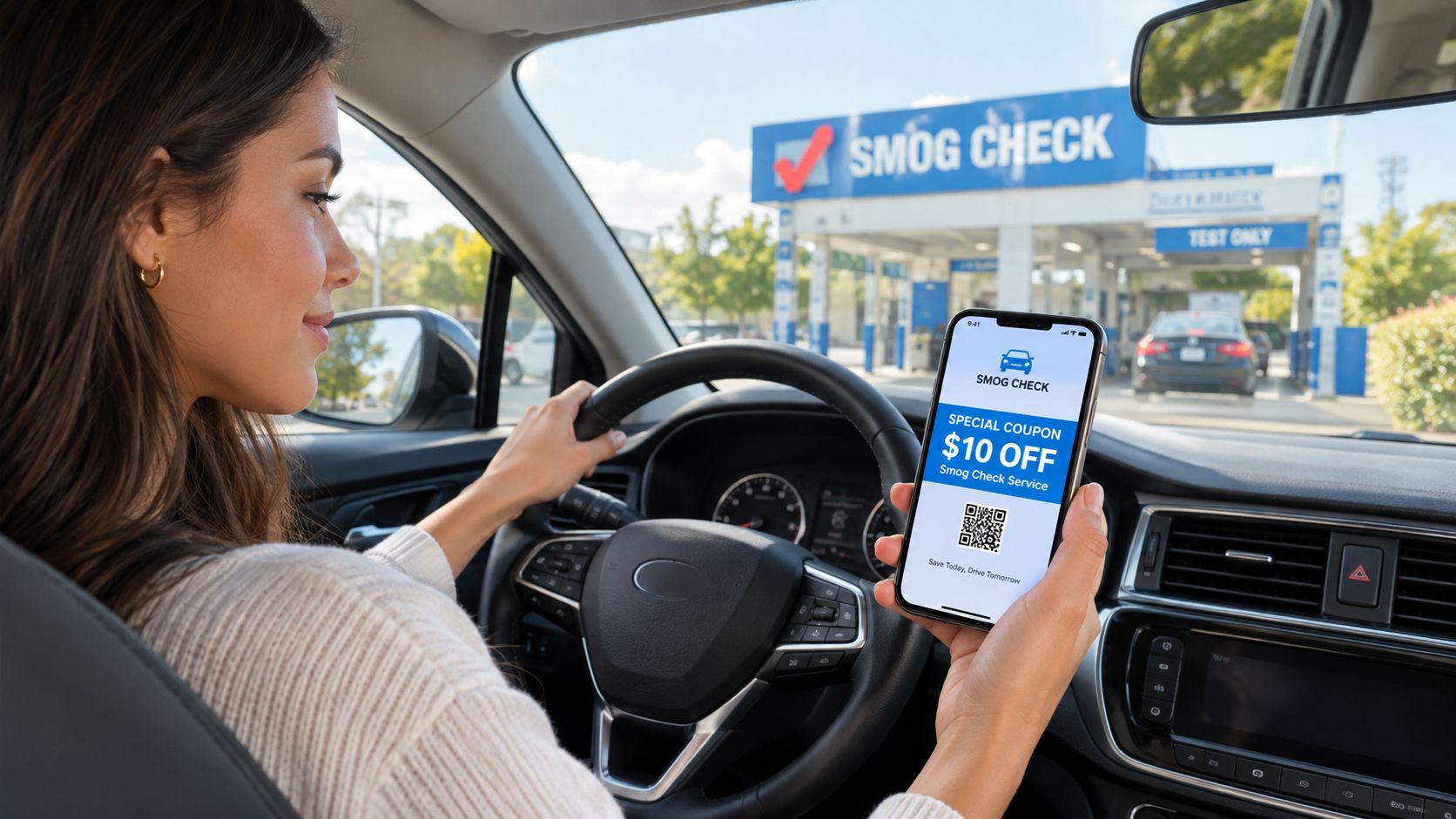
Check the notice before checking the price
The DMV renewal notice tells you whether a STAR-certified location is required. The California Bureau of Automotive Repair STAR guidance explains that some vehicles are directed to STAR stations, and STAR test-only stations are licensed to perform inspections without repairs. Arriving at a station that can't satisfy the notice can cost you another trip, even if its coupon looks attractive.
Practical rule: A coupon saves money only when the station can legally complete the inspection your renewal requires.
For an Antioch driver, the practical win is combining the correct certification with a short, organized visit. If you also need registration processing, an on-site DMV service can reduce a separate office trip. The coupon helps with the inspection charge, but the station's workflow determines whether you save time.
How to Find and Redeem Your Smog Check Coupon
Treat a coupon like a service offer, not a blank check. Before leaving home, find the current offer on the Fire House Smog coupon page and read every condition displayed with it. Look for the expiration date, vehicle eligibility, STAR requirements, whether the discount applies only to the inspection, and whether a free retest is included under the station's policy.
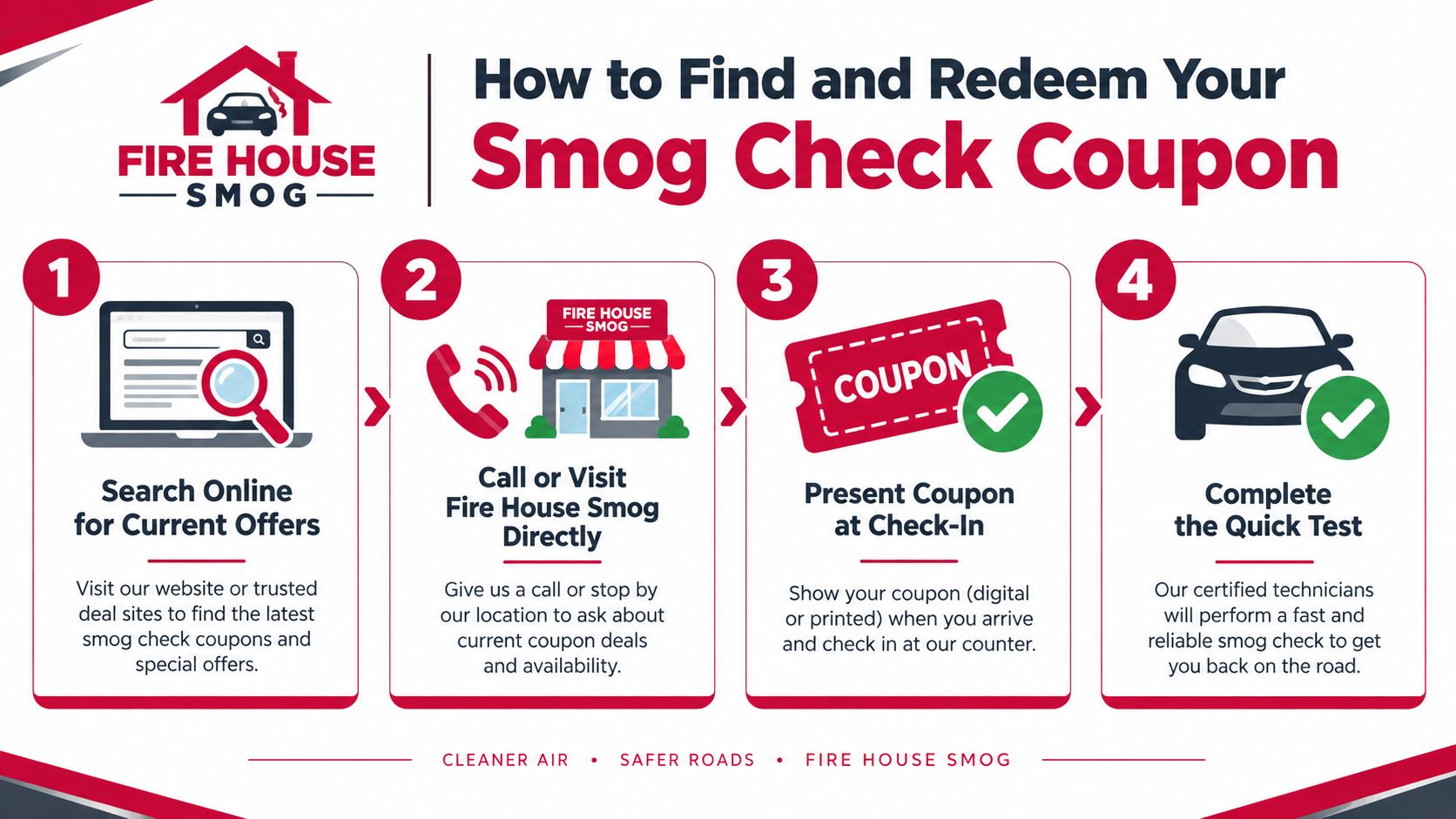
Follow these steps
Save the current offer. Keep the coupon on your phone or print it if that's easier. A screenshot can help if the online page changes before you arrive, but the station still controls acceptance under its posted terms.
Verify the vehicle category. Passenger cars, SUVs, and light-duty trucks are generally the straightforward fit for a standard test-only visit. RVs, motorhomes, unusual vehicles, and vehicles with equipment constraints may require a call ahead.
Confirm the total before testing. Ask whether the offer discounts the inspection fee only. California requires an $8.25 Smog Check certificate fee when a vehicle passes, and the Bureau of Automotive Repair certificate-fee guidance identifies that fee as separate from the inspection charge. A coupon normally doesn't remove that state fee.
Ask about the retest condition. A free retest can matter more than a larger initial discount if the vehicle doesn't pass. Confirm whether the retest must occur at the same station, whether repairs must be completed elsewhere, and how long the offer remains valid.
Present the coupon at check-in. Show the phone screen or printed offer before the technician begins the inspection. Mention any STAR requirement and provide the renewal notice so the station can confirm the correct test type.
Keep the paperwork. Save the receipt, inspection result, and any retest terms until the registration issue is complete.
Don't assume the advertised discount includes every charge. The certificate fee is a fixed state component, while the station sets the inspection price and coupon terms.
What a California Smog Check Actually Costs
The coupon headline is only one part of your out-of-pocket cost. California stations set their inspection prices, while the state certificate fee is fixed. A California smog check cost guide reported an average total of $74.22, including a $65.97 base inspection fee and the $8.25 state certificate fee.
Judge the coupon against the inspection charge, not the full receipt. A $10 to $20 discount can reduce the base price meaningfully, but it does not remove the certificate fee. The same guide reported a statewide average inspection cost of $68.56, confirming that station pricing varies.
| Cost Component | Average Amount | Coupon Discountable |
|---|---|---|
| Base inspection fee | $65.97 | Usually yes |
| State certificate fee | $8.25 | No |
| Retest or follow-up service | Depends on station policy and result | Only if the offer says so |
Read the offer as a total-cost document
Retest terms can determine whether a coupon saves money. California BAR monthly reports for 2025 recorded initial failure rates ranging from 4.28% to 7.81%, as summarized in the 2025 BAR Smog Check Executive Summary. Those figures do not predict your vehicle's result, but they justify checking the retest policy before booking.
Ask whether the retest is free, whether it must happen at the same station, and whether the offer requires repairs elsewhere. A larger first-visit discount is less useful if one failed test creates a second full charge.
For STAR requirements and pricing details, review Fire House Smog's STAR smog check cost information. A test-only station can also keep the transaction straightforward because inspection and repair sales remain separate. Get the complete pass-price and failure-price scenarios before authorizing the test.
Ask, “What will I pay if I pass, and what will I pay if I don't?” That answer matters more than the coupon's largest number.
Preparing Your Vehicle for the Fastest Possible Test
Most avoidable delays begin before the vehicle reaches the bay. Modern California inspections rely heavily on the vehicle's OBD-II system, so a car can look clean and run normally while still failing because its monitors aren't ready.
The California-focused failure guidance from Firehouse Smog identifies readiness monitors and check-engine-light status as dominant failure issues. It estimates that 30% to 40% of initial failures can come from monitors not being ready after a battery disconnect or reset, and reports that OBD-II failures account for 9.33% of initial BAR-97 tests.
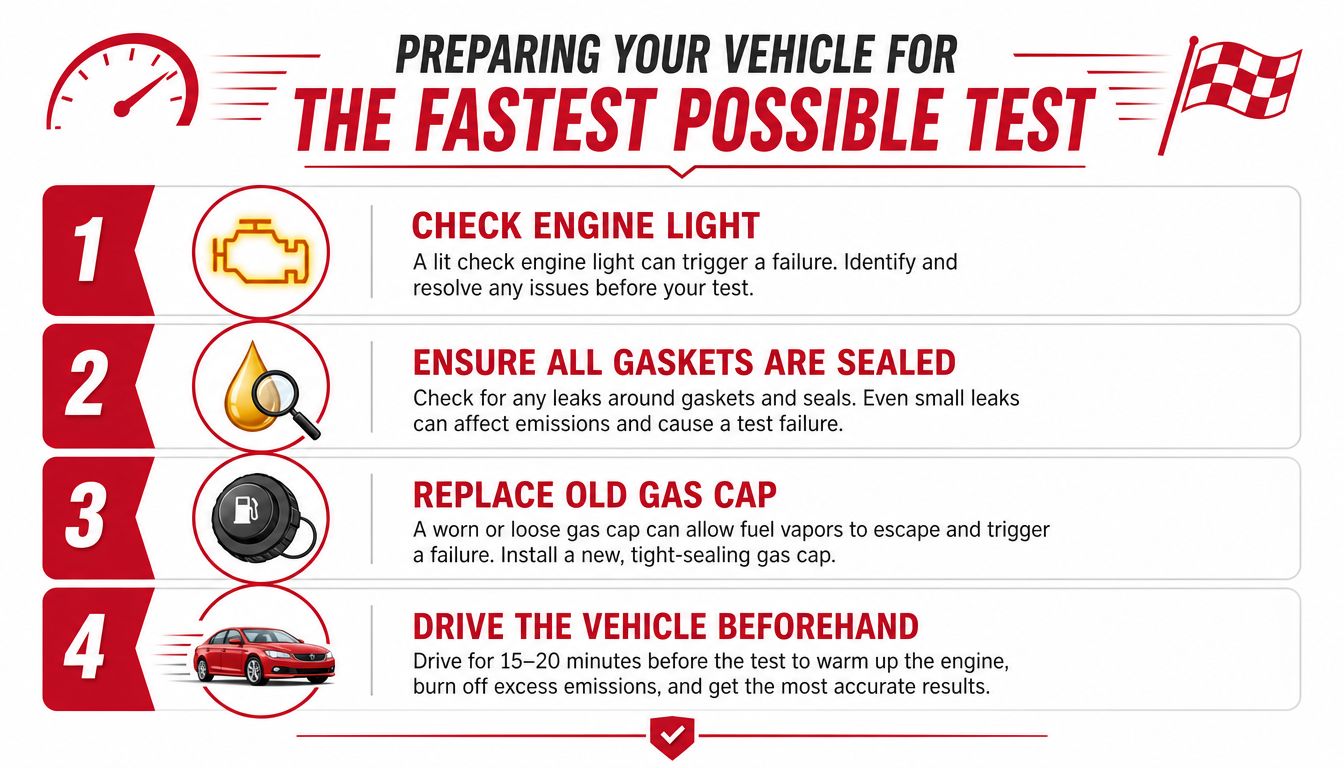
Use this pre-visit checklist
- Check the warning lights: Don't arrive with the check-engine light illuminated. If it came on recently, diagnose the cause rather than clearing the code.
- Avoid a last-minute battery reset: Disconnecting the battery can erase monitor data. If a reset has already happened, the vehicle may need mixed driving to complete its drive cycle.
- Leave time after repairs: Clearing diagnostic trouble codes immediately before testing can create a not-ready condition. Give the vehicle time to complete the required monitoring.
- Inspect the gas cap: A loose or damaged cap can trigger an evaporative-emissions fault. Make sure it seals properly before you leave.
- Bring the renewal notice: The notice helps the station verify the required inspection type and registration timing.
- Check the tires: Some inspection equipment uses a dynamometer. Proper inflation supports a smoother, safer test.
- Call about large vehicles: RVs and motorhomes may fit only when size and equipment conditions allow. Confirm before driving over.
Choose the visit time carefully
A coupon doesn't help if you spend the morning waiting. Early visits, extended evening hours, and weekend availability can make scheduling easier, while two-bay operations may keep vehicles moving more consistently. Bring your registration information, renewal notice, coupon, and payment method together so check-in doesn't stall.
If the check-engine light has been reset, don't gamble on a rushed appointment. Complete the vehicle's drive cycle first, or ask a qualified technician whether the monitors are ready. The OBD readiness monitor guide explains the issue in practical terms and helps you avoid an unnecessary failed visit.
Comparing Total Cost Scenarios With and Without a Coupon
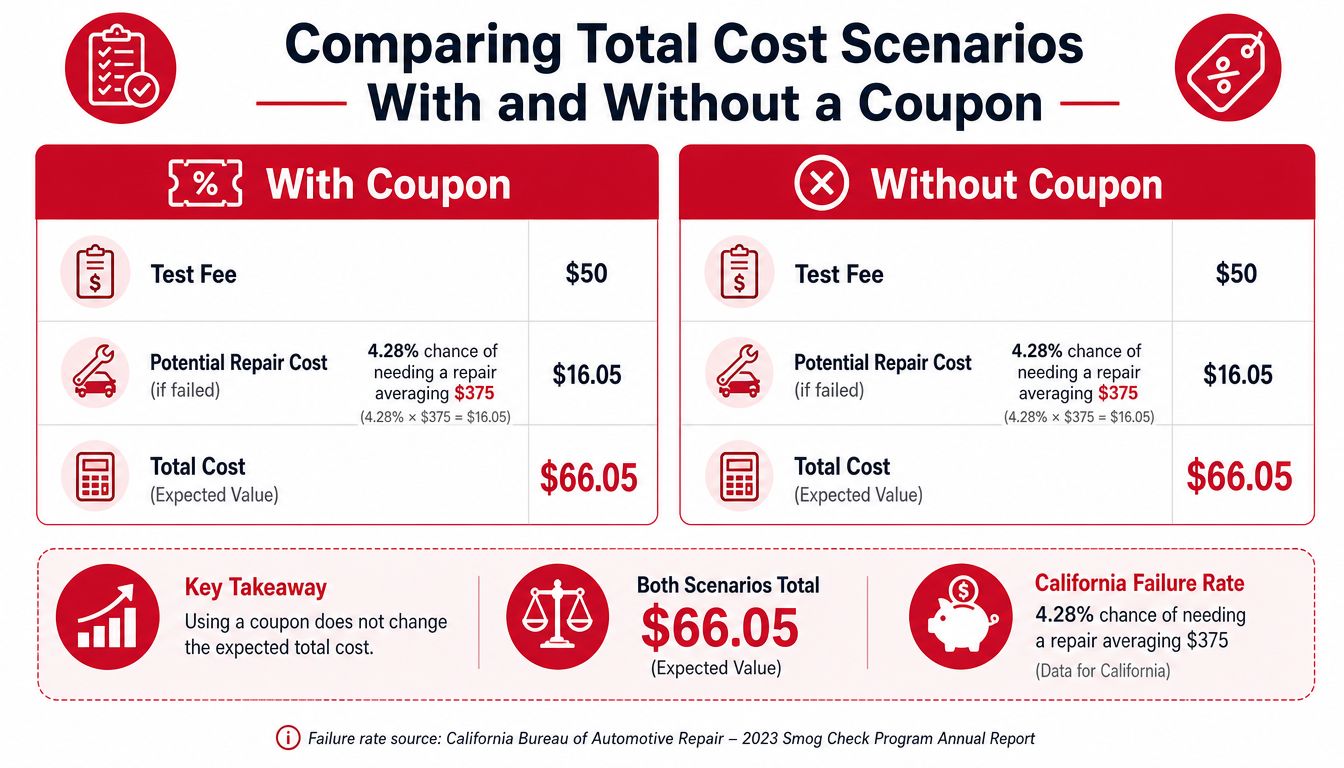
A coupon only lowers the inspection portion of the bill. For a first-visit pass, calculate the inspection charge, add the required certificate fee, then subtract the valid discount. That figure is your immediate out-of-pocket cost, not necessarily the full cost of compliance.
A failed test changes the calculation quickly. Repairs, diagnostics, a second inspection, and lost work time can outweigh a larger headline discount. Choose a coupon with retest coverage when the terms are clear. A smaller discount with a covered retest can cost less overall than a bigger discount that applies only once.
Compare the offers this way
| Situation | With a coupon | Without a coupon |
|---|---|---|
| Pass on the first test | Inspection fee minus the valid discount, plus the certificate fee | Full inspection fee plus the certificate fee |
| Fail the first test | Possible repair expense, with retest coverage only if stated in the offer | Possible repair expense and a separate retest charge unless the station provides coverage |
| Registration task remains | Look for a station that also handles eligible DMV services | You may need a separate DMV visit |
Retest risk is real, even though no general failure range predicts your vehicle's result. Compare the offer's retest terms, certificate-fee exclusion, expiration date, and vehicle restrictions before booking. The coupon should reduce the final bill, not merely advertise a lower inspection price.
Time also belongs in the total. A qualifying station that handles DMV registration services on site can eliminate another trip. A test-only workflow keeps emissions compliance separate from repair sales, which may help you control the visit's scope and cost.
For an Antioch driver near a renewal deadline, pick the offer with the lowest realistic out-the-door cost: discount, certificate fee, possible retest, repairs, and travel time. That is the comparison that saves money.
Your Action Plan for a Fast and Affordable Smog Check
Start with the renewal notice, not the coupon. Check whether it requires STAR, then inspect the vehicle for warning lights, recent battery work, and obvious gas-cap problems. If you reset the battery or cleared codes, wait until the monitors are ready before booking the test.
Use this short checklist:
- Confirm eligibility: Read the DMV notice and identify the required station type.
- Review the offer: Check the expiration, vehicle restrictions, certificate-fee exclusion, and retest terms.
- Prepare documents: Bring the renewal notice, registration information, identification, and coupon.
- Call for edge cases: Ask about RVs, motorhomes, diesel vehicles, unusual dimensions, or unclear coupon language.
- Pick a practical time: Use seven-day smog testing and extended hours to avoid the busiest part of your day.
- Finish registration promptly: If you need eligible DMV services, ask about on-site renewal and sticker issuance.
Fire House Smog is located at 2900 Lone Tree Way, Antioch, CA 94509, and can be reached at 925-754-1600. Its posted schedule lists smog testing seven days a week, DMV services Monday through Saturday from 9:30 AM to 5:00 PM, and Sunday DMV services from 12:00 PM to 4:00 PM. Call first for larger vehicles or any question about coupon eligibility.
The test-only model keeps the visit centered on emissions compliance rather than repair sales. That makes the cost easier to evaluate, especially when you compare the initial discount with the certificate fee and retest risk.
Visit Fire House Smog at 2900 Lone Tree Way in Antioch with your renewal notice and coupon ready. Call 925-754-1600 first if you have an RV, unusual vehicle, STAR question, or need to confirm retest terms, then schedule a focused test-only visit that keeps your total cost and time under control.
You notice it while fueling up. The California vehicle registration sticker on your rear plate looks faded, torn, or older than you expected. Maybe you renewed online months ago, but the replacement never arrived. Or perhaps you paid the renewal and assumed the sticker would take care of itself.
That assumption causes avoidable trouble. California treats the sticker as part of the vehicle's current registration display, and the correct solution depends on what happened. A lost year tab, an unreadable month tab, and a sticker that the DMV never mailed are different problems with different remedies.
Table of Contents
- What the California Vehicle Registration Sticker Actually Is
- Legal Requirements and Correct Display Rules
- How to Renew Your California Registration Sticker
- Replacing a Lost, Stolen, or Undelivered Sticker
- Where to Get Your Sticker Without the DMV Wait
- Documents Checklist and Practical Tips
- Penalties, Deadlines, and Frequently Asked Questions
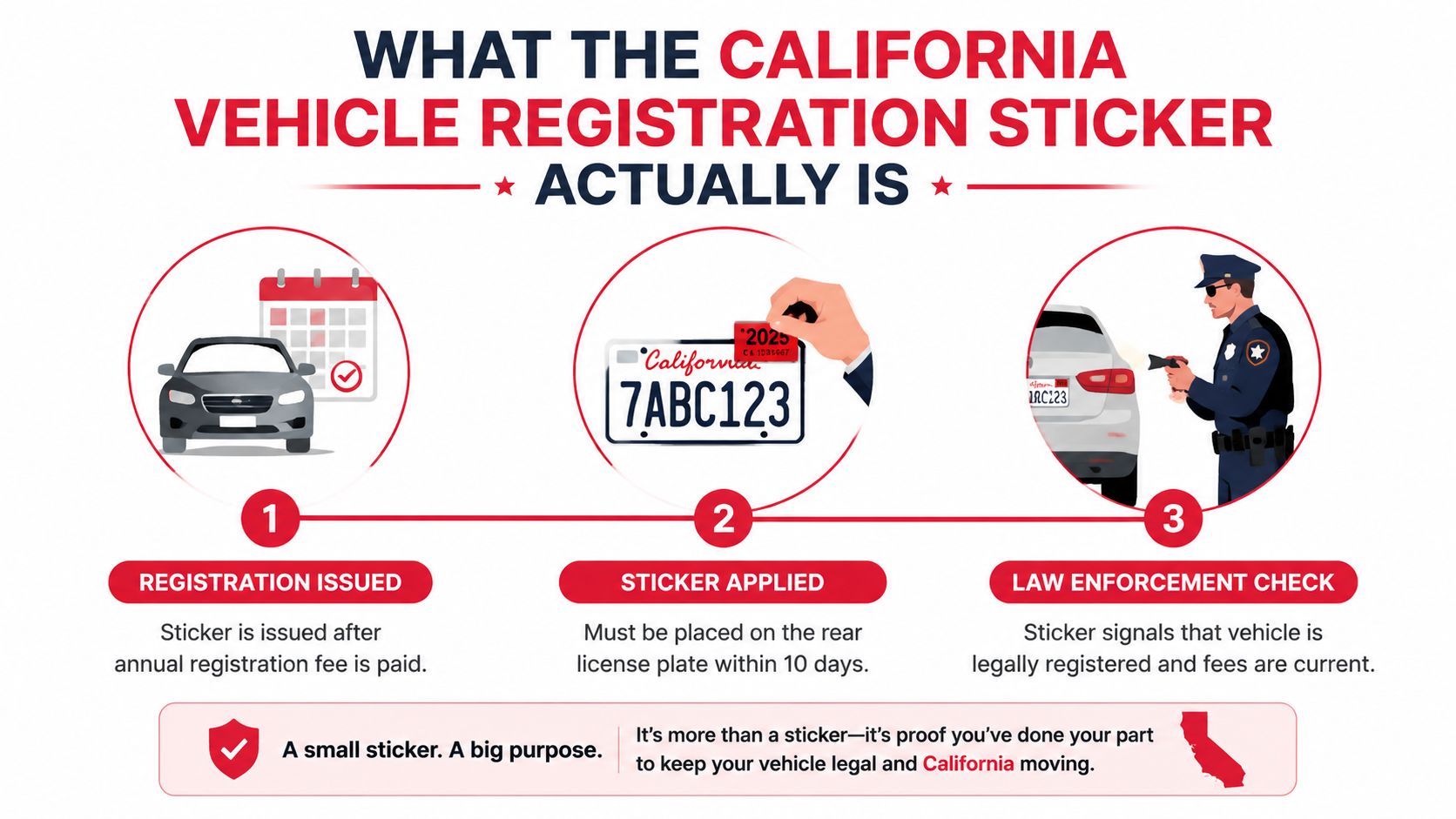
What the California Vehicle Registration Sticker Actually Is
A California vehicle registration sticker, commonly called a tab, is the validation device placed on the vehicle's license plate after registration renewal. California requires vehicle owners to renew registration every year, and the DMV sends new registration stickers after renewal. The owner must affix those stickers to the license plate to keep the registration display valid. The California DMV license plate guidance confirms that replacement month stickers may be issued at no cost when the owner is eligible.
The plate normally carries two important tabs. The year sticker identifies the registration year, while the month sticker identifies the month in which the registration expires. Together, they give a quick visual indication that the vehicle's registration should be current. Officers can also verify the vehicle record through DMV systems, so the physical sticker and the electronic record work together.
Practical rule: Treat the plate sticker as a required part of the vehicle's registration display, not as optional decoration.
California's system developed over time. The state first required vehicle registration in 1905, began issuing permanent license plates in 1914, introduced unique registration tags in 1916, and adopted annual registration stickers in 1976 to show that registration was current, as documented in the history of California vehicle registration plates. The DMV still uses stickers as part of the annual renewal process, even though registration information is also maintained electronically.
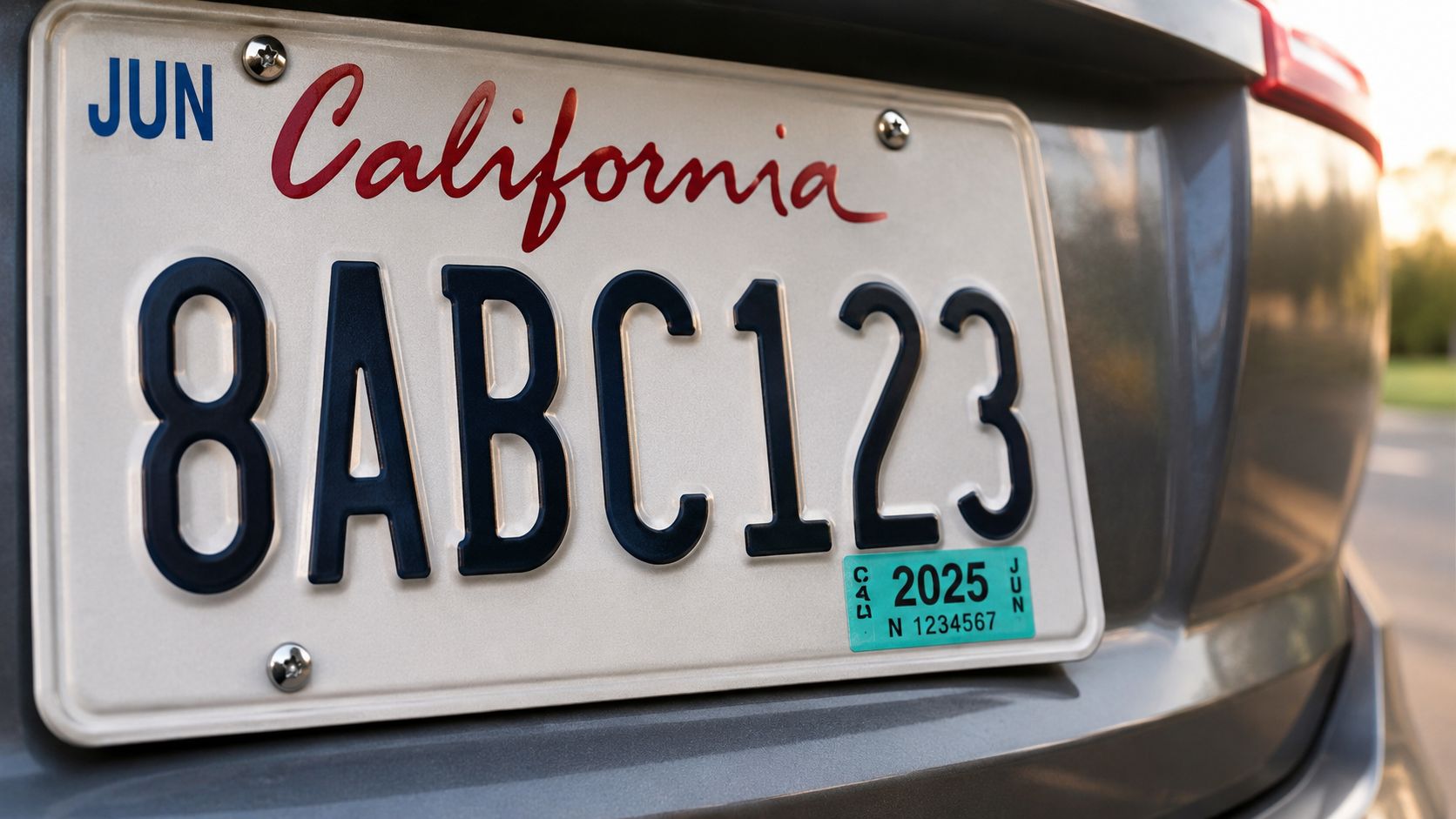
Look at the rear plate before you drive. If the year tab is missing, peeled away, or impossible to read, request the correct replacement rather than placing a random sticker over the problem. If the month tab is the issue, the DMV may treat it differently from a year-tab replacement.
The key question is simple: does your DMV record show current registration, and does your plate display the correct tabs? If the record is current but the sticker is missing, you need a replacement. If the record isn't current, ordering another sticker won't fix the underlying registration problem.
Legal Requirements and Correct Display Rules
The rear license plate is the required display location for California registration tabs. Apply each tab to the designated validation area, where it must stay visible and legible. Do not place it on the plate frame, vehicle body, or a removable cover. A frame that blocks the tab can make a current registration difficult to verify.
Before applying a replacement, clean away loose residue and let the plate dry. Press the tab down firmly. Follow the DMV's instructions for the specific replacement, especially before placing a new year tab over an older one. Layered or damaged tabs are harder to inspect and may peel away.
Check these common display mistakes
- Wrong plate: Ordinary vehicles generally display registration tabs on the rear plate. Do not attach one to a front plate or temporary paper document.
- Wrong location: A tab outside the designated area may be difficult to verify and may fail the display requirement.
- Blocked visibility: Oversized frames, tinted covers, dirt, and peeling edges can hide registration information.
- Unreadable condition: Replace a faded, damaged, or illegible tab.
- Out-of-date information: After receiving an issued replacement, remove the old tab and display the current one.
Year-tab and month-tab problems are not interchangeable. The DMV replacement process identifies the year sticker as lost, stolen, damaged, or illegible and requires vehicle and applicant information for the request. Use the DMV replacement sticker instructions to select the correct request. If the year tab never arrives by mail, verify the registration record and request a replacement instead of applying an unrelated tab. A missing month tab also needs attention, but do not assume the year-tab procedure automatically covers it.
A current electronic registration record does not make an obscured or unreadable plate display acceptable. Stand behind the vehicle and check both tabs before driving. Confirm that the year and month are present, readable, and uncovered. Fix any problem promptly, before it becomes an avoidable roadside issue.
How to Renew Your California Registration Sticker
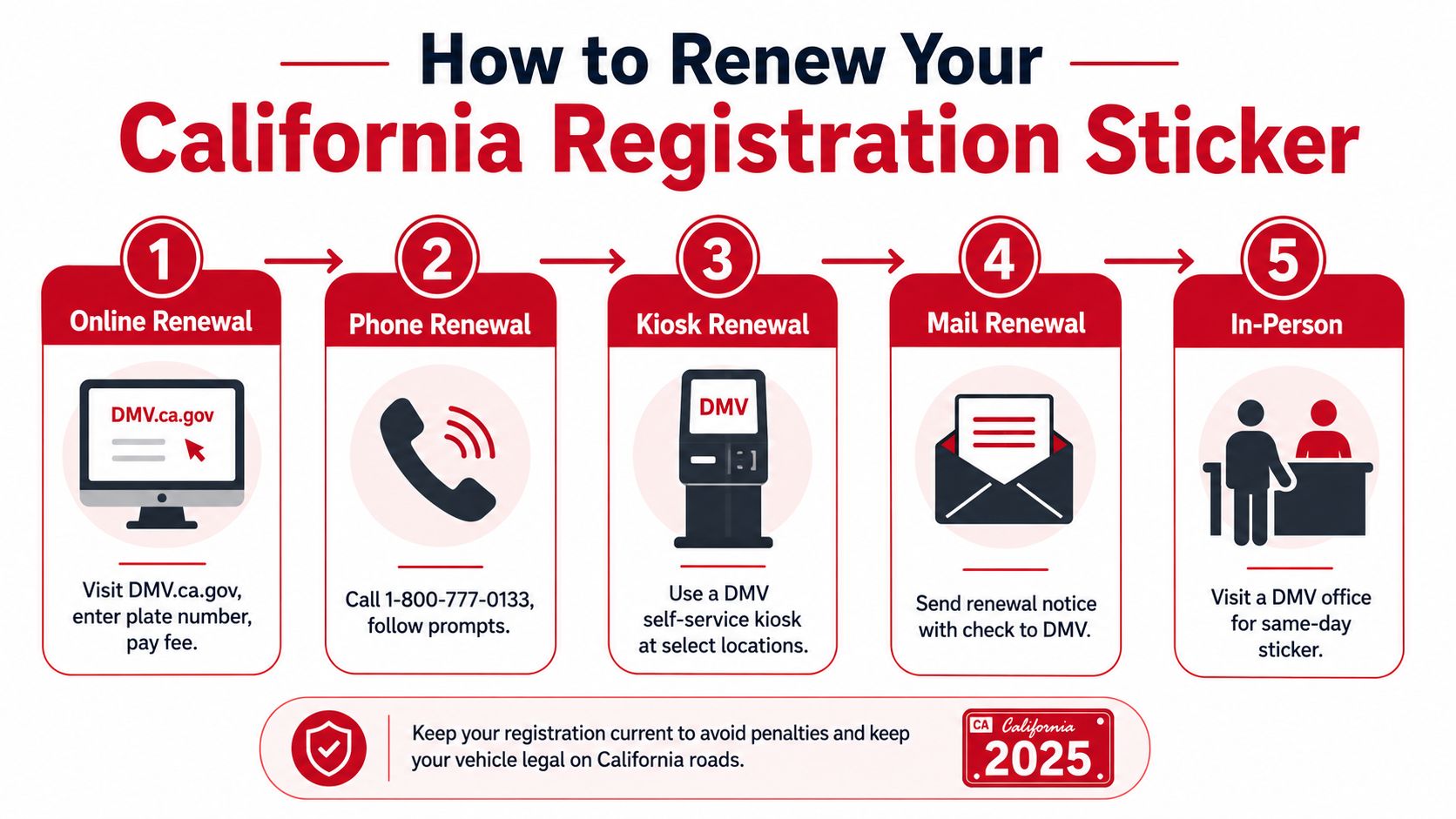
California gives drivers several renewal channels. The right choice depends on whether your record is straightforward, whether a smog certification is needed, and whether you need the physical sticker immediately.
Start with the renewal notice if you received one. It usually identifies the vehicle and the amount due, but the notice isn't the only way to renew. The DMV confirms that registration renewal can be completed online or by phone through its renewal service, and renewal stickers are mailed after processing.
Choose the channel that matches your situation
Online renewal works well when the vehicle is eligible and the DMV already has the required information. Use the official DMV website, enter the requested vehicle details, complete any smog requirement, and submit payment. Keep the confirmation for your records, but remember that confirmation and the physical sticker are separate things.
Phone renewal is useful when you prefer a guided process and your transaction qualifies. Have the renewal information and payment method available before calling. If the system identifies a missing requirement, resolve that issue instead of repeatedly submitting the same payment.
A DMV self-service kiosk can be the fastest choice when the vehicle meets the kiosk's requirements. DMV kiosks can also print registration card or sticker replacements using the plate number and the last five digits of the VIN, according to the DMV's replacement information.
Mail renewal suits drivers who prefer paper processing. Send the required renewal materials and payment to the address listed by the DMV. Mailing is slower and gives you less immediate visibility into the transaction, so confirm your address first.
A licensed DMV partner can make sense when you need a smog check and registration service together. The provider can tell you whether the vehicle qualifies for same-visit processing and whether a sticker can be issued on-site.
Don't confuse payment with completion
A payment alone doesn't prove that every renewal requirement has cleared. Smog certification, vehicle information, insurance records, or administrative holds can affect whether the DMV completes the renewal. Check the transaction status and follow the DMV's instructions if the record remains incomplete.
If fees have been paid but plates or stickers haven't been issued, the DMV may issue a temporary operating permit in situations where its requirements are met. That permit isn't a substitute for ignoring the missing sticker. Confirm what document applies to your vehicle and keep it with the registration paperwork while the DMV resolves issuance.
Renew early enough to account for mailing and unresolved requirements. If the sticker doesn't arrive, don't pay for a second renewal. Verify the original transaction first, then follow the replacement process that matches the problem.
Replacing a Lost, Stolen, or Undelivered Sticker
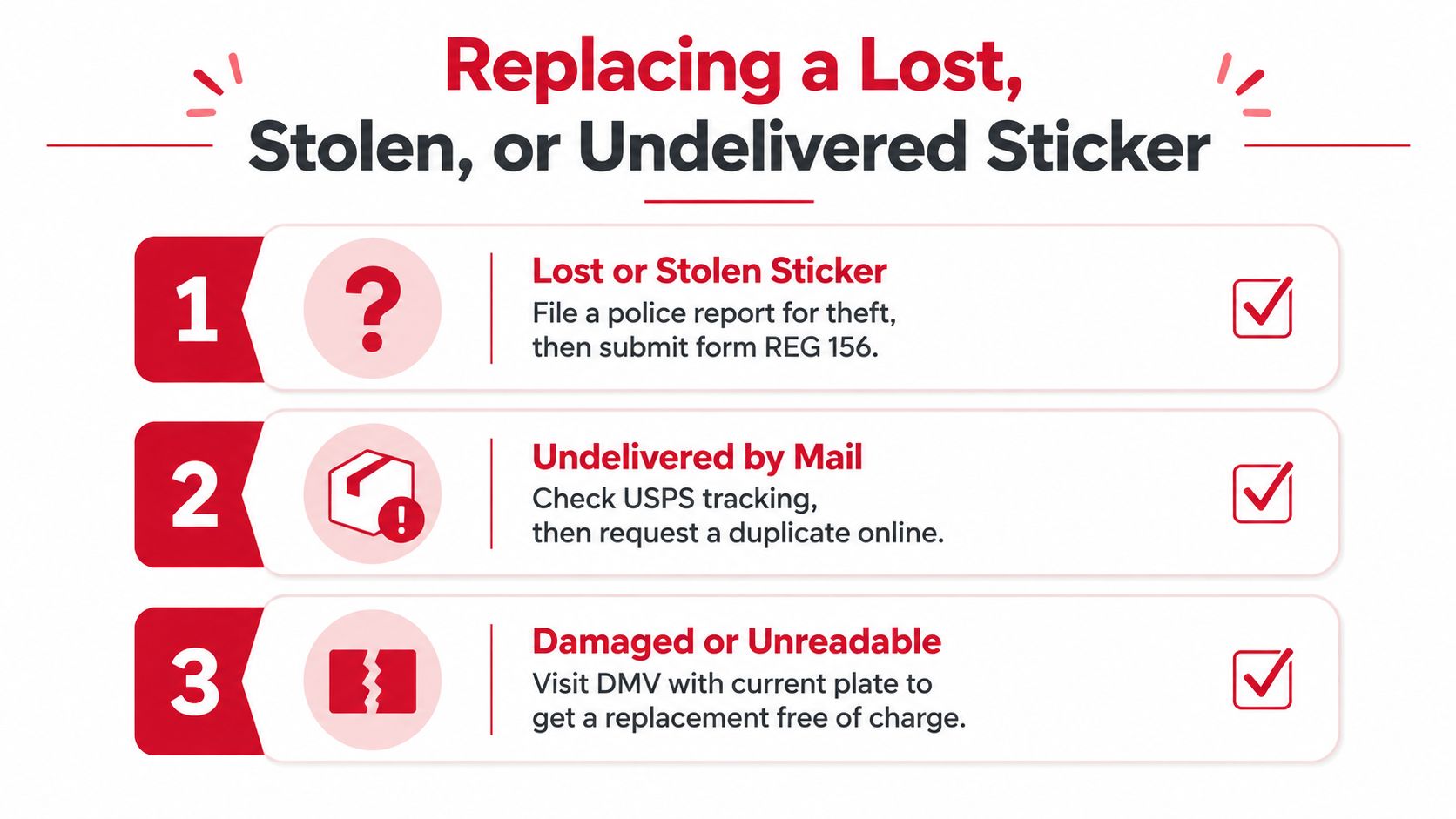
Start by identifying what happened. A sticker that vanished after installation requires a different request from one the DMV issued but never mailed. Damage, illegibility, and missing tabs also follow different rules. Check the year sticker and month sticker separately before submitting anything.
Year-tab replacements
For a lost, stolen, damaged, or unreadable year sticker, the DMV matches the replacement request to the vehicle record. You will need the plate number, registration information, and the last five digits of the VIN. The DMV's online replacement process explains the request and notes that a substitute-sticker fee applies in most cases.
Use the online process when the vehicle qualifies. A kiosk may be the faster choice when it offers replacement printing and you need a physical sticker promptly. Special or exempt vehicles may not qualify for the standard online route. In those cases, complete Form REG 156 and submit it by mail or at a DMV office.
Month-tab corrections
The month sticker follows a separate path. Eligible replacement month stickers may be issued without a fee, while replacing a year tab generally uses the substitute-sticker process. Selecting the wrong tab can send you through an unnecessary payment step or delay the request.
Check the tabs before applying. If the year remains visible but the month is missing or damaged, report the month-tab problem accurately and use the remedy assigned to that tab.
When the sticker never arrived
A sticker that never arrives requires a record check before a replacement request. Confirm that the renewal completed, then verify the mailing address on the vehicle record. The DMV mails stickers after renewal, but payment alone does not prove that issuance is complete.
Do not submit a second renewal or cancel the original payment because the envelope is late. Check the transaction status, confirm the address, and contact the DMV or use its replacement process if the record shows that the sticker was issued but not received.
Keep the renewal confirmation and related correspondence. Those records help establish nonreceipt rather than loss, theft, or damage, and they reduce the risk of paying twice for a completed transaction. If you need same-visit help, a licensed DMV partner such as Fire House Smog can handle eligible registration services without the standard DMV office wait.
Where to Get Your Sticker Without the DMV Wait
A DMV office is only one option, and it isn't always the most efficient one. Online renewal avoids the line but sends the sticker by mail. A kiosk can handle qualifying transactions quickly, while a licensed DMV business partner may combine emissions testing and registration work in one visit.
| Channel | Sticker in Hand | Typical Wait | Weekend Availability | Smog + Renewal Combo |
|---|---|---|---|---|
| DMV office | Depends on the transaction | Office queue and processing time | Limited | Not the usual format |
| DMV website | Usually mailed | Online processing plus delivery | Online access | No |
| DMV kiosk | Often available for qualifying replacements or transactions | Self-service transaction time | Depends on location | No |
| Licensed DMV partner | May be issued on-site | Appointment or walk-in workflow varies | Depends on provider | May be available |
For drivers who need only a routine renewal and aren't in a hurry, online processing is practical. For someone with a missing sticker, a kiosk can be preferable because eligible kiosks can print certain replacement documents without an office appointment. Check the specific kiosk's services before driving there.
A licensed provider can be more useful when the renewal depends on a smog inspection. Fire House Smog's DMV registration services include California registration renewals with on-site sticker printing during posted service hours. The location is 2900 Lone Tree Way in Antioch, and DMV service hours are Monday through Saturday from 9:30 AM to 5:00 PM and Sunday from 12:00 PM to 4:00 PM, based on the publisher's provided service information.
That combination can eliminate the back-and-forth between a smog station and a DMV office. Call ahead if the vehicle is a special category, a larger recreational vehicle, or has an unresolved registration hold. A licensed partner can process only what the vehicle record and applicable DMV rules allow.
Documents Checklist and Practical Tips
Prepare the information before you start. Most delays come from missing vehicle data, an unresolved smog requirement, or an address problem that nobody checked until after the sticker was mailed.
Renewal checklist
- Renewal notice: Bring it if you have it, but don't assume it's required for every renewal channel.
- License plate number: Use the plate number exactly as it appears on the vehicle.
- Vehicle identification information: The DMV replacement flow asks for the last five digits of the VIN.
- Smog information: Complete the required inspection before renewal when the vehicle record calls for it.
- Payment method: Use an accepted payment method for the selected channel and keep the confirmation.
- Address record: Verify that the DMV has the correct mailing address before submitting the renewal.
- Supporting documents: Bring any permit, ownership, exemption, or special-category paperwork that applies to the vehicle.
For a replacement, identify the failure clearly. Select a year-tab replacement when the year sticker was lost, stolen, damaged, or made illegible. Ask about a month-tab correction when only the month sticker is affected. Special-category and exempt vehicles may require REG 156 instead of the standard online flow.
Use the DMV's vehicle registration document checklist before visiting a service provider. It's better to discover a missing document at home than after you've already driven across town.
Keep a digital or printed copy of the renewal confirmation. It doesn't replace the plate sticker, but it gives you a record of the transaction while you resolve delivery or issuance. If the DMV record shows an unresolved requirement, address that item directly instead of submitting another payment.
Finally, check the plate after installation. Confirm that the sticker is on the rear plate, readable, firmly attached, and not blocked by a frame or cover. That quick inspection prevents a completed renewal from turning into a display problem.
Penalties, Deadlines, and Frequently Asked Questions
Registration problems become more expensive and harder to untangle when drivers ignore them. Late renewal can involve penalties, and an expired or missing tab can trigger a correction issue even when the underlying record needs a different fix. If you receive a citation, follow the court instructions and don't assume renewal alone closes the matter.
Use the DMV record as your starting point. A current record with a missing sticker calls for replacement. An expired record calls for renewal and resolution of whatever prevented completion, such as a missing requirement or administrative hold.
Can I drive while waiting for a mailed sticker?
Possibly, but don't rely on an envelope alone. If you submitted the proper registration application and the transaction is still being processed, keep your existing registration materials and any temporary operating permit issued by the DMV. Verify your status rather than assuming payment automatically completed the renewal.
What if my renewal notice never arrived?
A missing notice doesn't cancel the renewal obligation. Use the DMV's available renewal services, check the vehicle record, and confirm the mailing address. If the system shows a problem, resolve that problem before requesting a sticker.
Do out-of-state vehicles need California stickers?
The answer depends on the vehicle's registration status and where it is legally registered. A vehicle registered in another state follows that jurisdiction's plate and validation rules while it remains properly registered there. If you establish California registration, follow California's display requirements.
How does an ownership transfer affect the sticker?
An ownership transfer can change the registration record and may require new registration documents, plates, or stickers. Don't assume the previous owner's sticker remains appropriate after the DMV processes the transfer. Use the DMV transfer instructions or a licensed registration provider to identify the documents required for that vehicle.
For East Contra Costa County drivers who need help with renewal fees, review the California registration renewal fee service. Fire House Smog is located at 2900 Lone Tree Way, Antioch, California 94509, and can be reached at 925-754-1600.
Fire House Smog provides STAR-certified test-only smog checks and licensed California DMV registration services, including renewals with on-site sticker issuance during posted hours. Visit Fire House Smog to combine eligible smog and registration work in one stop, and call 925-754-1600 before visiting if your vehicle has a special category or unresolved DMV requirement.
That check engine light doesn't care that you're busy. Neither does a failed smog test, especially when you need the car back on the road and you don't want to throw money at parts you don't need. If you're looking for auto diagnostic and repair in Antioch, CA, the smart move is simple, get the problem confirmed first, then pay for the right fix, then retest only after the vehicle is ready.
Table of Contents
- What Auto Diagnostics Actually Involves
- How to Prepare Before Visiting a Repair Shop
- Choosing the Right Type of Station in Antioch
- Understanding Typical Costs and Timelines
- What to Do After Receiving Your Diagnosis
- Essential Questions to Ask Before Authorizing Repairs
What Auto Diagnostics Actually Involves
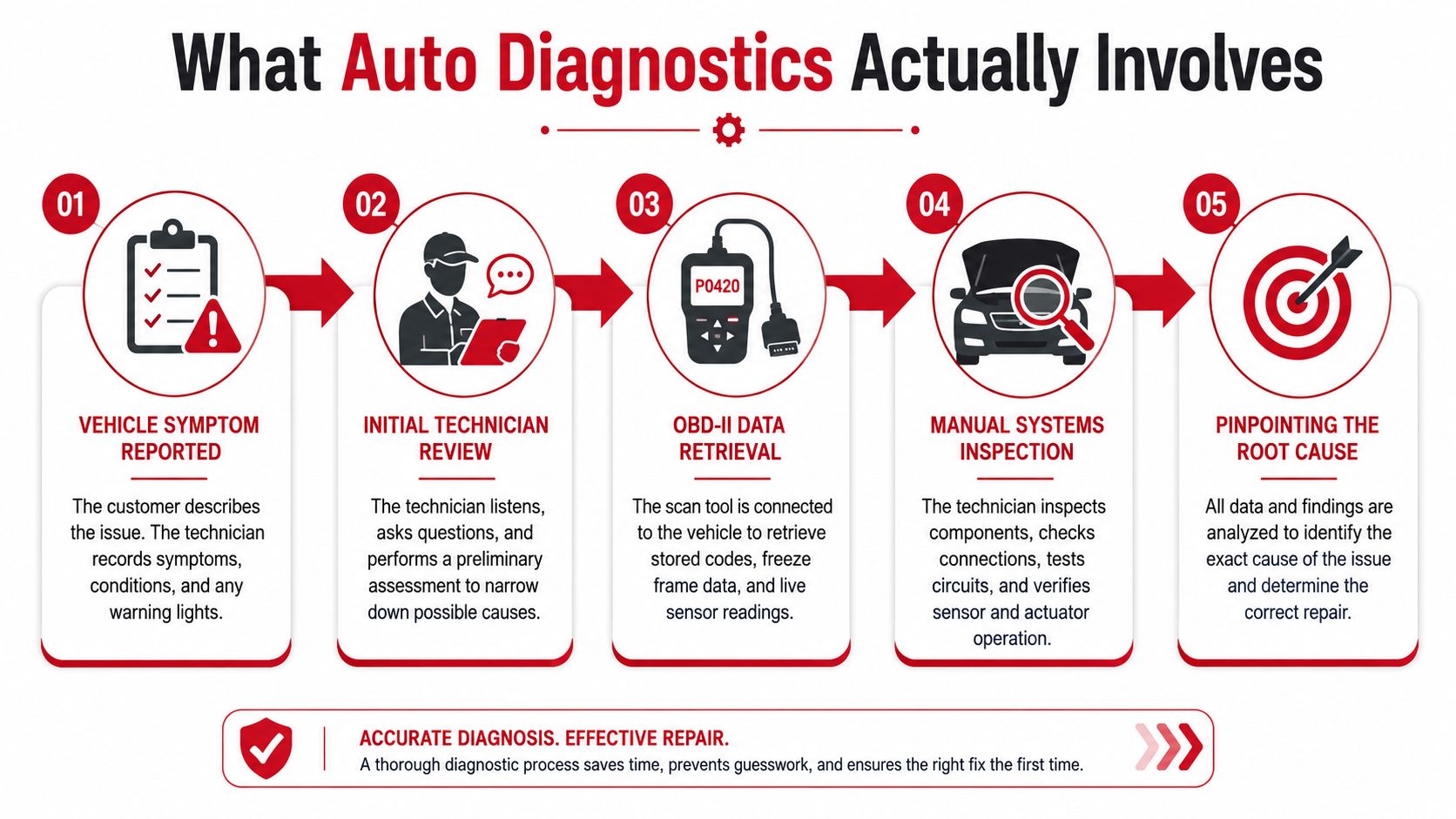
You pull into a shop in Antioch with a warning light on, or you just failed a smog test and want a fast answer. A good technician doesn't start by guessing. They start by pulling OBD-II data, checking the freeze-frame snapshot, and comparing live sensor values against what the car is doing on the bay floor.
Codes are clues, not verdicts
A fault code tells you where the computer saw a problem. It does not tell you which part should be replaced first. That's why a scan tool is only the starting point, not the finish line, in a proper auto diagnostic and repair Antioch CA workflow.
The best shops use the code as a map, then confirm the failure with manual inspection and symptom replication. If a car only acts up after warm-up, under load, or at idle, the technician has to see that behavior for themselves. Replacing the first part that “sounds right” is how people end up paying twice.
Practical rule: if a shop won't explain how it verified the failure, it's not really diagnosing, it's guessing.
The cleanest way to think about it is this. Scan the car, verify the symptoms, test the circuit or system, then decide on the repair. That order matters because modern drivability problems often share symptoms across several parts, and the wrong shortcut leads to the wrong invoice.
If you want a deeper look at why a vehicle can fail emissions for several different reasons, this guide on smog check fail reasons is worth reading.
How to Prepare Before Visiting a Repair Shop
A lot of diagnostic time gets wasted because the driver shows up with a vague story like, “It's been acting weird.” That doesn't help anyone. A better visit starts with a clean record of what happened, when it happened, and what the car was doing at the time.
Bring facts, not guesses
Write down the symptom the moment it shows up. Note whether it happened cold or hot, at idle or speed, with the A/C on, after fueling, or while climbing a hill. Those details help a technician reproduce the problem faster, which is the difference between a focused test and a wandering parts hunt.
Bring your recent maintenance history too. Oil changes, spark plugs, battery work, brake work, and any recent sensor replacement all matter because one repair can affect another system. If the car has aftermarket tuning, a modified intake, or a nonstock exhaust, say so up front. Technicians don't need a speech, they need the facts.
Have the car details ready
At check-in, give the VIN, the current fuel type, and any recent warning lights or failed inspections. If the car failed a smog test, hand over the paperwork and don't summarize it loosely. The exact failure result matters.
Bring the paperwork, not the memory.
I also tell people to show the technician any pattern. If the light comes on only after a tank of gas, or only after long freeway drives, say that. That's the kind of detail that turns a messy complaint into a useful diagnostic path.
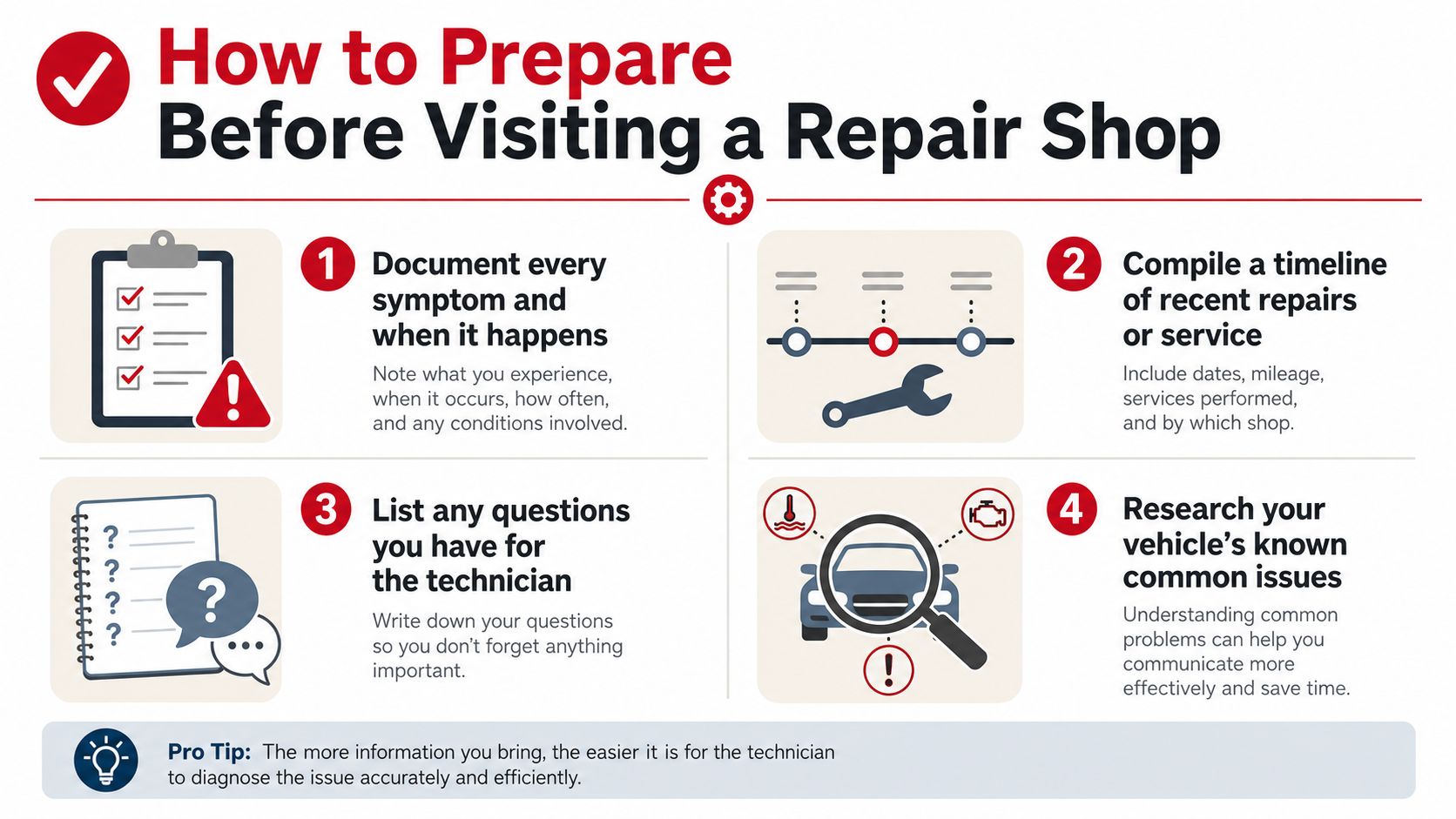
The goal is simple. Make it easy for the shop to verify the symptom, and you reduce the chance of paying for the wrong repair.
Choosing the Right Type of Station in Antioch
Not every problem belongs in the same lane. Antioch drivers usually deal with three different options, and mixing them up is how people waste time and money. A test-only smog station checks emissions compliance. A test-and-repair shop can both inspect and fix. A dealership service department usually sits in its own lane with brand-specific tools and procedures.
California's smog-check system is heavily segmented. As of December 31, 2025, the Bureau of Automotive Repair reported 2,031 Smog Check test-only stations, 3,992 test-and-repair stations, and 3,505 STAR stations statewide, plus 12,334 smog inspectors and 4,955 repair technicians California BAR licensing statistics. That scale is why station type matters. A test-only station is built for emissions verification, not repair sales. A test-and-repair shop can chase the fault and sell the fix.
Match the station to the problem
If you already know the car needs real mechanical work, start with a full repair shop. If you need an emissions test, a retest, or DMV-related paperwork after compliance work, a test-only station keeps the process cleaner because the incentives are different. Fire House Smog follows that test-only model, and its STAR-certified smog station information explains how that fits California's compliance structure.
| Station Type | Best For | Repair Services | Upsell Risk |
|---|---|---|---|
| Test-only smog station | Emissions testing, retests, compliance verification | No in-house repair sales | Lower, because the station isn't selling the fix |
| Test-and-repair shop | Diagnosis plus repair in one place | Yes | Higher, because the same shop diagnoses and repairs |
| Dealership service center | Brand-specific diagnostics and warranty work | Yes | Depends on the issue and the vehicle brand |
Use the station that fits the job. If you walk into a test-only lane expecting a repair estimate, you're at the wrong counter. If you need a precise diagnosis before you authorize any parts, a repair shop is the correct first stop.
Understanding Typical Costs and Timelines
Drivers hate diagnostic pricing because too many shops toss out a fee without explaining what it covers. That's a mistake. A proper diagnostic charge should buy actual testing, not a quick code read and a shrug.
Time depends on the complexity of the failure
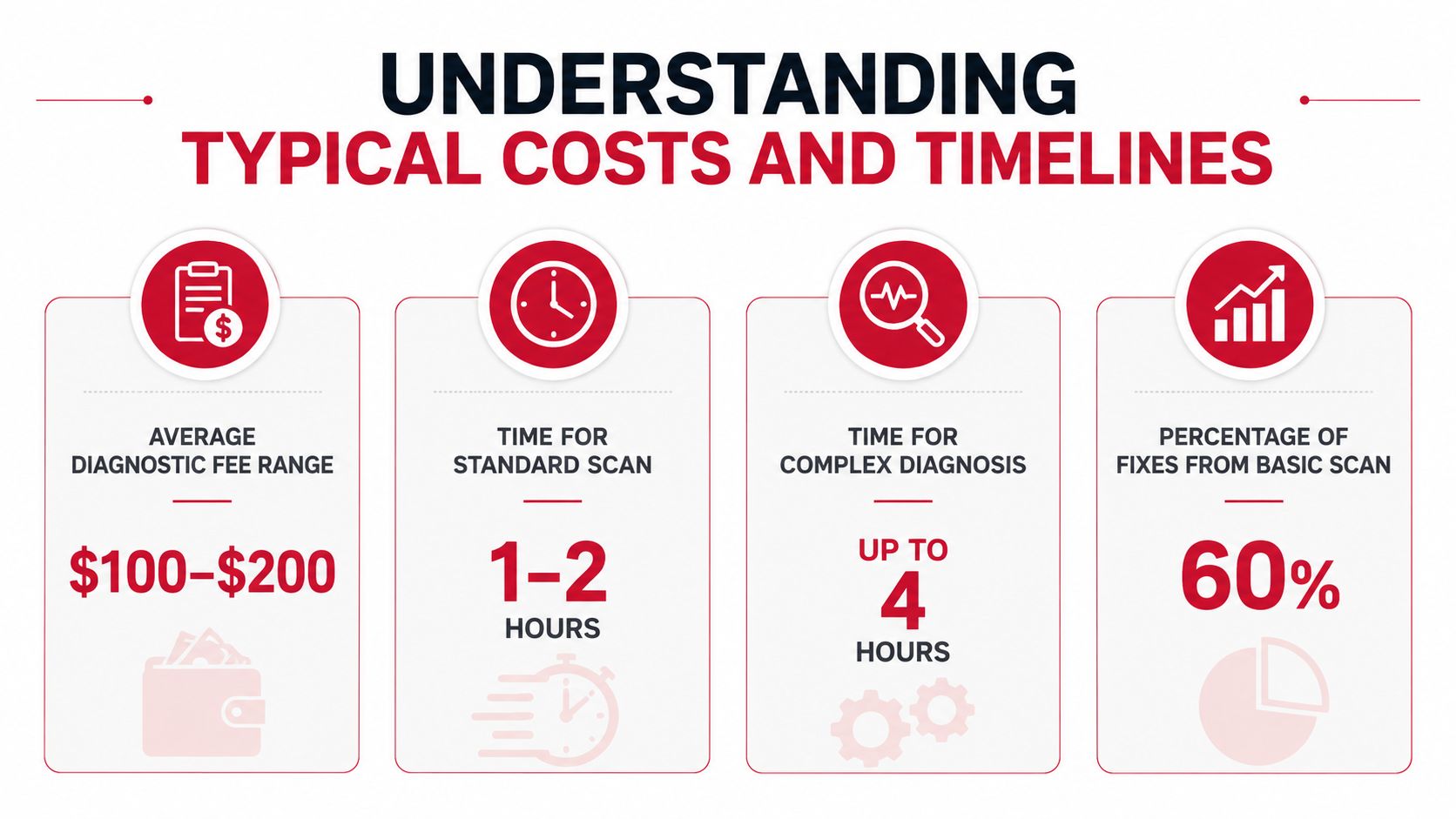
A basic diagnostic visit typically takes about 1 to 1.5 hours, while complex electrical or drivability cases can run 2 to 3 hours because the technician may need access to components, circuit testing, and live-data analysis diagnostic workflow benchmark. That timeline is normal when the shop is doing the work correctly.
What should you expect in return? Scan results, freeze-frame data, live sensor readings, and a clear explanation of what was tested next. If the shop jumps from code to part replacement without showing you the verification step, you're not buying diagnosis. You're buying hope.
Why a stepwise plan beats a flat guess
A flat diagnosis fee can be fine if the shop explains the phases. It's not fine if the fee comes with no plan. Ask how the technician will separate a sensor fault from wiring damage, vacuum issues, or a failing component elsewhere in the system. That sequence protects you from replacing the wrong part.
For smog-related work, budget expectations should reflect the difference between testing and repair. A test-only visit and a repair visit are not the same service, and the shop should tell you which one you need before anything gets authorized. If you want to compare smog pricing and service scope, the page on what a STAR smog check costs helps frame the decision.
A good estimate names the test, the likely cause, and the next verification step.
If the quote can't explain those three pieces, it's too fuzzy. Clear diagnostics save money because they stop the car from becoming a moving parts lottery.
What to Do After Receiving Your Diagnosis
A diagnosis without a decision is just paperwork. Once the shop tells you what failed, separate the job into three buckets, safety, compliance, and convenience. That order keeps you from spending money in the wrong place.
Start with the fault, not the favorite part
If the technician says a sensor circuit is bad, ask whether the code points to the sensor itself, the wiring, a connector, or an upstream issue. Don't authorize a replacement just because that part is common. Common doesn't mean correct.
This matters most after a failed smog test. The issue might be straightforward, or it might be part of a larger emissions problem that needs more testing before repairs begin. In California's regulated system, the right move is to confirm the failure path before chasing parts. That's how you avoid paying for a repair that doesn't clear the problem.
Decide when to move and when to pause
If the repair is safety-related, don't drag your feet. If it's an emissions issue and the explanation is thin, pause and ask for a second opinion. If the estimate includes several items, have the shop separate what's required now from what can wait.
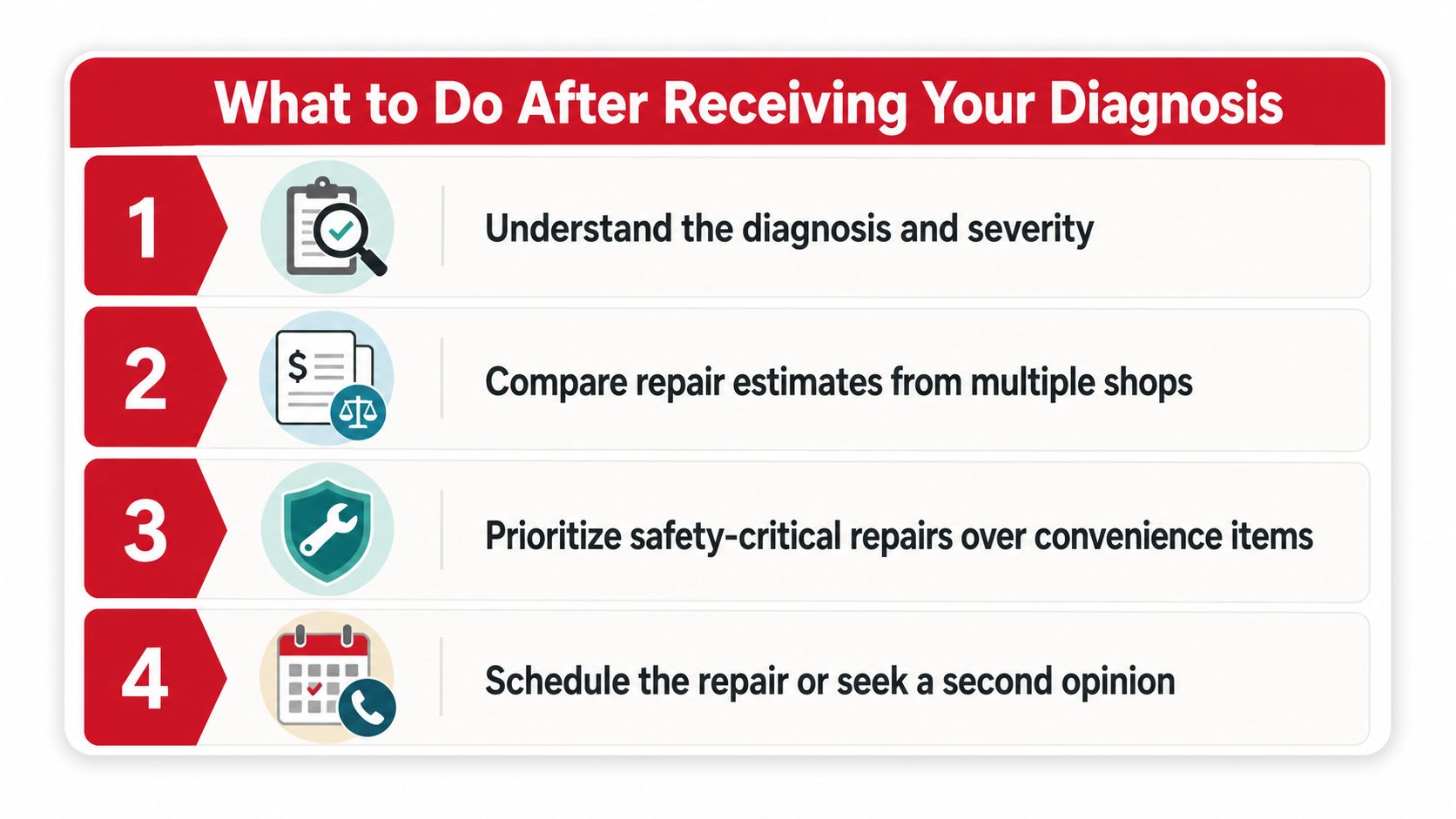
Here's the order I recommend:
- Confirm the diagnosis. Make sure the shop tested the problem, not just guessed at it.
- Check the severity. Safety-critical work comes first.
- Compare the repair path. If the issue is unclear or expensive, get another opinion.
- Plan the retest. Only retest after the actual cause has been fixed.
If the first repair doesn't solve the issue, stop and re-evaluate before stacking more parts onto the car. That's how bills grow without results. A disciplined diagnostic process saves the owner from paying for the same problem twice.
Essential Questions to Ask Before Authorizing Repairs
Most bad repair experiences start with one thing, the driver didn't ask enough questions. You don't need to sound difficult. You need to sound informed. The right questions force the shop to show its work.
Ask about the test, not just the part
Start with this. “What confirmed the failure?” Then ask, “What else did you rule out?” Those two questions expose whether the shop actually tested the problem or just jumped to the most likely culprit.
Follow with, “What's the labor broken into by phase?” If a shop can't explain how long the diagnosis, removal, repair, and verification each take, the estimate is too vague. Ask for the recommendation in writing before you agree to anything. That protects you if the repair doesn't solve the original complaint.
Ask different questions for smog-related work
For emissions issues, ask whether the repair is expected to address the specific fault code or only a common associated part. Those are not the same thing. A shop should also tell you whether the vehicle needs further diagnostic troubleshooting before any parts are replaced.
If the answer sounds like a sales pitch, keep asking.
Warranty matters too. Ask what happens if the repair doesn't fix the original issue, and ask whether the shop will recheck the same fault without charging you again for the same diagnosis. That's especially important when the first visit ends in a failed smog test and the root cause isn't obvious.
For Antioch drivers who want a test-only lane instead of a repair sale, Fire House Smog fits that role by handling emissions checks and DMV registration services without mixing in repair work. That separation is useful when you want compliance handled cleanly and you're already working with a mechanic on the fix.
If you need a straight answer on an emissions problem, or you want to handle the smog side without getting pulled into unnecessary repair pressure, visit Fire House Smog and use the Antioch test-only station for a clean, compliance-focused step forward. Bring your paperwork, ask the right questions, and let the diagnosis point you to the next move instead of letting guesswork drive the bill.
You're staring at a DMV renewal notice, or maybe you just got told your car needs a STAR-certified smog station instead of the shop around the corner. That's usually the moment the stress kicks in, because now the question isn't just “Can I pass?” It's also “Where do I go, and will I need to come back with repairs?”
A STAR station sounds technical, but the idea behind it is simple. California uses it to sort inspection stations by performance, equipment, and compliance, so the cars that need tighter oversight get tested in places the state keeps under closer watch. For drivers, that means the station you choose can affect whether the visit ends with a certificate, a repair referral, or a second trip.
Table of Contents
- The California Smog Check Most Drivers End Up Needing
- What STAR Certification Means
- Test-Only Versus Test-and-Repair STAR Stations
- How a STAR Test-Only Smog Check Works
- Why a Local STAR Station Like Fire House Smog Stands Out
- Preparing for Your Visit and Knowing What You Can Bring
- Misconceptions That Send Drivers to the Wrong Station
- Visiting a STAR Station in Antioch and Frequently Asked Questions
The California Smog Check Most Drivers End Up Needing
A lot of drivers meet the smog system in the least convenient way possible, with a renewal deadline hanging over them. The notice arrives, the car still runs fine, and then the paperwork says the vehicle needs a smog certificate before the DMV will finish the job. That's when a routine errand turns into a short course in California emissions compliance.
For many vehicles, a standard smog check is enough. But some cars and trucks get directed to a STAR-certified smog station because the state wants a more tightly controlled inspection for that vehicle or that situation. The distinction matters because STAR isn't just a label, it tells you which stations are authorized to test directed vehicles under California's performance rules. The state's STAR framework was created as part of a modernization effort that took effect in January 2013, and BAR says more than two-thirds of smog check stations are STAR certified, so this isn't some obscure corner of the system, it's a major part of how the state handles inspections (California Senate Transportation Committee PDF).
Why the station type changes your experience
If you go to a test-only shop, the visit stays focused on testing. If you go to a test-and-repair shop, the same location may also be able to fix what it finds. That's a real difference when you're trying to finish a registration renewal on the same day.
In Antioch and East Contra Costa County, that distinction often shows up in very practical ways. A driver may need a smog certificate, a renewal, and a clear answer about what happens if the car fails. A station that can handle the paperwork on-site turns a DMV chore into one stop instead of two or three.
Practical rule: if your notice says STAR is required, don't book the nearest random smog shop first. Book a station that is actually authorized for the type of inspection your paperwork demands.
What STAR Certification Means
A STAR-certified smog station is not a one-time approval that sits on the wall forever. California keeps it under ongoing review with measurable performance standards, inspection equipment rules, and periodic checks. In plain English, STAR status works more like a quality-control filter than a plaque.
The performance side of STAR status
BAR ties STAR eligibility to numbers that measure how a station performs on similar vehicles. The Similar Vehicle Failure Rate must be at least 50% of the industry-wide failure rate for similar vehicles in the most recently completed quarter, the Excessive Test Deviation Rate must be no more than one, and each inspector must maintain a Follow-up Pass Rate of at least 0.40 unless the station-level score applies for an inspector without one (BAR STAR certification page). Those thresholds matter because they show whether a station is producing careful, repeatable results.
The logic is simple once the jargon gets out of the way. A station that catches the right failures, avoids sloppy deviations, and keeps inspectors within the standard is more dependable for directed vehicles than one that misses too much or varies too widely. STAR turns that idea into a formal system.
The equipment side of the label
Certification also depends on the tools. BAR requires certified inspection equipment, current calibration, and the ability to inspect all vehicles in the Smog Check Program. California regulations say calibration-capable equipment has to pass calibration at least once every 10 calendar days, and BAR can restrict a station from communicating with the vehicle information database if deficiencies aren't corrected (California regulations on Cornell Law).
That means STAR is a live operating standard. If the station falls out of calibration, loses the right software setup, or cannot maintain the required tools, it stops being a dependable place for directed inspections.
A station page like Fire House Smog's STAR-certified smog check overview can help put that rule into a real-world setting. The point is not just that the station has the label. The point is that the label tells you the state is checking both the station's results and the station's equipment, so the inspection process stays accountable over time.
Bottom line: STAR status means the state is watching both the station's results and the station's equipment, which makes the label a continuously monitored quality mark, not a one-time award.
Test-Only Versus Test-and-Repair STAR Stations
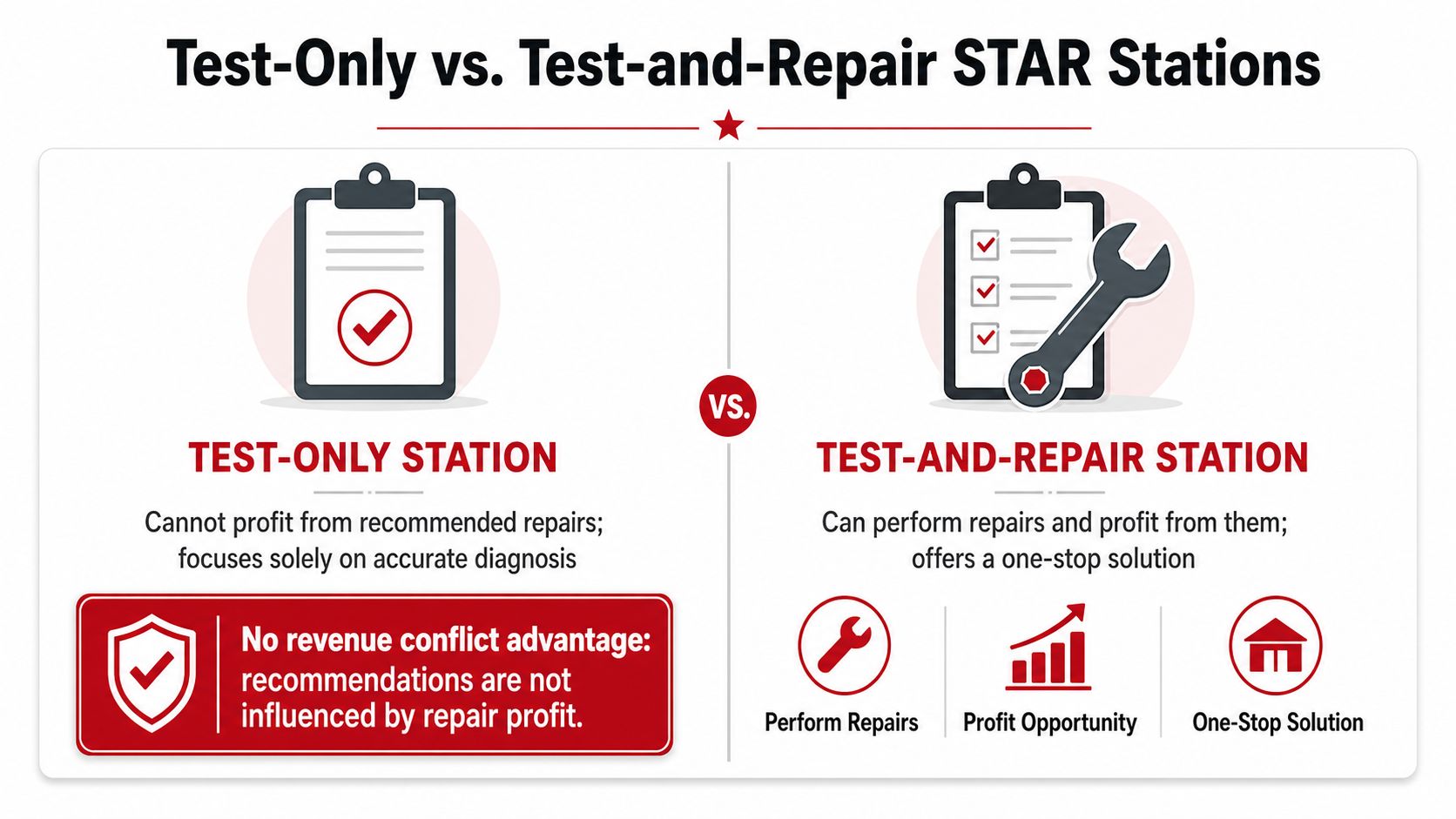
A driver trying to pick the right STAR location usually runs into one practical question first, who is allowed to test the car, and who is allowed to fix it afterward? A STAR test-only station can inspect your vehicle, but it cannot profit from repairing the reason it failed. A STAR test-and-repair station can do both. That split shapes both trust and convenience, especially when the renewal notice already feels like one more thing the DMV has dropped on your desk.

Why test-only matters to drivers
The value of a test-only station is the separation between the inspection and the repair estimate. If the station finds a problem, it does not have a repair bay waiting to turn that failure into additional work. The report sends you to the repair shop you choose, so the testing side stays distinct from the fixing side.
That separation matters for drivers who want the cleanest possible read on their car's emissions status. It also gives peace of mind to anyone who worries about being steered into repairs before they know what the car needs. A test-only shop answers one question, does the vehicle pass today, and then leaves the repair decision to you.
California's statewide numbers show that both station types handle a large share of the program. In BAR's BAR 2025 Smog Check Executive Summary Report, STAR Test-Only stations handled 5,916,245 initial tests and 481,639 failures, for an 8.14% failure rate, while STAR Test-and-Repair stations handled 2,766,051 initial tests and 227,215 failures, for an 8.21% failure rate. Those figures show a broad testing network, not a niche corner of the program.
Why regulators keep both models in play
The state needs places that can test vehicles, and it also needs stations that can repair them. The test-only model lowers the chance that a customer will be pushed toward unnecessary work, while the test-and-repair model gives drivers an option for diagnosis and repairs in one stop. Both fit the Smog Check Program, just in different roles.
For drivers who want a station whose job is limited to inspection, a STAR test-only station is the straightforward choice. For drivers who already know they want a shop that can handle both the result and the fix, test-and-repair is the better match. The right option depends less on the badge and more on what you want the station to do after it plugs in the car.
How a STAR Test-Only Smog Check Works
A STAR test-only visit usually starts with a drive-up and a quick review of your paperwork, much like any other inspection appointment. If your vehicle has been flagged for a directed inspection, the notice usually sends you to a STAR station instead of a regular one. The state is saying the car needs to be tested in a more controlled setting, where the inspection and the repair side stay separate.
What happens at the station
The station first verifies the vehicle and driver information, then connects the car to the inspection method that fits the vehicle. For 1996-and-newer vehicles, that means an OBD-II connection. Older vehicles may go through tailpipe or OIS testing, depending on what the program requires and what equipment the station supports.
After that, the inspector checks emissions-related components and completes the report. If the car passes, the certificate is issued electronically for DMV processing. If it fails, you receive a failure report that points toward repairs, but the station itself does not turn into your repair shop. That separation keeps the test result clean and leaves the next step to you.
What a failure does and doesn't mean
A failed test does not mean the vehicle is done for. It means the emissions system, readiness status, or visible equipment did not meet the standard that day. The purpose of the report is to identify the problem clearly enough that a repair shop can diagnose it without guessing.
A good failure report saves time. It gives the next mechanic a place to start instead of forcing them to search blindly. For a station example that follows this test-only model, you can look at the Lone Tree Way location details for Fire House Smog in Antioch.
Why a Local STAR Station Like Fire House Smog Stands Out
A local station matters when the problem is speed, not theory. At Fire House Smog on 2900 Lone Tree Way in Antioch, the selling point is the practical setup, not a slogan. It's a test-only station, so the testing side stays separate from repair revenue, and it also handles DMV registration tasks on-site during posted hours.
See the Lone Tree Way location details
Why the setup helps real drivers
Two service bays mean the station can move vehicles through faster than a single-bay setup usually can. That matters for commuters, fleet vehicles, and anyone trying to fit a smog check between work and school pickup. The station also posts smog testing seven days a week, which helps when your calendar doesn't match the DMV's.
The DMV side is useful for the same reason. When a driver can renew registration and leave with a sticker the same day, the smog visit stops being only an emissions errand and becomes a completed DMV task.
A local example of the test-only model
If you want a station that reflects the test-only logic discussed above, this is the kind of setup people usually mean. The test happens, the paperwork gets handled, and there's no in-house repair pitch sitting in the middle of the process. For drivers in Brentwood or Oakley, that can turn a frustrating compliance day into a short stop on the way home.
Preparing for Your Visit and Knowing What You Can Bring
The easiest smog visit is the one you prepare for before you pull into the lot. Bring your renewal notice or registration, because that gives the station the paperwork trail it needs for the correct transaction. If the check-engine light is on, don't assume the inspection will magically fix the issue, because the state still evaluates what the vehicle is telling the inspector.
A simple checklist before you drive over
| What to Bring to a STAR Test-Only Smog Check | Why It Matters |
|---|---|
| Renewal notice or registration | Helps the station match the inspection to the correct DMV record |
| Vehicle warmed up | A warmed-up engine is more representative of how the car operates in normal use |
| Gas cap that seals properly | A loose or failing cap can create avoidable emissions concerns |
| Check-engine light concerns addressed first | A warning light usually means the car needs attention before the test makes sense |
| Call ahead for RVs or motorhomes | Some RVs can be inspected, but bay and equipment limits apply |
DMV timing and same-visit planning
For drivers who want the inspection and registration handled together, timing matters. Fire House Smog lists DMV service hours as Monday through Saturday 9:30 AM to 5:00 PM and Sunday 12:00 PM to 4:00 PM. That makes it possible to line up the smog check and the DMV task in one trip instead of splitting them across different days.
Call ahead if your vehicle is unusual. Some RVs and motorhomes can be inspected, but the station has to confirm that the bay and equipment can handle the vehicle safely.
Misconceptions That Send Drivers to the Wrong Station
One common myth is that any shop can certify a directed vehicle. That's not how the system works. STAR stations exist because California wants the most tightly monitored inspections done in stations that meet specific performance and equipment standards.
Another misconception is that STAR stations are set up to fail cars. The opposite concern is closer to the truth. Test-only stations can't profit from the repairs they recommend, so the inspection result is kept separate from the repair sale. That doesn't guarantee a pass, but it does reduce the pressure to turn every failure into a bundled repair bill.
A third myth is that a failed test automatically means a huge repair. Often it doesn't. A failure report is just a starting point, and the next step is to decide whether your own mechanic or repair shop can fix the issue. The state's logic is simple, a failed inspection should lead to diagnosis, not panic.
Visiting a STAR Station in Antioch and Frequently Asked Questions
If you need a STAR test-only visit in East Contra Costa County, the concrete option to keep in mind is Fire House Smog, 2900 Lone Tree Way, Antioch, CA 94509. The phone number is 925-754-1600, and the posted DMV hours are Monday through Saturday 9:30 AM to 5:00 PM and Sunday 12:00 PM to 4:00 PM. If you're juggling registration, transfer paperwork, or a directed smog requirement, that combination saves time.
What if I just moved from another state? You'll usually need California registration steps, and that can include a smog inspection depending on the vehicle and paperwork.
Can a transmission problem keep me from being tested? It can complicate the visit if the vehicle isn't safe to inspect or can't be operated properly.
How are retests handled? If the vehicle fails, you repair it first, then return for the retest under the station's policy and the coupon terms if they apply.
Will a STAR test be accepted at the DMV the same day? If the vehicle passes and the electronic record clears, that's the whole point of doing the inspection before the DMV step.
If your renewal notice or directed vehicle paperwork is already on your counter, don't let it sit there another day. Fire House Smog handles STAR-certified test-only smog checks and on-site DMV registration services in Antioch, so you can keep the whole errand in one place. Visit Fire House Smog to check the station details and head in with a clearer plan.
2900 Lone Tree Way, Antioch, CA 94509, 925-754-1600. Fire House Smog there is a STAR-certified test-only smog station and a licensed DMV registration services provider, so if you need emissions certification or registration paperwork, that's the right counter to walk up to first.
A lot of people show up on Lone Tree Way not sure whether they need a smog check, a DMV renewal, or both. If your car has been flagged for a STAR station, or you want one stop for testing plus registration work, this location fits that job better than a typical repair-heavy smog shop.
Table of Contents
- What Fire House Smog on Lone Tree Way Antioch Does
- Understanding STAR Test-Only Smog Certification
- Smog and DMV Services Available at This Station
- Hours of Operation for Smog and DMV Services
- Test-Only Versus Test-and-Repair Smog Stations
- Parking, Layout, and Driving Directions
- Wait Times, Appointments, and Throughput Tips
- Coupon Policy and Free Retest Eligibility
- RV, Oversized Vehicle, and Out-of-State Transfer Notes
- Quick Reference and Frequently Asked Questions
What Fire House Smog on Lone Tree Way Antioch Does
Fire House Smog operates from 2900 Lone Tree Way, Antioch, CA 94509, and the main line is 925-754-1600. It serves as a STAR-certified test-only smog station and a licensed DMV registration services provider. That tells you right away whether you need emissions testing, registration work, or both.
Two service tracks, one stop
The smog side handles state-compliant emissions testing for drivers who need that inspection to complete a renewal, transfer, or other DMV-related step. The DMV side helps people take care of registration tasks without waiting in a longer government line. Because this is a test-only operation, the station is set up for inspection and paperwork, not for repair sales.
That changes the experience at the front counter. You are not dealing with a shop that can pass or fail a car and then steer you into its own repair bay. You are dealing with a station that tests, documents, and processes the paperwork cleanly, which is often the simpler path for a first-time visitor who just wants the work handled correctly.
Why that matters on Lone Tree Way
The practical value here is local, not historical. Lone Tree Way carries a mix of retail, auto-service, and DMV-related traffic, so the question is whether the station can handle your vehicle and your paperwork without wasting your time.
It also helps to know that this location fits a stricter inspection path. If your paperwork calls for a STAR station, or you want to confirm whether a STAR test-only smog visit is the right fit, use the station's own guidance before you arrive. STAR test-only smog guidance
The location is built for drivers who want a direct check-in, a clean test process, and one place that can handle registration services at the same stop.
Understanding STAR Test-Only Smog Certification
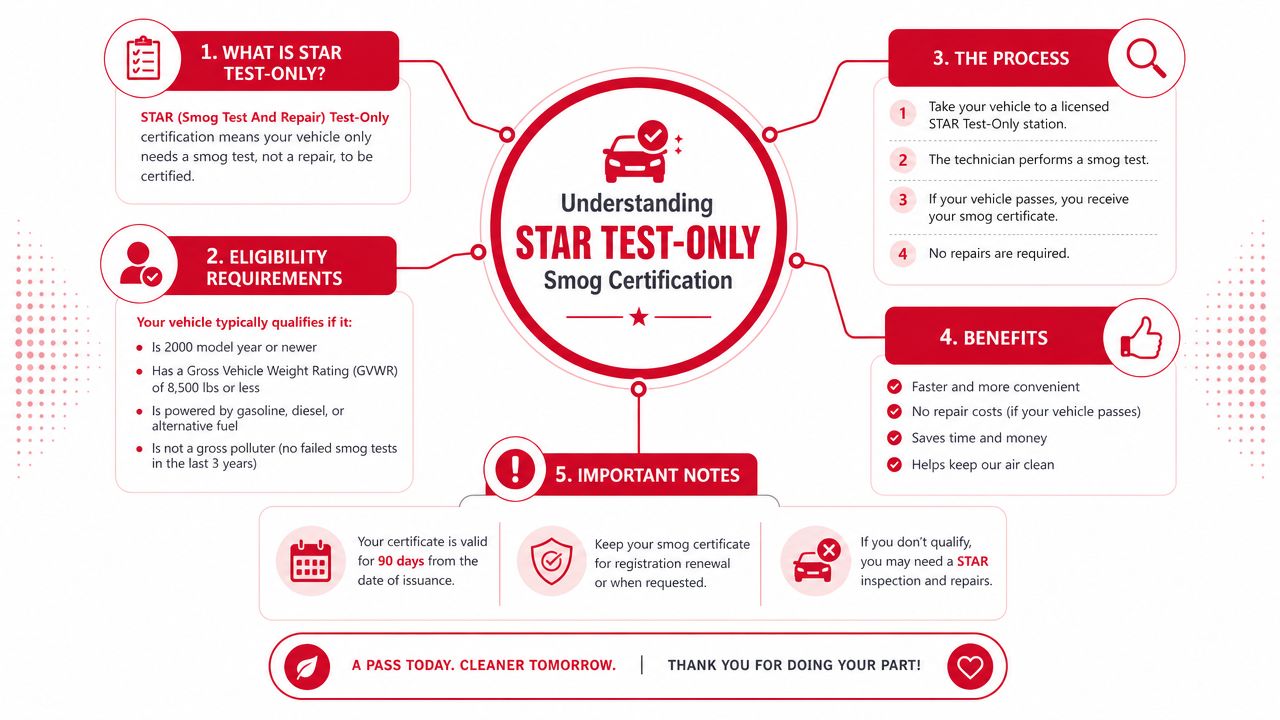
A STAR test-only station is for vehicles that need a stricter or specifically designated emissions inspection path. The key practical point is simple, the station tests your vehicle, but it does not repair it. If your vehicle is directed to a STAR station, you can't substitute a regular shop and call it the same thing.
Vehicles are commonly sent to this kind of station when the state wants a more tightly controlled emissions check. That can happen for a variety of compliance reasons, but the front-counter rule is always the same, if your paperwork says STAR, bring the car to a STAR station rather than guessing.
Practical rule: if the test is required and the vehicle has already been routed to a STAR station, don't shop for the nearest generic smog bay. Bring the exact paperwork and let the station process it the way the state expects.
The other thing drivers need to understand is the test-only part. A test-only station won't steer you into an in-house repair ticket because there isn't one to sell. That reduces the conflict of interest some people worry about when they're nervous about failing a smog test.
For drivers who want to verify they're at the right place, the station's STAR page spells out the service type directly at Fire House Smog's STAR-certified smog test page. That's the cleanest way to confirm the model before you roll in.
Smog and DMV Services Available at This Station
The service menu is straightforward once you split it into two lanes, smog and DMV. That's the easiest way to think about it at the counter, because each lane has different documents, different timing, and different reasons people get sent there.
Smog checks
This station handles passenger cars, SUVs, and light-duty trucks. It also accepts some RVs and motorhomes, but only within size and equipment limits. If you drive something larger or modified, you should call before you start the engine.
| Services at Fire House Smog on Lone Tree Way Antioch | ||
|---|---|---|
| Service Category | What It Covers | What to Bring |
| Smog testing | Passenger cars, SUVs, light-duty trucks, some RVs and motorhomes subject to size and equipment constraints | Vehicle, current registration if available, and any notice telling you to test at a STAR station |
| DMV registration renewals | On-site renewal processing with sticker printing | Valid ID and current registration |
| Ownership transfers | California vehicle transfers and out-of-state transfers | Title or transfer paperwork, valid ID, and lien information if applicable |
| Plates and tags | Plates and tags as needed during registration processing | Existing registration records and transfer documents |
DMV services
The DMV side is the part many drivers don't expect from a smog station. Here, renewals can be handled on-site, and stickers can be printed as part of the transaction. Transfers for California vehicles and out-of-state vehicles are also part of the workflow, along with plates and tags when needed.
Bring the basics. For renewals, that usually means your valid ID and current registration. For transfers, have the title or transfer documents ready, and don't show up missing lien information if a lender is still attached to the vehicle.
One useful thing about a station that does both jobs is that you can often handle the emissions test and the paperwork in the same trip. That saves you from driving across town twice, which is the primary inconvenience most drivers aim to avoid.
Hours of Operation for Smog and DMV Services
Smog testing and DMV services do not run on the same schedule, and that's where people get tripped up. If you assume the whole counter follows one timetable, you can waste a trip even when the doors are open.
Smog hours and DMV hours are separate
Smog testing runs seven days a week with extended evening and weekend availability. DMV services run Monday through Saturday from 9:30 AM to 5:00 PM and Sunday from 12:00 PM to 4:00 PM, with limited services possible on weekends.
| Service | Schedule |
|---|---|
| Smog testing | Seven days a week, extended evening and weekend hours |
| DMV services | Monday through Saturday, 9:30 AM to 5:00 PM |
| DMV services | Sunday, 12:00 PM to 4:00 PM |
| Weekend note | Limited services may be available on weekends |
The practical mistake is showing up for a DMV task during a smog-friendly hour and assuming the same counter flow applies. It doesn't. If your goal is only a test, the seven-day smog schedule gives you room. If you need registration work, you need to line up with the DMV window.
Weekday mornings are usually the cleanest time to avoid crowding. Sunday afternoon is also useful if you work Saturdays and still need a DMV counter that's open.
For most Antioch drivers, the weekend window is the one they forget. Sunday afternoon can be the most workable slot if your week is already packed and you don't want to give up a Saturday errand run.
Test-Only Versus Test-and-Repair Smog Stations
A test-only station and a test-and-repair station solve different problems. That difference sounds small until you're standing at the counter deciding whether you're there for verification or for actual mechanical work.
What test-only changes
At a test-only station, the technician checks emissions compliance and documents the result. There's no built-in repair sale waiting on the other side of the failure. That's the cleanest way to remove the financial incentive to fail a vehicle so the shop can earn the repair job.
A test-and-repair shop can diagnose and fix issues after the test. That sounds convenient, and sometimes it is, but it also means the business model is tied to repair revenue. If you already suspect your car needs work, that setup can make sense. If you just need a neutral answer on whether the vehicle passes, it may not be the right fit.
How to choose the right lane
Use a test-only station when the state has directed you there, or when you want a clean, unbiased check on a vehicle you believe is close to passing. Use a test-and-repair shop when you already know the car needs mechanical attention and you want diagnosis plus repair under one roof.
A test-only station helps when your question is, “Does it pass?” A repair shop helps when your question is, “What's broken and who's fixing it?”
That's the main trade-off. You get a cleaner testing environment, but you give up the convenience of leaving with repairs already done. For many drivers on Lone Tree Way, that trade works in their favor because they want speed, paperwork, and less pressure at the counter.
Parking, Layout, and Driving Directions
Lone Tree Way is a structured suburban arterial with active retail traffic, including a 3.22-acre retail project next to In-Shape Fitness at 4099 Lone Tree Way inside the 18-acre Antioch Town Center master-planned development. That matters because parking demand on the corridor isn't accidental, it's built into the way the area functions. Antioch Town Center project details
How to pull in without second-guessing yourself
The station sits on a stretch where quick in-and-out vehicle movement makes sense, so don't overcomplicate the approach. If you're coming from Highway 4, follow your normal Antioch retail-corridor turnoff to Lone Tree Way and stay alert for shared parking and adjacent business traffic. If you're already on Lone Tree Way, slow down early and look for the driveway rather than trying to brake at the last second.
Parking is usually easier when you arrive early in the day or later in the day, because the surrounding corridor sees regular turn-and-burn traffic from nearby services and retail stops. That's a practical effect of the area's layout, not a guess.
What first-time visitors should expect
- Turn early, not late. The lot flow is easier when you commit before the last moment.
- Keep the vehicle ready. Have your registration, ID, or transfer paperwork in hand before you park.
- Watch for shared use. Lone Tree Way businesses often rely on the same busy corridor rhythm, so don't assume the empty spot you see from the street is the only one available.
The goal is simple, arrive in a way that doesn't add stress before the inspection even starts. Once you know where to turn and when the lot is lightest, the rest of the visit moves faster.
Wait Times, Appointments, and Throughput Tips
Two things help this place move vehicles faster, two service bays and a schedule that spreads demand across the week. That doesn't make the line disappear, but it does mean the station is set up for throughput instead of lingering over a single car all afternoon.
What actually saves time
The easiest win is to call ahead on a busy Saturday, especially if you're bringing more than one vehicle or you need both smog and DMV work. The second easiest win is to bring every document before you get into the lot. Once you've parked, fishing around for missing paperwork is the fastest way to lose your place in the flow.
If you need both a smog check and a registration task, try to combine them in one visit. That's especially useful for drivers who don't want to make separate trips for a test and then a renewal. It also helps small businesses and fleet operators who need multiple vehicles processed without burning a whole workday.
Front-counter advice: if you're coming with a fleet, stack the paperwork in the same order the vehicles will be tested. That keeps the line moving and avoids backtracking between cars.
For drivers who want a rough sense of timing before they leave home, the station has a separate page that addresses how long a smog check tends to take, and it's worth reviewing before you head out: Fire House Smog's smog check timing page.
The key takeaway is not that the station promises a magic fast lane. It's that its hours and bay setup are built to reduce bottlenecks if you show up prepared.
Coupon Policy and Free Retest Eligibility
This station offers a coupon on smog tests and a free retest when required. That means you should ask about the current coupon before you pay, because pricing and eligibility matter more than guesswork at the counter.
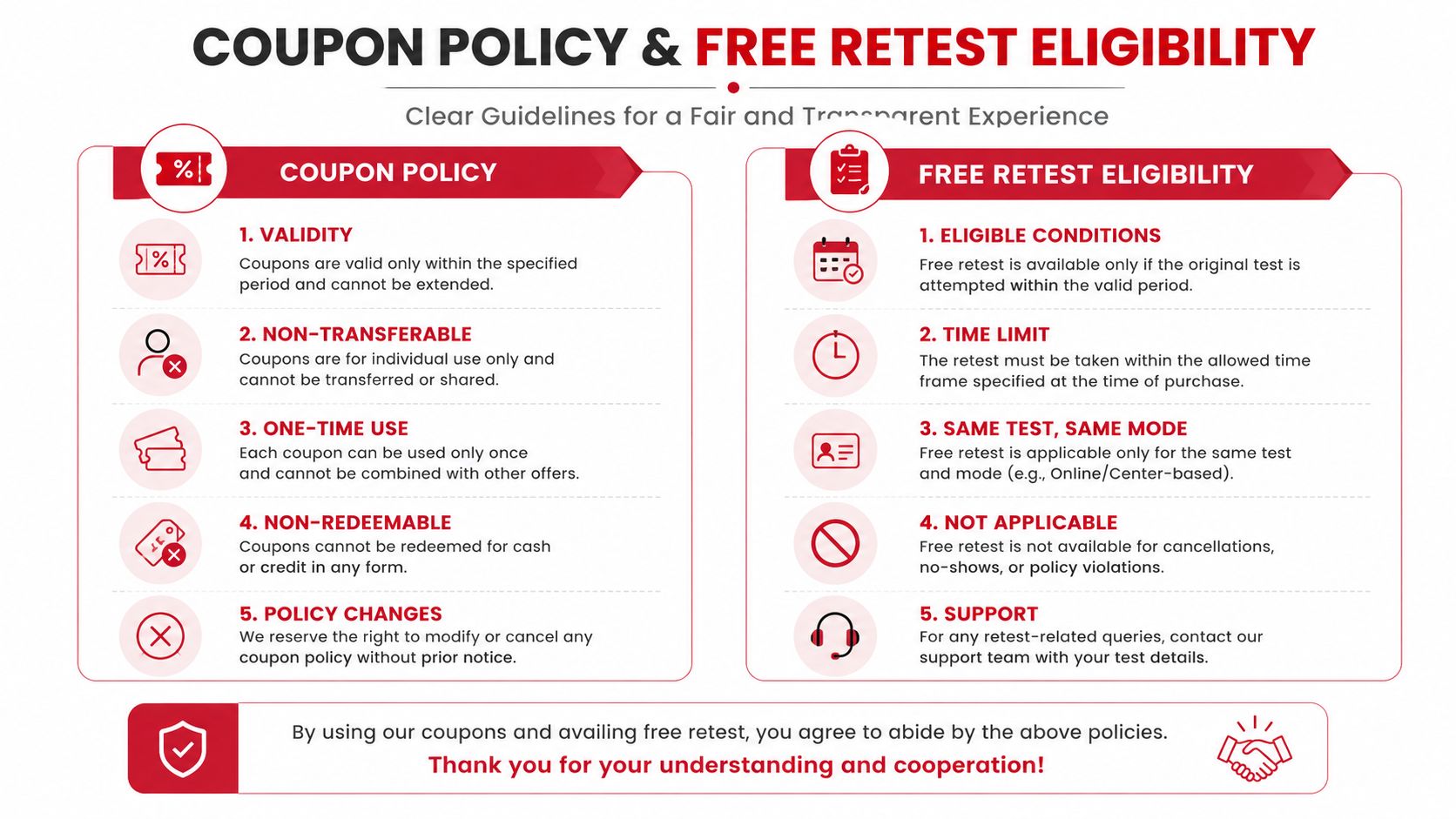
What to confirm before the test
- Coupon acceptance. Ask whether the current smog coupon applies to your vehicle and service type.
- Retest window. Confirm the eligibility period for a free retest before you leave.
- Separate fees. DMV charges and smog charges are different transactions, so don't assume one covers the other.
A free retest only helps if the vehicle failed, then got repaired elsewhere, then came back within the required window. That's how the test-only model works in real life. The station doesn't do the repair in-house, so the retest depends on where and when the fix happened.
For the current coupon details, the station posts its policy here: Fire House Smog's smog test coupon page. Check that before you show up if you want to avoid any confusion at payment time.
If the vehicle failed once, don't assume every shop's retest policy is the same. Ask this counter how its free retest works before you hand over the keys.
That single question can save you from paying twice or coming back with the wrong paperwork.
RV, Oversized Vehicle, and Out-of-State Transfer Notes
RVs and motorhomes are where a lot of generic smog advice falls apart. This station can handle some RVs and motorhomes, but only when the size and equipment fit the bay and the inspection setup. If the vehicle is oversized, modified, or unusually tall, calling first isn't optional.
Cases that need a phone call before you drive over
- Oversized RVs and motorhomes. Bay fit and equipment limits matter.
- Lifted trucks. Clearance and inspection access can change the visit.
- Diesel vehicles. Ask before coming in if the vehicle is diesel-powered.
- Check-engine lights. Don't assume a test will clear a warning light.
- Out-of-state transfers. Extra title and registration paperwork can change the process.
Out-of-state transfers deserve special attention because the paperwork can be more involved than a California renewal. If the title, lien info, or ownership path isn't clean, the counter may need more from you before the transaction can move.
The safest habit is to call before you leave home if the vehicle isn't a standard passenger car, SUV, or light-duty truck. That one call can tell you whether the station can inspect it, whether the paperwork is ready, and whether you should handle any missing documents first.
The same advice applies to anything that looks simple but isn't. A vehicle with unusual equipment can pass through a normal day just fine, but a bay with size constraints has to work inside limits. Better to ask once than to discover the limit in the parking lot.
Quick Reference and Frequently Asked Questions
Fire House Smog
Address: 2900 Lone Tree Way, Antioch, CA 94509
Phone: 925-754-1600
What it does: STAR-certified test-only smog checks, DMV registration services, renewals, transfers, plates, tags, and some RV testing within size and equipment limits.
FAQ
Is this the right place for a STAR-directed vehicle?
Yes. If your paperwork points you to a STAR station, this is the right model for that request.
What happens if my car fails?
You'll need repairs elsewhere, then a return visit for retesting if you qualify under the station's free retest policy.
Can I do a DMV renewal and a smog check on the same trip?
Often yes, as long as you come during the correct DMV hours and bring the right documents.
Do I need to call ahead for a walk-in?
For a standard car, you can usually walk in. For RVs, oversized vehicles, or out-of-state transfers, call first.
If you need a STAR test, DMV renewal, or help sorting out a transfer on Lone Tree Way, Fire House Smog is set up for exactly that kind of stop. Visit Fire House Smog before you head over, confirm the service you need, and bring the paperwork that matches your vehicle so the visit moves as cleanly as possible.
Vehicle registration renewal is the mandatory annual process of updating your vehicle's legal status with the state, proving you have insurance and have met requirements like a smog check, which allows you to legally drive on public roads. In California, that process can't be completed online unless your electronic smog certification is already on file with the DMV, so the order you do things in matters.
If you're reading this because you found a DMV renewal notice on the counter, remembered your tags are about to expire, or realized you still haven't handled your smog check, you're in the same spot as a lot of busy California drivers. The process feels simple until one missing step blocks the whole thing.
That's where most confusion starts. People think renewal just means paying a bill. It doesn't. It means the state verifies that your vehicle is still properly registered, properly insured, and, when required, properly emissions-tested.
If you want to understand what vehicle registration renewal is, what California checks, and how to avoid wasted trips and long lines, this guide will walk you through it in plain language.
Table of Contents
- That DMV Notice in Your Mailbox
- Why You Must Renew Your Vehicle Registration Annually
- Your California Renewal Checklist Documents and Deadlines
- How to Renew Your Registration in California From Online to On-Site
- Understanding Renewal Costs and Late Penalties
- The Easiest Way to Renew Your Registration in Antioch
That DMV Notice in Your Mailbox
That envelope usually creates the same reaction. You glance at it, set it down, and tell yourself you'll deal with it later. Then later turns into “Do I need a smog check first?” or “Can I just pay online tonight?”
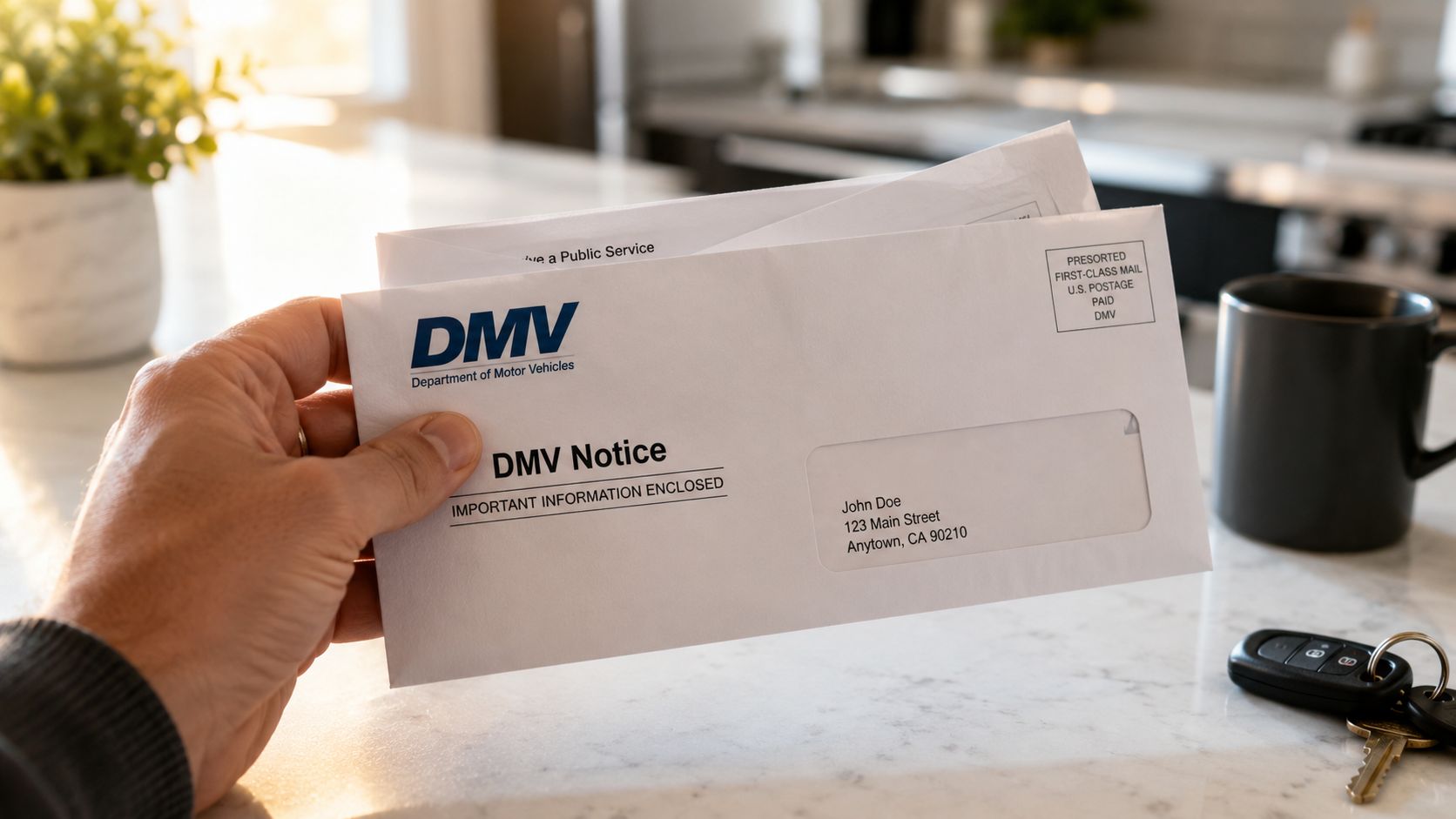
Vehicle registration renewal means renewing the state's permission for your vehicle to stay legally registered for road use. It's not the same as renewing your driver's license, and it's not just replacing a sticker.
A helpful way to think about it is this. Your license says you can drive. Your registration says this vehicle can be on public roads.
Practical rule: If your registration isn't current, paying attention to insurance alone won't fix it. The vehicle itself must be renewed with the state.
The DMV notice is really a prompt to verify three things:
- Your vehicle record is current. The state wants the registration tied to the right owner and the right vehicle details.
- Your compliance items are cleared. That can include insurance and, for many vehicles, emissions compliance.
- Your payment is submitted on time. Renewal only goes smoothly when the prerequisites are already lined up.
That's why renewal feels annoying when you're rushed. It's a chain of steps, and one missing link can stop the whole process.
Many California drivers get tripped up because they start at the payment screen. The better approach is to start with readiness. Do you have your notice or plate information? Is your insurance active? If your vehicle needs smog, has that result been sent in electronically?
Once those pieces are in place, renewal becomes routine instead of frustrating.
Why You Must Renew Your Vehicle Registration Annually
Driving on public roads comes with ongoing obligations. Registration renewal is one of them.
California doesn't treat registration as a one-time purchase that lasts forever. It works more like a recurring authorization. Each year, the state confirms that the vehicle remains properly documented and eligible to operate on shared roads.
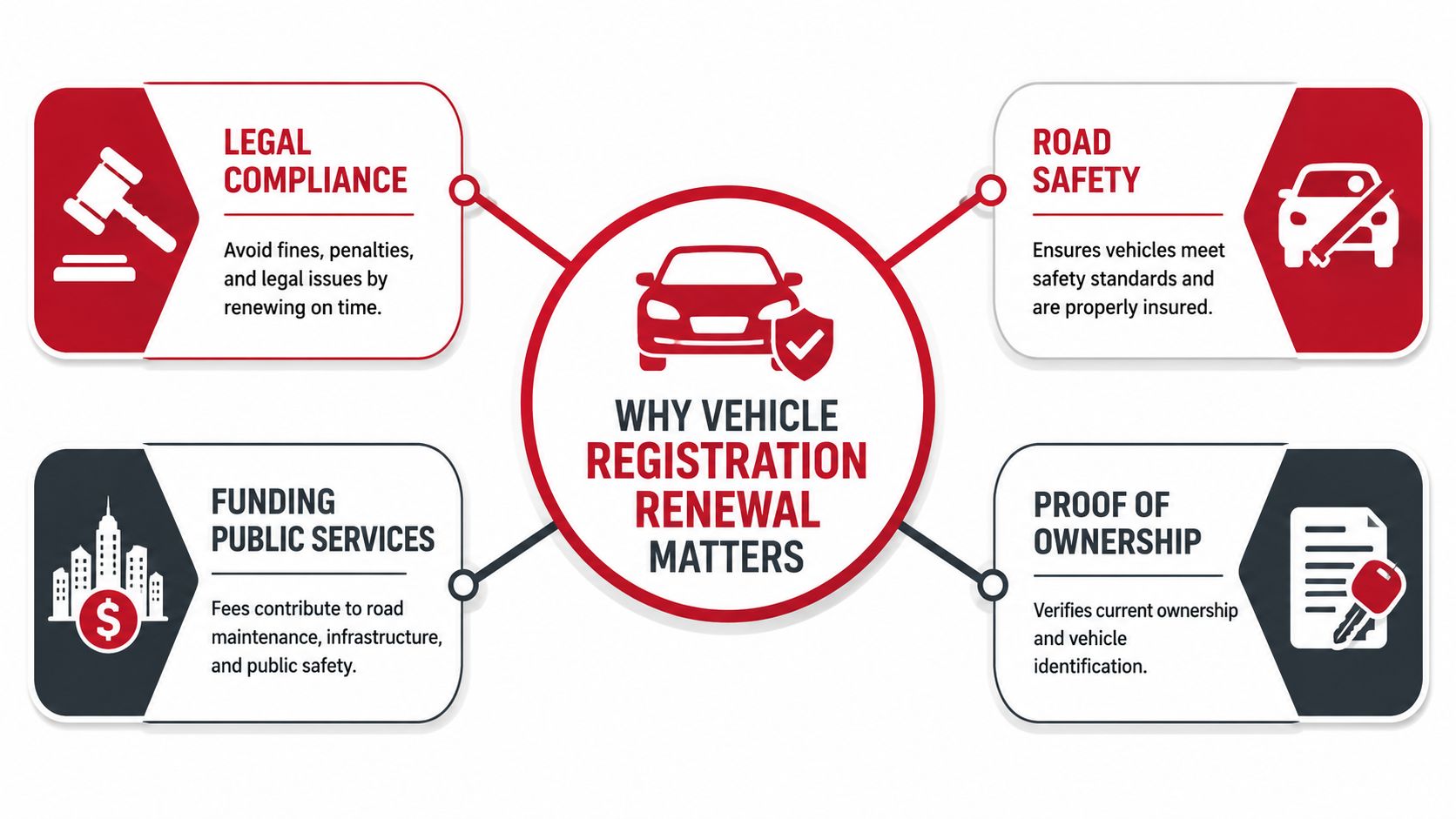
The legal reason
In the United States, renewal is an annual legal requirement. California's DMV says renewal can be denied even if fees are paid when a vehicle doesn't have valid smog certification on file or has outstanding parking tickets, and the DMV also states that electronic smog certification must already be on file before online renewal can proceed through the California vehicle registration renewal process.
That's the part many people don't expect. Payment alone doesn't solve everything. The DMV checks for compliance issues before it finishes the renewal.
The public-interest reason
Registration is also part of how the state manages safe and lawful road use. Think of it as a public-road operating agreement. You use state roads, and in return the state requires current records, valid insurance, and compliance with emissions rules where applicable.
That matters because renewal connects your vehicle to systems other agencies use too. Insurance isn't just something you keep in the glovebox. States increasingly verify it electronically, and the renewal process depends on those records matching.
Renewal isn't just paperwork. It's a state check that your vehicle still meets the conditions for legal use.
The California pain point most people hit
For many California drivers, the hardest part isn't understanding the law. It's handling the smog requirement at the right time.
Here's where people lose time:
- They try to renew online first. Then they discover the DMV has no smog result on file yet.
- They assume a paid fee guarantees completion. It doesn't if another hold is still active.
- They wait until the last minute. Then every extra errand feels urgent.
If you treat renewal like a short checklist instead of a single payment task, it gets much easier. The next step is knowing exactly what to gather before you start.
Your California Renewal Checklist Documents and Deadlines
Most renewal problems come from missing one item, not from the process being complicated. If you pull together what you need first, you can usually avoid repeat trips and stalled transactions.
What to gather before you start
Start with the basics:
- Your renewal notice, if you have it. This usually gives you the fastest path because it ties directly to your vehicle record.
- Your plate number or VIN. If the notice is missing, these details help locate the registration record.
- Current insurance information. California expects active coverage that can be matched to your vehicle record.
- Payment method. Different renewal channels may accept different forms of payment.
- Smog compliance, if required. This is often the item that decides whether you can finish today or not.
A lot of drivers ask about timing. Renewal systems around the world often use strict windows. One cited example outside California is India's 60-day pre-expiry application window for a standardized 5-year renewal duration, while some U.S. jurisdictions still rely on mailed forms and checks, such as New York's MV-3 process through a centralized center in Utica, described in this registration procedure reference. The lesson for California drivers is simple: don't assume every state handles timing and paperwork the same way.
If you want a practical list of paperwork situations, including common registration scenarios, this vehicle registration documents guide is a useful local reference.
When smog becomes the sticking point
Readers usually get confused at this point, so keep the sequence clear.
If your vehicle needs a smog check for renewal, the test must be completed first. In California, the electronic result has to reach DMV records before an online renewal can go through, as noted earlier.
That leads to a common misunderstanding: drivers often think the smog certificate is a paper they submit themselves. In practice, what matters is that the certification is transmitted and visible in the system.
If your renewal won't complete online, check the smog status before assuming the DMV website is the problem.
A few questions help you sort it out quickly:
- Does your renewal notice mention smog? If yes, handle that before trying to pay.
- Were you directed to a STAR station? If so, use the station type required by your notice.
- Did you just buy the vehicle or move to California? Ownership transfers and first-time California registration can involve separate emissions and document requirements.
- Do you have an unusual vehicle type? Some trucks, diesels, and RV-related cases can require extra verification.
Here's a simple comparison to keep straight:
| Requirement | Standard Annual Renewal | Ownership Transfer |
|---|---|---|
| Registration notice or vehicle record lookup | Usually enough to start | Transfer documents are typically needed |
| Insurance verification | Required | Required |
| Smog compliance | Often required based on DMV record | May be required depending on transaction details |
| Main goal | Extend current registration | Update legal ownership and registration record |
The takeaway is practical. Annual renewal is usually easier than a transfer, but both can stop cold if the emissions or insurance piece isn't ready.
How to Renew Your Registration in California From Online to On-Site
California gives you more than one way to renew. The right option depends on what's already done and how much time you want to spend solving problems.
The common renewal paths
Online renewal is the cleanest route when your record is already ready. It works well if your insurance is current, your smog requirement is cleared, and there are no holds that block issuance.
Mail renewal can still work for some drivers, but it's slower and less forgiving when something is missing. If you're close to expiration, mail can feel uncertain because you're waiting on processing instead of resolving issues in real time.
DMV field office service gives you face-to-face help, which is useful when the case is messy. It's also the option many people dread because it can take longer and usually requires more time carved out of your day.
Here's a quick comparison:
- Online
- Best for: Clean records and completed smog compliance
- Main drawback: You may only discover a hold after starting
- Mail
- Best for: Drivers who plan early and don't need immediate resolution
- Main drawback: Harder to correct issues quickly
- In person at a DMV office
- Best for: Complicated cases that need review
- Main drawback: More waiting and more schedule disruption
When one-stop service makes sense
For a lot of Antioch-area drivers, the biggest delay isn't the payment itself. It's having to do the smog check in one place and then solve the registration somewhere else.
That's why some people use a licensed DMV business partner that can handle both. One local option is DMV registration services near Antioch, where Fire House Smog provides STAR-certified test-only smog checks and on-site California DMV renewal services during posted service hours.
The practical benefit is straightforward. If your renewal depends on smog, combining those tasks can reduce extra stops and cut down on back-and-forth.
A short look at the process helps:
- Bring your renewal information.
- Complete the smog check if your notice requires it.
- Confirm the record is ready for DMV processing.
- Finish the registration transaction on site if eligible.
- Leave with updated documentation and tag issuance when available.
If you want to see how that service setup looks before visiting, this short video gives context:
For busy drivers, the main advantage is not having to guess which step comes first.
Understanding Renewal Costs and Late Penalties
Registration notices often look more complicated than they really are. You'll usually see several line items rather than one simple total.
What you're paying for
The exact amount on your notice can vary, but the structure usually reflects the state's registration-related charges and other required fees tied to that vehicle record. What matters most for most drivers is not memorizing every line item. It's understanding that the notice total is the amount tied to your vehicle's current renewal status.
If anything on the record is unresolved, the transaction may not process cleanly even when you're ready to pay.
For drivers trying to understand the line items before they head out, this registration renewal fee explainer can help decode what you're seeing on the notice.
Why waiting gets expensive fast
Late renewal matters because penalties don't stay theoretical. Other jurisdictions show the same pattern clearly. In the Dominican Republic, over 360,000 vehicles missed the registration sticker renewal deadline, and surcharges ranged from RD$2,000 for a single-year lapse to RD$3,100 for multi-year non-renewals, according to this report on missed vehicle renewals and surcharges.
California has its own penalty structure, and the practical lesson is the same. Once a registration goes late, the problem usually gets more expensive and more annoying, not less.
Paying attention before expiration is almost always easier than sorting out penalties, missing paperwork, and blocked records after the fact.
The most expensive delay is often the one caused by procrastination mixed with confusion. A driver waits because they think renewal is just a payment. Then they learn a required smog test or another hold still has to be cleared first.
The Easiest Way to Renew Your Registration in Antioch
If your goal is simple, get legal, avoid lines, and move on with your day, the easiest path is usually the one that removes extra stops.
Who this helps most
This works especially well for:
- Commuters with tight schedules. You don't want to spend a workday chasing separate errands.
- Families with more than one vehicle. Repeating the process across multiple cars gets old fast.
- Drivers who need smog and renewal together. That combination is where most time gets lost.
- Owners of cars, light trucks, and some RVs. A station that handles more than one vehicle type can simplify planning.
Fire House Smog is a STAR-certified test-only smog station and licensed DMV registration services provider at 2900 Lone Tree Way, Antioch, CA 94509. It offers smog testing seven days a week, has two service bays, and provides DMV service hours Monday through Saturday 9:30 AM to 5:00 PM and Sunday 12:00 PM to 4:00 PM, with 925-754-1600 for questions.
Local details you can use
The test-only model matters for some drivers because the station isn't selling repairs. That can make the visit feel more straightforward when all you need is emissions testing and registration help.
On-site DMV renewal service also matters because it addresses the most common Antioch-area pain point: people don't want one trip for smog and another for registration if both are part of the same task.
If you call ahead, you can also ask whether your vehicle type, especially if it's larger or RV-related, fits the service setup for that day. That small step can save you a wasted drive.
The core idea is simple. What is vehicle registration renewal? It's an annual legal requirement. But in practice, it goes fastest when the insurance, smog, and registration pieces are handled in the right order and, if possible, in one place.
If you want a faster local option for smog checks and California DMV renewals, Fire House Smog in Antioch handles STAR-certified smog testing and on-site registration services during posted hours, so you can clear the requirements and finish the process with fewer stops.
You've unpacked the boxes, changed your address, and maybe figured out which grocery store you like. Then the vehicle paperwork catches up with you. Your car still has an out-of-state title, your registration timing suddenly matters, and California wants more than just a signature and a fee.
That's often where difficulties arise. The official checklist sounds simple until you're standing at the counter missing a VIN verification, holding a smog report from the wrong time window, or learning that the base fee was only the smallest part of the total bill. An out of state title transfer in California is manageable, but it works best when you treat it like a document process first and a DMV visit second.
Drivers in Antioch and the rest of East Contra Costa County run into the same friction points over and over. The paperwork has to line up. The smog certificate has to be current. The title has to be usable, not just “some proof that I own the car.” If there's a lien, an electronic title, or a missing signature, the process slows down fast.
This guide is written the way I'd explain it to a new California resident who wants to get it done once, not twice. It focuses on what happens on the ground, what commonly fails, and how to move through the smog and registration parts with fewer surprises.
Table of Contents
- Welcome to California Now Let's Tackle the DMV
- Your Document and Fee Checklist Before You Start
- The Core Steps for a Smooth Title Transfer
- Understanding California's Smog Check Requirement
- Navigating Common Transfer Complications
- Skip the DMV Line and Finalize Your Registration
Welcome to California Now Let's Tackle the DMV
You unpack the house, update your insurance, and assume the car can wait until you have a free morning. Then the California paperwork starts asking for a VIN verification, a California smog certificate, and an original title that may still be sitting in a folder from your last state.
California handles an out of state transfer as a new vehicle record, not a simple address change. The state needs to confirm the vehicle, confirm ownership, and enter it into California's title and registration system correctly. That is why new residents get tripped up. The issue usually is not one big problem. It is a missed signature, a lender hold, a smog delay, or showing up before the vehicle record is ready to be finalized.
Where transfers usually go off track
The patterns are pretty consistent at the counter and at the smog station.
- The title is not ready for transfer: It may be signed in the wrong spot, missing a release, or still held electronically or by a lender.
- The owner handles steps in the wrong order: People head to DMV first, then learn they still need VIN verification or a California smog certificate.
- Out of state assumptions cause delays: A registration card, an old emissions test, or incomplete ownership paperwork often does not satisfy California's requirements.
- The move pushes the car paperwork down the list: By the time drivers deal with it, they are rushed and more likely to miss something.
One practical rule helps more than any checklist. Do not make your final DMV trip until the title path is clear, the smog question is settled, the VIN verification plan is set, and your California insurance is active.
A more effective approach
The smoothest cases follow the same order. First, confirm you have the ownership document that California can accept. Next, find out whether the vehicle will need smog. Then handle the verification and bring a complete packet for registration, instead of hoping the clerk can patch together missing pieces at the window.
That last part matters. California counter staff can tell you what is missing, but they usually cannot solve missing ownership records, lender delays, or failed smog issues on the spot.
At Fire House Smog, we see this every week. The official instructions tell you what the state requires. The primary frustration is knowing which item will stop the file from moving. If you want to avoid the common paperwork misses before you head out, use this California title transfer paperwork checklist.
Treat the transfer like a compliance file, not a quick errand. That mindset saves repeat trips.
Your Document and Fee Checklist Before You Start
Preparation saves more time here than speed. Before you leave home, you want a complete packet and a realistic idea of cost.
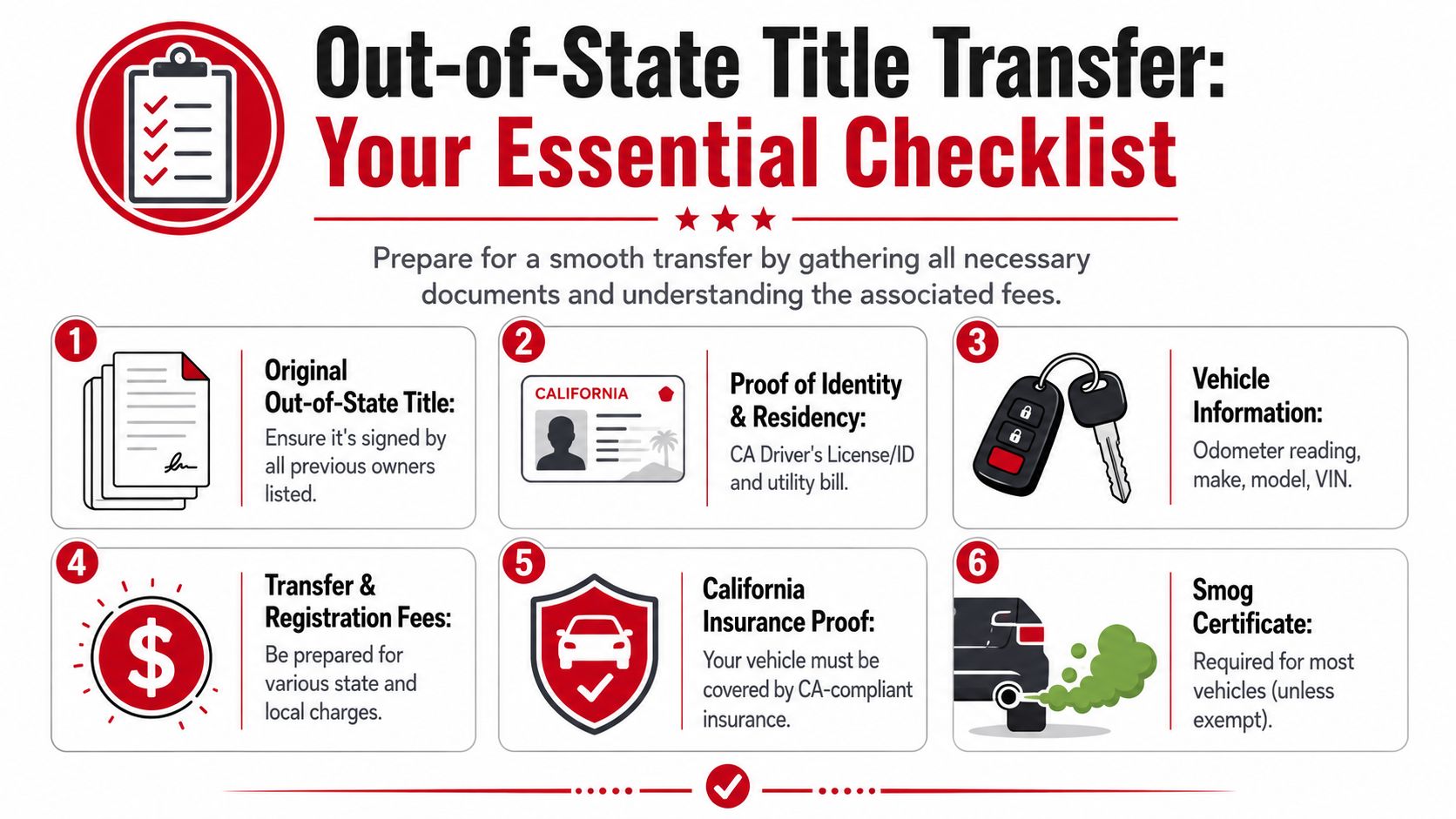
The documents that should be in your folder
For a standard California out of state title transfer, the required core items are consistent:
- Form REG 343: This is the Application for Title or Registration.
- Form REG 31: This is the Verification of Vehicle form.
- Original out-of-state title: It should be properly signed where required.
- California insurance proof: The vehicle must be covered under California-compliant insurance.
- Smog certificate if your vehicle isn't exempt: This belongs in your packet before the final filing stage.
- Ownership support if needed: If your situation involves a lien, a missing title, or title release issues, bring the supporting records that connect ownership clearly.
If you want a practical prep sheet before you go, this title transfer paperwork checklist is useful for organizing the documents people most often forget.
The fees people underestimate
A lot of drivers hear “title transfer fee” and assume that's the whole story. It isn't.
According to California title transfer fee guidance, the base title transfer fee is $15, but the total cost typically ranges from $150 to $300 or more once use tax, registration fees, and possible penalties are added. The same source states that use tax is calculated at 7.25% to 10.25% of the purchase price, depending on the local jurisdiction.
Here's the practical breakdown:
| Cost item | What to expect |
|---|---|
| Base transfer fee | $15 |
| Use tax | 7.25% to 10.25% of purchase price, depending on location |
| Title only fee | $27 for a new title only |
| Duplicate title | $27 if a duplicate is needed |
| Registration fee if registration has lapsed | Approximately $62 |
| Total transfer cost | Often $150 to $300 or more once all required charges are included |
The checklist that prevents repeat trips
Use this as your last review before you leave:
- Check the title first: Make sure you have the original out-of-state title and that signatures are complete.
- Confirm insurance is California-compliant: Out-of-state proof often creates confusion if the policy hasn't been updated.
- Know your smog status: If your vehicle isn't exempt, don't assume you can finish the process without the certificate.
- Bring the vehicle information with you: VIN, make, model, and odometer details need to match the paperwork.
- Budget beyond the headline fee: Use tax usually changes the total more than people expect.
- Watch the clock: The same fee guidance notes that failing to complete the transfer within 30 days of purchase may trigger added penalties.
Bring originals when possible. A clean folder with complete paperwork beats trying to reconstruct ownership details at the counter.
The Core Steps for a Smooth Title Transfer
A lot of new California residents hit the same snag. They have the car, the old title, and a free morning, then find out one missing form or one unresolved title issue stops the whole filing.
The process goes much better when you handle it in the order DMV staff and verification partners see every day. The usual filing packet includes Form REG 343, the original out-of-state title, a VIN verification on Form REG 31, a California smog certificate if your vehicle needs one, and payment for taxes and registration charges. The part the official instructions often gloss over is sequence. If you do the expensive or time-consuming steps before checking ownership problems, you can waste a trip.
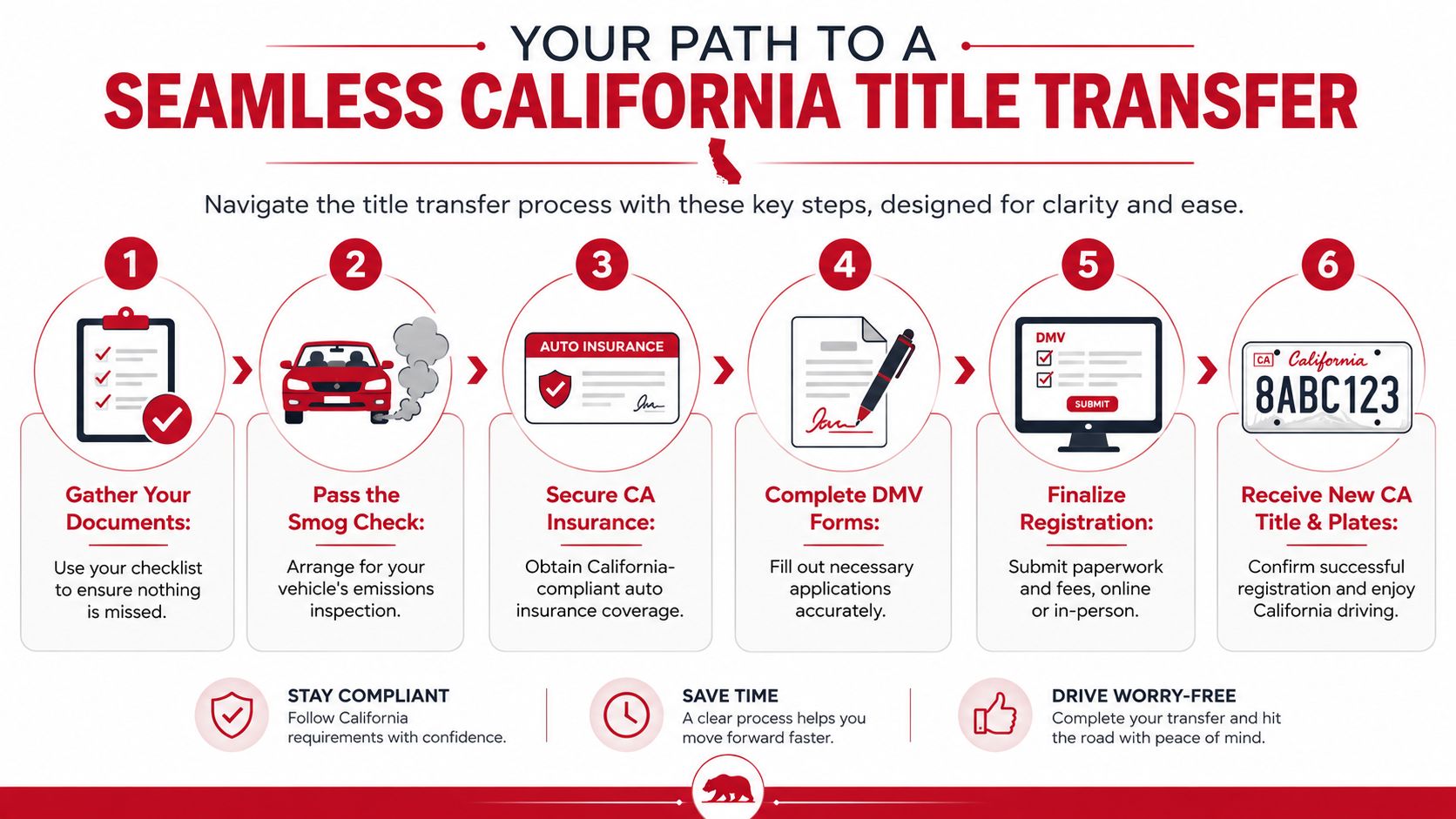
Start by confirming the title can actually transfer
Check the title before you book anything.
Look for missing seller signatures, mismatched names, lienholder information that was never released, or a title that was replaced by another document in the prior state. I have seen people complete a smog check and line up at DMV only to learn the title was signed in the wrong place or still showed a bank interest. California will not clean that up for you at the counter. You have to fix it with the seller, lender, or prior state first.
If the ownership chain is not clean, stop there and resolve it before spending time on the rest.
Get the VIN verification done early
For an out-of-state vehicle, California usually wants the vehicle physically verified so the VIN and basic vehicle details match the paperwork. That is where Form REG 31 comes in.
This step causes more repeat trips than people expect because it depends on the vehicle being present and the paperwork matching what is on the car. If the VIN plate is hard to read, the door label is missing, or the title has one digit off, the application can stall until that gets sorted out. If you want a plain-English overview of what the inspector is checking, Fire House Smog has a helpful guide to California VIN verification requirements.
A simple rule helps here. Do not save VIN verification for the same visit when you plan to file everything else unless you are certain the car and documents match.
Complete smog before your final DMV filing
Handle smog before you make the registration trip, not after.
Out-of-state owners often assume a recent inspection from another state will carry over. California does not treat it that way. If your vehicle is one that needs a California smog certificate, DMV will expect that result to already be on file when you finish the registration. At Fire House Smog, this is usually the point where people get frustrated, because they thought they were one signature away from being done and instead learn the vehicle still needs a California test.
The trade-off is simple. Doing smog earlier adds one errand up front, but it prevents a failed DMV visit later.
Submit the application with a complete packet
Once the title is clean, the VIN is verified, and smog is handled if required, bring the full packet for final processing:
- Form REG 343
- The original out-of-state title
- Completed VIN verification on Form REG 31
- Smog certification, if required
- California insurance information
- Payment for fees and taxes
Small mistakes matter here. A blank odometer field, a name that does not match your ID, or a title signed with cross-outs can send the file back for correction.
Here is the order that usually saves the most time:
| Best order | Why it works |
|---|---|
| Review the title first | Catches deal-breaking ownership issues before you spend time elsewhere |
| Do the VIN verification | Identifies mismatches while the vehicle is available for inspection |
| Complete the smog check if required | Prevents the last-step registration stall that catches many new residents |
| Fill out REG 343 carefully | Reduces avoidable clerical rejections |
| Go to DMV or registration partner with everything ready | Gives the clerk one complete file instead of a partial application |
In practice, the hard part is rarely the law itself. It is the missing signature, the unreadable VIN, or the smog step left for last.
Understanding California's Smog Check Requirement
A lot of out of state transfers stall at smog. The owner has the title, the forms, the insurance, and then learns California will not finish registration until the vehicle clears emissions.
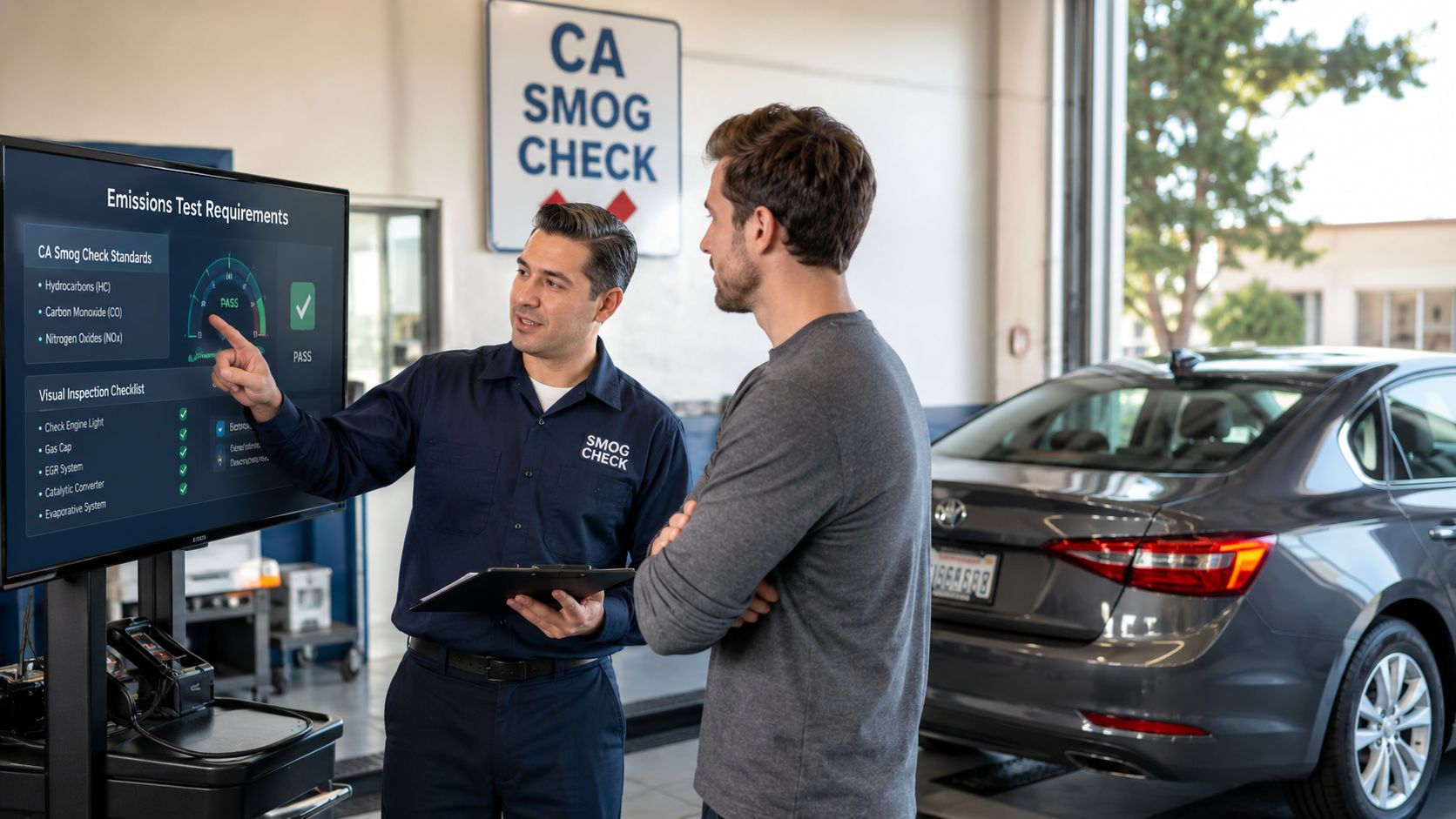
For most out of state vehicles being registered in California, a California smog certification is required before the transfer can be completed. The test has to be done at a California-licensed station, and some vehicles are directed to a STAR-certified station. The DMV summary sounds simple. The part it does not spell out is what usually goes wrong on the ground: people rely on an old test from another state, test the car too late, or assume their vehicle is exempt without confirming the rule that applies to their model year and fuel type.
Which vehicles usually need it
Start with the practical assumption that your vehicle needs a smog check unless you know it falls into an exemption. Electric vehicles are commonly exempt. Older vehicles can also fall outside the requirement based on model year and fuel type.
That is the point people should verify early.
If you drive a gasoline vehicle, a diesel vehicle, or a hybrid, and it is not clearly exempt, plan for a California smog check as part of the transfer. That keeps you from building the rest of the file around a guess.
What a STAR station changes
A STAR station is not just a regular shop with a different sign. It is a station that meets California's tighter program standards for certain inspections. If your registration case calls for a STAR inspection, going to a non-STAR shop first wastes time and money because you may have to test again at the correct facility.
That is one of the failure points the DMV website tends to gloss over. The rule is easy enough to read. The frustrating part is learning you tested at the wrong place only after you are trying to wrap up registration.
Using a shop that handles these transfer cases every day helps because staff can flag those issues before you start. At Fire House Smog, the station is STAR-certified, test-only, and also provides DMV registration services, so a new California resident can get the smog done and then finish the registration step in the same place once the paperwork is ready.
Before you go further, this video gives a helpful visual sense of the smog process and what drivers should expect.
What to do if the vehicle doesn't pass
A failed test does not kill the title transfer. It delays final registration until the emissions problem is corrected.
The first job is to read the failure report carefully and find out whether the issue looks like overdue maintenance, a sensor problem, or a repair issue that needs diagnosis. At a test-only station, the result is usually easier to trust because the shop is not trying to sell the repair in the same visit. That matters when you are deciding what to fix first and whether the car is worth further work.
One practical mistake to avoid is going straight to the DMV after a failed test and hoping the clerk can make an exception. They cannot finish the registration without a passing result when smog is required.
Treat smog as a gatekeeper item. Once it is handled correctly, the last registration step gets much easier.
Navigating Common Transfer Complications
Straightforward transfers move well. The difficult ones usually fail for predictable reasons.
According to expert data on California out-of-state transfer failures, approximately 30–40% of out-of-state title transfers face initial rejection due to documentation gaps, most often a missing valid smog certificate, incomplete REG 343 sections, or missing VIN verification on REG 31. The same source notes that when a vehicle has a lien, obtaining the title from the out-of-state lienholder can add 2–4 weeks to the process.
That tracks with what causes the most stress in real life. It's usually not a mystery rule. It's an incomplete chain of ownership or a record that California can't immediately accept.
When the title isn't clean and ready
A title can be “missing” in more than one way.
Sometimes the owner can't find it. Sometimes the lender still holds it. Sometimes the seller signed part of it but not all of it. Leased vehicles can create another version of the same problem because the registered user and the legal owner aren't always the same party on paper.
When that happens, don't rush into the DMV hoping they'll sort it out from your registration card. They usually need actual ownership documentation that supports the transfer.
Common trouble spots include:
- Active liens: The lender may need to release the lien or provide title-related paperwork before California can issue a clean new title.
- Seller errors: Missing signatures, name mismatches, or incomplete transfer sections can stop the filing.
- Lost title situations: You may need to work back through the original state or lienholder before California can finish the conversion.
- Leased vehicles: The leasing company's role changes the document path, so confirm what ownership papers they require before you schedule anything.
Why electronic titles create delays
Electronic title systems create a newer kind of problem. A driver assumes the title exists because the prior state shows ownership electronically, but California may still need a physical title or a paper version issued through the originating state's process.
The verified data specifically notes that e-title incompatibility is a growing bottleneck and that California does not universally accept out-of-state e-titles without additional verification steps. In practical terms, this means a transfer can stall even when ownership is legitimate, because the paperwork format isn't yet usable.
If your prior state used an electronic title, verify early whether a paper title must be requested. That question can save weeks.
The important takeaway is that complications aren't random. They fit patterns. If your vehicle has a lien, an electronic title, a lease structure, salvage history, or title gaps, pause and solve the ownership record before you worry about counter service speed.
Skip the DMV Line and Finalize Your Registration
Individuals can handle the forms. What they want to avoid is the long, uncertain final step.
That's the part where a licensed registration service changes the experience. Instead of making the DMV counter your only option, you can use a provider that's authorized to process registration work after the vehicle clears the required compliance pieces.
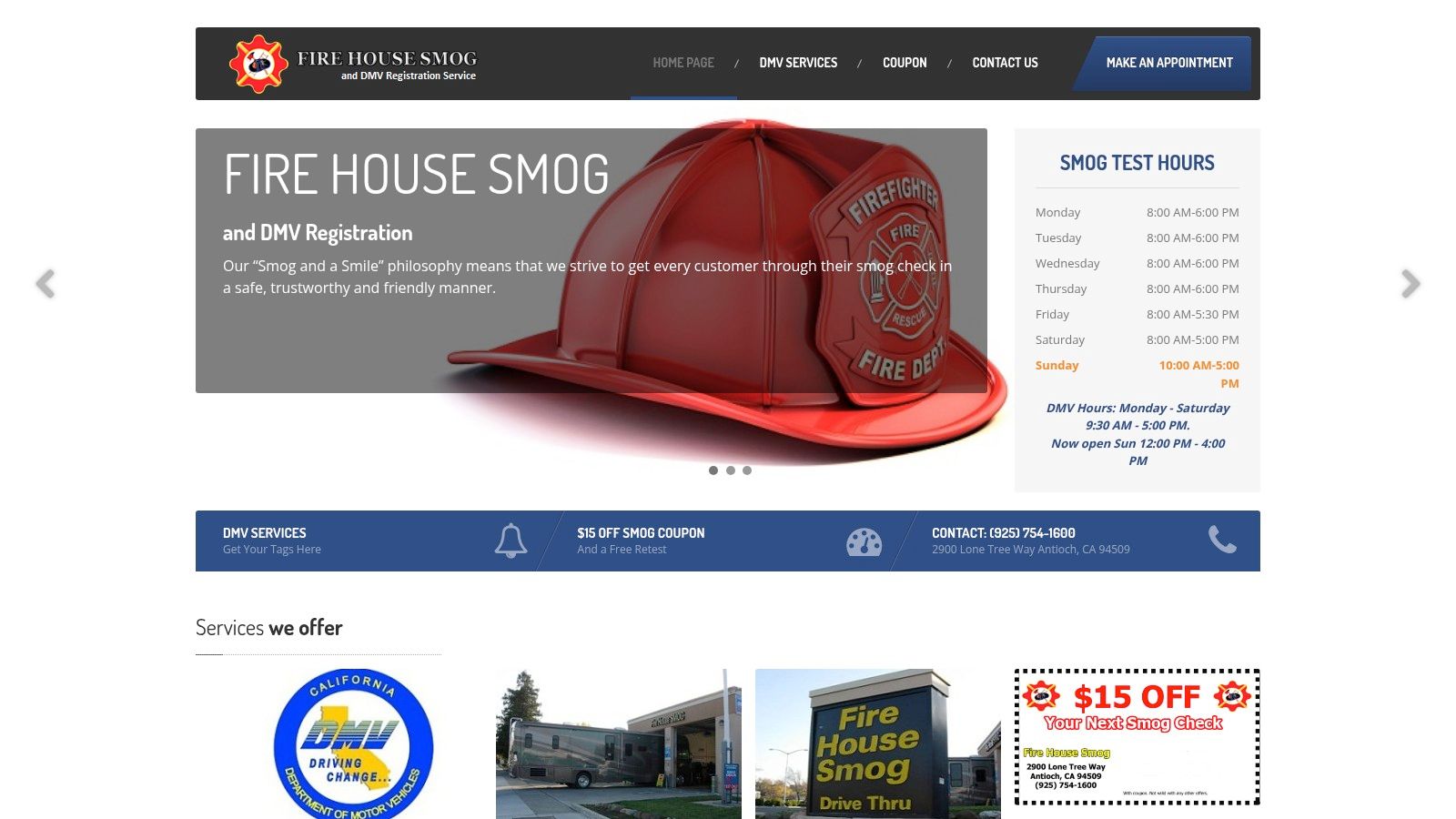
What an easier final step looks like
For many Antioch-area drivers, the most practical route is to complete the smog inspection, bring the ownership paperwork together, and finalize the registration side through a local DMV service provider rather than waiting for a traditional office appointment.
A provider offering DMV registration services near Antioch can handle renewals, ownership transfers, and related registration tasks on site when your documents are in order. That matters because the final step of an out of state title transfer is rarely difficult in theory. It's difficult because of lines, scheduling, and avoidable return trips.
Local details that matter
If you're in East Contra Costa County, the practical details are straightforward:
- Location: 2900 Lone Tree Way, Antioch, CA 94509
- Phone: 925-754-1600
- DMV service hours: Monday through Saturday 9:30 AM to 5:00 PM, Sunday 12:00 PM to 4:00 PM
- Smog availability: Seven days a week, with extended evening and weekend coverage
- Service type: STAR-certified test-only smog inspections and licensed DMV registration services
- Vehicle scope: Cars, trucks, and some RVs, subject to equipment and size limits
The on-the-ground advantage is simple. You can deal with emissions compliance and registration-related processing through the same location, and the test-only setup avoids the tension that comes with mixing diagnostics, repair sales, and paperwork under one roof.
For a new resident, that often makes the whole process feel more manageable. You're not guessing which step to do next. You're finishing the transfer with a complete packet and a shorter path to plates, stickers, and updated California records.
If you want a practical place to handle the smog and registration side of an out of state title transfer, Fire House Smog offers STAR-certified smog checks and licensed DMV registration services at 2900 Lone Tree Way in Antioch. Call 925-754-1600 to confirm your vehicle type, paperwork needs, and current DMV service availability before you stop by.

Your renewal notice shows up, and your eyes go straight to the line that means one more errand, one more fee, and one more chance to get caught by fine print. If the notice says you need a smog check, you're probably already searching for a Smog Test Only Discount and wondering which coupon is real, which one hides extra charges, and whether “free retest” means free.
That confusion is normal. Most drivers don't need a long lecture on emissions rules. They need practical help figuring out how to pay less, avoid coupon traps, and get through the test without a second surprise at the counter. If you're in Antioch, that usually means understanding how test-only pricing works, what terms matter, and how to use a discount at an Antioch smog check station without overcomplicating it.
Table of Contents
- That DMV Notice Just Arrived Now What
- Why Test-Only Stations Offer Better Discounts
- How to Find Legitimate Smog Test Coupons
- Decoding the Fine Print on Your Coupon
- Using Your Discount at Fire House Smog in Antioch
- Frequently Asked Questions About Smog Discounts
That DMV Notice Just Arrived Now What
The handling of that DMV envelope typically follows a familiar routine. The recipient opens it, scans for the due date, then stops when the smog requirement appears. The next thought is usually simple. How much is this going to cost?
In Antioch, the smart move isn't to call the first shop you remember. It's to check whether your notice points you toward a test-only requirement and then look for a coupon that applies to that category. That's where people save money without getting dragged into unclear pricing.
A common mistake is treating every smog station like it works the same way. It doesn't. If your renewal specifically pushes you toward a test-only path, the right discount can lower the inspection cost and keep the transaction cleaner because the station isn't trying to sell repairs on the back end.
The best time to read coupon terms is before you start the car, not when you're standing at the counter with your registration due.
Why Test-Only Stations Offer Better Discounts
A test-only coupon usually gives you a cleaner deal because the station is selling one thing: the inspection.
That matters. A shop that also does repairs has two revenue paths on the same visit. A test-only station does not. California separates those roles for a reason, and that separation helps the price stay easier to read. If the shop cannot turn a failed test into repair work, the coupon has less room to function as a low-price teaser.
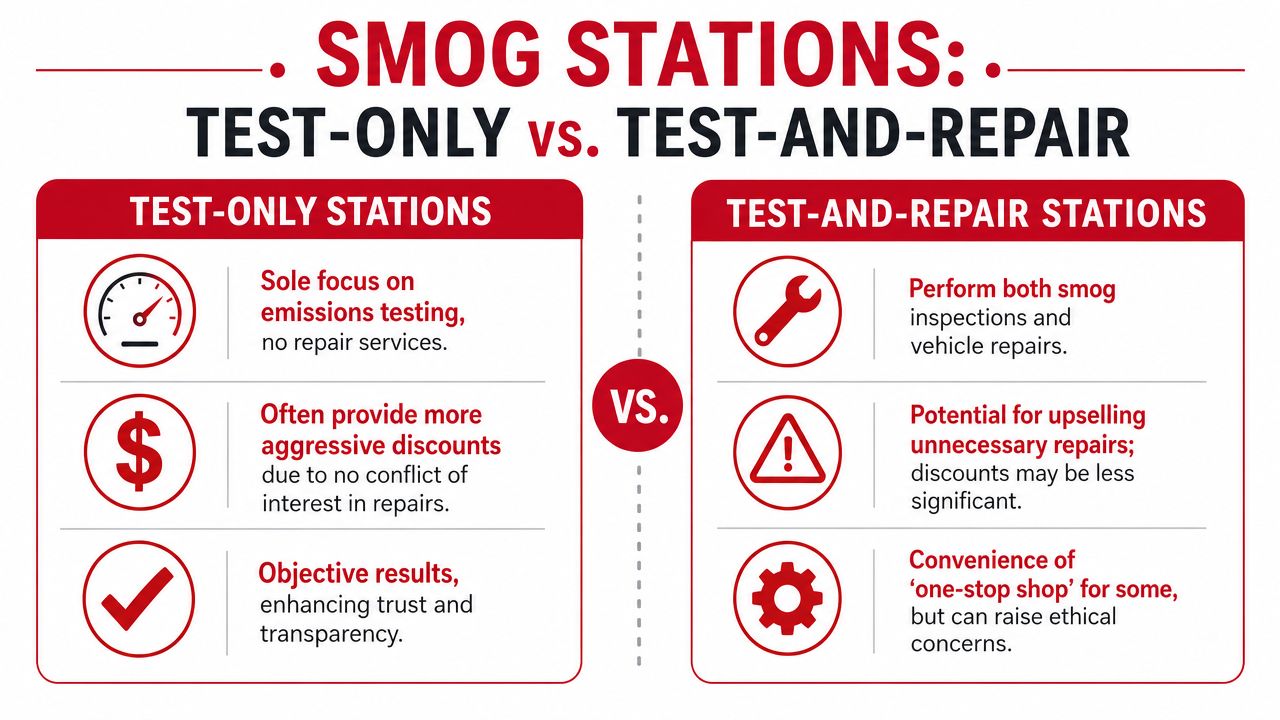
Why the pricing is easier to compare
At a test-only station, the questions are narrower. Does the coupon cover your vehicle class? Is the certificate fee included or separate? If the car fails, do you get a free retest, a discounted retest, or no retest break at all?
That last point gets missed all the time. Two coupons can show the same headline price and still have very different value once you read the retest terms. One shop may offer a free retest within a short window. Another may require you to pay again if you leave and come back after repairs. If you are comparing discounts seriously, the retest policy belongs near the top of the list, not buried at the bottom.
Here's the practical difference:
| Station type | What it does | What to check before you book |
|---|---|---|
| Test-only | Performs the inspection only | Coupon scope, certificate fee, retest terms, excluded vehicle types |
| Test-and-repair | Performs the inspection and may offer repairs | Intro price, repair upsell risk, whether the low test price depends on later work |
Drivers in Antioch can use that difference to their advantage. A straightforward test-only coupon is easier to compare across shops because you are judging the inspection terms, not trying to guess how the shop makes the numbers work on the back end.
The fine print is where the real discount lives
The best discounts are not always the loudest ones. I've seen plenty of smog offers with a strong top-line price and weak terms underneath. The useful coupon is the one that stays useful after you check the exclusions.
Look closely for details like these:
- whether the price applies to STAR or test-only vehicles
- whether trucks, older model years, or specialty vehicles are excluded
- whether the quoted price already includes the state certificate
- whether a free retest is limited to a certain number of days
- whether the station accepts another local discount on top of the posted coupon
That last one is rarely advertised clearly, but it is worth asking about. Some stations will not stack anything. Others may allow a coupon plus a small in-shop discount, especially if the terms do not conflict. The only way to know is to ask before the test starts.
Practical rule: Judge a smog coupon by the total out-the-door terms and the retest policy, not just the first number in bold.
Test-only stations do not automatically have the cheapest offer in every case. They do tend to give drivers a more honest comparison. For anyone trying to keep a renewal simple and avoid surprise costs, that is usually the better bargain.
How to Find Legitimate Smog Test Coupons
Good smog coupons aren't hard to find. Good smog coupons with clear terms are harder. That's the distinction that matters.
Start with the station's own website, because that's where you're most likely to see current offers and any restrictions tied to that location. If you're checking East Contra Costa County options, one place to look is this STAR smog test coupon page. Station-run coupon pages are usually more reliable than old directory listings or reposted screenshots that stay online long after the deal changes.
Where coupons usually show up
Drivers tend to find valid offers in a few repeat places:
- Station websites: Best for current terms, especially if the business updates coupons directly.
- Local mailers: Useful if you keep the flyer and check the expiration date.
- Deal platforms: Helpful for comparing discounts, but the listing description may be shorter than the actual in-shop terms.
- Google search results and map listings: Good for discovery, not always good for details.
One benchmark helps filter nonsense from reality. Some California test-only centers advertise deals like a $39.75 smog check, which is lower than a typical $45 to $70 range for model year 2000 and newer vehicles in major markets, and the fixed $8.25 certificate fee is a state pass-through rather than a markup item, as explained in STAR Smog Center's pricing FAQ. That tells you two things. First, real discounts exist. Second, the advertised special may apply only to the base inspection charge.
A quick screening method
When I look at a smog coupon, I don't start with the discount amount. I start with the exclusions.
Use this checklist before you commit:
- Check the vehicle category. Sedans, SUVs, trucks, vans, diesel vehicles, and some RVs may not all price the same.
- Look for “plus certificate” wording. If it appears, the advertised coupon price probably doesn't include the state certificate fee.
- Confirm station type. A test-only discount should be used at a test-only location, especially if your DMV paperwork points you that way.
- Read the expiration date. Old coupon pages waste time.
- Call if your vehicle isn't standard. Larger vehicles and specialty setups often have separate terms.
If the coupon headline is large and the restrictions are tiny, assume the restrictions matter more than the headline.
The people who overpay usually don't miss the coupon. They miss the terms attached to it.
Decoding the Fine Print on Your Coupon
Most smog coupon confusion comes from three phrases: free retest, certificate extra, and some vehicles excluded. None of those are harmless filler. Each one can change the final bill.
The tricky part is that drivers often read coupons as promises, while stations write them as limited offers. That gap is where frustration starts. A coupon can still be legitimate and still apply only to a narrow slice of vehicles or situations.
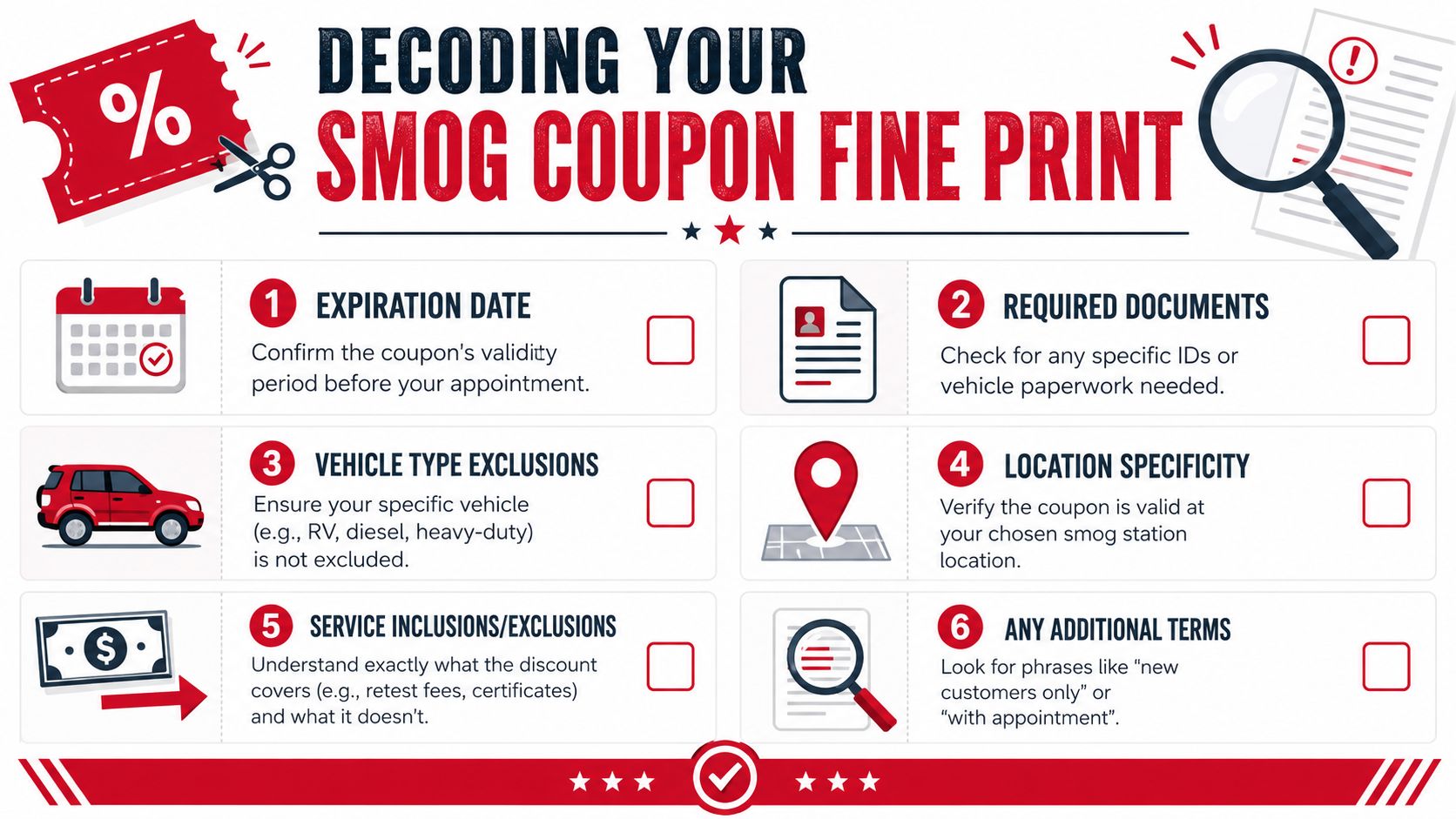
What free retest usually means
A lot of people assume “free retest” means unlimited second chances after any change they make to the car. That's where coupon language gets expensive.
Existing coverage often misses an important point. Test-only stations like Fire House Smog may offer free retests only if the vehicle fails due to emissions equipment issues, not if the owner installs new parts mid-test, according to Crown Smog Check's explanation of retest limits. If a guide online says “free retest” without defining the condition, it's incomplete.
Before you hand over the keys, ask one direct question: “Under what exact condition does the free retest apply?”
That single sentence clears up more confusion than the coupon itself.
Terms that deserve a slow read
Some coupon restrictions matter more than others:
- Vehicle exclusions: Trucks, vans, diesel vehicles, and certain RVs may fall outside the headline offer.
- Included charges: The coupon may reduce the inspection price but not include every fee shown at checkout.
- Appointment requirements: Some offers only apply if you mention the coupon when you arrive or book ahead.
- Customer type restrictions: A few specials apply only to new customers or one vehicle per visit.
Here's a simple way to read the offer:
| Coupon phrase | What it usually signals |
|---|---|
| Free retest | A narrow policy, not a blanket promise |
| Plus certificate | The state certificate fee is separate |
| Most vehicles | Your vehicle may fall outside the advertised price |
| STAR / test-only | The offer may be tied to a specific inspection type |
What drivers should ask before approving the test
If you want the fast version, ask these at check-in:
- “Is this coupon valid for my exact vehicle?”
- “Does the posted price include the certificate fee or not?”
- “What voids the free retest?”
That's enough to separate a real bargain from a misunderstanding.
Using Your Discount at Fire House Smog in Antioch
If you're planning to use a coupon locally, the smoothest approach is to arrive with the offer ready on your phone or printed out, confirm it applies before the test starts, and clarify the retest terms at the counter. That avoids the awkward version of the visit where the car is already in the bay and the pricing conversation starts too late.
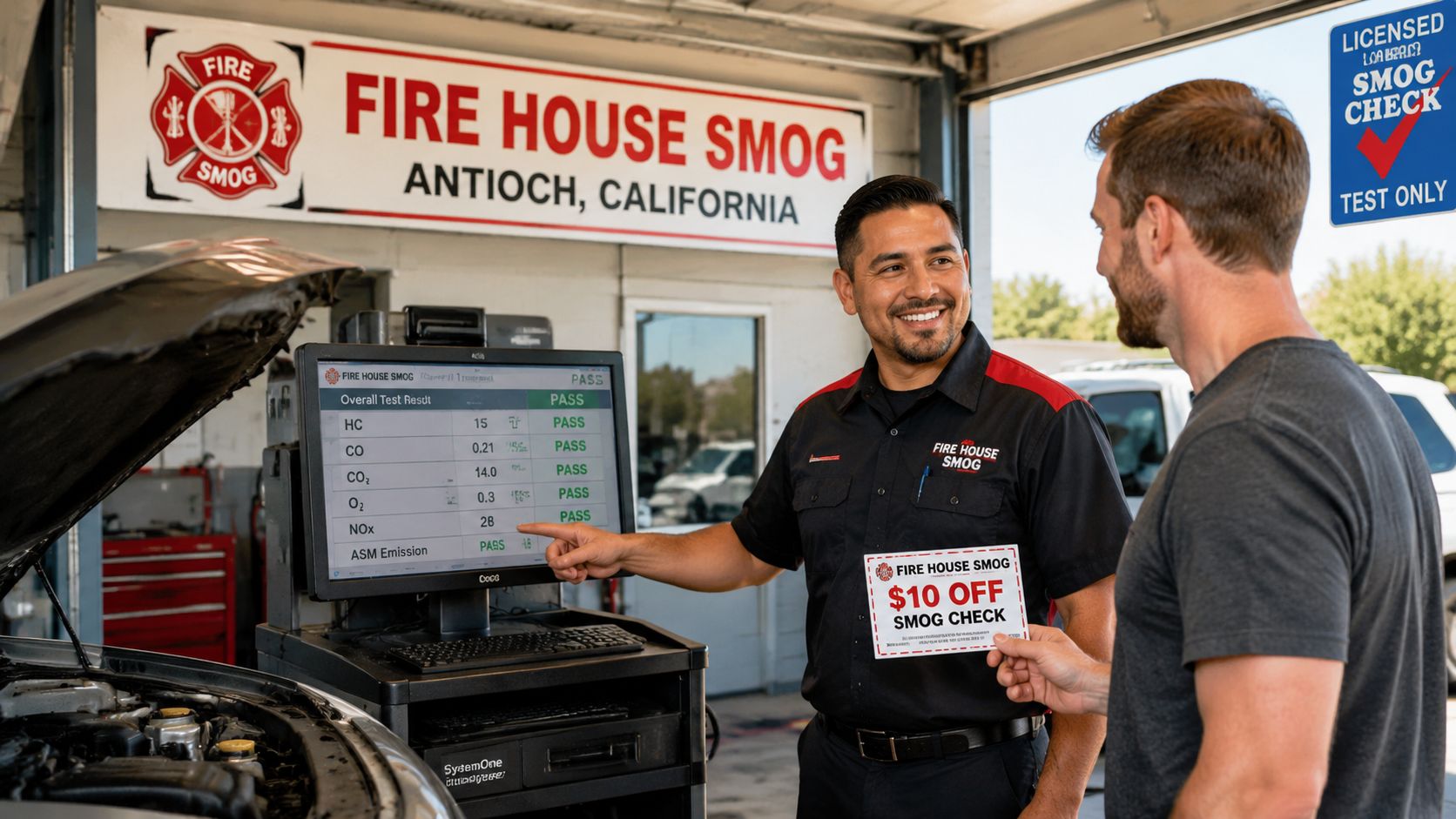
What the visit usually looks like
At Fire House Smog's in-out test-only center, the process is straightforward if you come prepared. Bring the vehicle, your renewal-related paperwork if you have it handy, and the coupon you intend to use. Since it's a STAR-certified test-only operation, the main point is inspection and certification, not repair sales.
The station operates with two service bays and offers smog testing seven days a week with extended evening and weekend hours, which helps if you're trying to fit a required inspection around work or family logistics. For DMV-related services, posted hours are Monday through Saturday 9:30 AM to 5:00 PM and Sunday 12:00 PM to 4:00 PM, with limited services possible on weekends. That matters if you want to pair the smog visit with registration help on site.
Why checking your coupon first saves time
Low-price smog offers work because the station keeps the process efficient. Industry guidance points to First Pass Rate as a key benchmark, and the average passing rate in high-traffic areas is about 88%, according to Diamond Certified's smog check guide. Shops offering discounted inspections have to keep equipment calibrated and workflow tight, because repeat tests eat into already thin margins.
That's why you don't want any avoidable delays at check-in. If your vehicle is a nonstandard fit, has unusual equipment, or you're relying on a free retest clause, ask before the test begins.
A short explainer can also help if you want to see how the process generally works:
Best way to use the discount without friction
Use a simple sequence:
- Show the coupon first. Don't wait until payment.
- State your vehicle type clearly. Sedan pricing often differs from larger vehicles.
- Ask about the retest condition. Especially important if the offer mentions one.
- Confirm whether DMV service is needed after the inspection. That can save a second trip.
- Keep the paperwork until registration is finished. It's easier than trying to reconstruct the visit later.
A coupon works best when it changes only one variable, the inspection price, and leaves no uncertainty about the rest.
Frequently Asked Questions About Smog Discounts
Can you combine a senior or military discount with another coupon
Sometimes a shop allows it. Sometimes the coupon language blocks it.
What matters is the station's posted policy, not a statewide rule that says every discount has to stand alone. BAR pricing rules focus on clear fee disclosure, especially the certificate fee. They do not force a shop to stack offers. That is why the smartest move is to ask one direct question before the test starts: “Can you apply this coupon with my senior or military discount on the same transaction?”
At Fire House Smog, ask that at check-in, not after the inspection is finished. That is when misunderstandings usually start.
What if your vehicle is sent to a test-only station and then fails badly
A hard fail changes the math.
You still get the benefit of a shop that only tests and does not sell you repairs on the spot. But if the car comes back with a Gross Polluter result or another serious failure, the discount on the inspection is no longer the main issue. Time, repair planning, and retest rules matter more. In some cases, owners may qualify for repair assistance through California's consumer assistance program, but that is a separate process and not something a test-only station handles during the same visit.
The practical takeaway is simple. If your coupon advertises a free retest, read the limit closely. Some offers cover only a return visit within a short window and only after repairs are completed elsewhere.
Does a STAR requirement automatically mean the smog check will cost more
No. STAR status by itself does not set the price.
The final cost usually comes down to the base rate, your vehicle category, whether the coupon excludes certain model years or larger vehicles, and whether the certificate fee is already included in the ad. A regular station and a STAR station can both run fair pricing. The difference is in the details printed under the headline price.
How long is the certificate good for
A smog certificate is valid for 90 days, according to Smog Check Deals' California smog discount overview.
That window matters more than drivers think. Test too early, then wait on registration or repairs, and you may end up paying for another inspection.
Is every free retest offer worth chasing
No. “Free retest” sounds better than it often is.
Some coupons only include the retest if you return within a tight deadline. Some exclude Gross Polluter results. Some apply only if the initial failure was close, or only if no parts had to be replaced. Others are valid only for the original vehicle category listed on the coupon. Those limits are not always obvious in the ad itself.
The useful coupon is the one with terms you can explain in one sentence. If the retest policy sounds vague on the phone, expect friction at the counter.
If you want a local option that handles STAR-certified test-only smog inspections and DMV-related services in one place, check Fire House Smog. Review the current coupon terms before you go, confirm how the retest policy applies to your vehicle, and bring the offer with you at check-in so the discount is settled up front.
You open the mailbox, see the DMV notice, and immediately start doing calendar math. Can I get there before work? Will I need an appointment? If the car still needs a smog check, is this now two errands instead of one?
That's why so many Antioch drivers search for DMV registration services near me when the renewal notice shows up. They're not looking for a government building. They're looking for the fastest legal way to get current, stay on the road, and avoid burning half a day in line.
In East Contra Costa County, the smarter move is usually simple: handle the smog requirement and the registration transaction through a licensed local provider so you can skip the main DMV office entirely.
Table of Contents
- That Dreaded Envelope What To Do When Your DMV Notice Arrives
- The DMV Office vs A Local Partner The Real Difference
- Your Guide to Same-Day Registration Renewals and Transfers
- What to Expect at Fire House Smog in Antioch
- Pro Tips to Permanently Avoid DMV Headaches
That Dreaded Envelope What To Do When Your DMV Notice Arrives
The usual pattern goes like this. You get the notice, set it on the counter, and tell yourself you'll deal with it later. A few days pass. Then the stress starts because registration deadlines don't move just because your week got packed.
For a lot of drivers in Antioch, the frustration isn't the renewal itself. It's the assumption that renewing registration automatically means a trip to a crowded DMV field office, a long wait, and a second stop somewhere else if the car also needs emissions testing.
That assumption is where people lose time.
In California, registration volume is already high, and it keeps pressure on the system. In 2023, California recorded a total of 1,775,915 vehicle registrations, an 11.9% increase from the previous year, which helps explain why field offices stay busy and why drivers look for faster alternatives through California Auto Outlook data from CNCDA.
What most drivers miss
A licensed DMV business partner can often handle the transaction you were planning to do at the state office. That means your search for DMV registration services near me should include local registration providers, not just official DMV locations.
If your renewal notice says a smog check is required, preparation matters. The fastest visits usually happen when you already know which documents to bring, and this vehicle registration documents guide is a practical place to double-check before you leave home.
Practical rule: Don't wait until the last week on the notice. The closer you get to the deadline, the fewer options you have if paperwork is missing or the vehicle needs a retest.
The better move in Antioch
Busy drivers usually care about one thing. Can this be handled in one stop?
That's a key advantage of using a local provider that's set up for both emissions compliance and registration work. Instead of treating the DMV notice like the start of a drawn-out chore, treat it like a checklist item. Get the car tested if required, finish the registration, collect what you need, and get back to your day.
The DMV Office vs A Local Partner The Real Difference
When people type DMV registration services near me, they often mean, “Where can I get this done today without making my whole day revolve around it?” That question has two very different answers depending on where you go.
A state DMV field office is the official channel. A licensed local partner is the practical channel for many common transactions.
Why the experience feels different
The DMV field office handles a huge range of issues, from licensing to identity documents to complex title problems. That broad mission is exactly why a routine registration errand can turn into a slow, crowded process.
A local registration provider is narrower by design. The workflow is built around common vehicle transactions, and that matters when you're trying to renew tags or complete a transfer without bouncing between locations.
The fastest registration visit is usually the one that removes extra stops, not the one that chases the nearest government building.
There's another point drivers often misunderstand. Many people still think registration and emissions testing are separate errands by default. In practice, California's STAR-certified stations like Fire House Smog are licensed to provide both, which simplifies the process and avoids the repair-sales conflict that can come with shops that also sell repairs, as noted in this discussion of third-party registration and emissions-location confusion.
DMV Office vs Local Partner
| Factor | CA DMV Field Office | Licensed Partner (e.g., Fire House Smog) |
|---|---|---|
| Primary role | Broad state services across many transaction types | Focused registration help for common vehicle needs |
| Smog check on-site | No | Yes, at locations that are licensed for both |
| Workflow | Often separate from emissions compliance | Can combine smog and registration in one visit |
| Repair upsell concern | Not applicable at DMV | Reduced at test-only stations that don't perform repairs |
| Convenience for renewals | Can require more waiting and planning | Often better suited for quick, local processing |
| Best use case | Complex DMV matters outside routine registration | Drivers who want one-stop renewal or transfer service |
What works and what doesn't
What works is choosing the place that matches the transaction. If you need a straightforward renewal, a smog-related renewal, or a common ownership transfer, a licensed partner is often the cleaner option.
What doesn't work is treating every DMV notice like it requires a trip to the field office. That approach adds friction for no real benefit when the job is something a local provider can legally process.
Your Guide to Same-Day Registration Renewals and Transfers
If you want same-day service, don't wing it. Most delays happen because the driver showed up with the wrong paperwork, forgot the title, or didn't realize the smog requirement had to be cleared first.
California requires a smog inspection for most registration renewals and ownership changes, and that requirement has to be satisfied before a sticker can be issued, according to the California DMV vehicle registration rules.
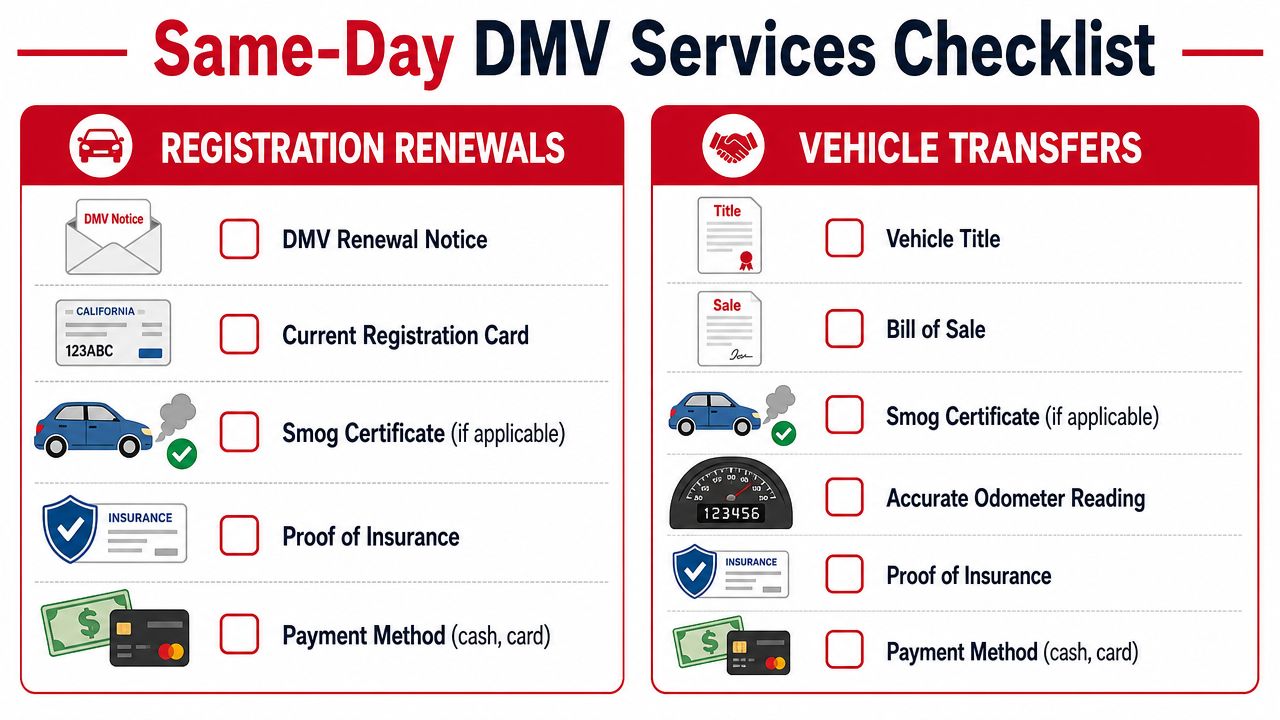
For a registration renewal
A renewal is usually the simpler visit, especially if the notice is current and the vehicle information matches what the state has on file.
Bring these items:
- DMV renewal notice: This speeds up lookups and helps the counter verify exactly what's due.
- Current registration card: Helpful if the notice isn't available or if details need to be confirmed.
- Smog certificate if applicable: If your renewal requires emissions compliance, handle that first.
- Proof of insurance: Keep it current and easy to show.
- Payment method: Bring a card or cash based on what the location accepts.
If you're unsure whether your paperwork is enough, it helps to review the transfer and registration requirements ahead of time through this vehicle registration transfer page.
For an ownership transfer
Transfers go smoothly when the title is complete and legible. They slow down fast when signatures are missing, the buyer and seller information doesn't match, or the odometer reading wasn't recorded properly where required.
Bring as much of the following as applies to your situation:
- Vehicle title: The pink slip matters most. Check signatures before leaving home.
- Bill of sale: Not always the main document, but often useful when the transaction details need support.
- Smog certificate if applicable: This is the item people forget most often in private-party sales.
- Accurate odometer reading: Write it down carefully.
- Proof of insurance: Don't assume you can sort this out later the same day.
- Payment method: Fees and processing still need to be completed on-site.
If you're buying or selling locally, fill out the title before anyone drives away. Fixing signature mistakes after the fact is where simple transfers turn into repeated trips.
The order matters
For transactions tied to emissions compliance, the sequence is straightforward:
- Confirm what kind of transaction you're doing
- Complete the smog check if the vehicle requires it
- Bring the supporting documents to the registration counter
- Finish payment and collect the updated registration items
That order is why one-stop locations save so much hassle. You're not guessing which errand comes first. The requirement that can block the sticker gets handled before the paperwork is finalized.
What to Expect at Fire House Smog in Antioch
At the Antioch location on Lone Tree Way, the process is built around a simple idea. Get the vehicle inspected, then complete the registration transaction without sending the driver somewhere else.
That matters because STAR test-only service changes the feel of the visit. A test-only station isn't trying to turn a failed inspection into a repair sale. For drivers, that removes a layer of suspicion that comes up at shops where the same business both diagnoses the problem and profits from the repair.
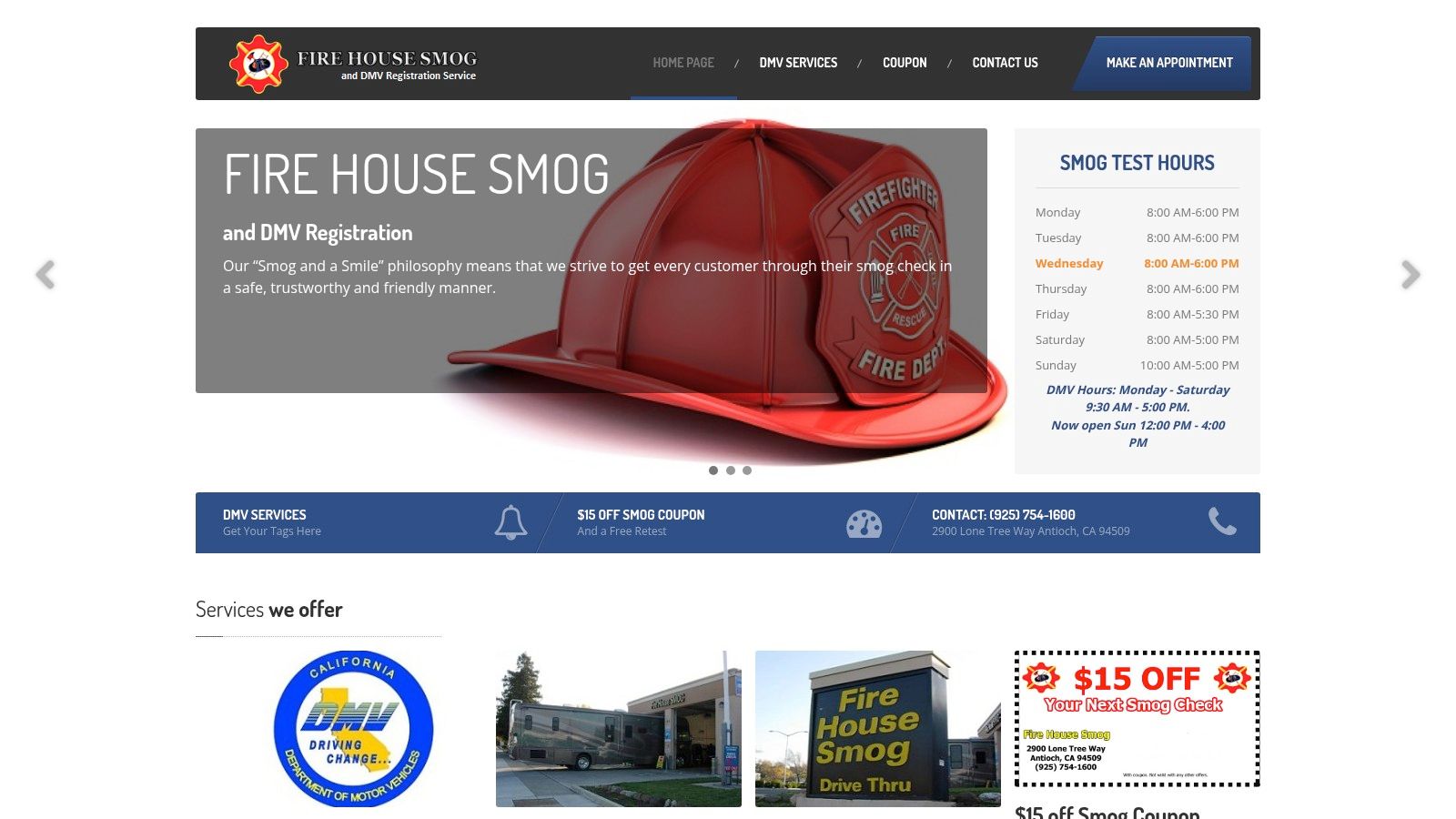
What the visit usually looks like
You arrive with the car and your paperwork. The smog side handles the inspection. After that, you move to the counter for the DMV side if your transaction qualifies for on-site processing.
The setup includes two service bays, which helps keep cars moving and reduces the bottleneck you often see at smaller stations with only one lane of activity. Most passenger cars, SUVs, and light trucks fit the usual workflow. Some RVs and motorhomes can be handled too, but calling first is the smart move because size and equipment limits matter.
If you need to confirm the emissions side before going in, the most relevant local service details are on the Antioch smog check page.
Why people choose this route
Drivers usually want three things:
- One stop instead of two: Finish the smog requirement and registration task in a single visit.
- No repair pressure: Test-only service keeps the inspection separate from repair sales.
- Same-day completion: For eligible transactions, you can leave with current registration handled instead of waiting to schedule another errand.
Local shops that combine compliance work and registration processing solve a very specific problem. They turn a DMV chore into a short operational stop.
Pro Tips to Permanently Avoid DMV Headaches
The cleanest registration experience starts before you leave home. Most problems aren't dramatic. They're small preventable issues like missing paperwork, an unsigned title, or showing up on a weekend expecting every weekday service to be available.
The habits that save time
- Open the notice right away: Don't let it sit on the counter until the deadline feels urgent.
- Check whether smog is part of the transaction: If it is, treat that as the gatekeeper step.
- Match the location to the job: Routine renewals and standard transfers often fit a licensed partner better than a field office.
- Review hours before you drive over: Weekend confusion is common.
Weekend availability is where drivers get tripped up. While some states have 24/7 self-service kiosks, most licensed California DMV partners offer more limited weekend hours, such as Sunday afternoons, so it's smart to verify current weekend tag-printing availability in advance through this weekend-hours note about third-party service limitations.
One last practical move
Before booking your time around the visit, check the business website for current smog coupons or service notes. Even when the registration side is the main reason you're going, a small discount on the smog side and a clear understanding of posted DMV hours can make the whole errand simpler.
If your goal is to stop treating registration like an all-day event, the pattern is consistent: prepare the documents, handle smog first when required, and use a local one-stop provider when the transaction fits.
If you want a local one-stop option in Antioch for smog testing and DMV registration help, Fire House Smog handles common renewals, ownership transfers, and on-site tag issuance during posted service hours. Calling ahead is the quickest way to confirm what documents you need and whether your transaction can be completed the same day.