You open your registration notice, scan for the due date, and then spot the line that throws you off: STAR Smog Check Required.
That wording makes a lot of drivers think something is wrong with the car. It can also sound like the test will be tougher, more expensive, or more likely to fail your vehicle. Usually, it means something much simpler. The DMV wants your car inspected at a station that meets a higher standard for testing quality.
If you're trying to figure out what a STAR test-only station is, why your notice mentions it, and what you're supposed to do next in Antioch, this guide breaks it down in plain English.
Table of Contents
- What 'STAR Smog Check Required' on Your DMV Notice Means
- What Makes a Smog Station 'STAR Certified'?
- Choosing Between a Test-Only vs a Test-and-Repair Station
- How to Prepare Your Vehicle for a Smog Check
- What to Expect During the Smog Test Process
- Your Local STAR Test-Only Solution in Antioch Fire House Smog
What 'STAR Smog Check Required' on Your DMV Notice Means
You open your registration notice expecting the usual renewal steps, then one line changes the mood: STAR Smog Check Required. Many Antioch drivers read that and assume the DMV found a problem with their car.
In most cases, that line is about the type of station you must visit, not a verdict on your vehicle's condition.
A simple way to read it is this: the DMV is giving you a lane to use, like being directed to a specific checkout line. Your car is still getting a smog inspection, but the inspection has to be done at a station approved for STAR work. If you need a local STAR smog check station in Antioch, the goal is to choose a shop that can issue the certificate your renewal requires.
What that means for you
Your next step is practical. Go straight to a STAR-certified station.
If you stop at a non-STAR shop first, that shop may not be able to complete the certification tied to your DMV notice. That can turn one errand into two.
Practical rule: If the notice says STAR is required, choose a STAR-certified station from the start.
What it does not mean
Drivers often worry that a STAR test is somehow harder on the car. That is a common myth.
The better way to understand it is this: STAR refers to the station's approval and oversight. Test-only adds another layer of confidence because the shop is focused on inspection, not selling repairs during the same visit. For many vehicle owners, that combination means a more impartial result and fewer doubts about whether the recommendation was influenced by repair work.
So if your notice says STAR, don't read it as a warning label on your car. Read it as an instruction about where to go. That small shift clears up most of the stress before the appointment even starts.
What Makes a Smog Station 'STAR Certified'?
You open your registration notice, see the word STAR, and it can feel like your car just got placed in a tougher category. That reaction is common. The reassuring part is that STAR describes the shop's approval status, not a harsher version of the smog test.
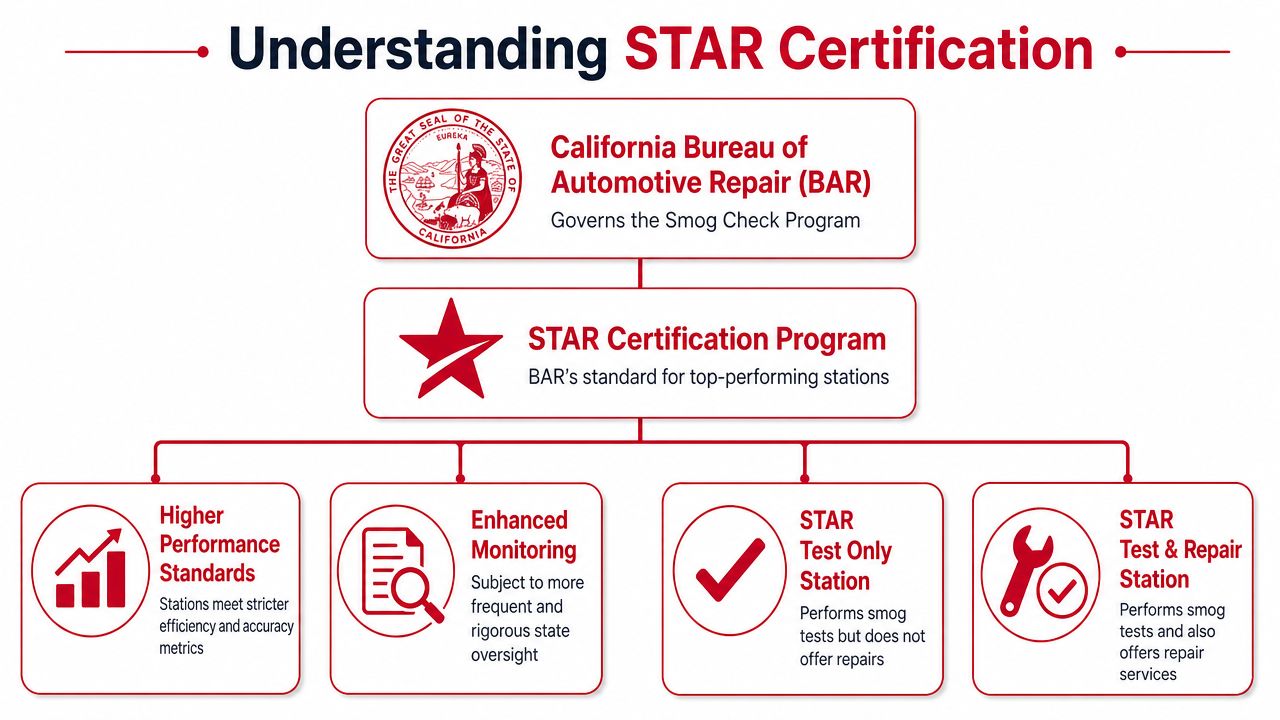
A STAR station is a smog station that the California Bureau of Automotive Repair recognizes for meeting stricter performance and oversight standards. The focus is on how the station performs inspections, tracks accuracy, and follows state requirements over time.
STAR refers to the station, not your car
This is the part that clears up the most confusion.
Drivers often hear “STAR” and assume the vehicle will be tested more aggressively. What changes is the level of accountability on the shop. BAR expects STAR stations to maintain stronger inspection performance, which helps the state rely on those results with more confidence.
A school testing room works as a useful comparison. The exam is the same, but one room may be supervised more closely to make sure procedures are followed correctly. The student is not facing a harder test. The supervision is tighter on the testing process.
That is why STAR and test-only make sense together for many drivers. STAR points to higher oversight. Test-only means the station is focused on inspection rather than repair sales. Put together, that can give you a more neutral, dependable result, which is exactly what many car owners want from a required inspection.
When seeking a local STAR smog check station in Antioch, the practical question is whether the station is approved to complete the inspection your DMV notice calls for.
Why some vehicles are sent to STAR stations
California uses STAR stations as part of its quality-control system in certain cases. That is why some drivers are directed to a STAR location while others can choose from a wider group of smog stations.
The easiest way to read that requirement is as a routing decision by the state. Your vehicle is being sent to a shop that meets a specific approval standard. It is not being singled out for a tougher technical exam.
That distinction matters. Once you understand that STAR is about station certification and oversight, the process feels much less intimidating.
Choosing Between a Test-Only vs a Test-and-Repair Station
Once you understand STAR, the next phrase that matters is test-only.
A lot of drivers assume all smog shops work the same way. They don't. Some inspect and repair. Others only inspect. That difference changes the customer experience in a big way.
The biggest difference is repairs
A STAR test-only station can perform Regular and STAR smog inspections, but it is legally prohibited from performing emission repairs, which helps create a non-bias outcome without repair revenue incentives, according to SmogTips' explanation of the STAR station program.
That legal limit is the whole point.
If a station can't sell you the repair, it has less room for the kind of suspicion many drivers already have. You don't have to wonder whether a failed test will immediately turn into a repair estimate from the same counter.
For some people, a test-and-repair station is convenient because one place can handle both steps. For others, especially drivers who want a neutral reading first, test-only feels more comfortable. An in-and-out smog test-only center is built around that inspection-first model.
Side-by-side comparison
| Feature | STAR Test-Only Station (e.g., Fire House Smog) | Test & Repair Station |
|---|---|---|
| Main role | Performs inspections | Performs inspections and repairs |
| Repair work on emissions issues | Not allowed | Allowed |
| STAR inspections | Yes, if certified | Yes, if certified |
| Regular smog inspections | Yes | Yes |
| Conflict-of-interest concern | Lower, because the shop can't sell repairs from a failed test | Higher potential concern, because the shop may also recommend and perform repairs |
| Best fit for | Drivers who want an inspection without in-house repair sales | Drivers who want testing and possible repairs in one location |
Which option fits your situation
Choose test-only if you want a clean yes-or-no answer first.
Choose test-and-repair if your priority is handling a likely failure and repair process under one roof. That can save trips, but it's a different kind of relationship with the shop.
If your DMV notice specifically requires STAR, make sure the station is STAR-certified first. After that, decide whether you prefer the neutrality of test-only or the convenience of test-and-repair.
For anxious drivers, the strongest benefit of a STAR test-only station is peace of mind. The station's job is to inspect, not to build a repair ticket.
How to Prepare Your Vehicle for a Smog Check
The easiest smog checks are usually the ones where the driver did a few simple things beforehand.
A little prep won't fix a real emissions problem, but it can prevent avoidable issues and help the appointment go more smoothly.
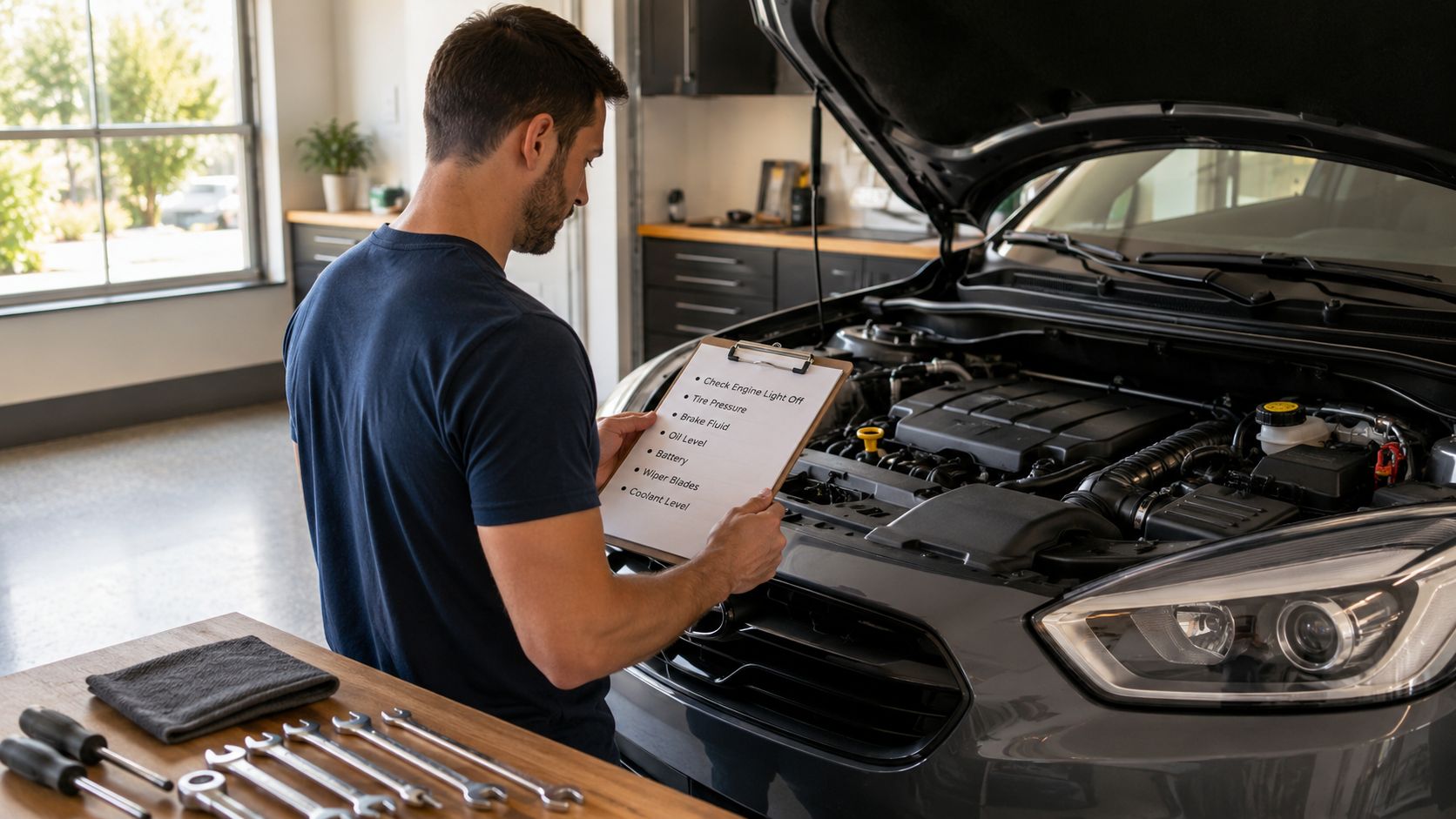
A short pre-test checklist
Start with the basics:
- Drive the car first: A short drive before the appointment helps warm the vehicle up. Cars that have been sitting a long time can be more finicky during inspection.
- Check the dashboard: If the Check Engine light is on, that's a strong sign you should diagnose the issue before testing.
- Look for obvious problems: Loose gas caps, visible smoke, or recent battery disconnects can create headaches.
- Make sure the car is usable for testing: If the tires are low or the battery is weak, take care of that before you go.
- Review common failure causes: This guide on why vehicles fail a smog check can help you spot issues before the visit.
What to bring with you
Keep your paperwork simple and easy to reach.
Bring:
- Your DMV renewal notice
- Current registration
- Proof of insurance
- Payment method
If you're unsure how the visit works from the driver's side, this short walkthrough gives a helpful visual overview:
A calm approach works best
Drivers sometimes rush in right before closing, with a cold engine, missing paperwork, and no idea whether the car has an active warning light. That creates stress before the technician even starts.
Give yourself a little margin. A prepared visit feels faster, cleaner, and a lot less frustrating.
What to Expect During the Smog Test Process
When you arrive, the process is usually more routine than people expect. You hand over the vehicle information, the technician confirms what kind of inspection is required, and then the car goes through the required checks.
The visit itself typically takes about 20 to 30 minutes, and for passing vehicles there is a mandatory $8.25 State Certificate fee, as described in All Star Smog Testing's summary of the California STAR program.
What the technician checks
The inspection involves visual and functional testing. The shop is looking at whether required emissions-related components are present and whether key systems respond as expected.
For vehicles that use OBDII, the inspection also includes reading the car's onboard data. That helps confirm the vehicle's reported information and emissions-related status.
What many drivers notice is how ordinary this looks in real life. The tech isn't inventing a custom test because your notice says STAR. The station is following the standard procedure it is authorized to perform.
How the visit usually ends
There are two basic outcomes.
If the vehicle passes, the certification is handled for your registration requirement. If it doesn't pass, the technician will tell you the result and give you the paperwork you need for the next step.
That failed result can still be useful. It tells you the car needs attention before registration can move forward, and it gives you a clear starting point for repairs elsewhere if you used a test-only station.
A failed smog test is frustrating, but it's still information you can act on. The report tells you where to focus, instead of leaving you guessing.
The main takeaway is that the process is structured, familiar, and usually quick. Most of the stress comes from the unknown before the appointment, not from the appointment itself.
Your Local STAR Test-Only Solution in Antioch Fire House Smog
You open your DMV notice, see that STAR is required, and the first question is usually simple: where do I go that checks the right box without turning this into a bigger project than it needs to be?
For Antioch drivers, the practical answer is a station that is both STAR-certified and test-only. Those two labels work well together. STAR means the shop is approved to perform the inspection your DMV notice calls for. Test-only means the station inspects the vehicle but does not use the visit to sell repairs. For many drivers, that combination feels more straightforward because the result is the result.
That pairing also clears up a common misunderstanding. A STAR test is not a tougher version of the smog check for your car. It is the same type of inspection performed at a station that meets stricter state performance standards. A good comparison is using a certified scale instead of a random one. The item being weighed has not changed. The standard for the equipment and process has.
Why this setup fits busy Antioch drivers
Fire House Smog is a STAR-certified test-only smog station and licensed DMV registration services provider in Antioch. That matters for local drivers who want one place that can handle the inspection and, in many cases, the registration steps that follow.
The business information provided for Fire House Smog highlights a few details that can make the errand easier:
- Seven-day smog availability: useful if work or family schedules limit weekday options
- Two service bays: helpful for keeping cars moving through the shop
- On-site DMV renewal services with sticker printing: can save a second stop for eligible registration needs
- Free retest policy: available per site policy and coupon terms
- Service for cars, SUVs, light-duty trucks, and some RVs: with a call-ahead recommendation for larger vehicles
A key benefit is clarity. If your notice says STAR, you need a shop authorized for STAR inspections. If you also prefer a station that focuses only on testing, a STAR test-only location matches both needs at once.
Location and service details
If that is the kind of station you want in Antioch, the published business details for Fire House Smog are:
- Address: 2900 Lone Tree Way, Antioch, CA 94509
- Phone: 925-754-1600
- DMV service hours: Monday through Saturday 9:30 AM to 5:00 PM, and Sunday 12:00 PM to 4:00 PM
- DMV services offered: renewals, ownership transfers, and related registration support with on-site tag issuance during posted hours
For a driver trying to get registration handled before a deadline, that setup can remove a lot of friction. You know the station can perform a STAR-required inspection. You know the test-only model keeps the visit focused on inspection results. And if your paperwork lines up, you may be able to take care of registration tasks in the same stop.
If you need a STAR-certified test-only inspection in Antioch, or want to handle a smog check and DMV registration task in one stop, Fire House Smog offers local service for passenger vehicles, light-duty trucks, and qualifying registration needs.
Your registration renewal notice shows up, and one line jumps off the page: you need a smog check. For a lot of Antioch drivers, that's the moment the questions start. Why this year? What exactly are they checking? Is a newer emissions rule going to cause trouble for the car you already own?
The easiest way to think about vehicle emissions standards is this: they're the air-quality rules your car has to meet so it can stay on the road legally. They may sound abstract, but they show up in a very concrete place. The smog station bay, the DMV renewal process, and that dashboard warning light you were hoping would go away on its own.
This guide is for the local driver who wants the policy translated into plain language. If you're trying to line up an Antioch smog check appointment, it helps to understand what the rules are really doing, how California fits into the bigger picture, and what your next step should be before you pull in for a test.
Table of Contents
- Your Guide to Navigating Smog Check Requirements
- What Are Vehicle Emissions Standards
- Federal vs California Standards Why the Rules Differ
- How Standards Impact Your Vehicle and Smog Test
- Passing Your Smog Check and What to Do If You Fail
- Compliance Made Easy in Antioch
Your Guide to Navigating Smog Check Requirements
A smog check can feel like a bureaucratic chore until you connect it to its real job. It's a screening process that helps keep higher-polluting vehicles from adding more exhaust to the air people breathe every day. In that sense, it works a lot like a routine health check. You may feel fine driving the car, but the test can catch a problem your nose, ears, and eyes won't detect.
That bigger purpose isn't just local. Over 70% of all light vehicles sold globally today are subject to mandatory vehicle emissions standards, and major markets such as the United States, Japan, and China helped establish the basic frameworks many countries now follow, according to the Climate Change Authority review of international vehicle emissions standards. So when you get a renewal notice in Antioch, you're dealing with a local requirement that sits inside a much larger shift toward tighter emissions control.
Why your smog check matters beyond registration
The test isn't only about paperwork. It's about confirming that your car's emissions system is still doing what it was designed to do. Parts like the catalytic converter, oxygen sensors, evaporative controls, and onboard computer all play a role.
If one of those systems stops working properly, your vehicle may still drive normally for a while. But it can release more pollution than the rules allow.
Practical rule: A smog check isn't a punishment for owning an older car. It's a compliance check to make sure the emissions equipment on that car is still working the way the law expects.
What drivers usually want to know first
Most questions fall into a few buckets:
- Why am I required this year: Registration cycles, vehicle type, and California program rules determine when testing applies.
- What are they checking: The vehicle's emissions-related systems, including electronic readiness and fault reporting.
- Will a new rule affect my current car: New sales rules and ownership rules are not the same thing.
- What happens if I fail: You'll need diagnosis and repair before retesting.
Those questions are normal. The confusion usually comes from hearing a federal headline, a California headline, and a DMV notice, then trying to figure out how they connect to one car in one driveway.
What Are Vehicle Emissions Standards
Vehicle emissions standards are legal limits on how much pollution a vehicle may emit. These standards tell manufacturers how clean a vehicle must be, and they give states a framework for checking whether vehicles on the road are still operating as intended.
Think of standards as limits on what comes out of the tailpipe
A useful way to picture it is as an environmental report card for your car. The rules focus on pollutants that affect air quality and health, including carbon monoxide (CO), nitrogen oxides (NOx), hydrocarbons (HC), and particulate matter (PM). You don't need to memorize every acronym. What matters is that these are the byproducts regulators try to reduce because they contribute to smog and dirtier air.
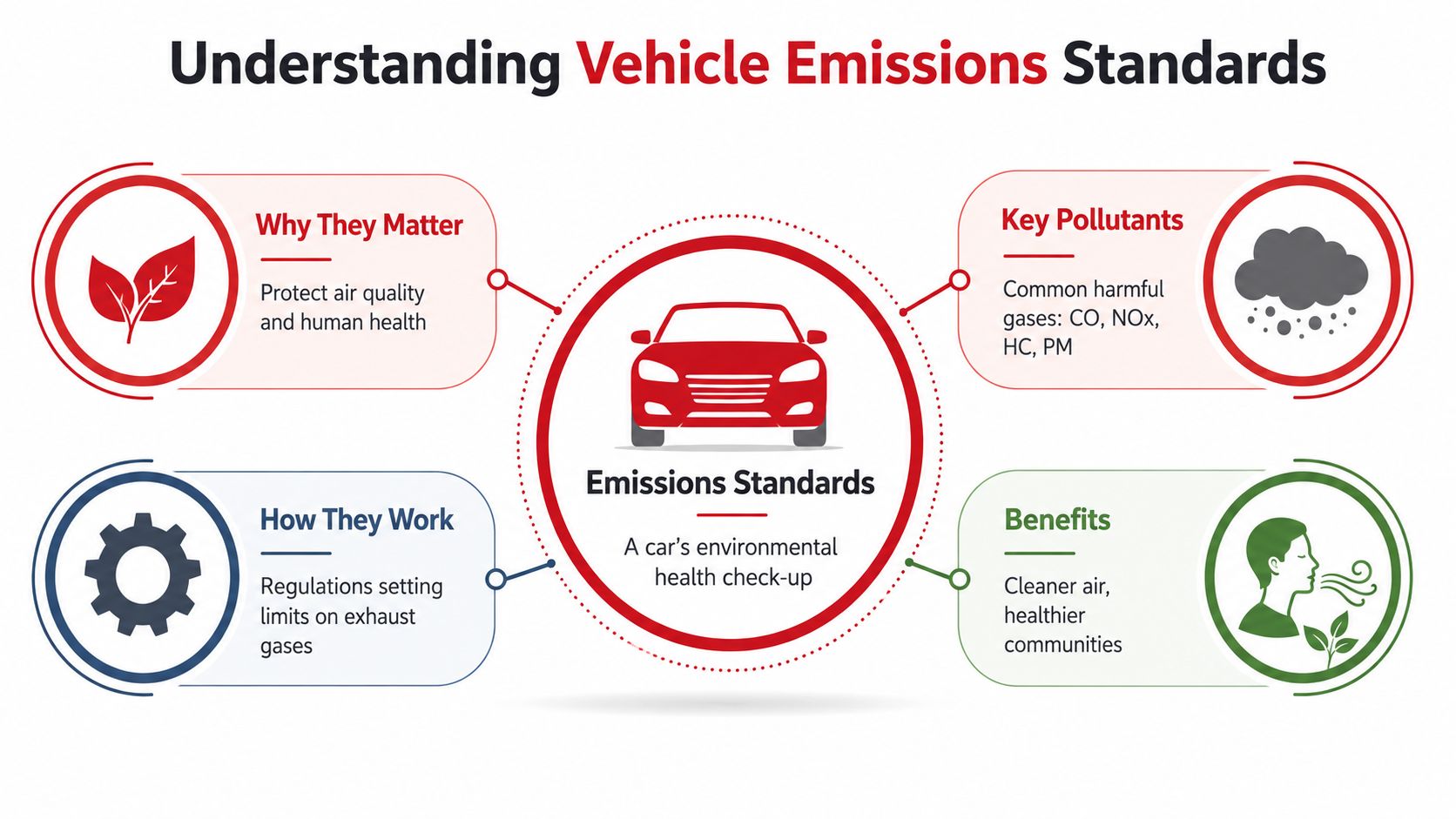
The scale helps explain why the rules exist. A typical passenger vehicle emits about 4.6 metric tons of carbon dioxide per year, each gallon of gasoline produces 8,887 grams of CO2, and light-duty vehicles account for 57% of U.S. transportation-sector greenhouse gas emissions, according to the EESI fact sheet on vehicle efficiency and emissions standards.
That doesn't mean your smog check is measuring every emissions issue in the same way. It does mean the vehicle category most Antioch residents drive has a large impact, which is why regulators pay so much attention to it.
Why this matters to an everyday driver
If you're standing at a smog counter, the policy debate can feel far away. But the practical takeaway is simple. Your car has emissions-control hardware and software. The standards are the rules. The smog check is one way the state verifies that your car still fits within that system.
Here's the plain-language version of the main pollutants:
| Pollutant | What it means in plain English | Why drivers should care |
|---|---|---|
| CO | Gas produced by incomplete combustion | Higher levels can point to poor combustion or control-system problems |
| NOx | Compounds formed under high heat in the engine | A major contributor to smog formation |
| HC | Unburned fuel vapors | Often signals fuel or ignition issues |
| PM | Very small particles in exhaust | Important in modern emissions control, especially under stricter rules |
Cleaner-running emissions systems usually mean fewer surprises at test time. A glowing Check Engine light often means the car already knows something is wrong.
Federal vs California Standards Why the Rules Differ
Drivers hear about EPA rules on the news, then run into California smog requirements at registration time. That can make it sound like there are competing systems. There are really two connected layers. A federal baseline and California's separate authority to set stricter rules in some areas.
Two rulebooks, one vehicle market
At the federal level, the Environmental Protection Agency sets national emissions standards. Those rules apply across the country and shape how automakers design vehicles for the U.S. market.
California operates differently because the Clean Air Act gives the state a unique waiver to set stricter vehicle emissions standards due to its “compelling and extraordinary” circumstances, and that waiver also allows other states to adopt California's rules, including rules tied to 100% zero-emission new passenger vehicle sales by 2035, as explained in the analysis of California's vehicle emissions waiver and related legal questions.
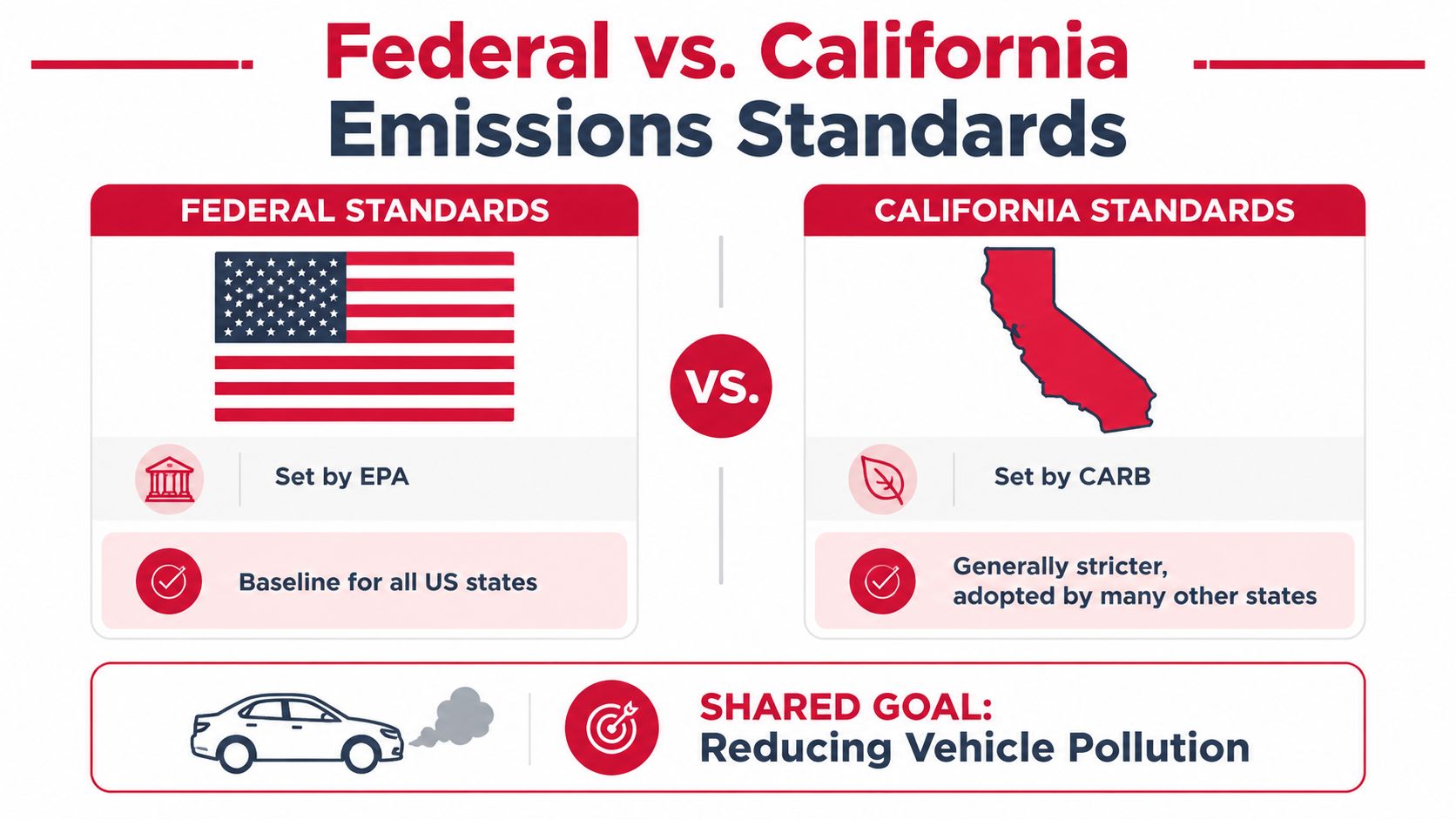
That's why California's rules aren't just a local preference. They come from a specific legal path built into federal law.
What that means when your car gets tested
For a driver in Antioch, the legal structure matters because it affects what kinds of vehicles are certified for sale here and how emissions compliance gets enforced over time. California has long pushed stricter controls, and that pressure shows up in the design of modern emissions systems, onboard diagnostics, and inspection programs.
The practical side looks like this:
- Manufacturers build to standards: They design vehicles to meet federal requirements, California requirements, or both depending on certification.
- States enforce road-use compliance: California uses inspections and registration rules to verify that emissions-related systems remain functional.
- Drivers deal with the result at renewal time: That's when abstract policy turns into a smog test notice.
The rule that affects a new vehicle at the dealership isn't always the same rule that affects your current vehicle at registration. That distinction clears up a lot of confusion.
A second source of confusion is the idea that if California adopts stricter future standards, your current gasoline or diesel vehicle will suddenly become illegal. That isn't how these standards work in practice. The standards for new vehicle sales influence what gets sold and how it gets engineered. Your smog check focuses on whether your specific registered vehicle still complies with the requirements that apply to it.
That's also why the car's electronics matter so much. The onboard system tracks emissions-related faults and readiness. In modern testing, that electronic self-reporting becomes a big part of the inspection.
How Standards Impact Your Vehicle and Smog Test
When drivers hear “vehicle emissions standards,” many picture lawmakers and automakers arguing over future cars. But your everyday encounter with those standards is much simpler. It happens when your car reports its own emissions health during a smog inspection.
What happens when you pull into the bay
For many vehicles, the heart of the process is the OBD-II system, short for onboard diagnostics. Think of it as the vehicle's internal watchdog. It monitors emissions-related components, stores trouble codes when it detects a problem, and tracks whether key systems have completed their self-checks.
So if you drive into a station in Antioch for testing, the process usually starts with basic vehicle identification and then moves to the inspection itself. The testing equipment reads what the car's computer has recorded. If the system sees an active fault, incomplete readiness information, or another emissions-related issue, that can affect the result.
Here's how that feels from the driver's seat:
- You arrive with a renewal notice or registration need.
- The technician checks the vehicle details to make sure the correct test applies.
- The inspection equipment communicates with the vehicle through the diagnostic system.
- The system reports status information about emissions-related monitors and faults.
- You get a pass or fail result based on what the program requires for that vehicle.
A lot of people also hear terms like STAR-certified and aren't sure what that means. In plain English, it means the station meets state program requirements for certain inspections. If your DMV notice says you need a STAR station, that isn't a suggestion. It's part of the testing requirement tied to your vehicle record.
The fear most drivers have, and the answer
The biggest anxiety point is usually this: if rules are getting stricter, will the state eventually force me to get rid of the car I already own?
The answer is no. None of the EPA or California standards require owners to give up existing vehicles, and used cars remain legal indefinitely. The stricter standards, including the 2027 to 2032 EPA rule, apply to the sale of new vehicles, according to the EPA announcement on final pollution standards for cars.
That distinction matters. A new-vehicle standard affects what automakers sell. A smog inspection affects whether your current vehicle is still operating legally within the inspection system.
If your current vehicle is registered properly and can meet the applicable inspection requirements, a future new-car rule doesn't automatically push it off the road.
Where drivers still get tripped up is assuming “legal to own” and “ready to pass smog” mean the same thing. They don't. A vehicle can remain legal to own, but still fail a required inspection if the emissions system has a fault. That's why maintenance matters. Not because the rules are trying to retire your car, but because the systems on the car still have to work.
Passing Your Smog Check and What to Do If You Fail
The best smog check strategy is boring. Show up with a vehicle that's fully warmed up, no warning lights on, and no unresolved emissions problems. Most headaches start when drivers rush in right after a battery disconnect, ignore a Check Engine light, or test a car that hasn't been driven enough to complete its self-checks.
A simple pre-test checklist
Before your appointment, focus on a few practical basics:
- Drive the car first: A warmed-up engine and emissions system usually give the test the conditions it expects.
- Check the dashboard: If the Check Engine light is on, deal with that before testing.
- Avoid testing right after repairs that reset monitors: If the battery was disconnected or codes were cleared, the car may need more driving before the system reports ready.
- Handle obvious maintenance issues: Poor running condition, fuel-system issues, or exhaust leaks can cause trouble.
- Bring your paperwork: Your renewal notice or registration information can help the station confirm what test is needed.
One local option for a test-only inspection is the Fire House Smog test-only discount center, which handles smog testing without doing in-house repair sales. For drivers who worry about being sold repair work at the same counter where they're tested, that model can make the process feel more straightforward.
If you pass
Passing is the easy path. The certificate is typically transmitted electronically, and then you move on to finish the registration step required for your renewal.
That's why a clean pass often feels anticlimactic. You arrive, the system checks out, the record goes through, and you're done.
To see the inspection process in action, this overview helps:
If you fail
A failed smog check doesn't always mean a major repair bill. It means the inspection found an emissions-related problem that has to be diagnosed and corrected before the vehicle can pass.
Use this sequence:
- Read the failure information carefully: The reason matters. A trouble code problem and an incomplete readiness problem aren't the same thing.
- Get the car diagnosed by a repair shop: A test-only station inspects. It doesn't repair.
- Complete the needed repair work: The goal is to fix the cause, not just clear the light.
- Return for retesting: If the station offers a retest policy or coupon, ask how it applies.
Don't guess at a fix after a fail. Let a repair technician identify the actual emissions fault, then come back once the system is ready for retest.
Compliance Made Easy in Antioch
Most drivers don't struggle with the idea of clean air. They struggle with the logistics. Finding time after work. Sorting out whether the DMV needs a test, a renewal, or both. Wondering if a failed test will turn into a sales pitch for repairs. Standing in one line for a smog certificate and another line for registration.
Why the policy side still matters locally
Federal and California rules shape the vehicle market, but individual drivers still interact with the system through periodic inspections and registration compliance. That connection is why policy isn't just background noise. It reaches all the way down to what happens when your renewal date approaches.
For example, the 2021 EPA final rule set an industry-wide target for light trucks at 161 grams of CO₂ per mile by 2026 and projected a fleetwide average of 49 mpg. These performance-based standards are met by manufacturers, not individual drivers, according to the Center for Climate and Energy Solutions summary of transportation carbon regulations. For local drivers, the key takeaway is the second half of that idea. Automakers meet the sales standards. Drivers still need inspections on existing vehicles because road-level compliance depends on whether emissions systems keep working over time.
That's why your renewal process can feel disconnected from the headline you heard about new-car rules. They are related, but they operate at different points in the system.
What solves the real-world hassle
The practical solution is usually less about learning every legal detail and more about choosing a setup that removes friction. In Antioch, that means looking for a station that can handle the inspection efficiently and help with the registration side when possible.
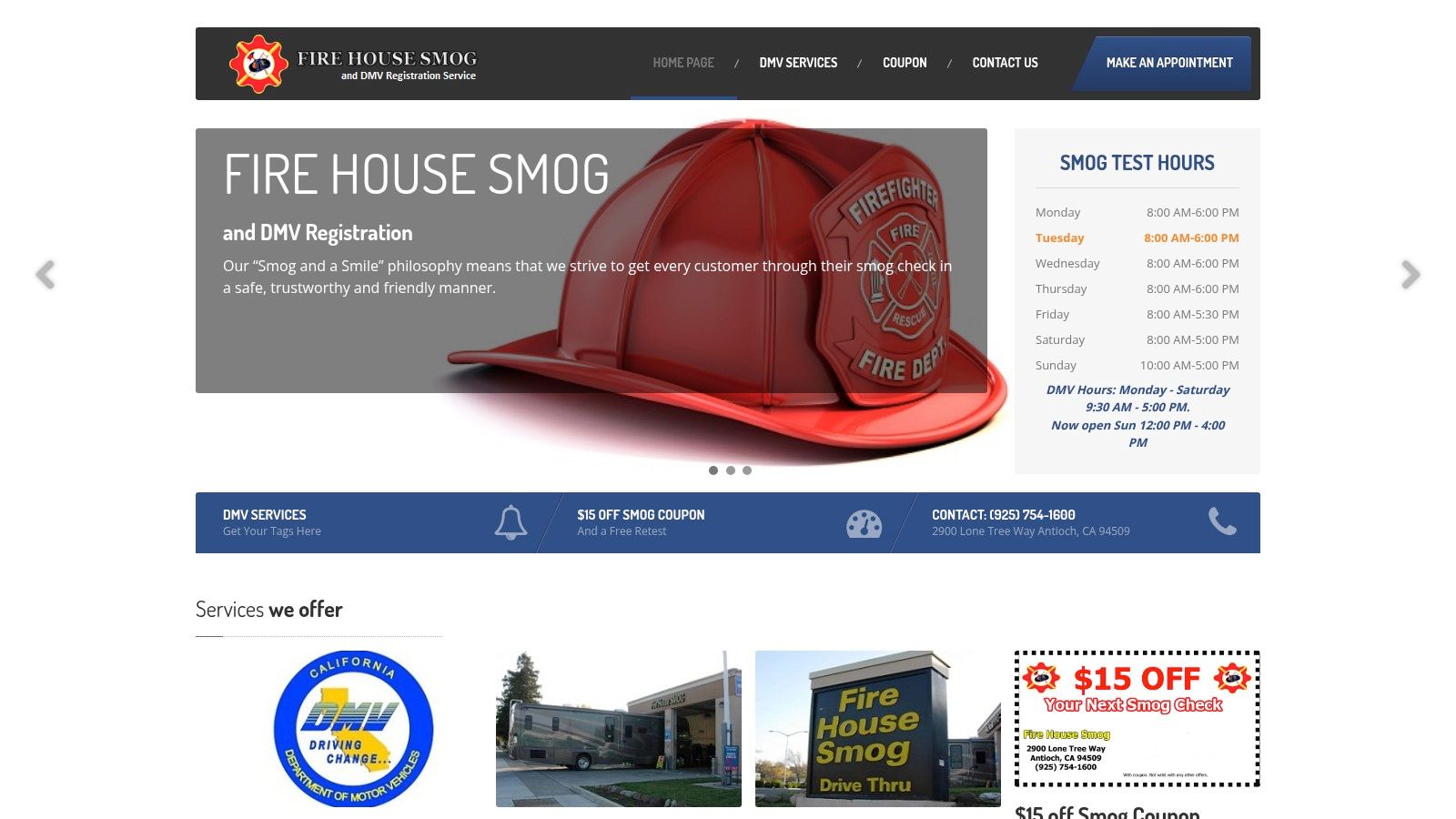
A few details make a meaningful difference for busy drivers:
- Test-only service: If a station doesn't sell repairs, there's less concern about a conflict between diagnosis and repair revenue.
- STAR-certified inspections: That matters when your notice specifically requires a STAR station.
- On-site DMV help: A location that can also process California DMV registration renewal services can reduce the back-and-forth many drivers dislike.
- Two service bays: More than one bay can help keep the flow moving when several cars arrive around the same time.
- Seven-day smog availability and extended hours: That matters if your work schedule makes weekday daytime errands difficult.
- Free retest policy, where applicable: If your vehicle needs another inspection after repairs, knowing the retest terms up front helps.
Here's a useful way to compare your options locally:
| What you need | Why it matters | What to ask before you go |
|---|---|---|
| STAR testing | Some DMV notices require it | “Does my notice require a STAR station?” |
| Test-only inspection | Helps avoid repair upselling concerns | “Do you perform repairs on-site?” |
| DMV transaction support | Saves a second trip | “Can you process renewal and print tags?” |
| Flexible hours | Makes compliance easier around work | “Are you open evenings or weekends?” |
For Antioch drivers, Fire House Smog fits that practical model. It's a STAR-certified test-only smog station and licensed DMV registration services provider at 2900 Lone Tree Way in Antioch, with two service bays, smog testing seven days a week, and on-site DMV services during posted hours, including renewals and ownership transfers. Those features directly address the most common local pain points: time, uncertainty, and the desire to separate testing from repair sales.
A smooth smog visit usually comes down to three things. Bring the right vehicle at the right time, make sure the car is actually ready, and choose a station whose process matches what your DMV notice requires.
If your renewal is coming up, the smartest move is to handle it before it becomes urgent. Check your notice, confirm whether you need a STAR inspection, make sure your dashboard is clear of warning lights, and plan the visit when you can complete the process without rushing.
If you need a smog inspection or want to handle registration in the same stop, Fire House Smog offers STAR-certified test-only smog checks and on-site DMV services in Antioch. Call ahead if you have questions about your vehicle type, a recent failed test, or whether your renewal paperwork requires a STAR station.