

You're standing in the quick-lube lane the day before your registration deadline, watching the clock and wondering whether a fresh oil change could be the difference between a pass and a trip back for repairs. The technician asks what you need, and the question comes out almost automatically: does an oil change affect emissions test results?
The honest answer has two parts. Fresh oil can improve tailpipe readings when the old oil is overdue or contaminated, but it won't repair a failed oxygen sensor, catalytic converter, or engine fault. At the same time, a recently serviced vehicle can still fail a California-style emissions inspection if its onboard computer hasn't completed its readiness checks, especially after someone disconnects the battery. The exhaust side and the computer side need separate attention.
Table of Contents
- The Question Most Drivers Ask Before Their Smog Check
- How Oil Condition Reaches the Tailpipe and the Computer
- What the Research Actually Measured After an Oil Change
- When Dirty Oil Raises Hydrocarbons and Carbon Monoxide
- The OBD Readiness Trap Behind a Check Engine Light
- A Practical Pre-Test Plan for the Week Before Your Appointment
- Putting It Together for a Clean First Pass
The Question Most Drivers Ask Before Their Smog Check
Maria's car is running normally. It starts without hesitation, the check-engine light is off, and she hasn't noticed unusual smoke. Her smog renewal is due soon, but the oil change sticker says she's overdue. She pulls into a quick-lube shop and asks whether changing the oil before the appointment is a smart move.
The answer depends on the oil's condition, not on the fact that an oil change is happening. If the oil has absorbed fuel, moisture, soot, or other contaminants, replacing it may reduce the material entering the intake through the crankcase ventilation system. That can help lower certain tailpipe readings. If the oil is already fresh and the engine is healthy, changing it again probably won't alter the result in a meaningful way.
There's another issue Maria may not see from the driver's seat. A smog inspection may evaluate the vehicle's OBD readiness, meaning whether the computer has completed its checks of emissions-related systems. A battery disconnect or memory reset can erase those completed checks. The car may have clean oil and no obvious drivability problem, yet still arrive at the station with monitors marked “not ready.”
Practical rule: An overdue oil change can be sensible maintenance before testing. Disconnecting the battery without allowing the computer to complete its checks can create a separate inspection problem.
Think of the decision as two lanes:
- Tailpipe lane: Oil condition can influence hydrocarbons and carbon monoxide when contaminated oil or fuel dilution increases crankcase vapor loading.
- Computer lane: Oil condition doesn't make an OBD monitor complete. The vehicle needs normal driving conditions so its monitoring routines can run.
- Repair lane: A warning light, active fault, excessive oil consumption, or visible smoke requires diagnosis rather than a last-minute oil change.
So, should Maria change the oil? If it's overdue, contaminated, or accompanied by an oil-related engine concern, yes, as part of proper preparation. If it was changed recently, her time is better spent checking for warning lights, preserving readiness, and making sure the vehicle is operating normally.
How Oil Condition Reaches the Tailpipe and the Computer
Engine oil doesn't normally burn as part of the fuel mixture, but the crankcase is connected to the intake through the PCV system. PCV means positive crankcase ventilation. It draws gases and vapors from inside the engine and routes them back into the intake, where the engine burns them.
Some combustion gas slips past the piston rings into the crankcase. Technicians call this blow-by. Worn rings can allow more combustion pressure into the crankcase, but even a normally operating engine produces some blow-by. The PCV system then carries those vapors toward the intake.
A useful analogy is a sponge beneath a dripping faucet. Fresh oil is a relatively clean sponge. Oil that has spent a long time absorbing fuel, moisture, and combustion byproducts is already saturated. When the PCV system pulls vapor from the crankcase, that contaminated mixture can become part of what the engine sends through combustion and eventually out of the exhaust.
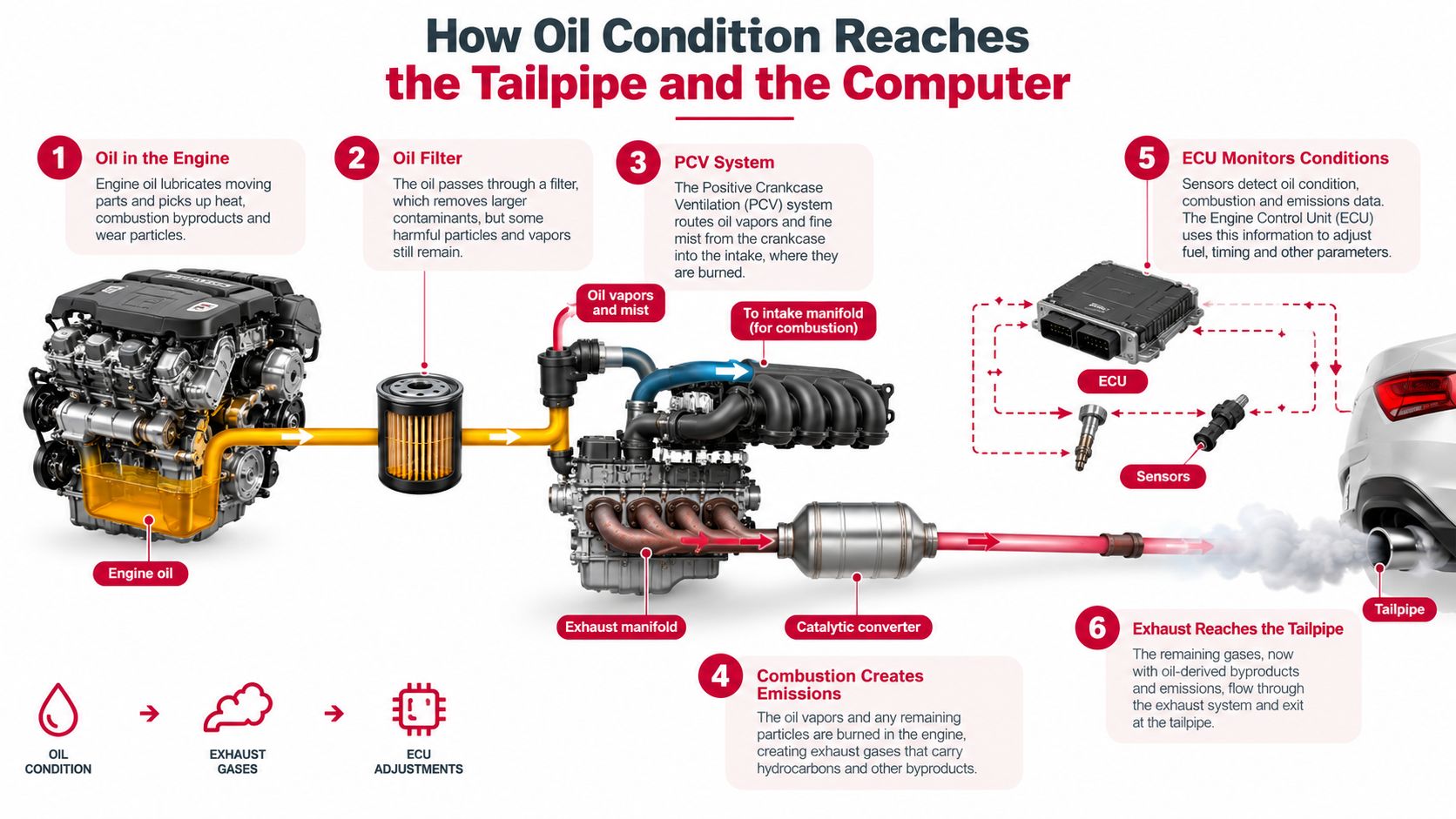
The tailpipe path
Hydrocarbons, often abbreviated HC, are unburned fuel compounds. Carbon monoxide, or CO, forms when combustion doesn't completely convert fuel into carbon dioxide. Extra crankcase vapors can affect the mixture entering the engine, particularly when the oil contains fuel or when the engine has mechanical wear.
That doesn't mean every old-looking oil sample causes a failure. Oil color alone isn't a reliable emissions diagnosis. The important question is what the oil has absorbed and whether the engine is allowing an unusual amount of vapor into the intake.
The computer path
The vehicle's OBD system is different from the oil circulating in the engine. OBD stands for onboard diagnostics. It uses sensors and programmed checks to evaluate emissions-related operation, including whether the catalytic converter, oxygen sensors, fuel systems, and other monitored systems appear to be working correctly.
You can read a straightforward explanation of the inspection process in this guide to what a smog check examines. The key distinction is simple: fresh oil may influence combustion conditions, but it doesn't directly set an OBD monitor to complete. A battery reset, cleared code, or recent repair can change the computer's status even when the oil level and oil quality are correct.
What the Research Actually Measured After an Oil Change
The strongest evidence for an oil change affecting emissions comes from a controlled comparison. A 2024 study in the Pakistan Journal of Science tested vehicles immediately before and after a routine engine oil change with portable emission analyzers. Across gasoline automobiles, motorcycles, and motorcycle rickshaws, the researchers measured reductions in regulated pollutants after fresh oil was installed. For the gasoline-powered vehicles included in the supplied findings, CO fell by 9% to 67%, while hydrocarbons fell by 21% to 52% (study PDF).
Those figures don't mean every vehicle will show the same change. The result depends on the vehicle's engine condition, the starting condition of the oil, fuel dilution, mechanical wear, and the testing method. A newer engine with recently serviced oil may have little room for improvement. A vehicle with badly contaminated oil may respond more noticeably.
One passenger-car comparison makes the result easier to picture. In the supplied study findings, the car's CO reading fell from 0.87% to 0.28%, approximately a 67% reduction, after the oil change. The same vehicle also showed a reduction in HC, although the verified material provided here doesn't include a specific HC value for the table below.
Tailpipe Emissions Before vs After Oil Change
| Test Condition | CO (%) | HC (ppm) |
|---|---|---|
| Passenger car before oil change | 0.87% | Reduced after the oil change, exact supplied value not specified |
| Passenger car after fresh oil installation | 0.28% | Lower than before, exact supplied value not specified |
The practical lesson is not that an oil change guarantees a pass. It's that oil condition can be a real emissions variable over a short testing window. A routine service may change what the analyzer measures, particularly when contaminated oil and fuel dilution are contributing to crankcase vapors.
The research also supports a useful distinction. An oil change is an emissions-related maintenance step, not an emissions-system repair. It may improve HC and CO readings, but it won't correct a damaged catalyst, a vacuum leak, a persistent misfire, or a sensor fault. The vehicle still needs to be evaluated as a complete system.
Here's a short visual explanation before we move to the underlying causes:
When Dirty Oil Raises Hydrocarbons and Carbon Monoxide
Contaminated oil becomes more relevant when the crankcase contains substances the engine wasn't designed to meter as part of its normal fuel mixture. The PCV valve pulls crankcase vapors into the intake, so the engine can burn them rather than release them directly. That process is useful, but it also means the condition of the crankcase can influence combustion.
Several situations can load the oil with unwanted material:
- Fuel dilution: Repeated short trips, rich operation, or an injector problem can allow unburned fuel to mix with the oil. That thins the oil and increases the amount of fuel vapor available to the PCV system.
- Moisture accumulation: An engine that doesn't reach normal operating conditions regularly may retain water vapor and condensation in the crankcase. Moisture changes the oil's condition and can combine with combustion byproducts.
- Soot loading: A rich-running engine creates more fuel than the combustion process can use cleanly. Soot and other byproducts then collect in the oil.
- Mechanical wear: Worn piston rings or valve seals can increase the amount of combustion gas or oil vapor entering places it shouldn't. The PCV system can carry that material toward the intake.
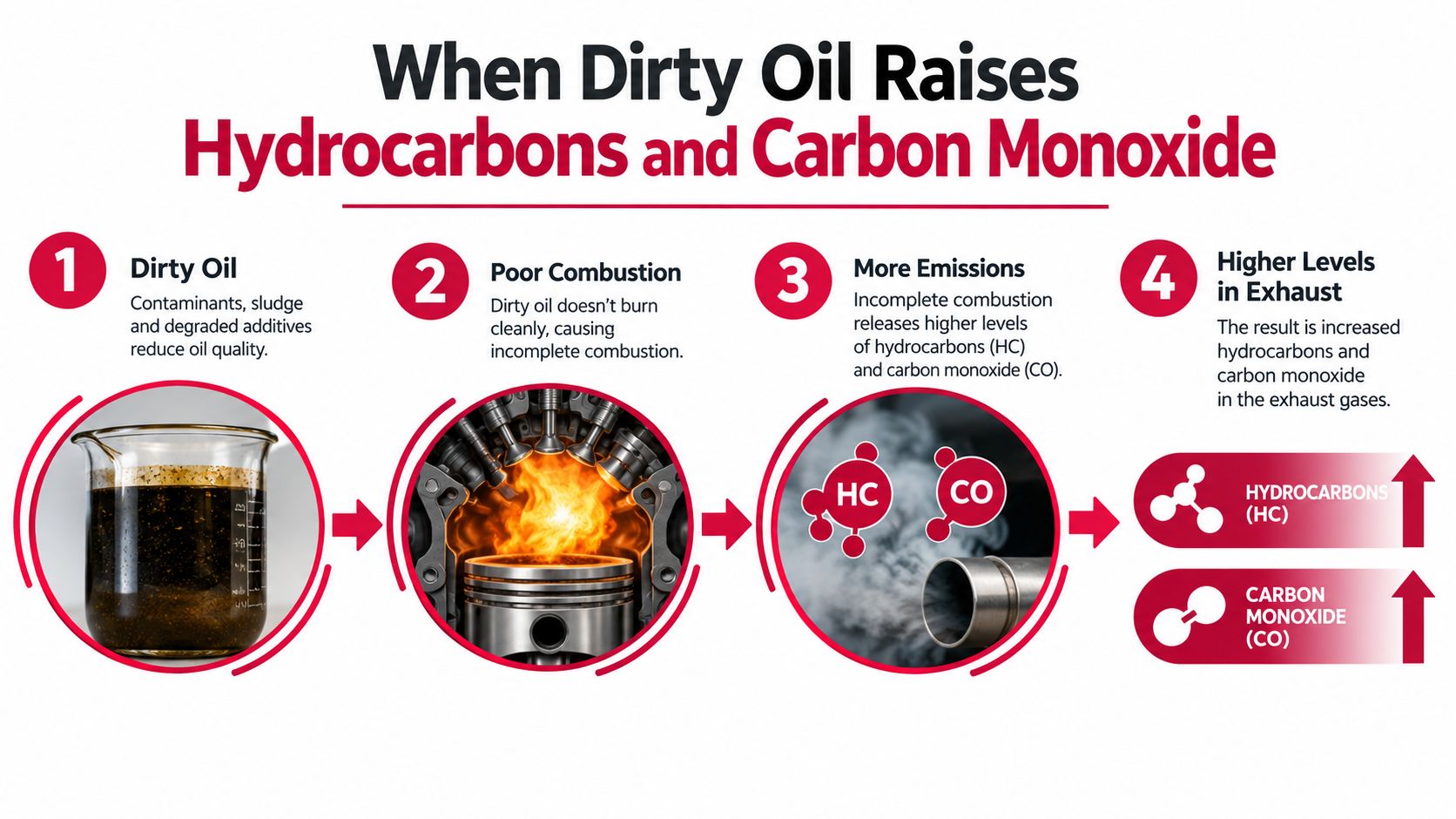
Why HC and CO can rise
HC rises when fuel or oil-related vapors pass through combustion without being fully burned. CO can rise when the mixture becomes richer than the engine can burn efficiently. Contaminated crankcase vapors don't always create a dramatic problem, but they can matter when the vehicle is already close to an inspection limit.
That's why a fresh oil change can help a borderline vehicle in some circumstances. It removes the old oil and the contaminants it has collected, reducing the load in the crankcase. The improvement is more plausible when the service is overdue or when there are signs of fuel dilution.
Why oil color isn't enough
Black oil isn't automatically proof that a vehicle will fail, and clean-looking oil isn't proof that the engine is emissions-ready. Oil darkens as it holds suspended material, and the oil's actual condition depends on the vehicle, lubricant, driving pattern, and maintenance history.
A fresh fill can remove one contributor to high readings. It can't remove the cause of a misfire, repair worn rings, or restore a damaged catalytic converter.
If the oil level keeps dropping, the exhaust produces excessive smoke, or the engine has an oil leak, treat those as diagnostic clues. The Maryland emissions inspection guidance advises checking oil and coolant levels and looking for leaks and excessive smoke before testing (vehicle emissions inspection guidance). Those checks are useful preparation principles even though inspection procedures vary by state.
The OBD Readiness Trap Behind a Check Engine Light
Many nervous drivers focus on the oil dipstick because it's visible. The OBD system is less obvious, but it can determine whether a modern vehicle is accepted for testing.
An OBD monitor is a programmed self-check. The computer observes conditions such as temperature, speed, load, fuel level, and other operating factors, then decides whether a particular emissions system has completed its evaluation. A monitor marked ready has completed its check. A monitor marked not ready hasn't gathered enough information yet.
Disconnecting the battery can erase stored readiness information. Clearing diagnostic trouble codes can do the same. That creates the trap: the technician installs fresh oil, the car feels fine, and the driver assumes the vehicle is prepared. But the computer may still need normal driving before the required checks complete.
Why a battery reset changes the answer
An oil change itself doesn't normally erase readiness. The problem arises when someone disconnects the battery during service, replaces the battery, clears a fault, or uses a scan tool to reset the computer. The vehicle then starts the post-reset process again.
A recent repair can create a similar situation. If the check-engine light is on, the computer has identified an emissions-related fault. Fresh oil doesn't override that fault. If the light was recently cleared, the light may remain off while the monitors are still incomplete.
Use this OBD readiness monitor explanation to understand what the dashboard and a scan tool are showing. Before the inspection, a technician can check readiness status without guessing from how the car feels.
What to do after a reset
Don't disconnect the battery as a casual pre-test step. If it was already disconnected, drive the vehicle normally and give the monitoring system time to run under varied conditions. The exact sequence depends on the vehicle, so the owner's manual or a technician's scan-tool check is more reliable than a generic internet drive cycle.
Computer-side rule: A clean oil change and a ready OBD system are separate achievements. You need both when the inspection relies on computer checks.
A Practical Pre-Test Plan for the Week Before Your Appointment
Start with the dashboard, not the oil bottle. If the check-engine light is illuminated, arrange diagnosis before the appointment. If the light was recently cleared or the battery was disconnected, have the readiness status checked before you pay for an inspection.
Early preparation
Look at the maintenance history. If the oil is overdue, the level is low, or the engine has signs of fuel dilution, schedule the oil change using the manufacturer-recommended oil. Don't treat an oil change as necessary just because the inspection is approaching if the oil was recently replaced and the engine is operating normally.
Check the basics as well:
- Oil and coolant: Bring both to the manufacturer-recommended level. Don't overfill either one.
- Leaks and smoke: Look for fluid leaks and excessive exhaust smoke. Those symptoms deserve attention before testing.
- Fuel cap: Make sure the cap seals properly after refueling. A loose or damaged cap can contribute to an emissions fault.
- Tires: Confirm that the tires are in sound condition and properly inflated so the vehicle can be driven safely during preparation.
- Recent parts: Avoid installing an unverified sensor, fuel additive, or other last-minute component without allowing time to confirm that the repair worked and the computer has completed its checks.
If the battery was disconnected
Drive the vehicle in ordinary traffic rather than trying to force a result with aggressive acceleration. A mix of city and steady-speed driving gives the computer varied operating conditions, but the required pattern differs by model.
Check readiness before the appointment. If a monitor still shows “not ready,” rescheduling may be wiser than arriving at the station and discovering the issue during the inspection. A scan tool can reveal this status before the official test.
On appointment day
A warmed-up engine generally gives the vehicle a better chance to operate as intended than a cold start at the station. Follow the station's instructions and avoid shutting the engine off repeatedly while waiting if staff ask you to remain in line.
An oil change may help when the lubricant is overdue or contaminated, especially if the vehicle has signs of fuel dilution or heavy crankcase vapor loading. It's usually wasted effort when the oil is fresh and the underlying problem is an active fault or incomplete readiness.
For more general preparation ideas, see this guide to reducing vehicle emissions. Use it as maintenance guidance, not as a promise that any single service will produce a pass.
Putting It Together for a Clean First Pass
The conditional answer is the useful one. Dirty or overdue oil can affect tailpipe readings, while fresh oil that was already in good condition may change very little. Battery disconnection and cleared codes can affect the computer's readiness status, regardless of what's in the oil pan.
If the vehicle fails, read the inspection report before authorizing repairs. The report should identify whether the issue involves a tailpipe reading, an OBD fault, readiness, or another inspection condition. Ask the station whether it can perform a retest and what its retest policy requires. If the vehicle needs a particular type of California inspection, confirm whether the station's certification matches that requirement. A STAR-certified test-only station is one possible option when the vehicle or registration notice calls for that type of inspection.
Questions drivers often leave unanswered
What if the battery was reset yesterday? Treat the vehicle as potentially not ready. A one-day-old reset doesn't prove that the monitors have completed, so check the status with a scan tool before testing. You may see evidence of a recent reset through incomplete readiness monitors, but the absence of that evidence doesn't establish that the battery was never disconnected.
What if the car is referred as a gross polluter? Don't try to mask the result with another oil change. Follow the referral instructions and have the underlying emissions problem diagnosed. A referral is a sign that the vehicle needs more than routine pre-test preparation.
Do DMV renewal rules cover every vehicle the same way? No. Requirements can vary by vehicle type, registration situation, and applicable California program rules. Classic vehicles, diesel vehicles, and recreational vehicles may have different testing treatment or equipment limitations, so check the notice and confirm with the testing station before driving over.
Can a station refuse the test? It can direct you to the appropriate process when the vehicle falls outside its equipment, certification, or service limits. Call ahead if you have a large recreational vehicle, unusual equipment, or a registration notice with special instructions.
A clean run means the vehicle has no active emissions warning light, no unresolved fault that blocks the inspection, required monitors are complete, and measured emissions are below the applicable limits. It also means the engine has the correct oil level and manufacturer-specified oil, with no obvious leak or smoke problem.
Don't schedule an oil change as a superstition. Schedule it because the oil needs replacing, then protect the computer's readiness and diagnose warning signs before testing.
Fire House Smog provides STAR-certified, test-only smog inspections and California DMV registration services at its Antioch location, with retest options available under its site policy and coupon terms. Visit Fire House Smog to check services, hours, and appointment information before your emissions test.
That “Smog Check Required” notice shows up at the worst time. Your registration renewal is coming up, your vehicle seems to run fine, and now one test stands between you and getting everything handled. If you've never failed before, it's easy to assume a smog check is just another quick errand. Sometimes it is. Sometimes it isn't.
Most failures come from a handful of repeat problems. A warning light is on. A monitor isn't ready. A converter is weak. An EVAP leak is small enough that you don't notice it, but the car's computer does. The good news is that smog check fail reasons are usually understandable once someone explains what the machine is looking for.
This guide breaks down eight of the most common smog check fail reasons, what they mean in plain English, how to spot them early, and what to do before you waste a trip to a test station. For Antioch drivers, there's one extra angle that matters. A test-only station like Fire House Smog doesn't make money selling you repairs, so the value is an unbiased result, a clear explanation of what failed, and a free retest option when policy and coupon terms apply. That changes how you should prepare before you arrive.
Table of Contents
- 1. Engine Performance Issues and Excessive Emissions
- 2. Faulty or Malfunctioning Check Engine Light and Diagnostic Issues
- 3. Catalytic Converter Damage or Degradation
- 4. Oxygen Sensor Faults and Malfunctions
- 5. Evaporative Emissions System EVAP Leaks and Failures
- 6. Exhaust System Leaks and Components
- 7. Failed Emissions Monitor Readiness
- 8. Vehicle Age and High Mileage Component Wear
- 8-Point Smog Check Failure Comparison
- Your Next Step Pass Your Smog Check with Confidence
1. Engine Performance Issues and Excessive Emissions
A lot of smog failures start before the test. The engine isn't burning fuel cleanly, and the exhaust tells on it. That can come from a weak ignition system, a fuel mixture that's too rich or too lean, a tired oxygen sensor, or a catalytic converter that isn't cleaning up the leftovers.
When combustion is off, the car may still start, idle, and drive. That's what throws people. They assume “runs okay” means “will pass.” It doesn't.
What poor combustion looks like in the real world
A common example is a car that hesitates on acceleration, smells a little rich at idle, and has fuel economy that's slipped. Another is a truck with no major drivability complaint, but it's overdue for plugs, the air filter is loaded up, and the converter has been stressed for a long time. Those are classic setups for increased emissions.
California drivers can get a feel for what their vehicle is being judged against by reviewing vehicle emissions standards in California. That won't diagnose the car, but it helps you understand why a “small” engine issue can become a test failure.
Practical rule: If the engine has been running rough, misfiring, burning oil, or smelling like raw fuel, don't make the smog station your first stop.
What helps before you test
A pre-inspection with a trusted mechanic makes sense if you already suspect a problem. That's especially true if the car has a rough idle, sluggish power, or a history of emissions repairs.
A few basics also matter:
- Stay current on ignition parts: Old spark plugs and neglected tune-up items make the engine work harder to burn fuel cleanly.
- Replace restricted filters on schedule: A dirty air filter can upset the air-fuel balance.
- Use the correct oil and fuel grade: The wrong fluids won't always trigger a warning light, but they can make a marginal engine dirtier at the tailpipe.
At a test-only station, the useful question after a failure isn't “Can you fix it?” It's “Can you explain what the results point to?” That keeps the next repair visit focused.
2. Faulty or Malfunctioning Check Engine Light and Diagnostic Issues
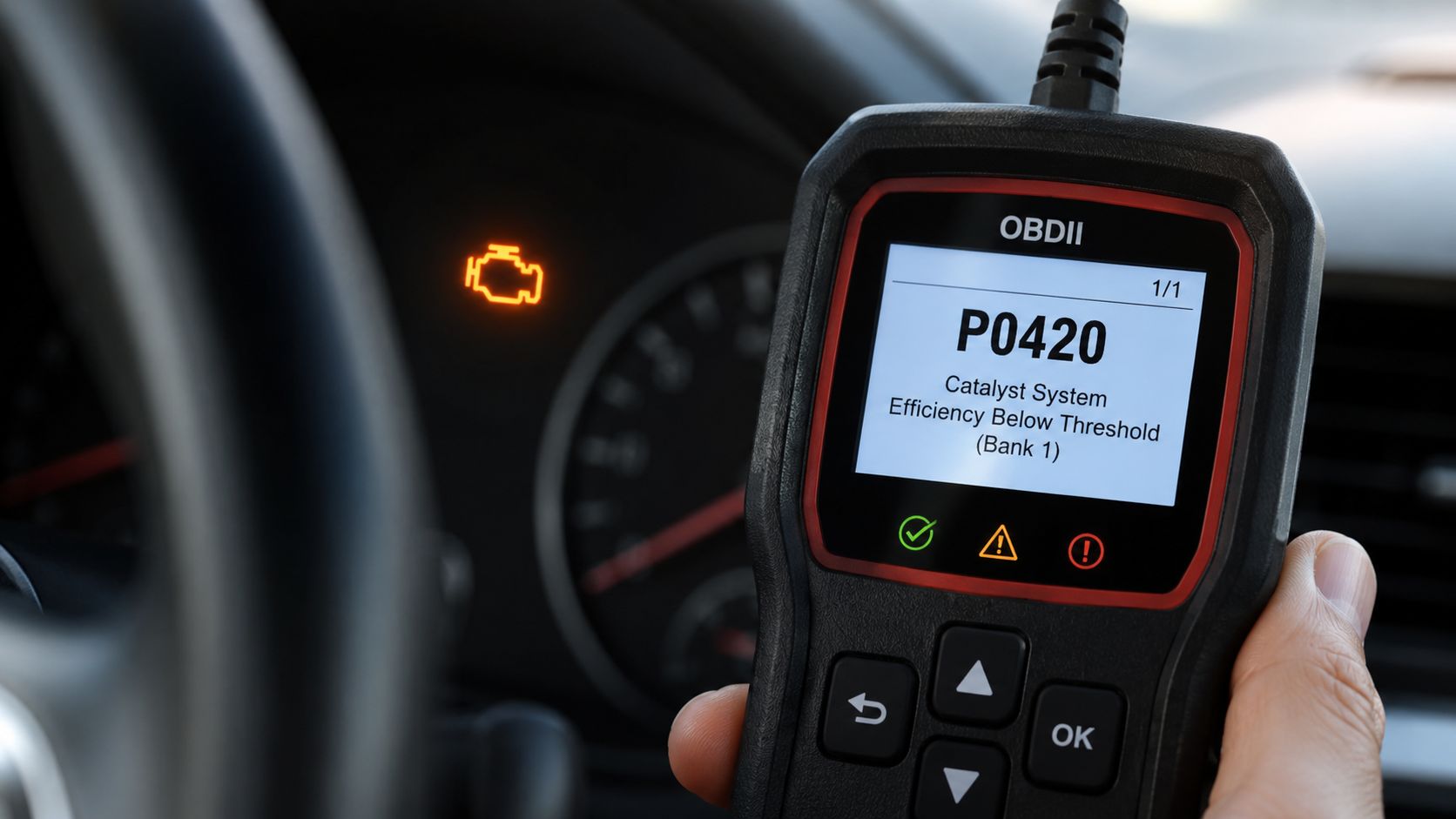
The single biggest mistake drivers make is showing up with the Check Engine Light on and hoping the car might squeak through. In California, that light usually ends the test before the conversation starts.
The most prevalent cause for California smog check failures is an illuminated Check Engine Light, and California DMV guidance treats a CEL or OBD monitor failure as automatic rejection criteria. The same source notes a statewide fleet-weighted failure rate of about 16% in the CY 2020-2021 roadside sample, with active codes playing a major role in those failures, according to this California smog failure overview.
Why the light matters even if the car drives fine
A CEL can point to a bad oxygen sensor, a vacuum leak, catalyst efficiency trouble, EVAP faults, or something else in the emissions system. Sometimes the vehicle feels completely normal. The onboard system still sees a fault, and that alone is enough to fail.
Pending codes can also trip people up after DIY repairs. They replace a part, clear the light, drive a little, and assume they're done. The car's computer may not agree yet.
If you're handling a renewal, it helps to understand the registration side too. Fire House Smog also provides California DMV registration renewal support, which is useful when you're trying to line up the test and renewal without multiple trips.
What to do before a test-only appointment
Use an OBD-II scanner first. Even a basic scan tool can tell you whether the light is on, whether codes are stored, and whether monitors are ready. That's a lot cheaper than failing for something you could have seen in your driveway.
Bring repair paperwork if the car recently had emissions work. At a test-only shop, that paperwork won't change the result, but it can help you make sense of what happened if the car still fails.
Don't clear codes right before a smog test unless the actual repair is complete and the drive cycle has been finished.
3. Catalytic Converter Damage or Degradation
If the catalytic converter is weak, dirty, damaged, or no longer efficient, the rest of the engine can be working reasonably well and you can still fail. The converter's job is to clean pollutants after combustion. Once it loses that ability, the exhaust numbers or onboard diagnostics will usually expose it.
This is one of the more expensive smog check fail reasons, which is why owners often want a second opinion before replacing anything. That's smart.
How converters fail in everyday use
Converters rarely die “for no reason.” Most of the time, something else hurts them first. Long-term rich running, repeated misfires, oil consumption, coolant contamination, or overheating can cook the catalyst inside. Physical impact can damage them too.
A common shop scenario goes like this: the car had a misfire for months, the owner fixed the ignition problem, the car runs better, but the converter never recovered. Another version is the car that rattles underneath because the substrate has broken apart internally.
A second major cause of smog failures is excessive tailpipe emissions tied to malfunctioning oxygen sensors or a dirty catalytic converter, and vehicles with tampered emissions systems can also fail automatically, as described in this California smog failure and repair discussion.
Repair trade-offs that matter
Converter replacement is one of those jobs where cutting corners often backfires. The cheapest part isn't always the part that lasts or the part that satisfies California requirements. Compatibility matters. So does fixing the root cause before installing the new converter.
What tends to work:
- Diagnose upstream problems first: If the engine is misfiring or running rich, a new converter may fail again.
- Inspect for exhaust leaks: A leak can skew readings and confuse the diagnosis.
- Use compliant parts: For emissions repairs, “close enough” is usually not good enough.
What doesn't work well is replacing the converter because a code mentioned catalyst efficiency, while ignoring the fuel-control problem that caused it.
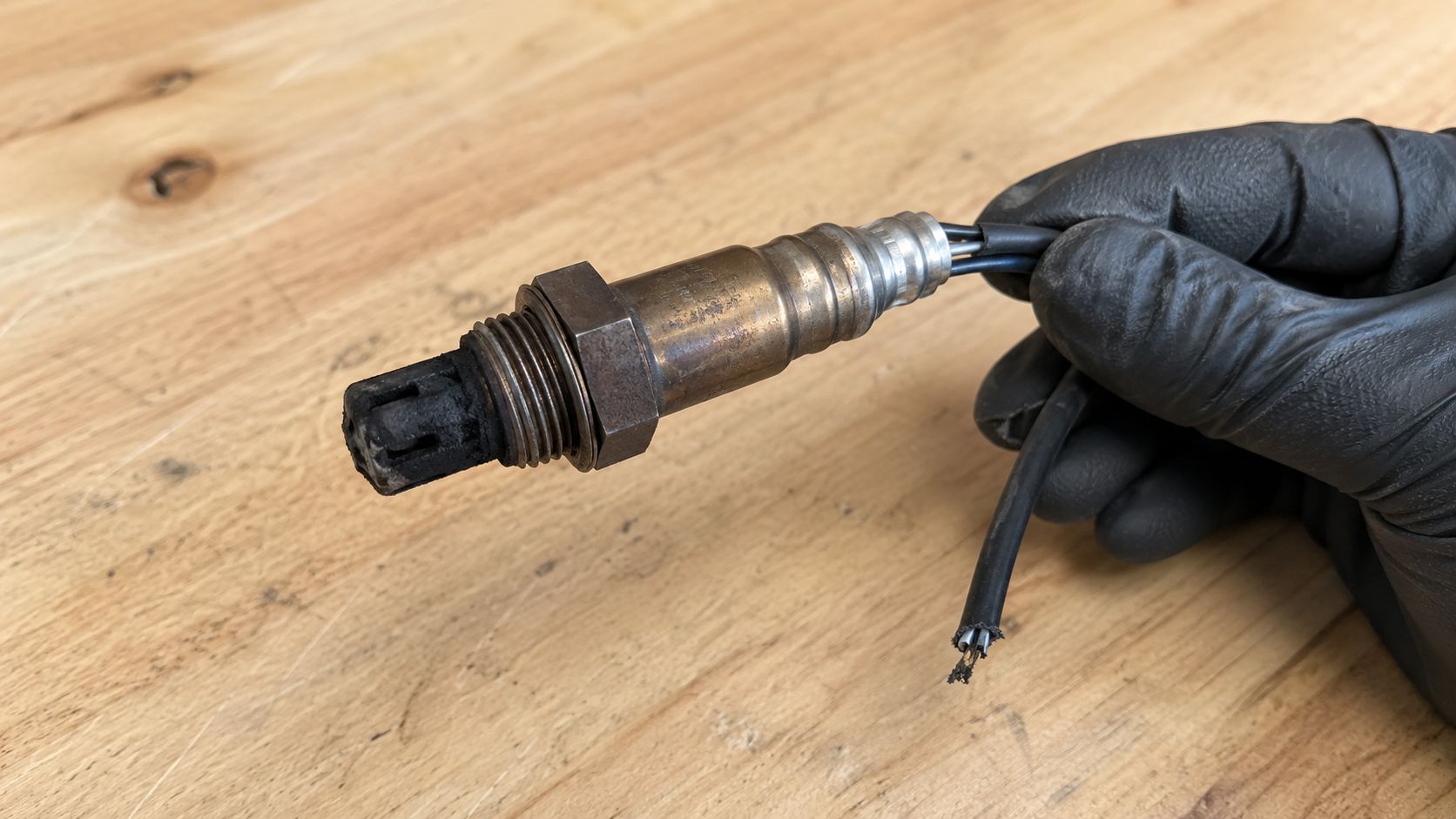
4. Oxygen Sensor Faults and Malfunctions
Oxygen sensors do more than trigger codes. They help the engine computer decide how much fuel to add or subtract. When the sensor lies, the engine follows bad information.
That can mean a rich condition, a lean condition, poor fuel economy, rough idle, sluggish throttle response, or a converter that's getting stressed in the background. Some drivers notice the symptoms right away. Others notice nothing until the smog test fails.
The sensor problem that snowballs
The upstream sensor usually has the biggest effect on fuel control. If it goes lazy or inaccurate, the engine may run richer than it should. That raises emissions and can eventually damage the catalytic converter. The downstream sensor mostly helps the system monitor converter performance, but a bad reading there can still create confusion and trigger emissions-related trouble.
This is why a simple sensor issue can turn into a more expensive repair if it sits too long. The car may still be drivable, but it isn't running cleanly.
What works and what doesn't
If a sensor is bad, replacing it with a quality part is the answer. Guessing isn't. Neither is swapping parts because a friend had the same code on a different car.
A better approach looks like this:
- Confirm the failure first: Scan data and basic diagnosis matter more than code definitions alone.
- Check for exhaust leaks or wiring damage: A good sensor can report bad data if outside air gets into the exhaust stream or the connector is compromised.
- Retest only after the system has relearned: Clearing the code and heading straight to the station is how people fail twice.
A practical example is the older commuter car that suddenly loses mileage and throws a lean code. Sometimes it needs a sensor. Sometimes it has a vacuum leak and the sensor is doing its job correctly. The repair path depends on diagnosis, not hunches.
5. Evaporative Emissions System EVAP Leaks and Failures
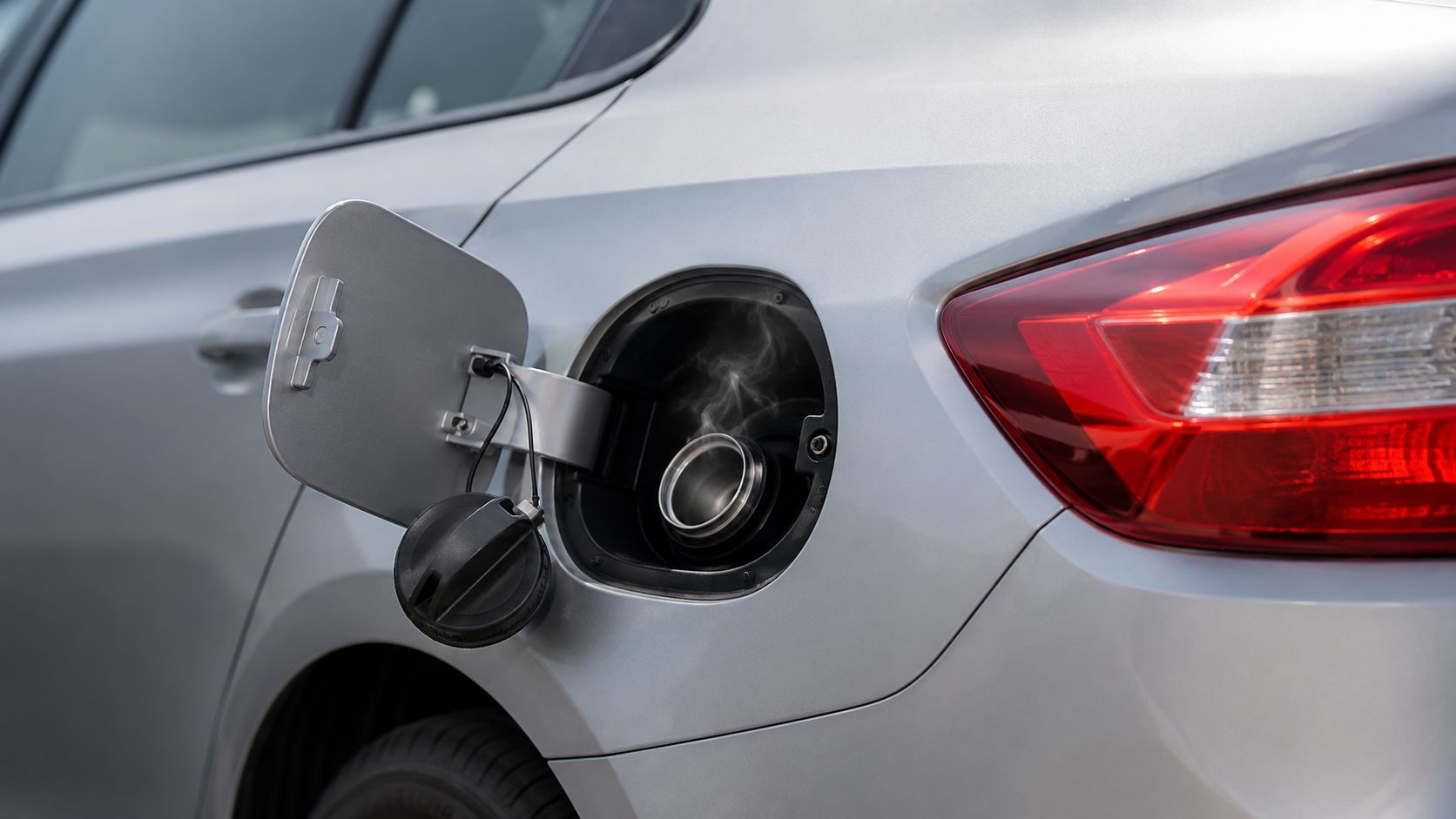
EVAP faults frustrate drivers because the car can run perfectly and still fail. The EVAP system deals with fuel vapor, not just what comes out of the tailpipe. If vapors escape through a leak, the onboard system usually sees it.
That leak might be as simple as the wrong gas cap or as annoying as a cracked hose tucked where no one can see it.
To get a feel for the area often used as a starting point, here's the fuel-fill side of the system:
The simple leak and the hidden leak
A loose, missing, or poor-quality gas cap is the easy one. It's worth checking because it costs little and does cause real problems. After that, things get more technical. Purge valves stick. Hoses crack. Canisters get contaminated. Filler neck components age out.
If you smell fuel around the car, especially near the fuel door or underneath after parking, don't ignore that. It's one of the few clues an EVAP problem may give you before the light comes on.
How to avoid a wasted retest
The best diagnostic method for many EVAP leaks is a smoke test at a repair shop. That puts visible smoke into the sealed system so the leak shows itself. Randomly replacing the gas cap, then the purge valve, then a hose, gets expensive fast.
A short explainer on EVAP diagnosis can help if you want to see the system in context before talking to a shop:
Two habits help prevent repeat problems:
- Use the correct gas cap: Some aftermarket caps fit, but don't seal correctly.
- Stop topping off the tank: Repeated overfilling can create EVAP system trouble.
A fresh gas cap can solve a simple cap problem. It won't fix a cracked hose, a stuck purge valve, or a damaged canister.
6. Exhaust System Leaks and Components
An exhaust leak changes more than noise. It can let outside air into the system, confuse sensor readings, and make the engine computer adjust fuel incorrectly. Leaks can also allow pollutants to escape before the system finishes treating them.
Older vehicles see this a lot. So do trucks that spend time on rough roads or vehicles with rusted hardware around flanges and gaskets.
Where leaks show up
The usual spots are the exhaust manifold, manifold gasket, flex pipe, converter connections, muffler seams, and tailpipe joints. A leak ahead of an oxygen sensor is usually more important than one farther back because it can directly distort what the sensor reports.
Drivers often describe a ticking sound on cold start, a hiss under load, or a deeper exhaust note that slowly got louder. Sometimes there's also a rattle from a loose heat shield or damaged internal converter material.
What to check before testing
You don't need to crawl under the car and play detective if you're not equipped for it. But you should pay attention to symptoms.
- Listen during cold start: Ticks and hisses are easier to hear before the system heats up.
- Notice new smells or cabin fumes: Exhaust entering the cabin is a safety issue, not just a smog issue.
- Ask for a full exhaust inspection during routine service: It's easier to catch a small leak before it becomes a larger repair.
At a test-only station, an exhaust problem may show up as a failed result or a reading that points toward a leak. The right next step is a repair shop that can physically inspect the system, not a guess based on sound alone.
7. Failed Emissions Monitor Readiness
This one catches a lot of careful owners by surprise. They repaired the problem. They cleared the code. The Check Engine Light is off. Then the car fails anyway because the monitors aren't ready.
A primary technical reason for smog check failure is incomplete OBD-II readiness monitors, and one source states that about 30 to 40% of initial failures in California happen because the monitors are not ready after battery disconnection or a reset. The same source explains that many vehicles need roughly 50 to 100 miles and the proper cold-to-hot operating cycles to complete self-tests, according to this guide to California smog check readiness requirements.
Why not ready is such a common surprise
Any recent battery replacement, code clearing, module reset, or some repair work can wipe out the stored self-test history. After that, the car has to prove to itself that key systems are working. That includes systems like the catalytic converter, EVAP, and oxygen sensor monitoring.
Short-trip drivers struggle here. If the car mostly goes a few miles at a time, the monitors may not see the conditions they need.
For drivers around East Contra Costa County, this matters more than most articles admit. A significant issue after some repairs isn't the bad part anymore. It's the absence of completed data in the computer. If you're scheduling local testing, smog check service near Pittsburg only helps once the vehicle is ready.
How to get monitors to complete
A proper drive cycle usually means normal mixed driving, not idling in the driveway and not a single blast down the freeway. You want cold starts, steady cruising, stop-and-go driving, and enough time at operating temperature.
What works best:
- Drive normally after repairs: Mixed city and highway use is better than one type only.
- Check monitor status with a scan tool before the test: That's the easiest way to avoid a wasted trip.
- Give it time after electrical work: If the battery was disconnected, assume the car may need more driving before it's ready.
Shop-floor reality: Clearing the light is not the same as proving the repair.
8. Vehicle Age and High Mileage Component Wear
Some vehicles fail because of one obvious fault. Others fail because age has chipped away at several systems at once. Hoses harden. Sensors slow down. Ignition parts weaken. Small vacuum leaks appear. The converter gets less efficient. None of that feels dramatic day to day, but the smog machine sees the total effect.
Older cars and work vehicles can be particularly challenging. The owner says, “It still runs fine,” and they're not wrong. It may run fine for commuting and still be marginal for emissions compliance.
Wear adds up even when the car still feels normal
High-mileage vehicles often carry a stack of small issues rather than one large one. A slightly lazy oxygen sensor, aging spark plugs, a minor exhaust leak, and a converter that's no longer at full strength can all add up to a failure.
There's also an overlooked version of this problem. Vehicles that sit for long stretches can develop emissions issues from inactivity, not just use. One source describes extended sitting as a contributor to moisture and carbon buildup that can affect EGR valves and vacuum circuits, especially on classic cars, seasonal vehicles, and fleet units, as noted in this discussion of passive decay in stored vehicles. Even if the vehicle starts and drives, dormant systems can still create smog trouble.
The practical approach for older vehicles
Older vehicles respond best to honest maintenance, not last-minute tricks. If the car is aging, plan ahead instead of trying to rescue it the week the registration is due.
A smart approach includes:
- Stay ahead on routine service: Plugs, filters, fluids, and vacuum line inspection matter more on older vehicles.
- Treat warning signs early: A rough idle or minor stumble usually gets more expensive with time.
- Keep records of emissions-related repairs: That helps the next technician avoid repeating work.
If a seasonal truck, spare car, or classic has been sitting, drive it enough to fully warm up and operate under normal conditions before assuming it's ready for testing. Stored vehicles often need more than a battery charge and a quick wash.
8-Point Smog Check Failure Comparison
| Issue | Implementation Complexity 🔄 | Resource Requirements ⚡ | Expected Outcomes 📊 | Ideal Use Cases 💡 | Key Advantages ⭐ |
|---|---|---|---|---|---|
| Engine Performance Issues and Excessive Emissions | Moderate–High: multi-cause diagnosis and engine repairs often needed 🔄 | Moderate–High: parts, labor, potential engine work and retests ⚡ | Lower NOx/CO/HC and improved drivability after repairs; smog pass if resolved 📊 | Vehicles with poor power, high emissions readings, failed dynamic tests; schedule tune-up before retest 💡 | Early detection prevents larger damage; STAR-certified, unbiased testing ⭐ |
| Faulty / Malfunctioning Check Engine Light (CEL) & Diagnostics | Low–Moderate: OBD-II scanning straightforward; intermittent faults may complicate diagnosis 🔄 | Low–Moderate: scanner, sensor/part replacement, and driving to reset monitors ⚡ | Codes cleared and monitors ready → likely pass if root cause fixed; may need 50–500 miles 📊 | Lit CEL, stored DTCs, or incomplete monitors; pre-scan before official test recommended 💡 | Often fixable with affordable parts; clear diagnostic guidance from test-only facility ⭐ |
| Catalytic Converter Damage or Degradation | Moderate: identification clear (P0420) but replacement often required 🔄 | High: converter replacement costs ($300–$1,200+), possible same-day repair but costly ⚡ | Significant reduction in HC/CO and restored converter efficiency after replacement; smog compliance likely 📊 | High-mileage vehicles or persistent P0420/P0430 codes; when converter efficiency is low 💡 | Definitive repair with long warranties; verifiable improvement post-replacement ⭐ |
| Oxygen Sensor Faults and Malfunctions | Low: codes and sensor tests identify failures quickly 🔄 | Low–Moderate: sensor parts ($150–$400) and short labor time; accessibility varies ⚡ | Faster sensor response, better fuel trim and lower emissions; monitors complete after ~30–50 miles 📊 | Vehicles with poor fuel economy, rough idle, or P0130–P0159 codes; replace upstream first if unsure 💡 | Affordable, quick fix that immediately improves economy and emissions readings ⭐ |
| EVAP Leaks and Failures | Low–Moderate: many issues are simple (gas cap) but small leaks can be tricky to locate 🔄 | Low–Moderate: inexpensive parts (caps, hoses) to expensive tank work ($500–$1,500+) ⚡ | CEL/Codes cleared and vapor containment restored; passing possible after drive cycles 📊 | P0440–P0459 codes, fuel smell, or recent fuel-system work; smoke test aids diagnosis 💡 | Many inexpensive fixes; component isolation simplifies diagnosis and repair ⭐ |
| Exhaust System Leaks and Components | Low–Moderate: visual inspection often reveals issues; some jobs require heavy labor 🔄 | Low–Moderate: muffler/tailpipe affordable; manifold or welded repairs increase cost ⚡ | Restored sealing → accurate O2 readings and reduced false emissions; smog pass likely 📊 | Rattling, hissing, visible rust, or sensor-triggered CELs; inspect underside during maintenance 💡 | Visible symptoms ease detection; standard repair procedures available ⭐ |
| Failed Emissions Monitor Readiness | Low: no mechanical repair in many cases, requires correct driving cycles 🔄 | Low: mainly time and mileage (50–500 miles); possibly pre-test scan to confirm readiness ⚡ | Monitors transition to "ready" and vehicle can be tested/passed without component repairs 📊 | After battery replacement, code clearing, or major service; drive varied routes before testing 💡 | No parts or major repairs usually required; straightforward to resolve with proper driving ⭐ |
| Vehicle Age & High-Mileage Component Wear | High: multiple, cumulative failures often present; root-cause identification can be complex 🔄 | High: several parts and labor may be required; parts for older models can be scarce ⚡ | Variable outcomes, may need staged repairs; sometimes uneconomical to fully restore emissions systems 📊 | Older or >100k–150k mile vehicles exhibiting multiple emissions symptoms; prioritize maintenance vs. replacement 💡 | Predictable wear patterns allow proactive maintenance planning; established repair methods exist ⭐ |
Your Next Step Pass Your Smog Check with Confidence
Most smog check fail reasons stop being mysterious once you know where to look. A lit Check Engine Light, a not-ready monitor, an EVAP leak, a tired oxygen sensor, a weak catalytic converter, or a simple exhaust leak all leave clues. The trouble starts when drivers ignore those clues, clear codes too soon, or assume a vehicle is ready because it feels normal on the road.
The practical move is to prepare before you arrive. Scan for codes. Confirm monitor readiness. Pay attention to fuel smell, rough idle, poor mileage, or changes in exhaust sound. If repairs were done recently, give the car enough normal driving time to complete its self-checks before you book the test. That one habit alone can save a lot of frustration.
A test-only station offers a real advantage. Fire House Smog doesn't sell repairs, so there's no built-in pressure to turn a failed inspection into a repair order. You get an objective result. If the vehicle passes, great. If it doesn't, you know the failure came from the test, not from a sales pitch built around the test.
That matters even more when the fix isn't obvious. A repair shop may be the right next step, but it helps to begin with a clean diagnosis and a clear printout. Then you can take that information to the mechanic of your choice and focus the repair on what's wrong.
The free retest policy also changes the process in a useful way. When your vehicle needs work, you don't want to feel like every return visit starts the whole ordeal over again. Knowing there may be a free retest available under site policy and coupon terms makes it easier to handle the first failure as information, not a disaster.
For Antioch drivers, there's another convenience factor. Fire House Smog also provides DMV services, including registration-related help and on-site tag issuance during posted hours. If your vehicle is ready, that can turn a stressful renewal into a much shorter stop.
If you're due for testing, don't guess. Show up prepared. If you suspect a problem, handle the diagnosis first. If you want an unbiased answer from a STAR-certified test-only station, Fire House Smog is built for exactly that kind of visit.
If you need a straightforward smog inspection in Antioch, Fire House Smog offers STAR-certified test-only service, free retest availability under policy terms, and on-site DMV help at 2900 Lone Tree Way. It's a practical choice when you want a clear result, no repair upsell, and a faster path to getting your registration handled.