

You're standing in the quick-lube lane the day before your registration deadline, watching the clock and wondering whether a fresh oil change could be the difference between a pass and a trip back for repairs. The technician asks what you need, and the question comes out almost automatically: does an oil change affect emissions test results?
The honest answer has two parts. Fresh oil can improve tailpipe readings when the old oil is overdue or contaminated, but it won't repair a failed oxygen sensor, catalytic converter, or engine fault. At the same time, a recently serviced vehicle can still fail a California-style emissions inspection if its onboard computer hasn't completed its readiness checks, especially after someone disconnects the battery. The exhaust side and the computer side need separate attention.
Table of Contents
- The Question Most Drivers Ask Before Their Smog Check
- How Oil Condition Reaches the Tailpipe and the Computer
- What the Research Actually Measured After an Oil Change
- When Dirty Oil Raises Hydrocarbons and Carbon Monoxide
- The OBD Readiness Trap Behind a Check Engine Light
- A Practical Pre-Test Plan for the Week Before Your Appointment
- Putting It Together for a Clean First Pass
The Question Most Drivers Ask Before Their Smog Check
Maria's car is running normally. It starts without hesitation, the check-engine light is off, and she hasn't noticed unusual smoke. Her smog renewal is due soon, but the oil change sticker says she's overdue. She pulls into a quick-lube shop and asks whether changing the oil before the appointment is a smart move.
The answer depends on the oil's condition, not on the fact that an oil change is happening. If the oil has absorbed fuel, moisture, soot, or other contaminants, replacing it may reduce the material entering the intake through the crankcase ventilation system. That can help lower certain tailpipe readings. If the oil is already fresh and the engine is healthy, changing it again probably won't alter the result in a meaningful way.
There's another issue Maria may not see from the driver's seat. A smog inspection may evaluate the vehicle's OBD readiness, meaning whether the computer has completed its checks of emissions-related systems. A battery disconnect or memory reset can erase those completed checks. The car may have clean oil and no obvious drivability problem, yet still arrive at the station with monitors marked “not ready.”
Practical rule: An overdue oil change can be sensible maintenance before testing. Disconnecting the battery without allowing the computer to complete its checks can create a separate inspection problem.
Think of the decision as two lanes:
- Tailpipe lane: Oil condition can influence hydrocarbons and carbon monoxide when contaminated oil or fuel dilution increases crankcase vapor loading.
- Computer lane: Oil condition doesn't make an OBD monitor complete. The vehicle needs normal driving conditions so its monitoring routines can run.
- Repair lane: A warning light, active fault, excessive oil consumption, or visible smoke requires diagnosis rather than a last-minute oil change.
So, should Maria change the oil? If it's overdue, contaminated, or accompanied by an oil-related engine concern, yes, as part of proper preparation. If it was changed recently, her time is better spent checking for warning lights, preserving readiness, and making sure the vehicle is operating normally.
How Oil Condition Reaches the Tailpipe and the Computer
Engine oil doesn't normally burn as part of the fuel mixture, but the crankcase is connected to the intake through the PCV system. PCV means positive crankcase ventilation. It draws gases and vapors from inside the engine and routes them back into the intake, where the engine burns them.
Some combustion gas slips past the piston rings into the crankcase. Technicians call this blow-by. Worn rings can allow more combustion pressure into the crankcase, but even a normally operating engine produces some blow-by. The PCV system then carries those vapors toward the intake.
A useful analogy is a sponge beneath a dripping faucet. Fresh oil is a relatively clean sponge. Oil that has spent a long time absorbing fuel, moisture, and combustion byproducts is already saturated. When the PCV system pulls vapor from the crankcase, that contaminated mixture can become part of what the engine sends through combustion and eventually out of the exhaust.
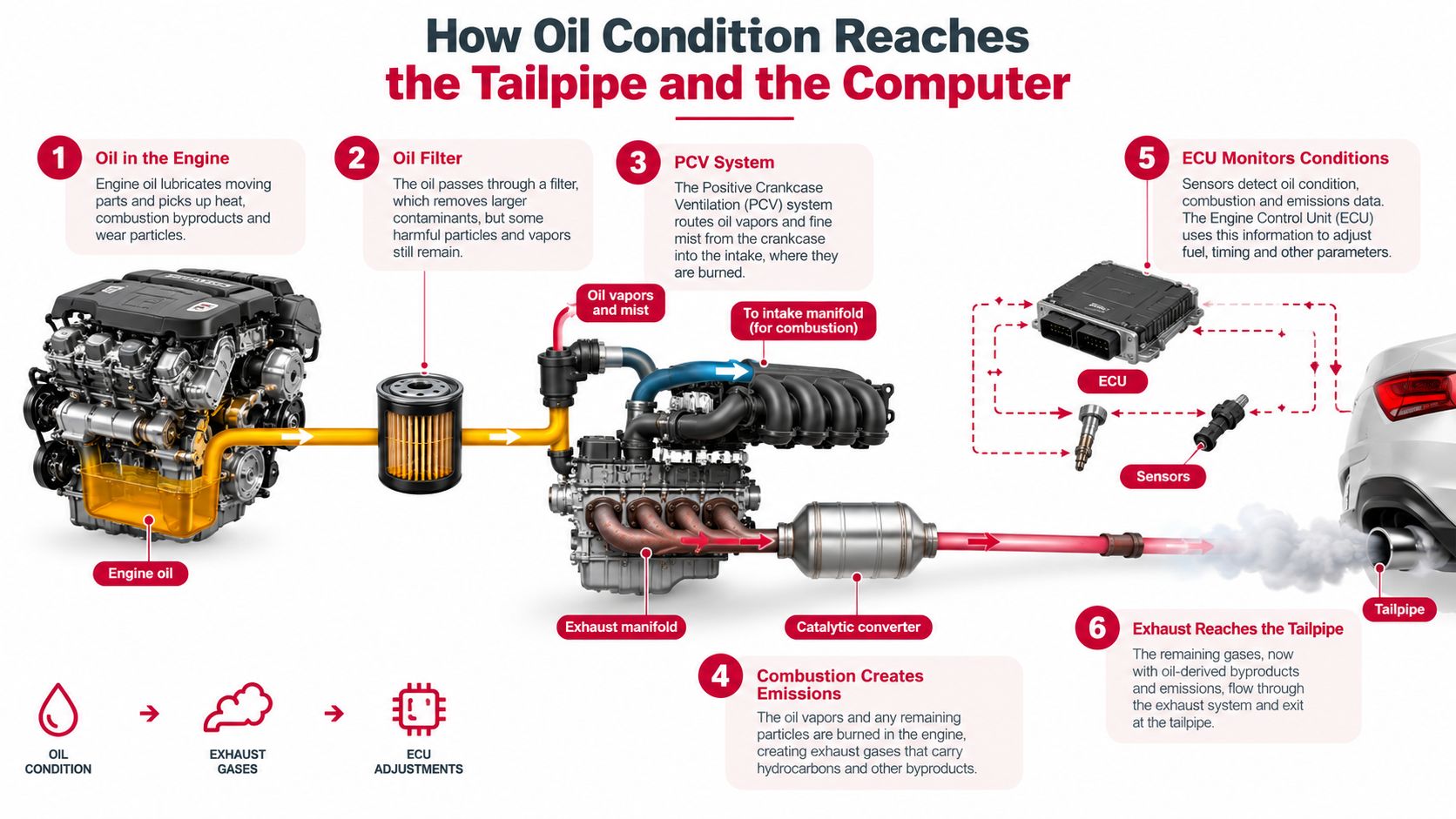
The tailpipe path
Hydrocarbons, often abbreviated HC, are unburned fuel compounds. Carbon monoxide, or CO, forms when combustion doesn't completely convert fuel into carbon dioxide. Extra crankcase vapors can affect the mixture entering the engine, particularly when the oil contains fuel or when the engine has mechanical wear.
That doesn't mean every old-looking oil sample causes a failure. Oil color alone isn't a reliable emissions diagnosis. The important question is what the oil has absorbed and whether the engine is allowing an unusual amount of vapor into the intake.
The computer path
The vehicle's OBD system is different from the oil circulating in the engine. OBD stands for onboard diagnostics. It uses sensors and programmed checks to evaluate emissions-related operation, including whether the catalytic converter, oxygen sensors, fuel systems, and other monitored systems appear to be working correctly.
You can read a straightforward explanation of the inspection process in this guide to what a smog check examines. The key distinction is simple: fresh oil may influence combustion conditions, but it doesn't directly set an OBD monitor to complete. A battery reset, cleared code, or recent repair can change the computer's status even when the oil level and oil quality are correct.
What the Research Actually Measured After an Oil Change
The strongest evidence for an oil change affecting emissions comes from a controlled comparison. A 2024 study in the Pakistan Journal of Science tested vehicles immediately before and after a routine engine oil change with portable emission analyzers. Across gasoline automobiles, motorcycles, and motorcycle rickshaws, the researchers measured reductions in regulated pollutants after fresh oil was installed. For the gasoline-powered vehicles included in the supplied findings, CO fell by 9% to 67%, while hydrocarbons fell by 21% to 52% (study PDF).
Those figures don't mean every vehicle will show the same change. The result depends on the vehicle's engine condition, the starting condition of the oil, fuel dilution, mechanical wear, and the testing method. A newer engine with recently serviced oil may have little room for improvement. A vehicle with badly contaminated oil may respond more noticeably.
One passenger-car comparison makes the result easier to picture. In the supplied study findings, the car's CO reading fell from 0.87% to 0.28%, approximately a 67% reduction, after the oil change. The same vehicle also showed a reduction in HC, although the verified material provided here doesn't include a specific HC value for the table below.
Tailpipe Emissions Before vs After Oil Change
| Test Condition | CO (%) | HC (ppm) |
|---|---|---|
| Passenger car before oil change | 0.87% | Reduced after the oil change, exact supplied value not specified |
| Passenger car after fresh oil installation | 0.28% | Lower than before, exact supplied value not specified |
The practical lesson is not that an oil change guarantees a pass. It's that oil condition can be a real emissions variable over a short testing window. A routine service may change what the analyzer measures, particularly when contaminated oil and fuel dilution are contributing to crankcase vapors.
The research also supports a useful distinction. An oil change is an emissions-related maintenance step, not an emissions-system repair. It may improve HC and CO readings, but it won't correct a damaged catalyst, a vacuum leak, a persistent misfire, or a sensor fault. The vehicle still needs to be evaluated as a complete system.
Here's a short visual explanation before we move to the underlying causes:
When Dirty Oil Raises Hydrocarbons and Carbon Monoxide
Contaminated oil becomes more relevant when the crankcase contains substances the engine wasn't designed to meter as part of its normal fuel mixture. The PCV valve pulls crankcase vapors into the intake, so the engine can burn them rather than release them directly. That process is useful, but it also means the condition of the crankcase can influence combustion.
Several situations can load the oil with unwanted material:
- Fuel dilution: Repeated short trips, rich operation, or an injector problem can allow unburned fuel to mix with the oil. That thins the oil and increases the amount of fuel vapor available to the PCV system.
- Moisture accumulation: An engine that doesn't reach normal operating conditions regularly may retain water vapor and condensation in the crankcase. Moisture changes the oil's condition and can combine with combustion byproducts.
- Soot loading: A rich-running engine creates more fuel than the combustion process can use cleanly. Soot and other byproducts then collect in the oil.
- Mechanical wear: Worn piston rings or valve seals can increase the amount of combustion gas or oil vapor entering places it shouldn't. The PCV system can carry that material toward the intake.
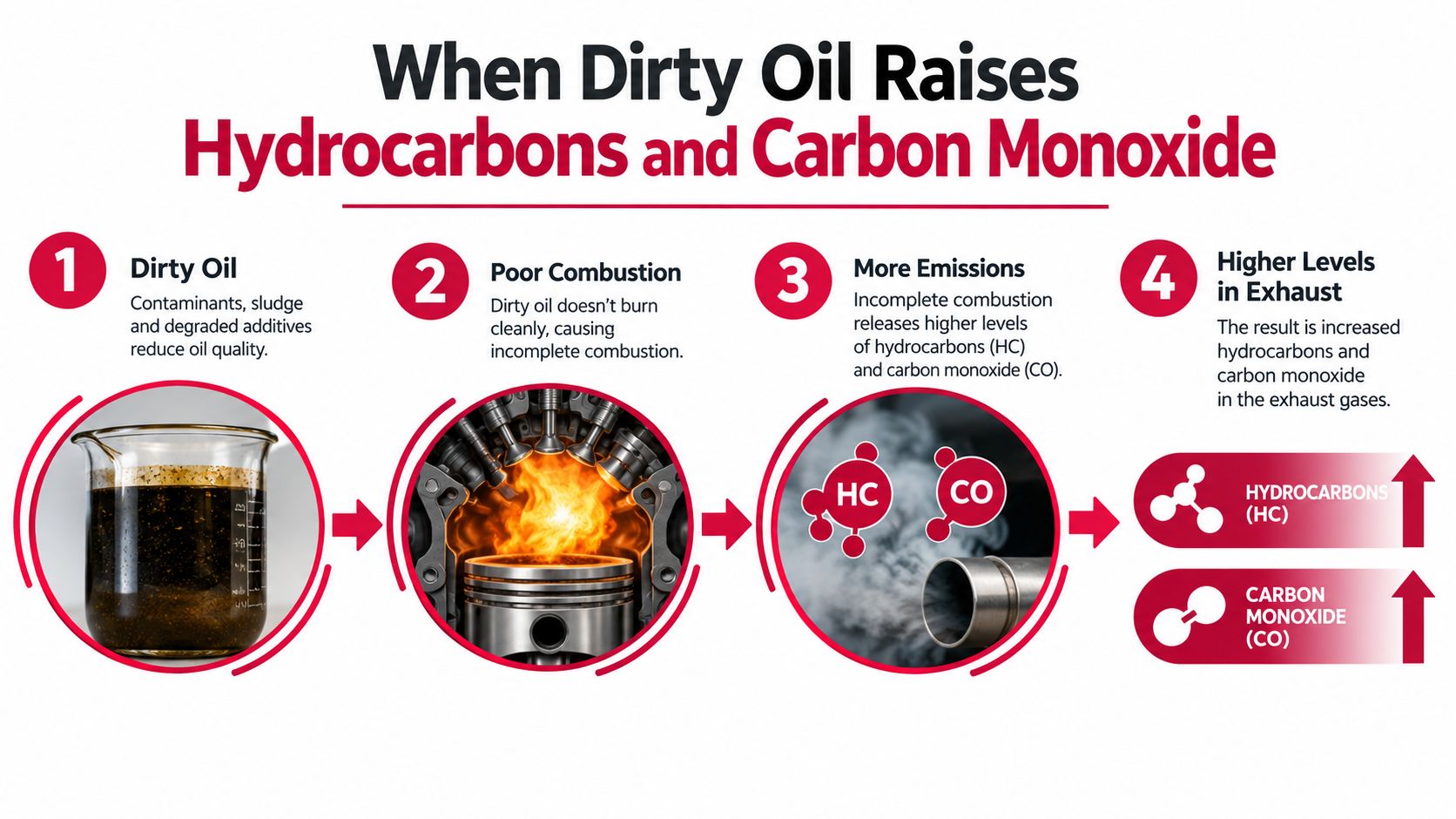
Why HC and CO can rise
HC rises when fuel or oil-related vapors pass through combustion without being fully burned. CO can rise when the mixture becomes richer than the engine can burn efficiently. Contaminated crankcase vapors don't always create a dramatic problem, but they can matter when the vehicle is already close to an inspection limit.
That's why a fresh oil change can help a borderline vehicle in some circumstances. It removes the old oil and the contaminants it has collected, reducing the load in the crankcase. The improvement is more plausible when the service is overdue or when there are signs of fuel dilution.
Why oil color isn't enough
Black oil isn't automatically proof that a vehicle will fail, and clean-looking oil isn't proof that the engine is emissions-ready. Oil darkens as it holds suspended material, and the oil's actual condition depends on the vehicle, lubricant, driving pattern, and maintenance history.
A fresh fill can remove one contributor to high readings. It can't remove the cause of a misfire, repair worn rings, or restore a damaged catalytic converter.
If the oil level keeps dropping, the exhaust produces excessive smoke, or the engine has an oil leak, treat those as diagnostic clues. The Maryland emissions inspection guidance advises checking oil and coolant levels and looking for leaks and excessive smoke before testing (vehicle emissions inspection guidance). Those checks are useful preparation principles even though inspection procedures vary by state.
The OBD Readiness Trap Behind a Check Engine Light
Many nervous drivers focus on the oil dipstick because it's visible. The OBD system is less obvious, but it can determine whether a modern vehicle is accepted for testing.
An OBD monitor is a programmed self-check. The computer observes conditions such as temperature, speed, load, fuel level, and other operating factors, then decides whether a particular emissions system has completed its evaluation. A monitor marked ready has completed its check. A monitor marked not ready hasn't gathered enough information yet.
Disconnecting the battery can erase stored readiness information. Clearing diagnostic trouble codes can do the same. That creates the trap: the technician installs fresh oil, the car feels fine, and the driver assumes the vehicle is prepared. But the computer may still need normal driving before the required checks complete.
Why a battery reset changes the answer
An oil change itself doesn't normally erase readiness. The problem arises when someone disconnects the battery during service, replaces the battery, clears a fault, or uses a scan tool to reset the computer. The vehicle then starts the post-reset process again.
A recent repair can create a similar situation. If the check-engine light is on, the computer has identified an emissions-related fault. Fresh oil doesn't override that fault. If the light was recently cleared, the light may remain off while the monitors are still incomplete.
Use this OBD readiness monitor explanation to understand what the dashboard and a scan tool are showing. Before the inspection, a technician can check readiness status without guessing from how the car feels.
What to do after a reset
Don't disconnect the battery as a casual pre-test step. If it was already disconnected, drive the vehicle normally and give the monitoring system time to run under varied conditions. The exact sequence depends on the vehicle, so the owner's manual or a technician's scan-tool check is more reliable than a generic internet drive cycle.
Computer-side rule: A clean oil change and a ready OBD system are separate achievements. You need both when the inspection relies on computer checks.
A Practical Pre-Test Plan for the Week Before Your Appointment
Start with the dashboard, not the oil bottle. If the check-engine light is illuminated, arrange diagnosis before the appointment. If the light was recently cleared or the battery was disconnected, have the readiness status checked before you pay for an inspection.
Early preparation
Look at the maintenance history. If the oil is overdue, the level is low, or the engine has signs of fuel dilution, schedule the oil change using the manufacturer-recommended oil. Don't treat an oil change as necessary just because the inspection is approaching if the oil was recently replaced and the engine is operating normally.
Check the basics as well:
- Oil and coolant: Bring both to the manufacturer-recommended level. Don't overfill either one.
- Leaks and smoke: Look for fluid leaks and excessive exhaust smoke. Those symptoms deserve attention before testing.
- Fuel cap: Make sure the cap seals properly after refueling. A loose or damaged cap can contribute to an emissions fault.
- Tires: Confirm that the tires are in sound condition and properly inflated so the vehicle can be driven safely during preparation.
- Recent parts: Avoid installing an unverified sensor, fuel additive, or other last-minute component without allowing time to confirm that the repair worked and the computer has completed its checks.
If the battery was disconnected
Drive the vehicle in ordinary traffic rather than trying to force a result with aggressive acceleration. A mix of city and steady-speed driving gives the computer varied operating conditions, but the required pattern differs by model.
Check readiness before the appointment. If a monitor still shows “not ready,” rescheduling may be wiser than arriving at the station and discovering the issue during the inspection. A scan tool can reveal this status before the official test.
On appointment day
A warmed-up engine generally gives the vehicle a better chance to operate as intended than a cold start at the station. Follow the station's instructions and avoid shutting the engine off repeatedly while waiting if staff ask you to remain in line.
An oil change may help when the lubricant is overdue or contaminated, especially if the vehicle has signs of fuel dilution or heavy crankcase vapor loading. It's usually wasted effort when the oil is fresh and the underlying problem is an active fault or incomplete readiness.
For more general preparation ideas, see this guide to reducing vehicle emissions. Use it as maintenance guidance, not as a promise that any single service will produce a pass.
Putting It Together for a Clean First Pass
The conditional answer is the useful one. Dirty or overdue oil can affect tailpipe readings, while fresh oil that was already in good condition may change very little. Battery disconnection and cleared codes can affect the computer's readiness status, regardless of what's in the oil pan.
If the vehicle fails, read the inspection report before authorizing repairs. The report should identify whether the issue involves a tailpipe reading, an OBD fault, readiness, or another inspection condition. Ask the station whether it can perform a retest and what its retest policy requires. If the vehicle needs a particular type of California inspection, confirm whether the station's certification matches that requirement. A STAR-certified test-only station is one possible option when the vehicle or registration notice calls for that type of inspection.
Questions drivers often leave unanswered
What if the battery was reset yesterday? Treat the vehicle as potentially not ready. A one-day-old reset doesn't prove that the monitors have completed, so check the status with a scan tool before testing. You may see evidence of a recent reset through incomplete readiness monitors, but the absence of that evidence doesn't establish that the battery was never disconnected.
What if the car is referred as a gross polluter? Don't try to mask the result with another oil change. Follow the referral instructions and have the underlying emissions problem diagnosed. A referral is a sign that the vehicle needs more than routine pre-test preparation.
Do DMV renewal rules cover every vehicle the same way? No. Requirements can vary by vehicle type, registration situation, and applicable California program rules. Classic vehicles, diesel vehicles, and recreational vehicles may have different testing treatment or equipment limitations, so check the notice and confirm with the testing station before driving over.
Can a station refuse the test? It can direct you to the appropriate process when the vehicle falls outside its equipment, certification, or service limits. Call ahead if you have a large recreational vehicle, unusual equipment, or a registration notice with special instructions.
A clean run means the vehicle has no active emissions warning light, no unresolved fault that blocks the inspection, required monitors are complete, and measured emissions are below the applicable limits. It also means the engine has the correct oil level and manufacturer-specified oil, with no obvious leak or smoke problem.
Don't schedule an oil change as a superstition. Schedule it because the oil needs replacing, then protect the computer's readiness and diagnose warning signs before testing.
Fire House Smog provides STAR-certified, test-only smog inspections and California DMV registration services at its Antioch location, with retest options available under its site policy and coupon terms. Visit Fire House Smog to check services, hours, and appointment information before your emissions test.