What Is STAR Testing? California Smog Check Explained
STAR is a voluntary California Smog Check certification for stations that meet higher inspection-performance standards, and it's the required location when a DMV notice says a STAR station must be used. It certifies the station, not the car, so a STAR inspection doesn't guarantee that a vehicle will pass.
Does the word “STAR” mean your car needs a special kind of emissions test? Usually, the test is still a Smog Check. STAR tells you which stations are qualified to inspect certain vehicles, and your DMV notice tells you whether you must use one.
Table of Contents
- What STAR Testing Means for California Drivers
- Who Has to Use a STAR Station
- STAR, Test-Only and Repair Shops Compared
- What Happens During a STAR Test and Why Cars Fail
- What a STAR Test Costs and How Long It Takes
- Confirm Your Notice and Book a STAR Test
What STAR Testing Means for California Drivers
Could your car need a STAR inspection even if it gets the same Smog Check as other vehicles? STAR is a designation for inspection stations, not a special test or a quality badge for your car. The designation is voluntary for stations, but when a DMV notice says a STAR station must be used, the inspection must be done at a STAR-certified station. This applies to directed vehicles identified by the state. Like an emergency care center equipped for higher-risk cases, a STAR station meets requirements for inspecting certain vehicles.
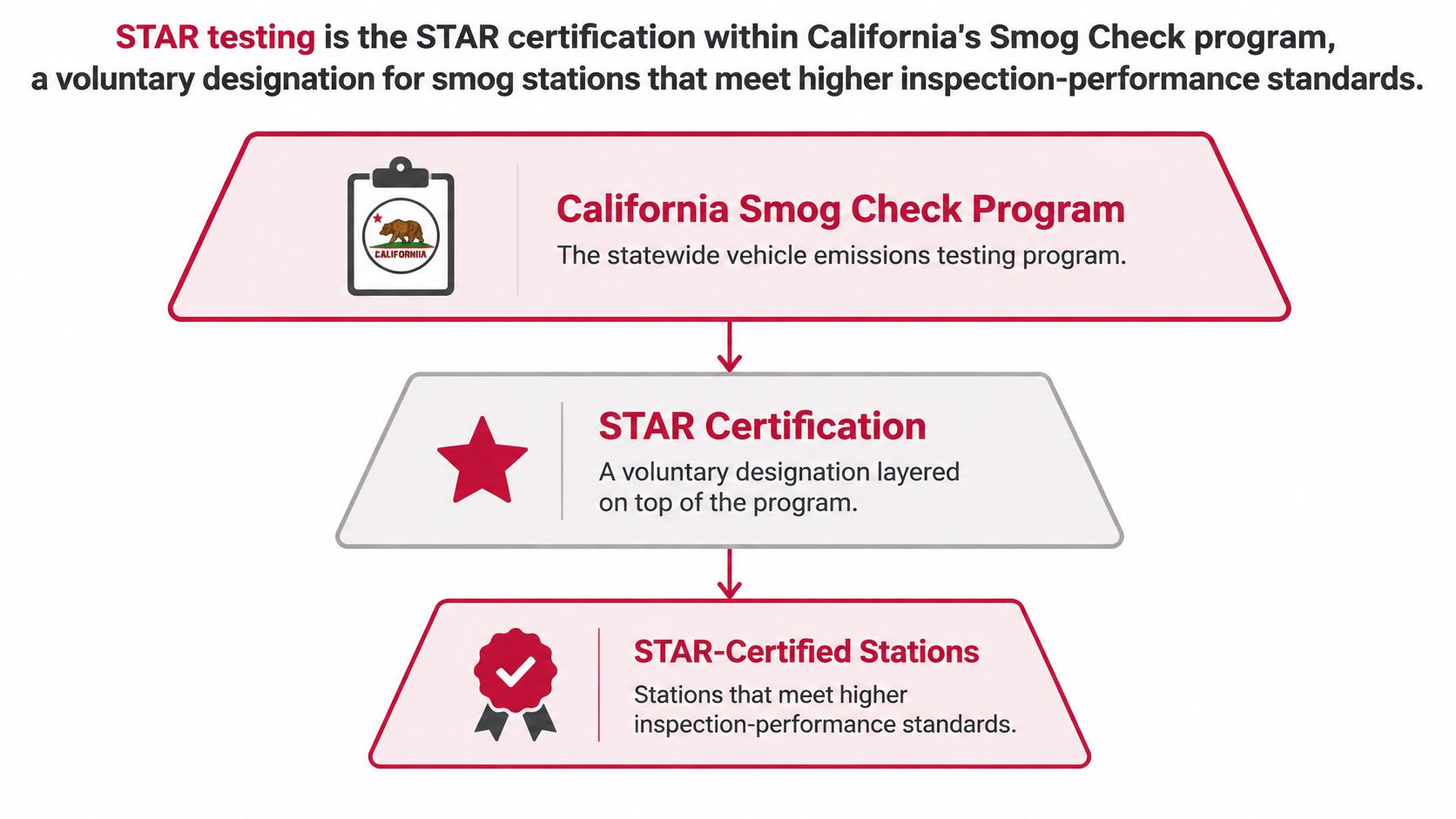
California introduced the program on January 1, 2013, replacing the earlier Gold Shield and Test-Only structure. It is part of the state's emissions-control system, under which many registered vehicles must pass a Smog Check every other year. A STAR inspection is still a Smog Check, not a different inspection required of every driver. The California DMV's smog inspection guide explains the program and how to tell whether a STAR station is required.
Station certification and vehicle compliance are separate. A STAR station meets additional performance requirements and can inspect directed vehicles. The car must still meet the emissions and inspection requirements that apply to it; the station's designation does not guarantee a pass.
In one sentence: STAR identifies a station within California's Smog Check program, not a car that is certain to pass.
Here, STAR refers to California vehicle inspections. The same term is also used for unrelated school assessments.
Who Has to Use a STAR Station
Does your DMV renewal notice require a STAR station? If it says “Smog Certification Required at a STAR station,” you must get the inspection at a STAR-certified facility. The notice is the clearest guide to whether STAR is required for your vehicle.
California identifies some vehicles as “directed vehicles” because they are considered more likely to fail an inspection. This group includes all model-year 1976–1999 vehicles, along with newer vehicles selected using the state's risk-based criteria, as described in the California DMV's smog inspection guide. A STAR station can inspect any vehicle, so you may choose one even if your notice doesn't require it.
| Vehicle situation | STAR station required? | Where to test |
|---|---|---|
| DMV notice says “Smog Certification Required at a STAR station” | Yes | Any STAR-certified station, test-only or test-and-repair |
| Directed vehicle, model-year 1976–1999 | Yes, when the notice requires it | STAR-certified station |
| Newer vehicle selected by risk-based criteria | Yes, when the notice requires it | STAR-certified station |
| Standard notice, newer vehicle, no STAR wording | No | Any licensed Smog Check station |
| Vehicle with a past emissions problem, no STAR wording | No, but a STAR station can inspect it | Any licensed station, or a STAR station by choice |
| No renewal notice yet, owner wants a pre-check | No | Any licensed station, or a STAR station by choice |
For example, if you have a 1994 sedan and your notice requires a STAR station, your usual mechanic can complete the inspection only if the shop is STAR-certified. Otherwise, take the car to an eligible station before completing registration.
Age or past emissions trouble may help explain why a vehicle needs attention, but neither determines the requirement on its own. The DMV notice is the deciding guide. For a broader overview of inspection situations, see this guide to California emissions testing requirements.
Follow the notice, not a rule of thumb. Your vehicle's age or your mechanic's usual practice does not override the DMV's instruction.
STAR, Test-Only and Repair Shops Compared
STAR is a station-quality designation added to a regular Smog Check station license. It evaluates the station's inspection performance, not the quality of the cars it tests. To qualify, a station must maintain required licenses, equipment, manuals, records and procedures, and have enough recent inspections for the Bureau of Automotive Repair (BAR) to measure its performance.
BAR uses several measures. A STAR station's Similar Vehicle Failure Rate must be at least 50% of the industry-wide rate for comparable vehicles. Its Incorrect Gear Selection rate must be no higher than 2% of certified vehicles, its Excessive Test Deviation Rate no greater than one, and its Follow-up Pass Rate generally at least 0.40 for the station or each listed inspector. The BAR STAR certification requirements explain these standards. They work like a driving instructor's performance review: the station must meet measured criteria, not just display a certificate. STAR status does not guarantee that a particular car will pass.
To compare stations, ask two questions: Is it STAR-certified, and can it sell repairs? Test-only shops inspect vehicles but do not sell repair work. Test-and-repair shops can inspect and repair. A repair shop without a Smog Check license may work on a car, but it cannot perform the official inspection or issue a certificate.
| Station type | STAR certified | Sells repairs | Inspects directed vehicles |
|---|---|---|---|
| STAR test-only | Yes | No | Yes |
| STAR test-and-repair | Yes | Yes | Yes |
| Non-STAR test-only | No | No | No |
| Non-STAR test-and-repair | No | Yes | No |
| Repair shop without a Smog Check license | No | Yes | No, cannot issue the certificate |
STAR stations performed 83% of statewide tests in calendar year 2023, even though they made up 48% of licensed stations, according to the BAR 2024 Smog Check Performance Report. That share describes how much testing they handled, not whether their inspections are easier or whether a car is more likely to pass. The result still depends on whether the vehicle meets the applicable requirements.
If your notice requires a STAR station, a non-STAR station cannot fulfill that requirement. Check the station's designation as well as its repair services: a shop may be able to fix your car without being authorized to complete the official inspection.
What Happens During a STAR Test and Why Cars Fail
What can make a car fail when its warning light is off? The answer often lies in its electronic readiness monitors, not only in tailpipe readings. A STAR designation certifies the station's inspection program, not the quality of your car or its likelihood of passing.
Three conditions are easy to mix up. A monitor is ready when the vehicle's self-check has finished. A diagnostic code is absent when the computer is not reporting a stored trouble code. Meeting pass criteria means the vehicle satisfies the full inspection requirements. These are connected, but one does not guarantee the others.
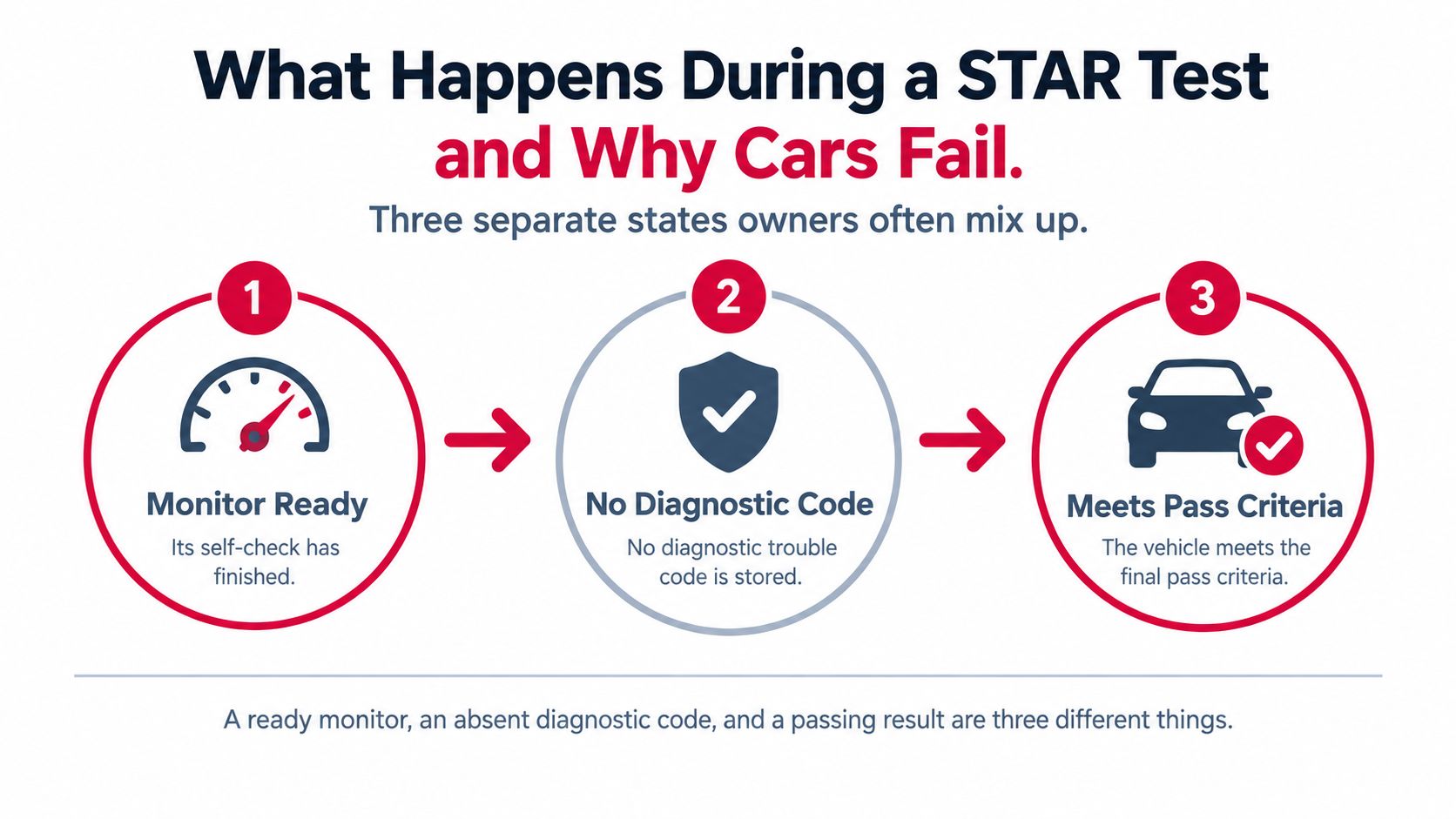
Under rules effective October 1, 2025, all readiness monitors must be set before a vehicle can pass, with implementation phased in and exceptions possible for vehicles with unique design issues. The BAR explanation of OBD readiness monitor rules explains that clearing codes or disconnecting the battery can leave monitors incomplete even when the check-engine light is off.
What the inspection checks
A STAR test checks whether a vehicle meets Smog Check requirements. It is not a repair diagnosis. The BAR description of Smog Check inspections outlines the required inspection systems and procedures. For modern vehicles with onboard diagnostics, the system examines electronically reported emissions-control information and readiness data. Applicable older vehicles may also undergo measured emissions and functional checks.
The visit generally follows these steps:
- Bring your registration and DMV renewal notice. Tell the station if the notice requires STAR.
- The inspector confirms the vehicle's identity and records its details.
- For an OBD-equipped vehicle, the inspection system reads emissions-control data and readiness status.
- The inspector checks whether each required monitor is set.
- Applicable older vehicles may receive additional emissions measurements and functional checks.
- The inspector checks visible emissions equipment in its installed condition.
- If the vehicle passes, a certificate is issued for registration. If it fails, the report lists the reasons.
Why a car can fail with the light off
A disconnected battery, recently cleared trouble codes, or a repair shortly before testing can reset monitors. The vehicle may need to be driven under suitable conditions before those self-checks finish. Until then, it may not be ready, even if it starts and drives normally without a warning light.
Newer vehicles can have the same readiness problem. Software, sensors and unfinished monitor checks can affect the result even when the dashboard shows no warning. A missing warning light is not proof that every required self-check has completed.
Before you book: Have the vehicle scanned a few days ahead and ask how many monitors remain incomplete. If any are not ready, ask what driving or service steps are appropriate before the inspection. Reviewing common Smog Check failure reasons can also help you understand what a failure report may identify.
What a STAR Test Costs and How Long It Takes
The total price has two parts: the state-set certificate fee and the station's inspection fee. The station's fee can differ, so ask for the all-in price before you drive over. If you're considering a test-only station, its charge covers the inspection rather than repairs added to the same bill.
Ask about the retest policy before booking, especially if your car has failed before. A retest may be free under a station's posted policy and coupon terms, but you'll want to confirm the conditions that apply to your visit. For a closer look at the cost components, see this guide to how much a STAR Smog Check costs.
The inspection itself is brief for many modern OBD-equipped vehicles, but the full visit can take longer. The queue, any warm-up driving needed before the test and registration paperwork can all affect how long you're there. Ask the station for a current wait estimate when you book, and check its posted hours.
When you request a quote, have these details ready:
- Vehicle details: Year, make and model.
- DMV notice: Keep it available so the station can confirm whether STAR is required.
- Registration and odometer: Have the current registration and odometer reading on hand.
Confirm Your Notice and Book a STAR Test
Use this short checklist before you schedule:
- Read the notice. If it says “Smog Certification Required at a STAR station,” book with a STAR-certified station.
- Choose a licensed station. Without STAR wording, you can use any licensed Smog Check station. A STAR station is also an option, particularly if the car has past emissions trouble.
- Confirm the details. Ask the station to verify its STAR status, whether it's test-only and what its retest policy covers.
- Check readiness. Scan the monitors a few days ahead and resolve incomplete items before the inspection.
If you want to see the general inspection process before booking, this video offers another overview.
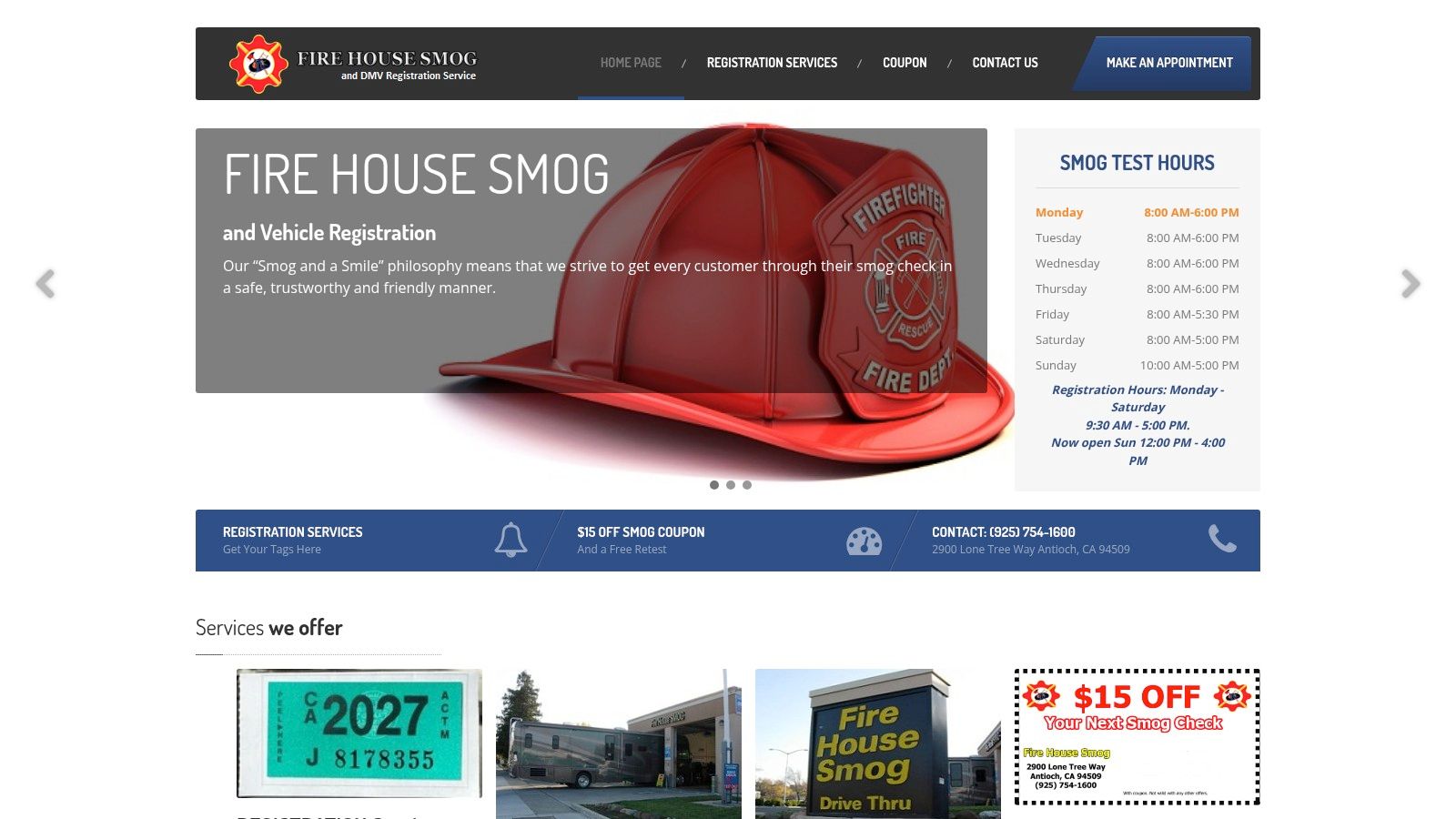
For drivers in East Contra Costa County, Fire House Smog is a STAR-certified test-only station at 2900 Lone Tree Way in Antioch. It offers smog inspections seven days a week, on-site DMV renewals and transfers, and a free retest when required under its site policy and coupon terms; call 925-754-1600 to confirm details and timing. Because the inspection checks compliance rather than diagnosing repairs, arriving with monitors ready gives your vehicle a better chance of completing the process on the first attempt.
If your notice requires STAR, bring it along with your registration and ask about readiness checks and retest terms before you set out. Visit Fire House Smog for STAR-certified test-only inspections and on-site DMV registration services in Antioch.