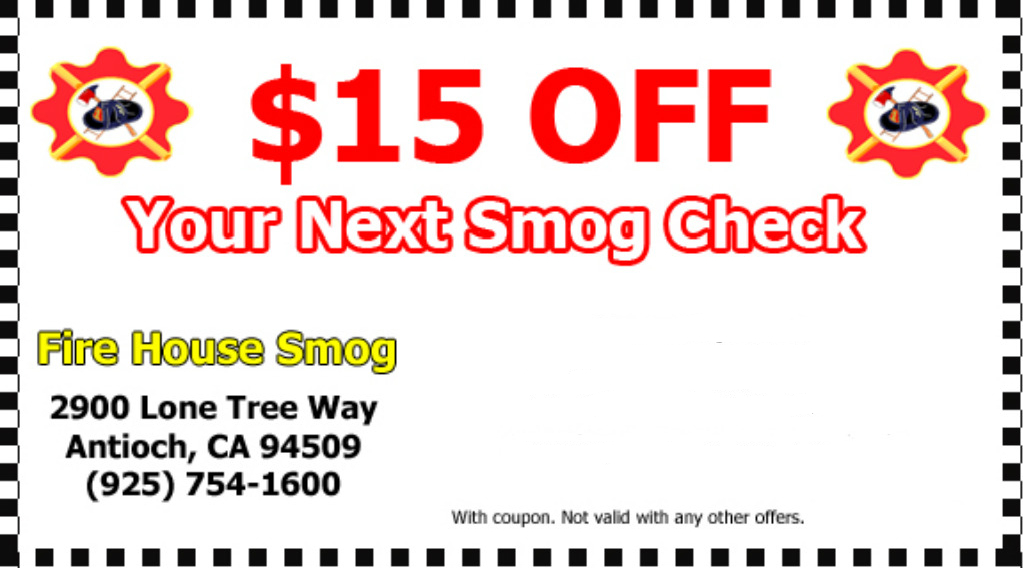
A1 Smog Coupon: How to Find, Validate, and Redeem It
You're standing at the smog station with a printed A1 smog coupon in your hand, but the price on it doesn't match what the person at the counter is asking. Maybe your DMV notice says STAR, your vehicle is a diesel, or the coupon's fine print has an expiration date you didn't notice. That's a familiar scene, and it's usually avoidable.
Treat the coupon as one part of a compliance workflow, not as a guarantee of a particular price or a passing result. Before you drive to a station, confirm the notice, the vehicle restrictions, the full price, and what happens if the car fails. Those checks can save you a wasted trip and help you avoid paying for an inspection at the wrong station.
Table of Contents
- What an A1 Smog Coupon Really Gets You
- Read Your DMV Notice Before You Use the Coupon
- Private Coupon vs State Assistance at a Glance
- Pre-Visit Checklist Before You Hand Over the Coupon
- Redeeming the Coupon at a STAR Test-Only Station
- Using the Free Retest the Smart Way
- Putting It Together for the Lowest Realistic Cost
What an A1 Smog Coupon Really Gets You
A coupon is a discount offer from a private station. It may reduce the inspection charge, but it doesn't automatically cover every vehicle, every required test, or every fee that could appear on your bill. The phrase “A1 smog coupon” can refer to different local offers, so don't assume a coupon you found online applies to the station you plan to visit.
Start with the price, but don't stop there. Ask whether the advertised amount is the total you'll pay or a starting price, whether a certificate fee is separate, and whether the offer applies to your vehicle's model year and fuel type. A discounted inspection can still turn into an unexpected expense if your vehicle is excluded or the coupon doesn't cover a required service.
The station matters as much as the discount. A standard smog requirement can generally be handled at a licensed station, while a vehicle directed to a STAR station must go to a STAR-certified location. A lower coupon price won't help if the shop can't perform the inspection your DMV notice requires.
Before you go: Confirm two things: “Does this coupon apply to my vehicle?” and “Can this station complete the test my notice requires?”
That's the practical test for any A1 smog coupon. First verify the offer. Then verify the station. Only after both checks should you count the discount as a saving.
Read Your DMV Notice Before You Use the Coupon
A driver walks in waving a printed coupon, hands over the keys, and finds out twenty minutes later the notice says STAR station required. The coupon was for a standard shop across town. The trip, the wait, and the discount are all wasted, and I see some version of that scene every renewal season.
Your renewal notice is the routing document for the whole transaction. It states which smog inspection your vehicle needs, and the California DMV's smog inspection guidance advises motorists to bring it so the station can transmit the result against the correct record. Read that line before you compare coupon prices, because a discount only has value at a station allowed to run your test.
If the notice says "Smog Certification Required at a STAR station," a STAR-certified location is the only place your inspection counts. If you're unsure what that label involves, this breakdown of STAR-certified smog stations explains how these stations differ. A notice without the STAR direction can generally be handled at any licensed station, which is where most coupons work.
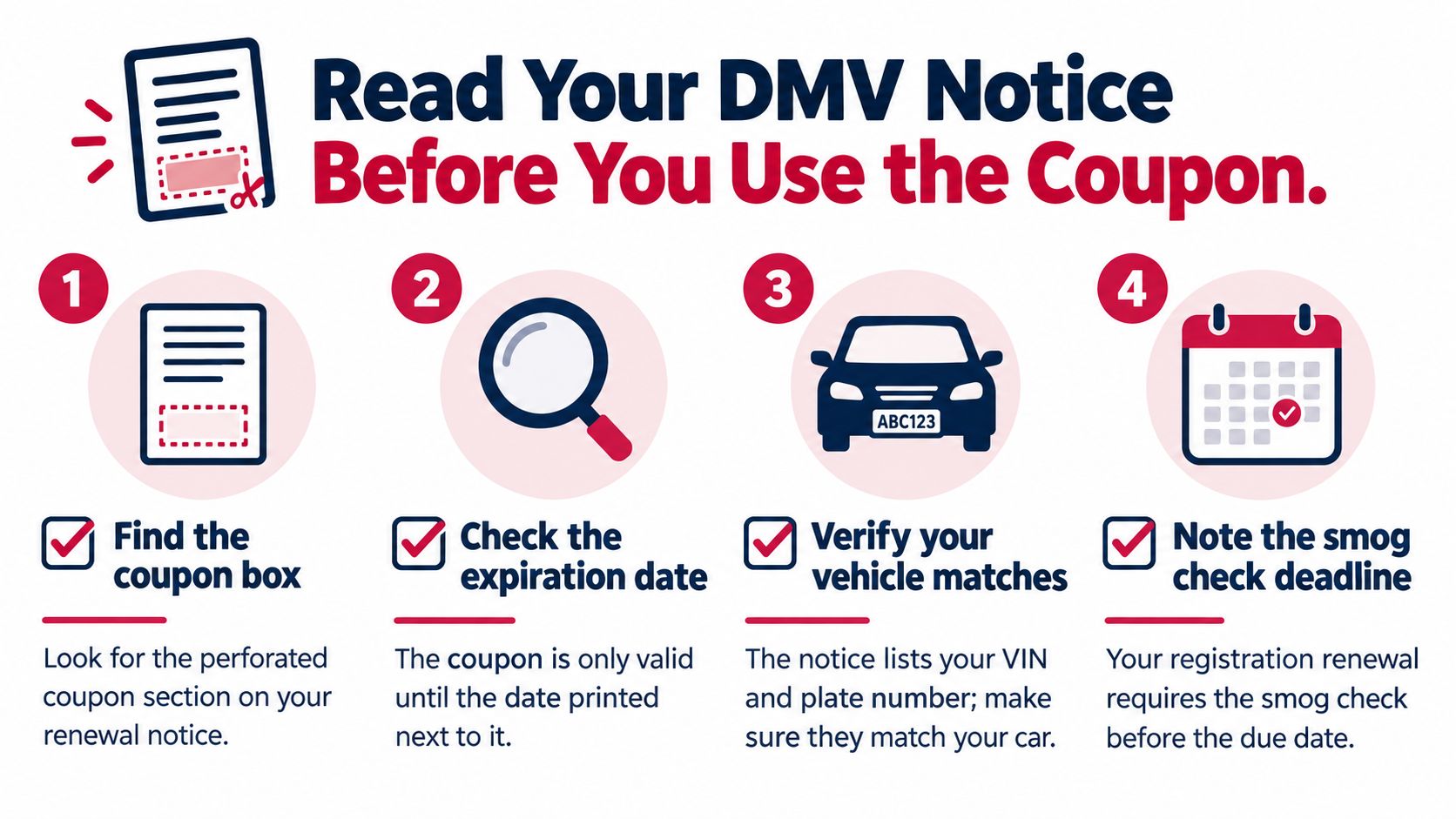
Check the notice at home, not at the counter:
- Find the smog line. Confirm whether it names a STAR station or a standard check.
- Match the vehicle. The plate and VIN on the notice should match the car you're bringing, especially in households with more than one vehicle due.
- Note the deadline. A failed test close to the registration date leaves little room for a retest.
- Flag the special cases. Exemptions and out-of-state transfers follow different rules, so confirm the process with the DMV or a licensed station before you pay for anything.
Treat the coupon as one step in a compliance job. The notice decides where your inspection counts. The discount decides the price once you're there. A cheap test at the wrong station saves nothing.
Private Coupon vs State Assistance at a Glance
A driver walks in with a coupon, then the car fails and the bill starts. The coupon helped only at the front counter. California's Consumer Assistance Program works later in the workflow, after a failed Smog Check, and it can change the repair or retirement decision instead of trimming a few dollars off the test.
Treat the two tools as separate lanes. The California Office of the Patient Advocate describes the Consumer Assistance Program, whose current materials list $1,350 for eligible owners and $2,000 for income-qualified owners; the California Air Resources Board's program report documents the older $1,000 retirement incentive. Program amounts and eligibility shift, so verify the rules in force now before you plan around them.
A station offer is controlled by that shop's fine print. State aid is controlled by income, vehicle, location, and funding rules. If the car is borderline, price the repair, the retirement option, and the renewed registration path before you spend anything on diagnosis.
| Option | What it covers | Eligibility | Can it stack with a station coupon |
|---|---|---|---|
| Private station coupon | A discount on an inspection, subject to the offer's terms. | The vehicle and service must meet the coupon restrictions. | Ask the station. Don't assume discounts combine. |
| Consumer Assistance Program | Eligible assistance after a failed Smog Check, with program rules determining the available support. | Applicants must meet current state criteria. | Confirm with both the program and station before relying on a combined saving. |
| Vehicle-retirement incentive | A payment for retiring an eligible vehicle, subject to program requirements. | Vehicle and owner must qualify under current rules. | It's a separate program benefit, not an inspection discount. |
In the San Joaquin Valley, Tune In & Tune Up advertises a repair voucher for qualifying post-failure needs. Check the district's Tune In & Tune Up program page for current availability, location rules, application timing, and documentation. Then ask the station whether your coupon still applies and get that answer before the inspection. The cheapest outcome usually comes from sequencing the steps, not chasing the biggest headline discount.
Pre-Visit Checklist Before You Hand Over the Coupon
The coupon's headline price isn't the number to compare. Compare the all-in price for your vehicle, including any fees the offer excludes and the conditions attached to a retest. Ask the station directly if the coupon page doesn't spell those terms out.
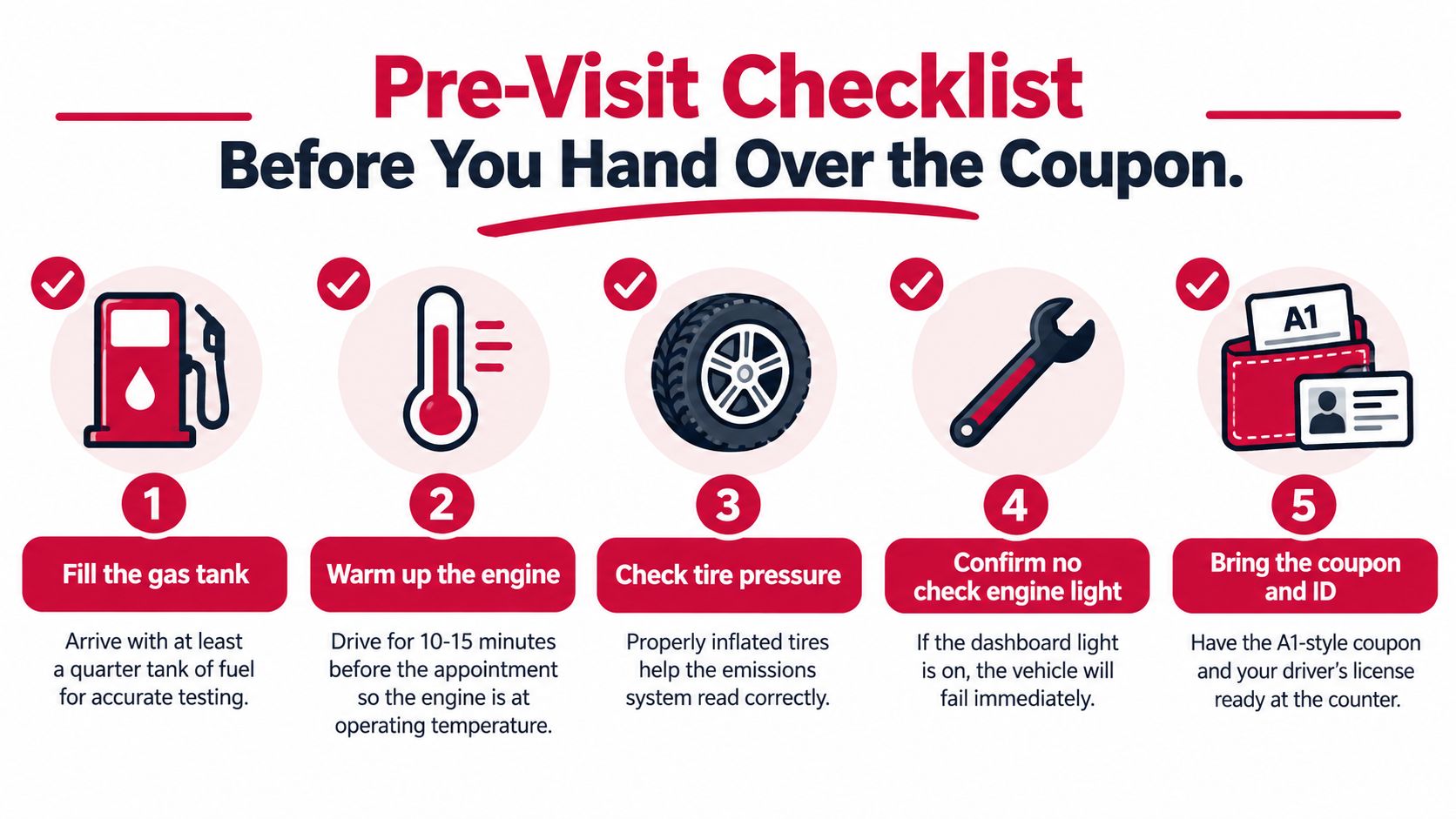
Check each of these before you leave home:
- Model year and fuel type: Confirm the offer covers your vehicle. Ask specifically about diesel and hybrid vehicles if either applies.
- Vehicle size and type: If you drive a truck or RV, confirm that the station can inspect it and whether size or equipment restrictions apply.
- Certificate fee: Ask whether it's included. One published San Diego comparison lists a separate $8.25 certificate charge and notes that station pricing and coupon coverage can vary; check the published coupon comparison for its terms.
- Extra inspection charges: Ask whether the station charges more for your vehicle or for additional visual or functional checks.
- Appointment and expiration: Confirm whether you need an appointment and whether the coupon will still be valid on the day you plan to visit.
- Retest conditions: Find out whether a retest is included, what the offer requires, and whether you must return to the same station.
Don't invent a total by adding the coupon price to a fee you saw on another station's page. Prices and terms vary. Call the station, describe the vehicle, and ask for the amount you'll owe if it passes. If it fails, ask what the coupon covers and what you'll pay for a retest.
That phone call is more useful than relying on a bold starting price. It also exposes restrictions before you're at the counter with the engine running.
Redeeming the Coupon at a STAR Test-Only Station
The counter handoff is where a cheap coupon turns expensive. Say this before the keys move: “My notice says STAR test-only, this is the vehicle, and I want the out-the-door price if it passes and the paperwork path if it fails.” That one sentence treats the coupon like a workflow, not a sticker price.
A STAR test-only station should match the inspection to what your registration notice requires. Model year and equipment still decide the method: newer vehicles usually get an OBD-II scan, while many older vehicles face tailpipe testing and closer visual checks. A lit check-engine light is not a courtesy issue here. If it is on, expect trouble.
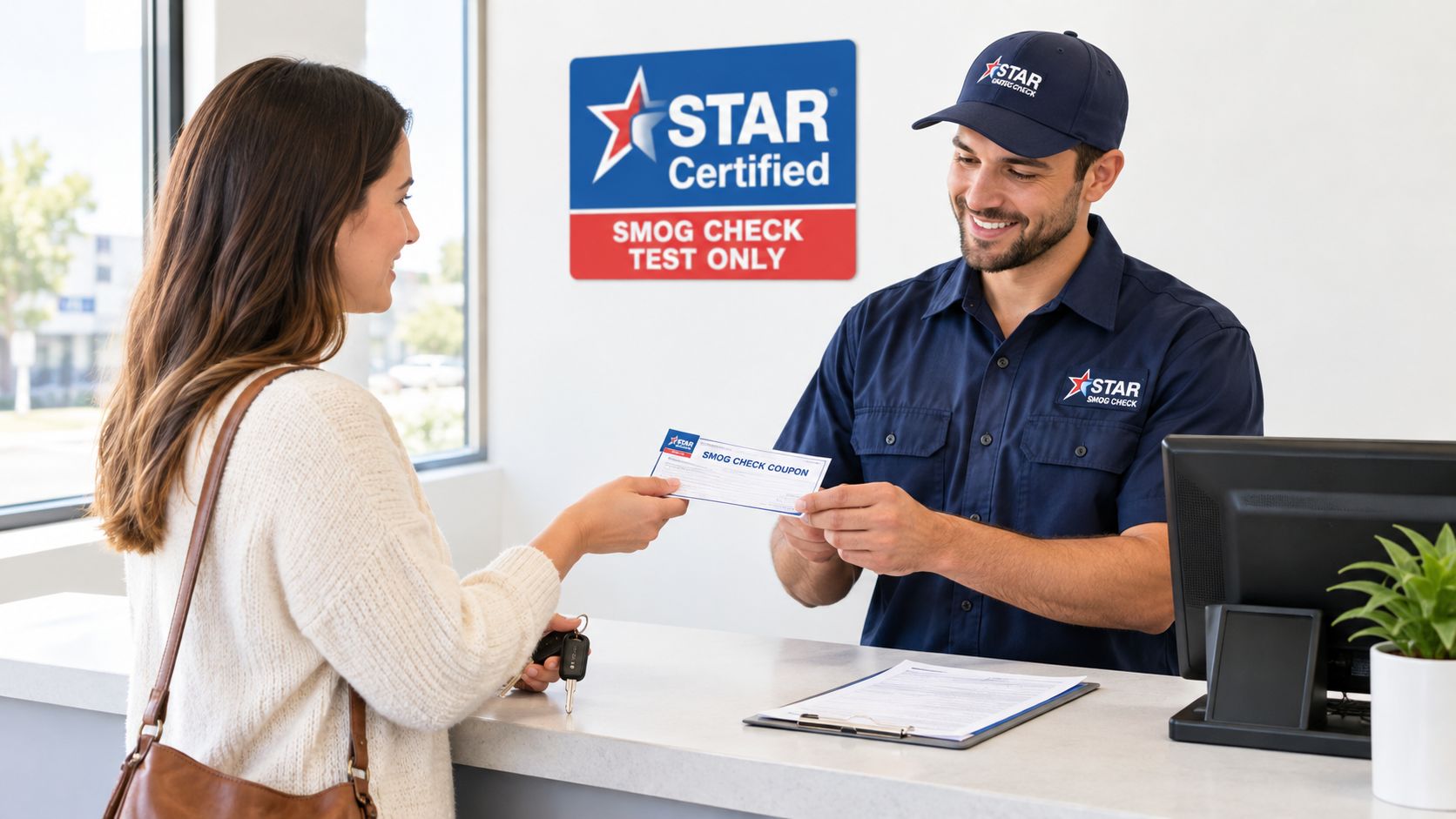
Use the test-only setup to your advantage. The station does not sell repairs, so the pass or fail comes without a built-in reason to inflate the remedy. That independence is useful, but it also means a fail sends you elsewhere for the fix, then back through the compliance line. Keep the Vehicle Inspection Report like it is money, because it is the map for the next move.
This is also where the state assistance comparison matters. If you qualify for California's Consumer Assistance Program, the cheapest private coupon may not be the lowest real cost once repair help or retirement options enter the picture. If you do not qualify, treat the coupon as a narrow discount on the test itself and demand a clean result path.
After a pass, confirm the certificate was transmitted electronically and leave with paper copies for your records. Registration services, weekend hours, and “we can handle that at the counter” extras are separate until the station says otherwise in writing.
Using the Free Retest the Smart Way
A free retest usually means two inspections for the price of one under the station's terms. It doesn't mean the vehicle is guaranteed to pass, and it won't erase a fault that hasn't been fixed. Use the first inspection to get a clear report, then repair the cause before returning.
Clearing trouble codes immediately before a retest is a poor shortcut. The car's OBD-II readiness monitors record whether emissions self-tests have completed. After a repair, the vehicle may need normal driving or a manufacturer-specified drive cycle before those monitors are ready. California's BAR STAR FAQ describes the free-retest structure, and BAR's readiness rules require all applicable monitors to be set for a pass under the regulation effective October 1, 2025.
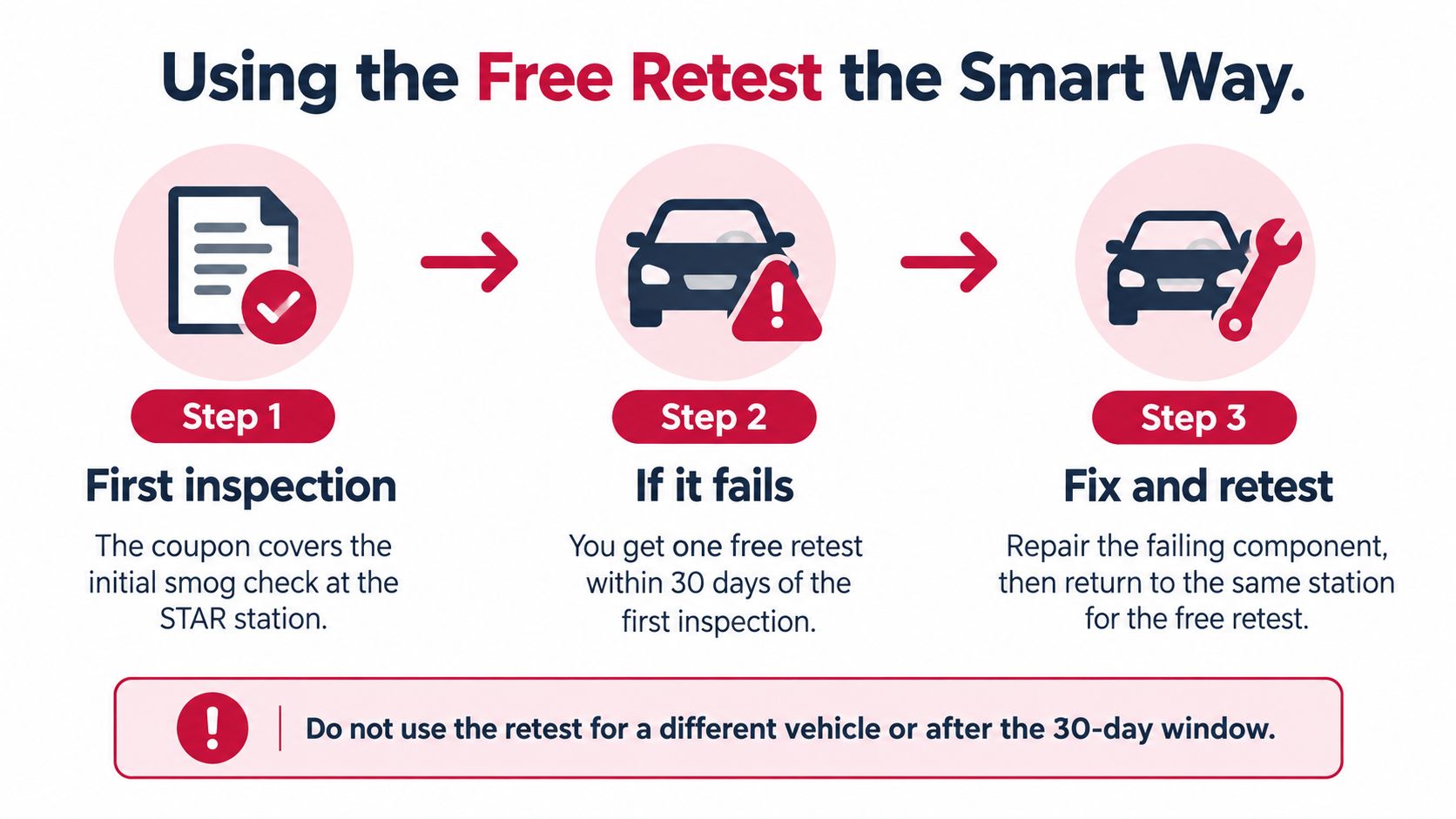
Use a measured retest routine:
- Read the report. Identify the failed component or monitor instead of guessing.
- Complete the repair. Don't clear codes as a substitute for fixing the fault.
- Allow readiness checks to run. Follow an appropriate drive cycle or normal driving pattern for the vehicle.
- Check before returning. Scan for pending codes and monitor status, and confirm the malfunction indicator light is off with the engine off and running.
If the light remains on or a required monitor is unset, postpone the retest. Ask a repair professional to check the vehicle's status first, and confirm the coupon's retest deadline and conditions with the station. For help understanding the next steps after a failure, see what happens after a failed smog test.
Putting It Together for the Lowest Realistic Cost
The best way to save is to avoid paying for the wrong inspection, not to chase the smallest advertised price. First, match the station to the DMV notice. Next, confirm the coupon's vehicle restrictions and all-in cost. If the car fails and money is tight, check whether state assistance could help with the larger repair or retirement expense.
Don't assume a private coupon and a state benefit can be combined. Ask both the program and the station, and verify eligibility before making plans around a discount. A dated eligibility check beats a memorized amount, especially when program rules and availability can change.
If you're comparing inspection prices, review the station's smog check pricing information and call to confirm what applies to your vehicle. For a STAR-directed inspection, make sure the station is STAR-certified before you set out. That order keeps the decision practical: verify the requirement, validate the coupon, then compare the true payable total.
A coupon is a tool. The compliance workflow is the job.
Fire House Smog offers STAR-certified test-only inspections, on-site DMV renewal services, and smog testing seven days a week at its Antioch location. Call 925-754-1600 to confirm coupon terms or ask about vehicle fit before visiting, then come to Fire House Smog for help with your inspection and registration needs.