
Official Test Only Smog Station: What to Know
You open your California DMV renewal notice expecting a routine fee reminder. Instead, one line says Smog Check Required, and another may direct you to a STAR-certified or test-only station. The wording can make a simple renewal feel like a trip through a maze of government terms.
The key is to separate two labels that people often treat as interchangeable. Test-only describes what a station is allowed to do. STAR describes a state certification tied to inspection performance and oversight. A station can be both, but the terms don't mean the same thing. Once that distinction is clear, choosing the right location, completing the inspection, and handling your registration become much easier.
Table of Contents
- Why Your Renewal Notice Says Smog Check
- What a Test Only Smog Station Is
- Test Only Versus Test and Repair Stations
- Why STAR Certification Changes the Equation
- What to Expect During Your Smog Visit
- Pairing Your Smog Check With DMV Services
- Can a Test Only Visit Help Your Car Pass
- Choosing the Right Station for Your Situation
Why Your Renewal Notice Says Smog Check
You open a California DMV renewal notice expecting a fee reminder. Instead, it says Smog Check Required, and your renewal cannot finish until the vehicle meets that requirement. For most gasoline vehicles older than eight model years and most diesel trucks, a passing emissions inspection is part of renewing registration. The notice functions as a registration gatekeeper, so treating it as optional can leave the renewal incomplete.
The wording may also point you toward a STAR-certified station, a test-only station, or another directed inspection type. These labels answer different questions. Test-only describes what the facility is licensed to do. STAR identifies a certification for eligible test-and-repair and test-only stations that meet higher inspection-based standards. One station can carry both labels, but neither term automatically replaces the other. The Bureau of Automotive Repair STAR FAQ explains the certification program.
Why some vehicles receive a direction
A station direction may be connected to the vehicle's inspection history, a directed recall, missing relevant smog history, or state monitoring of high-emitting vehicles. The reason can vary, but the practical step stays the same: read the notice before choosing a shop. A nearby facility may be licensed for smog inspections yet unable to perform the inspection your vehicle was assigned.
A general smog requirement usually leaves you with more choice among licensed stations. A notice naming STAR or test-only limits that choice. If DMV directs the vehicle to a STAR station, use a facility with that designation for the required inspection. The California Smog Check guidance from BAR describes how directed vehicles and test-only stations fit into the program.
Practical rule: Let the words on the renewal notice guide your selection. A business name can be misleading, so confirm that the station's BAR credentials match the stated requirement.
Before booking, identify the assignment first. Then check whether the station is authorized for that inspection and whether it may perform repairs. That distinction helps you choose the right visit instead of paying for an inspection the location cannot complete.
What a Test Only Smog Station Is
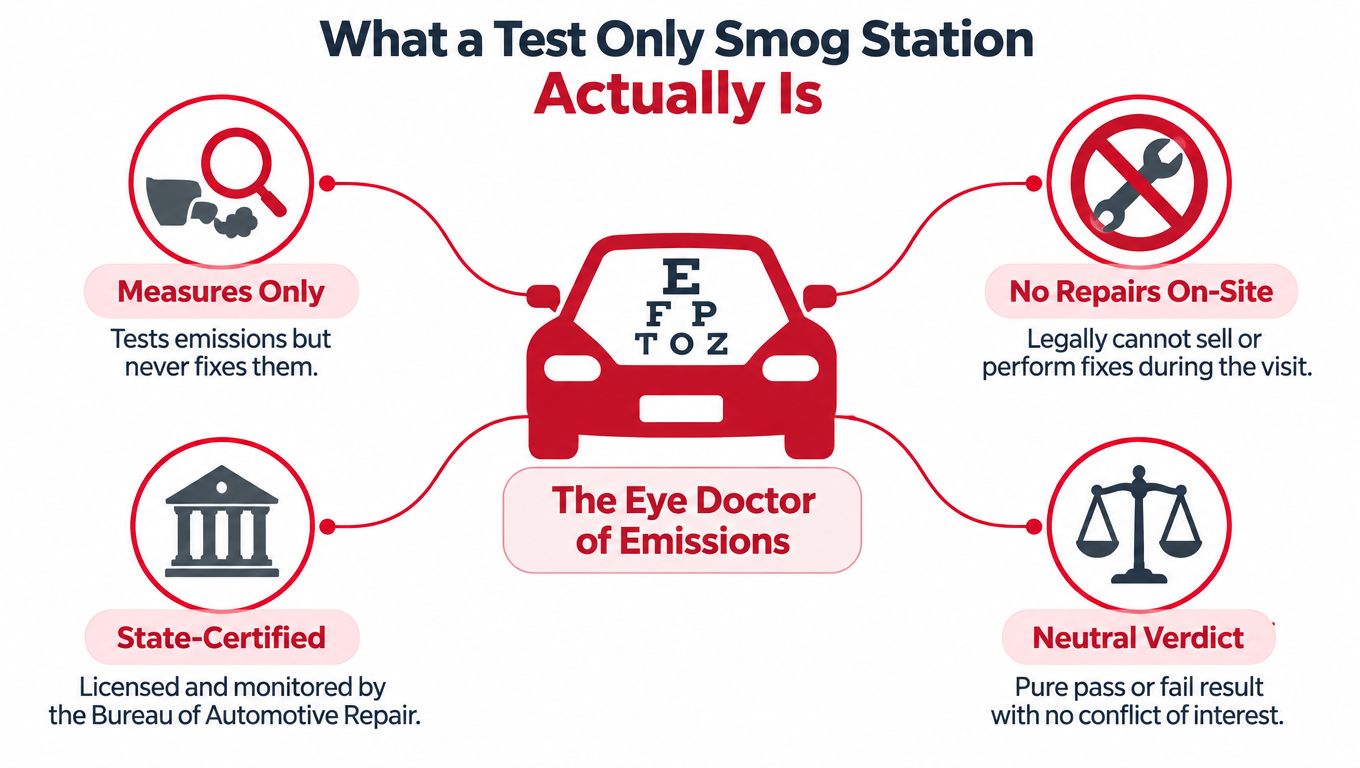
Your car can fail an emissions inspection without the inspection shop being the place that repairs it. A test-only smog station works like an eye doctor's examination room: it measures a condition, records the result, and gives you information for the next step. It does not diagnose or repair emissions problems during that visit.
The Bureau of Automotive Repair's smog check information describes a test-only station as a facility licensed to perform inspections only. Its authorization covers testing, not emissions diagnosis or repair. That distinction applies to the vehicle service the station is allowed to provide, not just the wording in its business name.
Why inspection and repair are separated
Consider a shop that decides whether your car fails and then sells the work needed to correct the failure. The arrangement can create a financial incentive to recommend repairs. California's test-only model separates those roles. The station's job is to perform the inspection and report its result.
That separation does not mean the technician ignores a problem. If your vehicle fails, you receive the failure information and can take the car to a qualified repair facility. The inspection and the repair decision occur in different places, like a medical test performed separately from treatment.
Where STAR fits
STAR certification is a separate layer. It is not another name for test-only. Qualifying test-only and test-and-repair stations can earn STAR certification by meeting the program's additional inspection standards.
A STAR test-only station has both designations:
- Test-only: It can inspect the vehicle but cannot diagnose or repair emissions problems.
- STAR-certified: It meets the program's additional standards and may serve vehicles directed to STAR facilities.
A STAR-directed vehicle needs the required inspection authorization, not necessarily a repair department. Test-only answers what the station can do. STAR answers which inspection tier it has earned.
Test Only Versus Test and Repair Stations
Your choice depends on what you need after the inspection. A test-only station suits a driver who wants the result first and plans to choose a repair shop separately. A test-and-repair station suits someone who prefers one business to inspect the vehicle and address an emissions problem if it fails.
Choose test-only when independence matters
Suppose your renewal notice allows a regular Smog Check, your car has no known emissions issue, and you already have a trusted repair shop. A test-only visit gives you the inspection result without tying that result to an in-house repair estimate. If the car passes, you can finish the transaction. If it fails, you can compare repair options before authorizing work.
A test-only technician can perform the required inspection and report the outcome. The station cannot diagnose or repair the emissions problem during that visit, clear a diagnostic fault, or adjust the vehicle for another test. The inspection works like a separate medical screening: it identifies the result, while treatment happens elsewhere.
Choose test-and-repair when one-stop service helps
A test-and-repair station can inspect the vehicle and, when appropriate, diagnose and perform qualifying emissions repairs. This may reduce scheduling when you already suspect a problem, such as a warning light or a previous failed inspection. The same business may also provide the follow-up test after repairs, subject to the applicable rules.
That convenience does not decide whether the station can inspect your vehicle. Your notice and vehicle status do. A station that offers repairs may still lack the authorization required for a directed inspection, so check the required designation before booking.
| Decision point | Test-only station | Test-and-repair station |
|---|---|---|
| Your priority | An inspection separate from repair sales | Inspection and possible repair coordination |
| After a failure | Take the result to a shop you select | Ask the same business about diagnosis and repairs |
| Repair service during the visit | Not available for emissions problems | May be available |
| If your notice names a station type | Use it only when the notice permits that option | Confirm it has the required authorization |
| STAR designation | May also be STAR-certified | May also be STAR-certified |
The words test-only describe the station's service limits. They do not describe the station's quality or predict whether your car will pass. Likewise, test-and-repair describes the services the business may provide, not a guaranteed result.
Before you arrive, read the renewal notice for any direction or credential requirement. If no special direction applies, choose between independent testing and repair convenience based on your vehicle's condition and the kind of follow-up support you want.
Why STAR Certification Changes the Equation
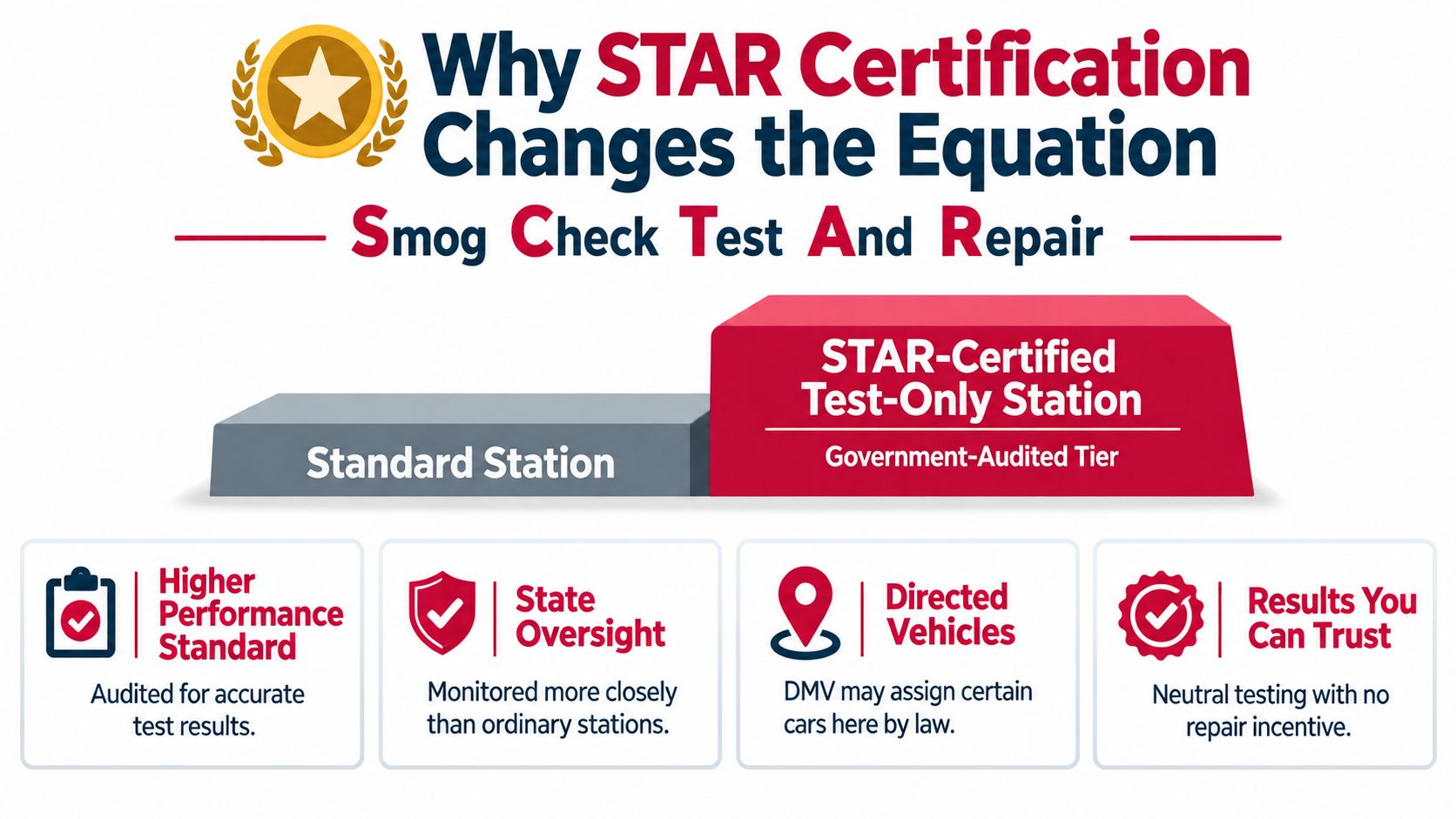
A driver can visit a test-only station and still need to ask a separate question: does that station have STAR certification? These labels describe different parts of the business. Test-only identifies what the station may sell. STAR identifies whether the station meets the state program's inspection and oversight requirements.
The official STAR program explanation from BAR describes STAR certification as available to qualifying test-and-repair and test-only stations. Certification is intended to support consistent inspection quality and emissions-reduction requirements. It does not change the condition of your vehicle or promise a passing result.
STAR and test-only answer different questions
Use two checks before booking:
- Can the station repair the vehicle? If it cannot, the business is test-only. If it can, it is test-and-repair.
- Does the station hold STAR certification? If it does, the station participates in STAR, regardless of whether it is test-only or test-and-repair.
California's published Smog Check information reports that, in calendar year 2025, 49% of licensed stations were STAR-certified, while STAR-certified stations performed 83% of all Smog Check tests. STAR stations therefore handle much of the testing, but STAR does not mean test-only. The California Smog Check information published by BAR supports those figures.
What STAR means for a directed vehicle
If DMV directs your vehicle to a STAR station, a non-STAR location cannot replace that requirement. Check the designation on your notice before choosing a business. A STAR-certified test-only station may fit well when you need the required credential and want the inspection kept separate from repair sales.
For a practical explanation of how these labels fit together, review this guide to a STAR-certified smog station. The useful rule is simple: verify both labels. “STAR” alone does not tell you whether the station repairs cars.
What to Expect During Your Smog Visit
An official test-only visit usually follows a straightforward sequence. Since the station can't sell emissions repairs during the inspection, the appointment stays focused on verifying the vehicle and transmitting the result.
Bring the DMV renewal notice or Smog Check Required letter, your current registration, and a payment method. The station needs accurate vehicle information, including the VIN, to connect the inspection result with the correct DMV record.
The inspection sequence
- Check in. The technician confirms the vehicle, the requested service, and any direction shown on your DMV paperwork.
- Verify the record. Vehicle details and VIN information are checked before testing begins.
- Connect the equipment. The technician accesses the vehicle's On-Board Diagnostics system and reads relevant information.
- Inspect emissions equipment. The process can include a visual review of items such as the catalytic converter, gas cap, and check engine light status.
- Measure emissions. Depending on the vehicle and applicable test requirements, the technician may use an emissions probe, dynamometer, or idle test.
- Transmit the result. A passing result is sent electronically to DMV, allowing the registration process to continue.
A 2000 and newer gasoline vehicle that passes usually takes about 20 to 30 minutes, according to the provided California smog service guidance. Because the result is transmitted electronically, you generally won't wait for a paper certificate to arrive by mail.
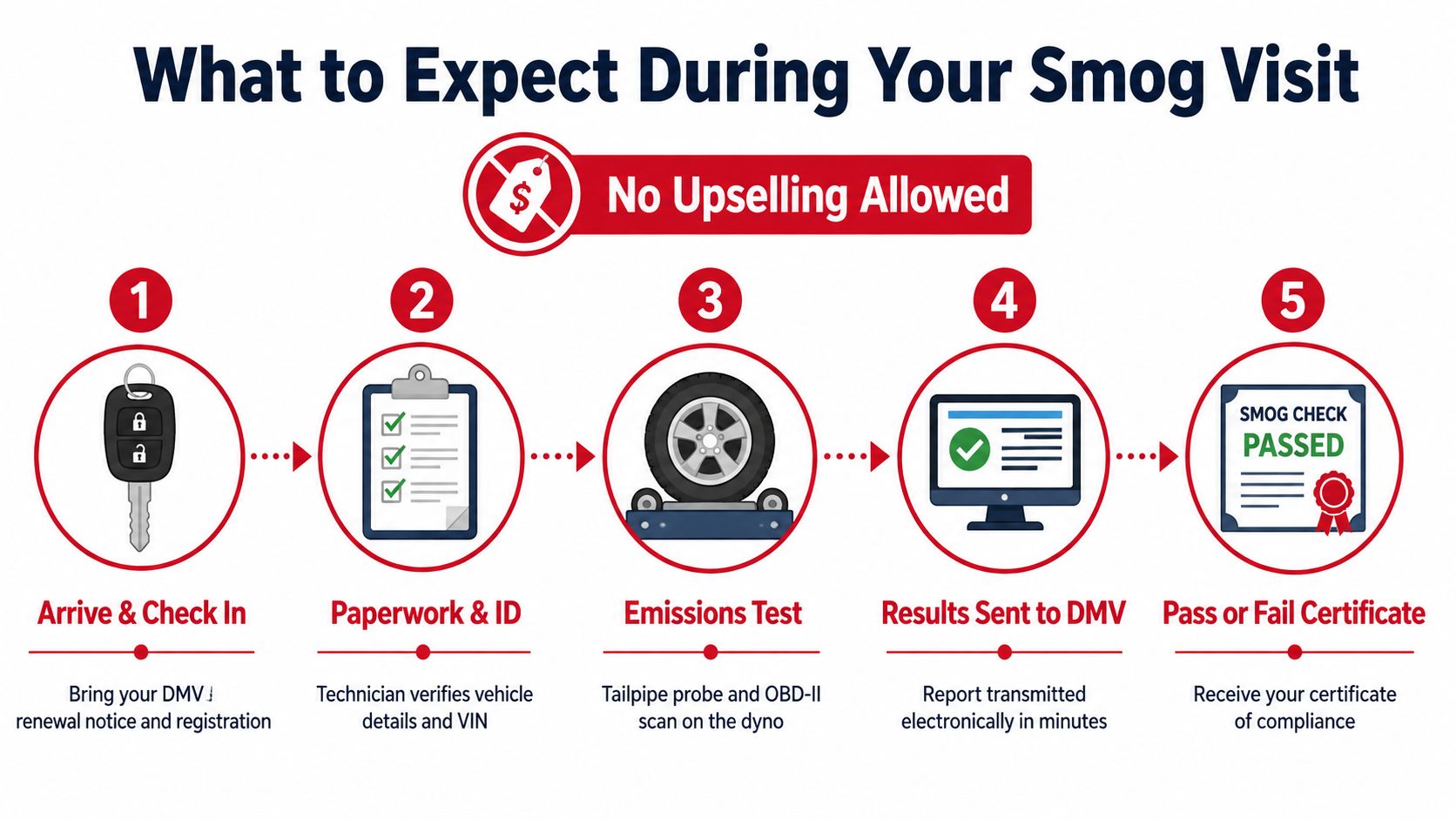
The technician isn't tuning the engine or preparing the car to pass. The station is documenting the vehicle's condition under the applicable inspection procedure. If the result is a failure, ask for the printed information and take it to a repair professional for diagnosis.
The process is also shown in this California smog inspection video, which can help first-time customers understand the basic flow before arriving.
Pairing Your Smog Check With DMV Services
A smog inspection and a registration renewal are separate actions, but they often belong in the same errand. Some STAR-certified test-only stations also operate as licensed DMV business partners. The California DMV business-partner program explains that participating partners can handle certain registration tasks and may offer shorter waits than a DMV field office.
The workflow is simple. First, the station completes the inspection. Once the passing result clears electronically, the DMV partner handles the eligible registration transaction at the same location. Depending on the record, that may include collecting renewal fees, issuing a sticker, or printing updated registration paperwork.
| Task | DMV Field Office | Smog Station With DMV Partner |
|---|---|---|
| Smog inspection | Usually completed elsewhere | Completed at the same location |
| Registration renewal | Available when the record qualifies | Available for eligible transactions |
| Sticker issuance | Handled at the office | May be handled on site |
| Ownership transfer | Available with required documents | May be available for eligible transfers |
| Number of stops | Often requires a separate smog visit | Can combine the inspection and DMV task |
| Wait experience | Field-office queue or appointment | Business-partner queue, often more focused |
When the combined visit helps most
This option is especially useful when your record needs an immediate transaction rather than a simple online renewal. A business partner may be able to help with a sticker, transfer paperwork, or a registration issue that an online form can't resolve.
California DMV also offers online and phone renewal channels, so an in-person partner visit isn't always necessary. Compare the transaction you need with the channel available to you. If you already need a smog inspection and your vehicle is directed to an eligible station, combining both services can remove an extra trip.
Learn more about the California smog check registration service before you leave home, and confirm which documents the location requires for your specific transaction.
Can a Test Only Visit Help Your Car Pass
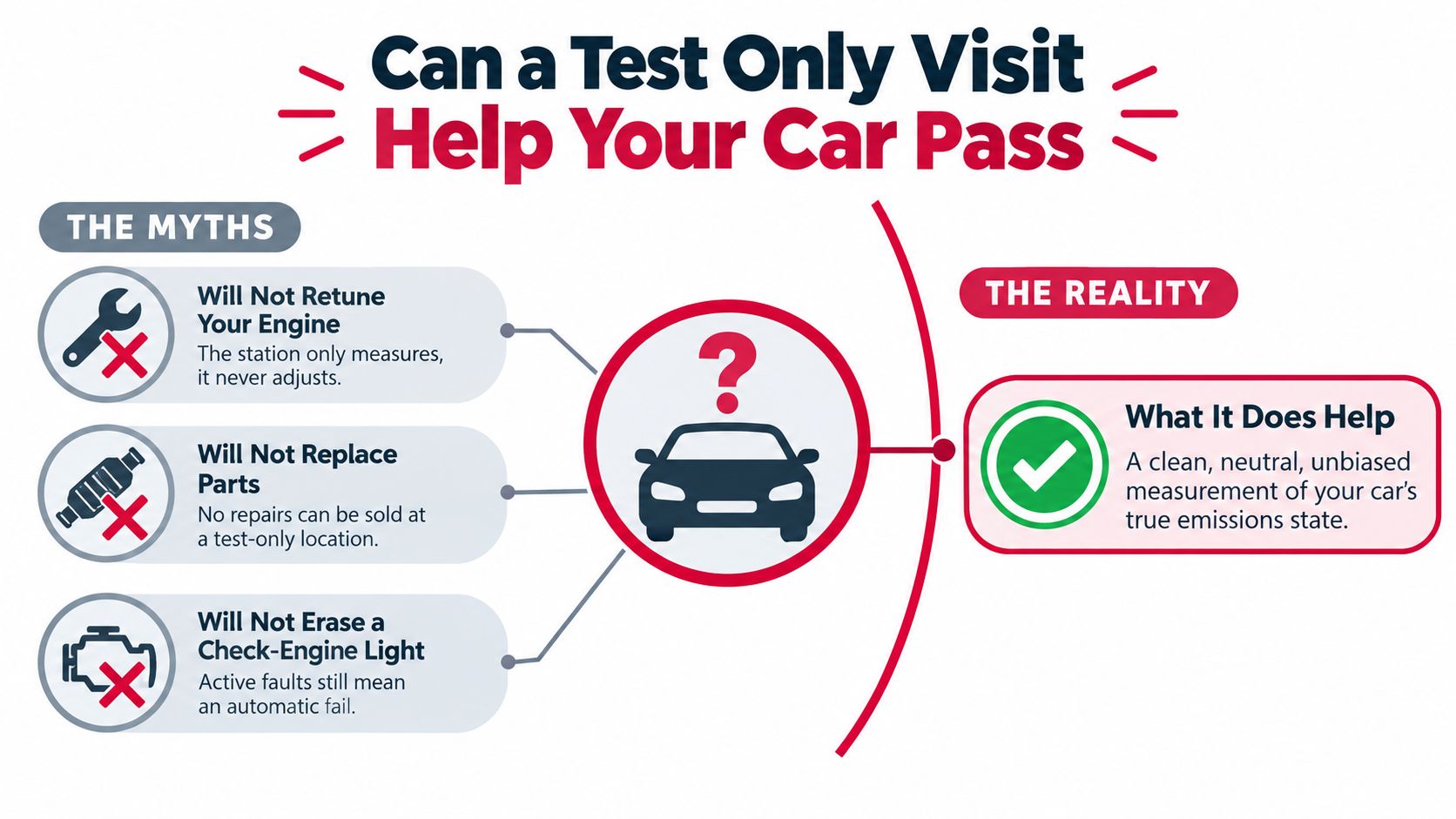
A 2004 Toyota Camry arrives for its smog test with an intermittent check-engine light. It may pass on one visit and fail on another because the vehicle's computer can show different readiness information depending on recent driving, repairs, or when the warning light becomes active. A test-only station cannot change that result. It records what the vehicle shows during the inspection.
A test-only visit can still improve the quality of your decision. The station provides an independent measurement and documents the result without also selling repairs. If the facility is STAR-certified, it follows the program's inspection requirements, but STAR certification does not guarantee a passing result.
What a failed test can reveal
Common failure causes include an active check-engine light, incomplete readiness monitors, emissions readings above the limit, a damaged catalytic converter, or visible emissions equipment problems. A recent battery replacement can also erase stored information and leave monitors incomplete, even if the car feels normal while driving.
For example, a Camry with a loose oxygen-sensor connection may run smoothly but fail its emissions reading. Another vehicle may have no warning light yet still fail because its catalytic converter is no longer reducing pollutants effectively. The test result points to the issue, while a qualified repair provider determines the fix.
Myth vs. reality
Myth: A test-only station can make a borderline car pass.
Reality: It measures the vehicle as presented and cannot tune, repair, or adjust it.
Myth: A failed test means the inspection was unfair.
Reality: The result identifies a compliance problem that needs attention before registration can be completed.
Myth: Trying another station is the repair.
Reality: Reviewing the common smog check failure reasons and obtaining a proper diagnosis is the productive next step.
Choosing the Right Station for Your Situation
Start with the renewal notice. It tells you more than a search result or a sign outside a shop.
| Notice Type | Station Required | Best For |
|---|---|---|
| Smog check required | A licensed station authorized for the vehicle | Drivers with a standard inspection requirement |
| Test-only stated | A test-only station | Vehicles directed away from repair facilities |
| STAR stated | A STAR-certified station | Vehicles requiring the program's inspection tier |
| STAR and test-only stated | A STAR-certified test-only station | Drivers who need both credentials |
Match the station to the transaction
If the notice only calls for a smog check, decide whether you prefer an inspection-only visit or the possibility of repair coordination. If it says test-only, don't book a standard repair shop merely because it has an available appointment. If it says STAR, confirm the location's certification before you arrive.
Then look at the practical details:
- Credential: Verify that the station matches the notice.
- Services: Check whether it performs only inspections or also handles repairs.
- DMV support: Ask whether it can process your renewal or other eligible registration task.
- Documents: Bring the notice, registration, and paperwork for any ownership transaction.
- Schedule: Confirm testing hours separately from DMV partner hours.
- Vehicle fit: Ask ahead about unusual vehicle sizes, recreational vehicles, or other equipment limits.
- Result handling: Confirm that the station transmits the result electronically and explain what happens if the vehicle fails.
A combined visit can be the fastest path when you need both a passing inspection and an eligible DMV transaction. It won't eliminate every requirement, and online renewal may be simpler for a straightforward record, but the right partner location can spare you a separate field-office stop.
Fire House Smog in Antioch offers STAR-certified test-only smog inspections and eligible DMV registration services, including renewal and ownership-transfer assistance. If your notice requires a matching station and you want to handle both tasks in one visit, visit Fire House Smog to review the available services and confirm the current hours before driving over.
1 comment
[…] These milestones show why a test-only station is more than an automotive shop with an emissions analyzer. It performs a regulated inspection under California's Smog Check framework. For a practical explanation of the facility's role, see Fire House Smog's official test-only smog station guide. […]
Auto Smog Test Only: A Complete Guide for California Drivers said: