1 for All Smog: What It Really Means and Where to Go
1 for all smog is not a single product or official program, it usually means you want one place that handles the smog check, a coupon, and the DMV renewal together. In California, that often comes down to a station that can test the car, explain the notice, and help finish the registration without sending you to three different counters.
You're probably holding a renewal notice, looking at your calendar, and trying to figure out whether you need a standard inspection, a STAR station, or a place that can also process the DMV paperwork. That confusion is normal, because the phrase sounds like a shortcut, but the answer depends on what your notice says and what kind of vehicle you drive.
Table of Contents
- What Drivers Actually Mean by 1 for All Smog
- Why Smog Testing Exists in the First Place
- How a California Smog Check Works
- Reading Your DMV Notice Before You Book
- Why a Test-Only Station Changes the Experience
- How Smog Coupons and Free Retests Work
- Why Cars Fail Even With the Check-Engine Light Off
- Your One-Stop Plan From Notice to Renewed Tags
What Drivers Actually Mean by 1 for All Smog
People typing 1 for all smog aren't looking for a brand name. They're looking for a simple path through three different jobs, and they want all three handled in one visit if possible.
Three things the phrase usually means
A driver might mean a coupon that works at a nearby station. Another driver might mean one shop that does the smog check and the DMV renewal. A third driver just wants the whole thing done in one hassle-free stop so they don't burn lunch break, gas, and patience on separate errands.
Practical rule: if you're searching this phrase, start by asking, “Do I need a discount, a test, or a DMV finish line?” That one question usually tells you where to go next.
That's why the phrase shows up on coupon pages, service pages, and local search results. It isn't a technical term. It's a searcher's way of saying, “I want the easiest legal path back to current tags.”
| What the searcher usually wants | What the phrase actually points to | Where Fire House Smog fits |
|---|---|---|
| One coupon that lowers the price | A station-specific discount or retest offer | A coupon that can be used with smog service |
| One stop for testing and DMV work | A test station with registration services | A test-only station with DMV registration services |
| One easy trip with no surprises | A smooth visit that covers the notice, the test, and the paperwork | A location designed to handle the full workflow |
A lot of first-timers get stuck because they assume all smog stations do the same thing. They don't. Some only test. Some repair. Some can also handle renewal paperwork. The smartest move is to match the phrase to the task before you leave home.
Why Smog Testing Exists in the First Place
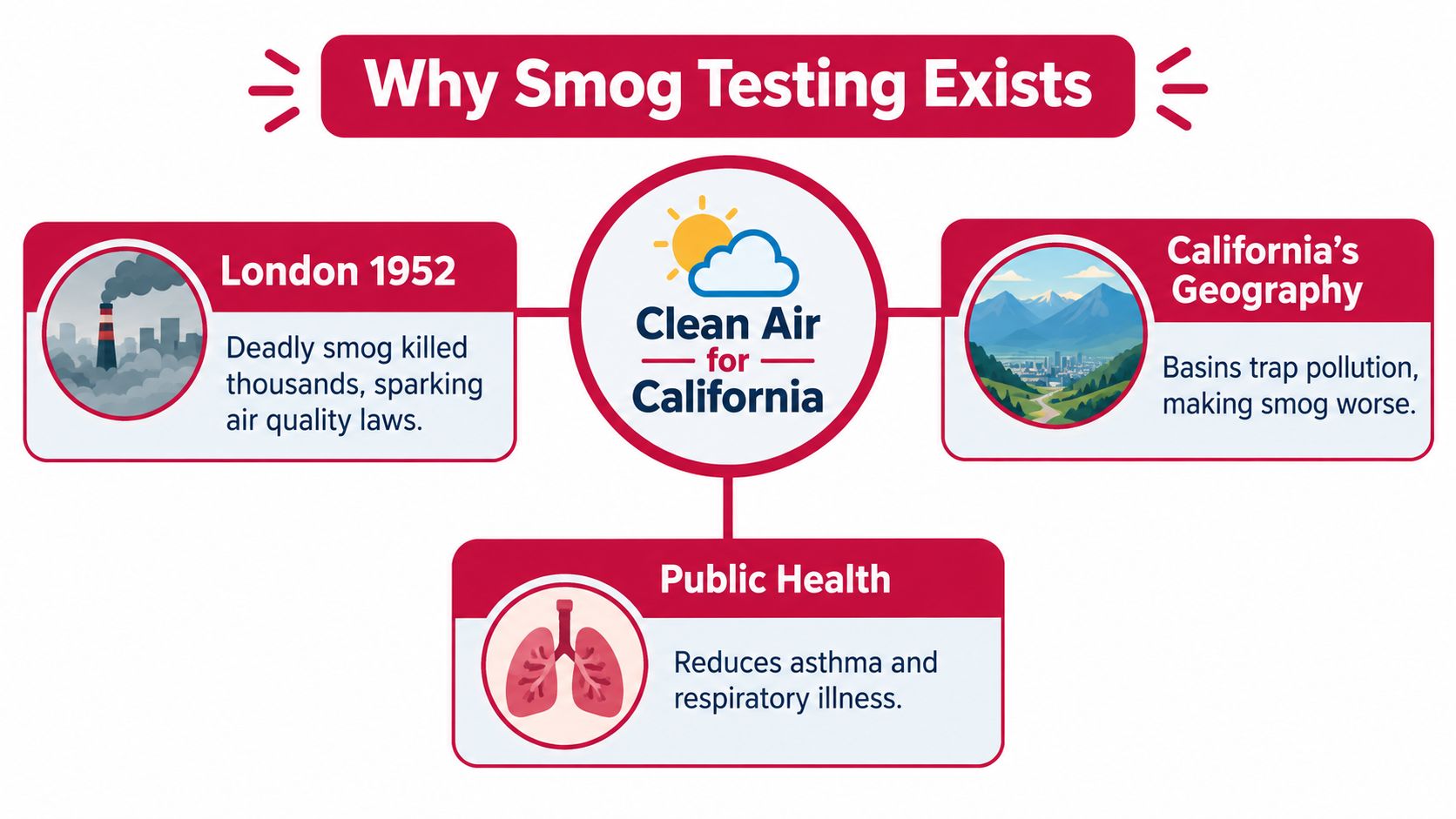
The reason California even has a smog check program is simple. Dirty air has already caused real harm, and vehicles are part of that story. The Great Smog of London in 1952 showed how weather, fuel use, and dense city life can trap pollution long enough to become a public-health disaster, and later assessments linked the episode to more than 10,000 premature deaths, with some estimates reaching about 12,000 PMC review of the Great Smog.
From coal smoke to car exhaust
London's disaster came from coal smoke, sulfur compounds, and particles trapped over the city. California's version became different. Los Angeles-type smog emerged in the 1940s, when nitrogen oxides and volatile organic compounds from combustion sources reacted in sunlight and formed ground-level ozone and other oxidants State of Global Air report.
That difference matters. You can't always smell or see the problem from the street. A car can look fine and still contribute to the kind of pollution that builds up in sunshine and traffic.
A smog check exists because air pollution is not just a skyline issue. It's a health issue, and vehicles are part of the equation.
California built inspection programs around that reality. The point isn't paperwork for its own sake. The point is to catch vehicles that are pushing too much pollution into the air, especially in places where traffic, heat, and geography trap exhaust close to people.
See how emissions requirements are explained in plain language
How a California Smog Check Works
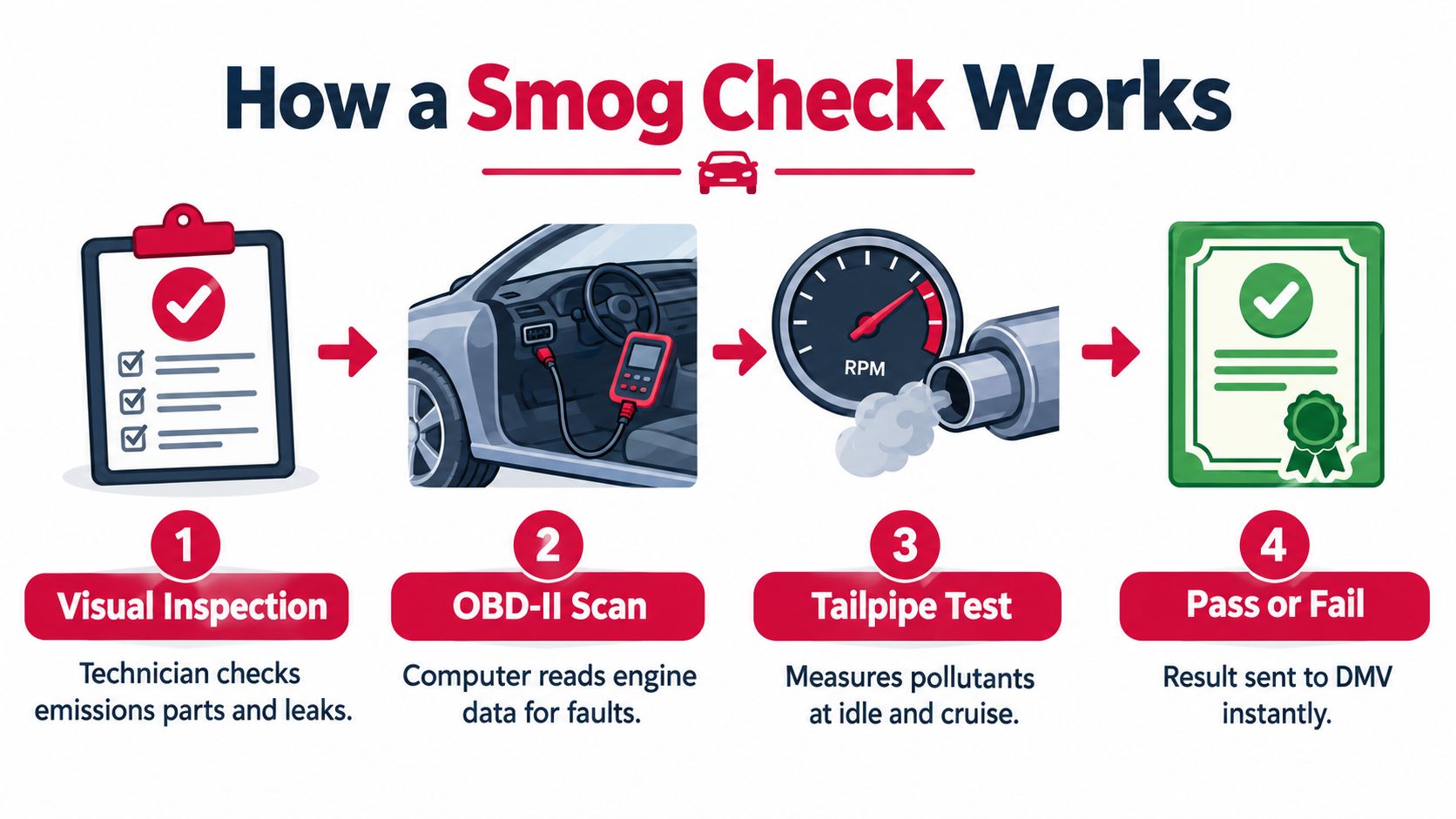
A smog check is a set process, not a guessing game. The technician inspects the vehicle, checks the onboard computer where required, and sends the result electronically so the DMV can use it. At a STAR-certified station, the state uses that designation to identify stations that meet inspection standards and, in some cases, to route certain vehicles there California BAR smog program.
What the station checks
On newer vehicles, the inspection often includes an OBD-II scan, which reads emissions-related computer data. Other vehicles go through different inspection steps based on vehicle type and model year. The goal stays the same: confirm whether the car meets California's emissions rules.
A test-only station has a narrow job. It measures and reports, and it does not sell the repair it may later recommend. That keeps the visit focused, especially if you are trying to avoid a sales pitch after a failure.
What you leave with
If the car passes, the result can move the DMV renewal forward electronically. If it fails, the report becomes the starting point for repairs and a retest. The smog station is also creating the record the DMV needs.
Customer rule: do not treat the smog visit like a mystery service. Ask what the station will inspect, how the result gets transmitted, and what paper or digital proof you will get before you leave.
Reading Your DMV Notice Before You Book
The safest way to avoid a wasted trip is to read the renewal notice before you book anything. California's DMV process runs electronically, so if your vehicle needs certification, paying the renewal fee alone does not finish the job. The DMV needs the smog certification information before the renewal can close out DMV renewal guidance.
Three common situations
One common notice is the routine renewal. For many vehicles, that means a biennial smog requirement, but the notice is what tells you whether your specific vehicle is in that cycle. Another is a car being registered in California for the first time after coming from another state. A third is a used-car transfer, where a change in ownership can trigger certification BAR smog check guidance.
Gasoline vehicles in their first four model years are generally exempt from the smog requirement on a transfer of ownership. The DMV also lists broader exception classes, including electric vehicles, certain older gasoline and diesel vehicles, some heavy vehicles above 14,000 pounds, and gasoline vehicles less than eight model-years old that may qualify for a smog-abatement fee during the first eight registered years DMV renewal guidance.
What the notice language means
If your notice says the vehicle needs certification, book the test first. If it specifically points to a STAR station, you need a STAR facility, not just any shop. That one detail is where a lot of drivers lose time, because a regular station may be fine for one car and wrong for another.
If you want a plain-English primer on that difference, learn how STAR certification differs from an ordinary smog station.
Why a Test-Only Station Changes the Experience
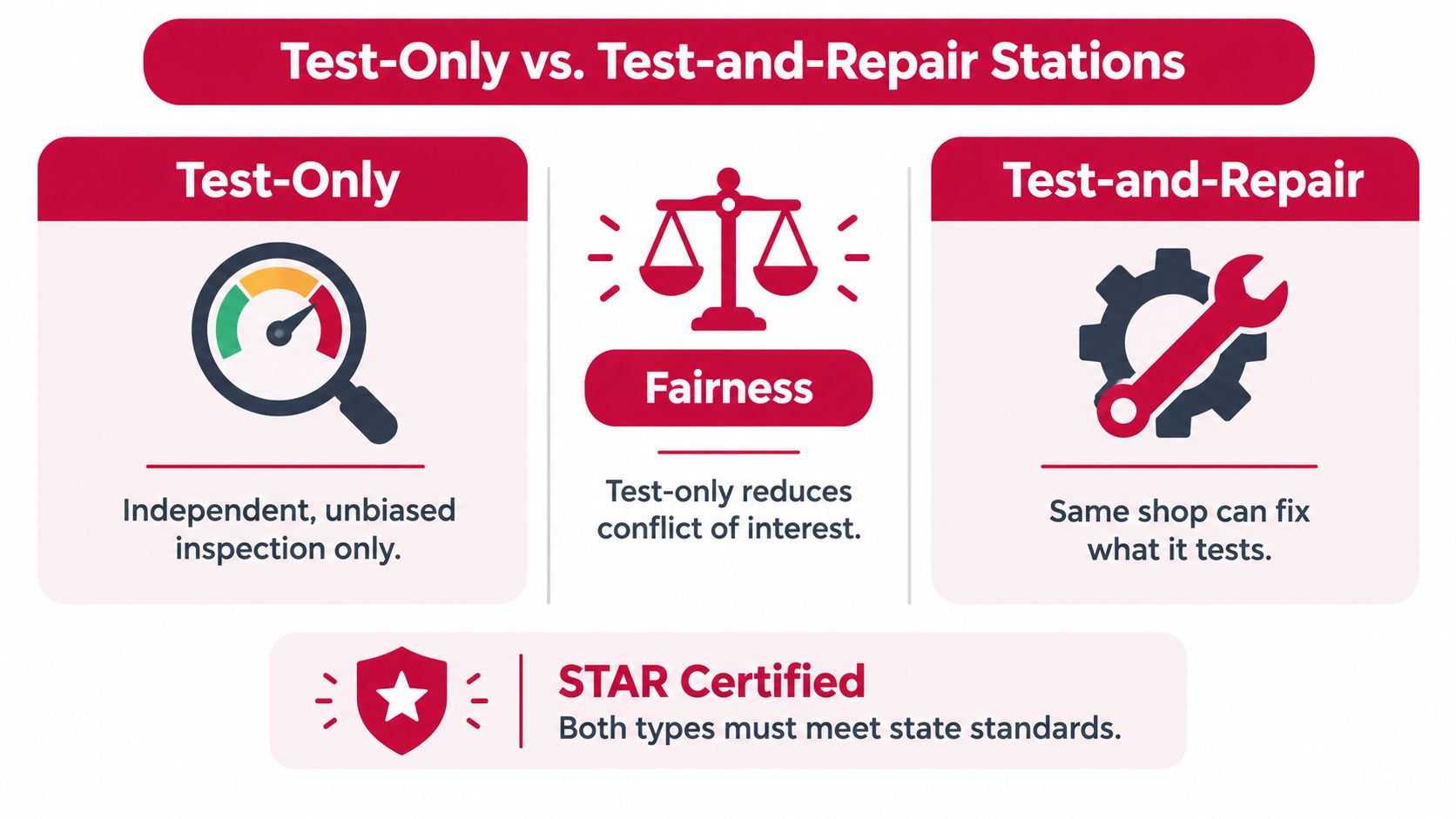
A test-only station changes the visit because the shop is not also trying to sell the repair after the inspection. That matters more than it sounds. If the same counter that fails the car also quotes the fix, some drivers feel pressure even when the station is acting fairly.
Test-only versus test-and-repair
| Feature | Test-Only | Test-and-Repair |
|---|---|---|
| Main job | Inspect the vehicle and report the result | Inspect and repair at the same site |
| Incentive structure | No repair sales tied to the test outcome | Repair revenue can follow a failed test |
| Best fit | Drivers who want an impartial inspection | Drivers who want diagnosis and repair in one place |
| STAR relevance | Often used for directed vehicles | Also can qualify if certified and approved |
A test-only site is useful when your notice points you to a specific station type and you do not want any confusion at the counter. If a driver shows up at a regular shop when the notice calls for a different setup, the trip can turn into a second errand.
That is the practical difference. You get the inspection, the result is reported, and the conversation stays centered on the test itself instead of a repair estimate before you know what the car needs.
For a first-timer, that can make the whole stop easier to understand. You know what the station does, what it does not do, and whether it matches the paper in your hand.
How Smog Coupons and Free Retests Work
A smog coupon sounds simple until you read the terms. One station may discount the test fee, while another may bundle that discount with a free retest if the vehicle fails. The savings only apply if the station accepts the offer you found and the vehicle fits the listed rules.
Before you drive over, review the current offer on the Fire House Smog coupon page so you know exactly what the discount and free retest cover.
What to confirm before you drive over
- Ask what the coupon covers. Some offers lower the inspection fee, while others focus on retest terms.
- Confirm the vehicle type. A station may take passenger cars and light trucks, but limit larger vehicles or RVs.
- Check whether the retest is included. Free retest terms often depend on where the repairs were made and whether the original station handled the first test.
- Verify the station can handle DMV renewal. If you want one-stop service, the coupon by itself is not enough.
A coupon matters most when it fits the rest of the trip. If you are paying for a test anyway, a valid discount helps. If you also want to finish registration, the better setup is a station that can test, transmit the result, and help complete the renewal in one visit.
Practical tip: read the coupon like a service contract, not a flyer. If the discount seems unclear, call and ask what is included before you start the car.
Why Cars Fail Even With the Check-Engine Light Off
A car can look fine on the dash and still fail smog. The inspection checks more than a warning light, and California's BAR reporting separates failures into emissions, gross-polluter, functional, visual, and OBD-II categories. That means the trouble can hide in readiness data, even when nothing is glowing on the cluster BAR 2025 executive summary.
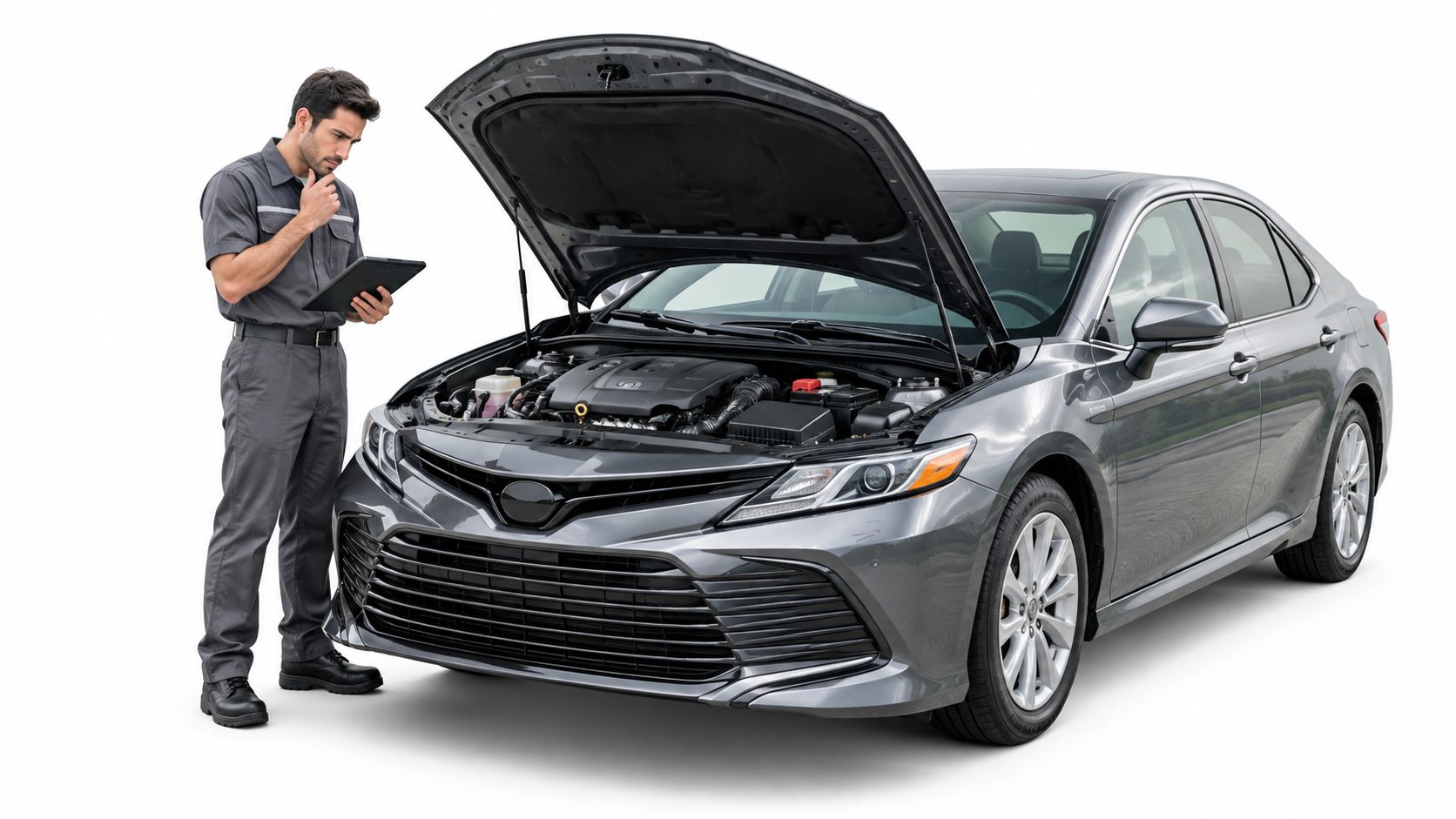
The hidden problem is often readiness
OBD-II readiness monitors show whether the emissions system has finished its self-checks. If you disconnect the battery or clear codes, those monitors can reset to incomplete. A quick drive around the block often is not enough to make them ready again.
A 2025 NHTSA technical bulletin shows why. In the cited case, some vehicles needed at least 400 miles before catalyst and oxygen-sensor monitors became ready, along with repeated deceleration maneuvers and scan-tool verification NHTSA technical bulletin. That is far more than a short errand.
What to do instead
If you recently disconnected the battery, cleared a code, or finished a repair, check the readiness status before you go to the station. That can spare you from paying for a test that is not ready to pass yet. If the vehicle fails for a reason that needs deeper review, BAR points customers toward the BAR Referee Program in appropriate cases.
Your One-Stop Plan From Notice to Renewed Tags
Start with the renewal notice, because that's where the requirement lives. If it calls for a smog check, make sure you know whether it wants a regular station or a STAR station before you book anything. If you have a coupon, confirm the terms first so the discount matches the visit.
Then choose a station that can handle the test and the DMV side of the trip in one stop. Fire House Smog at 2900 Lone Tree Way in Antioch offers STAR-certified test-only smog inspections, DMV registration services, and on-site tag issuance during posted hours, with the added convenience of two bays, weekend testing, and support for some RVs and motorhomes when space and equipment allow.
Need one straightforward visit instead of a multi-stop errand? Visit Fire House Smog to check the current hours, ask about RV accommodations, and confirm weekend availability before you head over. It's the kind of setup that turns “1 for all smog” from a confusing search into a single predictable trip.