You're standing at a California DMV counter with your renewal notice in hand when the clerk asks for proof of smog. You passed the inspection at a local station, but now you're wondering whether the paper receipt is enough, whether the result was sent electronically, and whether you can leave with your new registration sticker.
Those questions are common because California uses several related documents and station designations. A vehicle emission test certificate, the DMV renewal record, the registration sticker, and a BAR eligibility notice each serve a different purpose. This guide follows the process from the first renewal notice through testing, electronic transmission, DMV approval, and tag issuance.
Table of Contents
- What a Vehicle Emission Test Certificate Actually Proves
- How Emissions Testing Evolved into the Certificate You Hold Today
- Who Needs a Certificate and How California Designations Affect You
- Getting Your Certificate Step by Step at a Smog Station
- Digital Records Versus Paper Certificates and Validity Windows
- Misconceptions That Trip Up First Time Test Takers
- Troubleshooting Failures Lost Certificates and DMV Hiccups
- Putting It All Together for Your Next Renewal
What a Vehicle Emission Test Certificate Actually Proves
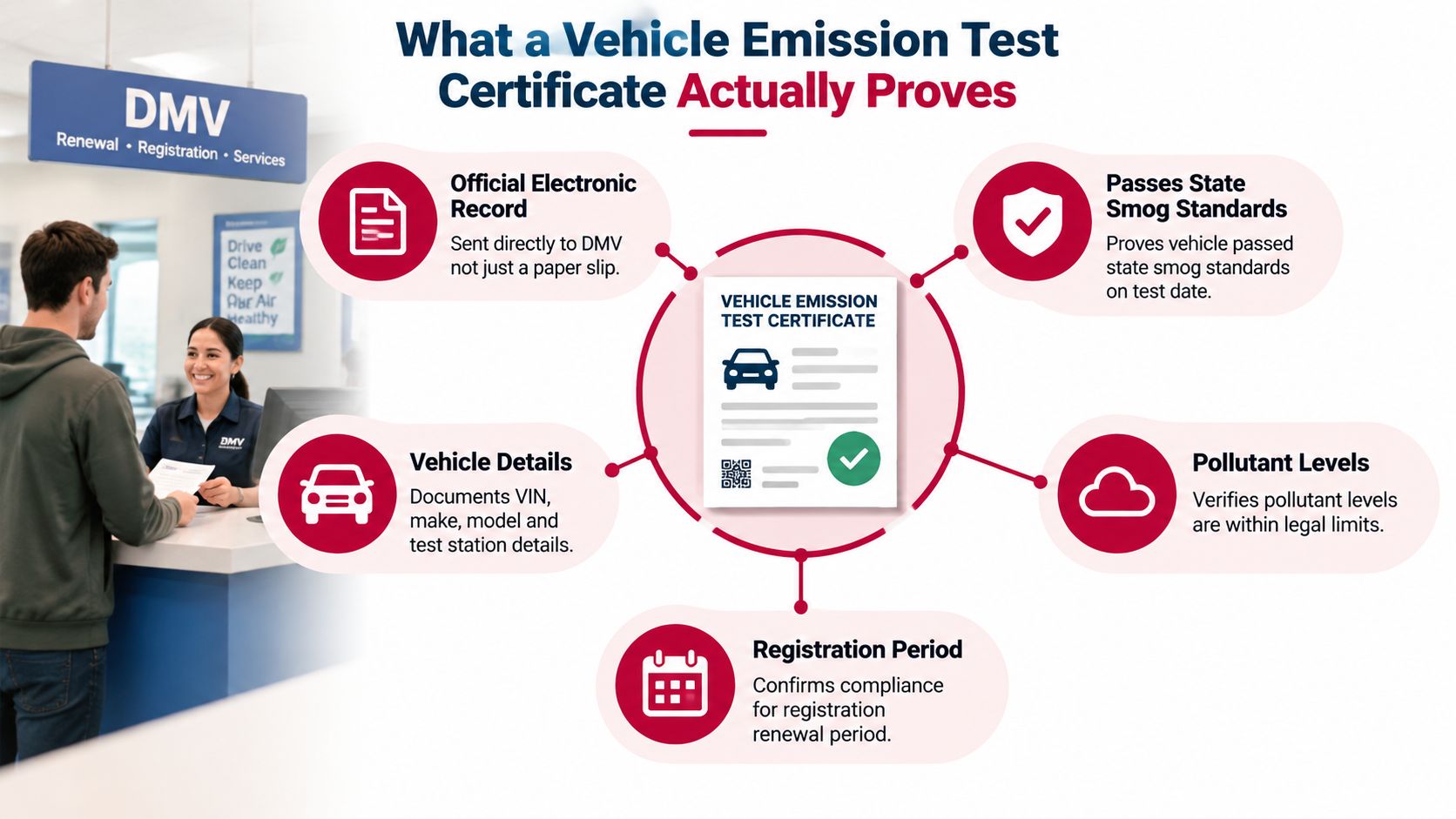
The clerk needs confirmation that your vehicle completed the required emissions inspection. A vehicle emission test certificate is the official electronic or printed record showing that the vehicle met the applicable California emissions requirements at the time of testing. The smog station sends the result through California's Bureau of Automotive Repair system, commonly called the BAR Vehicle Inspection System, or VIS, so the DMV can use that result when processing registration.
The certificate isn't a receipt saying that you paid for an inspection. It connects the vehicle's identity, inspection station, test results, and compliance status. Depending on the vehicle and test procedure, the record can reflect tailpipe emissions, OBD-II readiness monitors, emissions-control equipment, and visual checks for tampering.
The documents people often confuse
Suppose your 2015 sedan passes at a station. The station may give you a printed copy, but the electronic submission is the record that matters for the DMV transaction. You might also receive a payment receipt, which proves you paid the shop, and a smog certificate number, which identifies the inspection record. Neither document is the same as your registration sticker.
- Certificate of compliance: Shows that the vehicle passed the required emissions inspection.
- Inspection receipt: Shows the transaction details, but it isn't the registration approval.
- Smog certificate number: Helps locate or reference the inspection record.
- BAR eligibility notice: Tells you whether your vehicle needs a smog check and whether a particular station designation applies.
- Registration sticker: Shows that the DMV has renewed the registration. It doesn't replace the emissions certificate.
If you need help understanding a result, reviewing your emissions test results can help you identify whether the record says compliant, non-compliant, or requires another step.
Practical rule: Passing the inspection starts the DMV process. It doesn't finish registration until the DMV accepts the result and the renewal is completed.
How Emissions Testing Evolved into the Certificate You Hold Today
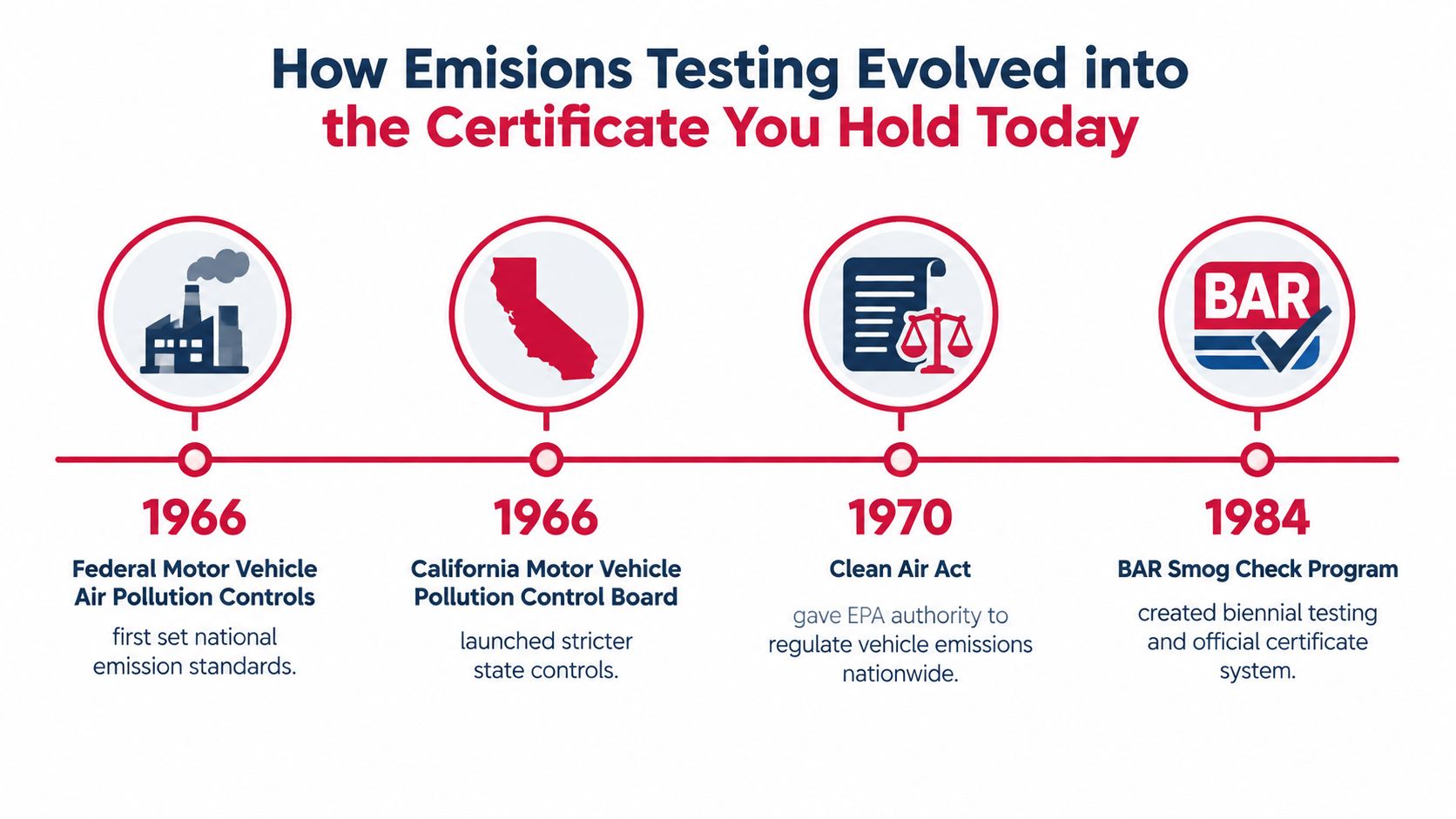
A California DMV renewal can seem simple: take the car for a smog check, then wait for the registration sticker. The certificate behind that transaction reflects a longer shift from informal exhaust checks to controlled, verifiable emissions programs. California passed the first emissions-testing legislation for vehicles sold in model year 1966 and later, and national action followed in 1968. New Jersey began a vehicle emissions testing program in 1974, according to EPA-referenced summaries of automotive emissions testing history.
The inspection had to prove more than a reading from a tailpipe. Regulators needed a record showing which vehicle was tested, where it was tested, what equipment was checked, and whether the vehicle met the standard for its era. That requirement shaped the certificate people encounter during a California renewal. It also explains why the result is submitted through a central electronic system instead of relying only on a handwritten statement from the smog station.
Why OBD-II changed the inspection
Older vehicles may depend more on direct exhaust measurement. Modern vehicles use onboard diagnostics, or OBD, to monitor emissions-related systems while the car operates. OBD-II was required on most light-duty vehicles in the United States by model year 1996. Inspection programs could then review stored fault information and readiness data along with other test procedures.
The result became a set of evidence rather than one brief observation. A car might show an acceptable exhaust reading during a short test while its diagnostic system records a catalyst problem, an evaporative leak, or another emissions-control fault. Georgia's inspection rules show how a passing certificate can depend on several checks, including exhaust emissions, evaporative emissions, emissions equipment, OBD equipment, tampering, and the fuel cap (Georgia inspection rules).
For a California DMV transaction, the certificate represents a recorded compliance decision. It is the inspection record that supports the electronic renewal workflow, while the registration sticker comes only after the DMV accepts the result and completes the registration.
Who Needs a Certificate and How California Designations Affect You
Start with the notice from the DMV or BAR. It tells you whether your vehicle needs a smog check for the transaction and may identify a required station type. The exact requirement depends on the vehicle, the registration event, and the designation attached to the vehicle record.
Gasoline vehicles that fall within California's newer-vehicle exemption can receive a one-time exemption during the applicable early model years. Most vehicles outside that exemption need a smog inspection at the regular renewal interval. A certificate may also be required when you transfer ownership, register a vehicle brought from another state, or complete another change-of-owner transaction.
Some vehicles follow different paths. Diesel vehicles, including certain diesel trucks, may have separate requirements based on vehicle class and weight. Don't assume that a standard gasoline smog workflow applies to every truck, recreational vehicle, or special-use vehicle. Check the notice or confirm the requirement before choosing a station.
STAR and test-only in plain English
A regular licensed station may test vehicles that aren't restricted to a special designation. A test-only station performs inspections but doesn't repair the vehicles it tests. A STAR station meets additional program requirements and tests vehicles that the BAR directs into the STAR program.
A vehicle marked as a gross polluter or directed vehicle may have to visit a specified type of station. The notice is more reliable than guessing from the vehicle's age or symptoms.
| Station Type | Who Can Test | Typical Use Case |
|---|---|---|
| Regular licensed station | Vehicles without a special station restriction | Standard inspections when the notice allows a general station |
| Test-only station | Vehicles requiring an independent emissions inspection | Directed vehicles or owners seeking a station that doesn't perform repairs |
| STAR station | Vehicles whose BAR eligibility notice requires STAR participation | STAR-required renewals and directed inspections |
Read the BAR notice before booking. The station that can test your neighbor's car might not be authorized for your vehicle's designation.
Getting Your Certificate Step by Step at a Smog Station
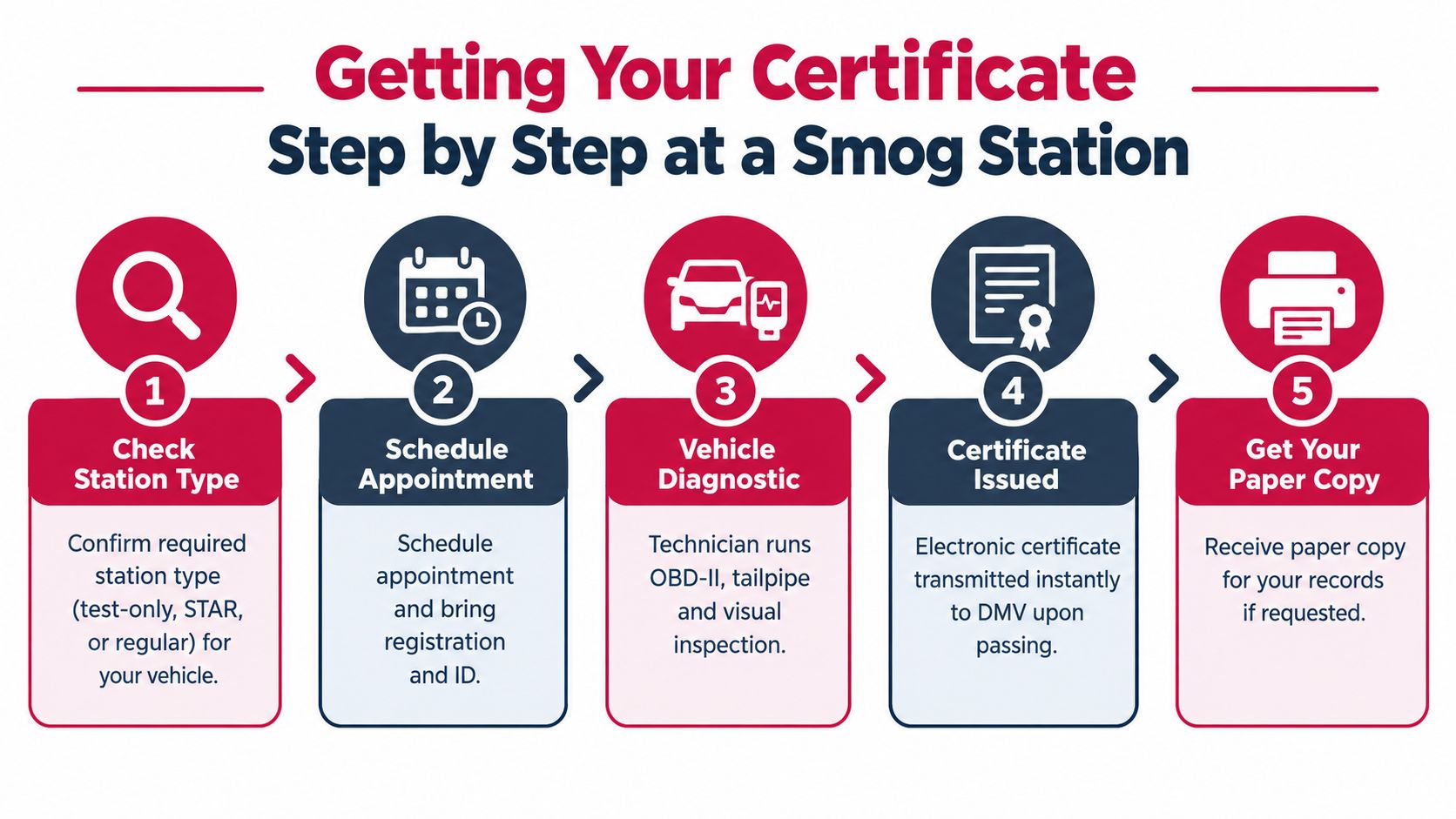
A smooth visit starts before you arrive. Look at the BAR eligibility notice or DMV renewal notice and identify whether it calls for a regular, STAR, or test-only station. If the notice is unclear, ask the station to verify the requirement before the inspection begins.
Bring your registration information and identification. The station may also ask for the renewal notice because it helps match the inspection to the correct DMV transaction. You'll pay the inspection charge established by the station, along with any applicable state-related fee shown in the transaction. Ask for an itemized receipt and keep it with your renewal paperwork.
What happens in the bay
The inspector verifies the vehicle identification information and connects the inspection equipment. On an OBD-II vehicle, the process includes downloading diagnostic information and checking whether required readiness monitors have completed. The inspector may also perform tailpipe and visual procedures appropriate to the vehicle.
The result generally falls into one of three practical categories:
- Certificate of compliance: The vehicle passes, and the result is transmitted electronically to the DMV.
- Certificate of non-compliance: The vehicle doesn't meet the requirement during that inspection. You receive the test information and can discuss diagnosis and repair.
- Directed or follow-up notice: The vehicle needs a particular station type, documentation, or additional action before the transaction can be completed.
A passing electronic result can reach the DMV without you carrying a paper certificate to a field office. Still, request a printed or emailed copy if you want a record for your files. When you compare California smog check stations, confirm that the station's designation matches your notice rather than choosing only by location.
The station's workflow can vary. At Fire House Smog in Antioch, STAR and test-only services are offered under the station's posted pricing and applicable coupon terms, so confirm the current charge before authorizing the inspection. The station is test-only, which means it can report the result and explain next steps without selling the repair itself.
Here's a short video overview of the inspection process:
Digital Records Versus Paper Certificates and Validity Windows
You finish a California smog inspection, receive an emailed certificate, and assume that document is what the DMV needs for your renewal. In practice, the station usually transmits the passing result electronically, and the DMV relies on that record when processing the registration transaction. The paper certificate or email copy remains useful for your files, but it does not serve as the registration sticker.
At a renewal counter, the distinction is easy to see. If the DMV system already displays the passing result, you generally do not need to hand over paper. If the result is missing, ask the station to confirm that the submission was completed and provide the identifying information needed for follow-up.
Two clocks can affect your renewal
The certificate has its own validity period, and the DMV transaction has a separate timing requirement. Ohio's E-Check guidance describes a certificate as valid for 365 days and says it must remain valid through the vehicle registration expiration date (Ohio E-Check FAQ). California drivers should follow their renewal notice and DMV instructions instead of applying Ohio's rule, because jurisdictions set different requirements.
Testing early can still create a California renewal problem. If the certificate falls outside the timing required for the registration transaction, or if the vehicle fails and needs repairs, the electronic record may not line up with the renewal. After the station submits a passing result, check the DMV record, complete the renewal, and keep the certificate number until the new sticker arrives.
| Feature | Paper or Email Certificate | DMV Electronic Record |
|---|---|---|
| Main purpose | Personal proof and reference | Official record used in DMV processing |
| Created by | Inspection station | Station submission received by BAR and DMV systems |
| Needed at renewal | Usually not if the electronic record is present | Yes, when the transaction requires smog compliance |
| Best use | Retain for records, repairs, or disputes | Confirm through the DMV transaction or account |
| Reprint option | Request it from the issuing station | Ask the station or DMV to investigate a missing submission |
A failed test and an expired certificate represent different records. A registration lapse is another DMV matter, with separate consequences. Ask which status is preventing the transaction, then address that specific record rather than treating the certificate, sticker, and DMV eligibility notice as interchangeable.
Misconceptions That Trip Up First Time Test Takers
A California renewal notice can mention smog compliance, yet three separate items may be involved. The Vehicle emission test certificate records the station's inspection result. The DMV renewal creates the current registration, and the registration sticker shows that renewal on the vehicle. A passing certificate does not complete the transaction by itself. You still need to follow the DMV instructions and pay any required charges.
“Any smog shop can test a directed vehicle.” A BAR eligibility notice may direct you to a STAR station or a test-only facility. A regular station can be legitimate and still be unable to perform the inspection required for that vehicle. Read the notice before choosing a shop, just as you would check the correct counter before starting another DMV service.
“A failed test means I have to approve an expensive repair immediately.” The failed certificate records the test result. Ask for the diagnostic information, identify the failed component or incomplete monitor, and compare repair options before authorizing work. A result gives you a repair question to answer, not an automatic repair order.
Why clearing the light can make things worse
Disconnecting the battery or clearing diagnostic trouble codes can erase the vehicle's readiness history. The check-engine light may disappear temporarily, while required monitors reset to incomplete. The inspector can then report the vehicle as not ready, leaving you without the passing certificate expected for renewal.
A recent repair can produce the same result. Even a properly repaired vehicle may need normal driving conditions before its diagnostic systems complete their checks. Ask the repair technician whether the monitors are ready before scheduling the inspection.
“A non-compliance certificate means I'm stranded.” A failed emissions test generally supplies information for the next decision. Driving depends on the vehicle's mechanical condition, registration status, and local requirements. Address serious symptoms promptly, and keep the renewal deadline in view.
Keep the three documents distinct:
- BAR eligibility notice: Tells you what the DMV or BAR expects, including any station designation.
- Vehicle emission test certificate: Records the inspection result.
- Registration sticker: Shows that the DMV renewal has been completed.
Troubleshooting Failures Lost Certificates and DMV Hiccups
A California renewal can stall even after you leave the smog station. Use the symptom to identify which record needs attention, rather than paying for another inspection before checking the first result.
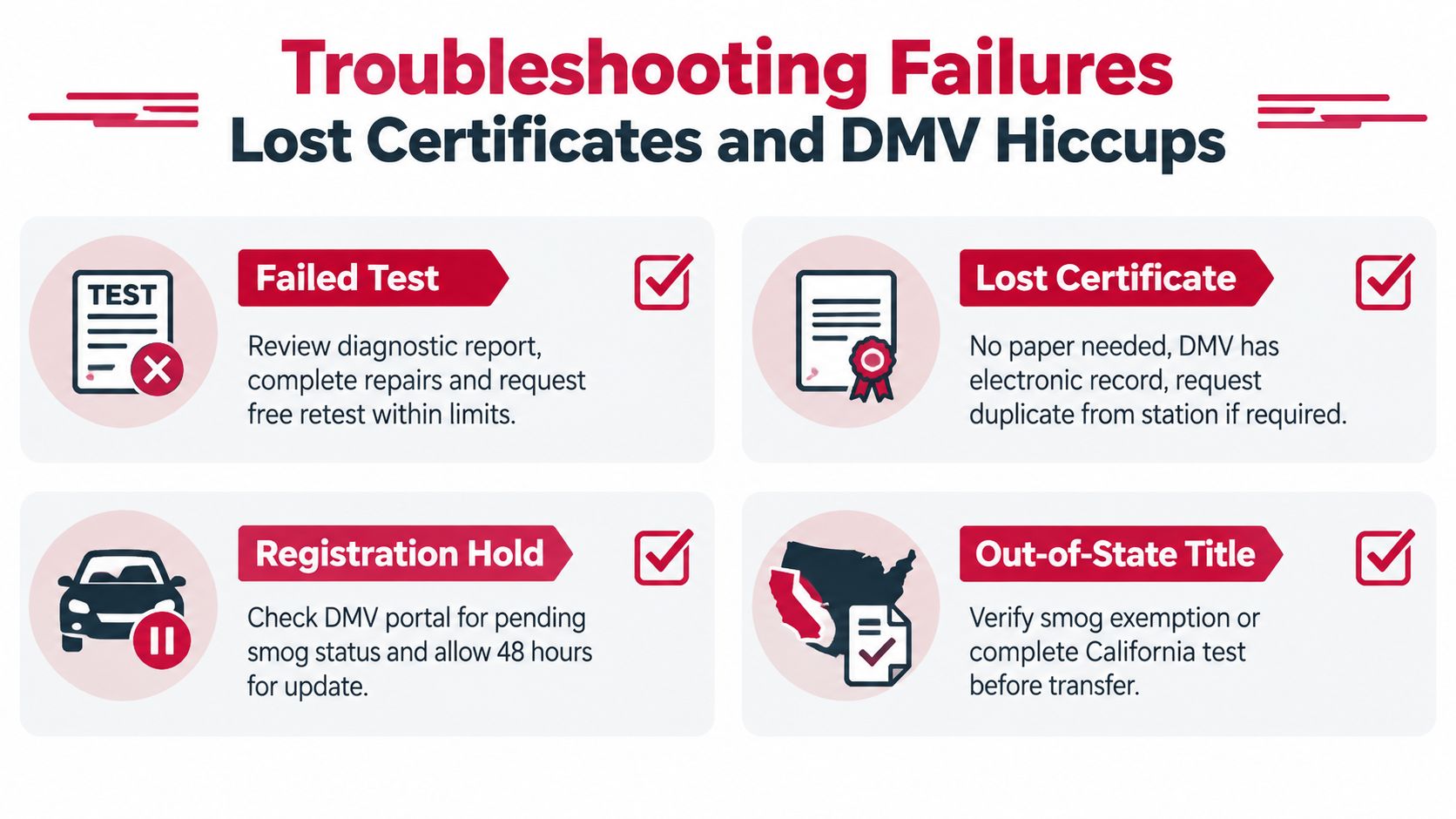
Failed emissions test
Diagnostic question: What failed, and did the station give you the inspection report?
Likely cause: The vehicle may have a diagnostic fault, incomplete readiness monitors, an emissions-control problem, or a visual issue with emissions equipment.
Next step: Keep the original report and request a diagnosis before approving repairs. Save itemized repair records, then ask the issuing station whether the vehicle qualifies for a retest after the work. This plain-language explanation of what happens if you fail a smog test can help you understand the usual next decisions.
Lost paper certificate
Diagnostic question: Does the DMV already show the passing result?
Likely cause: The paper certificate may be missing even though the station submitted the result electronically. The certificate is the test record, while the DMV renewal transaction is a separate step.
Next step: Check the DMV renewal status first. If you still need a duplicate, contact the station that performed the inspection with the vehicle identification information and approximate test date. The station may be able to reprint the record or confirm the certificate number.
Registration still shows a hold
Diagnostic question: Did the station submit the result, and does the DMV portal show a pending smog item?
Likely cause: The DMV record may not yet display the electronic transmission, or another registration requirement may remain unresolved.
Next step: Ask the station to verify the submission details. If the record remains missing, contact the DMV. Do not schedule another inspection until you know whether the first result was accepted or rejected. A second test will not necessarily resolve a record that never reached the DMV.
Out-of-state title transfer
Diagnostic question: Is the vehicle entering California through a title transfer, or does it qualify for a specific exemption?
Likely cause: An out-of-state vehicle often needs a California inspection before registration, although exemptions and vehicle categories can change the required path.
Next step: Review the DMV transfer requirements and bring the title, registration documents, and identification to the inspection or registration provider. A certificate from another state may not satisfy California's process.
For local certificate reprints or a gross-polluter retest quote, Fire House Smog lists 2900 Lone Tree Way, Antioch, CA 94509, with telephone 925-754-1600. Confirm the current details before visiting, especially if your vehicle has a special designation or needs equipment verification.
Putting It All Together for Your Next Renewal
假設你收到 DMV 的續牌通知,或 BAR eligibility notice 顯示需要驗車。先看通知要求,再按以下順序處理:
- 確認觸發原因。 續牌通知或 BAR eligibility notice 會指出是否需要 smog inspection。
- 核對站點資格。 一般車輛可使用普通 station,指定車輛則可能需要 STAR 或 test-only station。不要只按距離選店。
- 完成檢查。 帶上登記資料和身分證明,並向 station 索取 test report。
- 確認結果已傳送。 通過後,station 通常會把結果電子傳送至 DMV 流程。
- 完成續牌並核對標籤。 DMV 交易完成後,確認 registration record 已更新,或新的 sticker 已簽發。
- 保留資料。 在續牌完成前,保存 certificate number、收據和維修文件。
Certificate 是排放合規紀錄,DMV transaction 才是登記續牌,registration sticker 則是車主貼在車上的結果。三者像同一流程中的三張收據,作用不同,分開核對就較不容易混淆。
今天查看續牌日期和通知上的 station requirement。若你在 East Contra Costa County,可向 Fire House Smog 預約合適的檢查,並保留 certificate number,直到新的 registration sticker 到手。
Fire House Smog 提供 STAR-certified test-only smog inspections 及 California DMV registration services,包括續牌支援和現場 tag issuance。前往 Fire House Smog 查看服務並安排 vehicle emission test certificate appointment。