You've just opened your California DMV renewal notice, and there it is: a smog check requirement. Your car seems to run normally, but you're worried that a repair shop might recommend expensive work before you even know whether the vehicle failed. The good news is that you can separate the emissions inspection from any repair decision by choosing an auto smog test only station.
That distinction matters, but it's easy to confuse test-only, STAR, and ordinary test-and-repair stations. The station type determines what the business can do, while STAR describes whether the station meets California's performance standards. Your renewal notice determines which capability you need.
Table of Contents
- What Is an Auto Smog Test Only Station
- Understanding STAR Certification and Quality Standards
- Preparing Your Vehicle for Emissions Testing
- When You Need STAR Versus Regular Test-Only
- Special Cases for Diesel RV and Out-of-State Vehicles
- Your Complete Smog Check Experience at Fire House
What Is an Auto Smog Test Only Station
You pull into a station with a renewal notice on the passenger seat and one immediate concern: will the vehicle pass? An auto smog test only station is designed to answer that question through a California Smog Check inspection. It does not perform emissions repairs, so the inspection result remains separate from any later repair decision.
A test-only smog station measures emissions-related compliance, records the inspection results, and provides the required certification when the vehicle passes. Its role is similar to a measuring station rather than a general repair shop. The California Bureau of Automotive Repair's description of STAR and test-only stations explains the distinction between test-only businesses and test-and-repair stations.
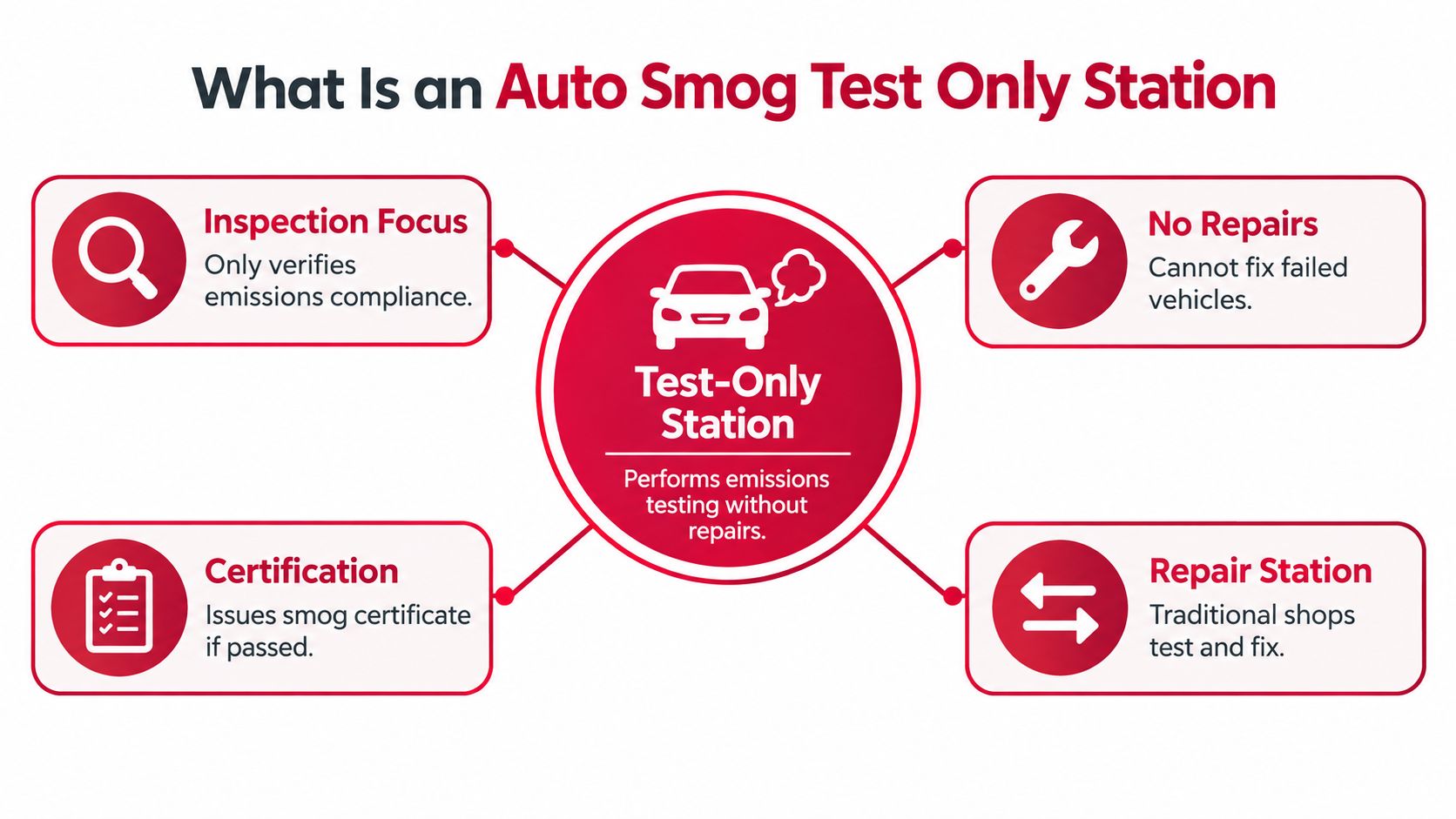
If your vehicle passes, the station completes the certification process that applies to your inspection. If it fails, you receive the test information and can choose a separate provider for diagnosis or repairs. You do not have to approve corrective work from the business that performed the inspection.
Practical rule: Ask for the vehicle inspection report after any failure so you can compare repair options with clear information about what the test identified.
How the station fits into California's program
California established its Smog Check program in 1984 under Senate Bill 33. The original program covered vehicles from the 1976 model year onward and generally used a biennial inspection structure. The Bureau of Automotive Repair, Department of Motor Vehicles, and California Air Resources Board work together within the program, as described in the BAR program background paper.
The program developed as vehicle technology changed. California introduced the Enhanced Smog Check program in June 1998, expanding beyond the earlier focus on basic two-speed-idle testing. Assembly Bill 2289 later created the STAR certification system, which replaced the Gold Shield program on January 1, 2013.
These milestones show why a test-only station is more than an automotive shop with an emissions analyzer. It performs a regulated inspection under California's Smog Check framework. For a practical explanation of the facility's role, see Fire House Smog's official test-only smog station guide.
Test-only versus test-and-repair
A test-and-repair station may inspect the vehicle, diagnose emissions problems, and complete repairs. That arrangement can suit a driver who wants one business to manage the entire process. A test-only station keeps the compliance measurement and repair choice with separate businesses, which can make comparison-shopping easier after a failure.
Before leaving after a failed inspection, confirm which part of the test produced the result and keep the report for the repair provider. A failure does not by itself mean the testing station should perform the repair. It means the vehicle needs further attention before the required certification can be completed.
Understanding STAR Certification and Quality Standards
A driver may hear “STAR station” and assume it means “test-only.” Those labels describe different things. Test-only identifies what the business does, while STAR-certified identifies whether the station meets California's performance requirements.
California permits STAR certification for both test-only and test-and-repair stations. A station can therefore perform inspections without being STAR-certified, and a STAR-certified station may offer repairs unless it operates under the test-only model.
STAR adds a performance-based quality layer to the station's license. California evaluates participating stations using inspection measures such as test deviations, similar-vehicle failure rates, incorrect gear selection during dynamometer testing, and follow-up pass rates. The program updates short-term performance measures monthly, while station pass or fail determinations occur quarterly, according to BAR's STAR program information.
What STAR tells you
A STAR designation means the station has met defined performance requirements for the type of Smog Check work it performs. It is not a general endorsement of every repair service, and it cannot guarantee that a particular vehicle will pass.
Your vehicle may still fail at a STAR station because of an emissions fault, an illuminated malfunction indicator lamp, incomplete diagnostic information, or another issue found during the inspection. The designation evaluates the station's inspection performance. It does not predict the condition of your car.
For drivers seeking an independent result, a STAR-certified test-only station combines two separate features. The business does not perform emissions repairs, and it meets the applicable STAR performance standards. That separation lets you take a failure report to a repair provider of your choice.
Why the station share and test share differ
STAR facilities performed a much larger share of inspections than their share of licensed stations in 2023. The BAR 2024 Smog Check Performance Report states that STAR-certified stations represented 48% of all licensed Smog Check stations but performed 83% of all Smog Check tests.
The report attributes part of this volume to vehicles directed to STAR facilities. Driver preference likely accounts for the rest. The figures show that a driver may encounter STAR stations frequently, but they do not mean every test-only station has STAR certification.
| Term | What it means | What it doesn't mean |
|---|---|---|
| Test-only | The business performs Smog Check inspections but doesn't make emissions repairs | It doesn't automatically mean the station is STAR-certified |
| STAR-certified | The station meets California's applicable performance requirements | It doesn't guarantee that every vehicle will pass |
| Test-and-repair | The business may inspect and repair emissions-related problems | It doesn't necessarily provide the separation some drivers prefer |
Before your appointment, read the DMV notice carefully. Confirm whether it directs you to a STAR facility, then verify both questions with the station: Does the business perform only testing, and is it STAR-certified? This check prevents a test-only label from being mistaken for a STAR designation.
For a practical explanation of the designation and what it means during an inspection, see Fire House Smog's guide to STAR-certified smog testing.
Preparing Your Vehicle for Emissions Testing
Modern California inspections rely heavily on the vehicle's OBD-II system, not only on a tailpipe measurement. EPA technical guidance explains that OBD systems monitor up to 11 emissions-related subsystem categories, including continuous monitors for misfire, fuel trim, and components. Other monitors run only when the vehicle reaches the operating conditions needed for the computer to complete its self-tests, as described in the EPA's vehicle emissions inspection and maintenance guidance.
The scanner may show a monitor as ready, not ready, or not applicable. “Not ready” doesn't automatically prove that the vehicle is producing excessive emissions. It means the computer hasn't completed the relevant self-test, so the emissions status remains officially unknown.
Avoid resetting the diagnostic system
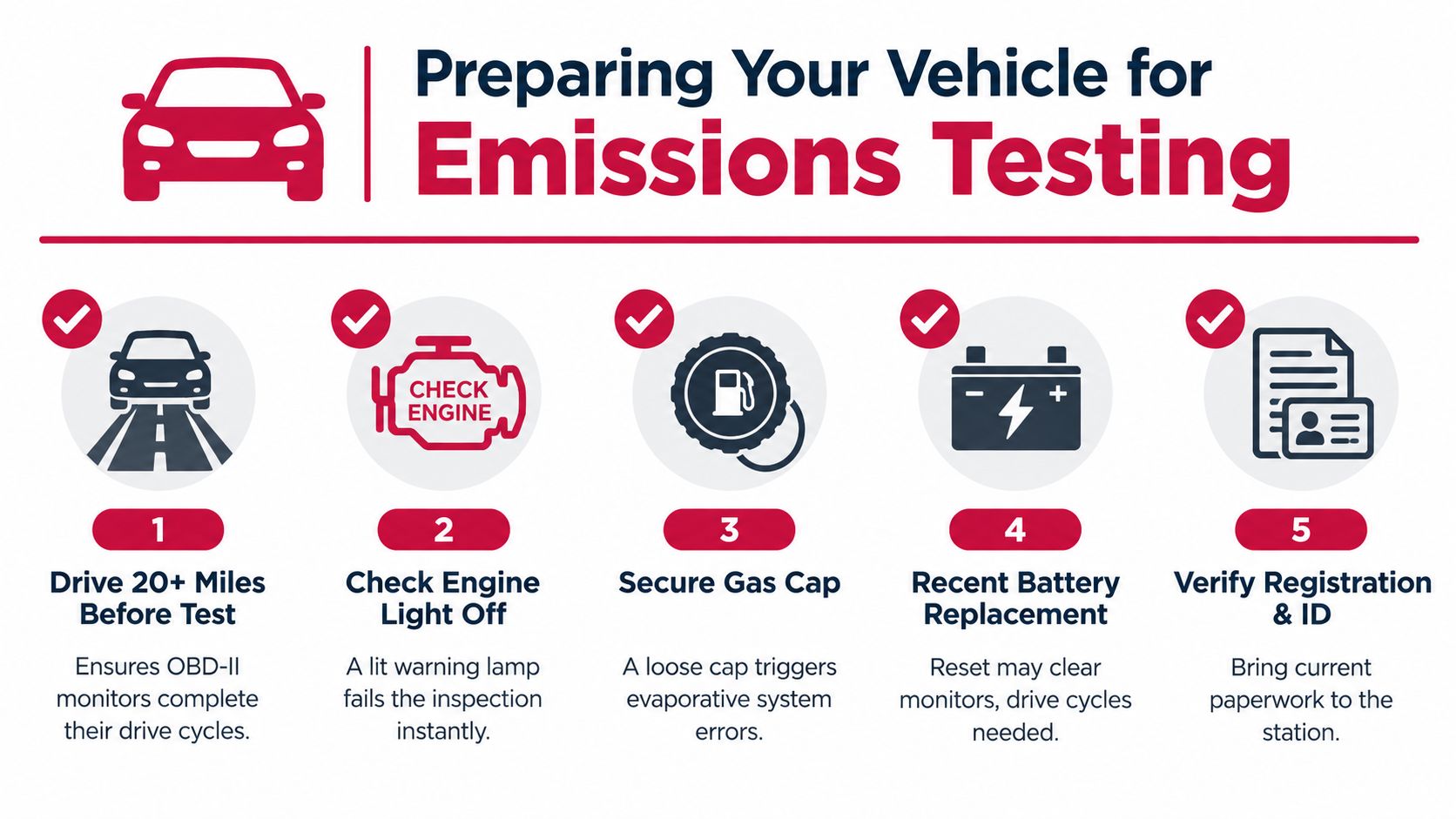
The most common preparation mistake is clearing trouble codes shortly before the appointment. Disconnecting the battery can have the same effect. Either action may erase stored readiness results, leaving the vehicle unable to demonstrate that its self-tests have completed.
If the check engine light has been on, don't just clear it and drive directly to the station. Have the problem diagnosed, complete any needed repair, and allow the vehicle's monitors to run through the required driving conditions. A compliant scan tool can show whether the applicable monitors are ready before you schedule the inspection.
A sensible pre-visit check
Use this short checklist before you leave home:
- Look at the warning lamps: Confirm that the malfunction indicator lamp isn't illuminated. A light that returns after code clearing still signals an unresolved emissions-related issue.
- Check the readiness status: Ask a qualified technician or use a compliant scan tool to verify that the applicable monitors show ready.
- Think about recent battery work: If you replaced or disconnected the battery, the vehicle may need normal driving before its self-tests finish.
- Inspect the fuel cap: A loose or damaged cap can contribute to evaporative-system faults. EPA guidance recognizes evaporative diagnostics as relevant because those systems can detect faults that increase fuel-vapor emissions.
- Bring your documents: Have your renewal notice and vehicle information available so the station can confirm the requested inspection.
Before you book: If a battery was recently disconnected or diagnostic codes were erased, ask the station whether the vehicle is likely to need additional drive-cycle preparation.
The car may drive smoothly while an evaporative, fuel-trim, or other emissions monitor remains incomplete. That's why readiness status deserves attention before an auto smog test only appointment, even when there's no obvious drivability complaint.
For a closer look at the scanner information drivers commonly encounter, review this guide to OBD readiness monitors.
When You Need STAR Versus Regular Test-Only
The wording on the DMV renewal notice should control your decision. Don't assume that “test-only” and “STAR” describe the same requirement. A regular test-only station can perform inspections without repairs, but a vehicle directed to a STAR station needs to be tested at a location with the required STAR capability.
The California Smog Check consumer page recorded 891,196 initial tests and an 8.77% initial failure rate in February 2025. Those figures show why a driver may feel uncertain about the result, but they don't predict what your own vehicle will do. The sensible response is to identify the required station type before arriving and prepare the car's diagnostic system rather than choosing a location at random.
Read the notice before searching
Use this decision guide:
| What your notice says | What to look for |
|---|---|
| STAR station required | Choose a station that is explicitly STAR-certified. It may be test-only or test-and-repair, depending on your preference and the location's services. |
| Smog check required, with no STAR direction | A licensed station may be appropriate, but confirm whether you want a test-only business and whether it handles your vehicle type. |
| The notice is unclear | Contact the station or use California's official program information before scheduling. Don't rely on the phrase “smog station” alone. |
A STAR station isn't necessarily a repair shop. The designation applies to the quality of the inspection operation, while the test-only label tells you that the business doesn't perform emissions repairs. The two labels answer different questions.
What happens after a pass or failure
If the vehicle passes, the inspection record can support the registration process. If it fails, the test-only station should provide the result so you can make a separate repair decision. You may use a repair facility of your choice, then ask about the retest process after the underlying issue has been addressed.
Fleet managers can apply the same logic across multiple vehicles. Record the station's certification status, keep each inspection result with the vehicle file, and avoid comparing vehicles tested under different procedures. Consistent testing makes the results easier to interpret, while independent repair decisions help keep inspection and repair costs separate.
Read the exact instruction: The station your DMV notice requires is determined by the notice, not by whether a location happens to advertise itself as test-only.
Special Cases for Diesel RV and Out-of-State Vehicles
A diesel pickup, motorhome, or recently imported vehicle may need more planning than a standard gasoline passenger car. Legal eligibility is only one part of the question. The station must also have the appropriate equipment and enough physical space to inspect the vehicle safely.
California's Smog Check frequently asked questions from BAR state that diesel vehicles from the 1998 model year onward generally require Smog Check when their GVWR is 14,000 pounds or less. Diesel vehicles from 1997 and older, and vehicles above 14,000 pounds under the stated rules, are excluded. The rule depends on both the model year and the vehicle's gross vehicle weight rating, so fuel type alone doesn't answer the question.
RV and motorhome owners
RVs and motorhomes can require Smog Check, but the right appointment depends on the vehicle's type, model year, dimensions, and classification. A vehicle may be legally subject to inspection while still being too large for a particular station's bay or equipment.
Call before driving across town. Give the station the vehicle's approximate length, height, width, fuel type, model year, and GVWR. A clear description lets the operator tell you whether the location can physically accommodate the vehicle or whether you need a facility with different equipment.
Consider two examples. A light-duty diesel van may fit the usual test setup and fall within the applicable weight range. A large diesel motorhome may require a different arrangement because its GVWR or dimensions exceed the station's normal operating limits. The names sound similar to a customer, but the appointment requirements can be very different.
Vehicles coming from another state
BAR reports that all out-of-state vehicles from the 1976 model year onward generally require a smog inspection when registering in California for the first time, even if the vehicle recently passed an inspection in another state. California's registration process applies its own requirements, so an out-of-state emissions certificate doesn't necessarily replace a California Smog Check.
Before booking, gather:
- Fuel type: Gasoline, diesel, hybrid, or another configuration.
- Model year: This helps determine which program rules may apply.
- GVWR: Check the manufacturer label or vehicle documentation, especially for diesel trucks and recreational vehicles.
- Registration status: Note whether the vehicle is already California-registered or entering California for the first registration.
- Vehicle dimensions: Confirm whether the station can accommodate the height, width, length, and wheel arrangement.
- DMV wording: Bring the renewal or registration paperwork and check whether it directs you to STAR.
If any detail is uncertain, ask before the appointment. That short conversation can prevent a wasted trip and gives the station a chance to explain what documentation or equipment the inspection requires.
Your Complete Smog Check Experience at Fire House
For an Antioch driver, the process can be simple when the vehicle and paperwork are ready. Fire House Smog operates as a STAR-certified test-only station at 2900 Lone Tree Way in Antioch, providing emissions inspections for cars, SUVs, light-duty trucks, and some recreational vehicles subject to size and equipment limits.
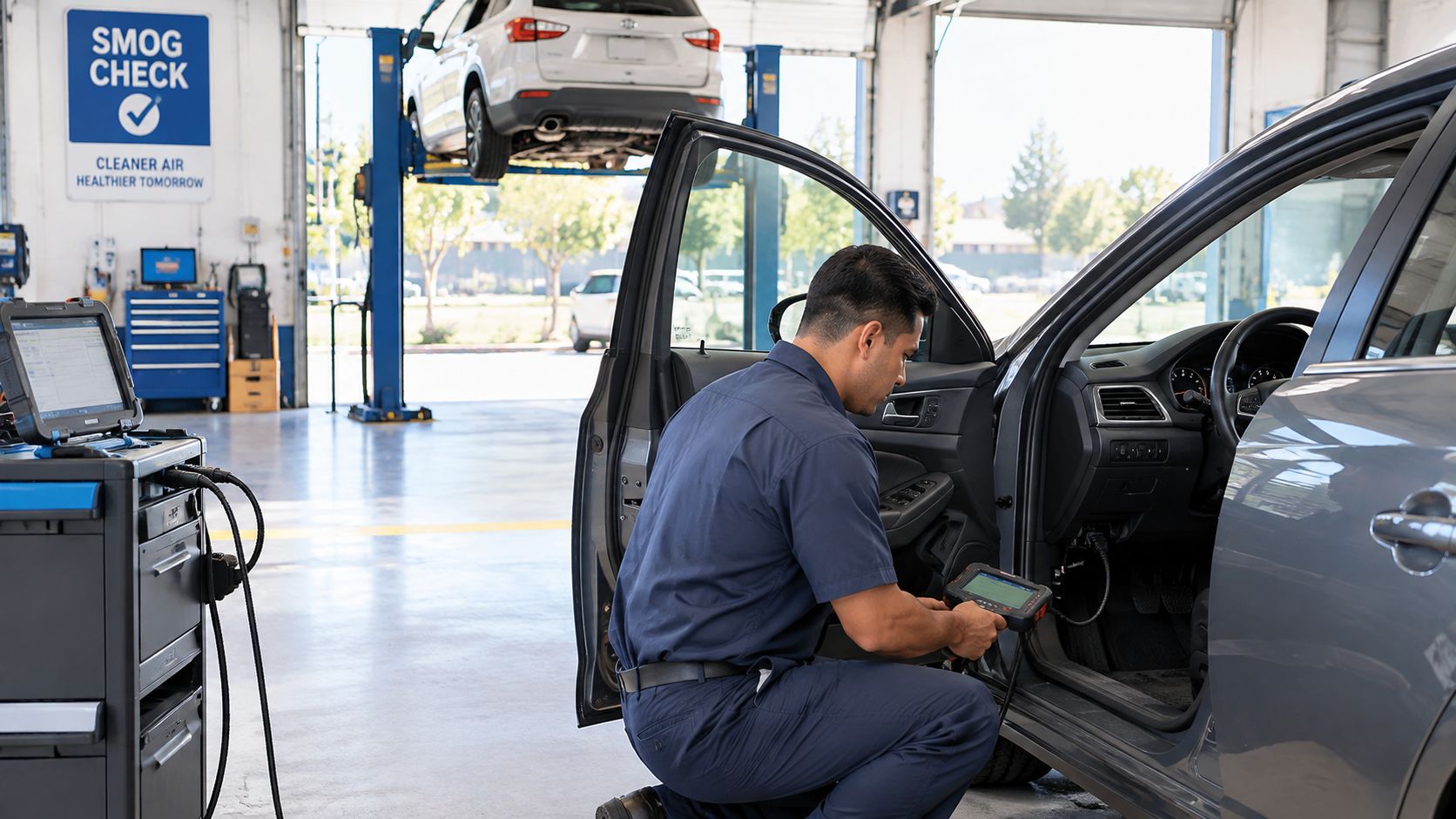
On arrival, bring your renewal notice, registration information, and identification. The station checks the vehicle under the required procedure, reviews the emissions-related data, and records the result. Because the operation is test-only, it doesn't sell emissions repairs. If the vehicle fails, you can take the report to a repair provider and ask about the applicable retest process.
Fire House has two service bays, offers smog testing seven days a week, and provides extended weekday and weekend availability. Its licensed DMV partnership also supports California registration renewals, ownership transfers, and on-site sticker printing, with DMV service hours separate from smog testing hours. Coupon terms may include a discount and a free retest, so confirm the current policy when you schedule.
For questions about a large vehicle or RV, call 925-754-1600 before arriving. Confirm the vehicle's dimensions, fuel type, model year, GVWR, and the exact requirement on your DMV notice. That preparation helps you choose the correct inspection and avoid repair pressure while keeping the certification process separate from any later work.
Fire House Smog provides STAR-certified, test-only smog inspections in Antioch for qualifying cars, trucks, and some RVs, along with California DMV registration services. Bring your renewal notice or registration paperwork, call 925-754-1600 with special-vehicle questions, and visit Fire House Smog to arrange an inspection without in-house emissions repair sales.