Yes, you can finish a California smog check and renew your registration in one stop at a licensed test-only station that also offers DMV services, with the sticker and plate printed on-site, as long as you bring the right documents and arrive before your registration deadline. California's Bureau of Automotive Repair reported 11,275,981 initial tests and 959,667 failures in 2025, an overall initial failure rate of 8.51%, so planning for the inspection, and a possible retest, matters.
You're probably reading this with a renewal notice on the kitchen counter and an expiration date approaching. The common mistake is treating smog and registration as separate errands. Drivers pay the registration fees first, discover that the DMV still needs a passing smog result, then make another trip to finish the renewal.
A combined California smog check and registration service removes that gap. The station tests the vehicle, transmits the result, completes the DMV transaction, and prints the registration sticker on-site when the vehicle passes and the paperwork is in order. The catch is timing. DMV fees remain due by the deadline even when the smog certification is missing, and paying those fees alone doesn't complete the renewal. California DMV renewal guidance explains that the renewal can't be finalized until the smog requirement is resolved.
Table of Contents
- Why Bundle a California Smog Check and Registration Service in One Visit
- Documents and Eligibility You Need Before You Go
- What Happens at the Smog Bay
- The DMV Handoff and On-Site Tag Printing
- Handling a Failed Smog Without Losing Your Day
- Comparing Bundled Visits to DMV Office and Online Options
- Smart Habits and Upcoming Rule Changes for California Drivers
Why Bundle a California Smog Check and Registration Service in One Visit
The practical objective is simple: leave with a legal vehicle, current registration, and the correct sticker, not merely a receipt showing that you started the process. A licensed station that combines emissions testing with DMV services can handle the inspection and registration handoff in one visit, provided the vehicle passes and the station is authorized for the specific requirement on your notice.
The deadline trap causes more trouble than the test itself. California requires registration fees by the renewal deadline even if the DMV hasn't received a passing smog certification. That means you can pay on time and still have an unfinished renewal. If you wait until the last day to discover that your vehicle needs a STAR station, a failed test or missing document can leave the process incomplete.
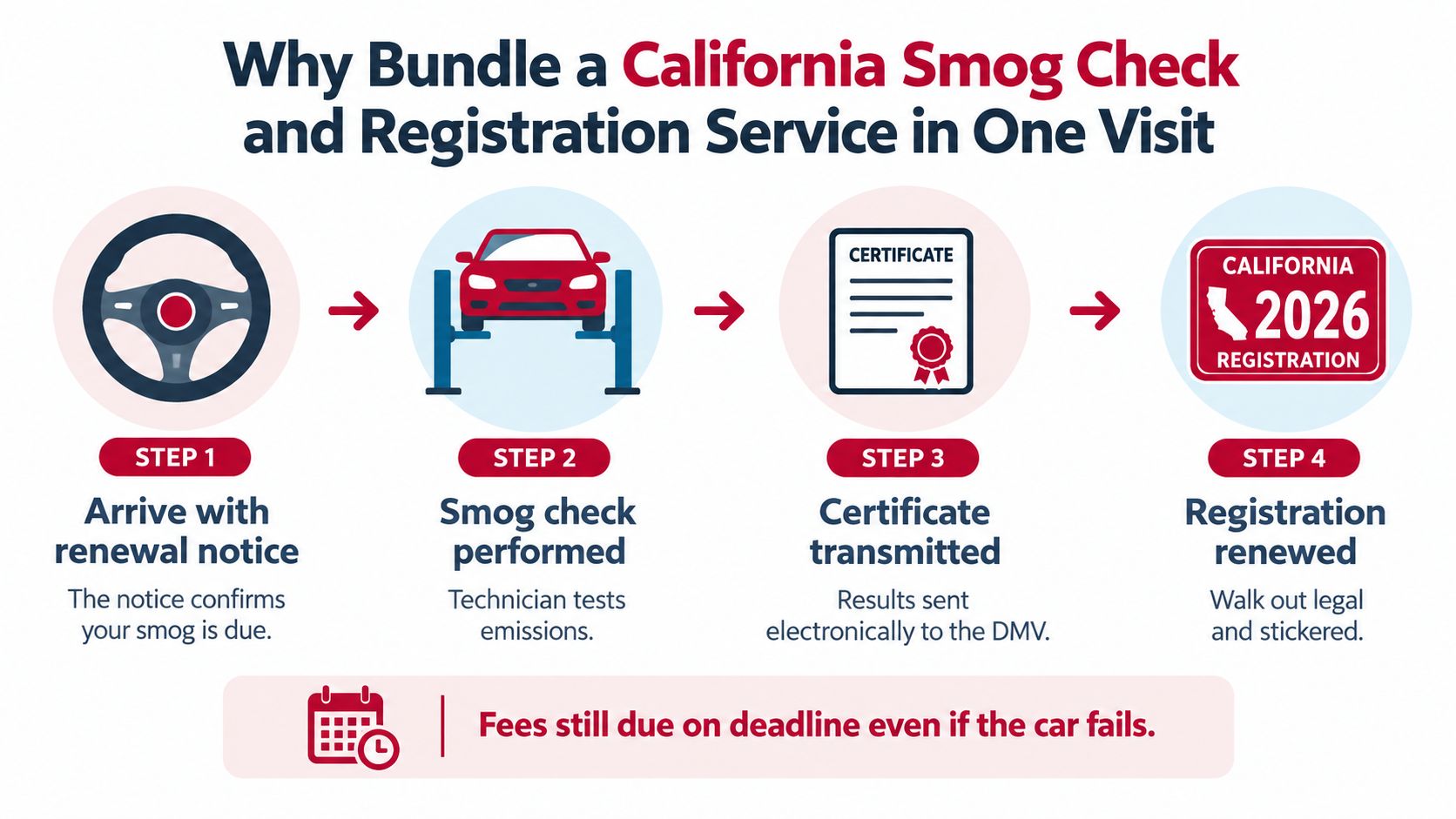
The bundled workflow
- Read the renewal notice first. Look for the smog indicator and any instruction requiring a STAR-certified or test-only station.
- Use the correct inspection station. A standard shop may not be authorized for a directed inspection.
- Complete the emissions test. The station sends the result to the DMV when the test is processed.
- Finish registration at the counter. The clerk confirms the vehicle record, accepts the required payment, and prints the sticker or plate when the transaction is complete.
A combined visit also helps drivers who misunderstand exemptions. California generally exempts gasoline-powered vehicles that are within the newer-vehicle exemption period from biennial inspections, but an exemption from testing doesn't necessarily mean an exemption from every smog-related registration charge. Transfer and initial-registration situations can also create a testing requirement even when a routine renewal might not.
Practical rule: Read the notice before choosing the station. The word “STAR” can determine whether a regular smog appointment will solve the problem.
Owners of newer gasoline vehicles, hybrids reaching the end of an exemption period, and vehicles with a directed notice benefit most from checking the requirement before booking. If you want a realistic idea of how the inspection fits into your day, review this guide to how long a California smog check takes.
Documents and Eligibility You Need Before You Go
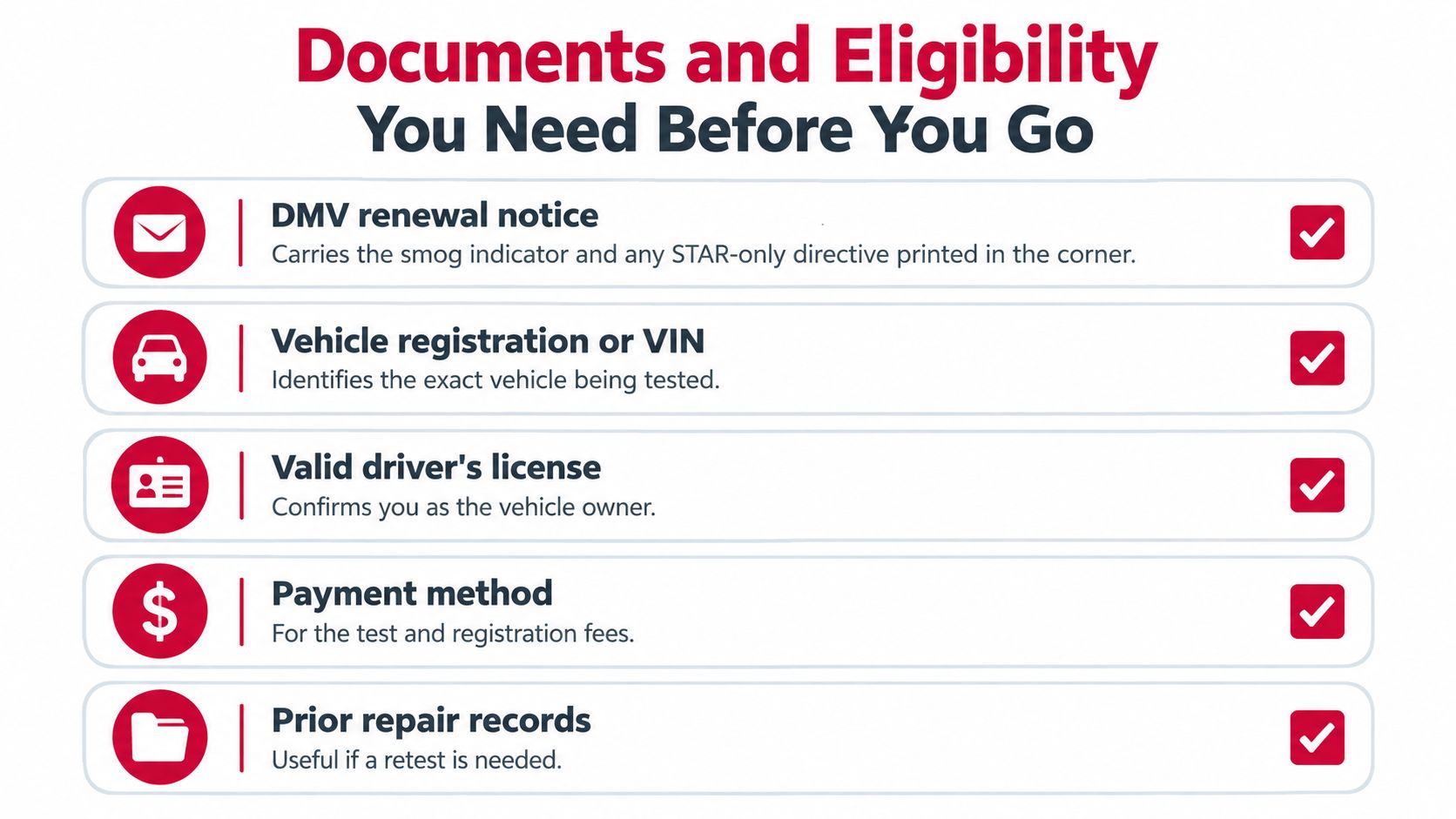
Bring the documents that identify you, the vehicle, and the transaction. A missing renewal notice or outdated ownership detail can turn a combined visit into a paperwork-only trip.
Start with the renewal notice
The DMV renewal notice is the most useful document in the glovebox. It identifies the vehicle and usually shows whether the renewal requires a smog certification. It can also contain a direction to use a STAR-certified station or a particular inspection type. Don't assume that any nearby smog shop can satisfy that instruction.
Bring the vehicle registration card or the vehicle identification number as well. The station needs to match the car in the bay to the DMV record, and an incorrect plate or VIN can delay the registration handoff.
Bring identification and payment
A valid driver's license or other accepted photo identification helps the clerk confirm the person handling the transaction. Bring a payment method that covers both the inspection and the registration charges. The station may process those amounts separately, so relying on a single payment method can create an avoidable delay.
If the transaction involves ownership transfer, bring the documents for that transfer. An out-of-state vehicle may require the original title, an odometer reading, current lien information, and additional registration paperwork. If the address on the DMV record has changed, handle that before the clerk prints the final documents, because an incorrect address can lead to a reprint or a separate correction.
Check eligibility before you drive over
California's rules depend on the vehicle's model year, fuel type, registration event, and inspection history. Most vehicles more than five model years old must be tested, while gas-powered vehicles built before 1976, motorcycles, and certain alternative-fuel vehicles are exempt under state guidance. Vehicles directed to a STAR facility are the important exception to casual station selection. If the notice names STAR, use a station with that designation.
Keep prior repair records if the vehicle has failed before. The technician can use the information to understand previous emissions work, and you may need the paperwork if a retest or repair-related process follows. This vehicle registration document checklist can help you organize the glovebox before leaving home.
What Happens at the Smog Bay
A typical visit starts with a technician checking the renewal notice, not immediately plugging into the car. Suppose you arrive at a two-bay Antioch station with the notice clipped to the sun visor. The technician confirms the vehicle identity, checks whether the notice directs you to a STAR station, and moves the vehicle into the appropriate bay.
For many newer vehicles, the central connection is the OBD-II port. The inspection equipment reads readiness monitors, the malfunction indicator lamp status, and stored fault information. A vehicle with incomplete monitors or an active emissions warning can require attention before it qualifies for a passing result.
Older vehicles follow a different path. The technician may use a tailpipe probe on a dynamometer and complete a visual inspection of emissions equipment. The inspection can take longer when the vehicle requires both functional and visual checks, rather than a straightforward OBD-based evaluation.
The bay work is also where obvious problems surface. A missing or defective gas cap, altered catalytic converter, disconnected emissions component, or aftermarket tuner can prevent a pass. A test-only station won't sell you repairs, which keeps the inspection separate from repair decisions. If the vehicle fails, the technician should explain the failed areas and provide the inspection report needed for the next step.
The final timing depends on vehicle type, station workload, and whether the car is ready for testing. Don't arrive with an already-warm assumption that every vehicle follows the same process. Bring the notice, leave room for intake questions, and tell the technician about recent battery replacement or emissions repairs.
The DMV Handoff and On-Site Tag Printing
A passing smog result is the midpoint of the bundled visit, not the finish line. The technician transmits the inspection result electronically, then the registration clerk retrieves the DMV renewal record and checks that the owner, address, VIN, and plate information match the paperwork.
The clerk then collects the registration payment and any other charges connected to the transaction. For an ownership transfer, that can include transfer-related amounts or other required fees. The exact total comes from the DMV record, so the renewal notice and current vehicle information matter.
Verify before you leave
The clerk may ask you to review or sign transaction documents. Read them instead of treating the signature as routine. Confirm that the following details are correct:
- VIN: Compare the vehicle identification number on the paperwork with the vehicle.
- Plate number: Make sure the plate belongs to the car you brought in.
- Owner and address: Check spelling and mailing information before printing.
- Smog status: Confirm that the inspection result shows as received and passed.
- Sticker details: Verify the month and year printed on the registration sticker.
When the station offers on-site tag printing, the sticker can be issued at the counter after the DMV transaction is accepted. Plates may also be printed or provided when the transaction requires them and the station's services cover that request. The time between a completed smog test and final sticker issuance depends on the station and transaction, but a clean, correctly documented renewal can move directly from inspection to clerk processing.
Don't drive away with only verbal confirmation. Take the registration card, sticker, receipts, and any plates or transfer documents the clerk gives you. If the printed information is wrong, correct it before leaving rather than trying to untangle the record later. For help with the administrative side, see the DMV registration customer service information.
Handling a Failed Smog Without Losing Your Day
A failure is not rare enough to ignore. BAR's 2025 executive summary recorded 959,667 failures from 11,275,981 initial tests, producing an 8.51% initial-test failure rate. The BAR 2025 Smog Check Executive Summary provides the statewide benchmark.
A failed result stops the bundled renewal. The technician can't complete the DMV registration as though the vehicle had passed, because the required certification is missing. You'll receive a Vehicle Inspection Report showing the failed components or conditions, and that report becomes the repair roadmap.
Read the failure report before authorizing work
The report may identify an emissions warning, incomplete readiness information, a visual equipment problem, or a measured result outside the permitted range. Ask the technician to explain what failed and whether the vehicle is eligible for a retest under the station's policy and the coupon terms. Do not approve unrelated maintenance just because the car is already in the bay.
The efficient strategy is usually to separate repair from registration. Take the report to a qualified repair facility, keep every receipt, and return after the repair is complete. If a free retest applies, confirm the deadline and whether it must occur at the original station or can be honored elsewhere.
A failed smog test changes the plan. It doesn't finish the registration, but it does tell you exactly what must be fixed before the DMV handoff can continue.
California's performance data also shows why station workflow matters. For 2000 and newer model-year vehicles tested in calendar years 2024 and 2025, about 1.3 million of 19 million vehicles failed, roughly 7%, according to BAR's performance report. Most vehicles pass, but a meaningful minority return after repairs. Schedule the first visit early enough that a second visit won't collide with the registration deadline.
Comparing Bundled Visits to DMV Office and Online Options
The right renewal path depends on what the DMV notice demands. A clean notice with no smog requirement may be handled online or through another approved channel. A notice that requires smog certification, or directs you to a STAR station, needs an in-person inspection before the DMV can finish the record.
| Path | Typical Time | Cost Notes | Clears Smog-Required Notice? |
|---|---|---|---|
| Combined smog and registration station | One coordinated visit if the vehicle passes | Inspection and registration charges are handled together | Yes, when the station is properly licensed for the requirement |
| Online renewal | Usually avoids a physical visit | DMV renewal charges and any applicable smog-related charge still apply | No, if a passing smog result is still missing |
| Mail renewal | Depends on mailing and processing | Payment and document requirements apply | No, if the notice requires a current inspection |
| DMV office visit | Appointment and office wait may be required | DMV charges apply, with no separate inspection included | Not by itself, because the vehicle still needs the correct smog test |
Choose based on the notice, not convenience
Online renewal is the fastest option when the DMV record is already clear. It doesn't replace an emissions inspection. Mail has the same limitation and adds document-handling time, so it makes little sense when the vehicle must be tested first.
A DMV office can resolve registration questions, ownership problems, and record corrections. It generally isn't the efficient first stop for a notice that clearly requires a smog certificate. The vehicle still needs inspection at an authorized station, and the DMV office won't turn a failed test into a passing result.
The combined station route wins when the car needs both services and the station can print the final sticker on-site. It also gives you one person to ask about the inspection record and one counter to complete the renewal. The limitation is straightforward: if the car fails or the documents don't match, the one-visit promise ends.
Smart Habits and Upcoming Rule Changes for California Drivers
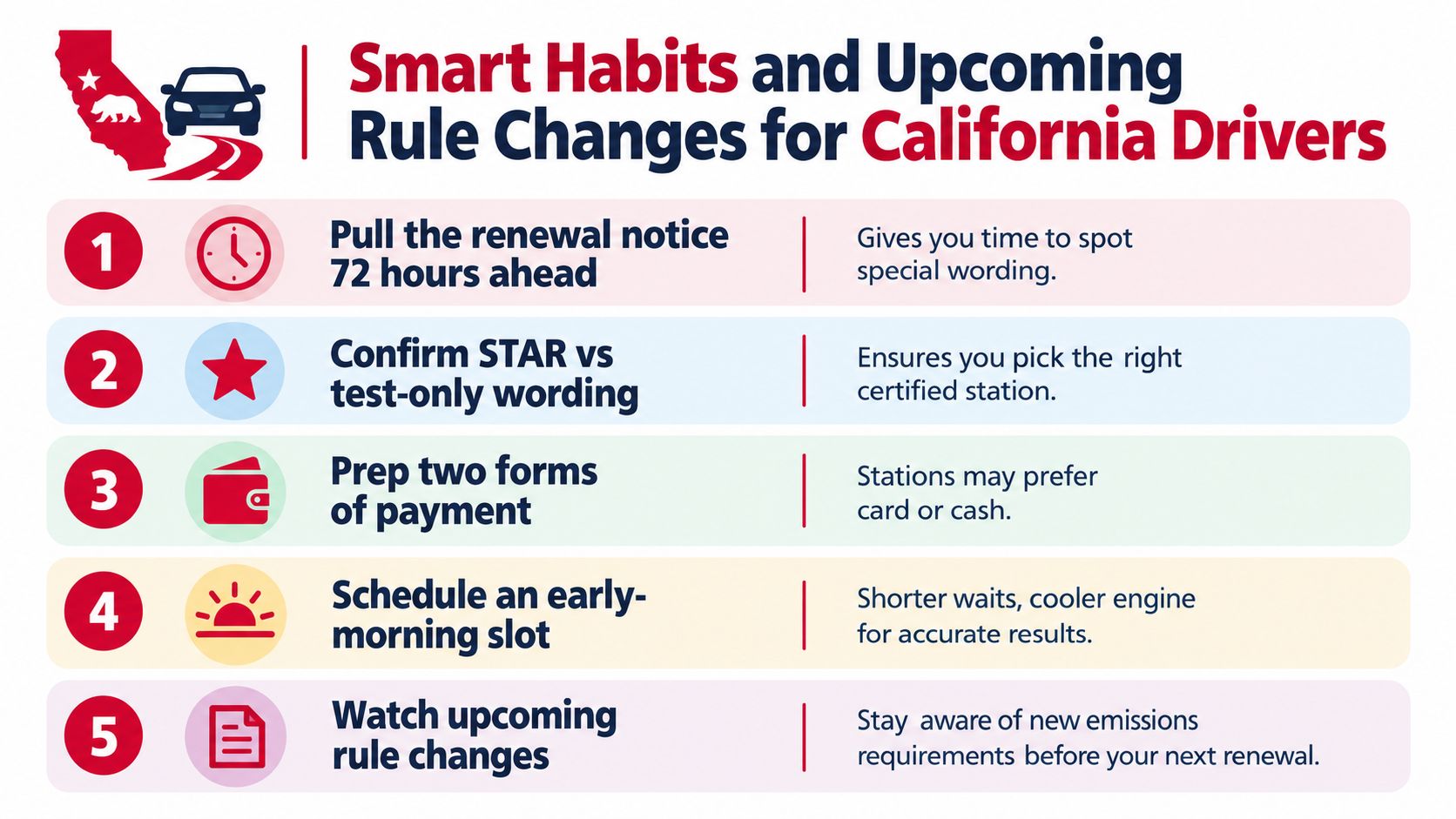
Treat the renewal notice as a work order. Pull it out ahead of the deadline, read the smog instruction, check the vehicle record, and choose the station based on the requirement rather than the closest search result.
Use a repeatable pre-visit routine
- Pull the notice early: Give yourself time to spot a STAR-only instruction, missing ownership information, or an address problem.
- Confirm the station license: Verify that the station is licensed and authorized for your vehicle's required inspection type.
- Prepare payment and records: Carry payment for the test and renewal, plus repair receipts if the vehicle has failed before.
- Book a practical appointment: An early visit leaves more room for a repair decision or retest if the first result isn't a pass.
- Save the inspection paperwork: Keep the report, receipts, registration card, and any retest information together.
Vehicle exemptions also require careful reading. BAR says vehicles within the newer-vehicle exemption period generally don't undergo the biennial inspection, but they may still pay a smog abatement fee. The exemption can also differ for initial registration and ownership changes. A vehicle that doesn't need a routine renewal test may still need inspection during a transfer.
California enacted Leno's Law in September 2026, with a staged exemption beginning for 1976 through 1980 vehicles in 2028 and advancing annually until 1985 vehicles are exempt by 2033, according to the verified program information. Classic-car owners should check the applicable year before assuming the current renewal routine will remain unchanged.
The broader lesson is to verify the rule each time the renewal arrives. Model year, fuel type, registration event, and the wording on the notice decide whether you need a test, a STAR station, or only a registration transaction. For an Antioch driver who needs both emissions certification and DMV processing, Fire House Smog is a STAR-certified test-only station that also provides licensed DMV registration services and on-site tag printing.
Bring your renewal notice, vehicle information, identification, and payment to Fire House Smog in Antioch for a STAR-certified test-only smog inspection and DMV registration service in the same visit. The station can handle qualifying renewals and transfers with on-site sticker or plate issuance, so schedule early enough to address a failed test or missing document before your registration deadline.