
California Smog Program Assistance: Who Qualifies in 2026
Your car just failed its Smog Check, registration is coming due, and you still need to drive to work. Before you authorize repairs or decide the car isn't worth keeping, check whether California's Consumer Assistance Program, usually called CAP, can help.
California smog program assistance offers separate paths for repairing an eligible vehicle or retiring it. The important part isn't just finding a payment amount. It's choosing the right path, checking your eligibility, and getting approval before you make a decision that could leave you paying the whole bill.
Table of Contents
- Assistance Amounts at a Glance
- Eligibility Rules to Check Before You Apply
- Choosing Between Repair and Retirement
- Retiring a Vehicle Through a BAR-Authorized Dismantler
- Documents, Timelines and Funding Limits
- Apply for Repair Assistance and Book Your Test
Assistance Amounts at a Glance
| Benefit | Who it applies to | Maximum amount | Condition to note |
|---|---|---|---|
| Emissions repair, model year 1996 or newer | Vehicle that fails a required biennial Smog Check | Up to $1,450 | Approval must come before work starts |
| Emissions repair, model years 1976 to 1995 | Vehicle that fails a required biennial Smog Check | Up to $1,100 | Approval must come before work starts |
| Retirement, income-eligible owner | Qualifying vehicle retired through a BAR-authorized dismantler | Up to $2,000 | Funds depend on annual availability |
| Retirement, pathway listed in current application materials | Qualifying owner under the applicable pathway | $1,500 or $2,000 | Confirm which pathway applies to you |
| Retirement, not income-eligible | Qualifying vehicle retired through a BAR-authorized dismantler | Up to $1,350 | Funds depend on annual availability |
The Bureau of Automotive Repair's CAP supplemental report lists repair assistance of up to $1,450 for model year 1996 or newer, up to $1,100 for model years 1976 to 1995, and retirement application amounts of $1,500 or $2,000, depending on the qualification pathway. The other retirement category in the table is a separate eligibility case, not an additional payment you can stack onto another benefit.
Use this decision rule before committing: choose repair when your remaining cost preserves transportation you can reasonably depend on. Compare retirement when your share of the repair bill, the car's other problems, and its remaining usefulness make keeping it difficult to justify.
What each benefit means in practice
The newer-vehicle repair row covers eligible emissions work after a qualifying failed inspection, not every mechanical problem the car has. The older-vehicle repair row serves the same purpose but has a different assistance ceiling.
The income-eligible retirement row concerns giving up a qualifying vehicle through the authorized dismantling process. The application-pathway row means you must identify the option CAP approves for you, rather than choosing the largest amount advertised. The non-income-eligible row provides a possible retirement route for owners who don't meet the income-qualified category.
These are maximum benefits, not guaranteed checks. Repair assistance shouldn't be treated as unrestricted money paid to you for whatever work you choose.
Budget safeguard: Your repair budget must include the required station copayment and any charges CAP doesn't cover. An assistance ceiling isn't a promise that your car will be repaired at no cost.
Start by matching your vehicle's model year and your intended outcome to the table. Then check the requirements before authorizing work, arranging dismantling, or counting on funding to replace your transportation.
Eligibility Rules to Check Before You Apply
A failed inspection alone doesn't establish eligibility. CAP also considers the applicant, vehicle, registration status, and repair arrangements.
The Bureau of Automotive Repair's repair-assistance requirements set the income-qualified threshold at gross household income at or below 225% of the federal poverty level and explain that repairs performed before application approval aren't reimbursed. Use the current household-size guidance in the application rather than guessing from take-home pay.
Check the vehicle and applicant together
Confirm a qualifying inspection failure. Repair assistance requires a failed, required biennial Smog Check, not an aborted inspection or a test conducted in manual or training mode. The completed failure documents the emissions-compliance problem.
Check whose name is on the title. The applicant must hold title to the vehicle. Having possession of a relative's car isn't the same as being its titled owner.
Verify registration status. CAP requires qualifying DMV registration status, so resolve questions about a recent purchase, transfer, or registration change before relying on assistance. A vehicle needing a Smog Check doesn't automatically qualify for CAP repair funding.
Choose a STAR-certified repair station. The facility must perform qualifying repair work, not just carry out inspections. STAR certification doesn't mean every station offers the same services.
Address emissions-system tampering. Vehicles with tampered emissions-control systems are excluded. Tell the station about modifications rather than assuming assistance will pay to undo them.
Check gross household income. Use the application's household and income definitions. This requirement targets help toward households that may otherwise struggle to pay for emissions repairs.
A qualifying situation still needs approval
Say you own a sedan in the newer-vehicle category, its registration status qualifies, your household meets the income requirement, and it fails its required inspection. That combination gives you a reason to apply, but it isn't approval to start repairs.
We're a STAR-certified test-only station at Fire House Smog. We can document the inspection result, but a separate STAR-certified repair station must handle repairs.
If you're unsure whether the vehicle needs an inspection at all, check the relevant California Smog Check exemptions before arranging a test. Exemption rules and assistance eligibility answer different questions.
Choosing Between Repair and Retirement
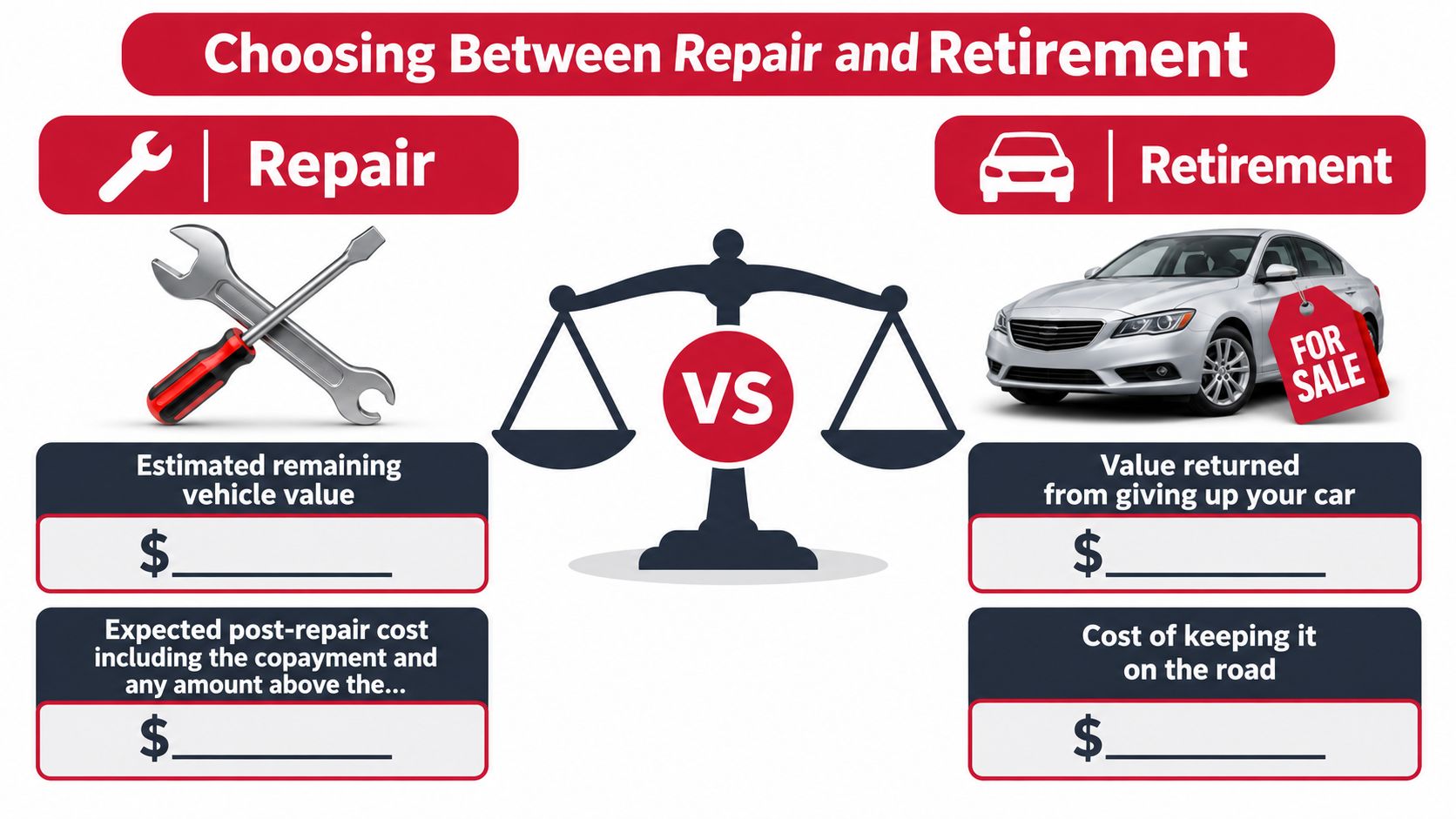
The best financial choice isn't necessarily the largest advertised benefit. It's the option that leaves you with workable transportation and a manageable out-of-pocket cost.
The Bureau of Automotive Repair's CAP overview lists retirement assistance of up to $2,000 for income-eligible owners and up to $1,350 for owners who aren't income-eligible, subject to qualification and available funding. Those payments belong in a comparison with your actual cost of keeping the vehicle, not just its repair estimate.
Compare what you keep with what you give up
| Decision factor | Repair may make more sense when | Retirement deserves a closer look when |
|---|---|---|
| Remaining vehicle usefulness | The car otherwise meets your needs | Other major problems remain |
| Owner-paid repair cost | Your share is affordable | Your share strains your budget |
| Replacement transportation | Replacing the car would be difficult | You have a practical alternative |
| Work and family travel | You depend on keeping this vehicle | You can manage without it |
| Ownership and registration | Your vehicle qualifies for repair assistance | A separate retirement pathway may fit |
Consider a car whose emissions repair quote is higher than its likely sale value. Even with assistance, the owner must consider the unpaid balance, copayment, and unrelated work the car needs.
Retirement could be sensible if that owner already has dependable transportation available. But another driver with the same repair quote may need the car for daily work and face a much larger cost to replace it.
Market value and transportation value aren't identical. An inexpensive car that reliably gets you to work can be worth keeping, while a more valuable vehicle with repeated mechanical problems can remain expensive to own.
Get a usable estimate before deciding
Ask the repair station to separate emissions-related work from other recommended maintenance. You need to know what addresses the inspection failure, what CAP may cover, and what remains your responsibility.
If you're looking for auto repair in Antioch, confirm that the facility can handle your vehicle's diagnosis and participate in the applicable assistance process. Don't assume a general repair quote establishes CAP coverage.
Compare your owner-paid repair cost with both the retirement payment and the cost of replacing the trips this car makes.
Don't surrender the vehicle or authorize repairs while treating an unapproved application as money already available.
Retiring a Vehicle Through a BAR-Authorized Dismantler
Vehicle retirement isn't a repair voucher with a different name. You're giving up the vehicle through a program-approved process, so the decision needs to include how you'll travel afterward.
A private sale, an ordinary scrap transaction, and CAP retirement aren't interchangeable. Before moving the vehicle, establish which program is accepting it and what that program requires.
Follow the retirement process deliberately
Confirm the vehicle's retirement eligibility. Check the title, ownership, registration, and vehicle conditions for the particular pathway. Don't apply the repair checklist as though it settles every retirement question.
Establish your approved payment category. Household income and the applicable qualification pathway can affect the payment. Use the amount confirmed for your application, not the highest figure you've seen online.
Verify funding before planning around the payment. Ask whether the program is accepting applications and whether funding is available. Don't make a replacement-car commitment based only on apparent eligibility.
Use a BAR-authorized dismantler. Confirm that the facility is authorized for your approved retirement option before arranging delivery. A business that buys scrap vehicles doesn't automatically fulfill that requirement.
Confirm handover and payment instructions. Read the approval materials for required forms, signatures, vehicle-delivery conditions, and the payment sequence. Get clarification before signing over the title or releasing the car.
Plan the last trip before handing over the keys
Say an owner has an older vehicle that needs emissions repairs and other substantial work. Retirement may offer a cleaner financial exit, but only if the owner can manage the loss of the vehicle.
Write down how you'll get home from the dismantler, commute afterward, and handle essential family trips. If you expect to buy another car, include the practical costs of putting that replacement into service rather than comparing purchase prices alone.
Before handover: Confirm the approved dismantler, required paperwork, and payment procedure. Don't assume you can complete an ordinary scrap transaction and claim CAP money afterward.
Keep copies of the approval, ownership documents, and any receipt issued when the dismantler accepts the vehicle. If the instructions don't explain when or how payment occurs, clarify that point before delivery.
The avoidable mistake is making the car unavailable first and checking the program process afterward. Retirement should be an organized transfer under the approved benefit, not an improvised disposal followed by an application.
Documents, Timelines and Funding Limits
Good paperwork helps an application move forward, but it doesn't reserve funding. You need both a complete application and an available program pathway.
The Bureau of Automotive Repair's consumer assistance pages explain that participation depends on available funds during the fiscal year, July 1 through June 30, and that retirement can be available even when a vehicle passes Smog Check. Don't arrange a failed test merely because you assume every retirement option requires one.
Build an application folder
The official application determines the final document list. Gather these items so you can answer questions accurately and respond to requests without searching through old paperwork:
- Ownership records. Have the title in the applicant's name and relevant ownership information available.
- Registration records. Keep current DMV documents and any notices explaining the vehicle's status together.
- Inspection paperwork. For repair assistance, retain the failed inspection report.
- Vehicle identification. Record the model year and vehicle identification number consistently across documents.
- Income records. Prepare documentation required for the income-qualified pathway.
- Repair information. Keep any written estimate and identify whether obtaining it involves a diagnostic charge.
An estimate is useful preparation, but don't assume every item in this folder must accompany every application. Follow the instructions for your selected benefit.
Treat timing and location as eligibility checks
Some retirement programs listed by BAR have geographic limits, including programs serving the Bay Area, Antelope Valley, San Luis Obispo County, Mojave Desert, Ventura County, and greater Los Angeles. A local incentive isn't necessarily available statewide.
Before filing, check the following:
- Program status. Confirm that the option is currently accepting applications.
- Funding status. Ask whether funds remain available rather than inferring availability from the calendar.
- Location rules. Verify that your address and vehicle meet any geographic conditions.
- Facility status. Use BAR's STAR-certified station lookup to identify the appropriate type of repair facility.
For repairs, the practical sequence is inspection failure, application, approval, authorized work, and compliance verification. Retirement follows its own approval and dismantler instructions.
Don't plan around an assumed processing time. Check current instructions on the BAR Consumer Assistance Program pages, and leave room for document requests before committing to paid work or replacement transportation.
Apply for Repair Assistance and Book Your Test
The repair process works best when you keep inspection, application approval, diagnosis, and repair authorization separate. Each serves a different purpose, and paying for work too early can undermine the assistance you hoped to receive.
Use the sequence below to organize the job. Your approval documents and the participating repair station's instructions should control the actual work and billing arrangements.
Start with the report and application
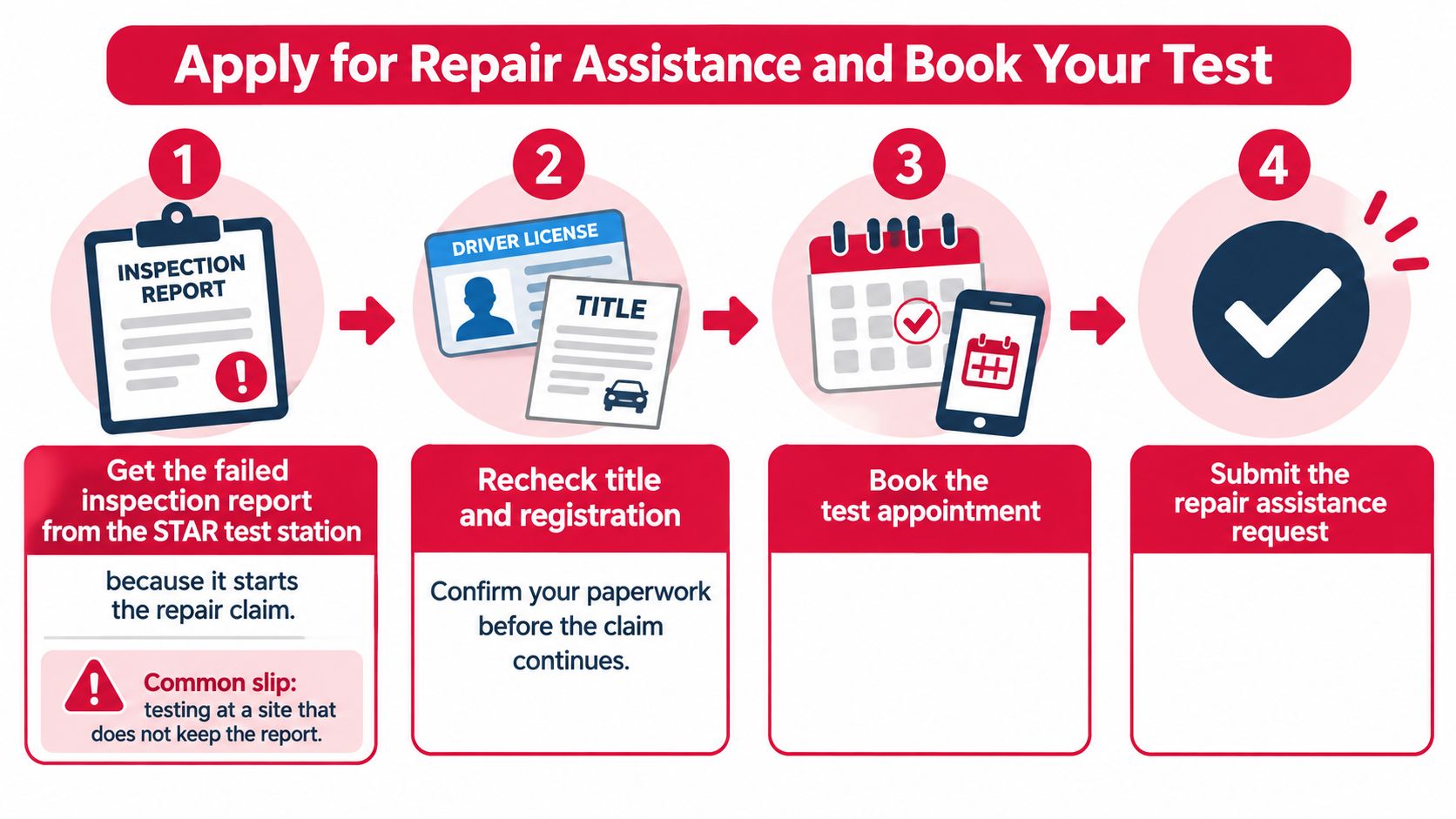
Keep the completed inspection report. Check that it identifies your vehicle correctly and retain a readable copy. If you've already failed, bring that report when discussing the next test or application.
Common slip: Remembering that the car failed but not having the paperwork needed to identify the inspection and its results.
Match the application to your ownership records. Review the applicant's name, vehicle identification, and registration information before submitting. If the vehicle is being transferred, initially registered in California, or re-registered, resolve the eligibility question rather than guessing.
Common slip: Assuming that being responsible for the car's registration makes every registration situation eligible for repair assistance.
Submit the application and obtain written approval. Read the approval conditions before you tell a shop to begin. A submitted application, a verbal expectation, and a repair authorization are different things.
Common slip: Asking a technician to fix the problem while the application is still pending.
For a plain-language explanation of the inspection outcome itself, review what happens if you fail a Smog Check. The report identifies the result, but it isn't a substitute for a repair diagnosis or a CAP approval.
Control the estimate and your share of the bill
Arrange diagnosis with the right repair facility. Tell the station that you're using CAP and show the approval paperwork before agreeing to services. Ask how it handles diagnostic authorization, covered repairs, and any proposed work outside the benefit.
Common slip: Expecting a test-only station to supply a repair quote or perform the work.
Request an itemized owner-cost explanation. Ask the repair station to show the approved program contribution, required copayment, uncovered charges, and any cost beyond the assistance limit. Have the station explain how those amounts fit together so you don't accidentally count a charge twice.
Common slip: Subtracting an advertised maximum from the total quote and assuming the result is the final bill.
A useful written estimate should identify the proposed repair, its relationship to the failure, and what happens if diagnosis reveals additional problems. Ask the shop to contact you before expanding the authorized work.
Finish with records and a compliance check
Authorize the agreed work and save the invoices. Keep the estimate, approval, repair authorization, and final invoice together. If a recommended service isn't included in the approved repair, decide on it separately.
Common slip: Treating every recommendation on a service sheet as covered emissions work.
Arrange the required follow-up inspection. Tell the testing station that the car has been repaired and bring the relevant paperwork. Follow the repair facility's and program's instructions rather than assuming that an invoice proves the vehicle now passes.
Common slip: Finishing the repair and overlooking the inspection needed to establish compliance.
At Fire House Smog, our test-only operation keeps inspection separate from repair sales. We don't do repairs, so you won't receive an in-house repair bill after your Smog Check, though a failed vehicle may still need paid work elsewhere.
We're located at 2900 Lone Tree Way, Antioch, CA 94509, and you can call (925) 754-1600 with testing questions. Bring an existing failed report if you have one, and keep repair authorization on hold until your approval is in hand.
At Fire House Smog, we provide STAR-certified, test-only inspections so you can document your vehicle's result without an in-house repair sales pitch. Visit Fire House Smog to book your test, bring any existing failed inspection report, and wait for CAP approval before authorizing assistance-funded repairs.