
Can You Get Car Registration Online in California
Yes, you can get car registration online in California when you're renewing an eligible vehicle already in your name. No, that isn't a blanket answer for title transfers, first-time registrations, or vehicles coming from another state.
Online renewal is a mainstream service: California DMV recorded 12,014,480 internet vehicle-registration-renewal customers in fiscal year 2021–2022, approximately 38.9% of renewal customers across all channels, according to its renewal customer report. The important distinction is what those customers were doing: renewing an existing registration record, not necessarily establishing ownership or registering a newly arrived vehicle.
Think of the DMV website as a self-checkout lane. It works well when the vehicle's record scans cleanly. It can't replace a missing title, supply an emissions certificate, or turn a payment receipt into a completed registration when required records are still missing.
Table of Contents
- Yes for Many California Renewals
- Which Registration Tasks Stay Online
- Smog Records and a Printed Sticker
- How to Renew an Eligible Vehicle Online
- When the Portal Will Not Finish the Renewal
- Transfers and Cars From Another State
- Renew Online or Finish in Antioch
Yes for Many California Renewals
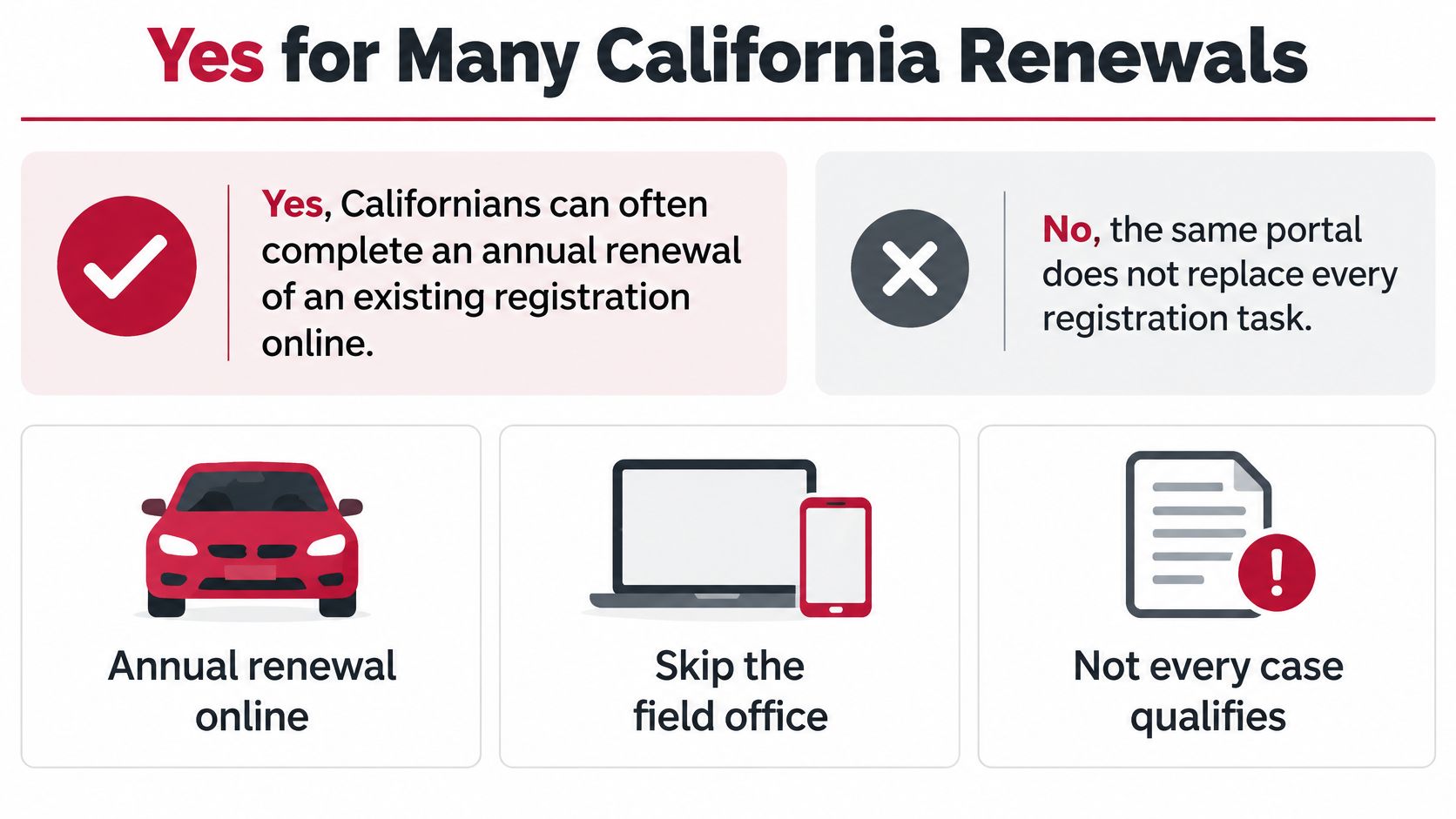
An eligible annual renewal can often be completed online without a field-office visit. But the renewal portal isn't a substitute for every transaction people describe as registering a car.
California recorded 12,187,450 internet renewal customers out of 31,009,049 total renewal customers in fiscal year 2020–2021, about 39.3%, according to the California DMV's renewal customer report. That volume makes the practical point: online renewal isn't a workaround or a special exception. It's an established service for vehicles that meet the requirements.
Start with the job, not the payment
Before entering a plate number, decide what you're asking DMV to change. These are different jobs:
- Renew an existing record. You already own the vehicle, and you're extending its registration.
- Transfer a purchase. You bought the vehicle and need the ownership record changed.
- Register an out-of-state vehicle. You're bringing a vehicle into California's registration system and need the appropriate documents reviewed.
The self-checkout comparison helps here. An ordinary renewal resembles scanning a known item with a readable barcode. A purchase with missing signatures resembles bringing an item to checkout without the paperwork needed to identify who owns it. Repeatedly scanning the plate won't solve that problem.
Practical rule: Choose the transaction that matches the vehicle's ownership and registration status, not simply the webpage that accepts a payment.
Eligible doesn't mean nothing else is required
A car can belong to you and still need a supporting step before an online renewal clears. For example, the renewal notice may require a smog inspection. The inspection itself happens outside the website, even if the registration transaction can ultimately finish online.
That distinction answers a common version of the question, “Can you get car registration online?” You may be able to complete the administrative renewal online without being able to complete every prerequisite from your laptop.
Start with the notice and the vehicle's current ownership documents. If the owner is staying the same and you're renewing an established California record, the regular renewal service is a reasonable starting point. If the owner or state registration is changing, select the corresponding document-based process instead.
Which Registration Tasks Stay Online
California registration tasks and the channel that finishes them
| Transaction | Online path | Must already be true | If the portal stops you |
|---|---|---|---|
| Annual renewal of a car already in your name | Yes, when eligibility checks pass | Vehicle identifiers, required electronic insurance and smog records, and an accepted payment method are available | Clear the failed check, then renew online or use assisted renewal |
| Planned nonoperation | Online or by mail | File by the registration expiration date | A missed deadline can mean a late penalty |
| Renewal notice shows wrong address | Change the address online first | Allow the address update to process before renewing | Correct the mailing record rather than paying against the old address |
| Partial-year or other nonstandard renewal | Assisted renewal rather than routine self-service | Renewal notice and supporting certification are ready | Use DMV assisted processing |
| Ownership transfer after a purchase | Not a renewal of the seller's record | Ownership papers, signatures, transfer fees, and required compliance documents are complete | Use DMV or a licensed registration partner |
| Out-of-state vehicle | Not through the standard annual-renewal portal | Ownership and California compliance documents are assembled | Use an in-person or authorized-provider document review |
| Missing California title | Not a routine renewal solution | A replacement-title application and supporting ownership papers are prepared | Obtain assisted document review |
| Smog due or unpaid parking citations | Payment alone doesn't complete renewal | Required smog information is on file and citations are resolved | Finish compliance before treating registration as complete |
Use the table one vehicle at a time. A renewal notice for the car you've owned for years points toward the annual-renewal row. A bill of sale for a car you just purchased points toward a transfer, even if the seller also handed you a renewal notice.
A renewal notice and a bill of sale mean different things
Say you open your household car's renewal notice. Your name is correct, the vehicle is familiar, and you haven't changed ownership. Your task is to check the renewal requirements and complete the existing record.
Now say you buy a used pickup over the weekend. You have the keys and a signed bill of sale, but the California ownership record still needs attention. Paying a renewal charge associated with that plate doesn't establish that the truck belongs to you.
The same separation matters when you move to California with a vehicle registered elsewhere. You aren't just extending an existing California registration. You need the paperwork appropriate to bringing that vehicle into the state's system.
A plate number identifies a vehicle. It doesn't tell the portal that every ownership, address, and compliance requirement has been satisfied.
Choose a fallback that can fix the actual problem
A rejected renewal doesn't always mean you need a field-office appointment. Some problems require a corrected electronic record; others require a person to review documents. Match the fallback to what's missing.
For an ordinary renewal, preserve the portal's message before closing the page. For an ownership transaction, organize the title papers instead of continuing through a renewal checkout. For an out-of-state vehicle, confirm the document packet before making a trip.
This avoids a frustrating detour: reaching a payment screen, assuming you selected the right service, and discovering afterward that the vehicle still needs a different transaction.
Smog Records and a Printed Sticker
The website can process information, but it can't inspect your exhaust system or hand a sticker through your screen. Those physical steps explain why an otherwise online transaction can still involve a visit somewhere.
The inspection and the registration are connected, but they aren't the same service. When a smog certificate is required, the registration process needs the electronic certification associated with the vehicle. A photo of inspection paperwork on your phone isn't the same thing as that electronic record being available.
Complete the inspection before assuming the record is ready
If your notice calls for a smog check, arrange the test before treating the renewal as a simple payment task. Keep the inspection paperwork so you can identify the vehicle and discuss any mismatch if the renewal still shows an emissions requirement.
Our guide to California smog test validity can help you think through the timing of the inspection and the registration transaction. Don't assume an old test automatically satisfies the requirement attached to the current transaction.
At a test-only station, inspection and repair sales are separate. We don't perform repairs, so a failed test doesn't lead to an in-house repair invoice. The next action is to address the reason for failure and arrange the necessary retest.
- If the vehicle passes: Keep the paperwork and make sure the renewal can recognize the required certification.
- If it fails: Resolve the emissions issue before expecting the registration requirement to clear.
- If the portal still requests smog: Preserve that message and the inspection paperwork rather than assuming another payment will help.
Decide how you need to receive the sticker
Finishing an online transaction and holding the registration sticker are different milestones. Follow the DMV's completion and delivery instructions, and don't assume an online payment means you'll have a physical sticker immediately.
If you need counter assistance, verify that the transaction can be completed with the documents you have. An unresolved compliance requirement remains unresolved at a counter, even when printing is available.
Also check registration-counter hours separately from smog-testing hours. A station may be open for inspections while its registration counter isn't operating. Once the required electronic records are ready and no ownership documents are missing, the website remains a sensible tool for an eligible renewal.
How to Renew an Eligible Vehicle Online
Start with a clean renewal: the car is already in your name, and you're extending its California registration rather than changing ownership. The California DMV vehicle-registration renewal service requires the plate number, the last five characters of the VIN or HIN, and an accepted electronic payment method, with required insurance and smog information on file.
Use this visual as a preparation checklist, then work through the actions below.
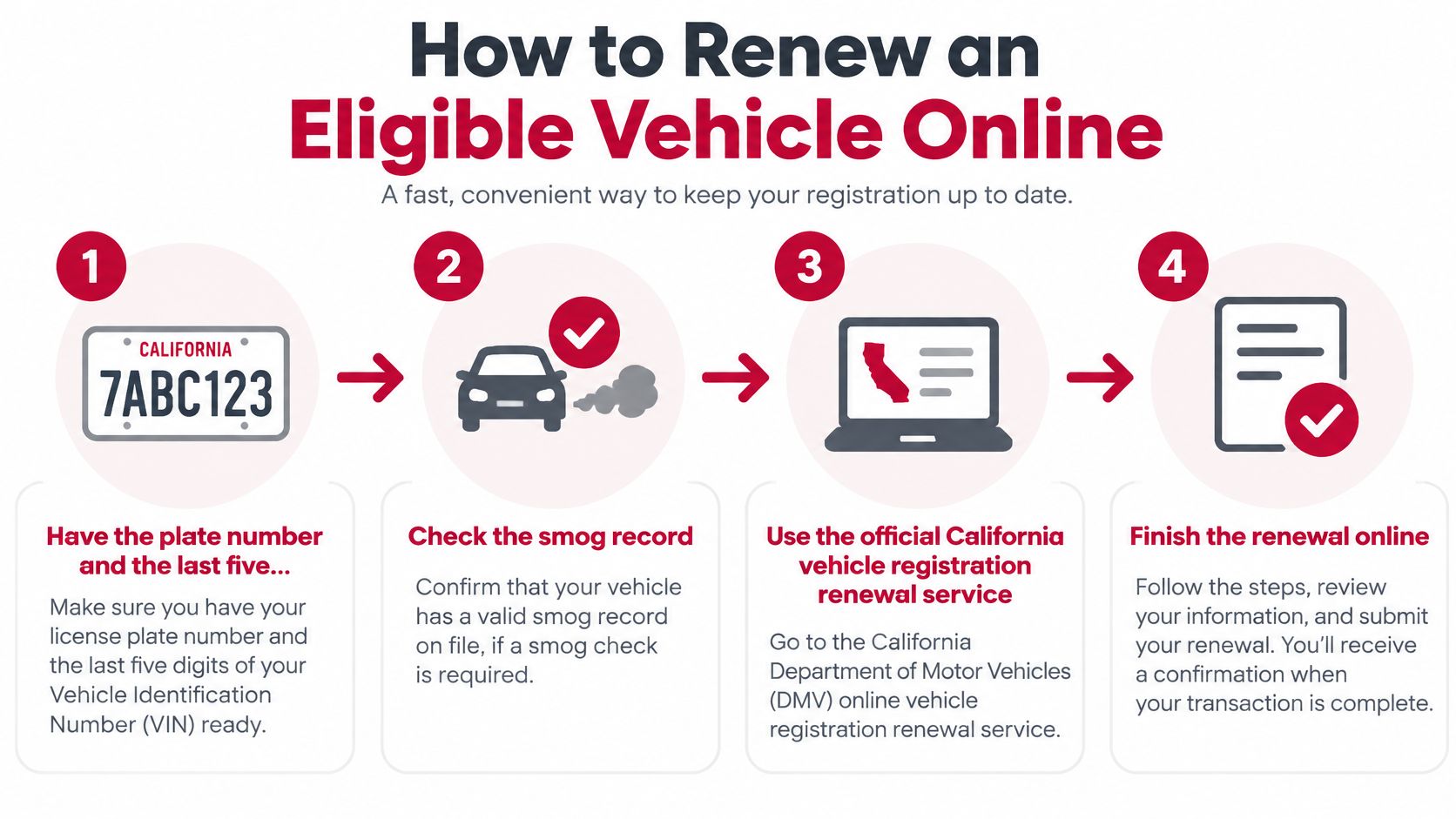
Prepare the record before paying
Gather the vehicle identifiers. Use the renewal notice or the vehicle's identifying information. Check each character carefully, especially when you manage several cars or work trucks.
Confirm electronic insurance reporting. Unless the vehicle is exempt, DMV needs the required insurance information electronically. Having a policy card in your wallet doesn't by itself establish that the electronic registration record has what it needs. Contact your insurer if the portal identifies an insurance problem.
Check the required smog record. Complete any required inspection and make sure the certification requirement is satisfied. Paying while the smog requirement remains open can leave you with fees paid but renewal unfinished.
Resolve parking citations and other holds. Read the notice and portal messages rather than skipping directly to checkout. If you recently resolved a citation, retain the receipt so you can address a record that hasn't cleared.
Pay the displayed fees. Use a credit card, debit card, or checking account accepted by the service. Review the vehicle information and amount before submitting.
Save the result and follow delivery instructions. Keep the confirmation and any status message. Watch for the registration card and sticker through the method DMV specifies, and act on any outstanding requirement rather than assuming the receipt closes the transaction.
For help organizing what to keep beside you, use our vehicle registration documents checklist. A readable notice, correct identifiers, and retained compliance receipts make it easier to resolve a rejected transaction without starting from memory.
Payment isn't clearance: The payment screen handles fees. A completed renewal also requires the vehicle's record to satisfy the applicable checks.
Read the final status, not just the charge
A successful charge tells you money moved. Read the completion language separately, including any instruction to submit a document or satisfy a requirement.
If the vehicle isn't being operated, consider the appropriate planned-nonoperation process rather than letting the renewal sit unresolved. Don't treat a pending issue as permission to ignore the expiration date.
This video provides another way to follow the renewal process.
If the portal asks for documents, displays an incorrect address, or won't accept the vehicle, save the exact message. It identifies what needs attention more reliably than a bank statement showing the payment.
When the Portal Will Not Finish the Renewal
Paid but not registered is the surprise to avoid. A payment receipt can exist while the registration remains incomplete because the vehicle still needs a required record or document.
Say an East Contra Costa driver pays during a lunch break, then discovers the required smog certification isn't on file. The useful next action is the inspection and confirmation of the certification record, not another attempt to pay the same renewal charge.
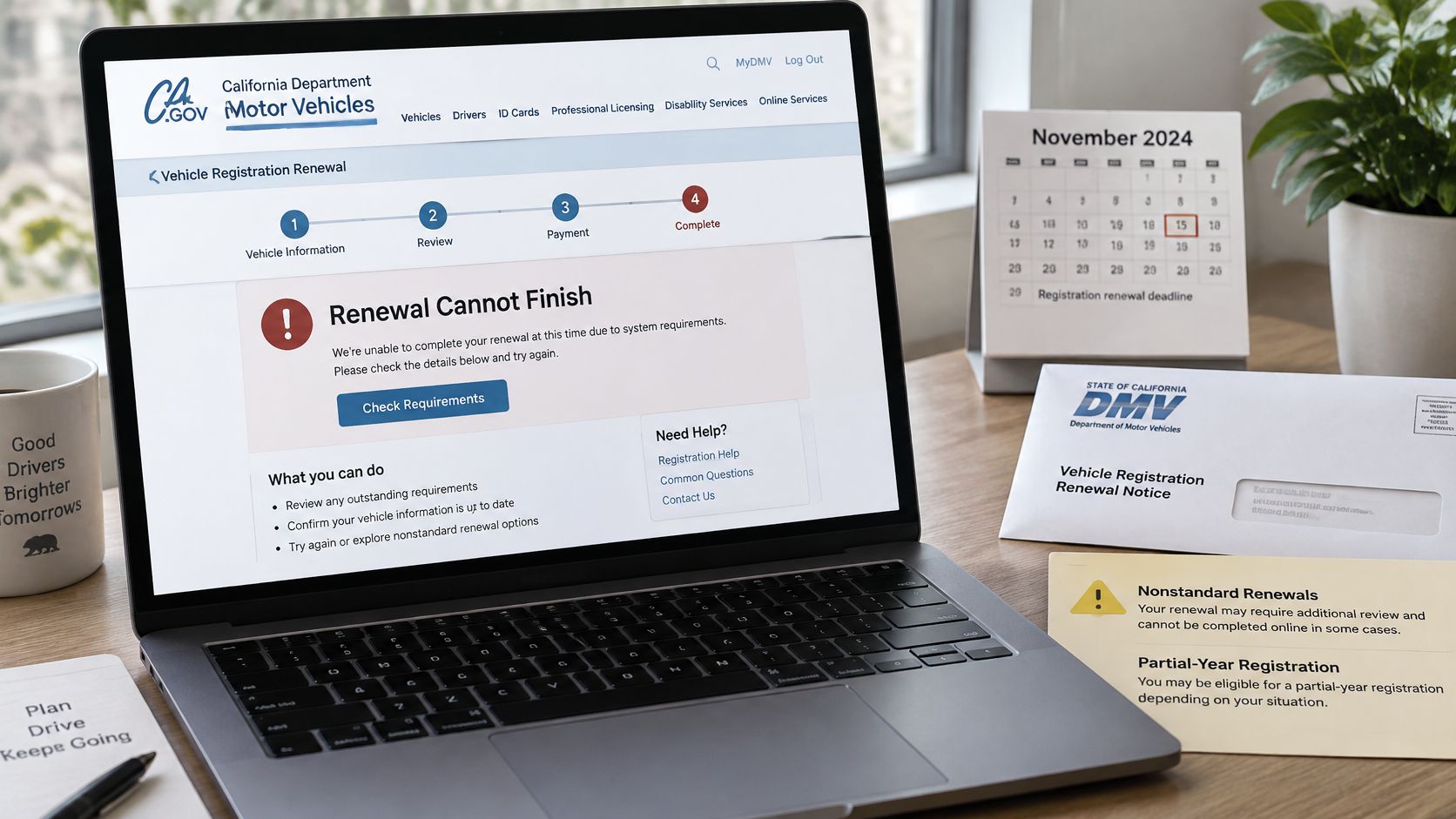
Match the stop to the fix
An incorrect address creates a timing problem. The California DMV's assisted renewal guidance instructs customers to change an incorrect address online and allow three business days before renewing, and states that renewal or planned nonoperation must be filed by the expiration date to avoid a late penalty.
Changing your address in a payment form isn't a substitute for correcting the DMV address record. Start with the address-change process, then allow the prescribed processing interval before attempting renewal.
Other stops call for different actions:
- Nonstandard renewal: Partial-year registration and other complex renewals need assisted processing. Prepare the renewal notice and smog certification when applicable.
- Insurance mismatch: Work with the insurer on the electronic reporting issue. Don't assume that entering payment details updates coverage information.
- Citation hold: Resolve the citation and retain proof. If the hold remains, seek help with the unresolved record rather than repeatedly submitting fees.
- Document request: Supply the requested paperwork through the appropriate assisted process. A routine checkout can't review missing supporting documents on its own.
Separate processing time from your deadline
The expiration date doesn't change just because you're working on a correction. Check it before choosing a process, particularly when an address update or document review is involved.
Don't improvise by sending duplicate payments. Save the confirmation, the unresolved message, and any supporting receipts, then use assisted DMV processing to establish what remains outstanding.
Fix the condition named in the rejection. Paying again doesn't replace an inspection, update an ownership record, or supply a missing signature.
A renewal problem and an ownership problem also require different responses. If the portal is rejecting a recently purchased vehicle because the paperwork still identifies the seller, you don't merely have a difficult annual renewal. You have a transfer to complete.
Transfers and Cars From Another State
People often search for online registration when they mean putting a newly purchased car in their name. California treats that as an ownership transfer, not an extension of the registration attached to the plate.
Under the California DMV title-transfer guidance, ownership changes must be reported within 10 days. A renewal payment doesn't substitute for that ownership transaction.
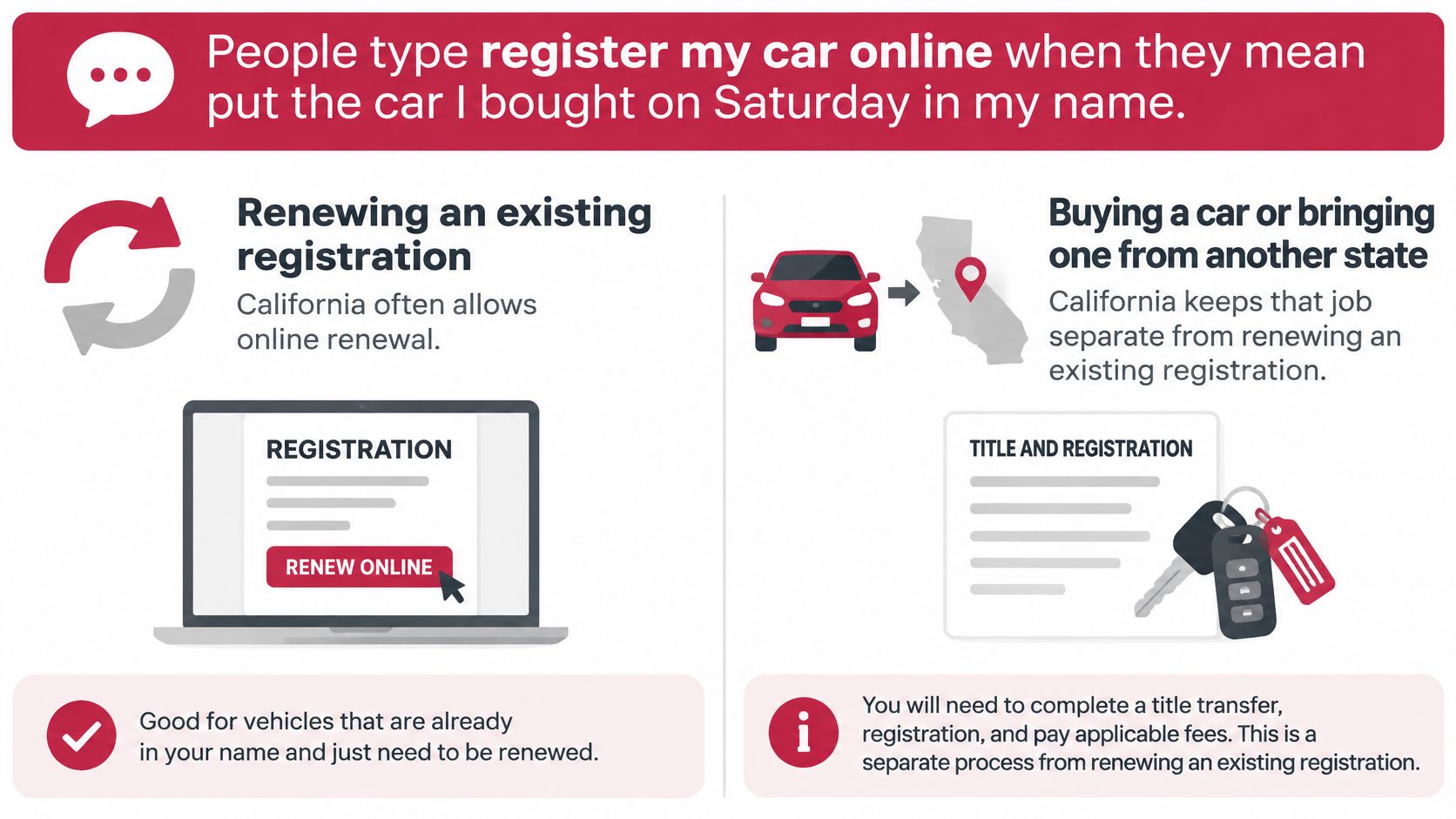
A California purchase needs a title packet
Say you buy a used sedan on Saturday. The seller gives you keys, a registration card, and a renewal notice. Before paying the renewal, check whether you have the documents needed to transfer ownership.
The packet can include:
- Ownership document: The California title, or the applicable replacement-title application if it's missing.
- Required signatures: The seller's and other required parties' signatures, including a lienholder when applicable.
- Odometer disclosure: The required mileage disclosure for the transaction.
- Fees and compliance documents: Transfer fees and smog certification when required.
A missing California title may require REG 227, rather than another trip through the renewal portal. Missing lienholder information or signatures also needs attention before you expect the ownership record to change.
Like a house, paying an annual bill doesn't change the name on the deed. Likewise, renewing the seller's registration doesn't establish you as the vehicle's new owner. Assuming otherwise can leave ownership records, liability questions, and penalties unresolved.
An out-of-state car starts from a different record
Now take a driver moving to California with a car registered elsewhere. The car may already belong to that driver, but there isn't a straightforward California annual-renewal record to extend.
The task is to assemble the ownership and California compliance documents appropriate to that vehicle. Our out-of-state vehicle registration guide helps distinguish that packet from an ordinary renewal notice.
Before visiting DMV or a licensed registration provider, gather the existing title and registration documents and identify any missing ownership papers. Confirm how any required inspection or verification will be handled. VIN Verification is not currently available at our station, so don't assume every part of an out-of-state transaction can happen at the same counter.
Online tools can help with document-based transactions, but they don't eliminate the documents themselves. The useful question isn't only whether you can start online. It's whether the channel you choose can finish the specific ownership and registration work your vehicle requires.
Renew Online or Finish in Antioch
Stay online when your vehicle's record is ready for routine renewal. That means the car is already in your name, required insurance and smog information is available electronically, the address is correct, and no unresolved citations or document requirements remain.
Choose counter assistance when you need help completing the record, have a title-transfer packet, or need an eligible transaction's sticker issued during the visit. Bring the renewal notice or ownership documents, the portal's rejection message, and any payment confirmation so the person reviewing the transaction can distinguish an unpaid fee from an unfinished requirement.
Check the counter hours before leaving
At Fire House Smog, we're a STAR-certified test-only station and licensed California DMV business partner at 2900 Lone Tree Way, Antioch, CA 94509. Our registration services include California renewals and ownership transfers; a regular California renewal, including the sticker, costs $30.00 plus the applicable DMV fee.
- Weekday DMV counter: Monday through Friday, 9:30 AM–5:00 PM.
- Weekend DMV counter: Saturday, 9:30 AM–5:00 PM, and Sunday, 12:00 PM–4:00 PM, with services possibly limited.
- Before bringing an RV or motorhome: Call (925) 754-1600 to check whether we can test it.
Smog-testing hours extend beyond the registration counter's schedule, so don't use the testing hours to plan a DMV transaction. Bring payment for both the station service fee and the applicable DMV fee, and call before traveling if you're unsure whether your documents are complete.
Fire House Smog offers test-only smog inspections, California registration renewals, and ownership-transfer assistance, with on-site sticker issuance for eligible completed transactions. Visit Fire House Smog and select Make an Appointment, or call to confirm what to bring before coming to our Antioch counter.