
Pre Smog Year California Explained and How to Verify
Gasoline vehicles with a 1975 model year or older are permanently exempt from California smog checks, while 1976 and newer vehicles generally still require testing unless they qualify for another exemption. The cutoff is based on the vehicle's model year, not how old the car feels, how rarely it's driven, or whether it carries classic-car plates.
You've found a clean older truck, checked the title, and are ready to register it. The seller calls it “pre-smog,” but the truck's paperwork says 1976. That single detail can change whether you need a Smog Check before completing a renewal or ownership transfer.
The phrase pre smog year California appears in listings, forums, and restoration discussions, but people often use it loosely. California's actual rule is more precise. A gasoline vehicle from model year 1975 or earlier falls under the permanent exemption. A newer classic vehicle may look just as old and may be maintained just as carefully, yet still follow different testing requirements.
Table of Contents
- Introduction to Pre Smog Rules in California
- How California Smog History Created the Pre Smog Era
- Which Model Years Count as Pre Smog and Exempt Today
- How to Verify Your Vehicle Smog Status Before the DMV
- What Pre Smog Status Means for Registration and Ownership Transfer
- Common Misconceptions About Pre Smog Vehicles
- Next Steps for Smog Checks and DMV Processing in Antioch
Introduction to Pre Smog Rules in California
You buy a restored pickup, check the title, and see a model year that differs from the seller's “pre-smog” description. The registration question starts with that recorded year, not with the vehicle's appearance, mileage, or time spent in storage.
Model year is a fixed label. It works like a classification printed on the title, registration, and vehicle records. California uses that label to select the applicable Smog Check rule. Vehicle age is the result of the label, not a separate test for exemption.
That difference can affect an ordinary DMV transaction. A 1974 pickup and a 1976 pickup may have matching restorations, the same engine family, and identical weekend use, yet receive different treatment. A carefully maintained 1978 coupe also does not become exempt just because owners call it a classic.
Practical rule: Read the model year on the title and registration before relying on a listing or seller's description.
The fixed cutoff is only one part of the broader system. Newer vehicles may receive temporary testing relief early in their registration life, while collector classifications, specialty plates, fuel type, and transfer circumstances follow their own rules. Those categories should not be blended together under the informal label “pre smog.”
The guide examines five decisions:
- Cutoff year: Why the rule uses a fixed model-year boundary.
- Vehicle status: How permanent exemption differs from temporary relief for newer vehicles.
- Verification: Which records to check before a DMV visit.
- Ownership: How renewal, sale, and out-of-state registration can affect the process.
- Future planning: How collector exemptions and new-vehicle standards may change.
For a specific vehicle, begin with the recorded model year and then confirm the applicable status. If the title, registration, and seller's description conflict, a direct check with the BAR or DMV is safer than relying on an online listing.
How California Smog History Created the Pre Smog Era
California's “pre-smog” language comes from a regulatory transition. Before modern tailpipe controls, residents and officials first had to recognize the problem, then measure it, and finally create enforceable standards.
From visible crisis to organized control
Los Angeles' first recognized smog episode occurred on July 26, 1943. Visibility in downtown Los Angeles fell to about three blocks, and residents reported smarting eyes, respiratory discomfort, nausea, and vomiting. People initially mistook the event for a gas attack, and similar smog episodes continued through the 1940s, according to the National Academies history of California air pollution.
That episode made air pollution publicly visible in a major American market. The issue was no longer an abstract concern for researchers. Residents could see the haze, feel its effects, and connect daily life with a growing environmental problem.
California then moved from observation toward administration. In 1947, Governor Earl Warren signed the Air Pollution Control Act, authorizing county air pollution control districts, as documented by the National Academies source above. The state had created a legal framework for organized air-pollution control within roughly four years of the major smog event.
Measurement changed the policy conversation
By the mid-1960s, California researchers were no longer limited to describing smog. They began creating precise tailpipe test systems in 1965, and California adopted the nation's first statewide vehicle-emissions standards for new cars in 1966, according to Hagerty's history of California vehicle-emissions regulation.
The results show why testing and standards became central. Average emissions of key smog-forming pollutants, including hydrocarbons and nitrogen oxides, fell from 14 grams per mile in 1965-model cars to 3 grams per mile by 1975, then to 1.5 grams per mile by 1981, according to the same Hagerty account.
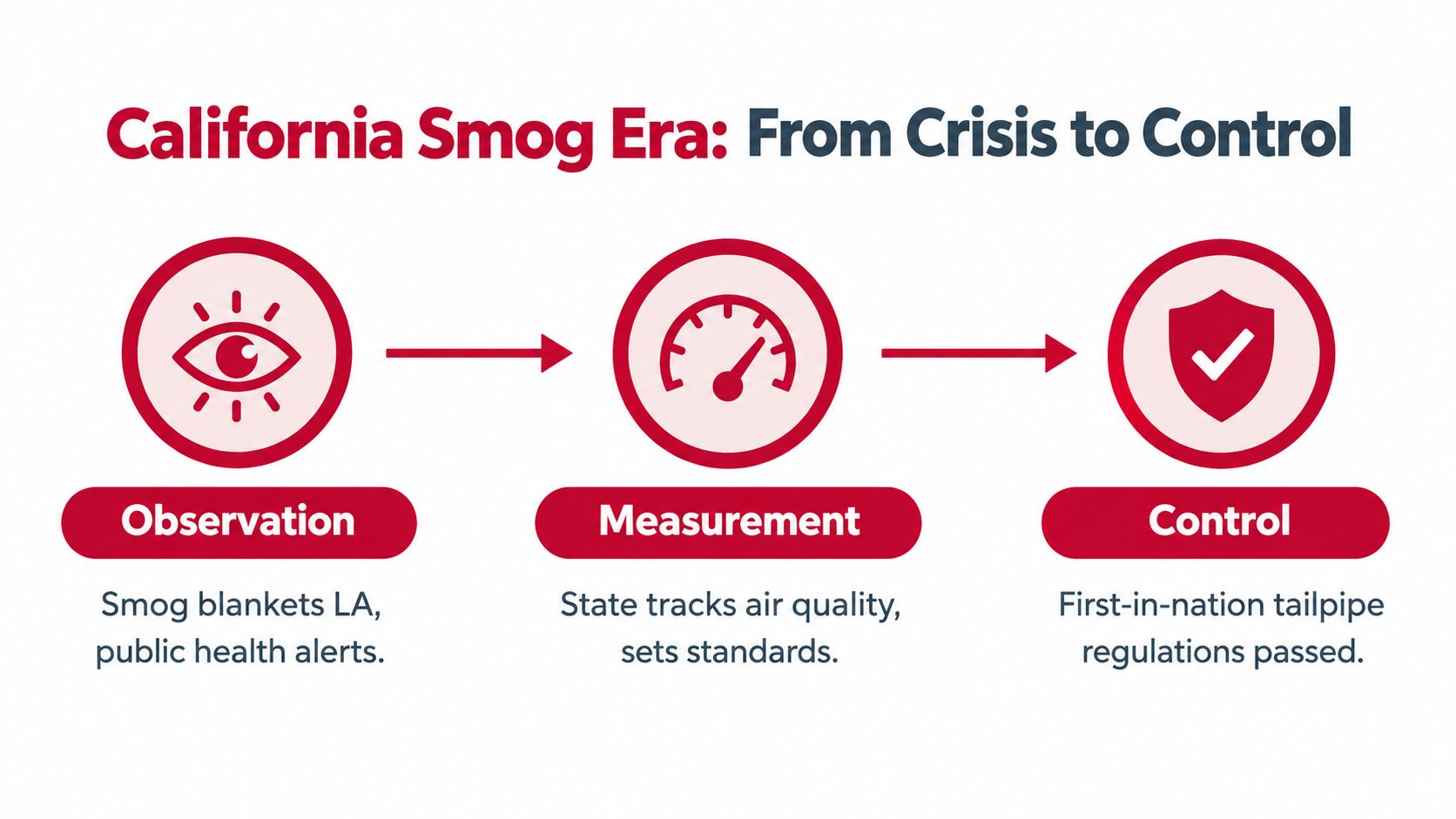
That sequence explains the logic behind a fixed cutoff. California needed a practical way to identify vehicles produced before the emissions-control era, without asking inspectors to reconstruct every vehicle's history. A model-year boundary gave registration officials and owners a clear administrative test.
The cutoff can feel arbitrary when you compare two neighboring model years. Historically, however, the dividing line represents the shift from largely uncontrolled vehicle pollution toward regulated manufacturing, testing, and emissions equipment. A newer classic may be old today, but it belongs to a later regulatory generation.
Which Model Years Count as Pre Smog and Exempt Today
A 1974 vehicle and a 1976 vehicle may look equally old at a registration counter, yet California treats them differently. The deciding factor is the recorded model year, not the vehicle's current age, restoration date, or how often it is driven.
A gasoline-powered vehicle with a 1975 model year or older is permanently exempt from California Smog Check requirements under the BAR's official Smog Check rules. “Permanently” means that routine testing does not begin later merely because the vehicle changes owners, stays registered for years, or is driven more frequently.
A gasoline vehicle from 1976 or newer does not gain that permanent exemption by becoming an old classic. A well-restored 1978 vehicle can still require a Smog Check when the relevant registration or ownership-transfer rule calls for one. Vehicle condition and exemption status are separate questions.
Use the model year first
Use this sequence:
- Read the recorded model year. Check the title, registration, or reliable vehicle records. The year of purchase or restoration does not control the classification.
- Compare it with 1975. A gasoline model year of 1975 or earlier falls within the permanent exemption category.
- For 1976 or newer, identify the transaction. Renewal and ownership transfer can create different testing requirements unless another rule applies.
- Confirm the fuel and vehicle type. The gasoline cutoff should not automatically be applied to hybrid, alternative-fuel, or other vehicle categories.
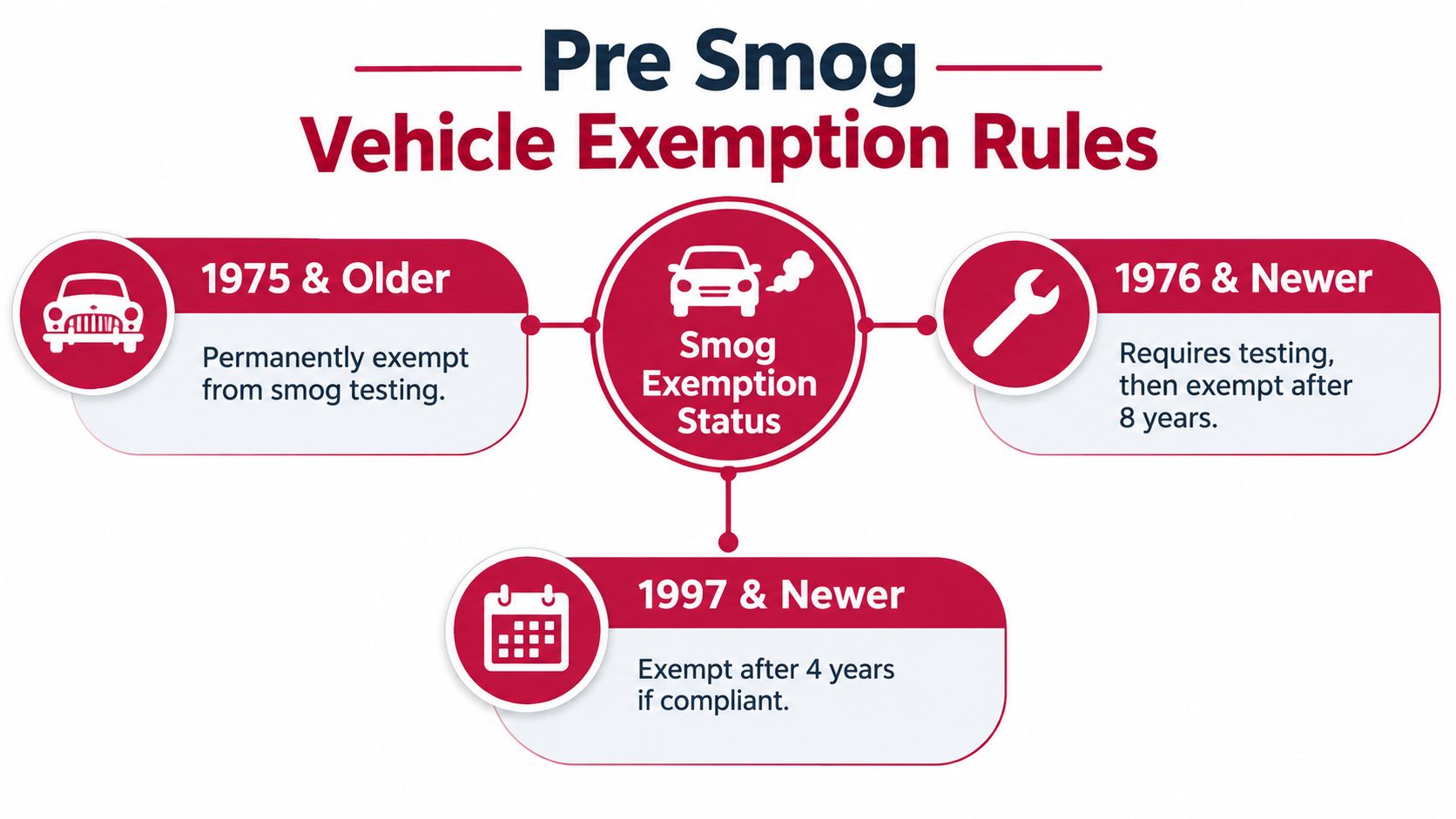
California also provides a separate renewal relief period for newer gasoline, hybrid, and alternative-fuel vehicles. Vehicles eight model years old or newer don't need a smog inspection for renewal, according to the BAR. This temporary rule changes as the vehicle moves through its model-year lifecycle, while the 1975-and-older exemption remains tied to the fixed cutoff.
For planning, the first required renewal test can be estimated by adding eight to the model year. The first change-of-ownership test can be estimated by adding four to the model year. These calculations are useful checks, but the registration notice and official records control the actual DMV process.
California's rules may also expand for certain collectors under the upcoming SB 1392 changes. That potential collector pathway is separate from the pre-smog cutoff, so an eligible collector vehicle should not be confused with a vehicle that qualifies automatically because it predates 1976.
For additional older-vehicle examples, review this guide to California smog-exempt vehicle years.
The practical question is: What model year does California have on record, what fuel does the vehicle use, and what transaction is being completed?
How to Verify Your Vehicle Smog Status Before the DMV
A buyer arrives at the DMV expecting a routine transfer, then learns that the vehicle's recorded model year or fuel type changes the smog requirement. Checking the records first can prevent that extra trip. Start with the vehicle's official identity, not the seller's description.
Begin with the paperwork
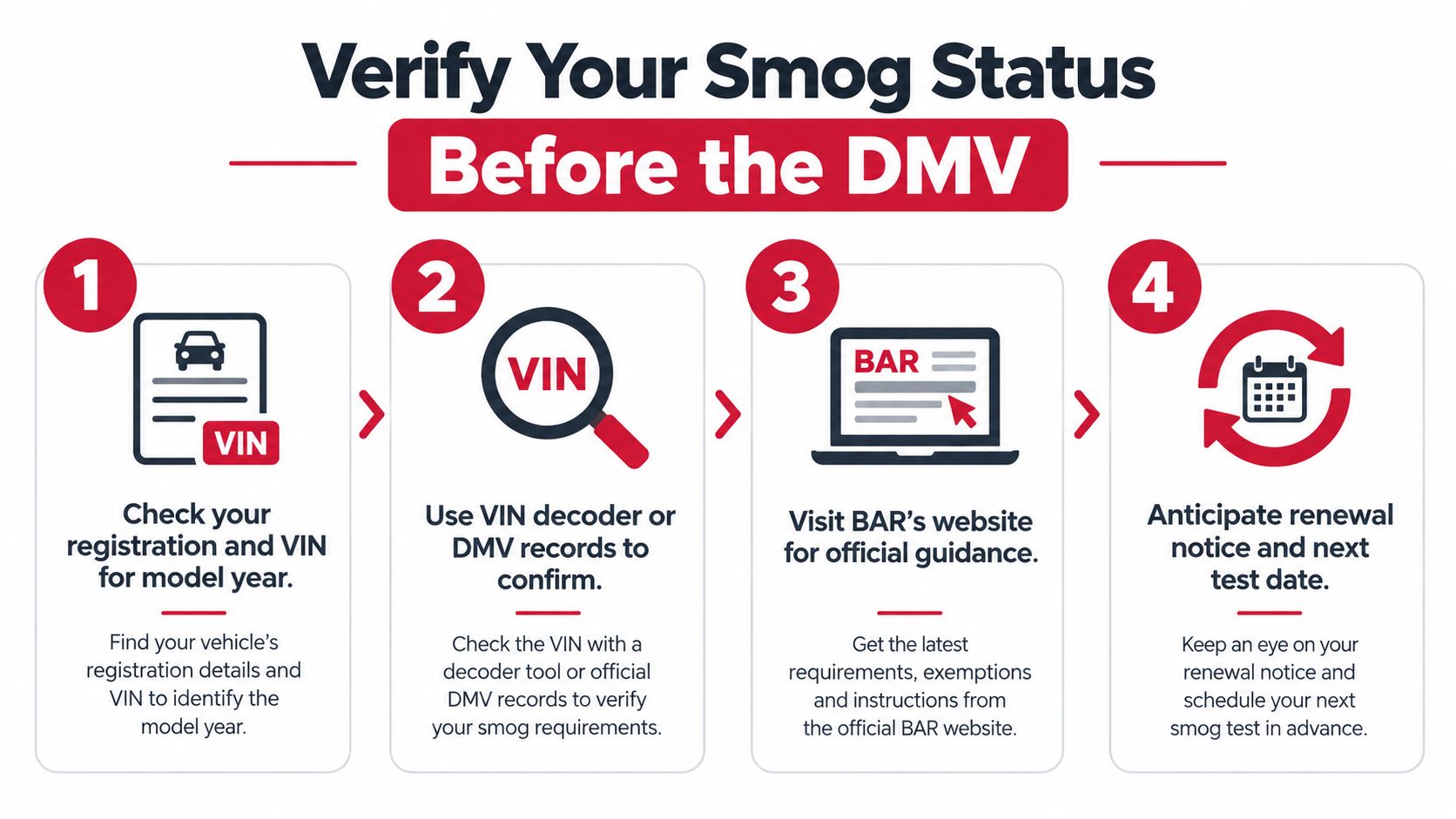
Review the California registration card, title, and vehicle identification number. Confirm that the model year matches across the documents. California's pre-smog cutoff is a fixed model-year rule, so an older-looking vehicle is not automatically exempt. A gasoline vehicle from 1975 or earlier follows a different path from a 1976 vehicle, even if both appear to be classic cars.
For an out-of-state purchase, compare the title with the VIN plate and available manufacturer information before assuming California will classify the vehicle as pre-smog. A VIN decoder can clarify basic identity details, but DMV records control when documents disagree. Engine swaps, reconstructed titles, incomplete paperwork, and unusual body conversions can make a general online answer misleading.
Match the vehicle to the transaction
Identify the transaction before deciding what to check. Renewal and ownership transfer can trigger different requirements for the same vehicle. As a planning estimate, add eight to the model year for the newer-vehicle renewal relief period, or add four to the model year for a change-of-ownership estimate. Confirm the result against the DMV notice and current BAR Smog Check guidance.
| Vehicle Model Year | Renewal Smog Required | Transfer Smog Required |
|---|---|---|
| 1975 and older gasoline vehicle | Permanently exempt | Permanently exempt |
| 1976 and newer, within the newer-vehicle relief period | Check registration notice | Check transfer requirements |
| 1976 and newer, outside that relief period | Usually required when prompted | Check transfer requirements |
The table is a planning aid, not a final decision. Vehicle type, fuel classification, transaction details, and attached records can change the result.
For a transfer, collect the title, bill of sale, identification, and out-of-state registration documents when applicable. Ask the DMV or BAR about unusual cases before scheduling a test, especially for an RV, nonstandard engine, or uncertain fuel classification. Review the requirements for an emission test certificate before arranging the transaction.
Keep supporting registration records even when the vehicle appears exempt. Clear documentation connects the recorded model year and fuel type to the vehicle being presented.
Before you leave home: Confirm the model year, fuel type, transaction type, and date shown on your DMV notice.
What Pre Smog Status Means for Registration and Ownership Transfer
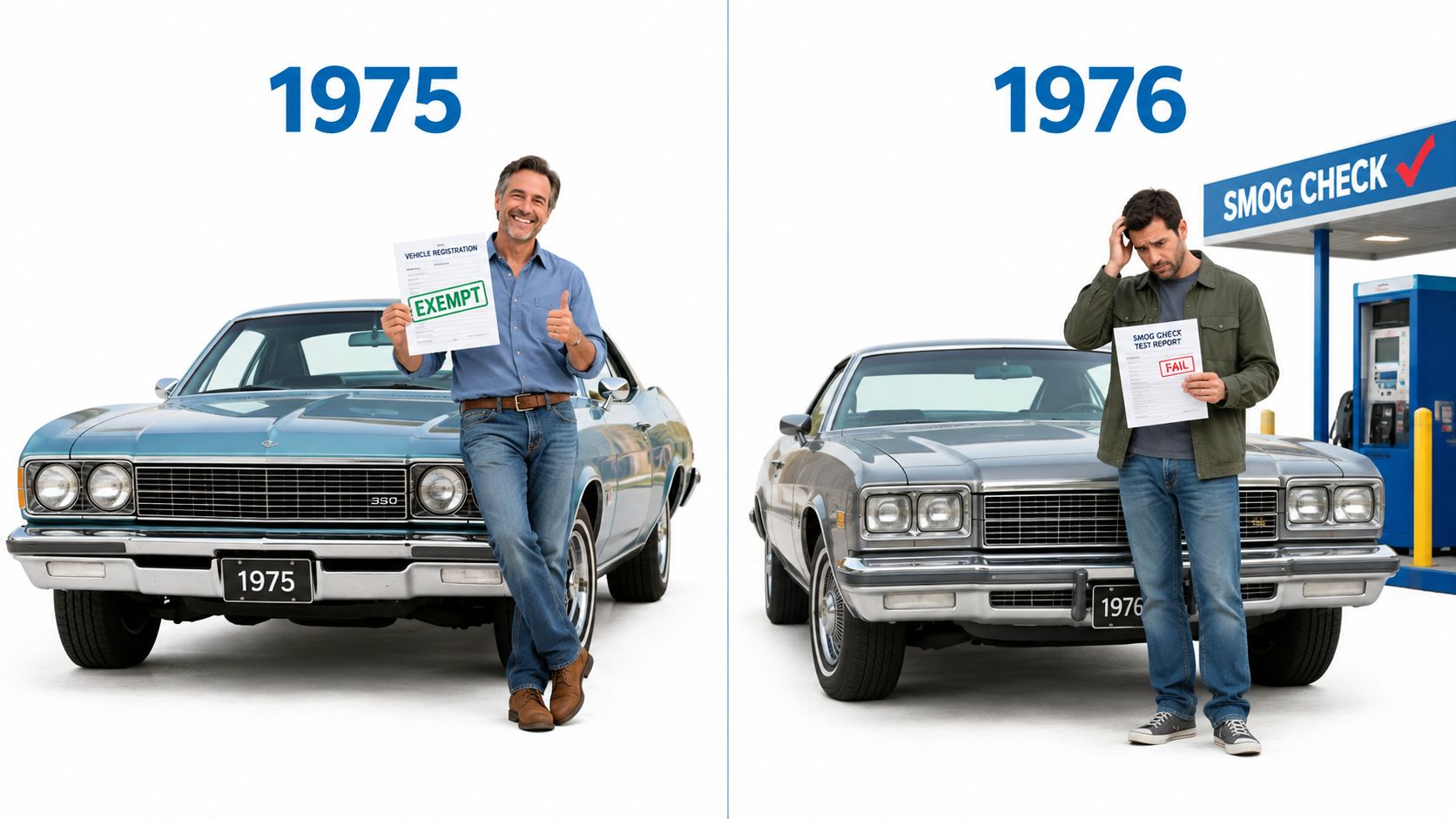
A buyer in Antioch may face two different outcomes with older cars. A gasoline vehicle from model year 1975 or earlier generally avoids the ordinary Smog Check requirement for registration renewal, while a 1976 vehicle may still require testing. The dividing line is the recorded model year, not the vehicle's age or its “classic” label.
The exempt vehicle still needs the correct registration paperwork and applicable charges. Exemption removes the routine smog step, not the DMV process itself. For broader qualifying categories, review this guide to smog exemptions in California.
Renewal and transfer are different moments
Renewal follows the registration cycle. A transfer follows the sale or ownership change. As a result, a car that did not need a recent renewal inspection may still require smog documentation during a transfer.
Before paying, the buyer should confirm who must provide certification. The seller should avoid promising exemption based only on age, mileage, a specialty plate, or a listing description. The DMV's recorded model year and fuel classification control the transaction. If those records conflict with the seller's statement, use the official record as the starting point.
Some vehicles need a different testing path. STAR requirements, modifications, unusual equipment, vehicle configuration, or RV status can affect where and how testing occurs. Contact a station or BAR before arriving if the vehicle does not resemble a standard passenger car.
The future policy discussion adds another distinction. SB 1392, known as “Jay Leno's Law,” is described as proposing a phased collector-car exemption that would begin January 1, 2028 for qualifying 1976 to 1980 vehicles, with the expansion continuing through model year 1985 by 2033, according to AutoNext's explanation of SB 1392. Those are proposed future changes, not a current blanket exemption. A 1976 vehicle should still be evaluated under the rule in effect for the transaction.
California is also tightening requirements for newer vehicles in a separate regulatory track. CARB's Advanced Clean Cars II program covers model years 2026 through 2035, while the state's emergency vehicle-emissions rules were readopted in 2025. Older collector vehicles and newer production vehicles therefore sit under different policy pressures.
For a sale or registration renewal, verify the exact model year, fuel type, and transaction requirement before scheduling a test or completing payment.
Common Misconceptions About Pre Smog Vehicles
A buyer finds a 1978 car advertised as “pre-smog” and assumes its age settles the issue. It does not. California uses a fixed model-year cutoff, not a vehicle-age test. For the permanent gasoline exemption, the cutoff is 1975 and older. A 1976 vehicle can be old enough to be collectible while still requiring a Smog Check for a particular transaction.
Classic plates do not automatically remove Smog Check requirements. Plate status may describe how the vehicle is registered, but it does not replace the official record's model year, fuel type, or transaction requirement. A seller's use of “classic” or “pre-smog” is a starting point for questions, not proof of exemption.
Low mileage does not change the cutoff. A car stored for most of the year may be driven very little, yet its model year remains the same. Proposed collector rules may include qualification conditions, so owners should not treat limited use as an exemption under current requirements.
The gasoline rule does not cover every older vehicle. The permanent cutoff described by BAR applies to gasoline-powered vehicles from model year 1975 and older. Hybrids, alternative-fuel vehicles, and specialty vehicles may follow different requirements. Confirm the vehicle's actual classification before applying the gasoline rule.
Why older advice causes trouble
Online listings often reduce a complicated DMV question to “pre-smog” or “smog exempt.” That shorthand may fit a 1974 gasoline car, but it can mislead someone shopping for a 1976, 1978, or 1980 vehicle. The result is a buyer who arrives for a renewal or ownership transfer expecting no test, then discovers that the transaction requires one.
The upcoming collector expansion makes date checking even more important. The phased SB 1392 schedule described earlier is separate from the current permanent 1975 cutoff. Newer vehicles also fall under a different emissions policy framework through CARB's Advanced Clean Cars II program, as explained in the official CARB program description.
The reliable question is not “Is this a classic?” It is “What model year and vehicle category does the official record show?”
If the advertisement conflicts with the registration or title, pause before paying. Resolving the record before purchase is easier than correcting a registration problem afterward.
Next Steps for Smog Checks and DMV Processing in Antioch
Start with the simple rule: 1975 and older gasoline vehicles are permanently exempt, while newer vehicles need a transaction-specific check. Confirm the model year on the registration or title, identify whether you're renewing or transferring ownership, and review the DMV notice before booking an appointment.
If the vehicle needs testing, choose a station that matches the vehicle and transaction. Fire House Smog is a STAR-certified test-only smog check station and licensed DMV registration-services provider in Antioch. It handles qualifying car, truck, and some RV inspections, along with registration renewals, ownership transfers, and on-site tag issuance during posted service hours.
Bring the registration card, title or transfer documents, VIN details, identification, and the DMV notice. If the vehicle is modified, unusually large, out of state, or has an engine swap, call ahead so the station can confirm whether its equipment and services fit the vehicle.
A practical appointment checklist:
- Model year: Confirm the official year, not the restoration year.
- Fuel type: Verify gasoline, hybrid, alternative fuel, or another classification.
- Transaction: Identify renewal, transfer, or initial California registration.
- Documents: Bring the registration and ownership paperwork.
- Questions: Mention modifications or unusual vehicle equipment before testing.
Fire House Smog can help Antioch-area owners verify the appropriate testing path, complete qualifying Smog Checks, and process DMV renewal or ownership-transfer services in one location. Visit Fire House Smog before your appointment to review the available services and plan your next step.