
California Business Vehicle Registration: 2026 Guide
You just bought the work van, the pickup, or the service truck, and now it's sitting in the lot with temporary paperwork while your crew is asking when it can start paying for itself. The DMV line doesn't care that you've got jobs to finish, invoices to send, or tools already loaded in the back. What matters is getting business vehicle registration done correctly, with the right documents, the right fees, and no repeat trip because one piece of paperwork was missing.
That's where most owners lose time. The registration process looks simple until you realize the vehicle may need commercial handling, smog paperwork, insurance that matches business use, and a form package that has to be accepted the first time. If you handle fleets, vans, light trucks, or a single company car, the difference between an easy filing and a rejected filing is usually preparation, not luck.
Table of Contents
- Getting Your Business on the Road Without the Hassle
- Does Your Vehicle Need Commercial Registration
- Your Document and Smog Check Checklist
- Navigating the California Registration Forms and Process
- Estimating Your Business Vehicle Registration Fees
- Skip the DMV Lines A Smarter Way to Register
Getting Your Business on the Road Without the Hassle
A contractor picks up a new service van on Friday, then spends Monday calling around because the registration packet isn't ready. A field manager has the title in one folder, insurance in another, and no clear answer on whether the vehicle has to be treated like a commercial unit. That is the core problem with business vehicle registration, the vehicle is ready, but the paperwork isn't.
The fastest path is not guessing at the DMV counter. It starts with classifying the vehicle correctly, lining up the ownership and insurance pieces, and making sure the emissions paperwork is already in hand before anyone submits the packet. From a DMV service partner's point of view, that early sorting is what saves the most time, because rejected filings usually come back with the same missing details.
Practical rule: If you are still sorting out whether the vehicle is personal, mixed-use, or fully tied to the company, stop and classify it first. Rework after a rejection always costs more time than a careful first submission.
For small businesses, the registration step is more than administrative. A sloppy filing can turn into a delay that pulls a vehicle out of service, ties up a driver, and forces someone to spend another day fixing paperwork instead of working. Clean submissions avoid that repeat work.
The practical goal is simple, get the vehicle legal without losing a day to avoidable mistakes. Treat the process like an operations checklist, not a one-time paperwork sprint, and the registration is easier to finish without surprises.
Does Your Vehicle Need Commercial Registration
The first mistake owners make is assuming that any car with a logo on the door automatically counts as a business vehicle, or that putting a vehicle in a company name makes the process easier. In practice, the classification depends on how the vehicle is used, how it's titled, and what documents the DMV or related agencies want to see. Generic advice usually skips that part, which is why owners end up with the wrong filing path.
A good test is to ask three questions. Who owns the vehicle on paper. How is it used day to day. What proof does the registering authority want before it accepts the registration. For some vehicles, the answer points to standard business handling. For others, it points to more formal commercial treatment.
Ownership and use don't mean the same thing
A vehicle can be used for work without being titled in a company name, and a vehicle can be titled to a business entity without being as simple as a personal car to register. That's where the paperwork gets messy. The source material is clear that requirements can vary by legal entity, vehicle type, and jurisdiction, and often call for business credentials such as an EIN, proof of ownership, and specific insurance before registration is accepted business vehicle registration guidance.
That means mixed-use vehicles need extra care. If a pickup is driven to job sites during the week and used personally on weekends, the owner still needs to understand how the registration and insurance records line up. The DMV doesn't care about convenience, it cares about whether the file matches the stated use.
What usually triggers the commercial path
Commercial treatment often comes up when the vehicle is clearly a work asset, especially when it's tied to a business entity or equipped for service use. Permanent tool racks, trade equipment, and company branding can all point toward a business file that should be handled differently than a private sedan. The key is not the decoration, it's the operational use and the documentation trail.
If the vehicle is doing business work every week, build the registration around that reality instead of trying to make a personal template fit.
The safest move is to classify the vehicle before you gather forms. That prevents the classic mistake of filing as if it were personal, then discovering later that the insurance, title, or supporting documents don't match the business use. It also keeps you from paying for a filing that has to be corrected later.
Your Document and Smog Check Checklist
A clean registration packet starts before you ever touch a DMV form. If one document is missing, the file can stall, and in California that often means the emissions piece becomes the blocker. The fastest way to handle business vehicle registration is to gather the ownership record, business proof, insurance, and smog paperwork together before submission.
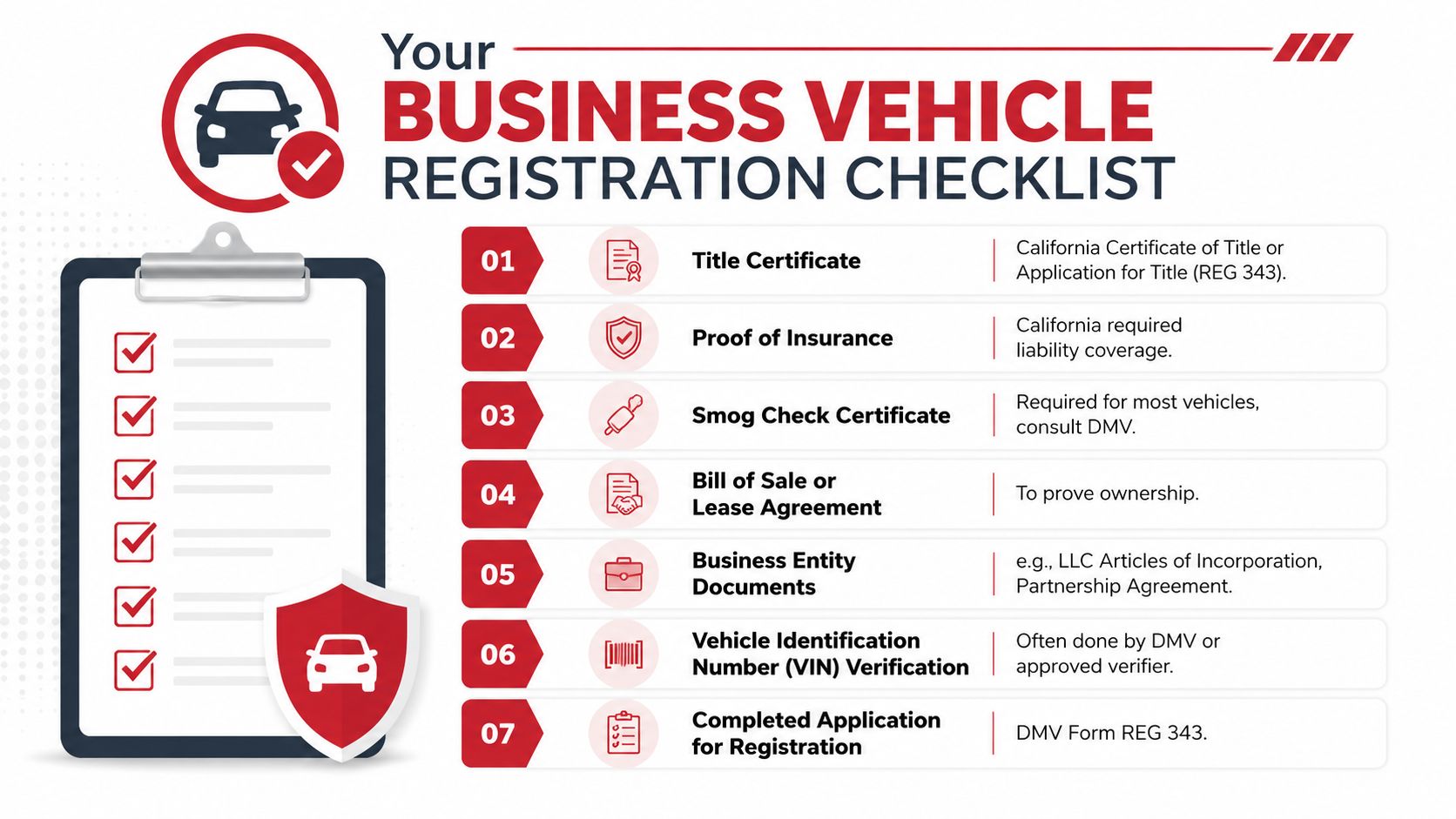
A solid packet usually includes the title or the out-of-state equivalent, a bill of sale or lease agreement if ownership changed, business entity documents, proof of insurance, and the completed registration application. California's smog rules matter here because proof of a passed inspection is part of the registration process for most vehicles, and smog checks are typically required every other year for vehicles that are at least six years old California Senate Transportation Committee fact sheet.
What to put in the folder first
- Title or ownership record: Bring the California Certificate of Title, or the correct out-of-state ownership document if the vehicle just came in from elsewhere.
- Business entity proof: Keep LLC, corporation, partnership, or other formation documents ready when the vehicle is titled to the company.
- Insurance matching business use: The policy needs to reflect commercial or business use, not just a personal driver profile.
- Bill of sale or lease papers: These help prove how the vehicle was acquired and who has the right to register it.
- Completed DMV application: Fill it out before the appointment so you're not guessing at the counter.
The internal document list for this workflow is available at Fire House Smog's registration document checklist, which is useful if you're trying to avoid missing a basic supporting item.
Where smog check problems usually happen
The most common failure point is timing. Owners often assume they can submit the registration first and fix emissions later, but that does not work smoothly in California. Smog inspection belongs in the initial packet, and missing emissions paperwork is a frequent reason for rejection.
That is why a test-only smog station matters. You want a place that can inspect, certify, and help close the loop without pushing you into a separate repair conversation. For a business owner, every extra stop means more downtime.
Navigating the California Registration Forms and Process
Once the paperwork is in hand, precision matters. The file has to match the vehicle, the owner, and the business entity, or the DMV will usually send it back for correction. For business vehicle registration, every document needs to tell the same story from start to finish.
Start by confirming business use, then gather ownership records and business documents, get the right insurance, complete the DMV forms, and submit the packet in that order. That sequence saves time because the state wants the paperwork to line up before it accepts the registration. It also keeps emissions paperwork in the initial submission instead of forcing a second round of corrections.
The form fields that deserve extra attention
The Application for Title or Registration, often handled as REG 343 in California workflows, needs a line-by-line review before it goes in. Names, entity type, mailing address, and vehicle details should match the title, the insurance record, and the supporting business documents. If the vehicle is owned by an LLC or corporation, use the exact company name on every page.
Small mismatches create big delays. If the title names one legal entity and the insurance certificate names another, the file can stall while someone sorts out the difference. That is time lost at the counter, and it is usually avoidable.
How title ownership affects the filing
A sole proprietor, LLC, corporation, or partnership can each create a different paper trail. The vehicle may be used for the same work, but the registering authority still cares about who legally owns it and who can act for that owner. The entity paperwork is part of showing that the business has the right to register the vehicle.
Practical rule: Use the exact legal name from the entity documents everywhere the DMV asks for the owner's name. Informal shortcuts lead to corrections.
If you are handling more than one vehicle, standardize the packet. Use the same naming convention, the same insurance format, and the same checklist for each unit. That makes later renewals easier, because the business does not have to relearn the process every time a new truck is added.
For owners who would rather not spend a morning fixing form errors, a service partner such as Fire House Smog can handle DMV registration tasks along with related emissions work in one place. If you are also planning for renewals, the registration renewal fee guide is useful for understanding what usually comes up again later.
Estimating Your Business Vehicle Registration Fees
The first question for many owners is cost, and it should be. Registration is part of the ongoing expense of keeping a company vehicle legal, not a one-time formality. California DMV statistics show that the average vehicle license fee was $89 per vehicle and the average total fee paid per vehicle registration was $261 in the 2019 publication, which makes the expense easier to treat as a recurring operating cost rather than a small filing charge California DMV statistics publication.
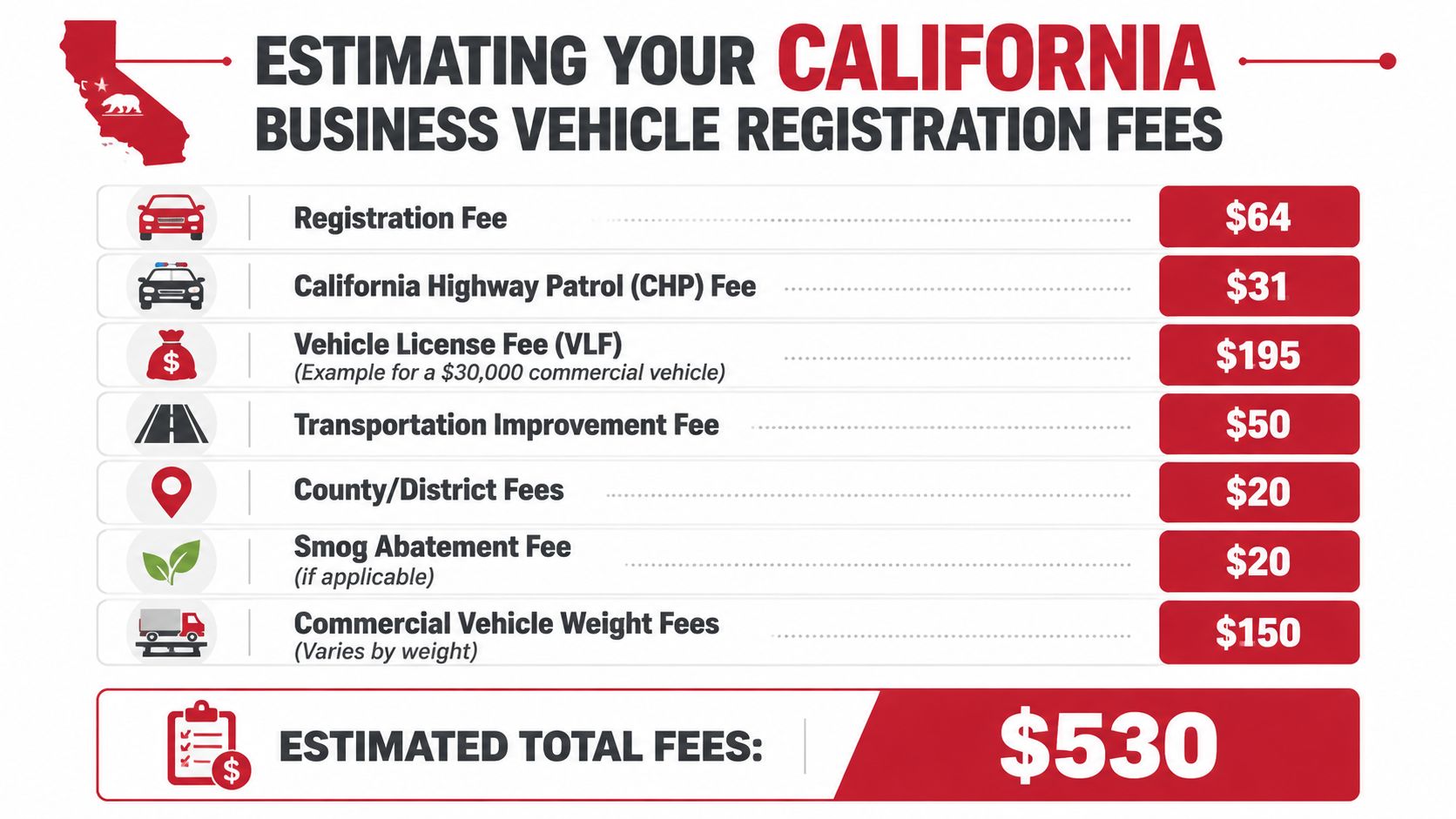
The total can change based on the vehicle type, whether it is commercial, how it is weighted, and which county or district charges apply. That is why one fleet vehicle may cost differently from another even when the paperwork looks similar. A light-duty service van and a passenger car do not always follow the same fee path.
What you're actually paying for
A registration bill is usually a stack of separate charges, not a single flat amount. Some fees cover the base registration, some relate to state administration, and some reflect vehicle value or use. Commercial vehicles can also bring in weight-related charges, which is where many owners get surprised.
The practical way to read the bill is this. Part of it is identity, part of it is compliance, and part of it is vehicle classification. If the vehicle is treated as a business asset, that classification can affect the final number more than people expect.
Why renewal timing matters
California's recurring registration cycle means the cost shows up again and again, not just when you buy the vehicle. The registration-renewal resource at Fire House Smog's registration renewal fee guidance is useful when you are planning ahead, because renewals are where budget mistakes usually pile up.
Budgeting advice: Don't price the vehicle only at purchase. Price the vehicle as an annual compliance line item, then keep the renewal date on the calendar from day one.
For a business, that is the better accounting approach. It makes cash flow easier to forecast, and it keeps a late renewal from turning into a work stoppage. If the vehicle is needed for revenue, the registration bill is really a continuity expense.
Skip the DMV Lines A Smarter Way to Register
A DMV office can take a whole morning, and if one piece of your packet is wrong, you may be back again. That's the hidden cost for small businesses, not just the fee itself, but the labor lost waiting, resubmitting, and rearranging routes. If your vehicle is needed for customers, that downtime hits harder than the paperwork line item.
A licensed DMV partner changes the workflow. Instead of sending one person to the DMV, another to a smog station, and a third person to chase forms, you can use a single stop for emissions and registration support where eligible. The goal is less back-and-forth, fewer corrections, and faster release of the vehicle back to work.
The operational advantage is simple. A business gets guidance from someone who handles registration files regularly, which lowers the chance of avoidable errors. It also helps when the vehicle needs on-site tag issuance or when the owner wants the registration handled without building an internal admin process around one truck.
If you want a local option that combines DMV registration services with smog testing, the service details at DMV registration services near me are worth checking before you plan a trip. That kind of setup is especially useful for owners who'd rather keep staff on job sites than in waiting rooms.
For most businesses, the best choice isn't “do it yourself or never do it at all.” It's choosing the path that gets the vehicle legal with the fewest mistakes and the least interruption. If that means handing the packet to a licensed partner, that's often the more efficient business decision.
A CTA for Fire House Smog. If you need help with California business vehicle registration, smog certification, or DMV paperwork for a work vehicle, contact Fire House Smog in Antioch and get the process handled in one visit instead of spending your day bouncing between offices.