
When to Replace Catalytic Converter: Signs, Costs, and Smog
You're in Antioch, the check engine light has just come on, and the car feels a little lazy pulling away from a stop. Maybe there's a sulfur smell after a drive, or a rattle underneath that wasn't there last week. The search for “when to replace catalytic converter” quickly turns into a list of expensive possibilities.
Don't approve a converter replacement based on mileage, a smell, or one trouble code. A catalytic converter should be replaced when testing confirms that it has lost efficiency, is physically damaged, or has become restricted. If a misfire, rich fuel mixture, oil consumption, coolant leak, or exhaust leak caused the failure, fix that problem first or the replacement may fail again.
Table of Contents
- Your Check Engine Light Just Came On Now What
- How Catalytic Converters Work and Why They Fail
- Symptoms and Diagnostic Steps That Confirm Failure
- Replacement Costs and Choosing the Right Option
- California Smog Tests and What a Failed Converter Means
- The Mileage Myth and the Theft Factor
- Prevention Tips and Local Next Steps for Antioch Drivers
Your Check Engine Light Just Came On Now What
A driver in Antioch might see P0420 on a scan tool and assume the catalytic converter is finished. That assumption is understandable, but it's not a diagnosis. P0420 means the powertrain control module believes catalyst efficiency is below its expected threshold. The code tells you where to investigate, not automatically which part to buy.
Start by recording the exact code and noting how the vehicle behaves. A steady check engine light with normal drivability calls for prompt testing, but a flashing light, severe shaking, strong fuel smell, or major power loss deserves immediate attention because an active misfire can send unburned fuel into the exhaust.
Practical rule: A code is a starting point. Live data and a complete engine check decide whether the converter is actually bad.
A proper inspection looks for the causes that can imitate converter failure. An exhaust leak near an oxygen sensor can introduce outside air and distort the reading. A biased sensor, fuel-control problem, or ignition fault can also make the computer interpret the exhaust incorrectly. The diagnostic guidance for P0420 catalyst efficiency testing emphasizes confirming the sensor pattern before replacing the converter.
If you're preparing for a California emissions inspection, don't erase the code and hope for a pass. Clearing codes resets emissions monitors, and the vehicle may need to complete its drive cycle before a station can evaluate it normally. Have the fault diagnosed, repair the underlying issue, and then confirm readiness and emissions performance.
For a useful overview of what a warning light can mean before a smog appointment, see this guide to check engine light and smog testing. The right question isn't “How many miles are on the converter?” It's “What test proves the converter can't do its job?”
How Catalytic Converters Work and Why They Fail
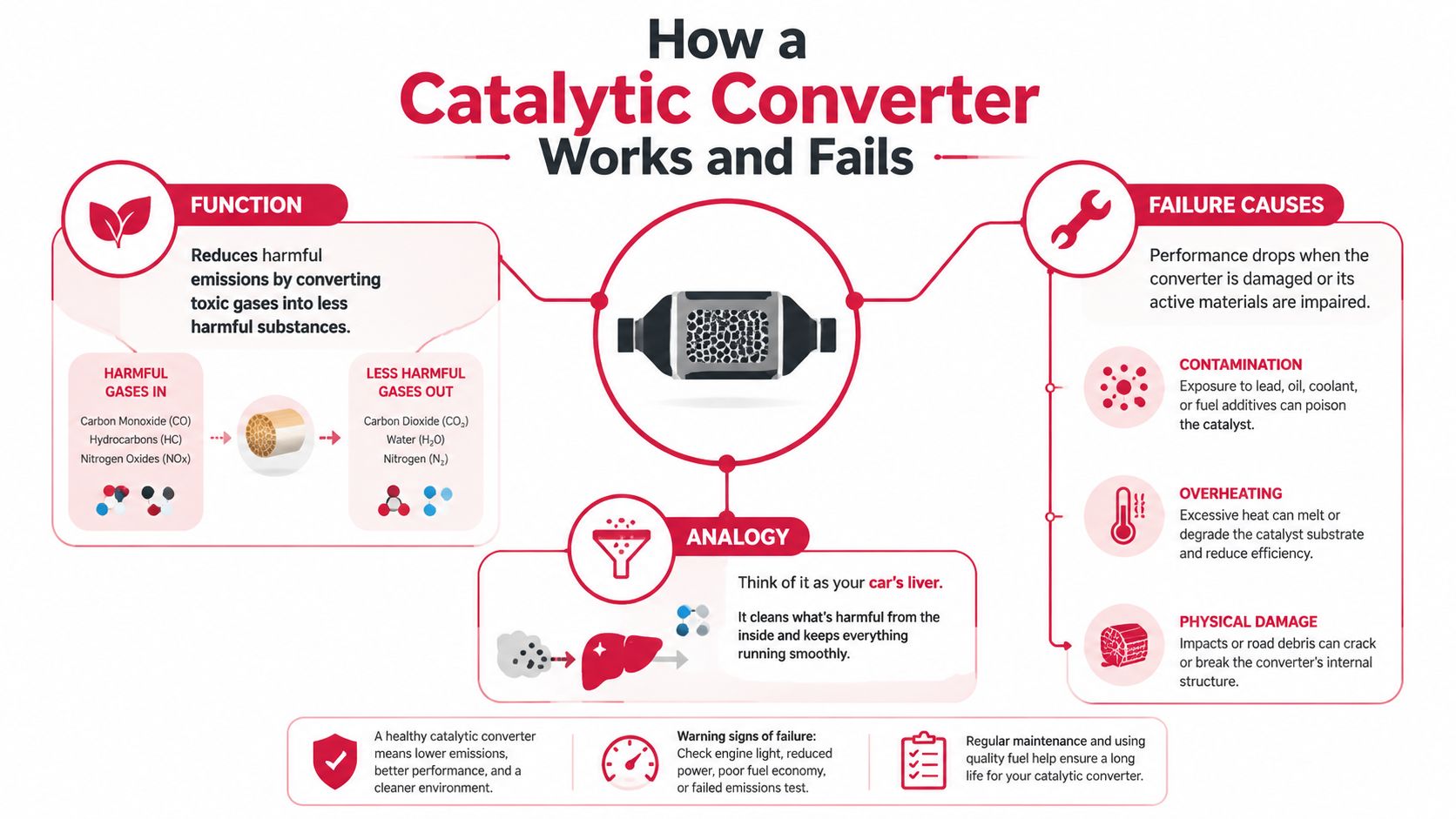
A catalytic converter is a high-temperature chemical filter in the exhaust system. It doesn't trap pollutants like an air filter. Instead, its coated internal substrate uses catalyst materials to promote chemical reactions that convert harmful exhaust compounds into less harmful gases before they leave the tailpipe.
Think of it as the car's liver. The liver processes unwanted substances, while the converter processes exhaust produced by combustion. This comparison isn't perfect, but it explains why the converter depends so heavily on the engine feeding it the right mixture. A healthy converter can clean up normal exhaust. It can't survive a continuous stream of raw fuel, oil, or coolant.
The three failure paths
Overheating usually starts upstream. A dead ignition coil, worn spark plug, injector problem, or other misfire can leave unburned fuel in the exhaust. The converter burns that fuel internally, creating excessive heat that can melt or damage the ceramic substrate.
Contamination happens when oil or coolant enters the combustion process. An engine that burns oil, leaks coolant internally, or runs with an incorrect fuel mixture can coat the catalyst and reduce its ability to store oxygen and process emissions. Replacing the converter without correcting the consumption or leak merely exposes the new part to the same damage.
Physical damage is easier to recognize but still needs confirmation. A hard impact from road debris, a damaged heat shield, or a broken internal substrate can produce a metallic rattle. The outer shell may look acceptable while the material inside has cracked, shifted, or begun restricting exhaust flow.
Engine condition determines converter life more than the odometer does. EPA materials state that original equipment converters on model year 1998 and newer vehicles generally have a useful life of 120,000 miles, while some California-certified PZEV vehicles reach 150,000 miles. The same EPA catalytic converter durability material distinguishes original equipment durability from aftermarket requirements.
That difference matters. A converter isn't a routine mileage service item like engine oil or a timing belt. If the engine is healthy and the converter passes efficiency testing, leave it alone.
For the broader relationship between exhaust components and vehicle emissions standards, remember the central repair order: diagnose the engine, correct the cause, then judge the converter.
Symptoms and Diagnostic Steps That Confirm Failure
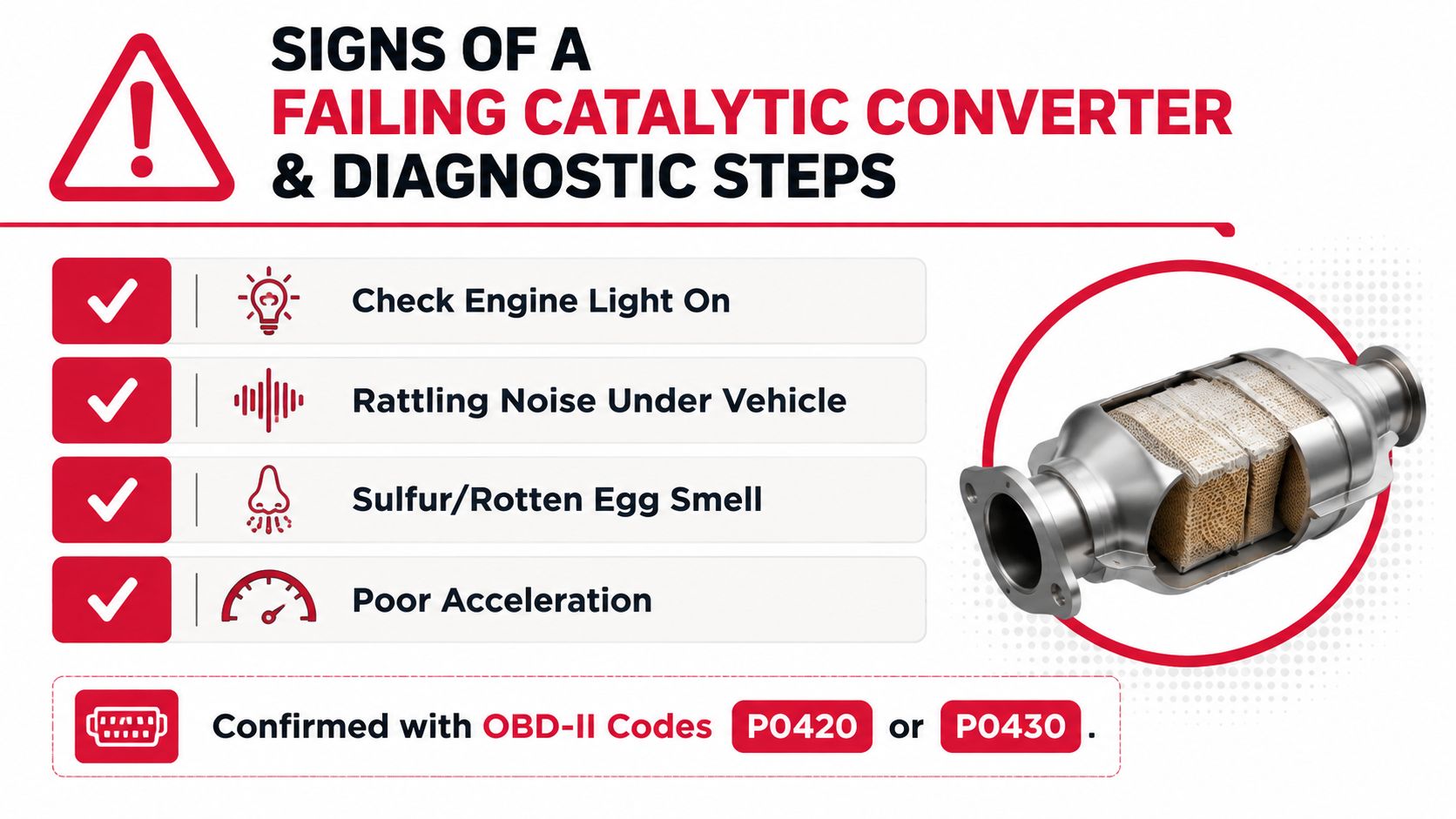
Drivers usually notice a converter problem through a combination of symptoms rather than one unmistakable sign. The common clues include a check engine light, P0420 or P0430, a rattling sound under the vehicle, a sulfur or rotten-egg odor, failed emissions testing, and sluggish acceleration.
Those symptoms point toward the exhaust system, but none proves converter failure by itself. A sulfur smell can follow an overly rich mixture. Poor acceleration can come from ignition, fuel, transmission, or intake problems. A rattle may be a loose heat shield rather than a broken catalyst.
What a responsible diagnostic includes
A technician should begin with a complete scan, not just the one code that appeared on a basic reader. The inspection should consider:
- Stored and pending codes: P0420 generally identifies catalyst efficiency on one bank, while P0430 refers to the other bank on vehicles that use a dual-bank layout.
- Misfire information: Active or recent misfires can damage a converter and must be corrected before condemning the part.
- Fuel-trim data: Abnormal fuel correction can indicate a vacuum leak, injector issue, air-measurement fault, or other mixture problem.
- Exhaust leaks: Leaks ahead of or near the oxygen sensors can pull in outside air and produce misleading readings.
- Sensor operation: The upstream sensor should respond to changing mixture conditions. The downstream sensor should show a comparatively damped pattern when the converter stores and releases oxygen effectively.
The decisive pattern is the relationship between the sensors. If the downstream oxygen-sensor waveform closely mirrors the upstream waveform, the converter isn't damping the exhaust-gas changes as it should. That evidence is stronger than P0420 alone because it demonstrates reduced oxygen-storage performance under the test conditions described in the P0420 diagnostic explanation.
A technician may also check for restriction when the vehicle has major power loss. A converter can lose efficiency without being plugged, and it can also become physically restricted after substrate damage. Those are separate faults with different testing requirements.
Ask the shop three direct questions: What code is present? What upstream cause was ruled out? What live-data pattern confirms converter inefficiency? If the answer is only “the scanner said catalytic converter,” keep asking.
The replacement decision is justified when the evidence shows the converter itself can't meet the required efficiency, or when inspection confirms physical collapse or restriction. If the engine still misfires, runs rich, burns oil, or leaks coolant, repair that first.
Replacement Costs and Choosing the Right Option
Once failure is confirmed, the cheapest part isn't automatically the cheapest repair. A low-priced converter installed on an engine with an unresolved misfire is money wasted. California drivers also face compliance requirements that can rule out an otherwise attractive aftermarket part.
OEM converters usually offer the closest match to the vehicle's original emissions calibration and fit. They can also be expensive and may have longer parts lead times. Aftermarket direct-fit converters are shaped for a particular application and typically reduce installation complexity. Universal converters may cost less initially, but installation requires cutting and welding, and the part still must be legal for the vehicle and location.
For California vehicles, verify the converter carries the required California Air Resources Board approval for that specific application. An EPA-compliant part may not satisfy California requirements. Confirm the part number, emissions certification, vehicle application, and warranty before installation.
Compare the choices before authorizing work
| Option | Typical Cost Range | Warranty | California Legal |
|---|---|---|---|
| OEM direct-fit converter | Obtain a vehicle-specific estimate | Check the manufacturer and seller terms | Generally, when correct for the vehicle |
| CARB-compliant aftermarket direct-fit converter | Obtain a vehicle-specific estimate | Varies by manufacturer and application | Yes, when approved for the exact application |
| CARB-compliant universal converter | Obtain a vehicle-specific estimate, including fabrication | Varies by manufacturer and installation | Yes, when approved and installed for the exact application |
| Unapproved aftermarket converter | Avoid | Warranty doesn't solve compliance problems | No, if it lacks required California approval |
The EPA material on aftermarket catalytic converter durability and warranty requirements describes historical aftermarket performance durability of 25,000 miles, with shell and end-pipe warranty coverage of 5 years or 50,000 miles. Treat warranty language as a condition to read carefully, not as proof that every replacement will last.
Fix the cause before fitting the part
A good repair sequence is straightforward:
- Diagnose and repair misfires, fuel-control faults, oil burning, coolant contamination, or exhaust leaks.
- Confirm the engine operates correctly after the repair.
- Test converter efficiency with scan data and, where appropriate, restriction testing.
- Install the correctly certified converter.
- Verify that the monitors run and the emissions fault doesn't return.
Don't let a shop skip step one. The converter is often the victim, not the original criminal.
California Smog Tests and What a Failed Converter Means
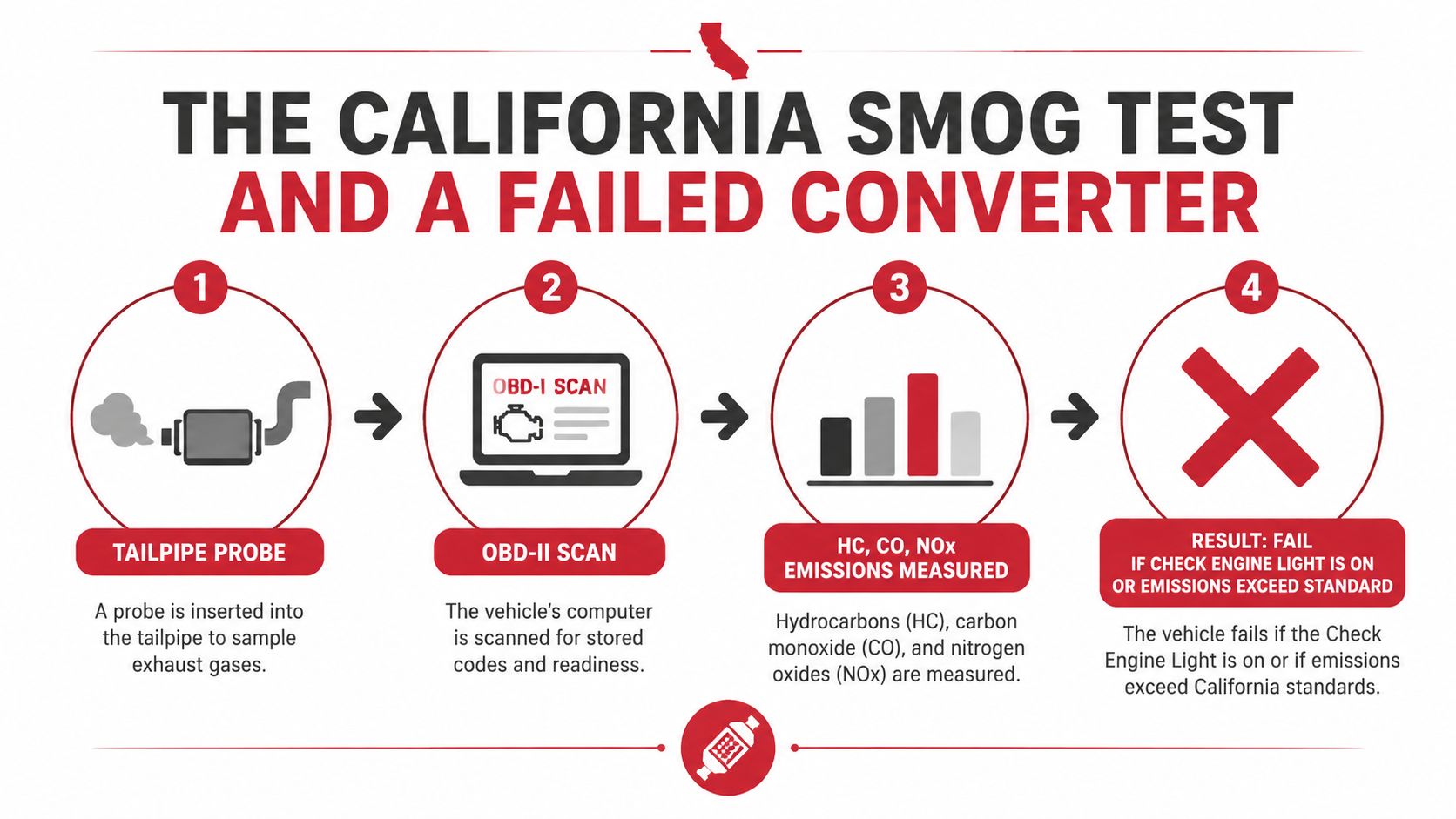
California drivers often discover converter trouble at the smog station. The inspection can expose an emissions problem even when the car feels normal, and a vehicle with an active check engine light generally has a serious readiness or emissions issue to resolve before certification.
A STAR-certified station follows California testing procedures and evaluates the vehicle's emissions-related systems. Depending on the vehicle and test configuration, the process can involve an OBD-II inspection and tailpipe emissions measurement. The station's job is to report the result, not to guess which repair will produce a passing certificate.
What to do after a failed result
Read the failure information carefully before buying parts. The result may identify an illuminated malfunction indicator, incomplete monitors, excessive emissions, or another emissions-system problem. A failed test doesn't automatically establish that the converter needs replacement.
Use this sequence:
- Keep the test paperwork: Give the diagnostic technician the exact failure information rather than a general description.
- Avoid clearing codes casually: Clearing the PCM can erase useful evidence and leave monitors incomplete.
- Repair the verified cause: Correct engine faults before replacing emissions hardware.
- Complete the drive cycle: The vehicle needs to demonstrate that its monitors have run successfully.
- Retest at a qualified station: Bring the repair documentation and ask about retest terms before scheduling.
A failed smog check can interfere with California registration renewal until the emissions issue is resolved. Registration deadlines still matter, so contact the DMV or use an authorized registration provider if you need clarification about your specific renewal status. Don't assume that driving with a failed test creates an unlimited repair window.
For Antioch and East Contra Costa County drivers, a guide to common smog-check failure reasons can help you interpret the result before visiting a repair shop. A test-only business such as Fire House Smog doesn't sell in-house repairs, which separates the inspection from the repair decision.
The local appointment matters
Choose a STAR-certified location when your renewal notice or vehicle requirement calls for it. Ask whether the station offers a retest policy, what documentation you'll need, and whether your vehicle type can be accommodated. Some larger vehicles and recreational vehicles require advance confirmation because equipment limits vary.
The practical goal is simple. Get an impartial test result, diagnose the failure elsewhere if necessary, complete the repair correctly, and return for a compliant retest.
The Mileage Myth and the Theft Factor
There's no fixed replacement interval for most catalytic converters. EPA guidance gives useful-life expectations for original equipment, but that doesn't turn the odometer into a replacement schedule. An engine that has been maintained and isn't misfiring, burning oil, or contaminating the exhaust can still have a serviceable converter at 150,000 miles, as noted in guidance on when catalytic converter replacement is appropriate.
That's why mileage alone is a poor reason to replace the part. Use symptoms, diagnostic codes, emissions-test results, live-data confirmation, and physical inspection. A high-mileage converter that passes those checks stays on the vehicle.
Theft creates a different decision entirely. The owner isn't replacing a worn component. The owner is restoring a missing exhaust system, often under insurance and repair-shop constraints, while deciding how much theft protection to add.
Local crime changes the practical answer
Catalytic converter theft remains uneven across regions. One independent dataset reported U.S. thefts remained above 137,000 in 2025, while a separate report recorded St. Paul thefts rising from 172 in 2024 to 504 in 2025, a 193% increase. Those figures come from the catalytic converter theft cycle analysis, which also describes areas moving in the opposite direction.
Colorado analysis reported that theft incidents peaked in 2021 and then trended downward, while a UK report found average thefts in 2024 were down 98% versus 2021. The contrast is the point. Local parking conditions, vehicle height, neighborhood patterns, insurance requirements, and changing enforcement can matter more than a national headline.
If theft caused the damage, photograph the vehicle, contact your insurer, and confirm whether the replacement must meet California certification requirements. Ask the installer about a shield, security fasteners, identification marking, and parking strategies that fit your vehicle. Don't confuse a theft replacement with a failed-efficiency replacement. The first restores missing equipment. The second follows diagnostic proof.
Prevention Tips and Local Next Steps for Antioch Drivers
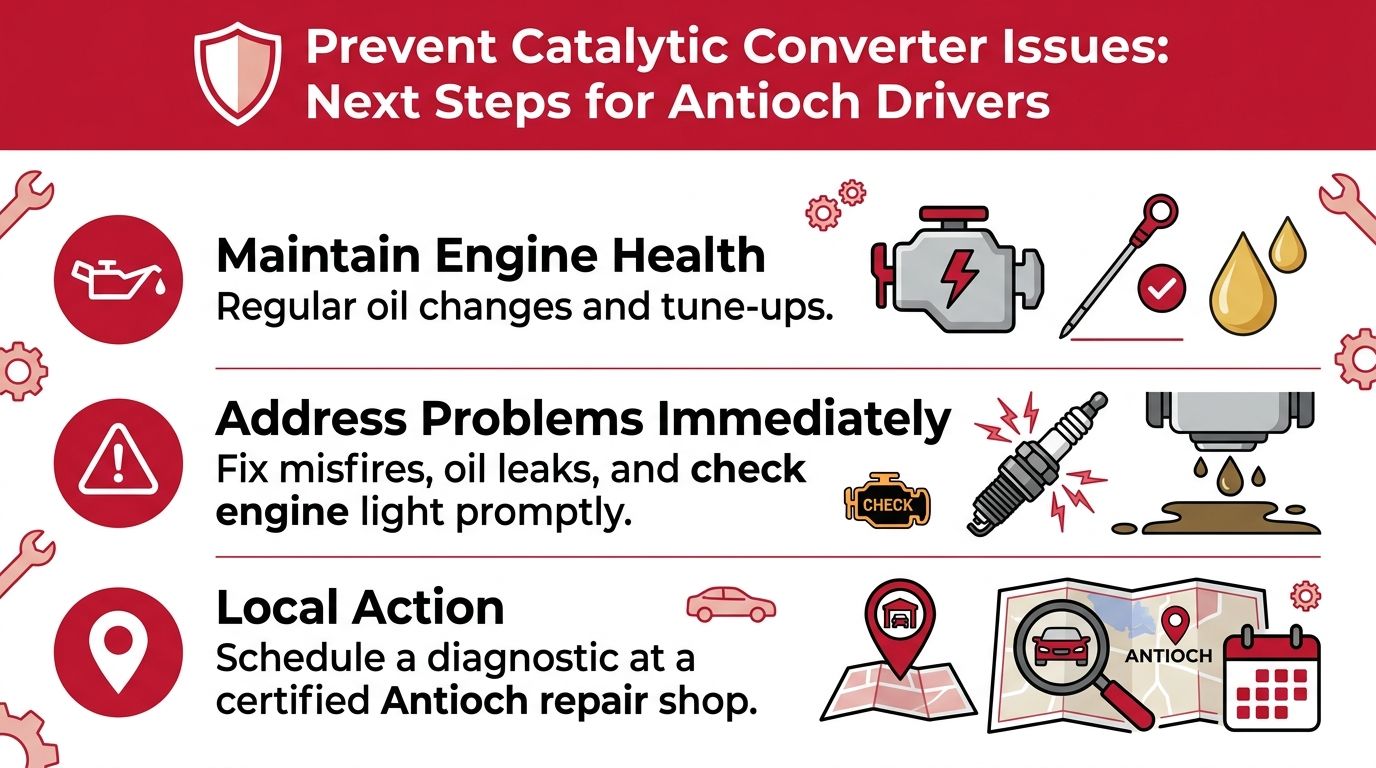
Converter prevention starts under the hood. Keep the engine properly tuned, respond to a misfire quickly, and investigate oil or coolant loss instead of treating the converter as a disposable fix. A healthy combustion system protects the substrate far better than any mileage-based replacement plan.
Short trips can leave the exhaust system below its intended operating temperature for longer periods, especially when the vehicle is used almost exclusively for brief errands. Combine necessary trips when practical, but don't use longer drives to hide a check engine light or active misfire. A warning light needs diagnosis, not exercise.
A sensible Antioch action plan
- Light on, car running normally: Get the codes read and request live-data testing before authorizing a converter.
- Light flashing or vehicle shaking: Stop treating it as a routine smog issue. Have the misfire diagnosed promptly.
- Failed smog test: Keep the paperwork, repair the verified cause, confirm monitor readiness, and arrange the retest.
- Rattle or major power loss: Ask for an inspection for substrate damage and exhaust restriction.
- Suspected theft: Photograph the damage, contact insurance, and ask for a California-compliant replacement plus theft deterrence.
- Registration due: Use a STAR-certified test-only station when required, and ask about retest eligibility before returning.
For local testing and registration logistics, Fire House Smog operates as a STAR-certified test-only smog station and licensed DMV registration services provider at 2900 Lone Tree Way in Antioch. It offers emissions inspections, selected DMV services, and a free retest according to its policy and coupon terms. Call 925-754-1600 to confirm vehicle or RV requirements before arriving.
The right answer to “when to replace catalytic converter” is rarely a mileage number. It's a documented decision: correct the upstream fault, confirm converter failure, install the right California-compliant part, and verify the result.
If your Antioch vehicle has a check engine light, failed smog result, suspected converter restriction, or theft damage, visit Fire House Smog for a STAR-certified test-only inspection and clear emissions information before you authorize repairs. Bring your failure paperwork or scan results, and use the test outcome to guide the next repair instead of replacing parts by guesswork.