Smog Check Stations: A Complete Guide
You open a DMV renewal notice, see that a smog certificate is part of the process, and suddenly the errand feels bigger than a quick stop at the corner shop. That reaction makes sense. Smog check stations are not just service bays, they're the gatekeepers for a statewide compliance system that California uses to keep millions of vehicles moving through renewal on time.
If you've never dealt with one before, the rules can feel mixed together, especially when one notice says STAR, another says test only, and the DMV page talks about renewal, registration, and emissions in the same breath. The safest way to think about it is simple, a smog station verifies whether your vehicle meets the state's inspection requirement so your paperwork can keep moving. In California, that system is large enough that it's better to understand the whole picture first, then pick the right station for your car and your situation.
Table of Contents
- Why Smog Check Stations Matter to California Drivers
- How Smog Check Stations Work
- Test-Only STAR versus Test-and-Repair Stations
- What Happens During Your Smog Check Visit
- Using a Smog Station with On-Site DMV Services
- RVs Fleets and Other Vehicles That Need Special Handling
- What Makes a Test-Only STAR Station in Antioch Stand Out
- Choosing the Right Station and Preparing for Your Visit
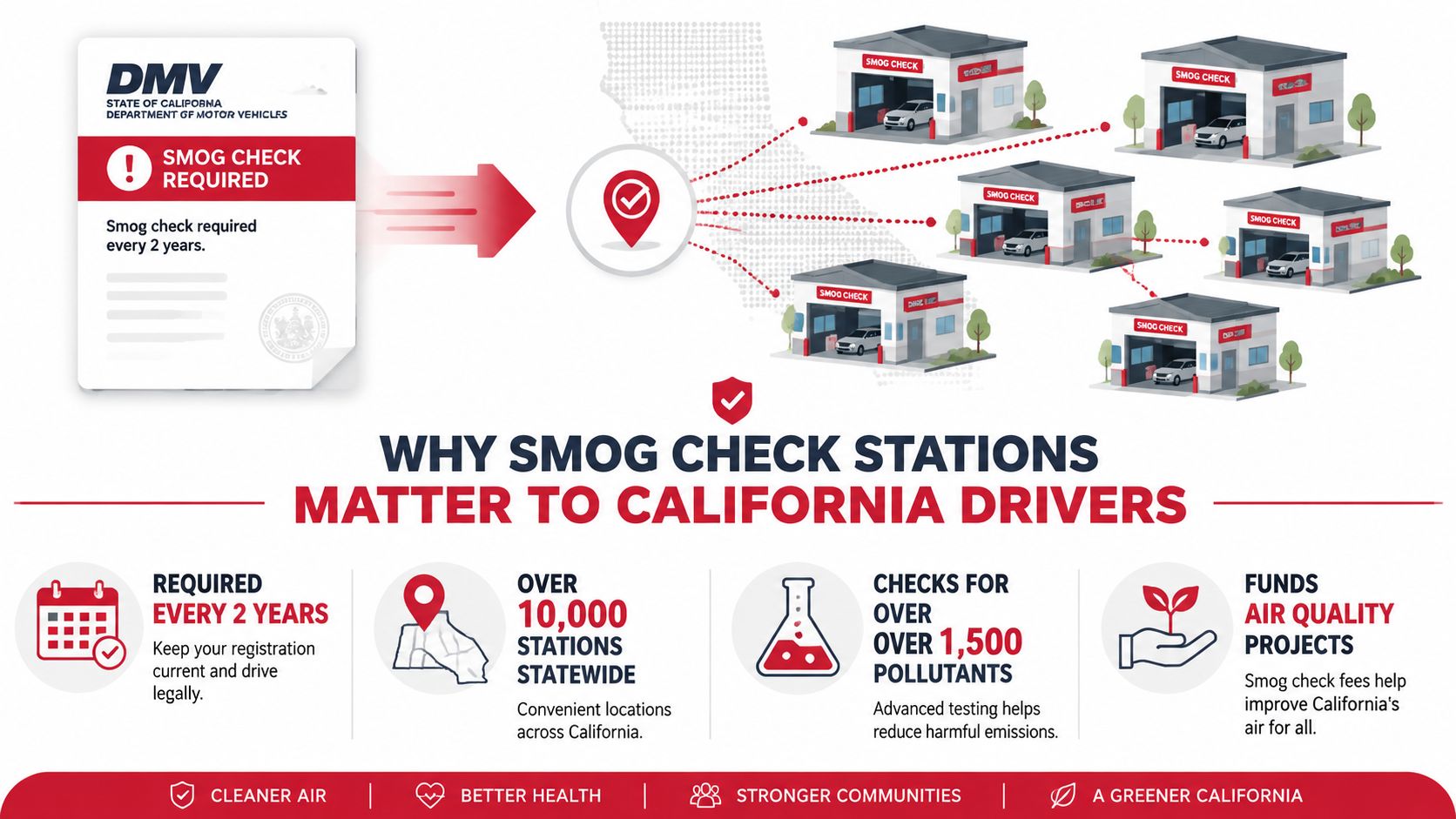
Why Smog Check Stations Matter to California Drivers
The first time a renewal notice points you toward a smog inspection, it can feel like one more chore in a stack of chores. The better way to read it is as a checkpoint in a statewide system that keeps California's vehicle renewal process moving. The state's smog program has been in place since 1984, and California says it now includes more than 7,000 smog check stations, about 10 million vehicles tested each year, and about 400 tons of smog-forming pollutants per day reduced through the system overall, which is why these stations function as public infrastructure, not an occasional extra stop (California Smog Check Fact Sheet/index.pdf)).
For a driver, that bigger system shows up in a very practical way. If the certificate does not get completed, renewal can stall, and the DMV does not care whether the delay came from a busy schedule, a confusing notice, or a station you chose without checking the rules first.
Practical rule: treat the smog visit the way you'd treat a brake inspection before a long trip. It is a required checkpoint, like checking tire pressure before you head out, not a guess-and-hope errand.
Timing matters too. California's current rules require most vehicles to get a Smog Check every other year, and for a first-time test, the state says to add eight years to the model year, so a 2020 model-year vehicle first needs one in 2028 (California Smog Check Fact Sheet). That is why the question is not only where to go. It is also when the requirement starts and whether the station you pick matches the notice in your hands.
For drivers who want the rules behind the test, the vehicle emissions standards guide gives a plain-language overview of the emissions standards that shape the inspection. If you only need the short version, the station is the last checkpoint between your vehicle and a clean renewal path.
How Smog Check Stations Work
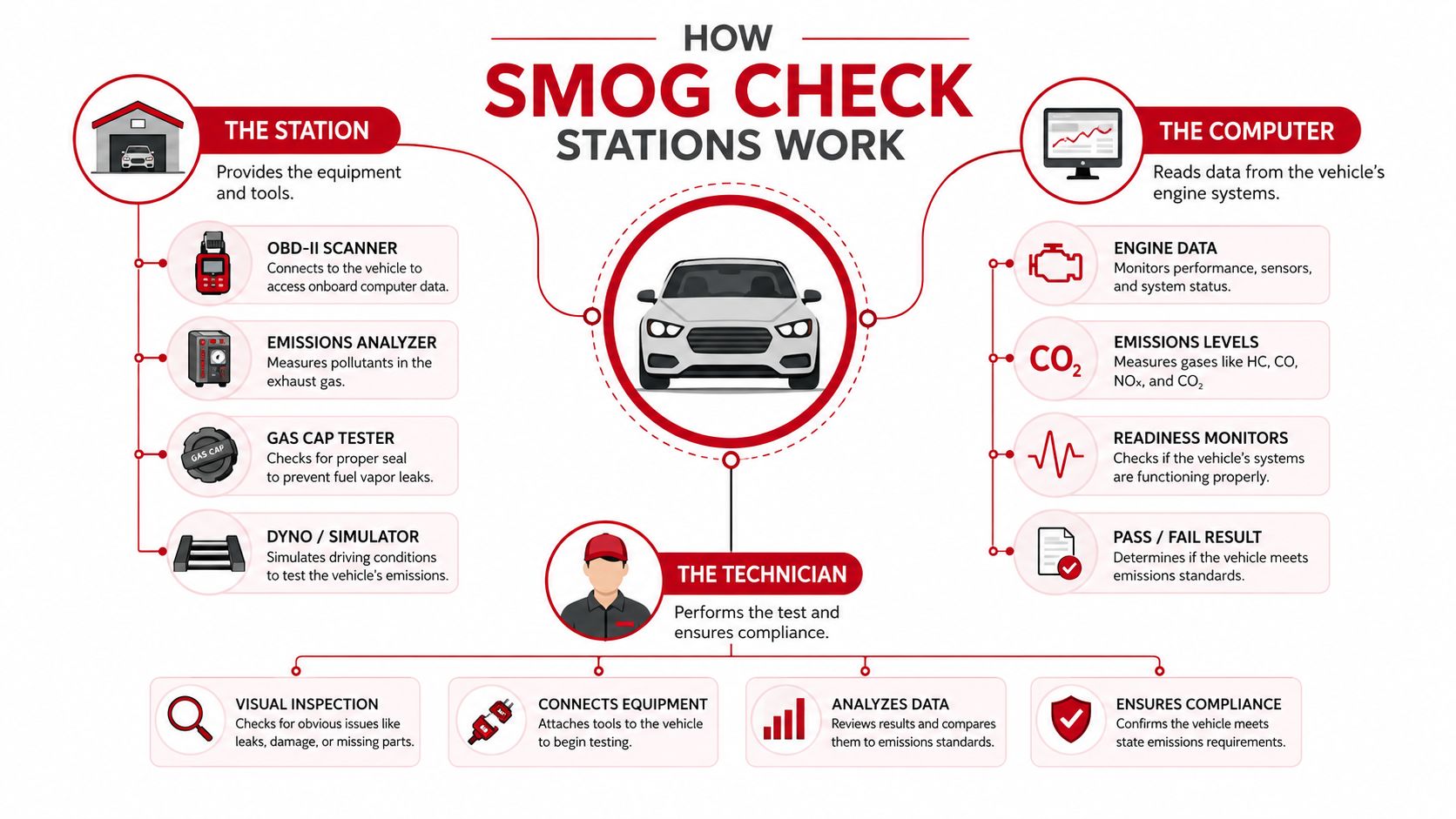
A smog check station is a controlled exam room for your car. The technician checks emissions-related systems with approved equipment instead of guessing from sound or appearance alone. California's test-only stations must use a BAR-97 emissions inspection system and keep supporting tools like an ignition timing light, vacuum pump or gauge, scan-code retrieval device, and a fuel-fillpipe restrictor gauge with defined dimensions and materials (California Code of Regulations, Section 3340.16).
That hardware list sounds old-school, but the inspection itself is increasingly digital. The BAR checklist says the station computer must run a BAR-tested and approved Microsoft-supported Windows version, and the emissions device must display and store live streaming OBD data, support bi-directional capability, and capture high-frequency abnormal signals regardless of screen refresh rate (BAR Smog Checklist). In plain English, the station is checking whether your vehicle's computer and emissions systems are talking to each other the way they should.
What the technician is looking for
The technician's job is narrower than many drivers expect. They look for emissions control issues, diagnostic trouble codes, visible tampering, and whether the onboard diagnostics behave correctly. They are not giving a general repair consultation or judging whether your transmission, suspension, or tires are in perfect shape.
A good smog bay reads your car the way a clinic reads a blood-pressure cuff, it is looking for a specific system response, not a full-body diagnosis.
That is why the inspection can feel technical even though the customer experience is simple. You bring the car in, the station connects to the vehicle, the computer checks the emissions side, and the state gets a record of whether your vehicle passed. If you want a shorter consumer-facing explanation of the timing, this smog check timing guide is a useful companion.
The fillpipe gauge is a good example of how exact the program gets. California specifies a non-sparking aluminum alloy 5052 tool with a test portion diameter of 0.9375–0.950 inches and a length of 5–12 inches, which shows that inspection hardware has to be reproducible from one station to the next (California Code of Regulations, Section 3340.16). That consistency is why a smog station is more than a mechanic with a scanner, it is a regulated testing site.
Test-Only STAR versus Test-and-Repair Stations
A first-time driver usually wants one clear answer. If the car fails, who can fix it, and who is there only to measure the result? A test-only station keeps those roles separate. The station performs the inspection and issues the outcome, but it does not profit from selling the repair that follows. A test-and-repair station can inspect the car and also handle qualifying repairs, which is convenient, though it places testing and repair under one roof.
California's BAR data helps show why those station types are treated differently. In the July 2025 executive summary, 1,019,416 initial tests produced 85,135 failures, a failure rate of 8.35%, and when all tests were counted, the failure rate was 8.88% (BAR July 2025 Executive Summary). The same report shows that BAR-97 stations had an overall failure rate of 17.69% versus 7.62% for OIS stations. That does not automatically mean one station type is doing a poorer job. It can also reflect the kinds of vehicles each category sees and how the inspection is carried out.
What STAR status signals
California uses STAR to direct certain vehicles to stations that meet higher performance standards. BAR has also said that vehicles certified by high-performing smog stations fail roadside checks at lower rates than those from lower-performing stations (BAR July 2025 Executive Summary). The label is about program performance, not waiting-room comfort or how polished the counter looks.
| Station Type | What It Does | Best Fit For |
|---|---|---|
| Test-only station | Performs the emissions inspection and issues the result | Drivers who want a pure inspection with no repair sales |
| Test-and-repair station | Tests the car and can also handle qualifying repairs | Drivers who want one stop for diagnosis and repair |
| STAR station | Meets higher program standards for directed vehicles | Drivers whose notice or vehicle profile requires STAR |
For a closer look at the category itself, the STAR-certified smog station guide gives a plain-English explanation of how these stations fit into the program. The main point is simple. A test-only lane, a repair-capable shop, and a STAR station each serve a different purpose, and the right one depends on what your notice requires and what kind of vehicle you are bringing in.
A station in Antioch shows how this works in practice. A driver can arrive for a required test, use a test-only STAR lane when the vehicle calls for it, and handle DMV-related errands in the same trip if the location offers that service. That setup matters for fleets too, because keeping testing separate from repair work can help a business move vehicles through without turning every stop into a repair consultation.
What Happens During Your Smog Check Visit
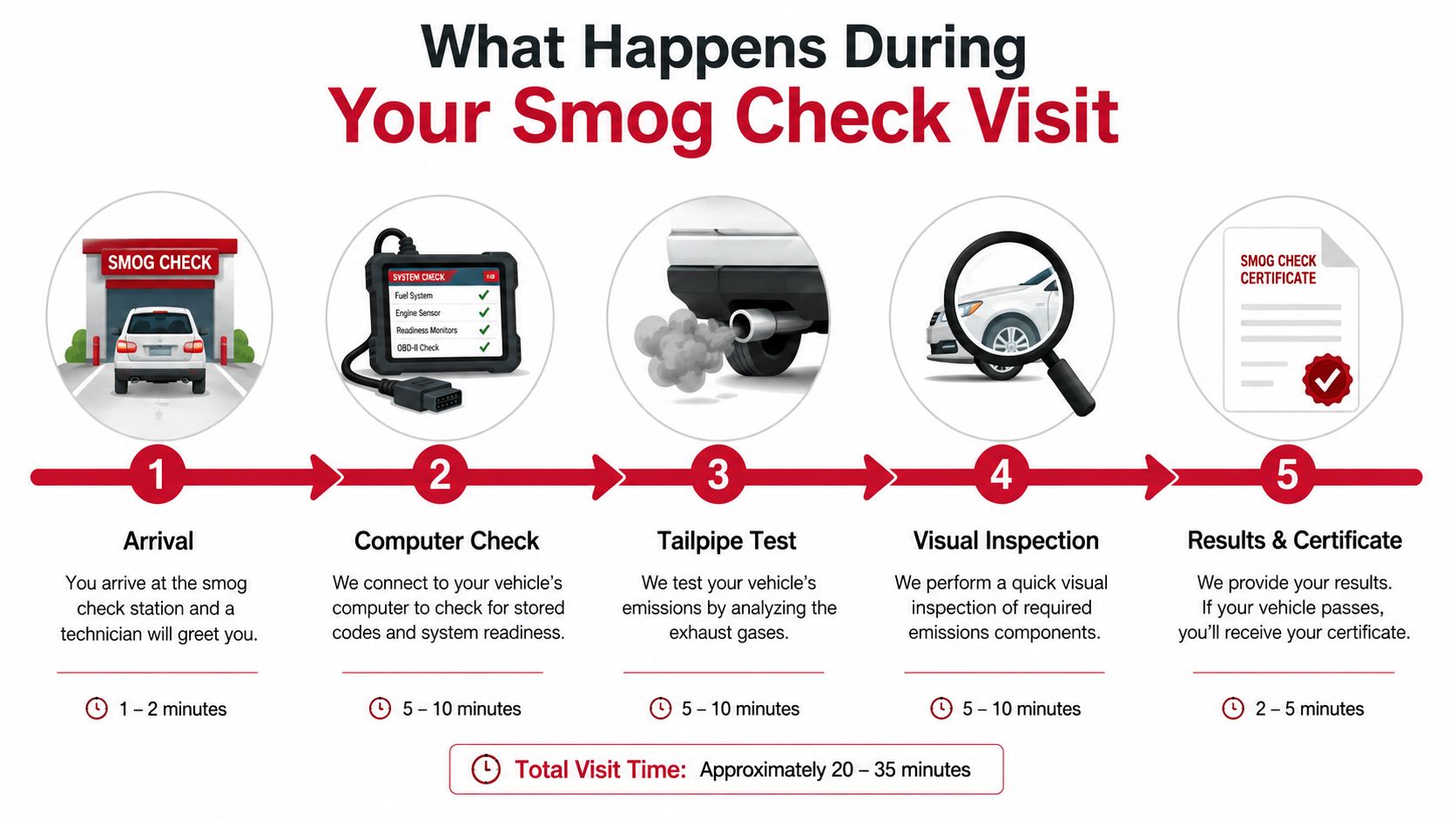
A smog visit is usually less mysterious than people expect once they understand the sequence. You pull in, the technician confirms the vehicle details, the car is connected to the inspection equipment, and the station checks the emissions-related systems that California requires. If the vehicle passes, the result gets handled electronically, and you leave with the paperwork trail needed for registration.
The visit from start to finish
The first step is paperwork and identification. The technician needs the right vehicle, the right registration information, and a car that's ready to be tested, which means the check engine light should already be addressed if it's on.
The second step is the diagnostics connection. On modern vehicles, the OBD system is the car's own language, and the station reads that language to see whether the emissions controls are behaving properly.
The third step is the physical inspection. The technician looks for visible emissions equipment issues and other problems that would interfere with a clean result.
If the car is only being warmed up, not driven enough to finish its self-checks, the station may see an incomplete picture even if the engine sounds fine.
The final step is the result. A pass keeps the renewal moving, while a fail usually comes with a report explaining what the station found. Some stations also offer a retest policy, which can matter if a repair is needed before the vehicle can return. When that happens, the station is no longer just a testing stop, it becomes part of the paper trail between repair, retest, and DMV completion.
A quick note on expectations. A smog inspection isn't a place for guesswork or persuasion, and the technician can't “override” a bad reading because a driver is in a hurry. The visit works best when you treat it like a checkpoint on a route, not a negotiation.
Using a Smog Station with On-Site DMV Services
A station that also handles DMV business changes the whole errand. Instead of finishing the smog test and then driving to a separate field office, you can often handle renewal-related paperwork in the same stop if the station is a licensed DMV business partner. That matters most when your main problem isn't the inspection itself, it's the time lost bouncing between two offices.
Fire House Smog in Antioch is a worked example of this setup. It offers on-site California DMV registration renewals with sticker printing, and it also handles ownership transfers for California and out-of-state vehicles, including stickers and plates as needed. For a driver staring at a renewal notice, that means the smog result and the DMV completion step can live in the same visit instead of becoming two separate trips.
What to bring and why it matters
A combined visit still works only if you show up prepared. Bring the renewal notice, any title or transfer paperwork you've been given, and a payment method that the station accepts. If your transaction involves an out-of-state title, the paperwork trail can be more involved, so it helps to ask what the station needs before you drive over.
Weekend and extended hours are useful because they cut down on the workday conflict most drivers run into. Fire House Smog lists Monday through Saturday 9:30 AM to 5:00 PM and Sunday 12:00 PM to 4:00 PM for DMV service hours, with limited services possible on weekends, which is exactly the kind of detail that prevents a wasted trip.
Driver shortcut: if your renewal notice points to smog plus registration, ask whether the station can finish both pieces before you leave. That one question can save a second line at the DMV.
The reason this model matters is simple. A DMV field office is good at government paperwork, but it isn't built around inspection throughput. A station with on-site DMV capability gives you the emissions result and the renewal handling in one place, which is the closest thing to a single-stop solution California drivers can get.
RVs Fleets and Other Vehicles That Need Special Handling
Not every vehicle fits neatly into a standard passenger-car appointment. RVs, motorhomes, and small fleet vehicles often need a quick phone call before they roll in because length, height, and bay clearance can change whether a station can test them safely. A two-bay layout helps, but it doesn't erase the fact that oversized vehicles take more planning than a sedan.
Real-world scheduling beats generic advice. A driver with a motorhome doesn't want to find out at the curb that the station can't handle the vehicle dimensions. A fleet manager doesn't want to send three work vans to a shop with limited throughput if one bay is tied up and the other is already full.
Why the station layout matters
A station with multiple bays can rotate vehicles more efficiently, especially when it also offers weekend availability. That matters for businesses that can't leave service vehicles off the road during weekday hours. It also matters for families trying to finish a registration task between school pickup and dinner.
Out-of-state title transfers fit into this same category of special handling. The smog test may be only one part of the visit, but the DMV paperwork can change what the station needs to verify, so those drivers should ask about document requirements before showing up.
Some stations are built around speed, others around breadth of service. The best match depends on whether you're arriving in a compact commuter car, a large utility vehicle, or a vehicle that needs both inspection and DMV processing in the same stop.
What Makes a Test-Only STAR Station in Antioch Stand Out
A test-only STAR station earns attention for a specific reason, it removes the repair incentive while still meeting a higher inspection standard. For drivers who worry about being sold work they didn't ask for, that combination can feel cleaner and easier to trust. The Antioch example also matters because it pairs the inspection with on-site DMV services, so the visit can solve both the smog requirement and the renewal problem.
The practical features line up with common driver frustrations. Two service bays help with throughput. Seven-day smog testing helps working drivers. Weekend DMV hours help people who can't disappear from work in the middle of the day. The drive-through layout on Lone Tree Way reduces the friction that usually makes inspection errands drag out longer than they should.
Why test-only is a feature
A test-only station doesn't make money by recommending fixes. That's useful when you want a straight result and a clean certificate trail. It's also useful when you already know your car needs repair elsewhere and just want the inspection handled by a separate party.
The Antioch location is also a good example of how one station can serve different needs without turning into a general repair shop. It can inspect passenger cars, SUVs, and light-duty trucks, and it can handle some RVs and motorhomes within size and equipment limits, which is exactly the kind of flexibility local drivers look for when a single vehicle can't be treated like a standard sedan.
If you're comparing nearby options, Fire House Smog is one option to consider for STAR-certified test-only inspection plus DMV registration support in one place. That matters most when your worry is accuracy, not upselling.
Choosing the Right Station and Preparing for Your Visit
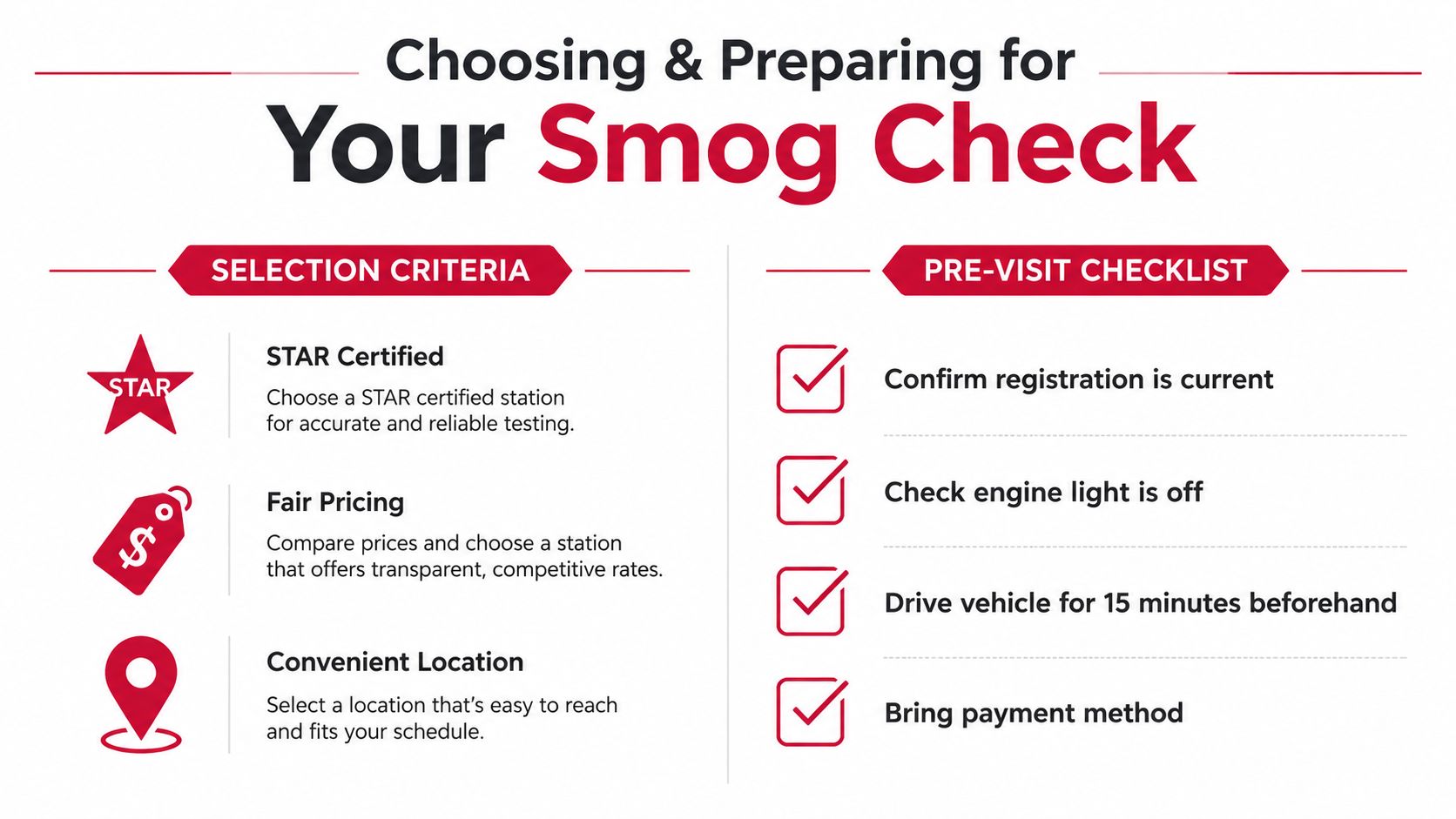
A smog check goes more smoothly when you start with the notice in your hand instead of the nearest address on a map. If the DMV paperwork says STAR, that is the first filter. If the same trip needs renewal help, look for a licensed partner that can handle the smog result and the paperwork step at the same stop. If the vehicle is oversized or unusual, call ahead so you know the bay, equipment, and height limits before you drive over.
A simple way to picture the choice is like picking the right socket for a lug nut. The wrench has to match the job, or the process stalls before it starts.
A simple pre-visit checklist
- Confirm the notice requirement: Check whether your vehicle needs a regular station, STAR, or something more specific.
- Make the car test-ready: If the check engine light is on, handle that first.
- Drive before you go: Get the engine fully warmed up so the car is ready to report accurately.
- Bring the paperwork: Renewal notice, title documents if needed, and a payment method.
- Ask about the retest policy: If the car fails, find out what the station includes before you leave.
These steps are like checking tire pressure before a road trip. A little preparation helps the visit reflect the car's real condition instead of a problem that could have been fixed earlier.
Quick questions drivers ask
Do I always need a STAR station? No. The requirement depends on the notice and the vehicle profile, not on convenience.
What does a free retest mean? It usually means the station will inspect the car again after a qualifying repair, but you should confirm the terms before assuming anything.
How is on-site DMV renewal different from the field office? A DMV field office handles government transactions, while an on-site partner can process certain renewal tasks right where the smog test happens.
If your goal is to finish the inspection without another stop and leave with the renewal step handled, a station like Fire House Smog is built for that kind of visit. Review its services, compare them with your notice, and decide whether its smog and DMV options fit your plan when you are ready to move ahead.