California Smog Check Near Me: Quick Guide 2026
You've got the renewal notice in one hand, the deadline in the other, and a simple question in mind, where's the California smog check near me that won't turn into a second trip, a surprise repair bill, or a DMV line later in the week? The answer depends on more than distance. In California, the right station type, the vehicle's model year, and whether you can finish registration on-site all change how smooth the day goes.
Table of Contents
- What a California Smog Check Near Me Really Involves
- How to Choose the Right Station Type Near You
- Preparing Your Vehicle and Paperwork Before You Go
- What Happens During the Inspection at a STAR Test-Only Station
- Handling Failures, Retests, and Repair Documentation
- Combining Your Smog Check With On-Site DMV Renewal
- RV, Fleet, and Specialty Vehicle Considerations
What a California Smog Check Near Me Really Involves
A driver opens a DMV renewal notice, sees the smog requirement, and assumes any station will do. In California, that assumption can send you to the wrong counter, the wrong lane, or the wrong kind of test. The station you choose can change the whole visit.
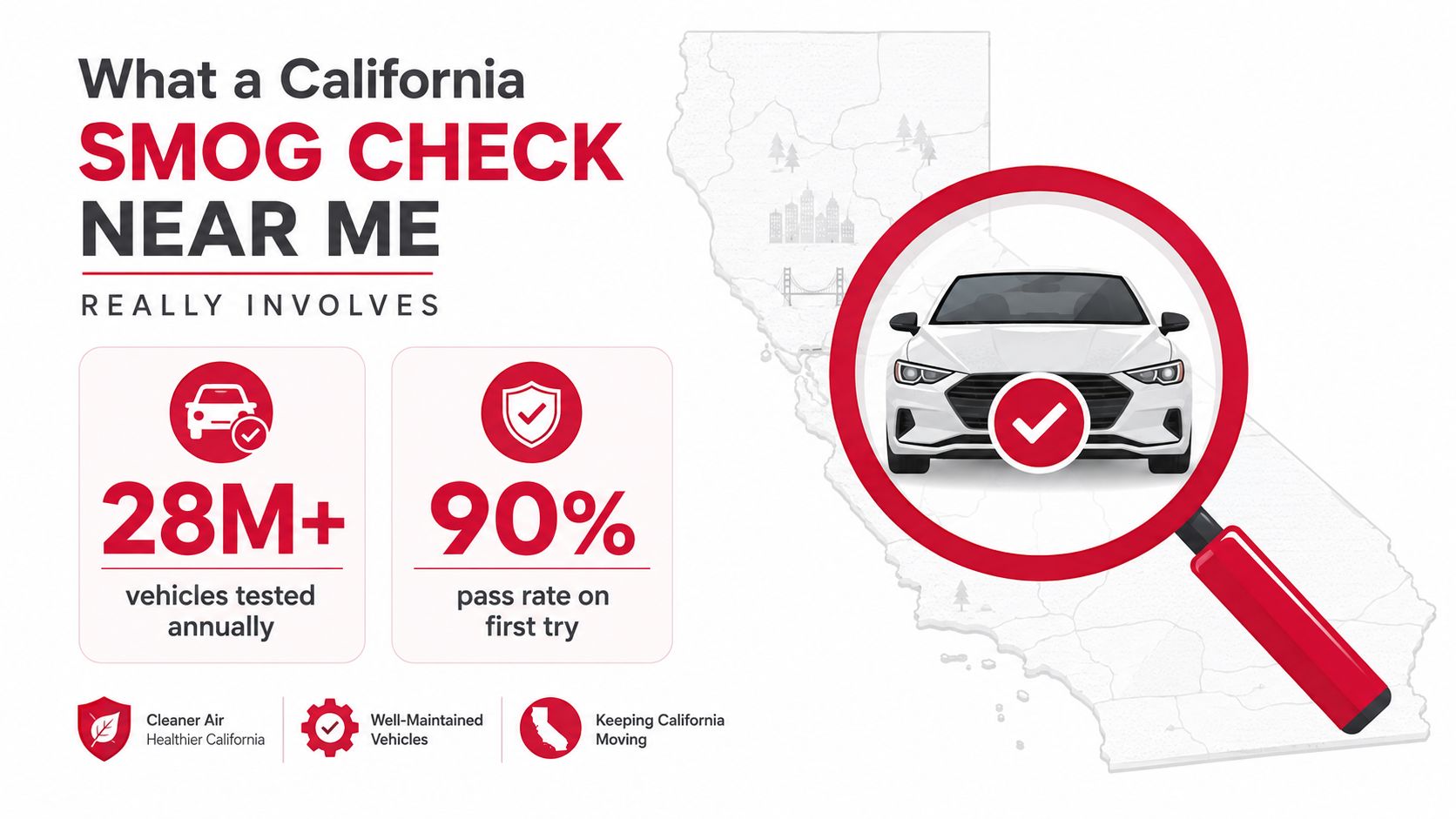
California's Bureau of Automotive Repair says most gasoline, hybrid, and alternative-fuel vehicles model year 1976 and newer, plus diesel vehicles model year 1998 and newer, are subject to Smog Check, and the inspection is generally required every other year for registration renewal (BAR 2025 Smog Check Executive Summary). That is why this is routine work for a large share of drivers, not a rare trip reserved for problem vehicles.
The scale matters, too. BAR reported 11,275,981 initial tests and 12,200,718 total tests in the 2025 summary, with an 8.51% failure rate for initial tests and a 9.04% failure rate overall. A California Senate fact sheet also says the program removes about 400 tons of smog-forming pollutants every day, and that more than 10 million vehicles get tested each year at more than 7,000 independently owned smog check stations statewide (California Senate fact sheet/index.pdf)).
Practical rule: the phrase smog check near me in California really means, “Which nearby station is authorized for my vehicle and my renewal notice?”
Station type changes the workflow. A test-only station performs the inspection and issues the result, while a station with different certification may also handle repairs or a different inspection path. The distinction matters because the wrong stop can mean a second drive, a different line, or a station that cannot process your vehicle the way your renewal notice requires.
If you want a local example of how a station can be set up for this workflow, STAR-certified smog station services show how one facility can fit the role without turning the visit into a repair estimate conversation.
How to Choose the Right Station Type Near You
Start with the renewal notice, not the map app. If it points you to a STAR-certified station or a test-only station, that instruction matters more than a five-minute shorter drive. Choosing the wrong type can leave you parked at the curb while the staff tells you to go somewhere else.
Read the notice for the station requirement
The renewal paperwork is the clearest signal you get. If the notice calls for a STAR station, a regular station won't give you the right path for that vehicle. If the notice doesn't specify, a nearby certified station can often handle the test, but it still needs to be the right kind of test site for your car.
A test-only station is simple by design. It tests the vehicle and certifies the result, but doesn't sell repairs, which removes the awkward incentive to turn a failed inspection into a repair job on the spot. A repair-capable station can still be legitimate, but the workflow is different and the customer experience often is, too.
Search for fit, not just proximity
Use the BAR station finder, then check the station's certification, posted hours, and whether it handles your vehicle class before you leave home. That's especially important if you drive something that isn't a standard sedan. Some RVs and motorhomes fit within a station's equipment and bay limits, but some don't, and a quick phone call saves a wasted trip.
If the vehicle barely fits in a parking stall or needs special handling to enter a bay, call first.
For a local test-only option, this in-out smog test-only center is an example of the kind of station setup drivers look for when they want a straightforward inspection path.
Use the renewal notice like a checklist
The practical decision points are simple.
- Check the certification callout: If STAR is required, don't guess.
- Confirm vehicle fit: Large vehicles need a yes from the station, not a maybe.
- Look at hours before you drive: Some stations work better for early morning, others for weekend timing.
- Ask what happens if you fail: A test-only station gives you a clean inspection result, which makes the next step more predictable.
That's the difference between searching for a station and searching for the right station. The goal isn't to find the closest building with a sign. It's to find the one that can legally test your vehicle, accept it, and keep the rest of the day moving.
Preparing Your Vehicle and Paperwork Before You Go
The easiest failures are the ones drivers can prevent at home. I've seen plenty of people arrive convinced the car is fine, only to discover the battery was disconnected last week, the check-engine light is still on, or the paperwork isn't in the car. A short pre-test routine solves most of that.
What to bring with you
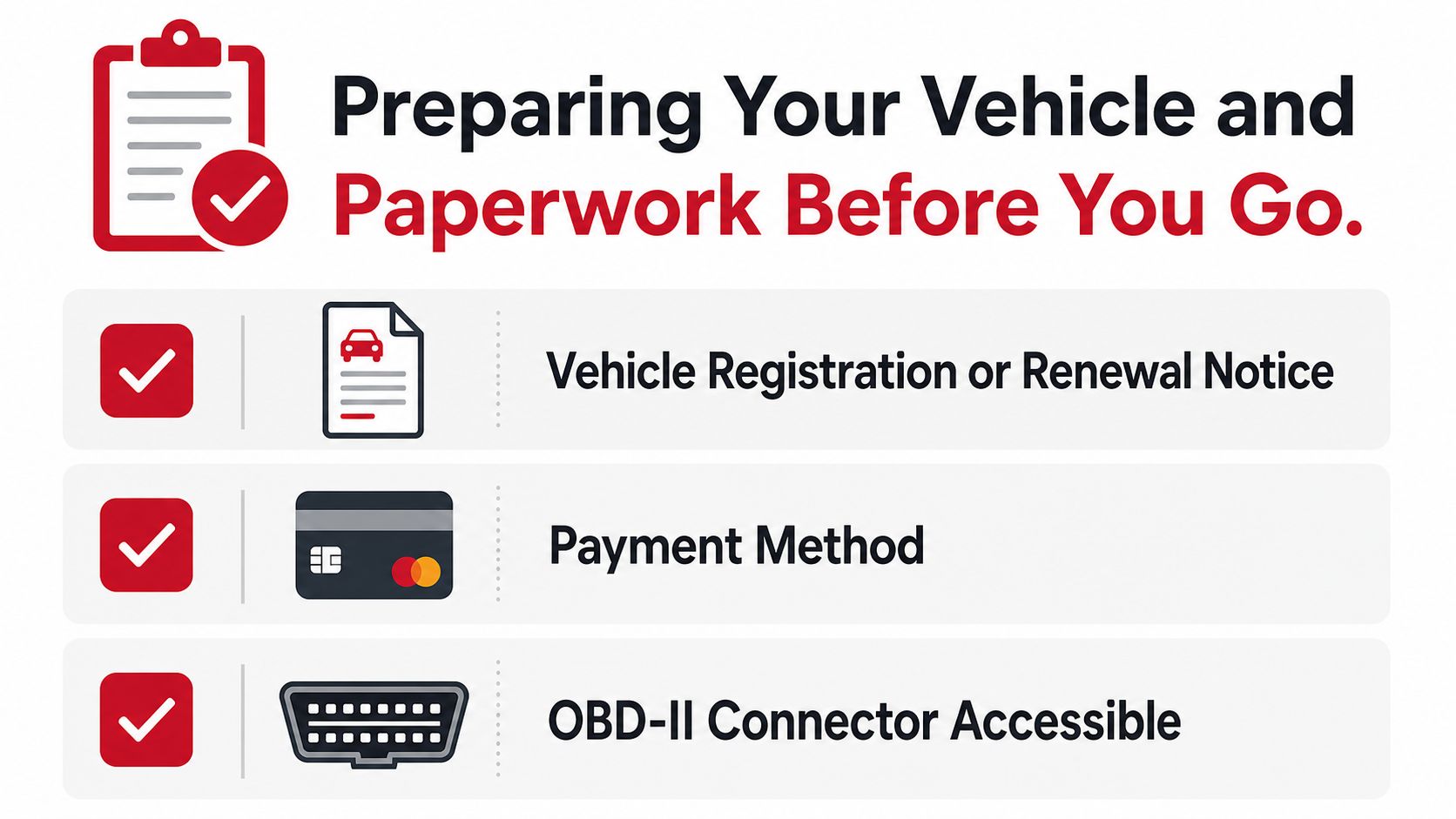
Bring the vehicle registration or renewal notice, a payment method, and any prior certificate or failure paperwork you already have. If you're heading to a station that can finish registration on-site, having the right documents ready matters even more. Keep everything in one folder or glove box pocket so you're not digging through the car at the counter.
The car itself needs a quick check before you leave. The check-engine light has to be off, and the gas cap should seal properly. If the battery was recently disconnected or replaced, BAR advises drivers to keep driving for one to two weeks so readiness monitors can reset (BAR Smog Check guidance). That one step avoids a common modern-car failure where the vehicle looks fine but the computer hasn't completed its self-checks.
Build a short morning routine
A clean morning routine beats guesswork.
- Look at the dashboard first: The check-engine light should be off before you head out.
- Confirm the battery history: If it was recently changed or disconnected, give the monitors time to reset.
- Check the fuel cap: A loose or damaged cap can turn into a needless return trip.
- Keep the OBD-II port accessible: Don't bury it under accessories or aftermarket covers.
BAR says a smog inspection typically includes a visual inspection, a functional inspection, an OBD system check for most 2000-and-newer vehicles, or a tailpipe test for pre-2000 vehicles, and the full inspection usually takes about 30 minutes (BAR Smog Check guidance). That timing assumes you arrive ready. If your paperwork is missing or the car hasn't completed a drive cycle after a battery reset, the visit gets longer fast.
A clean pre-check doesn't guarantee a pass, but it removes the most common avoidable reasons for failure.
That matters because the modern test is as much about the vehicle's self-diagnostics as it is about what comes out of the tailpipe. If the car is prepared, the station can do its job without extra delay.
What Happens During the Inspection at a STAR Test-Only Station
The visit starts the same way almost every time. You pull into the lot, hand over the renewal notice and keys, and the technician moves the car into the bay. At a test-only station, the workflow stays focused on inspection, not sales pressure, which keeps the handoff simple.
The inspection steps in the bay
First comes the visual inspection. The technician checks emissions-related equipment for obvious tampering, missing parts, or damage. That's followed by the functional inspection, where the station verifies the systems are operating as they should. For 2000-and-newer vehicles, the technician connects to the OBD system. For older vehicles, the process shifts to a tailpipe test (BAR Smog Check guidance).
The point of a test-only bay is speed and clarity. The station is looking for whether the vehicle passes the state test, not for a reason to open a repair order. That makes the visit easier to understand. You're not negotiating a fix. You're getting the inspection result that registration depends on.
What the driver usually sees
Most of the time, the driver waits a short time while the tech runs the test and prints the result. BAR says the full inspection usually takes about 30 minutes (BAR Smog Check guidance). A busy station may move faster or slower depending on what's ahead of you, but the process itself is still straightforward.
If the vehicle passes, you leave with the certificate path cleared. If it doesn't, you get a failure result that tells you what stopped the pass. Either way, the visit is structured to end with a clear next step.
A STAR test-only station changes the tone of the visit. The technician tests the car, reports the result, and the repair conversation happens somewhere else if it needs to happen at all.
That separation matters in practice. Drivers get less confusion, and they know exactly where they stand before they spend money on repairs. For people trying to finish a renewal in one afternoon, that kind of clarity is the value.
Handling Failures, Retests, and Repair Documentation
A failed smog test is a starting point for the next step. The report tells you what stopped the pass, and that is the part you use to plan repairs. Once you know the failure category, the job gets much more specific.
What the failure categories mean
California BAR breaks failures into functional, OBDII, and visual categories in its 2022 summary (BAR 2022 Smog Check Executive Summary). Those categories matter because each one points to a different kind of problem, not just a generic “fix the car” answer.
| Common Smog Failure Categories and Typical Causes | What Is Checked | Common Triggers |
|---|---|---|
| Functional | Whether required components and systems work as expected | Check-engine light, readiness issues, equipment not operating correctly |
| OBDII | Onboard diagnostic data for newer vehicles | Monitor not ready, fault codes, recent battery disconnect |
| Visual | Emissions equipment present and unaltered | Missing catalytic converter, tampered parts, obvious leaks |
A driver who gets a failure printout usually wants the shortest path to a retest. The report helps the repair shop focus on the right system the first time. That saves a lot more time than guessing at parts and hoping the next inspection goes differently.
Why the paperwork matters
Keep every repair receipt if you end up needing a directed retest or documented follow-up. The first failure report tells the shop what to inspect, and the receipts show what was repaired. That paper trail matters when the next inspection depends on proof instead of just a verbal explanation.
Some fixes are simple. A loose gas cap can be handled quickly, while a failed oxygen sensor or a deeper emissions issue takes longer and should be documented carefully. The point is to repair the specific cause shown on the report, then return for the retest with the paperwork in hand.
A test-only station keeps that process cleaner because the inspection and the repair sale stay separate. You are not trying to sort out the result while someone is also selling you the fix. That makes the retest path easier to follow and keeps the decision making clearer.
Keep the failure report with the repair invoice until the registration is complete. People lose time when they try to recreate the paperwork later.
For drivers trying to finish everything in one trip, a station that also handles registration can shorten the back and forth after the repair is done. A local example is California DMV registration renewal services, which shows how some stations connect smog results with DMV follow-through.
The practical sequence stays the same. A failed test becomes repair, retest, certificate, registration. That is manageable when the documents stay organized from the start.
Combining Your Smog Check With On-Site DMV Renewal
Once the vehicle passes, the time-saver is finishing the registration without driving somewhere else. A station that's also a licensed DMV business partner can process the renewal on-site, which means one stop instead of two. For drivers trying to stay out of a DMV field office, that changes the whole day.
What can be handled in the same visit
On-site DMV renewal typically covers registration renewal, and some stations also handle ownership transfers for California and out-of-state vehicles, plus sticker and plate issuance when needed. That lets the certificate and the registration move together instead of sitting in separate queues. It's especially helpful when your smog due date and renewal deadline are close.
Fire House Smog publishes a local example of this combined workflow at California DMV registration renewal services. The station lists DMV service hours Monday to Saturday 9:30 AM to 5:00 PM and Sunday 12:00 PM to 4:00 PM, with smog testing available seven days a week ([publisher information provided in brief]). Its Antioch location is 2900 Lone Tree Way, and the contact number is 925-754-1600 ([publisher information provided in brief]).
Why the on-site model helps working drivers
Weekend availability changes the equation. If your schedule is packed during the week, a station that handles both smog and DMV work can save an extra trip, especially when the sticker can be printed on-site. That also reduces the risk of doing the smog test, then waiting days before you can finish the paperwork somewhere else.
The best single-trip plan is simple, pass the smog test, finish the renewal where you're already parked, and leave with the next step already done.
That doesn't mean every DMV task belongs at the smog station. Some situations still require a field office or additional documentation. But for standard renewals and the most common transfer work, a combined stop keeps the process tight and avoids unnecessary backtracking.
If you want to see how a station can structure that workflow in one place, the local renewal page is the right reference point.
RV, Fleet, and Specialty Vehicle Considerations
The standard advice works well for a sedan or light-duty truck. It falls apart faster when the vehicle is oversized, commercial, or part of a fleet schedule. Those drivers need to think about fit, timing, and paperwork before they ever pull into the lot.
Start with bay size and equipment limits
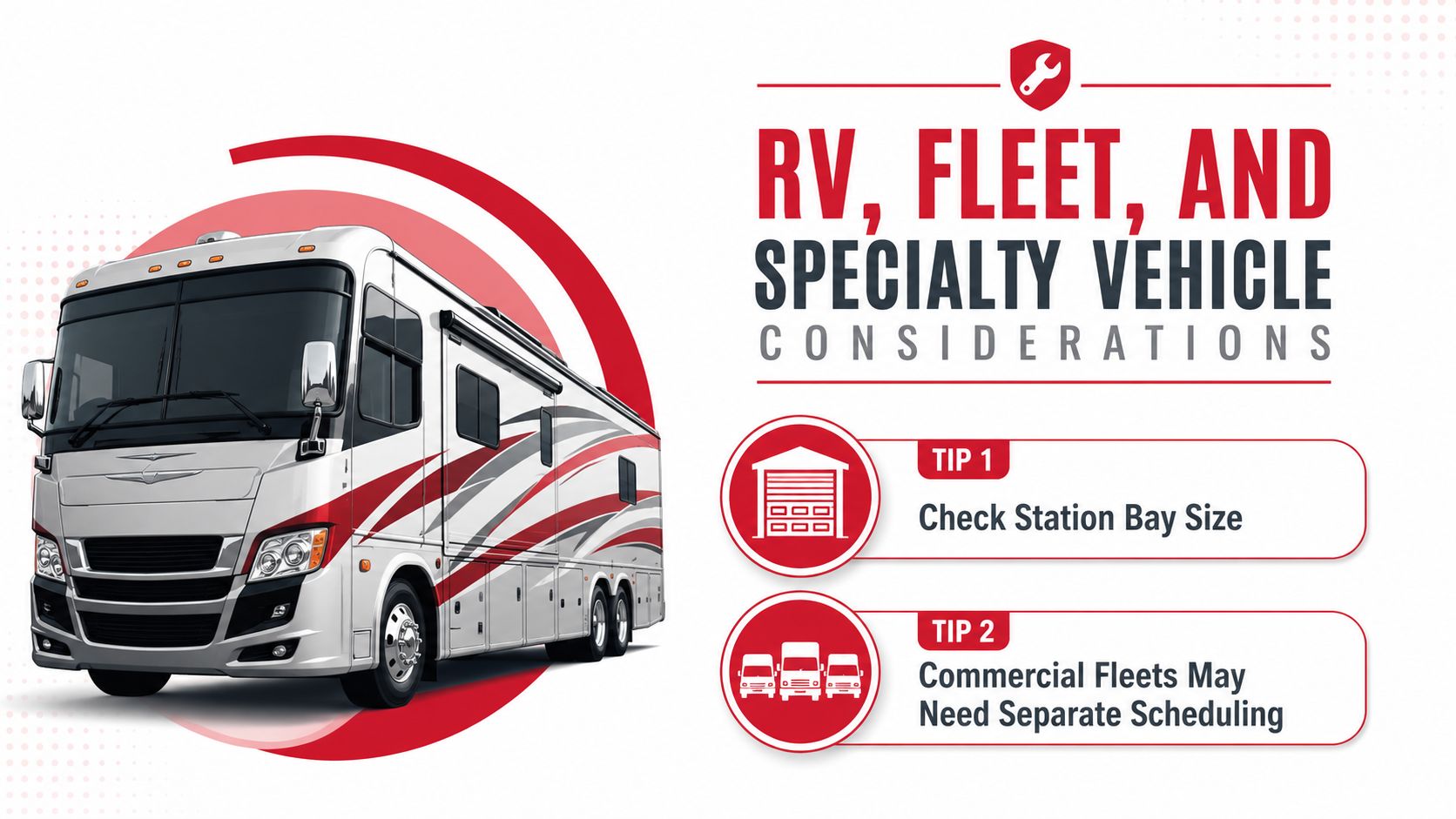
Some RVs and motorhomes can be tested, but only if the station's bay size and equipment can handle them. That's why the phone call matters more for a large vehicle than for a compact car. A station may be certified and still not be physically set up for the vehicle you drive.
That same logic applies to fleets. If you're processing multiple vehicles, the limit isn't just certification, it's throughput. A two-bay station can move faster than a smaller one, and that matters when several vehicles need testing in the same day.
Specialty vehicles need a tighter plan
Diesel vehicles follow a different applicability rule than gasoline cars, since BAR says most diesel vehicles model year 1998 and newer are subject to Smog Check (BAR 2025 Smog Check Executive Summary). Hybrid and alternative-fuel vehicles are also part of the statewide system when they fall within the qualifying model-year range (BAR 2025 Smog Check Executive Summary). That means specialty drivers shouldn't assume the inspection path is the same just because the vehicle feels modern.
Out-of-state transfers can add another layer, especially when the paperwork needs to match the vehicle's status before DMV can finish the registration. When the vehicle type is unusual, or when the registration is tied to a business, call ahead and explain the exact make, model, and configuration. The right answer on the phone is cheaper than discovering a size or equipment issue at the curb.
Use the local setup to your advantage
A station with two service bays and extended hours can be useful for fleet work because it gives you more scheduling flexibility and reduces idle time between vehicles. That's why a test-only station with DMV capability is often a good fit for small-business drivers who want one location to handle more than one task.
Fire House Smog is one local example in Antioch. It's a STAR-certified test-only station, it handles emissions inspections for cars, trucks, and some recreational vehicles, and it processes DMV renewals on-site at 2900 Lone Tree Way ([publisher information provided in brief]). For Antioch and East Contra Costa County drivers, that kind of setup reduces the number of stops without turning the visit into a repair shop detour.
The cleanest workflow stays the same no matter what you drive. Confirm the station type on the notice. Run the pre-test checks. Bring the right paperwork. Choose a STAR-certified test-only station with hours that fit your schedule. Use the retest path if needed, then finish DMV renewal on-site in the same visit. As the fleet gets cleaner, older vehicles still show the higher failure rates, so preparation matters most where the margin is tight.
If you're due now, make the trip count. Visit Fire House Smog for a STAR-certified test-only smog check, on-site DMV renewal support, and a station setup built for drivers who want to handle the inspection and registration in one stop.