
CA Title Transfer Paperwork: Your 2026 Step-by-Step Guide
You bought the car. Or maybe you finally found a buyer and now you want the deal finished without spending half a day untangling paperwork at the counter. That's usually the moment the stress starts. The keys are easy. The title transfer paperwork is where people get stuck.
Most problems aren't dramatic. They're small errors that stop the whole transfer. A missing signature. A smog certificate that's too old. A lender that hasn't sent the lien release yet. A lost title that nobody dealt with before the meeting. I've seen people show up feeling fully prepared, then realize one missing document means they have to leave and start over.
California doesn't make this impossible, but it does require accuracy and timing. If you know what belongs in the file and what commonly causes rejection, the process becomes much more manageable. If you'd rather avoid a long DMV visit, a licensed DMV partner can often handle the same paperwork in a faster, more practical setting.
Table of Contents
- Your Guide to Stress-Free California Title Transfers
- The Core Documents for Any California Title Transfer
- Understanding California's Smog Check Requirements
- Calculating Your Title Transfer Fees and Taxes
- Handling Special Transfers Gifts Inheritance and Liens
- Your Step-by-Step Title Transfer Checklist
- Skip the Line and Finalize Your Transfer Today
Your Guide to Stress-Free California Title Transfers
Buying or selling a vehicle should feel straightforward. In practice, a lot of California drivers hit the same wall. The sale is done, money changed hands, and then someone asks, “Do we have the right forms?” That's when the calm disappears.
A typical example looks like this. The seller signs the pink slip, the buyer takes the car home, and both assume the rest is routine. A few days later they learn the smog certificate is outdated, the odometer section wasn't completed correctly, or the title still shows a lienholder. None of those issues are unusual. All of them slow the transfer.
That's why a checklist matters more than good intentions. California title work isn't hard because the state asks for unusual documents. It's hard because each document has to line up with the others. Names, signatures, sale date, odometer reading, lien status, and smog compliance all have to support the same transaction.
Practical rule: If a car sale happened quickly, slow down before submitting the paperwork. Five extra minutes checking signatures and dates can save you an extra trip.
People also underestimate the benefit of using a licensed partner instead of waiting at a government office. If your paperwork is complete, the process moves smoothly. If it isn't, you want someone who can spot the issue before the packet gets rejected. That's the difference between a quick handoff and a frustrating restart.
The Core Documents for Any California Title Transfer
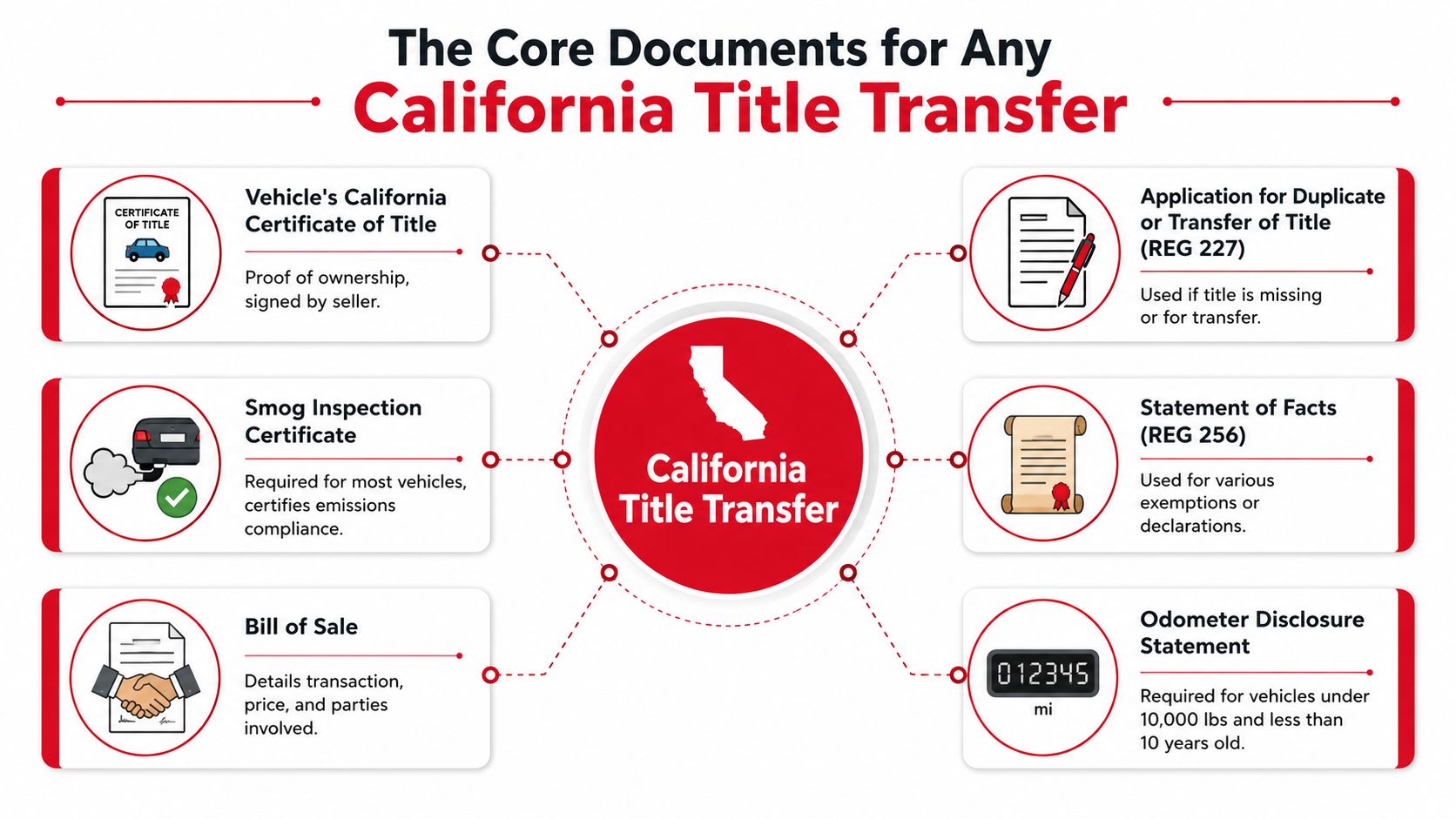
The foundation of California title transfer paperwork is the California Certificate of Title, often called the pink slip. Think of it as the vehicle's ownership record. If that document isn't properly endorsed, everything else becomes harder.
Start with the signed title
The title has to be signed by both seller and buyer. That part sounds obvious, but the DMV cares about how it's completed, not just whether names appear somewhere on the page. According to this California transfer guide, title transfer paperwork is legally invalid without a properly endorsed California Certificate of Title signed by both seller and buyer, along with a completed REG 262 that captures the odometer reading, VIN, sale date, and signatures. For vehicles under 10 years old, the odometer disclosure inside REG 262 is mandatory.
The most common mistake is treating the title like a casual receipt. It isn't. It's a legal ownership instrument, so scratched-out entries, incomplete signatures, or missing sale details can stop the transfer.
For a deeper rundown on the records drivers commonly need, this guide to vehicle registration documents in California is a useful companion.
When the title is missing
If the original title is lost, damaged, or unavailable, the transaction doesn't have to die there. California uses REG 227, the Application for Replacement or Transfer of Title, in these situations. This form is what gets the process back on track when the pink slip isn't in hand.
What doesn't work is hoping a bill of sale can replace a title in a standard private-party transfer. A bill of sale can support the record, but it doesn't substitute for the actual ownership document when the state requires title evidence.
Here's a useful visual walkthrough before you start filling forms:
Support documents that prevent delays
A clean transfer packet usually includes more than the title itself. Depending on the transaction, you may also need:
- REG 262: Needed for reassignment details, sale information, and required odometer disclosure in qualifying vehicles.
- Bill of sale: Helpful when the parties want a separate record of the agreed purchase price and sale date.
- REG 256: Used when someone needs to declare an exemption or explain a transaction detail.
- Smog certificate: Required in many transfers, which I cover separately below.
If the title and the supporting forms tell different stories, the DMV won't guess which one is right. It will stop the transfer until the paperwork matches.
Understanding California's Smog Check Requirements
A sale can look finished on the driveway and still stall at transfer because the smog piece was handled wrong. I see that happen with private-party deals where the title is signed, money has changed hands, and then someone learns the certificate is missing, expired, or was supposed to come from the seller.
For many California title transfers, the seller must provide a valid smog certification. The California DMV explains the rule and the common exemptions on its page about smog inspections for vehicle transfers. The key point is simple. Do not assume the buyer can fix this later without delaying the transfer.
Timing matters more than people expect. A smog certificate can be valid and still become a problem if it was issued too early and the paperwork does not get submitted in time. The cleanest approach is to test the vehicle close to the sale date, after you know the deal is real but before you hand over the signed title.
There are also a few stuck points that trip people up:
- A family transfer may be exempt, but the exemption still has to be documented correctly.
- A newer vehicle may fall under an exemption, but buyers and sellers often misread how that rule applies.
- A pending repair issue can hold up the sale if the seller waits until signing day to test.
- A lien release problem and a smog problem at the same time can turn a one-visit transfer into a back-and-forth file.
That last situation is where preparation saves time. If the car still has a lien showing on record, clear that issue and confirm the smog requirement before anyone heads to DMV. One missing item can stop the whole packet.
If the vehicle needs an inspection, use a station that can tell you clearly whether the car passes and whether a STAR test is required. For drivers who need that step completed before transfer, STAR-certified smog testing in Antioch is one local option.
Keep the smog certificate with the signed title and the rest of the transfer paperwork. When those documents move together, the transfer usually goes through with fewer surprises and fewer return trips.
Calculating Your Title Transfer Fees and Taxes
A lot of title transfers stall at the payment window, not because the title is wrong, but because the buyer budgeted for the deal and not for the state charges attached to that deal.
What you'll usually pay
Start with the title transfer fee. California DMV lists the current vehicle title transfer fee in its vehicle registration fee chart.
Then look at use tax. In a private-party sale, buyers are often surprised that the tax can matter more than the transfer fee itself. California CDTFA explains that use tax generally applies to vehicles purchased from private parties, and the rate depends on the buyer's address and any applicable district taxes in that location, not just the amount written on the bill of sale, as outlined by the California Department of Tax and Fee Administration.
That is the first trade-off to understand. A lower sale price may reduce tax if it reflects the actual transaction, but a number that does not match the facts can trigger questions and delay the file.
Why buyers get surprised at the counter
In day-to-day title work, the surprise usually comes from three places:
- Local tax differences. The base rate is only part of the total. District taxes can change the amount due.
- Exemption paperwork that is incomplete. A buyer may qualify for an exception, but DMV still needs the right form and a clean explanation.
- Other amounts already attached to the record. Past-due registration, penalties, or related fees can show up at the same visit.
This is why I tell customers to treat the transfer cost as a checklist item, not a guess. Confirm the sale amount, confirm whether an exemption applies, and check whether the vehicle record has registration money due along with the title work. If you want a quick reference for that second piece, review this overview of California registration renewal fees.
One more practical point. Timing still matters. If the transfer is submitted late, the problem is rarely just inconvenience. Late handling can add penalties, and once a file has both unpaid registration and missing title items, the visit gets longer fast.
The smoother path is simple. Bring enough to cover the transfer fee, expected use tax, and any registration balance that may already be sitting on the vehicle record. That keeps this part of the checklist from turning into a second trip.
Handling Special Transfers Gifts Inheritance and Liens
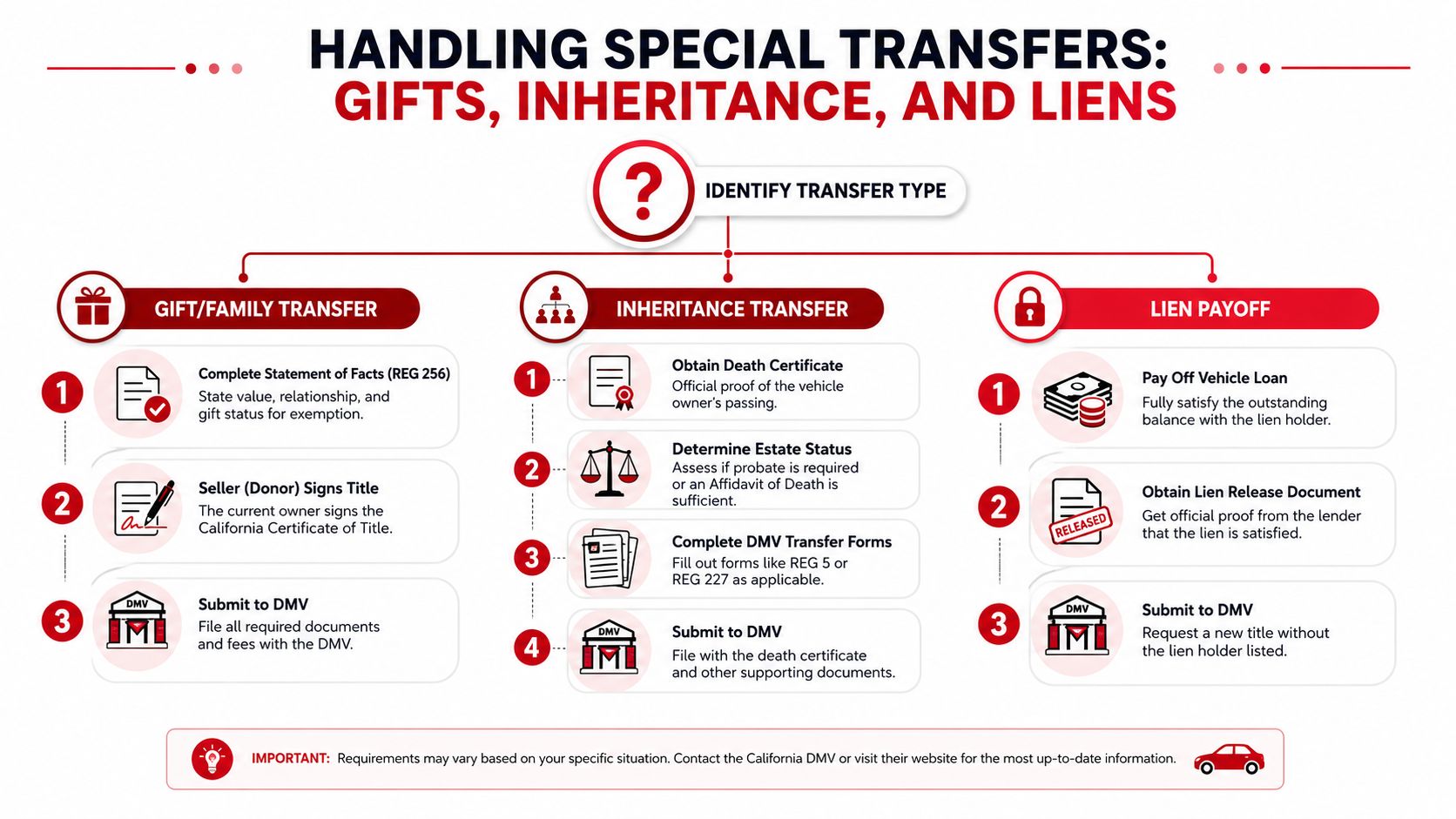
Not every transfer is a simple sale between two strangers. Some involve family, an estate, or a recently paid-off loan. These are the cases where generic online advice usually gets thin.
Family transfers and gifts
Gift transfers often look simple because no money changes hands, but the paperwork still has to explain the transaction clearly. In California, REG 256 is the form commonly used to document certain exemptions or declarations tied to the transfer.
What works is treating a family transfer with the same seriousness as a sale. The title still needs proper signatures. The state still needs a complete record. “It's just between relatives” doesn't remove the need for clean documentation.
Inheritance paperwork
Inheritance cases can be more sensitive because the paperwork depends on estate status and the authority of the person handling the transfer. In practice, families get delayed when they try to submit vehicle documents before confirming who has legal authority to sign and what supporting records the DMV expects.
The best approach is sequential. Gather the ownership record, confirm estate documents, and match the names exactly across the paperwork. If one form reflects the deceased owner and another reflects an heir without the legal bridge between them, the file stalls.
The lien release problem that stalls transfers
This is one of the most frustrating real-world problems in title transfer paperwork. The seller paid off the loan. Everyone assumes the title should now be clean. But the paper lien release hasn't arrived yet, or the lender still appears on the title record.
According to this discussion of common title transfer mistakes, a frequent issue is the “Lien Release Timing & Documentation Gap,” where owners wait for paper releases from lenders after payoff. That delay can lead to DMV rejection, and some cases may be resolved through electronic lien release verification.
That's the part many generic guides miss. They tell you to “bring the lien release” without dealing with the period when the lender hasn't mailed it yet. In practice, that gap is where deals get stuck.
Here's what usually helps:
- Confirm the payoff is fully posted with the lender before scheduling the transfer appointment.
- Ask whether the lien release is electronic or paper so you know what proof will exist.
- Don't assume the title is automatically clear just because the final payment was made.
- Wait to submit if the lender's record is still incomplete, unless you've confirmed an acceptable verification path.
A paid-off loan and a released lien are not always the same thing on the day you need to transfer ownership.
Your Step-by-Step Title Transfer Checklist
When people ask what to bring for title transfer paperwork, the short answer is everything that proves ownership, supports the transaction, and clears any exceptions. The longer answer is the checklist below.
What to bring before you submit anything
Use this as your pre-submission review:
The properly signed California Certificate of Title
Buyer and seller signatures must be complete and consistent with the transaction.REG 262 if your transfer requires it
Key details such as the sale date, VIN, and odometer disclosure are captured.A valid smog certificate when required
Don't assume this can be handled later without affecting timing.REG 227 if the title is missing
If the pink slip is gone, damaged, or unavailable, fix that before you try to finish the transfer.REG 256 if you're claiming an exemption or making a declaration
This often comes up in gift or family transfers.Bill of sale if you want a supporting transaction record
Not every standard transfer depends on it, but it often helps resolve confusion.Proof tied to lien release if there was a loan
This is especially important if the payoff happened recently.Funds for fees and taxes
Don't arrive assuming only the title fee is due.
California also imposes strict timing. According to California state guidance on ownership transfers, the transfer of vehicle ownership must be initiated with the DMV within 10 days of the sale, the seller must submit a Notice of Transfer and Release of Liability within five days, and REG 227 is required if the title is missing.
California Title Transfer Form Checklist
| Form Name | Form Number | Primary Purpose | Who Completes It |
|---|---|---|---|
| California Certificate of Title | N/A | Shows legal ownership and transfers it to the buyer | Seller and buyer |
| Vehicle/Vessel Transfer and Reassignment | REG 262 | Records transfer details, reassignment info, and odometer disclosure where required | Seller and buyer |
| Application for Replacement or Transfer of Title | REG 227 | Replaces a missing title or supports transfer when the original title isn't available | Owner and transferee as applicable |
| Statement of Facts | REG 256 | Declares exemptions or explains transaction details | Person claiming the exemption or making the statement |
| Notice of Transfer and Release of Liability | NRL | Notifies the state that the seller is no longer responsible for the vehicle | Seller |
A clean handoff between seller and buyer
The seller's side of the job isn't finished when the keys change hands. The buyer needs a signed title that's usable, and the seller needs to file the release of liability promptly so future tickets or record issues don't circle back.
What works best is a same-day paperwork handoff. Sit down, review each signature line, confirm the sale date, confirm lien status, and make sure the supporting forms are physically in hand before anyone leaves.
One more practical note. If you'd rather avoid a DMV office visit, a licensed DMV registration partner can often review the packet, process the transfer, and flag problems before they turn into a rejection. Fire House Smog provides California DMV registration services, including ownership transfers, along with on-site tag issuance during posted hours.
Skip the Line and Finalize Your Transfer Today
Most California title transfer problems come down to one issue. The file isn't complete when the customer shows up. Once you've got the title signed correctly, handled any smog requirement, and gathered the right supporting forms, the process gets much easier.
That's why people benefit from treating title work like a package instead of a loose set of papers. Ownership proof, transfer details, exemptions, lien status, and timing all need to line up. If one piece is late or inconsistent, the transfer slows down even if every other document looks fine.
For many drivers, the biggest win isn't just getting approved. It's avoiding the wasted trip. That means reviewing the title before anyone signs in the wrong place, checking whether the smog certificate is still valid, and making sure a recent payoff really shows as a released lien.
If you're organized, California title transfer paperwork is manageable. If you're rushed, it's easy to make small mistakes that cost you time. The practical path is simple. Gather the full packet, verify the details once, and submit it through a channel that can process it cleanly.
If you want help handling the paperwork without spending hours in line, Fire House Smog offers California DMV registration services, including ownership transfers, from its Antioch location. It's a practical option for drivers who want to pair smog compliance and transfer processing in one stop.