
Out of State Title Transfer California: Complete DMV Guide
The out of state title transfer California process typically must be completed within 30 days, and the vehicle must physically pass a California smog inspection before California plates can legally be issued. California treats the vehicle as a first-time California registration case, not as a simple continuation of its former registration.
You may be dealing with this immediately after moving, buying a vehicle across state lines, or bringing a car from another state into a new California household. The old plates and title may still look valid, but they don't complete California's requirements. The practical sequence is title conversion, California registration paperwork, vehicle identification verification, and emissions compliance.
A smooth application depends less on luck than on preparation. Owners who collect the right documents, arrange the smog inspection early, and use an authorized registration provider can avoid the most common return trips and processing delays.
Table of Contents
- Understanding the California Out of State Title Transfer Process
- Required Documents for Your Title Transfer Application
- Navigating California Smog and VIN Requirements
- Estimating Fees and Timeline for Registration Completion
- Using Local Authorized Services for a Faster Transfer
- Common Pitfalls to Avoid During the Transfer
- Finalizing Your California Vehicle Registration
Understanding the California Out of State Title Transfer Process
A new resident often discovers the problem at the least convenient moment. The car is packed, the move is complete, and the out-of-state title is safely stored in a folder. Then the owner learns that California doesn't just stamp the old document and issue plates. The vehicle enters California's first-time registration pathway, which requires ownership documents, a completed application, and verification of the vehicle's identity.
The California DMV identifies an out-of-state vehicle as a first-time California registration case. Its title-transfer guidance requires the Application for Title or Registration, REG 343, together with the last-issued out-of-state title or registration, while vehicle and owner information are verified during processing. The California DMV title transfer guidance is the controlling reference for the agency's requirements.
Why the deadline matters
The transfer is tied to both ownership and registration compliance. A widely used California registration guide notes that buyers generally must submit ownership documents and pay the $15 vehicle title transfer fee within 30 days. That fee and deadline should be confirmed against the DMV's current instructions before submission, especially where the transaction includes other registration or title actions.
The timing problem becomes more serious when an owner waits until the deadline is close and then discovers that the car hasn't passed smog or that the title contains a signing error. A failed inspection, missing document, or mismatched name can leave the application incomplete while the vehicle remains outside California's registration system.
Practical rule: Start with the smog and document review, not the DMV appointment. A scheduled visit can't fix a title that hasn't been correctly signed or a vehicle that hasn't met California emissions requirements.
The process resembles an ownership conversion rather than a routine renewal. Owners who want a practical overview of the ownership paperwork can also review this guide to DMV transfer of ownership requirements. The safest approach is to treat the move-in date or qualifying purchase date as the start of a compliance clock and assemble the complete file immediately.
Required Documents for Your Title Transfer Application
Paperwork determines whether the application moves forward or comes back for correction. Begin with the original out-of-state title, if available. It should show the proper seller release and buyer information, with signatures and dates completed in the manner required by the issuing state.
A dealer invoice isn't automatically a substitute for an ownership title. An invoice can document a sale, but it doesn't necessarily establish the same title information as the state-issued ownership document. If the title hasn't yet been issued, the DMV may need additional proof, such as an out-of-state registration and bill of sale, but owners should confirm the acceptable combination before appearing in person.
Assemble the core file
Use a physical folder or a carefully organized digital checklist, then verify every name and signature against the application.
- Out-of-state ownership document: Bring the last-issued title or registration required for the transaction. If a lienholder still controls the title, resolve the lien documentation before expecting a clean California title.
- REG 343 application: Complete the Application for Title or Registration with the owner information exactly as it appears on the supporting documents.
- Identity documentation: Carry a valid driver's license or identification card so the DMV or authorized verifier can connect the applicant to the ownership record.
- California insurance proof: Use documentation showing current California coverage. An out-of-state insurance card may not establish the coverage required for California registration.
- Sale and supporting records: Keep the bill of sale, dealer paperwork, and any other ownership records together. They can clarify the purchase circumstances when the title alone doesn't tell the complete story.
- Vehicle verification paperwork: Plan for a physical VIN verification as part of the out-of-state registration pathway.
The DMV's vehicle registration documents checklist can help you organize the file before scheduling service. The reason for this discipline is simple. A single incorrect signature, incomplete field, or inconsistent owner name can force you to restart part of the process.
Don't alter the title with correction fluid, erasures, or improvised cross-outs. If the document is damaged or the transfer section is unclear, contact the issuing state's motor vehicle agency or California DMV before making another entry. A clean, consistent document package gives the verifier and registration processor fewer reasons to stop the application.
Navigating California Smog and VIN Requirements
The emissions requirement is the trap that catches many otherwise prepared owners. California doesn't apply the usual 4-year or 6-year smog exemption to an out-of-state vehicle brought into California for its initial registration. Instead, gasoline and diesel out-of-state vehicles generally need a California smog check for the initial registration, followed by testing every two years afterward, as described in California out-of-state smog guidance.
That means an apparently current inspection from the previous state may not solve the California requirement. The vehicle must meet California's emissions process, and the inspection certificate becomes part of the registration file. Owners should arrange this before the final DMV submission because an incomplete emissions record can hold up the title and plate transaction.
Treat smog and VIN verification as separate checks
The smog inspection answers an emissions question. VIN verification answers an identity question. The verifier physically examines the vehicle identification number and compares it with the title and application, helping California confirm that the vehicle presented is the vehicle described in the ownership records.
A vehicle can pass one requirement and still fail to complete the other. Passing smog doesn't replace VIN verification, and a successful VIN check doesn't waive the emissions certificate.
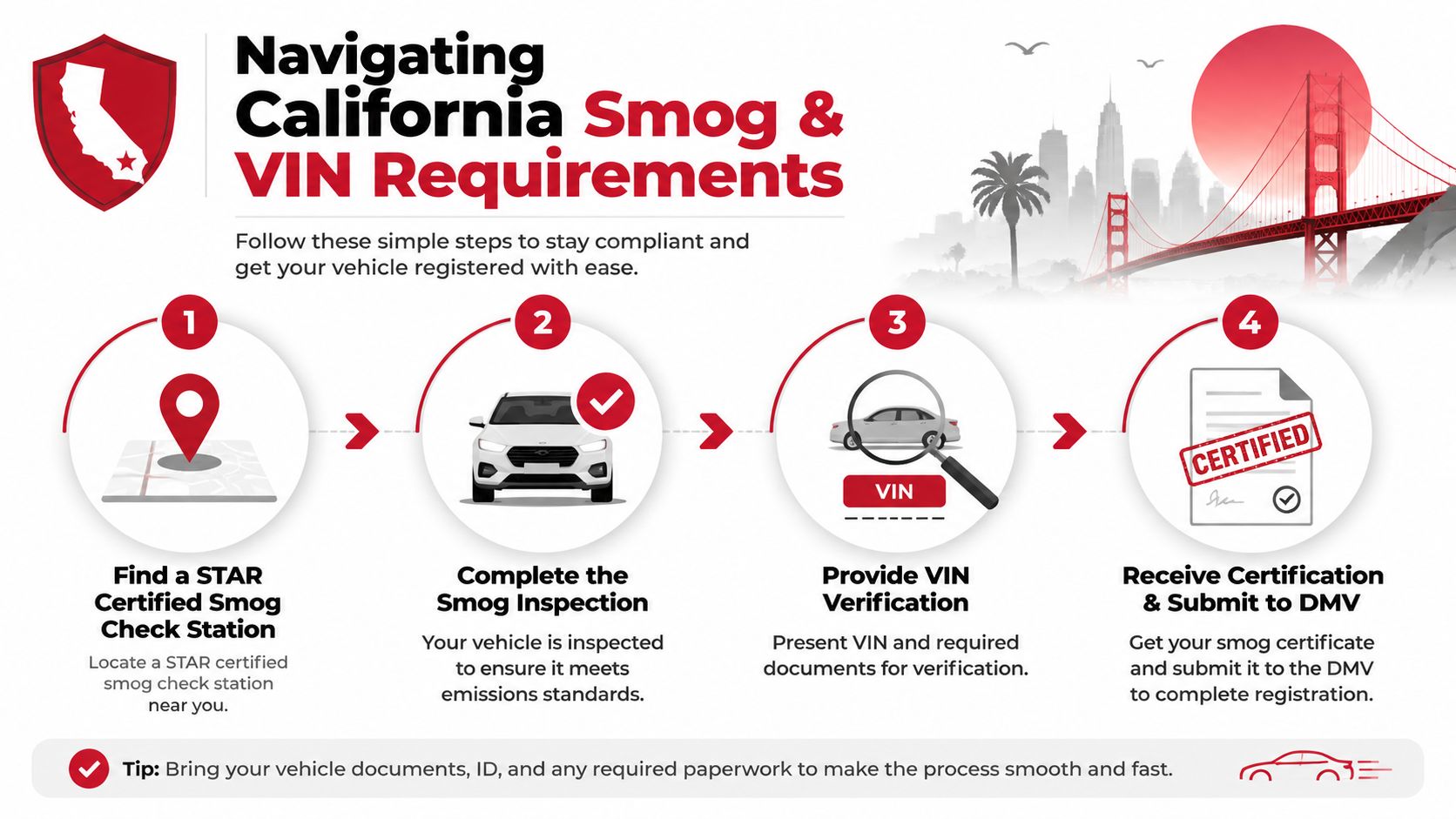
- Locate an appropriate station. Choose a California-licensed facility that can perform the required inspection for the vehicle. A STAR-certified smog station is a practical option when the transaction requires a recognized California emissions test.
- Bring the actual vehicle. Documentation alone isn't enough for a physical inspection or VIN review. The vehicle must be available for the technician or verifier to examine.
- Review the result before submission. If the vehicle fails, identify the cause and determine the retest path before presenting the DMV file. A failed result can stop registration completion.
- Keep the certification with the application records. The DMV needs the emissions result associated with the California registration transaction.
The cleanest workflow is to arrange the inspection and VIN review close together, then submit the title, REG 343, identity documents, insurance proof, and certification as one complete package. This reduces the chance that an owner will make a DMV trip before the vehicle has met both technical gates.
Estimating Fees and Timeline for Registration Completion
The $15 title transfer fee covers only one part of the transaction. Registration charges, vehicle-related assessments, county items, and transaction-specific amounts can change the final total. Since no single registration price applies to every out-of-state vehicle, confirm the amount for your vehicle with the DMV or an authorized provider before budgeting.
Budgeting only for the title fee can leave the registration payment short. Keep the compliance deadline separate from the processing timeline as well. Filing within the required period protects compliance, while the California title, plates, or other documents may arrive after the application has been accepted.
Typical Costs and Timelines
| Service Type | Estimated Cost | Typical Timeframe |
|---|---|---|
| Title transfer | $15 | Submit within the required 30-day period |
| Smog inspection | Varies by station and vehicle | Before final registration submission |
| VIN verification | Varies by provider or transaction | During the out-of-state registration process |
| California registration | Transaction-specific | After required documents and verification are accepted |
| Additional title or registration action | Some guidance identifies $27 for certain actions | Depends on the transaction |
Treat the $15 transfer fee and the possible $27 fee for certain registration or title actions as separate possibilities. Do not combine them automatically. Confirm which charge applies to your transaction through the DMV's title transfer instructions or with the authorized provider handling the file.
Plan for compliance first
A complete file and a passing inspection give an authorized service provider the information needed to process eligible registration work. Some providers may issue registration items on-site during posted service hours, which can reduce the delay associated with a field-office visit. That convenience does not remove California's requirements. A provider cannot replace a required inspection or correct defective ownership paperwork without supporting evidence.
The most useful budget is a transaction checklist: title, REG 343, VIN verification, smog certification, insurance proof, the transfer fee, and any vehicle-specific registration charges quoted before submission. Ask for the estimated total and expected processing steps together, especially if the vehicle still needs emissions testing. This helps separate costs you can confirm in advance from charges that depend on the completed application.
Using Local Authorized Services for a Faster Transfer
Waiting at a field office isn't the only way to handle an out-of-state vehicle. An authorized DMV registration service can review the paperwork, coordinate the emissions step, and process eligible registration work without sending every customer through the standard field-office queue.
That advantage matters most when the owner has limited time or is unfamiliar with California's separate title, VIN, and smog requirements. The provider still works within DMV rules, so the service doesn't eliminate the need for a valid title, a passing inspection, or accurate owner information. It can, however, reduce avoidable movement between separate locations.
What to verify before choosing a provider
Ask practical questions before arriving:
- Authorization: Confirm that the business is a licensed DMV partner and handles out-of-state ownership transfers.
- Inspection scope: Verify that the station can test your vehicle type and complete the California emissions requirement.
- VIN capability: Ask whether VIN verification is handled on-site or requires a separate appointment.
- Document review: Find out whether staff will check the title, REG 343, insurance proof, and supporting records before submission.
- Issuance options: Confirm whether stickers or plates can be issued on-site for the transaction.
- Hours and vehicle limits: Check posted hours, weekend availability, and whether the vehicle's size or equipment affects service.
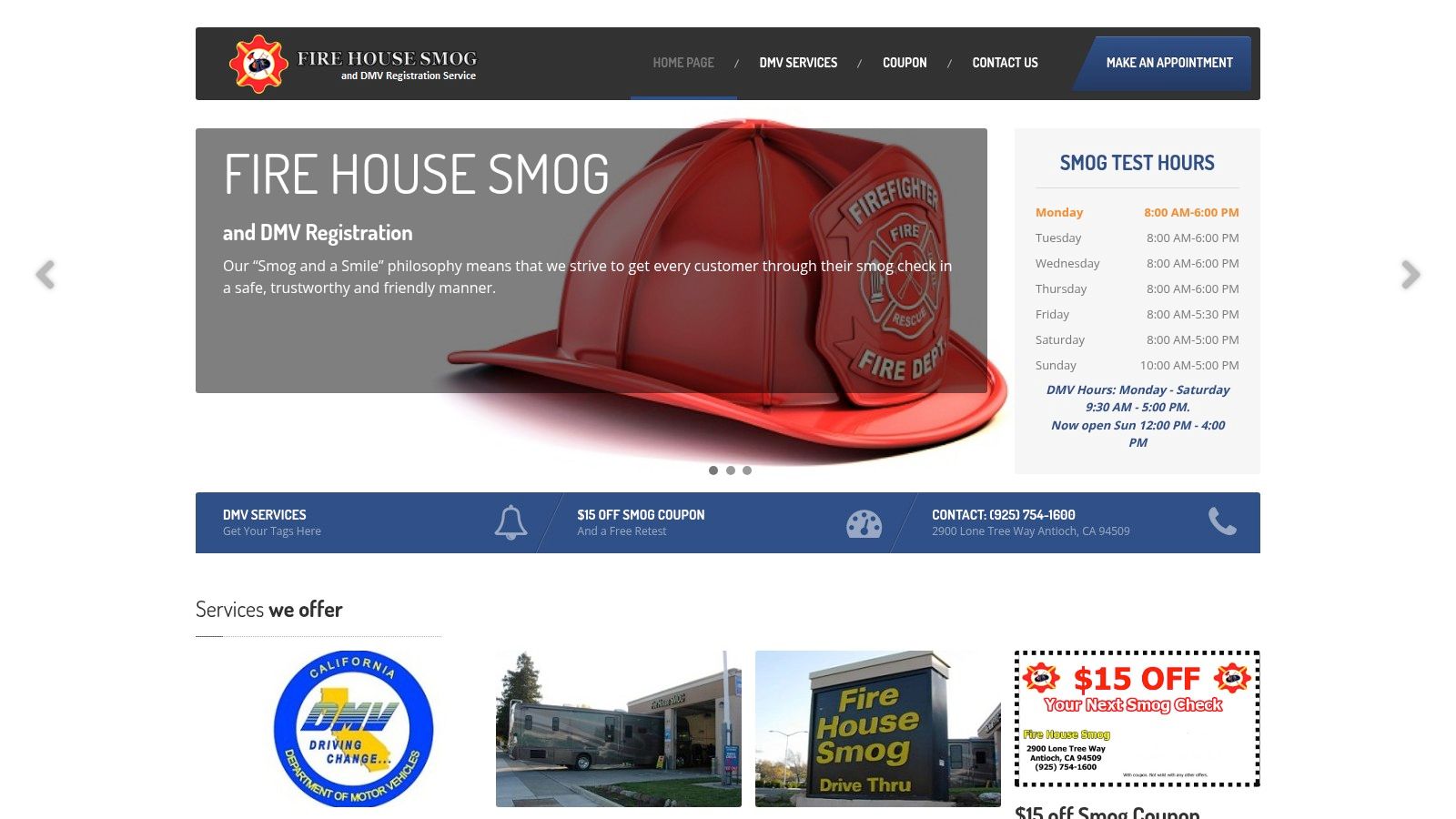
For owners in Antioch and East Contra Costa County, Fire House Smog is one local option. The business operates as a STAR-certified test-only smog station and licensed DMV registration services provider at 2900 Lone Tree Way in Antioch, with transfer-of-ownership services for California and out-of-state vehicles. Its posted operating information includes smog testing seven days a week, DMV service Monday through Saturday, and limited Sunday DMV service.
A test-only model also creates a clear boundary. The station performs the emissions inspection but doesn't sell repair services, so a failed vehicle may need to go elsewhere for repairs before retesting. That's an important trade-off to understand before choosing any test-only facility.
The service model is most useful when your paperwork is already close to complete and you want one coordinated visit. It won't rescue an unsigned title, replace California insurance proof, or guarantee a passing result.
Call ahead if you have a diesel vehicle, motorhome, recreational vehicle, unusual equipment, or a title with a lien. Confirming eligibility first is faster than arriving with a vehicle the station can't accommodate.
Common Pitfalls to Avoid During the Transfer
Most delays come from preventable mismatches, not from an unusually complicated DMV rule. Owners often focus on collecting documents but fail to compare the names, signatures, dates, and vehicle information across every page.
Errors that stop the file
- Submitting before smog compliance: An out-of-state vehicle generally needs the California inspection for initial registration. Arrange the test before relying on the DMV visit to finish the transaction.
- Using the wrong ownership record: A dealer invoice may show a purchase but may not replace the original out-of-state title. Bring the state-issued ownership document or confirm the acceptable alternative first.
- Signing the title inconsistently: Match the owner's legal name across the title, REG 343, identification, and insurance records. Don't guess where a seller or buyer should sign.
- Ignoring VIN verification: The DMV needs the vehicle identity checked as part of the out-of-state pathway. Have the physical vehicle available and make sure the VIN is readable.
- Relying on old insurance: Provide proof of California coverage rather than assuming an out-of-state policy will satisfy the registration file.
- Waiting until the deadline: The 30-day submission window is a compliance deadline, not a suggested target, according to the California title-transfer guidance linked earlier.
A final pre-submission check
Before handing over the packet, compare the VIN character by character, inspect the title for alterations, confirm all required signatures, and check that the smog result is associated with the correct vehicle. Keep copies or clear scans of everything you submit.
A complete application is not merely faster. It gives you a record of what was submitted if a processor later requests clarification.
If a title contains an error, don't cover it with correction fluid or add unexplained changes. Stop and ask the issuing authority or an authorized California registration provider how to correct the document. Improvisation on a title can create a bigger ownership problem than the original mistake.
Finalizing Your California Vehicle Registration
The owner who handles this process efficiently usually follows a straightforward order. First, secure the out-of-state title or acceptable ownership records and complete REG 343. Next, arrange California insurance, smog testing, and VIN verification. Finally, submit the complete packet and pay the transaction-specific charges before the 30-day deadline.
That sequence prevents the most common false start, arriving at a DMV counter with a valid-looking title but no California emissions certificate. It also makes it easier to identify the exact missing item if a verifier or processor asks for clarification.
For many new residents, the task feels intimidating because several agencies and requirements meet in one transaction. Once the ownership document, emissions result, vehicle identity, and registration application agree, the process becomes a manageable compliance errand rather than an open-ended DMV problem.
Don't wait until the last week. Review the title now, confirm the smog and VIN requirements for your vehicle, and choose either the DMV or an authorized local provider based on the complexity of your paperwork and the time you have available.
Fire House Smog handles California and out-of-state vehicle transfer-of-ownership services alongside STAR-certified smog inspections at 2900 Lone Tree Way in Antioch. Bring your vehicle and ownership paperwork for a coordinated review, and visit Fire House Smog to confirm current services and hours before you arrive.